Bosch vs De’Longhi: which super-automatic espresso machine should you buy?
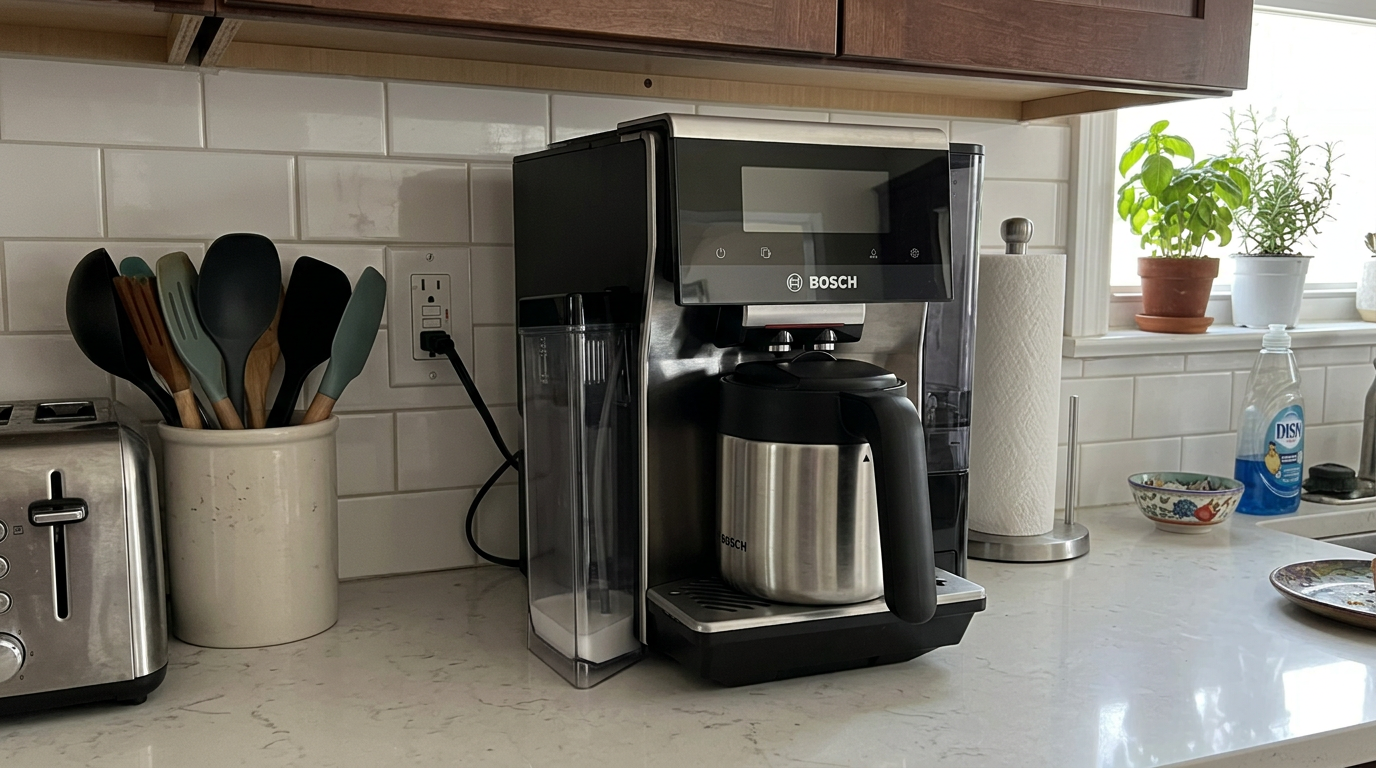
Bosch builds quiet, tidy machines that are a breeze to clean. De’Longhi builds machines that put more into the grinder and the dose. I lived with four of them, the Bosch 300 Series, Bosch 800 Series, De'Longhi Magnifica Evo and De'Longhi Rivelia, for four weeks each, measured what matters and lined up the data to find out which brand belongs in your kitchen.
We choose products independently. We may earn a commission through links on this page; your price stays the same. Affiliate policy
Jargon helpNew to espresso? Tap any dotted term to see what it means.
In this comparison
If you want the richest espresso for your money and one-touch milk that lives in the fridge, buy the De'Longhi Magnifica Evo. It pulled fuller shots than the Bosch 300, came within a whisker of the Bosch 800, and its steel grinder has far more range, and its LatteCrema carafe made the best foam of the entry-level pair. If you want the biggest, friendliest machine for a busy family, the Bosch 800 Series is the one to beat: a 5-inch touchscreen, 30 saved favorites and an 81-ounce tank. The Bosch 300 Series is the simplest and slimmest, and the De'Longhi Rivelia is the pick for homes that drink two kinds of beans.
The four machines
Specs checked November 14, 2026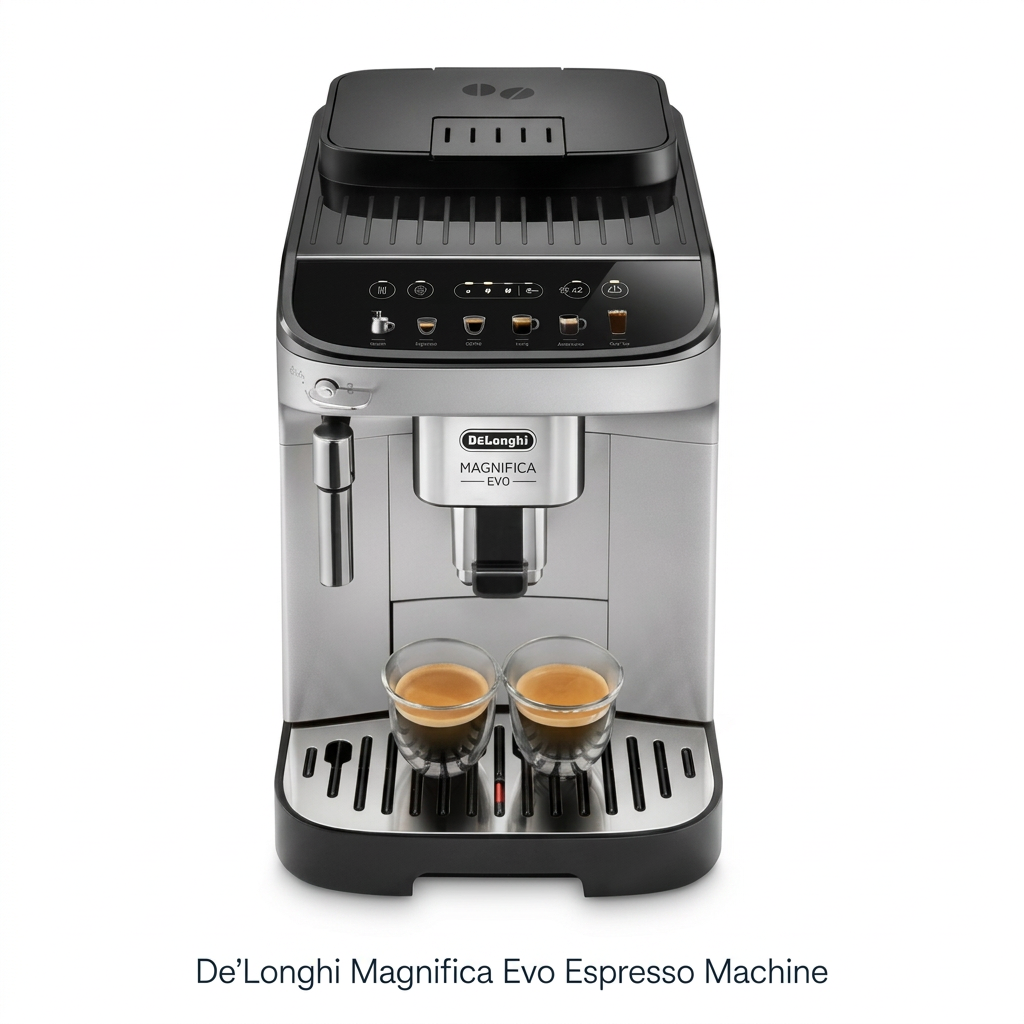
A 15-gram dose, 13 grind settings, one-touch LatteCrema foam and a MyLatte button that uses exactly the milk you pour in.
Check price on Amazon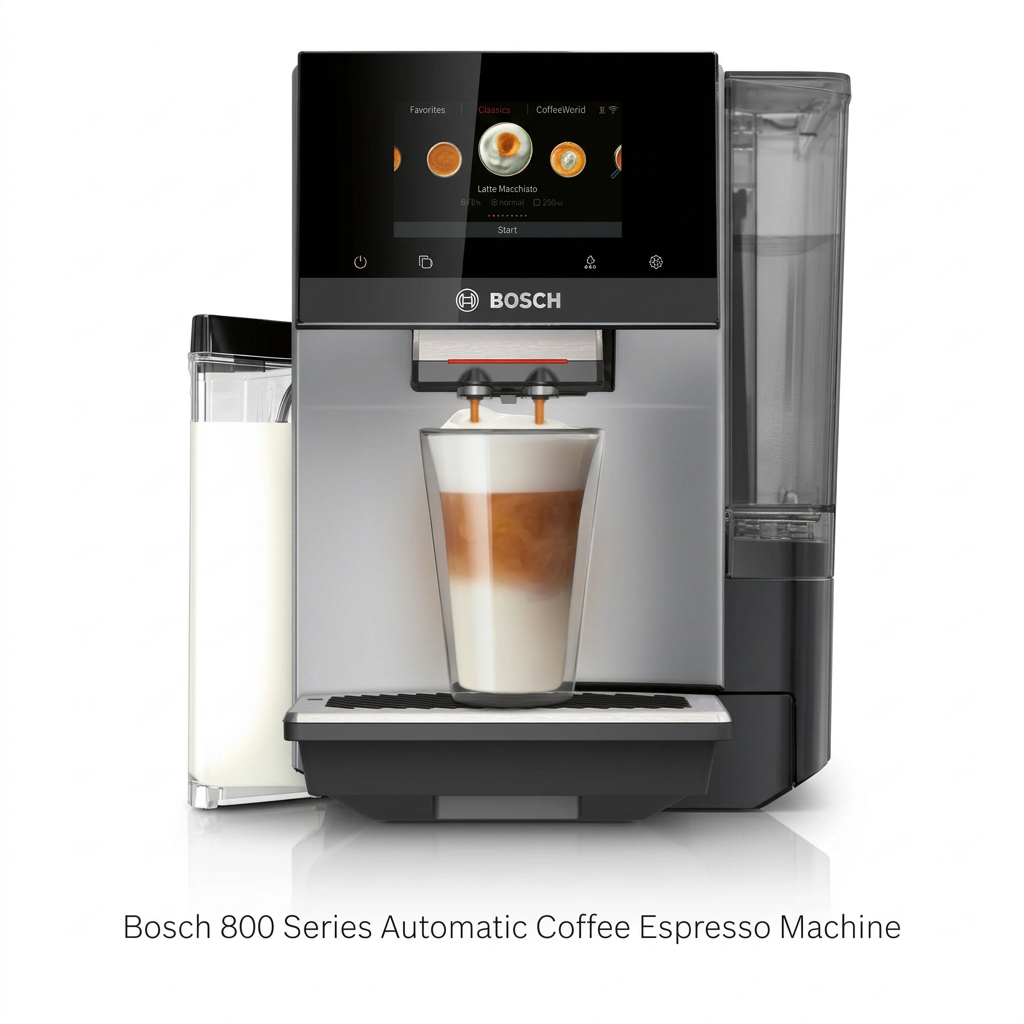
24 drinks on a 5-inch touchscreen, 30 favorites, a 19-bar pump, an 81-ounce tank and a fridge-friendly milk container.
Reveal Today’s Deal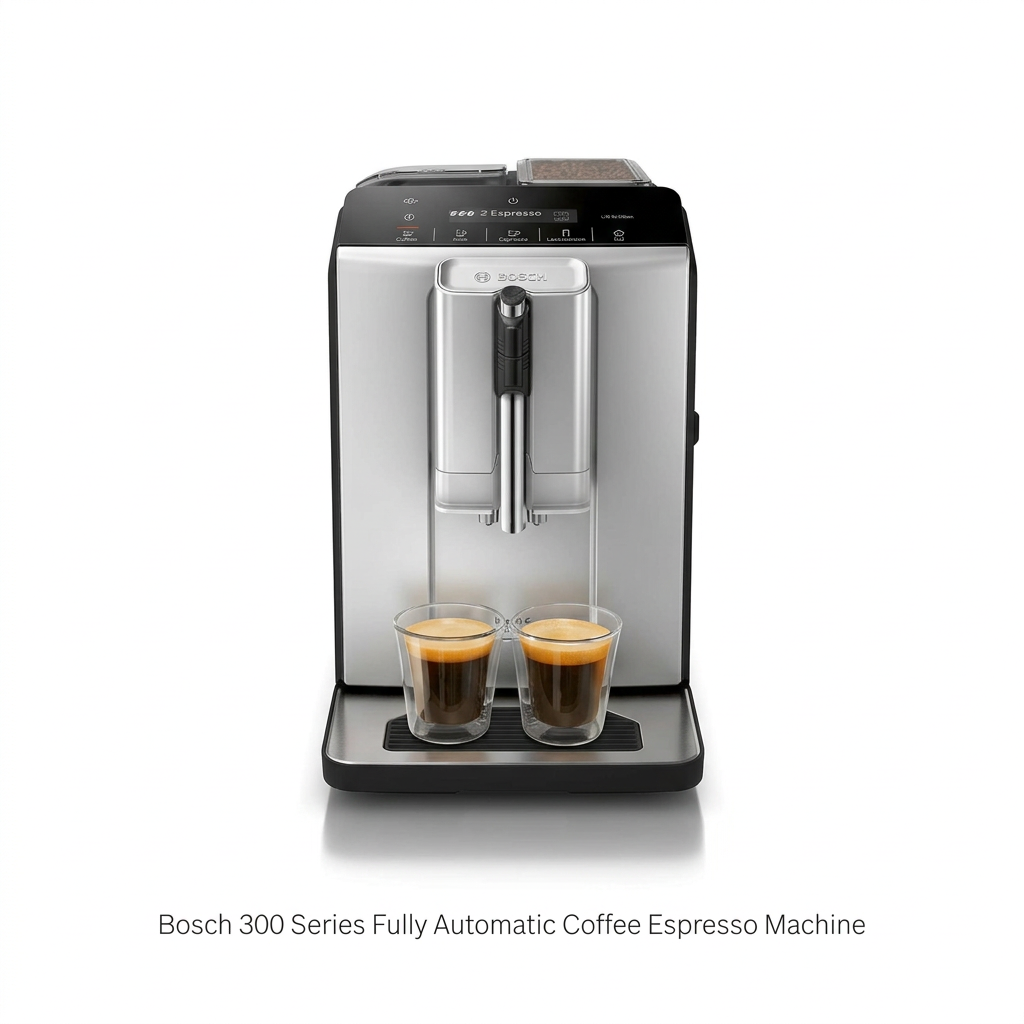
Five one-touch drinks, a dishwasher-safe in-cup frother, a front-loading brew unit and a body under 10 inches wide.
See Today’s Price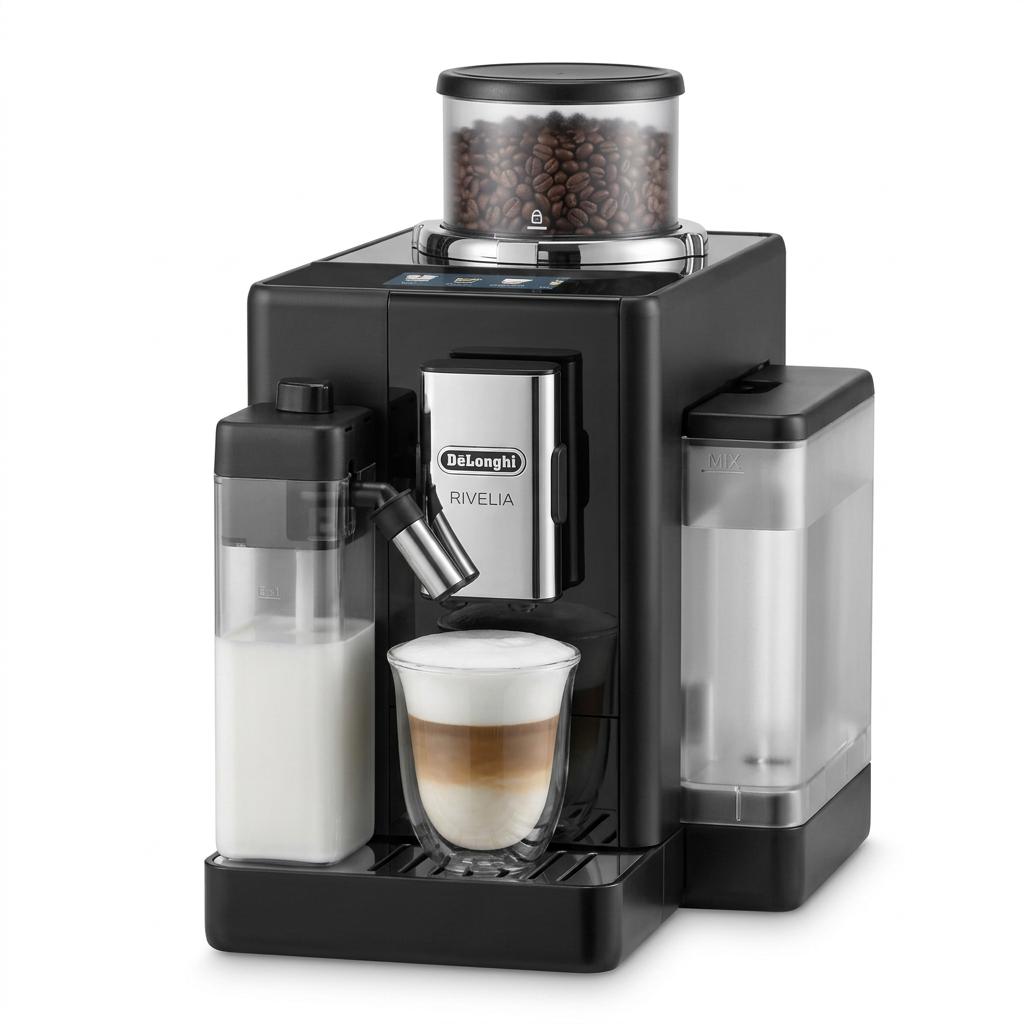
Two swappable bean hoppers, four profiles, a 3.5-inch touchscreen and a generous 15-gram dose for fuller shots.
Find Out the Price TodayBosch vs De'Longhi at a glance
- Bosch builds tidy, quiet machines with ceramic grinders, removable brew units and dishwasher-friendly parts.
- De’Longhi gives you more grinder range and a bigger dose for the money, so shots taste fuller at the entry level.
- At the top, the Bosch 800 pulls the best shot here, while the Rivelia wins on bean switching and ease of use.
- For one or two simple coffee drinkers, the Bosch 300 is the easiest machine here to live with.
Head to head
The better result in each row is marked, based on my testing and the manufacturer specs. Rows where the machines are identical have no winner.
Keep in mind that the tally is not my verdict. Some rows matter far more than others, and which ones matter depends on what you drink.
| Spec | De'Longhi Magnifica Evo | Bosch 800 Series | Bosch 300 Series | De'Longhi Rivelia |
|---|---|---|---|---|
| Espresso bodymy tasting, same beans | Rich, sweet, 15 g dose | Richest, 19-bar pump ✓ Best | Pleasant, a touch light | Full-bodied, a little soft |
| Grinder | Steel conical, 13 settings ✓ Best | Insulated ceramic discs | Ceramic discs, few steps | Steel conical, 13 settings ✓ Best |
| One-touch drinks | 7 | 24 (36 in app) ✓ Best | 5 | 18 |
| Milk system | LatteCrema carafe ✓ Best | Clip-on container, auto rinse ✓ Best | In-cup frother | Hot milk carafe |
| Measured milk temperature | About 140°F | 150–160°F ✓ Best | Warm | 140–149°F |
| Display | Icons and buttons | 5-inch touchscreen ✓ Best | Buttons | 3.5-inch touchscreen |
| User profiles or favorites | None | 30 favorites ✓ Best | None | 4 profiles |
| App | No | Home Connect ✓ Best | No | No |
| Two bean hoppers | No | No | No | Yes, swappable ✓ Best |
| Water tank | About 60 oz, front | 81 oz ✓ Best | 45 oz, rear | 47 oz, side |
| Width | 9.45 in ✓ Best | 13.9 in | 9.75 in | 9.6 in |
| Removable brew unit | Yes | Yes, side door | Yes, front | Yes |
| Dishwasher-safe milk parts | Carafe parts | Container parts | Whole frother ✓ Best | Carafe parts |
| Rows won | 3 | 8 | 1 | 2 |
Bosch vs De'Longhi pros and cons
De'Longhi Magnifica Evo
- Rich, repeatable espresso from a 15-gram dose
- LatteCrema foam is dense, hot and fridge-safe
- 13 grind settings let you tune for any bean
- No user profiles or screen
- No hot milk button without a workaround
- First drink of the day runs a little cool
Bosch 800 Series
- Rich espresso from a 19-bar pump
- 5-inch touchscreen with 30 saved favorites
- 81-ounce tank and a quiet ceramic grinder
- Drip tray fills quickly
- Drinks are warm rather than piping hot
- Large, and parts of the body are plastic
Bosch 300 Series
- One button per drink, almost no learning curve
- Front-loading brew unit and dishwasher-safe frother
- Slim, quiet and tidy on the counter
- Only five drinks and no app
- Grinder has just a few settings
- 45-ounce tank needs frequent refills
De'Longhi Rivelia
- Swap between two bean hoppers in seconds
- About 15 grams per shot for fuller body
- Quiet, at 66 to 68 dB in my kitchen
- Each bean swap wastes around 10 g of coffee
- Top-mounted screen is awkward for kids
- No true cold extraction or cold foam
Who should buy which machine?
- Espresso lovers on a sensible budget
- Cappuccino drinkers who want one-touch foam
- Anyone who likes to tune grind and strength
- Families with lots of different favorite drinks
- Busy kitchens that hate refilling water
- App fans who want to start a drink from the sofa
- One or two people who want simple drinks
- Narrow counters under low wall cabinets
- Owners who want parts that go in the dishwasher
- Homes that drink decaf and regular, or dark and light
- Couples who each want their own profile
- Anyone who wants a big dose and a modern look
Two different philosophies
Bosch and De’Longhi both make fully automatic machines that grind, tamp, brew and froth at the touch of a button. They get there in noticeably different ways, and that shapes everything from the taste to the cleaning.
Bosch is an appliance maker first. Its VeroCafe machines feel like they were designed by people who also make dishwashers: tidy, quiet, easy to wipe, with a removable brew unit and milk parts that go straight in the rack.
De’Longhi is a coffee specialist. Its machines put more effort into the grinder and the dose, so even the cheaper models pull a fuller, sweeter shot.
| Design choice | Bosch | De’Longhi |
|---|---|---|
| Grinder type | Ceramic grinding discs | Steel conical burrs |
| Grind settings | A few steps on the 300, 6 on the 500 | 13 on every model I tested |
| Pump pressure | 15 bar, 19 bar on the 800 | 15 bar on the Evo, 19 bar on the Rivelia |
| Brew unit | Removable on every model | Removable on every model |
| Milk approach | In-cup frother, hose or clip-on container | LatteCrema or hot milk carafe |
| Descaling program | Calc’n Clean | Guided descale cycle |
I used all four machines as my everyday coffee maker for four weeks each, with the same medium-dark blend, the same milk and the same cups. By the end, I could tell the brands apart with my eyes closed.
The Bosch machines were the quieter, cleaner companions. The De’Longhi machines were the better coffee for the money, especially at the entry level.
Our tip: Decide first whether you value easy cleaning or grinder range more, because that single choice usually picks the brand for you.
Design, size and build
Three of these four are remarkably slim. The Bosch 300 Series is just 9.75 inches wide, the Magnifica Evo 9.45 inches and the Rivelia about 9.6 inches, so all three squeeze into a narrow gap between a toaster and a wall.
The Bosch 800 is the outlier. At about 13.9 inches wide and 18.4 inches deep, it uses the full depth of a standard counter and needs a little space behind for air.
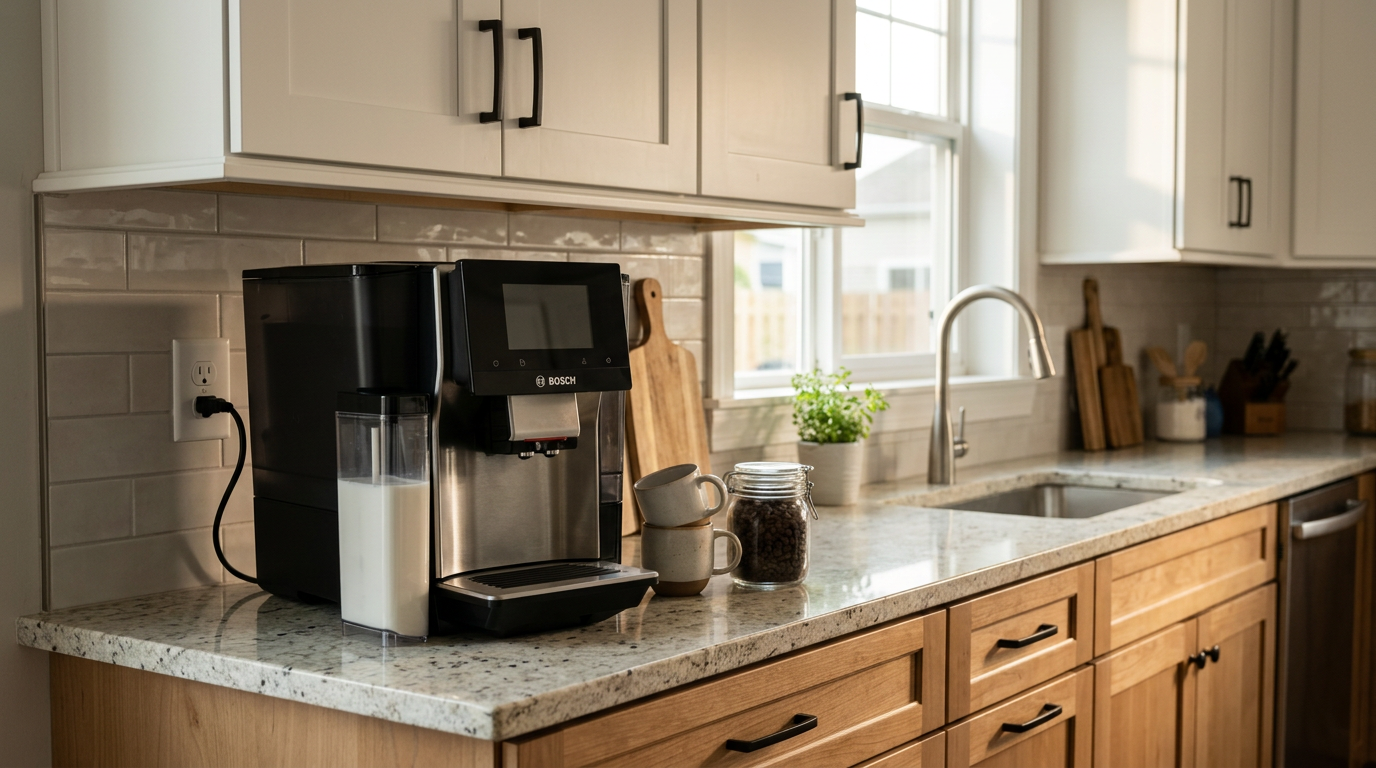
The Bosch 800 is the biggest machine here, and its 5-inch screen is the friendliest.
Height is less of a worry. Every machine sits between about 14 and 15.2 inches tall, so all four fit under standard wall cabinets, which usually hang about 18 inches above the counter.
What changes is how you reach the water. The Bosch 300 fills from the back, the Evo from the front, the Rivelia from the side and the Bosch 800 from a big removable tank.
Width on the counter
Narrower is easier to place. Three of the four are under 10 inches wide.
Build quality felt solid on all four, but in different ways. The Bosch 300 has a brushed front panel on a black body and felt light at about 14.7 pounds, which made it easy to slide forward for cleaning.
The Evo and Rivelia both weigh about 21 pounds and feel planted. The Rivelia’s rounded, modern look got the most compliments from guests, while the Evo looks more traditional with its silver front and buttons.
The Bosch 800 is heavier at about 22 pounds. Parts of its body are plastic, which surprised me at this level, but nothing creaked or flexed during my month with it.
Our tip: Measure the space in front of the machine too, because the drip trays on the Rivelia and Evo need room to slide out.
Grinder and dose
This is the biggest technical difference between the two brands, and you can taste it.
Both De’Longhi machines use stainless steel conical burrs✕Conical burrsTwo cone-shaped grinding parts, one inside the other. Beans are crushed between them, and the gap between the burrs sets how fine the coffee is. with 13 settings. Every Bosch here uses ceramic grinding discs, which stay sharp for a long time and run quietly, but offer fewer steps.
On the Bosch 300 Series, the grinder has just a few fineness steps. That kept things simple, but with lighter roasts I ran out of room to go finer before the shot tasted as sweet as I wanted.
The Bosch 800 uses an insulated version of the ceramic grinder. It was the quietest grinder of the four, and its range was wide enough for every bean I tried.
Grind settings
Counted from each machine’s grinder dial. More steps make it easier to dial in a new bag of beans.
Dose matters just as much. The dose✕DoseThe amount of ground coffee used for one drink, usually measured in grams. A bigger dose gives a stronger, fuller cup without simply adding bitterness. is how much ground coffee goes into each shot, and a bigger dose means more body without over-extracting.
The Evo offers three levels, about 9, 12 and 15 grams. On the Rivelia, intensity 5 ground for about 10 seconds and gave me roughly 15 grams on my scale, which is generous for an automatic machine.
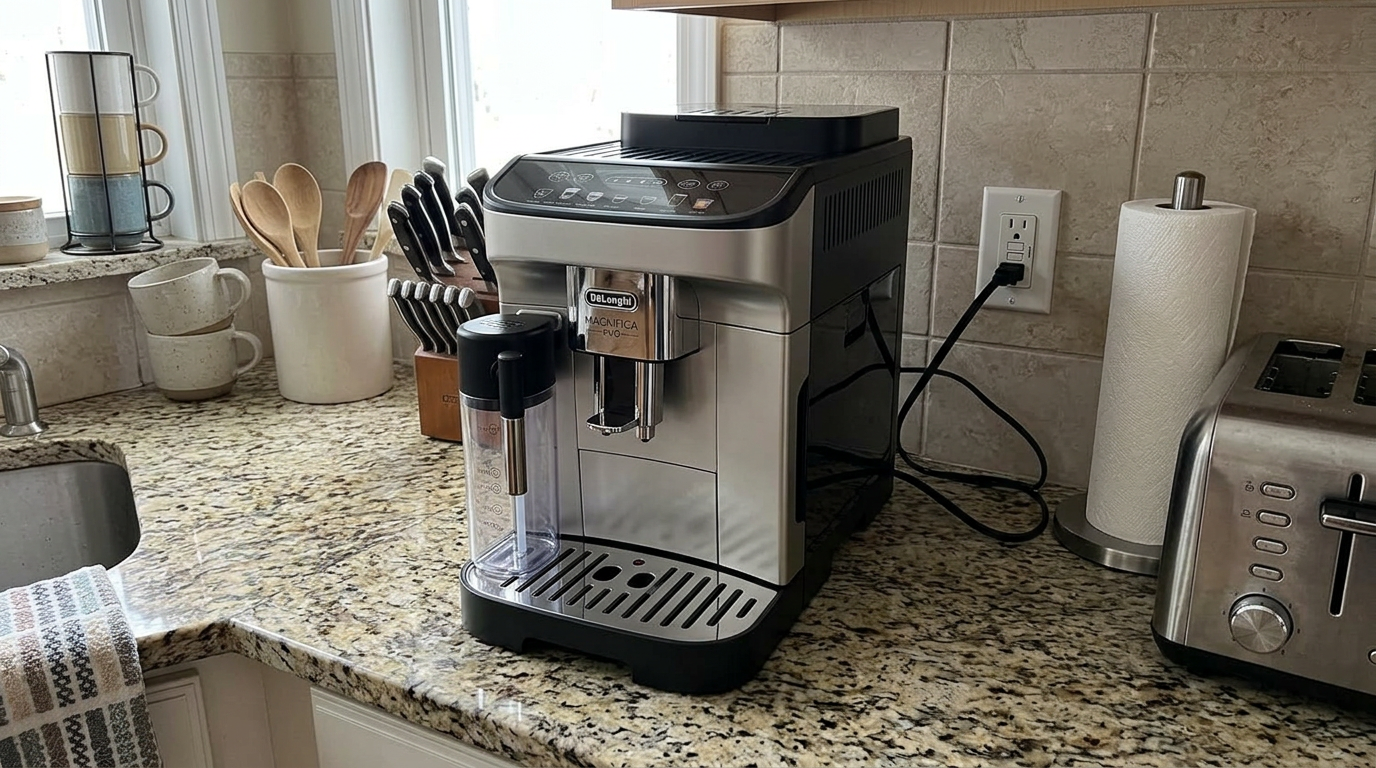
The Evo’s 13-step steel grinder gave me more room to tune than any Bosch.
Bosch handles strength differently. On the 300 you set it with the bean button, and on the 500 you get Mild, Regular, Strong and a clever Double Shot, which grinds and brews twice for a bolder cup without harsh bitterness.
I liked the Double Shot idea a lot. It is Bosch’s answer to a small brew chamber, and on the 800 it made my morning americano noticeably richer.
| Grinder detail | Bosch 300 | Bosch 800 | Magnifica Evo | Rivelia |
|---|---|---|---|---|
| Burr type | Ceramic discs | Insulated ceramic discs | Steel conical | Steel conical |
| Settings | A few steps | Adjustable | 13 | 13 |
| Top dose | Set by strength | Set by strength | About 15 g | About 15 g measured |
| Bean hopper | About 9 oz | 11 oz | 8.8 oz | 2 × 8.8 oz |
| Pre-ground option | No | No | Yes, one scoop | Yes, removable chute |
Our tip: Turn the grind dial only while the grinder is running, because adjusting it with the burrs stopped can jam beans on every machine here.
Espresso quality
I pulled dozens of shots on each machine with the same medium-dark blend, then tasted them side by side in warmed cups. The ranking surprised me a little.
The Bosch 800 Series pulled the richest espresso of the four. Its 19-bar pump and wide grinder range gave a thick crema and a chocolatey body that held up well in milk.
The Magnifica Evo came a very close second. At the 15-gram dose, the shot had real body and sweetness, with toasted nut and cocoa notes and very little bitterness.
The Rivelia was full-bodied too, thanks to the same generous dose, but a touch softer and rounder. It suited medium roasts best.
The Bosch 300 was pleasant but lighter. In a cappuccino nobody noticed, but as a straight espresso it lacked the depth of the other three.
My espresso ratings
My scores out of 10 for body, crema, flavor and consistency, taken from my single reviews of each machine.
All four use a thermoblock✕ThermoblockA compact heater that warms water on its way through a metal block, instead of keeping a boiler hot. It heats up fast and switches between tasks quickly., so they heat quickly and are ready in well under a minute. The Evo was ready in about 38 seconds from cold, including a short automatic rinse.
Every machine also runs a short pre-infusion✕Pre-infusionA short soak of the ground coffee before full pressure starts, so the water flows through the puck evenly. before full pressure. That helps the water flow evenly and is part of why even the cheapest machine here pulls a decent shot.
| What you taste | Likely cause | First fix on any of these machines |
|---|---|---|
| Sour, thin, watery | Under-extracted✕Under-extractionWhen water does not pull enough flavor out of the coffee. The shot tastes sour, thin and watery. | Grind one step finer or raise strength |
| Bitter, harsh, drying | Over-extraction | Grind one step coarser or shorten the drink |
| Pale crema that fades fast | Stale beans | Use beans within a few weeks of roasting |
| Lukewarm shot | Cold cup | Warm the cup with hot water first |
If straight espresso is your main drink, the shortlist is the Bosch 800 or the Magnifica Evo. The 800 wins by a hair, and the Evo wins by a mile on value.
See How Much You’ll SaveMilk drinks
This is where the four machines are most different, because each one uses its own milk system.
The Bosch 300 Series uses a clip-on in-cup frother. It froths straight into your cup, then the whole frother goes in the dishwasher, which is wonderfully simple but less precise.
The Bosch 800 has a clear milk container of about 24 ounces that clips onto the side. You can put it straight in the fridge between drinks, and the machine rinses the milk path automatically with its AutoMilk Clean program.
De’Longhi’s Magnifica Evo uses the LatteCrema carafe. It made dense, glossy microfoam✕MicrofoamMilk foam with bubbles so small you can barely see them. It feels silky and glossy, which is what a good flat white or cappuccino needs. at one touch, and the carafe goes in the fridge too.
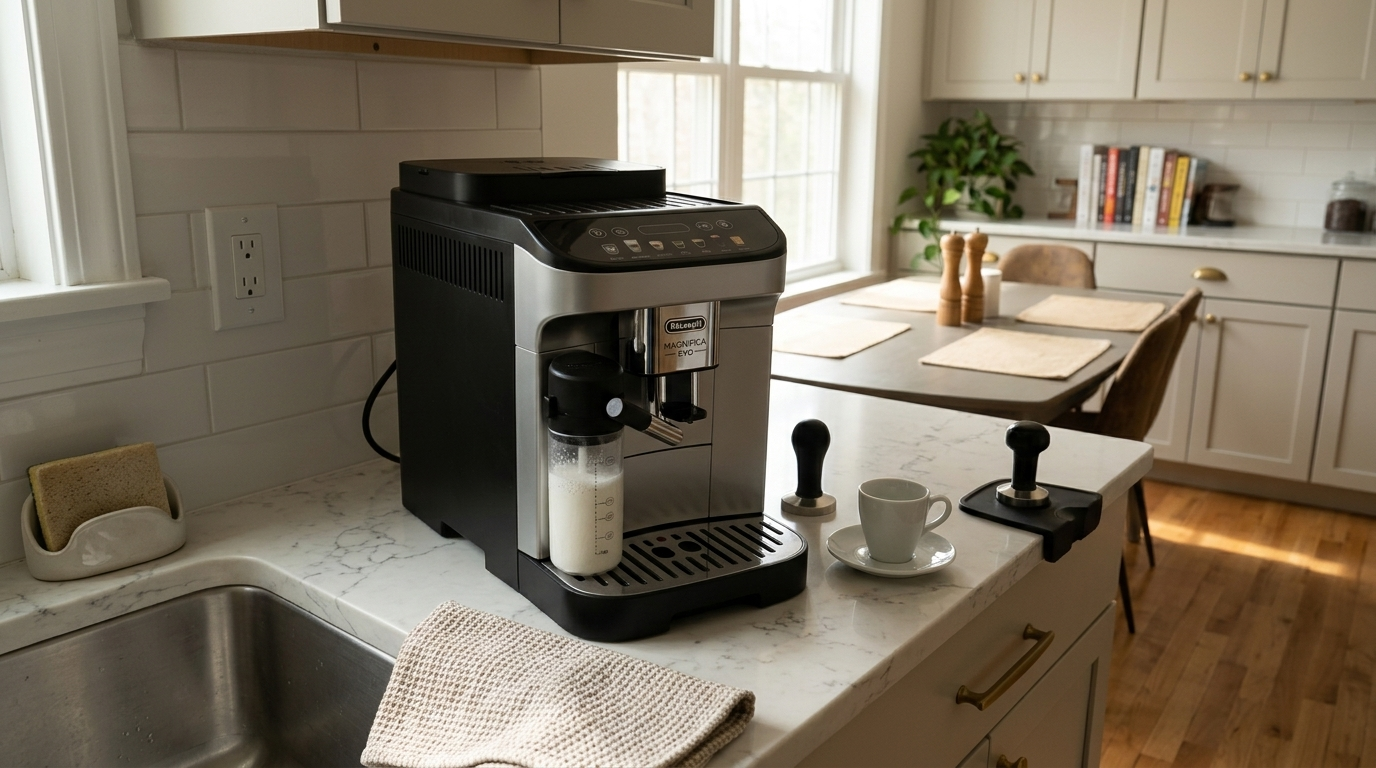
The LatteCrema carafe made the best foam of the two entry-level machines.
The Rivelia’s hot milk carafe is just as easy. My milk consistently came out between 140°F and 149°F, which is right where milk tastes sweetest.
The Evo’s clever extra is MyLatte. You pour in the milk you want, and the machine uses exactly that amount, so a small cup and a tall glass both come out right.
Measured milk temperature
Midpoints of my probe readings in the cup. Baristas usually aim for about 140 to 155°F for the sweetest milk.
Temperature is worth a moment. Milk sugars taste sweetest at around 140°F, and most baristas stop steaming somewhere between 140 and 155°F, because hotter milk starts to lose its sweetness.
So the De’Longhi machines aim for sweetness, while the Bosch 800 aims for heat. If you like a latte you can sip slowly, the 800 suits you better.
Foam quality followed the same pattern. Whole milk was best on all four, barista oat milk came a close second, and skim milk gave the stiffest but driest foam.
| Milk system | Bosch 300 | Bosch 800 | Magnifica Evo | Rivelia |
|---|---|---|---|---|
| Type | In-cup frother | Clip-on container | LatteCrema carafe | Hot milk carafe |
| Fridge-safe | No | Yes | Yes | Yes |
| Automatic rinse | No | Yes, AutoMilk Clean | Yes, Clean setting | Yes |
| One-touch latte macchiato | Yes | Yes | Yes | Yes |
| Flat white | No | Yes | Via MyLatte | Yes |
| Dishwasher-safe parts | Whole frother | Container parts | Carafe parts | Carafe parts |
Our tip: Use milk straight from the fridge on all four, because milk that warms on the counter makes big, soapy bubbles that collapse in the cup.
Drink menu, screens and controls
The menus range from five drinks to dozens, and the controls follow the same curve.
The Bosch 300 Series has one button per drink: espresso, coffee, cappuccino, latte macchiato and milk froth. Nobody in my house needed a single instruction.
The Magnifica Evo adds Over Ice, MyLatte and hot water for seven drinks, still controlled with clear icons and buttons. There is no screen and no user profile, which keeps it simple but means everyone shares the same settings.
The Rivelia moves to a 3.5-inch color touchscreen with 18 recipes and four profiles. The screen sits flat on top, which looked elegant but was awkward for my kids and for anyone sitting at the counter.
One-touch drinks on the machine
The Bosch 800 reaches 36 drinks through the Home Connect app.
The Bosch 800 Series is the clear winner for families. Its 5-inch touchscreen shows large drink images you swipe through like a phone, and it saves up to 30 favorites, so everyone’s drink is one tap away.
It is also the only one here with an app. Home Connect let me start a drink from my phone and unlock extra recipes, though I used the touchscreen far more often.
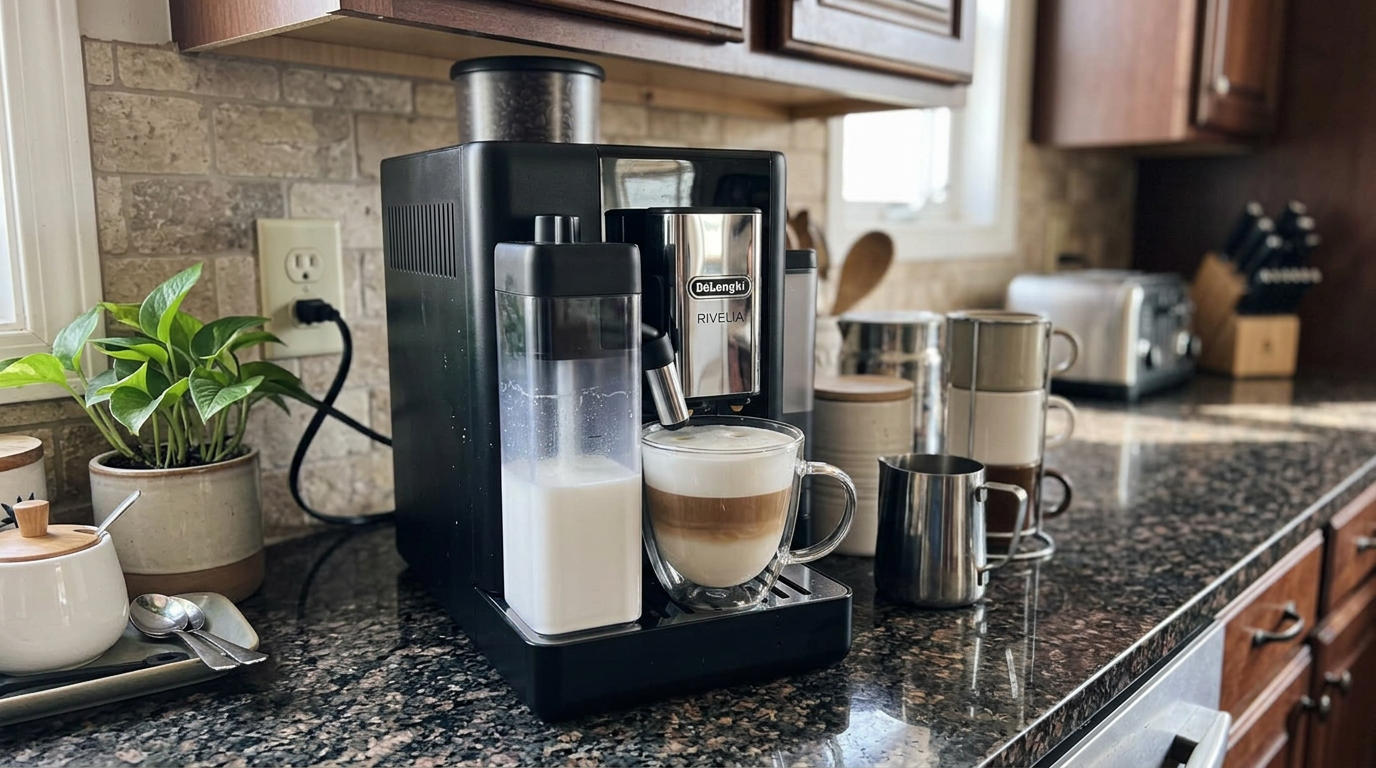
The Rivelia’s top screen looks great, but it suits standing adults best.
| Control | Bosch 300 | Bosch 800 | Magnifica Evo | Rivelia |
|---|---|---|---|---|
| Screen | None, buttons | 5-inch touchscreen | None, icons | 3.5-inch touchscreen |
| Profiles or favorites | None | 30 favorites | None | 4 profiles |
| App | No | Home Connect | No | No |
| Coffee pot function | No | About 25 oz | No | No |
| Two drinks at once | Yes | Yes | Yes, black coffee | Yes, black coffee |
Our tip: Save each person’s drink as a favorite or profile in the first week, so nobody ends up changing someone else’s settings.
How hot is the coffee?
Coffee brews best with water between about 195 and 205°F, according to the National Coffee Association. What ends up in your cup is cooler, because the cup, the spouts and the air all take some heat.
In my tests, the Bosch 800’s milk drinks landed around 150 to 160°F, with espresso a little higher. That is warm rather than scalding, and if you like coffee above 175°F you will notice it.
The De’Longhi machines aim a little lower for milk, around 140 to 149°F, but their hot water is hotter. The Rivelia’s hot water read 194 to 203°F, which is hot enough for black tea.
The Evo’s first drink of the day was the coolest of the session, because its cup warmer on top is passive. A quick rinse of the cup with hot water fixed it.
Our tip: Pre-warm your cup with a splash of hot water on any of these machines, because a cold ceramic mug can steal 10°F or more from a small drink.
Cleaning and upkeep
On cleaning, Bosch has the edge, and it is the main reason I would recommend a Bosch to someone who hates chores.
Every machine here has a removable brew unit✕Brew unitThe part that compresses the ground coffee, holds it while water passes through and then ejects the used puck. A removable one can be rinsed under the tap., which is a big deal. You can pull it out once a week, rinse old coffee off under the tap and let it dry, instead of relying on cleaning tablets alone.
The Bosch 300 Series makes it easiest. The brew unit slides out the front, and the clip-on milk frother goes straight in the dishwasher, so daily cleaning took me about two minutes.
The Bosch 500 and 800 add AutoMilk Clean, which steams the milk path after each session. You still need to rinse the hose or container, but there is less to scrub.
The De’Longhi carafes have more parts. The Evo’s LatteCrema carafe has a Clean setting that flushes it with steam, and I took it apart and rinsed it every couple of days.
Descaling is guided on all four. Bosch calls its program Calc’n Clean and combines descaling and cleaning in one cycle, while a full descale on the Evo took about 45 minutes, most of it hands-off.
My daily hands-on cleaning time
My estimate with daily milk drinks, not counting automatic rinses.
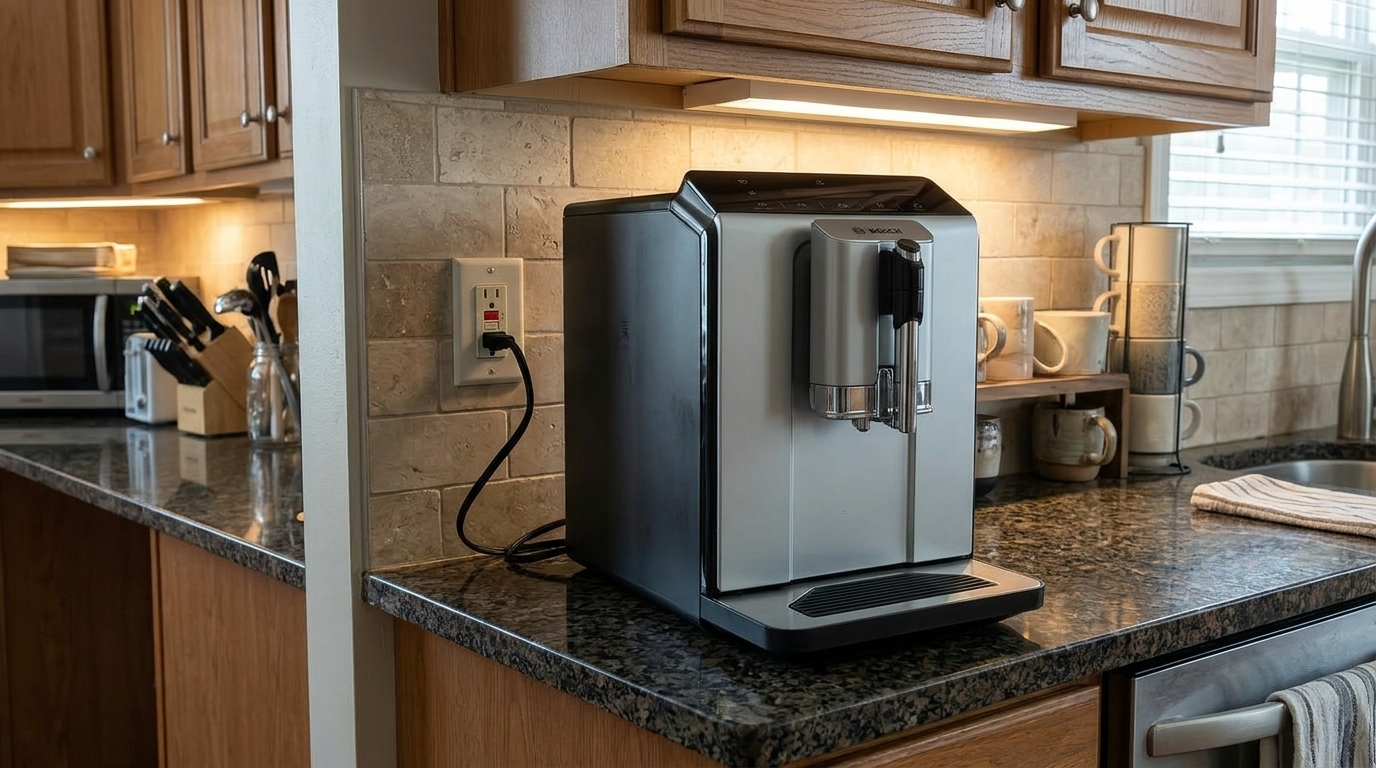
The Bosch 300’s brew unit slides out the front, which makes weekly rinsing quick.
| When | Bosch | De’Longhi |
|---|---|---|
| After milk drinks | Rinse frother or let AutoMilk Clean run | Run the carafe Clean setting |
| Daily | Empty tray and grounds | Empty tray and grounds |
| Weekly | Rinse the brew unit | Rinse the brew unit, wash the carafe |
| When prompted | Calc’n Clean | Descale cycle |
| Monthly | Wash the bean hopper | Wash the bean hopper and chute |
Our tip: Rinse the brew unit on any of these machines every week and let it air-dry overnight before you slide it back in.
Water, beans and capacity
Capacity is where the Bosch 800 pulls far ahead, and where the Bosch 300 falls behind.
The Bosch 800 Series holds 81 ounces of water and 11 ounces of beans, so a family of four could go a couple of days between refills. The Bosch 300 holds just 45 ounces, which meant a daily refill in my house.
Water tank size
From manufacturer specifications. A 64-ounce tank is a good middle ground for two people.
The Rivelia’s 47-ounce tank sounds small, but its two hoppers are the real story. Each holds about 8.8 ounces, so you can keep a bold blend in one and decaf or a lighter roast in the other.
Switching works well, with one catch. The brew chamber holds leftover grounds, and on my machine about 10 grams of the previous bean ended up in the next shot, roughly two-thirds of a single dose.
Drinks per full tank, my estimate
Rough maths allowing for rinse water. Your numbers depend on cup size.
Use fresh whole beans within a few weeks of the roast date on all four. Avoid very oily or flavored beans, which can clog the grinder and the chute over time.
Our tip: Buy a bag of beans you can finish in two or three weeks, because every grinder here tastes better with fresh coffee.
Real-life scenarios
Specs only go so far. These are the situations where one machine clearly pulled ahead during my testing.
The 19-bar pump and wide grinder range gave the richest shot of the four, with thick crema and a long, chocolatey finish.
LatteCrema foam was dense and sweet, and the carafe went back in the fridge in seconds.
Thirty favorites on a big touchscreen meant nobody had to ask me how anything worked.
Two hoppers and a quick swap meant no emptying beans into a bag at night.
Under 10 inches wide, quiet, and a frother that goes straight in the dishwasher.
Thirteen grind steps and three dose levels gave me more control than any Bosch.
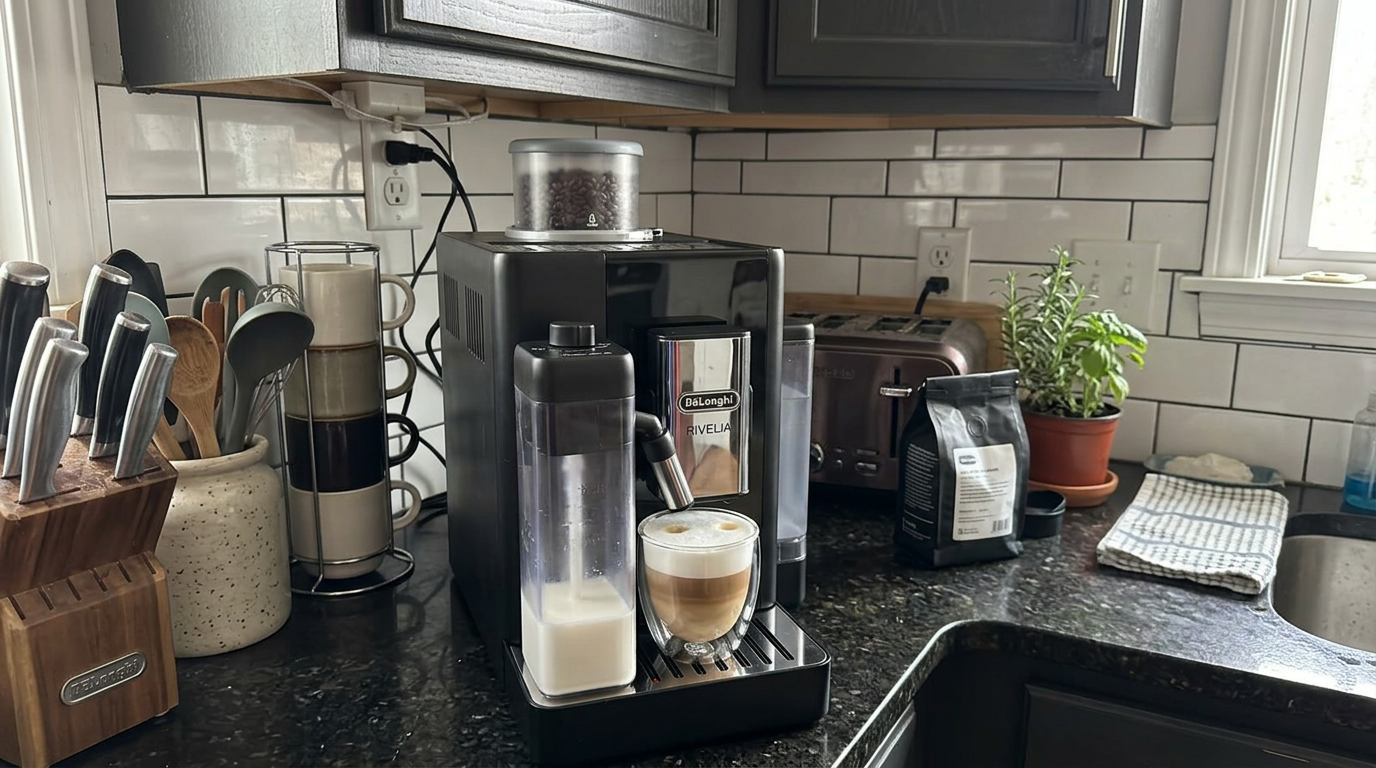
For a two-coffee household, the Rivelia was the machine nobody wanted to give back.
My scorecard
These are my own scores out of 10. The first four come from my single reviews of each machine, and I added capacity because it decides this matchup for many families.
De'Longhi Magnifica Evo
Bosch 800 Series
Bosch 300 Series
De'Longhi Rivelia
Overall, I rate the Bosch 800 and Rivelia 8.5, the Magnifica Evo 8.3 and the Bosch 300 7.7. The Evo is the value champion, because it gets within a whisker of the top two for much less.
See Today’s PriceWhich one is right for you?
3 quick questionsWhich one should you buy?
It comes down to two questions: do you care more about the coffee or the cleaning, and how many people will use the machine? If none of these is quite right for you, my guide to the best De’Longhi super-automatic machines covers the rest of the range I’ve tested.
If you want to go deeper, see my best Bosch espresso machines guide, or my head-to-heads of the Rivelia vs Magnifica Evo and the Magnifica Evo vs Magnifica Start. If you are still choosing a brand, my De’Longhi vs Philips comparison covers the other big name.
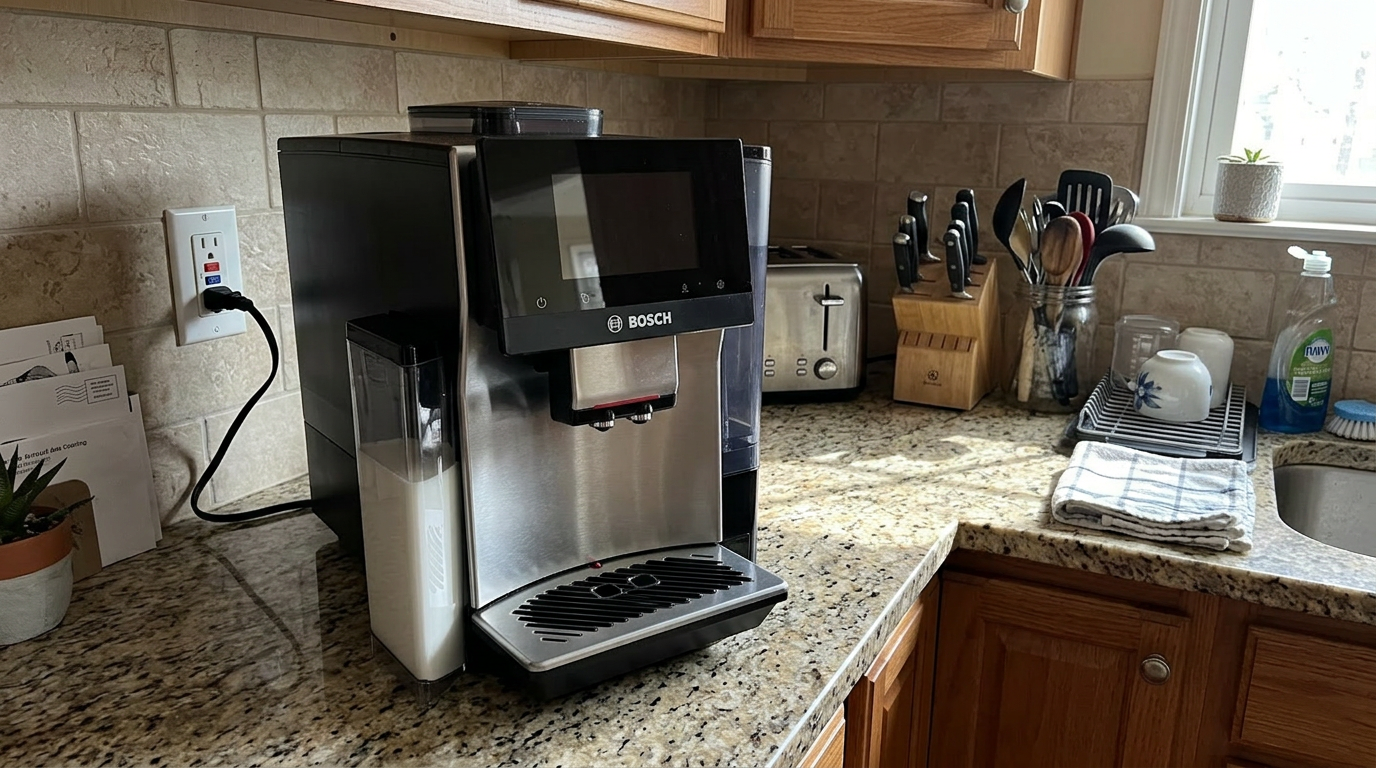
For a busy family kitchen, the Bosch 800 earns its extra counter space.
- You want rich espresso for sensible money
- You make cappuccinos and lattes most days
- You like to tune grind and strength
- You want a fridge-safe milk carafe
- You want a screen or user profiles
- You want very hot milk drinks
- You want app control
- Several people share the machine
- You want lots of drinks and saved favorites
- You hate refilling the water tank
- You like starting drinks from an app
- Your counter is shallow or narrow
- You like very hot coffee
- You want an all-metal body
- You want five drinks and zero learning curve
- Your counter is narrow
- You want dishwasher-safe milk parts
- You drink straight espresso and want depth
- You make lots of drinks a day
- You want to fine-tune the grind
- You keep two kinds of beans
- Two people want their own profiles
- You want a big dose and a modern look
- Kids or seated users need to see the screen
- You want iced drinks with cold foam
- You swap between very different roasts
For most homes, my pick is the De’Longhi Magnifica Evo. It pulls rich, sweet espresso from a 15-gram dose, makes dense one-touch foam and gives you a steel grinder with 13 settings, all for far less than the flagships.
If you want the best machine regardless, the Bosch 800 Series is the one I would buy for a busy family. It made the best espresso here, its touchscreen and 30 favorites make it effortless to share, and its 81-ounce tank barely needs attention.
Choose the Rivelia if your home drinks two beans, and the Bosch 300 if simplicity and easy cleaning matter more than anything else.
Bosch vs De'Longhi specifications
From manufacturer specifications and my own testing.
| Bosch 300 Series | Bosch 800 Series | De'Longhi Magnifica Evo | De'Longhi Rivelia | |
|---|---|---|---|---|
| Model | 300 Series VeroCafe, TIU20307 | 800 Series VeroCafe, TQU60307 | Magnifica Evo with LatteCrema | Rivelia |
| One-touch drinks | 5 | 24, up to 36 in app | 7 | 18 |
| Pump pressure | 15 bar | 19 bar | 15 bar | 19 bar |
| Heating | Thermoblock | Thermoblock | Thermoblock | Thermoblock |
| Grinder | Ceramic discs, a few steps | Insulated ceramic discs | Steel conical, 13 settings | Steel conical, 13 settings |
| Bean hopper | About 9 oz | 11 oz | About 8.8 oz | 2 × 8.8 oz |
| Water tank | 45 oz | 81 oz | About 60 oz | 47 oz |
| Milk system | In-cup frother | Clip-on container, 24 oz | LatteCrema carafe | Hot milk carafe |
| Display | Buttons | 5-inch touchscreen | Icons and buttons | 3.5-inch touchscreen |
| Profiles or favorites | None | 30 favorites | None | 4 profiles |
| App | No | Home Connect | No | No |
| Brew unit | Removable, front | Removable, side | Removable | Removable |
| Dimensions (W × H × D) | 9.75 × 14.88 × 16.5 in | 13.9 × 15 × 18.4 in | 9.45 × 14.2 × 17.3 in | 9.6 × 15.2 × 16.9 in |
| Weight | About 14.7 lb | About 22 lb | About 21 lb | About 21.4 lb |
How I tested and compared them
I used each machine as my everyday coffee maker for four weeks, making espresso, long coffee, americanos, cappuccinos and latte macchiatos, plus hot water for tea.
I weighed doses and yields, measured milk and hot water temperatures with a probe thermometer, worked through every grind range and frothed whole, 2%, skim and barista oat milk.
I ran every cleaning and descaling routine, timed my daily hands-on cleaning, and then compared my notes with manufacturer specifications and owner documentation. At the end of each four-week run, I wrote up my notes and measurements together.
- Coffee: dose, crema, body and consistency
- Milk: foam texture, temperature and drink range
- Workflow: controls, screens, profiles and apps
- Ownership: cleaning, capacity, noise and footprint
Bosch vs De'Longhi FAQ
Is Bosch or De'Longhi better for espresso?
At the top of each range, they are close: the Bosch 800 pulled my richest shot, with the De’Longhi Magnifica Evo a close second. At the entry level, De’Longhi wins clearly, because the Evo’s 13-step steel grinder and 15-gram dose give a fuller shot than the Bosch 300.
Which brand is easier to clean?
Bosch, by a small margin. Every Bosch has a removable brew unit, the Bosch 300’s whole milk frother goes in the dishwasher, and the 500 and 800 rinse the milk path automatically. De’Longhi brew units come out too, and the carafes are fridge-safe, but there are more milk parts to rinse.
Do Bosch and De'Longhi machines have removable brew units?
Yes. All four machines I compared have a removable brew unit you can rinse under the tap. On the Bosch 300 it slides out the front, and on the Bosch 800 it sits behind a side door.
Which is quieter, Bosch or De'Longhi?
The Bosch machines. Their ceramic grinders ran with a softer, lower sound, and the Bosch 800’s insulated grinder was the quietest of the four. The Rivelia measured 66 to 68 dB in my kitchen, which is still quiet for a bean-to-cup machine.
What is the main difference between the Bosch 300 and the Magnifica Evo?
The grinder and the milk system. The Evo has 13 grind settings, a 15-gram dose and a fridge-safe LatteCrema carafe. The Bosch 300 has fewer grind steps and an in-cup frother, but it is simpler to use and its frother goes in the dishwasher.
Is the Bosch 800 worth it over the De'Longhi Rivelia?
If you want capacity and lots of drinks, yes. The 800 has 24 drinks, 30 favorites, an app and an 81-ounce tank. The Rivelia is the better choice if you switch between two beans, such as regular and decaf, and it is easier to fit on a narrow counter.
Which machine makes the hottest milk drinks?
The Bosch 800, at about 150 to 160°F in my tests. The De’Longhi machines aimed lower, around 140 to 149°F, which tastes sweeter but cools faster.
Can these machines use pre-ground coffee?
Both De’Longhi machines can, with a one-scoop chute for decaf. On the Bosch side, the 500 Series has a ground coffee chute, while the Bosch 300 and 800 I tested work with beans.
Which is best for a small kitchen?
The Bosch 300, Magnifica Evo and Rivelia are all under 10 inches wide. The Bosch 300 is the easiest to tuck away, but its 45-ounce tank needs refilling more often.
Do I need a water filter?
If your water is moderately hard, yes. A filter cuts scale, so you descale less often and the coffee tastes cleaner. Both brands support filters and guide you through descaling when it is due.

- Our hands-on Bosch 300 Series review
- Our hands-on Bosch 800 Series review
- Our hands-on De’Longhi Magnifica Evo review
- Our hands-on De’Longhi Rivelia review
- Bosch and De’Longhi product specifications and owner documentation
- How to Brew Coffee, National Coffee Association
- Composting and Coffee Grounds, Cornell University