Bosch 300 Series review: five one-touch drinks, a ceramic grinder and the simplest cleanup in a slim body
The Bosch 300 Series Fully Automatic Coffee Espresso Machine is the entry point to Bosch's bean-to-cup range. It grinds, brews and froths with one press, fits on a narrow counter and has a brew unit you can pull out and rinse. Its espresso is smooth and its milk foam is good, but the menu is short, the grinder has few settings and the tank is small.

Michael Reynolds
Hands-on review
Hands-on testing, research, specs
4 weeks
24 minutes
Jargon helpNew to espresso? Tap any dotted term to see what it means.
In this review
Yes, if you want fresh-ground espresso, coffee and simple milk drinks with almost no learning curve. The Bosch 300 Series is slim, quiet and easy to keep clean, thanks to a brew unit that slides out the front and a milk frother that goes in the dishwasher. It sticks to five drinks, the grinder has only a few steps and the 45-ounce tank needs regular refills. For one or two coffee drinkers who value simplicity, it's an easy machine to live with.
Bosch 300 Series at a glance
Bosch 300 Series pros and cons
- Very easy to use, with one button per drink
- Removable brew unit and dishwasher-safe frother
- Slim, quiet and tidy on the counter
- Only five drinks and no app
- Grinder has just a few settings
- 45-ounce tank needs frequent refills
Who should buy the Bosch 300 Series?
- Couples who drink espresso, coffee and cappuccino
- First-time owners moving up from pods
- Narrow counters and tidy kitchens
- Households that want flat whites, Americanos or cold brew
- Coffee hobbyists who like fine-tuning every shot
- Big families who brew all morning
First impressions of the Bosch 300 Series
Michael Reynolds and I lived with the 300 Series for four weeks, and the first thing we both said was the same.
It looks more expensive than it is.
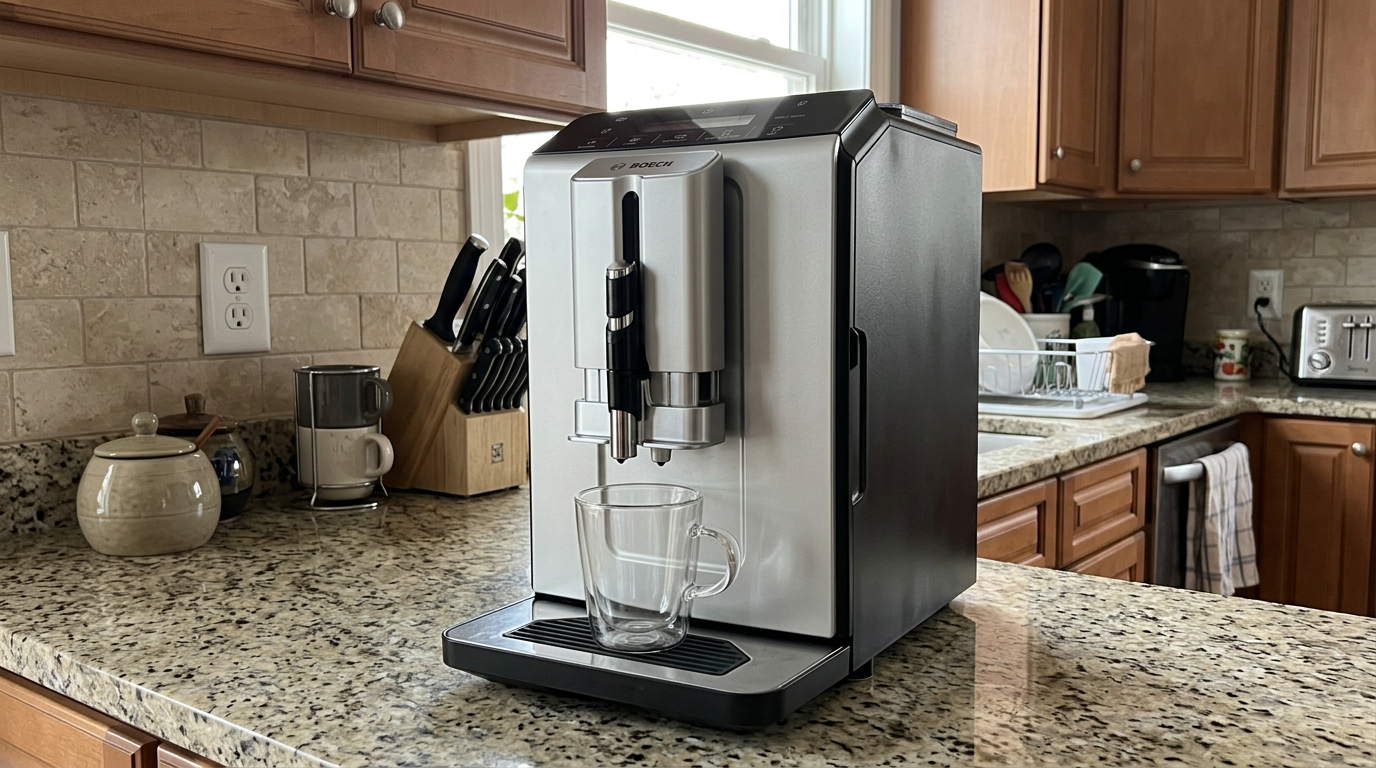
My unit is the silver version, with a brushed front panel, a black body and a slim profile that's under 10 inches wide.
On a crowded counter, that narrow footprint matters more than any spec on the box.
The second thing I noticed was how little there is to learn.
There's a row of illuminated sensor keys, a bean button for strength and a start-and-go logic that most people understand in a minute.
No touchscreen, no app and no menu tree.
My first espresso came out smooth and nutty, with a fine layer of hazelnut-colored crema.
It wasn't the boldest shot I've had, but it was balanced and easy to drink.
My first cappuccino needed a little patience with the frother, which I'll come back to.
The 300 Series takes up less than 10 inches of counter width.
What the Bosch 300 Series actually is
The 300 Series is a fully automatic, bean-to-cup machine.
You fill the hopper with whole beans, and it grinds, doses, tamps, brews and drops a dry puck into the waste drawer for every drink.
Bosch calls the range VeroCafe, and the 300 sits at the bottom of the line.
Inside is a thermoblock✕ThermoblockA compact heater that warms water as it flows through, instead of keeping a whole boiler hot. It heats up fast and uses little standby energy. that heats water on demand.
A 15-bar pump pushes that water through the coffee, which is plenty for espresso, where the target at the coffee itself is around 9 bar.
Power is rated at 1,600 watts, so warm-up is quick.
My test unit, model TIU20307, makes five drinks: espresso, coffee, cappuccino, latte macchiato and milk froth.
That's a short list compared with the rest of the range.
If you want an Americano or a flat white on the menu, my Bosch 500 Series review covers the next step up, with nine drinks.
It also has a two-cup function, which the black version of the 300 Series doesn't offer.
Bosch 300 Series design and setup
The Bosch 300 Series measures 9.75 × 14.88 × 16.5 inches, or about 24.8 × 37.8 × 41.9 cm.
At just under 15 inches tall, it slides under standard wall cabinets with room to spare.
It weighs about 14.7 pounds, so it's light enough to pull forward when you need to.
The water tank sits at the back and lifts out with a fold-down handle.
A valve in the base seals as you pull it, so it doesn't drip on the way to the tap.
Because it's at the back, I had to pull the machine forward a few inches each time, unless I left a gap behind it.
The bean hopper on top holds about 9 ounces of beans, roughly 255 grams.
Its lid has a rubber seal, which keeps the beans fresher and muffles the grinder.
The spout slides up and down, from espresso cups to mugs up to about 5 inches tall.
Tall latte glasses won't fit under it, which is something to know before you buy glassware.
Drip tray and waste drawer
The drip tray pulls out from the front, with the grounds drawer inside it.
A red float pops up through the grid when the tray is full, so you see it before it overflows.
A hinged door on the front opens up the brew unit, the grounds drawer and the inner drip area.
That front access is a real advantage, because you never have to turn the machine sideways to clean it.
On the 500 Series and the touchscreen models, the brew unit sits behind a side door instead.
Cup warmer, or not
The silver model I tested has no cup warmer on top.
The dark silver version of the 300 Series adds a heated top plate, which is worth knowing if you like hot espresso.
First-time setup
Setup takes about ten minutes.
You rinse and fill the tank, fit the water filter if you want to use it, set your water hardness with the included strip and run a first rinse.
To get into the settings, you press the bean button and the Calc'n Clean button together.
From there you set the language, sounds and water hardness.
Our tip: Leave a few inches free behind the machine, so you can lift the rear tank without pulling the whole machine forward.
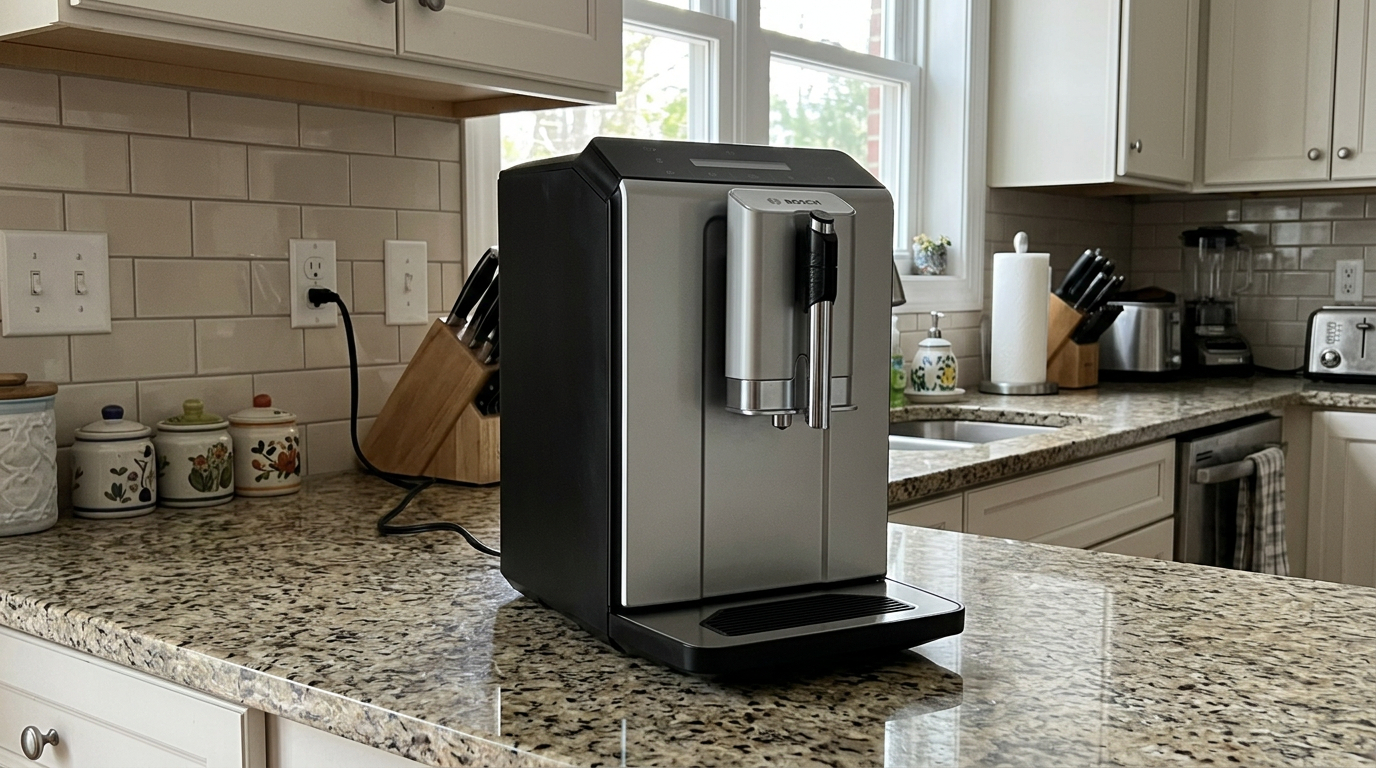
The brushed front and black body suit a bright, white kitchen.
What happens when you press a button
It helps to know what the machine is doing during those 30 to 90 seconds.
Once you understand the sequence, most of the small quirks make sense.
When you switch it on, the thermoblock heats up and the pump pushes a little hot water through the coffee path and out of the spout.
That startup rinse cleans out old water and warms the pipes, and it's why the drip tray fills faster than you'd expect.
When you press a drink, the grinder runs for a few seconds and drops the grounds into the brew unit.
The brew unit presses them into a puck, locks shut and the pump forces hot water through at high pressure.
After the pour, the brew unit opens and scrapes the dry puck into the grounds drawer.
| Step | What the machine does | Roughly how long |
|---|---|---|
| 1. Grind | Ceramic discs grind fresh beans | 3 to 5 s |
| 2. Tamp | Brew unit presses the grounds into a puck | 2 s |
| 3. Pre-wet | A little water soaks the puck | 2 to 3 s |
| 4. Brew | Hot water is pushed through at pressure | 15 to 50 s |
| 5. Eject | Dry puck drops into the drawer | 2 s |
For milk drinks, the frother comes in either before or after the coffee, depending on the drink.
A cappuccino gets foam first and espresso through it, while a latte macchiato builds its layers in a tall glass.
On shutdown, the machine rinses the coffee path once more, so the spout is clean for the next morning.
It's a short, logical routine, and it's why the 300 Series needs so little attention day to day.
Our tip: Leave a cup or a small jug under the spout when you switch on, so the startup rinse doesn't end up in your drink.
The built-in ceramic grinder
The 300 Series grinds with a ceramic disc grinder✕Ceramic disc grinderTwo hard ceramic plates that crush beans between them. Ceramic stays sharp for a long time and transfers little heat to the coffee, which helps protect its aroma..
Ceramic is hard, stays sharp and doesn't heat up much as it works.
That matters, because heat during grinding drives off aroma before the coffee even reaches the water.
It was also fairly quiet.
The grinder makes a short, low hum rather than a high whine, and the sealed hopper lid takes the edge off.
Few settings, so choose your beans well
The grinder has only a handful of fineness steps.
That keeps things simple, but it also means you can't fine-tune very far in either direction.
Out of the box, I found the middle setting slightly coarse for medium roasts.
One step finer gave a fuller shot with better crema.
With darker roasts, the factory setting was fine.
Bars show how much resistance the coffee puts up. Tested with a medium roast at the middle strength level.
Only change it while it grinds
The rule on every automatic grinder applies here too.
Turn the setting only while the grinder is running.
Moving it toward fine with the burrs stopped can trap bean pieces between the discs and strain the mechanism.
My routine was to start an espresso, move the setting one step and judge the result two or three cups later.
The first cup after a change still contains ground coffee from the old setting, so it tells you very little.
Our tip: After any grind change, wait two or three drinks before you judge the taste, because some old grounds are still in the chute.
Strength and cup size
Strength is set with the coffee bean button.
Each press steps through the strength levels, from mild to strong.
Behind the scenes, the machine simply grinds for longer and puts more coffee into the brew unit✕Brew unitThe chamber inside an automatic machine that receives the ground coffee, presses it into a puck, pushes hot water through it and then ejects the used grounds..
Cup size is programmed by holding the drink button.
Hold the espresso or coffee button for a few seconds and the machine starts brewing in programming mode.
Press again when the cup holds what you want, and it remembers that volume for every future press.
It's an old-fashioned way to set volume, but it's quick and you can see exactly what you're getting.
| Setting | How you change it | What it does |
|---|---|---|
| Strength | Press the bean button | More or less coffee per brew |
| Cup size | Hold a drink button, release at your level | Saves the volume for that drink |
| Grind | Small adjuster in the bean area | Finer or coarser grounds |
| Two cups | Two-cup option before you start | Brews two drinks side by side |
| Water hardness | Bean and Calc'n Clean buttons together | Sets descaling reminders |
Our tip: Program your espresso to about 1.3 fl oz instead of the default, for a denser, sweeter shot.
Bosch 300 Series espresso performance
The espresso surprised me more than anything else on this machine.
With fresh medium-roast beans, one step finer than default and the strongest setting, it pulled a smooth, round shot.
I tasted milk chocolate, toasted almond and a little caramel, with gentle acidity and only light bitterness.
The crema✕CremaThe golden-brown foam on top of an espresso. It forms when pressure pushes gases and oils out of freshly ground coffee. was fine and hazelnut-colored.
It held for a couple of minutes, which is decent for a machine in this class.
It wasn't as thick as the crema from bigger, pricier machines, but it was even and stable.
Temperature
The shots came out warm rather than scalding.
That's typical of compact thermoblock machines, and it means you can drink an espresso straight away.
If you like your coffee very hot, warm the cup first and run a rinse before the first shot of the day.
Consistency
Back-to-back shots tasted the same.
I made four espressos in a row for guests, and the last one was as full as the first.
The first shot after switching on was the one exception, and it improved once the machine had rinsed and warmed its pipes.
| What you taste or see | Likely cause | First change |
|---|---|---|
| Sour, thin, watery | Under-extraction | Go one grind step finer or raise strength |
| Bitter, harsh, drying | Over-extraction | Go one step coarser or shorten the volume |
| Pale crema that fades fast | Stale beans or grind too coarse | Use fresher beans and grind finer |
| Drips slowly or stops | Grind far too fine | Move one step coarser while grinding |
| Lukewarm shot | Cold cup or cold pipes | Warm the cup and run a rinse first |
Coffee and two-cup brewing
The Coffee button makes a longer drink in one continuous pour.
It's meant to replace a cup of drip coffee, and at a normal mug size it does that well.
The cup was smooth and clean, with a thin layer of crema and less body than an Americano made from espresso.
Push the volume too far and the end of the pour gets flat and slightly bitter.
For a big mug, I preferred running the Coffee drink twice into the same cup.
Two shorter brews kept the flavor fuller than one very long one.
Two cups at once
On this silver model, you can brew two drinks side by side.
For espresso and coffee, the machine grinds and brews in two passes, so both cups get a proper dose.
It's a real time-saver when two people want coffee at the same moment.
Measured from a warm machine. The first drink after switching on takes longer because of the rinse.
Milk foam and milk drinks
The 300 Series uses an in-cup milk frother✕In-cup milk frotherA small frothing unit on the front of the machine that draws milk through a short tube and steams it straight into your cup, so you don't need a pitcher or a steam wand. that clips onto the front of the machine.
A short tube goes into your milk, steam draws the milk up, and the frother sends hot foam straight into the cup.
There's no pitcher and no wand to wipe down.
The foam was fine and creamy, with small bubbles and a soft, spoonable texture on top of a cappuccino.
It wasn't as glossy as the foam from the more advanced machines in Bosch's range, but it was well above what I expected at this level.
The Bosch Series 6 I tested, for example, pours a silkier flat white from a hose that draws straight from the carton.
For latte macchiato, the frother pours the milk and foam first, then the espresso runs through and settles in the middle.
In a clear glass, the layers looked great.
Where it needs care
My first two cappuccinos had big, loose bubbles.
The cause was simple: the frother wasn't pushed all the way onto its connector, so it was pulling in extra air.
Once it clicked fully into place, the foam came out fine every time.
Cold milk also matters a lot.
Milk straight from the fridge foamed far better than milk that had been sitting on the counter.
My ratings on a 10-point scale for texture and how long the foam held.
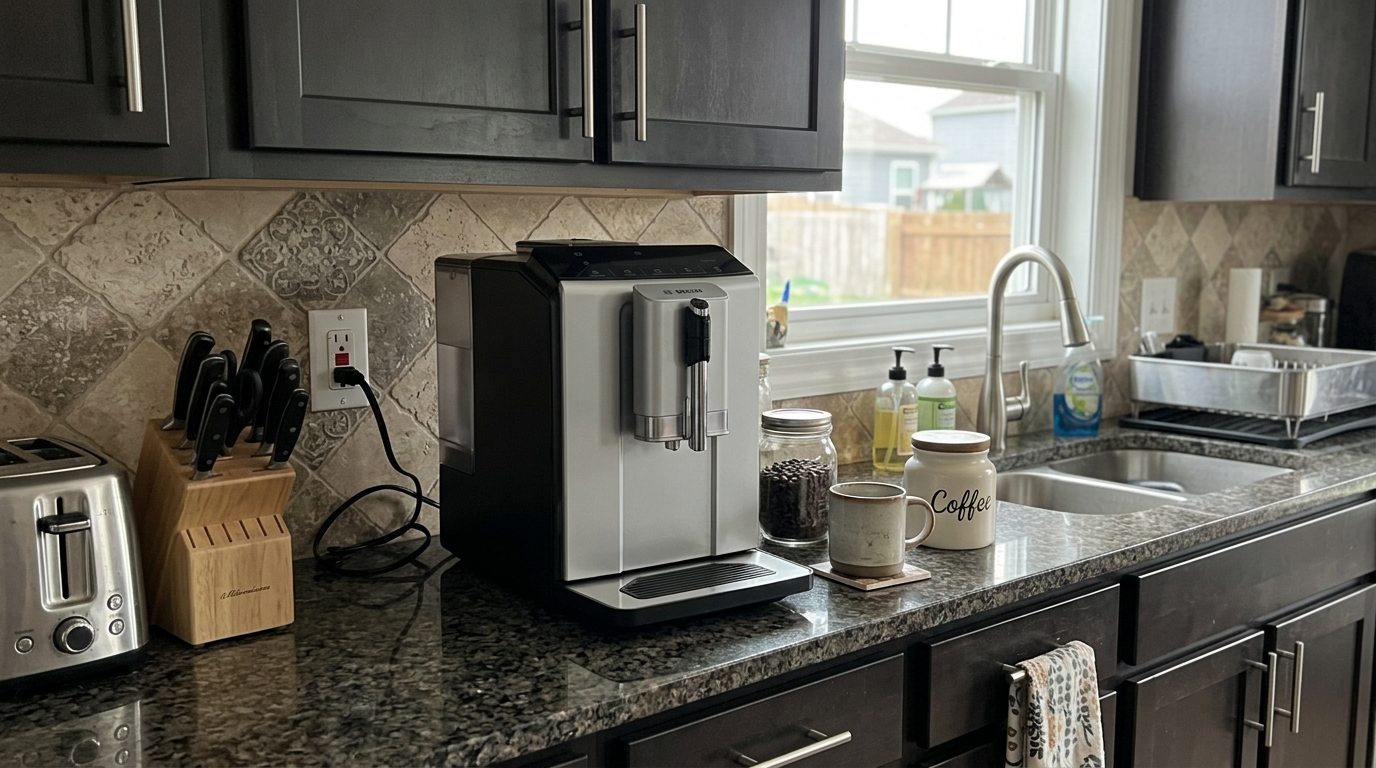
Its narrow body fits neatly between a toaster and the sink.
Our tip: Rinse the frother under the hot tap right after your last milk drink, because dried milk is much harder to shift later.
Controls and everyday programming
The control panel is a row of illuminated sensor keys with a small display.
Each drink has its own button, so there's no scrolling and no menus to learn.
Anyone in the house can make a cappuccino on their first try.
The trade-off is that there's nothing to explore.
There's no app, no user profiles and no saved favorites beyond the volume you program for each drink.
If an app matters to you, the Bosch Series 4 adds Home Connect and Quick Cup, which starts a drink straight from standby.
Settings like strength and cup size apply to everyone who uses the machine.
Iced espresso and big milk drinks
There's no iced coffee button, but you can make a good iced latte by hand.
Pour cold milk and any syrup into a glass, brew two espressos straight into it, then add ice last.
Adding ice after the coffee has mixed with cold milk keeps it from melting too fast.
For a big mug of cappuccino, run the cappuccino drink twice into the same cup.
One huge drink made with lots of cold milk comes out cooler, while two normal cycles keep it hot.
Our tip: For an iced latte, brew two espressos over cold milk and add the ice last, so it doesn't melt into a watery drink.
Getting hotter drinks
Temperature was the one complaint everyone in my house raised at least once.
Drinks from the 300 Series come out comfortably warm, ready to sip, rather than piping hot.
For most people that's fine, but if you like a scalding mug, you'll notice it.
The good news is that most of the heat loss happens after the coffee leaves the spout.
A cold ceramic cup can steal a surprising amount of heat from a small espresso in the first few seconds.
Milk drinks lose even more, because cold milk is a big part of the volume.
What made the biggest difference
I measured drinks with a probe thermometer across a week, trying one change at a time.
Warming the cup with hot tap water made the largest single difference for espresso.
Running a short rinse before the first drink of the day came next, because it heats the pipes and the spout.
For milk drinks, the biggest gain came from using a smaller amount of very cold milk and running two cycles for big mugs.
Approximate readings with a probe thermometer. Your numbers will vary with cup size and room temperature.
None of this is unusual for a compact machine with a thermoblock.
It's simply the trade-off for fast heat-up and low standby energy.
Even the flagship Bosch 800 Series serves its drinks warm rather than scalding, so this isn't unique to the entry model.
Once I built the cup-warming habit into my routine, the complaints stopped.
Our tip: Keep your espresso cups upside down on a warm towel or rinse them with hot water first, because the silver 300 Series has no cup warmer.
Small problems I ran into, and the fixes
Over four weeks, nothing broke and nothing needed a service call.
But a few small things came up that are worth knowing before you buy.
All of them were easy to fix once I understood the cause.
| Problem | What caused it | What fixed it |
|---|---|---|
| Coffee weak and pale in the first days | Grinder and brew unit still settling | Brew five to ten drinks before judging |
| Grinder whirring with no beans going in | Beans bridging in the hopper | Stir the beans and keep the hopper topped up |
| Big bubbles in the foam | Frother not fully seated | Push it on until it clicks |
| Water under the machine | Drip tray full or not pushed in fully | Empty it at the red float and push it flush |
| Very slow flow | Grind too fine for that bean | Go one step coarser while grinding |
| Descale reminder soon after setup | Water hardness left at default | Test the water and set the hardness |
The first-week weakness is the one that worries new owners most.
For the first handful of drinks, the grinder and the brew unit are still finding their rhythm, and the pucks can be a little wet.
By the end of my first day, the coffee had darkened and the crema was fuller.
The bean bridging happened only with large, oily beans.
With a drier medium roast, the beans fed smoothly every time.
Setting the water hardness properly is easy to skip, but it matters.
It decides how often the machine asks for Calc'n Clean, and a wrong setting means either too many prompts or too few.
Cleaning and maintaining the Bosch 300 Series
Cleaning is where the 300 Series earns its keep.
The machine rinses its coffee path when you switch it on and off, so the spout stays clean.
Everything else is quick and hands-on rather than complicated.
The removable brew unit
The brew unit sits behind the front door.
You switch the machine off, press the red release and slide the whole unit out by its handle.
Then you rinse it under lukewarm tap water, let it air-dry and slide it back until it clicks.
Never use soap on it and never put it in the dishwasher.
Detergent strips the food-grade grease from its seals and moving parts, and that leads to stiff movement and early wear.
I rinsed mine once a week, and it never looked dirty.
The milk frother
The frother pulls straight off the front and comes apart into a few pieces.
All of them are dishwasher-safe, which is the easiest milk cleaning I've seen on a machine like this.
On busy days, I rinsed it under hot water and put it through the dishwasher every few days.
Calc'n Clean
Bosch combines cleaning and descaling✕DescalingRunning a mild acid solution through the machine to dissolve mineral scale left by hard water. Scale slows heating and can block pipes. into one guided program called Calc'n Clean✕Calc'n CleanBosch's combined maintenance program. A cleaning tablet removes coffee oils from the brew path while a descaling tablet dissolves mineral scale, in one guided cycle..
When the machine asks for it, you add a cleaning tablet and a descaling tablet, follow the lights and let it run.
The water filter reduces scale between those cycles, and the machine tells you when to change it.
| When | Task | Why it matters |
|---|---|---|
| After milk drinks | Rinse the frother | Stops milk drying inside |
| Daily | Empty drip tray and grounds drawer | Prevents mold and odors |
| Daily | Wipe the front and the cup grid | Keeps coffee stains off |
| Weekly | Rinse the brew unit without soap | Removes grounds and oils |
| Every few days | Dishwasher cycle for the frother parts | Removes milk fat |
| When prompted | Calc'n Clean or filter change | Keeps oils and scale under control |
My estimate of hands-on cleaning time per day, averaged over a week.
Our tip: Rinse the brew unit with cool or lukewarm water only, and let it dry fully before you slide it back in.
What daily use is really like
Most mornings went like this.
I pressed power, let the rinse run into the drip tray, pressed the strength I wanted and then my drink.
An espresso was in my hand in well under a minute.
The tank and the tray
The 45-ounce tank is the 300 Series' practical limit.
With two of us making a cappuccino, a coffee and a couple of espressos a day, I refilled it every day or two.
The drip tray filled at about the same pace, mostly from the startup and shutdown rinses.
Rough maths from a 45 oz tank, allowing for rinse water. Actual numbers depend on cup size.
Noise
It's one of the quieter bean-to-cup machines I've used.
The grinder runs for a few seconds with a low hum, and the pump sounds steady rather than rattly.
Nobody in my house woke up to it.
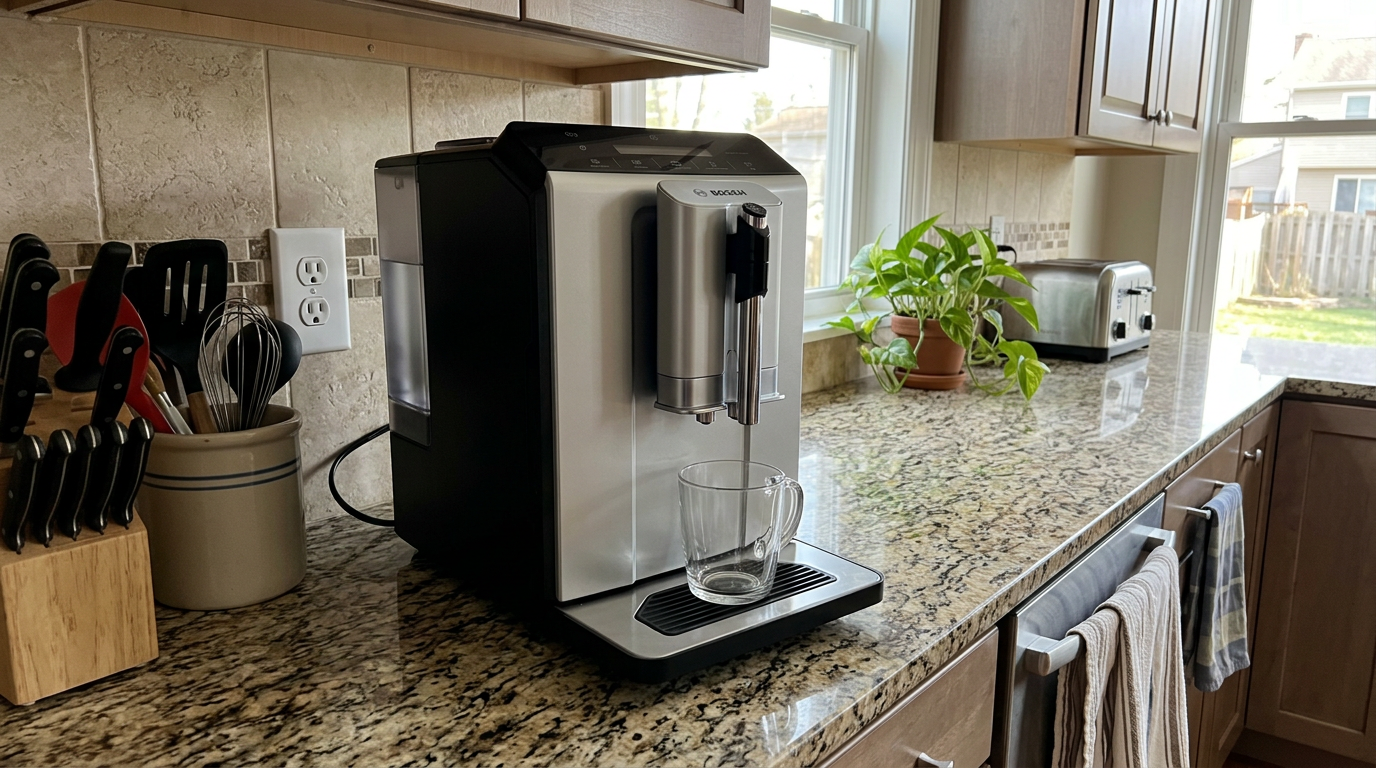
In daily use, it's the kind of machine that just quietly does its job.
Our tip: Fill the tank and empty the drip tray at night, so the morning rinse never stops your first drink halfway.
Beans, water and milk
With so few grinder steps, your choice of beans does a lot of the work.
Use fresh whole beans within a few weeks of the roast date.
Medium and medium-dark roasts suited the 300 Series best.
Very light roasts tasted thin, even at the finest step and the strongest setting.
Avoid oily, shiny beans and flavored or sugar-coated beans.
They leave a sticky film on the ceramic discs and can block the chute.
| Bean type | Espresso | Milk drinks |
|---|---|---|
| Medium-dark blend | Very good, full crema | Excellent |
| Medium roast | Good, go one step finer | Very good |
| Light roast | Thin, even at finest step | Fair |
| Very dark, oily | Not recommended | Not recommended |
Water
Fill the tank with fresh, cold water every day.
Use the filter if your tap water is moderately hard or harder.
Avoid distilled water, because coffee needs some minerals to taste full.
Common mistakes to avoid
The Bosch 300 Series is very forgiving, but a few habits will hold it back.
| Mistake | What happens | Better habit |
|---|---|---|
| Changing the grind with the grinder stopped | Bean pieces jam the discs | Adjust only while it grinds |
| Frother not fully pushed on | Big, loose bubbles | Push until it clicks |
| Using warm milk | Thin foam that collapses | Use milk straight from the fridge |
| Washing the brew unit with soap | Seals dry out and parts stick | Rinse with water only |
| One huge coffee pour | Flat, bitter finish | Run two shorter brews |
| Ignoring the red float | Drip tray overflows | Empty it when the float rises |
Change one thing at a time and taste after each change.
If you change the grind and the strength together, you won't know which one helped.
What I would change
A few more grinder steps would make it easier to dial in lighter roasts.
A bigger tank and a hot water button would make it more practical day to day.
And a tall-glass clearance of 6 inches or more would let it make a proper latte macchiato in a tall glass.
Is the Bosch 300 Series worth the money?
The 300 Series is about doing the basics well.
You get freshly ground espresso, a decent cup of coffee, two classic milk drinks and the easiest cleaning routine in Bosch's line-up.
What you don't get is variety, an app or a big tank.
Ask yourself three questions before you buy.
Do you mostly drink espresso, coffee and cappuccino? Are there only one or two of you? And do you value easy cleaning more than extra features?
If the answers are yes, the 300 Series is an easy recommendation.
If you want more drinks or a milk hose that pulls from a carton, look one step up.
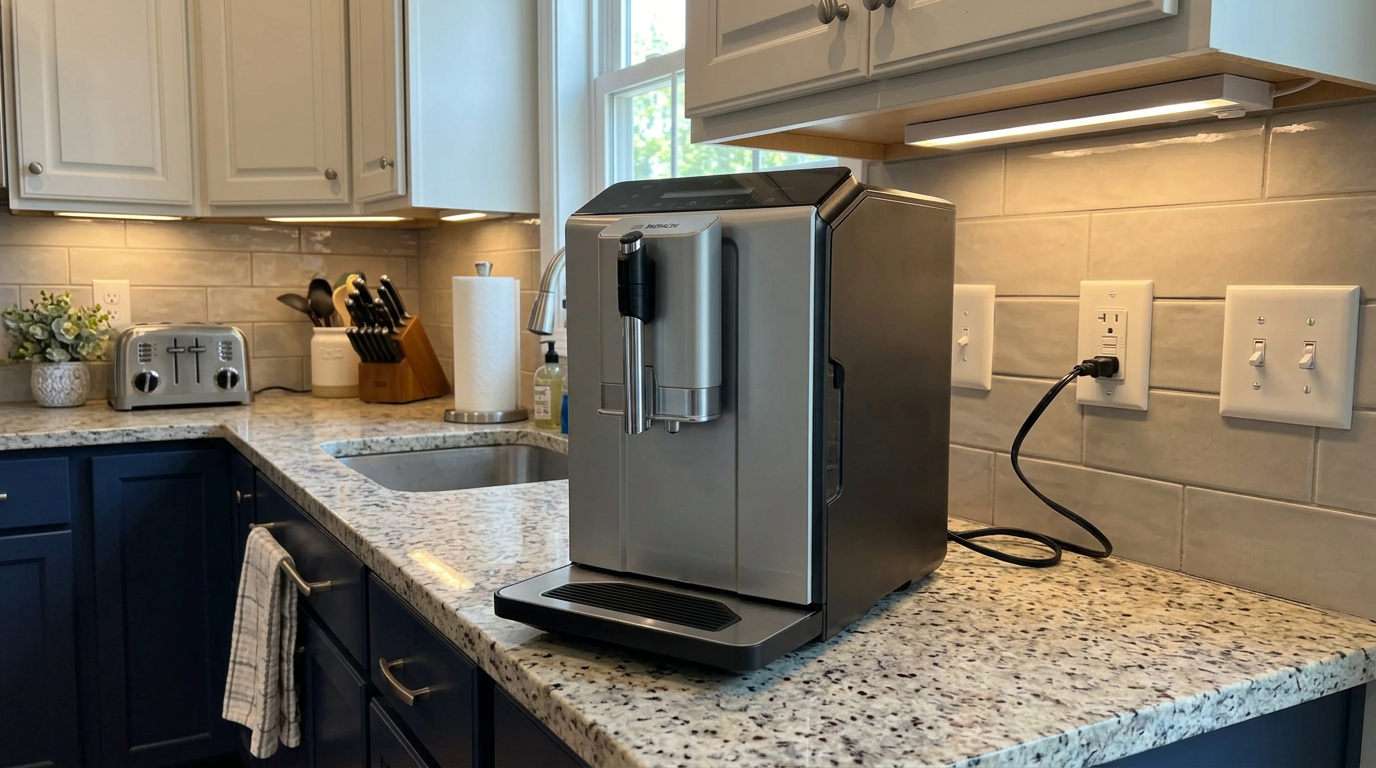
Its silver front works with both light and dark kitchens.
How it compares with the rest of the Bosch range
The most useful comparison is with the machines one or two steps up in the same family.
The Bosch 300 Series stands out for its slim body and easy cleaning, while the bigger models add drinks, tank size and features.
| Feature | 300 Series | 500 Series | Series 6 |
|---|---|---|---|
| Drinks on the machine | 5 | 9 | 25 |
| Milk system | In-cup frother | Hose from the carton | Hose from the carton |
| Control | Sensor keys | Keys and display | 3.7 in touchscreen |
| Water tank | 45 oz | 64 oz | 61 oz |
| Bean hopper | 9 oz | 9.5 oz | 10.6 oz |
| Cup clearance | 5 in | 5.5 in | 6.5 in |
| App and favorites | No | No | Yes |
| Removable brew unit | Yes | Yes | Yes |
The 500 Series is the natural next step if you want an Americano, a flat white and a hose that draws milk straight from the carton.
The Series 6 adds a touchscreen, 25 drinks and saved favorites, at the cost of a larger body.
The 300 Series keeps things simple in the smallest footprint.
| You mostly drink | Is the 300 Series a fit? | Why |
|---|---|---|
| Espresso | Very good | Smooth shot from a ceramic grinder |
| Coffee in a mug | Good | Clean, but run two brews for big mugs |
| Cappuccino and latte macchiato | Good | Creamy in-cup foam |
| Flat white or Americano | Poor | Not on the menu |
| Iced coffee | Fair | No program, but easy by hand |
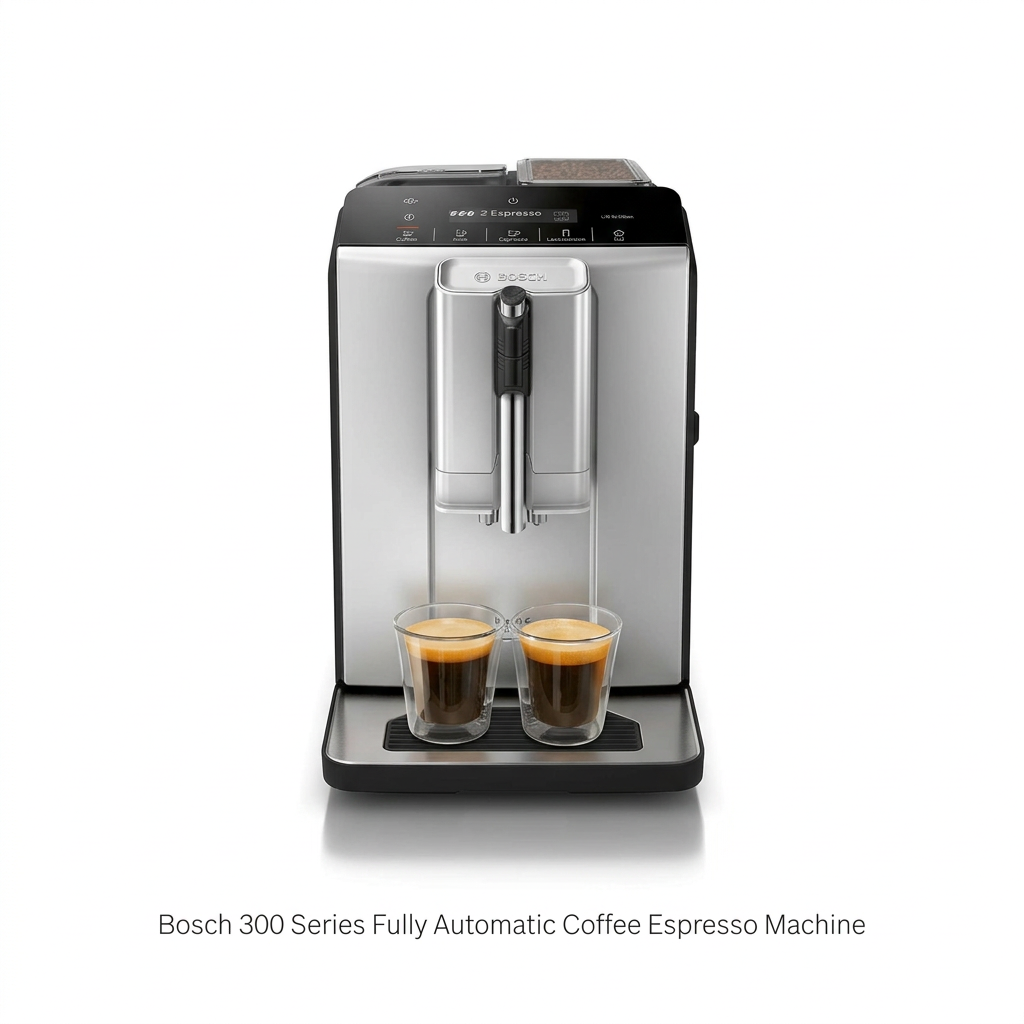
The full package: sensor-key panel, adjustable spout and front drip tray.
Other Bosch machines I tested
For nine drinks and a milk hose, see my Bosch 500 Series review.
The Bosch Series 4 adds Quick Cup, an app and a bigger tank.
For a touchscreen and 25 drinks, read my Bosch Series 6 review, and for the top of the range, my Bosch 800 Series review.
Which one is right for you: is the Bosch 300 Series your match?
4 quick questionsBosch 300 Series specifications
From manufacturer data and my own testing.
How I tested and scored the Bosch 300 Series
For four weeks, Michael Reynolds and I used the Bosch 300 Series as our everyday machine for espresso, coffee, cappuccino, latte macchiato and milk froth.
We worked through the grind steps and strength levels, programmed our own cup sizes and compared the default drinks with our adjusted ones.
We made milk drinks with whole, 2%, skim and barista oat milk, followed the daily and weekly cleaning routine and kept notes on how often the tank and tray needed attention.
We then checked our notes against Bosch's specifications and owner documentation.
- Espresso (7.8): body, crema, flavor, temperature and consistency across back-to-back shots.
- Milk drinks (7.4): foam texture, milk temperature and how easy the frother is to get right.
- Ease of use (8.5): controls, setup, programming and day-to-day handling.
- Cleaning (7.9): brew unit, frother, drip tray and maintenance prompts.
The overall score of 7.7 is an editorial rating that reflects those four areas.
Bosch 300 Series FAQ
Is the Bosch 300 Series worth it?
Yes, if you want simple, fresh-ground espresso, coffee and cappuccino with very easy cleaning. If you want more drinks, an app or a bigger tank, look at a higher model in the range.
How many drinks does the Bosch 300 Series make?
Five: espresso, coffee, cappuccino, latte macchiato and milk froth. The silver model can also brew two drinks at once.
How does the milk frother work?
A clip-on frother on the front draws milk through a short tube and steams it straight into your cup. Push it on until it clicks and use cold milk for the best foam.
Is the milk frother dishwasher-safe?
Yes. It pulls off the front, comes apart into a few pieces and all of them can go in the dishwasher.
Can I remove the brew unit?
Yes. Open the front door, press the release and slide it out. Rinse it with water only, never soap, and let it dry before you put it back.
How big is the water tank?
About 45 ounces, or 1.3 liters. It lifts out from the back, and with two coffee drinkers you'll refill it every day or two.
Does the Bosch 300 Series have a cup warmer?
The silver model doesn't. The dark silver version of the 300 Series has a heated top plate.
Can I adjust the grind?
Yes, in a few steps. Only change it while the grinder is running, and wait two or three cups before judging the result.
How do I set the cup size?
Hold the drink button until the machine starts in programming mode, then press again when the cup holds what you want. It remembers that volume.
Can it make iced coffee?
There's no iced program, but you can brew two espressos over cold milk and add ice last for a good iced latte.
How loud is the Bosch 300 Series?
It's quiet for a bean-to-cup machine. The ceramic grinder gives a short, low hum and the sealed hopper lid muffles it further.
Kitchen & coffee tester
Michael spent six years as a line cook in restaurants in Chicago and New York, and he has tested kitchen appliances for HouseholdMe since 2018, from air fryers to coffee makers. He holds an SCA certificate in barista skills and used the Bosch 300 Series as his everyday coffee machine for four weeks for this review.
- Four weeks of hands-on testing of the Bosch 300 Series TIU20307
- Bosch product specifications, spec sheets and owner documentation
- General espresso brewing and maintenance guidance