Bosch 800 Series review: a 5-inch touchscreen, 30 saved favorites and an 81-ounce tank that rarely needs filling
The Bosch 800 Series Automatic Coffee Espresso Machine is the top of Bosch's countertop range. It has the biggest screen, the biggest tank, a 19-bar pump, a milk container that clips on and off and room for 30 saved favorites. The espresso is the best in the range, but the drip tray fills quickly and drinks come out warm rather than piping hot.

Michael Reynolds
Hands-on review
Hands-on testing, research, specs
4 weeks
23 minutes
Jargon helpNew to espresso? Tap any dotted term to see what it means.
In this review
Yes, if you want the most capable Bosch on the counter and you don't mind its size. The Bosch 800 Series makes the best espresso in the range, puts 24 drinks and 30 favorites on a big 5-inch touchscreen and holds 81 ounces of water. Its clip-on milk container goes straight into the fridge, and its grinder is impressively quiet. The drip tray needs emptying often, drinks come out warm rather than scalding, and parts of the body are plastic.
Bosch 800 Series at a glance
Bosch 800 Series pros and cons
- Rich espresso from a 19-bar pump
- 5-inch touchscreen with 30 favorites
- 81-ounce tank and a quiet ceramic grinder
- Drip tray fills quickly
- Drinks are warm rather than piping hot
- Large, and parts of the body are plastic
Who should buy the Bosch 800 Series?
- Families with many different drink preferences
- Capsule owners who want fresh beans with the same ease
- Early risers who need a quiet grinder
- People who like their coffee scalding hot
- Kitchens with low wall cabinets over the counter
- Espresso hobbyists who want full manual control
First impressions of the Bosch 800 Series
Michael Reynolds and I used the 800 Series as our everyday machine for four weeks.
It's the biggest Bosch countertop machine, and it feels like the flagship the moment it comes out of the box.
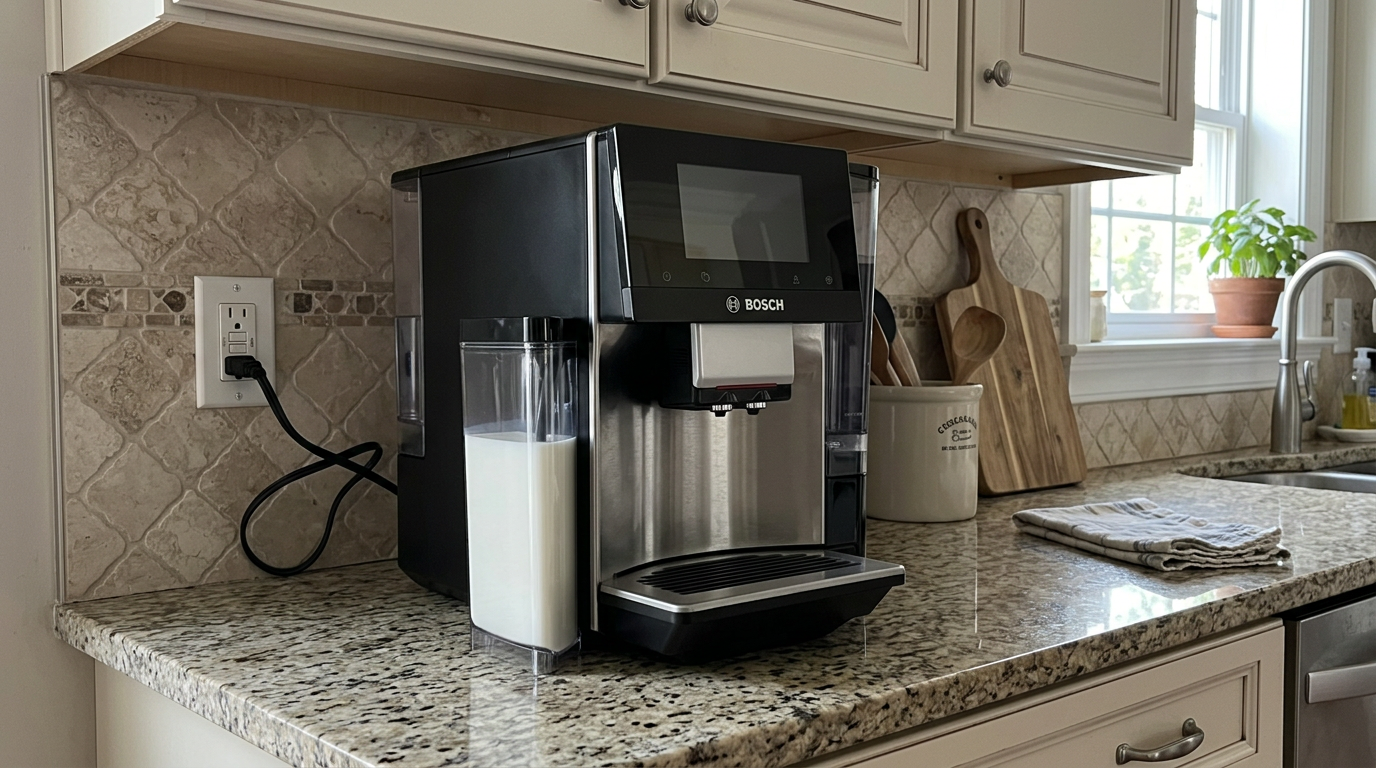
My silver unit has a brushed metal front, a black top section and a tall clear milk container that clips onto the side.
The 5-inch touchscreen dominates the front.
It's bright, sharp and responds like a small tablet, with every drink shown as a clear image.
My first cappuccino came out after three taps, with a thick cap of foam and a sweet, nutty espresso underneath.
The second thing I noticed was the sound, or the lack of it.
The grinder is the quietest I've heard in this range, more of a soft hum than a grind.
The tall milk container clips onto the side and comes off for the fridge.
What the Bosch 800 Series actually is
The 800 Series is a fully automatic, bean-to-cup espresso machine with an attached milk container and Wi-Fi.
It grinds fresh beans for every drink, tamps and brews them, then drops the dry puck into the grounds container.
For milk drinks, it draws milk from the attached container, froths it with steam and pours it into the cup.
The water is heated by a thermoblock✕ThermoblockA compact heater that warms water as it flows through, instead of keeping a whole boiler hot. It heats up fast and uses little standby energy., and a 19-bar pump drives it through the coffee.
That's more pump pressure than the rest of the range, which uses 15 bar.
Every other machine I tested, from the Bosch 300 Series to the Bosch Series 6, runs at 15 bar.
My test unit is model TQU60307 in silver.
It has 24 drinks on the touchscreen and up to 36 through the Home Connect app, including a cold brew-style drink and international specialties.
The stainless steel version of the 800 Series adds a cup warmer on top, which my silver unit doesn't have.
Bosch 800 Series design and setup
The Bosch 800 Series measures about 13.9 × 15 × 18.4 inches, or 35.2 × 38.1 × 46.7 cm.
It weighs about 22 pounds, so it needs a permanent spot rather than one you change often.
It's the widest machine in the Bosch range, mostly because of the milk container on the side.
Mind the cabinets
At 15 inches tall, it fits under most wall cabinets, which typically sit about 18 inches above the counter.
The problem is the bean hopper, which you fill from the top.
Under my cabinets, there wasn't enough room to pour beans in comfortably, so I pulled the machine forward each time.
At 22 pounds, that gets old quickly.
In the end, I kept a small scoop next to the machine and topped up the hopper a little at a time.
The depth matters too.
At about 18.4 inches, it uses the full depth of a standard counter, and it needs a bit of space behind for air to circulate.
Build quality
The brushed metal front looks premium on the counter.
The bean lid, water tank handle, drip tray, side panel and much of the frame are plastic.
Nothing felt flimsy, but it doesn't have the heavy, all-metal feel the touchscreen might lead you to expect.
First-time setup
Setup is guided on the touchscreen and took about 15 minutes, plus a few minutes to pair the app.
You choose the language, test your water hardness with the strip, fit the filter and run a first rinse to prime the lines.
The default settings were a little light for my taste, which I'll come back to in the grinder section.
Our tip: Before you choose a spot, check you have room to open the bean lid without pulling the machine forward.
What's in the box
Bosch includes a good set of extras with the 800 Series.
The milk adapter is a nice touch.
It lets you skip the container and draw milk straight from a carton, which is handy for plant milks you only use now and then.
The microfiber cloth is ideal for the brushed front and the touchscreen, which both pick up fingerprints.
Bundles vary between sellers, so check what's included where you buy.
What happens when you tap a drink
Knowing the sequence explains most of the 800 Series' habits, especially the busy drip tray.
Every time it switches on or off, it sends hot water through the coffee path and out of the spout.
After every milk drink, it purges the milk path with steam, and that water goes into the drip tray too.
When you tap a drink, the grinder drops fresh grounds into the brew unit✕Brew unitThe chamber inside an automatic machine that receives the ground coffee, presses it into a puck, pushes hot water through it and then ejects the used grounds..
The brew unit compacts them, wets them and then pushes hot water through at pressure.
Bosch's AromaMax system manages the dose, water volume, flow and temperature for each recipe.
| Step | What the machine does | Roughly how long |
|---|---|---|
| 1. Wake and heat | Thermoblock warms up | Seconds |
| 2. Rinse | Hot water flushes the coffee path | 5 to 10 s |
| 3. Grind | Ceramic discs grind fresh beans | 3 to 6 s |
| 4. Pre-wet | A little water soaks the puck | 2 to 4 s |
| 5. Brew | Hot water is pushed through at pressure | 15 to 50 s |
| 6. Milk | Steam draws and froths milk from the container | 15 to 40 s |
| 7. Clean | Steam purges the milk path | About 5 s |
For a finished cappuccino, the whole sequence takes under 90 seconds.
The 5-inch touchscreen and 30 favorites
The touchscreen is the best in the Bosch range.
At 5 inches, it shows large drink images that you swipe through like a phone.
Tap a drink and you get sliders for strength, size and milk ratio, plus an aroma setting.
Adjustments are easy to read and easy to undo.
Strength runs from mild up to extra strong, with double-shot settings at the top for bigger drinks.
Size is shown in ounces, so you can match it to your cup.
30 favorites
The 800 Series stores up to 30 favorites, the most in the range.
The Series 6 stores ten, and the Bosch Series 4 keeps favorites only in its app.
We set up favorites for both of us, plus a few for regular visitors, and each one became a one-tap shortcut.
There's also a Coffee Playlist, which brews a list of different drinks one after another.
When four friends came over, I set up their drinks once, and the machine worked through them while I talked.
| Setting | Range | What it changes |
|---|---|---|
| Strength | Mild to extra strong, plus double shot | Coffee per brew or two brews per cup |
| Size | Shown in ounces | Volume of the drink |
| Milk ratio | Several steps | Milk compared with coffee |
| Aroma | Several levels | How the coffee is pre-wetted |
| Two cups | On or off | Two drinks side by side |
| Favorites | Up to 30 | Saved drinks as one-tap shortcuts |
| Coffee Playlist | Several drinks in a row | Brews a round for guests |
Our tip: Build a Coffee Playlist before guests arrive, so the machine can make a round of different drinks while you look after people.
The quiet ceramic grinder
The 800 Series grinds with a ceramic disc grinder✕Ceramic disc grinderTwo hard ceramic plates that crush beans between them. Ceramic stays sharp for a long time and transfers little heat to the coffee, which helps protect its aroma. in an insulated chamber.
Ceramic stays sharp and runs cool, which protects the coffee's aroma.
The insulation is what you notice day to day.
It gives a soft, low hum instead of the high whine of many grinders, and it never woke anyone in my house.
Approximate readings with a phone sound meter. The 800 Series' grinder was close to the level of normal conversation.
Dialing it in
Out of the box, the grinder is set to a middle position.
With my medium-dark beans, the default espresso tasted a little thin and light.
Two steps finer gave a much richer shot with better crema and body.
The adjuster sits near the bean hopper.
Only turn it while the grinder is running, because turning it with the discs stopped can trap beans and damage the drive.
After a change, wait two or three drinks, because some old grounds are still in the chute.
Bars show how much resistance the coffee puts up. Tested with a medium-dark blend at strong strength.
Bosch 800 Series espresso performance
Once dialed in, the 800 Series made the best espresso of all the Bosch machines I tested.
With a medium-dark blend at strong strength, the shot was thick and syrupy.
I tasted dark chocolate, roasted almond and a little caramel, with low acidity and a long, clean finish.
The crema✕CremaThe golden-brown foam on top of an espresso. It forms when pressure pushes gases and oils out of freshly ground coffee. was dense and hazelnut-colored, and it lasted for several minutes.
The 19-bar pump and AromaMax system give it a little more body than the 15-bar machines in the range.
The ristretto was even better, short and sweet with less bitterness.
The aroma setting
The aroma setting changes how gently the coffee is wetted before full pressure.
With a medium roast, the highest setting gave a rounder, sweeter shot with softer acidity.
With darker beans, the difference was smaller, so I left it in the middle.
Consistency
I made six espressos back to back for a family lunch.
They tasted the same from first to last, with no drop in body or crema.
| What you taste or see | Likely cause | First change |
|---|---|---|
| Sour, thin, watery | Grind too coarse - default | Two steps finer while grinding |
| Bitter, harsh, drying | Over-extraction | One step coarser or a smaller size |
| Pale crema that fades fast | Stale beans | Use beans within a few weeks of roasting |
| Drips slowly or stops | Grind far too fine | One step coarser while grinding |
| Lukewarm shot | Cold cup or cold pipes | Warm the cup and run hot water first |
Temperature: warm, not scalding
Temperature is the 800 Series' most talked-about weakness, and I can see why.
Drinks come out warm and ready to sip, rather than piping hot.
In my measurements, milk drinks landed around 150 to 160°F in the cup, and espresso a little higher.
If you like your coffee above 175°F, you'll notice it.
It's a range-wide trait: the Bosch 500 Series and the Series 6 serve at similar temperatures, though the Series 6's cup warmer helps.
The good news is that three habits close most of the gap.
First, warm the cup, either with hot tap water or, on the stainless version, on the cup warmer.
Second, run a short hot water flush into your cup before the first shot of the day, then tip it out.
Third, use milk straight from the fridge, which gives the steam longer to heat and froth it.
Approximate readings with a probe thermometer. Your numbers will vary with cup size and room temperature.
The drinks menu
With 24 drinks on the screen, the 800 Series covers almost everything.
We used about a dozen regularly, and the rest came out when friends visited.
| Drink | How it's made | Our verdict |
|---|---|---|
| Espresso | Short pressure shot, about 1 to 1.5 oz | Rich and syrupy once dialed in |
| Ristretto | Shorter shot with less water | Sweetest straight coffee on the menu |
| Americano | Espresso plus hot water through a separate path | Clean and bright, never bitter |
| Coffee | Longer continuous pour for a 6 to 8 oz mug | Smooth, good drip replacement |
| Cappuccino | Foam first, then a double shot through it | Thick foam, strong coffee |
| Flat white | More coffee with finer milk | Our favorite milk drink |
| Latte macchiato | Hot milk and foam, espresso through the top | Clean layers in a glass |
| Cold brew-style drink | Cold water through the coffee | Soft and smooth over ice |
The Americano deserves a mention.
It adds hot water through a separate path rather than pushing it all through the coffee, so it stays clean and never turns bitter.
It became my afternoon drink.
Coffee pot
The 800 Series can also brew a coffee pot of about 25 ounces in several cycles.
With a low thermal jug under the spout, it was ideal for weekend breakfasts.
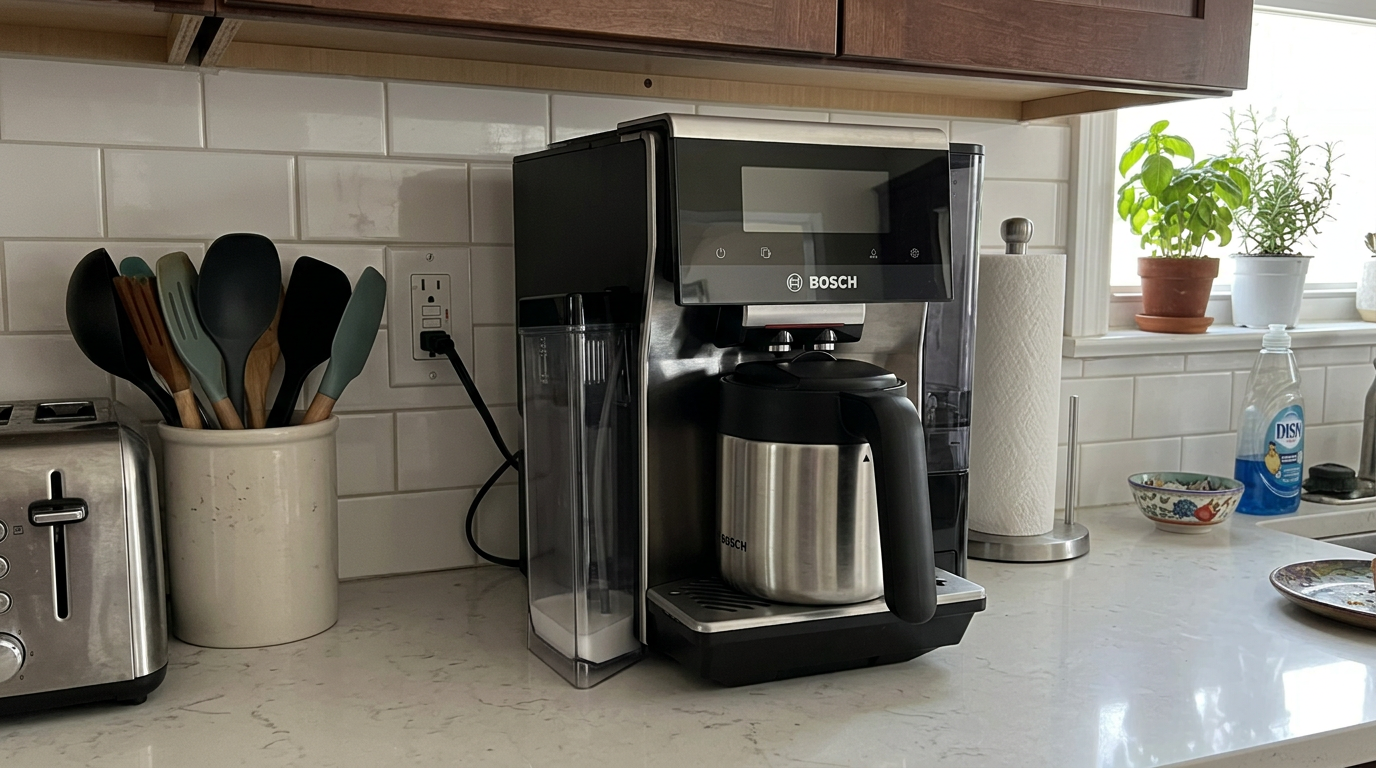
The coffee pot option fills a jug for a group in several cycles.
Our tip: Use the Americano instead of the long coffee for big mugs, because the separate hot water keeps it clean and smooth.
Milk foam and the milk container
The 800 Series uses a clear milk container of about 24 ounces that clips onto the side.
A short tube connects it to the spout, and steam draws the milk up, heats it and froths it.
After breakfast, you unclip the container and put it straight in the fridge door.
That's the big advantage over a loose hose: the milk stays cold, covered and ready.
The hose on the 500 Series and Series 4 is simpler to clean, but you have to remember to put the carton away.
The foam was creamy and consistent, with small, even bubbles.
It was excellent for cappuccinos and lattes, though not quite the glossy microfoam✕MicrofoamMilk foam with bubbles so small you can't see them. It feels silky and blends into the coffee instead of sitting on top like froth. you'd need for detailed latte art.
There's no knob to adjust the air, so the foam style is set by the recipe and the milk ratio.
My ratings on a 10-point scale for texture and how long the foam held.
Cold milk matters
Milk straight from the fridge, around 35 to 40°F, gave dense, glossy foam.
Milk that warmed above about 50°F on the counter made big, soapy bubbles that collapsed in the cup.
With the container living in the fridge between uses, that was easy to avoid.
After every milk drink, AutoMilk Clean✕AutoMilk CleanBosch's automatic steam purge. After each milk drink, a short burst of steam clears milk from the frothing path so it doesn't dry inside. blasts steam through the milk path to clear it.
Our tip: Unclip the milk container and put it in the fridge as soon as you've finished, so the milk stays cold for the next round.
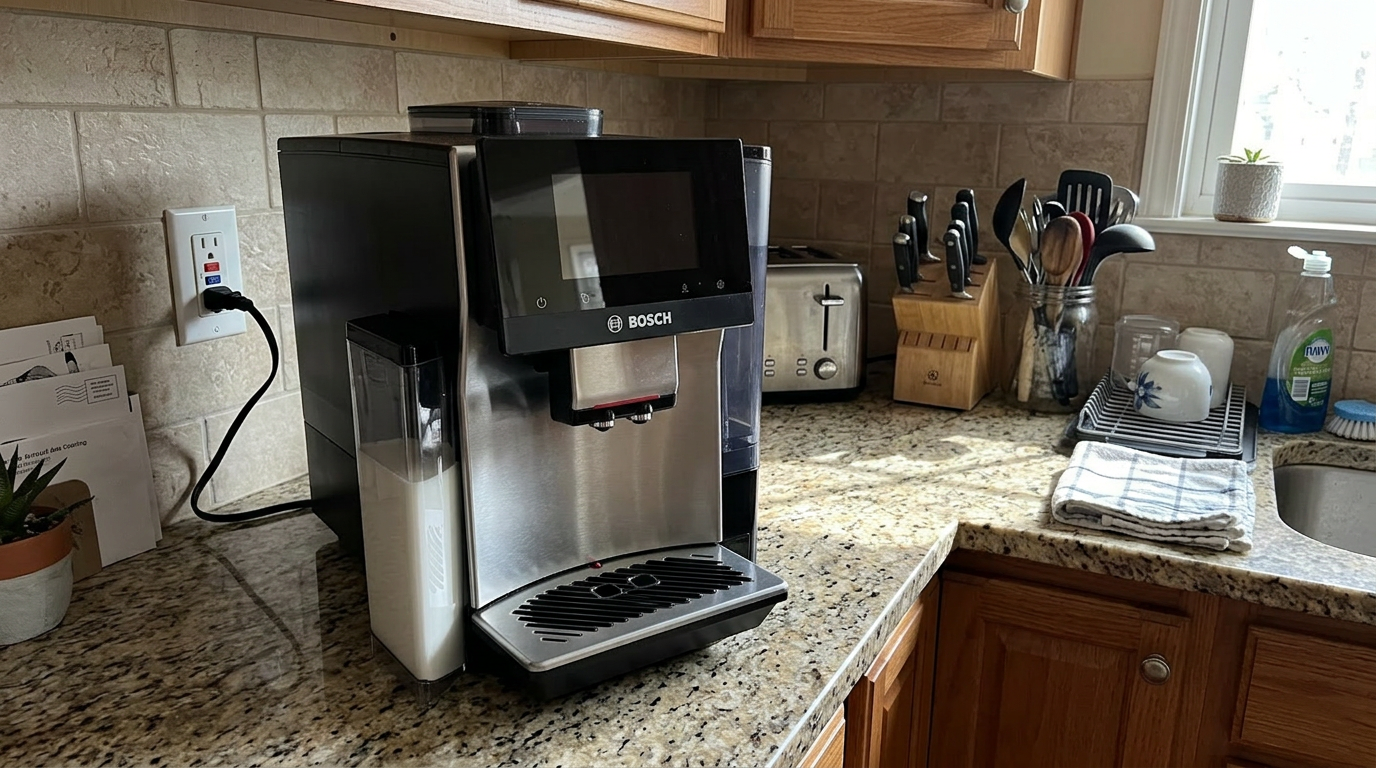
The milk container sits on the side, which adds to the width but keeps milk tidy.
The Home Connect app
The app adds 12 more drinks, for 36 in total, including international coffee specialties.
It can also start a drink remotely and send reminders for water, beans and maintenance.
Remote start has one practical catch.
When the machine wakes from cold, it runs its rinse first, and that hot water goes wherever the spout points.
If your mug is already in place, the rinse water ends up in your drink, and if there's no mug, the coffee ends up in the drip tray.
In practice, I found the touchscreen faster for everyday drinks, and used the app mostly for the extra recipes and reminders.
| Feature | On the machine | In the app |
|---|---|---|
| Drinks | 24 | Up to 36 |
| Favorites | 30 | Yes |
| Coffee Playlist | Yes | Yes |
| Remote start | No | Yes |
| Maintenance reminders | On screen | Push notifications |
| International specialties | Some | More |
Our tip: If you want to use remote start, leave an empty cup under the spout to catch the wake-up rinse, then swap in your mug.
Small problems I ran into, and the fixes
Over four weeks, the 800 Series never broke down.
But a few things came up that every new owner should know about.
| Problem | What caused it | What fixed it |
|---|---|---|
| Empty Drip Tray message mid-morning | Rinses filled the tray overnight | Empty it every evening |
| Thin espresso in week one | Default grind too coarse | Two steps finer while grinding |
| Rinse water in my remote-brewed mug | Wake-up rinse ran into the cup | Catch the rinse in a spare cup first |
| Soapy, large bubbles in foam | Milk container left out too long | Keep it in the fridge between uses |
| Beans spilled when refilling | Low cabinet above the hopper | Pull the machine forward or use a scoop |
| Milk not drawing | Tube not seated in the container | Push the tube fully into its port |
The drip tray message was the most common interruption by far.
Once emptying it became part of the evening routine, it stopped being an issue.
The thin espresso was the most important fix.
If you only try the default setting, you'll underrate this machine, because the difference after dialing in is big.
The remote-brew rinse issue is a small design quirk rather than a fault.
It's the reason I mostly used the touchscreen instead of the app for daily drinks.
Cleaning and maintaining the Bosch 800 Series
Much of the cleaning on the 800 Series is automatic.
It rinses the coffee path at power-on and power-off, and AutoMilk Clean purges the milk path after every milk drink.
The beverage outlet, drip tray and drip pans are dishwasher-safe.
The drip tray is the busy part
All those automatic rinses have to go somewhere, and that's the drip tray.
Even with only a few drinks a day, the machine asked me to empty it roughly once a day.
With four people and lots of milk drinks, it could ask twice.
It's the odd contrast of this machine: an 81-ounce tank you rarely fill, and a tray you empty often.
Milk container and tube
Every two or three days, I took the milk container, tube and spout parts apart and washed them in hot, soapy water.
Even with steam purging, milk fat slowly builds up inside the tube.
The brew unit
The brew unit comes out from the side.
You remove the water tank and the side panel, press the release and slide the unit out.
Rinse it under warm water, let it air-dry and slide it back in.
Never use soap and never put it in the dishwasher, because detergent strips the grease from its seals and gears.
Having a removable brew unit at all is a big plus, because you can see and rinse the part that touches every coffee.
Calc'n Clean
When it's due, the touchscreen guides you through Calc'n Clean✕Calc'n CleanBosch's combined maintenance program. A cleaning tablet removes coffee oils from the brew path while a descaling tablet dissolves mineral scale, in one guided cycle..
The cleaning tablet goes into a small compartment inside the bean container area, and the descaling✕DescalingRunning a mild acid solution through the machine to dissolve mineral scale left by hard water. Scale slows heating and can block pipes. tablet dissolves in the water tank.
Put a container of at least 30 ounces under the spout and the milk connector, press start and the program runs for about 20 to 30 minutes.
| When | Task | Why it matters |
|---|---|---|
| After milk drinks | Let AutoMilk Clean finish | Clears milk from the path |
| Daily | Empty drip tray and grounds container | Prevents mold and overflow |
| Every 2 to 3 days | Wash milk container, tube and spout parts | Removes milk fat |
| Weekly | Rinse the brew unit without soap | Removes grounds and oils |
| When prompted | Calc'n Clean | Removes oils and scale |
| When prompted | Replace the water filter | Keeps scale down |
My estimate of hands-on cleaning time per day, averaged over a week.
Our tip: Empty the drip tray every evening, even if the machine hasn't asked, so the morning rinses never stop your first drink.
What daily use is really like
Most mornings, I switched it on, let it rinse, took the milk container out of the fridge and clipped it on.
Then I tapped my favorite, and a cappuccino was ready in about 90 seconds.
After breakfast, the container went back in the fridge.
The 81-ounce tank is the 800 Series' great luxury.
The mid-range models hold 61 to 64 ounces, and the 300 Series just 45.
With two of us drinking milk drinks, Americanos and a few espressos, I filled it about twice a week.
Rough maths from an 81 oz tank, allowing for rinse water. Actual numbers depend on cup size.
Noise
It's the quietest Bosch I tested.
The insulated grinder hums softly, the pump is steady and the steam has a gentle hiss.
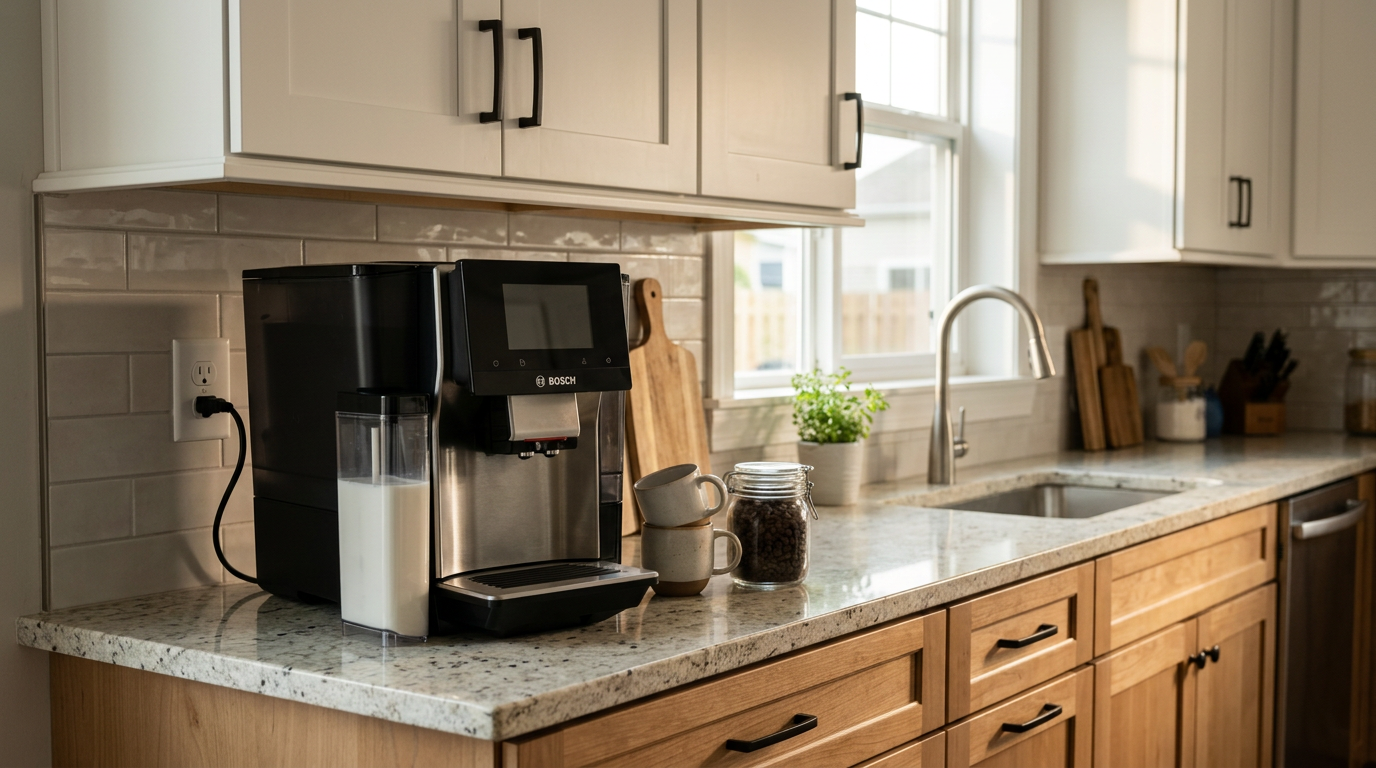
Under bright cabinets, the brushed front and large screen look sleek and modern.
Beans, water and milk
Use fresh whole beans within a few weeks of the roast date.
Medium and medium-dark roasts gave the best espresso and milk drinks.
Avoid very oily, dark beans and anything flavored or sugar-coated, because they gum up the grinder chute over time.
| Bean type | Espresso | Milk drinks |
|---|---|---|
| Medium-dark blend | Excellent, thick crema | Excellent |
| Medium roast | Very good, two steps finer | Very good |
| Light roast | Good at finest step with high aroma | Good |
| Very dark, oily | Not recommended | Not recommended |
| Flavored or glazed | Never | Never |
Fill the tank with fresh, cold water and use the filter if your water is moderately hard or harder.
Set your water hardness properly at setup, because it decides how often Calc'n Clean is needed.
A typical week with the 800 Series
Here's what a normal week looked like for the two of us, with a few guests at the weekend.
| Day | What we brewed | What the machine needed |
|---|---|---|
| Monday | Two flat whites - two espressos - one Americano | Drip tray emptied |
| Tuesday | Two cappuccinos - one ristretto | Drip tray emptied |
| Wednesday | Two flat whites - two Americanos | Tank refilled - milk parts washed |
| Thursday | Two cappuccinos - one espresso | Drip tray emptied |
| Friday | Two latte macchiatos - one Americano | Drip tray emptied |
| Saturday | Coffee Playlist for six - one coffee pot | Tank refilled - beans topped up |
| Sunday | Two flat whites - one espresso | Brew unit rinsed - milk parts washed |
That came to about 35 drinks, two tank refills and one bean top-up.
The drip tray needed emptying almost every day, while the tank only needed filling twice.
That pattern sums up the 800 Series: very little refilling, a little more emptying.
Common mistakes to avoid
The Bosch 800 Series is easy to live with, but a few habits will hold it back.
| Mistake | What happens | Better habit |
|---|---|---|
| Judging the default grind | Espresso tastes thin | Go two steps finer while grinding |
| Leaving the milk container out | Warm milk and loose foam | Store it in the fridge |
| Ignoring the drip tray | Machine stops mid-morning | Empty it every evening |
| Remote start into a mug | Rinse water dilutes the drink | Catch the rinse first |
| Washing the brew unit with soap | Seals dry out and parts stick | Rinse with water only |
| Filling the hopper under low cabinets | Spilled beans | Use a scoop or pull it forward |
What I would change
A bigger drip tray would fix the machine's most common daily annoyance.
Hotter default temperatures, or a simple temperature setting, would help people who like scalding coffee.
And a front-loading or angled bean hopper would make life easier under low cabinets.
Is the Bosch 800 Series worth the money?
The 800 Series is the Bosch to choose if you want the most capable machine and the most convenience.
You get the best espresso in the range, a big touchscreen, 30 favorites, a large tank and a milk container that lives in the fridge.
In return, you accept a large footprint, warm rather than scalding drinks and a drip tray that needs regular attention.
Ask yourself three questions before you buy.
Do several people in your house want different drinks? Do you have the counter space and cabinet height? And are you happy to warm your cups for hotter drinks?
If the answers are yes, the 800 Series is a superb everyday machine.
It's also the Bosch that handles guests best.
Thirty favorites, the Coffee Playlist and a coffee pot mean a round of mixed drinks is a few taps rather than a juggling act.
For a household that entertains often, that alone can justify the step up from the middle of the range.
Check what's included where you buy, because filters, cleaning tablets and milk adapters vary between bundles.
How it compares with other ways of making coffee
The most useful comparisons are with the setups people usually move from, and with the Bosch one step below.
| Feature | Bosch 800 Series | Capsule machine | Manual machine and grinder |
|---|---|---|---|
| Effort per drink | One tap | One button | Grinding, tamping, steaming |
| Freshness | Beans ground for every cup | Pre-ground in capsules | Beans ground for every cup |
| Drink variety | 24 on screen, 36 in the app | Depends on capsules | Unlimited, with skill |
| Time to a cappuccino | Under 90 s | About 1 to 2 min | 5 to 10 min with cleanup |
| Waste | Compostable grounds | Single-use capsules | Compostable grounds |
| Daily upkeep | Tray, milk parts, weekly brew unit | Very little | Wand, portafilter, grinder |
Moving from capsules, you get fresher, more aromatic coffee and less packaging waste, at the cost of a little more cleaning.
Moving from a manual setup, you lose the last bit of control over each shot, but gain speed and consistency.
Within Bosch's range, the Series 6 is the closest alternative.
| Feature | Series 6 | 800 Series |
|---|---|---|
| Display | 3.7 in touchscreen | 5 in touchscreen |
| Drinks on the machine | 25 | 24 |
| Drinks via the app | 41 | 36 |
| Favorites | 10 | 30 |
| Milk system | Hose into the carton | Attached milk container |
| Water tank | 61 oz | 81 oz |
| Pump pressure | 15 bar | 19 bar |
| Quick Cup | Yes | No |
| Cup clearance | 6.5 in | 5.5 in |
The Series 6 wins on Quick Cup and travel-mug clearance.
The 800 Series wins on screen size, favorites, tank size, pump pressure and the fridge-friendly milk container.
| You mostly drink | Is the 800 Series a fit? | Why |
|---|---|---|
| Espresso and ristretto | Excellent | Rich, syrupy shots once dialed in |
| Cappuccino and flat white | Very good | Creamy foam from cold milk |
| Americano | Excellent | Separate hot water path |
| Very hot drinks | Fair | Warm cups needed |
| Coffee for a group | Excellent | Coffee pot and Coffee Playlist |
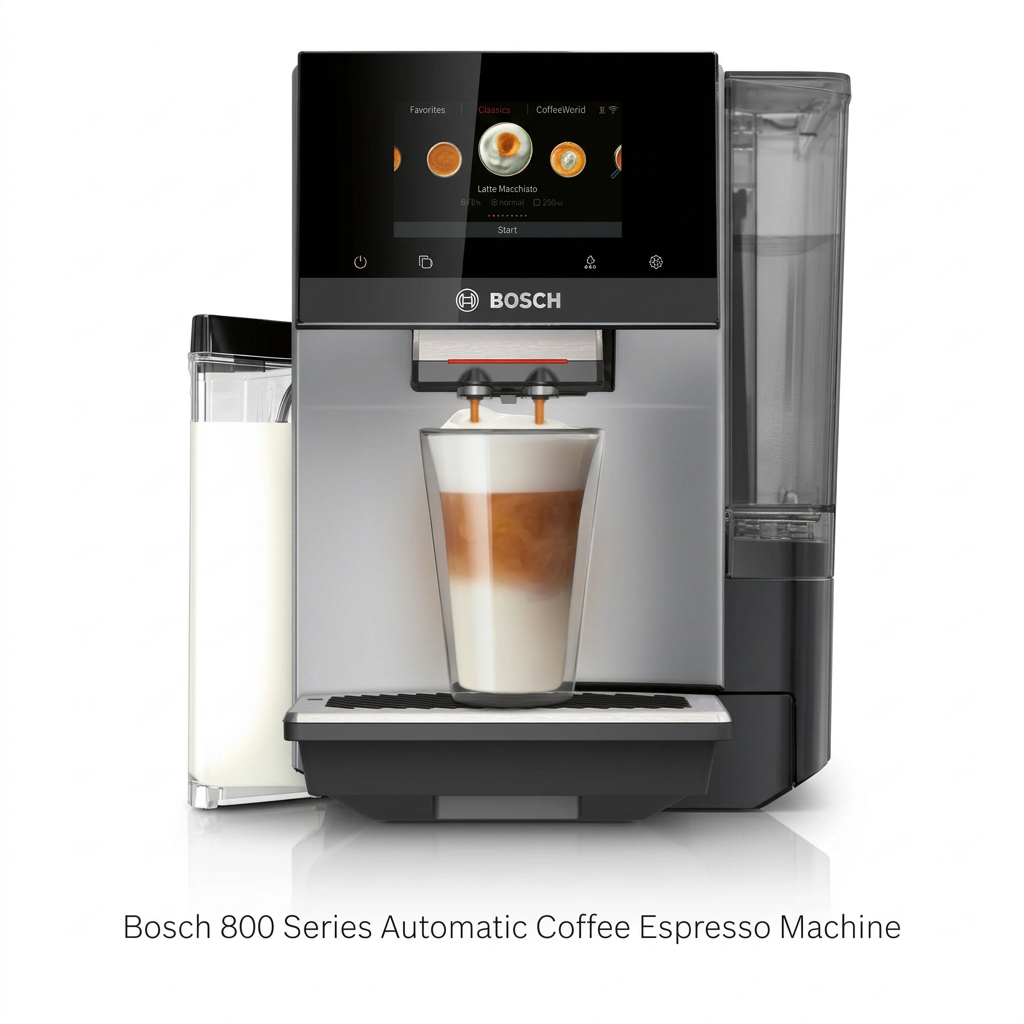
The full package: 5-inch touchscreen, adjustable spout, side milk container and drip tray.
Other Bosch machines I tested
For a slim, simple machine, see my Bosch 300 Series review.
The Bosch 500 Series has a decaf chute, and the Bosch Series 4 adds Quick Cup and an app.
For travel-mug clearance and Quick Cup with a touchscreen, read my Bosch Series 6 review.
Which one is right for you: is the Bosch 800 Series your match?
4 quick questionsBosch 800 Series specifications
From manufacturer data and my own testing.
How I tested and scored the Bosch 800 Series
For four weeks, Michael Reynolds and I used the Bosch 800 Series as our everyday machine for espresso, ristretto, Americano, coffee, cappuccino, flat white, latte macchiato and the cold brew-style drink.
We dialed in the grinder from the default setting, compared strength and aroma levels, set up favorites and a Coffee Playlist and brewed full coffee pots for guests.
We made milk drinks with whole, 2%, skim, barista oat and almond milk, measured temperatures with a probe and followed the full cleaning routine, including Calc'n Clean.
We then checked our notes against Bosch's specifications and owner documentation.
- Espresso (8.6): body, crema, flavor, temperature and consistency across back-to-back shots.
- Milk drinks (8.3): foam texture, milk temperature and the milk container.
- Ease of use (8.9): touchscreen, favorites, Coffee Playlist and the app.
- Cleaning (7.8): drip tray, milk parts, brew unit access and Calc'n Clean.
The overall score of 8.5 is an editorial rating that reflects those four areas.
Bosch 800 Series FAQ
Is the Bosch 800 Series worth it?
Yes, if you want the most capable Bosch, with the best espresso, a big touchscreen, 30 favorites and a large tank. If you want scalding drinks or have little space, look at a smaller model.
How many drinks does the Bosch 800 Series make?
24 on the touchscreen and up to 36 through the Home Connect app.
How many favorites can I save?
Up to 30, each with its own strength, size, milk ratio and aroma.
Why are the drinks not very hot?
Drinks come out warm and ready to sip. Warm your cup, run a short hot water flush first and use fridge-cold milk for hotter drinks.
How does the milk container work?
It clips onto the side and feeds milk to the spout through a short tube. Unclip it after use and store it in the fridge.
Why does the drip tray fill so fast?
The machine rinses on power-on, power-off and after every milk drink, and that water goes into the tray. Empty it daily.
How big is the water tank?
About 81 ounces, or 2.4 liters, the largest in Bosch's countertop range.
Is the grinder loud?
No. The insulated ceramic grinder is the quietest I tested in the range, with a soft hum.
Can I remove the brew unit?
Yes. Remove the water tank and side panel, press the release and slide it out. Rinse it with water only.
Can it make a pot of coffee?
Yes. The coffee pot option brews about 25 ounces in several cycles.
Does it have a cup warmer?
The silver model I tested doesn't. The stainless steel version of the 800 Series does.
Kitchen & coffee tester
Michael spent six years as a line cook in restaurants in Chicago and New York, and he has tested kitchen appliances for HouseholdMe since 2018, from air fryers to coffee makers. He holds an SCA certificate in barista skills and used the Bosch 800 Series as his everyday coffee machine for four weeks for this review.
- Four weeks of hands-on testing of the Bosch 800 Series TQU60307
- Bosch product specifications, spec sheets and owner documentation
- General espresso brewing and maintenance guidance