Best Window Cleaning Robots for Skylights and Slanted Glass (2026)
Skylights and roof windows are the hardest glass in the house to reach, and the hardest for a robot to stay on. I tested robots on pivot roof windows, a slanted glass gable and a sloping conservatory roof to find out what really works, and my top pick is the ECOVACS WINBOT W3 Omni. Just as important: I explain which slopes no robot should be on.

Emily Carter
Buying Guide
3 models · 3 picks
4 weeks per robot
I choose products independently. If you buy through my links, HouseholdMe may earn a commission at no extra cost to you. Affiliate policy
Jargon helpNew to window robots? Tap or hover over any dotted term to see what it means.
In this guide
The short answer
- Best for skylights and slanted glass: the WINBOT W3 Omni. The steadiest robot on steep slopes, with a battery station and self-washing pads.
- Best value: the WINBOT W2S Omni. A battery station and a TruEdge scrubber for the dirty frames of roof windows.
- Best lightweight pick: the HUTT H10. Easy to place on glass above your head, with a dry polishing pad for streak-free results.
- The honest caveat: window robots are built for steep glass. ECOVACS’ guidance puts the working range at roughly 60 to 120 degrees from horizontal, so shallow skylights and flat roof glass are off-limits.
Our picks at a glance
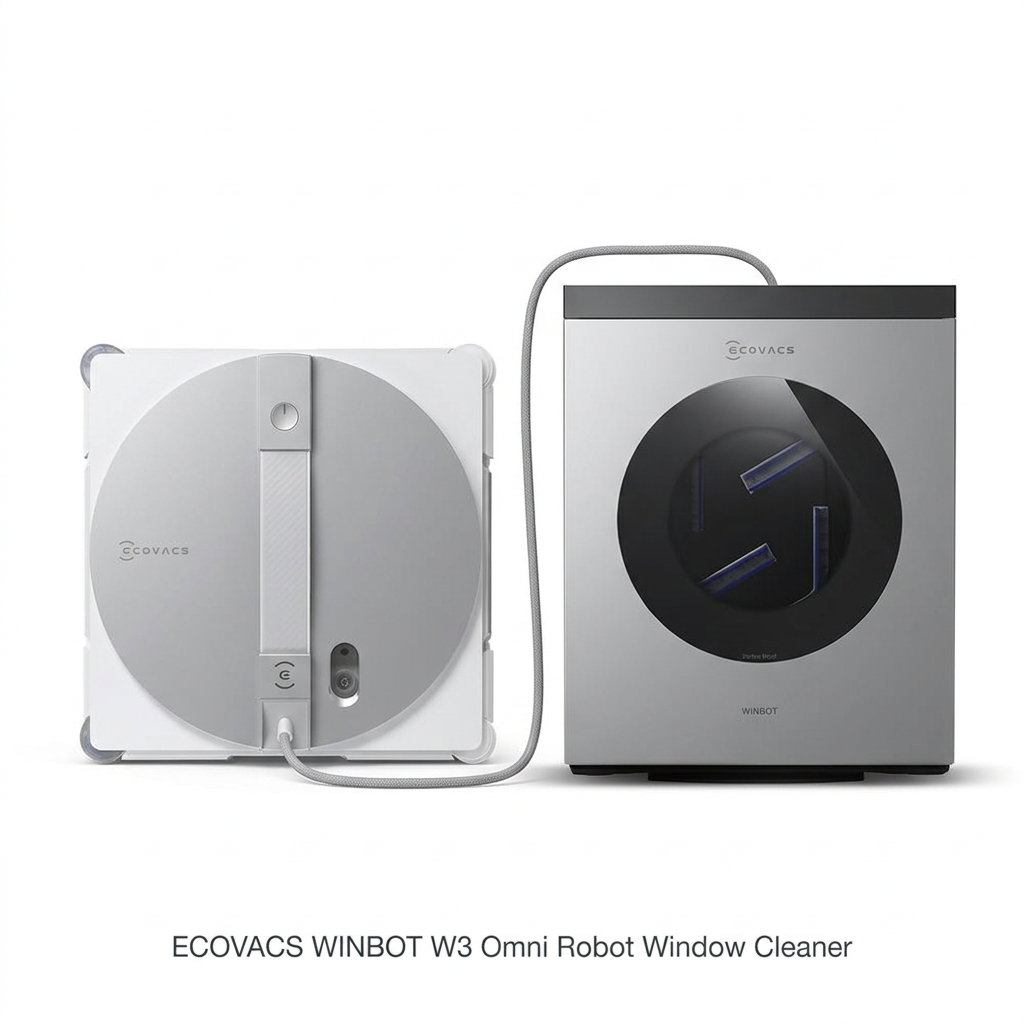
ECOVACS WINBOT W3 Omni
The calmest robot on sloping glass, with WIN-SLAM 5.0 mapping, a battery station and pads that wash themselves. Best on steep roof windows and slanted glass walls.
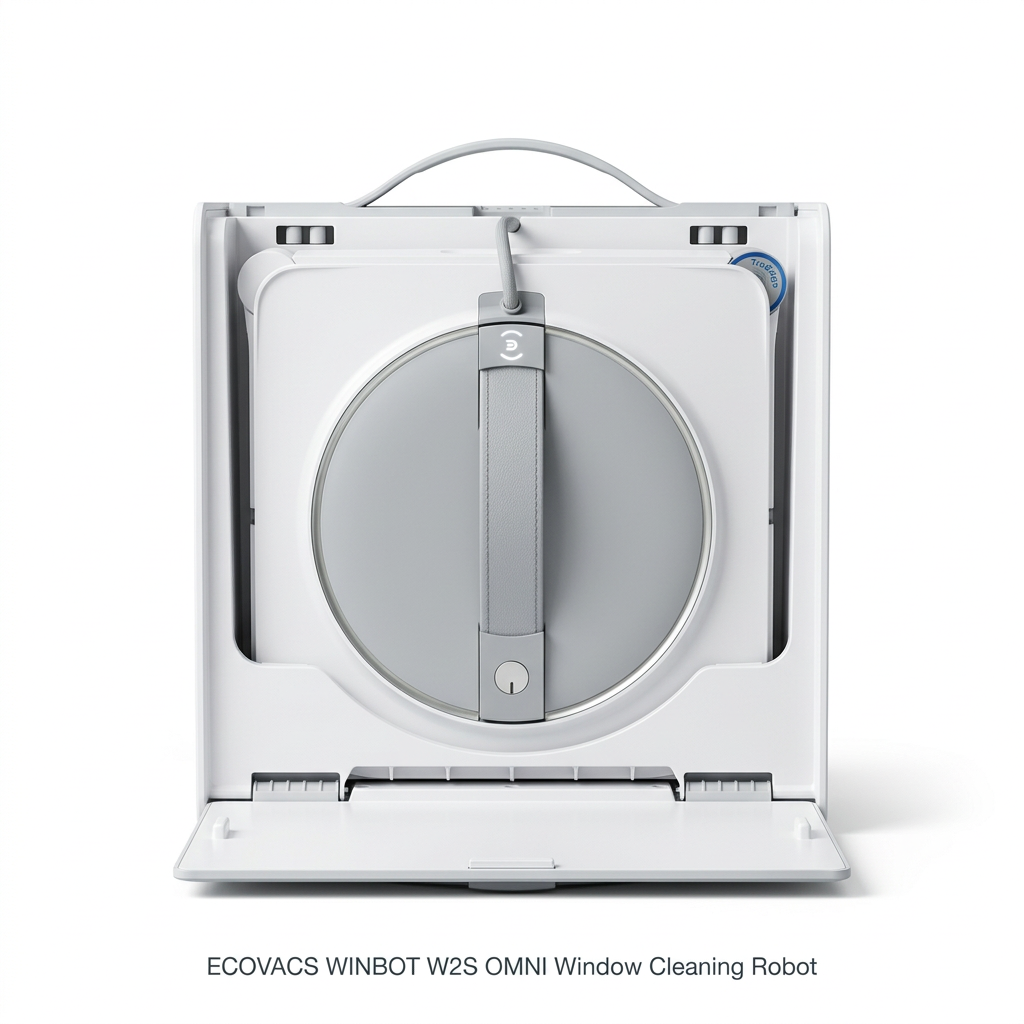
ECOVACS WINBOT W2S Omni
A battery station, 8,000 Pa and a TruEdge scrubber for the frames of roof windows, which collect the most dirt of any glass in the house.
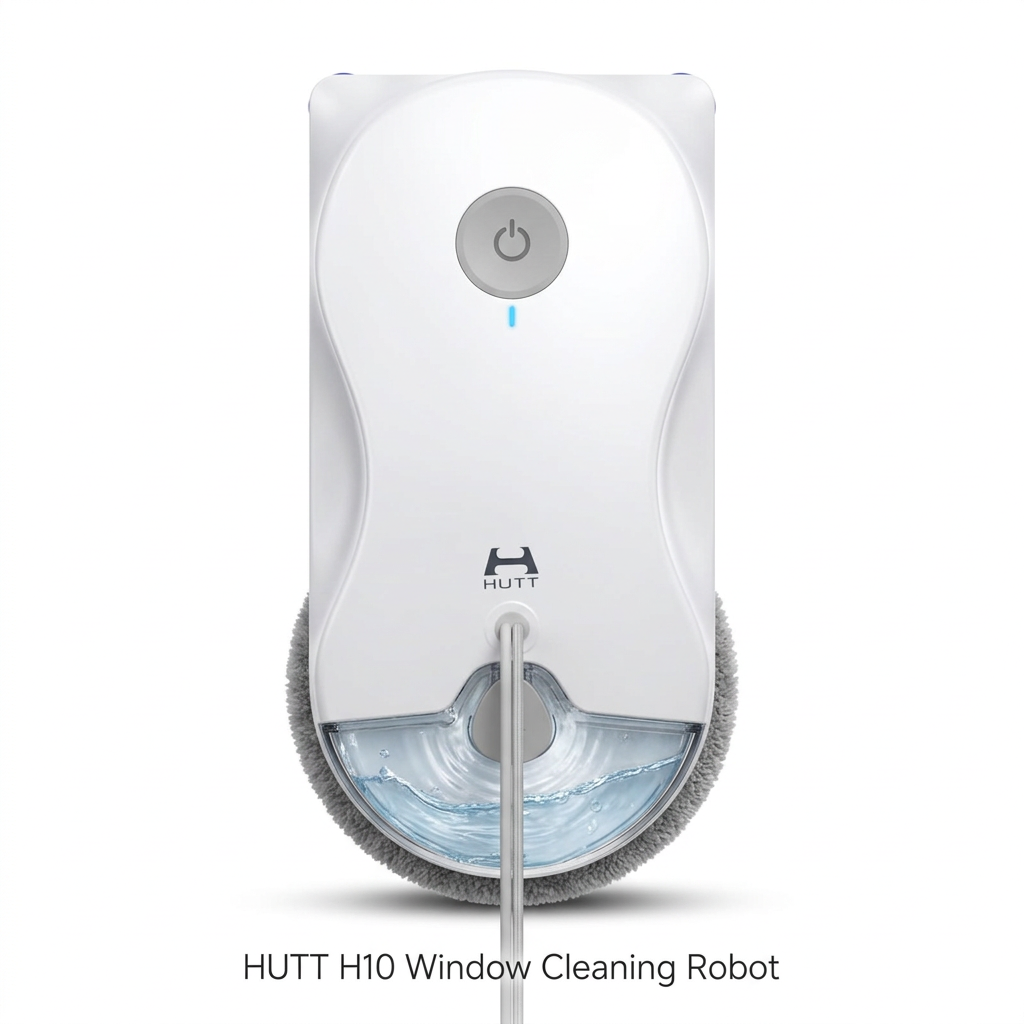
HUTT H10
Light enough to place easily on a roof window above your head, with a 30-minute backup and a dry polishing pad for streak-free glass.
Availability and deals change often. Check the current offer on Amazon before you buy.
First: will a robot work on your skylight?
This is the question to answer before you buy anything. A window robot holds on with suction and drives on tracks, and both are designed for upright glass. The flatter the glass, the more the robot struggles to know which way is up and to keep its tracks gripping.
ECOVACS’ own support guidance says a WINBOT can clean tilted glass when the angle between the glass and the horizontal is between 60 and 120 degrees, and warns that outside that range the robot may circle on the spot, get stuck or sound an alarm. Its most recent guidance is a little more generous, at 45 to 135 degrees.
| Your glass | Typical angle from horizontal | Robot suitable? |
|---|---|---|
| Vertical window | 90° | Yes |
| Steep slanted facade or gable glass | 60–85° | Yes |
| Pivot roof window turned for cleaning | Near vertical when rotated | Yes, from inside |
| Pitched roof window, fixed position | 30–60° | Only at the steep end of the range |
| Sloping conservatory roof | 15–30° | No |
| Flat skylight or roof lantern | 0–15° | No |
So the good news is that roof windows that pivot, steep slanted glass and gable glass are all realistic robot jobs. The bad news is that shallow skylights, roof lanterns and conservatory roofs are not, whatever a product listing implies.
Our tip: Measure the slope of your skylight with a free angle app on your phone before you buy, because the glass angle decides whether any robot will work.
Compare the best robots for slanted glass
I scored these robots on slanted and roof glass only, from 90 degrees down to the bottom of their rated range.
| 3 picks compared | Best overall | Best value | Lightweight |
|---|---|---|---|
| My slanted-glass scores | |||
| Overall score | 8.8 | 8.6 | 8.3 |
| Stability on slopes | 9.0 | 8.6 | 7.8 |
| Cleaning | 8.8 | 8.7 | 8.5 |
| Edge coverage | 8.6 | 8.6 | 8.1 |
| Safety | 9.3 | 9.0 | 8.6 |
| Hardware | |||
| Max suction | 8,000 Pa | 8,000 Pa | 6,500 Pa |
| Power | Battery station | Battery station | Corded + 30-min backup |
| Navigation | WIN-SLAM 5.0 | WIN-SLAM 4.0 | NAVI 7.0 |
| Self-washing pads | ✓ | ✕ | ✕ |
| Edge cleaning | TruEdge scrubber | TruEdge scrubber | Square polishing pad |
| Best for | Steep roof windows and slanted facades | Pivot roof windows with dirty frames | Indoor roof windows within reach |
My test scores on slanted glass
Each robot cleaned the same sloping glass for four weeks: two pivot roof windows in a loft bedroom, a slanted glass gable above a staircase and, as a limit test, the steeper panels of a conservatory roof.
I added a stability score for this guide, covering how calmly each robot held its line, turned and returned on sloping glass.
| Robot | Overall | Stability | Cleaning | Edges | Safety |
|---|---|---|---|---|---|
| WINBOT W3 Omni | 8.8 | 9.0 | 8.8 | 8.6 | 9.3 |
| WINBOT W2S Omni | 8.6 | 8.6 | 8.7 | 8.6 | 9.0 |
| HUTT H10 | 8.3 | 7.8 | 8.5 | 8.1 | 8.6 |
Editorial scores. Stability covers holding a straight line, turning and returning on glass between 60 and 90 degrees.
The two ECOVACS robots were clearly more settled on sloping glass. Both use WIN-SLAM mapping and square crawler tracks, which kept them on a steady line as the slope flattened.
The HUTT H10 cleaned beautifully but was the most sensitive to the angle. It was happy on steep glass and less so as the glass leaned back.
How I tested
I have tested home appliances professionally since 2016 and run HouseholdMe’s cleaning tests since 2021, with a background in industrial design.
For this guide I used three robots for four weeks each on slanted glass: two pivot roof windows in a loft bedroom, a slanted gable window above a staircase and the steeper roof panels of a conservatory, always from inside or from a safe platform.
I measured every glass angle with a digital angle finder, logged how each robot behaved at each angle and never stood on a roof or used an outdoor ladder to place a robot.
Suction vs gravity on sloping glass
On vertical glass, gravity pulls the robot straight down, parallel to the glass, and suction plus friction hold it in place. On sloping glass, part of the robot’s weight presses it into the glass, which sounds helpful, but the robot’s sensors and navigation are tuned for upright panes.
The real problems on shallow slopes are orientation and traction. A robot uses a gravity sensor✕Gravity sensora small sensor inside the robot that tells it which way is down, so it can plan its route and know where the top and bottom of the pane are. On very flat glass it loses that sense of direction. to know which way is down, and on flat glass it loses that reference and starts to circle or stop.
What suction does and does not do
Suction is measured in Pascals (Pa)✕Pascals (Pa)the unit used for suction. Higher numbers press the robot harder onto the glass., and both ECOVACS robots here grip at 8,000 Pa. That grip held them firmly at every angle in my test.
More suction does not fix the orientation problem, though. Even the strongest robot needs enough slope to know where it is going.
Traction matters too. On steep glass, the robot’s tracks or pads push against gravity as it climbs, and on sloping glass a light film of moisture or grit is enough to make the tracks spin. That is why clean tracks and dry glass mattered more in this test than in any other.
In practice, the robots in this guide behaved like this: rock solid on vertical glass, steady down to about 75 degrees, slower and more hesitant at 60 degrees and outside their comfort zone below that.
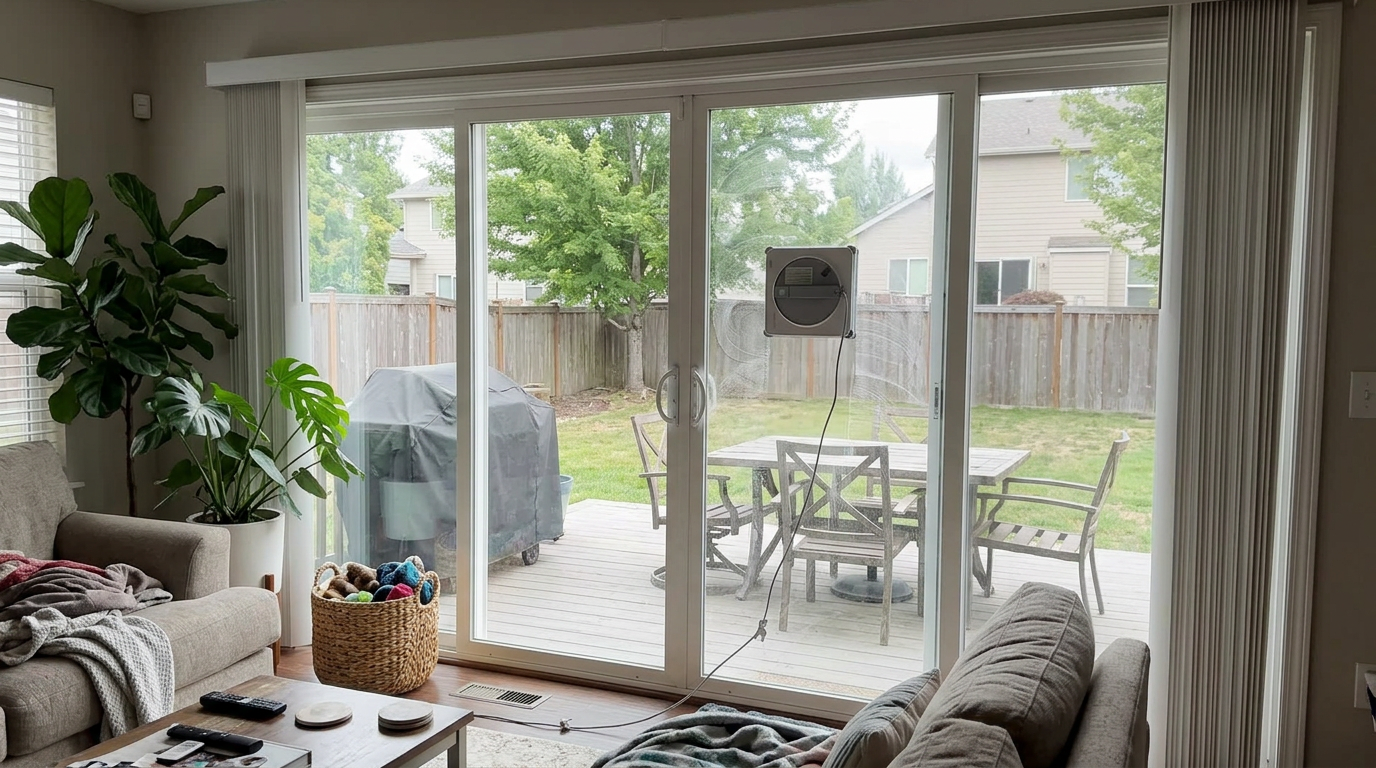
On steep slanted glass the station robots held a steady line; on shallow glass every robot lost its way.
Types of roof and slanted glass
“Skylight” covers very different kinds of glass. This is how the common types compare for a robot.
| Type | What it is | Robot verdict |
|---|---|---|
| Pivot roof window✕Pivot roof windowa roof window that rotates around a central hinge, so you can turn the outer pane to face into the room for cleaning. | Rotates for cleaning from inside | Good: turn it near vertical and clean both sides |
| Top-hung roof window | Opens outward from the top | Inside pane only, in most cases |
| Fixed skylight | A sealed glass panel in the roof | Usually too flat; no |
| Roof lantern | A glass pyramid or box on a flat roof | No |
| Conservatory roof | Low-pitch glass panels | No, apart from steep side panels |
| Slanted gable or facade glass | Steep glass in a wall | Yes, if within the angle range |
| Atrium glass | Large sloping glass over a space | Only steep sections, and only with safe access |
Pivot roof windows are the sweet spot. Once you rotate the sash, the outer pane faces you at a steep angle inside the room, and a robot can clean it safely without anyone going on the roof.
Our tip: Turn a pivot roof window until the glass is as close to vertical as it will go, because every extra degree makes the robot steadier.
Our picks in depth
1. ECOVACS WINBOT W3 Omni
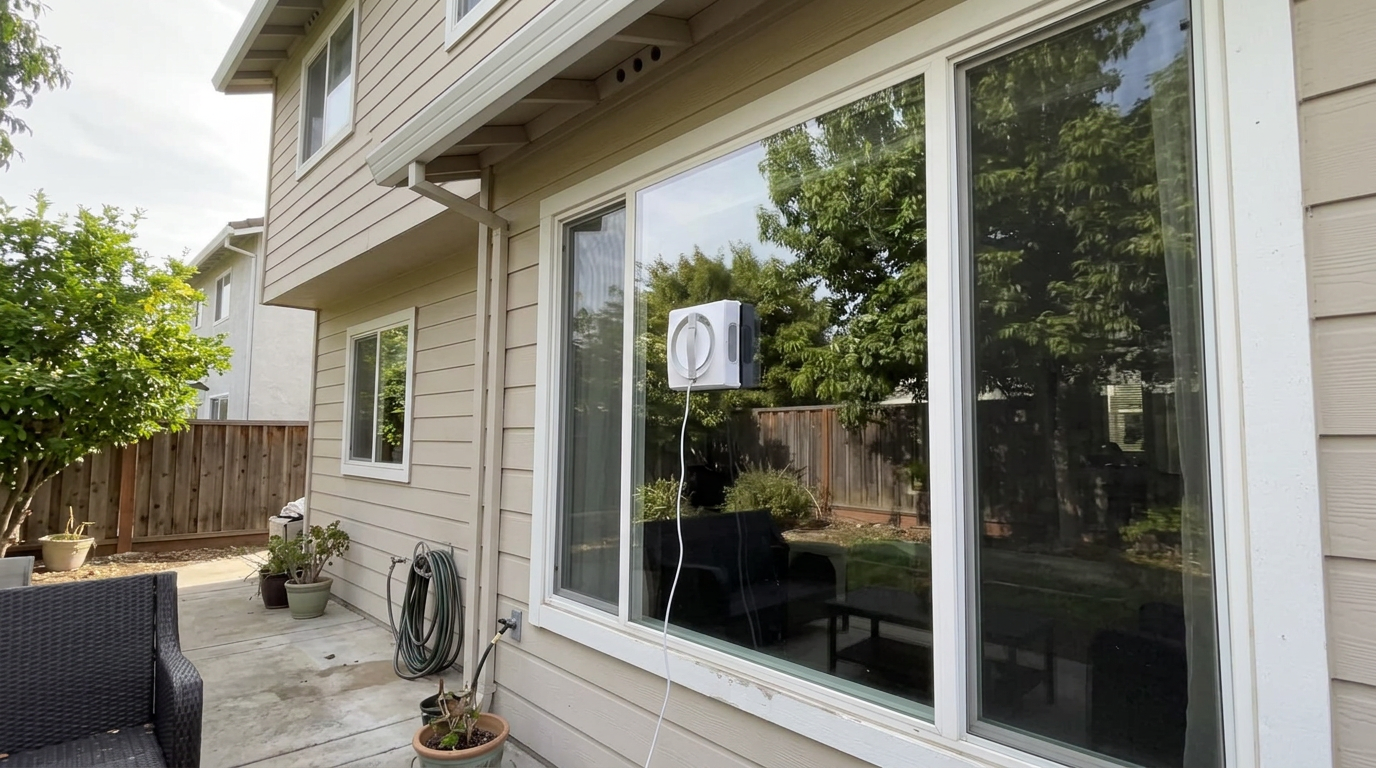
On sloping glass, calm matters more than power. The WINBOT W3 Omni was the steadiest robot of the three: it held straight lines, turned smoothly and found its way back to the start on every roof window I tried.
I put that down to its WIN-SLAM 5.0 navigation, the newest in the ECOVACS range, combined with square crawler tracks and 8,000 Pa of suction.
On pivot roof windows
With the sash rotated, the outer pane of my loft windows sat at a steep angle facing into the room. The W3 Omni cleaned it edge to edge, and its TruEdge scrubber cleaned the frame lip where roof windows collect moss, pollen and grit.
Because it runs from the station’s battery, there was no cable across the bed or the floor. I set the station on the floor below the window and the tether ran straight up to the robot.
On the slanted gable
The gable window above my stairs leans back at about 75 degrees, and I can only reach it from a platform on the landing. The W3 Omni mapped it in one pass and cleaned it without a single stop.
At the lower end of its range, on the steepest conservatory side panel at about 60 degrees, it slowed down but kept going. Below that, I did not test it, because that is outside what ECOVACS supports.
Pad washing on roof glass
Roof glass collects bird droppings, tree debris and moss spores. Its station rinses the dirty pads with 16 jets after each job, so I never had to scrub a pad covered in the green grime that roof windows produce.
Four weeks with it
I kept it in the loft for the whole four weeks and cleaned the two roof windows every week, plus the stair gable twice. It became a ten-minute Sunday job I did not mind.
The thing I valued most was never having a dirty pad in my hand on a narrow loft staircase. The station dealt with it, and I emptied the dirty water downstairs.
What to know before you buy
The station is heavy, and carrying it up to a loft is a two-handed job. Like every robot here, it will not clean shallow skylights or flat roof glass.
If you only have a couple of roof windows, the W2S Omni does nearly as well for less.
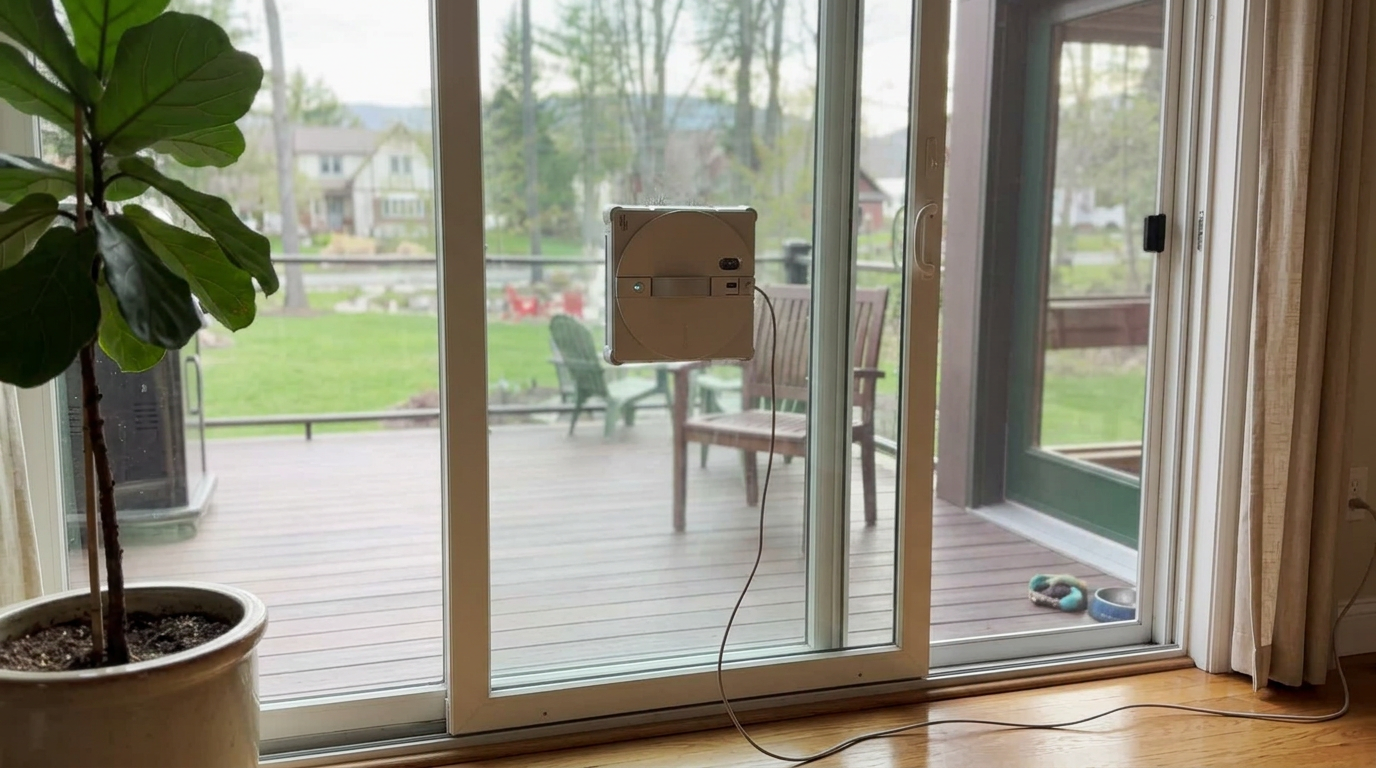
The station sits on the floor below a roof window and anchors the tether straight up to the robot.
- Steadiest robot on sloping glass
- WIN-SLAM 5.0 maps odd-shaped panes well
- Station washes pads, ideal for grimy roof glass
- Battery powered, no cable across the room
- Heavy station to carry up to a loft
- Will not work on shallow skylights
- Best on rectangular panes
- Homes with several pivot roof windows
- Slanted gables and steep facade glass
- People who clean roof glass regularly
- Flat skylights and roof lanterns
- Homes with one small roof window
- Anyone who cannot carry a heavy station upstairs
Choose this if you have steep roof or slanted glass and want the steadiest robot. Read my full WINBOT W3 Omni review.
2. ECOVACS WINBOT W2S Omni
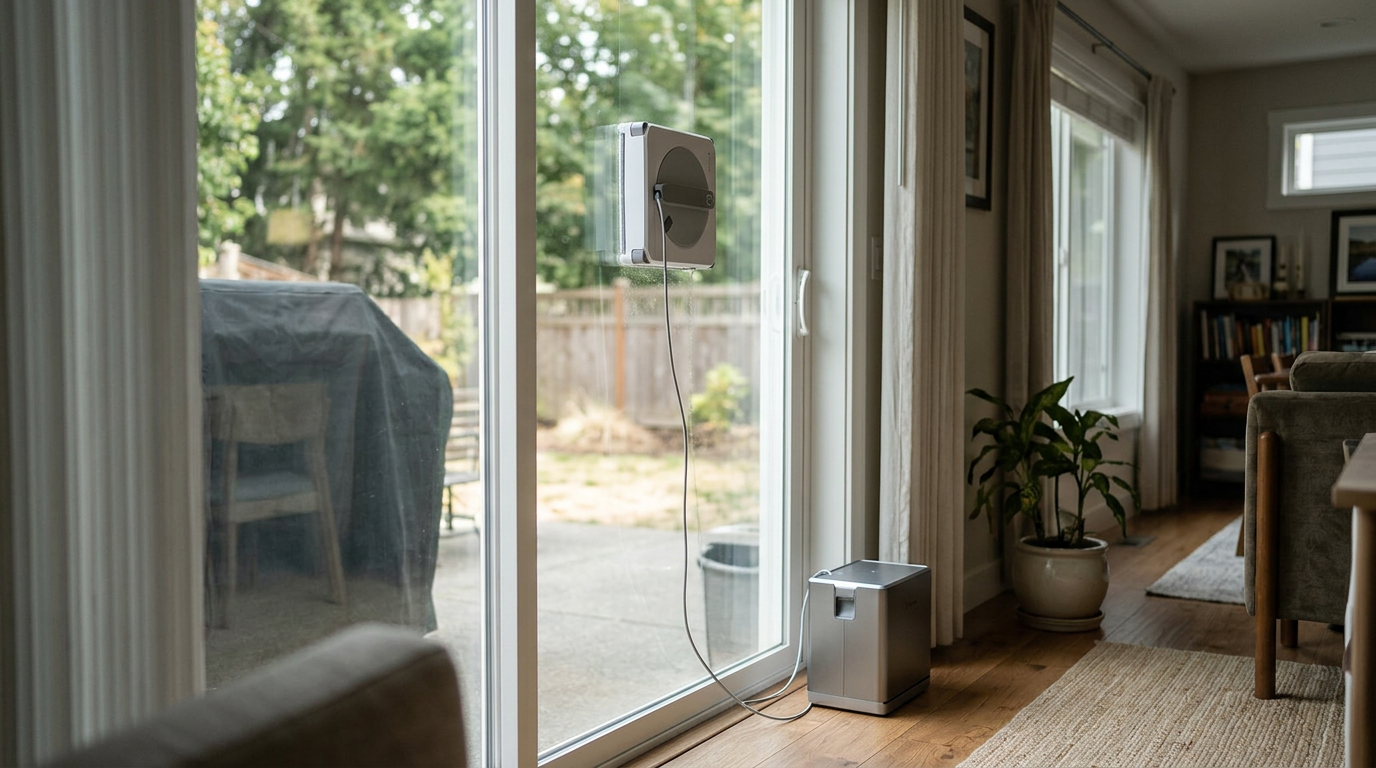
The WINBOT W2S Omni does most of what the W3 Omni does on sloping glass, minus the pad washing. It has the same 8,000 Pa of suction, a TruEdge scrubber and a portable battery station rated for 110 minutes.
On my pivot roof windows it cleaned almost as well, and it was slightly lighter to carry up the loft stairs.
Frames are where roof windows get dirty
Roof windows trap dirt along the bottom frame, where rain runs down and leaves a line of grit and moss. The W2S Omni’s TruEdge scrubber drops down along that frame and cleaned it far better than a flat pad.
In my single review it also handled heavily stained outside glass very well, which is exactly what neglected roof glass looks like.
Stability
On steep glass it was every bit as steady as the W3 Omni. As the slope reached the bottom of its range, it hesitated a little more at turns, which is where WIN-SLAM 5.0 on the W3 Omni seemed to help.
Our tip: Wipe the robot’s tracks before each roof window, because grit from roof glass is the main reason crawler robots lose traction on slopes.
Four weeks with it
I used it on the same loft windows and the gable for four weeks. It needed a fresh pad halfway through each roof window, which meant a trip to the bathroom sink, but the results were nearly identical to the W3 Omni.
Its retracting tether cable was handy in the loft, where a loose rope otherwise ends up across the bed.
What to know before you buy
You wash the pads by hand, and roof-window pads get very dirty. The station is also heavy to carry upstairs.
If you clean roof glass often, the W3 Omni’s pad washing is worth it. If you clean it a few times a year, this is the better value.
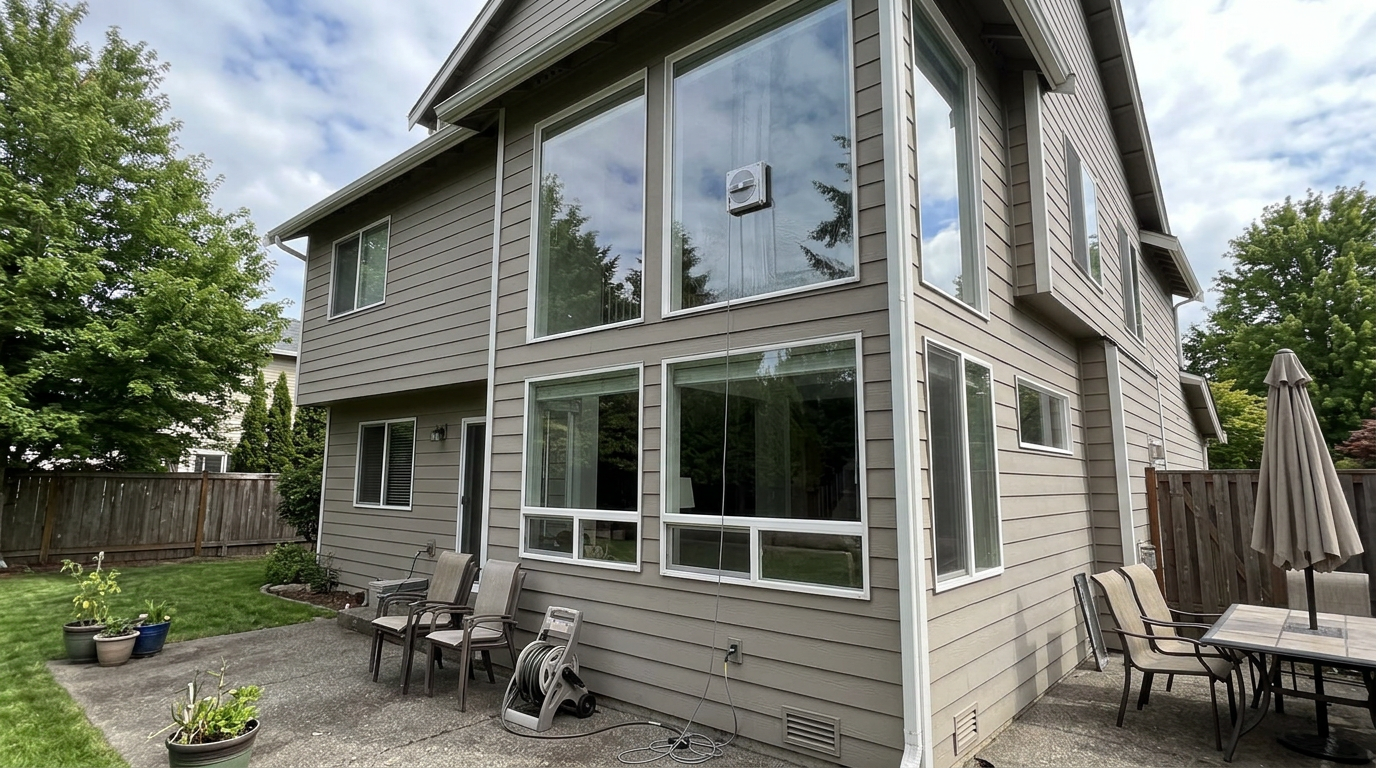
The W2S Omni’s TruEdge scrubber cleaned the gritty bottom frame of my roof windows.
- Battery station, no cable across the room
- TruEdge scrubber cleans dirty roof-window frames
- Strong on heavily stained glass
- Lighter to carry than the W3 Omni
- Pads need washing by hand
- Hesitates more at the bottom of its angle range
- Will not work on shallow skylights
- Homes with a few pivot roof windows
- Neglected roof glass with dirty frames
- Buyers who want a station for less
- Flat skylights and lanterns
- People who clean roof glass weekly
- Anyone who hates washing pads
Choose this if you want a capable station robot for roof windows at a better price. Read my full WINBOT W2S Omni review.
3. HUTT H10
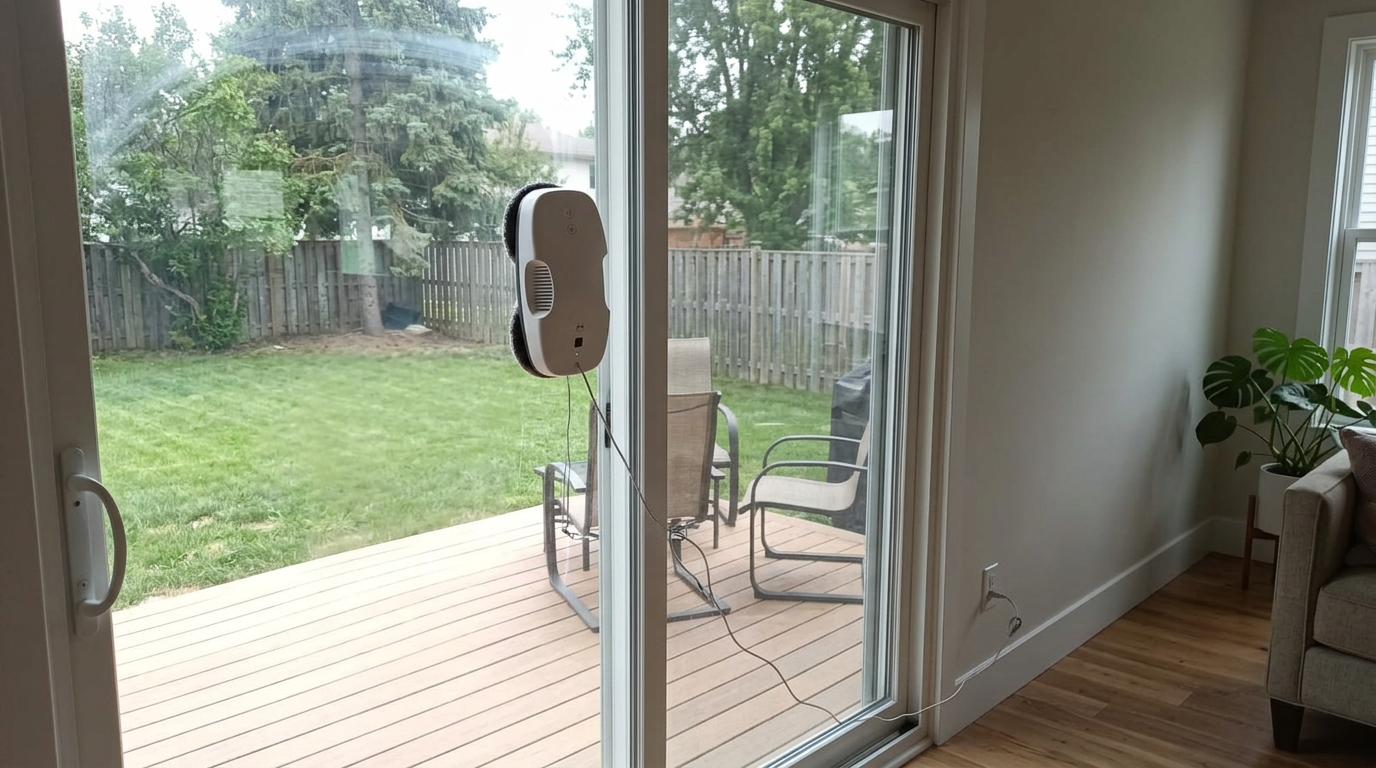
Placing a robot on a roof window means lifting it above your head. The HUTT H10 was the lightest of the three to handle, which made that part noticeably easier and safer.
Its dry polishing pad also left the clearest glass of the three on steep roof windows, where low winter sun shows every streak.
Best on steep, reachable glass
On my pivot roof windows, rotated near vertical, it cleaned both panes beautifully. It is quiet too, which I appreciated in a loft bedroom.
I could not find a published glass-angle limit for the H10, so I kept it to steep glass. As the slope leaned back, it became noticeably less sure of itself than the ECOVACS robots.
Power and cable
It runs on a cord with a 30-minute backup battery. In a loft, that meant running the cable from a bedside outlet up to the window, with slack, and keeping it away from the bed.
Our tip: Keep the H10’s square polishing pads dry when cleaning roof windows, because condensation on the inside of roof glass is the main cause of slipping and streaks.
Four weeks with it
I used it mainly on the bedroom roof window next to the bedside outlet, every week for four weeks. It was quick to lift into place and quiet enough to run while I tidied the room.
On the stair gable, which leans back further, I went back to the ECOVACS robots after a week, because the H10 stopped more often there.
What to know before you buy
It is the slowest robot here, it needs an outlet and it is the least stable at the bottom of the angle range. For steep, reachable roof windows indoors, it is a lovely, light option.
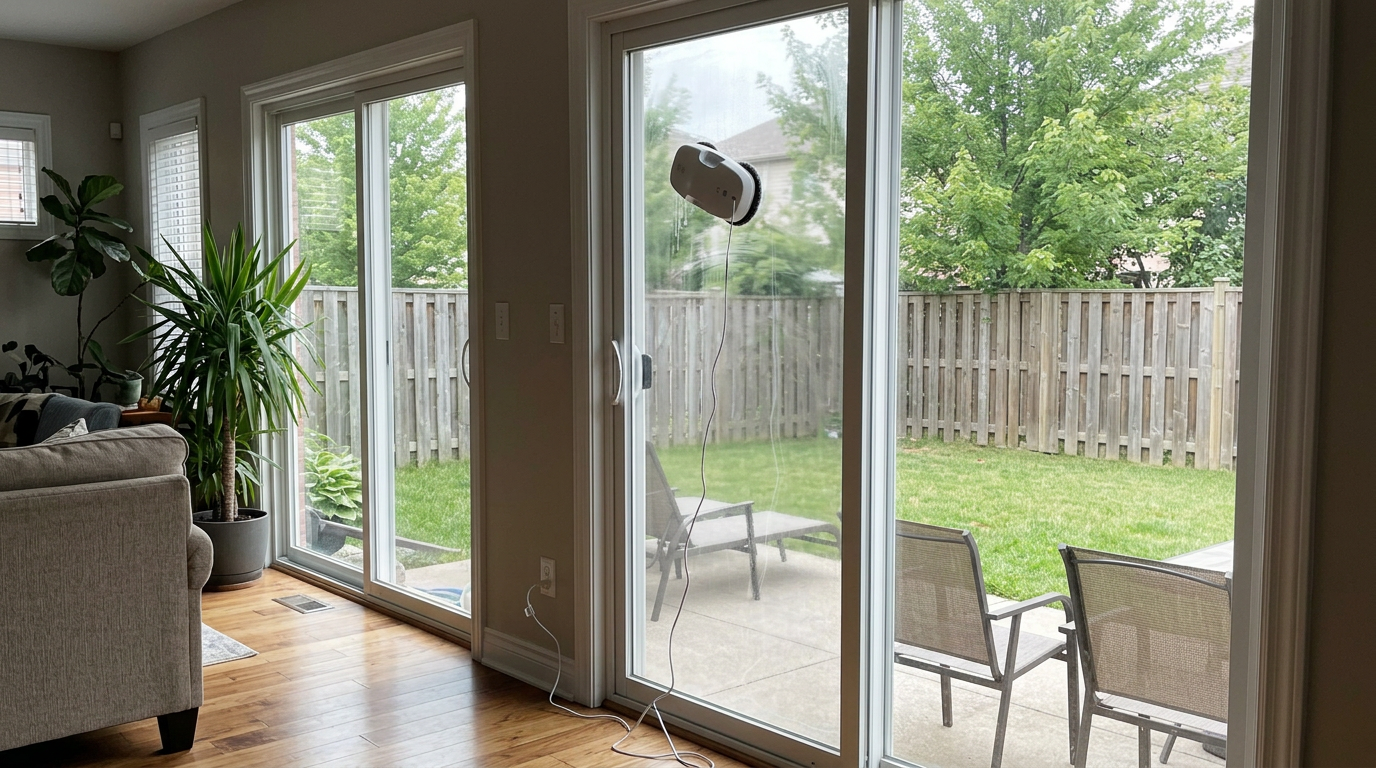
The light HUTT H10 is the easiest robot to place on a roof window above your head.
- Lightest and easiest to place overhead
- Clearest finish on steep roof windows
- Quiet in a bedroom or loft
- 30-minute backup battery
- Least stable as the glass leans back
- Needs an outlet and a cable route
- No published glass-angle limit
- Pivot roof windows in lofts and bedrooms
- People who find heavier robots hard to lift
- Anyone who notices streaks in low sun
- Shallow or fixed skylights
- Slanted glass far from outlets
- Large atrium or gable glass
Choose this if your roof windows are steep, reachable and indoors. Read my full HUTT H10 review.
My angle tests
I measured each test surface with a digital angle finder and logged how every robot behaved. I stayed within ECOVACS’ guidance for the Winbots and stopped any test the moment a robot struggled.
| Glass angle from horizontal | W3 Omni | W2S Omni | HUTT H10 |
|---|---|---|---|
| 90° (vertical window) | Excellent | Excellent | Excellent |
| About 80° (rotated roof window) | Excellent | Excellent | Excellent |
| About 75° (slanted gable) | Excellent | Very good | Good |
| About 60° (steep conservatory side) | Good, slower | Good, some hesitation | Unsure at turns |
| Below 45° (conservatory roof) | Not tested, outside guidance | Not tested, outside guidance | Not tested |
Stops and restarts on sloping glass
How often each robot stopped and needed me to restart or steer it on glass between 60° and 80°.
Time per pivot roof window, both sides
My stopwatch averages for a standard-size roof window, rounded.
How to measure your glass angle
You do not need special tools. A phone and a minute are enough to know whether a robot will work on your glass.
- Open a level or angle app
Most phones have one built in or available free.
- Lay the phone flat on the glass
Hold it against the pane, inside the frame.
- Read the angle from horizontal
90 degrees means vertical; 0 means flat.
- Compare with the robot’s range
For ECOVACS, aim for 60 degrees or steeper to be safe, 45 at the very least.
For pivot roof windows, measure in the cleaning position, with the sash rotated and locked. My loft windows read about 35 degrees closed and about 80 degrees rotated, which is the difference between impossible and easy.
The same window. Only the rotated position is suitable for a robot.
Cleaning a pivot roof window with a robot, step by step
This is the routine that worked best on my loft windows. It lets you clean both sides from inside without anyone going on the roof.
- Rotate the sash
Turn the window on its pivot until the outer pane faces into the room, and use the window’s barrel bolt or lock to hold it in the cleaning position.
- Anchor the tether
Clip it to the station or something heavy on the floor below, never to the window itself.
- Brush off loose debris
Remove leaves, moss and bird droppings by hand first.
- Place the robot near the middle
Let the suction build, then press start.
- Clean the outer pane, then the inner
Swap or rinse pads in between; the outer pane is much dirtier.
- Return the sash
Lift off the robot, unlock the cleaning position and close the window.
With the W3 Omni or W2S Omni, the station on the floor below doubles as the anchor, which made this routine quick and tidy.
Loft conversions and attic rooms
Loft rooms are where most people meet the skylight problem: roof windows they cannot reach, in a room with low ceilings, a narrow staircase and an outlet in the wrong place.
After four weeks of cleaning mine with robots, this is what I learned.
| Loft challenge | What helped |
|---|---|
| Narrow, steep staircase | A lighter robot, or carrying the station in two trips |
| Outlet far from the window | A battery station robot |
| Window above a bed or desk | Clearing the area and anchoring the tether to the station on the floor |
| Low ceiling near the window | Rotating the sash fully before placing the robot |
| Condensation in winter | Airing the room before cleaning |
If your loft has two or more roof windows, a station robot is worth it for the cable alone. Running a power cord across a bed to a window above it is awkward and, frankly, not very safe.
If you have one roof window with an outlet beside it, the HUTT H10 is the simplest answer.
Slanted gables and A-frame glass
Gable windows that lean back with the roofline, and the big triangular glass of A-frame homes, are the most dramatic slanted glass and the hardest to clean by hand. They are also where a robot can do the most good, as long as the angle allows.
My stair gable leans back at about 75 degrees, and I can only reach it from a platform on the landing. Before the test, it had been cleaned twice in five years.
Triangular panes need a robot that maps well, because a fixed pattern wastes time in the narrow top corner. The W3 Omni’s WIN-SLAM 5.0 handled the triangle best, finishing in one tidy run.
The very tip of a triangular pane is too narrow for any robot, so expect to leave a small corner for a pole and cloth.
Our tip: Start the robot in the widest part of a triangular pane, because it needs room to measure the glass before it can plan its way into the narrow top.
Which one is right for you?
4 quick questionsAnswer four questions and I will match you with the right robot for your roof and slanted glass. My single reviews go deeper, starting with the W3 Omni review.
Or find your home below
Steady on slopes, battery powered and pads that wash themselves.
A station robot with TruEdge for the frames.
Light to lift and streak-free in low sun.
WIN-SLAM 5.0 mapped my odd-shaped gable best.
Safety on sloping glass
Roof glass is high by definition, so the safety rules are stricter than for ordinary windows. My rule throughout this test was simple: I placed robots only from inside or from a stable platform, and never from a roof or an outdoor ladder.
The US Consumer Product Safety Commission estimates around 500,000 people are treated for ladder-related injuries each year, with about 300 deaths. Getting onto a roof to reach a skylight is the very situation a robot should help you avoid, not encourage.
- Stay inside
Use pivot windows, rotate the sash and clean from the room.
- Use a stable platform indoors
For high gables, use a proper platform or step with a handrail, not a chair.
- Anchor the tether to something heavy
The station, or heavy furniture on the floor below.
- Stay within the angle range
If the robot circles or alarms, take it off; do not keep trying.
- Never go on the roof
If glass can only be reached from the roof, it is a job for a professional.
Our tip: If a robot sounds an alarm on sloping glass, take it off and try a steeper angle or a different pane, because repeated restarts on glass that is too flat are how robots end up stuck out of reach.
Which homes benefit most
After four weeks, it was clear that a robot for slanted glass is a brilliant buy for some homes and a poor one for others.
| Your home | Worth buying a robot for roof glass? | Best pick |
|---|---|---|
| Loft conversion with pivot roof windows | Yes, strongly | W3 Omni or W2S Omni |
| House with a slanted glass gable | Yes, if you can reach it from inside | W3 Omni |
| Bedroom with one roof window by an outlet | Yes | HUTT H10 |
| Flat-roof extension with a roof lantern | No | A professional |
| Conservatory with a low-pitch roof | Only for the side panels | W2S Omni for the sides |
| Home with fixed skylights only | No | An extension pole indoors |
If your roof glass is mostly pivot windows and steep panes, a robot will change how often that glass gets cleaned. Mine went from once or twice a year to every few weeks.
If your roof glass is mostly flat, spend the money on a good extension pole and an annual professional clean instead.
What to look for in a robot for slanted glass
| Feature | Why it matters on slopes | Best here |
|---|---|---|
| Supported angle range | Decides whether it works at all | Check the maker’s guidance; ECOVACS publishes it |
| Navigation | Keeps a straight line on sloping glass | WIN-SLAM 5.0 on the W3 Omni |
| Battery station | No cable across lofts and stairs | W3 Omni, W2S Omni |
| Edge cleaning | Roof-window frames collect grit and moss | TruEdge on both Winbots |
| Weight | You lift it above your head | HUTT H10 |
| Pad handling | Roof glass is very dirty | W3 Omni pad washing |
The single most important check is the angle. A brilliant robot is useless on a 20-degree skylight, while a modest one does a fine job on a rotated pivot window.
Manufacturer ratings, scaled to 10,000 Pa.
When a robot will not work
For shallow skylights, roof lanterns, conservatory roofs and anything reachable only from the roof, a robot is the wrong tool. These are the alternatives I would use.
| Glass | Best alternative | Notes |
|---|---|---|
| Flat skylight inside | Extension pole with a microfiber head | From a stable platform indoors |
| Flat skylight outside | Professional window cleaner | Roof access needs proper equipment |
| Conservatory roof | Water-fed pole from the ground | Purified water dries spot-free |
| Roof lantern | Professional or water-fed pole | Never climb onto the flat roof |
| Atrium glass | Professional | Specialist access needed |
For the inside of a shallow skylight, an extension pole with a microfiber head did a better job than any robot could, and I could use it from the floor.
For outside roof glass, a professional with a water-fed pole is the safe answer. Many will do just the roof glass once or twice a year.
One more option is worth knowing about for flat glass you can reach from inside: a magnetic double-sided cleaner. It holds a pad on each side of the glass, though it only works on single panes or thin double glazing, so check the thickness first.
Whatever you choose, the principle is the same as with robots: keep your feet on the floor or on a stable platform, and leave roof access to people with the right equipment.
Condensation on roof windows
Roof windows are the coldest glass in many homes, so warm, moist air condenses on them, especially in bedrooms and bathrooms in winter. Wet glass is the enemy of every window robot.
In my test, every robot slipped on the inside pane of a loft window on cold mornings. Opening the window to air the room for ten minutes and wiping the glass dry solved it every time.
How well the robots ran on the inside pane of my loft windows in cold weather.
Cleaning the inside pane in the afternoon, once the room had warmed, gave the best results of all.
Streak-free results on roof glass
Roof glass faces the sky, so it collects more dirt than any other window and shows streaks in low sun. These habits made the biggest difference.
- Clear condensation first
Roof windows often have condensation on the inside. Air the room and wipe the glass dry before the robot goes on.
- Remove debris by hand
Leaves, moss and droppings smear if a robot drives through them.
- Use distilled water
The US Geological Survey estimates about 85 percent of US homes have hard water, which dries as spots.
- Run two passes on the outer pane
The first lifts the grime; the second clears it.
How much each habit improved results on my roof windows.
Robot, pole or professional for roof glass?
| Window robot | Extension pole | Professional | |
|---|---|---|---|
| Pivot roof windows | Excellent, from inside | Good | Excellent |
| Steep slanted gable | Excellent with platform access | Fair | Excellent |
| Flat skylight | Not suitable | Good from inside | Best for outside |
| Conservatory roof | Not suitable | Water-fed pole works | Excellent |
| Your effort | Low | Medium | None |
For most homes the answer is a combination: a robot for the roof windows and steep glass you can reach from inside, and a professional once or twice a year for the flat roof glass outside.
Roof windows through the year
Roof glass gets dirty in different ways through the seasons, and it showed in how often my robots needed a second pass.
| Season | What builds up on roof glass | Cleaning rhythm |
|---|---|---|
| Spring | Pollen and winter grime | Every 4–6 weeks, two passes on the first clean |
| Summer | Dust, insects, bird droppings | Every 6–8 weeks |
| Autumn | Leaves, tree debris, moss spores | Every 4–6 weeks; remove debris by hand |
| Winter | Rain spots, condensation inside | Clean the inside on mild afternoons |
Autumn was the hardest season for roof glass. Leaves stick to wet glass and leave brown marks, so I brushed them off by hand before every clean.
Maintenance after roof glass
- Wash pads thoroughly
Roof grime and moss stain pads; wash them warm, without fabric softener.
- Clean the tracks
Grit from roof glass costs traction on slopes.
- Clean the TruEdge scrubber
It collects moss and grit from roof-window frames.
- Empty the W3 Omni’s dirty-water tank
After every session.
- Inspect the tether
Overhead use puts more strain on it.
Myths about robots and skylights
- “Any window robot can clean a skylight.”
Most skylights are too flat. ECOVACS publishes a supported angle range, and flat roof glass is outside it.
- “More suction lets it work on flatter glass.”
Grip was never the problem in my test. On flat glass, robots lose their sense of direction, which suction cannot fix.
- “You can place it from the roof.”
You should never need to. If glass can only be reached from the roof, call a professional.
- “A robot will clean moss off a roof window.”
It will remove light green film, but established moss on frames needs hand removal first.
- “Roof windows only need cleaning once a year.”
Roof glass faces the sky and gets dirty fast. Every few months kept mine clear with one or two passes.
The honest picture is a good one, though. On pivot roof windows and steep slanted glass, a robot turns one of the most awkward cleaning jobs in the house into something you can do from inside in ten minutes.
Common mistakes with skylights and slanted glass
| Mistake | What happens | Fix |
|---|---|---|
| Using a robot on a flat skylight | It circles, stalls or alarms | Use a pole or a professional |
| Not locking a pivot window | The sash can swing with the robot on it | Use the cleaning-position bolt |
| Anchoring the tether to the window | No real protection if the sash moves | Anchor to the station or heavy furniture |
| Starting on condensation | The robot slips and smears | Dry the glass first |
| Climbing onto the roof | Serious fall risk | Clean from inside or call a professional |
Frequently asked questions
Can a window cleaning robot clean a skylight?
Only if the glass is steep enough. ECOVACS says its WINBOT robots work on glass between about 60 and 120 degrees from horizontal, with newer guidance at 45 to 135 degrees. Most fixed skylights are too flat.
What is the best robot for roof windows?
The ECOVACS WINBOT W3 Omni. It was the steadiest on sloping glass, runs on a battery station and washes its own pads.
Can a robot clean a pivot roof window from inside?
Yes. Rotate the sash into its cleaning position so the outer pane faces into the room, lock it and place the robot on it.
Will a window robot work on a conservatory roof?
Not on the low-pitch roof panels. Steep side panels within the angle range are fine.
What happens if the glass is too flat?
The robot loses its sense of direction, circles or stops and usually sounds an alarm.
Is the HUTT H10 rated for slanted glass?
I could not find a published angle limit, so I only used it on steep glass, where it worked well.
Do I need a battery station for roof windows?
It helps a lot. There is no cable across the room, and the station anchors the tether on the floor below.
Can I use a robot on an atrium or glass roof?
Only on steep sections with safe indoor access. Anything else is a job for a professional.
How often should I clean roof windows?
Every two or three months kept my loft windows clear with one or two passes.
Is it safe to place a robot from a ladder?
Indoors from a stable platform, yes. Never from an outdoor ladder or the roof.
Can I clean the outside of a top-hung roof window?
Usually not with a robot, because the outer pane does not turn to face you. Clean the inside pane with the robot and leave the outside to rain or a professional.
Which robot is lightest to lift onto a roof window?
The HUTT H10 was the easiest of the three to lift above my head and place on the glass.
For skylights and slanted glass, my pick is the ECOVACS WINBOT W3 Omni. It was the steadiest robot on sloping glass, its battery station keeps cables off the floor and its pads wash themselves after cleaning grimy roof glass.
Choose the W2S Omni for a few roof windows at a better price, and the HUTT H10 if you want the lightest robot for steep roof windows near an outlet.
Most importantly, check your glass angle first. Robots are excellent on pivot roof windows and steep slanted glass, and the wrong tool for flat skylights and conservatory roofs.
Senior home appliance tester
Emily has tested home appliances for a living since 2016, including five years as a test coordinator at a national consumer advocacy group, and has run HouseholdMe’s cleaning tests since 2021. She has a degree in industrial design, and for this guide she used three robots for four weeks each on pivot roof windows, a slanted glass gable and steep conservatory side panels, always from inside.
- Four weeks of hands-on testing per robot on slanted and roof glass, with measured glass angles
- HouseholdMe single reviews of the WINBOT W3 Omni, W2S Omni and HUTT H10
- ECOVACS support guidance on glass tilt angles for WINBOT robots
- US Consumer Product Safety Commission data on ladder-related injuries
- US Geological Survey data on hard water
- Buying guide published, based on hands-on testing of 3 robots on skylights and slanted glass.