ECOVACS WINBOT W3 Omni review: a window robot whose station washes its own pads, with TruEdge corners and a 130-minute battery
The ECOVACS WINBOT W3 Omni Robot Window Cleaner is the first window robot I have tested that cleans up after itself. Its station washes the dirty pads with high-pressure jets, its TruEdge scrubber reaches into corners and its battery lets you work far from an outlet, but it is heavy, it prefers rectangular glass and it is a lot of machine for a few small windows.

Emily Carter
Hands-on review
Hands-on testing, research, specs
4 weeks
20 minutes
Jargon helpNew to window robots? Tap any dotted term to see what it means.
In this review
Yes, if you have big windows, sliding doors or glass you never clean because it is high or awkward. The WINBOT W3 Omni cleaned as well on day 28 as on day one, its TruEdge scrubber left far less for me to finish by hand, and the station that washes the pads removed the one chore I hate about window robots. It is heavy to carry, it is built for rectangular glass, and for a few small, easy windows it is more machine than you need.
WINBOT W3 Omni at a glance
WINBOT W3 Omni pros and cons
- Station washes the dirty pads, so no sink scrubbing
- TruEdge scrubber cleans much closer to frames and corners
- Battery or plug-in power, with multiple safety layers
- Heavy station to carry between rooms
- Square design suits rectangular windows best
- Leaves a small pad mark where it parks
Who should buy the WINBOT W3 Omni?
- Homes with large windows and sliding glass doors
- High or outside windows that usually get skipped
- Households that pay for regular window cleaning
- Apartments with a few small, easy windows
- Arched, round or oddly shaped glass
- Anyone who needs a light robot to carry upstairs often
First impressions of the ECOVACS WINBOT W3 Omni
I did not expect to get attached to a window robot.
Windows are the chore I put off longest in my own house, and the high ones above the patio usually wait for a professional visit once or twice a year.
The ECOVACS WINBOT W3 Omni changed that within the first week.
Out of the box it looks like two separate products: a square white robot and a gray station about the size of a small carry-on case.
The station is the clever part. It stores the robot, carries the cleaning solution, powers everything from its own battery and, after each job, washes the dirty pads for you.
My first run was on the big sliding door to our deck, the glass the cat presses her nose against every morning.
I filled the solution, wet and wrung the pad, clipped the tether, pressed the button and watched it lock onto the glass.
It measured the door, sprayed a fine mist and worked its way down in neat stripes, slowing near the frame while a small scrubber dropped down and spun into the edges.
When it finished it drove back to where it started, beeped and waited for me.
I wiped one tiny pad mark where it had parked, and that was it.
By the end of the month I was taking it out for a single dirty window, which is the best compliment I can give a cleaning gadget.
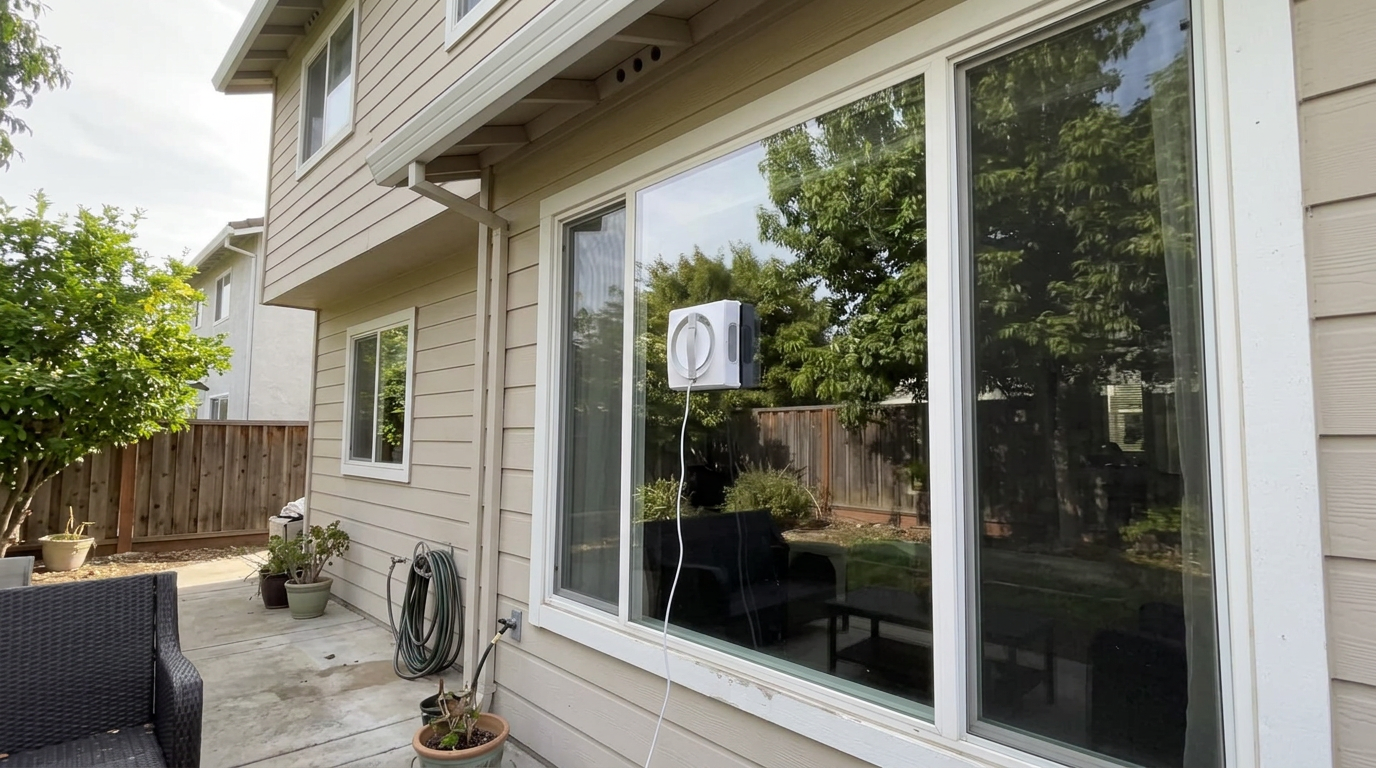
The W3 Omni working on the outside of our biggest window, the one that usually waits for a ladder.
What the WINBOT W3 Omni actually is
The W3 Omni is a robotic window cleaner that holds itself to glass with suction and wipes it with a damp microfiber pad✕Microfiber padA cloth made of very thin synthetic fibers that trap dust and grease. It is the part of the robot that actually wipes the glass..
You place it on the window, press start and it plans its own route, sprays cleaning solution ahead of the pad and works across the whole pane.
What sets it apart from cheaper robots is everything around that core.
Three parts that work together
The robot does the cleaning. The OMNI station✕OMNI stationA carry box that the robot docks into. It stores the robot, holds the safety cord and power cable, and on some models has its own battery or washes the pads. is the base camp. The tether and anti-fall cable tie the two together.
The station holds the solution, charges and powers the robot, stores the cable and safety line, and washes the pads after each session.
That last job is what ECOVACS calls Vortex Wash✕Vortex WashThe W3 OMNI station feature that sprays the dirty pads with high-pressure jets and spins the dirt away, so you do not wash them by hand.: 16 high-pressure nozzles rinse the pad and spin the dirt away in about a minute.
| Part | What it does | Why it matters |
|---|---|---|
| Robot | Suction, spraying, wiping and navigation | Does the actual cleaning on the glass |
| TruEdge scrubber | Drops down near frames and spins at up to 200 RPM | Cleans the strip along the frame a flat pad misses |
| OMNI station | Battery, solution, storage, cable and controls | Lets you clean away from outlets and carry it all in one go |
| Vortex Wash | 16 jets rinse the dirty pads in about a minute | No scrubbing pads in the sink after every job |
| Safety system | Tether, buckle, anti-fall cable and station suction cups | Keeps the robot safe on high and outside glass |
What's inside
ECOVACS rates the suction at up to 8,000 pascals✕Pascal (Pa)The unit used for suction. Home window robots range from about 2,500 Pa to 10,000 Pa., which held the robot firmly on every window I tried, inside and out.
Navigation runs on WIN-SLAM✕WIN-SLAM navigationECOVACS name for the robot mapping system. It measures the window first, then plans a tidy back-and-forth route instead of wandering. 5.0, which ECOVACS says avoids obstacles with 1 mm precision and plans a route before it starts.
The battery is rated for up to 130 minutes, and you can also run it plugged in for long sessions.
WINBOT W3 Omni design and setup
The robot itself is a neat white square with a carry handle on top and a bumper around the edge.
The station is the bulky part, and it is not light.
The whole kit is listed at close to 27 pounds, so carrying it upstairs is a two-handed job.
That weight is partly deliberate: the station is counterweighted and has suction✕Suction (Pa)How hard the fan pulls the robot against the glass, measured in pascals. More pascals means a firmer grip, which matters most on outside windows and big panes. cups underneath so it cannot be dragged along if the robot ever lets go of the glass.
First-time setup
Setup took me about 20 minutes, most of it reading the quick-start guide and charging the station.
You fill the clean-water and solution tanks, fit a pad, download the ECOVACS HOME app and update the firmware.
After that, a normal session takes about two minutes to prepare.
The station controls
The main buttons sit on top of the station: power, mode and cable retraction.
You can run everything without your phone, and the app adds extra modes, zone cleaning and a manual remote.
I used the station buttons for routine cleaning and the app when I wanted Zone mode on one dirty patch.
Our tip: Charge the station fully the night before a big window day. Running on battery means you can set up anywhere, without hunting for an outlet near each door.
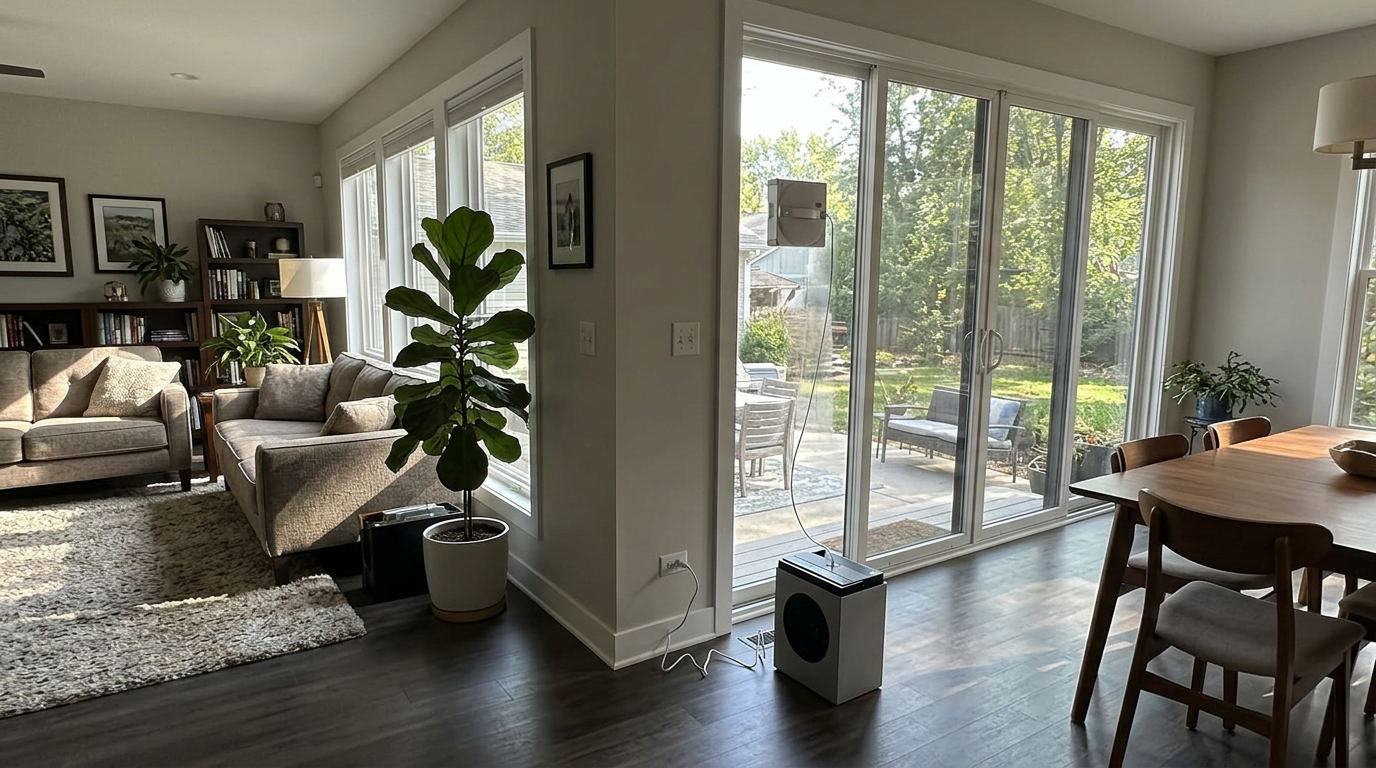
The station sits on the floor below the glass, counterweighted and stuck down with its suction cups.
Suction, safety and trusting it on high windows
The first time a robot hangs on a second-floor window, you watch it like a hawk.
I did too, for the first few runs.
By week two I was starting a cycle and going back to my coffee, and that confidence comes from several safety layers working together.
The layers that keep it on the glass
Suction is the first layer. At up to 8,000 Pa, the robot stayed planted even on the rough, pollen-coated outside of our patio windows.
The second is a double-lock safety buckle on the safety tether✕Safety tetherA strong cord that clips the robot to something solid indoors. If the robot ever lets go of the glass, the tether catches it before it can fall..
The third is an anti-fall system inside the robot: if it senses a drop, it tightens the safety cable automatically.
The fourth is the station itself, which is weighted and stuck to the floor with suction cups, so it cannot be pulled along.
ECOVACS calls this a 12-level protection system. The bars show how early each layer acts, not how strong it is.
Power cuts and low battery
When the battery gets low or a job finishes, the robot returns to its starting point and stays there for up to 30 minutes while it alerts you.
That is long enough to finish a phone call and come back without rushing.
I tested it once by pulling the plug mid-run in plug-in mode, and it simply held on and beeped.
The spray system and cleaning pads
Three wide-angle nozzles spray a fine mist ahead of the pad as the robot moves.
ECOVACS says the spray runs at higher pressure than its earlier models, and in practice the glass was evenly damp, with no drips running down the pane.
The pad is a wide microfiber rectangle that covers almost the whole underside.
It has to be wet and well wrung out before you start, like a cloth you would use by hand.
Cleaning solution
ECOVACS recommends its own solution, and I stuck with it for the whole test.
Some household glass cleaners foam or leave residue that can block the nozzles, and a robot with an automatic pad-washing station is not the place to experiment.
How long the pads last
ECOVACS suggests replacing the pads roughly every 30 cleaning cycles.
After four weeks of several sessions a week, mine still looked fine, though the outside-window pad was starting to gray.
My estimate of pad life by window condition, based on the rated 30 cycles and how fast my pads wore.
Our tip: Keep a spare pad for very dirty outside windows. A pad that has already picked up a season of pollen will smear more than it lifts.
How well the WINBOT W3 Omni cleans
The short answer: very well, and consistently.
The glass looked clearly cleaner after every cycle, and I saw no drop in performance between the first and last week.
That consistency matters more than any one great result, because it is what makes you keep using the robot.
Inside windows
On inside glass with dust, fingerprints and the odd smear, one Fast pass left it streak-free in normal daylight.
Low evening sun is the harshest test, and I could see only faint traces at the very edges on a couple of windows.
Outside windows
Outside glass was dirtier, with pollen, dust and rain spots.
Intensive mode removed almost all of it in one go. On the worst window, facing the road, a second run finished the job.
My ratings on a 10-point scale, using Fast inside and Intensive outside.
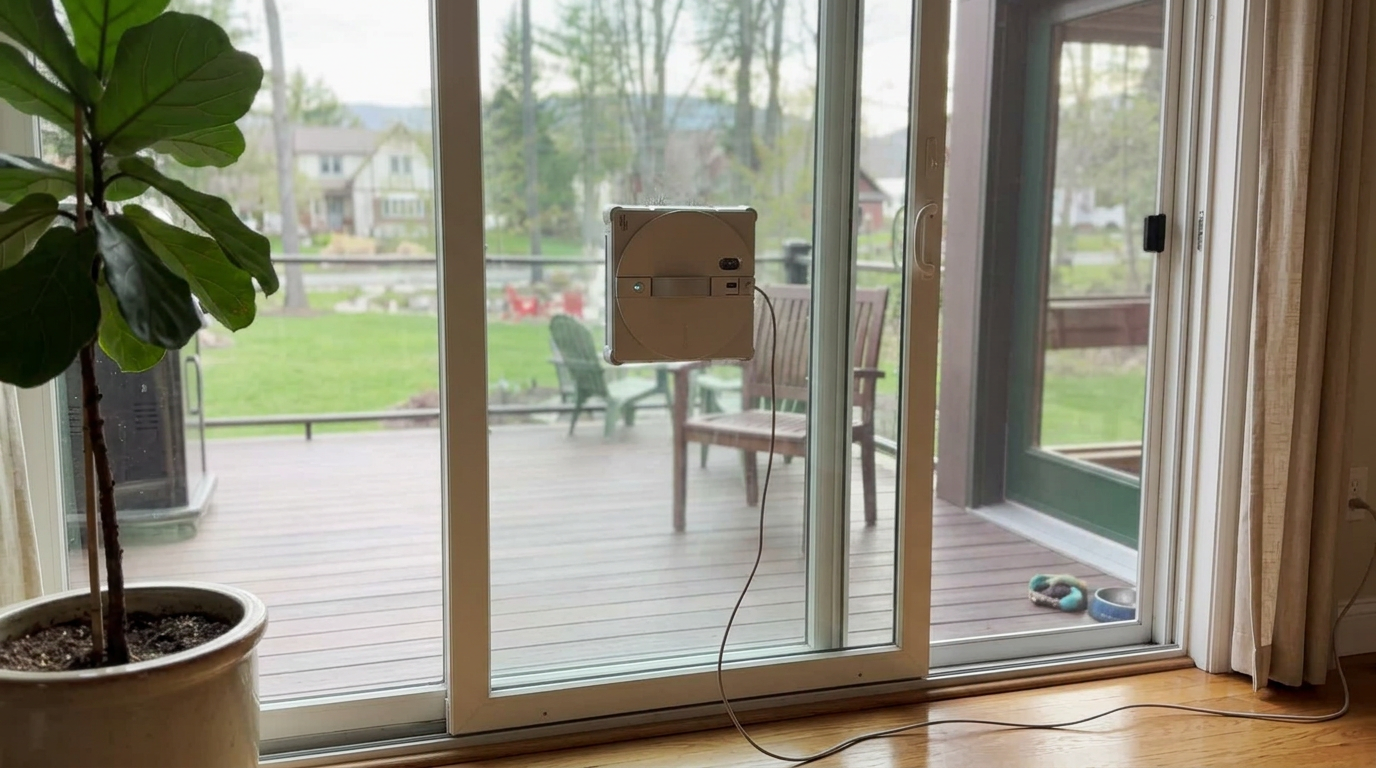
Our patio door after a Fast run, with the robot back at its starting point waiting to be lifted off.
Edges and corners: what TruEdge changes
Most window robots leave a frame of dirty glass around the edges, because a flat pad cannot reach right into the corner.
TruEdge✕TruEdgeECOVACS edge-cleaning system. Small spinning brushes reach into the strip of glass next to the frame that a flat pad cannot touch. is ECOVACS answer.
When the robot approaches a frame, a small scrubber lowers onto the glass and spins at up to 200 RPM, then lifts again when it moves on.
Lifting it between edges stops it from dragging dirt from the frame onto clean glass.
In practice, the strip next to the frame was clean on almost every window, and the corners were far better than I am used to.
My cleaning ratings by area of the window, out of 10.
The shape limit
The robot is square, and that is ideal for square and rectangular glass.
On an unusual shape, such as an arched window or a narrow angled pane, its route and shape can leave parts it cannot reach.
Walk around your house and look at your window shapes before you buy.
Our tip: Keep a microfiber cloth in the station. The robot leaves a small pad mark where it parks at the end, and a quick wipe takes it off.
The station that washes its own pads
This is the feature that made the W3 Omni worth testing.
On every other window robot I have used, the job ends with peeling off a filthy pad and scrubbing it in the sink.
On the W3 Omni, you put the robot back in the station and it washes the pad for you.
How Vortex Wash works
The station sprays the pad with high-pressure jets, spins the dirt away and drains it into a dirty-water tank.
ECOVACS says it takes about a minute, and that matched my experience.
There is also an optional self-clean cycle for the washing compartment, so you are not scrubbing that either.
What you still do by hand
You still rinse the dirty-water tank after each session. It takes seconds, but forget it and dirty water sits there until next time.
You also refill the solution and swap pads when they wear out.
My estimate of hands-on cleanup and wiping time per session.
Our tip: Rinse the dirty-water tank the moment the session ends. It takes ten seconds then and a lot longer once the water has sat for a week.
Battery, power and moving room to room
You can run the W3 Omni on battery or plugged in.
On battery, the rated 130 minutes covered a full day of my larger windows with charge to spare.
Plugged in, it runs as long as you need, which is handy for a wall of glass in one room.
Battery mode was the one I used most, because my outside windows are nowhere near an outlet.
Rated battery time across ECOVACS station models.
The weight is the trade-off.
Carrying the station up a flight of stairs is fine once, but I would not want to haul it to every room of a three-story house every week.
I ended up working floor by floor: downstairs one day, upstairs the next.
What using it is really like
My usual routine took about two minutes before the robot did the rest.
| Step | What I do | Why |
|---|---|---|
| 1. Carry | Take the station to the window | Everything is in one case |
| 2. Prepare | Wet and wring the pad, check solution | A damp pad cleans; a soaked one smears |
| 3. Anchor | Clip the tether, set the station flat | Safety comes before suction |
| 4. Attach | Hold the robot on the glass and press start | It locks on and confirms |
| 5. Clean | Choose a mode and walk away | It plans the route itself |
| 6. Retrieve | Lift it off when it beeps | It waits up to 30 minutes |
| 7. Wash | Dock it so the station washes the pad | About a minute, hands-free |
| 8. Rinse | Empty and rinse the dirty-water tank | Seconds now, a chore later |
The noise is a steady fan hum. It is clearly audible in the same room but not something I had to leave for.
I often ran it while working at the kitchen table a few feet away.
Our tip: Start with the window that annoys you most. Seeing that one clean is what turns a robot from a gadget into a habit.
Which windows and surfaces it suits
The W3 Omni is happiest on large, flat, rectangular glass.
| Surface | How it went | My verdict |
|---|---|---|
| Sliding glass doors | Fast, even, edge to edge | Excellent |
| Large picture windows | Planned route, no missed stripes | Excellent |
| High outside windows | Secure with tether and station anchored | Very good |
| Small rectangular panes | Works, but slower to set up than wiping by hand | Good |
| Arched or odd shapes | Square body cannot reach every part | Fair |
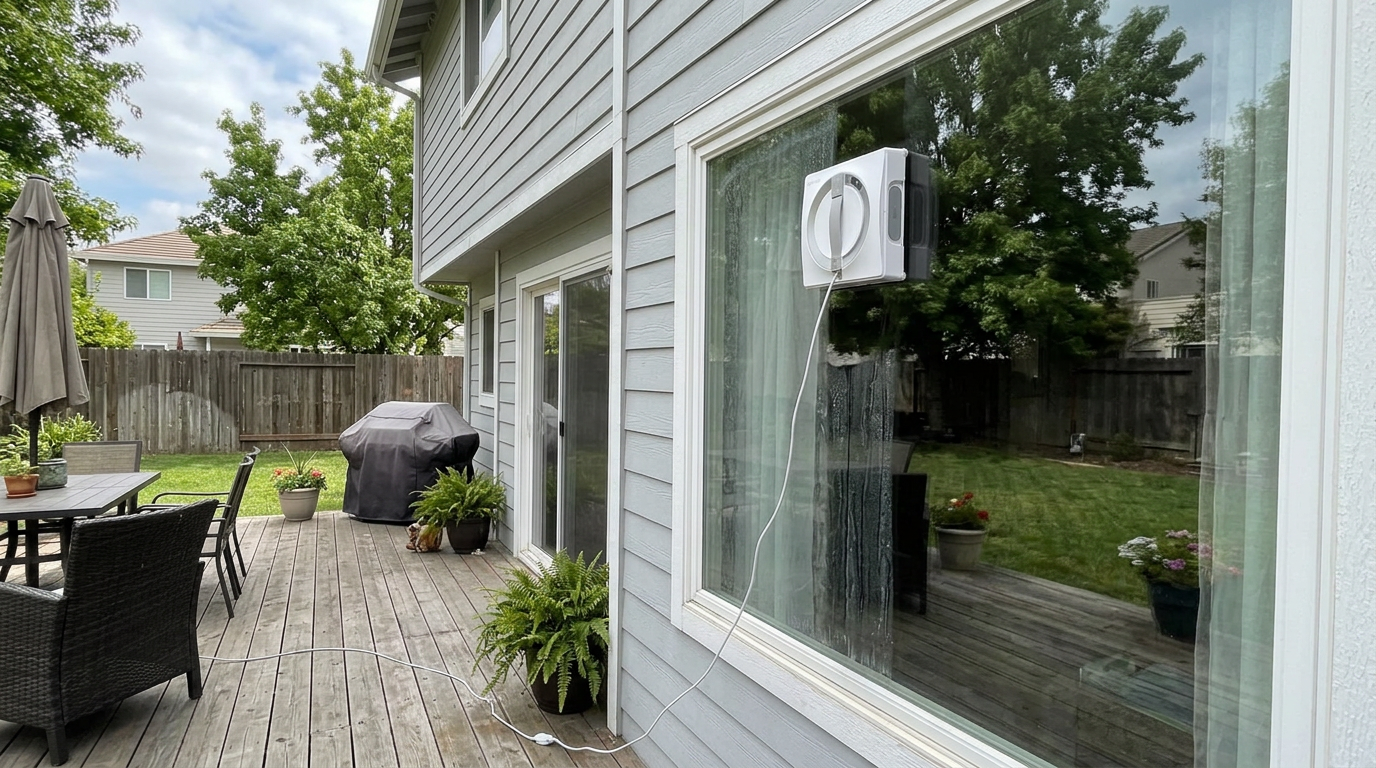
Outside glass by the deck, the kind of window that used to get cleaned twice a year.
Living with it: week one to week four
In week one I supervised every run and stuck to the inside of our sliding doors.
In week two I moved outside, anchored the station properly and let it clean the high windows above the patio while I gardened.
In week three I used Zone mode almost daily on the patio door and started cleaning single windows the moment they bothered me.
In week four I compared the results with the first week and could not see any difference in how clean the glass got.
How satisfied I was with the overall result each week, out of 10. The robot did not change; my setup and mode choices did.
Supplies, upkeep and long-term ownership
A window robot is not a buy-once gadget. It needs a few supplies and a little care to keep cleaning like new.
The good news is that the W3 Omni needs less hands-on care than any window robot I have tested, because the station does the dirtiest job.
What you keep buying
The two ongoing supplies are pads and cleaning solution.
Pads are rated for about 30 cleaning cycles. If you clean a few windows a week, that is a fresh pad every couple of months.
Solution use depends on how dirty your glass is and which mode you run. Intensive sprays more than Fast.
Why it should hold up
After four weeks of regular use, inside and out, the robot cleaned exactly as well as on day one.
There was no loss of suction, no drift in its route and no new noises from the fans.
The station’s pad washing also protects the robot indirectly: a clean pad means less grit dragged across the glass and less wear on the underside.
Running it plugged in for big sessions helps the battery, too, because it avoids draining it flat every time.
Storage
Everything packs into the station: robot, tether, cable and solution.
It lives in our hall closet, and it is the only window gadget I own that never leaves a cable or bottle lying around.
Plan for a floor-level spot, though. The station is too heavy to lift onto a high shelf every week.
Our tip: Store the station with clean pads fitted and an empty dirty-water tank. It will be ready to go the next time a window bothers you, which is exactly when you want it.
Noise, pets and family life
The W3 Omni is not silent, and no suction-based window robot is.
The fan makes a steady whoosh, similar to a hair dryer on a low setting, and the spray and scrubber add the odd whir.
In the same room it is noticeable. One room away, with the door half closed, I barely heard it.
How the noise compared in my house. Decibel figures for speech and vacuums are typical values, not measurements of this robot.
With a cat in the house
Our long-haired cat watched the robot with deep suspicion for two days and then ignored it.
She never touched it on the glass, but she did sniff the tether, so I kept the cable tidy and away from her favorite path.
If you have a dog that jumps at moving things, close the door while it works on a low pane.
With children around
Children are drawn to a robot climbing a window. That is half the fun, but treat it like any appliance with a power cable and a safety line.
Keep small hands off the tether and station while it is running, and do not let anyone pull the robot off the glass mid-cycle.
The voice prompts and the beep at the end are handy here: you always know when it is safe to lift it off.
Who will love it
If you dread window cleaning, own a house full of glass or live with pets who decorate the patio door, you will use this robot every week.
If you enjoy a cloth-and-squeegee Sunday ritual on a few small windows, it will mostly sit in the closet.
Common mistakes to avoid
The WINBOT W3 Omni is easy to use, but these habits hold it back.
| Mistake | What happens | Better habit |
|---|---|---|
| Using a soaking-wet pad | Smears and drips on the glass | Wet it, then wring it out well |
| Skipping the tether indoors | No backup if anything goes wrong | Clip it every single time |
| Third-party glass cleaner | Foam, residue or blocked nozzles | Use the recommended solution |
| Leaving dirty water in the station | Smells and grime build up | Rinse the tank after each session |
| Fast mode on neglected glass | A faint haze is left behind | Run Intensive first, then Fast |
| Station on a soft rug | Suction cups cannot grip | Set it on a hard, flat floor |
What I would change
A lighter station would make whole-house days easier.
I would also like a way to stop the robot leaving a pad mark where it parks.
Is the WINBOT W3 Omni worth the money?
For the right home, yes.
The best way to judge it is not against a bottle of glass cleaner and a cloth, but against how often your windows actually get cleaned.
If you pay for professional window cleaning a few times a year, add up those visits and compare.
If you have a few small windows you can reach from the floor, I would keep the money.
Ask yourself three questions.
Do you have large windows, sliding doors or glass that is hard to reach? Do you hate washing dirty pads? And are your windows mostly rectangular?
If the answers are yes, this is the most hands-off window robot I have used.
How it compares with other ECOVACS window robots
ECOVACS makes several station-based WINBOTs, and the right one depends on how much glass you have and whether you want pad washing.
| Feature | WINBOT W3 Omni | WINBOT W2S Omni | WINBOT W2S PRO Omni | WINBOT W2 PRO Omni |
|---|---|---|---|---|
| Self-washing pads | Yes, Vortex Wash | No | No | No |
| Max suction | 8,000 Pa | 8,000 Pa | 10,000 Pa | Not stated |
| Edge cleaning | TruEdge scrubber | TruEdge scrubber | TruEdge 2.0 brushes | Edge mode |
| Navigation | WIN-SLAM 5.0 | WIN-SLAM 4.0 | WIN-SLAM 4.0 | WIN-SLAM 4.0 |
| Rated battery | 130 min | 110 min | 110 min | 110 min |
| Best for | Most glass, least cleanup | Edges on a smaller budget | Strongest grip, frameless glass | Value station model |
| Your home | Is the W3 Omni a fit? | Why |
|---|---|---|
| Lots of sliding doors and big windows | Excellent | Covers large glass with little cleanup |
| High or outside windows | Excellent | Battery station and layered safety |
| A few small rectangular windows | Fair | More machine than you need |
| Arched or unusual shapes | Fair | Square body cannot reach every part |
| Pets that mark the glass daily | Very good | Zone mode on the same patch |
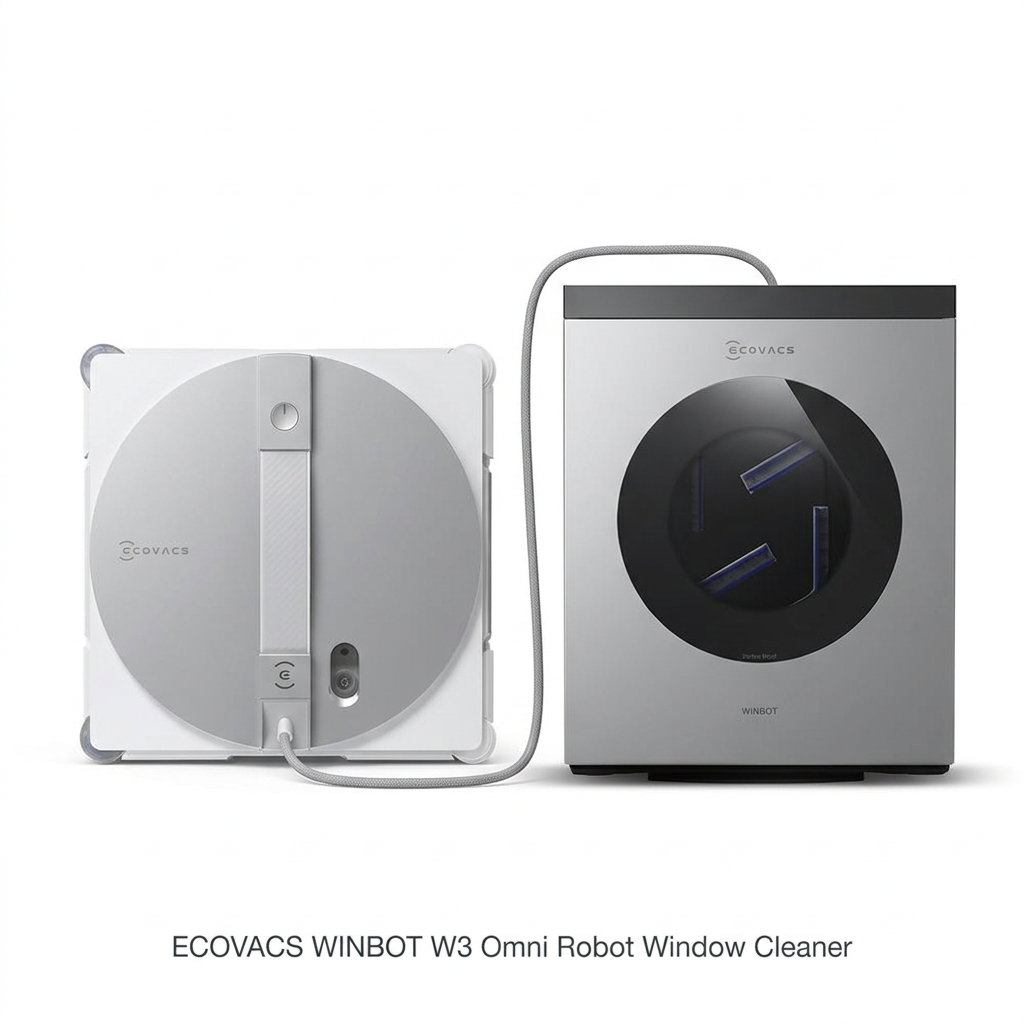
The full kit: the square robot and the station that powers it and washes its pads.
Other ECOVACS window robots I tested
If you want TruEdge without the pad washing, see my WINBOT W2S Omni review.
For the strongest suction in the range, read my WINBOT W2S PRO Omni review.
For a station model with dual power at a lower level, my WINBOT W2 PRO Omni review covers it.
Which one is right for you: is the WINBOT W3 Omni your match?
4 quick questionsWINBOT W3 Omni specifications
From manufacturer data and my own testing.
How I tested and scored the WINBOT W3 Omni
For four weeks, I used the WINBOT W3 Omni as my only way of cleaning windows at home, inside and out, several times a week.
I cleaned sliding doors, large picture windows, high outside panes above a patio and a few small rectangular windows, in Fast, Intensive, Zone and manual modes.
I ran it on battery and plugged in, tested how it behaves when the power is cut, tracked pad wear and timed my hands-on work before and after each session.
I then checked my notes against ECOVACS specifications and owner documentation.
- Cleaning (8.8): streaks, dust, pollen, fingerprints and rain marks on inside and outside glass, across several cleaning modes.
- Edge coverage (8.6): how close it gets to frames and into corners, and how much I still wiped by hand.
- Ease of use (9.0): setup, carrying, the station controls, the app, pad washing and putting it away.
- Safety (9.3): suction, the tether, the anti-fall cable, power-cut behavior and how the station stays put.
The overall score of 8.8 is an editorial rating that reflects those four areas.
WINBOT W3 Omni FAQ
Is the ECOVACS WINBOT W3 Omni worth it?
Yes, if you have large windows, sliding doors or hard-to-reach glass. Its station washes the pads, its TruEdge scrubber cleans close to frames and it runs on battery. For a few small, easy windows it is more than you need.
Does the WINBOT W3 Omni clean its own pads?
Yes. The station uses Vortex Wash, with 16 high-pressure nozzles that rinse the dirty pads in about a minute. You still rinse the dirty-water tank afterward.
How strong is the W3 Omni suction?
ECOVACS rates it at up to 8,000 Pa. It held firmly on every inside and outside window in my test.
Can I use the W3 Omni without an outlet?
Yes. It runs on its built-in battery, rated for up to 130 minutes, or plugged in for longer sessions.
Is it safe on high windows?
It has several safety layers: suction, sensors, a double-lock buckle, an auto-tightening anti-fall cable and a weighted station with suction cups. Always clip the tether.
What happens if the battery runs low?
The robot returns to its starting point and holds on for up to 30 minutes while it alerts you.
Does it clean window corners?
Much better than most robots. The TruEdge scrubber lowers near frames and spins into corners, though the very tip of some corners may still need a wipe.
Does it work on round or arched windows?
It is designed for square and rectangular glass. Unusual shapes may not be fully covered.
Can I use my own glass cleaner?
ECOVACS recommends its own solution. Other cleaners can foam, leave residue or block the nozzles.
How often should I replace the pads?
About every 30 cleaning cycles, sooner if you clean very dirty outside glass.
Does it leave marks?
It can leave a small pad mark where it parks at the end. A quick wipe with a microfiber cloth removes it.
How heavy is it?
The kit with the station is listed at close to 27 pounds, so it is a two-handed carry between floors.
Senior home appliance tester
Emily has tested home appliances for a living since 2016, including five years as a test coordinator at a national consumer advocacy group, and has run HouseholdMe's cleaning tests since 2021. She has a degree in industrial design, so she looks at how a product is built, not just how it performs. She used the WINBOT W3 Omni as her only window-cleaning tool for four weeks for this review, on everything from sliding doors to high windows above her patio.
- Four weeks of hands-on testing of the ECOVACS WINBOT W3 Omni
- ECOVACS product specifications and owner documentation
- General window-cleaning and robot-safety guidance