HUTT H10 review: a round-square robot that scrubs wet and polishes dry in one pass, with 6,500 Pa and a 30-minute backup
The HUTT H10 Window Cleaning Robot does something different: a spinning round pad scrubs the glass wet, then a square pad wipes it dry in the same pass. That left me fewer streaks than most robots, its 6,500 Pa grip and 30-minute backup felt secure and it is light at about 2.9 pounds, but it is slower than square crawlers, it needs dry, clean tracks to stay on course and narrow gaps in the glass stop it.

Emily Carter
Hands-on review
Hands-on testing, research, specs
4 weeks
20 minutes
Jargon helpNew to window robots? Tap any dotted term to see what it means.
In this review
Yes, if streak-free glass matters more to you than speed. The HUTT H10 scrubs with a wet round pad and polishes with a dry square one in a single pass, which gave me some of the clearest results in my testing, and it handled frameless mirrors and shower glass well. It is slower than square crawler robots, you must keep its tracks and square pads dry, and divided glass with narrow gaps will stop it.
HUTT H10 at a glance
HUTT H10 pros and cons
- Wet scrub plus dry polish leaves fewer streaks
- 6,500 Pa grip with steady 55 N pad pressure
- Light, quiet and backed by a 30-minute battery
- Slower than square crawler robots
- Tracks and square pads must stay dry
- Narrow gaps between glass panels stop it
Who should buy the HUTT H10?
- Anyone who hates streaks on sunny days
- Frameless mirrors and shower screens
- Small panes down to about 12 × 12 in
- People who want the quickest clean
- Divided mirrors or panels with gaps
- Windows far from power outlets
First impressions of the HUTT H10
The HUTT H10 looks unusual for a window robot: a white body with a round section and a square section, side by side.
That is the round-square design✕Round-square designA robot with a spinning round pad that scrubs wet, followed by a flat square pad that wipes dry, so one pass both cleans and polishes., and it is the whole story of this robot.
The round pad spins at about 70 RPM to scrub the glass wet. Right behind it, a square pad wipes and polishes the glass dry.
In the box I found the robot, a remote, a safety rope, a spray bottle, spare nozzles and three pairs of pads, plus a wide-voltage power adapter.
There is no cleaning solution. HUTT recommends purified water, which keeps the ultrasonic nozzles clear.
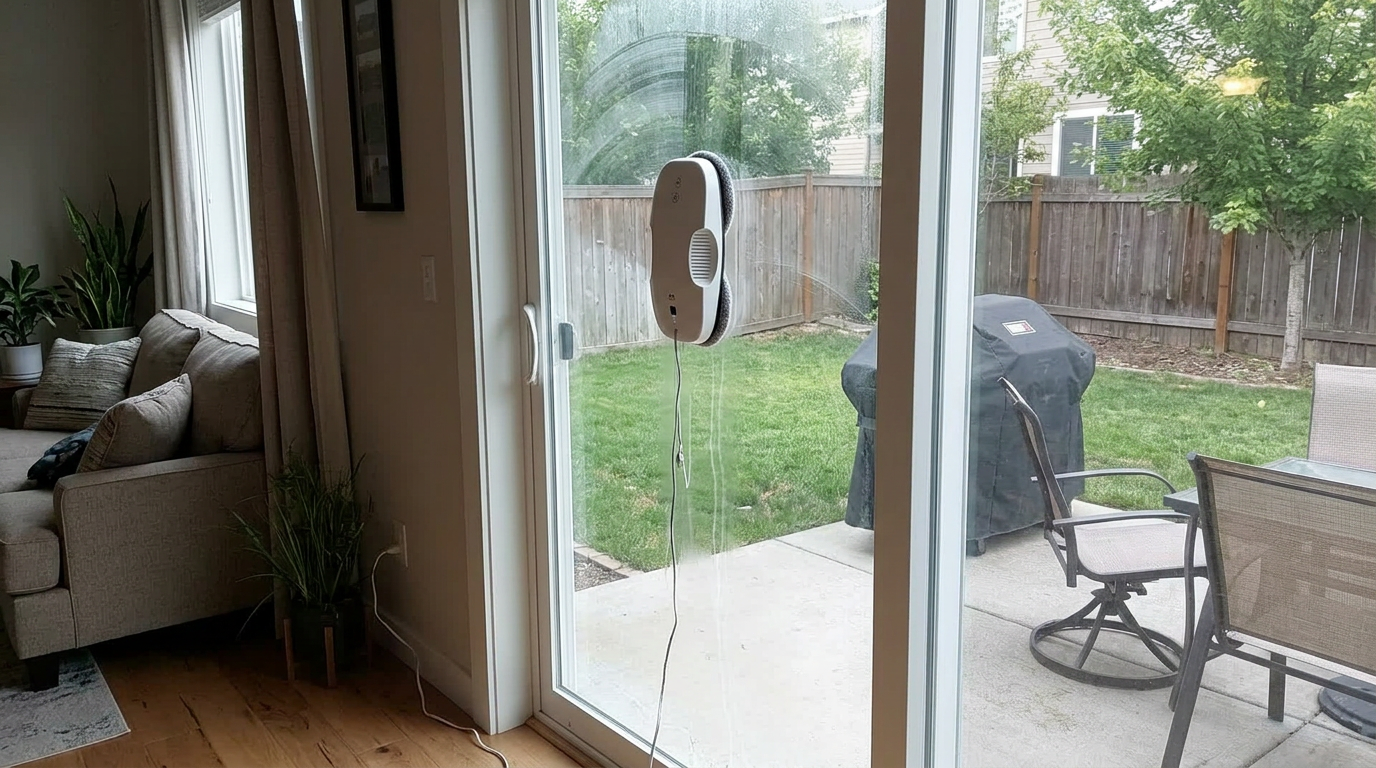
My first job was our patio door from inside. I wrung out the round pad, fitted the square pad dry, filled the 80 ml tank with filtered water and anchored the rope.
A long press of the button and it stuck to the glass. A short press and it started.
It worked more slowly than a square crawler, but when it finished, the glass was not just clean: it was clear, with almost no streaks, even with low sun coming through.
That clear finish became the theme of my four weeks with it.
The H10 on our patio door, its first job, with the grill outside.
What the HUTT H10 actually is
The H10 is a corded window robot with two cleaning stages in one body.
Stage one is the round pad, which spins to lift dirt with the help of an ultrasonic✕Ultrasonic sprayA tiny vibrating plate that turns water or cleaning solution into a very fine mist. Fine droplets wet the glass evenly without leaving drips. mist. Stage two is the square pad, which wipes the damp glass dry.
A brushless motor provides up to 6,500 Pa✕Pascal (Pa)The unit used for suction. Home window robots range from about 2,500 Pa to 10,000 Pa. of suction, and a 3D suspension base keeps a constant 55 N of pad pressure on the glass, about 12 pounds, similar to firm hand scrubbing.
| Feature | What it does | Why it matters |
|---|---|---|
| Round pad, 70 RPM | Scrubs wet | Lifts dirt and grime |
| Square pad | Wipes and polishes dry | Fewer streaks in one pass |
| Dual ultrasonic spray | Mists in both directions | Even hydration |
| NAVI 7.0 | Measures the window and plans paths | Efficient coverage |
| 14 sensors | Edges, pressure and stability | Safe, steady operation |
| Backup battery | Holds on for 30 minutes if power fails | Time to rescue it |
| 220 kg safety rope | Mountaineering-grade backup | Peace of mind on high glass |
How round-square cleaning works
Most window robots pick one approach. Dual round pads scrub but miss corners. Square crawlers reach corners but wipe with a single flat pad.
The H10 combines them.
The round pad does the hard work: it is damp, it spins and it pushes against the glass with steady pressure, loosening pollen, fingerprints and dust.
The square pad follows, dry, and wipes away the loosened dirt and moisture before it can dry into streaks.
| Design | How it cleans | Streaks | Corners |
|---|---|---|---|
| Round-square (H10) | Wet scrub, then dry polish | Fewest | Better than round alone |
| Dual round pads | Wet circular scrubbing | Can swirl | Curved patches |
| Square crawler | One flat damp pad | Depends on pad and spray | Closest |
The result, in my test, was glass that looked polished rather than just wiped.
HUTT H10 design and setup
At about 1.3 kg, roughly 2.9 pounds, the H10 is light and easy to place on high glass with one hand.
Setup is fast. Once it is plugged in, a long press attaches it to the glass and a short press starts cleaning. It is ready within seconds.
HUTT says it works on glass as small as about 30 by 30 cm, roughly 12 by 12 inches.
Before each clean
| Step | What I do | Why |
|---|---|---|
| 1. Tank | Fill with purified or filtered water | Prevents mineral buildup |
| 2. Round pad | Wet, then wring out thoroughly | Damp scrubbing, dry tracks |
| 3. Square pad | Fit completely dry | It polishes |
| 4. Tracks | Check they are clean and dry | Grip and straight paths |
| 5. Rope | Anchor it indoors | Essential on high glass |
| 6. Start | Long press to attach, short press to clean | Ready in seconds |
Our tip: Wipe the drive tracks dry before every session. Dust or moisture on the tracks is the most common reason for drifting or slipping near edges.
Suction and safety
Up to 6,500 Pa from the brushless motor held the H10 firmly on every window I tried, and the constant 55 N pressure kept the pads in solid contact.
Its 14 sensors handle edge detection✕Edge detectionSensors that tell the robot it has reached a frame or the edge of the glass, so it turns around instead of driving off., pressure monitoring and stability.
Bars show the order in which each layer acts.
Power cuts
If the power is interrupted, the built-in backup battery✕Backup batteryA small battery inside the robot that keeps the suction fan running if the power is cut, so the robot stays stuck to the glass while it beeps for help. keeps it attached for up to 30 minutes.
I tested it on an inside window by pulling the plug. It held on and alerted me.
The safety rope✕Safety tetherA strong cord that clips the robot to something solid indoors. If the robot ever lets go of the glass, the tether catches it before it can fall. is rated to 220 kg, far more than the robot weighs, which is reassuring on upstairs glass.
Dual ultrasonic spray and water
Two ultrasonic nozzles mist the glass in the direction of travel, so the round pad always meets damp glass.
The 80 ml visible tank is rated for up to about 646 square feet per refill, and it covered our whole ground floor easily.
No cleaning liquid is included. HUTT recommends purified water with minimal impurities to prevent mineral buildup and nozzle clogs.
I used filtered water throughout and had no clogs. Six spare nozzles in the box are there if you ever need them.
How far the 80 ml tank went in my testing, compared with the rated figure.
Our tip: Use filtered or purified water, not tap water, especially if yours is hard. It keeps the ultrasonic nozzles clear and stops mineral spots on dark glass.
How well the HUTT H10 cleans
This is where the H10 stood out.
It reliably removed pollen, fingerprints and smudges, and because the square pad dries as it goes, the glass looked clear rather than just clean.
In low sun, which reveals every streak, the H10’s results were among the clearest I have seen from a window robot.
My ratings on a 10-point scale.
Manage expectations on very neglected glass. It made a big improvement, but it is not a substitute for a professional deep clean on windows left for years.
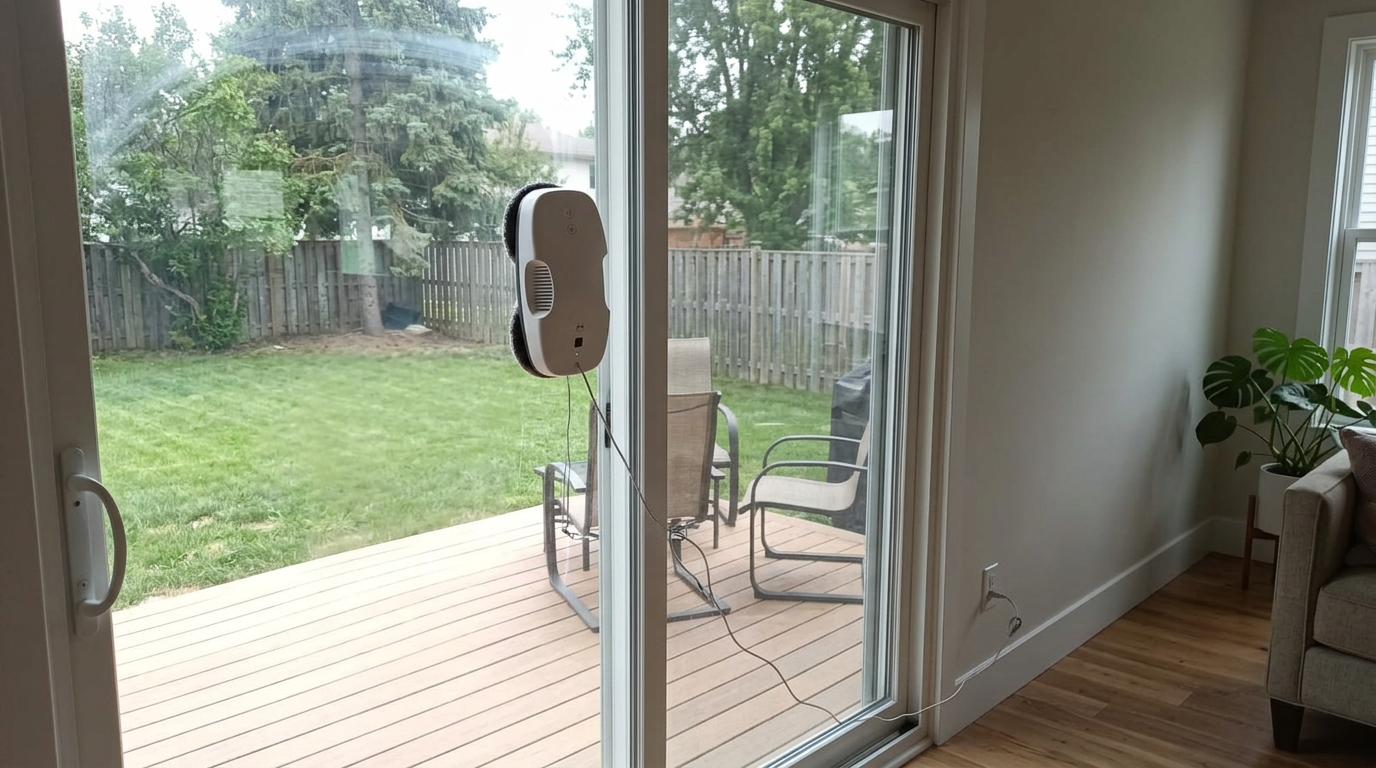
The deck door after one run: clear glass, even with the sun behind it.
Edges, corners and frameless glass
The H10’s edge detection impressed me most on frameless glass✕Frameless glassGlass with no raised frame around it, such as a shower screen, a mirror or a glass balcony rail. The robot must detect the drop-off with sensors instead of bumping into a frame..
On our frameless shower screen and bathroom mirror, it recognized the edge and cleaned right up to it, leaving no unwiped margin.
On framed windows, it worked close along the frame. The square section reached further into corners than a dual-round robot, though thin corner slivers remained.
My cleaning ratings by part of the glass, out of 10.
On one window, I could see a faint mark from the drive after cleaning. A cloth removed it in a second.
Our tip: Keep a dry microfiber cloth handy for the corners and any faint drive mark. It takes a few seconds and makes the window look finished.
Gaps, divided glass and other limits
The H10 needs continuous glass.
Our bathroom has a mirror made of two sections with a narrow gap between them. The robot reached the gap and stopped.
That is consistent with how its sensors work: a gap looks like an edge, so it treats it as one.
| Glass type | How it went | My verdict |
|---|---|---|
| Single large pane | Clear, streak-free | Excellent |
| Frameless mirror or screen | Clean to the edge | Excellent |
| Small pane, about 12 × 12 in | Fits and cleans | Very good |
| Divided mirror with a narrow gap | Stops at the gap | Clean each section separately |
| Glass with raised strips | Stops or turns | Fair |
If you have divided panes, clean each section as its own window.
Outside windows
Outside glass went well, with a few precautions.
I anchored the rope indoors, ran the cord through the window and made sure the tracks and square pad were dry before placing it.
The grip held firmly, and the dry polish stage was especially welcome outside, where rain spots and pollen usually leave streaks.
My ratings on a 10-point scale.
Avoid hot, direct sun. The mist dries before the round pad reaches it.
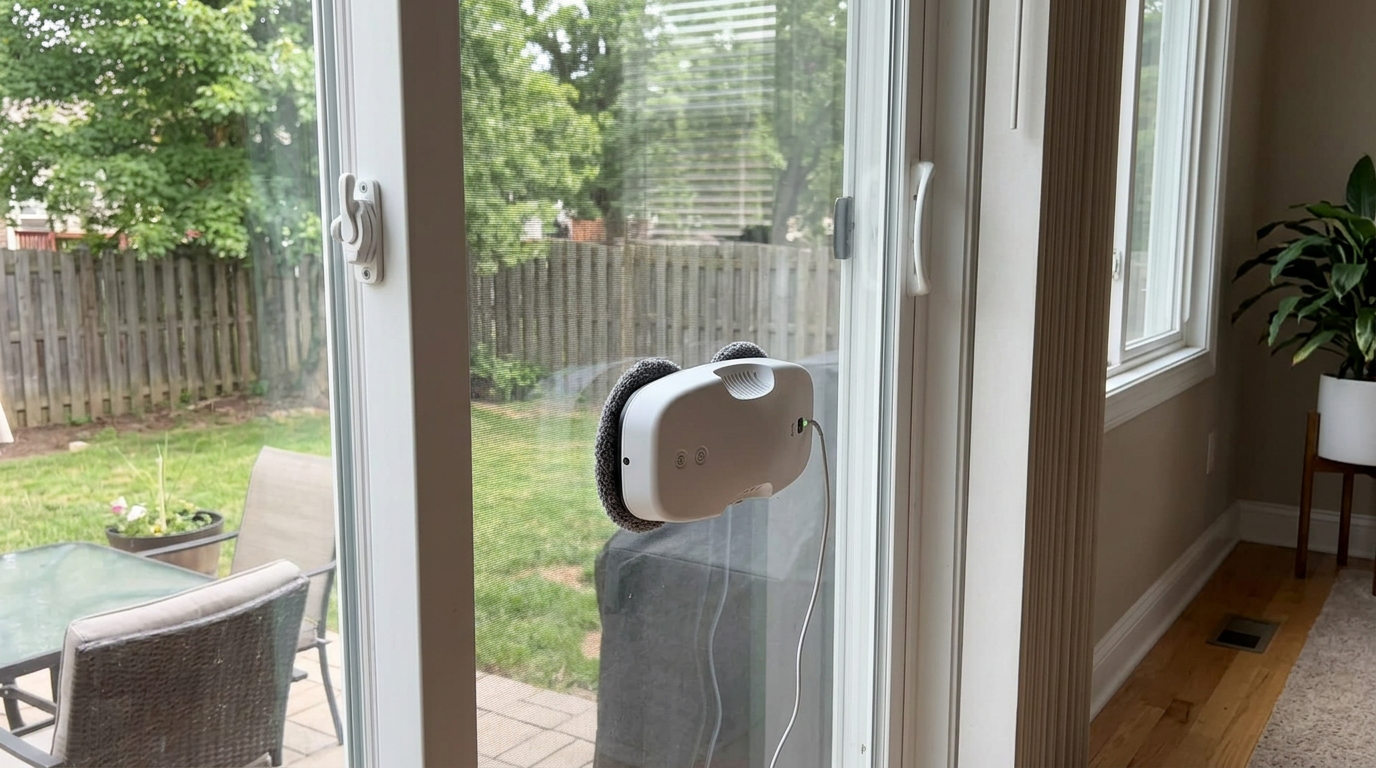
The patio door from inside after an outside run, with the chairs clearly visible through the glass.
My routine for upstairs windows
The H10’s light weight makes it easy to place on high glass, but I still followed a careful routine upstairs.
| Step | What I do | Why |
|---|---|---|
| 1. Anchor | Rope to a radiator pipe or heavy furniture | A 220 kg rope needs a solid anchor |
| 2. Dry | Wipe the tracks and fit a dry square pad | Prevents slipping at edges |
| 3. Cord | Route it so it cannot be pulled out | Avoid needless backup use |
| 4. Attach | Long press, hold until stuck | Do not let go early |
| 5. Stay in earshot | Listen for alerts | Use the 30-minute window |
| 6. Retrieve | Two hands, power off, lift in | Safe removal |
With that routine, I had no slips or scares on our upstairs windows during the test.
Keeping it on course: tracks and pads
Early in week one, the H10 drifted slightly on one door and struggled to turn near the edge.
The cause was exactly what HUTT describes: a little moisture on the drive tracks and a round pad I had not wrung out enough.
Once I dried the tracks, fitted the square pad dry and wrung the round pad properly, it tracked straight for the rest of the month.
How often each issue caused drifting or slipping in my test.
It is a small routine, but it matters more on the H10 than on simpler robots.
Mirrors and shower glass
HUTT pitches the H10 for windows, mirrors, shower doors and sliding doors, and the bathroom was where it surprised me.
The frameless shower screen came out clear to the edge, and soap film lifted well over two runs. Thick limescale needed a descaler first.
The bathroom mirror, as long as I cleaned each section separately, was streak-free.
My ratings on a 10-point scale.
Our tip: Let the bathroom air out before cleaning. Steam on the glass makes the square pad damp, and a damp square pad cannot polish.
Kitchen windows and greasy glass
Kitchen glass is a good test for any robot, because grease smears easily.
The H10’s two stages helped here. The wet round pad lifted the light film, and the dry square pad wiped the residue away before it could smear.
Near the stove, heavier buildup still needed a degreasing wipe first, but on the window over the sink, one run was enough.
My ratings on a 10-point scale.
Noise
HUTT rates the H10 as low as 65 dB, and it is one of the quieter window robots I have used.
It is still a steady fan sound, but softer and less whiny than many, and I worked comfortably in the same room.
Rated noise compared with typical everyday sounds.
Our cat did not leave the room, which is the best noise review I can give.
Power and cord reach
The H10 runs on mains power with a wide-voltage 110 to 240 V adapter. The battery is only for emergencies.
You need an outlet within cord reach, and for outside glass, a route for the cord through a door or window.
Our tip: Keep the power cord and safety rope on opposite sides. When they tangle, they tug the robot off its path.
What using it is really like
A session took about two minutes of setup, most of it pad preparation and wiping the tracks.
The robot then cleaned quietly while I did other things, a little slower than a square crawler.
Afterward, I lifted it off, wiped any corner slivers and rinsed the pads.
My hands-on time for a typical session.
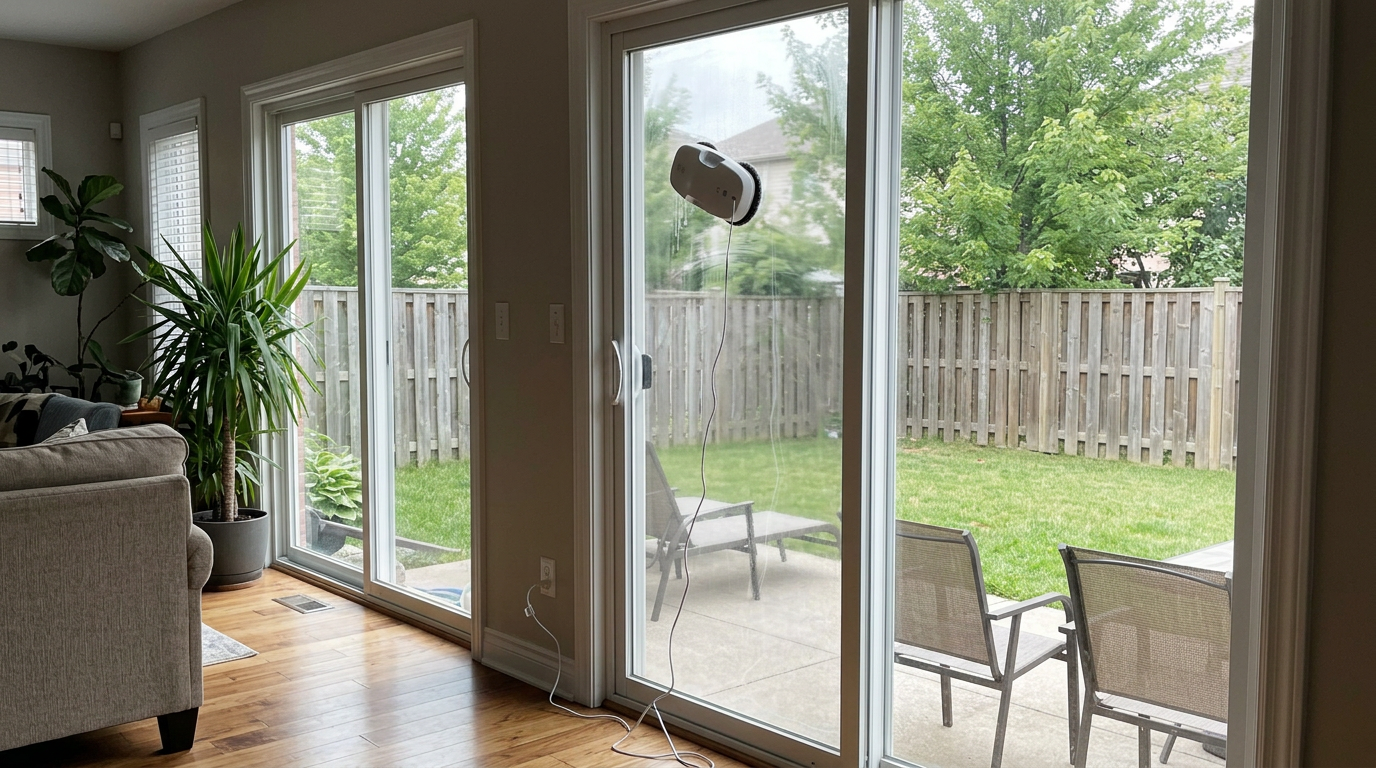
Living room sliders after a full clean, polished dry by the square pad.
A whole-floor cleaning day
I cleaned every window and door on our ground floor with the H10 in a single morning.
I prepared three round pads and three dry square pads, filled the tank with filtered water and wiped the tracks.
| Glass | Mode | Pads | Notes |
|---|---|---|---|
| Living room sliders | Full clean | Pair 1 | Streak-free in low sun |
| Patio door, inside | Full clean, then targeted | Pair 1 | Nose prints cleared |
| Kitchen window | Full clean | Pair 2 | Light grease lifted |
| Deck door, outside | Full clean | Pair 2 | Pollen and spots gone |
| Side window, outside | Full clean | Pair 3 | Clear finish |
It took longer than a square crawler would have, but my own time was about 25 minutes, and every pane looked polished.
Robot versus cleaning by hand
| Task | By hand | HUTT H10 |
|---|---|---|
| One small window | Faster | Slower, but streak-free |
| Several large doors | Tiring, streaks creep in | Consistent, clear results |
| Frameless mirrors | Easy | Easy, edge to edge |
| High outside glass | Ladder or stretching | From inside, roped |
| Your effort | All of it | Pad prep, track wipe, rinsing |
Its strongest advantage over hand cleaning is the finish. I rarely get glass this streak-free by hand on a big door.
How to get the best results
- Round pad damp and well wrung out; square pad completely dry.
- Wipe the drive tracks dry before every session.
- Use filtered or purified water.
- Clean divided glass one section at a time.
- Let steam clear before bathroom glass.
- Clean outside glass in shade.
- Keep the cord and rope apart.
My judgment of how much each habit improved the final result.
Pad care for two kinds of pad
The H10 uses two different pads, and each needs different care.
The round pad
The round pad is made of coarser microfiber and does the wet scrubbing. Soak it, then wring it out thoroughly so it is damp, not dripping.
After a session, it is the dirtier of the two. Rinse it well under warm water and let it dry fully.
The square pad
The square pad is a finer fabric attached with Velcro. It must go on completely dry, because its job is to polish.
After use it is usually only slightly damp. Let it dry completely before the next session; a spare dry square pad saves waiting.
| Pad | Before use | After use |
|---|---|---|
| Round pad | Wet, then wring out well | Rinse thoroughly, dry fully |
| Square pad | Fit completely dry | Air-dry before reuse |
With three pairs in the box, I always had a dry square pad ready, which made the polish stage reliable.
Our tip: Keep one dry square pad set aside for the last window of a session. A bone-dry polish pad on the final pane gives the best finish of the day.
Cleaning and maintaining it
| When | Task | Why it matters |
|---|---|---|
| Before each session | Wipe the tracks dry | Straight paths, no slipping |
| After each session | Rinse both pads, dry fully | Clean, dry pads polish best |
| After each session | Empty the tank | Avoids mineral deposits |
| Weekly | Wipe the sensors | Accurate edges |
| Before high glass | Check the rope | Your safety backup |
Supplies and long-term ownership
Running costs are low. It uses water, not proprietary solution, and the pads are washable.
With three pairs, I always had a dry square pad ready, which matters for the polish stage.
There is no storage case. I kept everything in a lidded box.
After four weeks, suction✕Suction (Pa)How hard the fan pulls the robot against the glass, measured in pascals. More pascals means a firmer grip, which matters most on outside windows and big panes., navigation and results were unchanged, as long as I kept the tracks and pads dry.
Which homes it suits best
| Home | How well it fits | Why |
|---|---|---|
| Sunny rooms where streaks show | Excellent | Dry polish stage |
| Bathrooms with frameless glass | Excellent | Clean to the edge |
| Homes with small panes | Very good | Works from about 12 × 12 in |
| Divided mirrors and panels | Fair | Stops at gaps |
| People in a hurry | Fair | Slower two-stage clean |
If you care most about how the glass looks when the sun hits it, the H10 is a standout.
Who will love the H10, and who will not
After a month, the H10 has a very clear personality.
It is the robot for people who notice streaks. If you have ever cleaned a window, felt pleased, then seen every smear the moment the sun hit it, this robot is aimed at you.
It is also a good fit for modern bathrooms with big frameless mirrors and shower screens, where its edge detection shines.
It is less suited to people who want the fastest possible clean, or homes with lots of divided panes, where it has to be moved section by section.
And it asks for a little care: dry tracks, a dry square pad and filtered water. If that sounds like too much, a simpler robot will feel easier, though it will not give you the same finish.
How well the H10 matches different priorities, from my experience.
Living with it: week one to week four
Week one: inside doors, plus a little drifting that taught me the dry-tracks routine.
Week two: bathroom mirror and frameless shower screen, where it shone.
Week three: outside glass on the ground floor and upstairs, with the rope anchored.
Week four: quiet weekly upkeep, with streak-free results that kept impressing me in low sun.
My overall satisfaction each week, out of 10.
What surprised me, good and bad
The biggest surprise was the finish. In low evening sun, which shows every flaw, the H10’s glass looked polished.
The second was frameless glass. It cleaned right to the edge of our shower screen and mirror without hesitating.
The less welcome surprises were the early drifting before I learned the dry-tracks routine, and the stop at the gap in our divided mirror.
How each detail compared with my expectations before testing.
Common mistakes to avoid
The HUTT H10 is easy to use, but it rewards a few habits.
| Mistake | What happens | Better habit |
|---|---|---|
| Damp square pad | No polish, streaks | Fit it completely dry |
| Over-wet round pad | Slipping, drips | Wring it out thoroughly |
| Damp or dusty tracks | Drifting near edges | Wipe them dry first |
| Hard tap water | Nozzle buildup | Use filtered water |
| Divided glass in one run | Stops at the gap | Clean each section |
| No rope on high glass | No backup | Anchor it every time |
What I would change
A little more speed and a storage case would make it close to ideal.
Is it a good first window robot?
For many people, yes, especially if what bothers you about windows is streaks.
It is light and simple to start: plug in, long press to attach, short press to clean.
The learning curve is the pad and track routine. Once you know to keep the tracks and square pad dry, it is easy.
If you want the quickest possible clean with no prep, a simpler square crawler may suit you better.
Is the HUTT H10 worth the money?
If streak-free glass is your priority, yes.
The round-square design gave me clearer results than most robots, and it adds a strong grip, quiet running, light weight and a 30-minute backup.
You trade some speed, and you take on a small pad-and-track routine.
Ask yourself three questions. Do streaks bother you in sunlight? Do you have frameless mirrors or shower glass? And can you live with a slightly slower clean?
If so, the H10 is an excellent choice.
Where your money goes
You are paying for the two-stage cleaning head, the suspension that keeps pressure constant and a solid safety package.
You are not paying for a station, an app or proprietary cleaning solution, which keeps ownership simple and cheap to run.
How it compares with other window robot designs
The most useful way to compare the H10 is by design.
| Feature | HUTT H10 | Dual round-pad robots | Square crawler robots | Station robots |
|---|---|---|---|---|
| Cleaning | Wet scrub, then dry polish | Wet circular scrub | One damp flat pad | One damp flat pad, edge tools |
| Streaks | Fewest | Can swirl | Moderate | Moderate to few |
| Corners | Thin slivers | Curved patches | Closest | Closest |
| Speed | Moderate | Slower | Fastest | Fast |
| Weight | About 1.3 kg | Varies | Varies | Heavy kit |
| Best for | Streak-free finish | Scrubbing on a budget | Speed and corners | Cleaning anywhere |
| Your home | Is the H10 a fit? | Why |
|---|---|---|
| Sunny rooms, big doors | Excellent | Dry polish |
| Frameless bathrooms | Excellent | Edge detection |
| Divided panes | Fair | Stops at gaps |
| Need for speed | Fair | Two-stage cleaning |
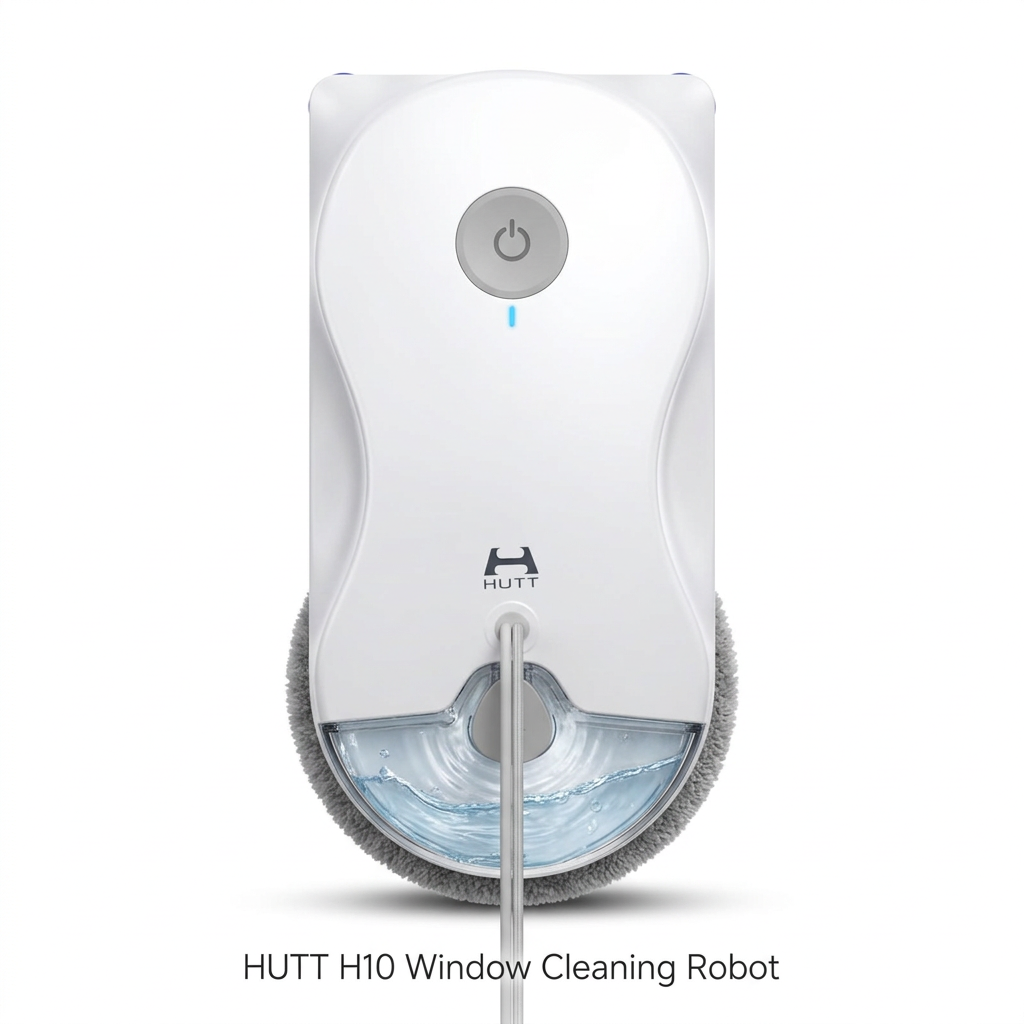
The H10’s round-square body: a round pad to scrub and a square pad to polish.
Which one is right for you: is the HUTT H10 your match?
4 quick questionsHUTT H10 specifications
From manufacturer data and my own testing.
How I tested and scored the HUTT H10
For four weeks, I used the HUTT H10 on sliding doors, a patio door, windows inside and out, a frameless shower screen and a divided bathroom mirror.
I compared results in low sun, tested its behavior at gaps and frameless edges, checked the backup battery by cutting power and tracked what caused drifting.
I used filtered water throughout and timed my hands-on work.
I then checked my notes against HUTT’s published specifications.
- Cleaning (8.5): streaks, pollen, fingerprints, everyday dirt and outside grime on windows, mirrors and shower glass.
- Edge coverage (8.1): frame lines, corners and frameless edges such as mirrors and shower screens.
- Ease of use (8.1): setup, the remote, pad preparation, track care, refills and handling.
- Safety (8.6): 6,500 Pa suction, 55 N pressure, 14 sensors, the 30-minute backup and the 220 kg rope.
The overall score of 8.3 is an editorial rating that reflects those four areas.
HUTT H10 FAQ
Is the HUTT H10 worth it?
Yes, if a streak-free finish matters most. It is slower than square crawlers and needs dry tracks and a dry square pad.
What is round-square cleaning?
A spinning round pad scrubs the glass wet, then a square pad wipes it dry in the same pass.
How strong is the suction?
Up to 6,500 Pa, with a constant 55 N of pad pressure.
What happens if the power goes out?
A backup battery keeps it attached for up to 30 minutes.
Does it come with cleaning solution?
No. HUTT recommends purified water to prevent nozzle clogs and mineral buildup.
How big is the tank?
80 ml, rated for up to about 646 square feet per refill.
Why does it drift or slip near edges?
Usually damp or dusty tracks or an over-wet round pad. Keep the tracks dry and wring the round pad well.
Can it clean frameless glass?
Yes. Its sensors detect frameless edges on mirrors and shower screens.
Can it cross gaps between glass panels?
No. A narrow gap looks like an edge, so clean each section separately.
What is the smallest window it can clean?
About 30 by 30 cm, roughly 12 by 12 inches.
How loud is it?
As low as 65 dB, one of the quieter window robots I have used.
How heavy is it?
About 1.3 kg, roughly 2.9 pounds.
Does it come with a storage case?
No. A lidded box keeps the robot, remote, adapter, rope and pads together.
Should the square pad be wet?
No. Fit the square pad completely dry so it can polish. Only the round pad should be damp.
Senior home appliance tester
Emily has tested home appliances for a living since 2016, including five years as a test coordinator at a national consumer advocacy group, and has run HouseholdMe's cleaning tests since 2021. She has a degree in industrial design, so she looks at how a product is built, not just how it performs. She used the HUTT H10 for four weeks for this review, on sliding doors, windows inside and out, a frameless shower screen and a divided bathroom mirror.
- Four weeks of hands-on testing of the HUTT H10
- HUTT product specifications
- General window-cleaning and robot-safety guidance