AIRMSEN 20 Bar review: two heaters, one-touch lattes and a touchscreen in a machine under 8 inches wide
The AIRMSEN 20 Bar Espresso Machine with Automatic Milk Frother is a compact semi-automatic machine with separate heaters for coffee and milk, so it brews and froths at the same time. Its cappuccinos and lattes are fast and genuinely hands-off, and the touchscreen is easy from day one, but the foam is airy rather than silky, there's no grinder, and the milk path needs flushing after every drink.

Michael Reynolds
Hands-on review
Hands-on testing, research, specs
3 weeks
24 minutes
Jargon helpNew to espresso? Tap any dotted term to see what it means.
In this review
Yes, if you drink cappuccinos and lattes most days and want them without learning a steam wand. The AIRMSEN 20 Bar heats coffee and milk separately, so a latte is ready in about a minute and a half, and the touchscreen makes every drink one tap. The espresso is good once you dial in the grind, but the foam is airy rather than silky, you'll need your own grinder for whole beans, and the milk path has to be flushed after every milk drink.
AIRMSEN 20 Bar at a glance
AIRMSEN 20 Bar pros and cons
- Brews espresso and froths milk at the same time
- One-tap cappuccinos and lattes from a color touchscreen
- Very narrow body fits tight counters
- Airy foam, not silky microfoam for latte art
- No grinder, so whole beans need a separate one
- Only about 4.1 inches of cup clearance
Who should buy the AIRMSEN 20 Bar?
- Households that drink milk drinks every day
- Small kitchens and tight counters
- Beginners who don't want to learn a steam wand
- Latte art fans who want glossy microfoam
- Anyone who fills a tall travel mug each morning
- People who want no cleanup after a milk drink
First impressions of the AIRMSEN 20 Bar
The AIRMSEN 20 Bar is built for one job: getting a cappuccino or latte into your cup with as few steps as possible.
It doesn't ask you to learn a steam wand, and it doesn't hide its drinks behind menus.
Out of the box, the AIRMSEN 20 Bar Espresso Machine is smaller than I expected.
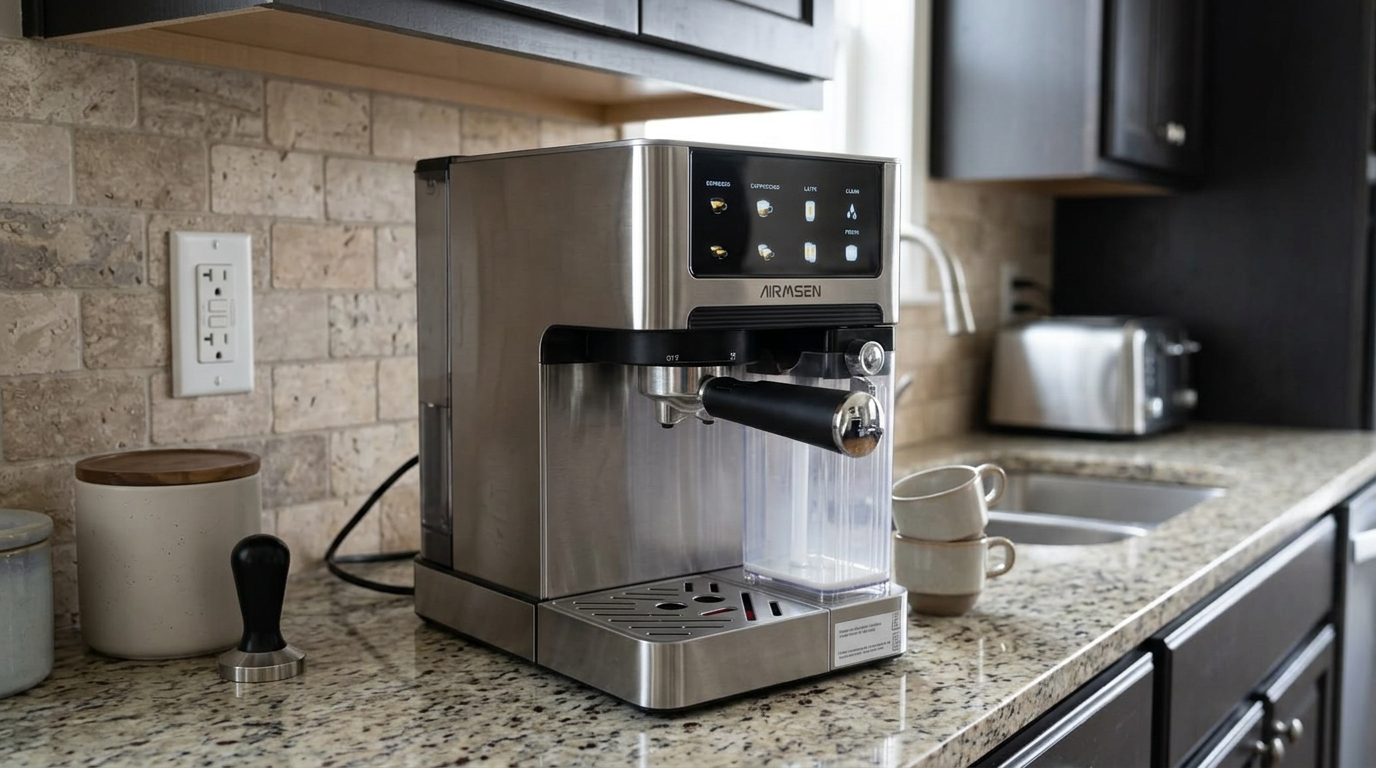
At just under 8 inches wide, it's narrower than most toasters, and the brushed steel panels and black glass control panel look tidy on a counter.
The color touchscreen lights up with five clear icons: single espresso, double espresso, cappuccino, latte and cleaning.
It weighs about 9.3 pounds, so I could lift it with one hand to wipe the counter underneath.
That lightness is the first hint of where the money went: into features rather than heft.
My first shot, made with the included scoop and pre-ground coffee, was thin and fast.
That's normal with coffee that isn't ground fine enough for espresso, and it improved as soon as I switched to my own burr grinder.
The real surprise came with my first latte.
I pressed one icon, the machine pulled a shot and frothed milk at the same time, and I had a hot latte in front of me before my toast popped.
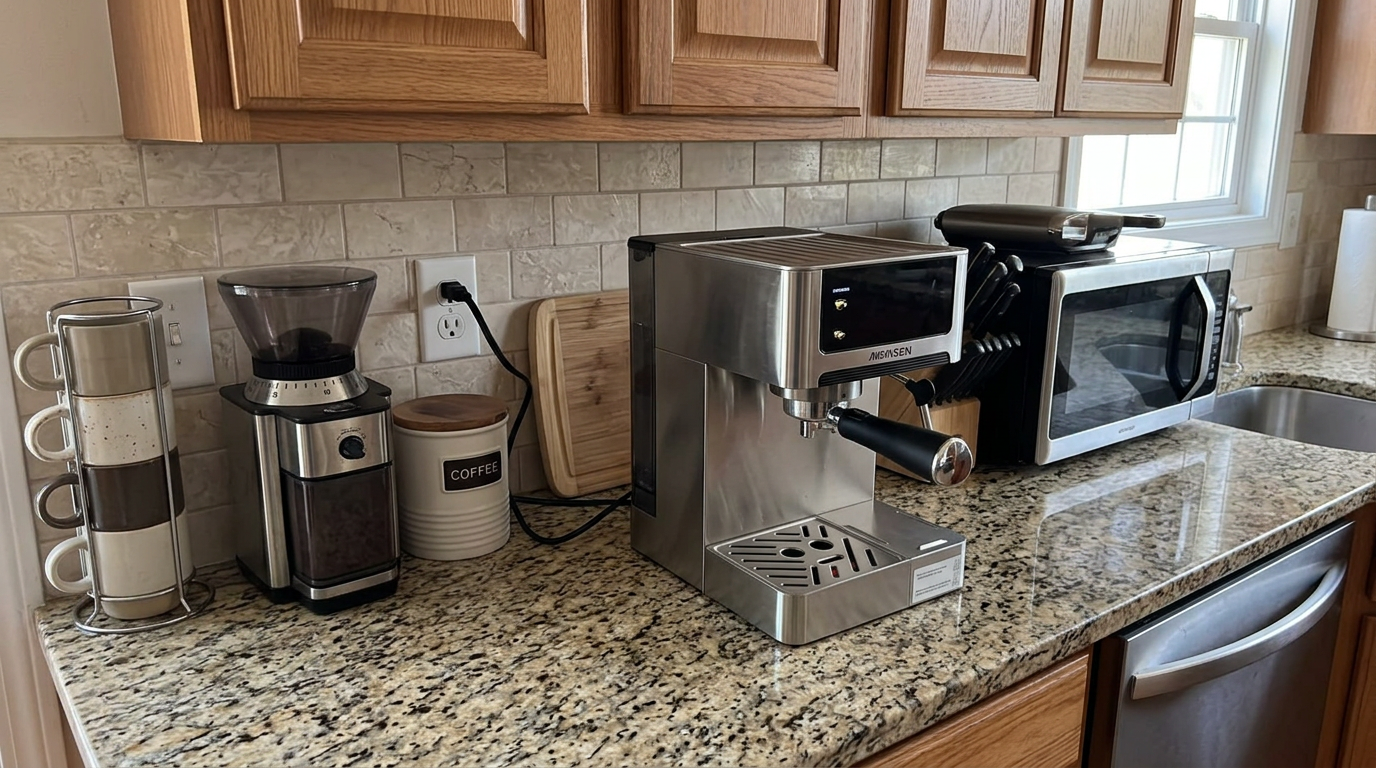
The AIRMSEN 20 Bar next to my burr grinder. You'll need one if you buy whole beans.
What the AIRMSEN 20 Bar actually is
The AIRMSEN 20 Bar is a semi-automatic pump espresso machine with an automatic milk system bolted on.
You grind and dose the coffee, tamp✕TampingPressing the ground coffee flat and firm in the basket. An even tamp gives water the same resistance everywhere, which helps the shot extract evenly. it into the portafilter✕PortafilterThe handle with a metal basket that holds the ground coffee. You lock it into the machine, and hot water is pushed through the coffee inside it., lock it in and tap a drink.
The machine controls the water, the pressure and the timing, and it froths milk from its own container straight into your cup.
Two heaters instead of one
The headline feature is what AIRMSEN calls a dual boiler.
One 1,350-watt heater is dedicated to brewing, and a separate 1,000-watt heater handles the milk.
On most machines in this size class, a single heater does both jobs.
That means you pull a shot, then wait while it heats up to steam temperature before you can froth.
On the AIRMSEN, both heaters run at once, so there's no waiting between the coffee and the milk.
What that changes in practice
If you mostly drink straight espresso, the second heater doesn't do much for you.
If you drink lattes, it's the reason this machine exists.
| Feature | AIRMSEN 20 Bar (tested) | Typical single-heater machine |
|---|---|---|
| Heating | Separate 1,350 W brew and 1,000 W milk heaters | One heater for brew and steam |
| Brew and froth together | Yes | No, you wait between them |
| Milk | Automatic, from a 17 oz container | Manual steam wand |
| Skill needed for milk | None | Some practice |
| Milk cleanup | Cleaning cycle after each drink | Wipe and purge the wand |
What's inside
A 20-bar Italian pump does the pushing, with a low-pressure pre-infusion✕Pre-infusionA short, gentle soak at low pressure before full pressure kicks in. It wets the whole coffee puck first, so water flows through it more evenly. stage at the start of every shot.
NTC sensors✕NTC sensorA small temperature probe that tells the machine's electronics how hot the water is, so the heater can switch on and off to hold a set range. watch the water temperature, and AIRMSEN states an extraction range of 203 to 208°F.
The milk system draws from a removable container and sends foam through an adjustable spout.
AIRMSEN 20 Bar design and setup
The AIRMSEN 20 Bar measures about 7.9 × 10.2 × 12 inches (W × D × H) and weighs about 9.3 pounds.
It slid under my wall cabinets with room to spare.
The catch is the water tank, which sits at the back, so you need space behind and above it to lift the tank out.
The water tank
The removable tank holds 60 ounces, roughly 1.8 liters.
AIRMSEN rates it for up to 12 extractions, but in my testing that number dropped fast once I made milk drinks and ran cleaning cycles.
I pulled the machine forward a few inches each time I filled it, which became a habit by the end of the first week.
The touchscreen
The control panel is a color touchscreen behind black glass.
It's bright, the icons are clear, and it responded to every tap I made with dry fingers.
With wet or milky fingers it occasionally needed a second tap, which is worth knowing if you make drinks in a hurry.
The cup warmer
The flat top plate warms cups while the machine is on.
I stacked two espresso cups there each morning, and pre-warmed cups kept my shots noticeably hotter for longer.
First-time setup
Setup took about 10 minutes.
Fill the tank, then run two or three water-only cleaning cycles before you brew anything.
That primes the water lines and flushes out anything left from manufacturing or shipping.
What's in the box
You get a portafilter with a roughly 2-inch (about 51 mm) basket, a single-shot basket, a double-shot basket and a measuring scoop with a flat tamping base on the other end.
That's enough to start with pre-ground coffee, but not enough to get the best from it.
Our tip: Run three water-only cleaning cycles before your first shot, even if the manual says two.
The touchscreen lit up on my counter, with a separate tamper and a canister of fresh beans beside it.
Grinding and coffee prep: bring your own grinder
There's no built-in grinder on the AIRMSEN 20 Bar.
If you buy pre-ground espresso coffee, that's fine, and it's the simplest way to start.
If you buy whole beans, budget for a separate burr grinder and the counter space it takes.
Why the grind matters so much here
For espresso, coffee should be ground fine, roughly like table salt.
Too fine and the water crawls through, or the basket clogs.
Too coarse and the water rushes through in a few seconds, giving a weak, sour shot.
I measured my shot times with a phone timer while dialing in, and the change was dramatic.
Approximate shot times for a double espresso with the same beans and dose. Around 25 to 30 seconds tasted best.
Dose and tamp
I used about 14 to 16 grams of coffee in the double basket and about 8 grams in the single.
The flat base of the included scoop works as a tamper, but it's small and light, and it was hard to press evenly.
After a few days I switched to a separate 2-inch tamper, and my shots became more consistent.
Uneven tamping leaves weak spots in the puck, which leads to channeling✕ChannelingWhen water finds a weak spot in the coffee puck and rushes through it. Part of the coffee is over-extracted and the rest barely touched, so the shot tastes sour and bitter at once. and a shot that's sour and bitter at the same time.
Our tip: Grind just before you brew; ground coffee loses its aroma within minutes.
AIRMSEN 20 Bar espresso performance
Once I had my grind and tamp right, the AIRMSEN made genuinely good espresso.
It isn't as tunable as a pricier machine, but for everyday shots it holds its own.
How it tasted
With a medium-dark blend, fine burr grind and a firm tamp, my double shots had a thick, hazelnut-colored crema✕CremaThe golden-brown foam on top of an espresso. It forms when pressure pushes gases and oils out of freshly ground coffee..
The body was full and syrupy, with notes of cocoa and caramel and a little roasted bitterness at the end.
With supermarket pre-ground coffee, shots were thinner and faster, with paler crema that faded within a minute.
If you're unsure which beans to start with, my guide to coffee roast levels explains why medium-dark roasts are the easiest to dial in.
Pre-infusion and the 20-bar label
Every shot starts with a short, gentle soak before full pressure.
I could hear the pump change pitch about two seconds in, and the first drips appeared evenly across the spouts.
That soak helped a lot with slightly uneven tamps.
The 20-bar✕BarA unit of pressure. One bar is roughly the air pressure at sea level. Espresso is usually brewed at around 9 bar at the coffee, whatever the pump's maximum rating. figure on the box is the pump's maximum rating, not the pressure at the coffee.
Good espresso is usually brewed at around 9 bar, and a bigger pump number doesn't make a better shot on its own.
What matters more is fresh coffee, the right grind and an even tamp.
Temperature
AIRMSEN says the brew water stays between 203 and 208°F.
I didn't have a way to probe the water inside the group, but my shots in pre-warmed cups measured about 160 to 165°F in the cup right after brewing.
That's hot enough to drink straight away and hot enough to make a latte that doesn't need reheating.
Single vs double
The single espresso preset pours about 1 to 1.7 ounces, and the double about 2 to 3 ounces.
I found the double basket far easier to work with.
It's more forgiving of small grind and tamp errors, and the shot tasted more balanced.
My flavor ratings on a 10-point scale, same machine and settings.
| What you taste or see | Likely cause | First change |
|---|---|---|
| Weak, watery, pale crema | Grind too coarse or not enough coffee | Grind finer and fill the basket fully |
| Sour, thin | Under-extraction | Grind finer, tamp firmer |
| Bitter, harsh | Over-extraction | Grind slightly coarser |
| Sour and bitter together | Channeling from an uneven tamp | Level the grounds, tamp straight down |
| Drips or no flow | Grind far too fine or basket clogged | Grind coarser, rinse the basket |
Automatic milk frothing
This is where the AIRMSEN 20 Bar earns its place on a counter.
The milk system is fully automatic, and it worked from the first try.
How it works
You fill the clear 17-ounce container with cold milk and click it onto the side of the machine.
Swing the milk spout over your cup, adjust its height and tap cappuccino or latte.
The machine draws milk up, heats and aerates it, and pours it straight into the cup while the espresso brews beside it.
When you're done, the container comes off and goes straight into the fridge, milk and all.
What the foam is like
The foam is light, airy and plentiful.
For a classic cappuccino with a tall cap of froth, it's very good.
It isn't the fine, glossy microfoam✕MicrofoamMilk foam with bubbles so small you can't see them. It feels silky and blends into the coffee instead of sitting on top like froth. you'd get from a skilled hand on a steam wand.
You can't pour latte art with it, and the foam on a latte sits on top rather than folding into the coffee.
Milk temperature
My lattes came out at about 140 to 150°F in the cup, which is the sweet spot where milk tastes sweetest.
You can lengthen the frothing time and save it, which adds more milk and a little more heat.
My ratings on a 10-point scale for foam texture and stability.
Milk tips that made a difference
Cold milk straight from the fridge foamed far better than milk that had sat out for 20 minutes.
Barista-style plant milks worked well. Thin, regular almond and oat drinks made big bubbles that collapsed within a minute.
Our tip: Keep the milk container in the fridge between drinks and click it on only when you need it.
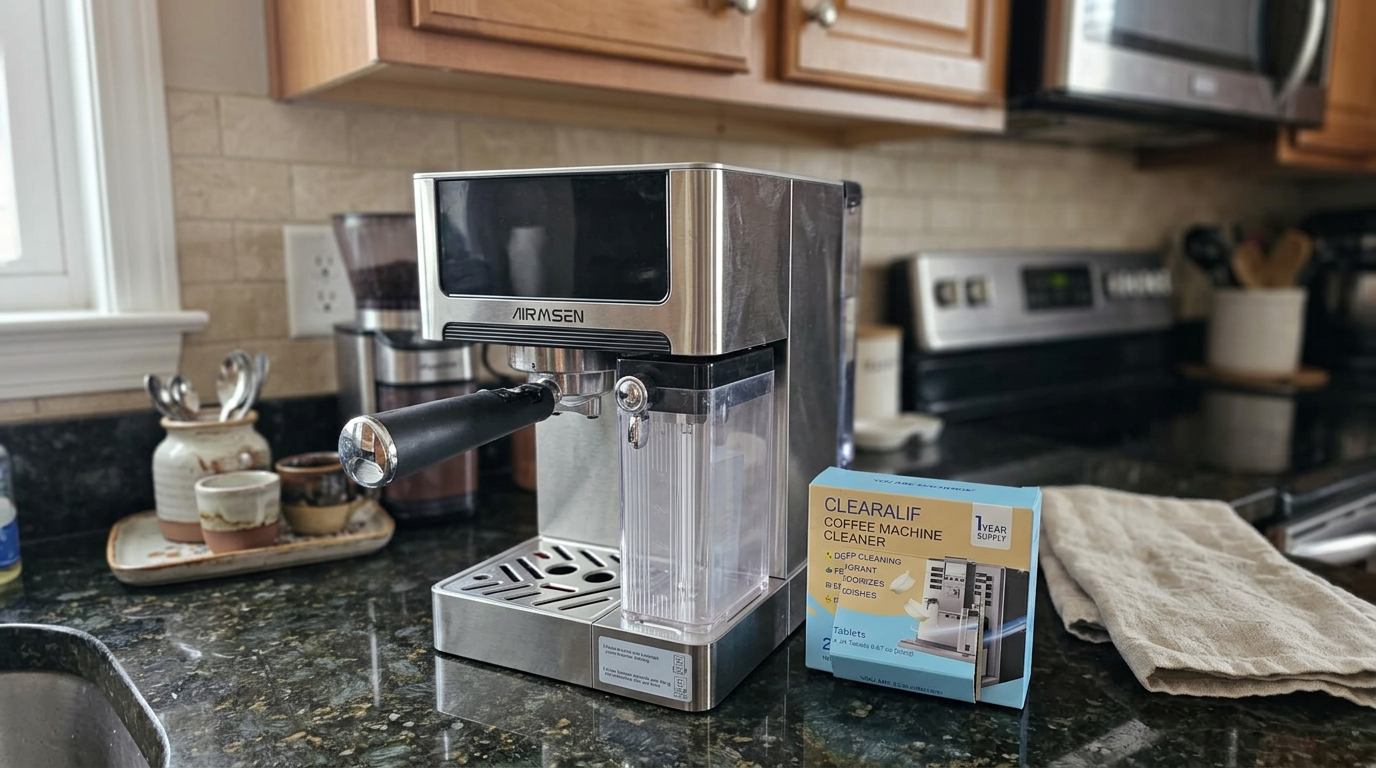
The clear 17-ounce milk container clicked onto the side, ready for a morning latte.
Brewing and frothing at the same time
I timed a full latte from tap to drink on a machine that was already warm.
Then I compared it with my notes from single-heater machines I've tested, where you brew first and steam afterward.
Why the second heater matters
On the AIRMSEN, the shot and the milk finish within seconds of each other.
On a single-heater machine like the De’Longhi Dedica EC680R, you wait for the heater to switch to steam temperature, then froth by hand.
Neither approach is wrong, but the time difference adds up if you make several drinks.
My timings from tap to drink, warm machine, including cleaning cycles.
The catch: cleaning between drinks
Those timings include a quick cleaning cycle after each milk drink.
Skip it, and the next latte is faster, but milk starts drying inside the system.
I'll come back to that, because it's the biggest daily chore with this machine.
Touchscreen, presets and saved settings
The touchscreen has five presets: single espresso, double espresso, cappuccino, latte and cleaning.
Daily use is as simple as it gets: lock in the portafilter and tap.
Saving your own drinks
You can adjust the extraction time for each coffee preset and the frothing time for each milk drink, then save them.
Press and hold the icon, and the machine enters setting mode; tap again when the cup reaches the level you want.
After that, every tap gives the same drink.
I shortened the double espresso slightly and lengthened the latte milk, and I never touched the settings again.
Presets are a starting point
The factory volumes are fine, but they're not a recipe for every bean.
A dark roast tasted better a little shorter, and a medium roast a little longer.
There are no user profiles, so if two people in your house like different drinks, one of you will be adjusting.
Our tip: Set your latte and double-shot volumes with your own cups on day one.
Cups, mugs and clearance
Cup clearance is about 4.1 inches under the portafilter and milk spout.
That's the AIRMSEN's most practical limitation, and it's worth measuring before you buy.
| Cup I tried | Height | Did it fit? |
|---|---|---|
| Espresso cup | About 2.5 in | Yes, easily |
| Cappuccino cup | About 3 in | Yes |
| Standard coffee mug | About 3.8 in | Yes, just |
| Short latte glass | About 4 in | Yes, with the spout raised |
| Tall latte glass | About 5.5 in | No |
| Travel mug | About 7 in | No |
I made my morning latte in a standard 12-ounce mug, which fit with a few millimeters to spare.
Tilting a taller mug worked once or twice, but it isn't something I'd rely on before coffee.
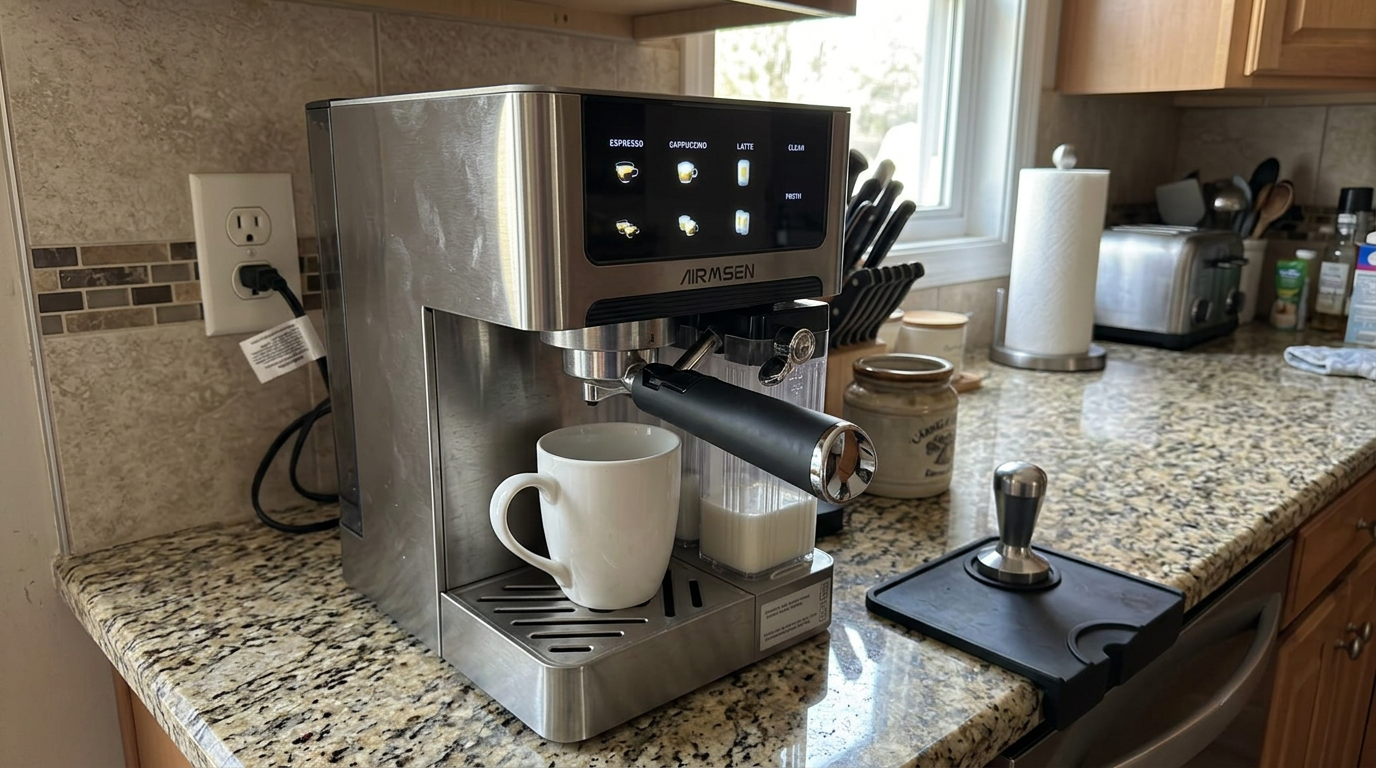
A standard white mug fits under the portafilter, but there isn't much room to spare.
Cleaning and maintaining the AIRMSEN 20 Bar
The automatic milk system is convenient, but it brings a daily cleaning job with it.
This is the area that pulled the AIRMSEN's score down the most.
Flush the milk path after every milk drink
After each cappuccino or latte, the milk tube and siphon need flushing.
Put a cup under the milk spout and tap the cleaning icon, and the machine pushes hot water and steam through the milk path.
It takes about 30 seconds.
Taking the milk container off and putting it in the fridge does not clean the inside of the system.
What happens if you skip it
On day nine, I skipped the cycle after a late latte and ran it the next morning.
The first few seconds of the flush came out cloudy, and the next latte had a faintly stale taste.
Dried milk can also block the narrow passages, cause odors and make frothing inconsistent.
| When | Task | Why it matters |
|---|---|---|
| After every milk drink | Run the cleaning cycle | Stops milk drying inside the tube |
| Daily | Empty and rinse the drip tray | Prevents mold and odors |
| Daily | Rinse the portafilter and basket | Removes old coffee oils |
| Daily | Change the tank water | Keeps the water fresh |
| Weekly | Wash the milk container, lid and tube | Clears milk film the flush can't reach |
| Every 2 to 3 months | Descale | Protects the heaters and pump |
Descaling
AIRMSEN recommends descaling✕DescalingRunning a mild acid solution through the machine to dissolve the mineral scale that hard water leaves inside heaters, pumps and pipes. about every two to three months.
If your water is hard or you make lots of drinks, go sooner.
Use a proper descaling solution and follow the manual's steps rather than an improvised mix.
My estimate of hands-on cleaning time per day.
Our tip: If the foam suddenly gets thin, flush the milk path twice before you change anything else.
What daily use is really like
My mornings: switch on, warm two cups on top, grind 15 grams, tamp and tap latte.
While the shot ran, the milk poured beside it, and I ran the cleaning cycle while my partner took the first cup.
From switching on to sitting down took about four minutes, including warm-up and grinding.
Warm-up
The machine was ready to brew in under a minute.
I ran a blank shot of water through the empty portafilter first, which warmed the metal and made the first shot noticeably hotter.
Tank and noise
The 60-ounce tank lasted about two days for two of us, with two milk drinks each per day plus cleaning cycles.
The pump is a short, mechanical hum during the shot, and the milk system adds a gurgle while frothing.
It's quieter than a machine with a built-in grinder, but you'll hear it from the next room.
Rough maths from a 60 oz tank, allowing for rinses and flushes. Actual numbers depend on your settings.
If you're still deciding between machine types, my guide to the best De’Longhi super-automatic machines covers bean-to-cup options that grind for you.
The drinks I made most often
By the end of the three weeks, I'd settled on a few drinks with settings that worked every time.
They're a good starting point if you're new to the machine.
| Drink | Coffee and basket | How I made it | Notes |
|---|---|---|---|
| Morning latte | 15 g, double basket | Latte preset, milk time lengthened | Creamy, hot, my daily cup |
| Cappuccino | 15 g, double basket | Cappuccino preset | Tall, airy foam cap |
| Double espresso | 15 g, double basket | Double preset, slightly shortened | Thick crema, cocoa notes |
| Americano | 15 g, double basket | Double shot, then hot water from the kettle | No hot water outlet |
| Cortado-style | 15 g, double basket | Double shot plus a short milk pour | Stop the milk early by tapping again |
| Iced latte | 15 g, double basket | Double shot over ice, cold milk | No frothing needed |
A homemade iced latte
There's no iced setting, but it's easy to make a good one.
I pulled a double shot into a small cup, then poured it over a tall glass packed to the top with ice and added cold milk.
Pouring hot espresso over just a few cubes made a watery drink, so a full glass of ice is the key.
No hot water outlet
The AIRMSEN has no separate hot water tap.
For Americanos and tea, I used the kettle.
Our tip: For an iced latte, pour the double shot over a glass packed right to the top with ice.
Living with it: week one to week three
In the first week, I focused on the coffee itself.
Switching from supermarket pre-ground to fresh, finely ground beans and a proper tamper transformed the espresso.
In the second week, I worked through milk types and saved my own latte and cappuccino settings.
That's also when I learned the hard way about skipping a cleaning cycle.
In the third week, I used it like any busy household would: two people, four milk drinks a day and a couple of weekend guests.
The foam stayed consistent, the touchscreen kept responding, and nothing rattled or leaked.
How I rated each drink by the end of the test, out of 10.
Serving guests
This is where the separate heaters really pay off.
For a weekend brunch, I made four lattes in about seven minutes, including a cleaning cycle after each one.
Every drink came out at the same temperature with the same foam, which is hard to do by hand on a steam wand.
What slowed me down
The portafilter has to be emptied, refilled and tamped between drinks, so I ground all four doses into small cups first.
The milk container's 17 ounces covered about four lattes before it needed topping up.
Our tip: Grinding for a group? Weigh all the doses into small cups before you pull the first shot.
Who will enjoy it
If you like your morning coffee fast and the same every day, the automation is genuinely pleasant.
If you enjoy the ritual of steaming milk by hand, this machine takes that away.
Build quality and reliability
The exterior is brushed stainless steel with a black glass control panel.
It looks more expensive than it is and wipes clean easily, though the steel shows fingerprints.
Under the steel panels, several internal parts are plastic, and the machine's 9.3-pound weight tells you it's a compact home appliance rather than a heavy, commercial-style machine.
The drip tray slid in and out smoothly, and the portafilter locked in firmly every time.
What owners report
Most owner feedback praises the speed, the touchscreen, the crema and the convenience.
Some buyers report pump failures and milk-frothing errors after one to three months of heavy daily use, and some mention slow replies from customer support.
I had no faults in three weeks, but that's not long enough to rule these out.
Common mistakes to avoid
The AIRMSEN 20 Bar is simple to use, but these habits will hold it back.
| Mistake | What happens | Better habit |
|---|---|---|
| Skipping the cleaning cycle | Milk dries in the tube, foam turns patchy | Flush after every milk drink |
| Using coarse supermarket coffee | Fast, sour, watery shots | Use fine espresso grind or a burr grinder |
| Tamping with the scoop only | Uneven puck, channeling | Use a separate 2-inch tamper |
| Using warm milk | Thin, short-lived foam | Use milk straight from the fridge |
| Pushing it against the wall | Can't lift the rear tank out | Leave room behind, or pull it forward |
| Ignoring descaling | Scale slows the pump and heaters | Descale every 2 to 3 months |
What I would change
A hot water outlet would make Americanos and tea easier.
A little more cup clearance would let tall latte glasses fit.
And a proper tamper in the box would help beginners get better shots from day one.
Is the AIRMSEN 20 Bar worth the money?
For daily milk drinkers with limited space, yes.
You get separate heaters, a fully automatic milk system and a touchscreen in a machine under 8 inches wide.
What you give up is control over milk texture, a built-in grinder and a low-maintenance routine.
Ask yourself three questions before you buy.
Do you drink cappuccinos or lattes most days? Are you happy to run a 30-second cleaning cycle after each one? And will your favorite mug fit under 4.1 inches?
If the answers are yes, the AIRMSEN is one of the quickest ways to a café-style milk drink at home.
If you mostly drink straight espresso, a simpler machine without the milk system will suit you better and save you the cleaning.
And if you want latte art, look for a machine with a proper steam wand, like the brim 19 Bar.
How it compares with other types of espresso machines
The fairest comparison is with the two other common ways to make milk drinks at home.
| Feature | AIRMSEN 20 Bar | Single-heater machine with steam wand | Bean-to-cup super-automatic |
|---|---|---|---|
| Brew and froth together | Yes | No | Usually, with a carafe |
| Milk system | Automatic container | Manual steam wand | Automatic carafe or wand |
| Milk texture | Airy foam | Silky microfoam with practice | Airy foam |
| Built-in grinder | No | Usually no | Yes |
| Your hands-on steps | Grind, dose, tamp, tap | Grind, dose, tamp, brew, steam | Tap |
| Milk cleanup | Cleaning cycle each drink | Wipe and purge the wand | Carafe rinse each day |
| Footprint | Very narrow | Narrow to medium | Wide and deep |
| You mostly drink | Is the AIRMSEN a fit? | Why |
|---|---|---|
| Lattes and cappuccinos daily | Excellent | One-tap milk, no wait between steps |
| Milk drinks for several people | Very good | Consistent foam, drink after drink |
| Straight espresso | Good | Good shots, but you pay for milk features you won't use |
| Latte art | Poor | Foam is too airy to pour patterns |
| Americanos and tea | Fair | No hot water outlet |
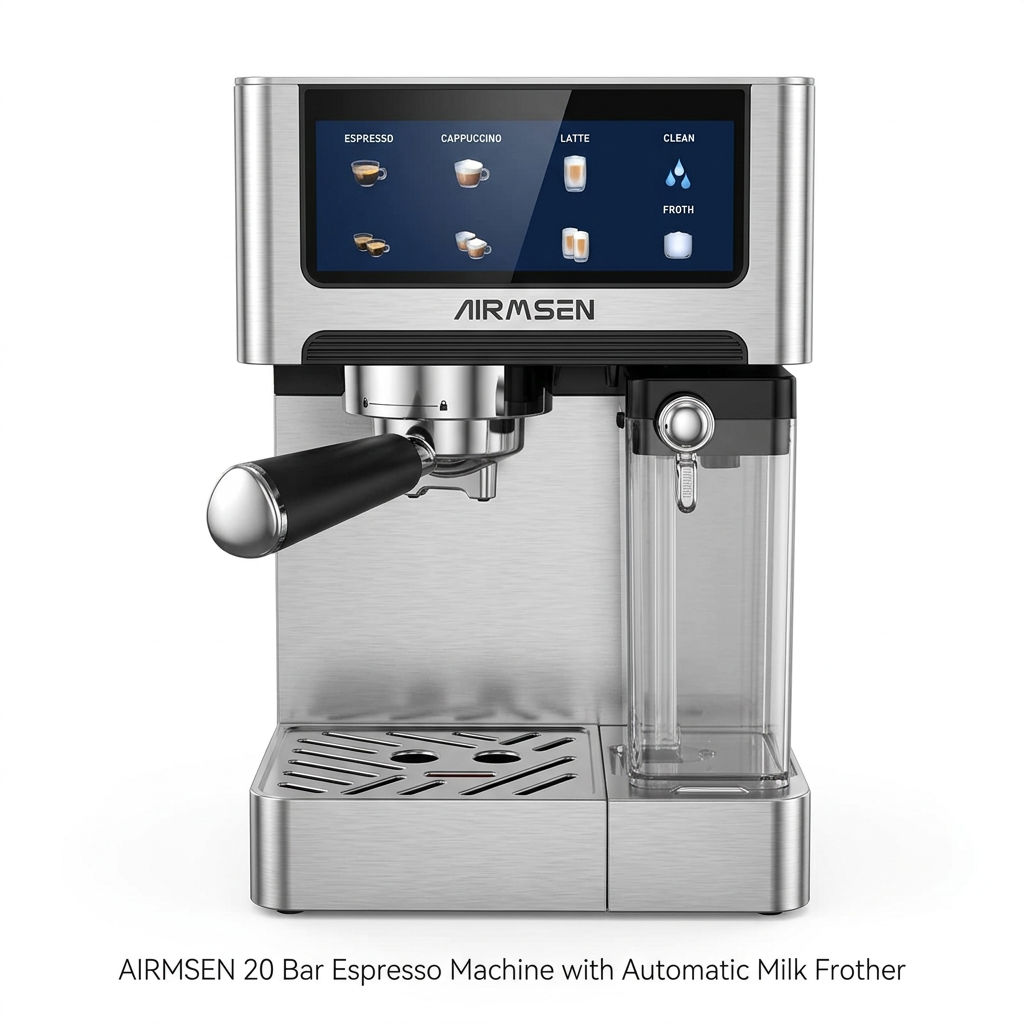
The full package: color touchscreen, portafilter and the clip-on milk container.
Which one is right for you: is the AIRMSEN 20 Bar your match?
4 quick questionsAIRMSEN 20 Bar specifications
From manufacturer data and my own testing.
How I tested and scored the AIRMSEN 20 Bar
For three weeks, I used the AIRMSEN 20 Bar as my everyday machine for single and double espressos, cappuccinos, lattes and iced drinks.
I compared supermarket pre-ground coffee with freshly burr-ground beans, timed my shots while dialing in and swapped the included scoop for a separate tamper.
I frothed whole, 2%, skim, barista oat and regular almond milk, saved my own presets, measured which cups fit and timed drinks against my notes from single-heater machines.
I ran the cleaning cycle after every milk drink except one deliberate skip, tracked how far a tank went and then checked my notes against AIRMSEN's specifications and owner documentation.
- Espresso (7.4): crema, body, temperature and consistency, with pre-ground and fresh beans.
- Milk drinks (7.8): foam texture, milk temperature, speed and consistency across milk types.
- Ease of use (8.4): touchscreen, presets, saved settings, setup and tank access.
- Cleaning (6.6): milk-path flushing, drip tray, weekly washing and descaling.
The overall score of 7.6 is an editorial rating that reflects those four areas.
AIRMSEN 20 Bar FAQ
Is the AIRMSEN 20 Bar worth it?
Yes, if you drink cappuccinos or lattes most days and want them at one tap. It brews and froths at the same time and fits tight counters. If you want latte art or mostly drink espresso, a steam wand machine suits you better.
Does the AIRMSEN 20 Bar really have two boilers?
It has two separate heaters: a 1,350-watt one for brewing and a 1,000-watt one for milk. That lets it pull a shot and froth milk at the same time.
Does it have a built-in grinder?
No. Use pre-ground espresso coffee or a separate burr grinder for whole beans.
Can I make latte art with it?
Not really. The automatic frother makes airy foam, not the fine microfoam you need for pouring patterns.
How big is the milk container?
About 17 ounces. It's removable, so you can store it in the fridge between drinks.
How do I clean the milk system?
Run the cleaning cycle with a cup under the milk spout after every milk drink, and wash the container, lid and tube weekly.
How often should I descale it?
About every two to three months, sooner with hard water or heavy use.
Will a travel mug fit?
No. Cup clearance is about 4.1 inches, which fits espresso cups, cappuccino cups and most standard mugs.
How big is the water tank?
60 ounces, about 1.8 liters. It's removable and sits at the back, so leave room to lift it out.
Does it have a hot water outlet?
No. Use a kettle for Americanos and tea.
What size is the portafilter?
The basket is about 2 inches, roughly 51 mm, and single and double baskets are included.
Can I save my own drink sizes?
Yes. You can adjust and save the extraction time for coffee and the frothing time for milk drinks.
Why is my espresso weak and watery?
Usually the grind is too coarse. Grind finer, fill the basket fully and tamp firmly and evenly.
Is the AIRMSEN 20 Bar reliable?
Mine had no faults in three weeks. Some owners report pump or frothing errors after a few months of heavy use, so check the warranty and return window.
Kitchen & coffee tester
Michael spent six years as a line cook in restaurants in Chicago and New York, and he has tested kitchen appliances for HouseholdMe since 2018, from air fryers to coffee makers. He holds an SCA certificate in barista skills and used the AIRMSEN 20 Bar as his everyday coffee machine for three weeks for this review.
- Three weeks of hands-on testing of the AIRMSEN 20 Bar Espresso Machine with Automatic Milk Frother
- AIRMSEN product specifications and owner documentation
- Owner feedback on reliability and support
- General espresso brewing and maintenance guidance