Yabano 3.5 Bar review: a light, simple cappuccino maker with a capable steam wand
The Yabano Espresso Machine is a 3.5-bar steam-pressure espresso maker with a steam wand and a four-cup glass carafe, light enough to lift with one hand. It makes strong, moka-style coffee and thick milk foam, not true café espresso.

Michael Reynolds
Hands-on review
Hands-on testing, research, specs
4 weeks
22 minutes
Jargon helpNew to espresso? Tap any dotted term to see what it means.
In this review
Yes, if you want simple, affordable cappuccinos in a small space. The Yabano 3.5 Bar is a steam-pressure espresso maker, so it brews a strong, moka-style coffee rather than true café espresso with thick crema. Its steam wand makes thick, creamy foam once you open the knob fully, and the glass carafe serves up to four cups. It's light enough to store in a cupboard. The filter holder takes practice to lock because the machine slides, the steam knob must be turned all the way to avoid water instead of steam, and you'll need a medium grind rather than fine espresso grounds.
Yabano 3.5 Bar at a glance
Yabano 3.5 Bar pros and cons
- Light, compact and easy to store
- Steam wand makes thick, creamy foam
- Glass carafe brews up to four cups
- Not true espresso, little crema
- Light body slides when locking the filter
- Steam knob must be fully open to work well
Who should buy the Yabano 3.5 Bar?
- Students and first apartments
- Occasional cappuccino drinkers
- Anyone who wants a simple, low-cost start
- Espresso lovers who want real crema
- Latte art fans who need silky microfoam
- Busy households making many drinks
First impressions of the Yabano 3.5 Bar
Some people want to learn espresso properly.
Others just want a cappuccino at home without spending much or giving up half the counter.
The Yabano Espresso Machine is firmly for the second group.
It's a small, black machine with a brushed silver band around the top, a round cap for the water and a steam wand on the side.
It brews into a glass carafe with markings for two and four cups.
At about 4.7 pounds, it's light enough to lift with one hand and tuck into a cupboard.
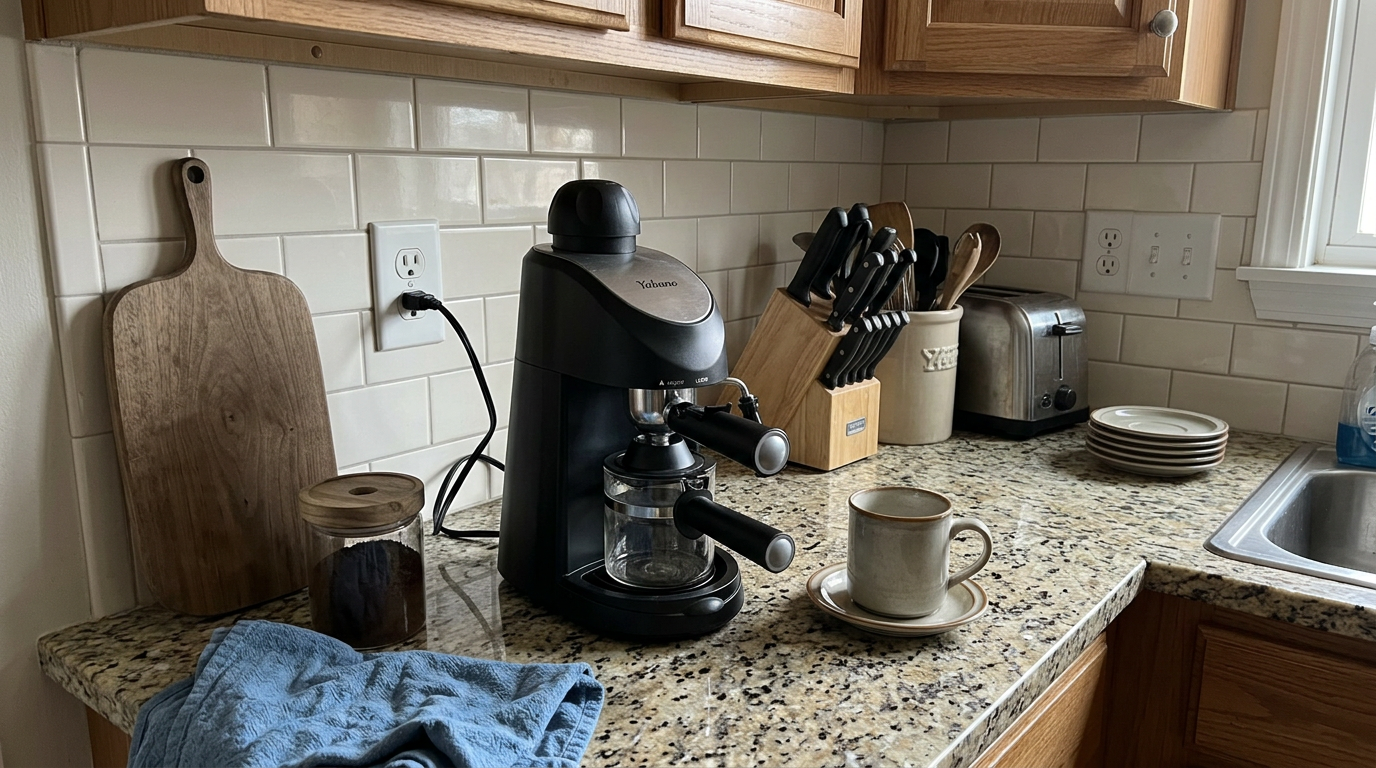
Michael and I unpacked it next to a cutting board and a knife block, and it took up barely more space than a kettle.
The first thing that caught us out was the filter holder.
Locking it in takes a firm, upward push and a twist, and the light machine slid on the counter the first time.
After a day, we'd learned to hold the machine steady with one hand, and it became second nature.
My first cup was a strong, dark coffee with a thin layer of foam, and with frothed milk on top it made a pleasant, comforting cappuccino.
The Yabano is small enough to share the counter with a cutting board and knife block.
What the Yabano 3.5 Bar actually is
Before anything else, it's important to understand what kind of machine this is.
The Yabano is a steam-pressure espresso maker✕Steam-pressure espresso makerA small machine that heats water in a sealed chamber until steam builds up, then uses that steam pressure to push hot water through the coffee. It makes strong coffee, but at much lower pressure than a pump espresso machine., rated at 3.5 bar.
It heats water in a sealed chamber, and steam pressure pushes the hot water through the coffee.
Pump espresso machines brew at around 9 bar at the coffee.
Approximate pressures at the coffee. Higher pressure gives a more concentrated, crema-rich shot.
In the cup, that means a strong, concentrated coffee that's closer to a moka pot than to café espresso.
It has plenty of coffee flavor and works well under milk.
It won't give you the thick, lasting crema✕CremaThe golden-brown foam on top of an espresso. It forms when pressure pushes gases and oils out of freshly ground coffee. or syrupy body of a pump machine.
Judge it as a cappuccino maker, and it makes much more sense.
Yabano 3.5 Bar design and setup
The Yabano 3.5 Bar measures about 7.7 inches wide, 13.1 inches tall and 10 inches deep.
It's mostly matte black plastic, with a brushed metal panel on top that looks smarter than you'd expect at this level.
What comes in the box
| Item | What it is | My verdict |
|---|---|---|
| Filter holder | Locking handle with a T-shaped clip | Works well once you learn the lock |
| Filters | Single and double | Use the single for one cup |
| Glass carafe | 2- and 4-cup markings | Handy for measuring water |
| Scoop | Measures ground coffee | Easy, consistent dosing |
| Tamper | Basic | Fine for a gentle press |
First-time setup
Wash the filter holder, filters, carafe, scoop and tamper before first use.
Then run a cycle with water only to flush the system.
Check that the water area is clear and seated properly before you start, because a small obstruction can stop it working.
Our tip: Run one full cycle with water only before your first coffee, to clear any factory taste.
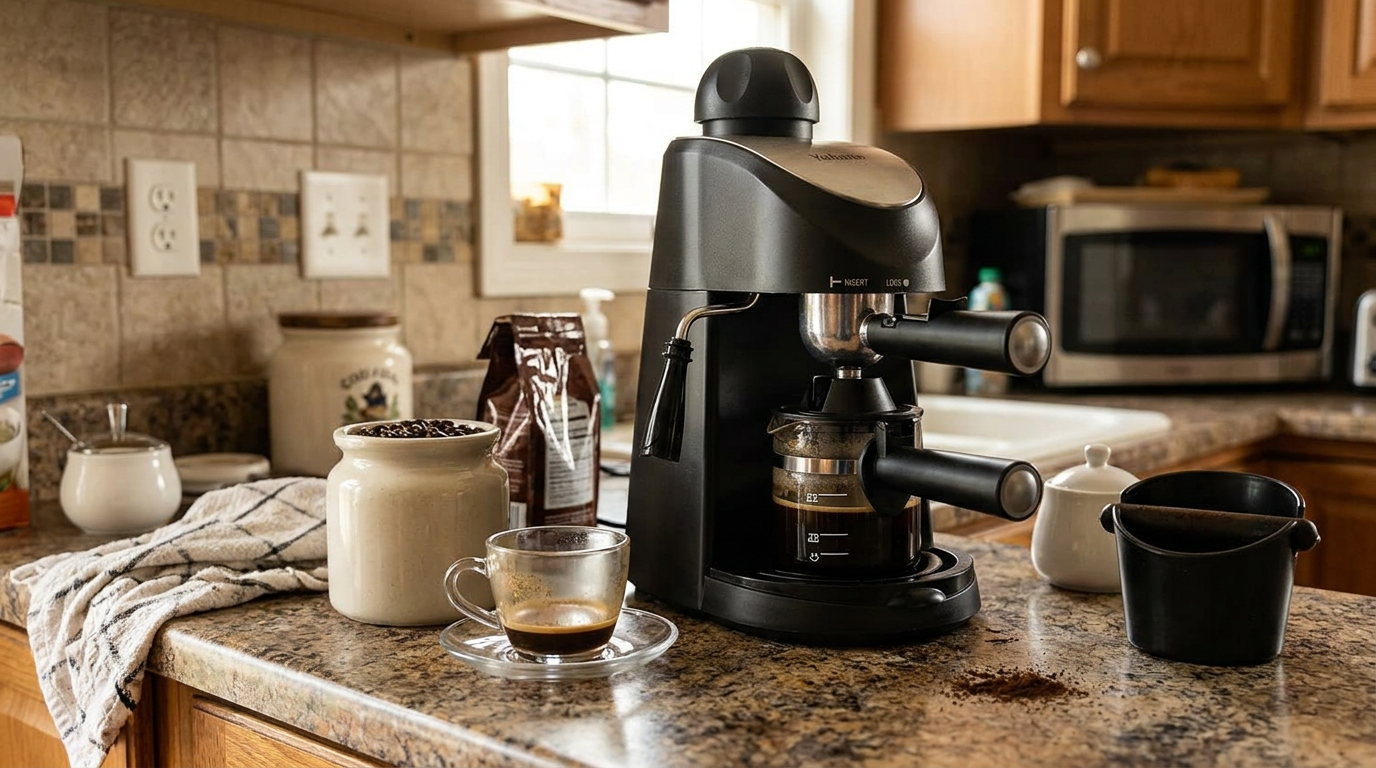
The glass carafe doubles as the measuring jug for water.
The glass carafe and filters
The glass carafe has markings for two and four cups, and it doubles as the measuring jug for water.
That makes the strength easy to control: the less water you put in, the stronger the coffee.
| Setup | Water | Result |
|---|---|---|
| Single filter | About 1 cup line | Strongest, best for cappuccinos |
| Double filter | 2-cup line | Strong, good for two small drinks |
| Double filter | 4-cup line | Mild, for sharing black coffee |
The single filter quickly became my default for milk drinks.
The double filter was handy on weekends when we wanted to share a carafe.
Locking the filter holder
The filter holder lock is the first skill to learn on this machine.
Position the holder under the brewing head, push it up firmly and turn it toward the lock marking until it stops.
The machine is light, so it can slide while you do this.
Controls and the indicator light
The controls are simple once you know the order of operations.
There's a power control, a setting for brewing, a setting for frothing and the steam knob that opens the wand.
The indicator light is your guide: it blinks while the machine heats and settles when it's ready.
| Control | What it does | When to use it |
|---|---|---|
| Power | Switches the machine on and starts heating | First step |
| Brew setting | Starts the coffee once hot | After locking the filter |
| Froth setting | Prepares steam for the wand | After brewing |
| Steam knob | Opens the steam to the wand | Fully open once the light stops blinking |
| Indicator light | Shows heating and ready status | Watch it before brewing or frothing |
The most common beginner mistake is rushing.
If you try to froth before the light settles, or only half-open the steam knob, you'll get water instead of steam.
Give it a moment, open the knob fully and it works every time.
From our logs during the first week.
Making a coffee, step by step
The order of steps matters on a steam machine, so here's the routine that worked best for me.
| Step | What you do | Tip |
|---|---|---|
| 1 | Measure water with the carafe and fill the chamber | Machine off and cool |
| 2 | Choose the single or double filter | Single for one cup |
| 3 | Add coffee with the scoop and level it | Don't overfill |
| 4 | Tamp gently to an even surface | No need for force |
| 5 | Lock the filter holder in | Hold the machine steady |
| 6 | Put the carafe or a cup under the spout | Centered, lid on |
| 7 | Switch on and select brewing | Wait for the indicator |
| 8 | Let it brew, then switch off | Froth milk next if you like |
The machine needs a short warm-up before coffee starts to flow.
Don't worry if nothing happens straight away; watch the indicator light.
Our tip: Leave the carafe lid closed while brewing, so the coffee stays hot while you froth the milk.
Dosing and tamping without a scale
Most people buying a machine like this won't own a coffee scale, and you don't need one.
The included scoop and a consistent routine are enough.
Tamping✕TampingPressing the ground coffee into a firm, flat puck so water passes through it evenly instead of finding loose, easy paths. on a low-pressure machine should be gentle.
Pressing too hard makes it harder for the steam pressure to push water through, which slows the brew and adds bitterness.
A light, level press gave me the most consistent results.
Our tip: Tamp gently and level, because a hard tamp slows a low-pressure machine and makes the coffee bitter.
Yabano 3.5 Bar coffee performance
I tested the Yabano 3.5 Bar with a dark roast, a medium-dark blend and a medium roast, all pre-ground.
Yabano recommends a medium-coarse grind, coarser than true espresso.
That's important: very fine espresso grounds can choke a low-pressure machine and make it drip slowly or overflow.
| Coffee | Grind | How it tasted |
|---|---|---|
| Dark roast | Medium | Bold, roasty, a bit bitter |
| Medium-dark blend | Medium | Strong, chocolatey, my favorite |
| Medium roast | Medium | Smoother, a little thin |
| Fine espresso grind | Very fine | Slow, bitter, messy |
The best cup came from a medium-dark blend at a medium grind, using the single filter for one cup.
It was strong and chocolatey, with a touch of roasty bitterness and a thin foam that faded quickly.
My relative strength ratings with a level scoop of coffee.
| What you taste or see | Likely cause | First change |
|---|---|---|
| Weak, watery | Too much water for the coffee | Brew a smaller amount |
| Very bitter | Dark roast or grind too fine | Use a medium-dark roast, medium grind |
| Slow drip or overflow | Grind too fine or overfilled | Use a coarser grind, level the scoop |
| Coffee around the filter holder | Not locked or grounds on rim | Wipe the rim, lock firmly |
| Lukewarm coffee | Cold cup | Warm the cup on top of the machine |
Our tip: Use a medium grind made for moka pots, not powdery espresso grounds, so the coffee flows evenly.
Steam wand and milk frothing
After brewing, you switch to frothing and wait for the indicator light to stop blinking.
Then comes the most important detail on this machine: turn the steam knob all the way, to about the six o'clock position.
If it's only partly open, water can sputter out instead of steam.
That one tip solved every frothing problem we had.
How the steam performed
Steam power was good for a machine this size once the knob was fully open.
About 120 ml of cold whole milk heated and foamed in roughly 40 to 60 seconds.
The foam was thick and creamy, perfect for a cappuccino.
Silky microfoam✕MicrofoamMilk foam with bubbles so small you can't see them. It feels silky and blends into the coffee instead of sitting on top like froth. for latte art was harder, because steam pressure fades as the water runs low.
My ratings on a 10-point scale for foam thickness and stability.
| Drink | Coffee | Milk | Texture |
|---|---|---|---|
| Cappuccino | Single filter, one cup | About 100 ml | Thick, airy foam |
| Latte | Double filter, two cups | About 180 ml | Hot milk, light foam |
| Mocha | Double filter, two cups | About 150 ml plus cocoa | Creamy |
| Iced latte | Single filter | Cold milk over ice | No steaming |
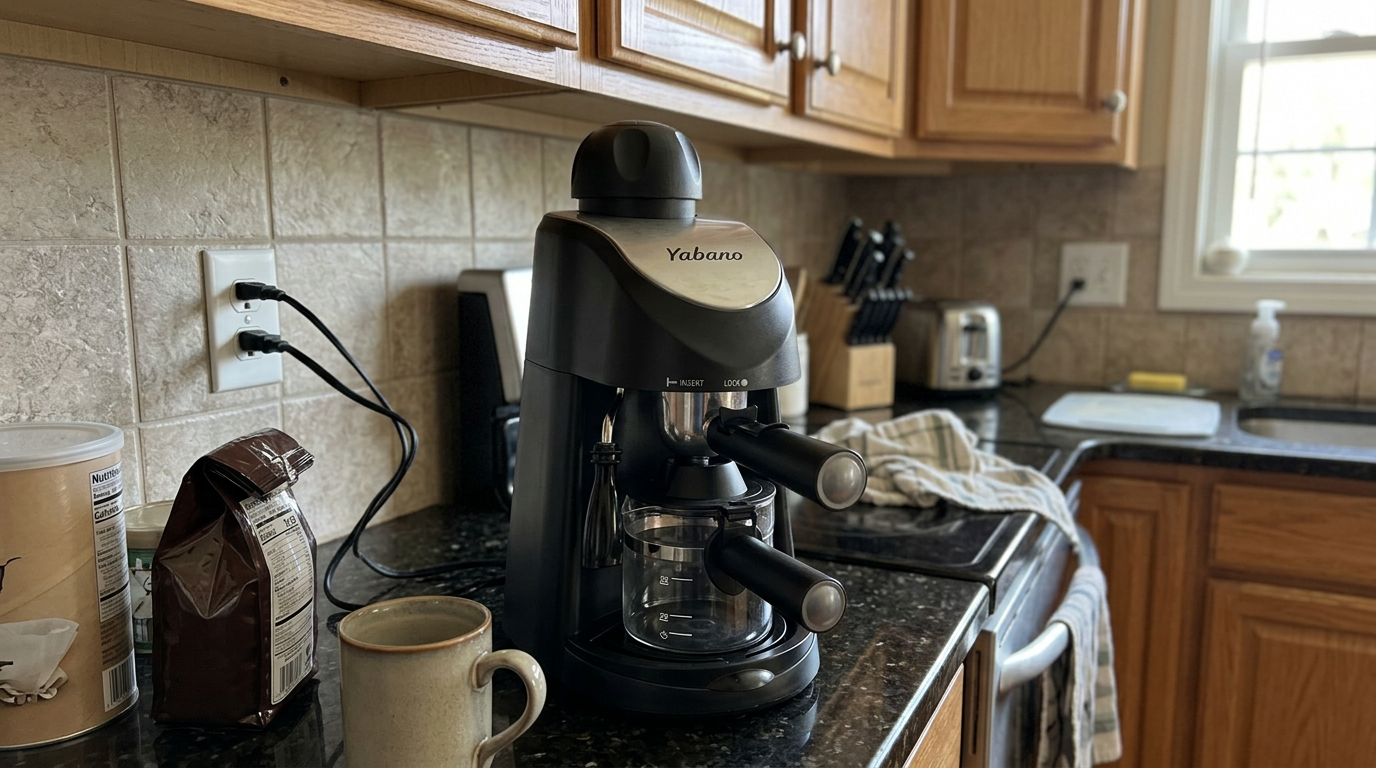
The steam wand swings out from the side for the milk pitcher.
Our tip: Leave room in the pitcher for the milk to grow, because it can nearly double as it foams.
Drinks I made every week
These are the drinks we made most often, each one playing to the Yabano's strengths.
| Drink | Filter | Milk or extra | My tip |
|---|---|---|---|
| Short strong coffee | Single | None | Drink it like a moka coffee |
| Cappuccino | Single | About 100 ml, thick foam | Froth right after brewing |
| Latte | Double | About 180 ml, light foam | Warm the mug on top |
| Mocha | Double | Steamed milk and cocoa | Stir cocoa into the coffee first |
| Americano-style | Single | Hot water from a kettle | Add water to taste |
The mocha and cappuccino were the stars.
On warm days, we also made iced lattes.
Brew a strong single-filter coffee, let it cool for a minute, then pour it over a glass full of ice and add cold milk.
Because the coffee is strong, it held up well even as the ice melted.
It's a simple way to get more use out of the machine through the summer.
The roasty strength of the coffee cut through milk and chocolate nicely.
Our tip: For a mocha, mix the cocoa into the hot coffee before adding milk, so it dissolves smoothly.
Why 3.5 bar tastes different
Understanding pressure explains everything about how this machine tastes.
Espresso is made by forcing hot water through finely ground, tightly packed coffee.
At around 9 bar, the water moves through quickly and evenly, pulling out oils that form crema and a syrupy body.
At 3.5 bar, the water needs a coarser grind to flow, and it moves more gently.
| What changes | At about 9 bar | At about 3.5 bar |
|---|---|---|
| Grind needed | Very fine | Medium to medium-coarse |
| Crema | Thick and lasting | Thin, fades fast |
| Body | Syrupy | Strong but thinner |
| Best use | Straight espresso and milk drinks | Milk drinks and strong black coffee |
So the Yabano makes a strong coffee with real coffee flavor, but not the texture of café espresso.
That's why I scored it as a cappuccino maker first and an espresso maker second.
The cup-warming top
The top of the Yabano 3.5 Bar gets warm while it works.
I put my cappuccino cup up there while the coffee brewed and the milk frothed.
A warm cup keeps a small drink hot for noticeably longer.
Just remember the surface is hot, so lift cups by the handle.
Our tip: Put your cup on the warm top while the coffee brews, so your cappuccino stays hot longer.
Coffee, water and milk
Because the brew is gentler, roast choice matters.
Medium-dark blends gave the best balance of strength and sweetness.
Very dark roasts could taste harsh, and light roasts came out thin.
| Roast | Black coffee | With milk |
|---|---|---|
| Light | Thin, sour edge | Lost in milk |
| Medium | Smooth but mild | Pleasant |
| Medium-dark | Strong, chocolatey | Best balance |
| Dark | Bitter, roasty | Good in mochas |
Look for pre-ground coffee labeled for moka pots or stovetop brewers, which matches the recommended medium-coarse grind.
Use fresh, cold, filtered water to slow scale buildup.
For milk, cold whole milk gave the thickest foam, and barista oat milk was the best plant option.
Cleaning and maintaining the Yabano 3.5 Bar
Cleaning is quick, with just a few removable parts.
After brewing, let the filter holder cool, then remove it.
The T-shaped clip on the handle holds the filter in place while you knock out the grounds, which is a clever touch.
| When | Task | Why it matters |
|---|---|---|
| After every brew | Knock out grounds, rinse filter and holder | Stops old coffee tainting the next cup |
| After every milk drink | Wipe the steam wand and purge it | Keeps the tip clear |
| Daily | Wash the carafe, empty the drip tray | Prevents stains and odors |
| Weekly | Wipe around the brewing head | Removes coffee residue |
| Monthly | Descale as the manual advises | Protects the heater |
Descaling✕DescalingRunning a mild acid solution through the machine to dissolve mineral scale left by hard water. Scale slows heating and can block pipes. matters on small steam machines, because scale builds up quickly in the heating chamber.
Never immerse the main body in water; wipe it with a damp cloth instead.
My estimate of hands-on cleaning time per day.
Our tip: Wipe the steam wand straight after frothing, before the milk dries onto the metal.
What daily use is really like
Once the routine clicked, mornings were simple.
Measure water, add coffee, lock the filter, switch on and wait.
A strong single cup took about three minutes from cold.
A cappuccino took about four to five.
Timed from a cold start, including heating.
Noise
It's quiet compared with pump machines, with gentle bubbling while brewing and a louder hiss from the steam wand.
There's no grinder or pump buzz, so it's friendly for early mornings.
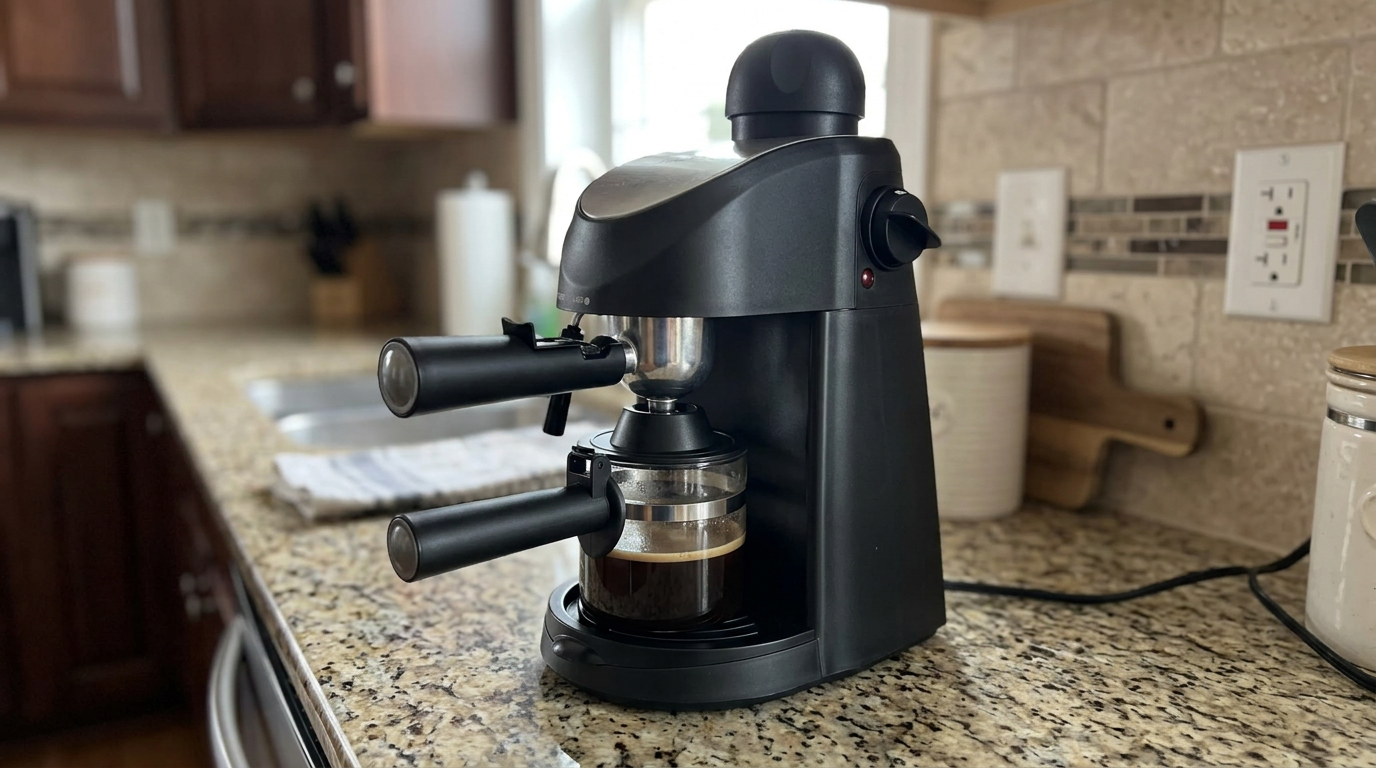
Light and compact, the Yabano is easy to move or put away.
Small kitchens and storage
At about 4.7 pounds and under 8 inches wide, the Yabano 3.5 Bar is one of the easiest machines to live with in a tiny kitchen.
We kept it on the counter during the week and put it in a cupboard on busy cooking days.
Let it cool completely and empty any water before storing it in a cupboard.
Using it safely
Steam machines are simple, but a few habits keep them safe.
None of this is hard, and after a few days it's automatic.
It's worth knowing before you buy, especially with children in the house.
Troubleshooting the problems I hit
These are the issues we ran into over four weeks, and how we fixed them.
| Problem | What I noticed | Fix that worked |
|---|---|---|
| Filter holder won't lock | Machine slides, handle misaligned | Align with the insert mark, hold the machine steady |
| Water instead of steam | Steam knob only partly open | Turn it fully to six o'clock |
| Milk won't froth | Machine not ready | Wait for the indicator to stop blinking |
| Coffee overflows | Grind too fine | Use a medium or medium-coarse grind |
| Weak steam at the end | Little water left | Brew less, keep water for steam |
| Drip tray full | Normal use | Empty it daily |
The two big lessons were holding the machine steady and opening the steam knob all the way.
Once we'd learned those, it was trouble-free.
A beginner’s first week with it
Here's how our first week went, which is a good guide if this is your first coffee machine with a steam wand.
| Day | What we did | What we learned |
|---|---|---|
| Day 1 | Flush cycle, first four-cup brew | Four cups tastes mild |
| Day 2 | Single filter, first cappuccino | Water came out of the wand |
| Day 3 | Opened the steam knob fully | Proper steam, thick foam |
| Day 4 | Switched to a moka-style grind | No more slow, bitter drips |
| Day 5 | Learned to brace the machine | Filter locks in one move |
| Day 6 | First mocha | A new favorite |
| Day 7 | Full routine without thinking | Cappuccino in about five minutes |
Our tasting scores for cappuccinos and lattes.
Almost every improvement came from three habits: the right grind, a fully open steam knob and brewing smaller amounts.
Cheap upgrades worth buying
The machine works out of the box, but a few small extras made our drinks better.
| Upgrade | What it fixes | Worth it? |
|---|---|---|
| Small stainless milk pitcher | Frothing in a mug | Yes, easier foam |
| Moka-grind coffee | Overflow and bitterness | Essential |
| Airtight canister | Stale pre-ground coffee | Yes |
| Descaling solution | Scale in the chamber | Yes, with hard water |
| Non-slip mat | Machine sliding when locking | Nice to have |
The non-slip mat surprised us.
It stopped the light machine from sliding when we locked the filter holder, which made the whole routine smoother.
Common mistakes to avoid
The Yabano 3.5 Bar is beginner-friendly, but a few habits will hold it back.
| Mistake | What happens | Better habit |
|---|---|---|
| Expecting café espresso | Disappointment | Treat it as a strong coffee and cappuccino maker |
| Using powdery espresso grounds | Slow, bitter, messy | Use a medium grind |
| Half-opening the steam knob | Water instead of steam | Open it fully |
| Brewing a full carafe for a cappuccino | Weak coffee, little steam | Use the single filter |
| Leaving milk on the wand | Hard, dried residue | Wipe straight away |
| Skipping descaling | Slower heating, weaker steam | Descale monthly with hard water |
What I would change
A slightly heavier base would stop it sliding when locking the filter.
Clearer markings on the steam knob would help new users.
And a stainless milk pitcher in the box would be a welcome extra.
Which households it suits best
Here's how I'd judge the Yabano 3.5 Bar for different buyers.
| Buyer | Fit | Why |
|---|---|---|
| Student or first apartment | Excellent | Light, small, simple |
| Occasional cappuccino drinker | Very good | Easy foam, low commitment |
| Couple sharing coffee | Good | Carafe serves two |
| Espresso enthusiast | Poor | Not true espresso |
| Big household | Fair | Small batches, one at a time |
The pattern is simple: the more you love milk drinks and the less space you have, the better the Yabano fits.
If you mostly drink straight espresso, look elsewhere.
Is the Yabano 3.5 Bar worth the money?
The Yabano is one of the simplest, most affordable ways to make cappuccinos at home.
You get strong, moka-style coffee, a capable steam wand and a carafe for up to four cups, in a machine light enough to store away.
Ask yourself three questions before you buy.
Do you mainly want milk drinks? Is space or budget tight? And are you happy with strong coffee rather than true café espresso?
If the answers are yes, it's a sensible first machine.
If you want real espresso with thick crema, a pump machine is worth the extra cost.
It's also worth thinking about what it replaces.
For a lot of people, the alternative is a daily café cappuccino, or a stovetop pot plus a separate milk frother.
The Yabano does both jobs in one light machine that's easy to put away.
For a first apartment, a dorm or a small office corner, that's a lot of convenience in a small box.
Go in expecting strong coffee and good foam, not café espresso, and you won't be disappointed.
Check what's included where you buy, because accessories can vary between listings.
Four weeks in: how it held up
We made around 80 to 100 drinks on the Yabano over a month, mostly cappuccinos and lattes.
| Area | Week 1 | Week 4 |
|---|---|---|
| Coffee strength | Mild on big brews | Strong with the single filter |
| Steam | Spitting water at first | Reliable once fully opened |
| Filter lock | Awkward | Quick and easy |
| Glass carafe | Clear | Clear, no staining |
| Faults | None | None |
No leaks, no faults and no loss of steam power over the month.
The brushed metal top kept its finish, and the matte body hid fingerprints and splashes well.
The filter holder's lock felt smoother by week two, which made the daily routine quicker.
We descaled once at the end, and the steam felt a touch stronger afterward.
How it compares with other coffee setups
The most useful comparison is with the kinds of machines you're likely choosing between.
The Yabano 3.5 Bar stands out for its low weight, simplicity and built-in steam wand.
| Feature | Yabano 3.5 Bar | Pump espresso machine | Stovetop moka pot |
|---|---|---|---|
| Pressure | About 3.5 bar, steam-driven | About 9 bar at the coffee | About 1.5 bar |
| Coffee style | Strong, moka-like | True espresso with crema | Strong, moka-like |
| Milk frothing | Built-in steam wand | Usually a steam wand | None |
| Servings | Up to 4 cups | 1–2 shots | Depends on size |
| Weight | About 4.7 lb | Often 10–20 lb | Very light |
| Learning curve | Low | Moderate | Low |
A pump machine makes real espresso but costs more and takes more space.
A moka pot makes similar coffee but can't froth milk.
The Yabano combines moka-style coffee with a steam wand, in a machine you can lift with one hand.
| You mostly drink | Is it a fit? | Why |
|---|---|---|
| Cappuccinos | Good | Thick, creamy foam |
| Lattes | Good | Hot milk, light foam |
| Straight espresso | Poor | Low pressure, little crema |
| Coffee for four | Good | Carafe makes up to four cups |
| Latte art | Fair | Foam is thick rather than silky |
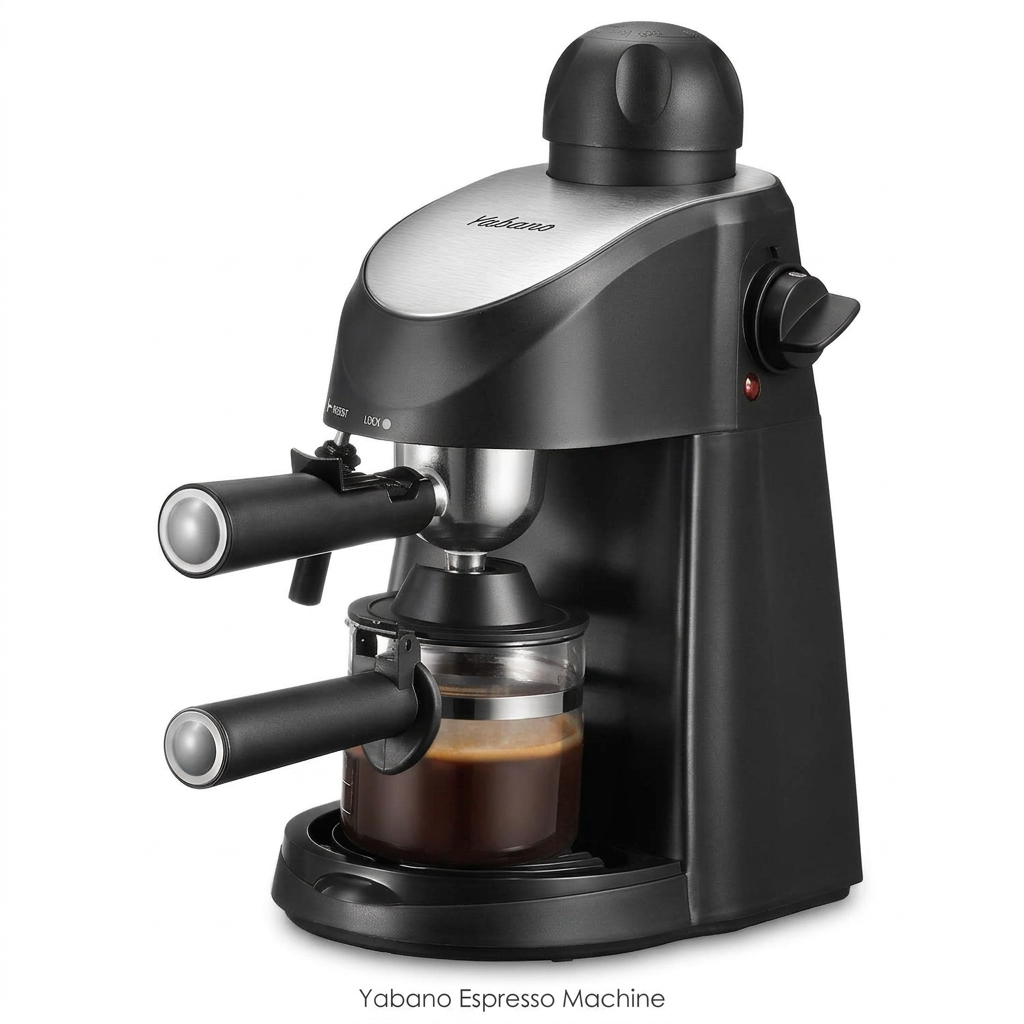
The full package: top water cap, steam wand, filter holder and glass carafe.
Which one is right for you: is the Yabano 3.5 Bar your match?
4 quick questionsYabano 3.5 Bar specifications
From manufacturer data and my own testing.
How I tested and scored the Yabano 3.5 Bar
For four weeks, Michael Reynolds and I used the Yabano 3.5 Bar every day for strong black coffee, cappuccinos, lattes and mochas, around 80 to 100 drinks in total.
We tested dark, medium-dark and medium roasts at different grinds, and compared the single and double filters at different water levels.
We frothed whole, semi-skimmed, skim and oat milk, logged every steam and filter-lock problem and timed each drink from a cold start.
We followed the daily cleaning routine, descaled once and checked our notes against Yabano's product information and manual.
- Coffee (6.0): strength, flavor and consistency with different roasts, grinds and serving sizes.
- Milk drinks (7.0): steam power, foam thickness and how reliably the steam knob worked.
- Ease of use (7.2): setup, the filter holder lock, controls, safety habits and the daily routine.
- Compact design (8.3): footprint, weight, build and how easily it fits and stores in a small kitchen.
The overall score of 6.7 is an editorial rating that reflects those four areas.
Yabano 3.5 Bar FAQ
Is the Yabano 3.5 Bar worth it?
Yes, if you want simple, affordable cappuccinos in a small space. It brews strong, moka-style coffee and makes thick milk foam, but not true café espresso.
Does it make real espresso?
Not in the café sense. It uses about 3.5 bar of steam pressure, compared with about 9 bar from a pump machine, so the coffee is strong but has little crema.
What grind should I use?
A medium to medium-coarse grind, like coffee made for moka pots. Very fine espresso grounds can make it drip slowly or overflow.
Why does water come out of the steam wand?
The steam knob probably isn't open far enough. Wait for the indicator to stop blinking, then turn the knob fully to about the six o'clock position.
How do I lock the filter holder?
Align it with the insert mark, push it up firmly and turn it to the lock mark while holding the machine steady with your other hand.
How many cups does it make?
Up to four, measured with the markings on the glass carafe.
How do I make a stronger coffee?
Use the single filter and less water. Big four-cup brews taste milder.
Can it froth plant milk?
Yes. Barista-style oat milk foamed best of the plant milks we tried, though whole milk gave the thickest foam.
What is the T-shaped clip on the handle for?
It holds the filter in place while you knock out the used grounds.
How do I clean it?
Rinse the filter and holder after each brew, wash the carafe daily, wipe and purge the steam wand after every milk drink and descale regularly.
How big is the Yabano 3.5 Bar?
About 7.7 inches wide, 13.1 inches tall and 10 inches deep, and it weighs about 4.7 pounds.
Kitchen & coffee tester
Michael spent six years as a line cook in restaurants in Chicago and New York, and he has tested kitchen appliances for HouseholdMe since 2018, from air fryers to coffee makers. He holds an SCA certificate in barista skills and used the Yabano 3.5 Bar as his everyday coffee machine for four weeks for this review.
- Four weeks of hands-on testing of the Yabano 3.5 Bar CM6816
- Yabano product information and manual
- General coffee brewing, milk frothing and maintenance guidance