SHARDOR CM1628 review
The SHARDOR CM1628 20 Bar Espresso Machine with Built-In Grinder is a compact, stainless steel all-in-one with a built-in grinder, adjustable brewing temperature from 194 to 204°F, single and double shot buttons and a swing-out arm for hot water and steam. It fit under my cabinets, stayed put on its suction feet and made a solid double or Americano every morning. Milk takes practice, and the controls are basic.

Michael Reynolds
Hands-on review
Hands-on testing, research, specs
3 weeks
20 minutes
Jargon helpNew to coffee gear? Tap any dotted term to see what it means.
In this review
Yes, if you want a compact, good-looking espresso machine with a grinder that can live on the counter under your cabinets. The SHARDOR CM1628 heated to 204°F in under two minutes, its adjustable temperature helped with different beans, and the dosing ring and hot water arm made doubles and Americanos quick and tidy. The steam wand is steady rather than strong, the display shows little, and the brand's long-term track record is short.
SHARDOR CM1628 at a glance
SHARDOR CM1628 pros and cons
- Compact enough to live under kitchen cabinets
- Adjustable brewing temperature, 194 to 204°F
- Built-in grinder with dosing ring and suction feet
- Steam wand is steady but slow for big lattes
- No pressure gauge or shot timer
- Short brand track record for long-term support
Who should buy the SHARDOR CM1628?
- Espresso and Americano drinkers
- Small kitchens with low cabinets
- Beginners who want an all-in-one start
- Latte lovers who want fast, powerful steam
- Tinkerers who want gauges and timers
- Buyers who want a long-established brand
First impressions of the SHARDOR CM1628
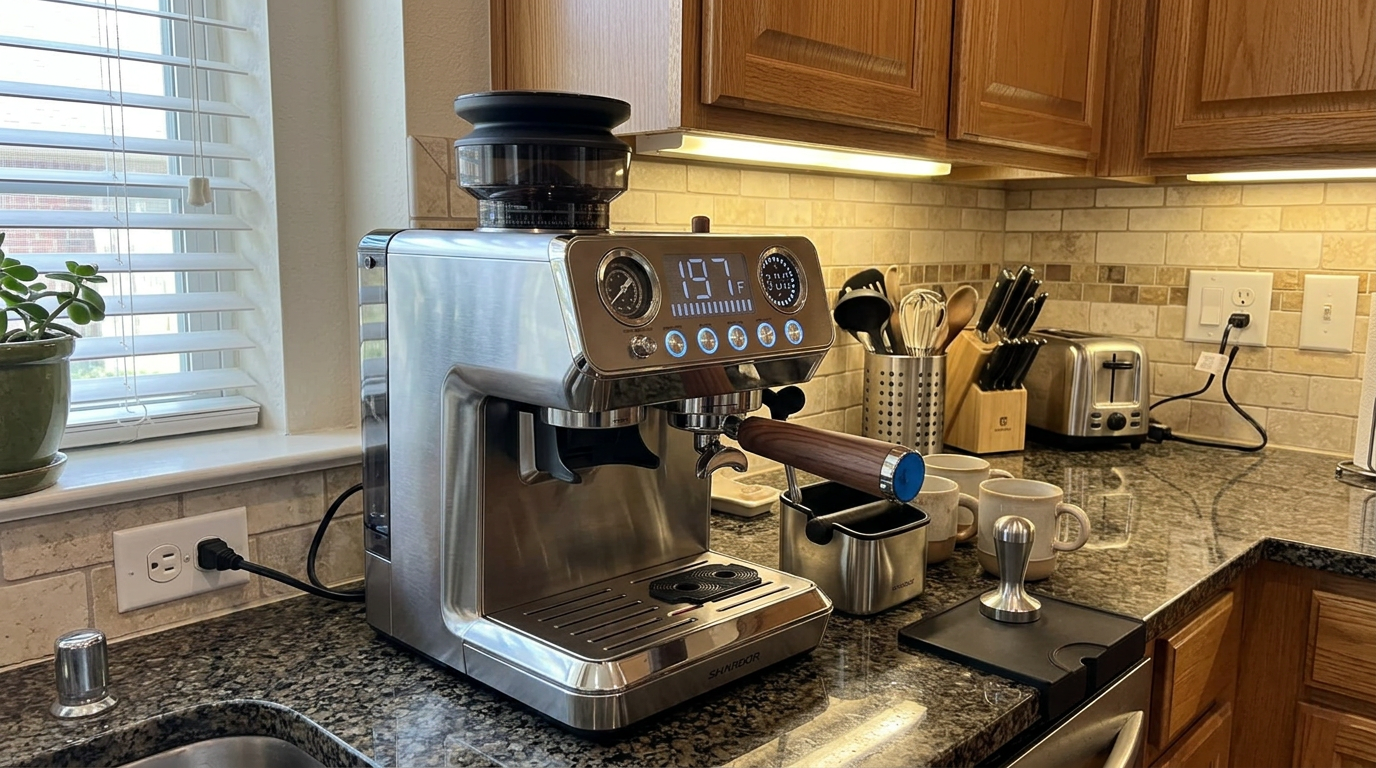
The kitchen where I tested the SHARDOR CM1628 has low upper cabinets and not much counter space.
Most espresso machines with a built-in grinder are too tall to fill there without sliding them forward every time.
The SHARDOR fit underneath with room to spare, and I could add beans and refill water without moving it at all.
That set the tone for the whole test.
This is a compact, practical, good-looking machine that you can leave out on the counter and use every morning without fuss.
Out of the box, the stainless steel body looks smart and well finished.
The grinder sits on top, the controls are on the front, and a swing-out arm on the right side handles hot water and steam.
Underneath, small suction cups hold it firmly to the counter.
I didn't think much of those until the first time I locked in the portafilter and the machine stayed exactly where it was.
My first double, on the default grind and the highest temperature, was rich and hot.
It wasn't perfect, but it was much better than I expected from a machine this size.
I tested it the way most buyers will use it: two people, an Americano or a double first thing, a cappuccino on weekends, and the occasional iced coffee.
Over three weeks, it made about a hundred doubles and Americanos for us, plus a fair number of cappuccinos.
The CM1628 fit under my low cabinets, so I could add beans without moving it.
What the SHARDOR CM1628 actually is
The CM1628 is a semi-automatic espresso machine with a built-in grinder.
You grind into the portafilter✕PortafilterThe handle with a metal basket that holds the ground coffee and locks into the machine's brew head., tamp, lock it in and press the single or double button.
The machine heats the water to the temperature you choose, pushes it through the coffee and stops the shot.
A swing-out arm on the right gives you hot water for Americanos and cup warming, and a steam button turns it into a steam wand for milk.
It is designed for daily home use, and it would suit a small office too.
What's in the box
My box held the machine, the bean hopper, a portafilter with filter baskets, a tamper, a dosing ring, a cleaning brush, a stainless steel milk pitcher and a silicone mat for the drip tray.
That covered everything I needed to start, apart from a scale.
Our tip: Put the silicone mat on the drip tray straight away, because it stops cups sliding and catches drips around the base of the cup.
SHARDOR CM1628 design and setup
Compact and under-cabinet friendly
The CM1628 is compact for a grinder machine.
It sat comfortably under my standard upper cabinets, and the hopper lid opened without hitting anything.
That meant I could keep it pushed back against the wall, add beans, grind and brew without pulling it out.
Suction feet
The small suction cups under the base keep the machine from sliding during grinding, tamping and locking the portafilter.
On a lighter machine, that makes a real difference to how solid it feels in use.
The water tank
The water tank sits at the back and lifts off for filling at the sink.
Its lid closes to stop splashing as you carry it back, and it slides back into place easily.
With two or three drinks a day, I refilled it about every two days.
The swing-out arm
The hot water and steam arm swings out for use and back in when you're done.
Tucked in, it keeps the machine's footprint narrow, which is handy in a tight corner.
Controls
The controls are about as simple as an espresso machine gets: an on button, a temperature setting, grind mode with a start button, single and double shot buttons, and a steam button for the arm.
There are no menus to dig through, which my partner appreciated.
The trade-off is that the display shows very little, so there is no shot timer or grind readout to help you dial in.
Setup
Setup took about 15 minutes: rinse the parts, fill the tank, fit the hopper, run hot water through the group and arm and pull a couple of practice shots.
Our tip: Swing the hot water arm inward after every use, because tucked in it can't catch a sleeve or a cupboard door.
The built-in grinder and dosing
The built-in grinder has 45 settings and an anti-static design that reduces the coffee clinging to the chute.
You choose grind mode, press start, and it grinds for a set time into the portafilter.
The dosing ring
The included dosing ring sits on top of the basket while you grind.
Without it, fluffy grounds spill over the edge; with it, almost everything lands where it should.
After grinding, you lift the ring off and the basket is ready to tamp.
Dose and grind time
With one level scoop of medium-roast beans in the hopper, a grind of about nine and a half seconds was enough to grind everything for a double.
I preferred to weigh my beans, and settled on about 16 grams for a double.
| Grind time | What it gave me | Use |
|---|---|---|
| About 6 s | Roughly a single dose | Single shot |
| About 9.5 s | About 16 g, one level scoop | Double shot |
| About 11 s | About 18 g | Stronger double for milk drinks |
Finding the right grind
With 45 settings, there is plenty of room to fine-tune.
I started in the middle and moved finer a few steps at a time until a double took around 25 to 30 seconds.
Our tip: Use a level scoop and the same grind time every day, because a consistent dose matters more than any other setting on this machine.
Adjustable brewing temperature
This is the CM1628's most useful feature for its size.
You can set the brewing temperature anywhere from 194 to 204°F.
Lighter roasts need hotter water to taste sweet, while darker roasts can turn bitter if the water is too hot.
Being able to choose made a clear difference with the three beans I tested.
| Roast | Temperature I used | Result |
|---|---|---|
| Light roast | 204°F | Less sour, sweeter |
| Medium roast | 202–204°F | Balanced, fruity |
| Medium-dark blend | 200°F | Chocolatey, round |
| Dark roast | 196°F | Less bitterness |
From cold, the machine reached 204°F in under two minutes.
CM1628 timed in my tests; boiler times vary widely.
Why temperature changes the taste
It helps to know why the temperature dial makes such a difference.
Brewing espresso is all about extraction✕ExtractionHow much flavor water dissolves from the coffee. Too little tastes sour and thin, too much tastes bitter and dry., and hotter water dissolves flavor faster.
Light roasts are dense and hard, so they need the hottest water to give up their sweetness.
Dark roasts are more porous and give up flavor easily, so very hot water pulls out more bitterness.
That's why the same temperature can't be right for every bag.
The CM1628 heats with a thermoblock✕ThermoblockA heater that warms water as it flows through a hot metal block instead of heating a whole boiler. It makes a machine ready in a minute or two., which warms water as it flows rather than storing it in a boiler.
That keeps the machine compact and quick to heat, and it held the set temperature well across two back-to-back doubles.
My ratings out of 100 for sweetness and balance.
Our tip: Change only one thing at a time, temperature or grind, because changing both makes it impossible to tell which one fixed the shot.
Noise and stability
The grinder is the loudest part, a short burst of about ten seconds for a double.
The pump hums steadily during the shot, and the steam arm hisses and pulses as it builds up.
It was noticeable in our open-plan kitchen, but not loud enough to wake anyone in the bedroom.
The suction feet in practice
On a smaller machine, locking in the portafilter often pushes the whole machine back.
The CM1628's suction feet stopped that completely.
When I wanted to wipe under it, I tipped it gently from one side to release the suction, and it came up easily.
| Sound | When | Normal? |
|---|---|---|
| Grinder burst | Grinding a dose | Yes |
| Steady pump hum | During the shot | Yes |
| Hiss and pulsing | Steam building up | Yes |
| Gurgle into the drip tray | Rinse and purge | Yes |
| Grinder running with nothing coming out | Any time | No, check the hopper |
Brand, reliability and support
SHARDOR is better known for grinders than espresso machines, and the CM1628 is a fairly new model.
Mine ran without a single fault for three weeks of daily use, and nothing loosened or leaked.
But there isn't much long-term history to judge yet, so I'd treat it like any machine from a newer maker.
Register the warranty, keep the box for the return window, and use it heavily in the first few weeks to shake out any early problems.
Looking after the grinder and steam arm from day one will also help it last.
| What to check | Why it matters |
|---|---|
| Warranty length and registration | Covers early faults |
| Replacement parts | Gaskets, baskets and burrs wear over time |
| Support contact | Faster help if something goes wrong |
| Return window | Time to test it properly at home |
Espresso and dialing in
Once dialed in, the SHARDOR CM1628 made a solid, hot double with good body and a steady layer of crema✕CremaThe golden-brown foam on top of an espresso. It forms when pressure pushes gases and oils out of freshly ground coffee..
With a medium roast at 204°F, it tasted round and sweet, with a little brightness.
It doesn't have the depth of a dialed-in shot from a much more expensive setup, but it is a big step up from pods.
Tamping
The CM1628 comes with two tampers, one built into another accessory and a separate one.
I preferred the heavier, solid metal one, because its weight made it easier to press down firmly and evenly.
My dialing-in shots
| Shot | Temp | Dose | Yield | Time | Taste |
|---|---|---|---|---|---|
| 1 | 204°F | 16 g | 40 g | About 18 s | Thin, a bit sour |
| 2 | 204°F | 16 g | 36 g | About 24 s | Pleasant, bright |
| 3 | 204°F | 16 g | 34 g | About 28 s | Round, sweet |
| 4 | 200°F | 16 g | 34 g | About 28 s | Chocolatey, softer |
No gauge or timer
There is no pressure gauge and no shot timer on the CM1628.
I timed shots on my phone, which worked fine, but a scale with a built-in timer is a worthwhile extra.
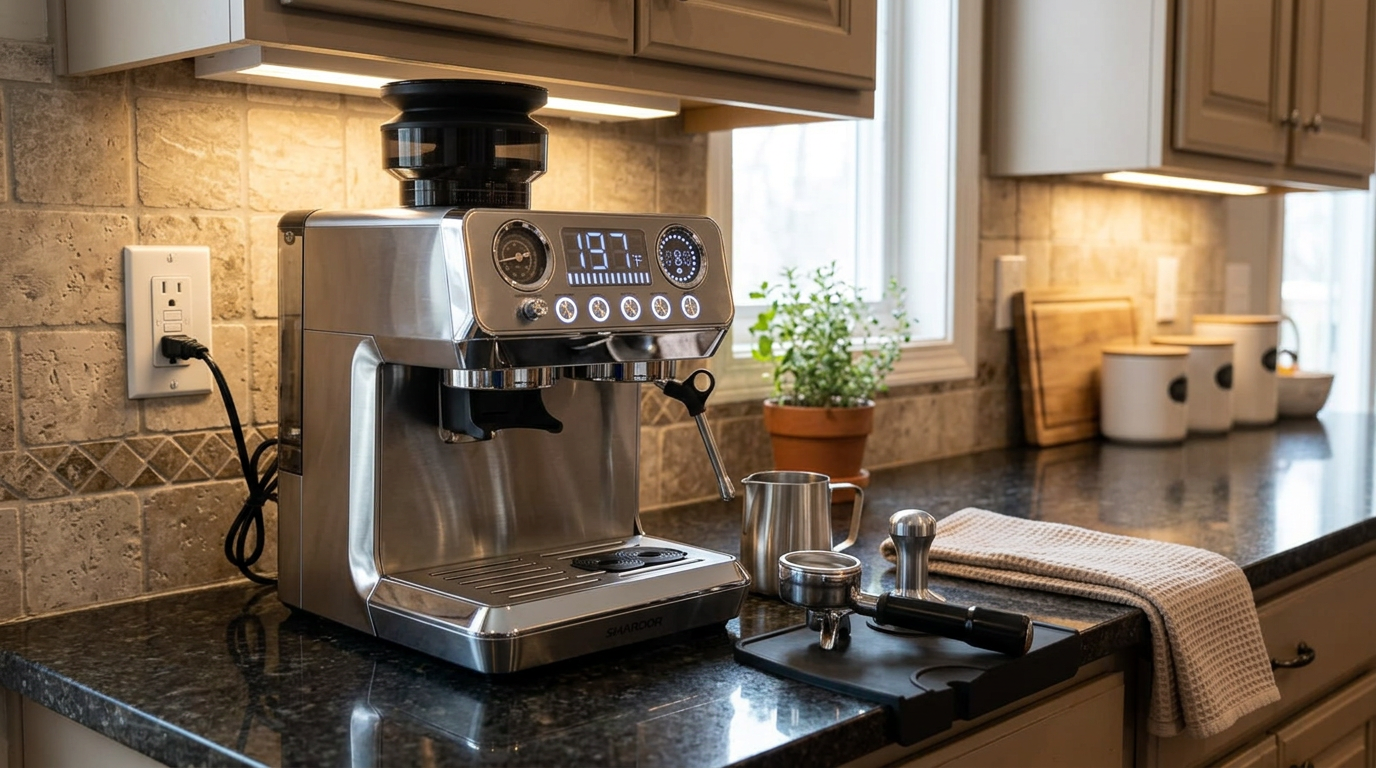
A medium roast at 204°F gave a round, sweet double in about 28 seconds.
Our tip: Warm your cup with hot water from the arm before every shot, because a hot cup keeps a small espresso hot to the last sip.
What “20 bar” means
Like most budget espresso machines, the CM1628 advertises a 20-bar pump.
That number is the pump's maximum, not the pressure your coffee is brewed at.
Good espresso is usually brewed around 9 bars, and the real pressure depends on how much resistance your coffee puck gives.
In practice, grind, dose and tamp affect the shot far more than the number on the box.
| What you see | What it means | First change |
|---|---|---|
| Fast, pale shot | Too little resistance | Grind finer |
| 25–30 s for a double | About right | Keep it |
| Slow drips, very dark | Too much resistance | Grind coarser |
| Spurts or pale streaks | Channeling | Level the grounds, tamp evenly |
| Little crema | Old beans or too coarse | Fresher beans, finer grind |
Americanos and hot water
The hot water arm is one of the CM1628's best everyday features.
Swing it out, and it dispenses hot water for an Americano or for warming cups.
Because it comes from the same arm as the steam, you press the steam button to switch between the two.
For Americanos, I poured hot water into the mug first and pulled the double on top, which kept more crema.
From our drink log, rounded.
Our tip: Put the hot water in the mug first and the shot on top, because the crema survives much better than when you pour water onto the espresso.
Steaming milk
Press the steam button, and the arm switches from hot water to steam.
It took a few seconds to build up, then delivered steady, consistent steam.
Foam quality
With the tip just under the surface for a few seconds, then sunk slightly so the milk spins, I got smooth, creamy foam for cappuccinos.
It took a few tries to get rid of big bubbles, but by the end of the first week the foam was good enough for simple latte art.
Steam power
The steam is steady rather than strong.
Steaming 6 ounces of milk took about a minute, which is fine for one cappuccino but slow if you're making four lattes for guests.
My ratings out of 10 for foam texture.
Why the built-in grinder matters
If you are coming from pods or pre-ground coffee, the grinder is the reason to buy this machine.
Ground coffee loses much of its aroma within minutes, while whole beans keep it for weeks.
I ran a blind tasting with the same beans: freshly ground on the CM1628, and pre-ground from the same bag a few days earlier.
Average scores out of 100 from three tasters.
Everyone picked the fresh shot.
Fresh grinding also lets you adjust the grind when a shot runs too fast or too slow, which you can't do with pre-ground coffee.
My favorite drinks and settings
These are the drinks we made most on the SHARDOR CM1628.
| Drink | Temperature | Milk or water | Notes |
|---|---|---|---|
| Double espresso | 204°F | None | Warm the cup first |
| Americano | 204°F | 5–6 oz hot water from the arm | Water first, shot on top |
| Cappuccino | 202°F | About 4–5 oz foamy milk | Steam small batches |
| Latte | 202°F | About 7 oz milk | Steam in two batches for two drinks |
| Cortado | 200°F | About 2 oz steamed milk | Strong and smooth |
| Iced latte | 204°F | Double onto ice, cold milk | Stir before adding milk |
A quick iced coffee
Pull a double straight onto three or four ice cubes, stir, then top up with cold water or milk.
It chills in seconds and stays strong because it only hits a few cubes.
What daily use is really like
A weekday Americano took about three minutes from switch-on, most of it waiting for the machine to heat.
While it heated, I added a scoop of beans, fitted the dosing ring and ground.
Then I tamped, locked in, warmed the mug with hot water, emptied it, added fresh hot water and pulled the double on top.
For cappuccinos, I added about a minute for steaming.
The water tank lasted about two days, and the drip tray's red float told me when it needed emptying.
Cleaning and maintaining the CM1628
After each shot, I twisted the portafilter to the left, removed it, knocked out the grounds and rinsed the basket.
After steaming, I wiped the arm and purged it.
The drip tray
The drip tray lifts out with its mat, and a small red float pops up when the tray is nearly full.
I emptied it once a day.
The grinder
The included brush sweeps stray grounds away, and it is also useful when you take the grinder apart to clean it.
I brushed the chute weekly and cleaned the burrs every couple of weeks.
| Task | What it removes | How often |
|---|---|---|
| Knock out and rinse basket | Grounds and oils | After every shot |
| Wipe and purge the arm | Milk residue | After every steam |
| Empty drip tray | Water | Daily, or when the float rises |
| Brush grinder chute | Old grounds | Weekly |
| Clean burrs | Oils and fines | Every 2 weeks |
| Descale | Mineral scale | Every 2–3 months |
My estimate of hands-on cleaning time per day.
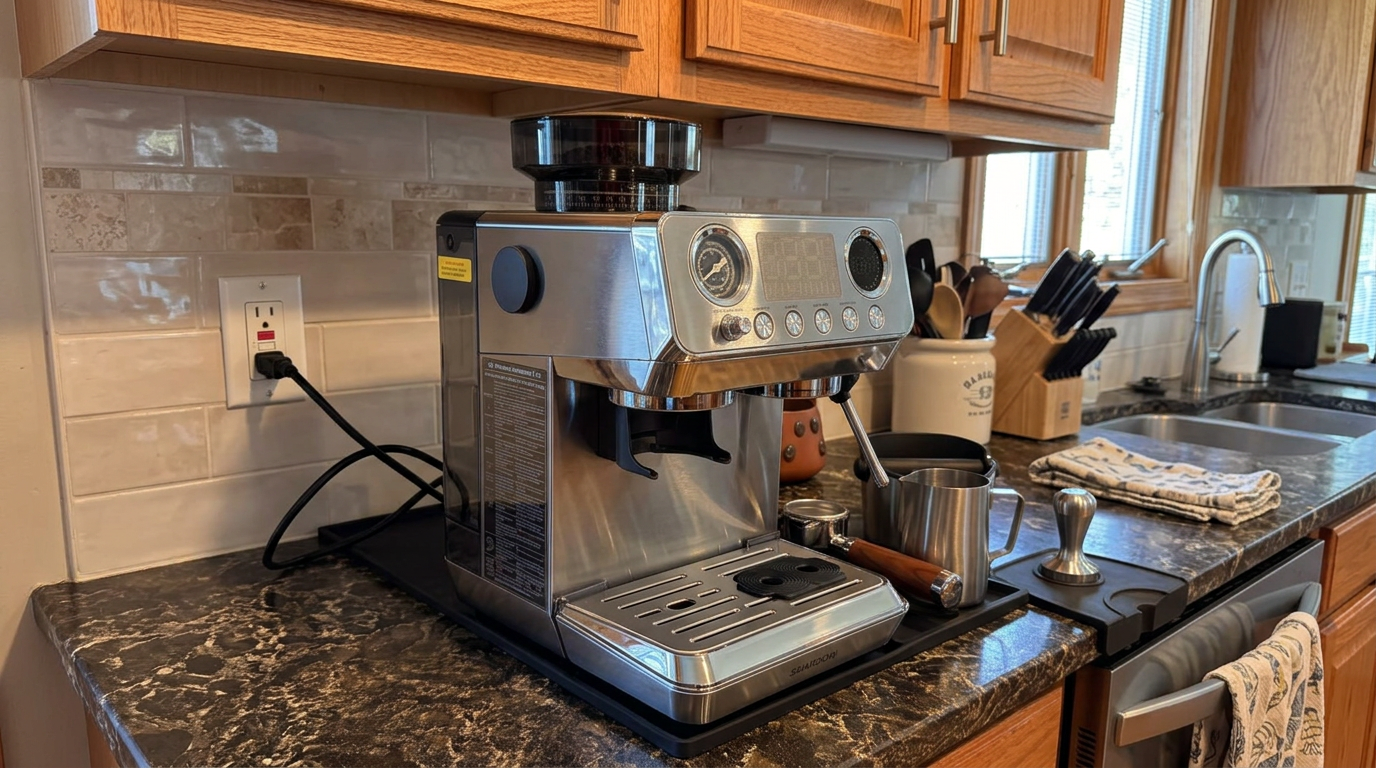
The drip tray's red float pops up when it's time to empty it.
Our tip: Wipe the steam arm with a damp cloth the moment you finish, because milk dries on hot metal within a minute or two.
How long it takes to learn
The CM1628's controls are simple: power, grind mode and start, single, double and steam.
My partner, who had never used an espresso machine, made her own Americano on day one with a few pointers.
Days to learn each step, from a first-time user's notes.
As usual, milk was the hardest part, and the modest steam power made it a little slower to learn.
Getting better foam from a modest wand
The CM1628's steam is gentle, which is actually helpful while you learn, because things happen slowly.
These steps gave me the best microfoam✕MicrofoamMilk foam with bubbles so small you can't see them. It feels silky and blends into the coffee instead of sitting on top like froth. from it.
| Step | What to do | Why |
|---|---|---|
| 1 | Purge the arm into a cloth | Clears water before steaming |
| 2 | Use 4–5 oz of very cold milk | Gives more time to texture |
| 3 | Tip just under the surface for 5–8 s | Adds air for foam |
| 4 | Sink the tip slightly, angle the pitcher | Spins the milk, removes big bubbles |
| 5 | Stop when the pitcher is hand-hot | Keeps milk sweet |
| 6 | Wipe and purge immediately | Stops milk drying on the arm |
Cheap extras that help
The CM1628 comes well equipped, but a couple of extras made a difference.
| Accessory | Why it helps | Priority |
|---|---|---|
| Small scale with timer | Weigh dose and yield, time shots | High |
| Knock box | Quick, clean puck disposal | Medium |
| Microfiber cloths | Wiping and purging the steam arm | High |
| WDT tool✕WDT toolA tool with thin needles used to stir ground coffee in the basket before tamping. It breaks up clumps so the puck has an even density. | Breaks up clumps before tamping | Low |
| Smaller milk pitcher | Better foam with modest steam | Medium |
Using it in a small office
For one week of the test, I took the CM1628 to a friend's three-person design studio.
They mostly drink Americanos and the occasional cappuccino, which suits this machine well.
The compact size fit on a narrow shelf next to their sink, and the suction feet kept it steady on a slightly slippery laminate top.
Each person learned the grind, tamp and brew steps in a day, and the hot water arm made Americanos quick between meetings.
The two things they noticed were the grinder noise during calls and the time it took to steam milk for several cappuccinos in a row.
For a small office that drinks mainly black coffee, I would happily recommend it.
For a busy office with many latte drinkers, I would look for a machine with stronger steam.
From their tally sheet.
Three weeks with the CM1628, week by week
Week 1: getting started
I learned the grinder and dosing ring, tried all three temperature settings and settled on 204°F for most beans.
Americanos were good from day one.
Week 2: milk
I switched to smaller milk batches and the foam improved quickly.
Week 3: routine
The machine became part of the morning without any thought.
The suction feet, compact size and quick heat-up were the things I appreciated most.
Our combined feeling about the machine, from our shared notes.
Common mistakes to avoid
| Mistake | What happens | Better habit |
|---|---|---|
| Grinding without the dosing ring | Grounds on the counter | Fit the ring every time |
| Using the lowest temperature for light beans | Sour shots | Start at 204°F |
| Steaming a full pitcher | Stiff, bubbly foam | Steam 4–5 oz at a time |
| Pouring water onto the shot | Crema breaks up | Water first, shot on top |
| Ignoring the red float | Overflowing drip tray | Empty when it rises |
| Leaving the arm swung out | Bumps and knocks | Swing it in after use |
What I would change
A stronger steam wand would make lattes quicker.
A shot timer on the display would make dialing in easier.
And longer-term information on parts would reassure buyers of a newer brand.
Three households, three verdicts
The Americano drinker
Someone who drinks two or three big black coffees a day.
The CM1628 is excellent for this, with quick hot water and adjustable temperature.
The small-kitchen couple
Two people, low cabinets and limited counter space.
It fits where many grinder machines don't.
The weekend host
Someone who makes coffee for friends on Saturday mornings.
Americanos and doubles are quick to turn out one after another, but a round of four cappuccinos took me around ten minutes because each pitcher of milk takes about a minute.
Serving Americanos first and milk drinks second kept things moving.
The latte family
Three or four people who all want big lattes.
The steady but modest steam will slow mornings down.
| Household | Fit | Main reason |
|---|---|---|
| Americano drinkers | Excellent | Hot water arm, adjustable temp |
| Small kitchens | Excellent | Compact, under-cabinet |
| Espresso beginners | Very good | Simple controls, grinder built in |
| Latte families | Fair | Modest steam power |
| Tinkerers | Fair | No gauge or timer |
Is the SHARDOR CM1628 worth the money?
The CM1628 is priced as an affordable all-in-one.
For that, you get a built-in grinder, adjustable brewing temperature, a hot water and steam arm, a dosing ring and a compact, good-looking body.
It is best value for espresso and Americano drinkers, and a little less so if you drink lots of big lattes.
Compared with buying a compact espresso machine and a separate grinder, it saves both money and counter space.
Compared with pods, the cost per cup is usually lower once you buy whole beans, and the coffee is noticeably fresher.
What you give up is steam power and the readouts that enthusiasts like, neither of which matters much for an Americano.
Three questions to ask:
Do you mainly drink espresso or Americanos?
Is your counter space or cabinet height limited?
Can you live without a gauge and a shot timer?
How it compares with other coffee setups
| Feature | SHARDOR CM1628 | Pod machine | Larger all-in-one machine |
|---|---|---|---|
| Fresh grinding | Built in, 45 settings | No | Built in |
| Temperature | Adjustable, 194–204°F | Fixed | Often adjustable |
| Hot water | Swing-out arm | Sometimes | Usually |
| Steam | Steady, modest | Frother, often separate | Often stronger |
| Size | Compact, under-cabinet | Small | Often large |
| Gauge and timer | None | None | Sometimes |
Compared with a pod machine, the CM1628 gives you fresh espresso, real Americanos and milk drinks, for a few extra minutes a day.
Compared with larger all-in-one machines, it gives up steam power and readouts but saves a lot of space.
If you are still comparing, see my best espresso machines with a grinder and best espresso machines under 500.
| You mostly drink | Is the CM1628 a fit? | Why |
|---|---|---|
| Americanos | Excellent | Hot water arm, hot shots |
| Double espresso | Very good | Adjustable temperature |
| Cappuccinos | Good | Smooth foam with small batches |
| Several big lattes | Fair | Modest steam power |
| One-touch milk drinks | Poor | Manual steaming |
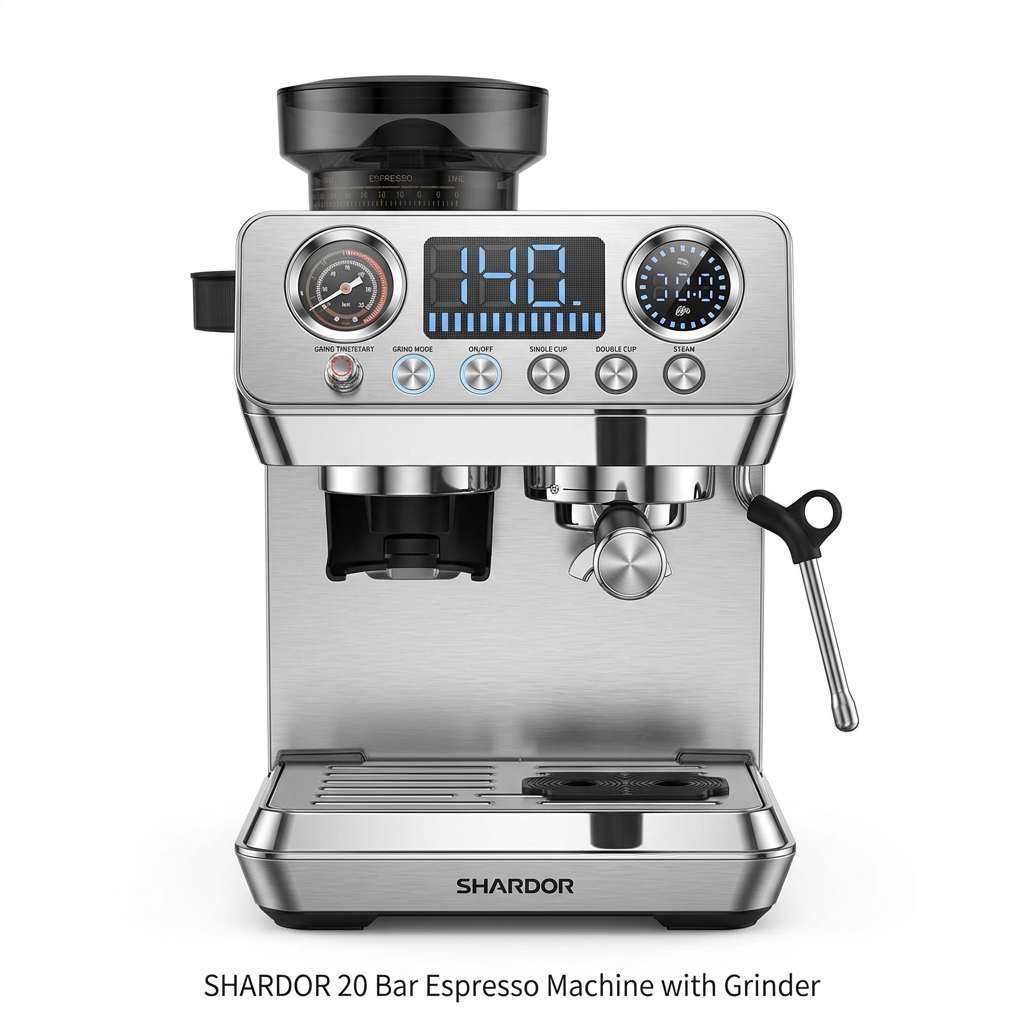
The full package: grinder on top, controls in front and the swing-out hot water and steam arm.
Which one is right for you: is the SHARDOR CM1628 your match?
4 quick questionsSHARDOR CM1628 specifications
From manufacturer data and my own testing.
How I tested and scored the SHARDOR CM1628
For three weeks, the SHARDOR CM1628 was our everyday espresso machine for double espressos, Americanos, cappuccinos and lattes.
I weighed beans and shots on a kitchen scale, timed grind cycles and shots with my phone, and tried the lowest, middle and highest temperature settings with three roasts.
I steamed whole and oat milk with the wand, used the hot water arm for Americanos and cup warming, and tracked how often the tank and drip tray needed attention.
I also cleaned the grinder with the included brush and checked how well the suction feet held the machine during grinding and tamping.
- Espresso (7.9): body, crema and balance at different temperatures.
- Milk drinks (7.5): steam power, foam texture and how long milk takes.
- Ease of use (8.2): controls, grinder, dosing ring and hot water arm.
- Cleaning (7.7): drip tray, grinder access, steam wand and daily mess.
The overall score of 7.8 is an editorial rating that reflects those four areas.
SHARDOR CM1628 FAQ
Is the SHARDOR CM1628 worth it?
Yes, if you want a compact all-in-one espresso machine with a grinder and adjustable temperature. It lacks a gauge and timer, and its steam wand is modest.
Can I adjust the brewing temperature?
Yes, from 194 to 204°F.
How fast does it heat up?
It reached 204°F in under two minutes in my tests.
Does it have a built-in grinder?
Yes, an anti-static grinder with 45 settings that grinds into the portafilter.
Will it fit under my cabinets?
It fit comfortably under my standard upper cabinets, and I could add beans without pulling it forward.
Does it make Americanos?
Yes. The swing-out arm dispenses hot water, which you add to a shot.
Can I steam milk?
Yes. Press the steam button to switch the arm from hot water to steam.
Does it have a pressure gauge?
No, and there is no shot timer either.
What accessories are included?
A bean hopper, filter baskets, tamper, dosing ring, cleaning brush, milk pitcher and a drip tray mat.
Why does it have suction feet?
They hold the machine in place while you lock in the portafilter and grind, so it doesn't slide on the counter.
How often do I refill the water tank?
With two or three drinks a day, about every two days.
What beans work best?
Fresh medium and medium-dark roasts. I used the 204°F setting for most beans.
Kitchen & coffee tester
Michael spent six years as a line cook in restaurants in Chicago and New York, and he has tested kitchen appliances for HouseholdMe since 2018, from air fryers to coffee makers. He holds an SCA certificate in barista skills and used the SHARDOR CM1628 as his everyday coffee maker for three weeks for this review.
- Three weeks of hands-on testing of the SHARDOR CM1628
- SHARDOR product specifications and user manual
- General espresso brewing, grinding and milk steaming guidance