Philips Café Aromis review
The Philips Café Aromis Automatic Espresso Machine with LatteGo Pro is Philips' flagship bean-to-cup machine, with more than 50 hot and cold recipes, real 5-minute cold brew and two tubeless LatteGo Pro carafes. It was ready in seconds, brewed quietly and fed eight people's saved drinks without a fuss. Milk is warm rather than piping hot, and there is a lot to learn before you use it all.

Michael Reynolds
Hands-on review
Hands-on testing, research, specs
3 weeks
21 minutes
Jargon helpNew to coffee gear? Tap any dotted term to see what it means.
In this review
Yes, if you want the biggest menu in a home bean-to-cup machine and drink iced coffee or cold brew often. The Philips Café Aromis made genuine cold brew in about 5 minutes, its stronger Brew Extract Plus dose gave noticeably fuller coffee than Philips' mid-range machines, and both LatteGo Pro carafes rinse clean in seconds. Milk drinks come out warm rather than hot, the grinder is still audible, and setup and the menu take some learning.
Philips Café Aromis at a glance
Philips Café Aromis pros and cons
- Real cold brew in about 5 minutes
- 50+ recipes and 8 user profiles
- Two tubeless LatteGo Pro carafes rinse in seconds
- Milk drinks are warm rather than hot
- Grinder is still clearly audible
- Long setup and a learning curve
Who should buy the Philips Café Aromis?
- Iced coffee and cold brew drinkers
- Families or shared homes with many different orders
- Plant milk users who hate cleaning tubes
- Espresso-only drinkers
- People who like milk very hot
- Anyone who wants a simple, buttons-only machine
First impressions of the Philips Café Aromis
I have tested a lot of Philips machines, and most of them share the same idea: a handful of drinks, a LatteGo jug and very easy cleaning.
The Philips Café Aromis keeps the easy cleaning and throws out the handful.
It has more than 50 recipes, two milk carafes and a cold brew function that actually uses cold water.
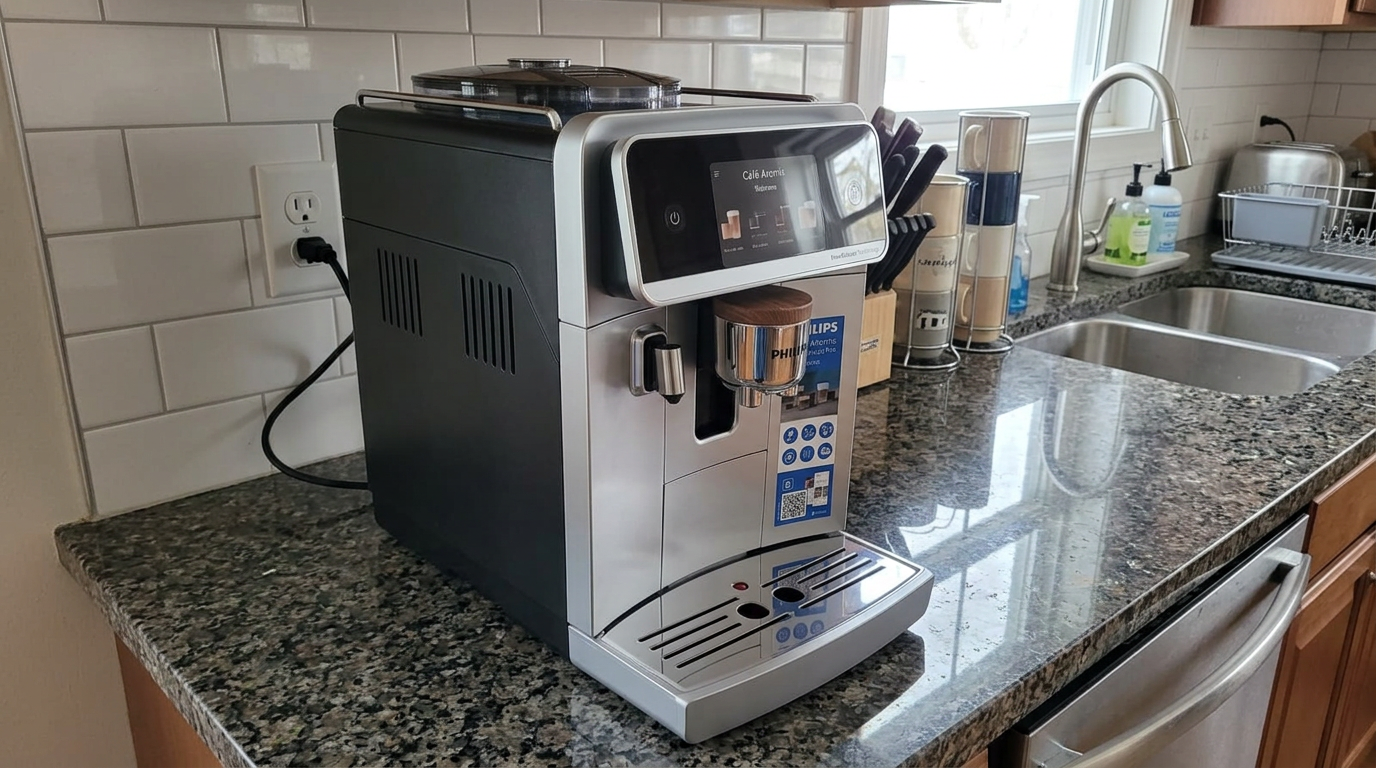
Out of the box, it looks calm and grown-up rather than flashy.
The lines are clean, the proportions are balanced, and the full-color touchscreen sits in the middle of the front like a small tablet.
There are almost no physical buttons, because nearly everything happens on that screen.
The first thing I noticed in use was how quickly it was ready.
From standby, it was ready to brew in about 3 seconds, before I had a cup out of the cupboard.
The second was the quiet, steady hum of the brewing, which barely carried into the next room.
By the end of week one, my partner had stopped buying cold brew on the way to work, and our weekend guests had their own saved drinks.
The Café Aromis looks calm on the counter, with the touchscreen doing almost all the work.
What the Philips Café Aromis actually is
The Café Aromis is the top of Philips' fully automatic, bean-to-cup range, sold as the 8000 Series.
It grinds whole beans, doses and presses them in the removable brew group✕Brew groupThe part inside an automatic machine that receives the ground coffee, presses it into a puck, pushes water through it and then ejects the used grounds., brews and drops the used puck into a drawer.
For milk drinks, the LatteGo Pro carafe mixes milk and air at speed in a small chamber and pours it straight into the cup.
What sets it apart from Philips' mid-range machines is the combination of three things.
A much bigger menu, a stronger dose called Brew Extract Plus, and real cold brew made by pushing cool water through the coffee under pressure.
What's in the box
In my box were the machine, two LatteGo Pro carafes (one for hot milk and one for cold), an AquaClean water filter, a measuring scoop, a water hardness strip and a tube of brew group grease.
Our tip: Label the cold carafe with a small sticker on the base, because the two LatteGo Pro carafes look almost the same at a glance.
Philips Café Aromis design and setup
The Café Aromis has a typical Philips bean-to-cup footprint, a little taller and deeper than the entry models to fit the bigger screen.
It sat comfortably under my standard upper cabinets with room to open the bean lid.
The water tank comes out from the front, which saved me sliding the machine forward to refill it.
The finish
The finish is clean and modern, without the high-gloss panels that collect fingerprints on some flagship machines.
After three weeks of daily use, it still looked tidy with a quick wipe every few days.
Setup
Setup is guided on the screen: fill the tank, add beans, set water hardness, fit the AquaClean filter and let the machine prime and rinse itself.
Connecting it to Wi-Fi and pairing the Philips HomeID app took me about 20 minutes, which is longer than I would like, but you only do it once.
Our tip: Do the Wi-Fi pairing before you add beans, because the app walks you through first-time calibration and it is easier with your phone already connected.
Touchscreen and the Barista Assistant
The touchscreen is the command center, and it is genuinely good.
Drinks are grouped into categories, each one shows its strength, volume and milk settings as soon as you tap it, and the screen tells you exactly what it needs: water, beans, an empty tray.
With more than 50 recipes, that guidance matters.
The Barista Assistant
The Barista Assistant is the Café Aromis' most unusual feature.
Instead of asking you to understand grind size or extraction, it asks simple questions about taste.
Did you find that too strong, too weak, too milky, too bitter?
Based on my answers, it nudged the strength and volume of my cappuccino two steps over the first week, and it started suggesting a cortado I would never have tried on my own.
It works on the screen and in the app, and it learns over time.
For someone new to coffee, it is like a patient barista standing next to the machine.
Our tip: Answer the Barista Assistant honestly after the first few drinks, because it adjusts much faster when you tell it what you didn't like.
Brew Extract Plus and the coffee dose
This is where the Café Aromis pulls clearly ahead of Philips' mid-range machines.
Brew Extract Plus puts more coffee in the brew group per cycle and adjusts the water flow to get more flavor out of it.
There are seven intensity levels, compared with five on most other Philips models.
In the cup, the difference was obvious.
On the top two levels, the coffee had more body and sweetness than the 4400 and 5500, and a cappuccino tasted of coffee rather than warm milk.
I rarely needed the extra-shot function, which I used daily on the mid-range machines.
My ratings out of 100 for body and coffee presence, same beans.
Espresso, ristretto and the black coffees
With a fresh medium-dark blend on level 6 or 7, the espresso had good body and a lasting crema✕CremaThe golden-brown foam on top of an espresso. It forms when pressure pushes gases and oils out of freshly ground coffee..
It is still an automatic machine, so it doesn't match a dialed-in manual shot, but it was among the best automatic espressos I have had from Philips.
The ristretto✕RistrettoA short espresso brewed with less water. It tastes more concentrated and sweeter, with less bitterness. was my favorite, short and syrupy with a cocoa finish.
The lungo✕LungoA long espresso brewed with more water through the same coffee. It is bigger and milder, with a little more bitterness. was less convincing, a bit thin and bitter at the end.
Americano and coffee
The Americano adds hot water after the espresso, so it tastes cleaner and rounder than a long pull.
The standard coffee button makes a smooth, easy mug that my weekend guests liked.
| Drink | Taste in my tests | Best setting I found |
|---|---|---|
| Ristretto | Syrupy, cocoa, sweet | Level 7, smallest volume |
| Espresso | Full body, lasting crema | Level 6 or 7 |
| Lungo | Thin, slightly bitter | Use Americano instead |
| Americano | Clean, round | Level 6 |
| Coffee | Smooth, easy mug | Level 5 |
Temperature and the first cup
The Café Aromis lets you raise the brewing temperature in the settings.
I used the highest setting for espresso and ristretto, and the middle one for Americanos and cold-weather mugs.
The very first drink after a long standby was a little cooler than the rest, so I got into the habit of running a short hot water rinse into the cup first.
After that, every espresso came out hot enough to drink slowly.
| What you taste or see | Likely cause | First change |
|---|---|---|
| Thin | Strength too low | Raise to level 6 or 7 |
| Sour | Grind too coarse | One step finer while grinding |
| Bitter, dry | Volume too large | Smaller volume |
| First drink lukewarm | Cold cup and spout | Rinse hot water into the cup |
| Weak in milk drinks | Low strength | Level 7 in your profile |
Our tip: Choose the Americano instead of the lungo for a bigger black coffee, because it adds water separately and stays rounder.
Real cold brew in about 5 minutes
This is the feature that made the Philips Café Aromis my partner's favorite machine of the year.
Most machines in this class make iced coffee by brewing hot coffee over ice, which melts the ice and dilutes the drink.
The Café Aromis instead pushes cool water through freshly ground coffee in pulses, under pressure, for about 5 minutes.
Real cold brew✕Cold brewCoffee made with cold or cool water instead of hot. It usually tastes smoother and less acidic than hot coffee poured over ice. normally takes 10 to 24 hours of steeping in the fridge.
In my tests, the 5-minute version came out smooth, low in acidity and naturally sweet.
Because the water is cool, fewer of the bitter, acidic compounds dissolve, which is why cold brew tastes softer than iced coffee.
Pressure and pulsing make up for the short time, forcing water evenly through the whole bed of coffee instead of leaving it to steep.
It wasn't quite as rich and chocolatey as my overnight batch, but it was far closer to that than to hot coffee over ice.
Typical times; Café Aromis timed in my kitchen.
How it tasted compared
My ratings out of 100 for smoothness and flavor.
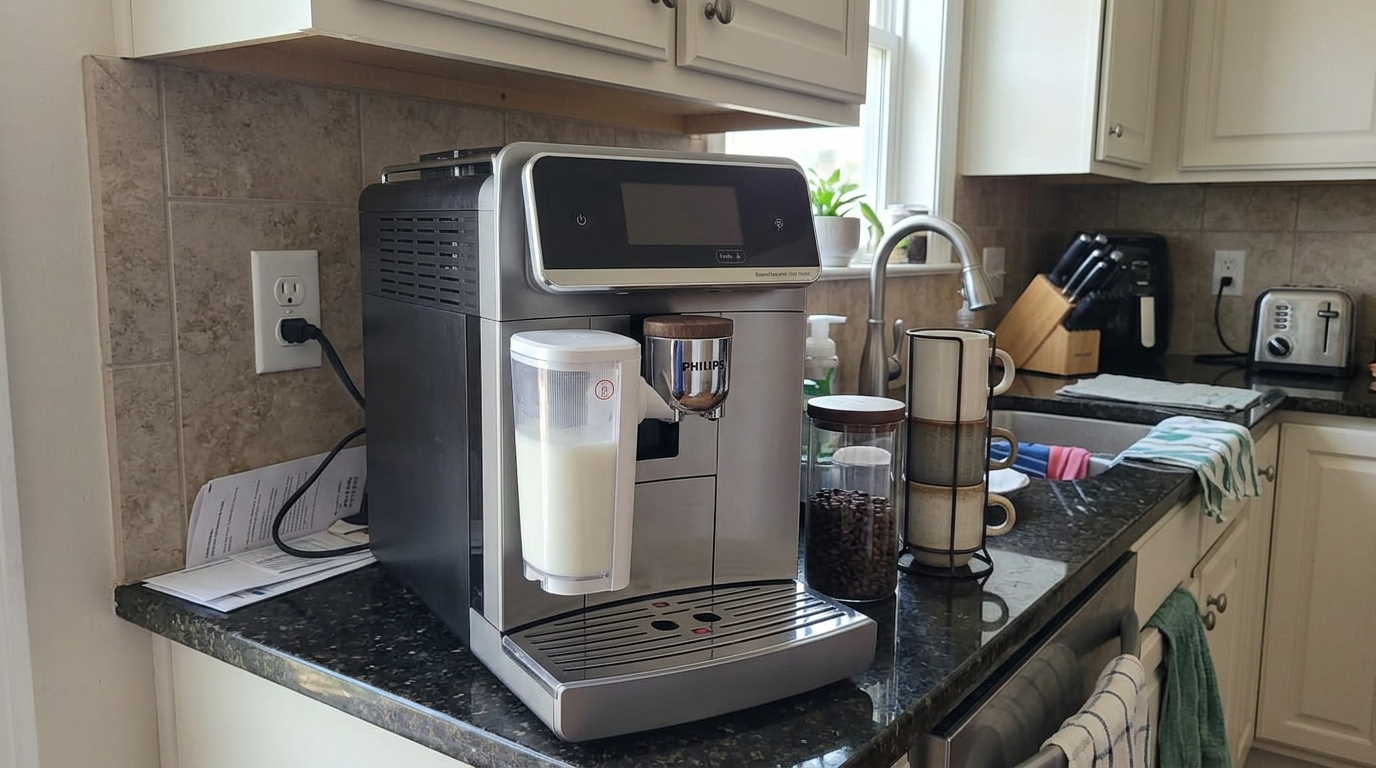
Cold brew takes about 5 minutes and comes out smooth rather than sharp.
Our tip: Use a medium roast for cold brew, because darker roasts tasted flat and lighter ones a little sour in the short 5-minute extraction.
Iced lattes and cold foam
The cold carafe turns the Café Aromis into a proper iced-drink machine.
It froths cold milk into a thick, stable foam without heating it.
Spooned onto cold brew, it made a cold foam drink as good as anything I've bought in a café.
My favorite iced drinks
| Drink | How I made it | Tip |
|---|---|---|
| Cold brew | Preset over ice | Medium roast, 4 or 5 cubes |
| Cold foam cold brew | Cold brew plus cold foam | Pour foam slowly over the back of a spoon |
| Iced latte | Iced preset with cold milk | Level 7 so the coffee comes through |
| Iced Americano | Preset over ice | Big glass on hot days |
| Sweet cold foam | Cold foam with a little vanilla syrup | Add syrup to the milk before frothing |
My favorite drinks and settings
After three weeks, these were the drinks saved in our profiles on the Philips Café Aromis.
Most of them took a few rounds with the Barista Assistant to get right, and a couple came straight from its suggestions.
| Drink | Strength | Volume | Notes |
|---|---|---|---|
| Morning ristretto | Level 7 | Smallest | Pre-warmed cup |
| Cappuccino | Level 7 | Less milk | Full coffee taste |
| Flat white | Level 6 | Medium milk | My partner's daily drink |
| Cortado | Level 7 | Small | Suggested by the Barista Assistant |
| Cold brew | Preset | Medium glass | Medium roast, 4 or 5 cubes |
| Iced latte | Level 7 | Large | Cold carafe, milk first |
| Americano | Level 6 | Large | Big mug for long work calls |
Making a cold foam cold brew
Start the cold brew over four or five ice cubes in a tall glass.
While it runs, fill the cold carafe with a little cold milk and a drop of vanilla syrup.
When the cold brew finishes, swap to cold foam and let it pour slowly on top.
The foam sat on the drink for several minutes and slowly sank into it, just like the café version.
Hot chocolate for the kids
The hot milk option is handy for non-coffee drinkers too.
Froth milk into a mug with a spoon of cocoa, stir, and it's done in under a minute.
Our tip: Save each perfected drink to your profile straight away, because it is easy to forget the exact strength and volume a week later.
The learning curve
There is a lot of machine here, and it took us a while to use it well.
In the first few days, the size of the menu was overwhelming, and I kept making the same three drinks out of habit.
Seven strength levels, two carafes, eight profiles, an app and an assistant all need a little attention before they pay off.
The good news is that the screen explains every step, and nothing needs technical coffee knowledge.
My advice is to set up your profile, pick five drinks to try in week one and let the Barista Assistant tune them.
By week two, the machine felt simple, because the drinks we actually used were saved and the rest stayed out of the way.
How long it took us to feel at home, from my notes.
LatteGo Pro milk drinks
The LatteGo Pro carafes are tubeless, made of a few interlocking parts.
You fill one with milk, clip it on and choose a drink, and the machine spins the milk with air and pours it straight into the cup.
The cappuccino had a thick, creamy foam, and the flat white and cortado had a thinner, silkier layer that suited them well.
With the big Brew Extract Plus dose, the coffee came through the milk better than on any other Philips machine I have used.
Milk temperature
Like almost every automatic carafe, the milk comes out warm rather than hot.
I measured 130 to 140°F, comfortable to drink straight away.
If you like your latte scalding, warm the cup first or choose a machine with a steam wand.
General milk guidance; Café Aromis results in the middle band.
Plant milks
The LatteGo Pro chamber handled plant milks well, which isn't true of every automatic system.
My ratings out of 10 for foam texture and stability.
Our tip: Pre-warm your cup with the hot water function before a latte, because the milk is warm rather than hot and a cold cup takes a few degrees off.
Profiles, the app and smart features
Eight user profiles is more than I have seen on any other home machine.
Each profile saves strength, volume, milk ratio and temperature for every recipe.
In a house with two adults, a teenager who drinks iced lattes and regular guests, that is genuinely useful.
The HomeID app
The Café Aromis connects over Wi-Fi to the Philips HomeID app.
From the app, I could browse recipes, adjust drinks, use the Barista Assistant, check maintenance alerts and start a brew.
The connection was stable throughout my test, and it reconnected without fuss after a router restart.
I used remote start mostly on weekends, when I would set a cold brew going while still on the sofa.
| Smart feature | How useful it was | Verdict |
|---|---|---|
| 8 user profiles | Every regular got their own drinks | Excellent |
| Barista Assistant | Adjusted drinks to our taste in days | Very good |
| HomeID recipes | Lots of ideas, matched to the menu | Good |
| Remote brewing | Handy for cold brew on weekends | Nice extra |
| Maintenance alerts in the app | Clear and timely | Good |
Start-up speed and noise
QuickStart
From standby, the Café Aromis was ready to brew in about 3 seconds.
From fully off, it took a little longer for the first rinse, but it was still faster than I could fetch a mug.
Café Aromis timed in my tests. Boiler machines vary widely.
Quiet brewing
The Café Aromis carries Quiet Mark certification, and in daily use the brewing was noticeably calm.
The grinder is still the loudest part, with a clear burst of a few seconds at the start of each drink.
It didn't wake anyone in our house, but you will hear it in an open-plan kitchen.
| Sound | When | Normal? |
|---|---|---|
| Grinder burst | Start of each drink | Yes |
| Soft hum and clicks | Brew group moving and brewing | Yes |
| Pulsing | Cold brew extraction | Yes, water is pulsed through the coffee |
| Water into the drip tray | Rinses and brewing | Yes |
| Grinding with no beans | Any time | No, check the hopper and app |
Cleaning and maintaining the Philips Café Aromis
Cleaning was where the Café Aromis felt most like a Philips machine, in the best way.
LatteGo Pro
After each milk drink, I took the carafe off, pulled it apart and rinsed it under the tap.
That took about 15 seconds.
Once a day, the parts went into the dishwasher.
The brew group
The brew group comes out through a side door for a weekly rinse under the tap.
It needs a dab of grease every couple of months and a degreasing✕DegreasingA cleaning cycle with a coffee oil tablet that dissolves the oily build-up water alone can't remove from the brew group. tablet when the machine asks.
Descaling
With the AquaClean filter fitted and replaced when prompted, Philips says you can go up to 5,000 cups before descaling.
The cleaning menu guides you through descaling when it is due.
| Task | What it removes | How often |
|---|---|---|
| Rinse LatteGo Pro | Milk residue | After every milk drink |
| LatteGo Pro in dishwasher | Milk film | Daily |
| Empty drip tray and grounds | Water and pucks | When prompted |
| Rinse brew group | Loose coffee | Weekly |
| Degreasing tablet | Coffee oils | When prompted |
| Grease brew group | Friction | Every couple of months |
| Replace AquaClean filter | Scale | When prompted |
My estimate of hands-on cleaning time per day.
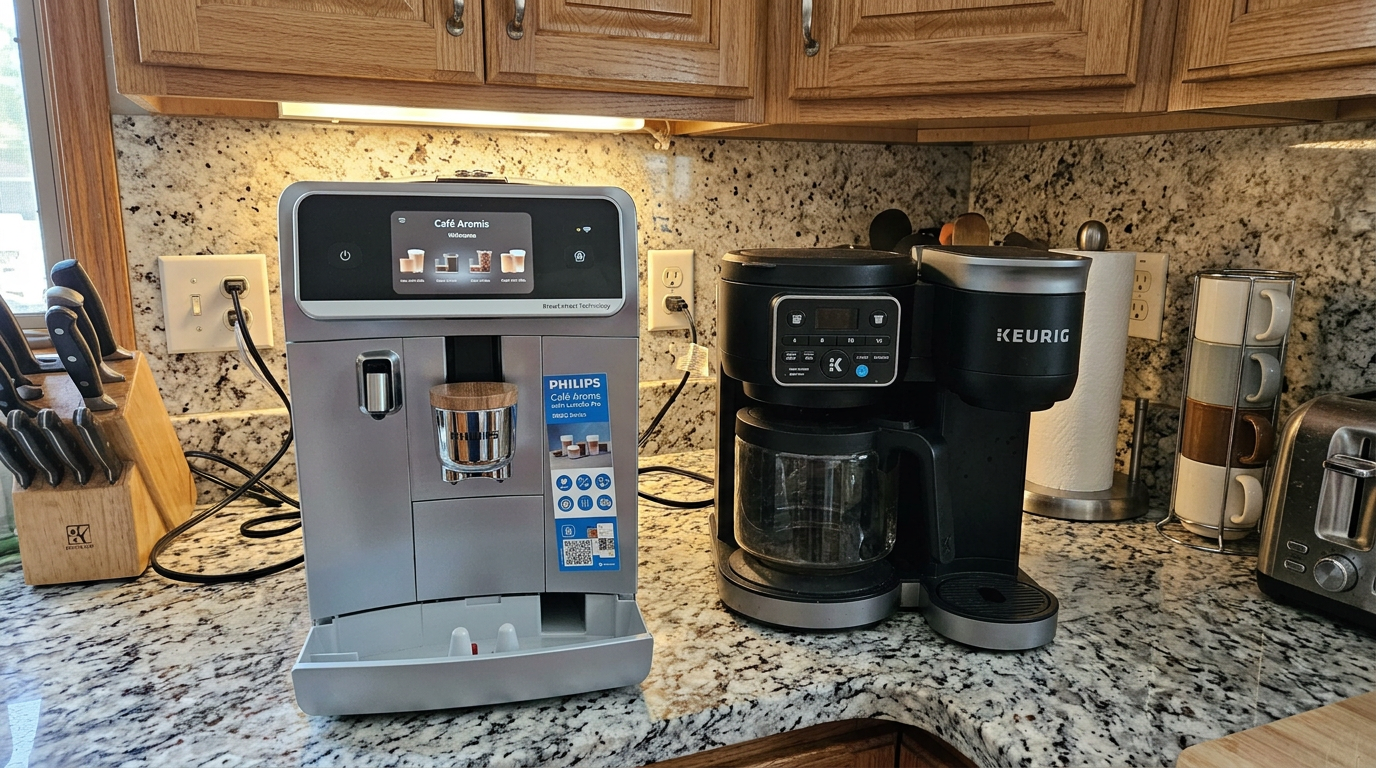
The tubeless LatteGo Pro carafe took about 15 seconds to rinse after each milk drink.
Our tip: Empty the drip tray and grounds drawer with the machine switched on, so its sensors register the change and reset the warnings.
What daily use is really like
Our weekday mornings took under five minutes for three drinks.
I tapped my profile for a ristretto, my partner chose a flat white, and our teenager made an iced latte before school.
In the afternoon, cold brew became the default, especially on warm days.
At weekends, our guests used their own profiles, which meant nobody had to remember anyone's order.
The water tank lasted us a little over a day with that mix, and I refilled the beans every three or four days.
From my drink log, rounded.
Beans, water and milk
The bigger dose shows off good beans better than Philips' mid-range machines.
Medium-dark blends made the best espresso and milk drinks.
Medium roasts were best for cold brew and iced Americanos.
Avoid oily and flavored beans, which leave residue in the grinder and brew group.
| Bean type | Hot espresso | Milk drinks | Cold brew |
|---|---|---|---|
| Medium-dark blend | Best | Excellent | Good, a little flat |
| Medium roast | Good, brighter | Good | Best, smooth |
| Light roast | Can be sour | Fades in milk | Fruity, slightly sour |
| Oily or flavored | Avoid | Avoid | Avoid |
Water and milk
Use fresh, cold water and keep the AquaClean filter fitted.
For the best foam, use milk straight from the fridge, and barista versions of plant milks.
Three weeks with the Café Aromis, week by week
Week 1: exploring the menu
We tried about 30 of the recipes and set up four profiles.
QuickStart and cold brew stood out immediately, and the menu felt a little overwhelming.
Week 2: dialing in
I moved the grind one step finer and saved level 7 cappuccinos and ristrettos.
The Barista Assistant adjusted my partner's flat white twice, and she agreed with both changes.
Week 3: the routine
Rinsing LatteGo Pro became a habit, and we ran our first degreasing cycle when the machine asked.
Nothing rattled, leaked or failed, and the drinks tasted as good as in week two.
Our combined feeling about the machine, from our shared notes.
Common mistakes to avoid
| Mistake | What happens | Better habit |
|---|---|---|
| Using the hot carafe for cold foam | Warm, thin foam | Use the cold carafe |
| Low strength in milk drinks | Coffee gets lost | Level 6 or 7 |
| Choosing a dark roast for cold brew | Flat, dull taste | Medium roast |
| Emptying the tray with the machine off | Warnings don't reset | Empty with the machine on |
| Skipping the Barista Assistant | Settings never improve | Answer its questions |
| Brewing lattes into a cold cup | Drink cools quickly | Pre-warm with hot water |
What I would change
Hotter milk would make it perfect for latte lovers who like it very hot.
A quieter grinder would match the quiet brewing.
And a shortcut for each profile's three favorite drinks on the home screen would cut down on scrolling.
Three households, three verdicts
The cold brew fan
Someone who buys cold brew most days.
The Café Aromis is the best Philips machine I have tested for this, by a clear margin.
The big household
Four or more people, all with different orders.
Eight profiles and 50+ recipes make this effortless.
The busy family
Two working parents, two teenagers and a dog that needs walking before eight.
QuickStart means nobody waits for the machine, and each person taps their own profile and walks away while it brews.
The tubeless carafe makes cleanup quick enough that it actually happens every morning, rather than being left until the weekend.
The only friction we saw was the grinder noise at 6 a.m., which is audible but short.
The espresso-only drinker
One double espresso every morning, nothing else.
It does it well, but most of its features would go unused.
| Household | Fit | Main reason |
|---|---|---|
| Cold brew and iced coffee fan | Excellent | Real 5-minute cold brew |
| Big or shared household | Excellent | 8 profiles, 50+ recipes |
| Plant milk users | Very good | Tubeless LatteGo Pro handles oat and soy |
| Very hot latte lovers | Fair | Milk comes out warm |
| Espresso-only drinker | Fair | Most features unused |
Is the Philips Café Aromis worth the money?
The Café Aromis sits at the very top of Philips' range, above the 4400 and 5500.
For the extra, you get real cold brew, a stronger dose with seven levels, two carafes, eight profiles and the Barista Assistant.
If you drink cold brew or iced coffee regularly, the cold brew function alone makes it worth choosing over the mid-range models.
If you only drink hot espresso, it's more machine than you need.
Think about how you buy coffee today, too.
If you pick up a cold brew or an iced latte on the way to work several times a week, the Café Aromis replaces that habit with something close in quality, made in your own kitchen in about 5 minutes.
In our house, that habit change was the single biggest reason we kept using it daily.
It is also the machine I would choose for a family, because eight profiles mean nobody has to remember anyone else's settings.
Three questions to ask:
Do you drink cold brew or iced coffee more than once a week?
Do three or more people use the machine?
Do you want the strongest coffee Philips makes in an automatic machine?
How it compares with other coffee setups
| Feature | Philips Café Aromis | Philips mid-range LatteGo machine | Manual machine and grinder |
|---|---|---|---|
| One-touch drinks | 50+ hot, iced and cold brew | 5 to 12 | None |
| Cold brew | Real cold-water extraction, about 5 min | Hot coffee over ice | By hand, overnight |
| Strength levels | 7, Brew Extract Plus | 3 to 5 | Full control |
| Milk | Two LatteGo Pro carafes | One LatteGo jug | Steam wand, hot milk |
| Profiles | Up to 8 | 0 to 2 | None |
| Start-up | About 3 s from standby | 30–45 s | Often several minutes |
Compared with Philips' mid-range machines, the Café Aromis adds real cold brew, a stronger dose and a much bigger menu.
My Philips 5500 review and Philips 4400 Series review cover the two models below it if you don't need cold brew.
Compared with a manual setup, it gives up hot milk and full control, but saves a lot of time and skill.
If cold drinks are your priority, my guide to the best espresso machines with cold brew puts it alongside the alternatives.
| You mostly drink | Is the Café Aromis a fit? | Why |
|---|---|---|
| Cold brew | Excellent | Real cold-water extraction in about 5 minutes |
| Iced lattes with cold foam | Excellent | Dedicated cold carafe |
| Cappuccinos and flat whites | Very good | Bigger dose, easy LatteGo Pro |
| Very hot lattes | Fair | Milk is warm, not hot |
| Espresso only | Fair | More machine than you need |
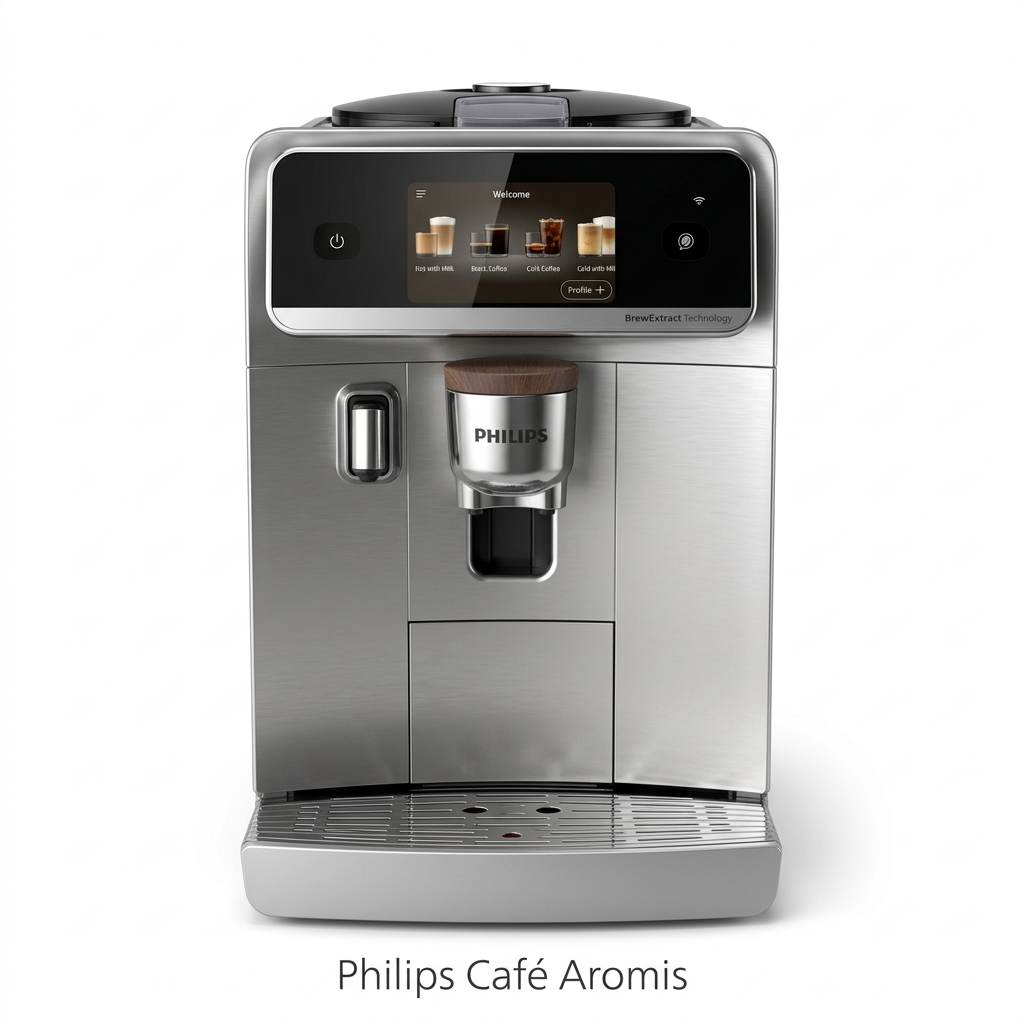
The full package: color touchscreen, adjustable spout and the LatteGo Pro carafe.
Which one is right for you: is the Philips Café Aromis your match?
4 quick questionsPhilips Café Aromis specifications
From manufacturer data and my own testing.
How I tested and scored the Philips Café Aromis
For three weeks, the Philips Café Aromis was our everyday coffee machine for hot drinks, iced drinks and cold brew.
My partner and I each used our own profile, and two friends who visited most weekends got profiles too, so I tested four of the eight slots.
I timed start-up and cold brew, measured drink and milk temperatures with a probe thermometer and compared the strongest coffee with Philips' mid-range LatteGo machines using the same beans.
I tested both LatteGo Pro carafes with whole, oat, almond and soy milk, used the HomeID app and the Barista Assistant daily, and followed the full cleaning routine.
- Espresso (8.5): body and flavor across the seven intensity levels and recipes.
- Milk drinks (8.6): hot foam, cold foam, milk temperature and plant milk results.
- Ease of use (9.1): touchscreen, Barista Assistant, profiles, app and cold brew workflow.
- Cleaning (8.8): LatteGo Pro rinsing, brew group care, alerts and descaling.
The overall score of 8.7 is an editorial rating that reflects those four areas.
Philips Café Aromis FAQ
Is the Philips Café Aromis worth it?
Yes, if you want lots of hot and cold drinks, real cold brew and easy milk cleaning for several people. If you only drink espresso, a simpler machine will do.
Does the Café Aromis make real cold brew?
Yes. It pushes cool water through fresh grounds under pressure and finished a cold brew in about 5 minutes in my tests, with a smooth, low-acid taste.
How many drinks does it make?
More than 50 preset recipes, from ristretto and lungo to cortado, flat white, iced lattes, cold foam drinks and cold brew.
How many user profiles does it have?
Up to eight, each saving strength, volume, milk ratio and temperature for every drink.
How hot is the milk?
Warm rather than hot. I measured about 130 to 140°F, which is typical for automatic carafes.
Does LatteGo Pro work with plant milk?
Yes. Oat, almond and soy all worked, and barista versions gave the most stable foam.
Why are there two milk carafes?
One LatteGo Pro carafe is for hot milk drinks and the other is for cold milk and cold foam.
How quickly is it ready?
About 3 seconds from standby in my tests, thanks to Philips' QuickStart.
Is it quiet?
Brewing is Quiet Mark certified and noticeably quiet. The grinder is still clearly audible for a few seconds.
What is the Barista Assistant?
A guided helper on the screen and in the app that asks about your taste and adjusts drink settings and suggestions for you.
Does it need Wi-Fi?
No. Wi-Fi and the HomeID app are optional, for remote brewing, recipes and the assistant.
How do I clean the milk system?
Take the carafe apart and rinse it under the tap after use. The parts are tubeless and dishwasher-safe.
Kitchen & coffee tester
Michael spent six years as a line cook in restaurants in Chicago and New York, and he has tested kitchen appliances for HouseholdMe since 2018, from air fryers to coffee makers. He holds an SCA certificate in barista skills and used the Philips Café Aromis as his everyday coffee maker for three weeks for this review.
- Three weeks of hands-on testing of the Philips Café Aromis
- Philips product specifications, user manual and the HomeID app
- General espresso, cold brew and milk texturing guidance