KitchenAid KF6 vs KF7 vs KF8: which fully automatic KitchenAid should you buy?
They share a heavy, metal-clad body, a 7-step steel grinder and a removable bean hopper. Then they split: the KitchenAid KF6 pours the most concentrated espresso in the range, the KitchenAid KF7 adds a touchscreen and an included milk container, and the KitchenAid KF8 adds 40-plus drinks, six profiles and a plant-milk mode. I used each one every day for four weeks, measured what matters and lined up the data to find out which belongs in your kitchen.
We choose products independently. We may earn a commission through links on this page; your price stays the same. Affiliate policy
Jargon helpNew to espresso? Tap any dotted term to see what it means.
In this comparison
For most homes, the KitchenAid KF8 is the KitchenAid to buy. It has the best milk drinks in the range, a plant-milk mode that genuinely helps with oat milk, 40-plus drinks and six profiles on a clear touchscreen, and one of the quietest grinders I have tested. If straight espresso is your main drink, the KitchenAid KF6 pulls the most concentrated shot I have measured from a one-touch machine, though you buy its milk container separately. The KitchenAid KF7 is the easiest to live with and looks gorgeous, but its espresso often tasted thin, so I only recommend it for latte drinkers who value design.
The three machines
Specs checked November 14, 2026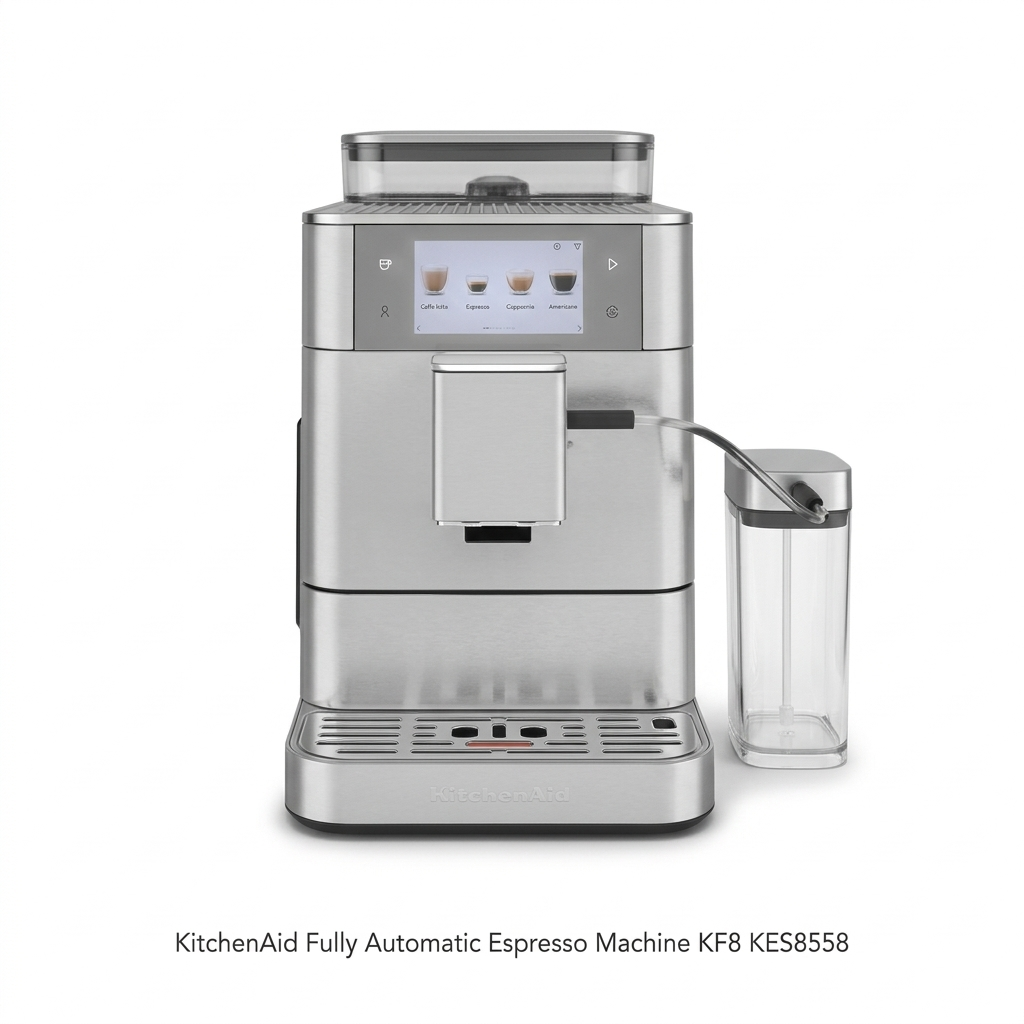
40-plus drinks, six profiles, a touchscreen, a plant-milk setting, two milk drinks at once and an 84.5-ounce tank.
Check price on Amazon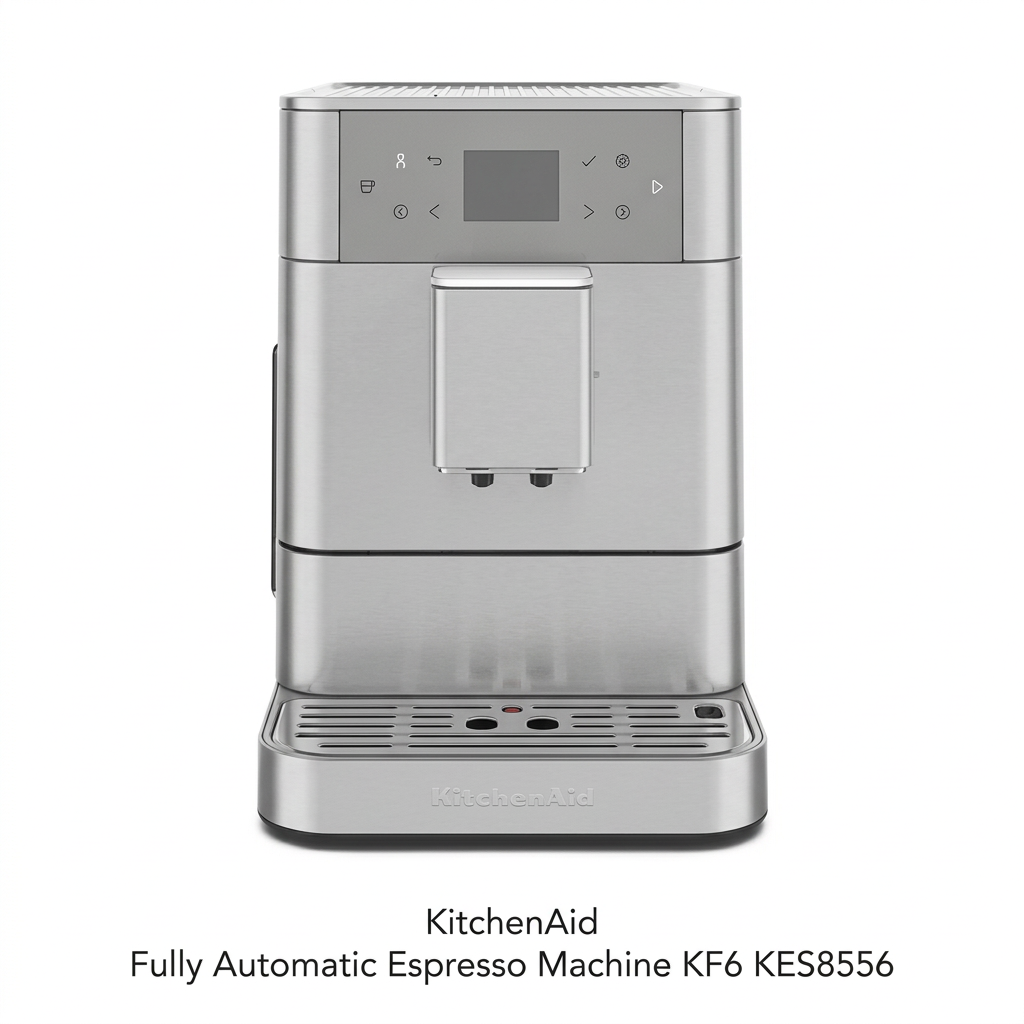
The most concentrated espresso in the range, four profiles, a metal-clad body and very quiet grinding; milk container sold separately.
Reveal Today’s Deal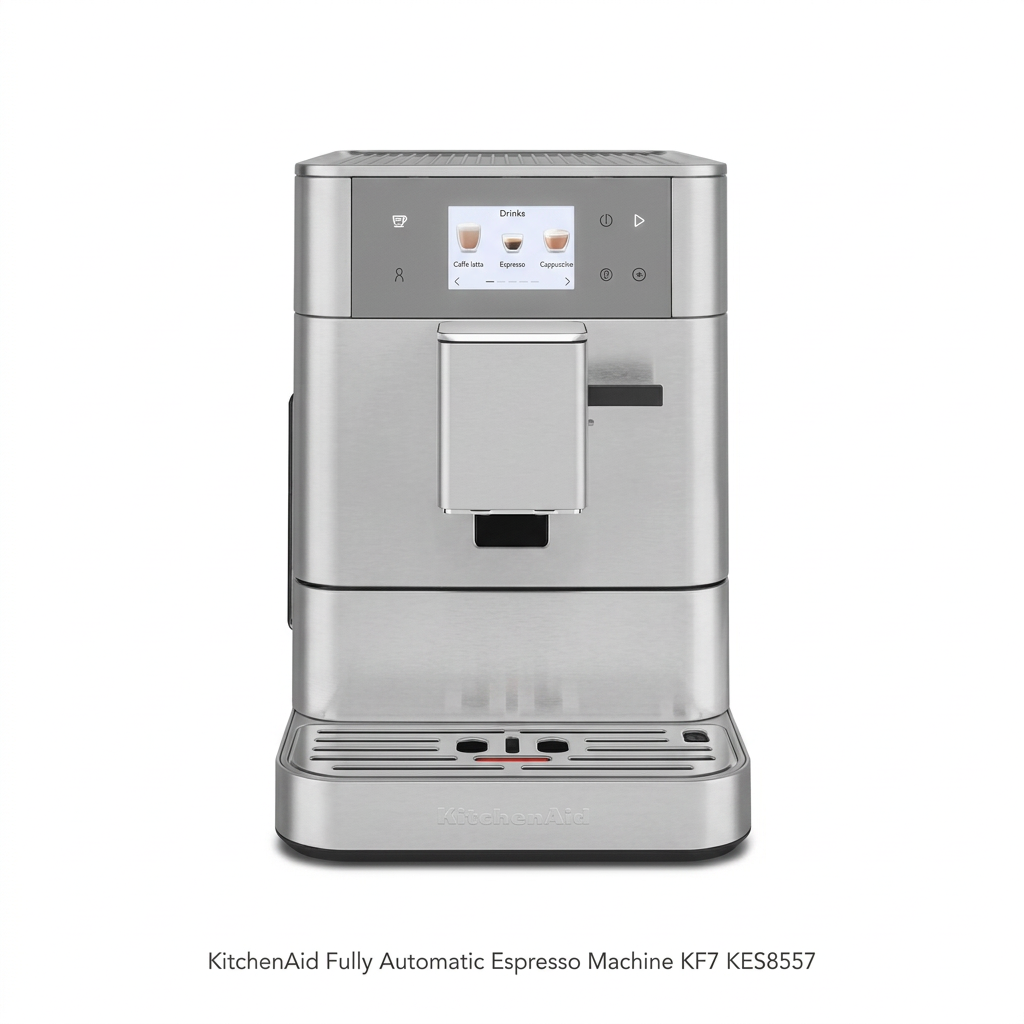
A 3.5-inch touchscreen, four profiles, a fridge-friendly 790 ml milk container and an easy cleaning routine.
See Today’s PriceKitchenAid KF6 vs KF7 vs KF8 at a glance
- All three share one metal-clad body, a steel conical grinder with 7 settings and a removable bean hopper.
- The KF6 is the espresso machine: button-driven, very quiet and the most concentrated shot, but its milk container is an extra.
- The KF7 adds a touchscreen and milk container, but its espresso lagged behind the other two.
- The KF8 is the all-rounder: 40-plus drinks, six profiles, plant-milk mode and two-cup milk drinks.
Head to head
The better result in each row is marked, based on my testing and the manufacturer specs. Rows where the machines are identical have no winner.
Keep in mind that the tally is not my verdict. Some rows matter far more than others, and which ones matter depends on what you drink.
| Spec | KitchenAid KF6 | KitchenAid KF7 | KitchenAid KF8 |
|---|---|---|---|
| Espressomy score | 9.0, dense and syrupy ✓ Best | 6.8, often thin | 8.6, smooth and well made |
| Milk drinksmy score | 8.0, silky | 8.2, good | 8.9, best in range ✓ Best |
| One-touch drinks | 15 | 20+ | 40+ ✓ Best |
| User profiles | 4 | 4 | 6 ✓ Best |
| Display | 2.4-inch color, buttons | 3.5-inch touchscreen ✓ Best | Color touchscreen ✓ Best |
| Milk container | Sold separately | 790 ml, included ✓ Best | Included ✓ Best |
| Plant-milk setting | No | No | Yes ✓ Best |
| Two milk drinks at once | No | No | Yes, splits the volume ✓ Best |
| Grinder | Steel conical, 7 settings | Steel conical, 7 settings | Steel conical, 7 settings, insulated ✓ Best |
| Water tank | 74 oz, side | 74 oz, slides out | 84.5 oz, lifts from top ✓ Best |
| Grinding noisemy measurement | About 61 dB peak ✓ Best | Quiet | One of the quietest I’ve tested ✓ Best |
| Ease of usemy score | 8.2 | 8.9 | 9.0 ✓ Best |
| Cleaningmy score | 8.4 | 8.6 ✓ Best | 8.2 |
| Weight | About 28 lb | About 28 lb | About 29 lb |
| Rows won | 2 | 3 | 11 |
KitchenAid KF6 vs KF7 vs KF8 pros and cons
KitchenAid KF6
- Concentrated, well-extracted espresso with thick crema
- Very quiet grinding and brewing
- Solid metal-clad body with a swappable bean hopper
- Milk container is sold separately
- Cappuccinos always pour milk before espresso
- Color screen uses buttons, not touch
KitchenAid KF7
- Clear 3.5-inch touchscreen and four profiles
- Milk container goes straight into the fridge
- Easy cleaning with a removable brew unit
- Espresso can taste thin and bitter
- Settings changes did little for flavor
- Drip tray is bulky to carry
KitchenAid KF8
- Excellent milk drinks, with a plant-milk setting
- Six profiles and 40-plus drinks on a touchscreen
- One of the quietest grinders I’ve tested
- Needs a big counter and overhead clearance
- Two-cup milk drinks split the milk volume
- Milk system needs daily attention
Who should buy which machine?
- Families where everyone drinks something different
- Oat and plant-milk drinkers
- Anyone who wants the quietest top-tier machine
- Espresso and americano drinkers first
- Small apartments where noise matters
- People who prefer buttons to touchscreens
- Latte and cappuccino drinkers who value design
- People who want the simplest daily cleaning
- Couples who want a touchscreen and profiles
Design, size and build
Line the three up and you would struggle to tell them apart from across the room. They share the same heavy, metal-clad body, about 14.3 inches tall, 10.2 inches wide and 18.6 inches deep.
That build is the first thing you notice. At about 28 to 29 pounds, these are among the most solid fully automatic machines I have tested, with none of the hollow plastic feel common at this level.
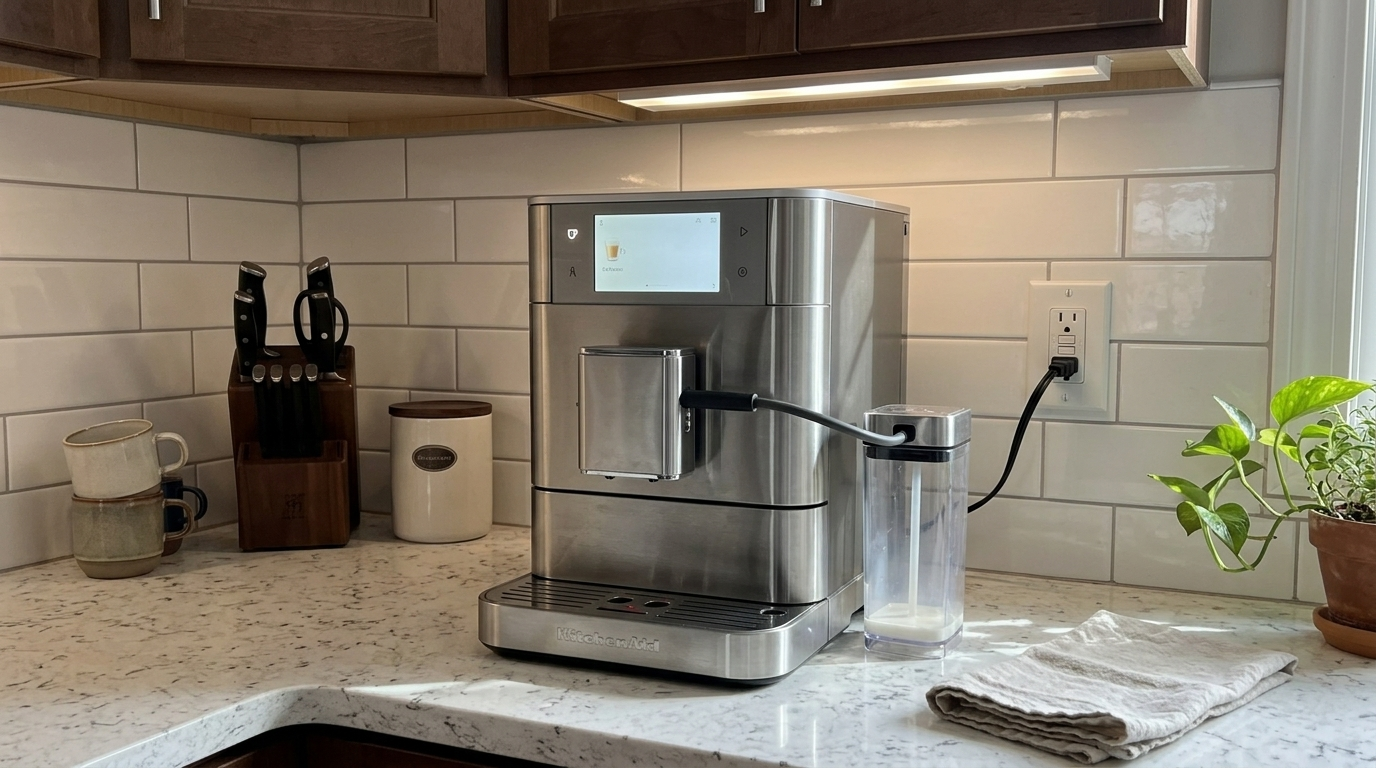
The KF8 shares its metal-clad body with the KF6 and KF7, but adds the biggest tank.
The differences are on the front and the side. The KitchenAid KF6 has a 2.4-inch color screen with buttons, the KF7 a 3.5-inch touchscreen, and the KF8 a color touchscreen with the most drinks.
The KF8’s tank is the one to plan for. It lifts out from the top, so you need overhead clearance, and the milk container clips on the side, which adds to the width.
Depth on the counter
All three use the full depth of a standard 24-inch counter.
The removable bean hopper is a lovely touch on all three. It holds about 270 grams and lifts off, so swapping to decaf in the evening takes seconds.
Our tip: Measure the space above the KF8 before you buy, because its water tank lifts out from the top and needs clear overhead room.
Setup and the first week
Setup took about 15 minutes on each machine, and I didn’t need the manual once on the KF7. You fill the tank, set the water hardness, run a rinse and choose your first drink.
A coffee was ready about 40 seconds after I pressed start on the KF6, and the KF8 heats up in under 40 seconds. That is quick enough that I never felt the need to leave them on.
The first week is where the personalities showed. The KF6 rewarded a high dose straight away; the KF8 needed a day of profile setup; and the KF7 spent most of the week making me adjust settings in search of a better espresso.
| Setup step | KF6 | KF7 | KF8 |
|---|---|---|---|
| Time to set up | About 15 minutes | About 15 minutes | About 15 minutes |
| Milk container | Buy separately | In the box | In the box |
| Profiles to create | Up to 4 | Up to 4 | Up to 6 |
| Time to first coffee | About 40 seconds | Quick | Under 40 seconds |
Our tip: Order the milk container with the KF6 if you drink any milk coffee, because it is not in the box.
How these machines make coffee
Under the skin, the three share the same basic recipe. Water from the tank is heated by a thermocoil✕ThermocoilA heater where water flows through a coiled metal tube wrapped around a heating element. It warms water on demand and is ready quickly., pushed by a 15-bar pump through freshly ground coffee in the brew unit, and the used puck drops into a drawer.
Before full pressure, each shot gets a short pre-infusion✕Pre-infusionA short, low-pressure soak of the ground coffee before full pressure starts, so the water flows through the puck evenly.. KitchenAid calls this setting "body" on the KF7 and KF8, and on the KF6 it is an adjustable pre-infusion.
A longer soak gives a fuller, rounder shot, and a shorter one a brighter, lighter cup. On the KF6, the stronger body setting helped build the thick, mottled crema✕CremaThe golden, foamy layer on top of a fresh espresso. It forms when pressure pushes oils and gases out of the coffee. I saw on almost every shot.
The pump is rated at 15 bar, but the coffee itself sees roughly 9 bar during the shot, which is the classic espresso target. More pressure on a spec sheet does not mean better coffee.
| Brewing setting | KF6 | KF7 | KF8 |
|---|---|---|---|
| Strength | Adjustable per drink | Bean icons | Adjustable per drink |
| Body or pre-infusion | Adjustable | Light, medium, strong | Light, medium, strong |
| Temperature | Low, medium, high | Adjustable | Low, medium, high |
| Milk and coffee order | Milk first for cappuccino | Adjustable on some drinks | Adjustable |
Our tip: Change one setting at a time on a KitchenAid, because strength, body and temperature all affect the cup and it is easy to lose track.
Screens, buttons and profiles
The KitchenAid KF6 uses a 2.4-inch color screen controlled with buttons. It is clear and responsive, but scrolling through 15 recipes with arrows is slower than tapping a picture.
The KF7 and KF8 use touchscreens. The KF7’s 3.5-inch screen was a pleasure to use, and the KF8 fits its 40-plus drinks into tidy menus without feeling cluttered.
Profiles matter more than the screen in a shared house. The KF6 and KF7 keep four, and the KitchenAid KF8 keeps six, each with its own strength, temperature, body and size.
On the KF8, I saved the plant-milk setting into my partner’s profile, so every oat latte she picked used it automatically. That small detail made the KF8 the machine she asked to keep.
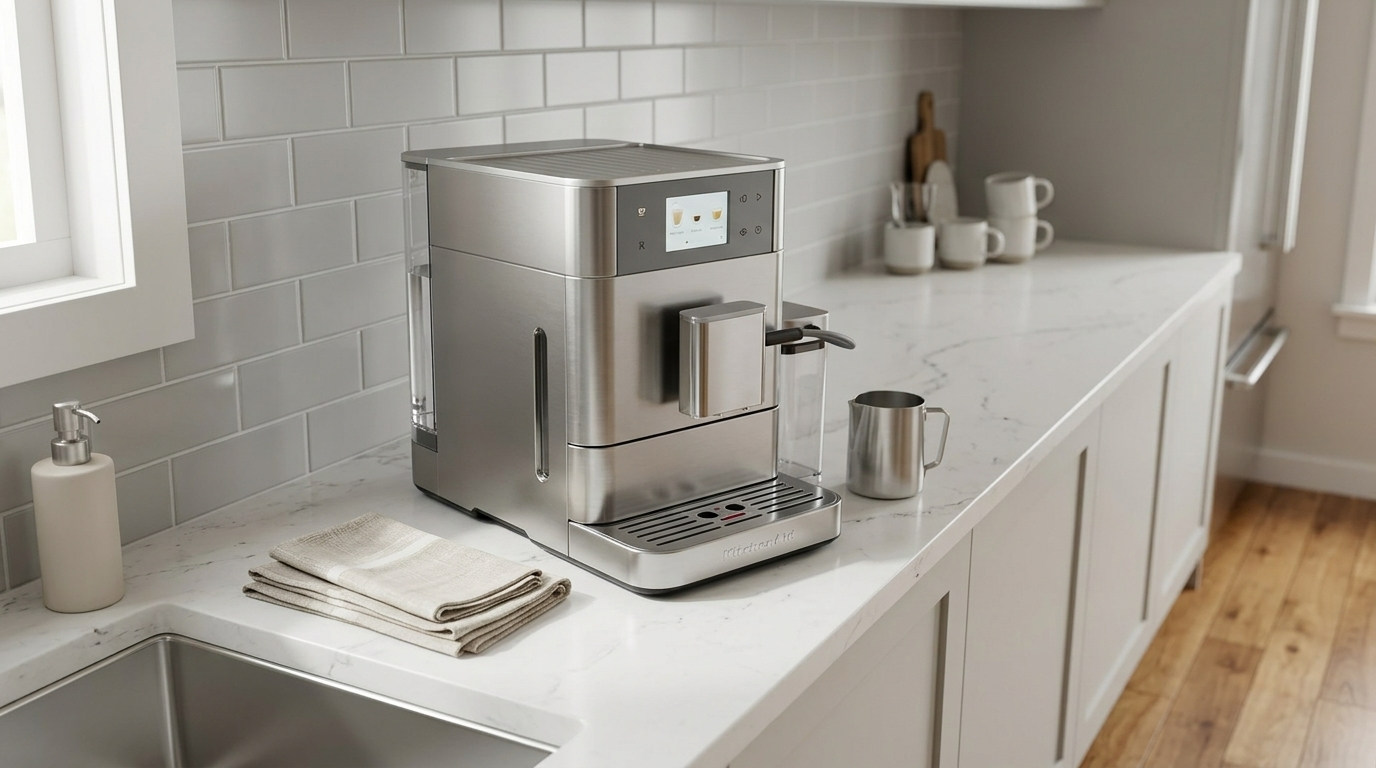
The KF7’s touchscreen was the most pleasant of the three to use.
| Control | KF6 | KF7 | KF8 |
|---|---|---|---|
| Display | 2.4-inch color, buttons | 3.5-inch touchscreen | Color touchscreen |
| Recipes | 15 | 20+ | 40+ |
| Profiles | 4 | 4 | 6 |
| Strength | Adjustable per drink | Shown as bean icons | Adjustable per drink |
| Body | Adjustable pre-infusion | Light, medium, strong | Light, medium, strong |
| Temperature | Low, medium, high | Adjustable | Low, medium, high |
Our tip: Create a profile for every regular coffee drinker in week one, because KitchenAid profiles store strength, body, temperature and size together.
Grinder and dose
All three use steel conical burrs✕Conical burrsTwo cone-shaped grinding parts, one inside the other. Beans are crushed between them, and the gap between the burrs sets how fine the coffee is. with 7 settings, and the KF8’s grinder is insulated for quieter running.
Seven settings is fewer than some rivals, but the range covered every medium and dark roast I tried. Light roasts were the only beans that left me wanting a finer step.
What separates them is how much coffee they use and how well they extract it. On the KF6, the brew unit took about 12 to 14 grams per shot at the higher strength settings, which is generous for a one-touch machine.
The KF6 rewards that high dose. Starting from high strength and working backwards gave me better results than starting weak and turning everything up at once.
| Grinder detail | KF6 | KF7 | KF8 |
|---|---|---|---|
| Burrs | Steel conical | Steel conical | Steel conical, insulated |
| Settings | 7 | 7 | 7 |
| Bean hopper | About 270 g, removable | About 270 g, removable | About 270 g, removable |
| Pre-ground chute | Yes | Yes, one scoop | Yes |
Our tip: Grind one step finer only after you have tried the highest strength, because on KitchenAid machines dose changes the taste more than grind.
Espresso quality
This is where the three machines split most clearly, and where the price ladder doesn’t match the cup.
The KitchenAid KF6 pulled the most concentrated espresso I have measured from a one-touch machine. Shots of about 1.4 fluid ounces read around 5.5% TDS✕TDS (total dissolved solids)The share of the drink that is dissolved coffee. Higher numbers mean a stronger, more concentrated shot., and shorter shots reached 6 to 7%.
The crema was thick, mottled and stable for several minutes, and the body was dense and almost syrupy. It scored 9.0 for espresso, the highest of any KitchenAid.
The KitchenAid KF8 came next at 8.6. Its espresso was smooth and well made, not as concentrated as the KF6’s, but a lovely base for a cortado.
The KF7 was the disappointment. Its straight espresso often lacked richness and turned bitter, and changing strength, body and grind helped less than I hoped, which is why it scored just 6.8.
With the right beans its shots were drinkable, and in milk drinks the weakness mostly disappeared. As a straight espresso machine, though, I would skip it.
My espresso ratings
My scores out of 10 for body, crema, flavor and consistency.
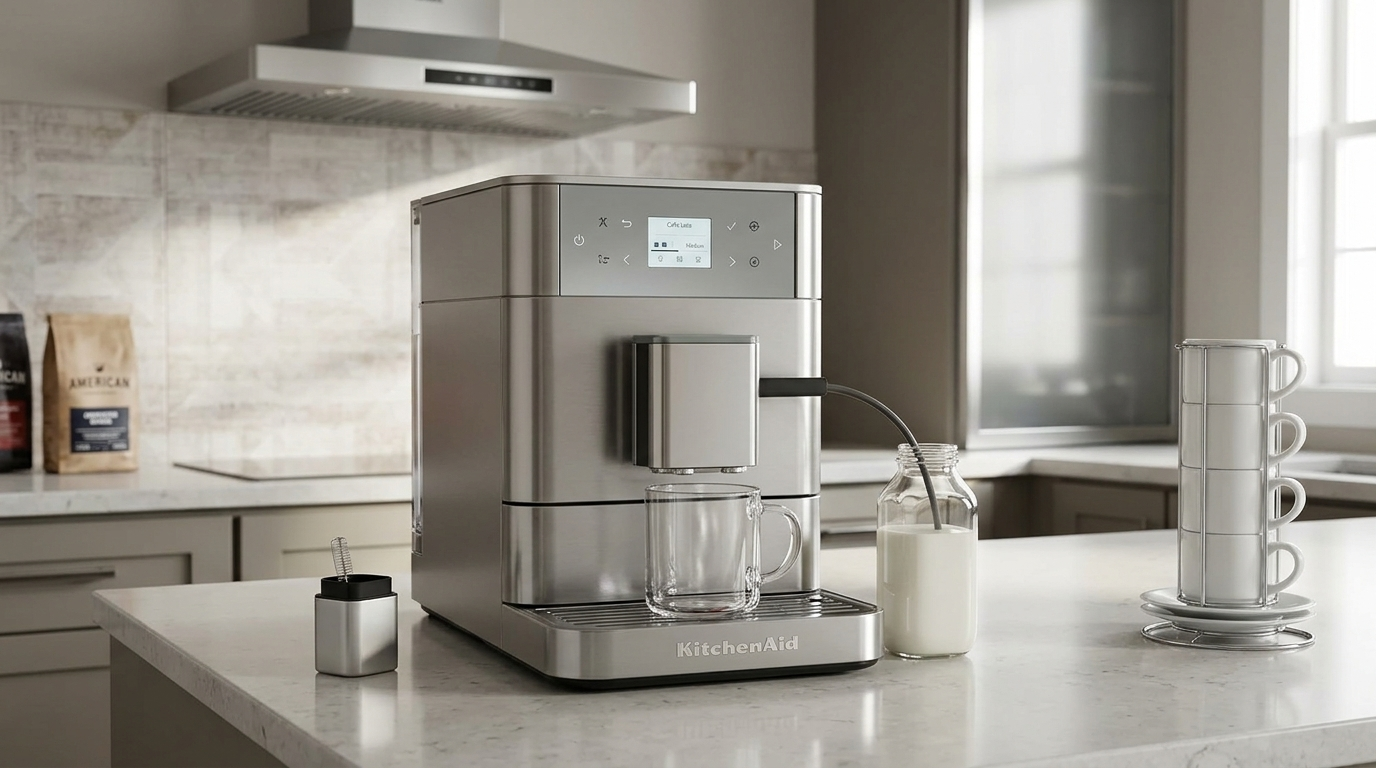
The KF6 pulled the densest, most concentrated espresso of the three.
| What you taste | Likely cause | First fix on a KitchenAid |
|---|---|---|
| Sour, thin, watery | Under-extracted✕Under-extractionWhen water does not pull enough flavor out of the coffee. The shot tastes sour, thin and watery. | Raise strength, then shorten the shot |
| Bitter, harsh | Over-extraction or very dark beans | Lighter body, medium roast |
| Pale crema | Stale beans | Use beans within a few weeks of roasting |
| Lukewarm shot | Cold cup | Rinse the cup with hot water first |
How hot are the drinks?
None of the three makes scalding coffee, and that is mostly a good thing for flavor.
On the KF6, espresso read about 167 to 170°F in the cup. On the KF8, espresso on high measured about 162 to 165°F in a warmed cup, and lattes finished at about 147 to 151°F.
The KF7’s lattes sat comfortably above 149°F, and its espresso on the high setting was as hot as I would want it.
A cold cup made a real difference on all three. A cold ceramic cup cost about 5 degrees on a small shot, so I rinsed every cup with hot water first.
Our tip: Rinse your cup with hot water before every espresso, because a cold cup cost me about 5 degrees on all three machines.
Milk drinks
All three froth milk automatically, but the systems and results differ.
The KitchenAid KF6 uses a hose with automatic frothing and rinsing, but the milk container is sold separately. Its foam was silky rather than thick, and cappuccinos always pour milk before espresso.
The KF7 includes a milk container of about 790 ml with a sealed lid, enough for four or five milk drinks. It can sit in the fridge door all day, and its milk drinks were good, which is why it scored higher for milk than for espresso.
The KitchenAid KF8 has the best milk drinks in KitchenAid’s range, scoring 8.9. It also lets you set the order of milk and coffee, which means proper layered latte macchiatos.
Its plant-milk mode is the real highlight. Oat milk often turns thin or bubbly on automatic machines, but with the plant setting on, my oat lattes were creamy and stable.
The KF8 also makes two milk drinks at once. There is a catch: when I set about 4 ounces of milk and chose two cups, each cup got roughly half.
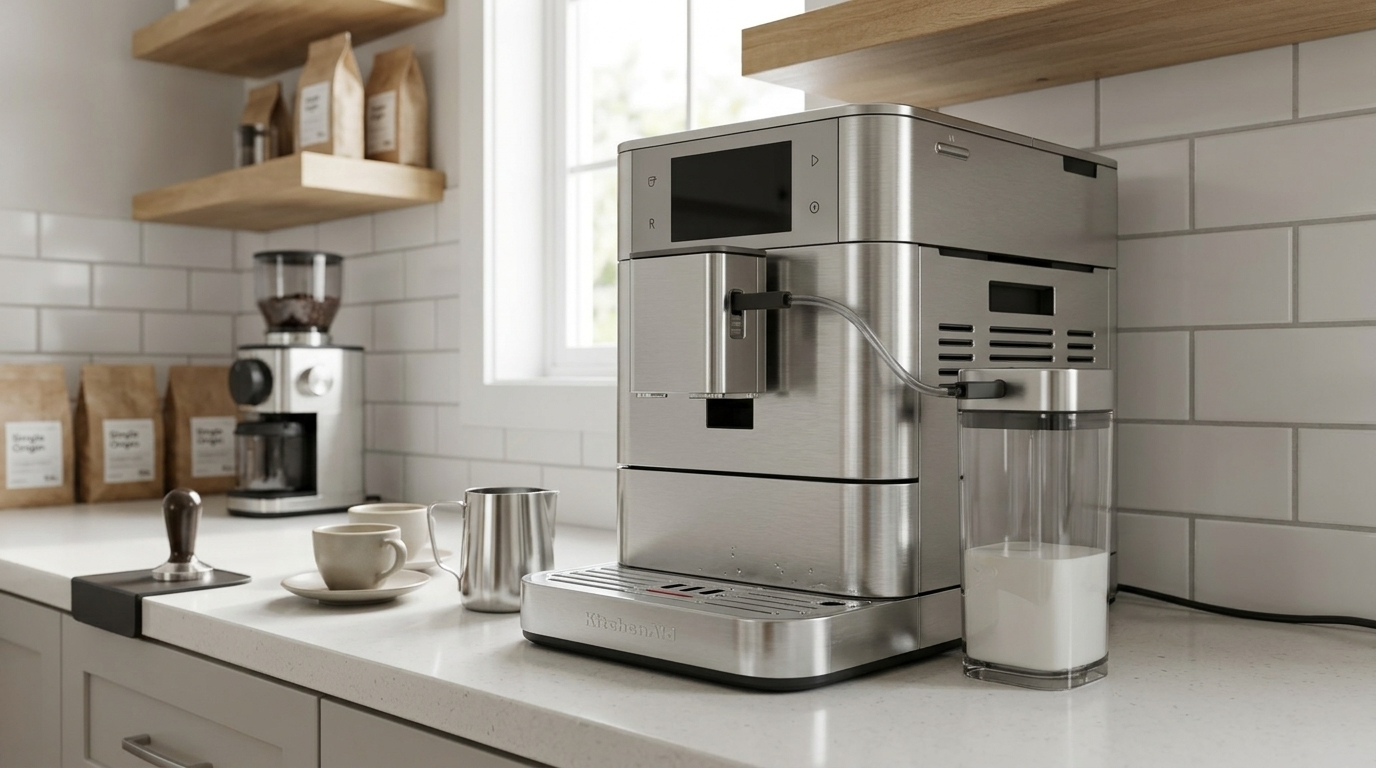
The KF8 makes two milk drinks at once, but the milk volume is split between the cups.
Milk-drink ratings
My scores out of 10 for texture, temperature and ease.
| Milk feature | KF6 | KF7 | KF8 |
|---|---|---|---|
| Milk container | Sold separately | About 790 ml, included | Included, clips on the side |
| Fridge-friendly | With the container | Yes, sealed lid | Yes |
| Milk and coffee order | Milk first for cappuccino | Adjustable on supported drinks | Adjustable |
| Plant-milk setting | No | No | Yes |
| Two cups at once | No | Yes | Yes, splits volume |
| Foam style | Silky, not thick | Good, creamy | Best in range |
Our tip: Use cold milk straight from the fridge on every KitchenAid, because warm milk gives big, loose bubbles that collapse quickly.
Americanos and long coffee
All three make a long coffee and an americano at one touch. On the KF8, my favorite was maximum strength, medium temperature, medium body, 2 ounces of coffee and 4.8 ounces of hot water.
That recipe gave a full, round mug with crema on top, and it became my default morning coffee on the KF8.
On the KitchenAid KF6, the americano benefited from the strong espresso base. Even with plenty of water, it never tasted thin.
The KF7’s americano was its weakest black drink, because it carried the same thin, slightly bitter edge as its espresso.
Our tip: Keep the coffee part of your americano short and add more water, because a short, strong shot plus water tastes rounder than a long shot.
Cleaning and upkeep
All three are easy to keep clean, with a removable brew unit✕Brew unitThe part that compresses the ground coffee, holds it while water passes through and then ejects the used puck. A removable one can be rinsed under the tap. you can rinse under the tap.
The KF7 scored highest for cleaning at 8.6. Its drip tray is dishwasher-safe and its sealed milk container goes straight in the fridge, though the tray is bulky to carry when full.
The KF6 scored 8.4. Its milk hose rinses automatically, and the full descale took about 45 minutes, most of it hands-off.
The KF8 scored 8.2, the lowest of the three, because its milk system needs a few minutes of attention every day. In return, you get the best milk drinks.
Cleaning scores
My scores out of 10 from my single reviews.
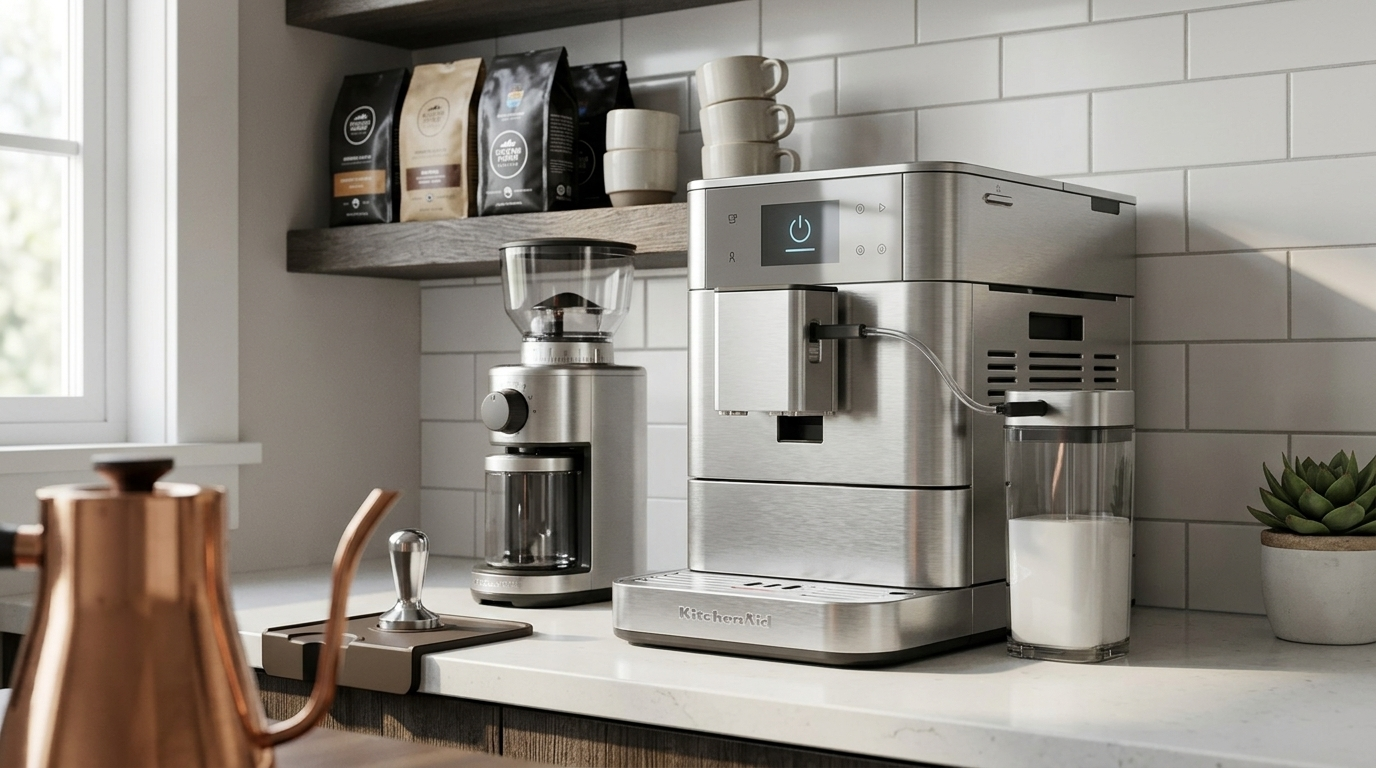
The KF7’s sealed milk container and dishwasher-safe tray make it the easiest to clean.
| When | KF6 | KF7 | KF8 |
|---|---|---|---|
| After milk | Automatic hose rinse | Rinse the container parts | Rinse the milk system |
| Daily | Empty tray and grounds | Empty tray and grounds | Empty tray, rinse milk parts |
| Weekly | Rinse the brew unit | Rinse the brew unit | Rinse the brew unit |
| When prompted | Descale, about 45 min | Descale | Descale |
Our tip: Rinse the brew unit every week on any KitchenAid and let it air-dry overnight before sliding it back in.
Noise
These are some of the quietest automatic machines I have tested. The KitchenAid KF6 peaked just over 60 dB while grinding and sat around 55 to 56 dB while brewing.
Many automatic machines I have measured hit 68 to 71 dB, so the KF6 is gentle enough for a small apartment at 6 a.m. The KF8’s insulated grinder was one of the quietest I have tested too.
Grinding noise
KF6 measured with a sound meter in my kitchen. The KF8 was similarly quiet.
The KF7 was quiet as well. In a busy kitchen you would barely notice any of them, and in an open-plan home they are among the most considerate machines you can buy.
Our tip: Grind with the hopper lid on, because the lid helps muffle the grinder on every machine here.
Water, beans and supplies
The KF6 and KF7 hold about 74 ounces of water, and the KF8 about 84.5 ounces. All three hold about 270 grams of beans in a removable hopper.
The KF8’s bigger tank meant fewer refills for my family of four, but remember that it lifts out from the top, so plan for the clearance.
Water tank size
From manufacturer specifications.
Use fresh whole beans within a few weeks of the roast date. Medium and medium-dark roasts suited all three, and the KF7 was happiest with a medium roast rather than a very dark one.
Use filtered water if yours is hard. It cuts scale, keeps the thermocoil clean and means fewer descaling cycles.
Our tip: Keep a bag of decaf next to the machine and use the removable hopper, because swapping beans takes seconds on all three.
Four weeks with each: what changed
Living with a machine for a month shows things a spec sheet can’t. Here is how my time with each one went.
With the KitchenAid KF6, week one was about finding the high-dose sweet spot. By week two, my espresso was dense and consistent, and the only friction was waiting for the separately bought milk container to arrive.
The KF7’s first week was a honeymoon. The touchscreen, the fridge-friendly milk container and the easy cleaning made it the nicest machine to use, but by week three I had stopped making straight espresso on it and only made lattes.
The KitchenAid KF8 took a day to set up profiles, then simply worked. By the end of the month, it was the machine my whole family reached for, mainly because of the plant-milk mode and two-cup drinks.
| Mistake I made | What happened | How to avoid it |
|---|---|---|
| Starting the KF6 on a weak setting | Thin, hard-to-diagnose shots | Start at high strength and work back |
| Making two KF8 lattes with one-cup milk | Two short, thin lattes | Save a two-cup recipe with double milk |
| Using a very dark roast on the KF7 | Bitter espresso | Use a medium roast and lighter body |
| Skipping the cup rinse | Lukewarm espresso | Rinse the cup with hot water first |
| Forgetting the KF8 clearance | Tank hard to lift out | Leave room above the machine |
None of these were serious, and all three machines rewarded small changes. The KF6 and KF8 got better the more I used them; the KF7 stayed the same, which for a latte drinker is no bad thing.
Our tip: Note your favorite settings on a sticky label inside a cupboard door, so you can restore them quickly after a descale or reset.
Real-life scenarios
Specs only go so far. These are the situations where one machine clearly pulled ahead during my testing.
The densest, most concentrated shot of the three, with crema that lasted for minutes.
Plant-milk mode saved in a profile made every oat latte creamy and stable.
Two-cup milk drinks, once I doubled the milk in a saved recipe.
The sealed 790 ml container lives in the fridge door and clips on in seconds.
About 61 dB while grinding and 55 dB brewing; nobody woke up.
Six profiles meant everyone had their own drink.
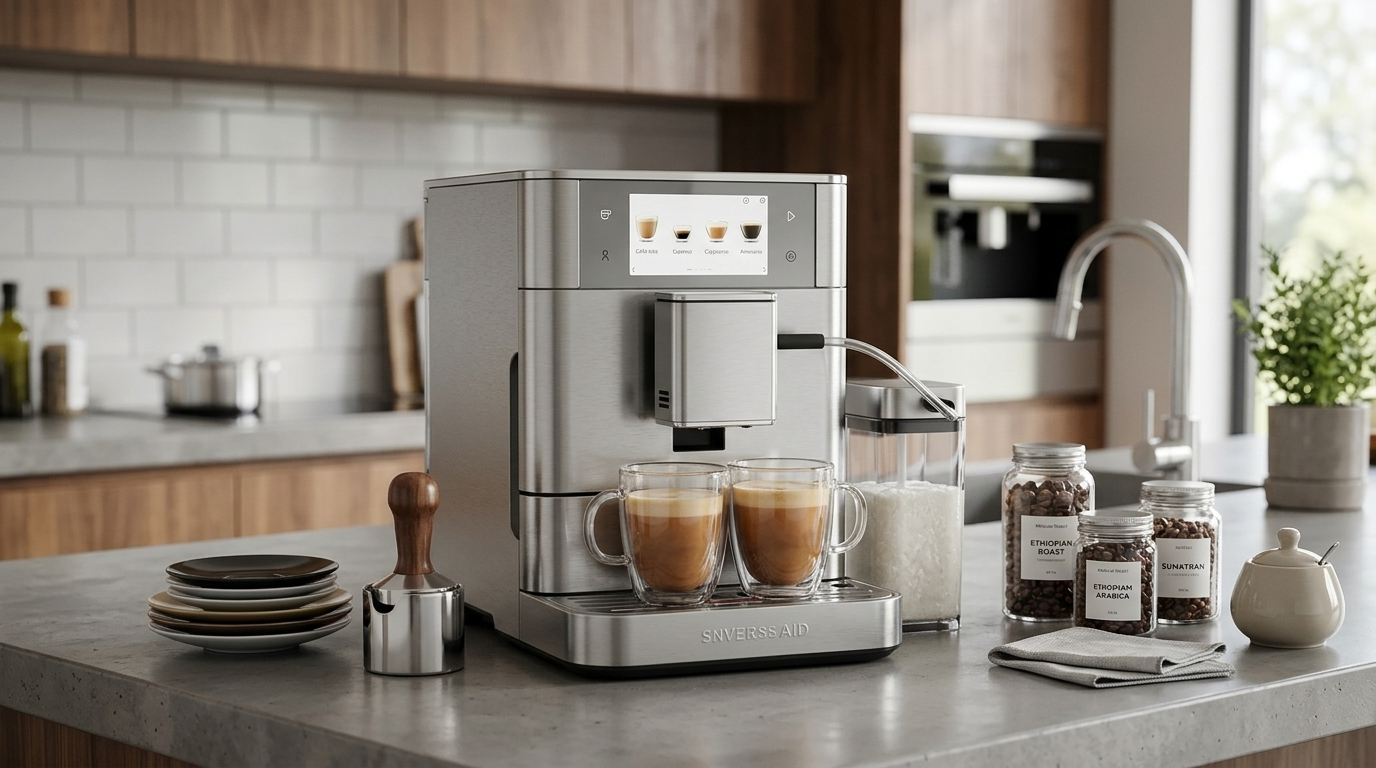
For a shared kitchen, the KF8 was the machine everyone used.
My scorecard
These are my own scores out of 10, taken from my single reviews of each machine.
KitchenAid KF8
KitchenAid KF6
KitchenAid KF7
Overall, I rate the KF8 8.7, the KF6 8.5 and the KF7 7.6. The KF6 and KF8 are both excellent; the KF7 is a lovely machine let down by its espresso.
See Today’s PriceWhich one is right for you?
4 quick questionsWhich one should you buy?
It comes down to one question: is espresso your main drink, or do you want the best milk drinks for several people? If none of these is quite right for you, my guide to the best super-automatic espresso machines covers the rest of the range I’ve tested.
For a closer look, read my KitchenAid KF6 vs KF8 comparison, or see the full single reviews of the KF6, KF7 and KF8.
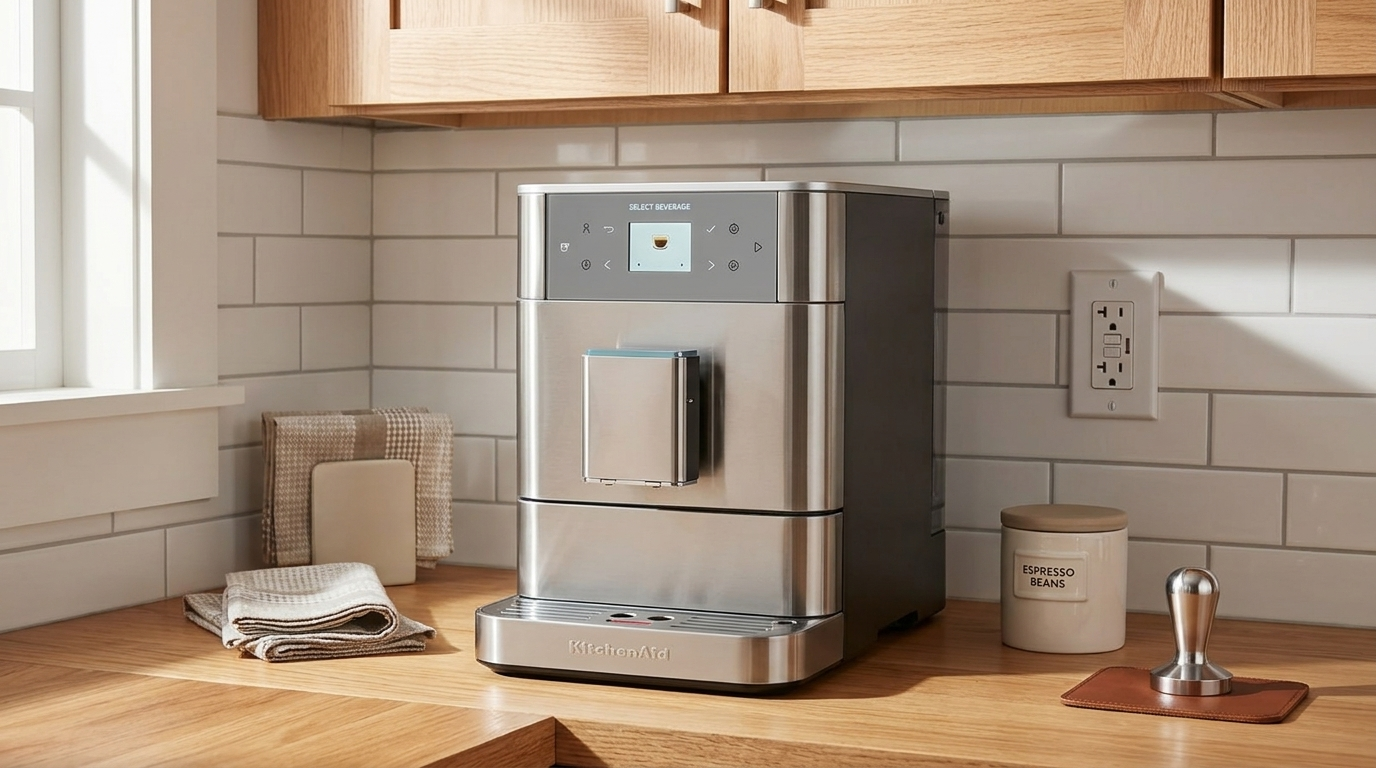
For espresso lovers, the KF6 is the KitchenAid to own.
- Several people share the machine
- You drink oat or plant milk
- You want the best milk drinks
- You want the most drinks
- You need a compact setup
- Your cabinets are low above the counter
- You want the strongest espresso
- Straight espresso is your main drink
- You want a very quiet machine
- You prefer buttons
- You want milk drinks without buying extras
- You want a touchscreen
- You want 40-plus drinks
- You mostly drink lattes
- You want the easiest cleaning
- You love the design and touchscreen
- You drink straight espresso
- You like to tweak settings for flavor
- You want plant-milk mode
For most homes, my pick is the KitchenAid KF8. It has the best milk drinks in KitchenAid’s range, a plant-milk mode that genuinely works, six profiles and 40-plus drinks, all from one of the quietest machines I have tested.
If espresso is your main drink, the KF6 is the better buy. It pulled the most concentrated shot of any one-touch machine I have measured, in the same solid, quiet body. The KF7 is beautiful and easy to clean, but its espresso holds it back.
Whichever you choose, start with high strength, use cold milk and rinse your cup with hot water first. All three reward a little care.
KitchenAid KF6 vs KF7 vs KF8 specifications
From manufacturer specifications and my own testing.
| KitchenAid KF6 | KitchenAid KF7 | KitchenAid KF8 | |
|---|---|---|---|
| Model | KES8556 | KES8557 | KES8558 |
| Recipes | 15 | 20+ | 40+ |
| Pump pressure | 15 bar | 15 bar | 15 bar |
| Power | 1,450 W | 1,450 W | 1,450 W |
| Grinder | Steel conical, 7 settings | Steel conical, 7 settings | Steel conical, 7 settings, insulated |
| Bean hopper | About 270 g, removable | About 270 g, removable | About 270 g, removable |
| Water tank | 74 oz | 74 oz | 84.5 oz |
| Milk container | Sold separately | About 790 ml, included | Included |
| Plant-milk setting | No | No | Yes |
| Display | 2.4-inch color, buttons | 3.5-inch touchscreen | Color touchscreen |
| Profiles | 4 | 4 | 6 |
| Dimensions (H × W × D) | 14.3 × 10.2 × 18.6 in | 14.3 × 10.2 × 18.6 in | 14.3 × 10.2 × 18.6 in |
| Weight | About 28 lb | About 28 lb | About 29 lb |
| Warranty | 2 years limited | 2 years limited | 2 years limited |
How I tested and compared them
I used each machine as my everyday coffee maker for four weeks, making espresso, americanos, cappuccinos, lattes, flat whites and cortados with whole and oat milk.
I weighed doses, measured TDS on the KF6, measured espresso and milk temperatures with a probe, and measured grinding and brewing noise with a sound meter.
I ran every cleaning and descaling routine, then wrote up my notes and measurements together and compared them with KitchenAid’s specifications and owner documentation.
- Coffee: dose, strength, crema and temperature
- Milk: texture, plant milk and two-cup drinks
- Workflow: controls, profiles and recipes
- Ownership: noise, cleaning, capacity and footprint
KitchenAid KF6 vs KF7 vs KF8 FAQ
Which KitchenAid espresso machine is best: KF6, KF7 or KF8?
For most people, the KF8. It has the best milk drinks in the range, a plant-milk mode, 40-plus drinks, six profiles and a very quiet grinder. If straight espresso is your priority, the KF6 pulls the most concentrated shot.
What is the difference between the KitchenAid KF6, KF7 and KF8?
They share a metal-clad body and a 7-setting steel grinder. The KF6 has 15 drinks, four profiles and a button screen, with the milk container sold separately. The KF7 adds a 3.5-inch touchscreen and an included milk container. The KF8 adds 40-plus drinks, six profiles, a plant-milk setting and two-cup milk drinks.
Which KitchenAid makes the best espresso?
The KF6, which scored 9.0 in my testing. Its shots read about 5.5% TDS at 1.4 fluid ounces and 6 to 7% for shorter shots, with thick, stable crema.
Is the KitchenAid KF7 good for espresso?
Not especially. Its straight espresso often tasted thin and bitter in my testing, and changing the settings helped less than I hoped. Its milk drinks were good, so it suits latte drinkers more than espresso drinkers.
Does the KF6 come with a milk container?
No. The KF6 uses a milk hose with automatic frothing, but the milk container is sold separately. The KF7 and KF8 include one.
Is the KF8 worth it over the KF6?
If several people share the machine or you drink milk drinks daily, yes. The KF8 adds 40-plus drinks, six profiles, plant-milk mode and two-cup milk drinks. If espresso is your main drink, the KF6 makes the stronger shot.
Which KitchenAid is quietest?
The KF6 and KF8 are both very quiet. The KF6 peaked at about 61 dB while grinding and 55 to 56 dB while brewing, and the KF8’s insulated grinder was one of the quietest I have tested.
Can the KitchenAid KF8 froth oat milk?
Yes, and it does it well. Its plant-milk setting made creamy, stable oat lattes. Save the setting into a profile so it applies automatically.
Are the KF6, KF7 and KF8 the same size?
Yes. All three measure about 14.3 × 10.2 × 18.6 inches and weigh about 28 to 29 pounds. The KF8 needs extra room above for its top-lifting tank and beside it for the milk container.
How long does descaling take on a KitchenAid?
On the KF6, the full cycle took about 45 minutes, most of it hands-off. The KF7 and KF8 follow a similar guided routine.

- Our hands-on KitchenAid KF6 review
- Our hands-on KitchenAid KF7 review
- Our hands-on KitchenAid KF8 review
- KitchenAid product specifications and owner documentation
- How to Brew Coffee, National Coffee Association