KitchenAid KF6 review: concentrated espresso, a metal-clad body and a swappable bean hopper that runs whisper-quiet
The KitchenAid Fully Automatic Espresso Machine KF6 KES8556 puts its effort into the coffee rather than the menu. It pulls some of the most concentrated espresso I have measured from a one-touch machine, wraps it in a heavy metal-clad body and grinds more quietly than almost anything I have tested. The milk container is sold separately, though, and the screen is not a touchscreen.
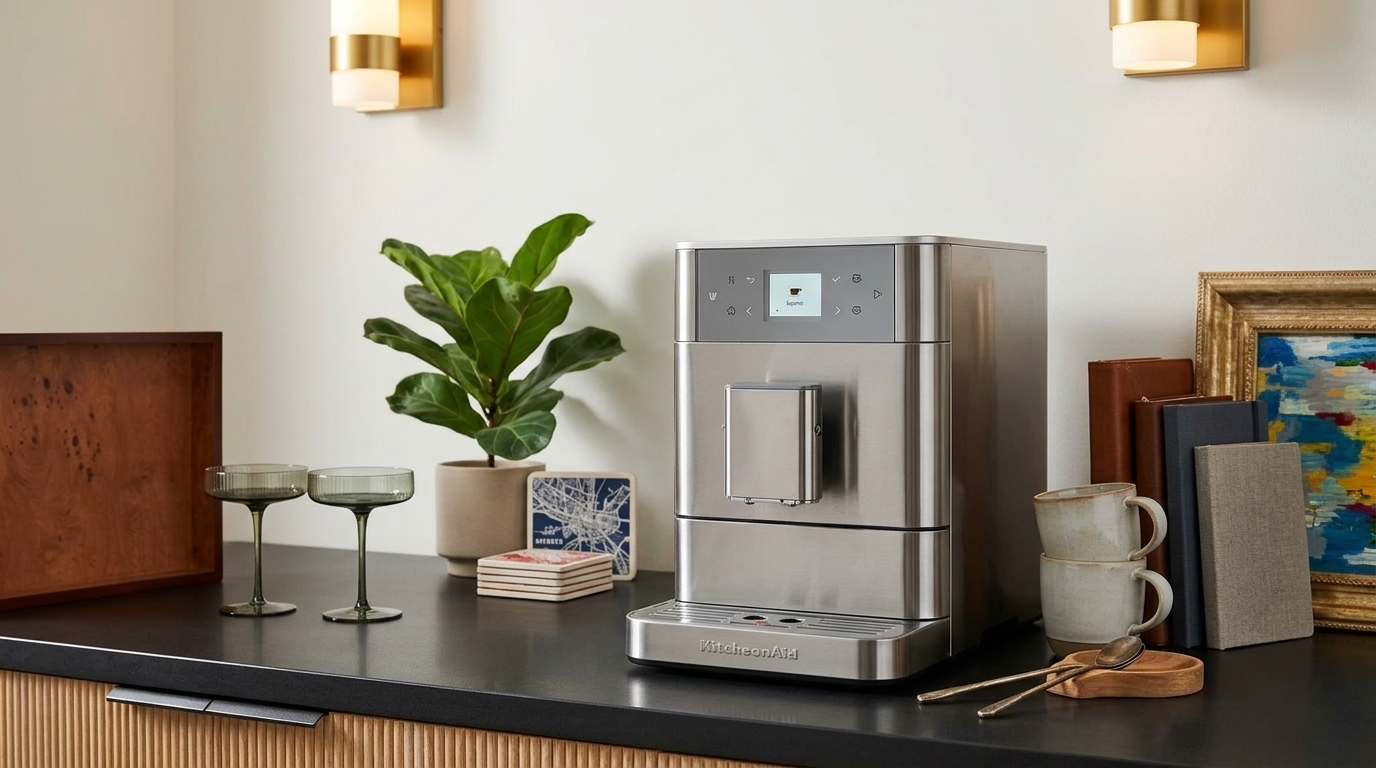

Michael Reynolds
Hands-on review
Hands-on testing, research, specs
4 weeks
22 minutes
Jargon helpNew to espresso? Tap any dotted term to see what it means.
In this review
Yes, if espresso is your main drink and you want a solid, quiet machine that several people can share. The KitchenAid KF6 doses generously, lets you tune strength, temperature and body, and keeps four profiles. Its removable hopper makes swapping beans easy. The compromises are a milk container you buy separately, cappuccinos that always pour milk first, foam that is silky rather than thick, a button-driven screen and shots that come out warm rather than piping hot.
KitchenAid KF6 at a glance
KitchenAid KF6 pros and cons
- Concentrated, well-extracted espresso with thick crema
- Very quiet grinding and brewing
- Solid metal-clad body with a swappable bean hopper
- Milk container is sold separately
- Cappuccinos always pour milk before espresso
- Color screen uses buttons, not touch
Who should buy the KitchenAid KF6?
- People who mostly drink espresso and Americanos
- Households with up to four coffee drinkers
- Anyone who switches between regular and decaf beans
- Fans of thick, dense cappuccino foam
- People who want a touchscreen and a long menu
- Anyone who likes their espresso very hot
First impressions of the KitchenAid KF6
The KF6 doesn't try to impress you with a long menu.
It tries to impress you with the coffee.
That became clear within the first hour.
Lifting it out of the box, I noticed the weight first.
The KitchenAid KF6 is clad in metal, and at roughly 28 pounds it feels like a proper appliance rather than a plastic shell.
It doesn't slide around when you press a button, and the drip tray clicks in with a reassuring thud.
My first espresso was the second surprise.
It came out short, dark and syrupy, with a thick, tiger-striped crema.
It tasted more like a shot from a manual machine than most one-touch espressos I've had.
The third surprise was what I didn't hear.
The grinder is so quiet that I checked twice whether it had actually started.
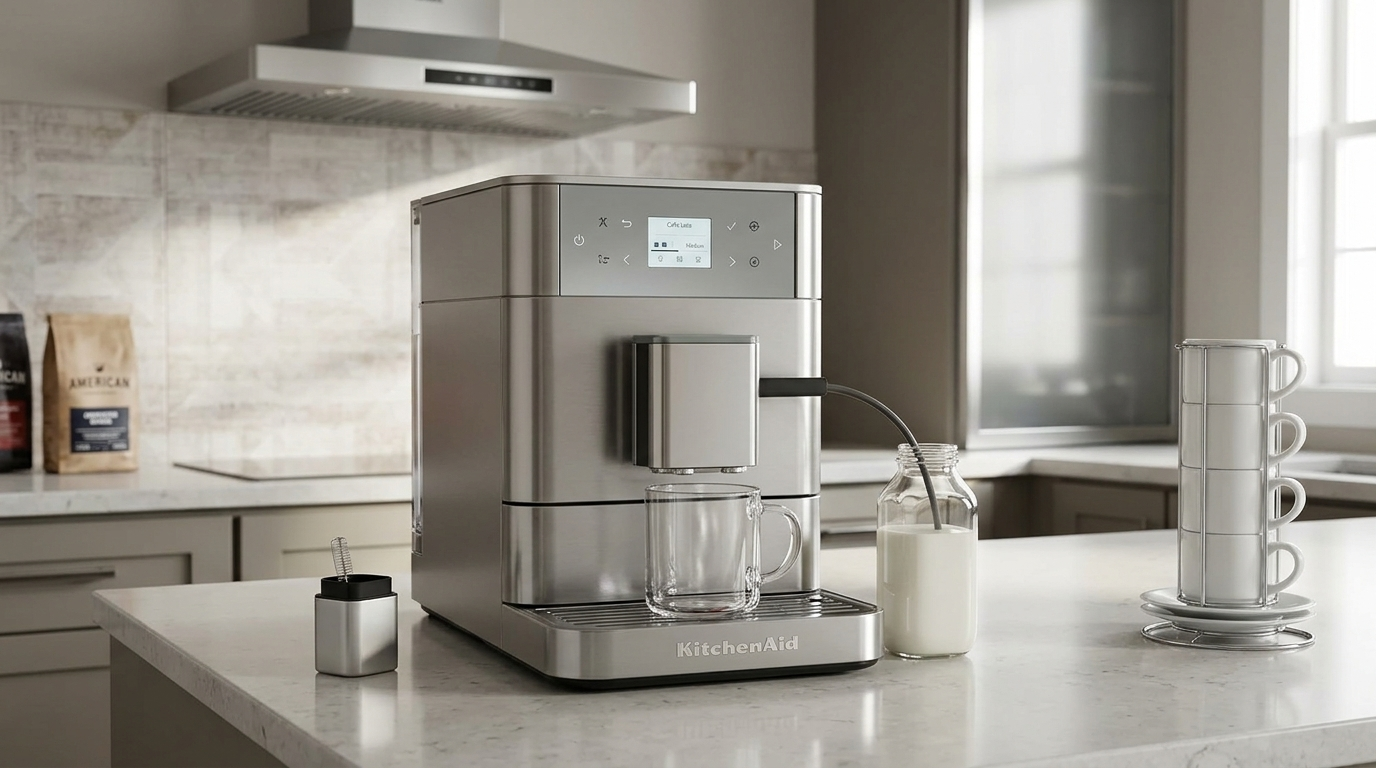
The KF6's metal body looks at home in a modern kitchen.
What the KitchenAid KF6 actually is
The KF6 is a fully automatic, bean-to-cup espresso machine with an automatic milk system.
It grinds the beans, doses and presses the coffee, brews it and drops the used puck into a bin.
For milk drinks, it draws milk through a hose, heats it and froths it.
It's built around a few things: a generous dose, fine grinding and three ways to tune the extraction.
There's no cold brew, no iced menu and no touchscreen.
Inside is a thermocoil heater and a 15-bar pump.
A coffee is ready in about 40 seconds from a press of the button.
The menu
There are 15 recipes on the screen.
They cover espresso, coffee, Americano, cappuccino, latte, latte macchiato and macchiato, plus doubles and hot water.
There's also a hot water portion for green tea, which runs a little cooler.
| Drink | How it's made | Milk used |
|---|---|---|
| Espresso and double espresso | Short brew, one or two full cycles | None |
| Coffee | Longer brew in one pour | None |
| Americano | Espresso, then hot water | None |
| Cappuccino | Milk and foam first, then espresso | Foam |
| Latte | More hot milk, thin foam, then espresso | Milk and foam |
| Latte macchiato | Layered milk, foam and espresso | Milk and foam |
| Macchiato | Espresso with a spoon of foam | Small amount |
| Hot water | Regular or cooler for green tea | None |
KitchenAid KF6 design and setup
The KF6 measures about 14.3 × 10.2 × 18.6 inches, or 36.3 × 26 × 47.3 cm.
It fits under standard cabinets, and its flat top leaves room for cups.
My unit was brushed stainless steel.
It also comes in Porcelain White and black.
The look is minimal, with a small color screen and a few buttons on a clean front.
Small details that help
Small wheels at the back let you roll it forward to wipe the counter.
That matters on a machine this heavy.
The 2.2-liter tank slides out sideways, so you don't need to move the machine or lift anything under a low cabinet.
For a tank this size, that's a real everyday win.
Our tip: Keep a hand's width clear on the tank side, so you can slide the tank out without moving the machine.
The cup warmer
The flat top doubles as a cup warmer, but it's passive.
After about 20 minutes, my infrared thermometer read 97 to 99°F, or around 37°C.
That keeps cups from being cold, but it won't make them hot.
I treated it as cup storage and rinsed cups with hot water before espresso.
First-time setup
Setup took about 15 minutes.
The screen walked me through language, water hardness and the filter, then ran a rinse.
The first three shots were thin while the grinder settled, so don't judge it before the fourth.
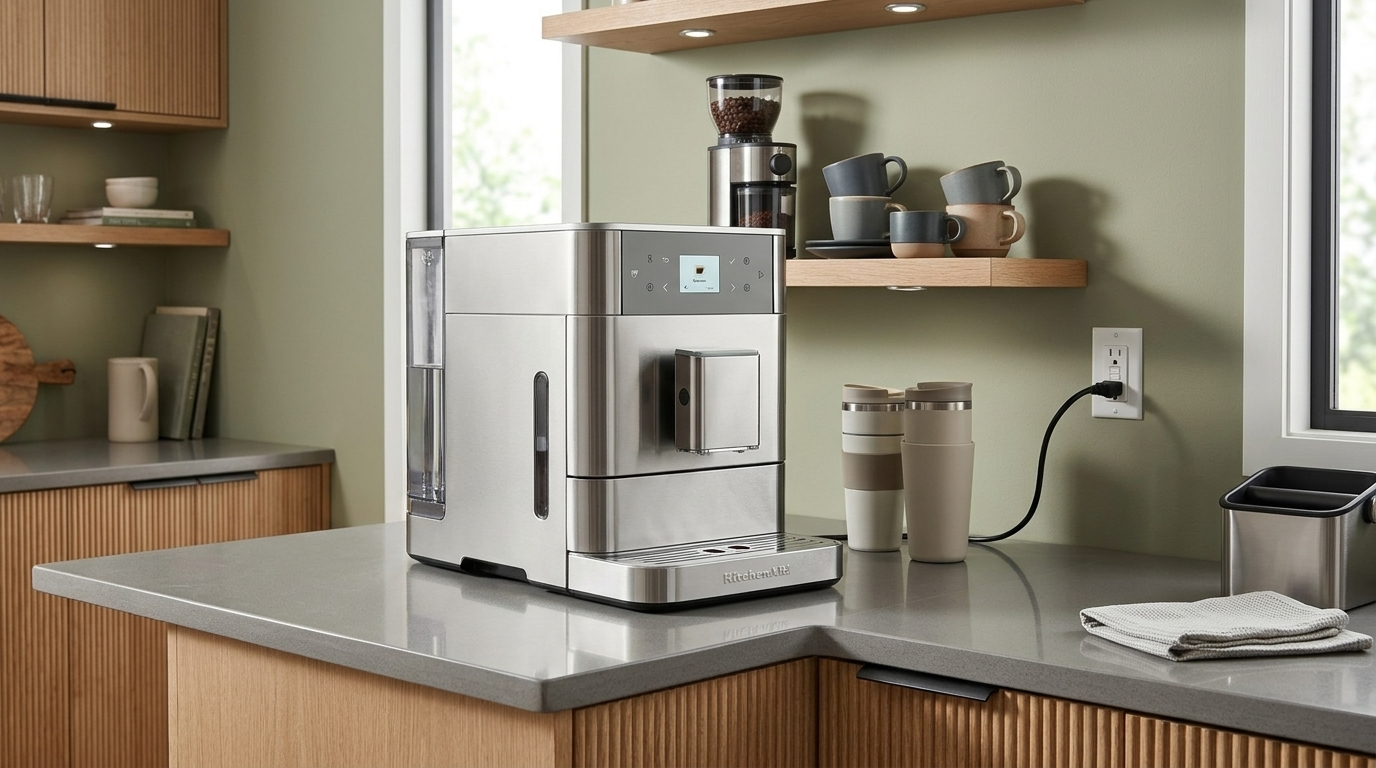
The flat top is handy for storing cups, but it only warms them gently.
The removable bean hopper
The KF6's hopper twists and lifts off the top.
That sounds minor until you live with it.
I kept my everyday medium-dark blend in the main hopper and bought a second hopper for a decaf.
In the evening, I lifted one off, twisted the other on and ran a short purge to clear the old grounds from the grinder.
The whole swap took under a minute, and nothing spilled.
| Hopper A | Hopper B | Who it suits |
|---|---|---|
| Regular blend | Decaf | Late-evening coffee drinkers |
| Medium roast | Dark roast | Espresso in the morning, milk drinks later |
| Everyday blend | Special single origin | Weekend treats without wasting beans |
| Your beans | Your partner's beans | Households with very different tastes |
Only one hopper comes in the box, so the second one is an extra purchase.
If you plan to switch several times a day, that's worth knowing before you buy.
Our tip: Always run the grinder purge after a hopper swap, so the first decaf doesn't contain grounds from the regular beans.
The grinder and dose
The KF6 grinds with steel conical burrs✕Conical burrsA cone-shaped cutting part that turns inside a ring. They grind evenly at fairly low speed, which keeps heat and noise down..
There are seven grind settings, set by a selector behind the right-hand side panel.
It isn't as quick as an outside dial, but you won't need it often once you've found your setting.
Why the dose matters
The brew unit✕Brew unitThe chamber inside an automatic machine that receives the ground coffee, presses it into a puck, pushes hot water through it and then ejects the used grounds. took about 12 to 14 grams per shot at the higher strength settings in my testing.
Combined with a fine grind, that builds a firm puck that resists the water properly.
That resistance is what makes the shots taste concentrated rather than watery.
Bars show how much resistance the coffee puts up and how long the water stays in contact with it, using a medium-dark blend.
Seven steps isn't many.
On a couple of light roasts, I wanted something between two settings.
For most beans, though, one of the seven landed close.
Our tip: Only change the grind while the grinder is running, and judge the result two or three drinks later.
KitchenAid KF6 espresso performance
Espresso is where the KitchenAid KF6 really earns its score.
I measured concentration with a refractometer.
Shots of about 1.4 fluid ounces read around 5.5% TDS✕TDS (total dissolved solids)The share of a drink that is dissolved coffee. Espresso usually sits around 8 to 12%. Most automatic machines land lower, because they use less coffee and more water., and shorter shots reached 6 to 7%.
That's high for a one-touch machine.
Refractometer readings with a medium-dark blend at a high strength setting. Shorter shots concentrate the same dose into less water.
How it tasted
The crema✕CremaThe golden-brown foam on top of an espresso. It forms when pressure pushes gases and oils out of freshly ground coffee. was thick, mottled and stable for several minutes.
The body was dense and almost syrupy.
I tasted dark chocolate, roasted hazelnut and a little brown sugar, with a clean finish.
It never tasted like coffee that had simply been made strong with more water.
Temperature
The KF6 doesn't pour the hottest shots I've measured.
In the cup, my espresso read about 75 to 76°C, or 167 to 170°F.
The first shot after a long break was a degree or two cooler.
It was pleasant to drink straight away, but if you like your espresso scalding, set temperature to high and warm your cup.
Probe readings straight after brewing. A cold ceramic cup costs about 5 degrees.
| What you taste or see | Likely cause | First change |
|---|---|---|
| Sour, thin, watery | Under-extraction | Raise strength, shorten the volume or grind finer |
| Bitter, harsh, drying | Over-extraction or a very dark roast | Grind one step coarser or try a lighter body |
| Pale crema that fades fast | Stale or pre-ground coffee | Use fresh whole beans |
| Lukewarm shot | Cold cup or low temperature | Warm the cup and set temperature to high |
| Drips slowly | Grind far too fine | Go one step coarser while grinding |
Long coffee, Americanos and doubles
The KF6 is often sold as an espresso machine, but I drank plenty of long coffee too.
The coffee button makes a longer cup in one pour.
At a normal mug size, it was smooth, with a thin crema and a pleasant bitterness.
When I pushed the volume very high, the end of the pour tasted flat.
Americanos
The Americano is the better long drink here.
It brews a concentrated espresso, then adds hot water separately.
Because the base shot is so strong, the Americano still tasted full and chocolatey rather than thin.
It became my default mid-morning drink.
Doubles
The double espresso runs two full grind-and-brew cycles.
The machine doesn't stretch one puck with extra water, so the second half of the cup tastes as good as the first.
With concentrated singles, a double is genuinely strong.
I used it for flat whites when I wanted the coffee to cut through the milk.
| Drink | My settings | Result |
|---|---|---|
| Espresso | High strength, high temp, short volume | Excellent, syrupy |
| Double espresso | Two cycles, high strength | Excellent, very strong |
| Americano | High strength, medium-size mug | Very good, full-bodied |
| Long coffee | Medium strength, normal mug | Good, smooth |
| Very long coffee | One big pour | Fair, flat finish |
Strength, temperature and body
The KF6 gives you three controls for each drink.
Strength changes how much coffee is ground.
Temperature has low, medium and high.
Body changes the pre-infusion✕Pre-infusionA short, gentle soak of the coffee before full pressure. It lets the puck swell evenly so water doesn't rush through weak spots., the gentle soak before full pressure.
| Control | What it changes | What I noticed |
|---|---|---|
| Strength | The coffee dose | The biggest difference in intensity |
| Temperature | Water temperature | High brought out more chocolate in dark roasts |
| Body | Pre-infusion | A longer soak made shots rounder and more even |
| Volume | Water in the cup | Shorter made shots thicker and sweeter |
| Grind | Particle size, behind the side panel | Fine-tunes resistance for each bean |
The body setting surprised me.
A longer soak made the shot rounder and smoother, especially with light roasts that tasted sharp otherwise.
With dark roasts, I preferred a shorter soak.
My best settings
For a medium-dark blend, my favorite was high strength, high temperature, a fuller body, grind setting two and a slightly shorter volume.
For a light roast, I went one grind setting finer and added more body.
Our tip: Change one setting at a time and make two shots before judging, so you know which change helped.
Milk foam and milk drinks
The KF6's milk system is a flexible hose that goes into your own milk container.
KitchenAid doesn't include one.
I used a tall glass, and later a clean glass bottle that went straight back into the fridge.
How the milk turned out
The milk was smooth, silky and hot enough.
Lattes and flat whites were excellent, with fine microfoam✕MicrofoamMilk foam with bubbles so small you can't see them. It feels silky and blends into the coffee instead of sitting on top like froth. that blended into the espresso.
Cappuccino foam was lighter and less dense than I like.
If you want a stiff, spoonable cap of foam, this isn't the machine for it.
My ratings on a 10-point scale for texture, stability and temperature.
Milk always goes first
For a cappuccino, the KF6 pours the milk first and the espresso second.
You can't change that order.
It means the espresso drops through the foam, and the cap ends up lightly marbled rather than a clean white dome.
For lattes, I didn't mind at all.
For cappuccinos, I noticed it.
Our tip: Keep milk in the fridge and pour out only what you need, because a glass on the counter warms up quickly.
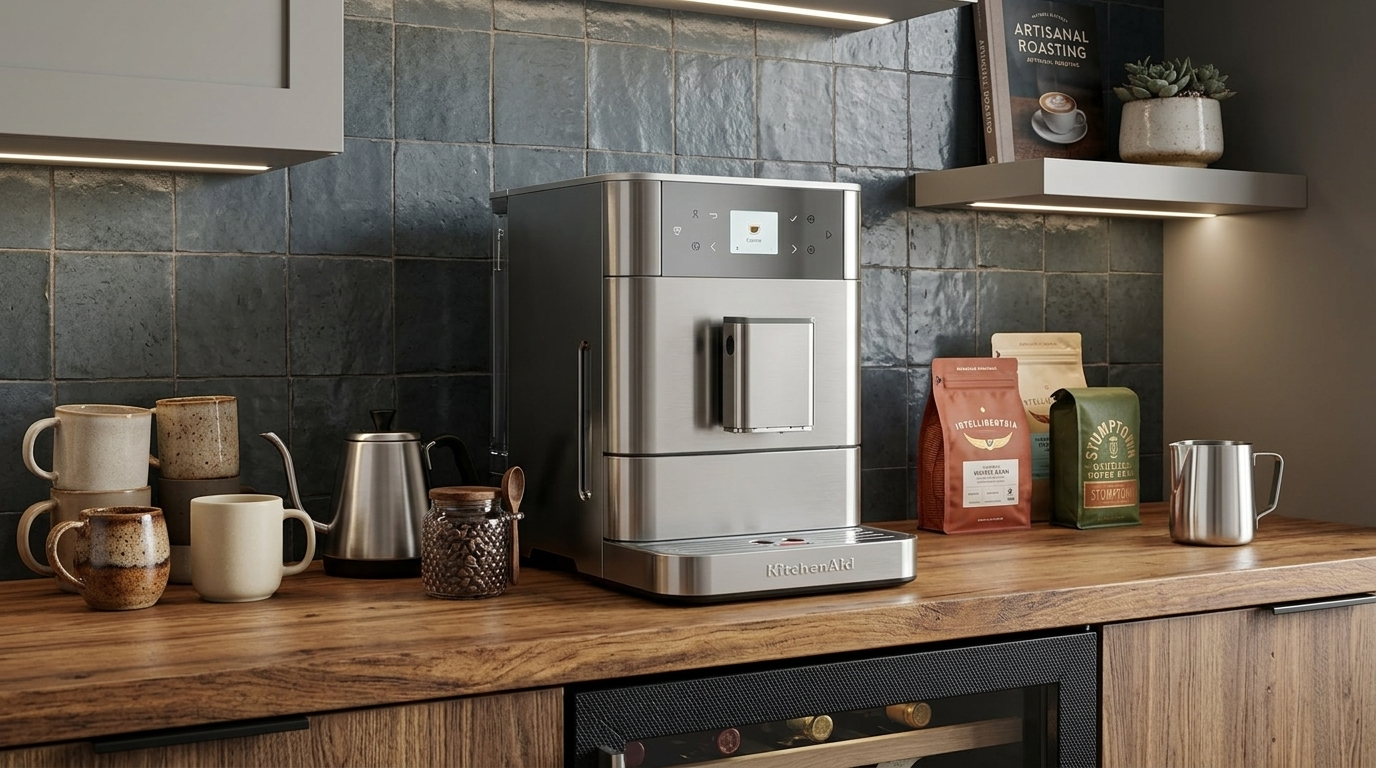
The KF6's milk hose drops into any glass or jug you already own.
Display, buttons and profiles
The KF6 has a 2.4-inch color screen, but you don't touch it.
You navigate with physical buttons beside it.
At first, that felt old-fashioned.
After a few days, it felt quick and reliable, with no smudges and no missed taps.
Four profiles
Each of the four profiles saves strength, temperature, volume and body for every drink.
We set up three: my short, strong espresso, a long mild coffee and a strong latte.
It saved us from adjusting the machine before every cup.
If you want the latest touchscreen experience, you may find the KF6 a little basic.
If you care most about what ends up in the cup, it works perfectly well.
Pre-ground coffee and decaf
There's a chute for pre-ground coffee✕Pre-ground bypassA separate chute that sends already-ground coffee straight to the brew unit, skipping the grinder. Handy for decaf without emptying the bean hopper..
It works, but it's a backup.
Supermarket pre-ground coffee tasted flat and thin compared with fresh beans from the grinder.
If you drink decaf often, a second hopper gives you much better results.
Our tip: Add only one level scoop to the pre-ground chute, because more can clog the brew unit.
Cleaning and maintaining the KitchenAid KF6
Maintenance runs from the screen, with prompts when something is due.
After milk drinks, the machine rinses the milk circuit.
Every week, I took the brew group out from the side, rinsed it in warm water and let it dry before putting it back.
That keeps coffee oils from going rancid.
Descaling
The KF6 tells you when to descale✕DescalingRunning a mild acid solution through the machine to dissolve mineral scale left by hard water. Scale slows heating and can block pipes. and guides you through it.
The full cycle took about 45 minutes, most of it hands-off.
| When | Task | Why it matters |
|---|---|---|
| After milk drinks | Run the milk rinse | Flushes milk from the hose and spout |
| Daily | Empty the drip tray and grounds bin | Prevents mold and odors |
| Weekly | Rinse the brew group in warm water | Removes coffee oils |
| Weekly | Take apart and wash the milk parts | Removes dried milk |
| When prompted | Brew unit tablet clean and descaling | Keeps oils and scale under control |
| When prompted | Replace the water filter | Keeps scale and chlorine out |
My estimate of hands-on cleaning time per day.
The drip tray is generous and pulls out from the front.
Even so, the rinses fill it faster than you'd expect, so I emptied it daily.
What daily use is really like
My mornings started with a press of the power button and a short rinse.
A coffee was ready about 40 seconds after I pressed start.
Noise
This is one of the quietest bean-to-cup machines I've tested.
The KF6 is Quiet Mark certified, and my phone meter agreed.
Grinding peaked just over 60 dB, and brewing sat around 55 to 56 dB.
Many automatic machines I've measured hit 68 to 71 dB.
Phone sound meter readings at about 50 cm. Every 10 dB sounds roughly twice as loud.
In an open-plan kitchen, that difference is huge.
I made espresso while someone was on a video call in the next room, and they never noticed.
How far a tank and hopper go
The 2.2-liter tank lasted two or three days for two people.
The 270-gram hopper lasted about a week and a half.
Rough maths from a 2.2 L tank, allowing for rinse water. Actual numbers depend on cup size.
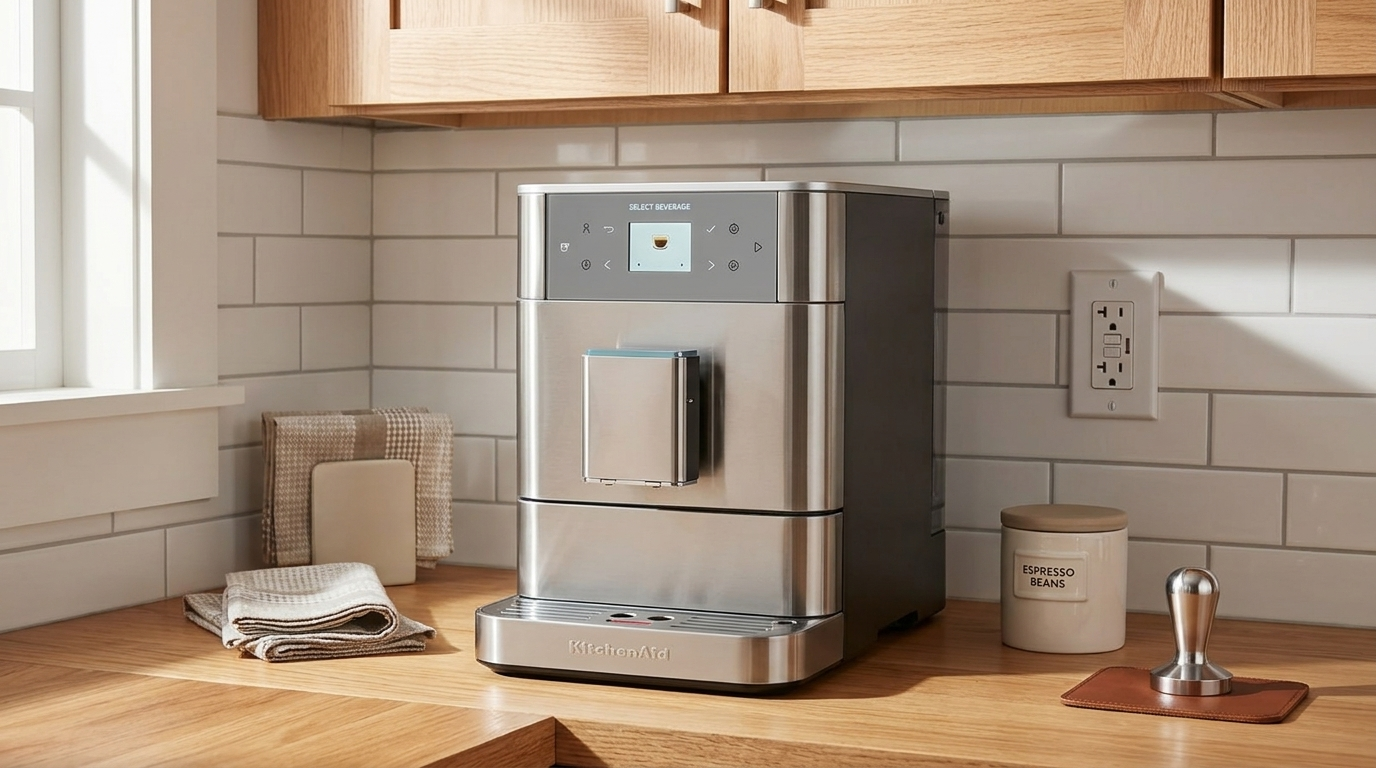
The side tank slides out without moving the machine.
My four weeks with the KF6, week by week
Week one was the baseline.
I made every recipe at its factory settings, so I had something to compare with later.
The espresso was already good, and the latte was smooth.
The cappuccino foam was lighter than I expected.
Week two was all about the espresso.
I moved the grind to setting two, raised the strength, shortened the shot and tried every body setting.
That's when the refractometer readings climbed from the low fives to the mid sixes.
Week three was for the household.
We set up profiles and bought a second hopper for decaf.
Evening coffee stopped being a debate.
Week four was about the routine and the cleaning.
I ran a full descale, timed the weekly brew group rinse and tracked how often the tray and bin needed emptying.
| Week | What I focused on | Main change |
|---|---|---|
| 1 | Every recipe at factory settings | None, baseline only |
| 2 | Dialing in espresso | Grind setting 2, higher strength, shorter shot |
| 3 | Profiles and decaf | Three profiles and a second hopper |
| 4 | Routine and maintenance | Weekly brew group rinse, full descale |
By the end, a weekday morning took about three minutes, including the milk rinse.
How the KF6 fits different households
Specs only tell you so much, so here is how the KF6 played out for the kinds of people who visited during testing.
The espresso drinker
This is who the KF6 is built for.
If you drink two or three straight espressos a day, the concentration and crema are the best reasons to buy it.
Set a high strength, a short volume and a warm cup, and you'll rarely need to touch anything again.
The latte household
Two people who drink lattes every morning will be happy.
The milk is smooth and hot enough, and the profiles mean each person gets their own ratio.
The only extra work is a quick rinse after the last milk drink and a weekly wash of the milk parts.
The cappuccino purist
This is where the KF6 struggles.
The foam is lighter than a classic cappuccino, and the milk always goes in first.
If a tall, firm cap of foam is the whole point of your morning, you will notice it every day.
The decaf-in-the-evening home
The removable hopper is made for this.
A second hopper and a quick purge gave us fresh-ground decaf in the evening without emptying anything.
It tasted far better than pre-ground decaf through the chute.
The early riser in a shared home
Few machines are as quiet.
At about 61 dB while grinding and 55 dB while brewing, the KF6 is gentle enough for a small apartment at 6 a.m.
| Household | How well it fits | Main reason |
|---|---|---|
| Espresso drinker | Excellent | Concentrated shots, thick crema |
| Latte household | Very good | Silky milk, four profiles |
| Cappuccino purist | Fair | Light foam, milk-first order |
| Regular and decaf drinkers | Excellent | Swappable hopper with purge |
| Early riser, shared home | Excellent | Very quiet grinder and pump |
Beans, water and milk
The KF6 shows off good beans, and it shows up bad ones.
Use whole beans within a few weeks of the roast date.
Medium and medium-dark roasts worked best for espresso.
Light roasts needed setting one or two and a fuller body.
Avoid very oily, shiny beans and flavored beans, which can clog the grinder.
| Bean type | Espresso | Milk drinks |
|---|---|---|
| Medium-dark blend | Excellent, thick crema | Excellent |
| Medium roast | Very good, brighter | Very good |
| Light roast | Grind finer, fuller body | Good |
| Supermarket pre-ground | Flat and thin | Fair |
| Very dark, oily | Not recommended | Not recommended |
Water
Use fresh, cold water and fit the filter if your water is moderately hard or harder.
Avoid distilled water, because coffee needs some minerals to taste full.
Common mistakes to avoid
The KitchenAid KF6 is easy to live with, but a few habits will hold it back.
| Mistake | What happens | Better habit |
|---|---|---|
| Starting with a low strength setting | Weak, watery shots | Start high and work down |
| Swapping hoppers without a purge | Old beans in the first cup | Run the grinder purge |
| Using a cold cup | Shot loses about 5 degrees | Rinse the cup with hot water |
| Relying on pre-ground coffee | Flat, thin espresso | Use a second hopper for decaf |
| Skipping the weekly brew group rinse | Stale, bitter flavors | Rinse it every week |
| Expecting stiff cappuccino foam | Disappointment | Choose latte or flat white |
What I would change
A milk container in the box would make the KF6 feel complete.
A choice of espresso-first cappuccinos would help purists.
And a touchscreen, or at least a front-mounted grind dial, would make tweaking faster.
Is the KitchenAid KF6 worth the money?
The KF6 is a premium machine, so it has to justify itself.
It does that in the cup and in the build.
The espresso is concentrated and consistent, the metal body feels built to last and the grinder is remarkably quiet.
Ask yourself three questions before you buy.
Is espresso, or an espresso-heavy drink, what you make most days?
Do several people share the machine?
And do you value a quiet, solid machine over a long menu?
If the answers are yes, the KF6 is easy to recommend.
If you mostly want thick cappuccino foam or iced drinks, look elsewhere.
Living with it long term
A machine like this should last years, so build and serviceability matter as much as the first cup.
The metal cladding, the removable brew group and the side-access tank all point the right way.
The brew group is easy to reach and rinse, which is the single most important habit for keeping an automatic machine healthy.
The guided descaling and the clean-me prompts mean you're unlikely to forget the bigger jobs.
Running costs are modest: water filters, cleaning tablets and descaler, plus a milk container and second hopper if you want them.
Check what's included where you buy, because bundles vary and some include extra hoppers or containers.
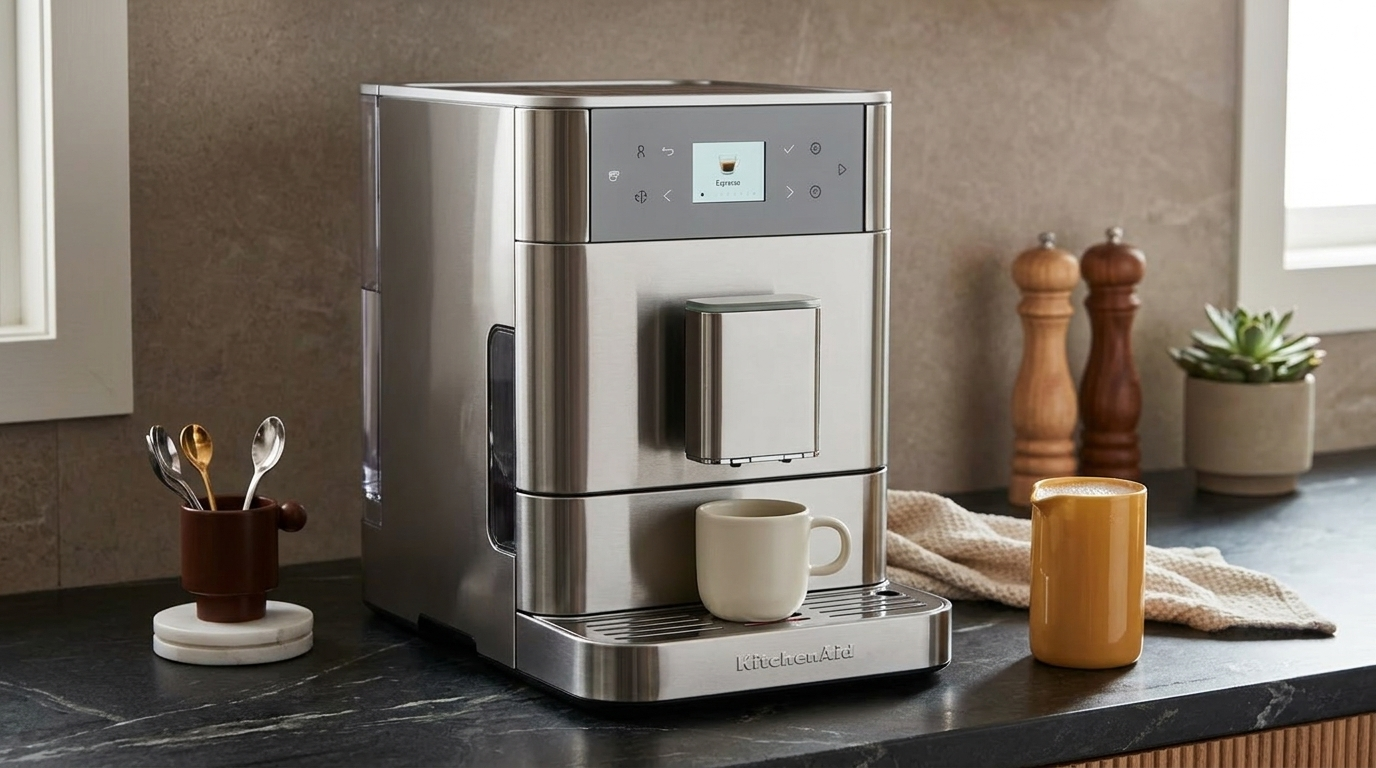
The KF6 is built around one job: very good espresso.
How it compares with other espresso setups
The most useful comparison is with the kinds of machines you're likely choosing between.
The KitchenAid KF6 stands out for its espresso, its quiet grinder and its build.
| Feature | KitchenAid KF6 | Feature-packed automatic | Manual machine and grinder |
|---|---|---|---|
| Espresso quality | Very concentrated, consistent | Varies widely | Excellent, skill-dependent |
| Milk drinks | One touch, silky milk | One touch, often thicker foam | Steam wand, skill-dependent |
| Bean switching | Removable hopper | Rare | Easy, by hand |
| User profiles | 4 | Often several | No |
| Noise | Very quiet | Often 68–71 dB | Varies |
| Touchscreen | No | Usually | No |
| Iced and cold drinks | No | Often | Manual |
A feature-packed automatic gives you more drinks and a slicker screen, but often a weaker shot.
A manual setup gives you the most control, but it takes skill every morning.
The KF6 sits in between, with near-manual espresso at one touch.
| You mostly drink | Is the KF6 a fit? | Why |
|---|---|---|
| Espresso | Excellent | High dose, high concentration |
| Americanos and long coffee | Very good | Concentrated base, clean hot water |
| Lattes and flat whites | Very good | Silky microfoam |
| Thick cappuccinos | Fair | Lighter foam, milk-first order |
| Iced coffee | Poor | No iced program |
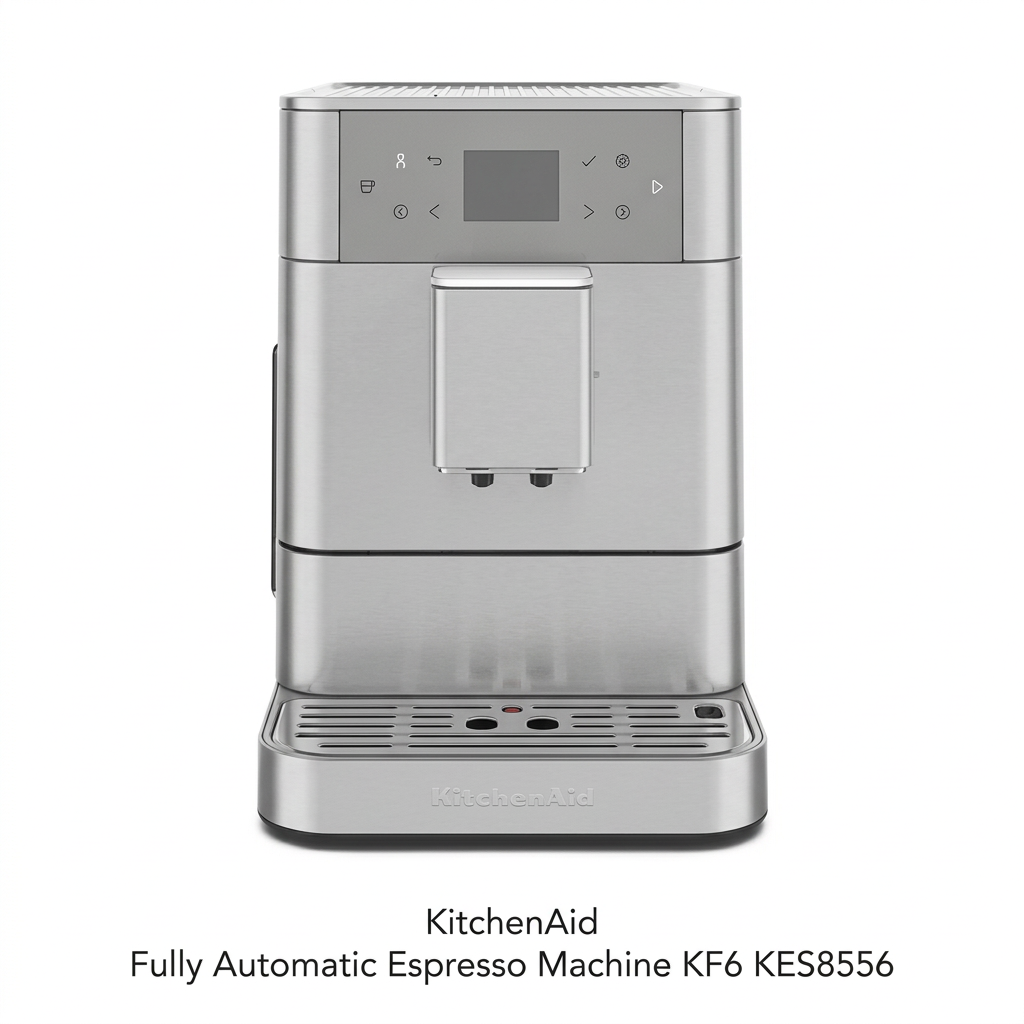
The full package: color display, side buttons and the coffee and milk spout.
Other KitchenAid machines I tested
For a slimmer machine with a steam wand, see my KitchenAid KF2 review.
The KitchenAid KF7 adds a touchscreen, a milk container and an adjustable milk and espresso order.
For the biggest menu and the most control, see my KitchenAid KF8 review.
Which one is right for you: is the KitchenAid KF6 your match?
4 quick questionsKitchenAid KF6 specifications
From manufacturer data and my own testing.
How I tested and scored the KitchenAid KF6
For four weeks, I used the KitchenAid KF6 as my everyday machine for espresso, double shots, Americanos, long coffee, lattes, flat whites and cappuccinos.
I tried all seven grind settings, every strength, temperature and body setting, set up four profiles, swapped beans with the removable hopper and made milk drinks with whole, semi-skimmed, skim and barista oat milk.
I measured shot temperature with a probe, concentration with a refractometer, noise with a phone meter at about 50 cm and the cup warmer with an infrared thermometer, and I followed every cleaning and descaling prompt.
Michael and a second HouseholdMe tester shared the machine and wrote the notes together. We then checked our notes against KitchenAid's specifications and owner documentation.
- Espresso (9.0): concentration, crema, flavor and consistency across back-to-back shots.
- Milk drinks (8.0): foam texture, milk temperature, drink balance and the fixed milk-first order.
- Ease of use (8.2): screen and buttons, profiles, hopper swaps, tank access and setup.
- Cleaning (8.4): milk rinses, brew unit care, guided descaling and daily emptying.
The overall score of 8.5 is an editorial rating that reflects those four areas.
More KitchenAid espresso machine reviews
Michael and I tested the whole KitchenAid range for four weeks each. If this one isn't quite right for you, these reviews cover the other models.
KitchenAid KF2 review: A slim, quiet bean-to-cup machine with an over-ice mode and a surprisingly good steam wand.
KitchenAid KF3 review: One-touch milk drinks, four profiles and a body-strength dial in a 7.7-inch-wide machine.
KitchenAid KF7 review: A beautifully designed, quiet touchscreen machine whose espresso doesn't quite keep up.
KitchenAid KF8 review: 40+ drinks, six profiles, plant-milk mode and two lattes at once from a near-silent machine.
KitchenAid KF6 FAQ
Is the KitchenAid KF6 worth it?
Yes, if you mostly drink espresso and want a quiet, solid machine with profiles for several people. If you mainly want thick cappuccino foam or a touchscreen, other machines are a better fit.
Does the KitchenAid KF6 come with a milk container?
No. It comes with a milk hose that you put into your own glass or jug. A matching container is sold separately.
Can I swap beans on the KitchenAid KF6?
Yes. The 270 g hopper twists and lifts off. With a second hopper, sold separately, you can switch between beans or decaf and purge the grinder in between.
How hot is the espresso from the KitchenAid KF6?
I measured about 75 to 76°C in the cup. That's pleasant to drink straight away, but pre-warm your cup if you like it very hot.
How quiet is the KitchenAid KF6?
Very quiet. I measured just over 60 dB while grinding and about 55 to 56 dB while brewing from half a meter away.
How many profiles does the KitchenAid KF6 have?
Four. Each one saves strength, temperature, volume and body for every drink.
Can I change the order of milk and espresso?
No. Cappuccinos always pour the milk first and the espresso second on the KF6.
How many grind settings does the KitchenAid KF6 have?
Seven. The selector sits behind the right-hand side panel.
Does the KitchenAid KF6 have a touchscreen?
No. It has a 2.4-inch color display that you navigate with physical buttons.
How long does descaling take?
About 45 minutes, guided step by step on the screen.
Can I use pre-ground coffee in the KitchenAid KF6?
Yes. There is a chute for one scoop of pre-ground coffee, which is handy for an occasional decaf.
Kitchen & coffee tester
Michael spent six years as a line cook in restaurants in Chicago and New York, and he has tested kitchen appliances for HouseholdMe since 2018, from air fryers to coffee makers. He holds an SCA certificate in barista skills and used the KitchenAid KF6 as his everyday coffee machine for four weeks for this review, writing up the testing notes together with a second HouseholdMe tester.
- Four weeks of hands-on testing of the KitchenAid KF6 KES8556
- KitchenAid product specifications and owner documentation
- General espresso brewing and maintenance guidance