KitchenAid KF3 review: one-touch milk drinks, four profiles and a body-strength dial in a 7.7-inch-wide machine
The KitchenAid Fully Automatic Espresso Machine KF3 KES8453 grinds, brews and froths milk at one touch, saves drinks for four people and lets you tune strength, temperature, volume and extraction body. It is remarkably slim and quiet, but the milk container is sold separately and the rear tank takes some getting used to.

Michael Reynolds
Hands-on review
Hands-on testing, research, specs
4 weeks
23 minutes
Jargon helpNew to espresso? Tap any dotted term to see what it means.
In this review
Yes, if you want one-touch milk drinks and real control over your coffee in a very small footprint. The KitchenAid KF3 doses up to about 15 grams, pulls rich, consistent espresso, makes two milk drinks at once and keeps settings for four people. Its color screen explains everything in plain words. The trade-offs are a milk container you have to buy separately, a milk hose that needs rinsing after every milk drink, and iced drinks that are brewed cooler but still come out warm.
KitchenAid KF3 at a glance
KitchenAid KF3 pros and cons
- Strong, consistent espresso with up to 15 g of coffee
- One-touch milk drinks, two at a time
- Four profiles and fine control in a 7.7-inch-wide body
- Milk container is sold separately
- Milk hose needs a rinse after every milk drink
- Iced drinks still come out warm
Who should buy the KitchenAid KF3?
- Small kitchens that want lattes at one touch
- Couples and families with different coffee tastes
- People who like to fine-tune their drinks
- Anyone who wants a complete milk setup in the box
- Iced coffee fans who want truly cold coffee
- People who want zero cleaning after milk drinks
First impressions of the KitchenAid KF3
Fully automatic machines with milk systems are usually big.
Wide bodies, side tanks and a carafe parked at the front.
The KF3 does it in 7.7 inches of width.
I put it where my kettle normally lives, and there was still room for a jar of beans beside it.
The second surprise was the screen.
The KitchenAid KF3 has a small color display that talks to you in full sentences.
When I forgot to slide the drip tray all the way in, it told me exactly that.
No blinking lights to decode, no manual to dig out.
The third surprise was my first cappuccino.
I dropped the milk hose into a glass of cold milk, pressed one button and got a tall, glossy cap with a thick espresso underneath.
It was hot, sweet and well balanced on the first try.
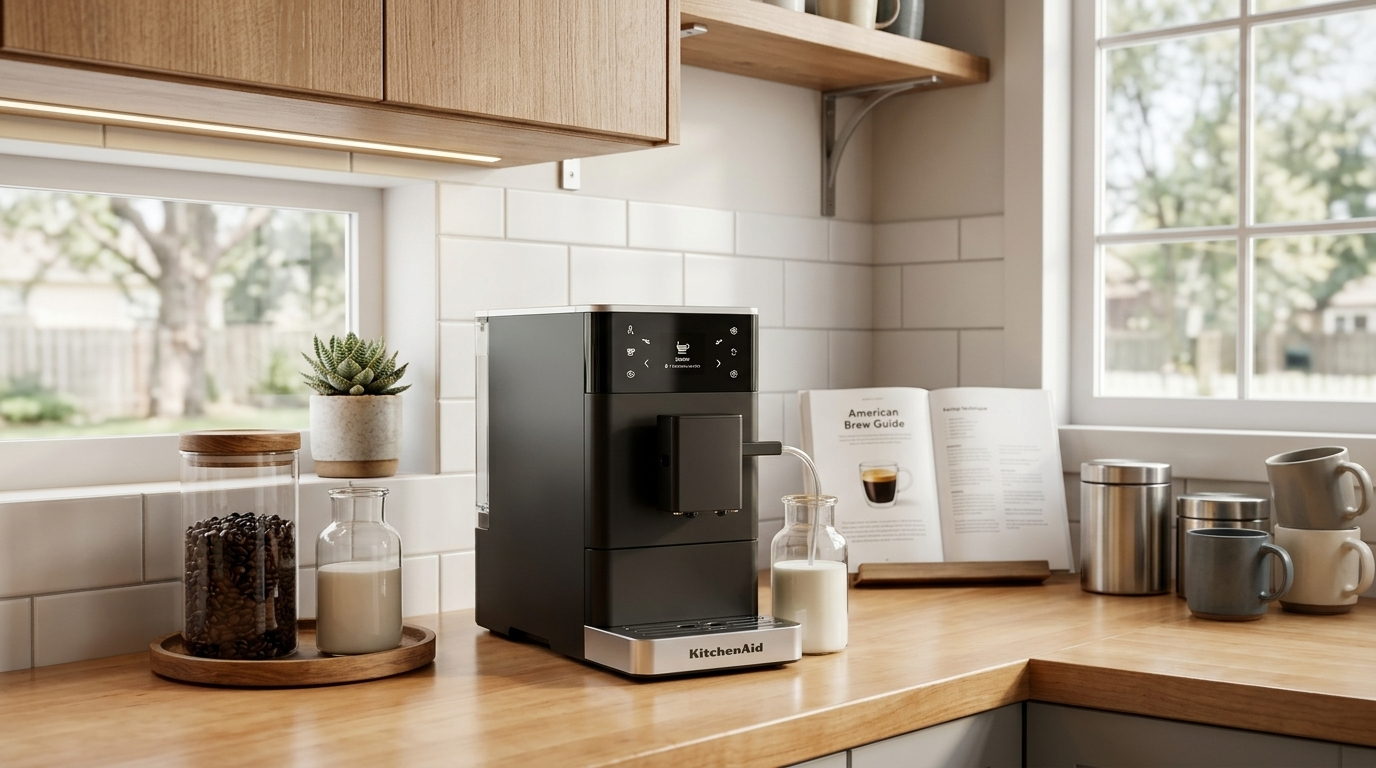
At 7.7 inches wide, the KF3 fits where most milk-system machines won't.
What the KitchenAid KF3 actually is
The KF3 is a fully automatic, bean-to-cup espresso machine with an automatic milk system.
It grinds whole beans, doses and presses the coffee, brews it and drops the used puck into a bin.
For milk drinks, it pulls milk through a silicone hose, heats it and froths it, then adds the espresso.
It sits in the middle of KitchenAid's compact range.
Compared with the entry model, it swaps the steam wand for one-touch milk, adds a color screen and adds four user profiles✕User profilesSaved sets of drink settings for different people. Each person picks their profile and gets their own strength, volume and temperature..
Inside is a thermoblock✕ThermoblockA compact heater that warms water as it flows through, instead of keeping a whole boiler hot. It heats up fast and uses less standby energy. and a 15-bar pump.
Four outlets, one spout
The front spout has two coffee outlets and two milk outlets.
That means the KF3 can make two espressos or two milk drinks at the same time.
Hot water has its own outlet, so Americanos never run the water through the coffee.
| Drink | How it's made | Milk used |
|---|---|---|
| Espresso | Short brew, single or true double | None |
| Coffee | Longer brew in one pour | None |
| Americano | Espresso, then hot water from its own outlet | None |
| Cappuccino | Espresso with a tall layer of foam | Foam |
| Caffè latte | Espresso with more hot milk and less foam | Milk and foam |
| Latte macchiato | Milk and foam first, espresso through the middle | Milk and foam |
| Macchiato | Espresso with a small spoon of foam | Small amount |
| Iced coffee and iced espresso | Brewed cooler and slower, for pouring over ice | None |
| Warm milk | Hot milk only | Milk |
KitchenAid KF3 design and setup
The KF3 measures 14.2 × 7.7 × 18.5 inches, or 36.1 × 19.6 × 47 cm.
It fits under standard wall cabinets with a few inches to spare.
It's deep, so check that you have about 19 inches of counter, plus a little extra behind it.
My unit was Matte Black.
It also comes in Porcelain White, which looks softer in a light kitchen.
The finish feels solid, and the drip tray and spout don't flex the way they do on cheaper machines.
The rear tank and the wheels
The 1.8-liter tank sits at the back.
That's what keeps the machine so narrow, but it means you can't just pull the tank out from the side.
KitchenAid adds wheels under the rear.
I tilted the front up slightly, rolled the machine forward about four inches and slid the tank out by its handle.
After a week, it took about ten seconds.
Our tip: Leave about two inches behind the KF3 so the tank and the side service panel are easy to reach.
The bean hopper and chute
The hopper in the middle of the top holds about 265 grams, or 9.3 ounces.
Its lid keeps light out, which helps beans stay fresh.
A separate chute takes one scoop of pre-ground coffee.
First-time setup
The screen walked me through language, units, water hardness and the water filter.
I switched to fluid ounces, turned off the button beeps and set the standby timer to 30 minutes.
The whole setup took about 15 minutes, including the first rinse.
The first three shots were a little thin while the grinder settled.
By the fourth, everything tasted right.
The milk hose drops straight into a glass or bottle next to the machine.
The grinder and dose
The KF3 grinds with steel conical burrs✕Conical burrsA cone-shaped cutting part that turns inside a ring. They grind evenly at fairly low speed, which keeps heat and noise down..
They turn slowly and quietly, and they sit behind sound insulation.
The grind selector is in the service area on the side, next to the brew unit.
You roll the machine forward, open the panel and turn the selector toward finer or coarser.
A big dose for a small machine
The brew unit✕Brew unitThe chamber inside an automatic machine that receives the ground coffee, presses it into a puck, pushes hot water through it and then ejects the used grounds. takes up to about 15 grams of coffee.
Many compact machines top out around 11 or 12 grams.
That extra coffee is why the KF3's strongest setting tastes properly strong instead of just bitter.
More coffee per brew means more flavor in the cup without stretching the shot with extra water.
How I set the grind
With a medium-dark blend, the factory setting was close.
I went one step finer for a thicker shot.
A light roast needed two steps finer and the strong body setting.
A very dark roast tasted harsh until I went one step coarser.
Our tip: Only change the grind while the grinder is running, and judge the result two or three drinks later.
KitchenAid KF3 espresso performance
This is the KF3's strongest area.
With a medium-dark blend at strength three, my espresso came out with a dense, hazelnut crema✕CremaThe golden-brown foam on top of an espresso. It forms when pressure pushes gases and oils out of freshly ground coffee. and a round, heavy body.
I tasted cocoa, roasted almond and a little dried cherry.
Bitterness was low, even at the strongest setting.
The default espresso is about 1.4 fluid ounces.
I trimmed mine to 1.2 ounces in 0.2-ounce steps, which made it thicker and sweeter.
True doubles
The 2× option grinds, presses and brews one dose, then grinds and brews a second.
It doesn't push extra water through one puck.
My doubles tasted as full as two singles, with no watery tail.
Consistency and pucks
I made five espressos in a row for a small dinner party.
The fifth was as hot and dense as the first.
The used pucks came out firm and nearly dry, holding their shape when I tipped the bin.
That's a good sign the brew unit is compressing the coffee properly.
My ratings on a 10-point scale for body, crema and flavor with the same medium-dark beans.
| What you taste or see | Likely cause | First change |
|---|---|---|
| Sour, thin, watery | Under-extraction | Strong body, higher strength or a finer grind |
| Bitter, harsh, drying | Over-extraction | Light or medium body, a coarser grind or less volume |
| Pale crema that fades fast | Stale or very oily beans | Use fresher medium roast beans |
| Drips slowly or stops | Grind far too fine | Go one step coarser while grinding |
| Lukewarm shot | Cold cup or low temperature | Warm the cup and set temperature to high |
Our tip: Run hot water into your espresso cup first, because a cold cup steals a lot of heat from a small shot.
The body setting: flow rate you can taste
The body setting is the feature that made me trust the KF3 with different beans.
KitchenAid calls it the Aroma Balance System.
It has three options: light, medium and strong.
They change how fast water flows through the coffee, not how much coffee is used.
Light runs the water through quickly.
Strong slows it down, so the water spends more time with the coffee.
| Setting | What it changes | How it tasted to me | Best with |
|---|---|---|---|
| Strength | How much coffee is ground | More or less intensity | Any roast |
| Body: light | Faster flow | Brighter, lighter, more tea-like | Dark roasts that turn bitter |
| Body: medium | Middle flow | Balanced, sweet | Medium and medium-dark roasts |
| Body: strong | Slower flow | Fuller, heavier, more chocolate | Light roasts and milk drinks |
In practice, the two settings work together.
For a dark roast, strength three with a light body gave me a big flavor without harshness.
For a light roast, strength three with a strong body pulled out more sweetness.
Resetting a recipe
Each drink has its own reset.
If you change five things and end up worse off, you can restore that one drink to its factory settings.
The rest of the machine stays as it was.
I used this twice when I got carried away.
Milk foam and milk drinks
The KF3's milk system is a simple silicone hose.
One end plugs into a socket on the side of the spout, and the other goes into your milk.
A matching sealed container is sold separately, but you don't need it.
I used a tall glass for the first week and a clean glass bottle from the fridge after that.
How the foam turned out
The foam is set per drink, and it's well judged.
Cappuccinos came out with a thick, stable cap of fine foam.
Caffè lattes had more hot milk and a thinner layer of microfoam✕MicrofoamMilk foam with bubbles so small you can't see them. It feels silky and blends into the coffee instead of sitting on top like froth..
Latte macchiatos layered neatly in a clear glass, with white milk, a band of espresso and foam on top.
The texture was good rather than great.
The bubbles were fine but slightly stiffer than what a skilled hand gets from a steam wand.
My ratings on a 10-point scale for texture, stability and temperature.
Two milk drinks at once
With two milk outlets, the KF3 can make two cappuccinos side by side.
That cut my weekend coffee round in half.
Both cups came out evenly split, with the same amount of foam.
Milk and coffee volume
You can change the milk volume in steps of about 0.3 fluid ounces and the coffee in steps of about 0.2.
I made my latte macchiato a little shorter on milk and a little longer on coffee.
My partner went the other way and saved it to her own profile.
Our tip: Keep the milk in the fridge and only pour out what you need, because the open glass and hose don't keep milk cold.
The hose is too narrow for powders, so drinks like matcha or chai lattes with powder in the milk aren't an option.
There's no dedicated plant-milk mode either, though barista oat milk still foamed well.
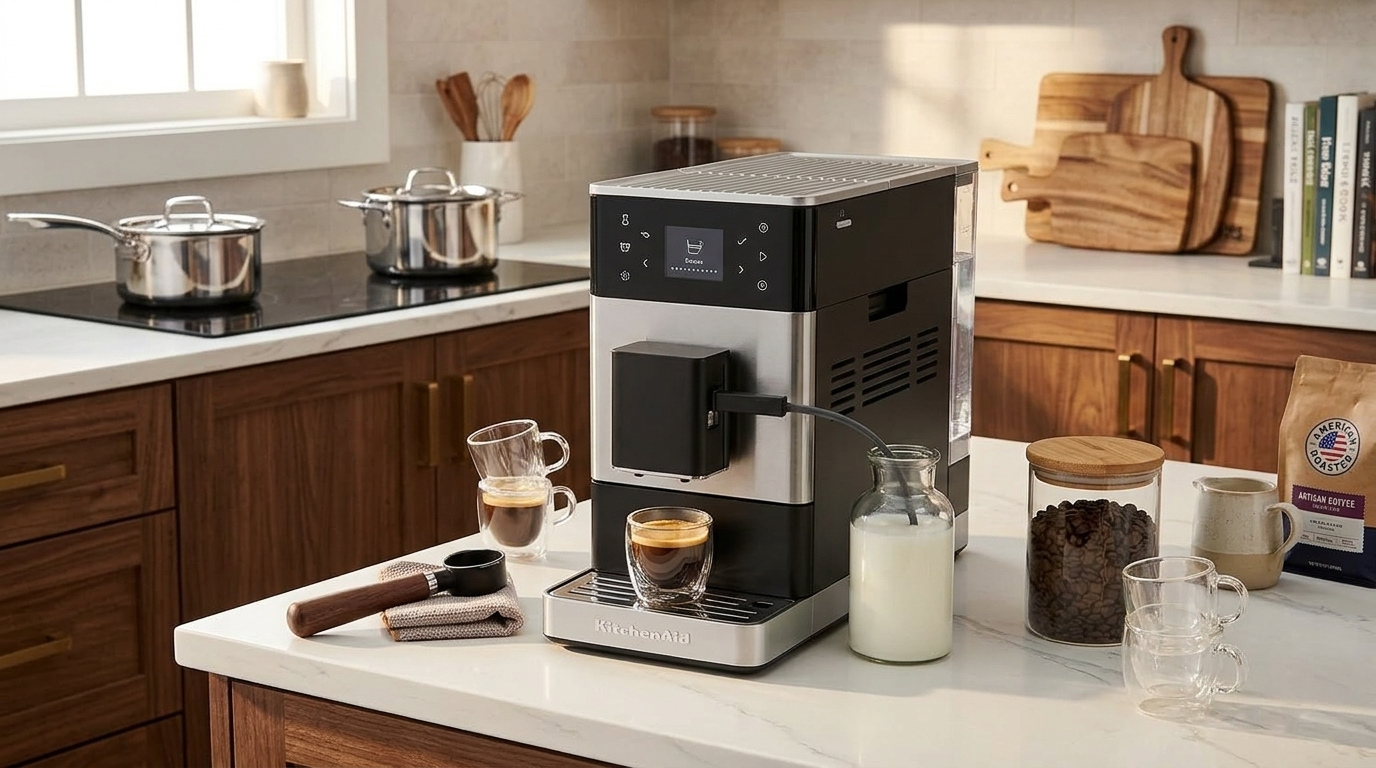
Latte macchiatos layer neatly when you use a clear glass.
Iced coffee and iced espresso
The KF3 has iced coffee and iced espresso buttons.
KitchenAid says they brew at a lower temperature and slightly slower.
I checked with a probe thermometer.
Iced espresso came out at about 45 to 47°C, only a few degrees below a normal shot.
So it's not cold brew.
It's a gentler, cooler shot meant to be poured onto ice.
Measured in a room-temperature glass straight after brewing, before any ice.
It did taste smoother than a hot shot poured on ice.
The downside is melt.
On a normal glass of small cubes, a double melted a good third of the ice.
Our tip: Chill the glass in the freezer for ten minutes before an iced drink, so less ice melts.
Color screen, profiles and settings
The KF3's color screen is about 2.4 inches, with touch buttons around it.
A person icon opens profiles, a cup icon opens drinks, a water drop opens cleaning and a gear opens settings.
Arrows move through menus, a check mark confirms and a back button goes back.
It's small, but it's never confusing.
While a drink is made, the screen shows each stage with a progress bar: heating, milk, then coffee.
Profiles
There are four profiles.
Each saves its own version of every drink.
We set up three: a strong, short espresso for me, a long, milky latte for my partner and a mild coffee for guests.
The profiles can't be named, so you remember who is number one and who is number three.
That's a small annoyance, not a deal breaker.
General settings
The settings menu has about 13 languages, metric or fluid ounces, sound on or off, the standby timer, the water filter and water hardness.
You can even change the accent color of the bars on screen.
There are short guides built into the menu, and a QR code in the service area opens KitchenAid's online help.
Pre-ground coffee and decaf
The pre-ground chute✕Pre-ground bypassA separate chute that sends already-ground coffee straight to the brew unit, skipping the grinder. Handy for decaf without emptying the bean hopper. sits next to the bean hopper.
Choose the pre-ground option, add one level scoop and start the drink.
I used it for an evening decaf latte most days, and it worked every time.
Our tip: Add only one level scoop to the pre-ground chute, because more can clog the brew unit.
Cleaning and maintaining the KitchenAid KF3
The KF3 keeps track of its own maintenance.
The cleaning menu shows progress bars for milk cleaning, brew unit cleaning and descaling✕DescalingRunning a mild acid solution through the machine to dissolve mineral scale left by hard water. Scale slows heating and can block pipes., and it tells you when each is due.
After milk drinks
After a milk drink, the screen offers a milk rinse.
You can run it now or later if you're making another drink.
You put the hose end into the drip tray area or a glass, and hot water and steam flush the hose and spout.
I ran it a glass under the spout so the drip tray filled more slowly.
The brew unit
The brew unit comes out through a panel on the side.
I rinsed it under the tap every week, let it air dry and clicked it back in.
None of the removable parts are dishwasher-safe.
| When | Task | Why it matters |
|---|---|---|
| After milk drinks | Run the milk rinse | Flushes milk from the hose and spout |
| Daily | Empty drip tray and grounds bin | Prevents mold and odors |
| Weekly | Rinse the brew unit under the tap | Removes coffee oils and loose grounds |
| Weekly | Wash the milk hose by hand | Stops residue building up |
| When prompted | Deep milk clean, brew unit tablet, descaling | Keeps oils, milk and scale under control |
| Every few months | Replace the water filter | Keeps scale and chlorine out |
My estimate of hands-on cleaning time per day.
The startup rinse runs every time you switch on, and it uses a fair amount of water.
I'd like the option to skip it.
What daily use is really like
My mornings started with a press of the power button and the startup rinse.
Then I picked my profile, tapped my drink and pressed start.
An espresso took under a minute and a cappuccino about 90 seconds.
Noise
The KF3 is one of the quietest bean-to-cup machines I've used.
I measured about 70 dB while grinding and about 60 dB while brewing from half a meter.
The grinder sounds like a low hum, not a whine.
Nobody in my house woke up during the four weeks.
Phone sound meter readings at about 50 cm. Conversation is a common reference level.
How far a tank and hopper go
With two of us making about six drinks a day, I refilled the 1.8-liter tank every second day.
The milk rinses use a surprising amount of water.
The 265-gram hopper lasted a little over a week.
Rough maths from a 1.8 L tank, allowing for rinse water. Actual numbers depend on cup size.
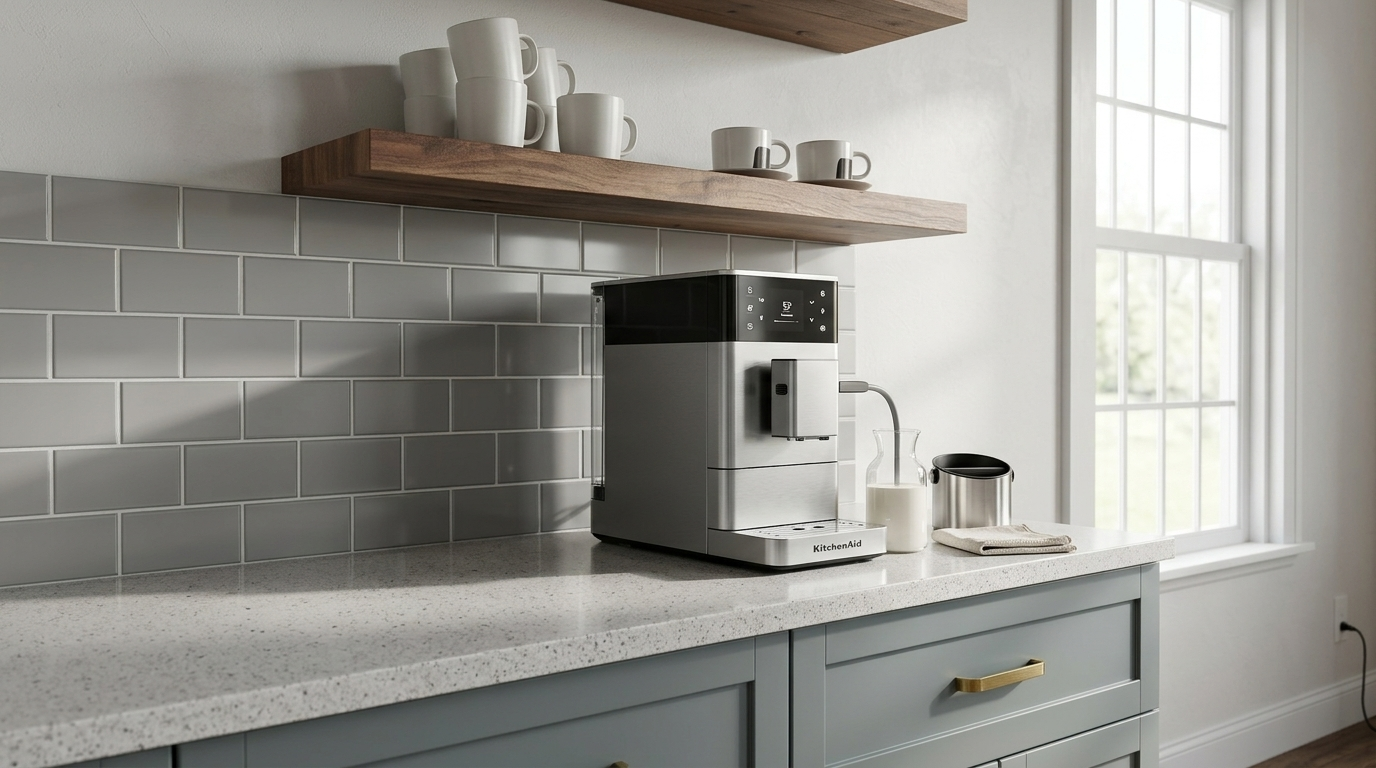
In Porcelain White, the KF3 almost disappears into a light kitchen.
My four weeks with the KF3, week by week
Week one was about learning the machine.
I made every drink on the menu at the factory settings, so I had a baseline to compare against.
The espresso and cappuccino were good straight away.
The caffè latte was a little milky for my taste, and the long coffee was slightly thin.
Week two was about dialing in.
I moved the grind one step finer, set strength three with a medium body for espresso and shortened the shot to 1.2 ounces.
I also raised the coffee volume in my latte by two steps and cut the milk by one.
That one change turned the latte from milky to balanced.
Week three was about the household.
We set up three profiles and stopped arguing about the strength button.
My partner's long latte and my short espresso no longer fought over the same settings.
Week four was about the routine.
By then, a weekday morning took about four minutes, including the milk rinse.
The tank needed filling every second day, and the hopper about once a week.
| Week | What I focused on | Main change |
|---|---|---|
| 1 | Every drink at factory settings | None, baseline only |
| 2 | Dialing in espresso and lattes | Finer grind, shorter shot, more coffee in the latte |
| 3 | Profiles for the household | Three saved profiles |
| 4 | Daily routine and cleaning | Milk rinse into a glass, weekly brew unit rinse |
The biggest lesson was to change one thing at a time.
Body, strength, grind and volume all affect the taste, and changing two at once makes it impossible to know what helped.
Beans, water and milk
The KF3 is good enough that your beans make a clear difference.
Use whole beans within a few weeks of the roast date.
Medium and medium-dark roasts worked best across the menu.
Light roasts needed a finer grind and the strong body setting.
Avoid very oily, shiny beans and flavored beans, which can clog the burrs and the chute.
| Bean type | Espresso | Milk drinks | Iced drinks |
|---|---|---|---|
| Medium-dark blend | Excellent | Excellent | Very good |
| Medium roast | Very good, brighter | Very good | Excellent |
| Light roast | Finer grind, strong body | Good | Good, a bit sharp |
| Very dark, oily | Not recommended | Not recommended | Not recommended |
Water
Use fresh, cold water every day.
Fit the filter if your water is moderately hard or harder, and enter your hardness so the descaling reminders are accurate.
Avoid distilled water, because coffee needs some minerals to taste full.
Common mistakes to avoid
The KitchenAid KF3 is easy to live with, but a few habits will hold it back.
| Mistake | What happens | Better habit |
|---|---|---|
| Skipping the milk rinse | Milk residue builds up in the hose | Rinse after the last milk drink |
| Leaving milk out in a glass | Milk warms up and spoils faster | Pour only what you need |
| Changing grind and body together | You can't tell which helped | Change one thing, then taste |
| Pushing the volume very high | Flat, over-brewed coffee | Use 2× instead |
| Iced espresso on small ice | Weak, watery drink | Use large cubes and a double |
| Pulling the tank with no room behind | Awkward and messy | Roll the machine forward first |
What I would change
A milk container in the box would make the KF3 feel complete.
Named profiles would be a small but welcome upgrade.
And an option to skip the startup rinse would save water.
Is the KitchenAid KF3 worth the money?
The KF3 has to justify a step up from a simpler machine.
It does that with one-touch milk, four profiles and more control than most compact machines offer.
The 15-gram dose and the body setting make a real difference in the cup.
And it does all of that in a body narrower than many basic machines.
Ask yourself three questions before you buy.
Do you drink milk drinks most days?
Do two or more people share the machine with different tastes?
And is your counter space limited?
If the answers are yes, the KF3 is easy to recommend.
Check what's included where you buy, because the milk container, filters and cleaning tablets vary between bundles.
How it compares with other espresso setups
The most useful comparison is with the kinds of machines you're likely choosing between.
The KitchenAid KF3 stands out for its size, its dose and its control.
| Feature | KitchenAid KF3 | Machine with a steam wand | Larger automatic with carafe |
|---|---|---|---|
| Grinding and brewing | Fully automatic | Fully automatic | Fully automatic |
| Milk drinks | One touch, two at once | You steam by hand | One touch |
| Maximum dose | About 15 g | Varies | Often 10–14 g |
| Body or flow control | Yes, 3 settings | Rare | Rare |
| User profiles | 4 | Usually none | Often several |
| Milk cleaning | Rinse after each milk drink | Wipe the wand | Carafe to wash |
| Footprint | Very slim | Varies | Usually wider |
A machine with a steam wand is cheaper to run and easier to clean, but every latte takes practice and two minutes.
A larger machine with a carafe often has more drinks and a container in the box, but takes more room.
The KF3 sits in between, with one-touch milk in a very small footprint.
| You mostly drink | Is the KF3 a fit? | Why |
|---|---|---|
| Espresso | Excellent | 15 g dose, true doubles, body control |
| Cappuccinos and lattes | Very good | One touch, two at once |
| Americanos | Very good | Separate hot water outlet |
| Iced coffee | Fair | Smoother, but still warm |
| Big household, many tastes | Good | 4 profiles, but no names |
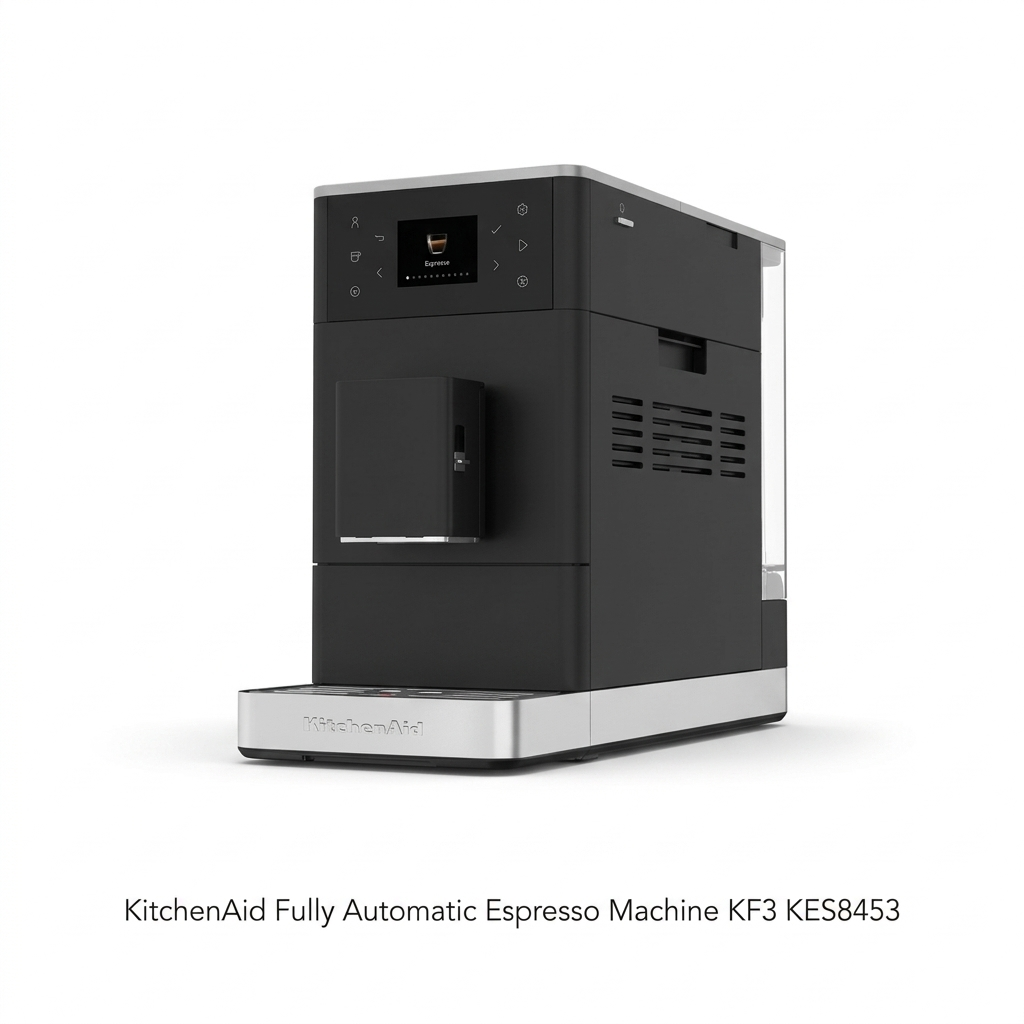
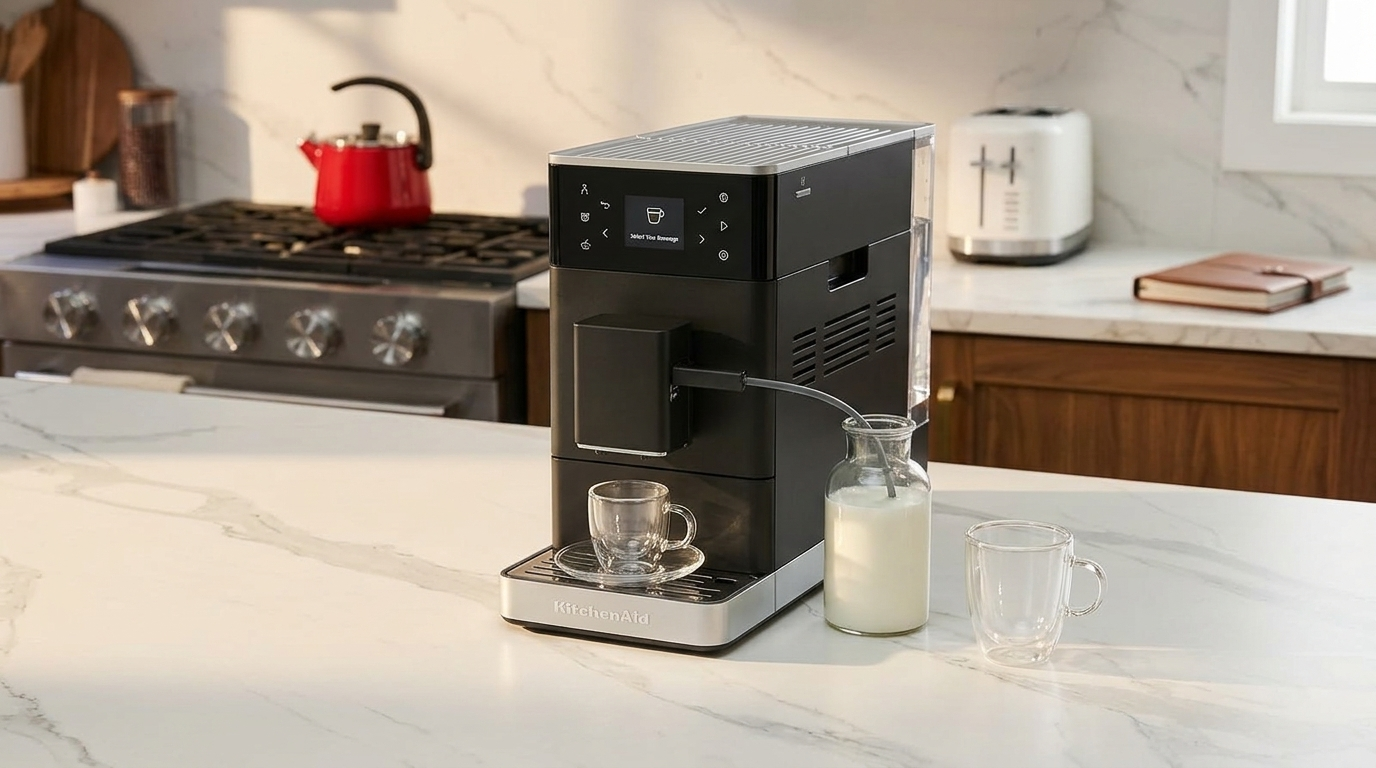
The full package: color display, touch controls and the four-outlet spout.
Other KitchenAid machines I tested
If you'd rather steam milk yourself, the KitchenAid KF2 keeps the same slim body with a surprisingly good steam wand.
The KitchenAid KF6 adds a touchscreen and a milk container.
For the biggest menu and the most control, see my KitchenAid KF8 review.
Which one is right for you: is the KitchenAid KF3 your match?
4 quick questionsKitchenAid KF3 specifications
From manufacturer data and my own testing.
How I tested and scored the KitchenAid KF3
For four weeks, I used the KitchenAid KF3 as my everyday machine for espresso, double shots, Americanos, cappuccinos, caffè lattes, latte macchiatos, iced espresso and iced coffee.
I worked through all three strength levels and all three body settings, changed the grind, adjusted coffee and milk volumes, set up four profiles and made milk drinks with whole, semi-skimmed, skim and barista oat milk.
I measured noise with a phone meter at about 50 cm, checked drink temperatures with a probe thermometer, followed every rinse and cleaning prompt and tracked how far a tank and a hopper went.
Michael and a second HouseholdMe tester shared the machine and wrote the notes together. We then checked our notes against KitchenAid's specifications and owner documentation.
- Espresso (8.8): body, crema, flavor and consistency across back-to-back shots and the three body settings.
- Milk drinks (8.2): foam texture, milk temperature, drink balance and the iced drinks.
- Ease of use (8.6): color screen, menu, profiles, setup and day-to-day convenience.
- Cleaning (7.9): milk rinses, brew unit care, reminders and how much water rinsing uses.
The overall score of 8.4 is an editorial rating that reflects those four areas.
More KitchenAid espresso machine reviews
Michael and I tested the whole KitchenAid range for four weeks each. If this one isn't quite right for you, these reviews cover the other models.
KitchenAid KF2 review: A slim, quiet bean-to-cup machine with an over-ice mode and a surprisingly good steam wand.
KitchenAid KF6 review: Concentrated espresso, a metal-clad body and a swappable bean hopper that runs whisper-quiet.
KitchenAid KF7 review: A beautifully designed, quiet touchscreen machine whose espresso doesn't quite keep up.
KitchenAid KF8 review: 40+ drinks, six profiles, plant-milk mode and two lattes at once from a near-silent machine.
KitchenAid KF3 FAQ
Is the KitchenAid KF3 worth it?
Yes, if you want one-touch milk drinks and fine control in a very slim machine. It makes strong, consistent espresso and keeps settings for four people. If you only drink black coffee, a simpler machine is a better buy.
Does the KitchenAid KF3 come with a milk container?
No. It comes with the milk hose, which you can put into any glass or bottle. A matching KitchenAid milk container is sold separately.
How many drinks does the KitchenAid KF3 make?
It has 11 drink and hot water functions: espresso, coffee, Americano, cappuccino, caffè latte, latte macchiato, macchiato, iced coffee, iced espresso, warm milk and hot water.
What is the body setting on the KitchenAid KF3?
Body changes the flow rate through the coffee. Light is faster and lighter, strong is slower and fuller. It works separately from strength, which changes how much coffee is used.
Can the KitchenAid KF3 make two drinks at once?
Yes. It has two coffee spouts and two milk spouts, so it can make two espressos or two milk drinks in one go.
How many user profiles does the KitchenAid KF3 have?
Four. Each one saves its own drink settings, but the profiles can't be given personal names on this model.
Are the iced drinks on the KitchenAid KF3 cold?
No. They're brewed cooler and slower, but the coffee is still warm, so pour it over plenty of large ice cubes.
Can I use oat milk in the KitchenAid KF3?
Yes. Barista-style oat milk foamed well in my testing. Rinse the hose straight after, because plant milks can leave residue.
Where is the water tank on the KitchenAid KF3?
At the back. Wheels under the machine let you roll it forward to slide the tank out.
Can I use pre-ground coffee in the KitchenAid KF3?
Yes. There is a bypass chute for one scoop of pre-ground coffee, which is handy for decaf.
How loud is the KitchenAid KF3?
It's quiet for a bean-to-cup machine. I measured about 70 dB while grinding and about 60 dB while brewing from half a meter away.
Kitchen & coffee tester
Michael spent six years as a line cook in restaurants in Chicago and New York, and he has tested kitchen appliances for HouseholdMe since 2018, from air fryers to coffee makers. He holds an SCA certificate in barista skills and used the KitchenAid KF3 as his everyday coffee machine for four weeks for this review, writing up the testing notes together with a second HouseholdMe tester.
- Four weeks of hands-on testing of the KitchenAid KF3 KES8453
- KitchenAid product specifications and owner documentation
- General espresso brewing and maintenance guidance