Jura vs De’Longhi: is Swiss premium worth paying more for?
Jura is the brand people mention when they want the best one-touch coffee at home; De’Longhi is the brand most people actually buy. Both make fully automatic machines that grind, brew and froth at a touch, and Jura typically costs a lot more. I used the Jura E6 and E8 and the De’Longhi Magnifica Evo and Rivelia as my daily machine for four weeks each to find out what the extra money buys you.
We choose products independently. We may earn a commission through links on this page; your price stays the same. Affiliate policy
Jargon helpNew to espresso? Tap any dotted term to see what it means.
In this comparison
For most homes, De’Longhi is the better value: the Magnifica Evo grinds a generous 15 g, makes dense, hot LatteCrema foam and its espresso scored 8.5 in my testing, within touching distance of Jura. Jura earns its premium in specific places: the Jura E6 pulled the heaviest, sweetest espresso of the four at 8.8, gives tea water at three temperatures and was the quietest grinder, while the Jura E8 offers 17 one-touch drinks and tracks its own filter. Buy Jura if you drink straight espresso or tea daily and value a premium, low-fuss machine; buy De’Longhi if you want great milk drinks for less, or two bean hoppers on the Rivelia.
The two brands
Specs checked November 13, 2026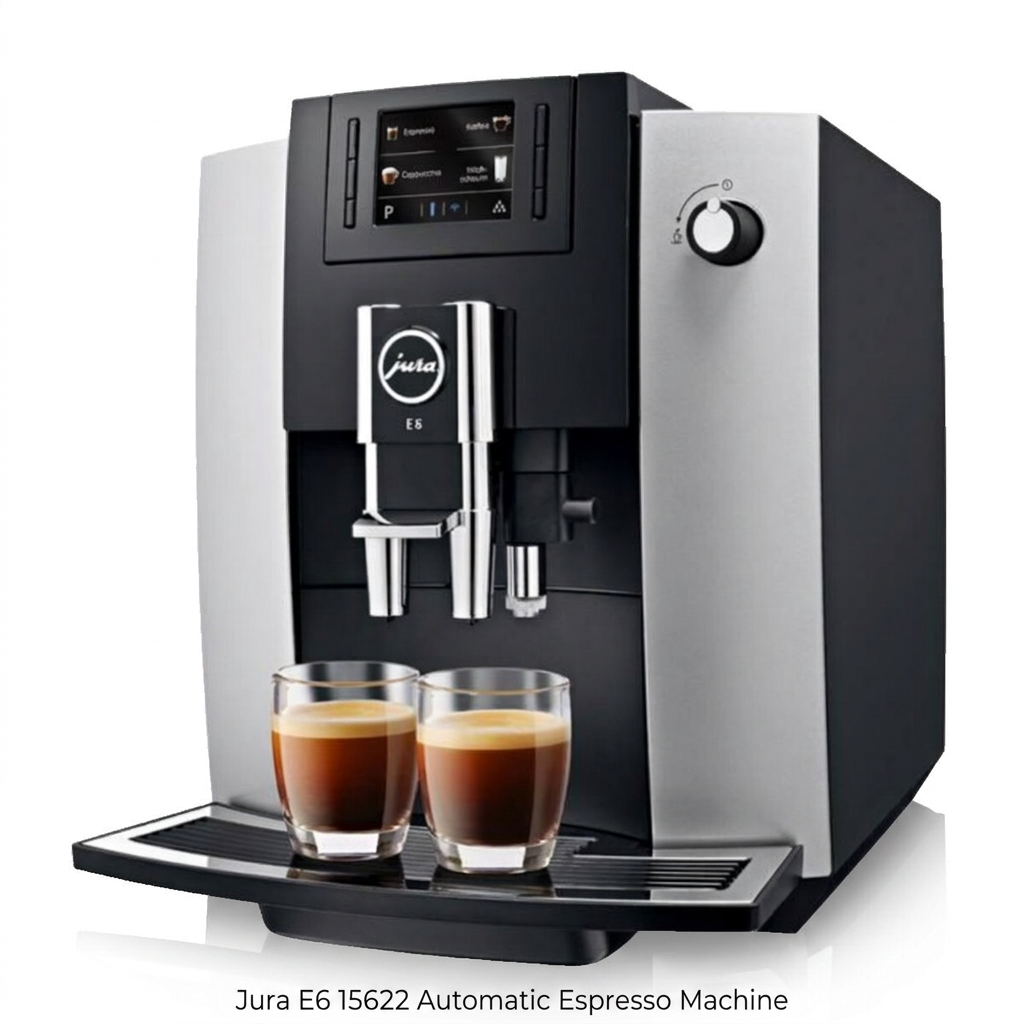
A 16 g brew unit with Pulse Extraction, the richest espresso I tested here, a true two-step americano, tea water at three temperatures and a quiet grinder.
Check price on Amazon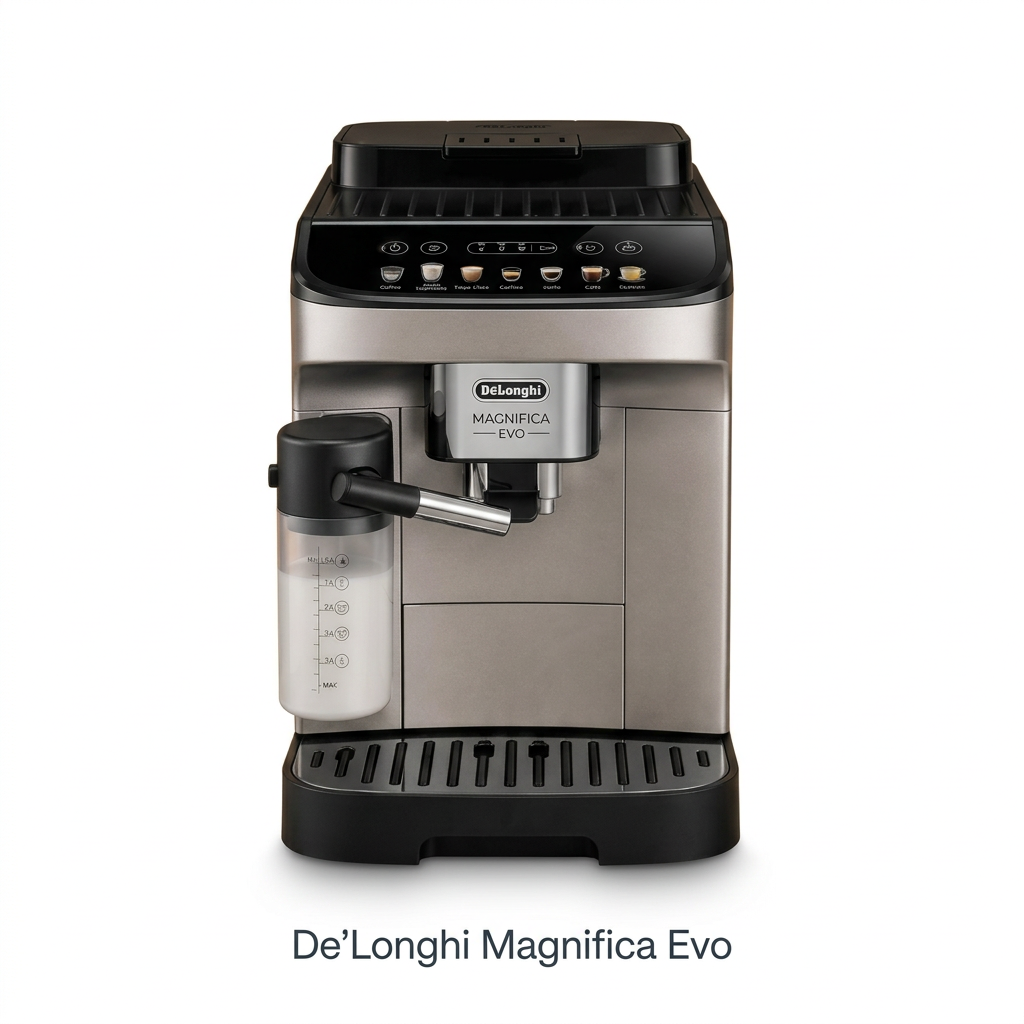
A 15 g top dose, seven one-touch drinks including Over Ice, dense LatteCrema foam and a MyLatte button for any cup size.
Reveal Today’s DealJura vs De’Longhi at a glance
- Both brands grind a generous 15 to 16 g dose, so both make real espresso.
- Jura wins on straight espresso, tea water, quiet grinding and premium finish.
- De’Longhi wins on milk foam temperature and density, cleaning access and value.
- Jura’s brew unit stays inside and is cleaned with tablets; De’Longhi’s slides out for a rinse.
Head to head
The better result in each row is marked, based on four weeks with each of the four machines and the manufacturer specs.
This is a brand-level table comparing the best of each brand. Price is not in it, but it is the reason this comparison exists, so weigh each row against how much more you are willing to pay.
| Spec | Jura (E6 and E8) | De’Longhi (Evo and Rivelia) |
|---|---|---|
| Top dose | 16 g | 15 g |
| Best espressomy score | 8.8 (E6) ✓ Best | 8.5 (Evo) |
| Milk temperature | About 122°F (E8) | About 140–149°F (Rivelia) ✓ Best |
| Milk foam | Silky microfoam (E8) | Dense, stable foam |
| Most one-touch drinks | 17 (E8) | 18 (Rivelia) ✓ Best |
| Tea water | 3 temperatures (E6) ✓ Best | Single hot water |
| Brew unit cleaning | Tablets, stays inside | Slides out, rinse with water ✓ Best |
| Filter tracking | Automatic on E8 ✓ Best | Hardness-based reminder |
| Grinder noise | Rubber-mounted, low (E6) ✓ Best | Evo 70–71 dB |
| Profiles or two hoppers | No | Rivelia: 4 profiles, 2 hoppers ✓ Best |
| Iced coffee button | No | Over Ice (Evo) ✓ Best |
| Build and finish | Premium, chrome-look ✓ Best | Mostly plastic |
| Rows won | 5 | 5 |
Jura vs De’Longhi pros and cons
Jura (E6 and E8)
- Heavy-bodied, sweet espresso with Pulse Extraction
- Premium build, quiet grinding and polished controls
- E6 tea water at three temperatures; E8 tracks its own filter
- Costs a lot more for similar drinks
- Brew unit stays inside and needs tablets
- E8 milk came out cool, at about 122°F
De’Longhi (Magnifica Evo and Rivelia)
- Generous 15 g dose and rich espresso for less
- Dense, hot LatteCrema foam at one touch
- Brew unit slides out for a simple water rinse
- Mostly plastic, less premium feel
- Evo has no hot milk button or profiles
- Rivelia screen lies flat on top
Who should buy which machine?
- Straight espresso and americano drinkers
- Daily tea drinkers alongside coffee
- Buyers who value a premium, quiet machine
- Cappuccino and latte lovers on a budget
- Families wanting profiles or two kinds of beans
- Anyone who wants easy brew-unit cleaning
The four machines I tested
To compare the brands fairly, I picked two from each that sit where most buyers shop.
From Jura: the E6, with nine one-touch drinks, a 2.8-inch color display and Smart Mode, and the E8, which adds 17 drinks, a 3.5-inch display, the J.O.E. app and automatic filter tracking.
From De’Longhi: the Magnifica Evo, with seven drinks and a LatteCrema carafe, and the Rivelia, with 18 recipes, four profiles and two swappable bean hoppers.
| Machine | Best at | My score |
|---|---|---|
| Jura E6 | Espresso, americano and tea | 8.4 |
| Jura E8 | Many one-touch milk drinks | 8.1 |
| De’Longhi Magnifica Evo | Rich coffee and dense foam for less | 8.3 |
| De’Longhi Rivelia | Profiles, two hoppers, quiet | 8.5 |
Notice the overall scores. The cheapest machine here, the Magnifica Evo, scored within a whisker of both Juras, and the Rivelia scored highest of all. That tells you a lot about what you are paying for.
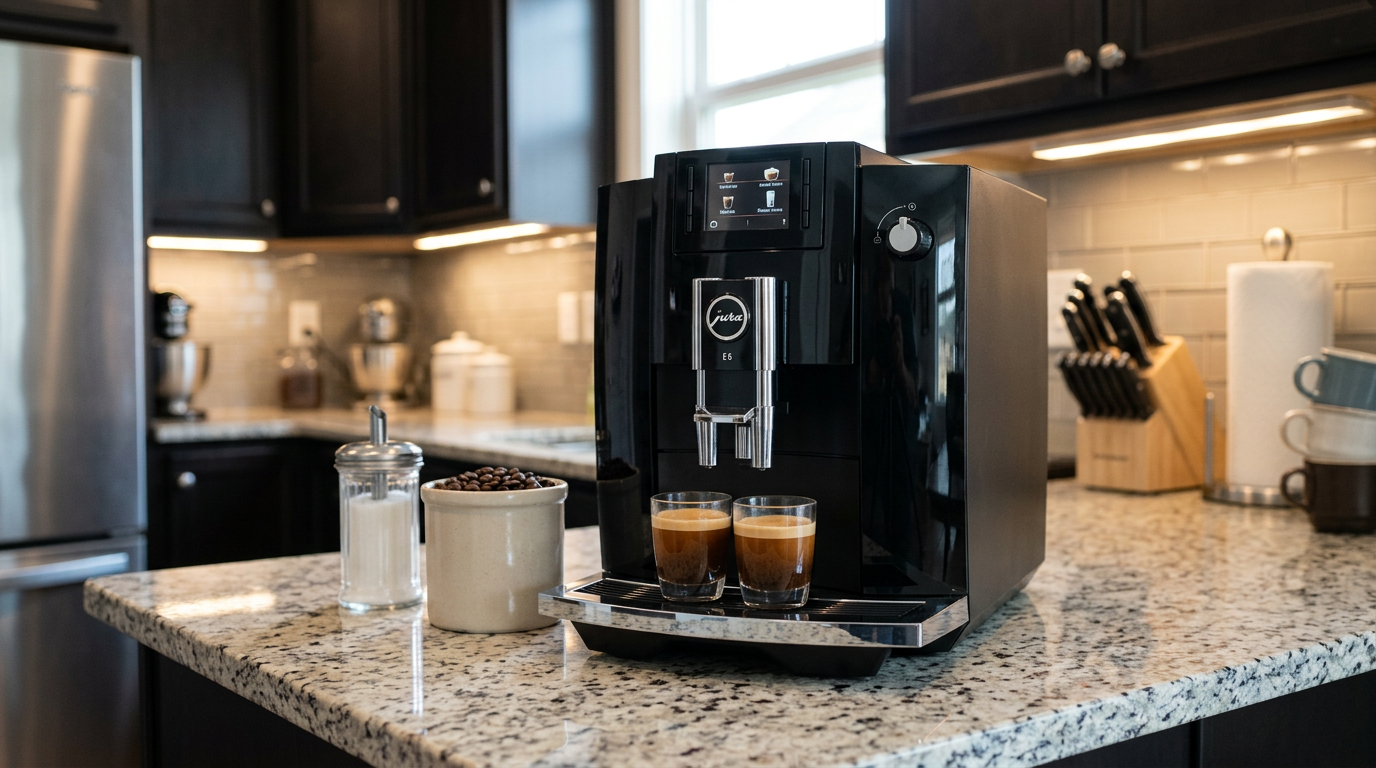
The Jura E6 pulled the richest espresso of the four machines.
Build and design
This is where Jura’s premium is most obvious. The E6’s glossy housing felt solid, with no flex when I pressed the panels, and the E8’s chrome-look front and cup light made it look like a small café appliance.
Both Juras are about 11 inches wide and 13.8 inches tall, and only 0.3 inches apart in depth. Their controls are physical buttons flanking a color display, which worked with damp fingers and needed no instructions.
The De’Longhis are mostly plastic, with a brushed-look front and stainless cup tray on the Evo and a black body with a top touchscreen on the Rivelia. They felt well put together, with tight panels and no rattles after four weeks, but not premium.
One honest note: the E8’s plastic drip tray grid was the one place it felt less premium than I expected at this level.
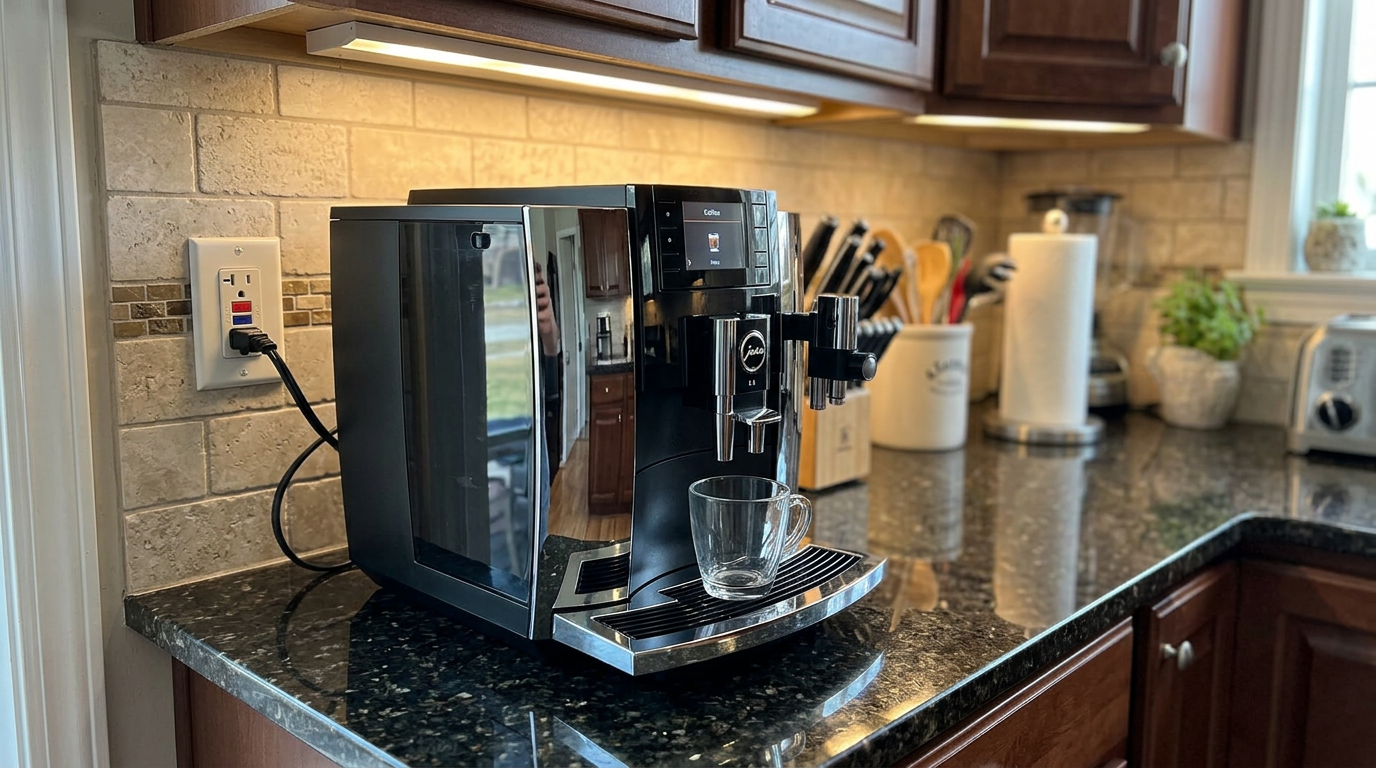
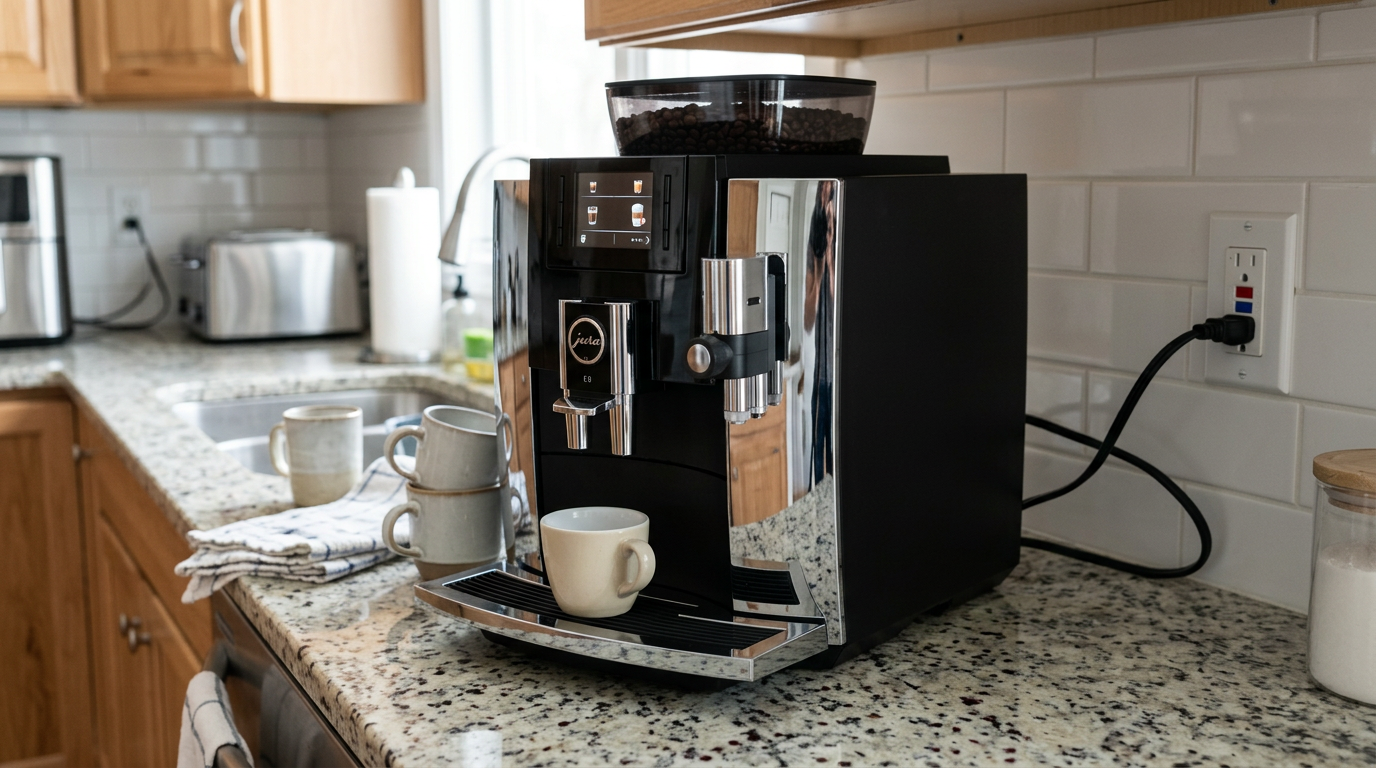
The Jura E8’s chrome-look front and cup light give it the more premium look.
Our tip: Measure the gap under your wall cabinets before you buy, and leave about two inches above the hopper so refilling beans never means sliding the machine forward.
How they brew
Both brands use a 15-bar pump, a thermoblock✕ThermoblockA compact heater that warms water as it passes through a metal block, instead of keeping a tank of water hot. It heats fast and switches quickly between tasks. heater and an internal brew unit, so on paper they are similar. The details differ.
Jura uses its Pulse Extraction Process✕Pulse Extraction Process (P.E.P.)Instead of one steady stream, the machine sends water through the coffee in short, rapid pulses. It helps short drinks like espresso extract more evenly., sending water through the coffee in short pulses after a short pre-infusion✕Pre-infusionA short soak of the ground coffee before full pressure, so the water flows through the puck evenly.. Both Juras take 5 to 16 grams per brew, so a 12-ounce mug or a double shot is one full extraction.
De’Longhi’s Evo offers about 9, 12 and 15 grams on its strength icons, and the Rivelia grinds up to about 15 grams. That is a generous dose for an automatic machine and only slightly below Jura’s.
Grinder behavior differed too. On the E6, the grind dial next to the hopper has six positions; setting 3 with the strongest level became my default, and setting 2 gave a bolder shot with thicker crema. On the E8, 15-gram doses took about five seconds, which limits friction heat.
On both De’Longhis, the 13-setting knob inside the hopper should only be turned while grinding, and the strength icons, not the grinder, did most of the work on body.
Top dose per brew
Jura from spec and my use; De’Longhi weighed at the highest strength.
| Brewing detail | Jura E6 | Jura E8 | Magnifica Evo | Rivelia |
|---|---|---|---|---|
| Pump | 15 bar | 15 bar | 15 bar | 19 bar |
| Extraction | P.E.P., pre-infusion | P.E.P. | Standard | Pre-infusion |
| Dose | 5–16 g | 5–16 g | ~9, 12, 15 g | Up to ~15 g |
| Grinder | 6-position, rubber-mounted | Fast, ~5 s for 15 g | Steel, 13 settings | Steel, 13 settings |
Espresso quality
This is Jura’s strongest argument. With a medium-dark blend on the E6’s setting 3 and strongest level, the espresso had a heavy body and thick crema✕CremaThe golden, foamy layer on top of a fresh espresso, formed when pressure pushes oils and gases out of the coffee., with dark chocolate, toasted nuts, low bitterness and a clean finish.
The E8 was smooth with a thick, even crema and mild chocolate, but a touch thin in body; its finest grind setting felt slightly coarse.
The Magnifica Evo was very close behind the E6. At grind setting 3 and high strength, it gave a full, aromatic body with cocoa, toasted nuts and dried fruit, at around 8 percent TDS✕TDS (total dissolved solids)The share of the drink that is dissolved coffee, measured with a refractometer. on my refractometer. The Rivelia’s 15-gram, 1:2 shots had a similarly full body.
My espresso scores
Body, crema, flavor and consistency, out of 10.
So Jura makes the single best espresso here, but it also makes the weakest. The brand alone does not guarantee a better shot; the model does.
Americano and long coffee
A proper americano is espresso plus hot water. Many machines fake it by pushing a whole mug of water through the coffee, which over-extracts it and turns it bitter.
Both Juras do it properly, pulling a concentrated espresso first and adding hot water through a separate path. The E6 lets you change strength or volume mid-drink and then save it, so my americano of about 2 oz of espresso and 3 oz of water was tuned once and stayed that way.
On the De’Longhis, I ran hot water first and put the espresso on top, which had more body than their Coffee buttons. It works well, but it is two presses instead of one.
Milk drinks
Both Juras draw milk through a silicone hose from a carton or container. Inside the frothing head, steam creates suction through the Venturi effect✕Venturi effectWhen steam rushes through a narrow channel it creates suction, pulling milk up a hose and mixing in air., mixes in air and makes fine foam.
The E6 makes one foam texture, good for its one-touch cappuccino, but there is no one-touch flat white or latte macchiato. The E8’s foam was the best part of its milk system: dense, smooth microfoam✕MicrofoamMilk foam with bubbles so small you can barely see them. It feels silky and glossy. that suits every milk drink.
The catch on the E8 is temperature. My frothed milk measured about 122°F, pleasant to sip straight away but cooler than many people expect.
The De’Longhis use a carafe instead of a hose. The Evo’s LatteCrema foam was dense, fine and stable, closer to a soft meringue, and the Rivelia’s milk came out at about 140 to 149°F. Both carafes can live in the fridge between drinks.
Milk drink scores
My milk scores out of 10, weighing texture, temperature and convenience.
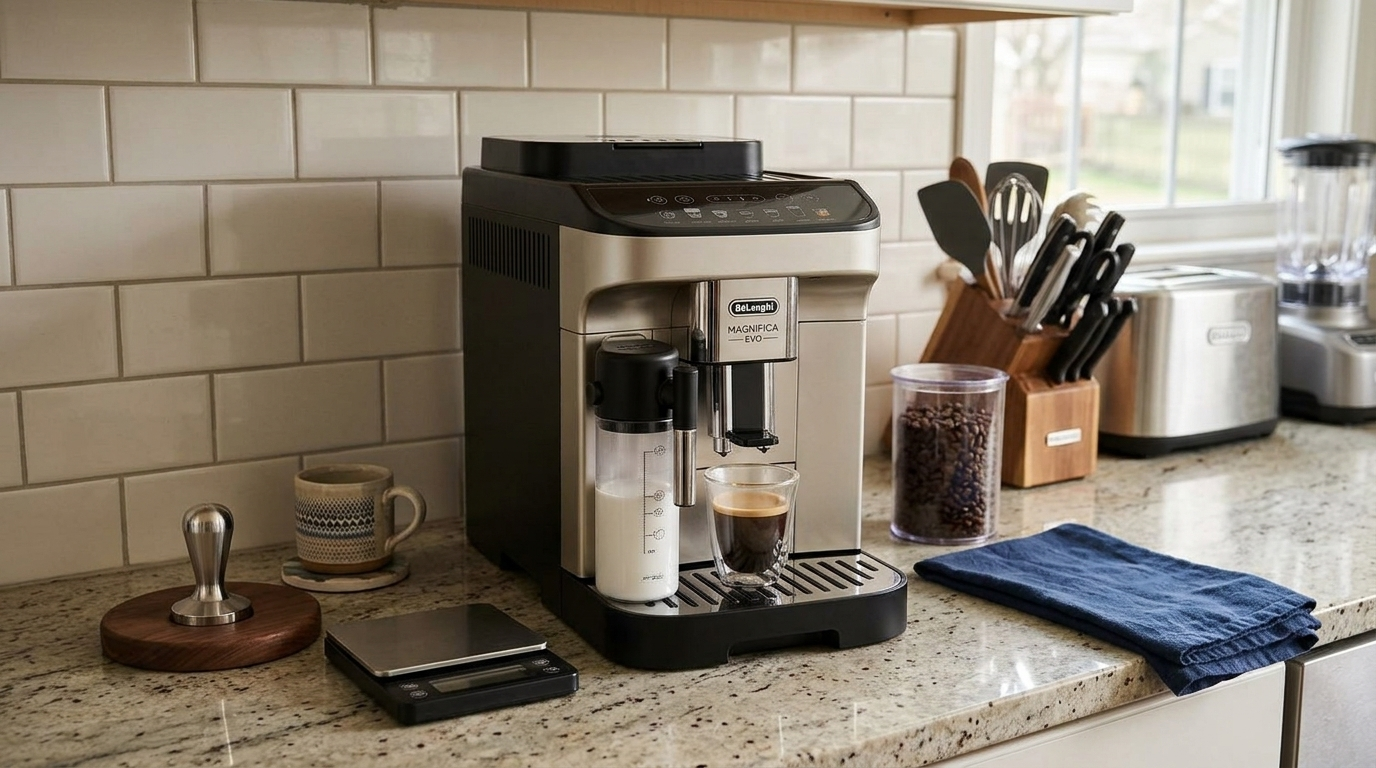
De’Longhi’s carafes made hotter, denser foam than either Jura.
| Milk detail | Jura E6 | Jura E8 | Magnifica Evo | Rivelia |
|---|---|---|---|---|
| System | Hose, one texture | Hose, fine-foam spout | LatteCrema carafe | Milk carafe |
| Milk temperature | Warm | About 122°F | Hot | 140–149°F |
| Flat white at one touch | No | Yes | MyLatte | Yes |
| Cleaning | Rinse prompt, tablet | Parts come apart | Clean function | Clean cycle |
Our tip: Pre-warm your cup with hot water before every milk drink on the Jura E8, because its milk comes out at about 122°F and a cold cup cools it fast.
Hot water and tea
If anyone in your house drinks tea, this section matters. The Jura E6 has three hot water temperatures: low for green and white tea, medium for herbal and high for black tea, plus a separate splash-free hot water spout.
The E8’s hot water topped out at about 176 to 185°F in my tests, fine for green tea but a little cool for strong black tea. The Rivelia’s hot water measured 194 to 203°F, hot enough for most teas.
| Tea | Ideal water | Jura E6 | Jura E8 | Rivelia |
|---|---|---|---|---|
| Green | 158–176°F | Low setting | Yes | A bit hot |
| White | 167–185°F | Low setting | Yes | A bit hot |
| Herbal | 194–212°F | Medium setting | Fair | Yes |
| Black | 203–212°F | High setting | A bit cool | Close |
Our tip: Fit the Jura E6’s dedicated hot water spout whenever you make tea, so you get a clean stream with no trace of milk.
Cleaning and upkeep
This is a quiet but important difference. Neither Jura has a brew unit you can pull out and rinse; both ask for a cleaning cycle, and you drop in a cleaning tablet when prompted.
Both De’Longhis have a removable brew unit✕Brew unitThe part that compresses the ground coffee, holds it while water passes through and then ejects the used puck. that slides out for a weekly rinse under the tap, with no tablets. Some owners prefer to see and touch the brew unit; others prefer Jura’s closed, automated approach.
On the milk side, the E6 prompts a rinse after milk drinks and runs a deep clean with a tablet in under four minutes. The E8’s frothing head comes apart without tools. The Evo flushes its carafe with a Clean function after each drink, and its lid comes apart weekly.
The E8 also detects its CLEARYL Smart+ filter automatically and shows every maintenance task on a dashboard, which removes one more thing to remember.
Hands-on cleaning per day with milk drinks
My estimates, not counting automatic rinses.
Noise
The Jura E6 was the quietest grinder of the four. It sits on rubber mounts with sound-damping inside the housing, and makes a low, short burst rather than a sharp whine.
The E8’s grinder is quick, but the gears that move its brew unit make a noticeable clunk during preparation and again when the puck is ejected. In an open-plan apartment at 6 a.m., you will hear it.
On the De’Longhi side, the Rivelia measured 66 to 68 dB while grinding and brewing, quiet for the class. The Evo’s grinder hit 70 to 71 dB for its first five or six seconds, with frothing at 60 to 62 dB.
How loud each felt, my ranking
Relative loudness from my side-by-side use. Shorter bars are quieter.
Size and weight
All four are compact for automatic machines. The Juras are about 11 inches wide, 13.8 inches tall and 17.3 to 17.6 inches deep, at about 21 to 22 lb.
The De’Longhis are narrower: the Evo about 9.45 inches wide, 17.3 deep and 14.2 tall, and the Rivelia about 9.6 by 16.9 by 15.2 inches, both around 21 lb.
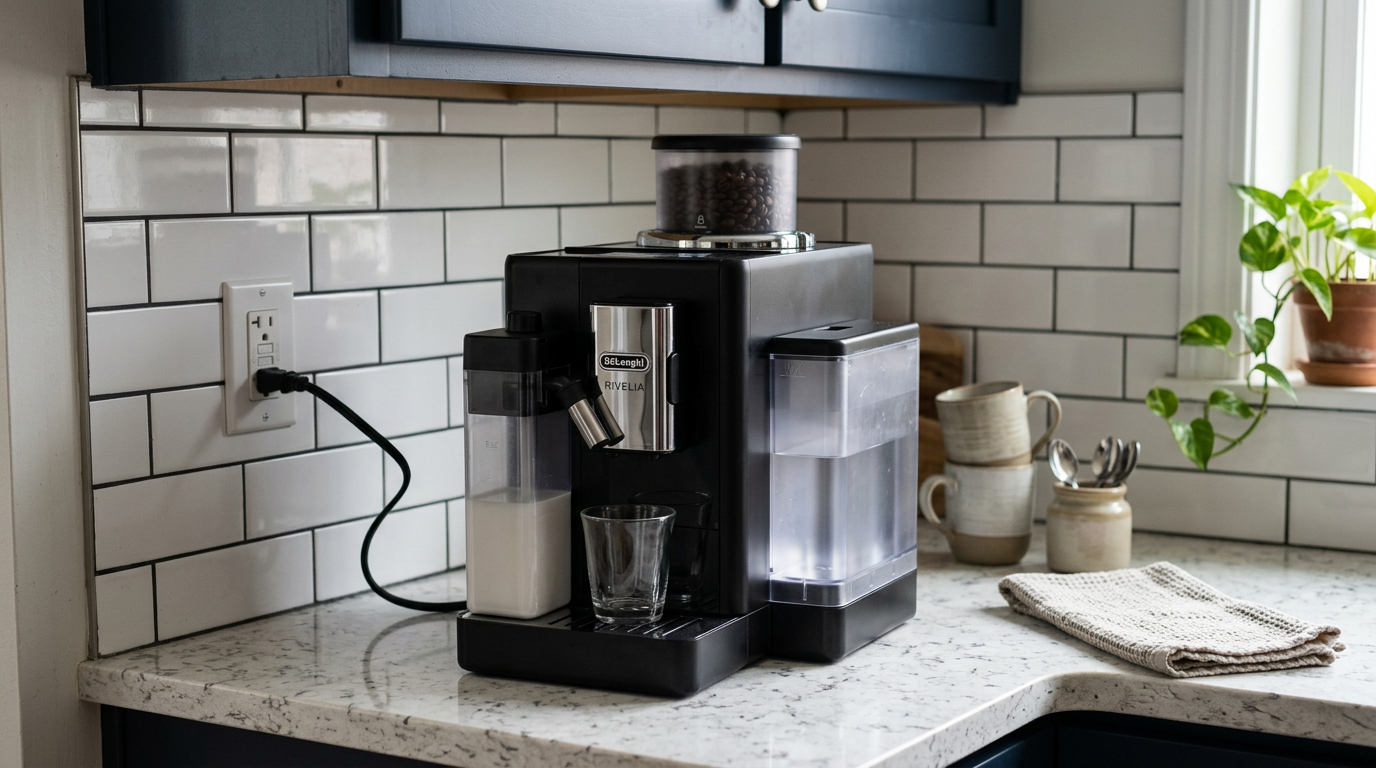
The Rivelia is narrow and quiet, with two swappable bean hoppers.
Is Jura worth paying more for?
After eight weeks with these four machines, my honest answer is: sometimes. The premium does not buy you dramatically better coffee across the board; it buys you specific strengths.
If you drink straight espresso and americanos, the Jura E6’s heavier body and thicker crema are a real, tasteable step up. If tea is a daily habit, its three water temperatures and separate spout are genuinely useful. And if you value quiet, premium materials and a closed, low-touch maintenance routine, Jura delivers that.
If you mostly drink cappuccinos and lattes, though, De’Longhi gave me hotter, denser foam for considerably less. And the Rivelia’s profiles and two bean hoppers solve family problems that neither Jura I tested does.
| What you pay for | Jura delivers? | De’Longhi alternative |
|---|---|---|
| Better straight espresso | Yes, on the E6 | Evo is close behind |
| Better milk drinks | No, cooler milk | Hotter, denser foam |
| More drinks | E8, 17 | Rivelia, 18 |
| Quiet | E6 yes, E8 clunky | Rivelia 66–68 dB |
| Premium build | Yes | Mostly plastic |
| Less maintenance thinking | E8 filter tracking | Hardness-based reminders |
Who each brand is really for
Jura’s ideal buyer drinks black coffee most days, maybe with a cappuccino at the weekend, appreciates a beautifully finished appliance and wants the machine to handle maintenance with as little thinking as possible. For that person, the E6 is a joy.
De’Longhi’s ideal buyer makes milk drinks every day, often for several people, and would rather put the difference toward good beans. The Evo and Rivelia are built around exactly that routine.
Plenty of people sit in between, and for them the deciding factor is usually budget. In my testing, spending more on Jura bought refinement, not a fundamentally different cup.
Our tip: Decide what you drink most before you compare price tags, because Jura’s advantages are concentrated in espresso and tea, not in milk drinks.
Beans, water and filters
All four rewarded fresh whole beans used within a few weeks of the roast date. Medium and medium-dark roasts worked best across both brands, and very oily or flavored beans are a bad idea on any automatic grinder.
Use fresh, cold water every day. The Juras use Jura’s filter cartridges, with the E8 detecting CLEARYL Smart+ automatically; the De’Longhis include a water filter and set descale reminders from the hardness you enter.
| Bean type | Jura E6 | Jura E8 | De’Longhi |
|---|---|---|---|
| Medium-dark blend | Best all-rounder | Best espresso | Full body, thick crema |
| Medium roast | Brighter americanos | Good long coffee | Bright and sweet |
| Light roast | Setting 2, strongest | Bright; extend the shot | Can taste sour |
| Very dark, oily | Avoid | Avoid | Avoid |
University of Oregon researchers found that uneven extraction can waste up to 40% of the coffee in a puck, which is one reason fresh, evenly ground beans matter on every machine here.
Our tip: Buy a bag of beans you can finish in two or three weeks, because all four grinders show off fresh coffee far better than stale.
Find Out the Price TodayA month with each brand
A machine feels different on day thirty than on day one, so here is how each brand settled into my routine.
Week one
On both Juras, setup followed the same pattern: test water hardness with the strip, enter it, fit the filter and let the machine rinse. The first few drinks were weaker than they should be while the grinder settled, so I did not judge anything until the fourth cup.
On the De’Longhis, the first-week task was the grind. Moving the Evo from the middle of the range down to setting 3 made the biggest difference, and the Rivelia’s Bean Adapt wizard suggested a sensible starting point for each new bag.
Weeks two and three
By week two, the E6’s Smart Mode had moved americano and espresso to its first page and cappuccino to page two. On the E8, the long coffee at the highest temperature became my morning mug, with a dense, durable crema and a soft, almond-like sweetness.
On the De’Longhis, routines settled quickly: the Evo’s carafe lived in the fridge, MyLatte cortados became a habit, and the Rivelia’s decaf hopper went on every afternoon.
Week four
Nothing broke, leaked or rattled on any of the four. The recurring gripes were small and model-specific: cool milk on the E8, the clunk of its brew gears, the Evo’s missing hot milk button and the Rivelia’s flat top screen.
| After four weeks | Jura | De’Longhi |
|---|---|---|
| Best drink | E6 espresso and americano | Evo cappuccino, Rivelia latte |
| Best feature | E6 tea water, E8 filter tracking | Evo MyLatte, Rivelia hoppers |
| Daily chore | Milk rinse prompts | Carafe Clean function |
| Biggest gripe | E8 milk temperature | Evo no hot milk button |
Smart features
The Jura E8 was the only machine here I ran from an app. Jura’s J.O.E. app shows maintenance as percentages and countdowns, lets you set size, strength and temperature, and started grinding within about a second of pressing start on my phone.
I never needed it for daily use, because the buttons do everything. The De’Longhis do without an app; the Rivelia’s four profiles and Coffee Routines were the more useful smart feature for a family.
Our tip: Give any new machine a full week and four or five drinks before you judge the coffee, because the grinder needs a few cycles to settle.
Our tip: Save each person’s drink as a profile on the Rivelia, or let the Jura E6’s Smart Mode learn your habits, so your usual coffee is always one press away.
Real-life scenarios
Specs only go so far. These are the situations where one brand clearly pulled ahead across my testing.
The E6’s heavy body and thick crema felt like a café espresso.
LatteCrema foam came out dense and hot; the E8’s milk was about 122°F.
The E6’s low water setting and separate spout kept tea clean and unscorched.
The Rivelia swaps bean hoppers in seconds.
The E6’s rubber-mounted grinder was the quietest of the four.
The Magnifica Evo scored within 0.1 of the Jura E6 overall.
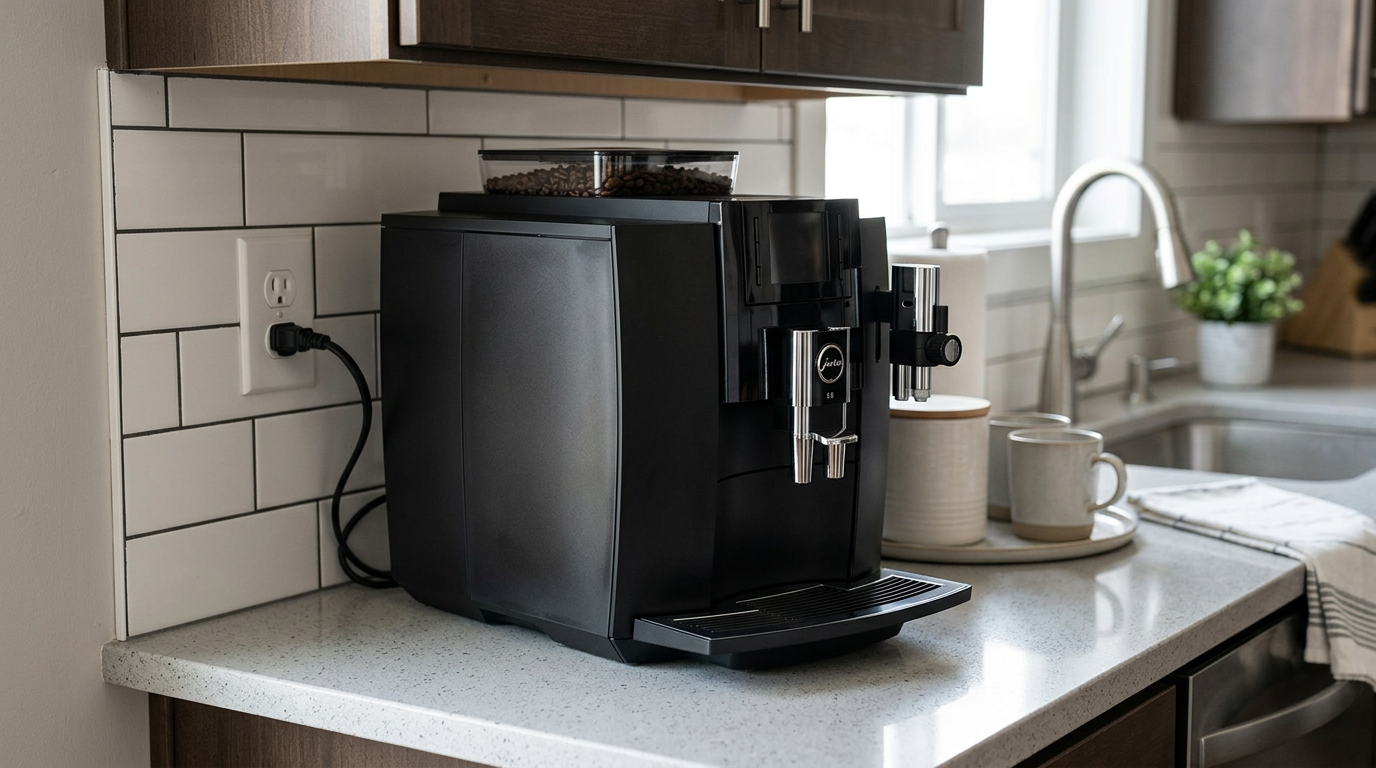
The Jura E8 is the easiest Jura to share, with 17 one-touch drinks.
My scorecard
These scores come straight from my single reviews of each machine, all out of 10.
| Machine | Espresso | Milk | Ease of use | Cleaning | Overall |
|---|---|---|---|---|---|
| Jura E6 | 8.8 | 8.0 | 8.6 | 8.1 | 8.4 |
| Jura E8 | 8.0 | 7.8 | 8.9 | 8.0 | 8.1 |
| De’Longhi Magnifica Evo | 8.5 | 8.4 | 8.4 | 8.0 | 8.3 |
| De’Longhi Rivelia | 8.3 | 8.5 | 9.1 | 8.2 | 8.5 |
Brand averages
On average, the brands are level, except on milk, where De’Longhi leads. That is the clearest data point in this comparison: you pay more for Jura, and the extra money goes into finish, quiet and specific features rather than a better average cup.
See How Much You’ll SaveWhich one is right for you?
4 quick questionsWhich brand should you buy?
It comes down to one question: is your daily drink black or white? Jura’s advantages cluster around espresso, americano and tea; De’Longhi’s around milk drinks and value.
For the detail behind each machine, read my Jura E6, Jura E8, Magnifica Evo and Rivelia reviews, or my Jura E6 vs E8 comparison.
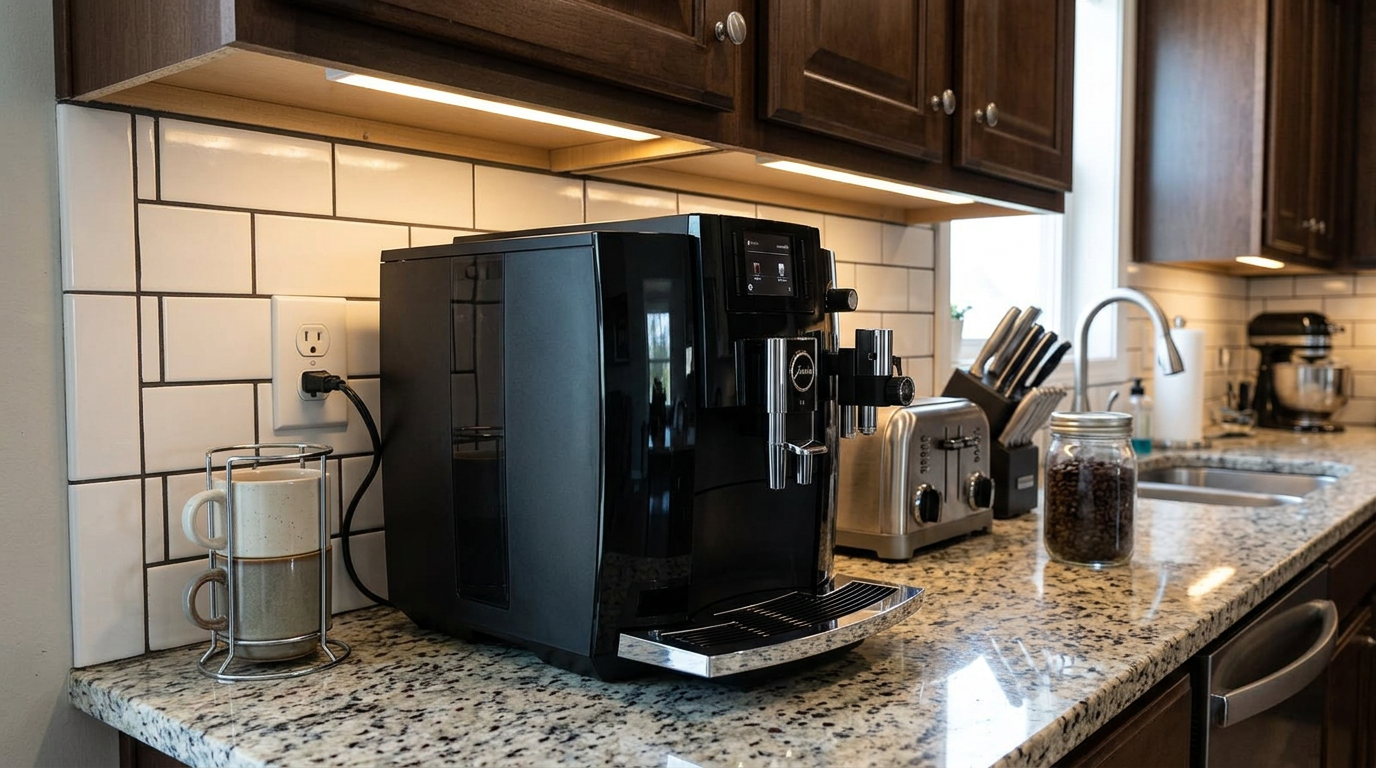
The Jura E6 doubles as a tea station, with three water temperatures.
- You drink espresso or americanos daily
- Someone at home drinks tea
- You want a quiet machine
- You value premium build
- Milk drinks are your main habit
- You want one-touch flat whites
- You want to spend less
- You drink cappuccinos and lattes
- You want dense, hot foam
- You want the best value
- You like iced coffee
- You want premium materials
- You drink tea daily
- You need profiles (choose the Rivelia)
For most homes, my pick is De’Longhi, and specifically the Magnifica Evo. It grinds a generous 15 g, makes dense, hot foam and scored within a whisker of the Jura E6 overall for considerably less. Families should step up to the Rivelia for profiles and two bean hoppers.
The Jura E6 is worth the premium if you drink straight espresso, americanos or tea every day and want a quiet, beautifully made machine. It pulled the best espresso of the four.
Whichever you choose, use fresh medium-dark beans and keep up with the milk cleaning. All four machines reward a little care with years of good coffee.
Jura vs De’Longhi specifications
From manufacturer specifications and my own testing.
| Jura E6 | Jura E8 | Magnifica Evo | Rivelia | |
|---|---|---|---|---|
| Model | 15622 | 15648 | Magnifica Evo | Rivelia |
| Pump | 15 bar | 15 bar | 15 bar | 19 bar |
| Extraction | P.E.P. with pre-infusion | P.E.P. | Standard | With pre-infusion |
| Top dose | 16 g | 16 g | ~15 g | ~15 g |
| One-touch drinks | 9 plus doubles | 17 | 7 | 18 |
| Milk | Hose, one texture | Hose, fine foam, 3 amounts | LatteCrema carafe | Milk carafe |
| Hot water | 3 temperatures | Up to ~176–185°F | Hot water tap | 194–203°F measured |
| Brew unit | Internal, tablets | Internal, tablets | Removable, rinse | Removable, rinse |
| Display | 2.8-in color | 3.5-in color | Touch icons | 3.5-in touchscreen |
| Water tank | 64 oz | 64 oz | About 60 oz | 47 oz |
| Size | 11 x 13.8 x 17.3 in | 11 x 13.8 x 17.6 in | 9.45 x 17.3 x 14.2 in | 9.6 x 16.9 x 15.2 in |
| Weight | ~22 lb | ~21.2 lb | ~21 lb | 21.4 lb |
How I tested and compared them
I used each of the four machines as my everyday coffee maker for four weeks, making espresso, americanos, cappuccinos, flat whites, latte macchiatos, iced drinks and tea water. Testing notes were written up together by Michael Reynolds and the HouseholdMe team.
I weighed doses, measured milk and hot water temperatures with a probe thermometer, checked De’Longhi espresso with a refractometer and measured noise with a sound meter.
I ran every cleaning routine, then compared my notes with Jura’s and De’Longhi’s specifications, owner documentation and published espresso research.
- Coffee: dose, crema, body, flavor and consistency.
- Milk: foam texture, temperature, speed and drink range.
- Workflow: heat-up, controls, guidance and daily routine.
- Ownership: cleaning, water care, noise and footprint.
Jura vs De’Longhi FAQ
Is Jura better than De’Longhi?
Not across the board. In my testing, the Jura E6 made the best espresso and was the quietest, but De’Longhi’s Magnifica Evo and Rivelia made hotter, denser milk foam and scored as high or higher overall for less.
Is Jura worth the extra money?
If you drink straight espresso, americanos or tea every day and value premium build and quiet, yes. If you mostly drink cappuccinos and lattes, De’Longhi gives you more for less.
Which brand makes better espresso?
The Jura E6 scored highest at 8.8, but the De’Longhi Magnifica Evo was close at 8.5, and the Jura E8 scored 8.0.
Which brand makes better milk drinks?
De’Longhi. Its LatteCrema foam was dense and hot; the Jura E8’s milk measured about 122°F.
Can you remove the brew unit on Jura machines?
Not on the E6 or E8. You clean it with a tablet when prompted. De’Longhi’s brew unit slides out for a rinse under the tap.
Which is better for tea?
The Jura E6, with three hot water temperatures and a separate hot water spout.
Which is quieter?
The Jura E6’s rubber-mounted grinder was the quietest; the De’Longhi Rivelia measured 66 to 68 dB. The Jura E8’s brew gears were noticeably louder.
Which has more drinks?
The De’Longhi Rivelia has 18 recipes and the Jura E8 has 17. The E6 has 9 and the Magnifica Evo 7.
Do Jura or De’Longhi machines have profiles?
The De’Longhi Rivelia has four. Neither Jura I tested has profiles, though the E6’s Smart Mode learns your favorite drinks.
Which is easier to clean?
Both are easy. De’Longhi’s removable brew unit is simpler to rinse; the Jura E8 tracks its filter and maintenance automatically.

- Our hands-on Jura E6 review
- Our hands-on Jura E8 review
- Our hands-on De’Longhi Magnifica Evo review
- Our hands-on De’Longhi Rivelia review
- Jura and De’Longhi product specifications and owner documentation
- The perfect shot of espresso every time with chemistry, University of Oregon research