De'Longhi Rivelia vs Philips 3300: which automatic espresso machine should you buy?
One gives you two swappable bean hoppers, a color touchscreen and a fuller espresso. The other is quieter, smaller and has a milk carafe that rinses clean in seconds. I lived with both, measured what matters and compared the data to find out which one belongs in your kitchen.
We choose products independently. We may earn a commission through links on this page; your price stays the same. Affiliate policy
Jargon helpNew to espresso? Tap any dotted term to see what it means.
In this comparison
If you care most about what ends up in the cup, I would pick the De'Longhi Rivelia. It grinds almost twice as much coffee per shot, makes richer espresso and lets you swap between two bean hoppers in seconds. The Philips 3300 is the one I would buy for a small kitchen or a light sleeper, because it is quieter, more compact and far quicker to clean. Be aware that the Rivelia takes more cleaning effort, and that a single espresso from the Philips is noticeably lighter.
The two machines
Specs checked November 10, 2026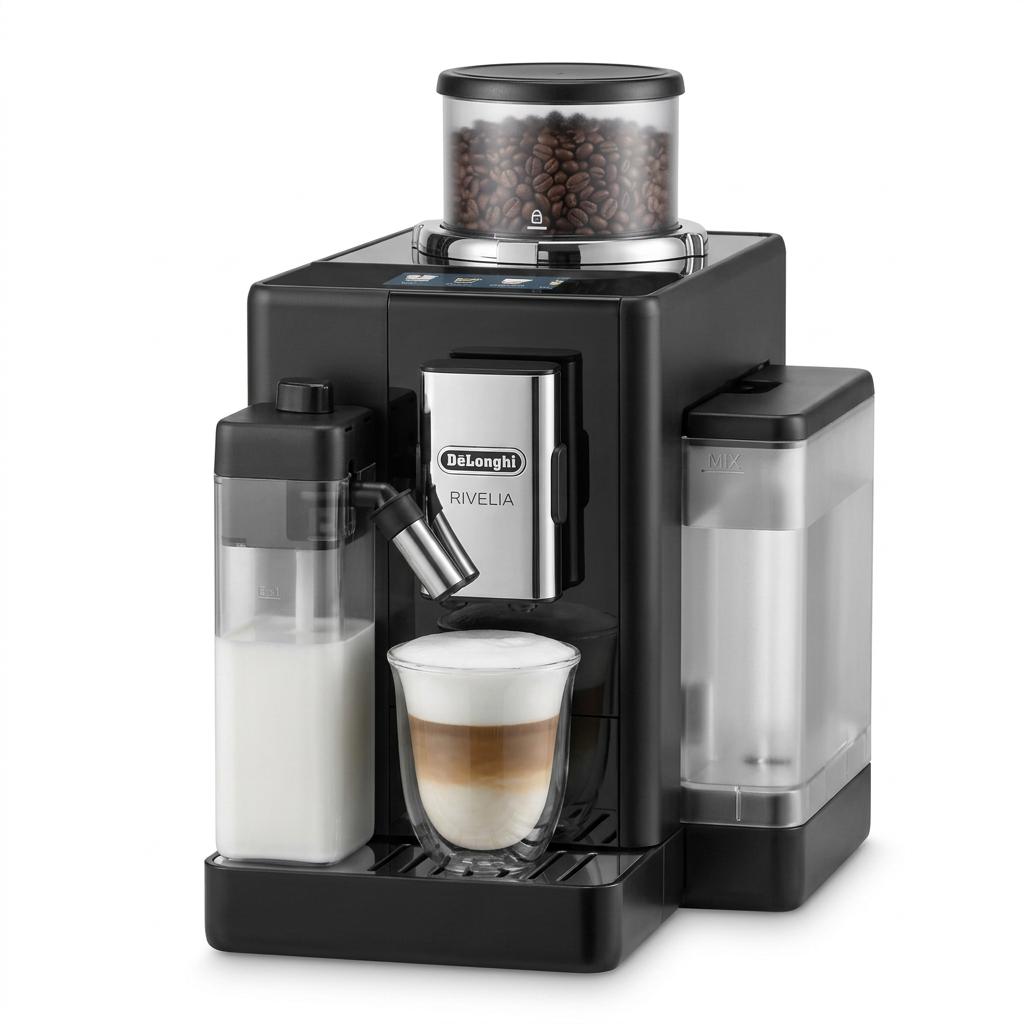
Two swappable bean hoppers, a 15-gram dose, four user profiles and 18 one-touch drinks on a color touchscreen.
See Today’s Price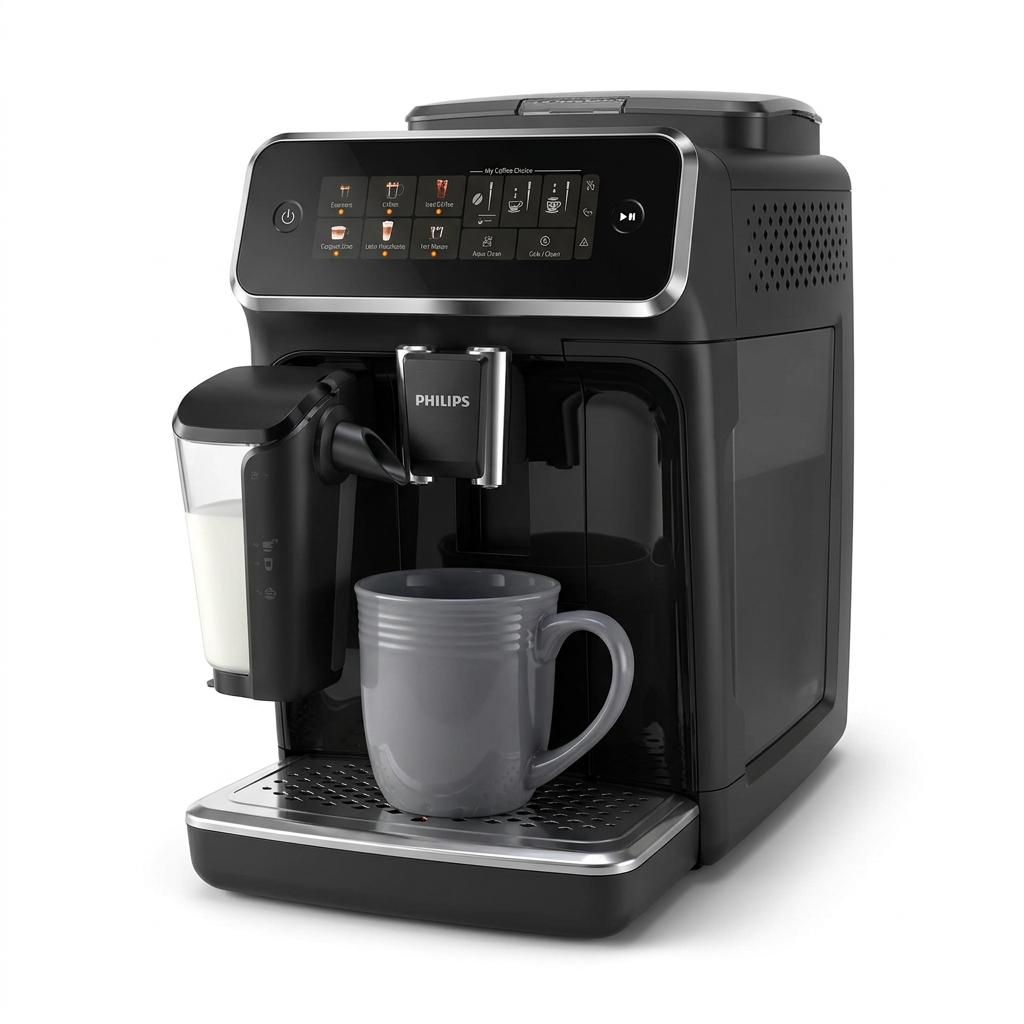
A sealed, quiet grinder, a two-part milk carafe with no tubes and front access to everything you empty or refill.
Reveal Today’s DealRivelia vs Philips 3300 at a glance
- Buy the Rivelia if you drink straight espresso or want regular and decaf on tap. Its bigger dose gives a thicker, sweeter shot.
- Buy the Philips 3300 if cleaning is the chore you dread. Its milk carafe has no tubes, and everything you empty slides out of the front.
- The Philips is clearly quieter when grinding, which matters in open-plan homes and early mornings.
- Neither machine makes true cold brew, but the Rivelia can add cold milk foam with an optional upgrade set.
Head to head
The better result in each row is marked, and rows without a mark are a tie or a matter of taste. Figures come from my own measurements and the manufacturers' specifications.
Keep in mind that the tally is not my verdict. Most of the Philips wins are about size and upkeep, while the Rivelia wins sit closer to the coffee itself.
| Spec | Rivelia | Philips 3300 |
|---|---|---|
| Max doseper single shot | About 15 g ✓ Best | About 8 g |
| Bean hoppers | Two, 8.8 oz each, swappable ✓ Best | One, about 9.7 oz |
| One-touch drinks | 18 recipes ✓ Best | 6 drinks |
| User profiles | Four ✓ Best | None |
| Controls | 3.5-inch color touchscreen ✓ Best | Backlit touch icons |
| Cold milk foam | With optional upgrade set ✓ Best | No |
| Milk carafe cleaning | Clean cycle, weekly strip-down | Two parts, no tubes ✓ Best |
| Grinder noisemeasured | 66 to 68 dB | 61 to 62 dB ✓ Best |
| Water tank | 47 oz, side, top-fill | 61 oz, front ✓ Best |
| Depth | 16.9 in | 14.6 in ✓ Best |
| Weight | 21.4 lb | 17.6 lb ✓ Best |
| Water filter | Included | Up to 5,000 cups between descales ✓ Best |
| Daily emptying | Tray tends to drop at the front | Everything slides out the front ✓ Best |
| Grinder | Stainless conical, 13 settings | Ceramic, 12 settings |
| Pre-ground chute | Yes | Yes |
| Hot water spout | Yes | Yes |
| Removable brew group | Yes | Yes |
| Rows won | 6 | 7 |
Rivelia vs Philips 3300 pros and cons
De'Longhi Rivelia
- Swap between two bean hoppers in about three seconds
- Grinds up to about 15 g for fuller-bodied espresso
- Four profiles and 18 recipes on a color touchscreen
- Each bean swap purges or mixes about 10 g of coffee
- Top-mounted screen is hard to read from below
- Milk carafe needs a full weekly strip-down
Philips 3300
- Gasket-sealed grinder is one of the quietest I have measured
- Two-part milk carafe rinses clean in about 10 seconds
- Compact, light and serviced entirely from the front
- 8 g single dose makes a lighter espresso
- Milk foam is stiff rather than silky
- Only six drinks and no user profiles
Who should buy which machine?
- Homes where one person drinks decaf and another doesn't
- Espresso drinkers who want more body from one button
- Families who want everyone's drink saved under their own name
- Anyone who hates cleaning milk systems
- Early risers with someone asleep nearby
- Smaller kitchens and people moving up from capsules
Design, size and build
On paper these two machines are almost the same width, but they feel very different on the counter. The Rivelia has rounded corners, a slim body and a water tank that clips onto the side rather than sliding out of the back.
The Philips 3300 is a more conventional upright box. It is a little taller, but it is noticeably shallower, and it fit into a gap on my counter that I had assumed was only good for a utensil jar.
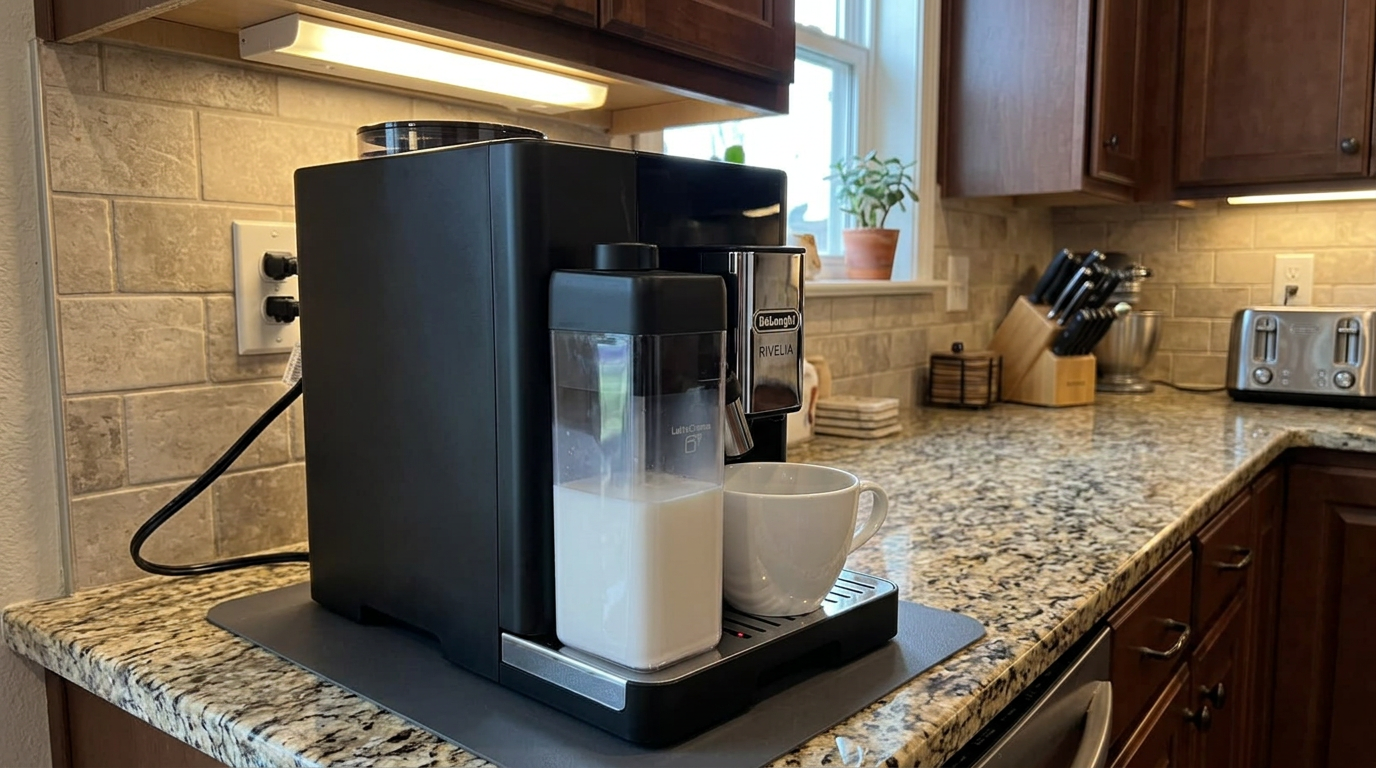
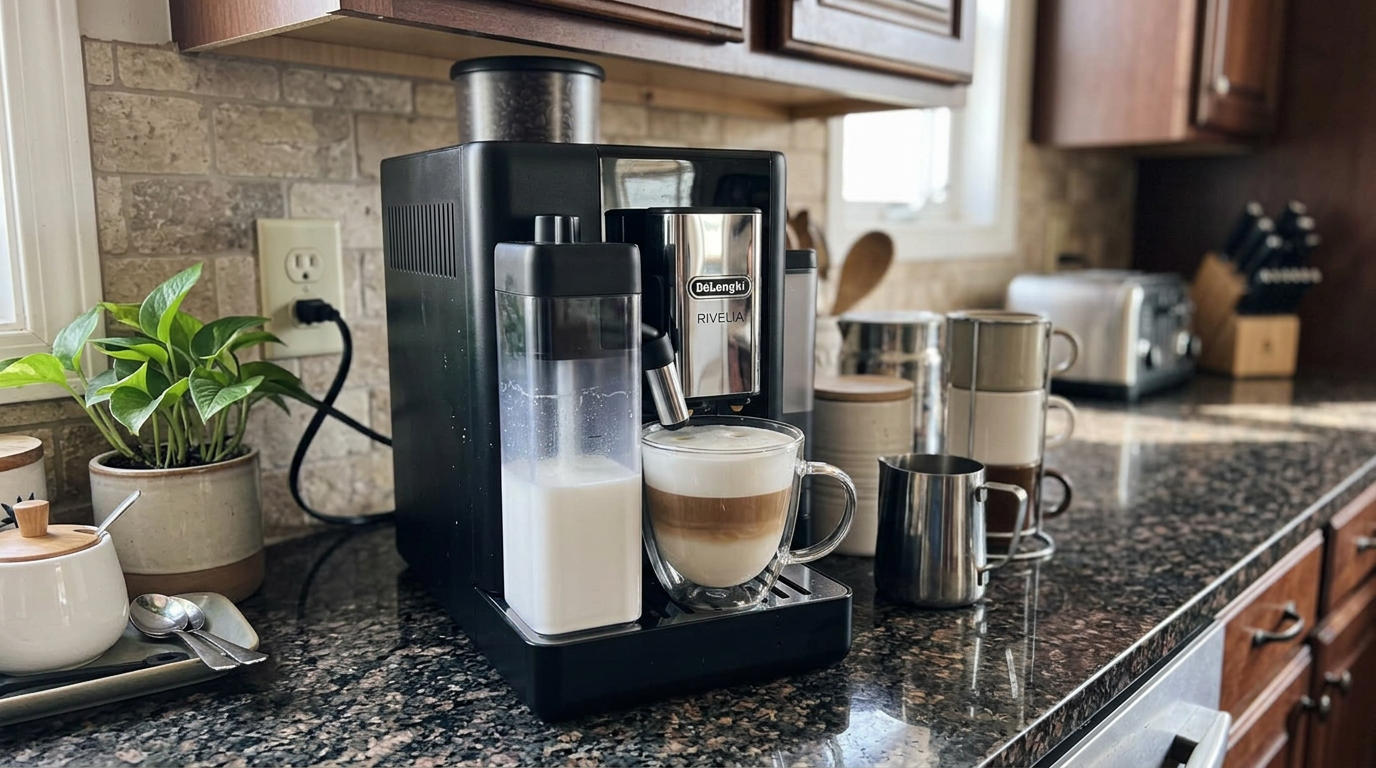
The Rivelia's rounded body looks less boxy than most bean-to-cup machines.
Depth is the number I would check first. The Rivelia is about 16.9 inches deep, and the drip tray needs room in front, while the Philips is only about 14.6 inches deep.
Height works the other way. Both bean hoppers and the touchscreen sit on top of the Rivelia, so you need clearance under your wall cabinets to twist a hopper off and read the display.
Depth on the counter
Build quality is closer than the looks suggest. Both bodies are mostly plastic, and both wipe down easily.
The Philips has a little flex in its removable water tank, but its drip tray is excellent. Internal baffles stop water sloshing on the way to the sink, and the stainless grate shrugs off scratches from mugs.
My biggest gripe with the Rivelia is that there are no handles or finger recesses anywhere. Every time I wanted to wipe underneath it, I had to hug all 21 pounds of it with both hands.
Our tip: Measure the gap under your wall cabinets before ordering the Rivelia, because you need room above it to lift off a hopper.
Setup and the first week
Both machines guide you through setup, and both were ready in about 15 minutes. You test your water hardness with the included strip, fit the water filter and let the machine prime and rinse itself.
The difference showed up after that. The Rivelia's Bean Adapt wizard asks about your beans and suggests a grind setting, so my first drinks were already close to where I eventually settled.
The Philips needed patience instead. Its new ceramic burrs✕Ceramic burrsGrinding parts made of ceramic instead of steel. They stay cool and last a long time. and brew group✕Brew groupThe removable unit inside an automatic machine that holds, presses and brews the ground coffee. took roughly 20 to 30 drinks to settle in, and the pucks went from crumbly to firm over that time.
Philips 3300 puck quality during break-in
If you judge the Philips on day one, you will judge it too harshly. I would make about two weeks of normal coffee before changing anything.
Our tip: Treat the first few drinks from either machine as throwaways, because they flush out the factory rinse water and loose grounds.
Controls and drink menu
This is one of the clearest differences between the two. The Rivelia runs everything from a sharp 3.5-inch color touchscreen, with a coffee menu, a milk menu and 18 one-touch recipes.
It also stores four user profiles. One person's flat white and another's long coffee each live under their own icon, and within a week my usual morning drink was waiting on the first screen.
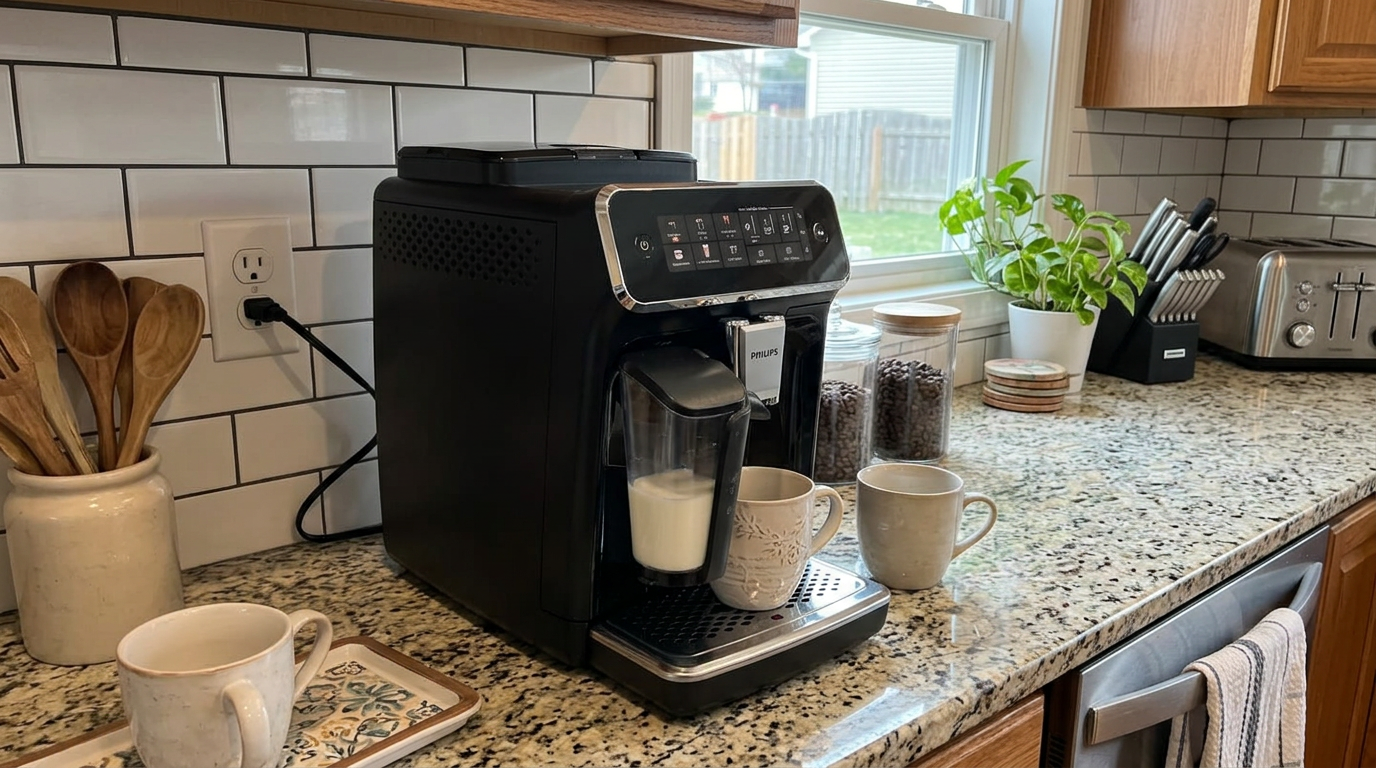
The Philips keeps things simple with one backlit icon per drink.
The Philips takes the opposite approach. Six backlit icons cover espresso, coffee, cappuccino, latte macchiato, iced coffee and hot water, and there is no menu to scroll through before your first coffee.
Each drink has three levels of strength, volume and milk. That gives you 27 combinations for every milk drink, but the steps are coarse, and there is nowhere to save a personal recipe for each person.
| Feature | Rivelia | Philips 3300 |
|---|---|---|
| Interface | 3.5-inch color touchscreen | Backlit touch icons |
| One-touch drinks | 18 | 6 |
| User profiles | 4 | None |
| Strength levels | 5 intensity steps | 3 |
| Learns your habits | Yes, suggests usual drinks | No |
| Screen visible when seated | Poorly, it faces upward | Yes, front panel |
The Rivelia's weakness is where that lovely screen sits. It lies flat on top of the machine, so it looks great when you stand over it and poor from a lower angle.
My kids could not easily read it, and anyone using a wheelchair would struggle. The Philips icons face forward on the front panel, so everyone in the house can see them.
Bean hoppers and switching coffee
This is the feature most people buy the Rivelia for. It ships with two 8.8-ounce hoppers that twist on and off the grinder, and a shutter closes as you lift one away so the beans stay inside.
The swap itself took me about three seconds every time. What happens next is the part worth understanding, because about 10 grams of beans always stay between the hopper and the burrs✕BurrsTwo ridged grinding surfaces that crush beans to an even size, unlike a blade that chops them..
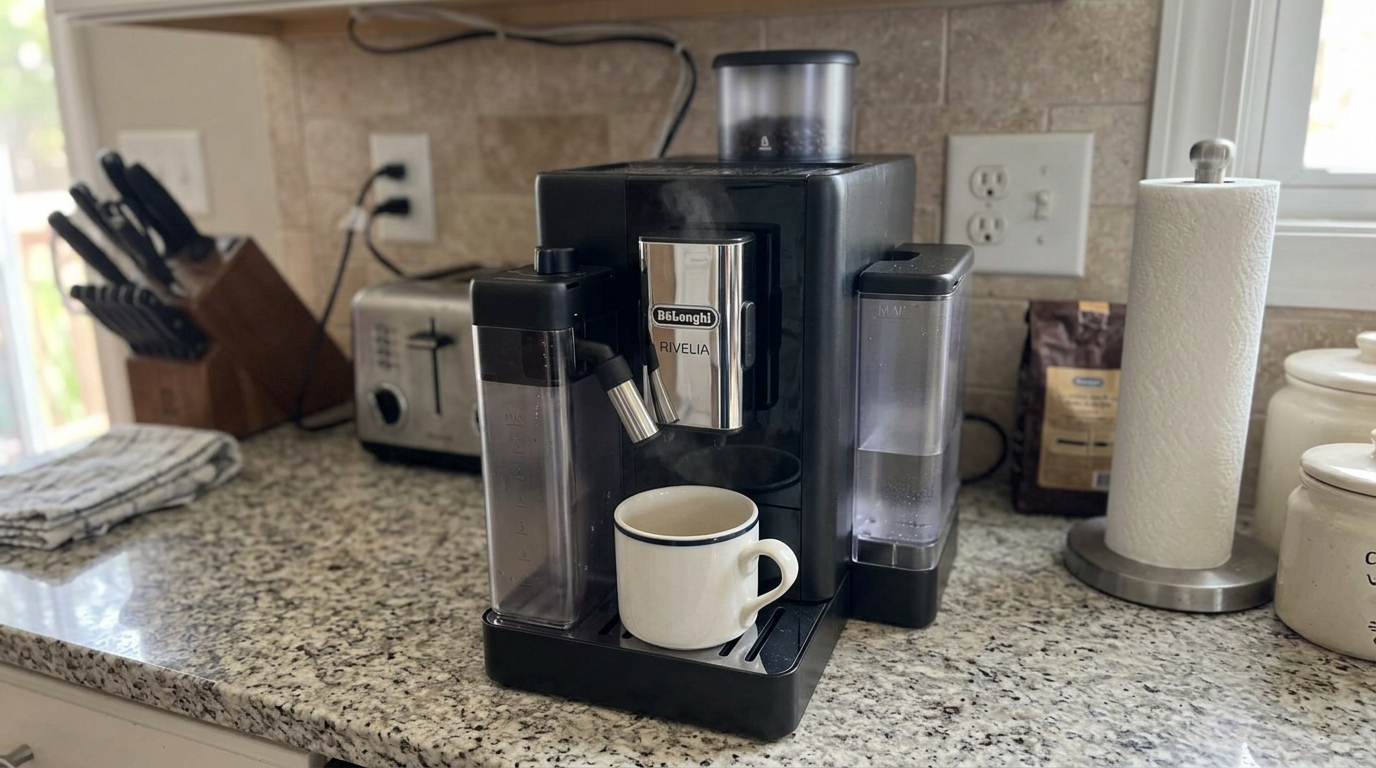
The hopper on top lifts off with a quarter turn, which makes a regular-and-decaf routine easy.
The machine lets you grind and empty those leftovers, or use them in a transition drink. If you are switching to decaf in the afternoon, a transition drink still contains caffeine, so I chose to purge almost every time.
Rivelia beans purged per day by switching habit
The Philips has one 275-gram hopper with a sealed lid. For decaf, it offers a pre-ground chute, so you can add one level scoop of up to about 12 grams for a single drink without touching the beans.
That works for an occasional evening cup, but it means keeping a bag of pre-ground decaf, which goes stale far faster than whole beans. The Rivelia keeps both coffees fresh and whole.
There is one real limit on the Rivelia's party trick. It has one grinder with one dial, so a pale light roast and an oily dark roast will not both extract at their best on the same setting.
| Hopper pairing on the Rivelia | How well it worked |
|---|---|
| Regular and decaf, same roast level | Excellent |
| Two medium blends | Excellent |
| Medium and dark roast | Good, small grind compromise |
| Light and dark roast | Uneven |
Our tip: Fill the Rivelia's two hoppers with coffees of a similar roast level, ideally from the same roaster, so one grind setting suits both.
Grinder and dose
The two grinders are close on paper. The Rivelia uses stainless steel conical burrs✕Conical burrsA cone-shaped burr sitting inside a ring. A common, durable design for even grinding. with 13 settings, and the Philips uses ceramic burrs with 12.
Both had enough headroom at the fine end. With beans roasted about four weeks earlier, the Rivelia could grind fine enough to nearly stall the pump, and the Philips gave its best results on settings 1 to 3.
The real gap is in how much coffee each machine uses. At intensity 5, the Rivelia's grinder ran for about 10 seconds and produced a dose✕DoseThe amount of ground coffee used for one drink, measured in grams. of roughly 15 grams on my scale.
The Philips brew chamber tops out at about 8 grams per cycle. Its three strength levels move the dose between roughly 6 and 8 grams, which is why the taste difference between them is subtle.
Coffee per single shot
The Philips can close most of that gap with its double function. Two cycles into one cup add up to about 16 grams, and the difference in body is obvious.
One rule applies to both grinders. Only turn the grind dial while the grinder is running, because turning it while idle can force the burrs against trapped beans.
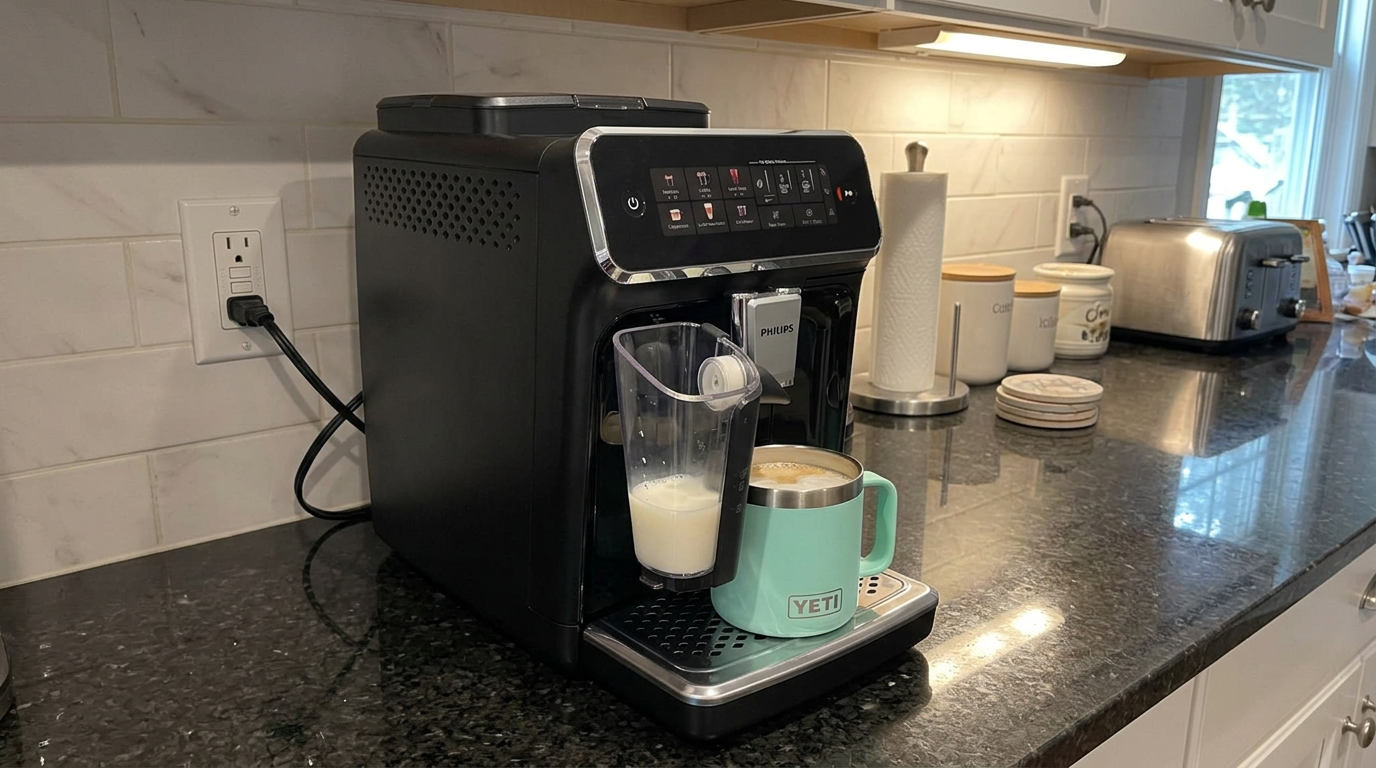
Moving the Philips grinder down to settings 1 to 3 gave me firmer pucks and more body.
| What you taste | Likely cause | First change on either machine |
|---|---|---|
| Sour, sharp, thin | Under-extraction | Grind one step finer |
| Bitter, harsh, drying | Over-extraction | Grind coarser or lower the volume |
| Watery body | Dose too low | Raise strength, or brew a double on the Philips |
| Coffee drips very slowly | Grind too fine | Grind one step coarser |
Our tip: After any grind change, brew two or three drinks before judging it, because coffee from the old setting is still in the grinder path.
Espresso quality
This is where the bigger dose pays off. With a medium-roast blend, the Rivelia poured a thick layer of hazelnut crema✕CremaThe golden-brown foam on top of a fresh espresso, made of oils and gases released during brewing. and tasted of cocoa and toasted nuts with a full body.
I aimed for roughly a 1:2 ratio✕RatioCoffee in versus drink out by weight. A 1:2 ratio means 15 g of coffee makes about 30 g of espresso., with 15 grams in and about 30 grams in the cup. After a short pre-infusion✕Pre-infusionA short burst of water that wets the coffee before full pressure, so the water flows through more evenly., the shot was intense and chocolate-forward, and very good for one button press.
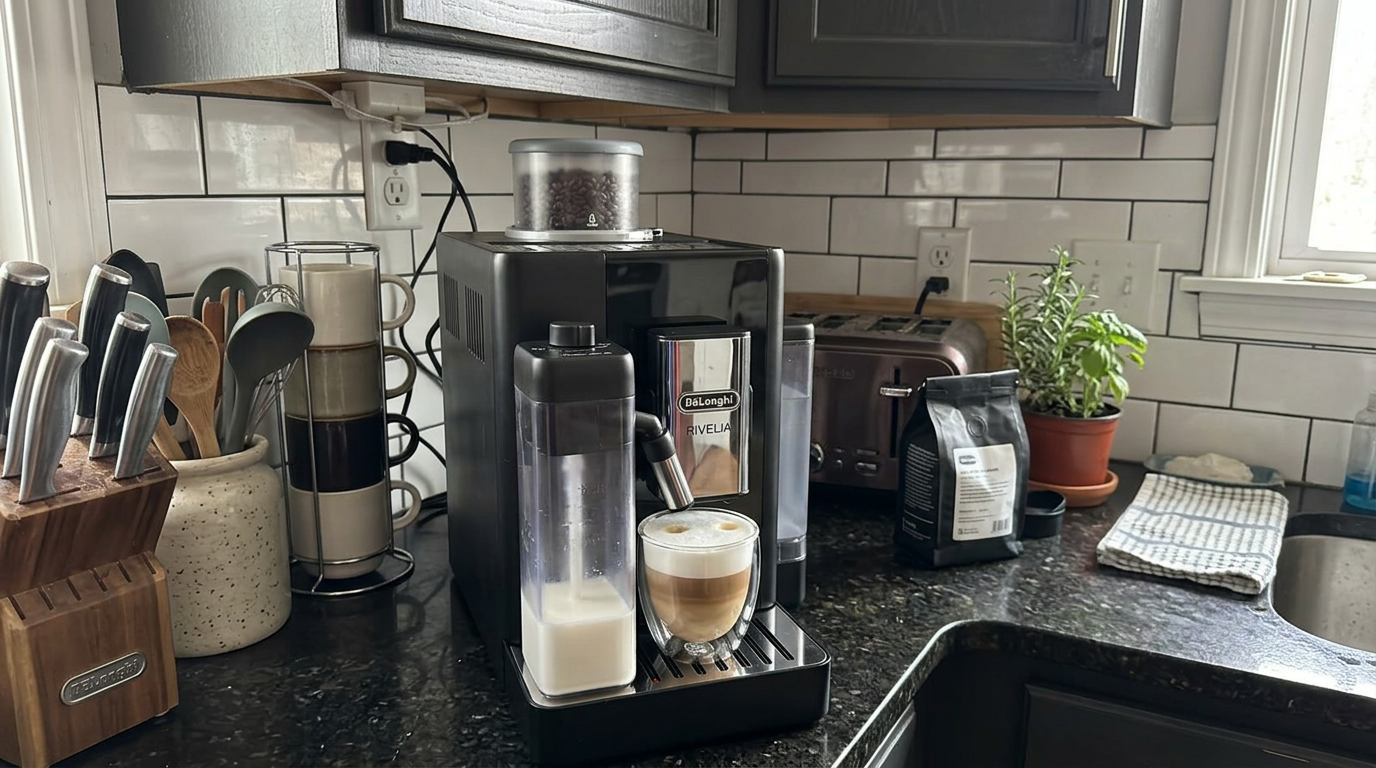
The Rivelia's 15-gram dose shows up as a thicker, sweeter espresso.
The Philips 3300 made a clean, balanced shot with a moderate crema and none of the burnt bitterness I have had from cheaper automatic machines. It was simply lighter in body.
To put numbers on that, I measured TDS✕TDSTotal dissolved solids: the percentage of your drink that is dissolved coffee. Higher means stronger and denser. on the Philips at fine grind settings. It landed between 4.5% and 5.5%, while a traditional manual espresso machine usually reaches 10% to 12%.
Espresso strength (TDS)
On its own, a single espresso from the Philips tastes closer to a strong short coffee than a café shot. Under milk, that difference matters far less than you would think.
The Rivelia does not reach manual-machine levels either, and lighter coffees lose some of their delicate fruit notes. Still, side by side, it was the espresso I reached for every time.
Heating and temperature
Both machines heat water on demand with a thermoblock✕ThermoblockA heater that warms water as it flows through, instead of keeping a tank of water hot all day. rather than keeping a boiler hot. That keeps warm-up short and energy use low when they sit idle.
The Rivelia needs a moment between milk and espresso, and I could hear it bringing its heater down from steaming temperature to brewing temperature. That short pause is the reason the espresso never tasted scorched after the milk.
On the Philips, espresso came out of the spout at about 185°F on startup, and coffee for milk drinks measured 183 to 185°F. That is a few degrees lower than ideal brewing water, though some heat is lost on the way to the cup.
| Measured output | Rivelia | Philips 3300 |
|---|---|---|
| Frothed milk | 140 to 149°F | Warm, best in a preheated glass |
| Espresso at the spout | Hot, no scorched taste | About 185°F |
| Hot water spout | 194 to 203°F | 170 to 194°F |
| Temperature settings | Adjustable, set by Bean Adapt | 3 levels |
| Rated power | 1,450 W | 1,500 W |
Hot water spout, top reading
For tea, both are hot enough for black tea and topping up an Americano. The Rivelia's hot water ran a little hotter, though its plastic spout feels cheaper than the rest of the machine.
Our tip: Run a splash of hot water into your cup and tip it out before brewing, so a cold mug doesn't steal heat from a small espresso.
Milk drinks
Both machines use a clip-on carafe that froths milk and pours it straight into your glass. You choose a drink, and each one handles the milk and the espresso in the right order.
The Rivelia's LatteCrema Hot carafe clips onto the left side and draws milk through a small tube. It offers three foam styles, from light to dense, and you can stop the milk and coffee at the volume you like and save the result.
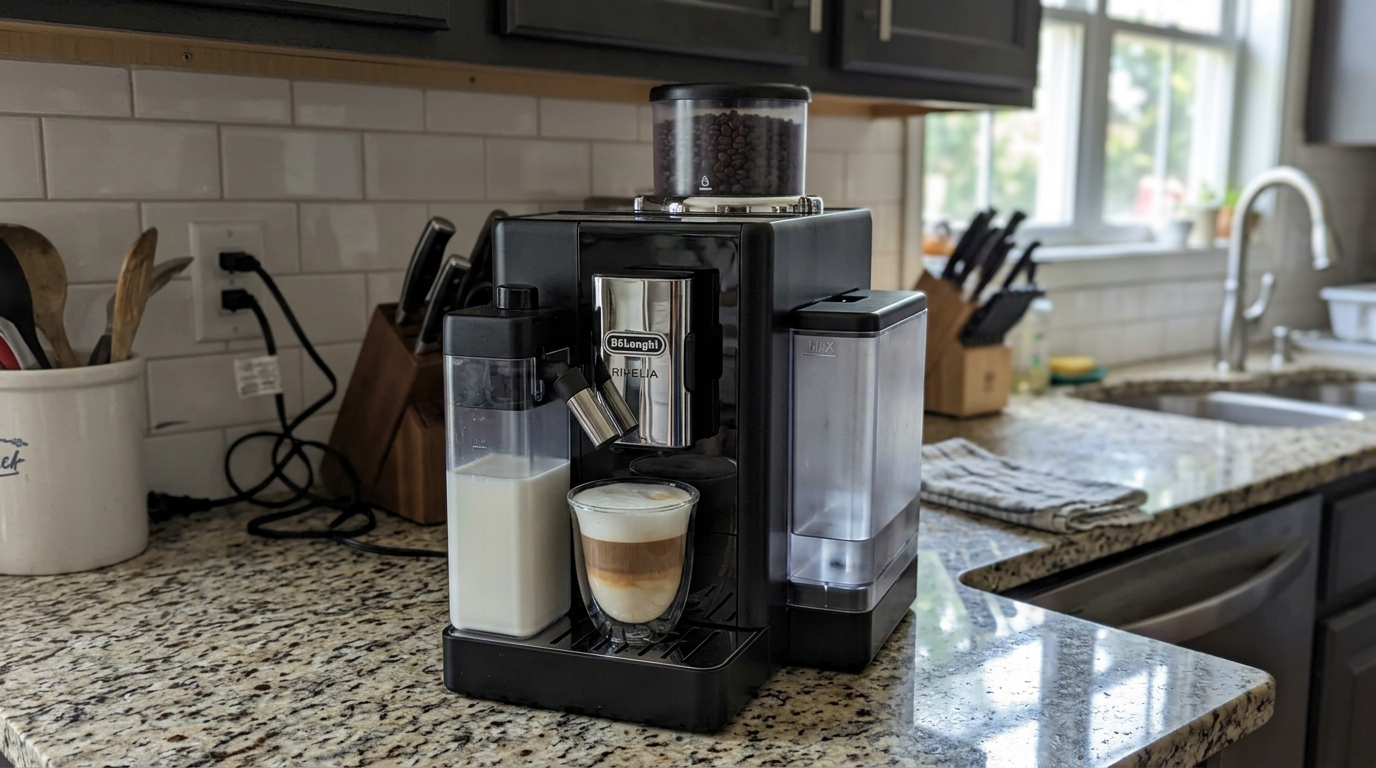
The Rivelia's foam came out smooth and stable, with fine bubbles.
Its foam was smooth and stable, with fine bubbles. It is a little airier than the silky microfoam✕MicrofoamMilk with tiny, even bubbles that feels silky and pours well enough for latte art. a barista makes by hand, which is perfect for a cappuccino and very good for a flat white.
The Philips LatteGo carafe is just two molded parts that snap together, with no tubes or hidden channels. Milk is pulled into a small side chamber, whipped with air and poured into the cup.
Its foam was dense, stiff and generous. That makes a classic spoonable cappuccino cap, but the bubbles are coarser, and the foam sits on the milk rather than blending into it.
Milk scores out of 10
Both handled oat milk well, and barista-style plant milks held their foam best on each. The Rivelia's milk measured 140 to 149°F, which is right where milk tastes sweetest, but it may feel a bit mild if you like your latte very hot.
Capacity favors the Rivelia for bigger rounds. The Philips carafe holds 260 ml, enough for about two cappuccinos, and its lid has no latch, so it slid off twice when I lifted the carafe by its body.
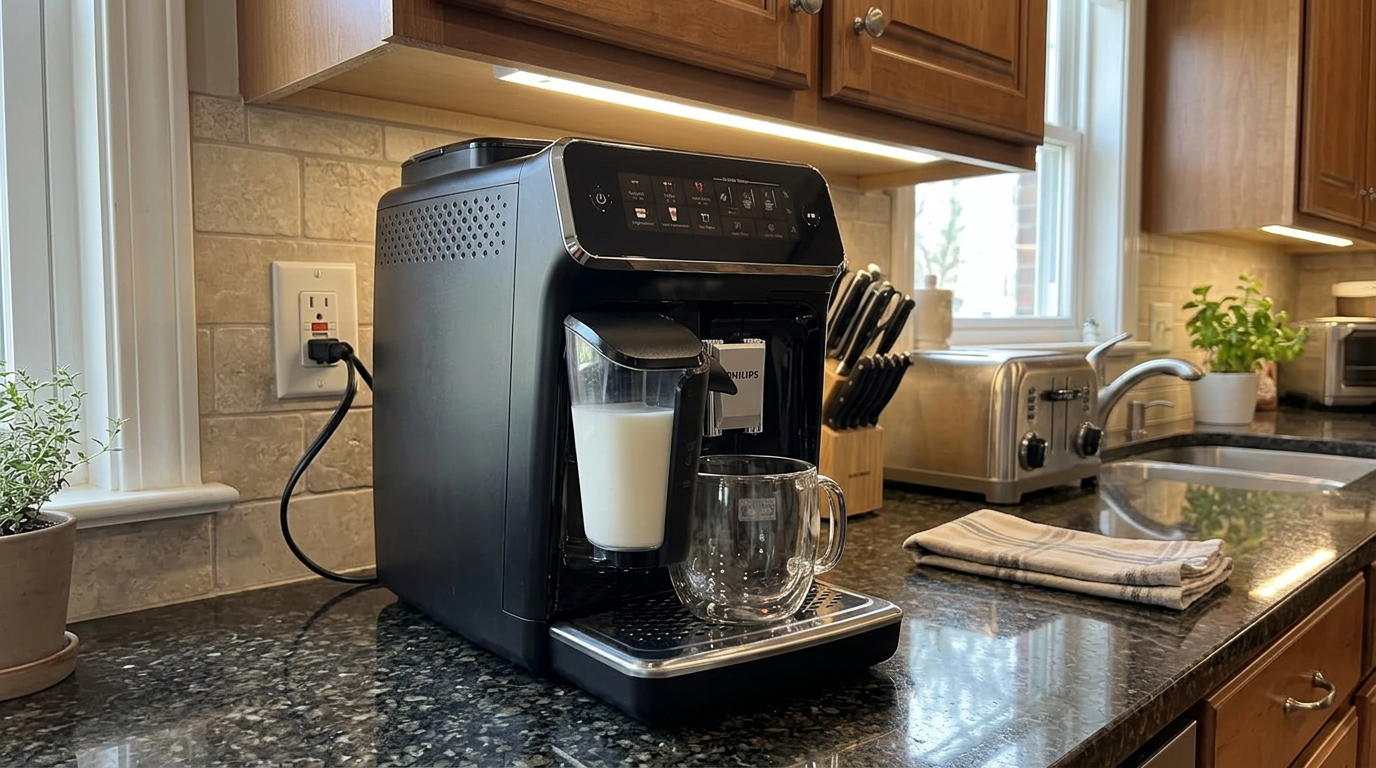
The LatteGo carafe has no tubes, which is why it rinses clean so quickly.
Our tip: Use milk straight from the fridge in either carafe, because cold milk builds firmer, longer-lasting foam.
See How Much You’ll SaveIced coffee and cold drinks
Both menus show iced drinks, so it is easy to assume either one can make cold coffee. Neither can brew cold, and neither makes true cold brew, which needs hours of slow steeping.
The Rivelia's iced recipes pour hot espresso or coffee onto ice you have already put in the glass. The Philips iced coffee setting is a little cleverer, because the pump pulses more slowly and brews a concentrated coffee at a slightly lower temperature.
The Rivelia has one card up its sleeve. De'Longhi sells an optional LatteCrema Cool upgrade set with a cold milk carafe, which unlocks six cold recipes and real cold foam that the Philips cannot match.
| Cold drink | Rivelia | Philips 3300 |
|---|---|---|
| Espresso over ice | Yes | Yes |
| Dedicated iced coffee setting | Recipe over ice | Slower, concentrated brew |
| Cold milk foam | With optional upgrade set | No |
| True cold brew | No | No |
How cold the drink got, by amount of ice
On both machines, the amount of ice made the biggest difference. With only a few cubes I got a lukewarm, diluted drink, while a full glass cooled the coffee almost instantly.
Noise
The Philips is the quieter machine, and it is one of its best features. A thick rubber gasket in the hopper lid seals the grinder compartment and absorbs most of the high-pitched whine.
With the lid closed, its grinder peaked at 61 to 62 decibels✕Decibels (dB)A measure of loudness. Every 10 dB increase sounds roughly twice as loud to most people.. I took the lid off to test it, and the same grind jumped to 72 to 73 decibels.
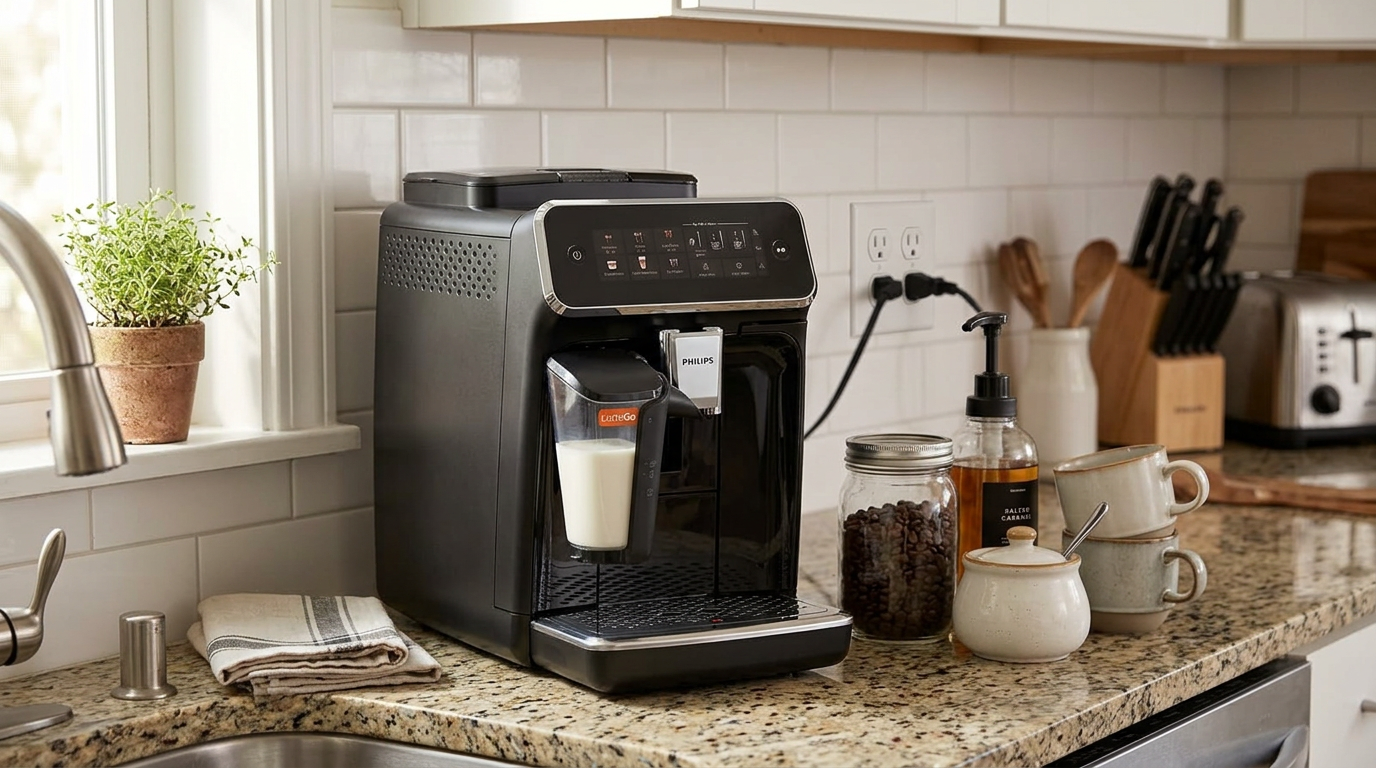
With its lid shut, the Philips grinder is a low rumble rather than a whine.
The Rivelia measured 66 to 68 decibels during grinding and brewing. That is still quiet for a fully automatic machine, roughly the level of a running dishwasher, and its grind only lasts about 10 seconds.
Measured peak noise at about 1 meter
I made coffee on the Philips at 6 a.m. with a child asleep in the next room, and nobody woke up. With the Rivelia, a light sleeper near the kitchen may notice the grinder.
Our tip: Press the Philips hopper lid down firmly after every refill, because a lid left slightly open undoes most of its noise reduction.
Cleaning and upkeep
If the Rivelia wins in the cup, the Philips 3300 wins at the sink. My daily routine on it took less than a minute, and the milk carafe was the star.
I timed myself separating, rinsing and refitting the LatteGo carafe, and it took under 10 seconds. Both parts are dishwasher safe, so I put it in once a day after the last drink.
The Rivelia asks for a little more. After every milk drink, you turn the carafe dial to clean, and hot water and steam flush the milk path in a few seconds.
Once a week, though, its carafe should come completely apart. The lid, frothing parts and intake tube need a wash in warm soapy water so milk fat does not build up.
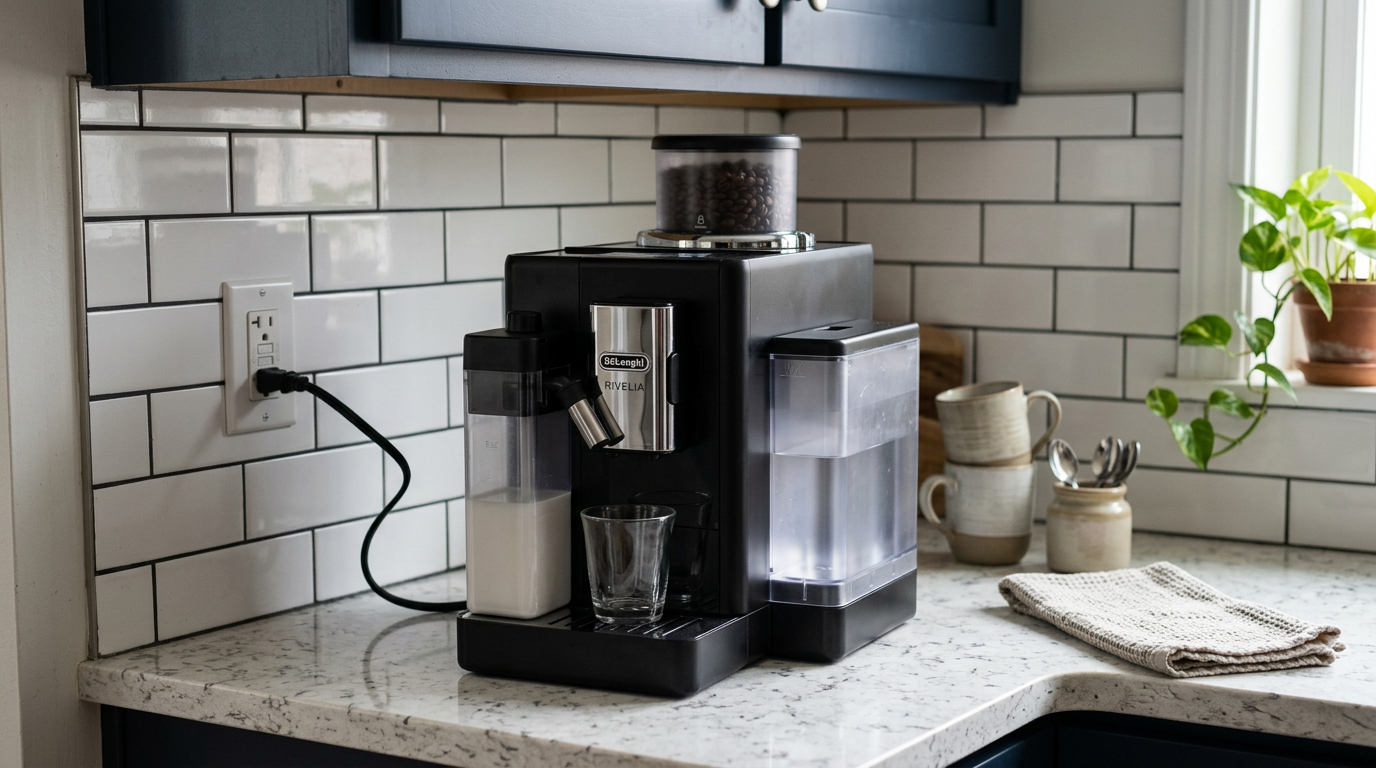
The Rivelia's grounds container sits behind the drip tray, so empty it before it gets full.
Daily emptying also favors the Philips. Its water tank, drip tray and grounds bin all slide out of the front, so you never have to pull the machine away from the wall.
On the Rivelia, the drip tray and grounds container tended to drop down at the front as they came free. Hold the assembly with your other hand, or you risk spilling coffee water on the counter.
Time I spent on milk cleaning per day
Both brew groups slide out for a weekly rinse under plain warm water. The Philips also comes with a tube of food-grade grease, and the rails and shaft need a thin layer every few months.
Do not wait for either machine to tell you the grounds bin is full. Warm, damp pucks in a closed space can start to grow mold within a few days.
Water, filters and descaling
Scale is the slow killer of automatic coffee machines. Minerals in hard water build up inside the heater and narrow the water paths, which lowers temperature and flow over time.
Both machines come with a water filter, and I would fit it from day one. The Philips AquaClean filter goes furthest, with Philips claiming up to 5,000 cups without descaling✕DescalingRunning a cleaning solution through the machine to dissolve mineral build-up from hard water. if you replace the filter when prompted.
Each AquaClean filter lasts roughly 500 to 600 cups, or about three months in a typical home. On the Rivelia, I followed its descaling reminders, which it sets from the water hardness you enter during setup.
Typical descaling interval without a filter
The tanks are different, too. The Philips holds 1.8 liters and slides out of the front, while the Rivelia holds 1.4 liters on the side but can be topped up from above without removing it.
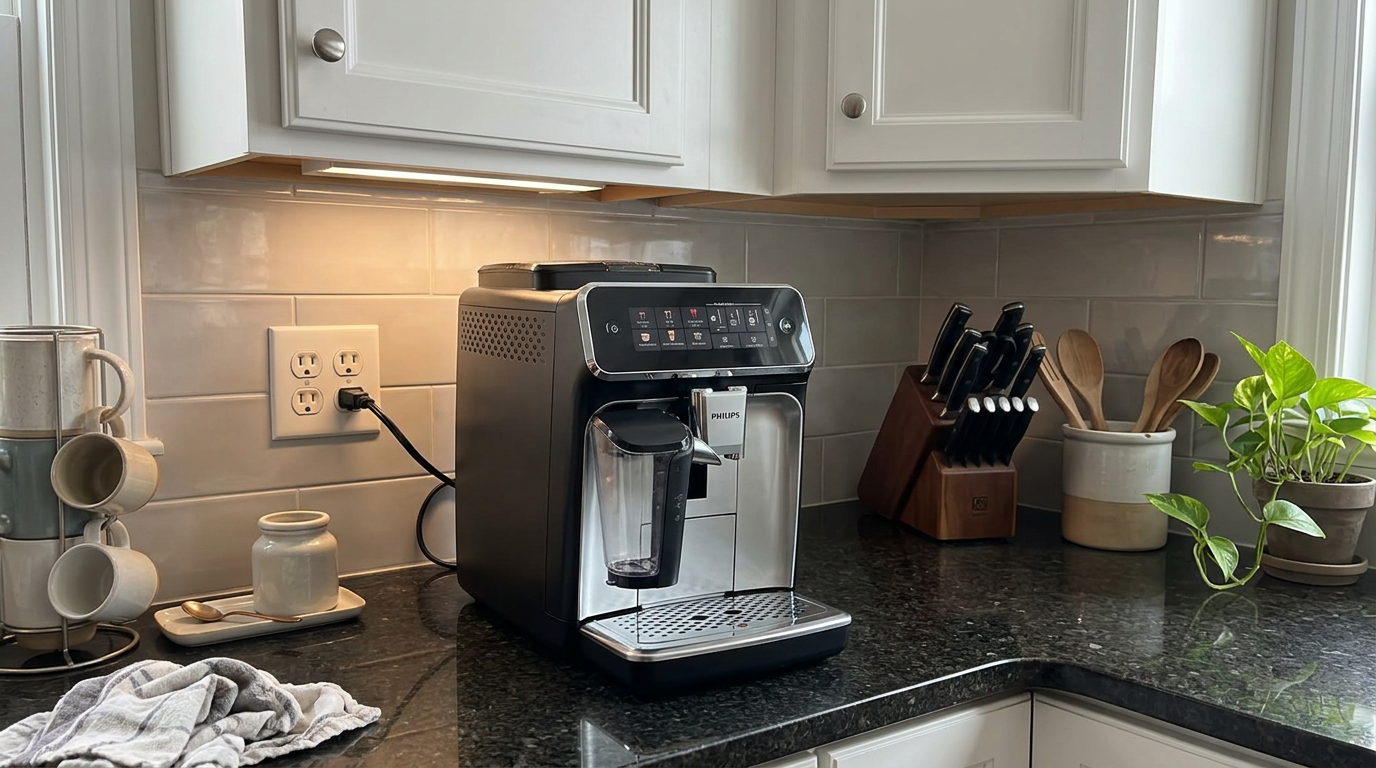
The Philips water tank slides out of the front, so the machine can stay tucked against the wall.
I liked both designs for different reasons. The Philips needs fewer refills, and the Rivelia's top-fill tank saves a trip to the sink on busy mornings.
Our tip: Write the date on the filter box when you fit a new one, so you know roughly when the next one is due.
Beans per bag and everyday running
The small Philips dose has an upside. A 250-gram bag makes about 31 single drinks on the Philips, compared with about 16 single shots at the Rivelia's top intensity.
For milk drinks, where coffee strength matters less, that stretches your beans much further. If you brew doubles on the Philips to match the Rivelia's body, the difference largely disappears.
Drinks from a 250 g bag of beans
Remember to count the Rivelia's purges if you switch beans often. One swap a day uses about 10 grams, or roughly two-thirds of a shot.
Bean choice matters on both. Very oily, shiny dark roasts can stick to the hopper walls and clog the grinder over time, so medium and dry dark roasts are the sweet spot.
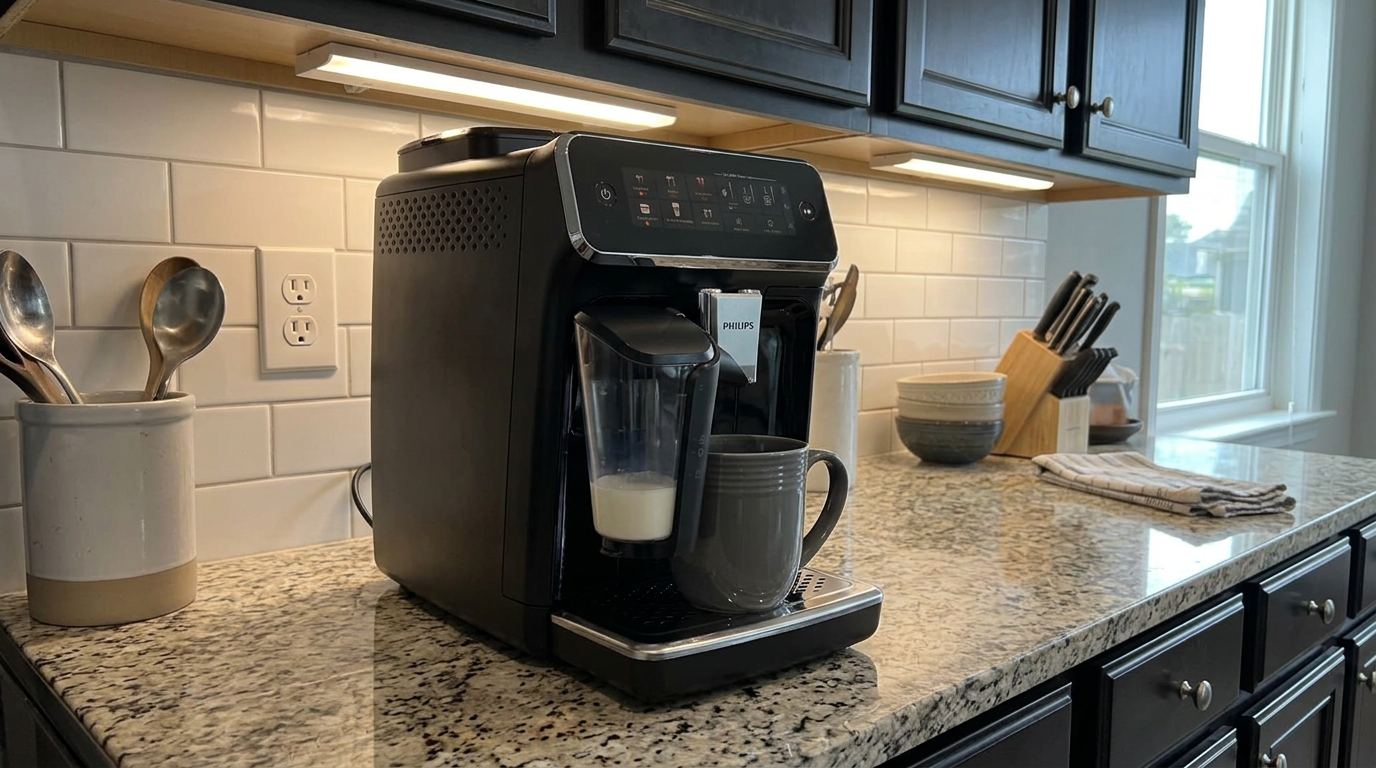
The Philips small single dose makes a bag of beans last about twice as long.
Real-life scenarios: which machine fits your home?
Spec sheets only get you so far, so it helps to picture a normal week with each machine. These are the moments where the choice became obvious for me.
Twist off one hopper, fit the other, purge, and your afternoon decaf is ready in less time than it takes to read this.
The sealed grinder is quiet enough that nobody in the next room stirs.
Each person taps their own profile, and nobody has to remember strength, size or milk settings.
The two-part carafe goes under the tap or into the dishwasher, and you are done in seconds.
The 15-gram dose gives a fuller, sweeter shot without needing a double.
It is shallower, and the tank, tray and grounds bin all come out of the front.
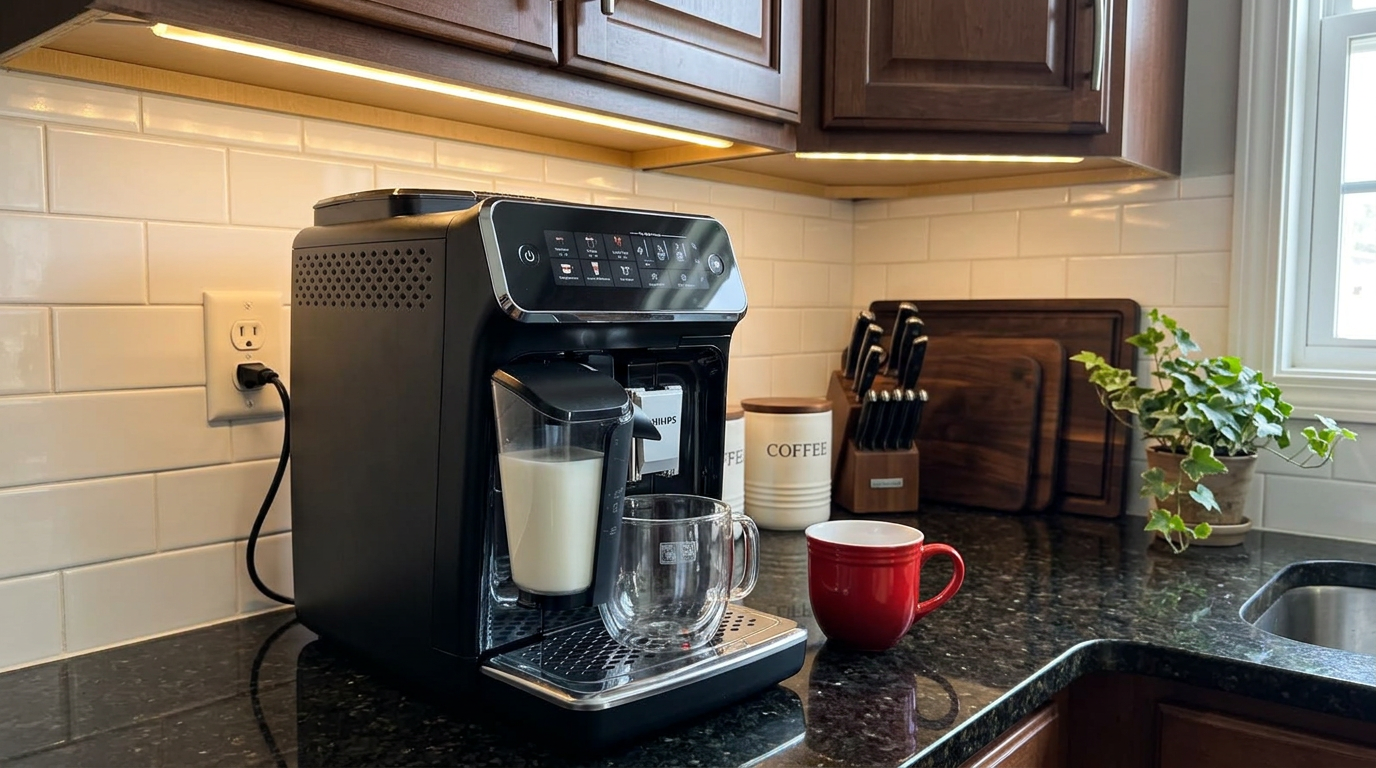
Guests made their own drinks on the Philips without asking a single question.
What each machine asks of you
Neither machine has a real learning curve. You never tamp, weigh or steam by hand on either, and both made a drinkable coffee within the first few attempts.
The Rivelia asks you to think about which beans go in which hopper and when to purge. The Philips asks for patience during break-in and a regular dab of grease on the brew group.
My scorecard
These are my own scores out of 10, based on weeks of daily use and the measurements above. They are a judgment call rather than a lab result, but they show clearly where each machine pulls ahead.
De'Longhi Rivelia
Philips 3300
Overall, I rate the Rivelia 8.5 and the Philips 3300 8.4. That narrow gap tells you this decision is about your priorities, not about one machine being clearly better.
Which one is right for you?
4 quick questionsWhich one should you buy?
It comes down to one question: is the coffee or the cleanup more important to you? If you want the better cup and a machine that adapts to everyone in the house, the Rivelia is worth a minute of extra care each day.
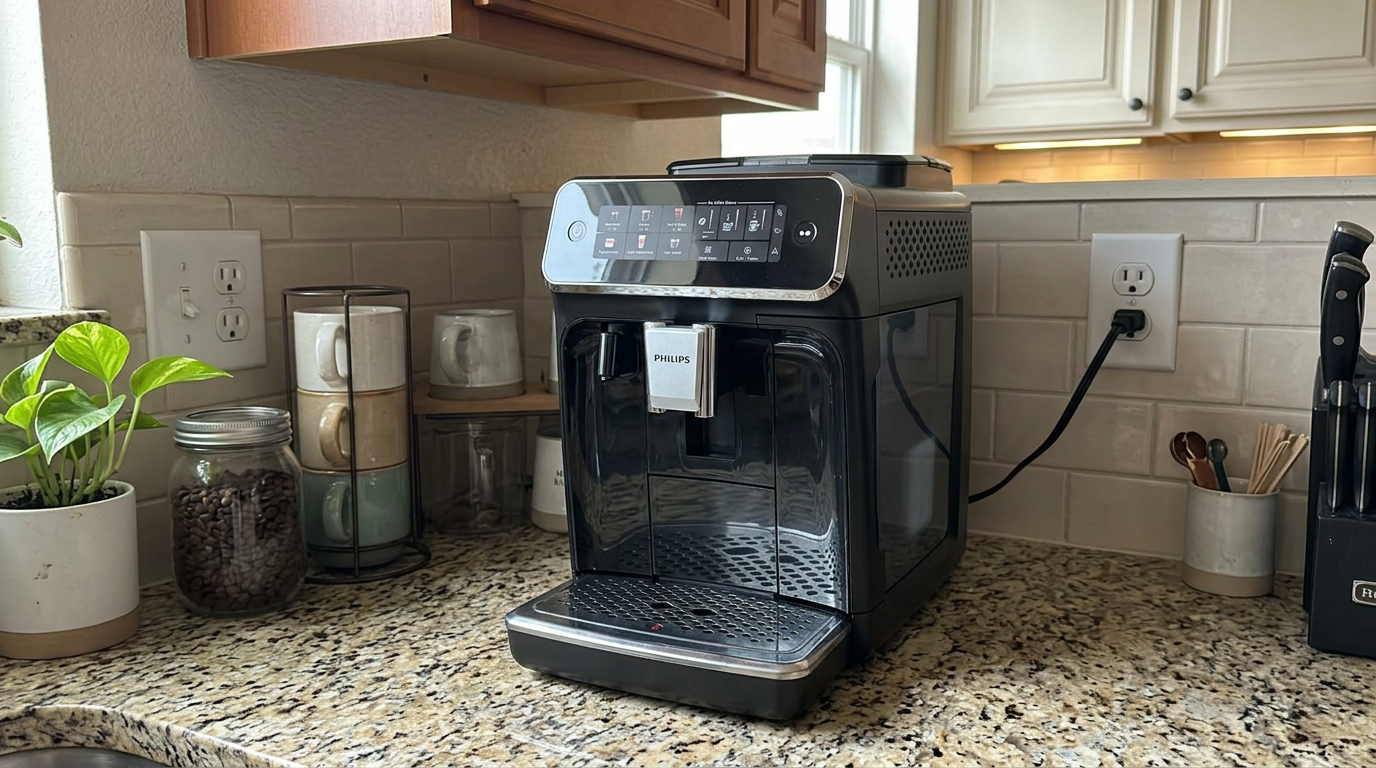
For small kitchens and busy mornings, the Philips 3300 is the easier machine to live with.
- Someone at home drinks decaf
- You drink straight espresso often
- Several people want their own saved drinks
- You might want cold foam later
- You alternate very light and very dark roasts daily
- You have low wall cabinets
- You want the fastest possible milk cleanup
- You mostly drink milk-based coffee
- You want under a minute of daily cleanup
- You make coffee while others sleep
- Your counter is shallow
- You want café-strength espresso from one cycle
- You need silky foam for latte art
- You want user profiles or a big drink menu
Pick the Rivelia for fuller espresso, two bean hoppers and saved drinks for everyone. Pick the Philips 3300 for quiet mornings, a compact footprint and the easiest milk cleanup.
My pick is the De'Longhi Rivelia. It makes the fuller, sweeter espresso, handles regular and decaf without fuss and gives every person in the house their own drink at one touch.
The Philips 3300 is still the smarter buy for many homes. It is quieter, smaller and far easier to clean, and its milk drinks are very good once you settle on a finer grind.
Whichever you choose, buy fresh whole beans, fit the water filter and empty the grounds bin before it fills.
De'Longhi Rivelia vs Philips 3300 specifications
From manufacturer specifications and my own measurements. Checked November 10, 2026.
| De'Longhi Rivelia | Philips 3300 | |
|---|---|---|
| Type | Fully automatic | Fully automatic |
| Pump pressure | 19 bar | 15 bar |
| Heating | Thermoblock | Thermoblock |
| Grinder | Stainless conical, 13 settings | Ceramic, 12 settings |
| Bean hoppers | 2 x 8.8 oz (250 g), swappable | 1 x 9.7 oz (275 g), sealed lid |
| Dose per shot | Up to about 15 g | About 6 to 8 g |
| One-touch drinks | 18 | 6 |
| User profiles | 4 | None |
| Display | 3.5-inch color touchscreen | Backlit touch icons |
| Milk system | LatteCrema Hot carafe | LatteGo carafe, 260 ml |
| Cold foam | Optional upgrade set | No |
| Water tank | 47 oz (1.4 L), side, top-fill | 61 oz (1.8 L), front |
| Pre-ground option | Yes | Yes, one scoop |
| Noise (measured) | 66 to 68 dB | 61 to 62 dB grinding |
| Power | 1,450 W | 1,500 W |
| Dimensions | 9.6 x 16.9 x 15.2 in | 9.7 x 14.6 x 17 in |
| Weight | 21.4 lb | 17.6 lb |
How I tested and compared them
I used each machine as my main coffee maker for several weeks, making espresso, long coffee, cappuccinos, latte macchiatos and iced drinks. I weighed doses on a coffee scale, took temperatures with a probe thermometer and measured noise with a decibel meter.
On the Rivelia, I switched between regular and decaf hoppers regularly and tried similar and very different roasts. On the Philips, I worked through the grind settings, tracked the break-in period and checked strength with a TDS meter.
I then compared my notes with the manufacturers' specifications and general espresso brewing guidance. Where a figure came from a manufacturer rather than my own testing, I have said so.
- Coffee: dose, crema, body and consistency.
- Milk: foam texture, temperature and plant milk results.
- Workflow: controls, bean switching and daily routine.
- Ownership: noise, cleaning, water care and footprint.
De'Longhi Rivelia vs Philips 3300 FAQ
Is the De'Longhi Rivelia better than the Philips 3300?
For espresso, flexibility and features, I think so. It grinds about 15 grams per shot, has two swappable bean hoppers and stores four user profiles. The Philips 3300 is better for quiet operation, compact size and fast cleaning.
Which makes stronger espresso?
The Rivelia. It grinds up to about 15 grams per shot, while the Philips uses about 8 grams per single cycle. Brewing a double on the Philips closes most of the gap.
Which is quieter?
The Philips 3300. Its sealed hopper lid kept the grinder at 61 to 62 dB in my testing, while the Rivelia measured 66 to 68 dB.
Which is easier to clean?
The Philips 3300. Its two-part milk carafe has no tubes and rinses clean in about 10 seconds, and the tank, drip tray and grounds bin all slide out of the front.
Can I switch between regular and decaf?
On the Rivelia, yes. You swap hoppers in about three seconds and purge roughly 10 grams of leftover beans. The Philips has one hopper, but you can add a scoop of pre-ground decaf through its chute.
Can either machine make cold brew?
No. Both pour hot coffee over ice. The Philips brews a slower, concentrated iced coffee, and the Rivelia can add cold milk foam with an optional upgrade set.
Which has better milk foam?
The Rivelia makes smoother, finer foam. The Philips makes dense, stiff foam that suits classic cappuccinos but is not silky enough for latte art.
Which is better for a small kitchen?
The Philips 3300. It is about 2 inches shallower and lighter, and everything you refill or empty comes out of the front. The Rivelia needs clearance above for its hoppers and screen.
Do both work with oat milk?
Yes. Both frothed oat milk well in my testing, and barista-style plant milks held their foam best.
How often do I need to descale?
It depends on your water. With the Philips AquaClean filter replaced on time, Philips claims up to 5,000 cups between descales. The Rivelia reminds you based on the water hardness you set.

- Our hands-on De'Longhi Rivelia review
- Our hands-on Philips 3300 review
- De'Longhi product specifications and owner documentation
- Philips product specifications and user manual
- General espresso brewing and maintenance guidance
- Comparison published.