De'Longhi Rivelia review: two bean hoppers, one touchscreen and a very easy morning
The De'Longhi Rivelia Automatic Espresso Machine lets you swap beans in seconds, remembers four people's drinks and froths milk at the press of a button. It made my regular-and-decaf household far simpler, though the bean switch has limits you should understand before buying.
In this review
Yes, if your household drinks two kinds of coffee and wants café-style milk drinks without learning to steam. The De'Longhi Rivelia swaps hoppers in seconds, grinds a generous dose for a fully automatic machine and runs quieter than I expected. The bean switch works best with similar roasts, the touchscreen sits on top where not everyone can see it, and there's no real cold extraction. For a busy home that wants great coffee at one touch, it's one of the friendliest machines I've used.
De'Longhi Rivelia at a glance
De'Longhi Rivelia pros and cons
- Swap between two bean hoppers in a few seconds
- Grinds up to about 15 g for a fuller-bodied espresso
- Quiet in use, measuring 66 to 68 dB in my kitchen
- Each swap wastes or mixes around 10 g of beans
- Flat top screen is awkward for kids and seated users
- No true cold extraction or cold milk foam
Who should buy the De'Longhi Rivelia?
- Homes where one person drinks decaf and another doesn't
- Milk-drink fans who want one-touch lattes and cappuccinos
- Smaller kitchens that need a narrow machine
- Anyone who alternates very light and very dark roasts daily
- People who want genuine cold brew and cold foam
- Kitchens with low wall cabinets above the counter
First impressions of the De'Longhi Rivelia
Most fully automatic espresso machines solve the same problem in the same way.
You fill one hopper, pick a drink and live with whatever beans happen to be inside until they run out.
That works fine until someone in the house wants decaf in the evening.
The De'Longhi Rivelia is built around fixing exactly that moment.
It ships with two bean hoppers that twist on and off the grinder, so changing coffee takes about as long as changing a lid.
I went in expecting a gimmick and came away using it every afternoon.
The second thing I noticed was the shape.
It has rounded corners, a slim body and a water tank that clips to the side instead of sliding out of the front or back.
On my counter it looked noticeably less boxy than a typical bean-to-cup machine.
The third thing I noticed was less flattering.
There are no handles or finger recesses anywhere on the body.
Every time I wanted to shift it to wipe underneath, I had to hug it with both hands.
At roughly 21 pounds, that's manageable, but it's something you'll do more often than you think.
Then I pressed the first button, and the machine started to win me over.
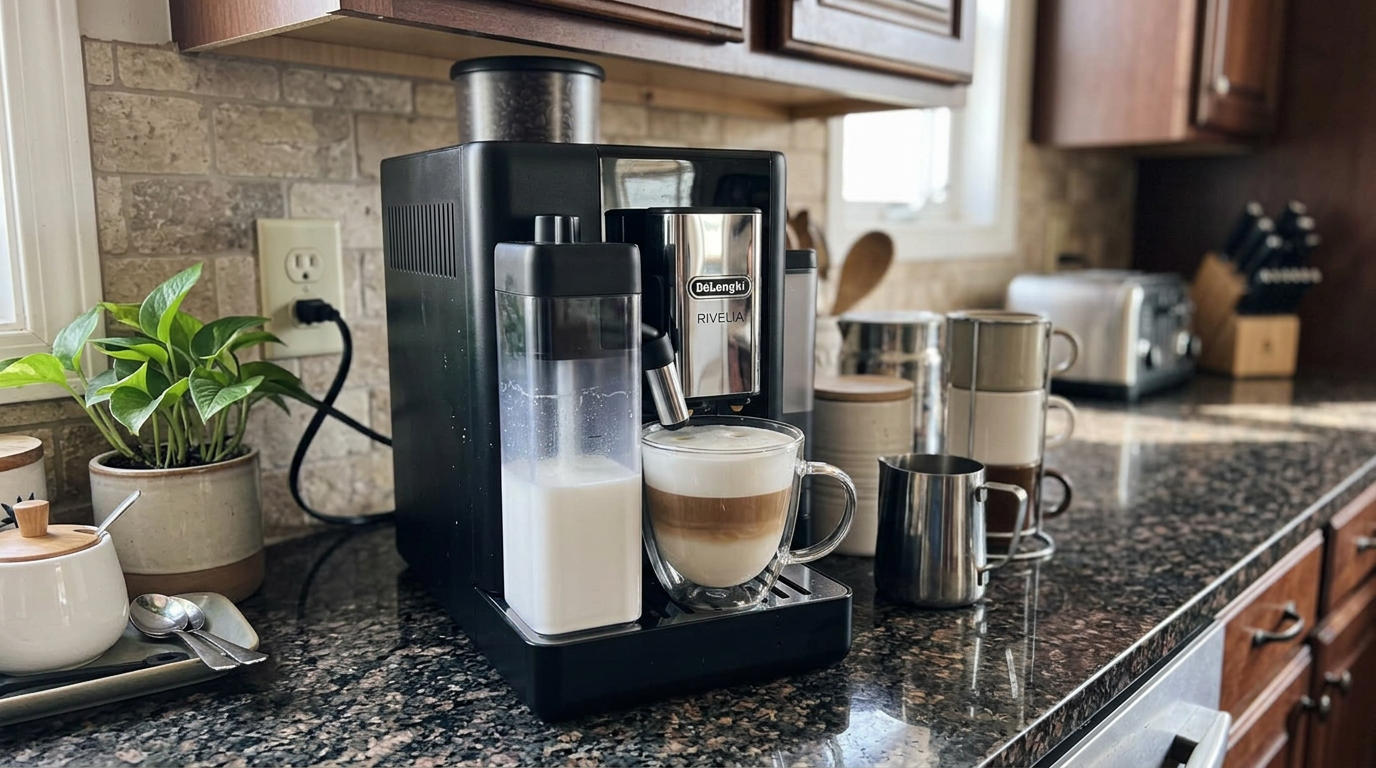
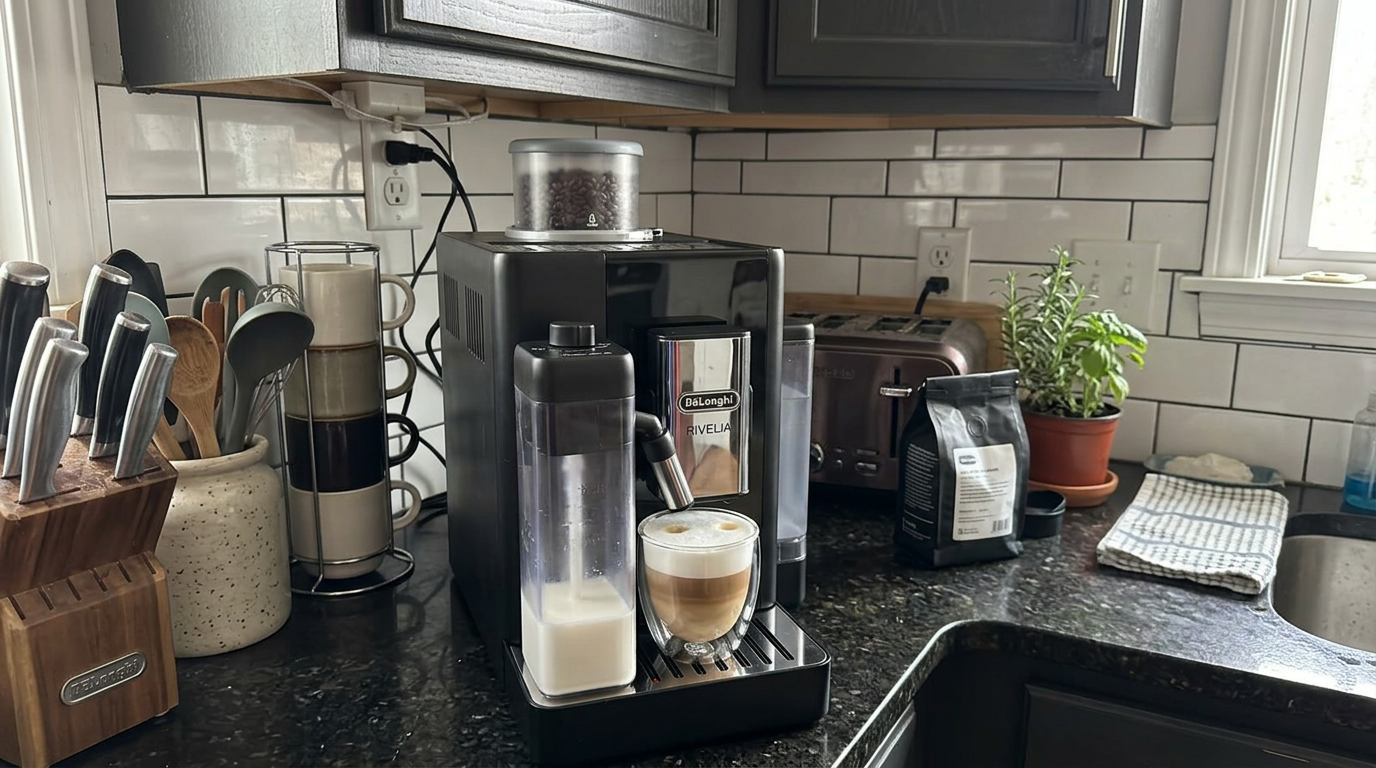
The milk carafe clips to the left side, so the whole machine stays narrow on the counter.
What the De'Longhi Rivelia actually is
The Rivelia is a fully automatic espresso machine, often called a bean-to-cup or super-automatic.
That means it grinds, doses, tamps, brews and ejects the used puck by itself.
Your job is to keep it supplied with beans, water and milk, and to choose a drink.
Inside is a stainless steel conical burr grinder with 13 settings and a 19-bar pump.
The removable brew unit has a 44 mm chamber that holds up to about 15 grams of ground coffee.
Milk is handled by an automatic carafe that heats and froths in one pass.
A 3.5-inch color touchscreen on the top panel runs everything.
The US version I tested offers 18 one-touch recipes, from espresso and coffee to flat white, cortado, cappuccino and latte macchiato.
You can store up to four user profiles, each with its own drink settings.
Two features set it apart from most machines at this level.
The first is the Bean Switch System, with its two interchangeable 8.8-ounce hoppers.
The second is Bean Adapt Technology, which asks about your beans and then suggests a grind setting and adjusts dose and temperature to match.
Manufacturer capacities. Hopper bars are shown in ounces against the tank's 47 fluid ounces for scale.
The Bean Switch System in real life
This is the feature most people buy the Rivelia for, so I spent the most time on it.
Each hopper locks onto the grinder with a 90-degree twist.
When you remove one, a shutter closes so the beans stay inside and don't spill across the counter.
Put the other hopper on, and the machine notices the change and asks what to do next.
Mechanically, the swap took me about three seconds every time.
What happens after the swap is the part worth understanding.
Some coffee always stays between the hopper and the burrs.
On my machine, that leftover amount weighed right around 10 grams.
The Rivelia gives you two options for it.
- Grind and empty: the machine grinds the leftover beans and drops them into the grounds container.
- Make a transition drink: the leftover beans go into your next cup, mixed with the new ones.
Neither choice is free.
If I'm switching from regular to decaf at 3 p.m., a transition drink still contains caffeine, which defeats the point.
So in practice I chose to grind and empty almost every time.
That's roughly 10 grams of coffee lost per switch, or about two-thirds of a single shot.
Based on the roughly 10 g I measured left in the grinder after each swap.
For one swap a day, I think that's a fair trade for the convenience.
If you plan to change beans three or four times daily, the waste starts to add up.
Our tip: Swap hoppers right before the drink you'd make anyway, so the purge happens once instead of twice.
The limit nobody mentions
The bigger catch isn't waste, it's grind size.
The Rivelia has one grinder, and you set its fineness with a physical dial.
A very light, dense roast usually needs a finer grind than a dark, oily one.
Swapping from one to the other without moving the dial means one of them won't extract at its best.
In my testing, the switch worked beautifully with two coffees of a similar roast level.
A medium house blend paired with a medium decaf was ideal.
Pairing a pale, fruity light roast with a smoky dark roast was where results got uneven.
My advice is to treat the two hoppers as a "same family" pair, ideally from the same roaster with a similar roast.
| Hopper pairing | How well it worked | Why |
|---|---|---|
| Regular + decaf, same roast level | Excellent | One grind setting suits both |
| Two medium blends | Excellent | Similar density and solubility |
| Medium + dark roast | Good | Small grind compromise |
| Light + dark roast | Uneven | Needs different grind settings |
One more practical point: the hoppers aren't designed as airtight storage.
Keep the bulk of your beans in a sealed bag or canister and only fill the hopper with a few days' worth.
Bean Adapt: the setup wizard that helps more than I expected
Bean Adapt sounds like marketing, but it's a genuinely useful starting point.
You add a new bean on the touchscreen and answer a few questions about it, such as roast level and type.
The machine then suggests a grind setting and adjusts parameters like dose and brewing temperature to suit.
You can name each bean, so "Morning Blend" and "Evening Decaf" each get their own saved recipe.
I found the suggested grind setting a sensible first guess rather than a final answer.
For my medium-roast beans, it landed close to where I eventually settled.
The real value is that it removes the blank-page feeling for new owners.
Instead of guessing at 13 grind settings, you start somewhere reasonable and fine-tune by taste.
Our tip: Pour a few test espressos after setting up a new bean, then change the grind only one step at a time.
How the De'Longhi Rivelia makes a drink
The process looks simple from the outside, but there's a lot happening behind the screen.
Watching and timing each step helped me understand where the machine does well.
- Grind: the burrs run for a set time based on the intensity you choose, up to about 10 seconds.
- Tamp: the brew unit compresses the grounds into a puck.
- Pre-infuse: a short burst of water wets the puck before full pressure.
- Extract: the pump pushes hot water through until your chosen volume is reached.
- Eject: the spent puck drops into the internal grounds container.
For milk drinks, the order changes.
The machine grinds first, then textures the milk, and finally pours the espresso on top.
Between the milk and the coffee, I could hear it adjusting its heating system down from steaming temperature to brewing temperature.
That pause is short, and it's the reason the espresso doesn't taste scorched after the milk.
The intensity setting is essentially a dose control.
At intensity 5, the grinder ran for about 10 seconds and produced a dose of roughly 15 grams on my scale.
That's a generous amount for a fully automatic machine, and it shows in the cup.
| Intensity | What changes | When I used it |
|---|---|---|
| Low (1–2) | Shorter grind time, smaller dose | Mild long coffees |
| Medium (3) | Moderate dose | Everyday coffee crema |
| High (5) | About 10 seconds of grinding, roughly 15 g | Espresso and milk drinks |
De'Longhi Rivelia design and setup
The Rivelia is narrow for a machine that does this much.
De'Longhi lists it at 245 × 430 × 385 mm, or about 9.6 × 16.9 × 15.2 inches.
With the side tank fitted, my tape measure showed close to 25 cm wide, so roughly 10 inches.
Depth is the number I'd check first, because it's about 17 inches and the drip tray needs room in front.
| Measurement | Metric | Imperial |
|---|---|---|
| Width (with tank) | 245–250 mm | 9.6–9.8 in |
| Depth | 430–440 mm | 16.9–17.3 in |
| Height | 385 mm | 15.2 in |
| Weight | 9.7 kg | 21.4 lb |
| Water tank | 1.4 L | 47 fl oz |
Height matters too, but for a different reason than usual.
The bean hoppers sit on top, and so does the touchscreen.
If your wall cabinets are low, you'll want clearance to twist a hopper off and see the display without leaning in.
A water tank that doesn't slide
The side-mounted tank is one of my favorite details.
It drops into place from above rather than sliding on rails.
Better still, you can refill it from the top without removing it at all.
On a busy morning, that small difference saves a trip to the sink.
At 47 ounces, it holds enough that you're not refilling it after every couple of drinks.
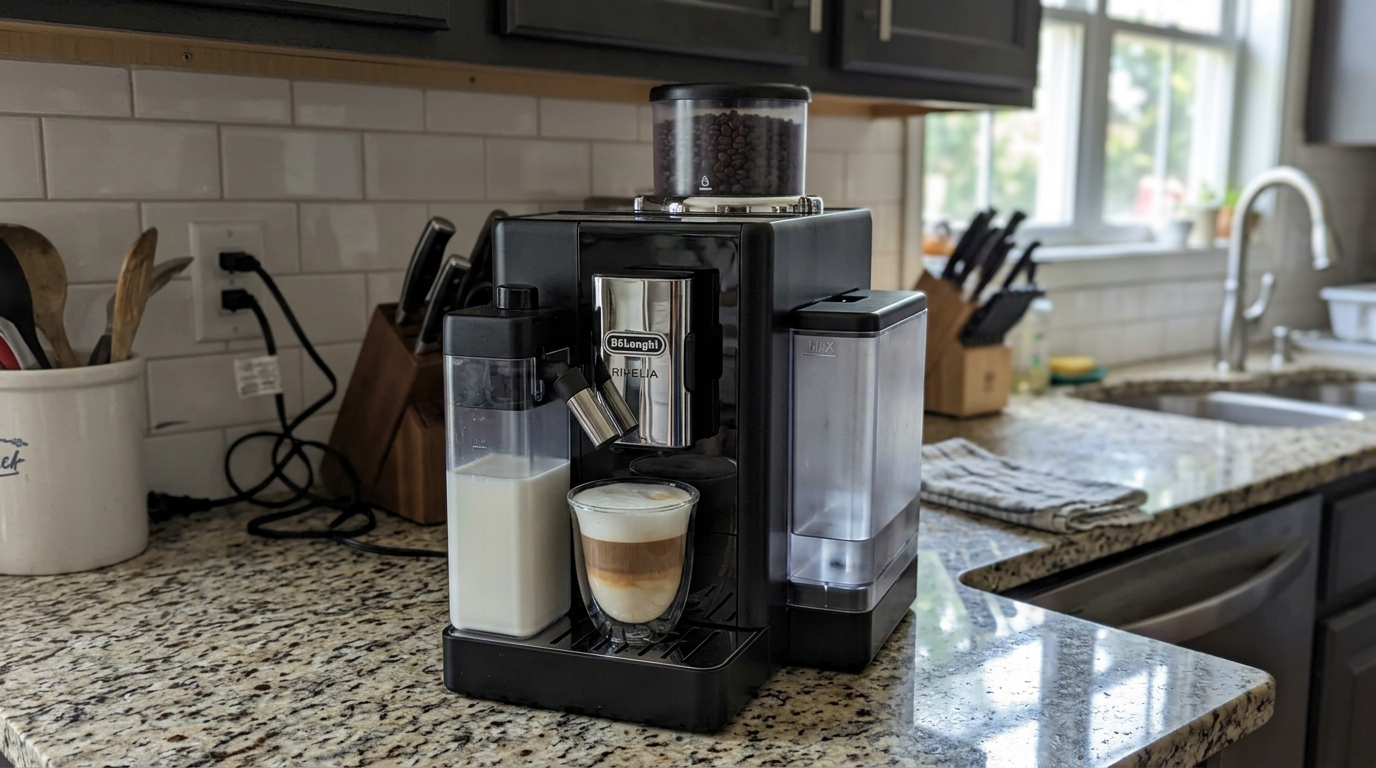
The tank clips onto the side and can be topped up from above without lifting it out.
Setup in about 15 minutes
First-time setup is guided on screen.
You choose a language, set water hardness with the included test strip, fit the water filter and run a rinse.
The whole process is quick, and most of it is spent waiting for the first rinse to finish.
Testing water hardness is worth doing properly, because it decides how often the machine asks you to descale.
Our tip: Run two or three throwaway coffees after setup to flush the system before judging the taste.
The touchscreen and profiles
The 3.5-inch color screen is sharp, bright and responsive.
Drinks are split into a coffee menu and a milk menu, which keeps each list short and easy to scan.
There's also a profiles button and a settings menu for rinsing, descaling, filter tracking, beeps and auto-standby.
Four profiles is enough for most families.
Each person's strength, size and milk settings stay saved under their own icon.
The machine also tracks your habits through what De'Longhi calls Coffee Routines, surfacing the drinks you make most often at certain times of day.
Within a week, my usual morning drink was waiting on the first screen.
The placement problem
My main complaint about the interface is where it lives.
The screen lies flat on the top of the machine rather than facing you.
Standing over it, the viewing angles are excellent.
From a lower position, it's a different story.
My kids couldn't easily see it, and anyone using a wheelchair would struggle to read it.
A slight forward tilt at the front would have solved this.
It doesn't change how good the coffee is, but it does change who in the house can use it independently.
Confusing iced drink buttons
The coffee menu includes icons for iced coffee and espresso over ice.
It's easy to assume that means the machine can make cold coffee.
It can't.
Those recipes brew hot coffee onto ice you've already put in the glass.
I'll cover what that means for summer drinks further down.
The built-in grinder
The Rivelia uses a stainless steel conical burr grinder with 13 settings.
Lower numbers are finer, and higher numbers are coarser.
That's not a huge range compared with a dedicated espresso grinder, but it covers what a fully automatic machine needs.
The more important question is whether it can grind fine enough for fresh beans.
It can.
With beans roasted about four weeks earlier, I could grind fine enough on a low setting to nearly stall the pump.
That tells me there's headroom at the fine end, which is where good espresso lives.
Like most fully automatic machines, you should only change the grind setting while the grinder is running.
Turning the dial while it's idle can strain the burrs.
| What you taste or see | Likely cause | First change |
|---|---|---|
| Sour, sharp, thin | Under-extraction | Grind one step finer |
| Bitter, harsh, drying | Over-extraction | Grind one step coarser |
| Coffee gushes out pale | Grind too coarse or stale beans | Grind finer, check bean age |
| Coffee drips very slowly | Grind too fine | Grind one step coarser |
| Watery body | Dose too low | Raise the intensity |
Our tip: Adjust the grind dial only while the grinder is running, and wait two or three drinks before judging the change.
That last point is easy to miss.
A little ground coffee stays in the grinder path after each drink.
So the first cup after a change still contains some coffee ground at the old setting.
Give it a couple of shots before deciding whether the adjustment worked.
De'Longhi Rivelia espresso performance
Espresso is where the larger dose pays off.
My go-to recipe was intensity 5, which gave me about 15 grams of coffee, and a small cup size.
I aimed for roughly a 1:2 ratio, meaning about 30 grams of espresso in the cup.
With fresh beans, the shot ran with a thick layer of hazelnut crema.
The machine tamped, ran a short pre-infusion and then started the main extraction.
The resulting espresso was intense and chocolate-forward.
With a medium-roast blend, I tasted cocoa and toasted nuts with a full body.
The more delicate fruit notes of lighter coffees came through less clearly.
That's typical of fully automatic machines, which don't give you the same control as a manual espresso setup.
For a drink made by pressing one button, though, it was very good.
| Recipe | Intensity | Dose (approx.) | Cup out (approx.) | Ratio |
|---|---|---|---|---|
| Espresso | 5 | 15 g | 30 g | 1:2 |
| Ristretto-style | 5 | 15 g | 22 g | 1:1.5 |
| Longer espresso | 5 | 15 g | 38 g | 1:2.5 |
| Coffee (long) | 4–5 | 13–15 g | 120 ml | Mild |
Starting points built around the 15 g dose I measured at intensity 5. Adjust cup size by taste.
Bean freshness made a bigger difference than any setting.
Beans in the three-to-five-week window after roasting gave the richest crema and the most balanced taste.
Supermarket beans with no roast date ran faster and tasted flatter, even at the same settings.
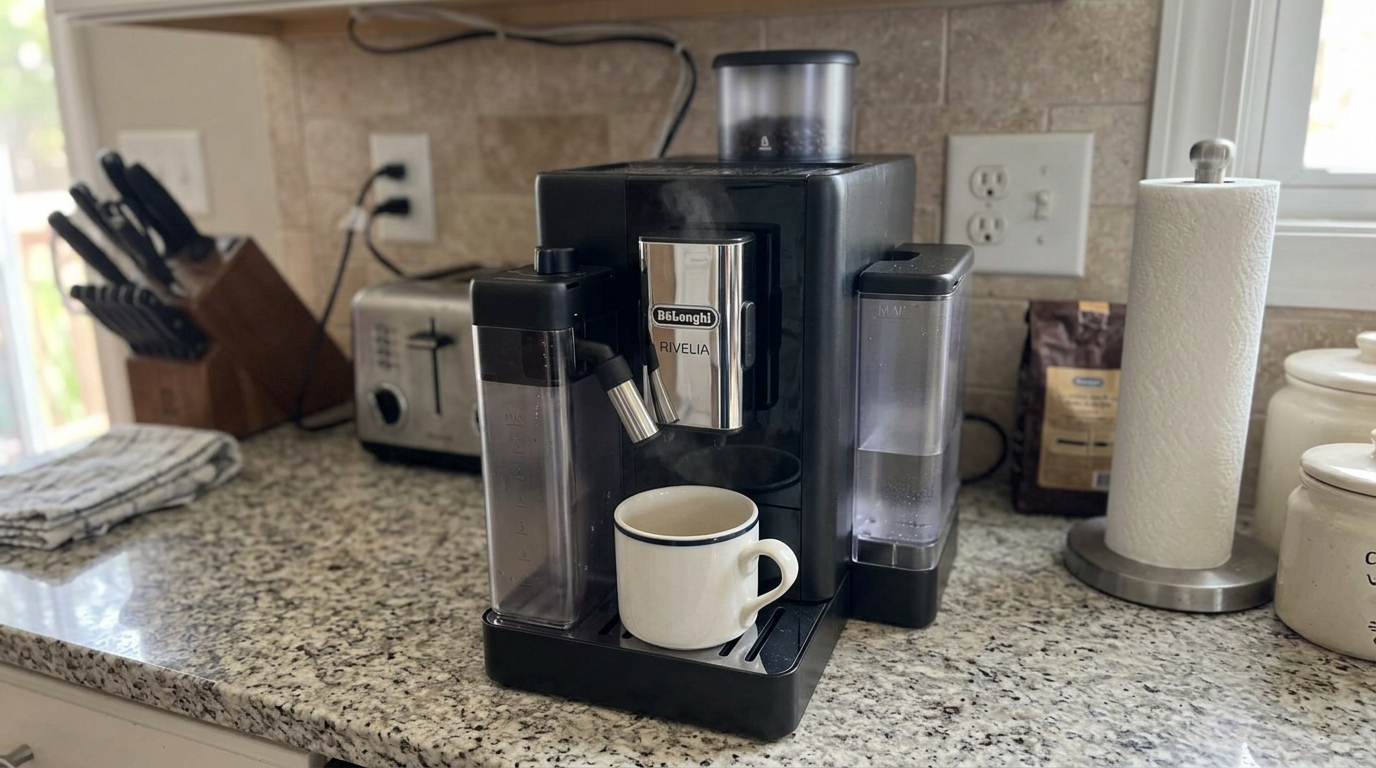
A long coffee topped with crema is one of the drinks I made most often.
My favorite everyday drink
The coffee recipe, sometimes called coffee crema, became my default first cup of the day.
It's a longer drink than espresso, but with a layer of crema on top that gives it more body in the first few sips.
It's hot, smooth and far better than drip coffee made from the same beans.
The double-cup function is handy for two people, although I preferred making two single drinks for the best strength.
Our tip: Use a pre-warmed cup, because a cold ceramic mug can drop the temperature of a small espresso noticeably.
Milk drinks and the LatteCrema carafe
Milk drinks are where most buyers will spend their time, and the Rivelia handles them well.
The carafe clips onto the left side of the machine and draws milk through a small tube.
You choose a drink, and the machine froths the milk and adds the espresso in the right order.
To test it, I programmed a latte macchiato.
You can stop the milk and coffee at the volume you like, and the machine then asks whether to save it as your recipe.
Saving took one tap.
I measured milk temperature with a probe thermometer across several drinks.
It consistently came out between 140°F and 149°F, which is right in the range where milk tastes sweetest.
If you like your latte very hot, that may feel a little mild, so preheating the glass helps.
Probe thermometer readings across several drinks. Bars are scaled to the hot water reading.
The texture was smooth and stable, with fine bubbles.
It's slightly airier than the silky microfoam a skilled barista makes by hand.
For a cappuccino, that's perfect; for a flat white, it's very good rather than perfect.
Oat milk frothed well, though barista-style versions held their foam better than standard cartons.
A small habit that improves layered drinks
A latte macchiato is built in layers, with the espresso sitting between milk and foam.
It looks great, but the first sip can taste bitter if you don't mix it.
Give it a quick stir before you drink, and the whole glass tastes smoother.
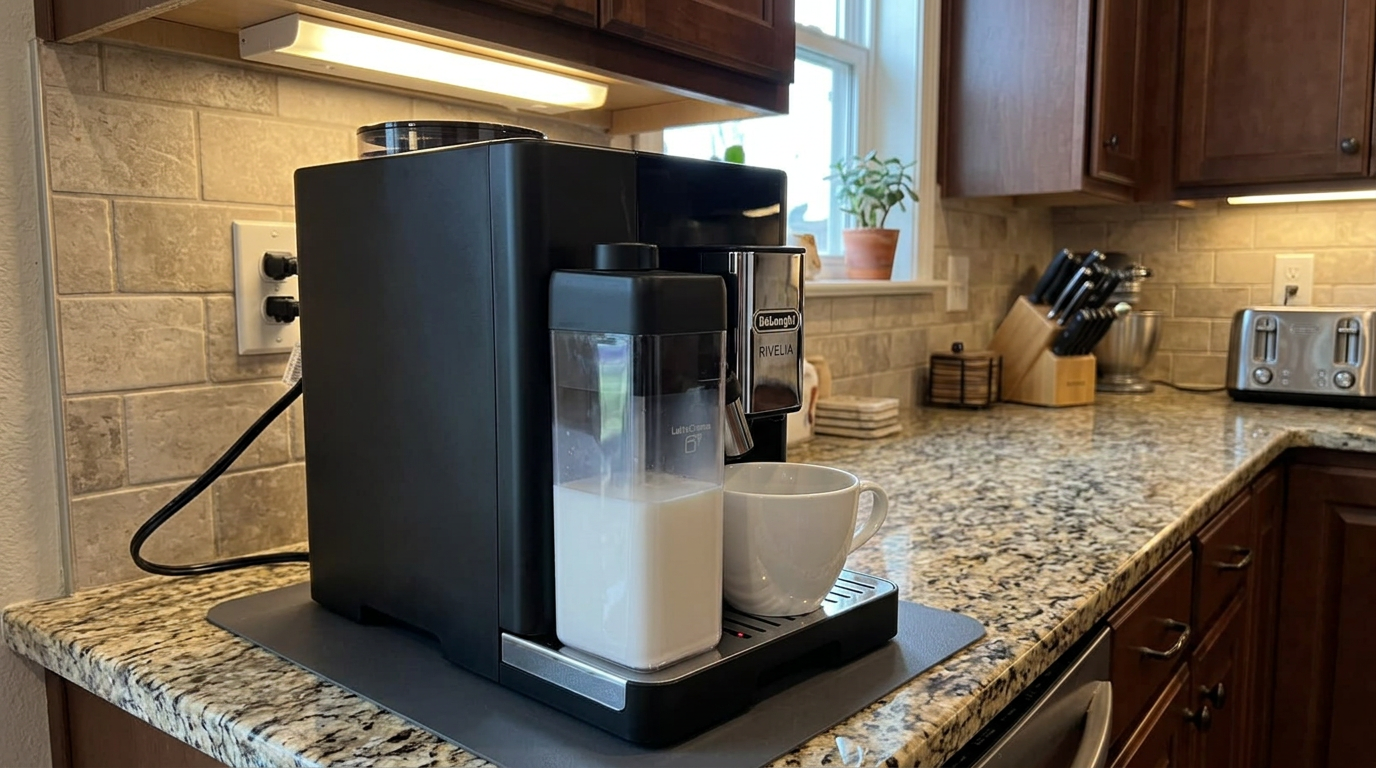
The carafe can go back in the fridge between drinks, which keeps the milk fresh.
After every milk drink, the machine prompts you to run a quick clean.
Turn the dial on the carafe to the clean position, and hot water and steam flush the milk path.
It takes a few seconds, and you shouldn't skip it.
The carafe can then go back into the fridge with milk still inside.
Iced coffee: what it can and can't do
Let's clear this up, because the menu makes it confusing.
The Rivelia model I tested has a hot milk carafe only.
It does not brew cold coffee, and it does not make cold milk foam.
The iced recipes simply pour hot espresso or coffee over ice you've added to the glass.
That's a perfectly good iced drink if you use plenty of ice.
It's just not the same as cold brew, which steeps coffee slowly at low temperature for a softer, sweeter taste.
| Drink | Possible on this model? | How |
|---|---|---|
| Espresso over ice | Yes | Hot espresso poured onto ice |
| Iced coffee | Yes | Hot coffee poured onto ice |
| Iced latte | Yes, with a workaround | Espresso over ice, then cold milk added by hand |
| True cold brew | No | Needs cold extraction |
| Cold milk foam | No | Carafe froths hot milk only |
Our tip: Fill the glass completely with ice before brewing, because hot espresso melts a few cubes faster than you'd think.
Hot water and tea
A small hot water spout is stored in a compartment in the top of the machine.
You plug it in when you need it and press the hot water option.
My readings came in between 194°F and 203°F, which is hot enough for black tea and for topping up an Americano.
For green tea, I let the water sit for a minute first.
My only complaint is the spout itself.
It's lightweight plastic, and it feels cheaper than the rest of the machine.
It works fine, but on a machine at this level, I expected something sturdier.
How loud is the Rivelia?
Noise surprised me in a good way.
I measured between 66 and 68 decibels during grinding and brewing.
That's roughly the level of a normal conversation or a running dishwasher.
The grinder is the loudest part and lasts around 10 seconds per drink.
Milk frothing adds a soft hiss rather than a roar.
My readings for the Rivelia, alongside common reference levels for everyday sounds.
If someone sleeps near the kitchen, they may still notice the grinder.
But for early mornings in an open-plan home, it's one of the quieter fully automatic machines I've used.
Cleaning and maintaining the Rivelia
Day-to-day care is straightforward, and the machine reminds you of most of it.
The removable brew unit, auto-rinse cycles and step-by-step descaling guide all make upkeep easier.
There are two habits I'd build from day one.
Empty the grounds container early
The spent pucks collect in a container behind the drip tray.
Don't wait for the machine to tell you it's full.
Warm, damp coffee pucks in a closed space can start to grow mold within a few days.
The top and side vents help heat escape, but emptying often is still the best defense.
There's also a design quirk here.
When I pulled out the drip tray and grounds container, the assembly tended to drop down at the front.
Hold it with your other hand as it comes free, or you'll risk spilling coffee water on the counter.
Take the carafe apart weekly
The quick clean after each drink handles the milk path.
Once a week, though, the carafe should come completely apart.
Wash the lid, frothing parts and intake tube in warm soapy water to stop milk fat building up.
The removable pre-ground coffee chute deserves a rinse now and then too, because fine dust and moisture collect there.
| When | Task | Why it matters |
|---|---|---|
| After each milk drink | Run the carafe clean cycle | Stops milk drying in the frother |
| Every day or two | Empty grounds container and drip tray | Prevents mold and odors |
| Weekly | Disassemble and wash the milk carafe | Removes milk fat buildup |
| Weekly | Rinse the brew unit under the tap | Clears coffee oils and grounds |
| When prompted | Replace the water filter | Reduces scale and improves taste |
| When prompted | Run the descaling program | Protects heating parts and valves |
Our tip: Leave the brew unit to air-dry fully before putting it back, so moisture isn't trapped inside the machine.
Water filter and descaling
The Rivelia comes with a water filter, and I'd install it from the start.
Minerals such as calcium and magnesium build up as scale inside the heating system and narrow water paths.
Over time, that can slow flow, lower temperature and shorten the machine's life.
If you run out of filters, use filtered water rather than straight tap water in a hard-water area.
Then run the descaling program whenever the machine asks.
Descaling frequency depends on your water hardness and how much coffee you make.
General guidance for home espresso machines. The Rivelia sets its own reminder based on the hardness you enter at setup.
What daily use is really like
Specs tell you what a machine contains, but not how it fits into a real morning.
With the De'Longhi Rivelia, my mornings had very few decisions left in them.
I turned it on, waited for the short warm-up rinse and tapped my profile.
My usual coffee was already at the top of the list.
While it brewed, I could get on with breakfast instead of standing at the counter.
| Step | Who does the work | What you control |
|---|---|---|
| Warm-up and rinse | Machine | Nothing, it's automatic |
| Bean choice | You, once | Which hopper is fitted |
| Grind and dose | Machine | Grind dial and intensity |
| Extraction | Machine | Cup size and temperature |
| Milk | Machine | Milk amount and foam level |
| Cleanup | Machine prompts, you confirm | Carafe clean and emptying |
The four profiles were the quiet hero of daily use.
One person's flat white and my coffee crema each lived under our own icon, with no settings to remember.
Visitors could tap a drink and get something good without any instruction.
Regular in the morning, decaf in the afternoon
This is the routine the Rivelia was made for.
In the morning, the regular hopper is fitted and everyone gets their usual drink.
After lunch, I twisted it off, fitted the decaf hopper, chose grind and empty, and made an afternoon decaf coffee crema.
The whole switch took less time than it takes to read this paragraph.
The full hopper I removed went into the cupboard with its shutter closed, ready for the next morning.
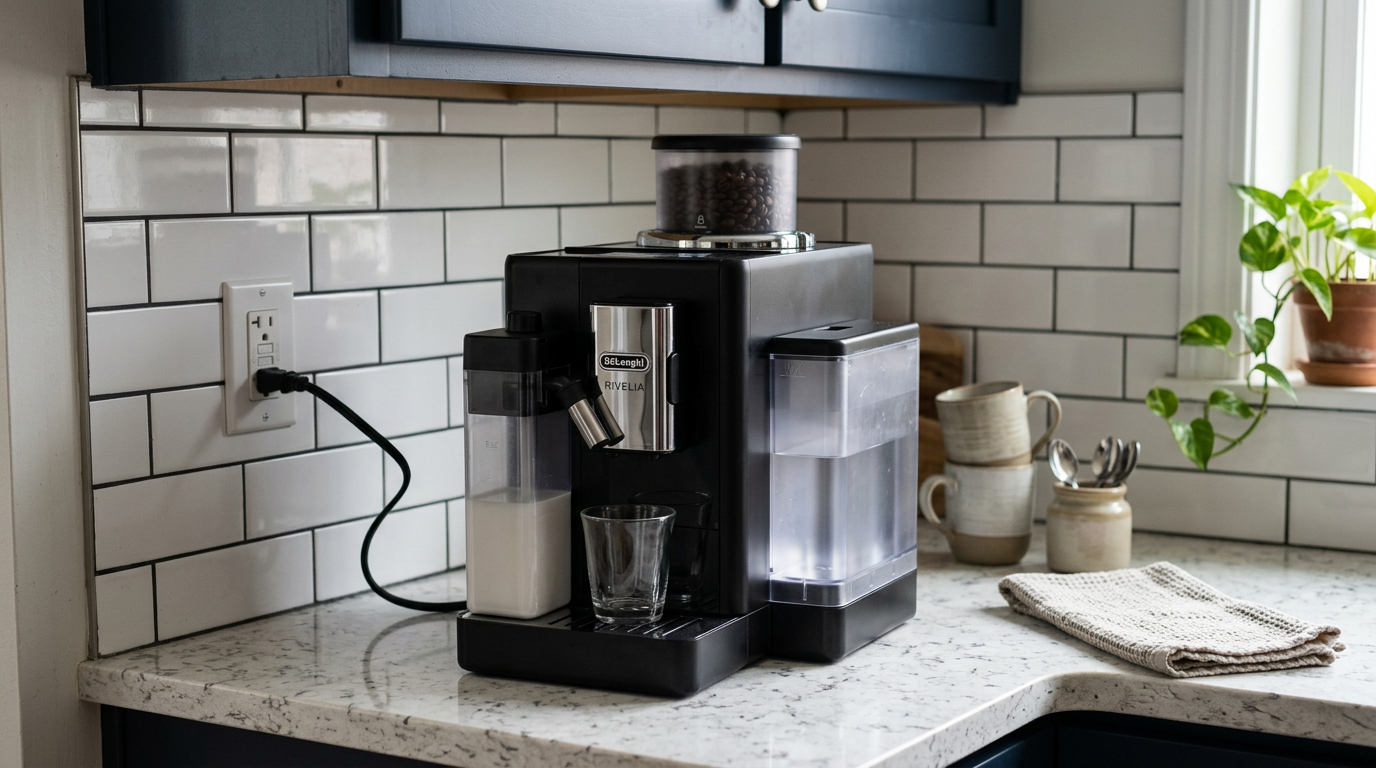
With a hopper fitted, the Rivelia stands about 15 inches tall, so check your cabinet clearance.
Making several drinks in a row
Back-to-back drinks are where fully automatic machines can feel slow.
The Rivelia uses a thermoblock heating system rather than separate boilers, so it needs a moment to switch between milk and espresso temperatures.
For two or three drinks, the wait was barely noticeable.
For a larger group, plan on a few minutes and keep an eye on the drip tray and grounds container.
Beans, water and small upgrades
A good fully automatic machine makes your beans easier to taste, for better and for worse.
Freshly roasted whole beans are the biggest single upgrade you can make.
I had the best results with beans roasted about four to five weeks before brewing.
Very fresh beans can be gassy, while very old beans run fast and taste flat.
Look for a roast date on the bag rather than just a best-before date.
Avoid very oily, dark beans.
The oil can coat the burrs and stick to the hopper chute, which can cause flow problems over time.
Medium and medium-dark roasts are the sweet spot for this grinder.
| Bean type | Grind setting direction | Intensity | Best drinks |
|---|---|---|---|
| Medium roast blend | Middle of the range | 4–5 | Espresso, cappuccino, latte |
| Medium-dark roast | Slightly coarser | 4–5 | Milk drinks, coffee crema |
| Decaf (medium) | Same as matching regular bean | 5 | Afternoon coffee, latte |
| Light roast | Finer | 5 | Espresso, long coffee |
| Very oily dark roast | Not recommended | – | Can clog the grinder path |
Accessories I'd actually add
You don't need much beyond what's in the box.
A spare set of water filters is the most useful extra.
A good milk cleaning solution helps with the weekly carafe wash.
And a sealed canister keeps your backup beans fresh while the hoppers do daily duty.
Common mistakes to avoid
The Rivelia is easy to live with, but a few habits can hold it back.
These are the ones I'd watch in the first couple of weeks.
| Mistake | What happens | Better habit |
|---|---|---|
| Switching light and dark roasts without changing grind | One coffee tastes sour or bitter | Pair beans with similar roast levels |
| Making a transition drink when switching to decaf | Your "decaf" still has caffeine | Choose grind and empty |
| Turning the grind dial while idle | Strain on the burrs | Adjust only while grinding |
| Skipping the carafe clean | Milk dries in the frother | Run the clean cycle every time |
| Waiting for the full-container alert | Mold and odors | Empty pucks every day or two |
| Using hard tap water without a filter | Faster scale buildup | Fit the filter and descale on time |
Dialing in tends to worry new owners the most.
In reality, Bean Adapt gets you close, and a couple of small adjustments finish the job.
What I'd change
My wish list is short.
I'd tilt the screen forward at the front so everyone in the house can see it.
I'd add finger grips or handles to the body, and a catch to stop the drip tray dropping.
And I'd upgrade the plastic hot water spout to match the rest of the build.
None of that changes my verdict, but each is worth knowing before you buy.
Is the De'Longhi Rivelia worth the money?
The Rivelia sits in the upper-middle of the fully automatic market.
The right way to judge it is by what problem it solves for your household.
If everyone drinks the same coffee all day, the second hopper is a nice extra rather than a reason to buy.
If your home has a decaf drinker, or you like to keep a guest-friendly blend alongside something special, it earns its place every day.
The generous dose is another quiet advantage.
Being able to grind around 15 grams means fuller-bodied espresso and better milk drinks than many machines with smaller brew chambers.
Add four profiles, a helpful setup wizard and a quiet grinder, and the package feels complete.
What you give up is cold extraction, a front-facing screen and a little flexibility with very different roasts.
Think about how many people will use it, how often you'd switch beans and whether you want iced drinks in summer.
Those three answers will tell you more than any feature list.
For my household, the daily convenience outweighed the compromises.
How it compares with other espresso setups
The most useful comparison isn't with one particular model.
It's with the kinds of setup you're most likely choosing between.
On paper and in use, the Rivelia is strongest when you want variety and convenience in the same machine.
| Feature | De'Longhi Rivelia | Single-hopper automatic | Manual machine + grinder |
|---|---|---|---|
| Bean switching | Two hoppers, about 3 seconds | Empty the hopper by hand | Swap beans in the grinder |
| Typical dose | Up to about 15 g | Often 9–12 g | 18–20 g |
| Milk drinks | One touch, automatic | One touch or manual wand | Manual steaming |
| User profiles | Four | Often none or one | None |
| Cold extraction | No | Only on some models | No |
| Learning curve | Low | Low | Steep |
| Counter footprint | Narrow, one unit | One unit | Two or more devices |
A single-hopper automatic is simpler, but changing beans means scooping them out by hand.
A manual machine with a separate grinder gives you the most control and the best flavor clarity.
It also asks for real skill, more time and more counter space.
The Rivelia lands in a very comfortable middle ground for families.
It keeps the one-touch ease of an automatic and adds the flexibility most automatics lack.
| Rivelia feature | What it does | Who benefits most |
|---|---|---|
| Bean Switch System | Two swappable 8.8 oz hoppers | Regular and decaf households |
| Bean Adapt | Suggests grind, sets dose and temperature | New owners and bean explorers |
| Four profiles | Saves each person's drinks | Families and shared homes |
| Coffee Routines | Learns your usual drinks | Creatures of habit |
| Side top-fill tank | Refill without removing | Busy mornings |
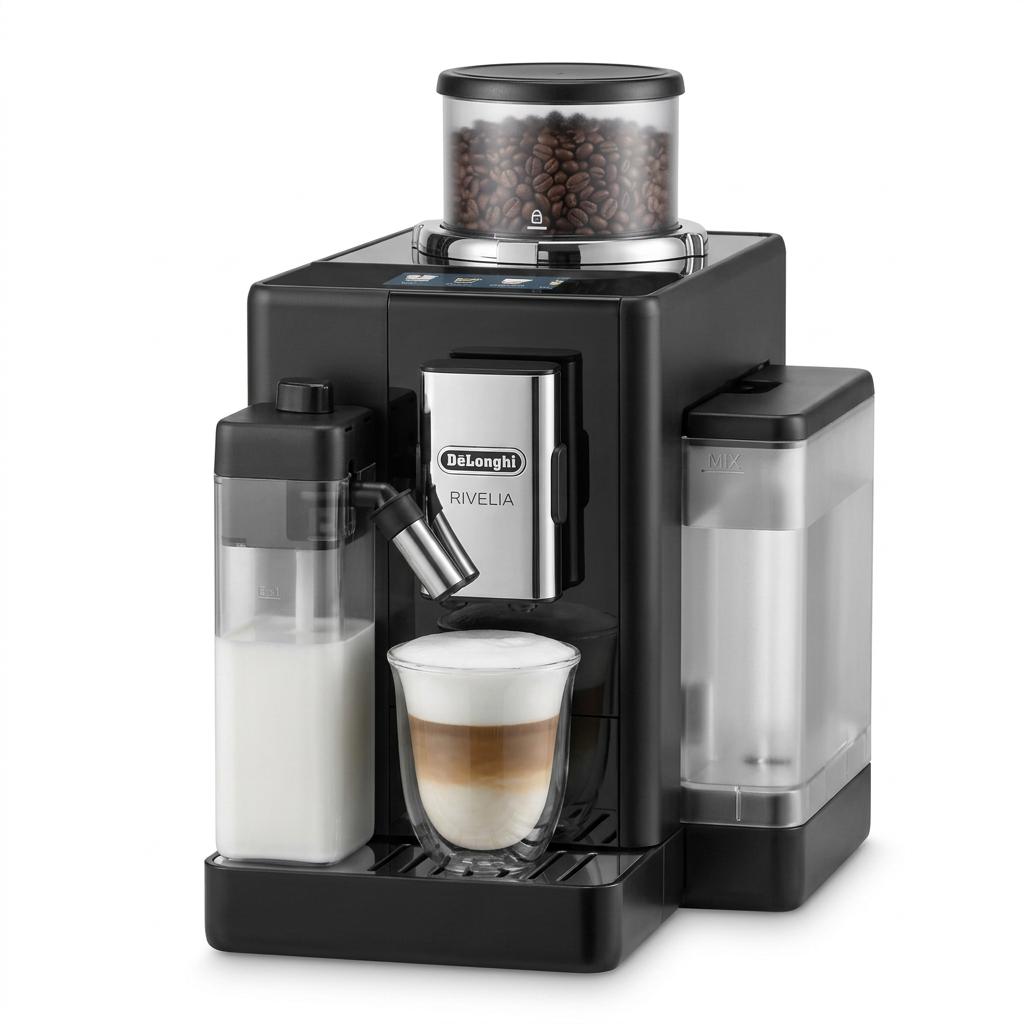
The full layout: hopper on top, milk carafe on the left and water tank on the right.
De'Longhi Rivelia specifications
From manufacturer data and my own measurements.
How I tested and scored the De'Longhi Rivelia
I used the De'Longhi Rivelia as my main coffee machine for several weeks.
I made espresso, coffee crema, latte macchiatos and cappuccinos, and switched between regular and decaf hoppers regularly.
I weighed doses and shots on a coffee scale, took milk and hot water temperatures with a probe thermometer and measured noise with a decibel meter.
I also tried pairings of similar and very different roasts to see how the bean switch handled them.
I then compared my notes with the manufacturer's specifications and general espresso brewing guidance.
- Espresso (8.3): dose, crema, body and consistency with fresh beans.
- Milk (8.5): foam texture, temperature and ease of the carafe.
- Ease of use (9.1): touchscreen, profiles, Bean Adapt and the bean switch.
- Cleaning (8.2): routine care, prompts and design quirks.
The overall score of 8.5 is an editorial rating that reflects those four areas.
De'Longhi Rivelia FAQ
Is the De'Longhi Rivelia worth it?
Yes, if you switch between two coffees, such as regular and decaf, or several people share one machine. It's less compelling if everyone drinks the same beans or you want true cold brew.
How does the bean switch work?
Each hopper twists off with a quarter turn. After a swap, the machine either grinds and discards the roughly 10 g left in the grinder or uses it in your next drink.
Can the Rivelia make cold brew?
No. Its iced recipes pour hot coffee over ice. The model I tested has no cold extraction and no cold milk foam.
How hot is the milk?
I measured frothed milk between 140°F and 149°F, which keeps it sweet without scalding.
How much coffee does it grind per shot?
At the highest intensity, about 15 g, which gives a fuller-bodied espresso than many automatic machines.
Is the Rivelia loud?
I measured 66 to 68 dB while grinding and brewing, which is fairly quiet for a fully automatic machine.
Can I use pre-ground coffee?
Yes. There's a removable chute for pre-ground coffee, which also makes it easy to brew a single decaf without swapping hoppers.
How many people can have their own settings?
Up to four user profiles, each with saved drinks, strength and size.
Can I use oat or other plant milks?
Yes. Plant milks froth well, and barista-style versions hold their foam best.

- Hands-on testing of the De'Longhi Rivelia
- De'Longhi product specifications and owner documentation
- General espresso brewing and maintenance guidance