De’Longhi Magnifica Duo vs Philips 3300: which automatic espresso machine should you buy?
One pours the strongest automatic espresso I’ve measured in this class and makes cold brew in under three minutes. The other is so quiet I made coffee next to a sleeping child, and its milk carafe rinses clean in ten seconds. I used both as my everyday machine and dug through the data to find out which one belongs on your counter.
We choose products independently. We may earn a commission through links on this page; your price stays the same. Affiliate policy
Jargon helpNew to espresso? Tap any dotted term to see what it means.
In this comparison
If you want stronger coffee and you drink iced lattes for half the year, I would pick the De’Longhi Magnifica Duo. Its bigger dose made a far denser espresso, and its second carafe gives you cold foam and quick cold brew that the Philips simply can’t make. The Philips 3300 is the one I would buy for a quiet home that lives on hot milk drinks, because its grinder barely makes a sound and its milk carafe is the easiest to clean I’ve used. Be aware that the Duo has a sharp, high-pitched grinder, and that a single Philips espresso is noticeably lighter unless you brew a double.
The two machines
Specs checked November 10, 2026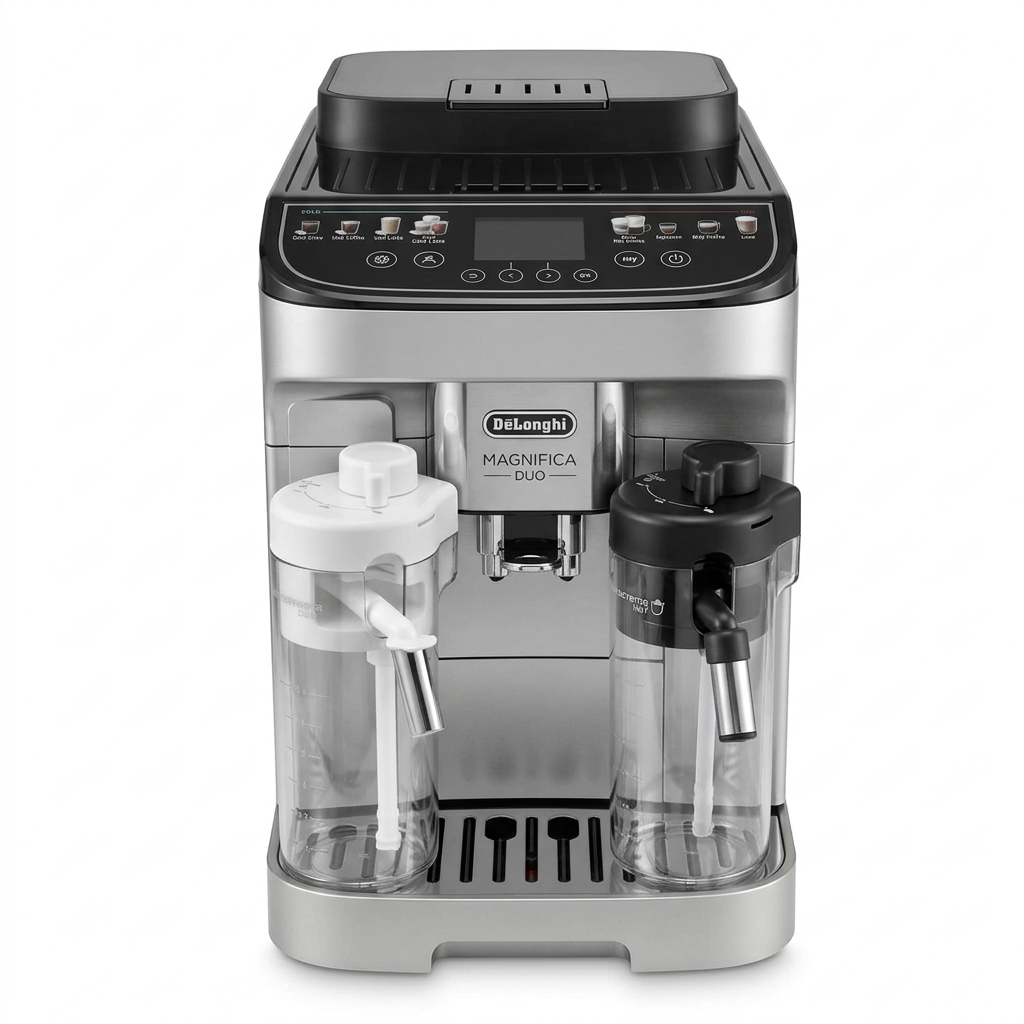
A narrow bean-to-cup machine with separate hot and cold milk carafes, cold brew in under three minutes and 18 drink recipes.
See Today’s Price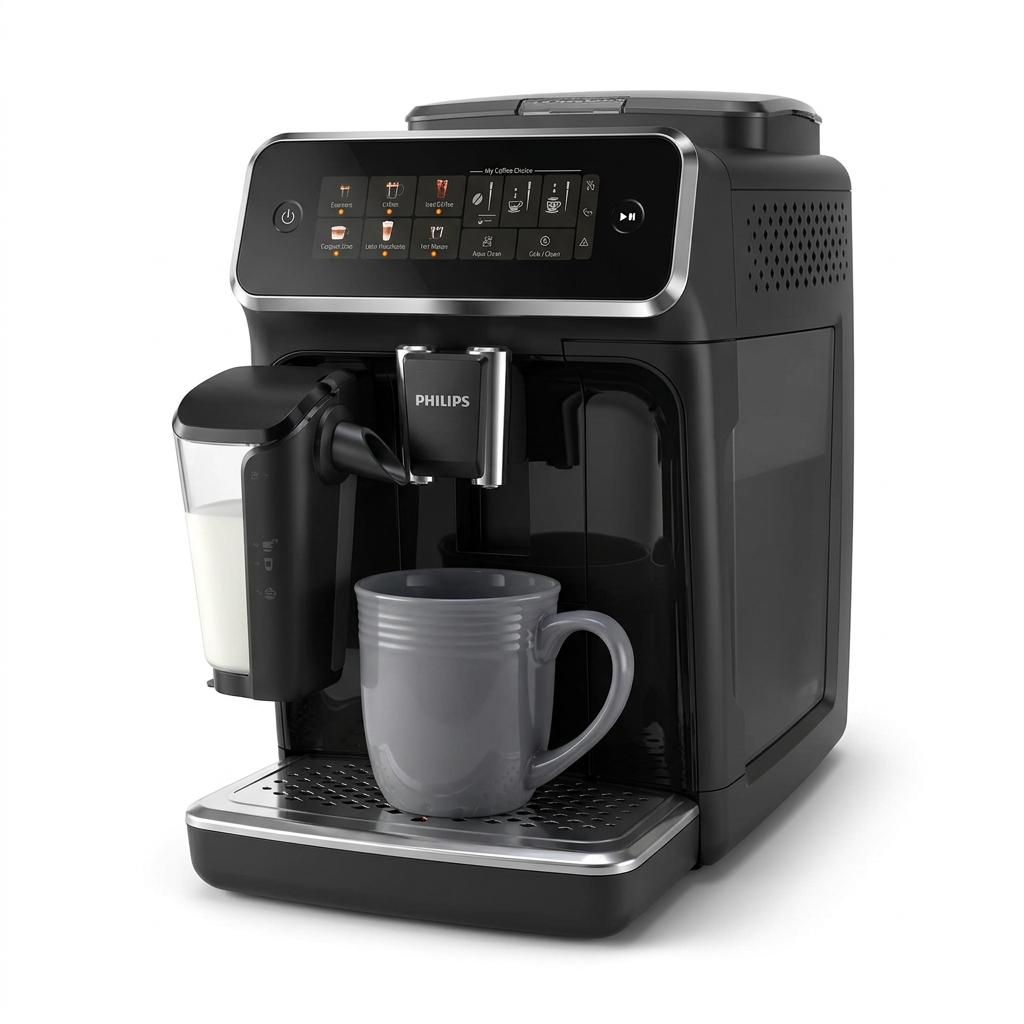
A compact, front-loading machine with a gasket-sealed grinder, a tube-free LatteGo carafe and six one-touch drinks.
Reveal Today’s DealMagnifica Duo vs Philips 3300 at a glance
- Buy the Magnifica Duo if you want a strong, full-bodied espresso from a single press. Its dose is up to 13.5 grams, against about 8 grams on the Philips.
- Buy the Philips 3300 if noise and cleanup matter most. Its sealed grinder is far quieter, and its two-piece milk carafe has no tubes to clean.
- Only the Duo makes cold foam and quick cold brew. The Philips iced coffee is a concentrated warm brew poured over ice.
- The Philips is smaller, lighter and loads from the front. The Duo is narrower but much deeper, so measure your counter first.
Head to head
The better result in each row is marked, and rows without a mark are a tie or a matter of taste. Figures are my own measurements where I took them, and manufacturer specs everywhere else.
The tally is not my verdict. Several of the Duo’s wins are about menu and features, while the Philips wins tend to show up every single morning.
| Spec | Magnifica Duo | Philips 3300 |
|---|---|---|
| Espresso strengthTDS, measured | Up to 8.6% ✓ Best | 4.5 to 5.5% |
| Coffee per cycle | About 10 to 13.5 g ✓ Best | About 6 to 8 g |
| Grind settings | 13, stainless conical burrs | 12, ceramic burrs |
| Grinder noisemeasured | 68 to 69 dB | 61 to 62 dB ✓ Best |
| Pump noisemeasured | About 55 dB ✓ Best | 62 to 68 dB |
| Milk system | Hot and cold carafes ✓ Best | One LatteGo carafe |
| Milk cleanup | Auto rinse, carafes have more parts | Two parts, no tubes ✓ Best |
| Cold brew | Under 3 minutes ✓ Best | No |
| Cold foam | Yes ✓ Best | No |
| Drink menu | 18 recipes plus hot water ✓ Best | 5 recipes plus hot water |
| User profiles | 3 ✓ Best | None |
| Controls | 2.4-inch color display, buttons | Backlit touch icons |
| Bean hopper | 250 g | 275 g, sealed lid ✓ Best |
| Grounds bin | 14 pucks ✓ Best | 12 pucks |
| Tank access | From the side | From the front ✓ Best |
| Depth | 17.32 in | 14.6 in ✓ Best |
| Weight | 20.8 lb | 17.6 lb ✓ Best |
| Water filter | Filter compatible | AquaClean, up to 5,000 cups claimed ✓ Best |
| Water tank | 1.8 L | 1.8 L |
| Pump pressure | 15 bar | 15 bar |
| Rows won | 9 | 7 |
Magnifica Duo vs Philips 3300 pros and cons
De’Longhi Magnifica Duo
- Dense, strong espresso of up to 8.6% TDS
- Separate carafes for hot microfoam and cold foam
- Cold brew in under three minutes, no overnight steep
- Sharp, high-pitched grinder
- Two carafes to store in the fridge and cupboard
- Deep body and side-loading water tank
Philips 3300 Series
- Gasket-sealed grinder that stays genuinely quiet
- Two-piece LatteGo carafe with no tubes, rinsed in seconds
- Tank, tray and grounds bin all come out from the front
- Single espresso is light at about 8 grams of coffee
- Stiff foam rather than silky microfoam
- No cold foam, no cold brew and no user profiles
Who should buy which machine?
- Households that switch between hot and iced coffee
- People who like a strong, full-bodied espresso
- Shared kitchens where everyone wants their own saved drink
- Early risers in open-plan homes or small apartments
- Anyone who hates cleaning milk hoses and frothers
- Capsule users who want fresh beans with no learning curve
Design, size and build
On paper these two take up almost the same width on a counter. In my kitchen they felt very different, because the shape of each machine decides where it can go.
The Magnifica Duo is the narrower of the two at 9.45 inches wide. It is also very deep at 17.32 inches, and the water tank pulls out from the right side, so it needs room on that flank and a deep counter.
The Philips 3300 is a touch wider at about 9.7 inches, but almost three inches shallower. Its water tank, drip tray and grounds bin all slide out from the front, so I could push it into a corner and never move it again.
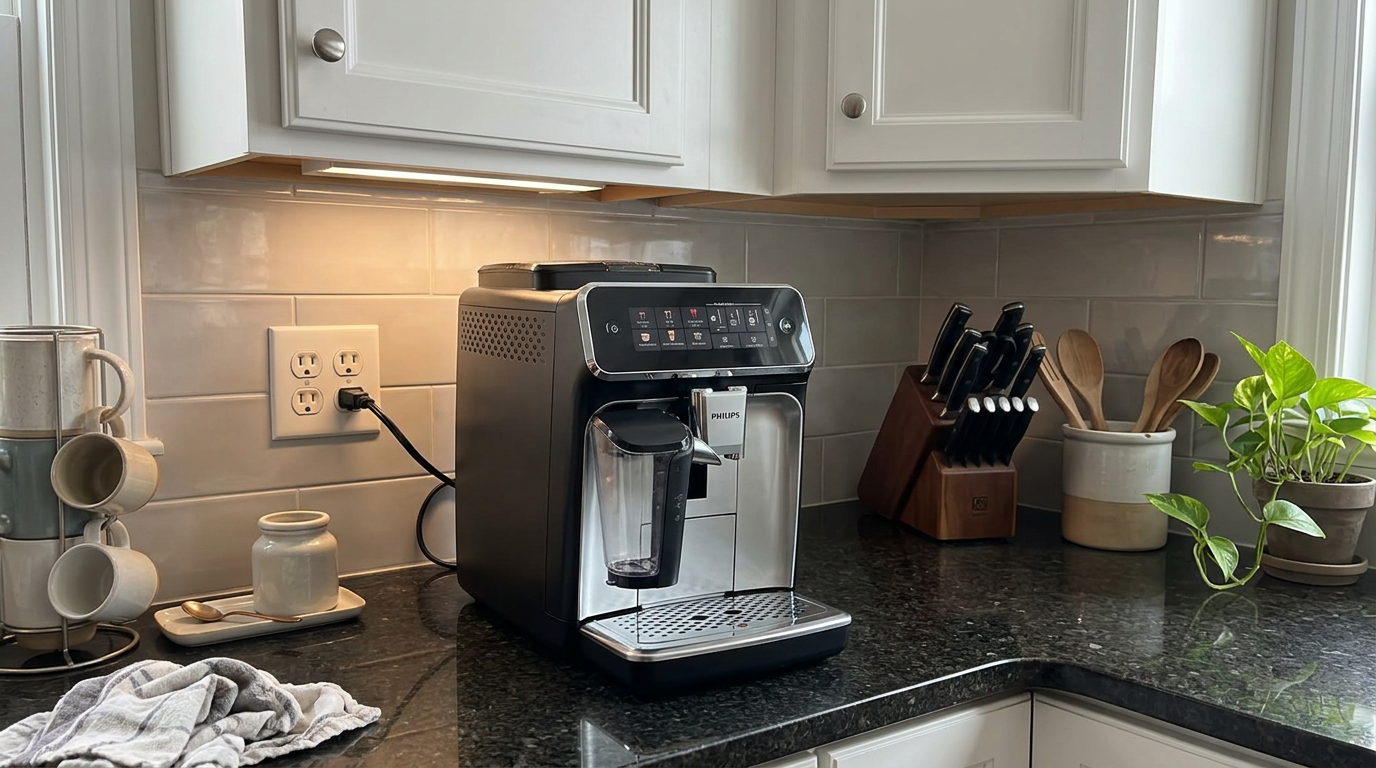
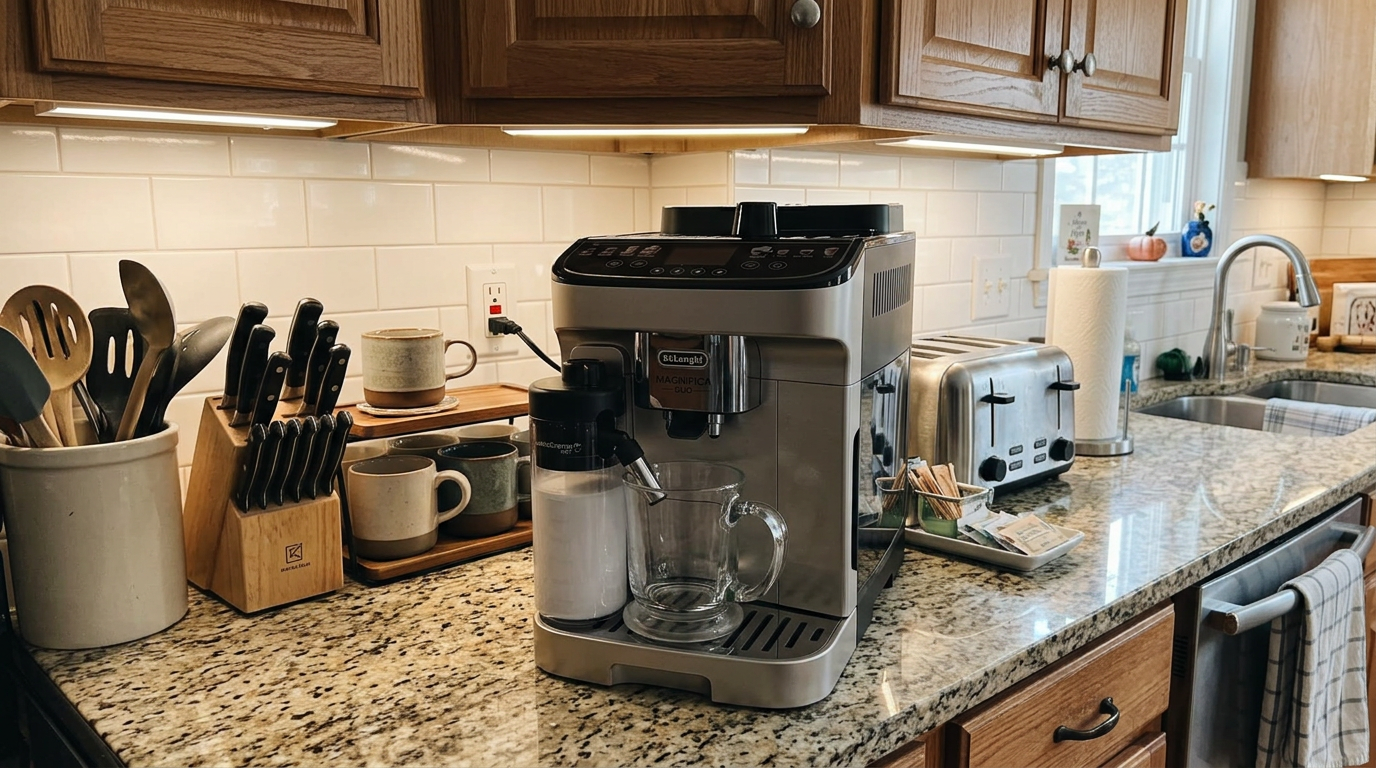
The Philips sits happily in a corner, because everything you service daily comes out of the front.
How deep each machine is
Height is the one place the Philips asks for more. At 17 inches, it stands almost three inches taller than the Duo, and both need a little extra clearance to lift the bean lid.
Both bodies are mostly plastic, and neither feels like a luxury appliance when you press on a side panel. The Duo hides it better with a brushed metallic finish, while the Philips is a plainer molded body with chrome-look trim.
The Philips has the better drip tray, with internal baffles that stop it sloshing on the way to the sink and a stainless grate that shrugs off mug scratches. The Duo’s cup tray on top only gets lightly warm, so neither machine is a real cup warmer.
Our tip: Measure the depth of your counter and the gap under your wall cabinets before you order, because the Duo is deep and the Philips is tall.
Setup, controls and menu
Setup took me about ten minutes on each machine. You rinse the tank, test your water with the strip, fit the filter and let the machine prime and rinse itself.
Both use a thermoblock✕ThermoblockA heater that warms water as it flows through, instead of keeping a boiler full of hot water. It makes a machine ready in under a minute. heater, so neither keeps a tank of water hot all day. My Duo was ready to brew 35 to 45 seconds after switching on, and the Philips runs a short rinse while it heats that takes about the same time.
The way you choose a drink is where they really part ways. The Duo has a 2.4-inch color display with soft-touch buttons beside it, while the Philips has a panel of backlit icons with one icon per drink.
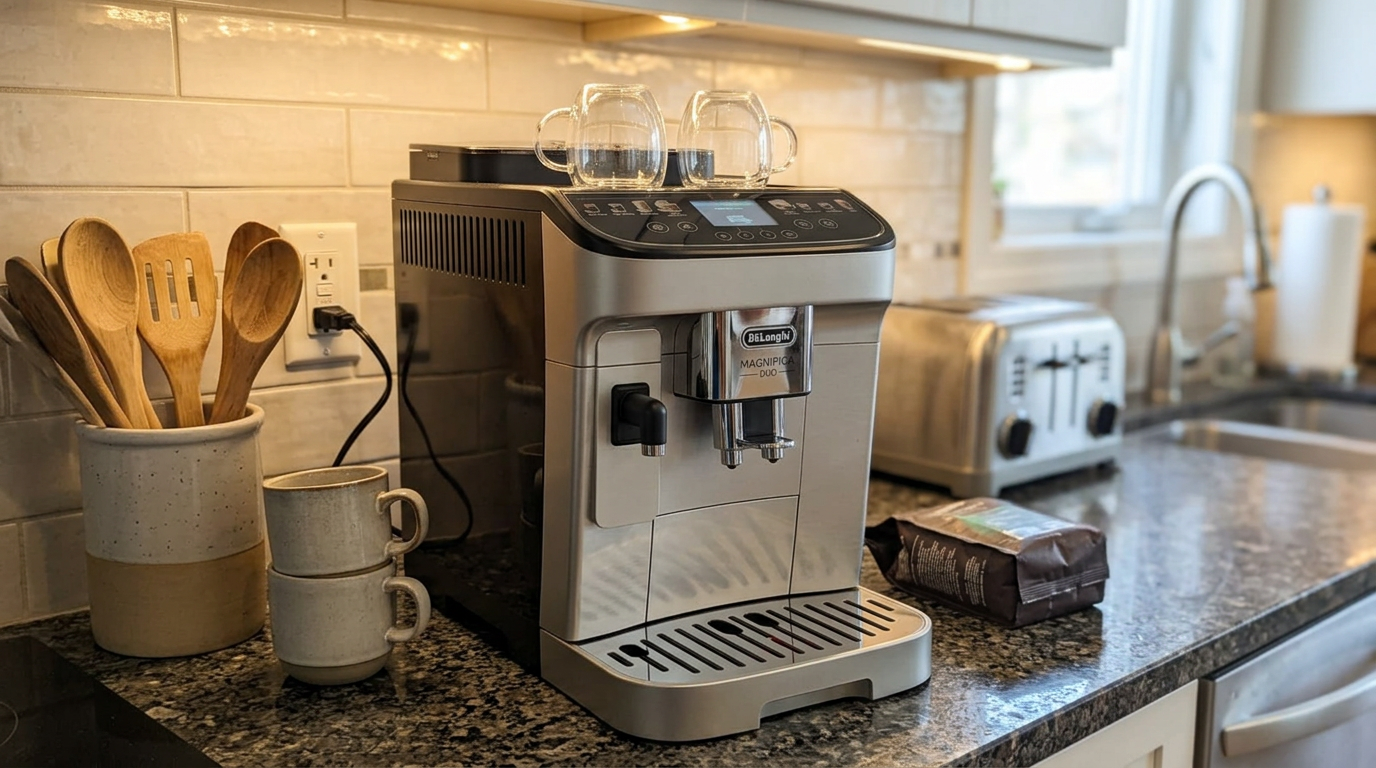
The Duo’s color display sits above the spout, with hot drinks on one side and cold drinks on the other.
I liked the Philips icons straight away. There is no scrolling before your first coffee, and the strength, volume and milk settings light up so you can see what you picked at a glance.
The Duo took me a day or two to learn, because you scroll through some options and the hot and cold drinks sit on opposite sides. Once I knew where my usual drinks lived it became quick, and buttons don’t smear with fingerprints the way a glass screen does.
| Control feature | Magnifica Duo | Philips 3300 |
|---|---|---|
| Interface | 2.4-inch color display, buttons | Backlit touch icons |
| Recipes | 18 coffee and milk drinks | 5 coffee and milk drinks |
| Strength levels | 5 | 3 |
| Temperature settings | Set per drink type | 3 levels |
| User profiles | 3 | None |
| Learning time | A day or two | Minutes |
The three user profiles on the Duo are a bigger deal than they look. I kept one for a strong flat white, one for a milder iced latte and one as a guest default, so nobody had to remember anybody else’s settings.
The Philips gives every drink three levels of strength, volume and milk, which works out at 27 combinations per milk drink. That is plenty for most homes, but the steps are coarse, and you can’t save a personal favorite.
Our tip: Save your most-used drink in a Duo profile slot, so one press brings back your size, strength and milk settings every morning.
Grinder and dosing
The grinder decides more about your coffee on an automatic machine than almost anything else. These two take quite different approaches, and the difference shows up in every cup.
The Magnifica Duo uses a stainless steel conical burr✕Conical burrA cone-shaped grinding part that crushes beans between two ridged surfaces for an even grind, rather than chopping them like a blade. grinder with 13 positions, from 1 to 7 in half steps. With the dark and medium-dark espresso roasts I used most, my best results landed between 2.5 and 4.
The Philips uses ceramic burrs✕Ceramic burrsGrinding burrs made of ceramic instead of steel. They stay cooler and wear very slowly, though they can chip if a stone gets into the beans. with 12 settings, where 1 is the finest. It ships in the middle of the range, and moving down to settings 1 to 3 gave me firmer pucks and noticeably more body.
Coffee per cycle at each strength
That chart is the single most important difference between these machines. At its five-bean maximum, the Duo’s grinder ran for up to 9 seconds and put roughly 10 to 13.5 grams of coffee into the brew group✕Brew groupThe removable unit inside an automatic machine that receives the ground coffee, presses it and pushes hot water through it..
The Philips brew chamber holds about 8 grams per cycle at its strongest setting. For comparison, a café double shot usually uses 16 to 18 grams, so a single Philips espresso works with roughly half the coffee.
Both grinders share one rule that every new owner should learn. Only turn the dial while the burrs are spinning, because turning it while idle can force the burrs against trapped beans.
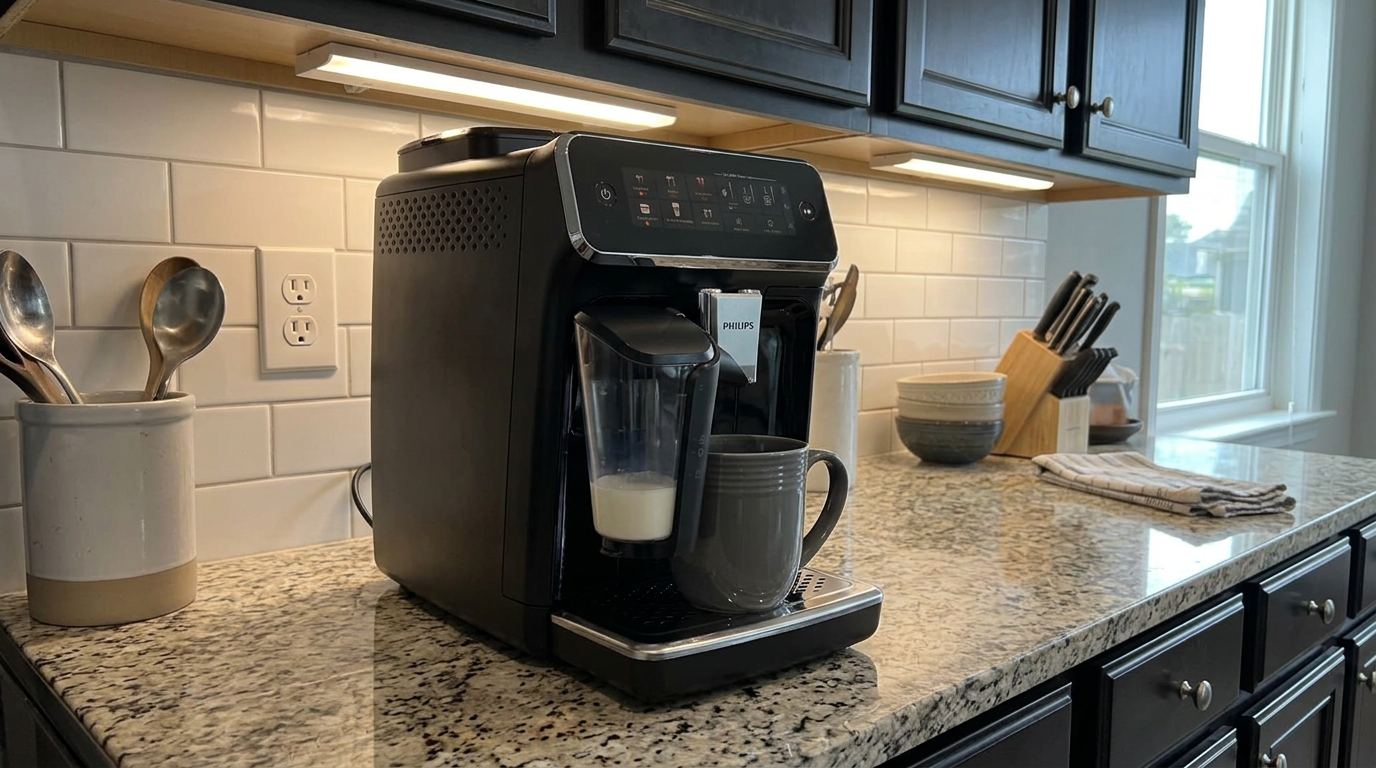
The Philips grind knob sits inside the bean hopper, under the gasket-sealed lid.
Both machines also need a settling-in period. The Duo found its rhythm after about 8 to 10 brewing cycles, while the Philips needed closer to 20 to 30 cycles before its pucks went from crumbly to firm.
Cups before each machine settled in
If you judge the Philips in its first week, you will judge it too harshly. Its first ten pucks were sloppy and its shots thin, and both improved steadily through the second week.
Each machine has a bypass chute for pre-ground coffee. The Duo takes up to 15 grams and the Philips one level scoop of up to about 12 grams, which is handy for an evening decaf without emptying the hopper.
Our tip: Change the grind one step at a time and judge it over two or three drinks, because the first cup after a change still contains coffee from the old setting.
Espresso quality
This is where the gap between the two machines is widest. I measured the strength of both machines’ espresso as TDS✕TDSTotal dissolved solids: the share of your cup that is actually dissolved coffee. Higher TDS tastes denser and more intense., which tells you how much coffee is actually dissolved in the cup.
At its stronger settings, the Duo reached 8.6% TDS. The Philips landed between 4.5% and 5.5% at fine grind settings, and published measurements put it near 3% at its coarsest setting.
Espresso strength (TDS)
In the cup, the Duo gave me a heavy body and a dense, tight crema✕CremaThe layer of golden-brown foam on top of an espresso, formed by oils and gases released under pressure.. With a rich dark roast, the flavor leaned firmly toward cocoa and dark chocolate.
The Philips shot was clean, balanced and pleasant, with a moderate crema and none of the burnt bitterness of cheaper automatics. On its own, though, it tasted closer to a strong short coffee than a true café espresso.
The numbers above explain why. Both pour roughly the same amount of liquid, but the Philips has about 8 grams of coffee to work with against up to 13.5 grams in the Duo.
Brewing temperature is close between them. My Duo shots measured 85 to 90°C, or 185 to 194°F, and the Philips came out at about 85°C, or 185°F, at the spout.
Both are a little cool for light roasts, which need hotter water to extract fully. Medium-dark and dark beans suit both machines best, and the Philips lets you raise the temperature to its highest of three settings.
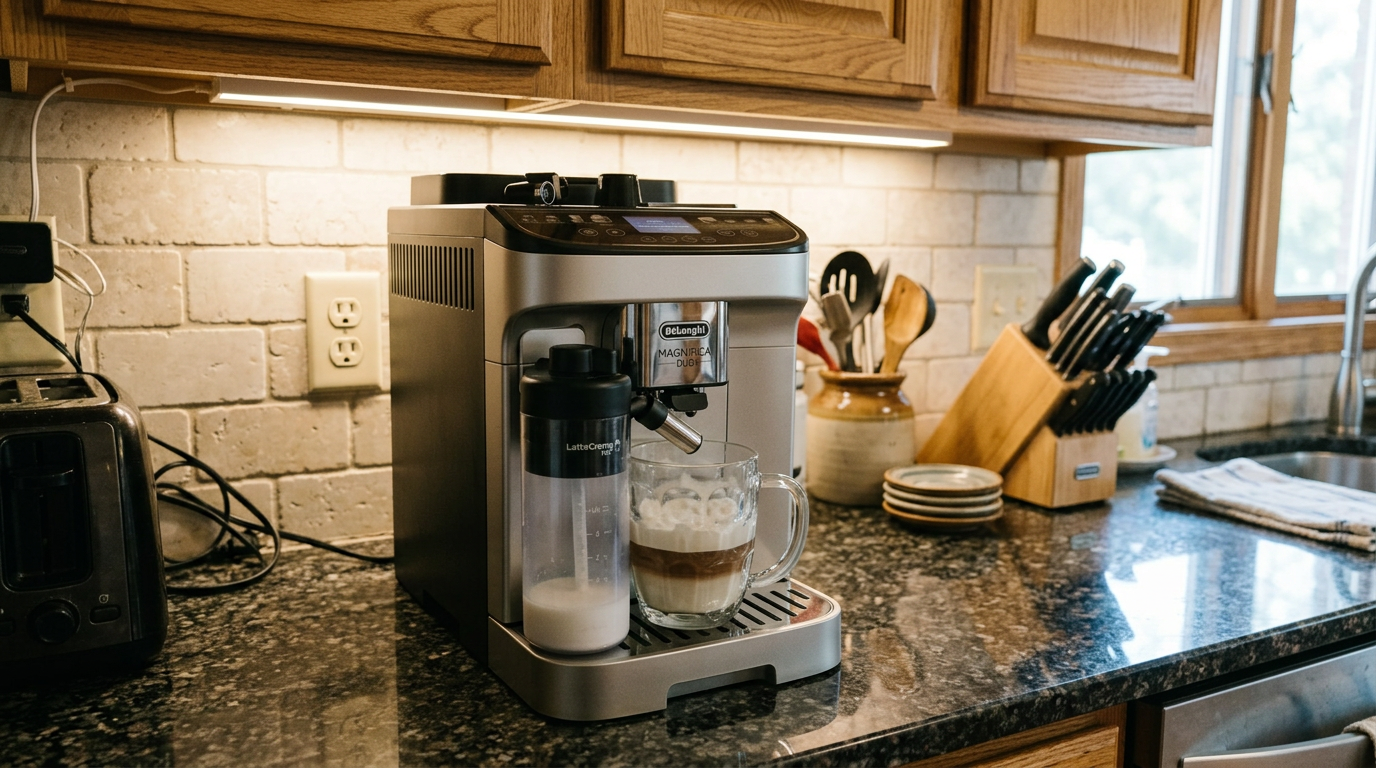
With a medium-dark roast, the Duo’s espresso cuts through milk with plenty of cocoa flavor.
How I got the most out of each machine
On the Duo, my favorite trick uses the Coffee Crema setting at five-bean strength, which triggers the longest grind the machine has. I stop it by hand once about 32 grams has come out, and it gives a dense, very strong double-style shot.
On the Philips, the simplest fix is the double function, which runs two cycles into the same cup and gets you to about 16 grams of coffee. Combined with grind setting 1 or 2 and the strong setting, it made the best espresso I got from that machine.
There is one more Philips trick worth knowing. Published measurements show that a full 12-gram scoop through the pre-ground chute can push the shot to around 7% TDS, because it beats the grinder’s own dose.
| Goal | Magnifica Duo | Philips 3300 |
|---|---|---|
| Fuller espresso | Grind 2.5 to 3, 5 beans | Grind 1 to 2, strong, double |
| Everyday cappuccino | Grind 3, 4 to 5 beans | Grind 2 to 3, strong, single |
| Large latte | Grind 3 to 4, 5 beans | Grind 2 to 3, strong, double |
| Iced drinks | 5 beans, glass full of ice | Strong, glass full of ice |
Even with every trick, the Duo makes the stronger shot. If you drink straight espresso every day, this section alone should push you toward it.
If almost everything you drink has milk in it, the gap shrinks a lot. Under 6 ounces of foamed milk, I struggled to tell the Philips double from the Duo single in a blind sip.
Find Out the Price TodayLong coffee and black coffee
Not everyone in a house wants espresso, so I spent a week drinking big mugs of black coffee from both machines. The Duo gives you three ways to make one, and the Philips gives you one main option plus a workaround.
The Duo’s Coffee Crema is a lungo✕LungoA long espresso, made by pushing more water through the same coffee. It is bigger and milder than an espresso, but more intense than drip coffee.-style drink of about 5 ounces with crema on top. It was my pick for a strong morning mug.
Its Drip Coffee setting is more clever. It grinds for about 6 seconds, brews half the cup, then grinds and brews the second half, which stops one small puck from being over-extracted and bitter.
The Philips Coffee setting pushes more water through its one small puck. It works for a medium mug, but at the largest volume it got thin and a little bitter in my testing.
| Black coffee | Magnifica Duo | Philips 3300 |
|---|---|---|
| Long espresso | Coffee Crema, full body | Coffee, thinner at large sizes |
| Drip-style mug | Two grinds, two half-brews | Not available |
| Americano | One-touch, water bypass | Double espresso plus hot water by hand |
| Best result | Americano or Coffee Crema | Double espresso topped with hot water |
On the Philips, my best black coffee was a double espresso topped up from the hot water spout. That keeps the extraction short and adds volume afterward, which tastes much cleaner.
The Duo does the same thing for you with a one-touch Americano. The water bypasses the coffee, so it adds length without adding bitterness.
Our tip: On the Philips, make big black coffees as a double espresso plus hot water rather than using the largest Coffee size.
Milk drinks
Both machines froth milk automatically and pour it straight into your cup. How they do it, and how much cleaning each system asks for, is very different.
The Duo’s black-lidded LatteCrema Hot carafe draws milk up a flexible straw, heats and aerates it and pours it through an extending spout. A dial on the lid gives three foam levels, from low for a flat white to high for a cappuccino.
The Philips LatteGo carafe is two molded pieces that snap together with no tubes, latches or hidden channels. Milk is pulled into a small side chamber, mixed with air at high speed and poured into the cup.
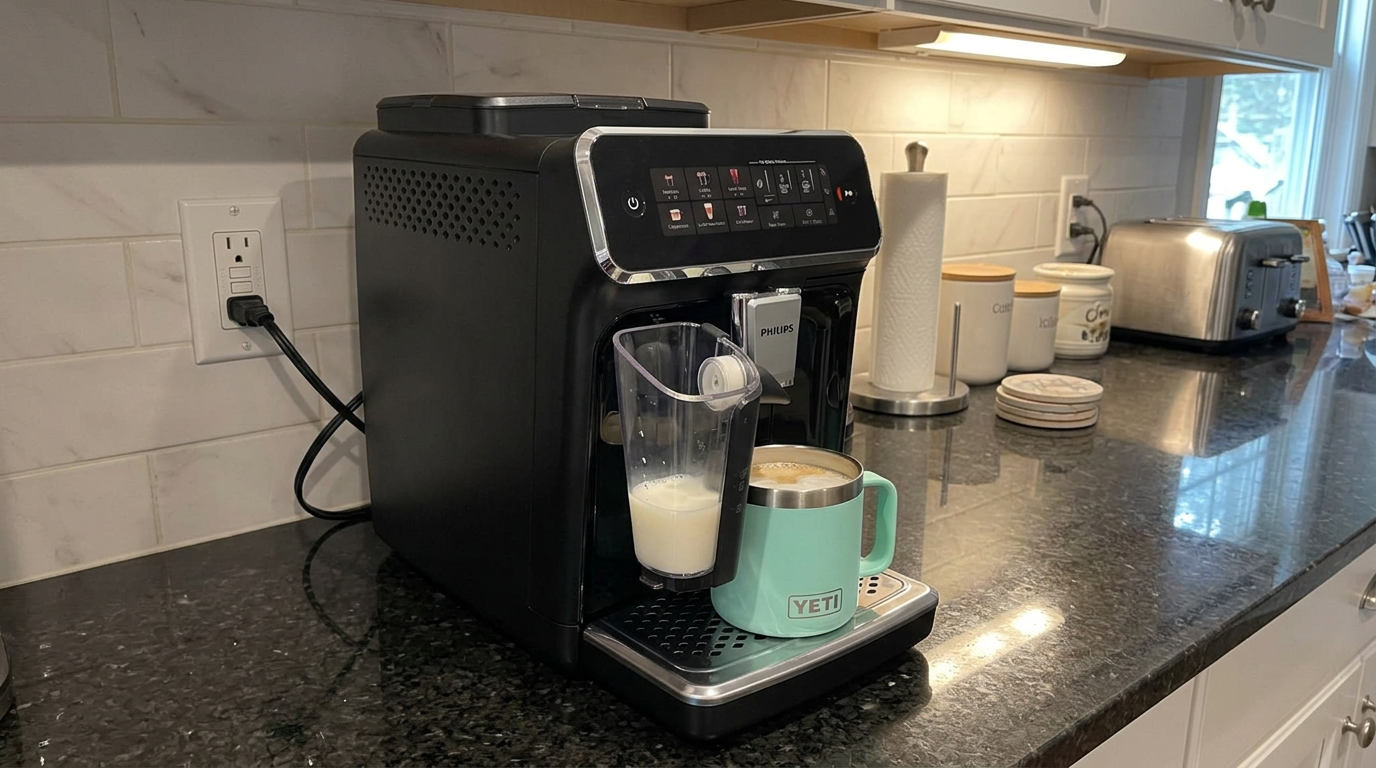
The LatteGo carafe clips on the front and froths straight into your cup.
How the foam turned out
The Duo’s foam was consistently fine and glossy, with small bubbles rather than big soapy ones. It is not pourable microfoam✕MicrofoamMilk steamed into tiny, even bubbles so it feels silky and pours well enough for latte art. for latte art, but for a cappuccino you drink right away it was excellent.
The Philips foam was dense, stiff and generous in volume. It makes a classic tall, spoonable cappuccino cap, but the bubbles are a little coarser and the foam sits on the milk rather than blending into it.
My milk ratings out of 10
That chart sums up the trade. The Duo makes the nicer milk, and the Philips makes the milk you will never mind cleaning up after.
Both handled plant milks well. Oat milk was a pleasant surprise on the Philips, and on the Duo barista-style oat, almond and soy milks gave the most stable foam.
Whole milk at about 3.5% fat gave me the most stable foam on both machines. Lower-fat milk foams up easily but collapses faster in the cup.
Cleaning the milk system
After every milk drink, the Duo asks you to run a short CLEAN cycle that flushes steam and hot water through the milk spout. It takes a few seconds, and both carafes come apart and are top-rack dishwasher safe.
The Philips has no internal milk path to flush at all. I timed myself separating, rinsing and reassembling the LatteGo, and it took under 10 seconds.
Daily milk cleanup time
The Philips has a few quirks of its own. Its lid sits loosely with no latch, and twice I picked up the carafe by its body and the lid slid off.
There is also no hot-milk-only button on the Philips, so you stop a cycle by hand for a cup of frothed milk. The Duo has a dedicated Hot Milk recipe, which my kids used for babyccinos.
Our tip: Keep the milk carafe in the fridge between drinks, because colder milk builds finer, longer-lasting foam on both machines.
See Today’s PriceCold and iced drinks
If you drink iced coffee all summer, this section may settle the whole decision. Both machines have an iced button, but they do very different things.
The Magnifica Duo has a second white-lidded LatteCrema Cool carafe that whips cold milk without heating it. Straight from a fridge at 5°C, or 41°F, my milk came out at around 20°C, or 68°F, as a thick, velvety cold foam.
Its Cold Extraction mode makes cold brew✕Cold brewCoffee extracted with cool water instead of hot. It tastes smoother and less acidic, and is traditionally steeped for 12 to 24 hours. using low pressure and pulses of water at about 50 to 58°C, or 122 to 136°F. Every batch I made finished in under three minutes, and it was smooth, low in acidity and naturally sweet.
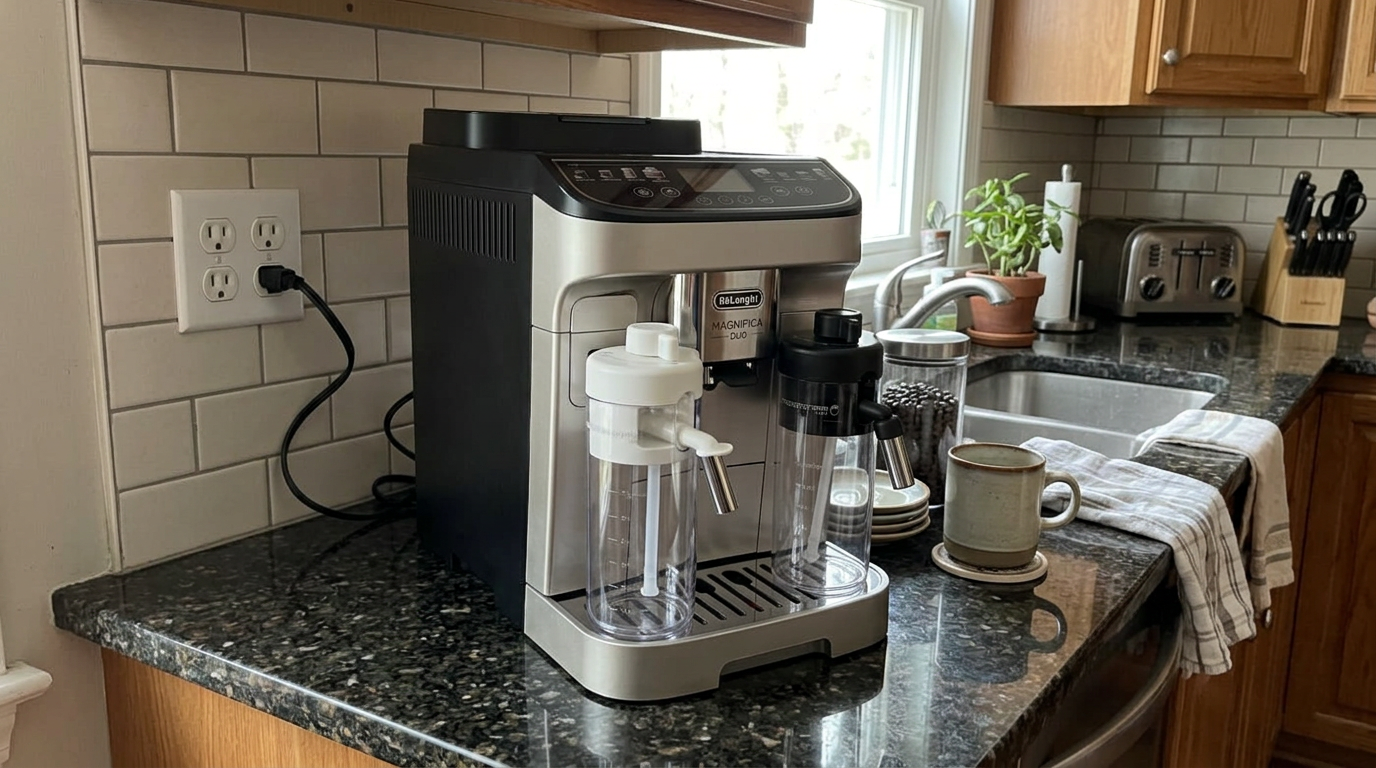
Two carafes on the Duo: one for hot milk, one for cold foam.
Time to a glass of cold brew
The Philips 3300 doesn’t chill anything. Its iced coffee button slows the pump and brews a little cooler to make a concentrated, warm coffee that you pour straight over a full glass of ice.
Done that way, it works well, and the concentrated brew cools almost instantly. With only a few cubes, though, I got a lukewarm and diluted drink.
| Cold drink | Magnifica Duo | Philips 3300 |
|---|---|---|
| Cold brew | Yes, under 3 minutes | No |
| Iced coffee | Yes, hot brew over ice | Yes, concentrated brew over ice |
| Iced espresso and Americano | Yes | By hand |
| Cold foam | Yes, dedicated carafe | No |
| Iced milk drinks | 5 one-touch recipes | Add cold milk yourself |
I expected cold foam to be a gimmick, and it became the feature I used most in warm weather. An iced latte topped with cold foam from the Duo tastes like a café drink, while the Philips version tastes like good iced coffee with milk added.
The Duo has one quirk here. After several hot drinks, the first part of a cold brew came out noticeably warmer, because the thermoblock and brew group hold heat for a while.
Our tip: Fill the glass to the top with large ice cubes before pressing any iced drink, because big cubes melt slower and keep the coffee from tasting watery.
Noise
Noise is the Philips 3300’s best feature, and it is the area where the Duo lost the most points with me. I measured both at about one meter from the machine.
The Philips bean lid has a thick rubber gasket that seals the grinder compartment. With the lid closed, the grinder peaked at 61 to 62 dB, and the manufacturer says the range makes 40% less noise than its earlier models.
The Duo’s grinder measured 68 to 69 dB with a sharp, high-pitched tone that cuts through a quiet house. The grind only lasts a few seconds, up to 9 at the strongest setting, but that is what a sleeping partner will hear.
Measured noise levels
Decibels are logarithmic, so a 7 dB gap is much bigger than it looks. To most people, it sounds like the Duo’s grinder is well over half again as loud.
The pumps tell the opposite story. The Duo’s pump was a calm 55 dB while brewing, while the Philips pump buzzed at 62 to 68 dB and is actually the loudest part of its cycle.
Character matters as much as volume. The Philips makes a low, muffled rumble followed by a steady buzz, while the Duo makes a short, piercing whine followed by near silence.
I made coffee on the Philips at 6 a.m. with a child asleep in the next room, and nobody woke up. On the Duo, I found myself waiting until the house was awake before making a second cup.
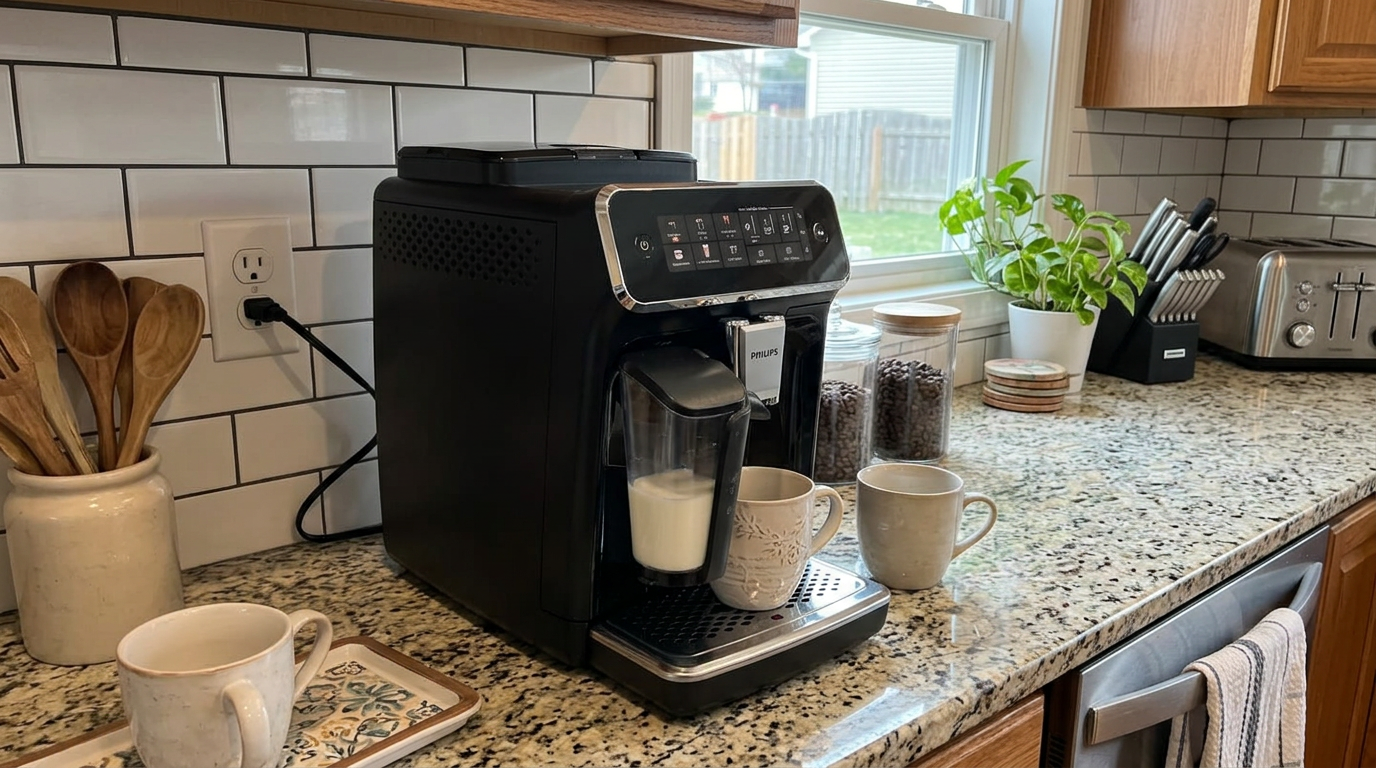
The sealed lid on the Philips keeps the grinder to a low, muffled hum.
Daily workflow
Specs only tell you so much. What you really live with is the routine at 7 a.m. with a full day ahead, so here is what my mornings looked like on each.
On the Duo, I switched it on, took the hot carafe from the fridge and clipped it on. I pressed my profile, and about a minute later I had a flat white, followed by the CLEAN prompt and the carafe back in the fridge.
On the Philips, I switched it on and let it rinse while I filled the LatteGo with cold milk. I touched cappuccino, waited about a minute, then rinsed the carafe under the hot tap in the time it took to stir in sugar.
| Step for one cappuccino | Magnifica Duo | Philips 3300 |
|---|---|---|
| Heat-up | 35 to 45 seconds | Short rinse while heating |
| Choose a drink | Profile or scroll the menu | One icon |
| Grind, tamp, brew | Automatic | Automatic |
| Froth milk | Automatic | Automatic |
| After the drink | Run CLEAN, carafe to fridge | Rinse carafe or return to fridge |
| Swap for an iced drink | Clip on the cold carafe | Fill a glass with ice |
Neither machine asks you to weigh, tamp, time a shot or steam milk by hand. That is the whole point of a super-automatic✕Super-automaticA bean-to-cup machine that grinds, doses, tamps, brews and often froths at one press, with no portafilter to handle., and guests made their own drinks on both without asking me a single question.
Making several drinks in a row went smoothly on both. Each brews coffee and heats milk one after the other, and I made four milk drinks back to back on each without waiting.
Drinks before you need to refill or empty
The small LatteGo carafe is the real limit on a busy Philips morning. At 260 ml, it needs topping up after about two cappuccinos, while I could pour more drinks between refills from the Duo carafe.
The Duo asks for a little more planning when hot and cold drinks are mixed. You swap carafes between recipes, which takes seconds but is easy to forget when you are half awake.
Our tip: Empty the drip tray at the same time as the grounds bin every morning, so a full tray never catches you halfway through a drink.
Cleaning and upkeep
If the coffee is where the Philips compromises, cleaning is where it shines. My daily routine on it took less than a minute, and on the Duo it took a little longer.
Both have a removable brew group, which I consider essential on any bean-to-cup machine. On each, you open a side door, press a release and slide the group out to rinse it under warm water.
Neither group should ever see dish soap or the dishwasher. Detergent strips the lubricant the moving parts need, and the Philips even includes a tube of food-grade grease for its rails.
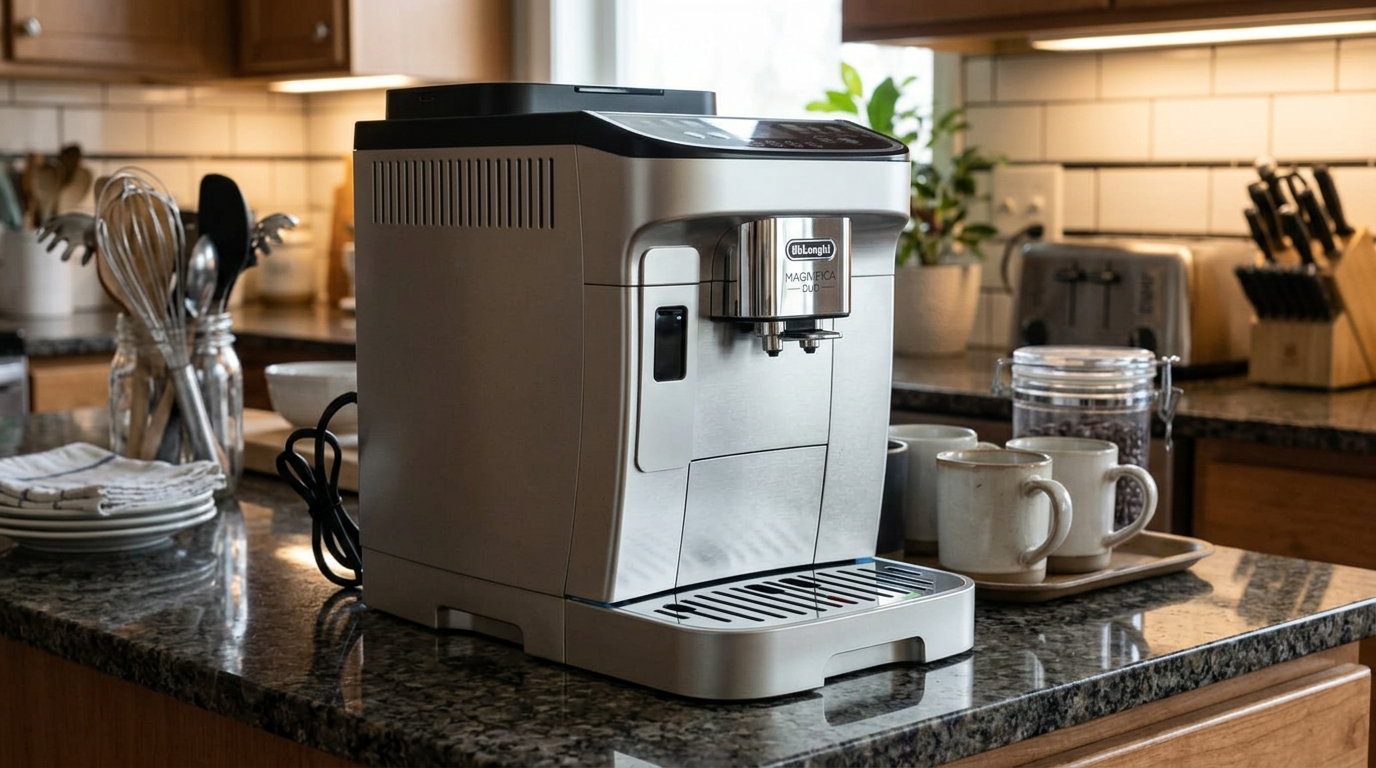
With the carafe off, the Duo’s front is easy to wipe, but the tank still comes out from the side.
The bigger daily difference is milk. The Duo’s carafes have more parts and its spout needs the CLEAN prompt every time, while the Philips carafe is two pieces that rinse in seconds.
Access is the other difference. Everything you empty daily on the Philips comes out of the front, while the Duo’s tank comes out of the right side.
My cleaning scores out of 10
The Duo has one more storage catch. If you use both carafes, you need fridge room for two milk containers, which is a real issue in a small fridge.
Our tip: Never wash either brew group with dish soap, because it strips the lubricant and can make the group stick or creak over time.
Water, filters and descaling
Scale is the slow killer of automatic coffee machines. Minerals in hard water build up inside the thermoblock and narrow the water paths over time.
Both machines ask for your water hardness during setup and use it to decide when to remind you to descale✕DescalingRunning a cleaning solution through the machine to dissolve mineral build-up from hard water.. Both take a filter in the tank, and both deserve one from day one.
The Philips AquaClean filter is the stronger system on paper. The manufacturer says that if you replace the filter when prompted, you won’t need to descale for up to 5,000 cups, with each filter lasting roughly 500 to 600 cups.
Philips cups between descaling
Unfiltered figures are rough estimates, because each machine sets its own schedule from your hardness setting. The AquaClean figure is the manufacturer’s claim.
Descaling the Duo took me 25 to 30 minutes, though most of it is waiting. You pour descaler to the A line, add water to the B line, set a big container under the spouts and let the machine run its pause-and-rinse cycles.
| Water care | Magnifica Duo | Philips 3300 |
|---|---|---|
| Filter | Water filter in the tank | AquaClean in the tank |
| Filter life | Change when prompted | About 500 to 600 cups |
| Descaler | Lactic acid descaler, 1 included | Manufacturer’s descaler |
| Descaling time | 25 to 30 minutes | About half an hour |
| Vinegar | Avoid | Avoid |
Skip vinegar on both machines. It can damage seals, and it isn’t effective enough on its own to protect the heater.
Our tip: Use a container that holds at least 2 liters when you descale, because a smaller bowl will overflow during the rinse cycles.
Beans and how far a bag goes
The dose difference has an upside for the Philips that is easy to miss. Because each single cycle uses only about 8 grams, a bag of beans lasts much longer.
Drinks per 250 g bag of beans
Calculated from the dose per drink, that is a real saving for milk drinkers, where coffee strength matters less. If you always brew Philips doubles to match the Duo’s body, the advantage disappears.
Medium-dark and dark roasts are the sweet spot on both machines. Avoid very oily, glossy beans, which stick to the hopper walls and can clog either grinder over time.
See How Much You’ll SaveReal-life scenarios: which machine fits your home?
Spec sheets only get you so far, so it helps to picture a normal week with each machine. These are the situations where I think the choice becomes obvious.
Its bigger dose gives a flat white real coffee punch from a single cycle, and your saved profile brings it back with one press.
The sealed grinder keeps the noise to a low hum, so nobody else has to wake up with you.
Cold brew in under three minutes or an iced latte with cold foam is something the Philips simply can’t match.
A ten-second carafe rinse and front-loading parts mean the cleanup actually gets done every day.
Each person saves their own size, strength and milk in a profile, so nobody drinks somebody else’s five-bean espresso.
Six icons, three settings each and almost no learning curve make it feel like a pod machine that grinds fresh beans.
Notice that neither machine wins every morning. The right choice depends on which of those situations looks most like your own life.
For households that drink hot and iced coffee, the Duo covers the whole year.
My scorecard
These are my own scores out of 10, based on daily use and the data above. My overall rating is 8.6 for the Magnifica Duo and 8.4 for the Philips 3300.
Magnifica Duo
Philips 3300
Which one is right for you?
4 quick questionsWhich one should you buy?
It comes down to one question: do you want more coffee, or less effort? If you want a stronger cup and cold drinks, the Duo is worth its louder grinder and extra cleanup.
If you want the quietest, easiest machine and most of your drinks are hot with milk, the Philips is the one you will enjoy living with every day.
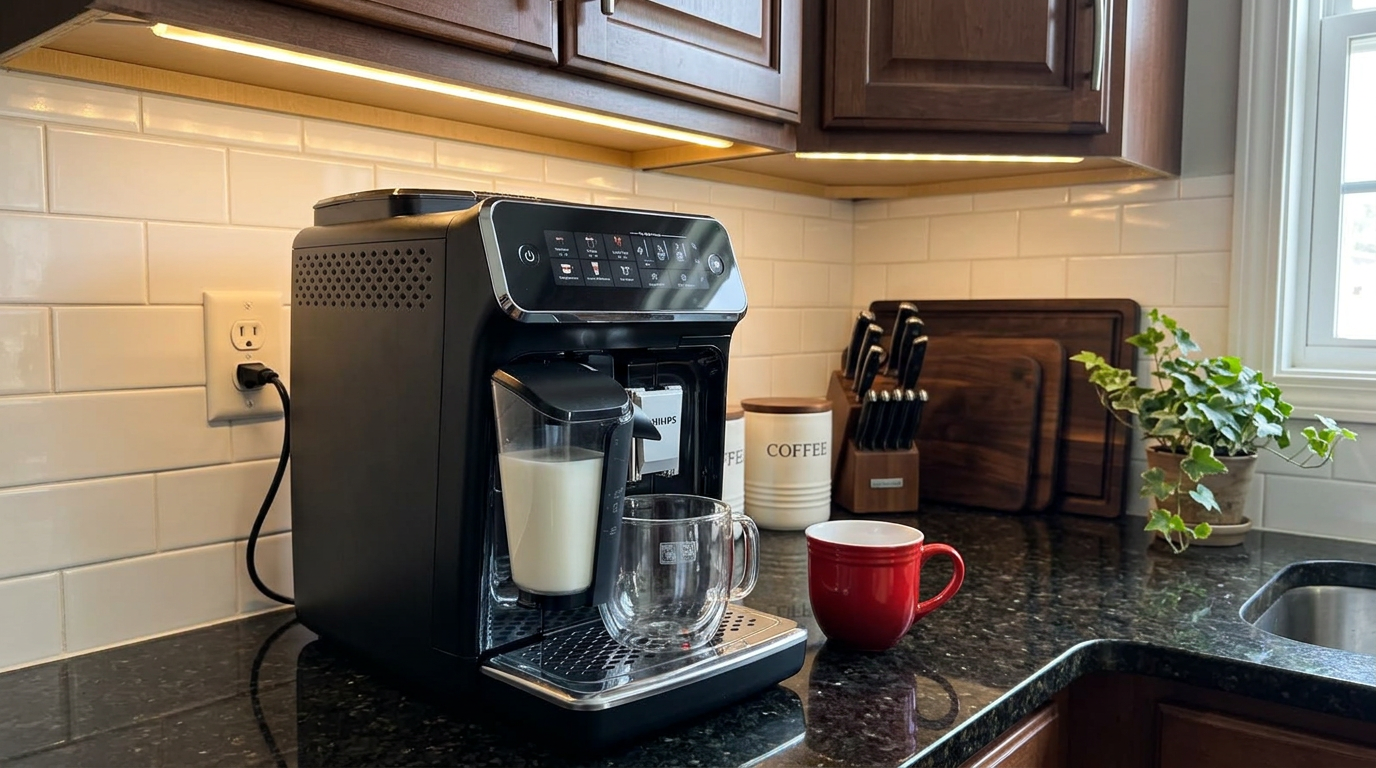
For quiet homes that live on cappuccinos, the Philips is the easier machine to live with.
- You want a strong espresso from one press
- You drink iced coffee and want cold foam
- Several people need their own saved drinks
- Your counter is narrow but deep
- Someone sleeps near the kitchen
- You have no fridge room for a second carafe
- You want the fastest possible cleanup
- You want a quiet machine for early mornings
- You hate cleaning milk systems
- You want everything to load from the front
- You are moving up from capsules
- You drink strong straight espresso all day
- You want cold foam or cold brew
- You want silky foam for latte art
Pick the Magnifica Duo for stronger espresso, cold drinks and saved profiles. Pick the Philips 3300 for quiet mornings, a smaller footprint and the easiest milk cleanup around.
My pick is the De’Longhi Magnifica Duo. It pours a far stronger espresso, makes the nicer milk and adds cold foam and quick cold brew, so it covers every drink a household wants all year.
The Philips 3300 is still the smarter buy for many homes. It is quieter, smaller and the easiest machine here to keep clean, and a double shot closes much of the strength gap under milk.
Whichever you choose, use fresh medium-dark beans, fit the water filter and give the machine its first week to settle in.
Magnifica Duo vs Philips 3300 specifications
From manufacturer specifications and my own measurements. Checked November 10, 2026.
| Magnifica Duo | Philips 3300 | |
|---|---|---|
| Type | Fully automatic bean-to-cup | Fully automatic bean-to-cup |
| Heating | Thermoblock | Thermoblock |
| Pump | 15 bar | 15 bar |
| Power | 1,450 W | 1,500 W |
| Grinder | Stainless steel conical burr, 13 positions | 100% ceramic burrs, 12 settings |
| Strength levels | 5, about 10 to 13.5 g dose | 3, about 6 to 8 g dose |
| Brew temperature | 85 to 90°C / 185 to 194°F (measured) | About 85°C / 185°F at the spout (measured) |
| Espresso TDS | Up to 8.6% (measured) | 4.5 to 5.5% (measured) |
| Milk system | LatteCrema Hot and LatteCrema Cool carafes | LatteGo, 260 ml, two parts |
| Cold brew | Yes, under 3 minutes | No |
| Recipes | 18 drinks plus hot water | 5 drinks plus hot water |
| Controls | 2.4-inch color display, buttons | Backlit touch icons |
| User profiles | 3 | None |
| Water tank | 1.8 L, side access | 1.8 L, front access |
| Bean hopper | 250 g | 275 g, gasketed lid |
| Pre-ground chute | Up to 15 g | One scoop, up to about 12 g |
| Grounds bin | 14 pucks | 12 pucks |
| Cup clearance | 3.3 to 5.5 in | 3.3 to 5.7 in |
| Water filter | Yes | AquaClean, up to 5,000 cups claimed |
| Noise (measured) | 68 to 69 dB grinding, 55 dB brewing | 61 to 62 dB grinding, 62 to 68 dB brewing |
| Dimensions (W x D x H) | 9.45 x 17.32 x 14.17 in | 9.7 x 14.6 x 17.0 in |
| Weight | 20.8 lb | 17.6 lb |
How I tested and compared them
I used both machines as my everyday coffee maker, making every drink on each menu, from espresso and long coffee to cappuccinos, iced drinks and, on the Duo, cold brew. I tested the grind range on both with dark and medium-dark roasts and tracked each break-in period.
I measured espresso strength with a TDS meter, the dry dose, brewing and milk temperatures, heat-up times and noise at about one meter. I also timed the daily and weekly cleaning, and checked my notes against manufacturer specifications and published measurements.
- Coffee: strength, body, crema and how each handles different roasts.
- Milk: foam texture, temperature, plant milks and cold foam.
- Versatility: menu size, cold drinks and saved profiles.
- Ownership: noise, cleaning, water care and footprint.
Magnifica Duo vs Philips 3300 FAQ
Is the Magnifica Duo better than the Philips 3300?
For espresso strength, milk texture and cold drinks, I think so. The Philips 3300 is better for quiet operation, compact size and fast cleanup.
Why is the Philips 3300 espresso weaker?
Its brew chamber holds about 8 grams of coffee per cycle, against up to 13.5 grams in the Magnifica Duo. Brew a double for a fuller shot.
Which is quieter?
The Philips 3300. Its gasket-sealed grinder measured 61 to 62 dB, while the Duo’s grinder measured 68 to 69 dB with a sharper tone.
Can the Philips 3300 make cold brew?
No. Its iced coffee setting brews a concentrated warm coffee to pour over ice. Only the Magnifica Duo makes cold brew and cold foam.
Which is easier to clean?
The Philips 3300. Its two-piece LatteGo carafe has no tubes and rinses clean in under 10 seconds, and everything you empty daily comes out of the front.
Are both milk carafes dishwasher safe?
Yes. Both of the Duo’s carafes are top-rack dishwasher safe, and so are both parts of the Philips LatteGo.
Which one is better for oat milk?
Both handle plant milks well. Barista-style oat milk gave the most stable foam on the Duo, and oat milk was a pleasant surprise on the Philips.
Which has more drinks?
The Magnifica Duo, with 18 hot and cold recipes, hot water and three user profiles. The Philips has five drinks plus hot water.
Do I need to descale them?
Yes, when the machine asks. Fitting the water filter delays it, and the Philips AquaClean filter can stretch it to up to 5,000 cups according to the manufacturer.
Which fits a small kitchen better?
The Philips is shallower and lighter and loads from the front. The Duo is a little narrower, but much deeper and its tank comes out from the side.

- Hands-on testing of the De’Longhi Magnifica Duo
- Hands-on testing of the Philips 3300 Series with LatteGo
- Manufacturer specifications and owner manuals for both machines
- Published measurements and verified owner feedback on both models
- Comparison published.