De’Longhi Magnifica Duo review: hot lattes, cold foam and 3-minute cold brew
The De’Longhi Magnifica Duo Automatic Espresso Machine grinds, brews and froths at the touch of a button, and it does cold drinks as seriously as hot ones. It made the strongest automatic espresso I’ve measured in this class, though the grinder is loud and you’ll be storing two milk carafes.
In this review
Yes, if your household drinks iced lattes in summer and cappuccinos in winter, and nobody wants to learn barista skills to get them. The De’Longhi Magnifica Duo pulls a dense, strong espresso, foams hot and cold milk with two dedicated carafes and makes a smooth cold brew in under three minutes. The grinder has a sharp, high-pitched whine, the buttons take a little learning and the second carafe needs a spot in the fridge. For one-touch hot and cold coffee from fresh beans, it’s the most versatile machine I’ve used at this size.
De’Longhi Magnifica Duo at a glance
De’Longhi Magnifica Duo pros and cons
- Two carafes make both hot microfoam and cold foam
- Cold brew in under three minutes, no overnight steep
- Dense, strong espresso with up to 8.6% TDS
- Grinder has a sharp, high-pitched sound
- Two carafes take up fridge and cupboard space
- Button navigation instead of a touchscreen
Who should buy the De’Longhi Magnifica Duo?
- Households that switch between hot and iced coffee
- People who want café drinks without barista skills
- Anyone who uses oat, almond or soy milk
- Home baristas who want to tamp, steam and pour latte art
- Light-roast fans who want hotter brewing temperatures
- Small fridges with no room for a second carafe
First impressions of the Magnifica Duo
Most automatic espresso machines are built around one idea: hot coffee, with hot milk if you want it.
Iced drinks usually feel bolted on, and the result is a hot shot poured over ice that melts into something thin.
I came to the Magnifica Duo curious whether it would break that pattern or just add a few cold icons to the menu.
The first thing I noticed was what came out of the box.
There are two milk carafes, not one.
The black-lidded carafe is for hot milk, and the white-lidded one is for cold foam.
They clip onto the same spout on the front of the machine, so switching between them takes a couple of seconds.
The second thing I noticed was how narrow the machine is.
At 9.45 inches wide, it slots into a gap on the counter where many bean-to-cup machines simply wouldn’t fit.
It is deep, though, and I’ll come back to that in the setup section.
My first drink was an espresso, before I had changed a single setting.
It came out dark and syrupy, with a thick, fine crema that held its shape for a good while.
That set the tone for the rest of my testing.
This is a machine that leans strong by default, and it rewards darker coffee.
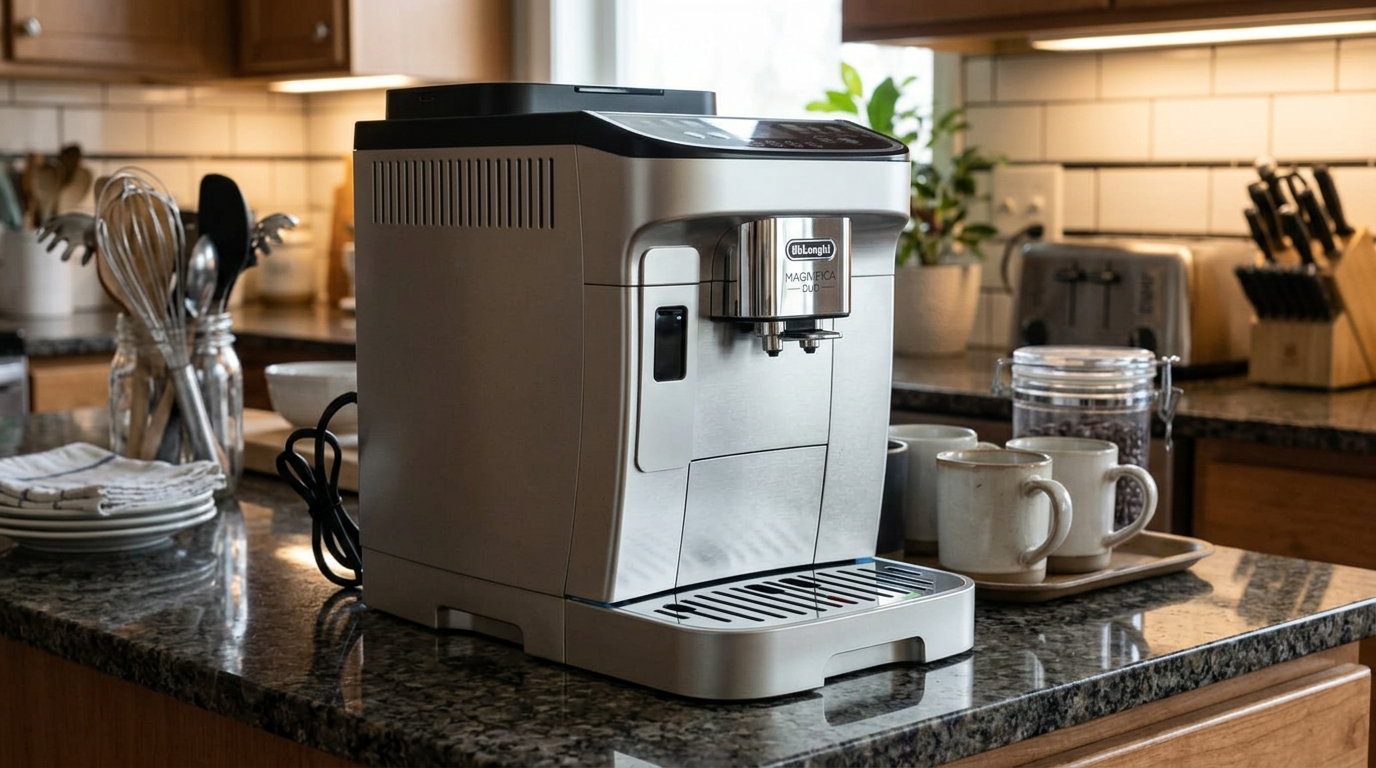
The narrow body fits into tight counter spaces, but leave room behind it for the depth.
What the Magnifica Duo actually is
The De’Longhi Magnifica Duo is a fully automatic espresso machine, sometimes called a super-automatic or bean-to-cup machine.
That means it grinds the beans, doses the coffee, tamps it, brews it and dumps the used puck into a bin, all on its own.
You choose a drink, and the machine does every step.
It has three distinct brewing methods built in.
There is pressurized espresso, a dual-cycle drip-style coffee and a low-temperature cold brew extraction.
Around those, De’Longhi has built 20 preset recipes, from a plain espresso to an iced latte macchiato.
Inside, the machine uses a thermoblock rather than a boiler.
A thermoblock heats water as it passes through, which is why the machine is ready so quickly.
The pump is rated at 15 bar, which is typical for this category.
The grinder is a stainless steel conical burr unit with 13 positions.
Milk is handled by De’Longhi’s LatteCrema system, here in two versions: LatteCrema Hot and LatteCrema Cool.
Manufacturer capacities. The bars show size relative to the 1.8-liter tank, except pucks, which are counted per bin.
The 1.8-liter tank is a sensible size for a household of two or three.
Keep in mind that the rinse after every milk drink also draws from the tank, so it empties faster than your drink count suggests.
Where the Duo fits in the Magnifica family
The Magnifica name covers several machines, and it’s easy to confuse them.
The Duo sits above the entry-level models and below the larger, flagship-style machines in De’Longhi’s range.
In practice it behaves like a streamlined version of a premium hot-and-cold machine, without the big touchscreen or app.
The table below shows how it differs from the rest of the Magnifica line.
| Model | Milk system | Cold foam | Cold brew | Screen | Profiles |
|---|---|---|---|---|---|
| Magnifica S | Manual steam wand | No | No | No screen | None |
| Magnifica Evo | LatteCrema Hot carafe | No | No | Touch icons | None |
| Magnifica Plus | LatteCrema Hot carafe | No | No | 3.5-inch touchscreen | 4 |
| Magnifica Duo | Hot and Cool carafes | Yes | Yes | 2.4-inch color, buttons | 3 |
Based on De’Longhi’s published model features.
The Duo is the only Magnifica here that does cold foam and true cold brew.
You give up the bigger touchscreen and one user profile compared with the Plus.
If you never drink cold coffee, that trade isn’t worth making.
If you do, the Duo is the one to look at.
Magnifica Duo design and setup
The Magnifica Duo has a brushed metallic finish over a composite plastic body.
It looks smarter than most machines in its class, though you can tell it’s plastic when you press on the side panels.
That isn’t a problem in daily use, and it keeps the weight down to a manageable 20.8 pounds.
Depth is the measurement to check before you buy.
At 17.32 inches deep, it will stick out on a shallow counter, and you need to reach the water tank on the right side.
The bean hopper lid sits on top, so you also want a little clearance under your wall cabinets.
| Measurement | Imperial | Metric |
|---|---|---|
| Width | 9.45 in | 24 cm |
| Depth | 17.32 in | 44 cm |
| Height | 14.17 in | 36 cm |
| Weight | 20.8 lb | 9.4 kg |
| Cup clearance | 3.3 to 5.5 in | 8.4 to 14 cm |
| Water tank | 60.8 fl oz | 1.8 L |
Setup is straightforward, and most of the time goes into rinsing parts and running the first flush.
You fill the tank, add beans, set your water hardness and let the machine prime itself.
A water hardness test strip tells you which hardness level to choose, and that setting decides when the machine asks you to descale.
The water filter goes into the tank and is worth fitting from day one.
Heat-up is fast thanks to the thermoblock.
From cold, mine was ready to brew in 35 to 45 seconds.
That’s a real advantage on busy mornings, when you don’t want to plan ahead for a warm-up.
My timings. Heat-up is almost instant, while descaling is the one job that needs a free half hour.
Our tip: Fit the water filter and set the correct water hardness during setup, so the descaling alerts match your actual water.
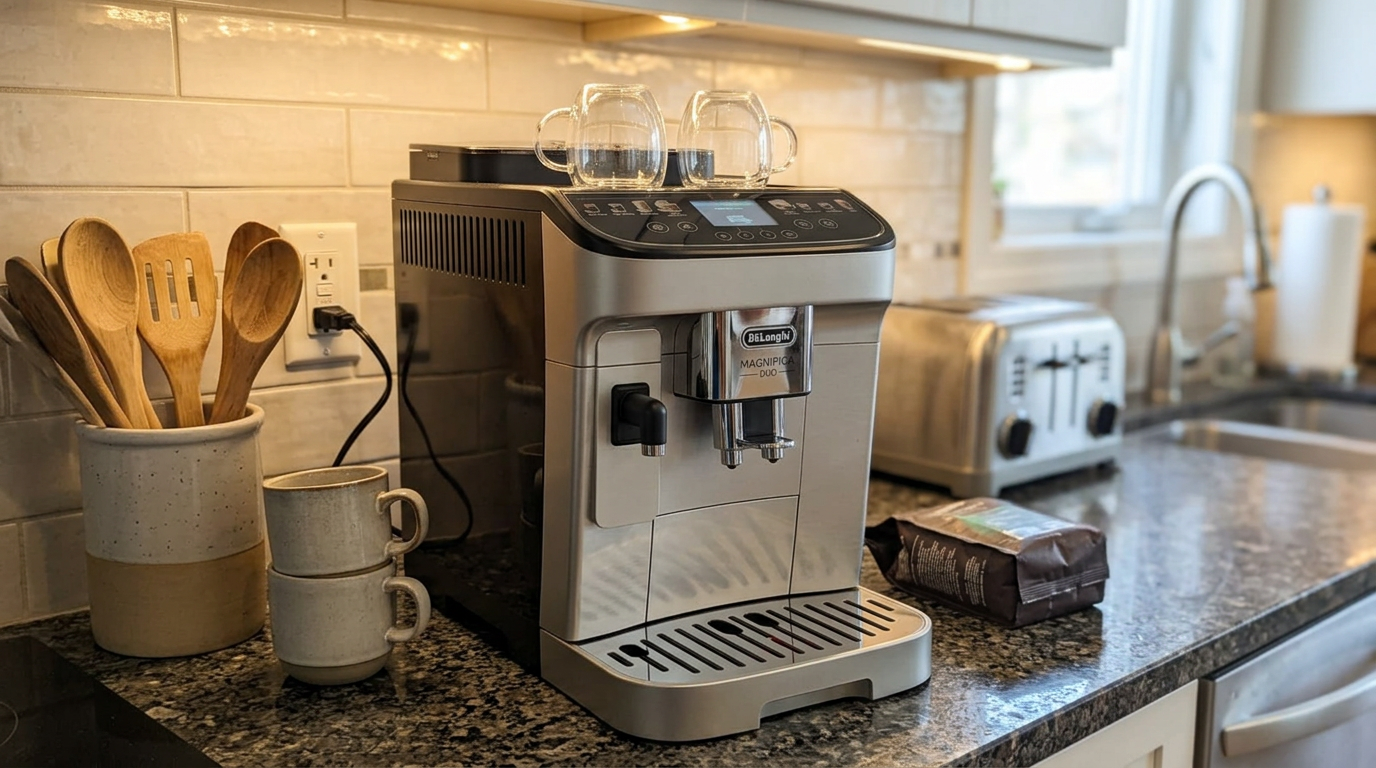
The cup tray on top stays only lightly warm, so it’s a resting place for cups rather than a real warmer.
The built-in grinder
The grinder on the Magnifica Duo is a stainless steel conical burr unit.
The adjustment dial sits inside the bean hopper and runs from 1 to 7 in half steps, which gives you 13 positions.
Lower numbers are finer, higher numbers are coarser.
For the dark and medium-dark espresso roasts I used most, the best results landed between settings 2.5 and 4.
Coarser settings ran faster and tasted thinner, while going much finer than 2.5 slowed the flow without adding anything I could taste.
There is one rule I’d underline for every new owner.
Only turn the grind dial while the burrs are spinning.
If you turn it while the grinder is still, bean fragments can wedge between the burrs and put strain on the drive.
The easiest way is to start a drink, then turn the dial one step during the grinding sound.
Our tip: Change the grind by one half step at a time, then judge the result over two or three drinks before you change it again.
Give it time to settle
A new machine, or a new bag of beans, doesn’t hit its stride on the first cup.
In my testing it took around 8 to 10 brewing cycles before the dose and flow rate settled into a consistent pattern.
The first few drinks after a grind change are partly made with coffee that was already in the chute.
So don’t judge a setting on the very next cup.
| What you taste or see | Likely cause | First change |
|---|---|---|
| Sour, thin, watery | Grind too coarse or strength too low | Grind one step finer or raise strength |
| Bitter, harsh, drying | Grind too fine for the bean | Grind one step coarser |
| Coffee runs out very fast | Grind too coarse | Grind finer while the burrs spin |
| Coffee only drips slowly | Grind too fine or dose too high | Grind coarser |
| Weak iced drinks | Ice dilution | Use the 5-bean strength setting |
Strength and dose
Strength is set with a bean icon scale, and the top setting is five beans.
The strength setting controls how long the grinder runs, and so how much coffee goes into the brew chamber.
At the five-bean setting, the grinder ran for up to 9 seconds and delivered roughly 10 to 13.5 grams of ground coffee.
More coffee in the chamber creates more resistance, which slows the extraction.
That slower flow is what gives the stronger settings their extra body and depth.
My measurements of dry dose in the brew chamber. Maximum grind time at 5 beans was about 9 seconds.
There’s also a bypass chute for pre-ground coffee.
It takes up to 15 grams, measured with the included scoop, and you select the pre-ground icon before brewing.
It’s handy for an evening decaf, since you don’t have to empty the hopper first.
Magnifica Duo espresso performance
Espresso is where the Magnifica Duo surprised me most.
Automatic machines often make a lighter, more diluted shot than a manual machine, because they work with smaller doses and fixed routines.
The Duo goes the other way.
I measured the strength of its espresso as total dissolved solids, or TDS, which tells you how much coffee is actually dissolved in the cup.
At the stronger settings, my shots reached 8.6% TDS.
Typical automatic machines tend to sit somewhere around 5 to 7%.
Higher TDS means more coffee dissolved in the cup, which you taste as body and intensity.
In the cup, that showed up as a heavy body and a dense, tight crema.
With a rich dark roast, the flavor leaned firmly toward cocoa and dark chocolate.
A standard small shot gave me about 33 grams of liquid, or 1.16 fluid ounces.
The brewing water runs at about 85 to 90°C, or 185 to 194°F.
That’s on the cooler side for espresso, and it explains a lot about the machine’s character.
Cooler water suits darker roasts, which can turn bitter when brewed very hot.
Lighter, fruitier roasts are a different story.
They need hotter water to extract fully, so on this machine they can taste a little sharp or thin.
If you mostly drink light roasts, that’s worth knowing before you buy.
| Roast | Grind setting | Strength | What to expect |
|---|---|---|---|
| Dark | 2.5 to 3 | 4 to 5 beans | Cocoa, heavy body, thick crema |
| Medium-dark | 3 to 4 | 4 to 5 beans | Chocolate and caramel, balanced |
| Medium | 3.5 to 4 | 4 beans | Rounder, slightly brighter |
| Light | 2.5 to 3 | 5 beans | Sharper and thinner at this temperature |
Starting points built from the 2.5 to 4 range that worked best for darker roasts in my testing. Every bean is different, so adjust by taste.
My trick for a proper double shot
The standard espresso is good, but I wanted something stronger for my morning flat white.
The best method I found uses the Coffee Crema setting instead of the espresso button.
At five-bean strength, Coffee Crema triggers the longest grinding cycle the machine has, up to 9 seconds.
I then stop the drink manually once about 32 grams, or 1.1 fluid ounces, has come out.
The result is a dense, very strong double-style shot with a thick layer of crema.
It takes a little practice to stop at the right moment, but a small scale under the cup makes it easy.
Our tip: Warm your espresso cup with a splash of hot water first, because a cold cup takes heat out of a small shot fast.
Long coffee, drip and Americano
Not everyone in a house wants espresso.
The Magnifica Duo has three ways to make a larger black coffee, and they taste quite different.
Coffee Crema
Coffee Crema is a long espresso, sometimes called a lungo.
It pushes more water through the coffee under pressure and gives you about 5 fluid ounces topped with crema.
It’s fuller and more intense than the other long options, and it was my pick for a big mug in the morning.
Drip Coffee
Drip Coffee is the more interesting one.
Instead of one long pressurized shot, the machine works in two cycles.
It grinds for about 6 seconds, brews half the cup, pauses, grinds another 6-second dose and brews the second half.
Splitting the job keeps each puck from being over-extracted, which is what makes a lot of long coffees from automatic machines taste bitter.
The result has a lighter body than espresso and a cleaner finish.
It doesn’t have the distinct, layered aroma of a careful hand pour-over, but it’s a good everyday mug of coffee.
Americano
The Americano pulls a full espresso and then adds hot water through a separate bypass.
Because the water doesn’t pass through the coffee, it doesn’t add bitterness.
This gave me the most espresso-like long drink of the three.
| Drink | How it’s made | Body | Best for |
|---|---|---|---|
| Coffee Crema | One long pressurized extraction | Full | A strong, crema-topped mug |
| Drip Coffee | Two grinds, two half-extractions | Light, clean | Easy everyday drinking |
| Americano | Espresso plus bypass hot water | Medium | An espresso flavor, made longer |
Hot milk drinks with LatteCrema Hot
The black-lidded LatteCrema Hot carafe handles every warm milk drink on the Magnifica Duo.
You fill it with milk, clip it to the front and pick a drink.
The machine draws milk up through a flexible straw, heats and aerates it, and pours it straight into your cup.
The spout extends, so it reaches down into tall latte glasses without splashing.
On the lid is a dial with three foam positions.
Position 1 gives low foam for a flat white or caffè latte.
Position 2 is medium foam for a latte macchiato.
Position 3 is high foam for a cappuccino.
The presets choose the right amount of milk for you, but the dial decides how airy that milk is.
| Dial position | Foam level | Drinks it suits |
|---|---|---|
| 1 | Low | Flat white, caffè latte |
| 2 | Medium | Latte macchiato |
| 3 | High | Cappuccino |
The foam itself was consistently fine and glossy, with small bubbles rather than big soapy ones.
It’s not the stretchy, pourable microfoam you’d use for latte art, and you can’t steer it the way you can with a manual wand.
For a cappuccino you want to drink right away, though, it’s excellent and completely repeatable.
Whole milk with about 3.5% fat gave the most stable foam in my tests.
Oat, almond and soy milk work too, and barista-style versions of plant milks generally give the most stable foam.
Measured in the cup. Output temperature depends on the drink and the foam setting.
Milk came out between 55 and 80°C, or 131 to 176°F, depending on the drink and froth setting.
Hotter drinks lose a little of milk’s natural sweetness, so I preferred the lower end for flat whites.
If you like your latte very hot, you’ll be happy with the upper end.
Our tip: Keep the hot carafe in the fridge between drinks, because colder milk produces finer, longer-lasting foam.
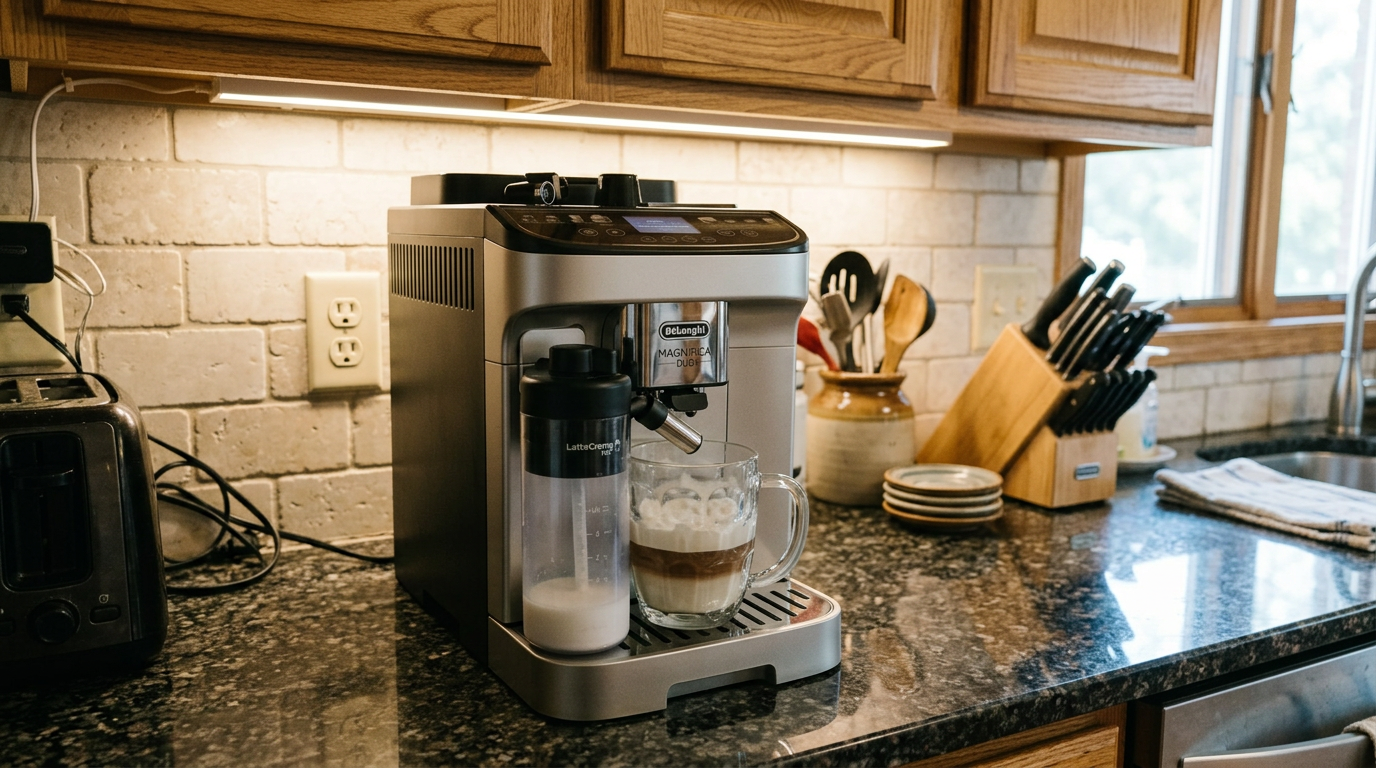
A latte macchiato from the hot carafe: milk first, then espresso, in distinct layers.
The cleaning prompt after every milk drink
After every milk drink, the machine asks you to run a short CLEAN cycle.
You put a cup under the spout, press OK, and it flushes steam and hot water through the milk channel.
It sounds like a chore, but it takes a few seconds and stops milk drying inside the system.
Running it every time is what keeps the milk path clean.
Cold brew, cold foam and iced drinks
This is the reason to choose the Magnifica Duo over a hot-only machine.
It has three different approaches to cold coffee, and it helps to know which is which.
LatteCrema Cool and cold foam
The white-lidded LatteCrema Cool carafe has a rigid straw and a fixed spout.
It doesn’t use the heating system at all.
Instead, it whips cold milk with air to create a thick, silky cold foam.
Straight from a fridge at 5°C, or 41°F, my milk came out of the carafe at around 20°C, or 68°F.
That’s cool enough to keep an iced drink cold while giving it a dense, velvety top.
Cold foam is the part I expected to be a gimmick, and it’s the part I ended up using most in warm weather.
The cold carafe aerates milk without heating it, so the foam stays cool.
Cold brew in under three minutes
Traditional cold brew steeps coarse coffee in cold water for 12 to 24 hours.
The Duo’s Cold Extraction Technology takes a different route.
It uses low pressure and pulses of water at a much lower temperature than the hot recipes, around 50 to 58°C, or 122 to 136°F, in my readings.
The full extraction finished in under three minutes every time I made it.
The result is smooth, low in acidity and naturally sweet.
It isn’t identical to a 24-hour steep, and a cold brew purist will notice the difference.
For a spontaneous glass on a hot afternoon, I’d take three minutes over planning a day ahead.
The machine trades the overnight steep for a pulsed, low-temperature extraction.
Iced coffee and iced espresso
The iced drinks work differently from the cold brew.
They use a normal hot extraction, at about 80°C, or 176°F, poured directly over ice.
That’s quicker and more intense, but hot coffee melts ice fast.
To avoid a watery drink, I filled the glass with plenty of ice, around eight cubes, and used the five-bean strength setting.
With those two adjustments, my iced lattes tasted like coffee rather than coffee-flavored water.
Our tip: Brew cold drinks first and hot drinks after, because leftover heat in the system can warm the start of a cold brew.
That last tip came straight from my testing.
After several hot espressos in a row, the first part of a cold brew came out noticeably warmer.
The thermoblock and brew group hold heat for a while.
On mornings when someone wants an iced latte and someone else wants a cappuccino, make the cold one first.
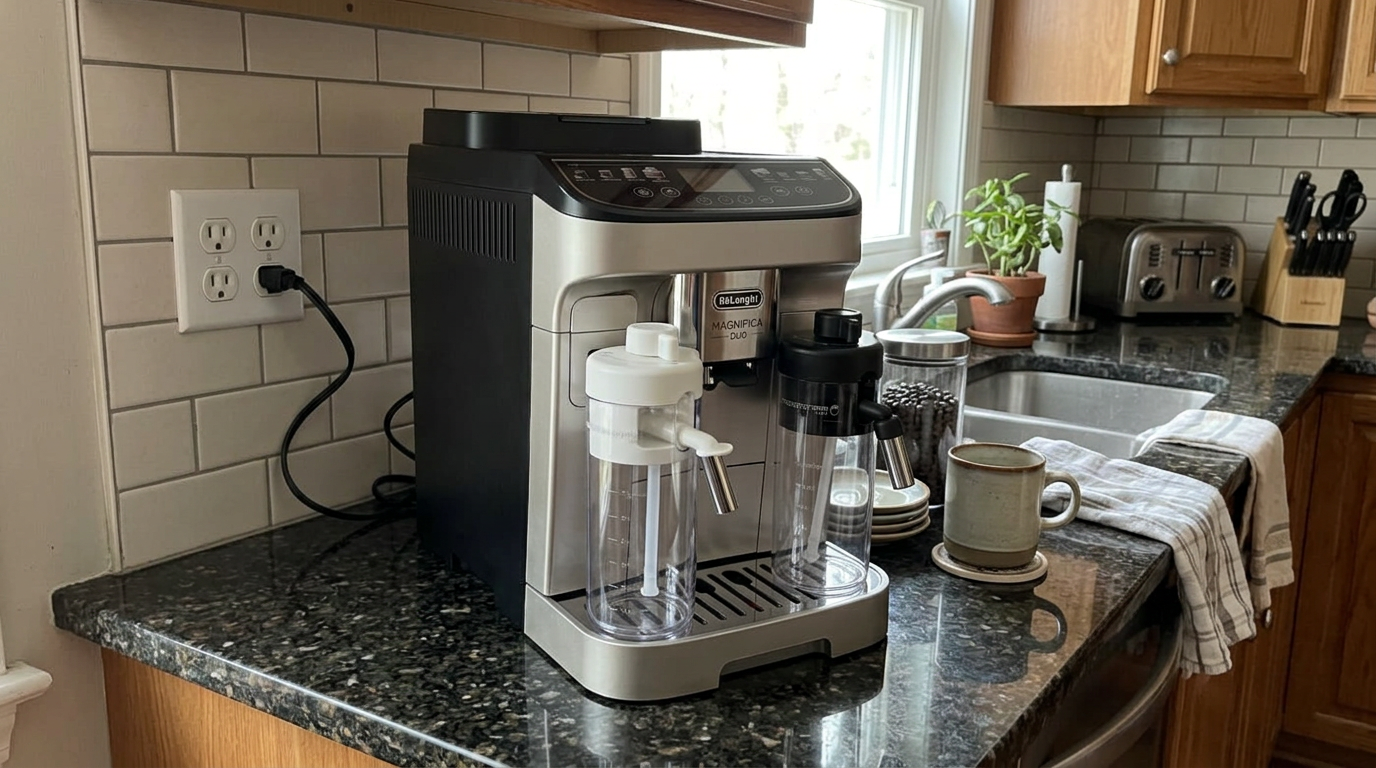
Two carafes: white for cold foam, black for hot milk. Both clip to the same connector.
Display, buttons and user profiles
The Magnifica Duo has a 2.4-inch color display, flanked by soft-touch buttons.
It isn’t a touchscreen.
You press physical-feeling buttons next to the icons rather than tapping the screen itself.
That took me a day or two to get used to.
The cold and hot drinks sit on opposite sides of the panel, and you scroll through some options rather than seeing everything at once.
Once I had learned where my usual drinks lived, it became quick.
The upside is that buttons are easy to wipe and don’t smear with fingerprints the way a glass screen does.
Three user profiles
You can save three profiles, each with its own drink sizes and strength.
My setup was one profile for a strong flat white, one for a milder iced latte and one as a guest default.
It’s a small feature that makes a big difference in a shared kitchen.
Nobody has to remember anybody else’s settings, and nobody accidentally drinks a five-bean espresso they didn’t ask for.
Our tip: Save your most-used drink in a profile slot, so a single press brings back your size, strength and milk settings.
How loud is the Magnifica Duo?
Noise is the area where the Magnifica Duo lost the most points with me.
It’s not that the machine is unusually loud overall.
It’s the character of the grinder.
During grinding I measured 68 to 69 dB, with a high-pitched tone that cuts through a quiet house.
The pump, by contrast, was a calm 55 dB while brewing.
My measurements. Decibels are logarithmic, so the grinder sounds far more than 25% louder.
Because decibels work on a logarithmic scale, a 13 to 14 dB jump is a big perceived difference.
The grinding only lasts a few seconds per drink, and up to 9 seconds at the strongest setting.
But if somebody sleeps next to the kitchen, the grinder is what they’ll hear.
On an open-plan floor, I found myself waiting until the household was awake before making a second coffee.
What daily use is really like
Specifications only tell you so much.
The real question is what the Magnifica Duo is like at 7 a.m. with a full day ahead.
My morning looked like this.
I switched it on, and by the time I had a cup out of the cupboard it was ready.
I took the hot carafe out of the fridge, clipped it on and pressed my profile.
About a minute later I had a flat white, followed by the quick CLEAN prompt.
The carafe then went back in the fridge.
- Switch on: the thermoblock is ready in under a minute.
- Attach a carafe: hot for warm drinks, cool for iced ones.
- Choose a drink: pick a preset or your saved profile.
- Let it work: grinding, brewing and frothing happen automatically.
- Rinse: run the CLEAN prompt and put the carafe back in the fridge.
What you don’t do is just as important.
You don’t weigh coffee, tamp, time shots or steam milk by hand.
That’s the whole point of a machine like this, and it’s why anyone in the house can use it.
| Step | Who does the work | What you control |
|---|---|---|
| Heat-up | Machine | Nothing, it takes under a minute |
| Grinding and dosing | Machine | Grind setting and strength |
| Brewing | Machine | Drink size and recipe |
| Milk | Machine | Carafe choice and foam level |
| Cleaning milk path | Machine, on your OK | When to run it |
| Emptying bins and tray | You | How often |
Making several drinks in a row
The Duo uses a single thermoblock, so it brews coffee and heats milk one after the other rather than at the same time.
For two cappuccinos that’s fine, and the whole sequence is still quick.
Mixing hot and cold drinks takes a bit more planning because of the heat carryover I mentioned earlier.
The carafes also need swapping between hot and cold recipes, which takes seconds but is easy to forget.
The grounds bin holds 14 used pucks, so on a busy weekend with guests you’ll empty it at least once.
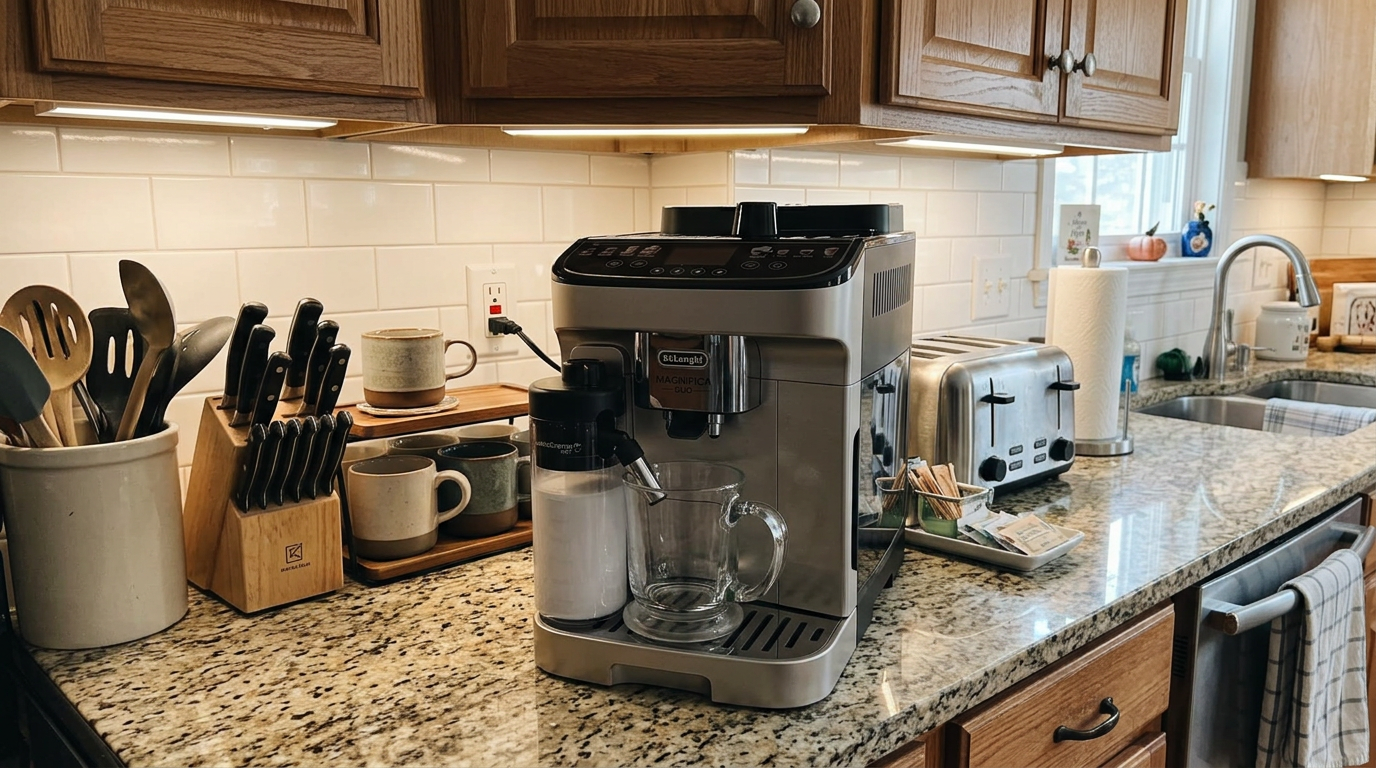
Daily use is quick: clip on the carafe, press a drink and rinse when prompted.
Our tip: Empty the drip tray at the same time as the grounds bin, so you never get caught by a full tray halfway through a drink.
Cleaning and maintaining the Magnifica Duo
Cleaning is better than I expected, with one small catch.
The milk system is the part most automatic machines make difficult, and here it’s simple.
Both carafes come apart completely, and every piece is top-rack dishwasher safe.
The automatic rinse after each milk drink handles the internal channel.
The brew group is removable too, which I consider essential on any bean-to-cup machine.
You take out the water tank, open the side door and press the two red release buttons to slide the group out.
It only needs rinsing under warm water.
Don’t use soap or put it in the dishwasher, because that strips the lubrication it needs.
| When | Task | Why it matters |
|---|---|---|
| After each milk drink | Run the CLEAN prompt | Clears milk from the internal spout |
| Daily | Empty drip tray and grounds bin, rinse the water tank | Prevents mold and stale smells |
| Daily, if you used milk | Wash the carafe parts | Stops milk residue building up |
| Weekly | Remove and rinse the brew group, clear the chamber | Removes coffee oils and powder |
| When prompted | Descale | Controls scale inside the thermoblock |
Descaling step by step
The machine tells you when it needs descaling, based on the water hardness you set during setup.
The whole process takes about 25 to 30 minutes, but most of that is waiting.
De’Longhi specifies its own lactic acid descaler for this machine.
- Remove the water filter from the tank.
- Pour descaler to level A, then add water up to level B.
- Place a container of at least 2 liters under the coffee and water spouts.
- Go to Settings, then Maintenance, then Descaling, and press OK.
- Let the machine run its automatic pause-and-rinse cycles.
- Fill the tank to MAX with fresh water for the final rinse.
The small catch I mentioned is storage.
With two carafes, you need space for two milk containers in the fridge if you use both regularly.
In a small fridge, that’s a real consideration.
Our tip: Use a container that holds at least 2 liters for descaling, because a smaller bowl will overflow during the rinse cycles.
Beans, milk and water
A good machine makes your ingredients easier to taste, for better and for worse.
Because the Magnifica Duo brews at a slightly cooler temperature, the beans you choose matter more than usual.
Choosing beans
Medium-dark and dark roasts are the sweet spot.
They gave me the cocoa-heavy, full-bodied espresso this machine does best, and they cut through milk well.
Light roasts can work, but expect a brighter, sometimes sharper cup.
Avoid very oily, glossy beans.
Oil can coat the burrs and the hopper and slow the flow of beans into the grinder over time.
Fresh whole beans make the biggest difference of all, since pre-ground coffee throws away the main benefit of a built-in grinder.
| Bean type | Fit on this machine | Notes |
|---|---|---|
| Dark roast | Excellent | Rich crema, chocolate notes |
| Medium-dark roast | Excellent | Best all-rounder for milk drinks |
| Medium roast | Good | Rounder, a little brighter |
| Light roast | Fair | Can taste sharp at 85 to 90°C |
| Very oily beans | Avoid | Can clog the hopper and burrs |
Choosing milk
Whole milk at around 3.5% fat gave the most stable foam, hot or cold.
Lower-fat milk foams up easily but collapses faster.
Plant-based milks work in both carafes, and barista versions are designed to foam better than standard ones.
Whatever you use, start with it cold from the fridge.
Water matters more than most people expect
Espresso is mostly water, and the minerals in it affect both flavor and the machine.
Hard water speeds up scale formation inside the thermoblock.
Set the hardness level correctly, keep the filter in the tank and change it when the machine asks.
Rinsing the tank daily and refilling it with fresh water also keeps the coffee tasting clean.
Common mistakes to avoid
The Magnifica Duo is easy to live with, but a few habits can still hold it back.
These are the ones I’d watch for during the first couple of weeks.
| Mistake | What happens | Better habit |
|---|---|---|
| Turning the grind dial when the grinder is off | Beans can jam the burrs | Only adjust while grinding |
| Judging a new setting on the next cup | Old grounds are still in the chute | Wait 2 to 3 drinks |
| Making iced drinks at low strength | Watery, diluted coffee | Use 5 beans and lots of ice |
| Brewing cold brew after hot drinks | Cold brew starts warm | Make cold drinks first |
| Skipping the CLEAN prompt | Milk dries in the spout | Rinse after every milk drink |
| Using soap on the brew group | Removes needed lubrication | Rinse with warm water only |
Most of these are about patience.
The machine needs 8 to 10 cycles to settle with a new bag, and each grind change takes a couple of drinks to show its effect.
Once it’s dialed in, it stays consistent for the life of the bag.
What I would change
My wish list is short.
A quieter, lower-pitched grinder would make early mornings easier.
A touchscreen, or at least a flatter menu, would make finding the cold drinks quicker.
I’d also welcome a slightly hotter brewing option for light-roast fans.
None of this changes my overall view, but you should know about it before buying.
Is the De’Longhi Magnifica Duo worth the money?
The Magnifica Duo is a mid-range machine, so it isn’t an impulse purchase.
The right way to judge it is by what it replaces.
To get the same results otherwise, you’d need an espresso machine, a grinder, a milk frother and a cold brew setup with a day of lead time.
That’s a lot of counter space and a lot of steps.
Here, it all fits in a body under 10 inches wide.
It makes the most sense if you drink milk-based coffee daily and want cold drinks part of the year.
It makes less sense if you only drink hot espresso, because cheaper hot-only models in the same family cover that well.
It also isn’t the right pick if you enjoy the craft of making espresso by hand.
Ask yourself three questions before buying.
How often do you drink iced coffee?
How many people in the house will use it?
And do you have room in the fridge for a second carafe?
If the answers are often, more than one and yes, the Duo is easy to recommend.
My editorial sub-scores. Versatility is the clear standout.
How it compares with other espresso setups
The most useful comparison isn’t with a single model.
It’s with the kinds of setup you’re realistically choosing between.
The Magnifica Duo is strongest when you value variety and want hot and cold drinks with no skill required.
| Feature | Magnifica Duo | Manual machine and grinder | Hot-only automatic |
|---|---|---|---|
| Grinding | Built in | Separate unit | Built in |
| Hot milk | Automatic carafe | Manual steam wand | Automatic or manual |
| Cold foam | Yes, dedicated carafe | No | Usually no |
| Cold brew | Under 3 minutes | Overnight steep | Usually no |
| Latte art | No | Yes, with practice | Rarely |
| Learning curve | Low | Steep | Low |
| Counter footprint | One narrow unit | Two or more devices | One unit |
A manual machine with a separate grinder gives you the most control and the best path to latte art.
It also asks for skill, time and much more counter space.
A hot-only automatic machine is simpler, but you lose cold foam and proper cold brew.
The Duo sits in an appealing middle ground: automatic convenience with the widest menu of the three.
| Magnifica Duo feature | What it means for you |
|---|---|
| Thermoblock heating | Ready in under a minute |
| 15-bar pump | Standard pressure for full crema |
| 13 grind positions | Room to tune for dark to medium roasts |
| 5 strength levels | Dose up to about 13.5 g |
| 2 milk carafes | Hot microfoam and cold foam |
| 3 user profiles | Everyone keeps their own settings |
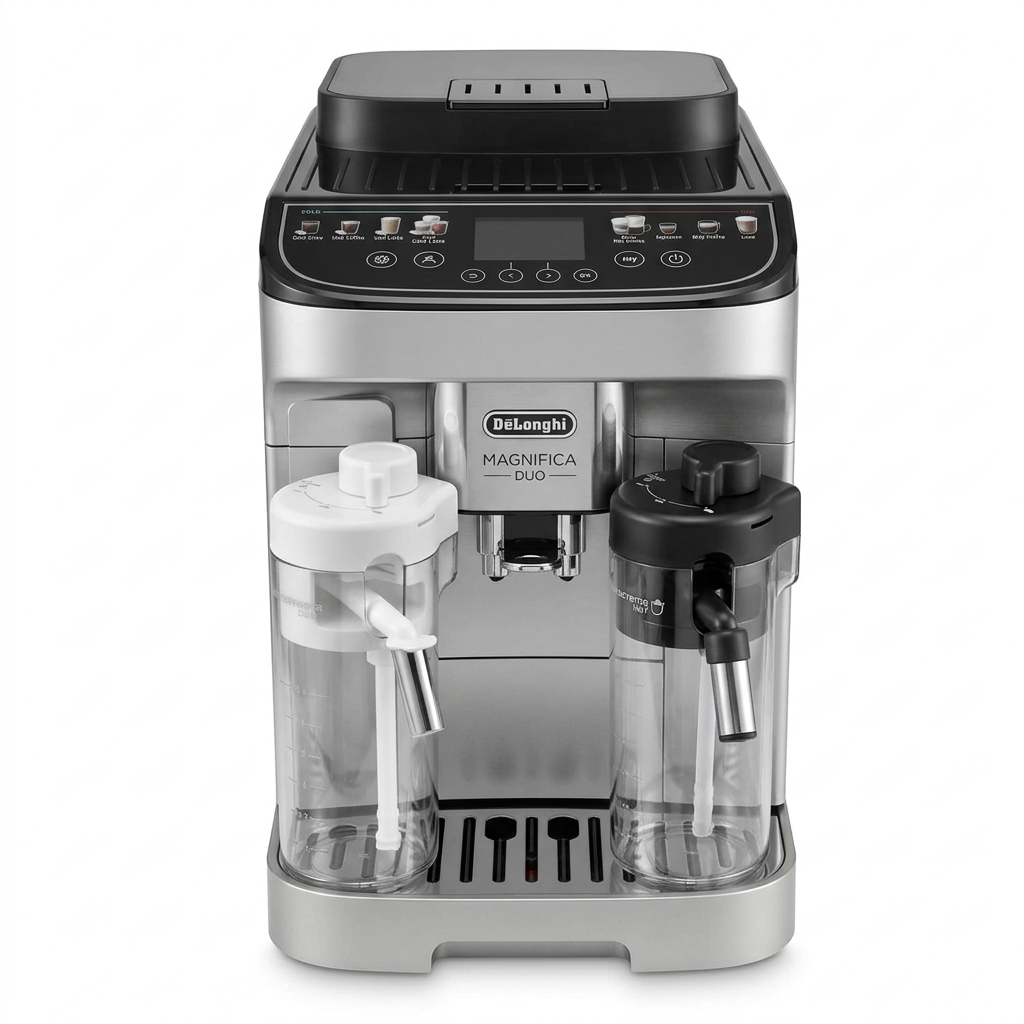
The full setup: cold carafe on the left, hot carafe on the right and the controls across the top.
De’Longhi Magnifica Duo specifications
From manufacturer data and my own measurements.
How I tested and scored the Magnifica Duo
I used the De’Longhi Magnifica Duo for every type of drink on its menu: espresso, long coffees, hot milk drinks, cold foam drinks, iced coffee and cold brew.
I measured espresso strength as TDS, the dry dose at maximum strength, brewing and milk temperatures, heat-up time and noise levels.
I also tested grind settings with dark and medium-dark roasts, worked through the cleaning and descaling routines and compared it with the rest of the Magnifica range.
- Espresso (8.4): strength, body, crema and how it handles different roasts.
- Milk (8.8): hot and cold foam quality, temperature and consistency.
- Versatility (9.4): menu breadth, cold brew and hot-and-cold flexibility.
- Cleaning (7.9): daily upkeep, brew group access, descaling and storage.
The overall score of 8.6 is an editorial rating that reflects those four areas, with noise and controls taken into account.
De’Longhi Magnifica Duo FAQ
Is the De’Longhi Magnifica Duo worth it?
Yes, if you drink milk-based coffee most days and want iced drinks and cold brew too. It’s less compelling if you only drink hot espresso or prefer making coffee by hand.
Can the Magnifica Duo really make cold brew in 3 minutes?
Yes. It uses a low-pressure, pulsed extraction at lower water temperatures and finished in under three minutes in my testing. It’s smooth and low in acidity, though not identical to a 12 to 24-hour steep.
What is the difference between the two milk carafes?
The black-lidded LatteCrema Hot carafe heats and foams milk for cappuccinos and lattes. The white-lidded LatteCrema Cool carafe whips cold milk into cold foam without heating it.
Does it work with plant-based milk?
Yes. Oat, almond and soy milk all work in both carafes, and barista versions generally foam best.
What grind setting should I use?
For dark and medium-dark roasts, settings between 2.5 and 4 worked best for me. Only turn the dial while the grinder is running.
How long does it take to heat up?
From cold, it was ready to brew in about 35 to 45 seconds thanks to its thermoblock.
Is the Magnifica Duo loud?
The grinder reached 68 to 69 dB with a high-pitched tone, while brewing was a quieter 55 dB.
Are the milk carafes dishwasher safe?
Yes. Both carafes come apart fully, and the parts are top-rack dishwasher safe.
How do I clean the brew group?
Remove the water tank, open the side door, press the two red buttons and slide the group out. Rinse it under warm water only, with no soap.
How many drinks can it make?
It lists 20 options, which includes 18 hot and cold coffee and milk recipes, plus hot water and saved user profiles.

- Hands-on testing of the De’Longhi Magnifica Duo
- De’Longhi product specifications and owner documentation
- General espresso brewing and maintenance guidance