Gevi ECMG0 review
The Gevi ECMG0 20 Bar Espresso Machine is a compact, white semi-automatic machine built around pre-ground coffee and pressurized baskets, so you can make cappuccinos without buying a grinder first. Its steam wand is the real highlight, with automatic cool-down after steaming. The espresso is easy and forgiving, but not precise.

Michael Reynolds
Hands-on review
Hands-on testing, research, specs
3 weeks
24 minutes
Jargon helpNew to coffee gear? Tap any dotted term to see what it means.
In this review
Yes, if you mainly drink cappuccinos and lattes and want to start with pre-ground coffee. The Gevi ECMG0 has a surprisingly strong steam wand that made silky milk, clever automatic cool-down after steaming and forgiving pressurized baskets that make crema from supermarket coffee. It is mostly plastic, and with a standard basket my shots ran fast, bitter and uneven, so it is not the machine for serious traditional espresso.
Gevi ECMG0 at a glance
Gevi ECMG0 pros and cons
- Strong steam wand makes silky milk
- Pressurized baskets forgive pre-ground coffee
- Automatic cool-down after steaming
- Mostly plastic, light body
- Standard-basket shots ran fast and bitter
- No milk pitcher or metal tamper included
Who should buy the Gevi ECMG0?
- Cappuccino and latte drinkers
- Beginners without a grinder
- Small kitchens and narrow counters
- Espresso hobbyists who weigh and dial in
- Buyers who want a heavy metal machine
- People who only drink straight espresso
First impressions of the Gevi ECMG0
Most people who buy a first espresso machine hit the same wall in week one.
The machine is fine, but the grinder they need costs almost as much again, and pre-ground coffee in a normal basket just gushes through.
The Gevi ECMG0 20 Bar espresso machine is built to get you past that wall without buying anything else.
It ships with two pressurized baskets✕Pressurized basketA filter basket with a single tiny exit hole. It builds resistance for you, so pre-ground coffee still makes crema, but it limits how much you can fine-tune the shot., a combined scoop and tamper, and a steam wand that is far stronger than I expected from something this small.
Out of the box, the white finish was the first thing my partner commented on.
It looks clean and bright on the counter, and the soft pulsing lights make it feel more thought-through than a lot of plastic budget machines.
Then I picked it up and felt how light it is.
The body, top and water tank are plastic, and the only real metal you touch every day is the stainless steel drip tray and the aluminum part of the portafilter✕PortafilterThe handle with a metal basket that holds the ground coffee and locks into the machine during brewing..
In the first week I made a cappuccino every morning and a straight shot most afternoons.
By day three I had a clear picture: the milk side of this machine is its strength, and the espresso side is easy and forgiving, but not precise.
That picture held for all three weeks.
The white finish looks clean on the counter, even though most of the body is plastic.
What the Gevi ECMG0 actually is
The ECMG0 is a compact, semi-automatic espresso machine.
You fill and tamp✕TampingPressing the ground coffee flat and firm in the basket, so water flows through it evenly instead of finding weak spots. the portafilter yourself, press a button for one or two shots, and steam milk by hand with the wand.
It is designed around pre-ground coffee first, with fresh beans and a grinder as an optional next step.
What's in the box
The machine comes with the portafilter, a single-shot and a double-shot pressurized basket, a plastic scoop with a tamper on the other end, and the steam wand with a removable Panarello✕PanarelloA plastic or metal sleeve on a steam wand that pulls in extra air automatically. It makes foam easier, but bubblier and harder to control. sleeve.
There is no milk pitcher, no separate metal tamper and no non-pressurized basket✕Non-pressurized basketA standard espresso basket with many open holes. The coffee puck itself has to create the resistance, so grind size and tamping matter far more..
If you plan to grow into fresh-ground espresso, those are the three things you will buy later.
Our tip: Buy a small 12-ounce steaming pitcher on day one, because the steam wand is the best part of this machine and you will use it daily.
Design, build and counter space
The ECMG0 is narrow, roughly 5.5 inches wide, so it slots in between a toaster and a kettle without a fight.
It is about a foot deep and a foot tall, which left plenty of room under our wall cabinets.
The tank sits at the back and slides into guide slots.
A folding handle on top makes it easy to lift out and fill at the sink, which I did every second day.
The plastic question
The plastic body is the honest trade-off at this level.
It doesn't feel fragile, but it doesn't feel heavy or premium either, and the machine shifts a little when you lock in the portafilter firmly.
I braced it with one hand during locking for the first few days, and after that it became a habit.
Long-term durability is the big unknown with any light machine.
Three weeks of daily use showed no cracks, rattles or leaks, but I can't promise you five years from a three-week test.
The drip tray
The drip tray is stainless steel and fits neatly into the base.
A float rises as water collects, so you can see from across the kitchen when it needs emptying.
That float turned out to matter more than I expected, because this machine deliberately puts water in the tray after steaming, which I explain below.
Our tip: Brace the top of the machine with your free hand when you twist the portafilter in, because the light body can slide on a smooth counter.
Controls, lights and the side switch
The controls are simple, and they mostly make sense after one or two drinks.
On the front you get three buttons: manual, one shot and two shots.
On the side there is a mode switch with three positions: center for off or idle, one side for coffee and the other for steam.
Programmable shot buttons
The one-shot and two-shot buttons are volumetric and programmable.
That means you can teach the machine how much water to push through, and it will repeat that amount every time.
I set the double to stop at roughly 36 to 40 grams in the cup, then left it alone for most of the test.
The manual button
The manual button starts the pump and keeps it running until you press it again.
It's the one I used most when I had a scale under the cup, because I could stop the shot exactly when the weight looked right.
Expect a few grams of drip after you stop: in my tests a shot I stopped at 30 grams finished at around 40.
Lights that tell you what mode you're in
The lights pulse softly instead of blinking hard.
They glow blue in standby and coffee mode, and turn white in steam mode.
It sounds small, but at 6:30 in the morning the color told me instantly whether I had left the switch in steam.
| What you want | Side switch | Button |
|---|---|---|
| Espresso, auto-stop | Coffee | One shot or two shots |
| Espresso, stopped by you | Coffee | Manual, press again to stop |
| Steamed milk | Steam | Open steam, then close |
| Idle | Center | None |
Our tip: If you press a shot button and nothing happens, check the side switch first: the machine only brews in coffee mode.
Portafilter and the two pressurized baskets
The portafilter combines an aluminum body with a plastic handle and a plastic insert.
It has a small hinged piece designed to help knock the used puck out of the basket.
I got used to it, but if you prefer a plain portafilter with nothing moving, you may find it fiddly.
How a pressurized basket works
Both included baskets are pressurized.
Look inside and you'll see lots of small holes, but underneath there is only one tiny outlet.
That restricted exit creates the resistance that a fine, perfectly tamped puck would normally create.
So even with supermarket pre-ground coffee, the shot doesn't gush, and you still get a layer of crema✕CremaThe golden-brown foam on top of an espresso. It forms when pressure pushes gases and oils out of freshly ground coffee. on top.
The catch is control: the basket does the work, so changing grind or tamp changes the result much less than with a standard basket.
| Basket | Holes | Best with | What you control |
|---|---|---|---|
| Pressurized single | Many inside, one exit | Pre-ground, one shot | Dose and shot volume |
| Pressurized double | Many inside, one exit | Pre-ground, two shots | Dose and shot volume |
| Non-pressurized (not included) | Many open exits | Fresh fine grind | Grind, dose, tamp, time |
Fit and compatibility
Each basket has a notch that lines up with the portafilter and twists in securely.
The group is about 2 inches, or 51 mm, across, which is a common size for compact machines.
But a matching diameter doesn't guarantee that baskets or portafilters from other brands will fit.
Our tip: Check the exact model compatibility before you buy an aftermarket basket or portafilter, because 51 mm alone is not a guarantee of fit.
Brewing with pre-ground coffee
This is how the ECMG0 is meant to be used, and it's where it is at its friendliest.
The supplied scoop holds about 7 grams of pre-ground coffee, so two level scoops give you the roughly 14-gram dose✕DoseThe weight of dry ground coffee you put in the basket, usually measured in grams. the double basket wants.
Measured with level scoops of medium-fine pre-ground espresso coffee.
My daily routine with pre-ground
- Step 1: Fill the double basket with two level scoops, about 14 grams.
- Step 2: Tamp lightly and evenly with the tamper end of the scoop.
- Step 3: Lock the portafilter into the group, bracing the machine.
- Step 4: Make sure the side switch is in coffee mode.
- Step 5: Press two shots, or press manual and stop by weight.
In one typical shot, I stopped the manual button at around 30 grams of espresso.
A few more grams dripped through afterward, and the cup finished at around 40 grams.
The whole shot took about 15 seconds.
One representative shot from my notes. Your numbers will vary with coffee and volume setting.
That's quicker and longer than a textbook shot, but that's normal for a pressurized basket.
The basket doesn't depend on a long, slow pour to build pressure, so the classic 25-to-30-second rule doesn't really apply here.
Our tip: Use coffee labeled espresso grind rather than drip grind, because even a pressurized basket gives a thicker, sweeter shot with finer grounds.
How the espresso tastes
With fresh pre-ground espresso coffee, the shot came out with a visible, fairly thick layer of crema.
It looks impressive, but that crema is partly made by the basket's tiny exit, not only by the coffee.
In the cup, the taste was decent for this kind of machine: roasty, round and a bit flat on the finish.
I never got the depth or sweetness you get from a carefully dialed-in shot on a standard basket.
Where it works best
As a straight espresso, it's a reasonable everyday shot rather than a special one.
As the base for a cappuccino or latte, it is much better, because the milk rounds off the flatness and the coffee still comes through.
That matches how I ended up using it: milk drinks in the morning, a quick straight shot after lunch.
| Drink | Taste in my tests | Best setting I found |
|---|---|---|
| Single espresso | Light, a little thin | One scoop, one-shot button |
| Double espresso | Round, roasty, simple | Two scoops, stop near 36 g |
| Cappuccino | Balanced, creamy | Double shot, 5 oz milk |
| Latte | Mild, milky | Double shot, 8 oz milk |
| Americano | Clean, light | Double shot plus hot water |
Our tip: For straight espresso, stop the shot earlier at around 30 to 32 grams, because the last part of a pressurized shot mostly adds water and bitterness.
The 20-bar question
The 20-bar figure on the box is the headline number, so I wanted to see what it means in practice.
For conventional espresso, the pressure you actually want at the coffee is roughly 8 to 9 bar.
More isn't automatically better, because too much pressure can push water through the puck too hard and unevenly.
During my non-pressurized test, the reading went past the top of the gauge I was using.
Based on where the needle maxed out, I estimate the machine was delivering around 17 to 18 bar, but I can't confirm the exact figure.
My estimate from a gauge that reached its maximum. Treat the Gevi figure as approximate.
With a pressurized basket, that high pressure isn't a big problem, because the basket's tiny exit is designed for it.
With a standard basket, it can make balanced extraction✕ExtractionHow much flavor water pulls out of the coffee. Too little tastes sour and thin, too much tastes bitter and dry. harder.
So read 20 bar as "plenty of pump", not as "better espresso".
Testing a standard, non-pressurized basket
Because many buyers want to grow into "real" espresso, I also tried a non-pressurized basket in the ECMG0.
Here the coffee puck itself has to create the resistance, so grind, distribution and tamping all have to be right.
I used about 15 grams of freshly ground espresso coffee from a burr grinder✕Burr grinderA grinder that crushes beans between two abrasive plates, giving even particles. Blade grinders chop unevenly and make espresso harder to control..
I broke up the clumps with a WDT tool✕WDTShort for Weiss Distribution Technique: stirring the grounds with thin needles to break up clumps before tamping., tapped the portafilter to settle the bed and tamped with a matching 51 mm tamper.
What happened
The shot ran in about 18 seconds, which is too fast for a standard basket.
I aim for roughly 25 to 30 seconds with this kind of basket.
The same grind setting had given a longer, slower shot on another compact machine in my kitchen, so this machine clearly behaves differently.
The espresso tasted hot and bitter, with a harsh edge and not much sweetness.
My single dialed test. A finer grind would be the first adjustment.
The crater in the puck
When I knocked out the puck, there was a noticeable crater on one side.
That suggests the water wasn't spreading evenly over the coffee, but hitting one area harder than the rest.
Uneven water flow leads to channeling✕ChannelingWhen water finds a weak path through the coffee puck and rushes through it, leaving the rest under-extracted.: part of the puck gets over-extracted and bitter, while the rest stays under-extracted and sour.
A finer grind and careful puck prep may help, but the crater points to a limit in how evenly this machine delivers water.
Our tip: If you try a standard basket, grind finer than you would on other compact machines and judge by time and taste, not by the grind number.
My conclusion on "upgrading"
You can experiment with a standard basket, and you'll learn a lot.
But I wouldn't buy the ECMG0 as a platform to build serious traditional espresso around.
It shines with the baskets it ships with.
Milk steaming: the ECMG0's real strength
This is where the ECMG0 surprised me most.
The steam wand✕Steam wandThe metal pipe that blasts steam into milk to heat it and create foam for cappuccinos and lattes. has real power for such a small machine, and it can produce smooth, silky milk for cappuccinos.
With the Panarello sleeve on, it makes bubbly foam almost automatically.
With the sleeve pulled off, it became a much better wand, giving me proper control and a finer texture.
How I steamed milk
- Cold whole milk: straight from the fridge, filling the pitcher about halfway.
- Sleeve off: I removed the Panarello for more direct control and silkier foam.
- Stretch first: tip just under the surface to add a little air while the milk is still cool.
- Then spin: angle the pitcher to create a whirlpool and fold the bubbles in.
- Then heat: lower the tip slightly and steam until the pitcher is hot to hold.
- Wipe at once: turn the steam off and wipe the wand immediately.
Air should only go in while the milk is still around room temperature.
After that, keep the tip a little deeper and just let the whirlpool heat and polish the milk.
The wand heats milk quickly, so this all happens faster than on a lot of small machines.
Scored for texture, stability and how easy it was to repeat.
The result with whole milk was silky, glossy and hot enough for a proper cappuccino.
I even poured a few rough hearts by the end of week two, which is not something I expect from a machine in this class.
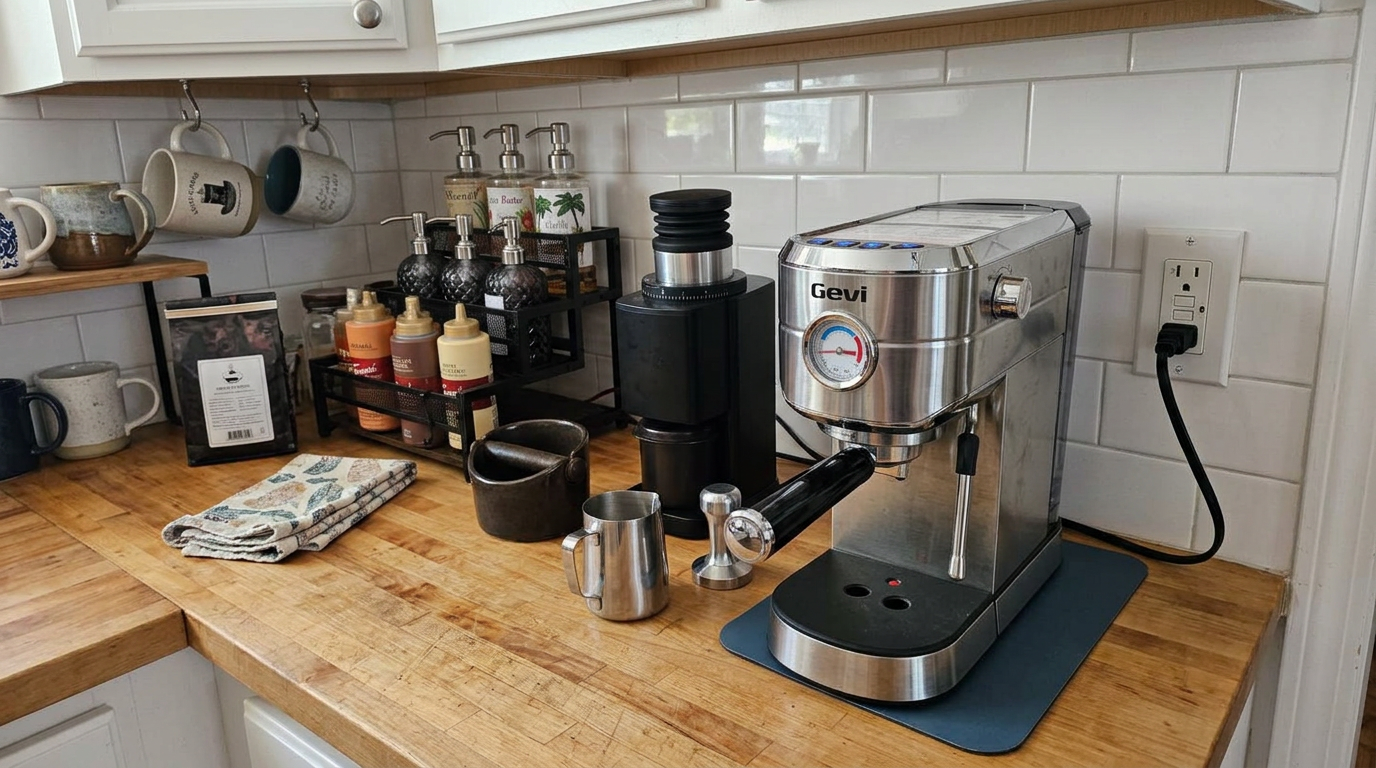
With the sleeve off, the wand produced silky milk for cappuccinos and basic latte art.
Our tip: Use a pitcher with a pointed spout and fill it only halfway, because the wand is strong enough to overflow a full pitcher in seconds.
Automatic cool-down and the drip tray
On many small machines, going from steam back to espresso is awkward.
The heater is now too hot for coffee, and you have to flush water through it by hand to cool it down.
The ECMG0 does this for you.
When you finish steaming, it releases water into the drip tray while it cools the heater back to brewing temperature.
Water in the tray is normal
The first time I saw water appear in the tray after steaming, I thought it was leaking.
It isn't: that water is part of the automatic cool-down.
The float in the drip tray rises with it, so keep an eye on it after milk drinks.
| What you see | When | Normal? |
|---|---|---|
| Water flowing into the tray | Right after steaming | Yes, automatic cool-down |
| Float rising | After several drinks | Yes, empty the tray |
| Drip after stopping a shot | After manual stop | Yes, a few grams |
| Nothing when pressing a shot button | Switch in steam or center | Yes, switch to coffee |
| Water pooling under the machine | Any time | No, check the tank seal |
Our tip: Make your espresso first and steam milk second, so the machine never has to cool down in the middle of making a drink.
What daily use is really like
A typical morning cappuccino took me about four minutes from switch-on to first sip.
That includes the machine warming up, two scoops of coffee, a 15-second shot, steaming milk and a quick wipe.
On days I only wanted a straight espresso, I was done in about two minutes.
My average hands-on time per drink over three weeks.
Making two drinks in a row
For two cappuccinos, the best order was both shots first, then steam both portions of milk.
That way the automatic cool-down only happens once, at the end.
With a pressurized basket, two drinks back to back felt quick and painless.
Noise
The pump is noticeable but not harsh, a steady buzz during the 15-second shot.
Steaming is louder, as it is on every machine with a wand.
Neither woke anyone in our apartment, though both were clearly audible in the next room.
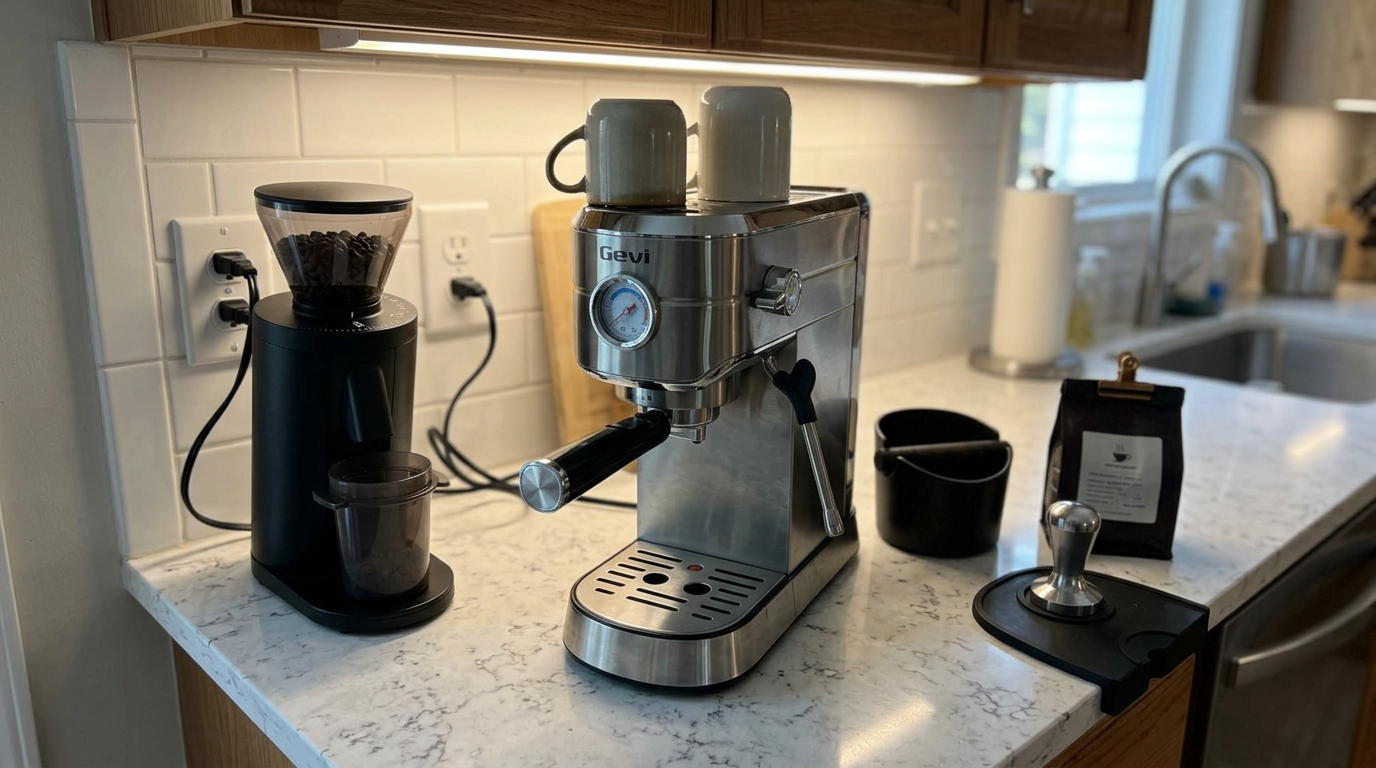
A morning cappuccino took me about four minutes, start to finish.
Cleaning and maintenance
Daily cleaning on the ECMG0 is short, as long as you do it straight away.
Knock out the puck, rinse the basket and portafilter, and wipe the steam wand immediately after every milk drink.
Milk dries fast on a hot wand, and once it bakes on it takes real scrubbing.
| Task | Why | How often |
|---|---|---|
| Wipe and purge steam wand | Milk residue | After every milk drink |
| Rinse basket and portafilter | Old coffee oils | After every use |
| Empty drip tray | Cool-down water | When the float rises |
| Wash Panarello sleeve | Dried milk inside | Every few days |
| Clean pressurized basket exit | Fine grounds can clog it | Weekly |
| Descale | Mineral scale | Every 1 to 3 months, by water hardness |
Watch the pressurized basket
Pressurized baskets have one tiny exit hole, and fine coffee can partly block it over time.
Once a week, I held each basket up to the light and rinsed the exit with hot water.
If your shots start to slow down or spurt, that's the first thing to check.
Descaling
Descaling✕DescalingRunning a mild acid solution through the machine to dissolve mineral scale left by hard water. Scale slows heating and can block pipes. matters on any machine that heats water, and this one is no exception.
How often depends on your water: every month or two in hard-water areas, every two to three months in soft-water areas.
Using filtered water from the start makes a big difference to how often you need to do it.
My estimate of daily hands-on cleaning time.
Our tip: Purge the wand for one second into a damp cloth after steaming, because it blows out milk sucked back inside the tip.
Coffee, grind and milk to use
Because the ECMG0 is built around pre-ground coffee, your choice of coffee matters more than any setting on the machine.
Medium and medium-dark espresso blends worked best in my tests.
They gave the fullest body and the most chocolate in milk drinks.
Light roasts tasted thin and sour in the pressurized basket, and they faded badly under milk.
| Coffee | Straight espresso | Milk drinks | Verdict |
|---|---|---|---|
| Medium-dark espresso blend, pre-ground | Good, round | Excellent | Best overall |
| Medium roast, pre-ground | Fair, brighter | Good | Fine for lattes |
| Light roast | Thin, sour | Fades in milk | Avoid |
| Drip-grind coffee | Watery | Weak | Avoid |
| Fresh-ground with pressurized basket | Good, more aroma | Very good | Nice upgrade |
Keep pre-ground coffee fresh
Pre-ground coffee loses aroma quickly once the bag is open.
I bought small bags and kept them sealed, away from heat and light, and used each within about two weeks.
For more detail, my guide on how to store coffee beans covers the same rules for ground coffee.
Milk
Cold whole milk gave the silkiest texture.
For plant milks, barista versions of oat milk worked best, because the added fat and protein hold the foam together.
Our tip: Keep a bag of pre-ground espresso coffee in an airtight container, and buy smaller bags more often instead of one big bag.
Three weeks with the ECMG0, week by week
Week 1: learning the routine
I made pre-ground cappuccinos every morning with the Panarello on.
The machine was easy to learn, apart from forgetting the side switch twice in steam mode.
I programmed the double-shot button on day four and left it there.
Week 2: sleeve off, better milk
I removed the Panarello and spent a few mornings learning the bare wand.
By the end of the week the milk was glossy, and my partner switched from lattes to cappuccinos.
I also noticed the water after steaming in the tray, and started emptying it every evening.
Week 3: the standard basket test
I tried fresh-ground coffee in both the pressurized basket and a standard basket.
Fresh coffee in the pressurized basket was a nice upgrade in aroma.
The standard basket ran fast, tasted bitter and left a cratered puck, which confirmed that this machine is happiest as designed.
Our combined feeling about the machine, from shared notes.
Common mistakes to avoid
| Mistake | What happens | Better habit |
|---|---|---|
| Leaving the side switch in steam | Shot buttons do nothing | Switch to coffee before brewing |
| Filling the pitcher to the top | Milk overflows fast | Fill it halfway |
| Letting milk dry on the wand | Hard, baked-on residue | Wipe and purge at once |
| Using drip-grind coffee | Watery, weak shots | Buy espresso grind |
| Panicking at water in the tray | Thinking it leaks | It's the cool-down, empty the tray |
| Running standard-basket shots at old grind settings | Fast, bitter shots | Grind finer and test by time |
What I would change
A slightly heavier base, or rubber feet with more grip, would stop the machine sliding when you lock in the portafilter.
A small metal tamper in the box would make a real difference.
And a little more control over water distribution would make the ECMG0 far more interesting for fresh-ground espresso.
Three households, three verdicts
The cappuccino lover
One or two milk drinks a day, mostly cappuccinos and lattes.
The strong steam wand and automatic cool-down make the ECMG0 a very good fit.
The beginner on a tight setup
Someone who wants café-style drinks without buying a grinder yet.
Pre-ground coffee and pressurized baskets make this one of the easiest ways in.
The espresso hobbyist
Someone who wants to weigh, grind, tweak and chase the perfect straight shot.
The pressure behavior and uneven puck in my standard-basket test make this a poor platform for that.
| Household | Fit | Main reason |
|---|---|---|
| Cappuccino lover | Excellent | Powerful steam wand, silky milk |
| Beginner, no grinder | Very good | Pressurized baskets forgive pre-ground coffee |
| Small kitchen | Very good | About 5.5 inches wide |
| Espresso hobbyist | Poor | High pressure, uneven water in standard basket |
| Plain black coffee drinker | Fair | Espresso is decent but simple |
Is the Gevi ECMG0 worth it?
The ECMG0 makes the most sense if you see it as a compact cappuccino machine that also makes simple espresso.
For that, it's genuinely good: easy to learn, quick, small and strong on milk.
It also saves you from buying a grinder on day one, which is a big part of the real cost of home espresso.
It makes less sense if your goal is to learn traditional espresso properly.
The Gevi ECMG0 can't give you the even, controlled extraction that a standard basket needs, and that will hold you back.
Three questions to ask yourself:
Do you mostly drink milk drinks?
Are you happy using pre-ground coffee, at least for now?
And do you care more about speed and ease than about fine control?
If you answered yes three times, the ECMG0 is a sensible buy.
How it compares with other coffee setups
| Feature | Gevi ECMG0 | Pod machine | Larger semi-automatic with standard baskets |
|---|---|---|---|
| Coffee used | Pre-ground, pressurized baskets | Pods only | Fresh-ground beans |
| Milk | Strong manual steam wand | Often separate frother | Steam wand, full control |
| Learning curve | Low | Very low | Medium to high |
| Espresso control | Low | None | High |
| Counter width | About 5.5 in | Small | Usually wider |
| Need a grinder? | No | No | Yes |
Compared with a pod machine, the ECMG0 asks a little more of you but gives you real steamed milk and loose coffee of your choice.
Compared with a larger semi-automatic with a grinder, it gives up control and consistency, but costs you far less effort and counter space.
If you want to understand what that extra control buys you, my explainer on coffee extraction is a good place to start.
| You mostly drink | Is the ECMG0 a fit? | Why |
|---|---|---|
| Cappuccinos and lattes | Excellent | Powerful wand, silky milk |
| Quick espresso | Good | Easy, forgiving pressurized shots |
| Americanos | Good | Double shot plus hot water |
| Competition-style espresso | Poor | High pressure, uneven puck |
| Latte art practice | Good | Bare wand makes real microfoam |
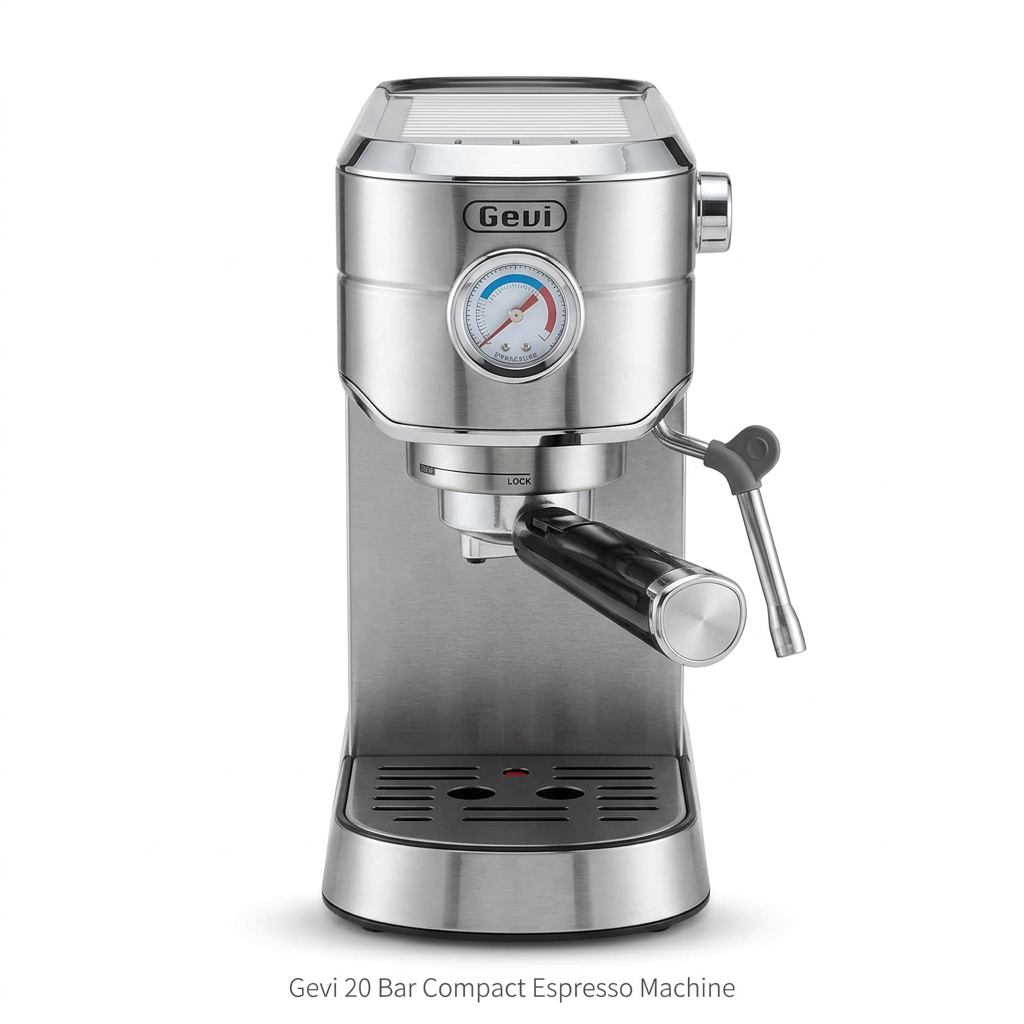
The full package: portafilter, steam wand, three shot buttons and the side mode switch.
Which one is right for you: is the Gevi ECMG0 your match?
4 quick questionsGevi ECMG0 specifications
From manufacturer data and my own testing.
How I tested and scored the Gevi ECMG0
For three weeks, the Gevi ECMG0 was our everyday espresso machine for cappuccinos, lattes, Americanos and straight shots.
I wrote notes after every session and weighed doses and shots with a kitchen scale.
I tested both pressurized baskets with pre-ground coffee, then a standard basket with fresh-ground coffee, WDT and a 51 mm tamper, and checked pressure with a gauge.
I steamed whole, 2% and barista oat milk with and without the Panarello, and followed the full cleaning routine.
Finally, I checked my notes against the manual and Gevi's published specifications.
- Espresso (7.0): crema, body and flavor with pressurized and standard baskets.
- Milk drinks (8.4): steam power, foam texture and plant milk results.
- Ease of use (8.2): controls, programming, pre-ground workflow and speed.
- Cleaning (7.8): drip tray, cool-down water, wand and basket care.
The overall score of 7.6 is an editorial rating that reflects those four areas.
Gevi ECMG0 FAQ
Is the Gevi ECMG0 good for beginners?
Yes. Its pressurized baskets make crema from pre-ground coffee, so you can start without a grinder, and the controls are simple.
Does the Gevi ECMG0 really make 20 bar?
The pump is rated at 20 bar. My gauge maxed out during a standard-basket test, and I estimate around 17 to 18 bar, well above the 8 to 9 bar ideal for traditional espresso.
Can I use fresh-ground coffee?
Yes. Fresh-ground coffee in the pressurized basket gave more aroma. With a standard basket, my shots ran fast and bitter, so you would need a finer grind and careful prep.
How much coffee goes in the double basket?
About 14 grams, or two level scoops of the supplied scoop.
Why is there water in the drip tray after steaming?
The machine automatically releases water to cool down after steaming. It is normal, not a leak.
Is the steam wand good?
Yes, it is the best part of the machine. With the Panarello removed, it made silky milk suitable for cappuccinos and basic latte art.
Can I program the shot buttons?
Yes, the one-shot and two-shot buttons are volumetric and can be programmed. The manual button lets you stop by weight.
Will other 51 mm accessories fit?
Not automatically. The group is about 2 inches across, but check exact compatibility before buying aftermarket baskets or portafilters.
Why won't my shot start?
Check the side switch. The machine only brews in coffee mode, not in steam or center position.
How often should I descale?
Every one to three months, depending on how hard your water is. Filtered water helps.
Is it loud?
The pump buzzes steadily for the short shot, and steaming is louder, but neither is harsh.
Is it well built?
It is mostly plastic with a stainless drip tray. It held up fine in three weeks, but long-term durability is unknown.
Kitchen & coffee tester
Michael spent six years as a line cook in restaurants in Chicago and New York, and he has tested kitchen appliances for HouseholdMe since 2018, from air fryers to coffee makers. He holds an SCA certificate in barista skills and used the Gevi ECMG0 as his everyday coffee machine for three weeks for this review.
- Three weeks of hands-on testing of the Gevi ECMG0 20 Bar espresso machine
- Gevi product support page, specifications and user manual
- General espresso brewing, pressure and milk-steaming guidance