Gaggia Classic Pro E24 review: a brass-boiler classic that rewards you for learning real espresso
The Gaggia RI9380/46 E24 Espresso Machine, better known as the Gaggia Classic Pro E24, is the newest version of a machine home baristas have trusted for decades, now with a solid brass boiler, a commercial 58 mm portafilter, a three-way solenoid valve and a 9 bar pressure limit. I used it daily for three weeks to see whether the classic still earns its reputation.

Michael Reynolds
Hands-on review
Hands-on testing, research, specs
3 weeks
19 minutes
Jargon helpNew to espresso? Tap any dotted term to see what it means.
In this review
Yes, if you want to learn real espresso on a machine built to last. The Gaggia Classic Pro E24 made the best straight espresso and the most powerful steam of any machine in this price range I've tested, thanks to its heavy brass boiler, 58 mm portafilter and 9 bar limit, and its three-way valve leaves dry pucks. It's also repairable and made in Italy. But it asks more of you: a 10-minute warm-up, a good grinder, a little temperature surfing and practice with a powerful wand.
Gaggia Classic Pro E24 at a glance
Gaggia Classic Pro E24 pros and cons
- Excellent, stable espresso with a 9 bar limit
- Powerful, fast steam for real microfoam
- Commercial 58 mm parts, three-way valve, repairable
- Needs about 10 minutes to fully warm up
- No PID, so temperature takes technique
- Low cup clearance and a learning curve
Who should buy the Gaggia Classic Pro E24?
- Aspiring home baristas
- People who want a machine for many years
- Straight espresso and flat white lovers
- Push-button convenience seekers
- Pre-ground-only coffee drinkers
- People who want automatic milk
First impressions of the Gaggia Classic Pro E24
The Gaggia Classic is a machine I've known about for years, and the E24 still has the same honest, boxy stainless body and three chunky rocker switches.
What's changed is inside: a solid brass boiler in place of the old aluminum one.
The first thing I picked up was the 58 mm portafilter✕PortafilterThe handle with a metal basket that holds the ground coffee. You lock it into the machine to brew., and at about a pound of stainless steel, it felt like café equipment.
In the box were three baskets, two single-wall and one pressurized, a plastic tamper and a scoop.
The brew light came on quickly, but I followed the advice to give it a full 10 minutes with the portafilter locked in.
My first shot, 16 grams of a fresh medium roast to 32 grams in about 30 seconds, was sweet, syrupy and balanced, with a thick, tiger-striped crema.
When I knocked the puck out, it came out dry and solid, thanks to the three-way valve✕Three-way valveA valve that releases leftover pressure after a shot, so the used coffee comes out drier and the spouts stop dripping sooner..
Then I flicked the steam switch, and the wand spun my milk faster than any other machine I've tested at this level.
It felt less like an appliance and more like a small café machine, which is exactly what the Gaggia Classic Pro E24 aims to be.
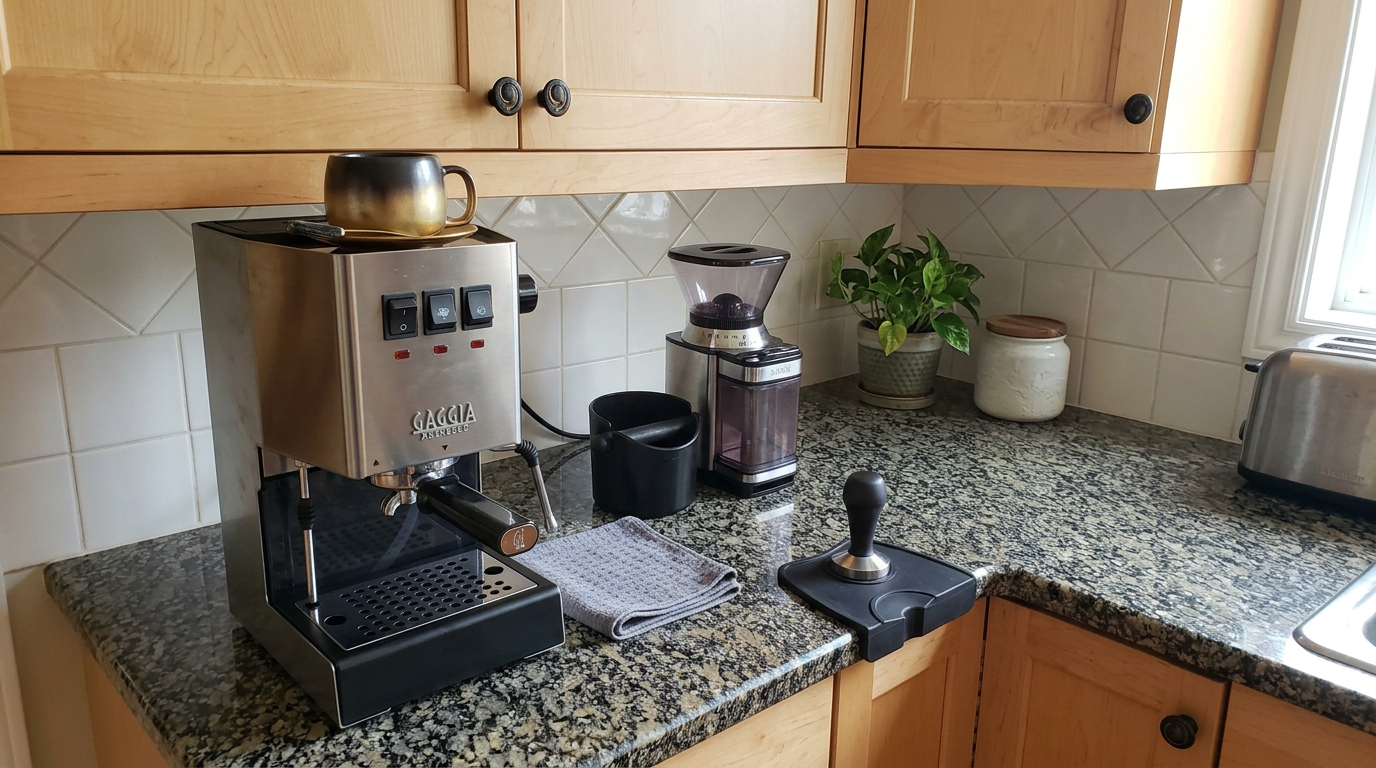
The E24 on my counter with a grinder and tamper close by. Cups warm on the flat top.
What the Classic Pro E24 actually is
The Classic Pro E24 is a single-boiler semi-automatic espresso machine with commercial-style parts.
There's no screen and no programming: a power switch, a brew switch and a steam switch, plus a steam knob.
| Feature | What it does | My verdict |
|---|---|---|
| Brass boiler | Stores hot water with lots of thermal mass | Very stable temperature |
| 58 mm portafilter | Heavy stainless, commercial size | Excellent |
| Three-way solenoid valve | Releases pressure after the shot | Dry pucks, allows backflushing |
| 9 bar OPV | Limits brewing pressure | Ideal for espresso |
| Steam wand | Commercial-style | Powerful and fast |
| Three baskets | Two single-wall, one pressurized | Covers beginners and enthusiasts |
The new brass boiler and why it matters
The headline change in the E24 is the boiler.
The upper part is now solid brass instead of aluminum, making it heavier and bigger.
| Change vs the old aluminum boiler | Figure | What it means |
|---|---|---|
| Weight of the upper boiler | About 59% heavier | More thermal mass |
| Water capacity | About 26% larger | More hot water for brewing and steam |
| Stored heat | About 27% more | Steadier temperature, stronger steam |
| Steaming speed | About 25% faster | Quicker milk drinks |
Why mass matters
The boiler sits right on a heavy brass group head, which locks onto the heavy stainless portafilter.
Once heated, all that metal acts like a thermal battery, keeping the water temperature steady as it flows into the coffee.
Budget machines that heat water on the fly in a small thermoblock✕ThermoblockA compact heater that warms water as it flows through, instead of keeping a boiler of hot water ready. can't do that, so their shots can swing hotter or cooler.
Safety
The brass is a lead-free alloy made for drinking water, compliant with some of the strictest state standards in the US.
Older Classic owners can even buy the brass boiler separately as an upgrade.
Warm-up: why 10 minutes matters
The brew-ready light comes on quickly, about 20 seconds later than the old aluminum model, but that only means the water is hot.
The brass group and the heavy portafilter need much longer to soak up heat.
I compared shots after different warm-up times, with the portafilter locked in throughout.
How my shots tasted after different warm-up times, rated out of 10.
How I handled it
I switched the E24 on as soon as I got up, with the portafilter locked in, and made coffee 10 minutes later.
A smart plug on a timer would do the same job.
It's the one real inconvenience of the machine, and it's the price of all that thermal stability.
Our tip: Plug the E24 into a smart plug set to switch on 10 minutes before you usually make coffee.
Temperature surfing, step by step
The E24 has no PID✕PIDA smart temperature controller that keeps brewing water closer to a set temperature than a simple thermostat., so the boiler temperature rises and falls a little as the thermostat switches the heaters on and off.
Temperature surfing✕Temperature surfingTiming your shot around the heating light so the boiler is at the temperature you want when you start brewing. lets you start your shot at the right moment, every time.
| Step | What I do | Why |
|---|---|---|
| 1. Warm up | 10 minutes, portafilter locked in | Metal reaches equilibrium |
| 2. Flush | Run water through the group for 5 to 7 s | Triggers the heating cycle |
| 3. Watch | The ready light goes off after 20 to 30 s | Heaters are on |
| 4. Prep | Grind, dose, distribute and tamp | Use the waiting time |
| 5. Brew | When the light comes back on, lock in and brew | Starts near 200 °F |
Adjusting for roast
For darker roasts, I ran a two-second flush just before locking in, which brought the temperature down slightly.
For lighter roasts, I flicked the steam switch on for a few seconds and off again, which pushed it hotter, closer to 205 °F.
| Roast | Extra step | Approximate temperature |
|---|---|---|
| Dark | Two-second flush before brewing | Just under 200 °F |
| Medium | Standard routine | About 200 °F |
| Light | Brief steam-switch boost | Close to 205 °F |
Classic Pro E24 espresso performance
This is where the Gaggia Classic Pro E24 shines.
Temperature stability
Measurements of the temperature inside the coffee puck show it holding within about two degrees of 200 °F through a 30-second shot.
In my cup, that showed up as consistency: shot after shot tasted the same once I'd dialed in.
How it tasted
With a fresh medium roast, 16 grams to 32 grams in about 30 seconds, shots were syrupy and sweet, with caramel, red fruit and a long, clean finish.
Dark roasts surfed a little cooler were chocolatey and smooth, without bitterness.
A light roast, boosted hotter, was bright and sweet rather than sour, which few machines at this level manage.
Pressure
The 9 bar OPV✕OPVShort for over-pressure valve. It caps the brewing pressure, usually at about 9 bar, by sending extra water back to the tank. keeps the pressure where it should be, so the puck isn't over-compressed and shots don't turn harsh.
My flavor ratings on a 10-point scale.
| What you taste | Likely cause | First change |
|---|---|---|
| Sour | Too cool or grind too coarse | Boost temperature, grind finer |
| Bitter | Too hot or grind too fine | Flush before brewing, grind coarser |
| Thin, fast | Dose too low | 16 to 18 g |
| Uneven, spurting | Channeling | Use WDT, tamp level |
Baskets, grinder and pre-ground coffee
The E24 includes two single-wall basket✕Single-wall basketA basket full of small holes. All the resistance comes from the coffee itself, so grind and tamp matter much more. options and one pressurized basket with a pin.
Single-wall baskets
These are what the machine is built for: fresh beans ground just before brewing, a precise grind and good prep.
The double basket held my 16 to 18 gram doses comfortably.
The pressurized basket
This one is for pre-ground espresso or ESE pods.
It made decent, crema-topped shots with no grinder at all, which is a nice way to start.
The grinder you need
To get the most from the E24, you need a capable espresso grinder with fine adjustment; a quality burr grinder with at least 50 mm flat burrs is ideal.
My guide to burr vs blade grinders explains why.
| Basket | Coffee | Result |
|---|---|---|
| Single-wall double | Fresh beans, good grinder | Excellent |
| Single-wall single | Fresh beans | Good, trickier |
| Pressurized | Pre-ground or ESE pods | Decent, easy |
Our tip: If you don't have a grinder yet, start with the pressurized basket, then switch to single-wall once you buy one.
Dose, distribute and tamp
With single-wall baskets, prep makes or breaks the shot.
Dose
I used 16 grams for a sweet, balanced double and 18 grams for a bolder shot, weighed on a scale every time.
Distribute
A WDT✕WDTShort for Weiss Distribution Technique: stirring the grounds with fine needles to break up clumps before tamping. tool broke up clumps and evened out the bed; it made a visible difference with a bottomless portafilter.
Tamp
The included plastic tamper is the weakest accessory; a heavy 58 mm stainless tamper gave me level pucks and better edge seals.
Lock in
The 58 mm portafilter locks in with a firm, positive feel, and the 18 to 20 pound machine doesn't move.
| Step | Tool | Why |
|---|---|---|
| Dose | Scale | Repeatable shots |
| Distribute | WDT tool | Fewer channels |
| Tamp | 58 mm stainless tamper | Level, even puck |
| Clean rim | Brush or finger | Good gasket seal |
Our tip: Upgrade the plastic tamper first; a heavy, well-fitting 58 mm tamper is the cheapest big improvement.
The three-way valve and dry pucks
The three-way solenoid valve is a feature you notice every single time.
When you switch off the brew switch, it instantly releases the pressure above the puck down a pipe into the drip tray.
The result is a dry, firm puck that knocks out cleanly in one tap.
The portafilter doesn't sneeze or spray when you unlock it straight after brewing, either.
It also means you can backflush✕BackflushRunning water back through the group with a blank basket and cleaner to flush coffee oils out of the valve and shower screen. the group with a blind basket and cleaner, which keeps the shower screen and valve free of old coffee oils.
After using several budget machines with soupy pucks, this felt like a real upgrade in daily life.
How often a puck knocked out cleanly in one tap.
Steaming milk with the E24
The E24's steam is the strongest I've used on a home machine in this range.
Speed
After flipping the steam switch, the steam-ready light came on in about 60 seconds.
You don't have to wait for it, though: usable steam builds in about 20 seconds, and starting a little early gives gentler steam that's easier for beginners.
At full readiness, 5 ounces of milk went from 42 °F to 142 °F in about 24 seconds.
Texture
The brass boiler's stored energy keeps the steam strong right to the end of the jug, so the whirlpool never fades.
Once I'd learned to stretch quickly, the microfoam✕MicrofoamMilk foam with bubbles so small you can't see them. It feels silky and pours well for latte art. was glossy and fine, perfect for latte art.
My ratings on a 10-point scale for texture.
The learning curve
All that power means things happen fast.
My first jugs were over-stretched, because I added air for too long; a couple of seconds is plenty.
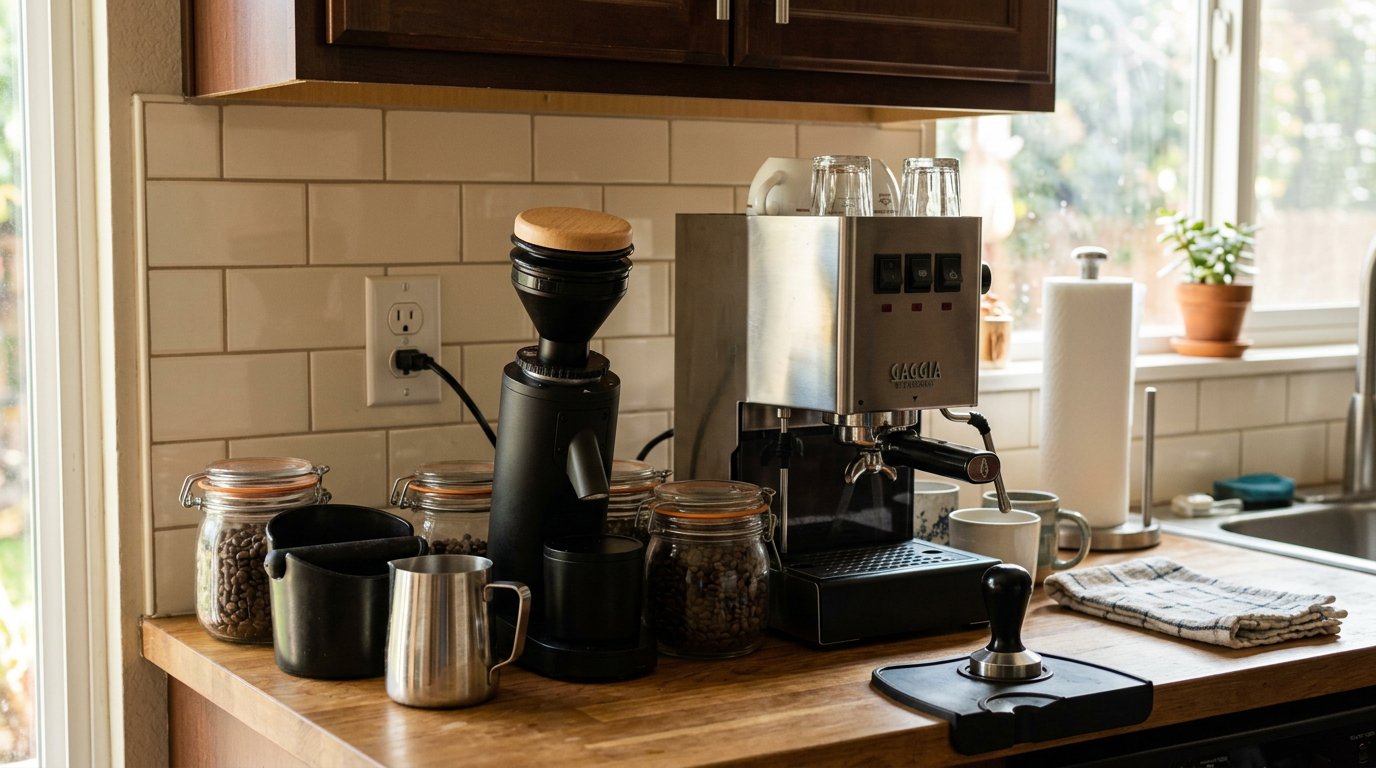
The E24 on a wooden counter with my grinder and pitcher. The steam wand on the right is powerful and fast.
How I steam milk on the E24, step by step
| Step | What I do | Why |
|---|---|---|
| 1. Brew | Pull the shot first | Single boiler |
| 2. Steam switch | Flip it on, wait 20 to 60 s | Earlier means gentler steam |
| 3. Purge | Open the knob over the drip tray | Clears water |
| 4. Stretch | Tip at the surface, only 2 to 3 s | Steam is strong |
| 5. Spin | Sink slightly, off-center | Fast whirlpool |
| 6. Stop | Around 140 °F | In about 20 to 25 s |
| 7. Clean | Wipe and purge | Stops milk drying |
| 8. Refill | Run water through the group with steam off | Refills the boiler before the next shot |
The last step matters on a single-boiler machine: after steaming, run a little water through the group to refill the boiler and bring it back down before the next shot.
My latte art over the test, rated out of 10.
Our tip: Start steaming 20 seconds after flipping the switch while you're learning; the gentler steam is easier to control.
Design, controls and size
The E24 is narrow and deep enough to sit comfortably in most kitchens, and its weight keeps it planted.
Controls
Three heavy-duty rocker switches for power, brew and steam, each with an indicator light, plus a steam knob on the side.
They feel satisfyingly mechanical and built to last.
The tank
The tank sits at the front and can be pulled out or filled from a funnel under the lid, which is handy under low cabinets.
Cup clearance
At about 3.25 inches, clearance is low: espresso cups and short glasses fit, but most mugs don't.
I brewed into a small pitcher or cup and poured into mugs.
Our tip: Brew into a small jug or espresso cup and pour into your mug; most mugs won't fit under the spouts.
Hot water and Americanos
The E24 delivers hot water from the steam wand when the steam switch is off and you open the knob.
I used it for Americanos, adding about five ounces of water to a double shot in a mug.
Because the shots were so sweet, Americanos were excellent, closer to a great filter coffee than a diluted espresso.
Running hot water also refills and cools the boiler after steaming, which is part of a good single-boiler routine.
| Drink | Water | Notes |
|---|---|---|
| Americano | About 5 oz on a double | Sweet and clean |
| Long black | Water first, shot on top | More crema |
| Tea | From the wand | Handy |
My first-week checklist for new owners
| Day | What to do | Why |
|---|---|---|
| Day 1 | Rinse parts, fill the tank, prime the boiler and wand | Clean, safe start |
| Day 1 | Warm up 10 minutes with the portafilter in | Stable shots |
| Day 2 | Start with 16 g in, 32 g out in about 30 s | A reliable recipe |
| Day 3 | Learn the temperature-surfing routine | Consistent temperature |
| Day 4 | Practice steaming early, at 20 s | Gentler steam to learn on |
| Day 5 | Refill the boiler after steaming | Protects the next shot |
| Day 6 | Buy a 58 mm metal tamper | Better pucks |
| Day 7 | Backflush with water | Keeps the valve clean |
What other owners say
The Gaggia Classic has one of the most loyal followings in home espresso.
Owners praise its espresso, steam power and build quality, and many have kept older Classics running for well over a decade with nothing more than routine descaling and the odd gasket.
Technicians often see 15-year-old machines that are still working.
The most common complaints are the warm-up time, the lack of a PID, low cup clearance and the basic plastic tamper.
E24 owners in particular report noticeably stronger steam and steadier shots than the older aluminum-boiler models.
What that means for you
This is a machine people keep, repair and upgrade rather than replace.
Cleaning and maintaining the E24
| When | Task | Why it matters |
|---|---|---|
| After steaming | Wipe and purge the wand | Stops milk drying |
| Daily | Rinse the portafilter and basket | Removes coffee oils |
| Daily | Empty the drip tray | The valve sends water there |
| Weekly | Backflush with water | Clears the shower screen and valve |
| Monthly | Backflush with espresso cleaner | Removes old oils |
| Every 3 to 4 months | Descale, or use filtered water | Protects the boiler and valve |
Water
Filtered or softened water slows scale build-up and improves flavor; with hard tap water, descale every three to four months.
Because the heating elements sit outside the boiler, they don't get scaled up themselves, which helps them last.
My estimate of hands-on cleaning time per day.
Inside the machine and repairability
One reason the Classic lasts is that it's simple inside.
| Part | What it does | Why it matters |
|---|---|---|
| Brass boiler with external elements | Heats the water | Elements never touch water, so no scale on them |
| Brew and steam thermostats | Control the two temperatures | Simple, replaceable |
| Thermal fuse | Cuts power if it overheats | Safety backup |
| 9 bar OPV | Caps brewing pressure | Returns extra water to the tank |
| Three-way solenoid valve | Releases pressure after the shot | Dry pucks |
| Rocker switches | Power, brew, steam | Durable and easy to replace |
The layout is modular, so many repairs can be done at home with common parts.
That's rare for a machine at this level, and it's why the Gaggia Classic Pro E24 can be a decade-long purchase.
What daily use is really like
My weekday routine: the smart plug switched the E24 on 10 minutes before I came downstairs.
Then I flushed the group, ground and tamped while the light cycled, brewed when it came back on, and steamed.
A flat white took about four minutes of hands-on time, plus the warm-up I didn't have to watch.
Noise
The vibration pump has a classic buzz, and the steam is a strong, rushing hiss.
Tank life
Rough maths from a 72 oz tank, including flushes and backflushes.
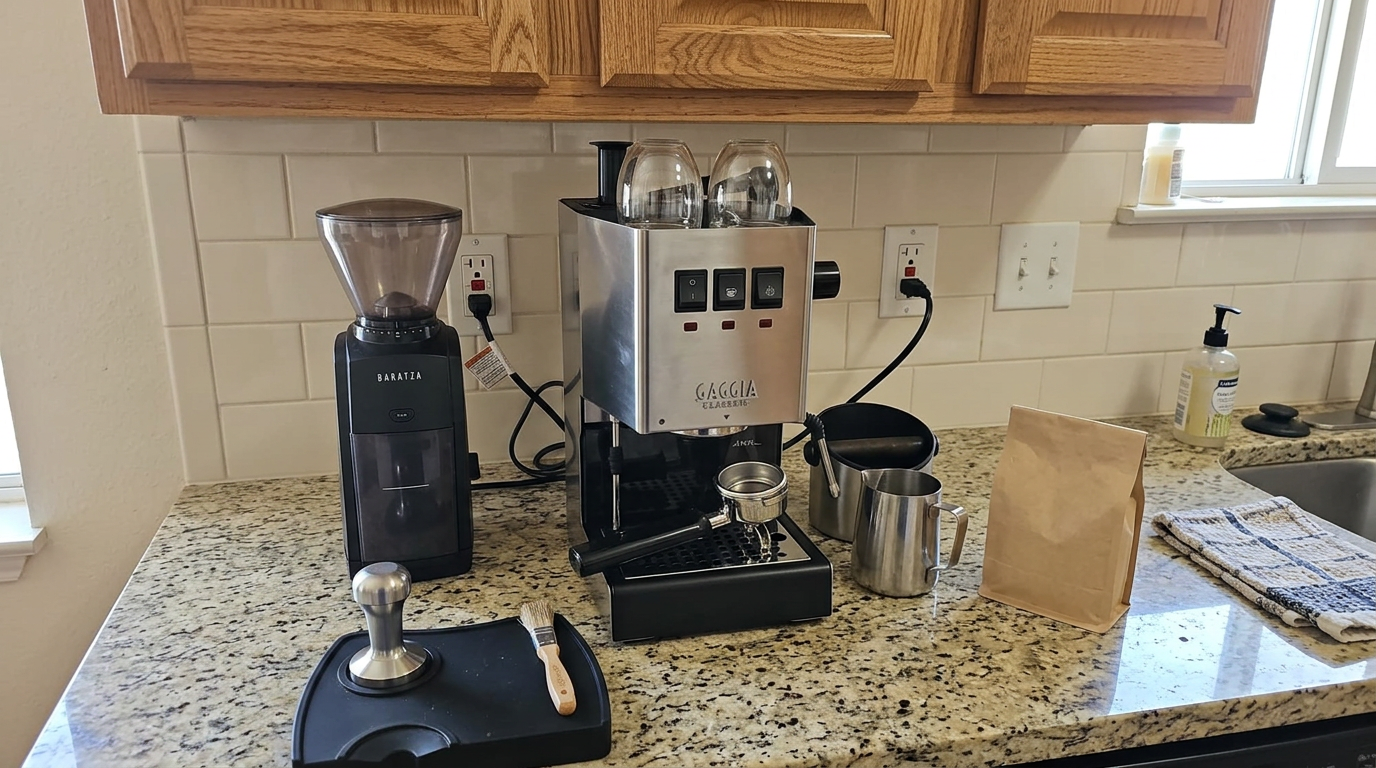
The E24 with cups warming on top and my grinder beside it. The rocker switches are simple and built to last.
The drinks I made most often
| Drink | Coffee | How I made it | Notes |
|---|---|---|---|
| Double espresso | 16 g in, 32 g out | About 30 s at about 200 °F | Syrupy and sweet |
| Flat white | 16 g double | Thin layer of microfoam | My favorite |
| Cappuccino | 18 g double | Longer stretch | Glossy foam |
| Cortado | 16 g double | Equal parts milk | Quick |
| Americano | 16 g double | About 5 oz hot water | Clean and sweet |
| Light-roast espresso | 18 g in, 40 g out | Boosted hotter | Bright, fruity |
The E24 made me drink more straight espresso than any other machine in this series, because it was simply that good.
Our tip: For light roasts, try a longer ratio, around 1:2.2, together with the steam-switch temperature boost.
Living with it: week one to week three
Week one
I learned the warm-up and temperature surfing, and over-stretched a lot of milk.
Week two
I added a heavy tamper and a WDT tool, dialed in three roasts and started pouring latte art.
Week three
I used the Gaggia Classic Pro E24 for a busy household and a weekend of guests.
It stayed consistent and never struggled, and the steam was the fastest of any home machine I've used.
How I rated each drink by the end of the test, out of 10.
Serving guests
With guests, the single boiler means switching between brewing and steaming, but the E24's steam is so fast that it barely mattered.
Four flat whites took me about 12 minutes, including refilling the boiler between steams.
I pulled two shots, steamed one jug for both, refilled the boiler, and repeated.
Our tip: For guests, pull two shots, steam one jug for both, then refill the boiler before the next pair.
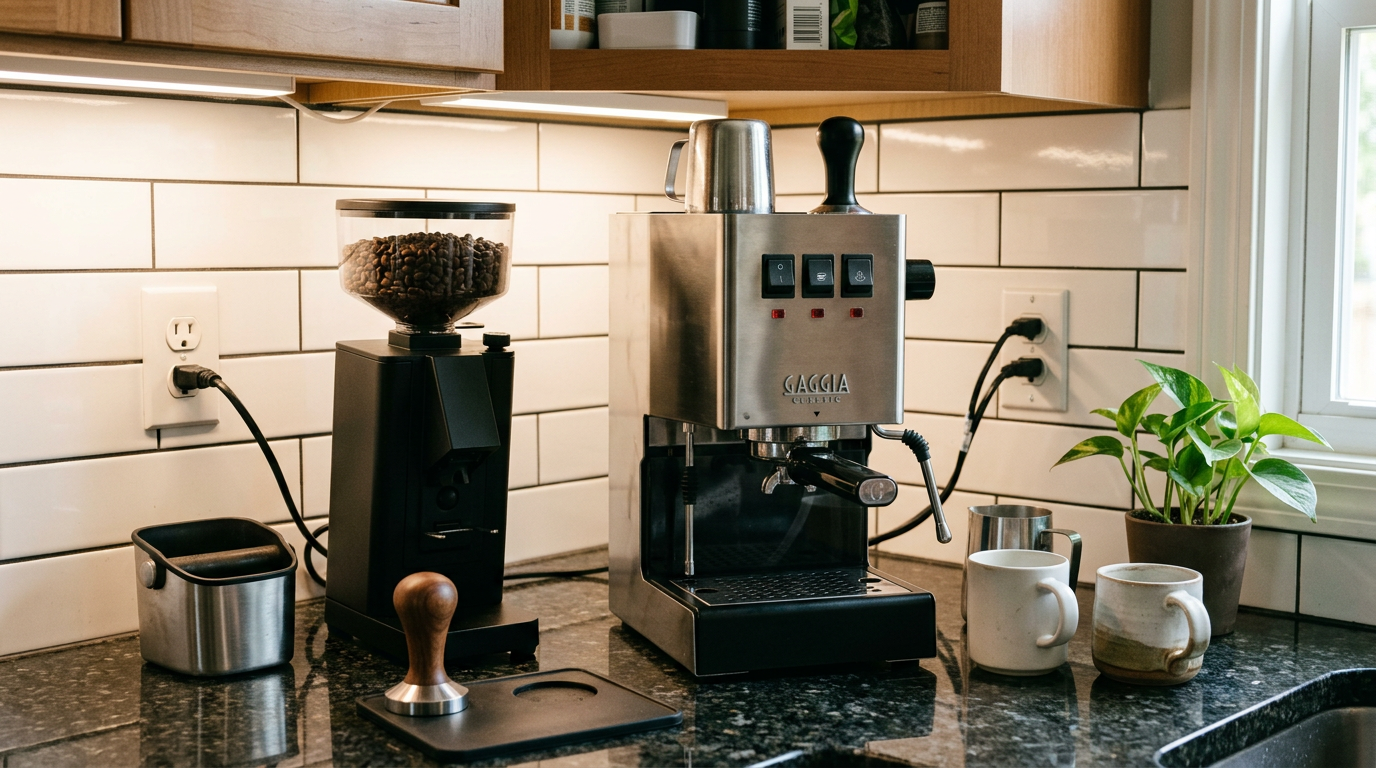
The E24 with my grinder, knock box and pitcher. Dry pucks made cleanup between drinks fast.
What I liked most, and what bugged me
What I liked most
The espresso: stable, sweet and consistent once dialed in.
The steam: powerful, fast and perfect for latte art.
The build: heavy, commercial-style parts, dry pucks and real repairability.
What bugged me
The 10-minute warm-up.
No PID, so temperature takes a routine.
Low cup clearance and a cheap plastic tamper.
Who will enjoy it
If you want to learn espresso properly on a machine that lasts, you'll love the Gaggia Classic Pro E24.
If you want push-button convenience, it will feel like hard work.
Common mistakes to avoid
| Mistake | What happens | Better habit |
|---|---|---|
| Brewing as soon as the light comes on | Thin, sour shots | Warm up 10 minutes |
| Ignoring the thermostat cycle | Inconsistent temperature | Temperature surf |
| Stretching milk too long | Stiff, bubbly milk | Two to three seconds of air |
| Not refilling after steaming | Scorched next shot | Run water through the group |
| Using pre-ground in single-wall baskets | Fast, sour shots | Use the pressurized basket |
| Never backflushing | Old oils, bitter shots | Weekly water, monthly cleaner |
A built-in PID and a little more cup clearance would make the E24 nearly perfect for its price.
Is the Gaggia Classic Pro E24 worth the money?
For aspiring home baristas, absolutely.
You get café-grade parts, a brass boiler with excellent stability, powerful steam, dry pucks and a machine you can keep running for many years.
What you give up is convenience: a warm-up, a routine and the need for a good grinder.
Ask yourself three questions before you buy.
Do you want to learn real espresso? Do you have, or will you buy, a capable grinder? Can you switch it on 10 minutes early?
If the answers are yes, the Gaggia Classic Pro E24 is one of the best-value espresso machines you can buy.
If you'd rather be guided through every step, see my La Specialista Touch review.
How it compares with other setups
| Feature | Gaggia Classic Pro E24 | Budget machine with 58 mm and PID | Guided all-in-one |
|---|---|---|---|
| Heating | Brass boiler | Thermoblock with PID | Thermoblock |
| Temperature | Very stable, needs surfing | Set by PID | Guided |
| Steam | Very powerful | Modest | Good to excellent |
| Dry pucks | Yes, three-way valve | Varies | Varies |
| Repairability | Excellent | Limited | Limited |
| Best for | Learning, longevity | Budget learning | Convenience |
| You mostly drink | Is the E24 a fit? | Why |
|---|---|---|
| Straight espresso | Excellent | Stable temperature, 9 bar |
| Flat whites and lattes | Excellent | Powerful steam |
| Pre-ground coffee only | Fair | Pressurized basket only |
| Quick morning coffee | Fair | Needs warm-up |
For a cheaper 58 mm machine with a PID and timer, see my CASABREWS Ultra review.
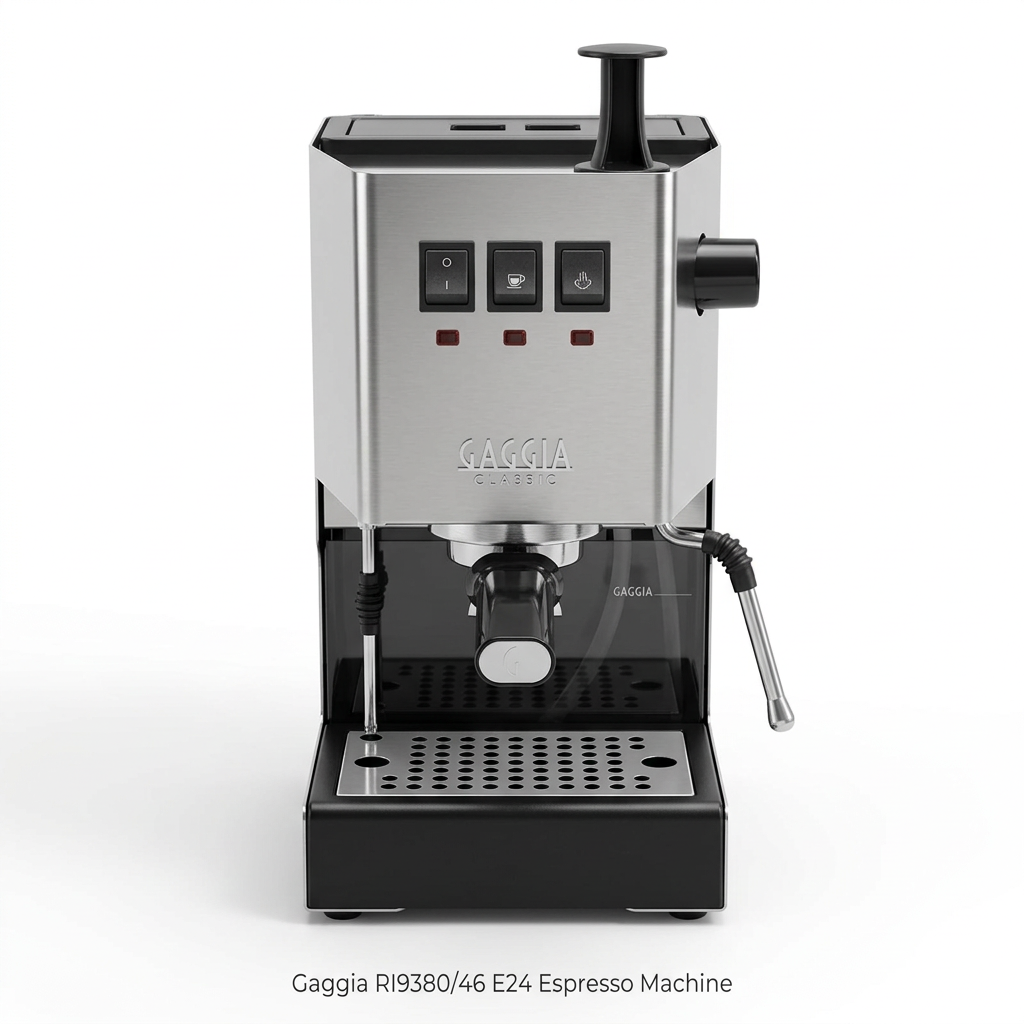
The Gaggia Classic Pro E24 from the front: three rocker switches, 58 mm portafilter and steam wand.
A classic, updated
The Gaggia Classic has been a benchmark for home espresso for a long time, and it's still designed and built in Italy.
The E24 keeps everything people loved about it: the single-piece steel frame, the commercial-size parts, the simple switches and the steam power.
It adds the brass boiler, which fixes the old model's biggest weakness, temperature that drifted between shots.
Compared with budget machines built mostly from plastic, the E24 feels like a different category of product.
It's heavier, simpler and more serviceable, and it treats you like someone who wants to learn rather than someone who wants to press one button.
| Generation | Boiler | What changed |
|---|---|---|
| Earlier Classic models | Aluminum | The original benchmark |
| Classic Pro | Aluminum, 9 bar OPV | Better pressure, new switches |
| Classic Pro E24 | Solid brass | Steadier temperature, stronger steam |
Accessories worth buying
The standard 58 mm size means a huge range of accessories fits the E24.
| Accessory | Why | Impact |
|---|---|---|
| Espresso burr grinder | Fine, even grounds for single-wall baskets | Essential |
| 58 mm metal tamper | Level, consistent pucks | Big |
| Coffee scale | Repeatable dose and yield | Big |
| WDT tool | Fewer channels | Medium |
| Blind basket and espresso cleaner | Backflushing | Medium |
| Precision basket | More even extraction | Small to medium |
| Bottomless portafilter | See your extraction | Small, great for learning |
| Water filter or softened water | Less scale, better taste | Medium |
The grinder matters most; without one, you're limited to the pressurized basket and miss what makes this machine special.
After that, a good tamper and a scale make the biggest difference for the least money.
Build quality and longevity
The E24 feels built to last: a one-piece steel frame, a heavy brass group and boiler, a stainless portafilter and minimal plastic.
The switches have a solid, mechanical click, and the steam knob turns smoothly.
Over three weeks of daily use, nothing loosened, leaked or misbehaved.
What wears over time
The group gasket and shower screen are normal wear parts, and they're cheap and easy to replace.
The thermostats and switches can also be replaced at home if they ever fail.
With basic care, this is a machine you can expect to keep for a very long time.
Which one is right for you: is the Gaggia Classic Pro E24 your match?
4 quick questionsGaggia Classic Pro E24 specifications
From manufacturer data and my own testing.
How I tested and scored the Gaggia Classic Pro E24
For three weeks, I used the Gaggia Classic Pro E24 as my everyday machine for espresso, flat whites, cappuccinos and Americanos, usually four drinks a day, with a capable burr grinder and a scale.
I tested the full warm-up, a short warm-up, and the temperature-surfing routine for light, medium and dark roasts, and timed steam readiness and steaming.
I used the single-wall baskets with fresh beans and the pressurized basket with pre-ground coffee, and backflushed weekly.
I then checked my notes against Gaggia's specifications, other hands-on reviews and owner feedback.
- Espresso (8.8): flavor, body, consistency and temperature control across roasts.
- Milk drinks (8.6): steam power, microfoam and steaming speed.
- Ease of use (7.4): warm-up, temperature surfing, controls and learning curve.
- Cleaning (8.0): dry pucks, backflushing, descaling and repairability.
The overall score of 8.2 is an editorial rating that reflects those four areas.
Gaggia Classic Pro E24 FAQ
Is the Gaggia Classic Pro E24 worth it?
Yes, for anyone who wants to learn real espresso on a durable machine. It isn't ideal for push-button convenience.
What is new in the E24?
A solid brass boiler that is heavier and larger than the old aluminum one, giving more stable temperature and about 25 percent faster steaming.
Does it have a PID?
No. It uses thermostats, so a simple temperature-surfing routine helps you hit your target temperature.
How long does it take to warm up?
The light comes on quickly, but give it about 10 minutes with the portafilter locked in for stable shots.
What size is the portafilter?
58 mm, the commercial standard, in heavy stainless steel.
Does it have a three-way valve?
Yes. It releases pressure after the shot, so pucks come out dry and you can backflush.
What pressure does it brew at?
It comes with a 9 bar over-pressure valve, the standard for espresso.
How good is the steam?
Very strong. It heated 5 oz of milk from 42 to 142 °F in about 24 seconds in my test.
Can I use pre-ground coffee?
Yes, with the included pressurized basket. Fresh beans and the single-wall baskets taste much better.
Is the brass boiler safe?
It uses a lead-free brass alloy made for drinking water and meets strict state standards.
How big is the water tank?
About 72 ounces, roughly 2.1 liters, filled from the front or top.
Can I repair it myself?
Yes. The layout is simple and parts are widely available.
Kitchen & coffee tester
Michael spent six years as a line cook in restaurants in Chicago and New York, and he has tested kitchen appliances for HouseholdMe since 2018, from air fryers to coffee makers. He holds an SCA certificate in barista skills and used the Gaggia Classic Pro E24 as his everyday coffee machine for three weeks for this review.
- Three weeks of hands-on testing of the Gaggia Classic Pro E24
- Gaggia product specifications and manual
- Independent hands-on reviews of the Classic Pro E24
- Owner feedback on durability, steam and temperature