De'Longhi Classic vs Stilosa
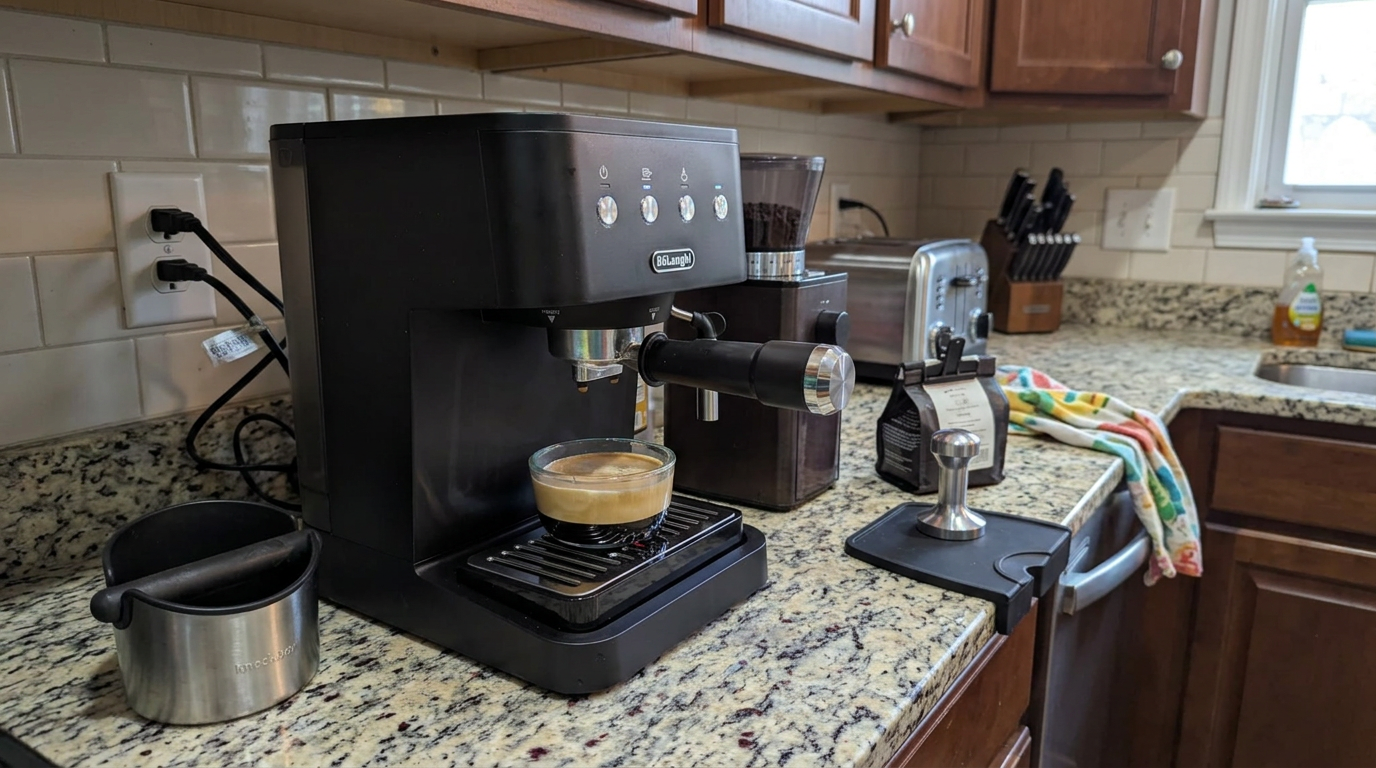
Two compact De'Longhi espresso machines for beginners, one built around a thermoblock and pre-ground convenience, the other around a small stainless steel boiler that rewards a good grinder. We used each one daily for four weeks to find out which suits which kind of coffee drinker.
We choose products independently. We may earn a commission when you buy through our links. Affiliate policy
Jargon helpNew to espresso gear? Tap any dotted term to see what it means.
In this comparison
If you'll use pre-ground coffee and mostly drink cappuccinos, buy the De'Longhi Classic. It made hot, balanced shots from supermarket espresso from the first morning, holds 57 ounces of water, has a working pressure gauge and takes cheap 51 mm upgrades later. If you own a burr grinder or plan to buy one, buy the De'Longhi Stilosa: its stainless steel boiler, stronger steam and lack of a solenoid valve gave us the best espresso of the two once we depressurized the basket.
The two machines
Specs checked November 25, 2026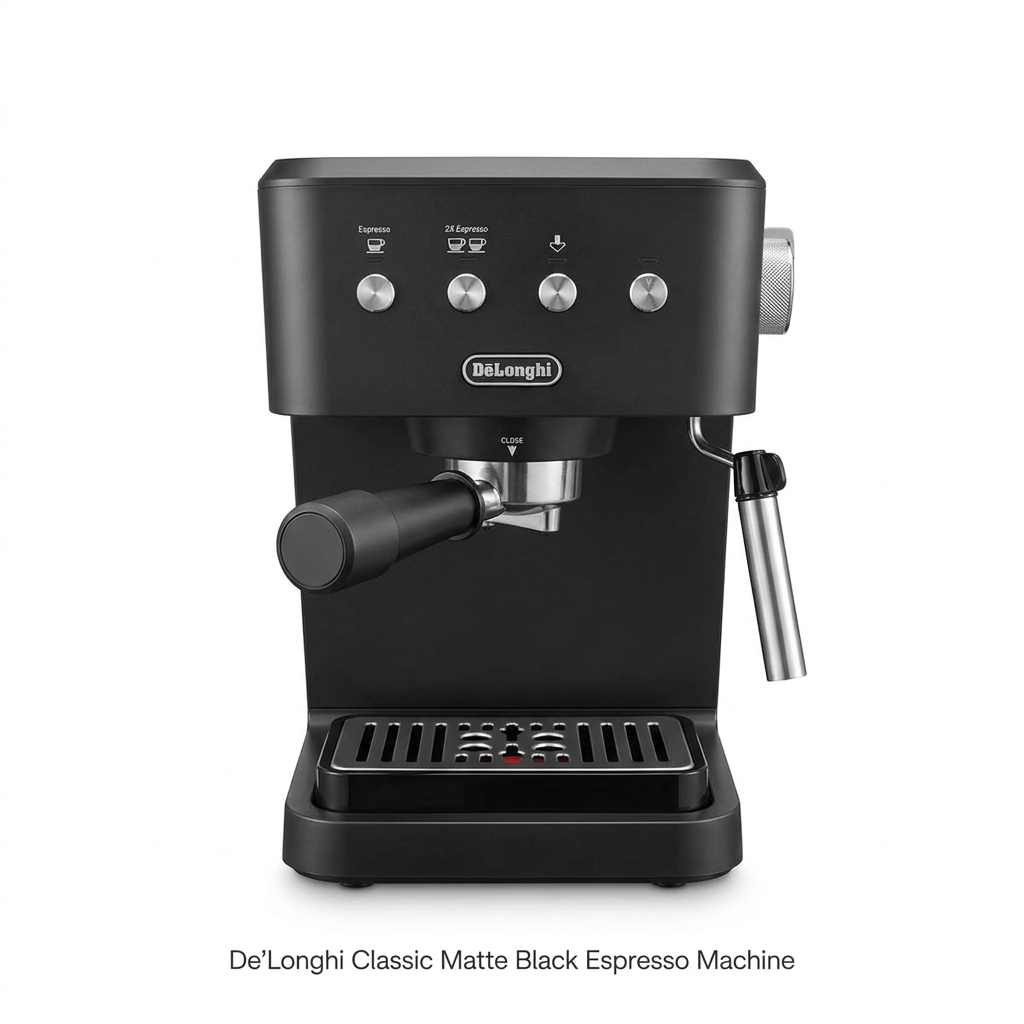
Thermoblock heating, a 15-bar pump, a front pressure gauge, a Panarello wand, a 57 oz tank and a common 51 mm portafilter fitting, in matte black.
Check price on Amazon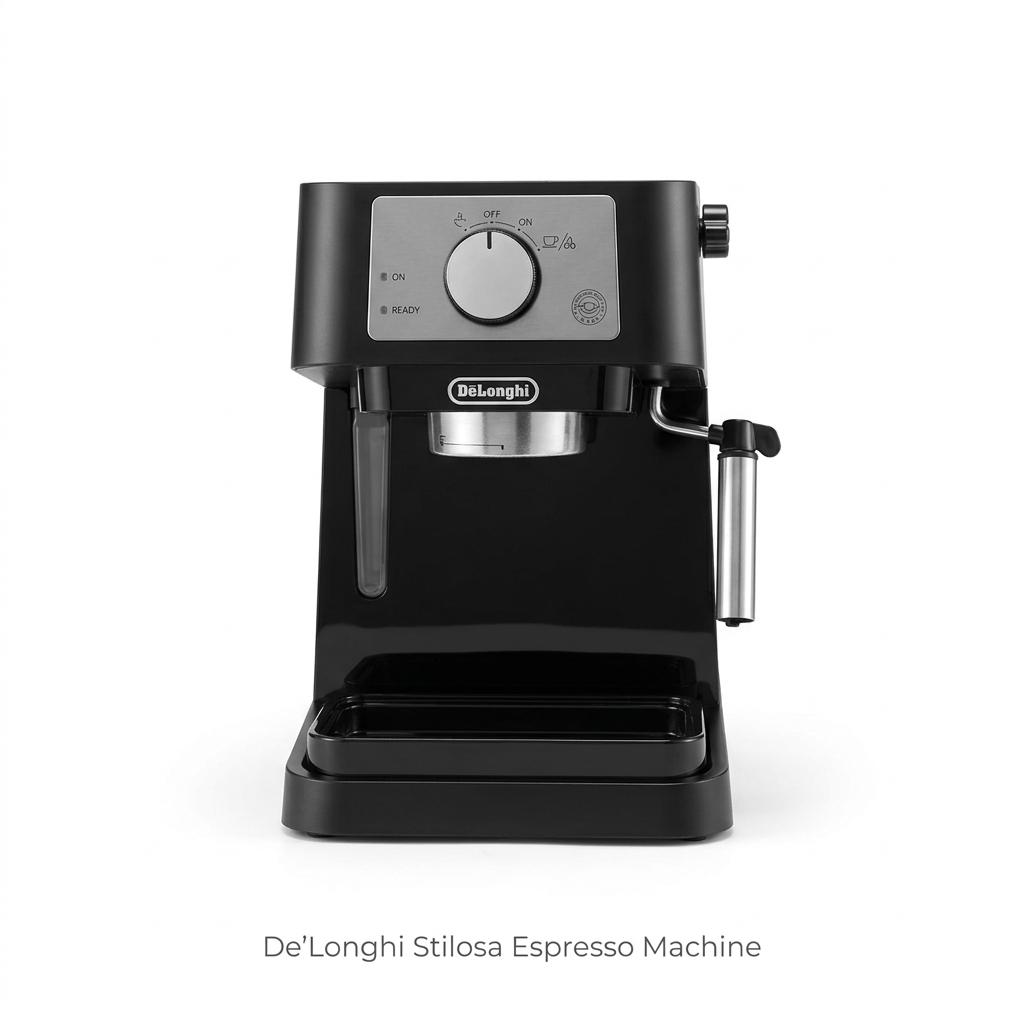
A small stainless steel boiler connected to the group, a manual knob with no solenoid valve, a Panarello-style steam wand and pressurized baskets you can depressurize.
See Today’s PriceDe'Longhi Classic vs Stilosa at a glance
- The Classic makes the better espresso from pre-ground coffee.
- The Stilosa makes the better espresso once you add a burr grinder.
- The Stilosa steams stronger; the Classic has the bigger tank and a gauge.
- The Classic stops shots for you; the Stilosa is fully manual.
Head to head
I scored both machines across the same twelve rows, using the notes Alex and I kept during the four weeks with each.
The De'Longhi Stilosa wins more rows, but look at which ones: most of its wins depend on a burr grinder and a depressurized basket. The De'Longhi Classic wins the rows that matter if you use pre-ground coffee and want things simple.
| Spec | Classic | Stilosa |
|---|---|---|
| Heating | Thermoblock | Stainless steel boiler ✓ Best |
| Espresso, stock and pre-ground | 7.0 ✓ Best | 6.2 |
| Espresso, upgraded | 8.2 | 8.6 ✓ Best |
| Cappuccino foam, sleeve on | 6.2 | 7.8 ✓ Best |
| Water tank | About 57 oz ✓ Best | About 34 oz |
| Pressure gauge | Yes, front ✓ Best | No |
| Shot control | Programmable buttons | Manual knob |
| Bloom or pause | No | Yes, pump pause ✓ Best |
| Upgrade path | 51 mm bottomless portafilters | Depressurize, better baskets |
| Ease of use | 8.0 ✓ Best | 6.8 |
| Cleaning | 7.4 | 7.8 ✓ Best |
| Overall score | 7.5 | 7.8 ✓ Best |
| Rows won | 4 | 6 |
The 0.3-point gap in overall score is smaller than it looks. The Stilosa's higher score comes from its espresso ceiling and steam, while the Classic loses points mainly for its light portafilter and stiff stock foam.
If you never plan to buy a grinder, the Stilosa's best rows simply don't apply to you. In that case the Classic is the stronger machine in daily use.
Reveal Today’s DealPros and cons
De'Longhi Classic
- Hot, balanced shots from pre-ground coffee
- Big 57 oz tank and a working gauge
- Fits common 51 mm upgrade portafilters
- Light portafilter; the machine slides when locking in
- Stiff Panarello foam until you remove the sleeve
- Short wait to switch from brewing to steam
De'Longhi Stilosa
- Stainless steel boiler connected to the group
- Best espresso of the two with a grinder
- No solenoid valve, so you can bloom shots
- Plastic-heavy portafilter and basic tamper
- Small boiler cools during a long shot
- Fully manual, with a real learning curve
Who should buy which machine?
- Pre-ground coffee drinkers
- Cappuccino and latte macchiato fans
- Pod upgraders who want shots that stop by themselves
- Learners who own or will buy a burr grinder
- Tinkerers who enjoy recipes and tricks
- Anyone who drinks both light and dark roasts
How they differ
On paper these two look like close cousins: both are compact De'Longhi espresso machines with a 15-bar pump, pressurized baskets, a Panarello-style wand and a plastic scoop-tamper in the box. Inside, they are built on very different ideas.
The De'Longhi Classic heats water on demand with a thermoblock✕ThermoblockA small metal block with water channels and a heating element. It heats water as it passes through, so it warms up fast but has little stored heat.. It's quick, consistent and needs almost no thought, and it uses the same block for brewing and steaming.
The De'Longhi Stilosa keeps a small stainless steel boiler bolted to the group head. That keeps the group warm and gives the steam wand more push, but the boiler holds only a little hot water, so the temperature falls as a shot goes on.
| Classic | Stilosa | |
|---|---|---|
| Heater | Thermoblock, 1,350 W | Small stainless steel boiler |
| Shot control | One-cup and two-cup buttons that stop by themselves | Rotary knob you start and stop yourself |
| Solenoid valve | Not listed; the shot stops automatically | None, so you can pause and bloom |
| Portafilter | 51 mm, angled tabs | Basic, plastic insert |
| Baskets | Pressurized | Pressurized, can be depressurized |
| Gauge | Yes | No |
| Steam wand | Panarello, removable sleeve | Panarello-style sleeve, stronger steam |
That split explains almost everything else in this comparison. The Classic is easier because the machine makes more decisions for you.
The Stilosa is harder because you make the decisions, and that is also why it can make better espresso in the right hands. Neither approach is wrong; they suit different people.
Design and counter space
The De'Longhi Classic looks the more expensive of the two. Its matte black metal wrap hides fingerprints, and the round pressure gauge on the front gives it a small café-machine look that visitors noticed straight away.
The De'Longhi Stilosa is plainer, with simple styling, plastic knobs and a ready light. It looks like a budget machine, and it doesn't pretend otherwise.
Both fit under standard wall cabinets. The Classic's tank lifts out of the back and needs a little headroom, and the Stilosa's tank also sits at the rear, so plan for some room behind either machine.
Water tank size, approximate
Larger tank means fewer refills. We refilled the Classic about twice a week and the Stilosa every other day.
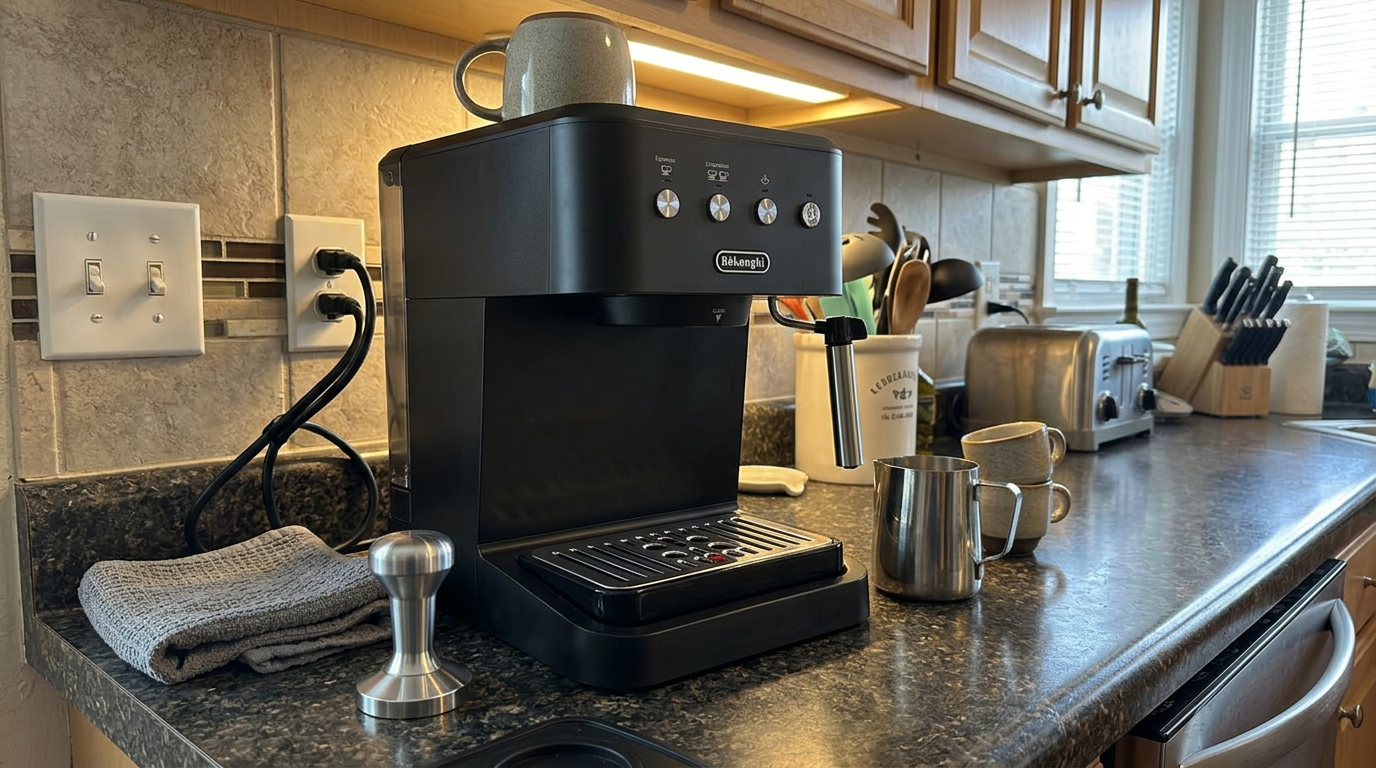
The Classic with a mug warming on top. The matte finish stayed fingerprint-free for the whole test.
Our tip: Leave a hand-width of space behind either machine, because both tanks come out from the back.
Setup
Setup took about ten minutes on each. We rinsed the parts, filled the tanks with filtered water and flushed water through the group and the wand.
The Stilosa needs one extra step: priming the boiler by running the pump until water flows steadily, which pushes out the air. Its first two shots tasted a little papery until the machine settled; the Classic's first shot was good straight away.
| Step | Classic | Stilosa |
|---|---|---|
| Wash parts | Portafilter, baskets, tank | Portafilter, baskets, tank, tray |
| Prime | Flush the group, open the wand briefly | Run the pump until the boiler fills |
| Heat up | Wait for the buttons to go steady | Wait for the ready light, a few minutes |
| First good shot | Shot one | Shot three |
| Total time | About 10 minutes | About 10 to 12 minutes |
Controls and daily routine
The De'Longhi Classic works like a pod machine with a portafilter. You dose, tamp, lock in and press one-cup or two-cup, and the machine stops the shot for you.
Both buttons can be reprogrammed, so once we had found a shot length we liked, every morning came out the same. Alex used it half asleep without a single ruined shot.
The De'Longhi Stilosa has a power switch, a ready light, a rotary knob for coffee or steam and a toggle for the wand. You start the pump and you stop it, usually by watching the shot weight on a scale.
| Task | Classic | Stilosa |
|---|---|---|
| Start a shot | Press a button | Turn the knob |
| Stop a shot | Automatic | You turn it off |
| Program shot length | Yes, both buttons | No |
| Bloom the shot | No | Pause the pump |
| Hands-on time, espresso | About 2 minutes | About 2.5 to 4.5 minutes |
Manual control sounds like more work, and it is. But it's also what lets the Stilosa do the bloom and temperature tricks covered below.
Our tip: Reprogram the Classic’s two-cup button to a slightly shorter shot for a richer double.
Is It On Sale? Check NowBaskets and pre-ground coffee
Both machines ship with pressurized baskets✕Pressurized basketA filter basket with a single tiny exit hole. It builds pressure on its own, so even uneven or pre-ground coffee gives a foamy, drinkable shot.. They are built for pre-ground coffee and make a foamy layer that looks like crema even when the coffee underneath is ordinary.
This is where the De'Longhi Classic pulled ahead in the first two weeks. With a medium-roast supermarket espresso at about 14 grams, it made hot, balanced, chocolatey shots every morning, as long as we ground slightly coarser than normal.
The De'Longhi Stilosa's stock baskets made foamy, simple shots that tasted flatter. The difference is the design: the Stilosa's real strength is the basket you get after removing the pressurizing parts.
| Coffee | Classic, stock basket | Stilosa, stock basket |
|---|---|---|
| Supermarket pre-ground espresso | Good, reliable | Okay, foamy |
| Fresh beans, coarse-ish grind | Good | Okay |
| Fresh beans, fine espresso grind | Chokes the basket | Chokes the basket |
| Very dark oily roast | Bitter, smoky | Bitter, flat |
Depressurizing the Stilosa basket means loosening a small retainer underneath and removing the plastic insert, spring and screen piece. It took Alex about five minutes over a towel the first time.
The Classic's baskets can't be depressurized the same way, but its common 51 mm fitting means a cheap third-party single-wall basket and portafilter do the same job.
Espresso flavor
We tasted both machines side by side with the same coffees and the same doses at each stage of the test. Out of the box, the Classic was clearly better; after the upgrades, the Stilosa was.
Stock, the Classic's shots were hot and balanced with a soft nougat sweetness. Upgraded with a bottomless portafilter and fresh beans, they gained a natural crema, gentle spice and a sweet almond note.
The Stilosa started foamy and a little flat. With a depressurized basket, a burr grinder, a metal tamper, a puck screen and a better basket, it made the richest, clearest espresso of the test, with real body and a long finish.
Espresso quality by setup, my ratings out of 10
Same coffees and doses at each stage, tasted side by side.
The middle rows matter. A Stilosa with only a depressurized basket and a grinder scored 7.6, below the upgraded Classic at 8.2; it took the extra accessories to push it to 8.6.
So the Stilosa has the higher ceiling, but you have to climb to reach it. The Classic gets most people most of the way with less effort.
See How Much You’ll SaveTemperature and the bloom trick
Neither machine has precise electronic temperature control. The Classic's thermoblock simply delivers the same temperature every time, which is part of why its shots were so consistent.
The Stilosa's small boiler cools as you brew, because hot water leaves and cooler water comes in. At the start of a flush we read the low 200s Fahrenheit at the group, falling noticeably by the end.
That sounds like a weakness, but it gives you a simple temperature dial. Flush until the ready light goes off for cooler water that suits dark roasts, or blip the steam switch for a few seconds for hotter water that suits light roasts.
Stilosa bloom test, my ratings out of 10
Same coffee, grind and dose; light-medium roast.
The Classic can't do this, because its buttons run each shot from start to finish. For most of the cappuccino drinkers it suits, that's no loss at all.
The pressure gauge
Only the De'Longhi Classic has a gauge, and it is rare on a compact De'Longhi. The dial has no numbers, but the middle of the scale roughly marks the zone you want during a shot.
With the stock pressurized baskets, the needle rose into the middle on almost every shot, even during a blank flush with an empty basket. The basket's exit hole creates that pressure, so the gauge looks reassuring without telling you much.
Once we fitted a single-wall basket, the needle began to reflect our grind and dose, and it became a genuinely useful guide. The De'Longhi Stilosa has no gauge, so on that machine we judged shots by time, weight and taste alone.
| Needle with a single-wall basket | What it means | What to change |
|---|---|---|
| Barely moves | Grind too coarse | Grind finer |
| Steady in the middle | Good resistance | Keep it |
| Pinned high, slow drips | Grind too fine | Go coarser |
| Rises, then drops fast | Channeling | Distribute and tamp level |
Upgrade paths
Both machines are best treated as platforms that grow with you, but they grow in different directions.
The De'Longhi Classic uses the common angled-tab 51 mm fitting, so a third-party bottomless portafilter✕Bottomless portafilterA portafilter with the bottom cut away so you can see the coffee flow from the basket. It shows channeling straight away and usually pairs with a single-wall basket. locked straight in. With a single-wall basket, fresh beans and a WDT tool, it went from 7.0 to 8.2 in our ratings.
The De'Longhi Stilosa upgrades in smaller steps: depressurize the basket, add a burr grinder, then a metal tamper, a puck screen, a quality basket and a scale. We added one at a time and tasted after each.
Stilosa shot quality as we upgraded, out of 10
Same coffee across the test.
| Upgrade | Classic | Stilosa |
|---|---|---|
| Burr grinder | Needed for single-wall baskets | Essential |
| Single-wall basket | Third-party 51 mm | Depressurize the stock one, or buy one |
| Bottomless portafilter | Locks straight in | Check the fit first |
| Metal tamper | Helps | Helps |
| Puck screen | Optional | Spreads water from the small shower screen |
The Classic's upgrade is a single, bigger jump; the Stilosa's is a ladder. If you enjoy tinkering, the ladder is half the fun.
Find Out the Price TodaySteaming milk
Both machines use a Panarello✕Panarello wandA steam wand with a sleeve that has small air holes. It pulls air into the milk automatically, making thick foam with no technique.-style sleeve, and both make cappuccino foam with almost no skill. The difference is steam power.
The De'Longhi Stilosa's boiler gave noticeably stronger, drier steam. Its cappuccino foam was creamy, and it heated a jug of milk faster than the Classic did.
The De'Longhi Classic's Panarello made stiff, bubbly foam with the sleeve on. Pull the sleeve off, zip-tie the rubber nozzle and it becomes a manual tip that made glossy microfoam; by week four Alex was pouring simple hearts.
Milk texture, my ratings out of 10
Whole milk unless noted.
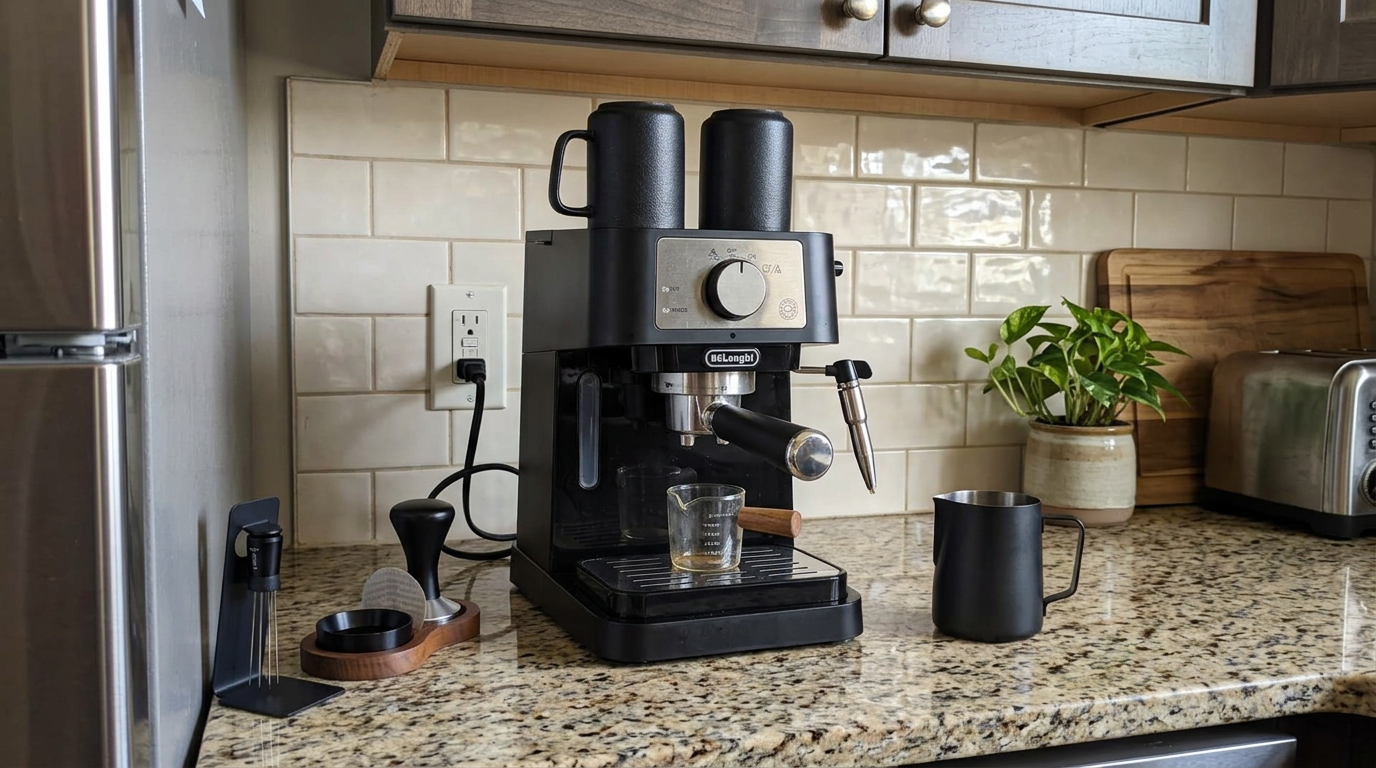
A Stilosa cappuccino. The boiler’s stronger steam made creamy foam with the sleeve on.
Our tip: If you remove the Classic’s Panarello sleeve, zip-tie the rubber nozzle before your first steam.
Switching from brew to steam
Neither machine can brew and steam at the same time, so for milk drinks you brew first, then switch.
On the De'Longhi Classic, the thermoblock took about 30 seconds to reach steam temperature, and roughly the same to cool back for the next shot. Two lattes back to back took about nine minutes from switching on.
The De'Longhi Stilosa took about a minute to heat above brewing temperature for steam. Going back to brewing needs a flush, or the next shot comes out scalded and bitter.
Two lattes back to back, from switch-on
Our average across several mornings, including the Stilosa’s longer first heat-up.
For one or two milk drinks a day, neither delay matters. For four cappuccinos in a row, brew every shot first, then steam the milk in batches.
Hot water and Americanos
The De'Longhi Classic sends hot water through the wand in brew mode, using the side knob. We made an Americano most afternoons, adding about five ounces to a double, and its stock shots tasted smoother that way.
The De'Longhi Stilosa has no separate hot-water mode in the same way; we drew water through the group or heated it separately. For Americanos and tea, the Classic was simply more convenient.
| Drink | Classic | Stilosa |
|---|---|---|
| Americano | Hot water from the wand | Brew, then add kettle water |
| Long black | Water first, shot on top | Same, with kettle water |
| Tea | Straight from the wand | Kettle |
| Cup warming | Splash from the wand, or warm on top | Blank shot through the group |
Coffee to use
Roast level mattered on both, but in different ways. On the Classic with stock baskets, medium and medium-dark blends tasted best; very dark oily beans turned smoky.
On an upgraded Stilosa, you can match the recipe to the roast. Dark roasts liked cooler water and a classic brew ratio✕Brew ratioThe weight of espresso in the cup compared with the dry coffee in the basket. 1:2 means 18 g of coffee makes 36 g of espresso. of about 1:2, while a light roast at 18 grams in and 54 grams out tasted bright and juicy.
| Roast | Classic, stock basket | Stilosa, upgraded |
|---|---|---|
| Light | Thin, a little sour | Bright at 1:3, hot water trick |
| Medium | Chocolate and nougat | Sweet and balanced at about 1:2.2 |
| Medium-dark | Bold, smooth | Rich at about 1:2 |
| Dark, oily | Smoky, bitter | Fine with the cooler flush trick |
Our tip: Buy pre-ground coffee in small bags and finish each within two weeks for the best stock-basket shots.
Cleaning and care
Daily cleaning is similar: knock out the puck, rinse the basket, wipe and purge the wand and empty the drip tray. The Panarello sleeves on both collect milk, so we rinsed them after every milk drink.
The Classic's descaling is unusually clear, with A and B lines molded into the tank for descaler and water. The Stilosa's boiler needs descaling every one to three months depending on your water, and its simple layout makes it easier to maintain over the years.
| When | Classic | Stilosa |
|---|---|---|
| After every shot | Knock out, rinse basket | Knock out, rinse basket and puck screen |
| After milk | Rinse sleeve, purge wand | Rinse sleeve, purge wand |
| Daily | Empty drip tray | Empty drip tray |
| Weekly | Brush gasket, clear basket hole | Soak basket and portafilter |
| Every few months | Descale with A and B lines | Descale the boiler |
Hands-on cleaning time per day, our estimate
Build and reliability
Both machines save money in the same place: the portafilter. The Classic's is thin aluminum and plastic, and the whole machine is light enough to slide when you twist it in.
The Stilosa's portafilter has a plastic insert and feels similarly basic. Its strength is underneath, where the stainless boiler, vibration pump and steam valve are standard, durable parts.
Neither leaked or failed in four weeks of daily use. The Stilosa lost prime once with an airlock, which running the pump with the steam valve open fixed in a minute.
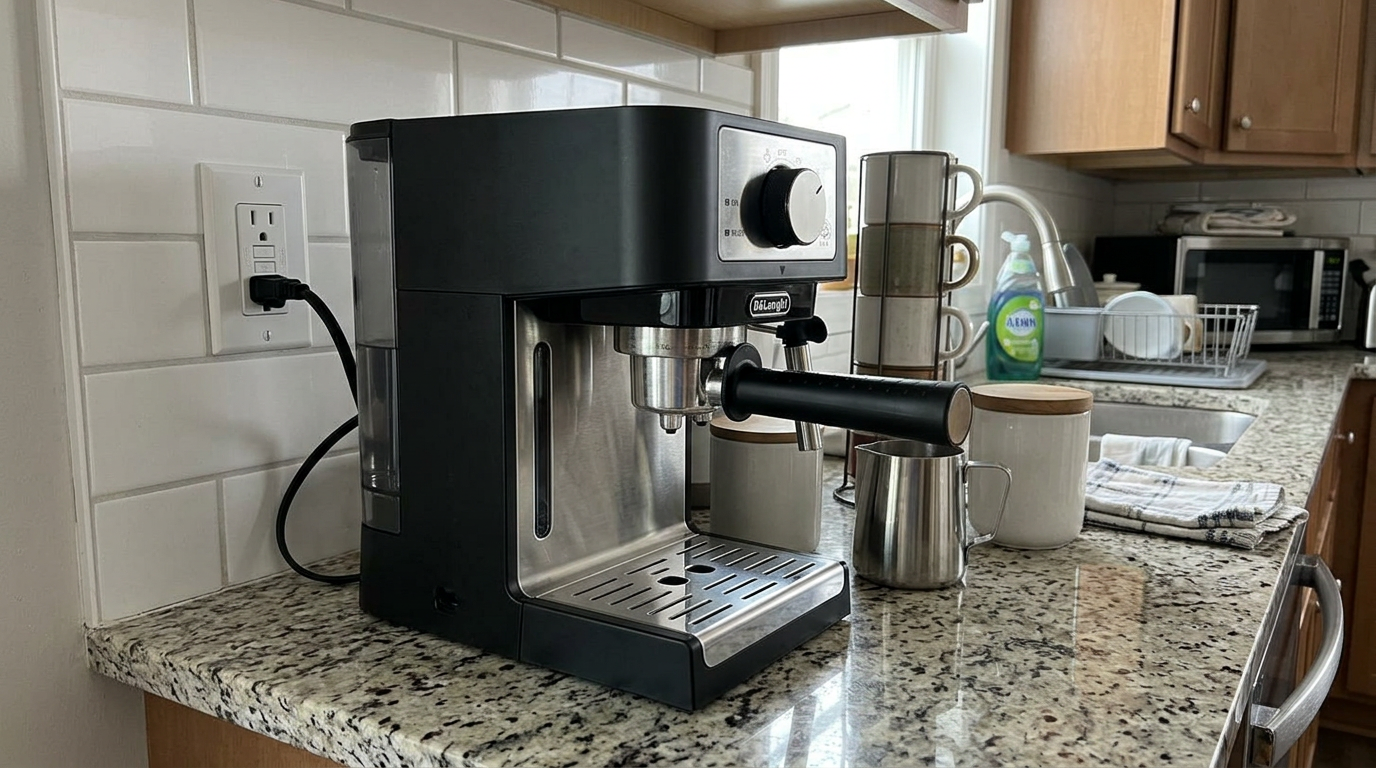
An upgraded Stilosa shot with a depressurized basket and fresh beans.
What about the Classic Signature?
Shopping for the Classic, you'll also see the De'Longhi Classic Signature. It's the same idea in a more traditional outfit, with a metal front, a central gauge, top buttons and a flat cup warmer.
Inside, it's closer to De'Longhi's slim compacts, and it uses its own proprietary portafilter rather than the Classic's common 51 mm fitting. That matters: the matte black Classic takes cheap bottomless portafilters, while the Signature relies on a third-party single-wall basket for its upgrade.
| Classic (matte black) | Classic Signature | |
|---|---|---|
| Look | Modern, front gauge | Traditional, central gauge |
| Portafilter | Common 51 mm | Proprietary, plastic-heavy |
| Heat-up | Quick | About 15 seconds |
| Upgrade path | Bottomless portafilter | Third-party single-wall basket |
| Our score | 7.5 | 7.3 |
If you love the classic café look, the Classic Signature makes the same easy cappuccinos and heats up in about 15 seconds. For most people, though, the matte black Classic is the better buy, because its fitting leaves more room to grow.
Small details that matter
The De'Longhi Classic is light, at about nine pounds, and it twisted on the counter every time we locked in the portafilter. Resting a hand on top fixed it, and after a few days it became automatic.
Its drip tray insert lifts out for taller glasses, and the top plate keeps cups warm while the machine is on. The front buttons are lit, so you can see at a glance when it's ready.
The De'Longhi Stilosa has a little storage spot for the spare basket, which we used for the single. Coffee drips briefly after you stop a shot, a side effect of having no solenoid valve.
Its small shower screen spread water less evenly than we liked, which is why a puck screen made such a difference. On the Classic, wiping grounds off the basket rim was the one habit that prevented leaks.
Our tip: Run a blank shot through the Classic into your cup before the first coffee to warm both.
Who should skip each
Skip the De'Longhi Classic if you want café-level espresso with no add-ons, or latte-art milk without removing the sleeve and zip-tying the nozzle. Skip it too if a light, slightly hollow portafilter will bother you every morning.
Skip the De'Longhi Stilosa if you won't buy a burr grinder. Without one, you're stuck with its pressurized shots, which were the weakest of the test.
Skip it as well if you want buttons that stop the shot for you, or if the idea of flushing, blooming and weighing shots sounds like a chore. It rewards curiosity, and it frustrates people who just want coffee.
Mistakes to avoid
Most problems we hit on both machines came from habits, not hardware.
The biggest one on the Classic was grinding fine for the stock basket, which choked the shot. On the Stilosa, it was judging the whole machine on its stock pressurized shots.
| Mistake | Machine | Better habit |
|---|---|---|
| Grinding fine for the stock basket | Both | Go slightly coarser |
| Overfilling the basket | Classic | About 14 g maximum |
| Trusting the gauge with stock baskets | Classic | Judge by taste and flow |
| Removing the sleeve without a zip tie | Classic | Zip-tie the nozzle first |
| Brewing straight after steaming | Stilosa | Flush first |
| Using a blade grinder | Stilosa | Use a burr grinder |
| Losing basket parts | Stilosa | Depressurize over a towel |
A typical morning on each
On the Classic, a morning cappuccino took about four and a half minutes from a cold start. On a fully upgraded Stilosa, it took about six, mostly because of weighing and the bloom.
| Step | Classic | Stilosa |
|---|---|---|
| Switch on | Ready quickly | A few minutes to the ready light |
| Prep | Dose 14 g, tap, tamp | Grind, dose, distribute, tamp, puck screen |
| Brew | Press two-cup | Bloom, then brew to weight |
| Steam | Wait about 30 s, foam | Wait about 1 min, foam |
| Clean | Knock out, rinse sleeve | Knock out, rinse screen and sleeve |
| Total | About 4.5 min | About 6 min |
Our tip: On the Stilosa, make your espresso first and steam second, because going back to brewing needs a flush.
Four weeks with each: our notes
Michael Reynolds here. Alex and I shared each machine for four weeks and wrote our notes together, usually three or four drinks a day between us.
De'Longhi Classic
Week one was stock: pre-ground medium roast, pressurized baskets and the sleeve on. Every drink was easy and good once we learned to grind coarser rather than finer.
In week two we fitted a bottomless portafilter and single-wall basket, and the gauge suddenly became useful. Our first upgraded shots were uneven until we started using a WDT tool.
Week three was about milk: sleeve off, nozzle zip-tied, microfoam practice. In week four we went back and forth between the stock and upgraded setups and found ourselves using the stock basket on busy mornings and the upgrade at weekends.
By the end, the Classic felt like a machine we could hand to anyone in the house.
De'Longhi Stilosa
Week one with pressurized baskets was basic but okay, and the steam wand was the pleasant surprise. Week two, with a depressurized basket and a burr grinder, was a big jump.
In week three we added a metal tamper, puck screen and better basket and learned the flush, steam and bloom tricks. Week four was recipes: 1:2 for dark roasts, 1:3 for a washed Kenyan that tasted like fruit juice with a chocolate finish.
By the end, the Stilosa was making espresso we'd happily serve to friends, but only one of us could make it reliably.
Real-life scenarios
Here's how we'd match each machine to a few common households.
Buttons stop the shot, pre-ground works and the routine is nearly as quick as a capsule machine.
The boiler, bloom and temperature tricks reward practice more than anything else at this level.
The big tank and foolproof Panarello mean anyone can make their own drink.
The hot-water trick and a 1:3 ratio brought out bright, fruity flavors.
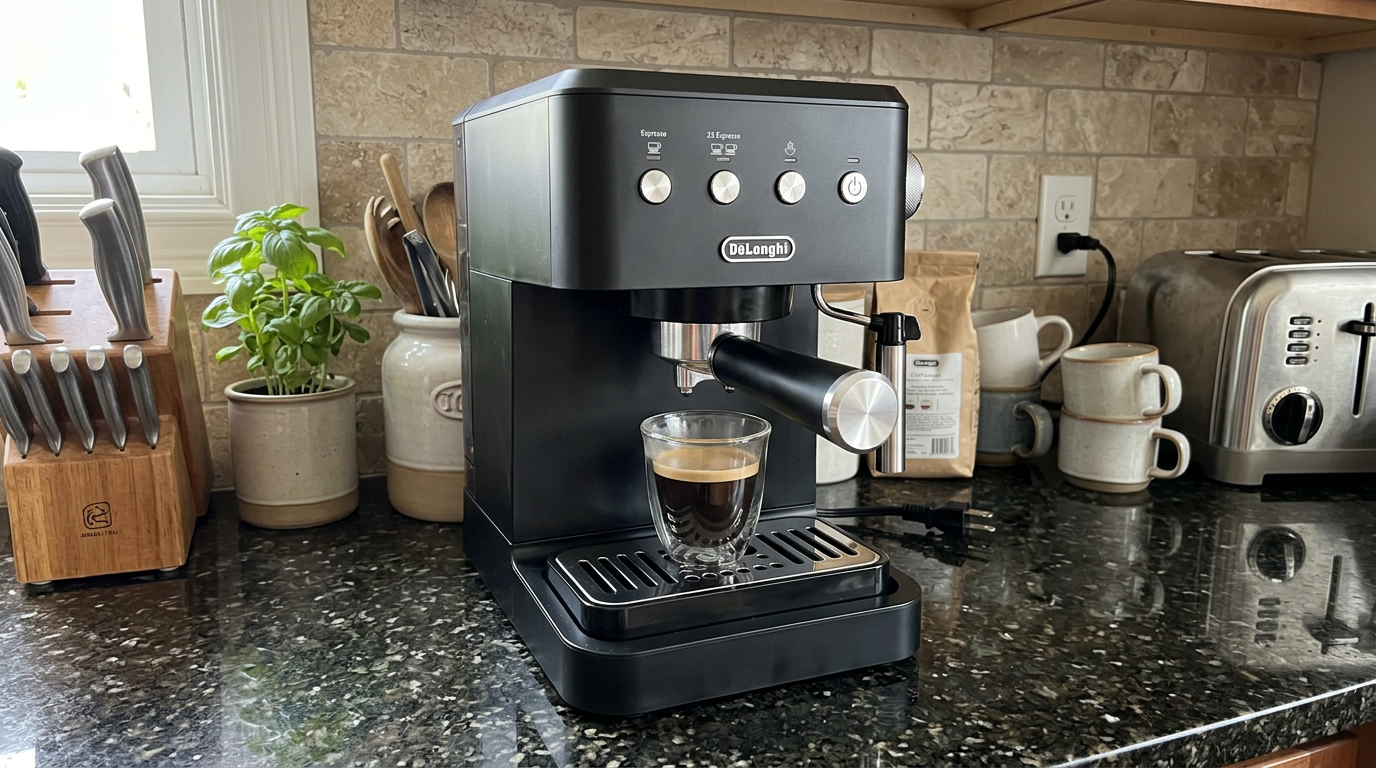
A stock-basket shot on the Classic, ready in about two minutes.
My scorecard
These are my scores out of 10 from the single reviews, updated after the full four weeks.
De'Longhi Classic
De'Longhi Stilosa
The De'Longhi Stilosa scores 7.8 overall on the strength of its espresso and easy care; the De'Longhi Classic scores 7.5, with ease of use doing most of the work.
Check price on AmazonWhich one is right for you?
4 quick questionsWhich one should you buy?
For most households, I'd buy the De'Longhi Classic. It makes the better coffee from pre-ground beans, stops each shot for you, holds a huge tank of water and has a fitting that takes cheap upgrades when you're ready.
Buy the De'Longhi Stilosa if a burr grinder is already on your counter or in your basket. Its boiler, stronger steam and bloom trick made the best espresso of this comparison.
If you're torn, ask yourself one question: will you weigh your shots? If yes, the Stilosa; if not, the Classic.
- You use pre-ground coffee
- You want shots that stop by themselves
- You like a big tank and a gauge
- You want silky milk without modding the wand
- A light portafilter will annoy you
- You own or will buy a burr grinder
- You enjoy recipes and tricks
- You want stronger steam
- You want one-touch drinks
- You won’t buy any upgrades
Our pick for most households is the De'Longhi Classic. It makes hot, balanced espresso from pre-ground coffee, foams milk with no skill, holds 57 ounces of water and takes cheap 51 mm upgrades later.
Choose the De'Longhi Stilosa if you own a burr grinder and enjoy learning. With a depressurized basket and a few accessories, it made the best espresso and the strongest steam of the two.
Whichever you choose, grind a little coarser than you think for the stock baskets and finish each bag of coffee within two weeks.
De'Longhi Classic vs Stilosa specifications
From manufacturer specifications and our own testing.
| De'Longhi Classic (EM450) | De'Longhi Stilosa | |
|---|---|---|
| Type | Semi-automatic espresso machine | Manual espresso machine |
| Heating | Thermoblock, 1,350 W | Stainless steel boiler |
| Pump | 15 bar | Vibration pump, up to 15 bar |
| Portafilter | 51 mm, angled tabs | Basic, plastic insert |
| Baskets | Pressurized | Pressurized, can be depressurized |
| Shot control | Programmable one-cup and two-cup | Manual rotary knob |
| Solenoid valve | Not listed | None |
| Pressure gauge | Yes, front | No |
| Steam wand | Panarello, removable sleeve | Panarello-style sleeve |
| Hot water | Yes, from the wand | No dedicated mode |
| Water tank | About 57 oz, with descaling lines | About 34 oz, rear |
| Dimensions | About 8.9 × 11.1 × 12 in | Compact |
| Weight | About 9 lb | Light |
| Our score | 7.5 | 7.8 |
How we tested and compared them
Michael Reynolds here. Alex van Gog and I used each machine as our everyday espresso maker for four weeks, making espresso, cappuccinos, lattes, latte macchiatos and Americanos, and we kept shared notes throughout.
We started each machine stock with pre-ground coffee, then upgraded step by step: a bottomless portafilter and single-wall basket on the Classic, a depressurized basket, burr grinder, tamper, puck screen and scale on the Stilosa. We tasted both side by side with the same coffees, doses and ratios.
- Espresso: stock and upgraded shots, roasts and recipes.
- Milk: foam with and without the sleeve, and switch-over time.
- Workflow: controls, tank, heat-up and daily routine.
- Ownership: cleaning, descaling, build and repairability.
You can read more about our process on our how we test page.
De'Longhi Classic vs Stilosa FAQ
Which is better, the De'Longhi Classic or the Stilosa?
For pre-ground coffee and easy cappuccinos, the Classic. With a burr grinder and some technique, the Stilosa makes the better espresso.
Does the Stilosa have a boiler?
Yes. It has a small stainless steel boiler connected to the group head. The Classic uses a thermoblock.
Can I use pre-ground coffee in both?
Yes. Both come with pressurized baskets that work well with pre-ground coffee. The Classic made the better shots that way in our testing.
Which one has a pressure gauge?
Only the Classic. It becomes most useful once you fit a single-wall basket.
Can I use a bottomless portafilter?
On the Classic, yes: a third-party 51 mm bottomless portafilter locked straight in. On the Stilosa, check the fit before you buy.
How do I depressurize the Stilosa basket?
Loosen the small retainer under the basket, remove the plastic insert, spring and screen piece, and reassemble without them.
Which steams milk better?
The Stilosa has stronger steam and better foam with the sleeve on. With the sleeve removed and the nozzle zip-tied, the Classic made silky latte-art milk.
Can either machine make latte art?
Yes, with practice. The Classic needs the Panarello sleeve removed; the Stilosa's steam is strong enough with careful technique.
Which has the bigger water tank?
The Classic, at about 57 ounces. The Stilosa holds about 34 ounces.
Do they stop the shot automatically?
The Classic does, with programmable one-cup and two-cup buttons. The Stilosa is manual: you start and stop the pump.
What is the bloom trick on the Stilosa?
Run the pump for a few seconds, pause for about 10 seconds, then finish the shot. It made sweeter shots with light-medium roasts.
What about the De'Longhi Classic Signature?
It has a traditional look with a central gauge and a cup warmer, but uses a proprietary portafilter. The matte black Classic's 51 mm fitting is easier to upgrade.

- Our hands-on De'Longhi Classic review
- Our hands-on De'Longhi Stilosa review
- Our hands-on De'Longhi Classic Signature review
- De'Longhi manufacturer specifications and user manuals