Chefman 4.5L Deep Fryer vs Chefman TurboFry 9 Qt Air Fryer
Air fryer or deep fryer is one of the biggest kitchen questions, and comparing two from the same brand keeps it fair. The Chefman 4.5 Liter Deep Fryer fries in a real oil bath up to 375°F, with a big basket for crowds. The Chefman TurboFry 9 Qt is a large air fryer that reaches 450°F and crisps food with hot air and a teaspoon of oil. I used each for four weeks of family dinners, snacks and a game night to find out which one deserves your counter.
We choose products independently. We may earn a commission when you buy through our links. Affiliate policy
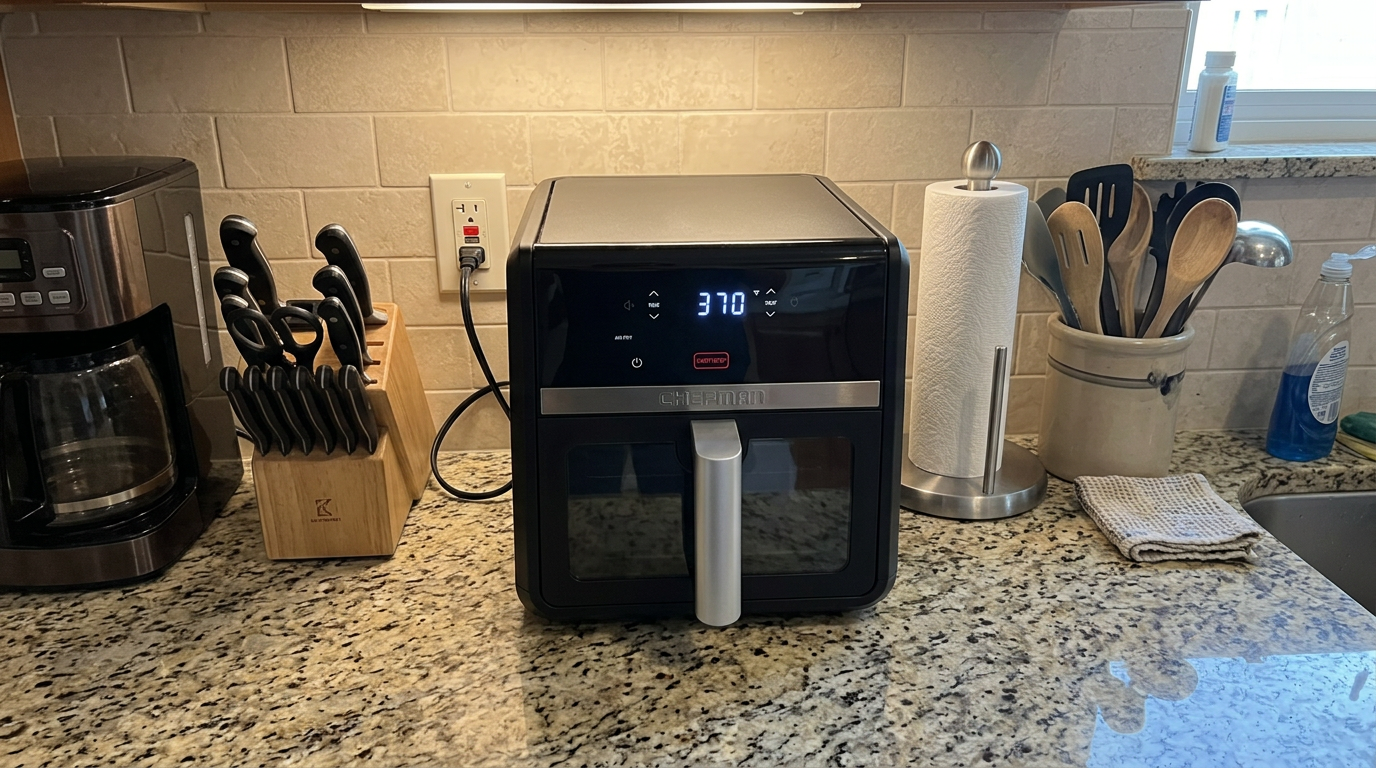
Jargon helpNew to deep or air frying? Tap any dotted term to see what it means.
In this comparison
For most households, buy the Chefman TurboFry 9 Qt. It made crackly chicken skin, crisp frozen snacks with no preheat and dinner for five in one basket, with a two-minute cleanup and no pot of oil. Buy the Chefman 4.5 Liter Deep Fryer if you love beer-battered fish, onion rings and classic double-fried fries, cook for crowds and have good ventilation; nothing beats real oil for batter.
The two fryers
Specs checked November 26, 2026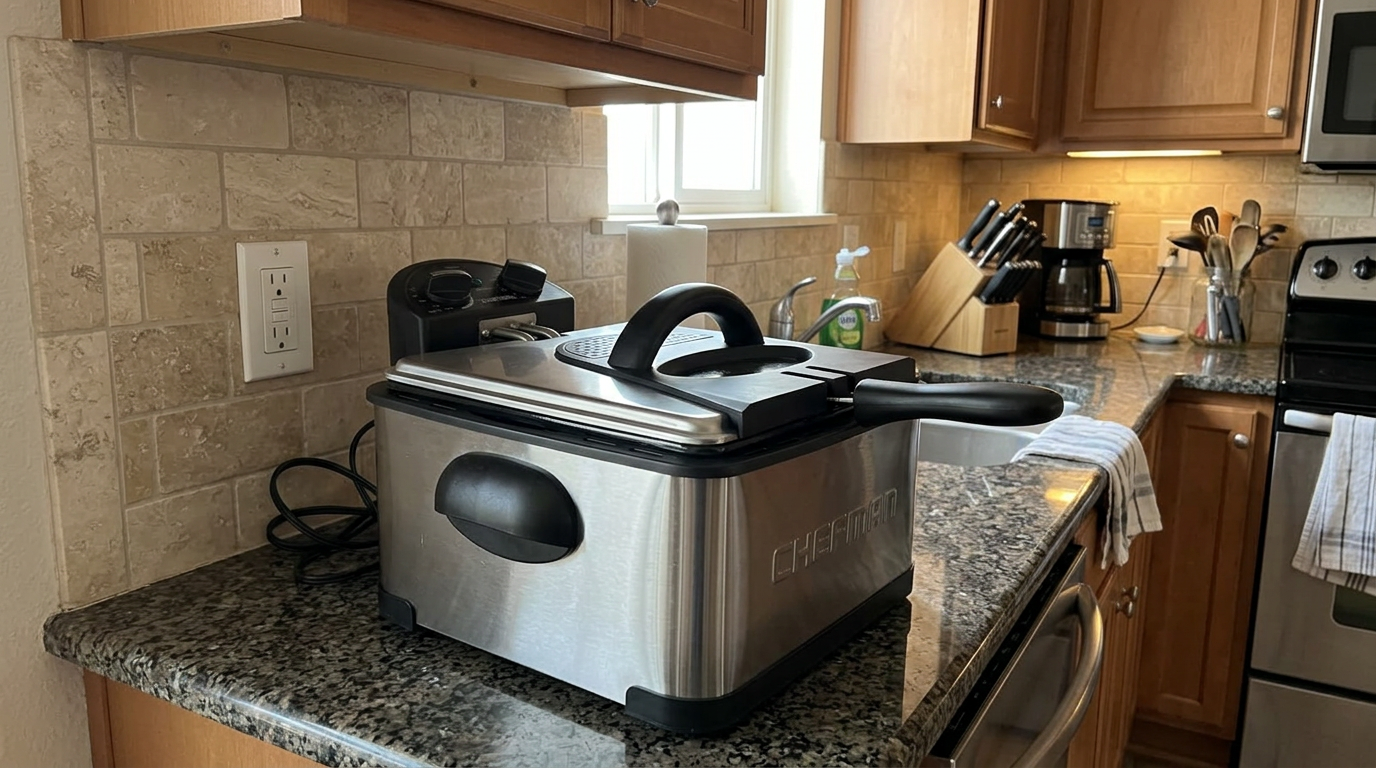
Big stainless deep fryer with a 4.5-liter oil tank, a thermostat to 375°F, a timer shut-off and a magnetic breakaway cord.
Check price on Amazon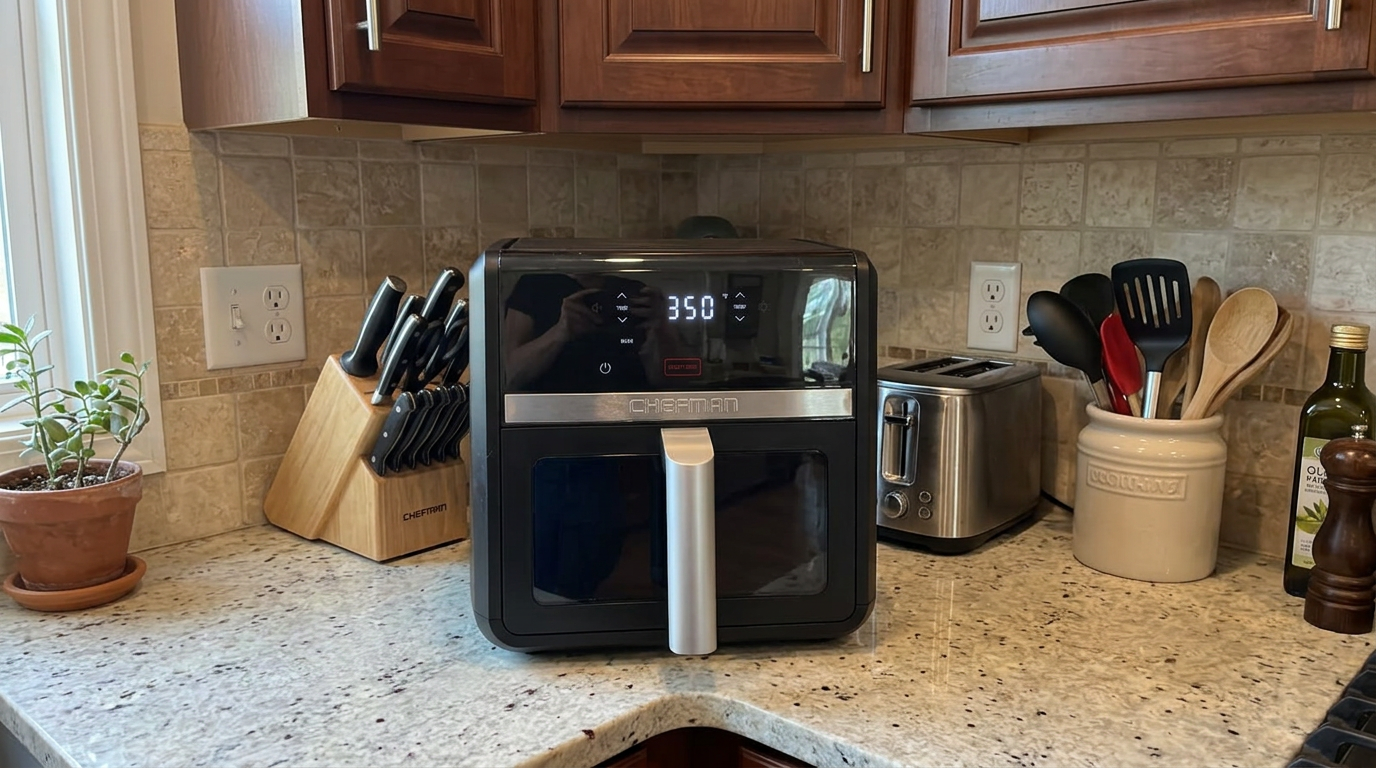
9-quart single-basket air fryer that reaches 450°F, with a Frozen setting, a viewing window and a dishwasher-safe basket.
See Today’s PriceDeep fryer vs TurboFry at a glance
- The deep fryer made the best battered food and classic double-fried fries.
- The TurboFry made crisper chicken skin and better frozen snacks, with no oil bath.
- The TurboFry cleaned up in about two minutes; the deep fryer needed oil straining.
- The deep fryer’s front lid vents and weak filter were its biggest weaknesses.
Head to head
The best result in each row is marked, based on my four weeks with each fryer and the manufacturer specs.
The TurboFry wins on everyday convenience, cleanup and chicken; the deep fryer wins on batter and classic fries.
| Spec | Deep fryer | TurboFry |
|---|---|---|
| Chicken skinmy ratings | Crisp wings, excellent | Crackly, 9.3 ✓ Best |
| Battered food | Excellent ✓ Best | Not designed for wet batter |
| Fresh fries | Double-fried, excellent ✓ Best | Crisp in a single layer |
| Frozen snacks | 3 to 5 min, very good | No preheat, 9.0 ✓ Best |
| Oil used | About 4.5 L | A teaspoon or two ✓ Best |
| Smell | Lingers for hours | Minimal ✓ Best |
| Cleanup | Strain oil, wash tank | About 2 min ✓ Best |
| Capacity | About 1.5 lb fries a batch | Dinner for five ✓ Best |
| Heat-up | About 10 min to 350°F | Frozen: no preheat ✓ Best |
| Reheating | Not suited | Pizza in 4 to 5 min ✓ Best |
| Rows won | 2 | 8 |
Eight rows to the TurboFry and two to the deep fryer. Those two rows matter a lot if battered food is why you want a fryer.
Is It On Sale? Check NowDeep fryer vs TurboFry pros and cons
Chefman 4.5L Deep Fryer
- Big capacity for family-sized batches
- Adjustable thermostat for proper double-frying
- Removable oil tank and magnetic breakaway cord
- Hot steam vents out of the front of the lid
- Charcoal filter does little for smell
- First unit failed; no separate power switch
Chefman TurboFry 9 Qt
- 450°F heat for real crispness
- Big 9-quart basket for family meals
- Frozen setting needs no preheat
- Large and fairly heavy
- Fan hum is noticeable
- Touchscreen sometimes needs a second tap
Who should buy which fryer?
- Beer-battered fish and onion rings
- Double-fried fries and wings for a crowd
- Game nights with good ventilation
- Everyday family dinners
- Frozen snacks without preheating
- Anyone who wants crisp food with little oil
Air fryer vs deep fryer: how they work
The two cook in fundamentally different ways, and that explains almost every result in this comparison.
The Deep fryer is an immersion element✕Immersion elementA heating element that sits right in the oil, so it heats faster than a fryer that warms the tank from underneath. fryer. The heating element sits in 4.5 liters of oil, and a probe next to it tells the thermostat when to switch on and off. Food is surrounded by hot oil, which drives water out of the surface fast and sets batter instantly.
The TurboFry is a convection✕ConvectionCooking with a fan that moves hot air around the food. It is how an air fryer browns and crisps without a bath of oil. oven in basket form. A DC fan pushes air heated up to 450°F around the food. A teaspoon or two of oil tossed through in a bowl is enough to brown it through the Maillard reaction✕Maillard reactionThe browning reaction between proteins and sugars that gives fries, chicken skin and batter their golden color and roasted flavor..
| Inside | Deep fryer | TurboFry |
|---|---|---|
| Method | Oil bath | Hot air |
| Max temperature | 375°F | 450°F |
| Power | 1,700 W | 1,750 W |
| Capacity | 4.5 L oil tank | 9 qt basket |
| Controls | Thermostat dial and timer | Touchscreen, 7 functions |
| Oil per session | Most of a large bottle | 1 to 2 teaspoons |
In practice, oil wins on wet batter and that unmistakable fried texture. Hot air wins on everything around the cooking: oil, smell, cleanup and how often you will actually use it.
Same brand, same family kitchen and four weeks each kept the comparison fair: the differences you read here come from oil versus air, not from one company building a better product than another.
Design and size
The Deep fryer is a big stainless steel box, roughly 15 by 15 inches, with a removable oil tank, a lift-out heating unit and control panel, a wide wire basket and a lid with a viewing window, vents and a charcoal filter. Its outer housing gets very hot during use.
The TurboFry is a big black square with a pull-out basket, a viewing window in the drawer and a touchscreen on top. It is about 15.75 by 11.81 by 11.42 inches and about 11 pounds. Its body gets warm on long hot cooks, so I kept a few inches of clearance.
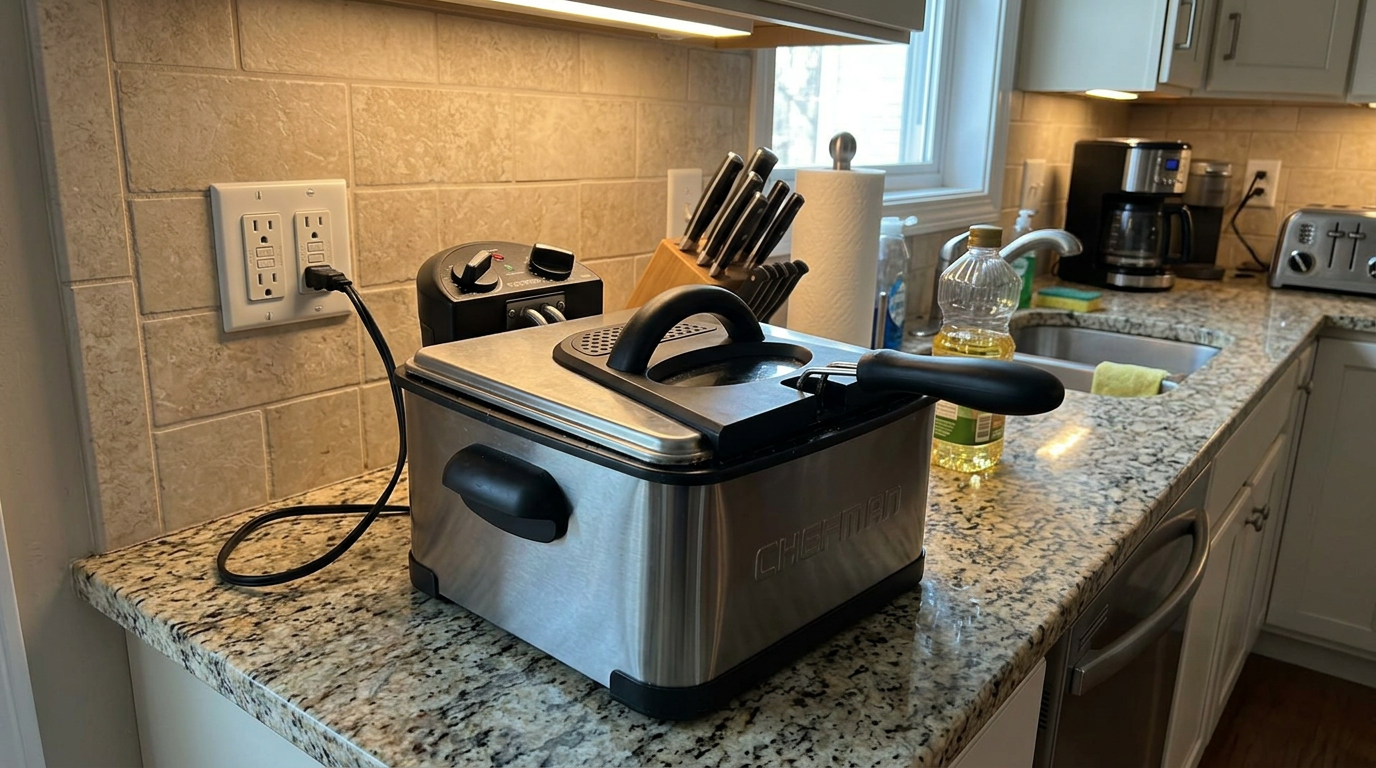
The deep fryer’s lid: the front vents are where the hot steam escapes.
I stored the deep fryer in a cupboard between sessions; its magnetic cord detaches completely, which made that tidier. The TurboFry stayed on the counter, because I used it almost every day.
Setup and the first week
The Deep fryer took five minutes to assemble: wash the basket and tank, slot everything together and fill with oil to the max line, which took most of a large bottle. I need to be upfront: my first unit worked for one session of fries, then would not power on. The replacement worked perfectly for the rest of testing.
The TurboFry needed only a wash of the basket and rack and a permanent spot near its own outlet. My first cooks were frozen fries and nuggets on the Frozen setting, and by the end of week one I was using the 450°F finish on fresh food.
| Setup | Deep fryer | TurboFry |
|---|---|---|
| Time to first cook | 5 min plus oil heat-up | Minutes |
| Supplies | A large bottle of oil | A spoon of oil |
| First cook | Double-fried fries | Frozen fries and nuggets |
| Issues | First unit failed | None |
Our tip: Test any new fryer early, within the return window; it is how I caught the faulty deep fryer.
Controls
The Deep fryer has a thermostat dial to 375°F, a timer and two orange lights. The heating light switches off when the oil is ready, which confused me at first because I expected a green ready light. There is no separate power switch: turning the timer starts the fryer and it shuts off at zero, which is safe but awkward when preheating.
The TurboFry has a touchscreen: pick a function, adjust time and temperature with arrows, press start. A shake reminder sounds partway through. It occasionally needed a second tap, especially with greasy fingers.
| Control | Deep fryer | TurboFry |
|---|---|---|
| Temperature | Dial to 375°F | 90 to 450°F |
| Timer | Yes, shuts off at zero | Yes |
| Presets | None | Air Fry, Frozen, Reheat, Bake, Broil, Dehydrate |
| Reminders | None | Shake reminder |
| Quirk | No power switch | Occasional second tap |
I checked the deep fryer’s dial with a probe thermometer; it was usually within ten degrees once settled.
Check price on AmazonFrench fries
Fries are why most people buy a fryer, and here the Deep fryer earned its place. I soaked cut russets overnight, dried them completely, dusted them with cornstarch, fried them at 340 to 350°F for six to eight minutes, rested them ten minutes and fried again at 375°F. This double-frying✕Double-fryingFrying once at a lower temperature to cook the inside, resting, then frying again hotter to crisp the outside. gave fluffy middles and crisp outsides, better than anything from my oven.
On the TurboFry, fresh fries crisped evenly in a single loose layer with a light coating of oil. Piled a whole bag deep, the top crisped while the bottom stayed soft. Frozen fries on the Frozen setting took about 16 to 18 minutes with no preheat.
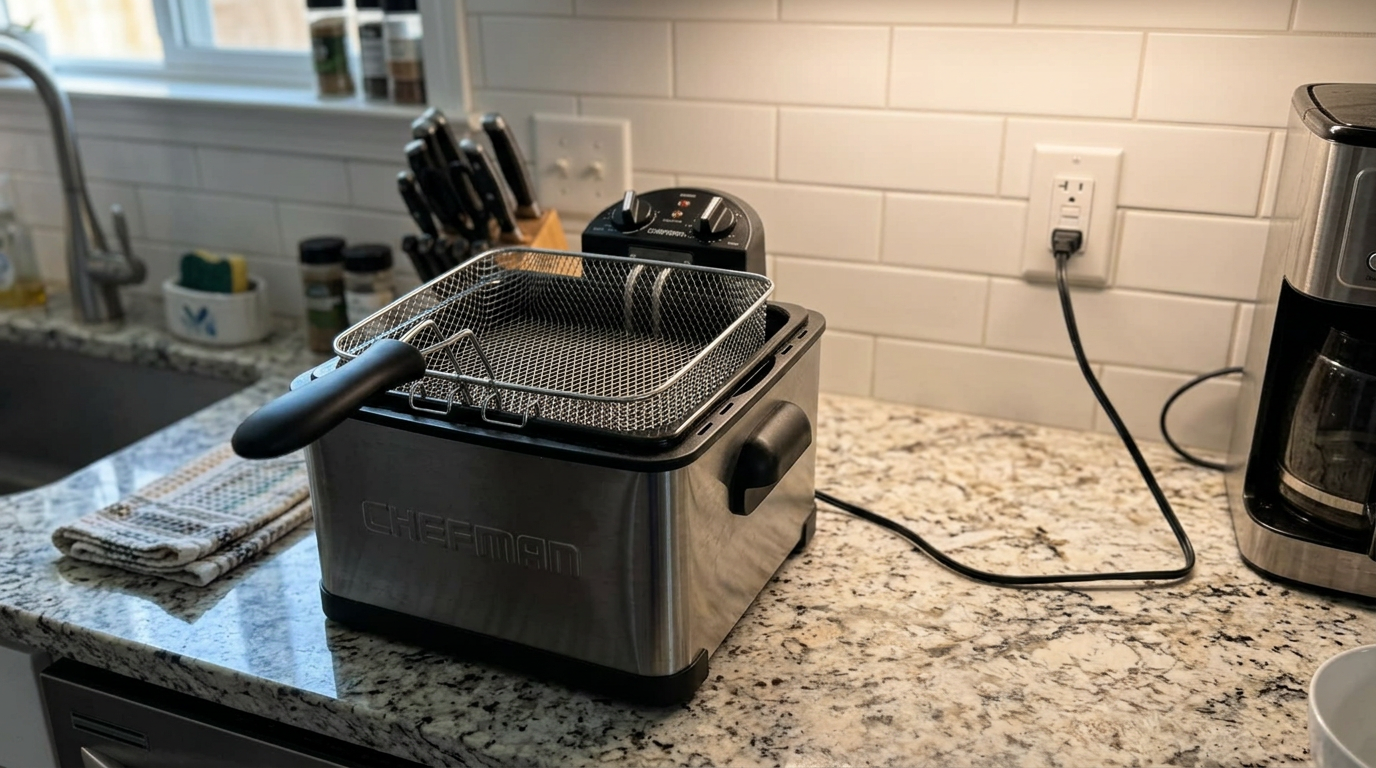
Double-fried russet fries from the deep fryer.
| Fries | Deep fryer | TurboFry |
|---|---|---|
| Fresh, from scratch | Double-fried, excellent | Crisp in a single layer |
| Frozen | About 4 to 5 min at 375°F | About 16 to 18 min, no preheat |
| Per batch | About 1.5 lb | A loose single layer |
| Oil | Oil bath | A teaspoon or two |
Chicken, wings and tenders
On the Deep fryer, wings fried eight to ten at a time took about ten to twelve minutes to crisp skin and 165°F inside, and tasted just like sports-bar wings. Buttermilk tenders at 350°F were juicy with a craggy crust in five to seven minutes.
On the TurboFry, six skin-on chicken thighs at 400°F for about 20 minutes, then 450°F for the last five, came out with crackly, restaurant-style skin and juicy meat. The high finish rendered the fat under the skin.
Chicken results
My ratings out of 10.
Our tip: On the TurboFry, start at 400°F and finish at 450°F; on the deep fryer, fry raw chicken at a moderate 350°F so the inside cooks before the crust burns.
Battered food: the deep fryer’s home turf
This is where the Deep fryer has no rival. Beer-battered onion rings, with a light flour dusting first, puffed golden in two to three minutes and vanished at a family dinner. Cod strips in the same batter turned golden in about four minutes at 350°F and flaked perfectly inside. Jalapeño poppers, breaded twice, fried in three to four minutes.
The trick was lowering the empty basket first and dropping each piece into the oil with tongs, so the wet coating did not stick to the wire.
The TurboFry is not designed for wet batter, and I did not test it with one. Hot air cannot set a runny batter the way oil does, so it drips and spreads before it crisps. Breaded and frozen coated foods, like mozzarella sticks, worked very well.
| Food | Deep fryer | TurboFry |
|---|---|---|
| Beer-battered onion rings | Excellent | Not tested |
| Beer-battered fish | Golden in about 4 min | Not tested |
| Jalapeño poppers | Very good | Not tested |
| Frozen mozzarella sticks | Not tested | 8 to 9 min, no blowouts |
If fish fries and onion rings are the reason you want a fryer, buy the deep fryer.
Frozen snacks
The TurboFry’s Frozen setting was one of its best features. It starts lower to heat food through, then ramps up to crisp. No preheat, no babysitting. Tater tots came out evenly browned in about 15 to 16 minutes, mozzarella sticks heated in 8 to 9 minutes without the cheese bursting, and nuggets took about 10 to 11.
The Deep fryer was faster once the oil was hot: crinkle fries in four to five minutes and nuggets and fish sticks in three to four. Frozen food drops the oil temperature hard, so I shook off ice crystals, fried smaller batches and lowered the basket slowly because the oil spat.
Frozen snack times
My times; the deep fryer also needs about 10 minutes to heat the oil first.
Counting the deep fryer’s ten-minute heat-up and the cleanup after, the TurboFry was the easier choice for a quick Friday snack night.
Heat-up, temperature and recovery
The Deep fryer took about ten minutes to reach 350°F with a full tank and a few more to reach 375°F. A full basket of fries dropped the oil by around 40 degrees, with a recovery time✕Recovery timeHow long the oil takes to climb back to the set temperature after cold food goes in. Slow recovery means greasier food. of about two minutes. Overloaded batches took much longer and came out greasier.
The TurboFry does not need a preheat on the Frozen setting, and its 450°F ceiling gave me finishing power that 400°F air fryers lack.
| Heat | Deep fryer | TurboFry |
|---|---|---|
| Cold to cooking | About 10 min to 350°F | No preheat on Frozen |
| Max | 375°F | 450°F |
| After a batch | About 2 min recovery | No recovery needed |
| Accuracy | Within about 10°F of the dial | Not measured |
Capacity and cooking for a crowd
Both are big. The Deep fryer fit about 1.5 pounds of fries per batch, enough for three, plus eight to ten wings, six to eight tenders or ten to twelve onion rings. A meal for four took two or three batches.
The TurboFry fed five adults roasted potatoes and sausages in one load, browned evenly. Spacing still mattered: a single loose layer crisped best.
| Load | Deep fryer | TurboFry |
|---|---|---|
| Fries | About 1.5 lb per batch | One loose layer |
| Wings or thighs | 8 to 10 wings | 6 thighs |
| Family dinner | 2 to 3 batches | 1 batch for five |
| Game night | Excellent for a crowd | Snacks in quick rounds |
Oil: the hidden difference
The Deep fryer needs most of a large bottle of oil to reach its max line. Choose a high smoke point✕Smoke pointThe temperature at which an oil starts to smoke and break down. For frying, choose oil that stays stable well above your cooking temperature. oil; canola, peanut and vegetable blends all worked, while unrefined oils smoke too early. I strained cooled oil through a sieve and coffee filter and reused it about five times for fries, frying chicken and battered food later because they break it down faster.
The TurboFry needs a teaspoon or two tossed through the food in a bowl. At 450°F, extra-virgin olive oil and butter can smoke, so I used avocado or canola for anything with a hot finish.
| Oil | Deep fryer | TurboFry |
|---|---|---|
| Per session | Most of a large bottle | 1 to 2 teaspoons |
| Reuse | About 5 sessions for fries | Not applicable |
| Disposal | Cool, strain or seal and bin | Not needed |
| Best oils | Canola, peanut, vegetable | Avocado, canola |
Our tip: Never pour hot oil down the sink; let it cool, strain it for reuse or seal it in a container for the trash.
Smell, steam and the lid
This is the Deep fryer’s biggest flaw. The lid has ventilation slots along the front, and when fries or battered chicken release steam, it pours out the front. The first time I lifted the lid, the steam stung my hand. From then on, I used an oven mitt and lifted from the front edge so the opening faced away. The charcoal filter barely helped, because most steam bypasses it; my kitchen smelled of frying for hours.
The TurboFry produced only cooking smells, nothing that lingered. Its fan hum was the main thing I noticed.
| Issue | Deep fryer | TurboFry |
|---|---|---|
| Hot steam | Out of the front vents | No |
| Lingering smell | Hours | Minimal |
| Ventilation needed | Range hood and window | Normal |
| Noise | Quiet apart from the sizzle | Noticeable fan hum |
If you live in a small apartment with poor ventilation, this row alone may decide it.
Safety
The Deep fryer demands respect. I never left it unattended, used long tongs and an oven mitt, dried every ingredient, kept water away and let the oil cool completely before moving it. Its magnetic breakaway cord is excellent: a gentle tug released it cleanly instead of dragging hot oil off the counter. Inside, the basket came close to the stiff probe wires, so I lowered it slowly.
The TurboFry is far less risky, but its basket, rack and rendered fat get very hot at 450°F. I set the basket on a trivet, poured off fat before the hot finish and never ran loose paper liners.
Cleaning
After every session with the Deep fryer, I let the oil cool, strained it, then washed the tank by hand and put the basket and lid in the dishwasher. The heating element got a careful wipe, never immersed, and everything had to be bone dry before the next fry. Allow ten minutes or more.
The TurboFry has one nonstick basket and one rack, both dishwasher safe. Most nights I soaked the basket in hot soapy water for a few minutes and wiped it. About two minutes.
Hands-on cleanup per cook
My estimates.
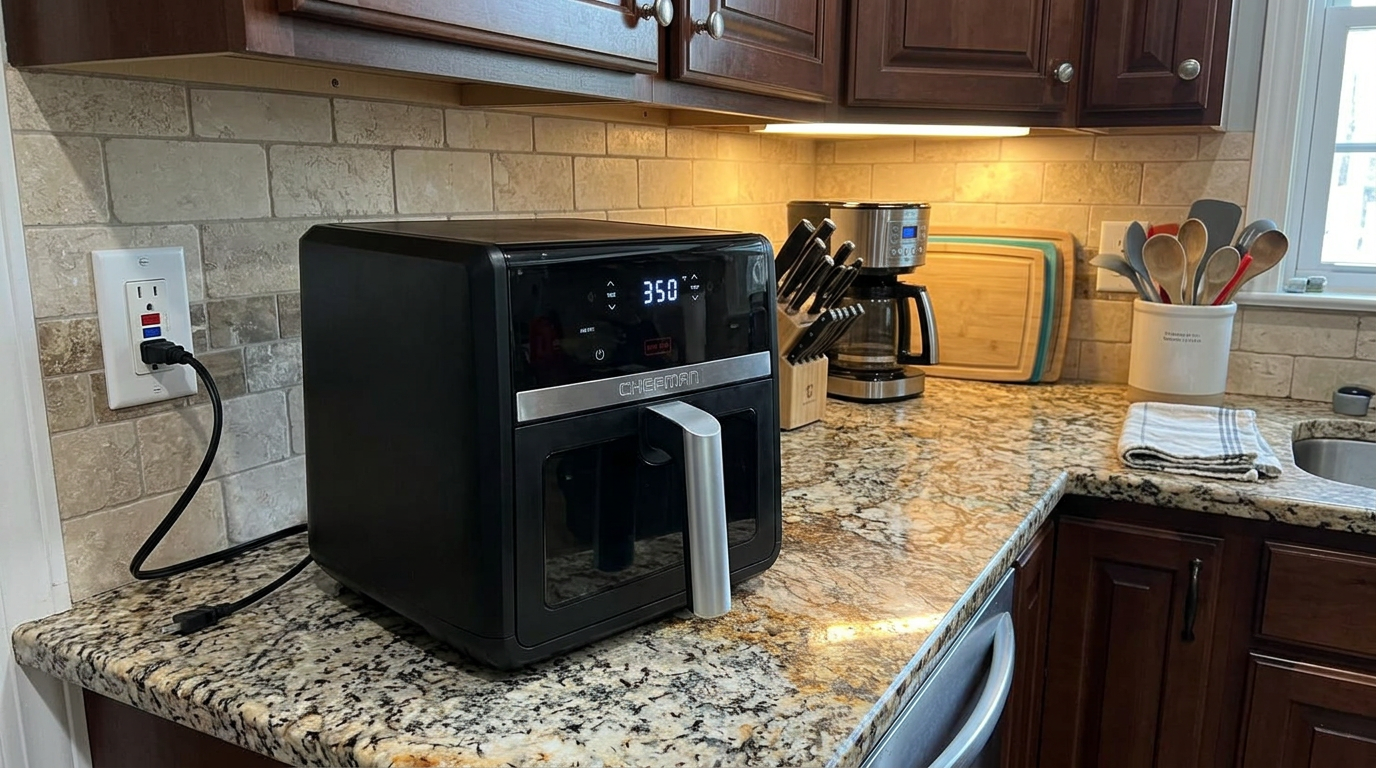
The TurboFry’s single basket kept cleanup quick.
Our tip: Plan deep-fryer sessions in order, fries first and battered or spicy foods last, so the oil lasts longer.
Storage between uses
Between sessions, I either left the Deep fryer’s strained oil in the tank with the lid on, which is fine for a few days somewhere cool, or poured it back into its bottle and stored the fryer in a cupboard. The breakaway cord detaches completely, which keeps storage tidy, but the full tank is heavy and awkward to move.
The TurboFry is about 11 pounds and bulky, so moving it in and out of a cupboard every day gets old fast. I gave it a permanent corner near an outlet with a few inches of clearance behind and to the sides and room in front to pull the basket out fully onto a trivet.
| Storage | Deep fryer | TurboFry |
|---|---|---|
| Where it lived | Low cupboard | Counter corner |
| Oil | Strained, bottled or covered | None |
| Clearance in use | Clear area around the hot housing | A few inches behind and to the sides |
| Moving it | Heavy with oil inside | About 11 lb |
Our tip: Decide on a permanent spot before you unbox either fryer; both are too big to shuffle around daily.
Reheating, vegetables and extras
The TurboFry does much more than fry. A pizza slice reheated at about 360°F in four to five minutes with a crisp base. Broccoli charred in about eight minutes, halved Brussels sprouts in about 12, salmon fillets at 400°F in 10 to 12. It also bakes, broils and dehydrates; apple slices dried evenly over a few hours.
The Deep fryer does one job: deep frying. It does it well, but it will not reheat leftovers or roast vegetables.
| Job | Deep fryer | TurboFry |
|---|---|---|
| Reheat pizza | No | 4 to 5 min, crisp |
| Vegetables | No | Broccoli, sprouts, sweet potato |
| Salmon | Battered cod | Fillets, 10 to 12 min |
| Dehydrate | No | Yes, apple slices |
Weeknights vs weekends
Over four weeks, the TurboFry became my weeknight default: chicken thighs with green beans in about 25 minutes, sausages and potatoes for five in about 25, salmon in 10 to 12, and frozen snack nights the kids loved. I estimate about 40% of cooks were fresh food, 30% frozen, 20% reheating and 10% baking, broiling and dehydrating.
The Deep fryer was a weekend and game-night appliance. Filling it with oil, heating it, frying in batches, ventilating the kitchen and straining the oil afterward made it a project, but the wings, onion rings and fries were worth it for a crowd.
| Occasion | Deep fryer | TurboFry |
|---|---|---|
| Tuesday dinner | Too much effort | Default choice |
| Friday snacks | Fast once hot | No preheat |
| Game night | Excellent wings and rings | Quick rounds of snacks |
| Fish fry | Excellent | Not designed for batter |
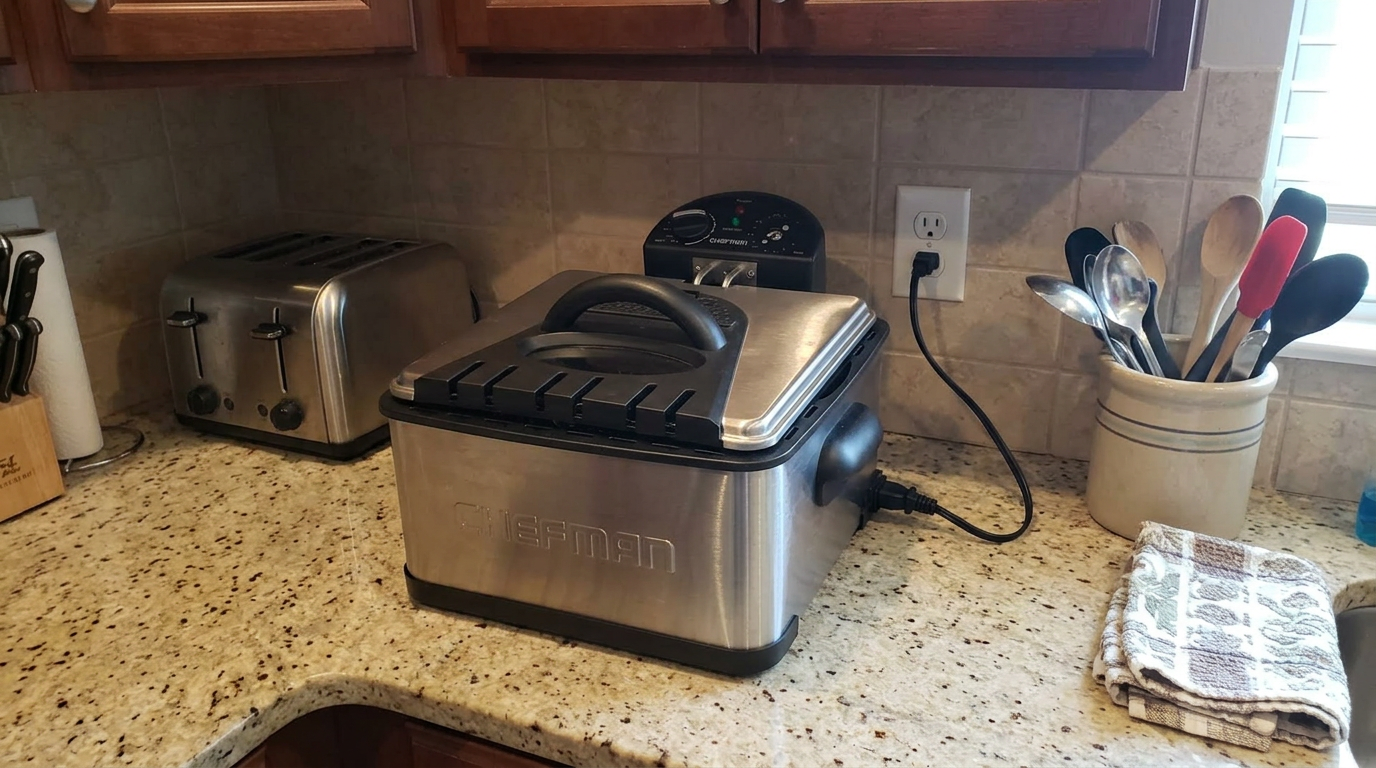
The deep fryer came out for weekends and game nights.
Lighter cooking
The TurboFry used a teaspoon or two of oil for a family dinner, and vegetables cooked that way felt much lighter than pan-fried versions; my kids ate more of them than usual.
Food from the Deep fryer is genuinely fried in oil, which is part of what makes battered food and double-fried fries so good. Draining in the basket for about 20 seconds and resting food on a wire rack, not paper towels, kept it crisp rather than greasy.
Our tip: Season fried food in the first few seconds while its surface is still glossy; salt sticks best then.
Prep habits that made the difference
A few habits improved results on both fryers more than any setting.
On the TurboFry: pat chicken and potatoes dry, toss them with a little oil in a bowl rather than pouring it into the basket, cut pieces to even sizes, spread food in a single loose layer and shake or flip at the reminder. With no oil at all, potatoes came out dry and pale; with too much, oil pooled and smoked at 450°F.
On the Deep fryer: dry everything thoroughly, dust fries with cornstarch, rest battered food briefly so the coating sets, fry in batches that do not crash the oil temperature and drain over the tank for about 20 seconds before moving food to a wire rack. For a crowd, I kept finished batches warm in a low oven.
| Habit | Deep fryer | TurboFry |
|---|---|---|
| Dry the surface | Stops spitting and foaming | Faster browning |
| Oil | Fill to the max line | 1 to 2 teaspoons in a bowl |
| Batch size | Do not crash the temperature | Single loose layer |
| Finishing | Drain, rack, salt straight away | Hot finish at 450°F |
Our tip: Cut potatoes and vegetables to even sizes on either fryer so everything finishes together.
What I would change on each
On the Deep fryer, I would redesign the lid so steam vents away from your hand and through the filter, add a proper power switch and a green ready light, and give the basket more clearance from the probe wires. And I would want confidence it works out of the box, after my first unit failed.
On the TurboFry, I would want a quieter fan for open-plan kitchens, a more responsive touchscreen and a slightly smaller footprint.
| Wish list | Deep fryer | TurboFry |
|---|---|---|
| Biggest wish | A lid that vents away from you | A quieter fan |
| Second | A power switch | A more responsive touchscreen |
| Third | Better odor filtering | A smaller footprint |
The deep fryer’s issues affect safety and comfort; the TurboFry’s are minor annoyances. That is a big part of why I recommend the air fryer to most people.
Is each worth the money?
The TurboFry is worth it for families and frequent cooks. The 450°F ceiling and the big basket earned their keep every week, and it replaced my older, weaker air fryer completely.
The Deep fryer is one of the more affordable large fryers, and its food is genuinely good, but you trade polish for capacity and value. Ask yourself three questions: do you fry for three or more people, do you have good ventilation and are you happy to use an oven mitt every time you lift the lid? If the answer is yes three times, it is a good buy; buy it where returns are easy.
Mistakes to avoid
Putting battered food in the deep fryer basket before lowering it. The coating sticks to the wire.
Overloading either basket. Oil temperature crashes; air cannot circulate.
Lifting the deep fryer lid bare-handed near the front vents. The steam burns.
Running the TurboFry at 450°F the whole time. Burnt outside, raw inside.
Frying wet food. The oil foams and spits.
| Problem | Fix |
|---|---|
| Greasy deep-fried food | Smaller batches, wait for recovery |
| Soft bottom layer in the TurboFry | Single loose layer, shake halfway |
| Smoke at 450°F | High-smoke-point oil, pour off fat |
| Steam on your hand | Oven mitt, lift the lid away from you |
Which suits you?
Choose the TurboFry if you want crisp food most nights with little oil, little smell and almost no cleanup, and you cook for a family. It is more air fryer than one person needs, though.
Choose the Deep fryer if fried fish, onion rings, poppers and classic double-fried fries are what you crave, you fry for three or more, you have good ventilation and you are happy to use an oven mitt every time you lift the lid.
| Household | Better pick | Why |
|---|---|---|
| Family, weeknight dinners | TurboFry | One basket, quick cleanup |
| Game-night host with a range hood | Deep fryer | Batter and big batches |
| Small apartment | TurboFry | No lingering smell |
| Living alone | Neither ideal | Both are large |
Four weeks with each: my diary notes
Chefman 4.5L Deep Fryer
Week 1: First unit failed; replacement arrived; first double-fried fries.
Week 2: Wings, tenders, onion rings; a steam sting from the lid.
Week 3: Poppers for a family dinner, oil straining and a deep clean.
Week 4: Friday fish fry; a safe, settled routine.
Chefman TurboFry 9 Qt
Week 1: Chicken thighs with a 450°F finish; learned single layers.
Week 2: Dinner for five and frozen snack nights.
Week 3: Pizza reheats and dried apple slices.
Week 4: The weeknight default; fan hum and touchscreen still minor gripes.
Real-life scenarios
These are the situations where one fryer fit better in my four weeks.
About 25 minutes, one basket.
Golden in four minutes.
No preheat.
Fluffy inside, crisp outside.
No lingering smell.
Crisp crust in minutes.
My scorecard
These are my scores out of 10 from my single reviews.
Chefman 4.5L Deep Fryer
Deep fryer category scores.
Chefman TurboFry 9 Qt
TurboFry category scores.
Overall, I rate the Chefman TurboFry 9 Qt 8.4 and the Chefman 4.5L Deep Fryer 7.6. The deep fryer’s food was excellent; its lid, smell and early unit failure cost it.
Check price on AmazonWhich one is right for you?
4 quick questionsWhich one should you buy?
For most households, the Chefman TurboFry 9 Qt: crisper chicken, easier frozen snacks, reheating and vegetables, with almost no cleanup.
For battered food lovers and game-night hosts, the Chefman 4.5L Deep Fryer: nothing beats real oil for onion rings, fish and double-fried fries.
For the full detail, read my reviews of the Chefman 4.5L Deep Fryer and the Chefman TurboFry 9 Qt.
- You want crisp food most nights
- You cook frozen snacks often
- You want quick cleanup
- You live alone with little counter space
- You mainly want wet-battered food
- You love battered food
- You want classic double-fried fries
- You have a good range hood
- Frying smells bother you
- You want quick everyday cleanup
My pick for most households is the Chefman TurboFry 9 Qt. It reached 450°F for crackly chicken skin, cooked frozen snacks with no preheat and fed five in one basket, with a two-minute cleanup.
Choose the Chefman 4.5L Deep Fryer if you love beer-battered fish, onion rings and double-fried fries, fry for a crowd and have good ventilation. Use an oven mitt for its lid every time.
Whichever you choose, dry your food well and do not overload the basket.
Deep fryer vs TurboFry specifications
From manufacturer specifications and my own testing.
| Chefman 4.5L Deep Fryer | Chefman TurboFry 9 Qt | |
|---|---|---|
| Type | Immersion-element deep fryer | Single-basket air fryer |
| Capacity | 4.5 L oil | 9 qt basket |
| Temperature | Up to 375°F | 90 to 450°F |
| Power | 1,700 W, 120 V | 1,750 W, 120 V |
| Controls | Thermostat dial and timer | Touchscreen, 7 functions |
| Shut-off | When the timer reaches zero | Timer |
| Safety | Magnetic breakaway cord | Shake reminder, viewing window |
| Dishwasher safe | Basket and lid | Basket and rack |
| Size | About 15 x 15 in | About 15.75 x 11.81 x 11.42 in |
| Weight | Not listed in my notes | About 11 lb |
How I tested and compared them
Emily Carter here. I used each fryer for four weeks of family cooking for two adults and two small children, plus a game night and a family dinner.
On the deep fryer, I made double-fried fries, wings, buttermilk tenders, beer-battered onion rings and fish, jalapeño poppers and frozen snacks, checked the dial with a probe thermometer and strained and reused the oil. On the TurboFry, I cooked chicken thighs, potatoes and sausages, frozen snacks, vegetables and salmon, reheated pizza and dried apple slices.
- Results: crispness, juiciness and flavor
- Time: heat-up, cooking and recovery
- Everyday use: controls, capacity, smell and noise
- Ownership: oil, cleaning and safety
Deep fryer vs TurboFry FAQ
Is an air fryer better than a deep fryer?
For most households, yes. The TurboFry made crisper chicken and better frozen snacks with a spoon of oil and a two-minute cleanup. The deep fryer is better for wet batter and classic double-fried fries.
Can the TurboFry make battered food?
It is not designed for wet batter, and I did not test it with one. Breaded and frozen coated foods worked very well.
Which makes better fries?
From scratch, the deep fryer’s double-fried fries. For frozen fries, the TurboFry, with no preheat and no oil bath.
How much oil does the deep fryer need?
Most of a large bottle to reach the max line of its 4.5-liter tank. I reused strained oil about five times for fries.
Does the deep fryer smell?
Yes. Steam escapes through the front lid vents, the charcoal filter barely helps and my kitchen smelled of frying for hours.
How hot does the TurboFry get?
Up to 450°F, which gave crackly chicken skin with a hot finish.
Which is easier to clean?
The TurboFry, about two minutes for one basket and rack. The deep fryer needs oil straining and a hand-washed tank.
Which is safer?
The TurboFry. The deep fryer has a good breakaway cord, but hot oil and front-venting steam demand care.