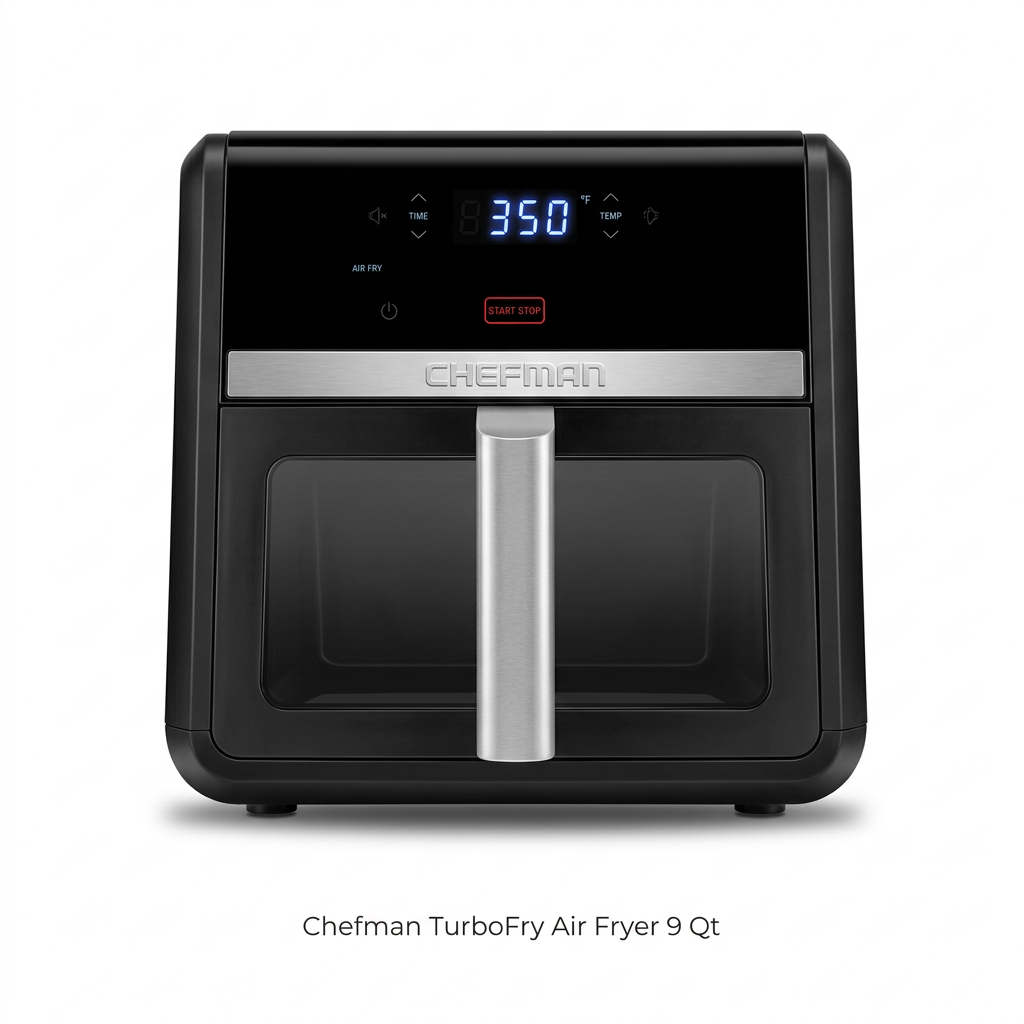
Chefman TurboFry 9 Qt review
The Chefman TurboFry Air Fryer 9 Qt is a big single-basket air fryer that heats to 450°F, and that extra heat really shows. In three weeks it gave me crackly chicken thighs, crisp frozen snacks with no preheat, and enough food for five adults in one basket. It's large, the fan hums, and the touchscreen sometimes needs a second tap, but it crisps food better than most air fryers I've used.
Emily Carter
Hands-on review
Hands-on testing, research, specs
3 weeks
25 minutes
Jargon helpNew to air fryers? Tap any dotted term to see what it means.
In this review
Yes, if you cook for a family and care most about crispness. The Chefman TurboFry 9 Qt reaches 450°F, and that extra heat gave me restaurant-style chicken skin, evenly browned tater tots and pizza that reheated with a crisp crust in minutes. The 9-quart basket fed five adults in one round. It's big and heavy, the fan is audible and the touchscreen occasionally needs a second tap. If you live alone or have a tiny kitchen, it's more air fryer than you need.
Chefman TurboFry 9 Qt at a glance
Chefman TurboFry 9 Qt pros and cons
- 450°F heat for real crispness
- Big 9-quart basket for family meals
- Frozen setting needs no preheat
- Large and fairly heavy
- Fan hum is noticeable
- Touchscreen sometimes needs a second tap
Who should buy the Chefman TurboFry 9 Qt?
- Families of four or more
- Meal preppers and batch cooks
- Anyone frustrated by soft, pale air-fried food
- People living alone
- Small kitchens with tight counters
- Anyone who needs a very quiet appliance
First impressions of the Chefman TurboFry 9 Qt
The Chefman TurboFry 9 Qt isn't flashy.
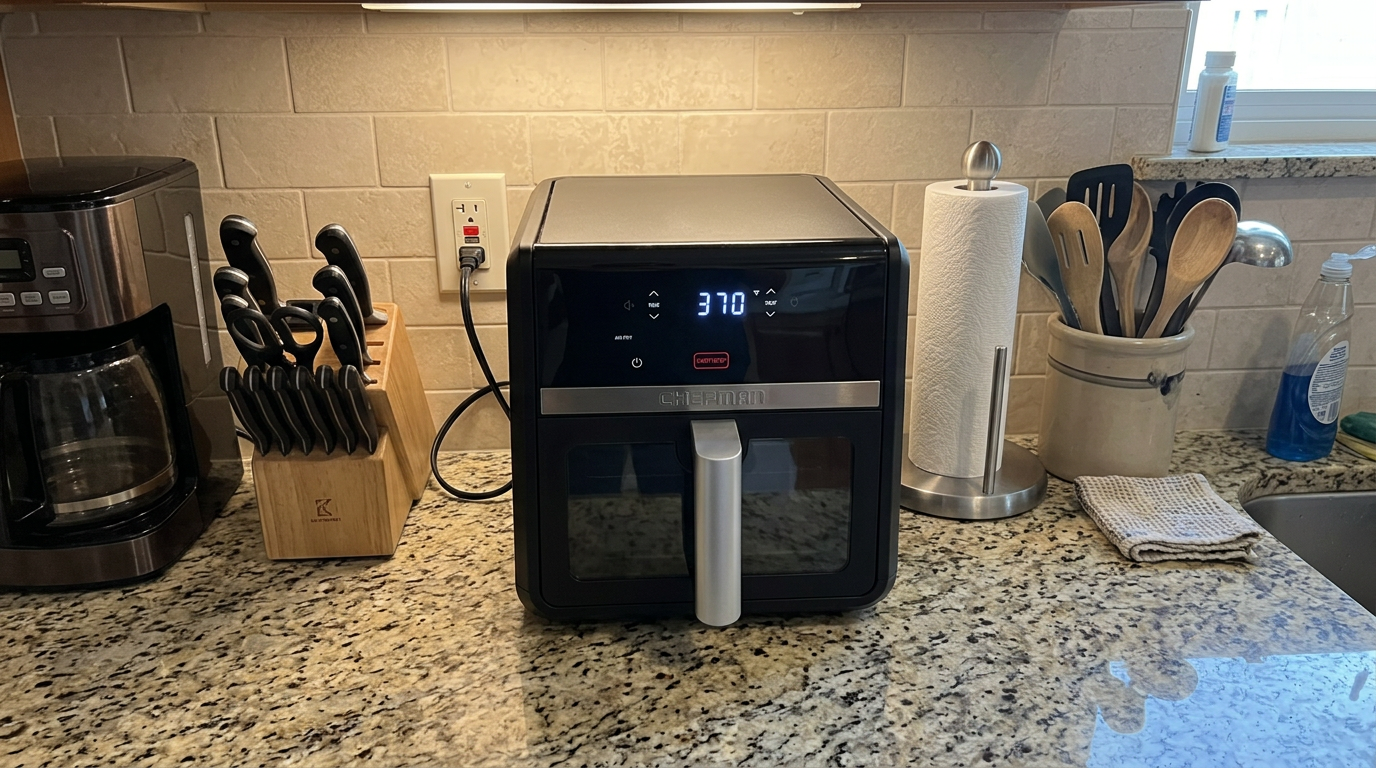
It's a big, black, square air fryer with a pull-out basket, a viewing window in the front and a touchscreen on top.
What caught my eye on the box was one number: 450°F.
Most basket air fryers I've used top out at 400°F, and they often struggle to crisp food without overcooking it.
I wanted to see whether the higher ceiling was real performance or just a marketing number.
After three weeks, my answer is clear: it's real, and it makes a practical difference.
It quickly became my default appliance for weeknight dinners and frozen food.
It never felt fussy or complicated.
It just worked hard, night after night, which is exactly what I want from an everyday kitchen appliance.
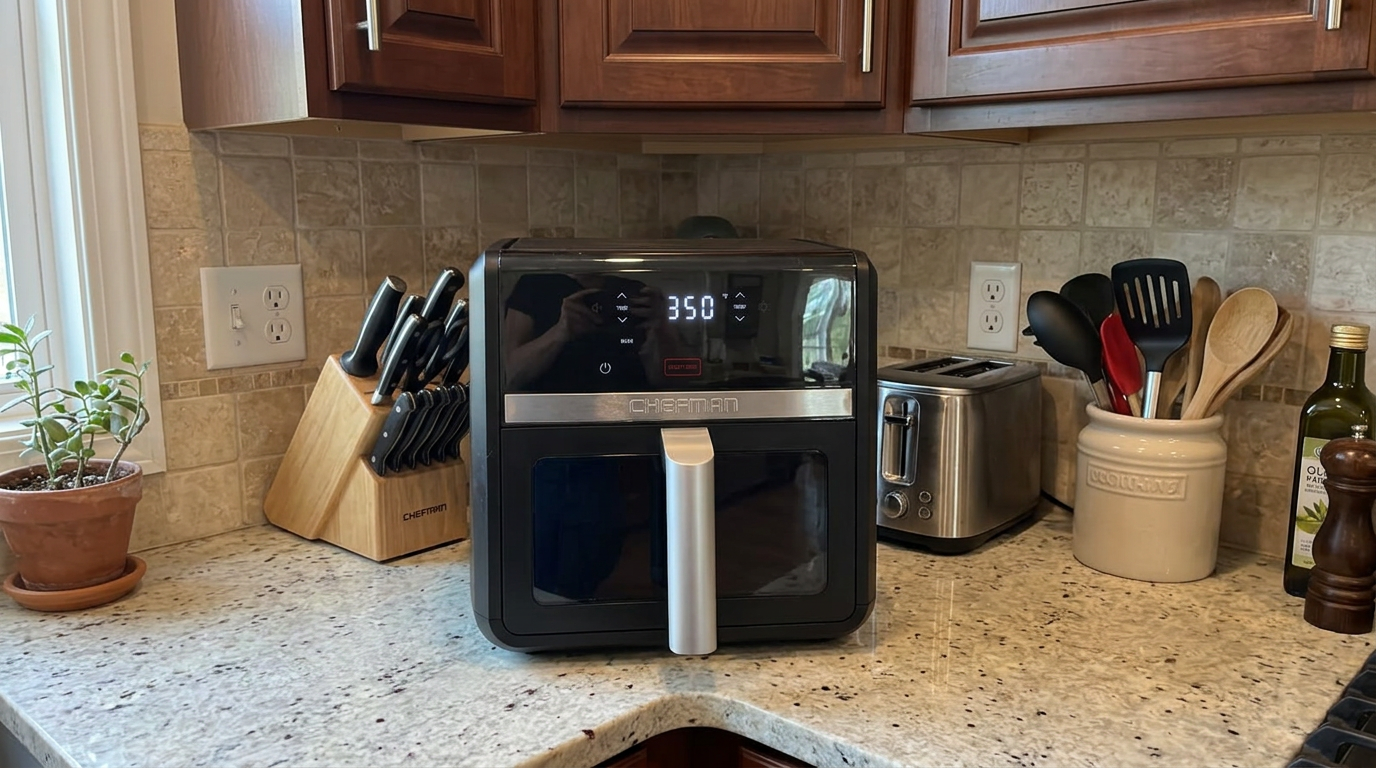
A simple single-basket design with a window built into the drawer.
What the Chefman TurboFry 9 Qt actually is
This is Chefman's TurboFry 9-quart air fryer, model RJ38-9TW-V2.
Chefman lists a temperature range of 90°F to 450°F, about 32°C to 232°C, with 1,750 watts of power.
It uses a DC motor✕DC motorA direct-current fan motor. It can spin fast and steadily, which pushes more hot air around the basket for quicker, more even cooking. to drive the fan, and Chefman claims it cooks up to 40% faster than its other air fryers.
That's a manufacturer claim, but in my kitchen it was noticeably quicker than the 400°F basket models I'm used to.
The functions I used
| Function | What I used it for | How often |
|---|---|---|
| Air Fry | Chicken thighs, potatoes, sausage | Most days |
| Frozen | Tater tots, mozzarella sticks | Several times a week |
| Reheat | Pizza and leftovers | Several times a week |
| Bake | Small bakes and gratins | Occasionally |
| Broil | Melting and browning tops | Occasionally |
| Dehydrate | Apple slices | Once |
Our tip: Run the empty air fryer at a high setting for about 10 minutes before the first cook, so any new-appliance smell burns off before your food goes in.
Why 450°F makes a real difference
The higher temperature ceiling is the heart of this air fryer.
A fan pushing hot air around the food is convection✕ConvectionCooking with moving hot air. A fan carries heat to the food faster than still air, so food browns and crisps more quickly. cooking, and more heat means faster browning on the surface.
That browning is the Maillard reaction✕Maillard reactionThe reaction between proteins and sugars at high heat that turns food golden brown and creates savory, roasted flavors., and it's where the golden color and roasted flavor come from.
With a weaker air fryer, I often had to cook food longer just to get color, which dried out the inside.
Here, I could start at a moderate heat to cook the food through, then finish hotter to crisp the outside quickly.
An extra 50°F gives you more finishing power.
Chicken thighs with crackly skin
Bone-in, skin-on chicken thighs were my main test for crispness.
I cooked six pieces on a normal weeknight, lightly oiled and seasoned with salt, pepper and paprika.
I started at 400°F, about 204°C, then turned the heat up to 450°F for the last few minutes.
The total time was about 25 minutes, and the thickest thigh read 175°F on my thermometer.
The skin was crackly and restaurant-style, and the meat inside stayed juicy.
The high finish helped render✕RenderTo melt fat out of meat or skin with heat. Rendered chicken skin turns thin and crisp instead of rubbery. the fat under the skin, which is what turns it thin and crisp instead of rubbery.
| Stage | Setting | Time | Why |
|---|---|---|---|
| Cook through | 400°F / 204°C | About 20 min | Cooks the meat evenly |
| Flip | At the shake reminder | Halfway | Browns both sides |
| Crisp finish | 450°F / 232°C | About 5 min | Renders fat, crisps skin |
My ratings out of 10 for crisp skin and juicy meat.
Our tip: Pat chicken skin completely dry with paper towels before seasoning, because surface moisture has to steam off before the skin can crisp.
Frozen foods and the Frozen setting
I expected the Frozen setting to be a gimmick.
It turned out to be one of the most useful features on the Chefman TurboFry 9 Qt.
It starts at a lower temperature to heat the food through, then automatically ramps the heat up to crisp the outside.
There's no preheating and no babysitting: you put the food in and press start.
Tater tots
Tater tots came out evenly browned, crisp on the outside and soft inside, with no scorched edges or cold centers.
Mozzarella sticks
Mozzarella sticks heated cleanly without the cheese bursting out everywhere, which is the usual problem with high heat.
The gentle start warmed the cheese before the high finish crisped the coating.
My times on the Frozen setting, no preheat.
Our tip: Don't thaw frozen snacks first, because the Frozen setting is designed to start from frozen and thawed coatings can go soggy.
Capacity and airflow: big basket, smart spacing
The 9-quart basket is genuinely spacious.
It shines when you cook for a group, because you don't have to run a second batch.
Dinner for five in one basket
One evening I made roasted potatoes and sausages for five adults in a single load.
Everything browned evenly, and nobody had to wait for a second round.
Spacing still matters
A big basket doesn't mean you can tip a whole bag in and walk away.
When I piled frozen fries deep, the top crisped while the bottom stayed soft.
Spread out in a single, loose layer, they crisped evenly every time.
| Load | Result | My rating |
|---|---|---|
| Single loose layer | Even, crisp all over | 9.2 |
| Two layers, shaken twice | Mostly crisp | 8.0 |
| Whole bag in a pile | Soft bottom layer | 6.0 |
From my potatoes-and-sausage test.
Our tip: Shake the basket when the shake reminder sounds, because moving the food halfway is what lets the big basket crisp evenly.
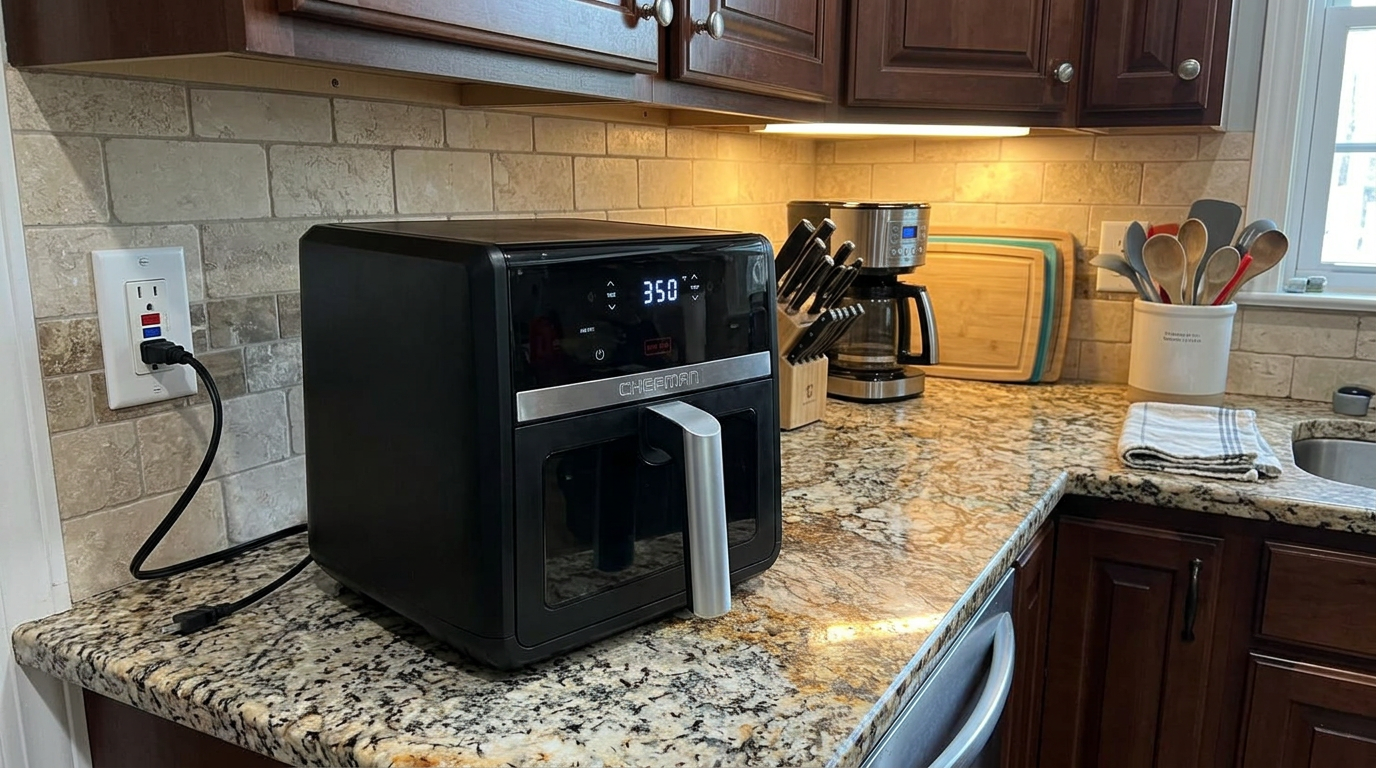
The big basket feeds a family, as long as you leave room for air.
Reheating leftovers and the viewing window
Reheating turned out to be one of the biggest pleasant surprises.
Pizza is the perfect test: the microwave makes the crust rubbery, and the oven takes too long.
At about 360°F, roughly 182°C, a slice was ready in 4 to 5 minutes with a crisp base and melted cheese.
Fried chicken, fries and roast potatoes all came back crisp too.
The window
At first, the viewing window seemed like a gimmick.
In practice, it was handy for reheating and browning checks, because I could see the cheese melt without pulling out the basket and losing heat.
It's not revolutionary, but it's genuinely practical.
My reheating times at about 360°F / 182°C.
Our tip: Reheat pizza at a moderate 360°F rather than full heat, so the crust crisps before the toppings burn.
Dehydrate mode: a nice extra
I tested dehydrating✕DehydratingDrying food slowly with low, steady heat and moving air, so moisture leaves without the food cooking or browning much. with apple slices to see whether it was a real feature or just filler on the box.
After a few hours, the slices were evenly dried and chewy-crisp.
So it works, but a single basket holds far less than a dedicated dehydrator with stacked trays.
I'd treat it as an occasional bonus, not a reason to buy.
| Food | Typical temperature | Typical time |
|---|---|---|
| Apple slices | About 135°F / 57°C | 5–7 hours |
| Banana chips | About 135°F / 57°C | 6–8 hours |
| Kale chips | About 200°F / 93°C | 30–45 min |
General dehydrating ranges. Thinner, even slices dry faster.
Prep habits that got the most out of it
Strong heat does most of the work, but a few habits made a big difference to the results from the Chefman TurboFry 9 Qt.
A little oil, not a lot
For fresh food, a teaspoon or two of oil tossed through in a bowl was enough.
With no oil at all, potatoes came out dry and pale; with too much, oil pooled in the basket and smoked at 450°F.
Even sizes
Cutting potatoes and vegetables into pieces of the same size meant everything finished together.
Mixed sizes left me with some burnt pieces and some still firm.
Dry surfaces
Patting chicken and potatoes dry was the single easiest way to get more crunch.
Water on the surface has to steam off first, and that slows down browning.
| Habit | Why it helps | Best for |
|---|---|---|
| Pat food dry | Faster browning | Chicken, potatoes |
| Light oil in a bowl | Even, golden coating | Fresh vegetables, fries |
| Even sizes | Finishes together | Potatoes, carrots |
| Single loose layer | Air reaches every side | Everything |
| Moderate start, hot finish | Juicy inside, crisp outside | Chicken, sausages |
Weeknight meals that worked best
Over three weeks, a handful of meals became regulars in my house.
They all play to the TurboFry's strengths: strong heat, a big basket and fast results.
Sausages and potatoes
Halved baby potatoes went in first for about 10 minutes, then the sausages joined them.
About 15 minutes later, both were browned and ready, with no second pan to wash.
Crispy chicken thighs with green beans
Chicken thighs cooked for most of the time, and I added green beans for the last 6 or 7 minutes, so both finished together.
Salmon fillets
Salmon at 400°F took about 10 to 12 minutes and came out flaky, with crisp edges.
I didn't use the 450°F finish here, because fish dries out quickly.
Friday snack night
Tater tots, nuggets and mozzarella sticks on the Frozen setting, one after another.
The kids loved it, and I loved not heating the big oven.
| Meal | Setting | Total time | Serves |
|---|---|---|---|
| Sausages and potatoes | Air Fry 400°F | About 25 min | 4–5 |
| Chicken thighs and green beans | 400°F, then 450°F | About 25 min | 4–6 |
| Salmon fillets | Air Fry 400°F | 10–12 min | 3–4 |
| Snack night | Frozen | 8–16 min per batch | Family |
Our tip: Add quick-cooking vegetables partway through a longer cook, so they finish at the same moment as the meat instead of burning.
Design, size and weight
Chefman lists the TurboFry at about 15.75 × 11.81 × 11.42 inches, roughly 40 × 30 × 29 cm.
Retail listings put the weight at about 11 pounds, around 5 kg.
That's a lot of air fryer, and it's awkward to tuck into a standard cabinet.
Exterior heat
The outside of the body gets warm during high-temperature cooks.
It's not dangerously hot, but it's warm enough that I wouldn't push it flush against a wall or tile.
Our tip: Measure your counter depth before buying, because the basket needs space to slide all the way out in front.
Touchscreen and everyday controls
The touch panel is simple: pick a function, adjust time and temperature with the arrows, and press start.
A shake reminder sounds partway through, which reminded me to shake fries or flip chicken.
It works fine most of the time, but it occasionally needed a second tap to register.
That was most noticeable when my fingers were slightly greasy from handling food.
It's a small annoyance, not a dealbreaker.
Once I knew to expect it, I simply pressed a little more firmly and the problem mostly went away.
The arrows for time and temperature are easy to read, and the display is bright enough to see from across the kitchen.
Our tip: Keep a damp cloth near the air fryer and wipe your fingertips before tapping, so the touchscreen responds the first time.
Noise in a real kitchen
The TurboFry is not a quiet appliance.
The fan makes a noticeable hum that you'll hear over casual conversation in the kitchen.
It's not jet-engine loud, and the steady sound faded into the background after a few days.
But if your kitchen is open-plan and you watch TV nearby, it's worth knowing.
For me, the noise was a fair trade for how quickly and evenly it cooked.
Most cooks were over in 10 to 25 minutes, so the hum never lasted long.
My impressions while cooking, not lab measurements.
Vegetables, sides and lighter cooking
The high heat isn't only for chicken and fries.
Vegetables were one of the nicest surprises of the test.
Broccoli florets tossed with a teaspoon of oil and a pinch of salt picked up charred edges in about 8 minutes at 400°F.
Brussels sprouts, halved, took around 12 minutes and came out crisp outside and tender in the middle.
Carrot sticks and sweet potato wedges caramelized nicely, though their natural sugars meant I watched them through the window near the end.
Because the food needs so little oil, these sides felt much lighter than pan-fried versions, and my kids ate more vegetables than usual.
| Vegetable | Setting | Time | Tip |
|---|---|---|---|
| Broccoli florets | 400°F / 204°C | 7–9 min | Keep florets similar sizes |
| Brussels sprouts, halved | 400°F / 204°C | 11–13 min | Cut side down first |
| Sweet potato wedges | 400°F / 204°C | 16–18 min | Watch the last few minutes |
| Green beans | 400°F / 204°C | 6–8 min | Add late to longer cooks |
| Zucchini rounds | 400°F / 204°C | 8–10 min | Pat dry before oiling |
Our tip: Skip the 450°F finish for delicate vegetables like broccoli and green beans, because their tips can burn in under a minute at that heat.
Small extras that made it better
You don't need anything extra, but a few kitchen basics made the three weeks easier.
| Item | Why it helped |
|---|---|
| Probe thermometer | Checked chicken and salmon quickly |
| Silicone-tipped tongs | Flipped food without scratching the basket |
| Heat-resistant trivet | A safe spot for the hot basket |
| Mixing bowl | Tossing food in oil and seasoning |
| Air fryer liners | Saucy or sticky foods |
The thermometer was the most useful by far.
With high heat, food goes from just right to overdone quickly, and a quick reading took away the guesswork.
If you use liners, make sure they don't cover the whole base, so the hot air can still move under the food.
Setting it up and the first week
Setup was quick: unpack, wash the basket and rack, and find it a permanent spot.
Because it's heavy and bulky, I'd decide on that spot before you unbox it.
Moving it in and out of a cupboard every day gets old fast.
Where I put it
I chose a corner of the counter near an outlet, with a few inches of clearance behind and to the sides.
There's enough room in front to pull the basket all the way out and set it on a trivet.
I kept it away from the wall tiles, because the body gets warm on long, hot cooks.
The first few cooks
My first cooks were frozen fries and chicken nuggets on the Frozen setting, which made it easy to learn the controls.
By the end of the first week, I was confident using the 450°F finish on fresh food.
Our tip: Keep a heat-resistant trivet next to the air fryer, so you always have a safe place to set the hot basket down while you shake or serve.
Safety habits that matter
Any air fryer that reaches 450°F deserves a little respect.
The basket, the rack and any fat collected underneath get very hot, so I always used oven mitts or a dry towel on the handle area when shaking food.
I set the basket down on a trivet, never straight on the counter, and kept it away from the edge where small hands could reach.
When cooking fatty sausages or chicken thighs, I poured off the rendered fat partway through, so it didn't smoke during the hot finish.
And I never left it running with paper liners or parchment that wasn't weighed down by food, because the strong fan can lift loose paper into the heating element.
Our tip: Pull the basket out slowly after a hot cook and keep your face back, because a puff of steam and hot air escapes the moment it opens.
All my cooking results in one place
| Food | Setting | Time | Result | My rating |
|---|---|---|---|---|
| Chicken thighs, 6 pieces | 400°F, then 450°F | About 25 min | Crackly skin, juicy | 9.3 |
| Tater tots | Frozen | 15–16 min | Crisp outside, soft inside | 9 |
| Mozzarella sticks | Frozen | 8–9 min | No blowouts | 8.8 |
| Potatoes and sausage for 5 | Air Fry 400°F | About 25 min | Even browning | 8.8 |
| Pizza reheat | About 360°F | 4–5 min | Crisp crust | 9.2 |
| Apple slices | Dehydrate | Several hours | Evenly dried | 7.8 |
Cleaning and caring for the TurboFry
Cleaning is where a single basket shines.
There's one nonstick basket and one rack, and Chefman lists both as dishwasher-safe.
Most nights I just soaked the basket in hot, soapy water for a few minutes and wiped it clean.
The window needs an occasional wipe to keep it clear, and the heating element above the basket benefits from a gentle clean once it's cold.
| Task | What it removes | How often |
|---|---|---|
| Wash basket and rack | Grease and crumbs | After every cook |
| Wipe the window | Grease haze | Weekly |
| Wipe interior, cool | Splatter | Weekly |
| Check heating element | Stuck-on bits | Monthly |
My estimate of hands-on cleaning time per cook.
Our tip: Avoid metal tongs and scouring pads on the basket, because scratches in the nonstick coating make food stick more over time.
One basket and one rack keep cleanup quick.
What daily use is really like
After three weeks, the Chefman TurboFry 9 Qt felt like a reliable default rather than a gadget.
On planned evenings it cooked chicken thighs, potatoes and sausages.
On tired evenings it handled tater tots and nuggets on the Frozen setting with no preheat.
Leftovers went in on Reheat instead of the microwave.
Having one dependable appliance took a lot of decision-making out of busy weeknights.
Share of cooks from my testing notes.
Three weeks with the TurboFry, week by week
Week 1: testing the heat
Chicken thighs with a 450°F finish showed straight away that the extra heat was real.
I also learned to spread food in a single layer.
Week 2: family dinners and frozen nights
Potatoes and sausage for five, plus tater tots and mozzarella sticks on the Frozen setting.
No second batches, and no preheating.
Week 3: reheating and extras
Pizza reheats became a habit, and I tried dried apple slices.
The small downsides, the hum and the occasional double-tap, never went away, but they never bothered me much either.
From my testing notes.
Common mistakes to avoid
| Mistake | What happens | Better habit |
|---|---|---|
| Piling food deep | Soft bottom layer | Single loose layer |
| Cooking at 450°F the whole time | Burnt outside, raw inside | Start moderate, finish hot |
| Pushing it against the wall | Heat builds up | Leave a few inches |
| Ignoring the shake reminder | Uneven browning | Shake or flip halfway |
| Thawing frozen snacks | Soggy coating | Cook from frozen |
| Metal utensils in the basket | Scratched coating | Silicone-tipped tongs |
What I would change
A quieter fan would make it nicer in open-plan kitchens.
A more responsive touchscreen would remove the occasional double-tap.
And a slightly smaller footprint would help it fit more counters.
Three households, three verdicts
The family of five
Chicken, potatoes and sausages in one basket, plus frozen snacks for the kids.
This is exactly who the TurboFry is for.
One basket feeds everyone at once, and the strong heat means nobody gets the soft, pale batch.
The meal prepper
Big batches of chicken and roast vegetables on a Sunday.
A very good fit, as long as you spread food out.
I cooked two big trays' worth of chicken thighs in two quick rounds on a Sunday, and they reheated well all week.
The person living alone
Single portions most nights and a small kitchen.
It works, but it's more air fryer than you need.
| Household | Fit | Main reason |
|---|---|---|
| Family of four or more | Excellent | Big basket, no second batch |
| Meal prepper | Very good | Large loads, strong heat |
| Crisp-food fan | Excellent | 450°F finish |
| Living alone, small kitchen | Fair | Too big |
Is the Chefman TurboFry 9 Qt worth the money?
For families and frequent cooks, yes.
It delivers consistent results, fast cooking and crisp textures without constant adjustments.
The 450°F ceiling and the big basket are the two things you're really paying for, and both earned their keep in my kitchen.
The extras, like Dehydrate, are nice but secondary.
It also saved me time in small ways every day.
There was no preheating on the Frozen setting, no waiting for a full oven to warm up, and no second batch to keep warm while the first one went cold.
Over a week of family dinners, those minutes added up.
It also replaced my old, weaker air fryer completely, so it didn't add another appliance to the counter.
If you live alone, have little counter space or need a very quiet appliance, it's probably overkill.
Three questions to ask:
Do you regularly cook for more than two people?
Do you want crisper results than a typical air fryer gives you?
And do you have room for a large basket model?
Single basket vs. dual basket
The big decision with family-size air fryers is one large basket or two smaller ones.
A dual-basket air fryer wins when you need to cook two different foods at different times and temperatures, and have them finish together.
The TurboFry wins on raw heating power, crispness and simplicity.
When I didn't need two separate zones, I preferred the single big basket and the stronger heat.
| Feature | Chefman TurboFry 9 Qt | Dual-basket air fryer | Air fryer oven |
|---|---|---|---|
| Max heat | 450°F | Often 400–450°F | Often 400–450°F |
| Two foods, two settings | No | Yes | Racks, one setting |
| Large single items | Excellent | Limited by basket width | Good |
| Viewing window | Yes | Sometimes | Usually |
| Cleaning | One basket, one rack | Two baskets | Several racks |
| You mostly cook | Is the TurboFry a fit? | Why |
|---|---|---|
| Crispy chicken and potatoes | Excellent | 450°F finish |
| Frozen snacks | Excellent | Frozen setting, no preheat |
| Big family batches | Very good | 9-quart basket |
| Two different dishes at once | Fair | A dual basket is better |
| Single portions | Fair | More than you need |
Which one is right for you: is the Chefman TurboFry 9 Qt your match?
4 quick questionsChefman TurboFry 9 Qt specifications
From manufacturer data, retailer listings and my own testing.
How I tested and scored the Chefman TurboFry 9 Qt
For three weeks, the Chefman TurboFry 9 Qt was my family's main air fryer.
I cooked chicken thighs, potatoes and sausages, frozen snacks, reheated pizza and leftovers, and dried apple slices.
I checked meat with a probe thermometer, timed every cook and compared results with the 400°F basket air fryers I've used before.
I also noted noise, exterior heat, touchscreen response and how long cleanup took.
Finally, I checked my notes against Chefman's specifications and the user guide.
- Crisping (9.1): browning, crunch and juiciness across foods.
- Capacity (8.6): basket size and how many batches it saves.
- Ease of use (8.0): touchscreen, presets, window and reminders.
- Cleaning (8.0): basket, rack and dishwasher use.
The overall score of 8.4 is an editorial rating that reflects those four areas, minus a little for size and noise.
Chefman TurboFry 9 Qt FAQ
Is the Chefman TurboFry 9 Qt worth it?
Yes, for families and batch cooks who want crisp results. For one person or a tiny kitchen, it's more air fryer than you need.
How hot does it get?
Chefman lists a range of 90°F to 450°F, which is 50°F hotter than many basket air fryers.
Does the 450°F setting really help?
Yes. Finishing chicken thighs at 450°F gave crackly skin while the meat stayed juicy.
What does the Frozen setting do?
It starts at a lower temperature and ramps up automatically, so frozen snacks heat through and then crisp without preheating.
How much food fits in the basket?
I cooked potatoes and sausages for five adults in one load. Keep food in a loose layer for even crisping.
Is it loud?
The fan has a noticeable hum you'll hear over conversation, but it isn't extremely loud.
Does the outside get hot?
It gets warm during high-heat cooking, so leave a few inches of space from walls.
Is the basket dishwasher-safe?
Chefman lists the nonstick basket and rack as dishwasher-safe.
Can it dehydrate?
Yes. Apple slices dried evenly in a few hours, but capacity is limited compared with a dedicated dehydrator.
Is it good for reheating pizza?
Very. About 4 to 5 minutes at 360°F gave a crisp crust and melted cheese.
Single basket or dual basket?
Choose a dual basket if you often cook two dishes at different settings. Choose the TurboFry for maximum heat and simple, large batches.
How big is it?
About 15.75 × 11.81 × 11.42 inches and roughly 11 pounds, so measure your counter first.
Senior home appliance tester
Emily has tested home appliances for a living since 2016, first as a test coordinator at a national consumer advocacy group and, since 2021, at HouseholdMe. She has a degree in industrial design from Ohio State, so she looks at how a product is built, not just how it performs. She used the Chefman TurboFry 9 Qt as her family's main air fryer for three weeks for this review.
- Three weeks of hands-on testing of the Chefman TurboFry Air Fryer 9 Qt RJ38-9TW-V2
- TurboFry 9 Qt product information, Chefman
- Chefman RJ38-9TW-V2 user guide