Cosori TurboBlaze review

Emily Carter
Hands-on review
Hands-on testing, research, specs
3 weeks
27 minutes
Jargon helpNew to air fryers? Tap any dotted term to see what it means.
In this review
Yes, for most kitchens. The Cosori TurboBlaze is the quietest, easiest-to-read basket air fryer I have used, and it cooked fries, bacon and cookies as well as any 6-quart basket I have tested. It takes up less counter space than you would guess from its capacity. The catch: it only heats from the top, and there is no shake reminder, so you still need to flip things like grilled cheese yourself.
Cosori TurboBlaze at a glance
Cosori TurboBlaze pros and cons
- Very quiet, with soft beeps and a peak of about 54 dB
- Big top-mounted display with fan speed you can see and change
- Flat crisper tray that is easy to clean and stays put
- No shake reminder, so you have to remember to flip
- Heats from the top only, so undersides can lag
- Preheating can overdo foods if you keep the full cook time
Who should buy the Cosori TurboBlaze?
- Open-plan homes where a loud fryer would bother people
- Small kitchens that need 6 quarts in a compact footprint
- Cooks who want control over fan speed for baking and drying
- People who never want to flip or shake food
- Households that cook two different foods at once
- Anyone who wants a see-through window to watch food
First impressions of the Cosori TurboBlaze
I have lived with a lot of air fryers. Most of them look alike, sound alike and beep loudly enough to wake a sleeping toddler two rooms away.
The TurboBlaze felt different within the first hour. I bought it myself, with no sponsor involved, and did what I do with every new fryer: unboxed it, washed the basket and tray, and ran it empty to burn off the factory smell.
That empty run was the first surprise. I kept waiting for the usual roar, and it never came. The fan has a soft, steady hum, and the end-of-cycle beep is more of a polite chirp.
The second surprise was the controls. On the Cosori TurboBlaze, the whole control panel sits on top of the machine rather than on the front. The display is big and bright, and I could read it from across the kitchen.
It also made me ask a question I kept coming back to for three weeks. There is no shake reminder button at all. Older Cosori models remind you to shake the basket halfway through. This one does not.
So does that mean you never need to flip or shake? I tested that question hard, and the answer is “mostly, but not always.” I will show you exactly where it falls short.
Our tip: Run the fryer empty at 400°F for 10 minutes before the first cook, with a window open, to clear the new-appliance smell.
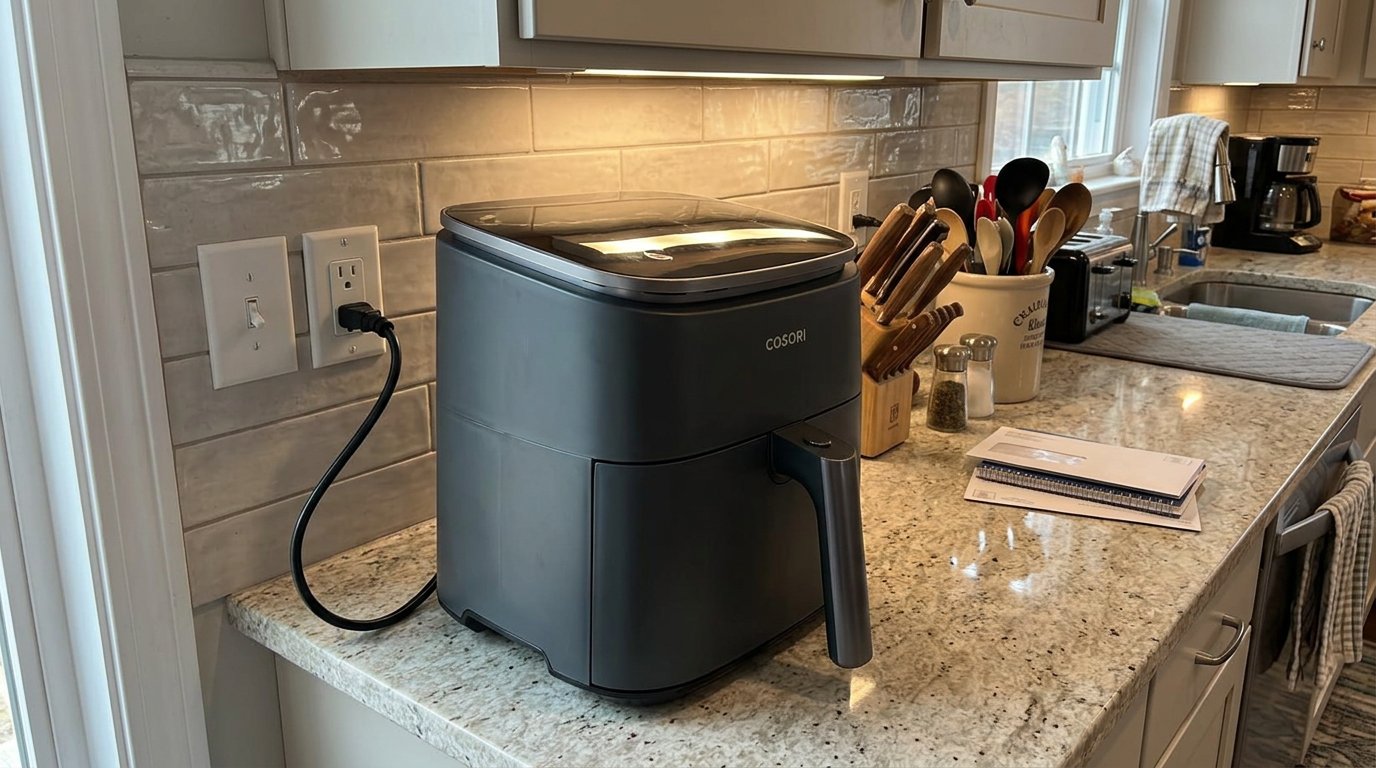
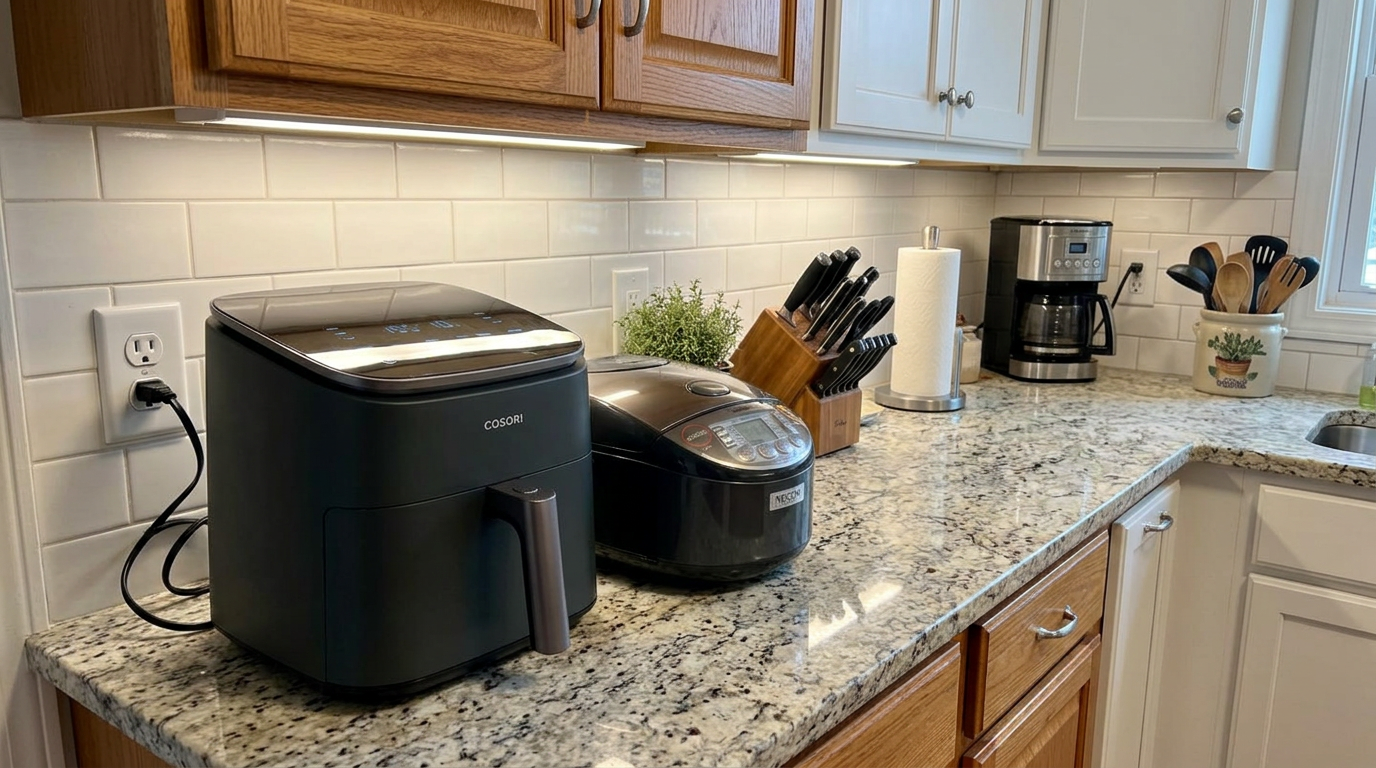
The TurboBlaze on my counter. The controls sit on top, so nothing sticks out at the front.
What the Cosori TurboBlaze actually is
The TurboBlaze is a 6-quart basket air fryer from Cosori. It has one pull-out basket with a removable crisper tray inside, and a heater and fan in the top of the unit.
Like every air fryer, it is really a small convection oven✕Convection oven An oven with a fan that blows hot air around the food, so it cooks and browns faster than still heat.. A heating element warms the air, and a fan pushes that air down and around the food.
What makes this model different is the fan. The TurboBlaze has five fan speeds, and the display shows which one is running as a row of bars. Five bars lit means full airflow.
Most air fryers have one fan speed and a few presets that only change the time and temperature. Here, the presets also change the fan speed. Bake drops to level 3. Dry drops to level 1. That changes how the food cooks, not just how long.
It also has a separate Preheat button. Cosori clearly wants you to use it: the manual pushes preheating much harder than older Cosori manuals I have read.
The heat comes from the top only. Some newer fryers, like the Cosori Dual Blaze I tested alongside it, also heat from below. That one design choice explains most of what I found in testing.
| Function | What I used it for | Fan level |
|---|---|---|
| Air Fry | Fries, wings, nuggets, vegetables | 5 (full) |
| Bake | Cookies, muffins, small cakes | 3 |
| Reheat | Leftover pizza and fries | 4 |
| Keep Warm | Holding food until dinner | 2 |
| Dry | Apple chips and jerky | 1 |
| Proof | Rising bread and pizza dough | 1 |
Design, size and build
I tested the TurboBlaze side by side with two other Cosori fryers I own: the classic Cosori Pro II (5.8 quarts) and the Cosori Dual Blaze (6.8 quarts). That gave me a fair way to judge size.
The TurboBlaze is the one that takes up the least room. It is shorter and less deep than the other two, so it fits under my wall cabinets with space to spare.
That matters more than it sounds. An air fryer needs open space around it while it runs, because hot air leaves through vents at the back. A smaller footprint means you can keep it out on the counter without it taking over.
Inside, the basket is close to square. I measured about 9.5 inches across in both directions, and about 3.75 inches deep with the tray in. That is a little shallower than the other two, but the floor area is as big or bigger.
For flat foods like fries, bacon, wings and fish fillets, floor area is what counts. You want food in one layer, not piled up. On that front, the TurboBlaze’s square basket does very well for its size.
The finish is a matte dark gray that hides fingerprints. The basket handle feels solid, and the basket slides in and out smoothly on the first try, every time.
Our tip: Measure the gap under your wall cabinets before you buy. Lifting the basket out needs a few inches more than the fryer’s height.
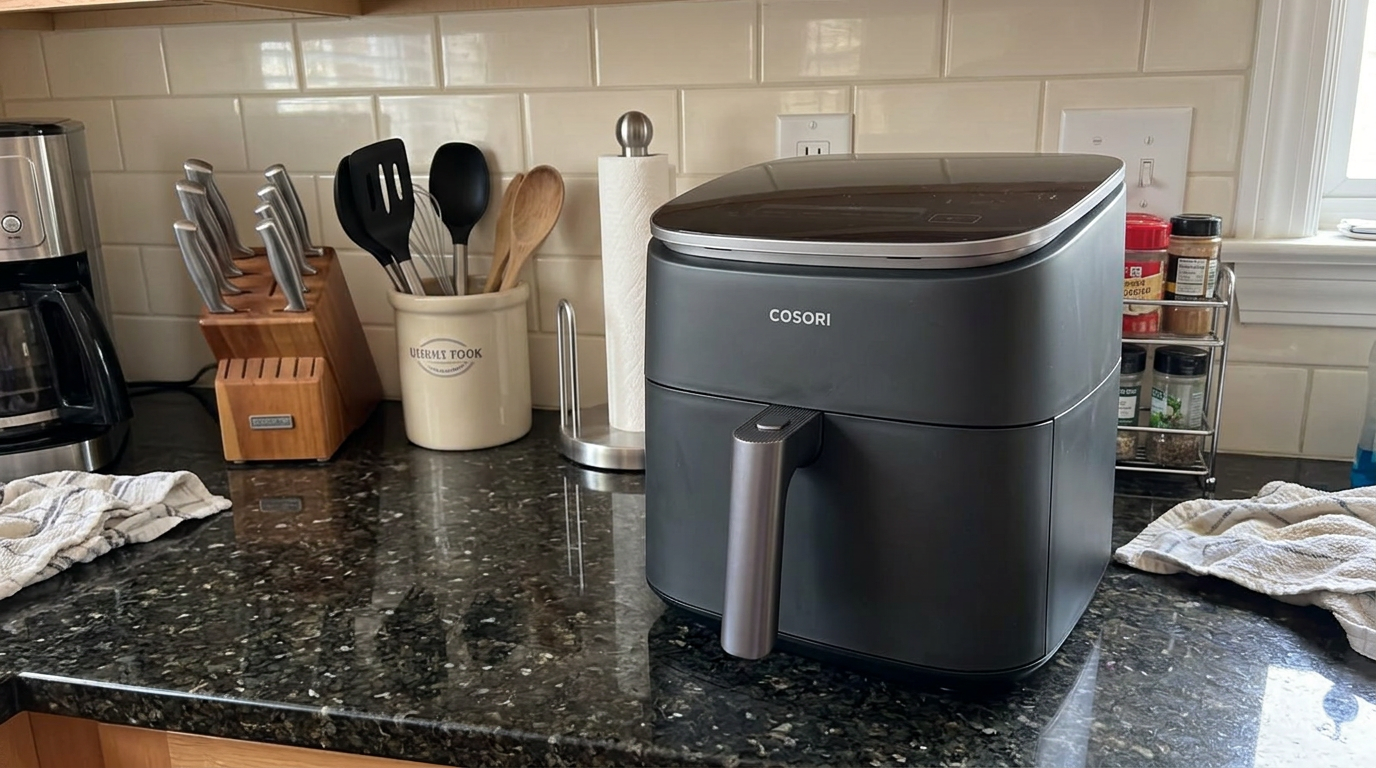
From the side you can see how compact the body is for a 6-quart basket.
Basket, crisper tray and safety button
The basket has a safety button on the handle. You press it to release the basket from the body. The Pro II does not have this; it uses a slider release instead.
At first the button felt like one more step. After a week, I liked it. With small kids in the house, a basket that cannot be yanked out by accident is a real plus.
Inside the basket sits a removable crisper tray✕Crisper tray The raised, perforated plate inside an air fryer basket. Food sits on it so hot air can reach the underside and fat can drip away.. This is where the TurboBlaze beats the Dual Blaze clearly.
The Dual Blaze tray has raised ridges that trap grease and crumbs, and two large openings that small pieces of food fall through. I lost more than a few fries and broccoli bits through those holes.
The TurboBlaze tray is flatter and sits flush. It wipes clean in seconds. It also gives a stable base for a small baking dish or ramekin, so nothing tips when you slide the basket in.
Small rubber pads and subtle ledges inside the basket hold the tray in place. You give it a light push to seat it. Once it is in, I could tip the basket fully upside down over a plate and the tray stayed put.
That makes it easy to dump out fries without the tray falling onto the plate with them. Compare that with the Pro II, which uses a separate inner basket inside an outer pan. Dumping food from that is easy too, but you have two deep pieces to wash instead of one basket and a flat tray.
Controls, display and sound
The top-mounted control panel is the biggest visual difference between the TurboBlaze and other Cosori fryers. The Pro II puts its controls on the front, and the Dual Blaze has a much smaller display that I found hard to read.
Because the TurboBlaze display faces up and is large, I could read it from almost any angle. I even checked it while sitting on a kitchen stool, lower than the counter, and could still see the time and temperature clearly.
The buttons are big and laid out logically. Temperature and time each have their own buttons, so you are never cycling through one control to change both. Function buttons are labeled in plain words.
The alert beeps are much quieter and softer than those on the Pro II and the Dual Blaze. If you cook while someone is napping or on a call in the next room, you will notice.
The running noise is low too. With my sound meter about three feet away, the TurboBlaze peaked at about 54 dB✕Decibels (dB) A measure of loudness. Every 10 dB sounds roughly twice as loud, so 54 dB is about half as loud as 64 dB. during cooking. The Pro II usually ran above 60 dB in the same spot.
If you are choosing an air fryer for an open-plan kitchen, the TurboBlaze is the quiet pick in the Cosori range I have tested.
Fan speeds and the preheat question
This is where the TurboBlaze gets interesting. Among the Cosori fryers I have used, it is the only one that shows fan speed on the display and lets you change it.
In the high-airflow modes, all five bars light up. When you pick a gentler preset, fewer bars light, and you can hear the fan slow down. The screen shows you what the machine is actually doing with the air.
Defaults as shown on the display during my testing
Now to the flipping question. The user manual never tells you to flip or shake food. In the included recipe book, I counted only about three recipes that mention turning food over.
Instead, the manual tells you again and again to press Preheat before cooking, unless the unit is already hot. Older Cosori manuals from a couple of years ago barely mentioned it.
My theory going in was simple. If you preheat, the crisper tray gets hot. Food placed on a hot tray should brown underneath from contact, while the fan browns the top. Then you would not need to flip.
The Preheat button makes this easy. When you change the target temperature, the preheat time adjusts on its own. You do not have to guess how long to wait.
So I put the theory to the test with the food that most needs flipping: grilled cheese.
Grilled cheese test: do you still need to flip?
Grilled cheese is a tough test for a top-heated fryer. The bread is buttered on the outside, and it only turns golden where heat hits it hard. The recipe guide suggests 350°F for 6 to 8 minutes, flipping halfway.
I made the same sandwich three ways, using the same bread, butter and cheese each time.
| Run | Settings | Top | Bottom |
|---|---|---|---|
| Cold start, no flip | Air Fry, 350°F, 8 min | Golden | Pale and uneven |
| Preheated, no flip | Air Fry, 350°F, 8 min | Crisp, golden | Only slightly better |
| Flipped halfway | Air Fry, 350°F, 4 + 4 min | Well toasted | Lightly toasted |
The cold start went into a basket I could still touch. The top browned nicely, but the underside stayed pale in patches. It clearly needed turning.
The preheated run gave a nice crunch on top. The bottom improved, but only a little. It was not the even, two-sided golden sandwich I had hoped for.
The flipped run was the best of the three. After the first 4 minutes, the first side was lightly toasted. After flipping and 4 more minutes, the second side was well toasted. The first side stayed a bit lighter, but both sides were properly cooked.
So my answer is clear. Even without a shake reminder, and even with preheating, some foods still need a flip. Grilled cheese, toast, burgers and anything breaded on both sides are on that list.
Our tip: For grilled cheese, flip at 4 minutes, then add 1 extra minute on the first side at the end if you want both sides equally golden.
Bake mode and the cookie test
On many air fryers, the Bake button is just a shortcut. It sets a different default time and temperature, but the fan blows exactly as hard as it does for fries.
On the TurboBlaze, Bake drops the fan to level 3. That is a real change. Strong airflow dries out the top of cakes and cookies before the middle is done, so a gentler fan should help.
To check, I baked cookie dough side by side in the TurboBlaze and the Pro II. Both used a foil sling, a strip of foil folded under the dough with the ends sticking up, so I could lift the cookies out to cool.
The cookie dough guide said 320°F for 7 to 8 minutes. I ran both for 8 minutes, let them cool, then cut through the center cookie.
| Fryer | Settings | Top | Center |
|---|---|---|---|
| Cosori TurboBlaze | Bake, 320°F, 8 min, fan level 3 | Soft, lightly golden | Slightly gooey |
| Cosori Pro II | Bake, 320°F, 8 min, full fan | Drier, crunchier | Slightly gooey |
| Pro II, my adjustment | Bake, 320°F, 7 min | Close to TurboBlaze | Gooey |
Both batches looked good. Each had a slightly gooey center and bottom, which is how I like cookies.
The Pro II batch was a touch more done, with a drier, crunchier top, because of its stronger airflow. The TurboBlaze cookies stayed softer on top.
The difference was small. Taking about 1 minute off the time on the Pro II got very close to the TurboBlaze result. Which you prefer comes down to whether you like soft or crisp cookies.
Still, I like that the TurboBlaze’s Bake mode actually behaves differently. For muffins and small cakes, a gentler fan means fewer domed, cracked tops.
Our tip: Use a foil sling for cookies and small bakes. Fold a strip of foil twice as long as the basket so you can lift everything out without tilting.
French fries: TurboBlaze vs Dual Blaze
The Dual Blaze is the obvious alternative in the Cosori range. It has heating elements on both the top and the bottom, a bigger body, a smaller display and no Preheat button.
Because it heats from both sides, the Dual Blaze rarely needs shaking. Stirring fries once still helps where pieces touch, but you can mostly leave it alone. That is its main selling point.
The manual for the TurboBlaze suggests 1.5 pounds of thin-cut frozen fries on Air Fry at 400°F for 13 to 15 minutes.
I split a 2-pound bag evenly, 16 ounces in each fryer, and set both to 400°F for 15 minutes. I did not shake or stir either one at any point.
| Fryer | Preheat | Settings | Result |
|---|---|---|---|
| Cosori TurboBlaze | Yes | Air Fry, 400°F, 15 min, no shake | Deep golden, slightly overdone |
| Cosori Dual Blaze | No (no button) | Air Fry, 400°F, 15 min, no shake | Lighter, less crisp |
I preheated the TurboBlaze first, then loaded the fries and started the timer. The Dual Blaze went straight in from cold, since it has no preheat option.
The TurboBlaze fries came out noticeably more golden. In fact, they were slightly overcooked at 15 minutes. They finished faster and more thoroughly than the Dual Blaze fries, and preheating clearly helped.
This surprised me. I expected the two-element fryer to win easily on a no-shake test. With preheating, the top-only TurboBlaze kept up and then some.
For a pound of frozen fries in the TurboBlaze, I now preheat and set 12 to 13 minutes. I give the basket one quick shake at the halfway mark out of habit, but it is not essential.
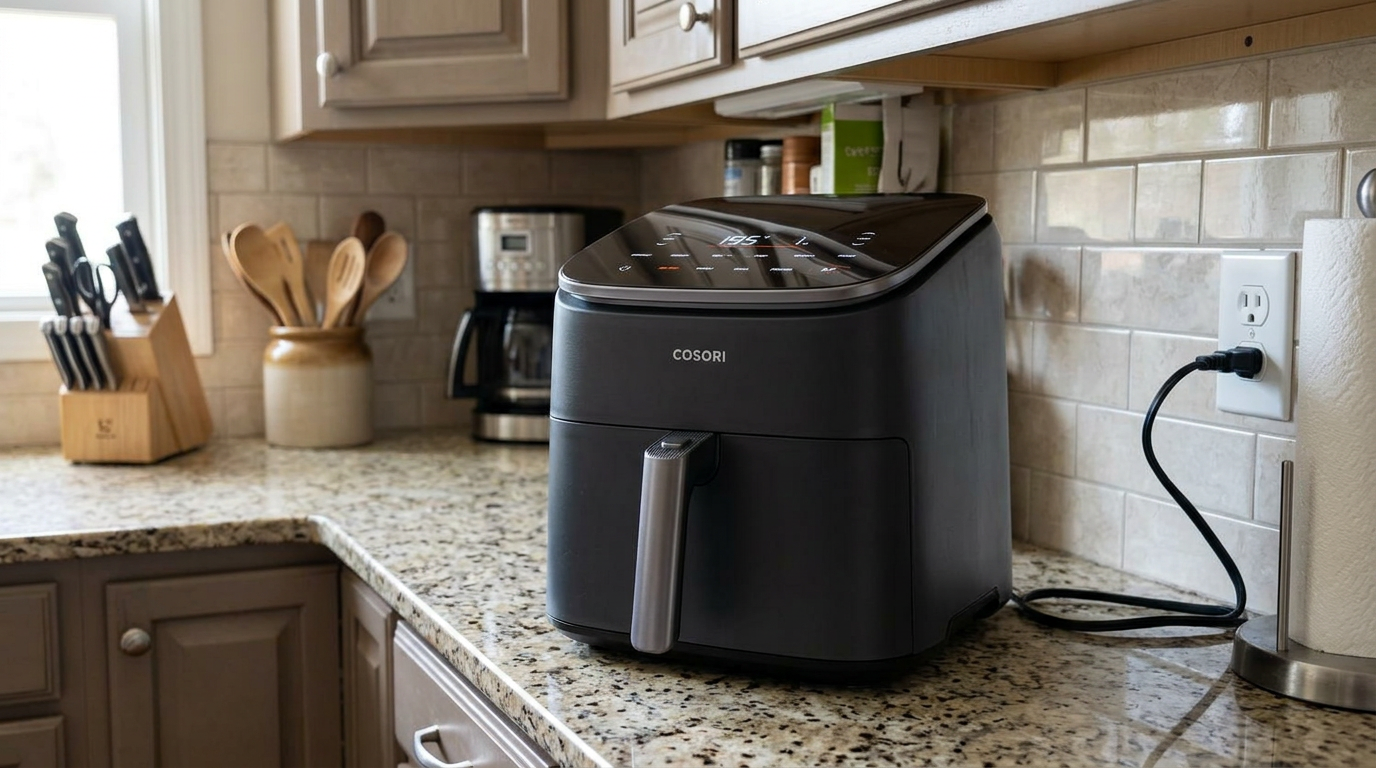
Mid-cook. With the fryer preheated, a pound of fries needed only 12 to 13 minutes.
Bacon test: three Cosori fryers side by side
Bacon is a good test of crispness and of how a fryer handles grease. I cooked it in all three fryers at the same time: the TurboBlaze, the Dual Blaze and the Pro II.
All three ran at 380°F for 8 minutes with a custom bacon setting, and I never flipped the strips. I preheated two of the units, one for 5 minutes and one for 4 minutes, and left the third cold because it does not need preheating.
Normally I put a slice of bread under the tray when I cook bacon. It soaks up the drippings, which cuts down on smoke and makes cleanup easier. This time I skipped it on purpose to see how each fryer coped with the grease on its own.
| Fryer | Preheat | Settings | Result |
|---|---|---|---|
| Cosori TurboBlaze | Yes | 380°F, 8 min, no flip | Crispy, a little less crunchy than usual |
| Cosori Pro II | Yes | 380°F, 8 min, no flip | Crispy, good shrinkage |
| Cosori Dual Blaze | No | 380°F, 8 min, no flip | Not scored in this test |
Both the Pro II and the TurboBlaze made crispy bacon, and both strips shrank a fair bit, as bacon does.
Here is the twist. Because I preheated the TurboBlaze this time, which I do not normally do for bacon, it came out slightly less crunchy than my usual results from it.
Over three weeks, my best bacon came from a cold start: 380°F for 8 minutes, no preheat, no flipping. The fat renders slowly as the basket warms, and the strips end up crunchier.
None of the bacon needed flipping. The top heater and the fan handled thin strips well on their own.
Our tip: Skip Preheat for bacon. Start it cold at 380°F for 8 minutes, and lay a slice of bread under the tray to catch the drippings.
Reheat, Dry, Proof and Keep Warm
The gentle presets are where the variable fan pays off most. I used each of them at least a few times during testing.
| Function | Default setting | Fan level | How it did |
|---|---|---|---|
| Preheat | Time adjusts to target temperature | Full | Fast and hands-off |
| Reheat | Reheat preset | 4 | Crisp pizza crust, soft top |
| Dry | 135°F for 6 hours | 1 | Gentle airflow, very quiet |
| Proof | 90°F, up to 110°F | 1 | Warm, still air for dough |
| Keep Warm | 170°F for 30 minutes | 2 | Holds food without drying, barely audible |
Reheat drops the fan to level 4. That is enough to re-crisp leftover pizza and fries without blasting the tops dry.
Dry runs at 135°F for 6 hours by default, with the fan at level 1. That is the setting you want for dehydrating✕Dehydrating Drying food slowly at low heat so it loses its water. It is how you make fruit chips, jerky and dried herbs. fruit or making jerky. Low airflow means the outside does not harden before the inside dries.
Proof sets 90°F, with a maximum of 110°F, and again uses fan level 1. That makes it handy for rising bread or pizza dough on a cold day, since the low fan will not dry out the surface.
Keep Warm is the quiet star. It runs at 170°F for 30 minutes with the fan at level 2. It is so quiet I sometimes forgot it was on.
The Dual Blaze keep-warm mode runs its fan at full force. It is louder and more likely to dry food out. The TurboBlaze’s gentler fan held food without that problem.
If you often cook a side dish early and hold it while the main finishes, the TurboBlaze’s Keep Warm is a small feature that makes a big difference.
All my test results in one place
Here is everything from my set tests, so you can see where the TurboBlaze shines and where it needs a little help from you.
| Test | Settings | Flip needed? | Score |
|---|---|---|---|
| Frozen thin fries, 1 lb | Preheat, 400°F, 15 min | No | 9.3 |
| Bacon | Cold start, 380°F, 8 min | No | 9.4 |
| Cookies | Bake, 320°F, 8 min | No | 8.8 |
| Grilled cheese | 350°F, 4 + 4 min | Yes | 8.2 |
| Leftover pizza | Reheat preset | No | 9.0 |
| Keep Warm hold | 170°F, 30 min | No | 9.2 |
The pattern is easy to read. Foods that sit flat and cook mostly from the top, like fries and bacon, came out excellent with no help.
Foods that need even browning on two flat sides, like grilled cheese, still need a flip. That is the price of a top-only heater, and the only real weak spot in the results.
If you are happy to flip a sandwich or a burger halfway, the Cosori TurboBlaze handles everyday cooking as well as any 6-quart basket I have tested.
Speed and noise
Noise is where the TurboBlaze stands out most against its siblings. I measured with a sound meter about three feet from each fryer, in the same spot on my counter.
| What I measured | TurboBlaze | Pro II |
|---|---|---|
| Peak while air frying | About 54 dB | Often above 60 dB |
| Keep Warm | Barely audible | Not compared |
| End-of-cycle beep | Soft chirp | Loud beep |
| Fries, 1 lb, preheated | Done in 12 to 13 min | About 15 min |
A difference of 6 to 8 dB does not sound like much on paper. In a real kitchen, it is the difference between talking normally next to the fryer and raising your voice.
On speed, preheating is the key. Once the basket is hot, the strong fan gets frozen food golden fast. My fries were done 2 to 3 minutes sooner than the manual’s time.
Our tip: Check frozen foods 2 to 3 minutes before the package time the first few times you use the TurboBlaze. It runs hot and fast after preheating.
Cleaning and care
Cleaning is easy, mainly thanks to the flat tray. With the Dual Blaze, I had to scrub between ridges. With the TurboBlaze, a soapy sponge and a quick rinse did the job.
| Part | How I cleaned it | Time |
|---|---|---|
| Crisper tray | Warm soapy water, soft sponge | About 1 min |
| Basket | Wipe out fat, then soapy sponge | About 2 min |
| Basket after bacon | Let fat cool, wipe with paper towels, wash | About 4 min |
| Top panel and body | Damp cloth, unplugged and cool | Under 1 min |
| Heating element | Soft brush, only when cool | Monthly |
The basket and tray have a nonstick coating✕Nonstick coating A smooth layer on the basket and tray that stops food from sticking. Metal tools and scouring pads can scratch it., so I never used steel wool or metal tongs. Silicone-tipped tongs worked fine for everything.
The top-mounted panel also helps with cleaning. There are no buttons on the front for grease to splash onto, and the flat top wipes clean in one pass.
Typical time to clean the tray or inner basket after a batch of fries, from my notes
What daily use looked like
For three weeks, the TurboBlaze was our main air fryer. My family of four used it almost every day, for breakfasts, after-school snacks and dinner sides.
The things I reached for most were Air Fry and Reheat. Bake and Keep Warm came next, then Dry and Proof on weekends.
From my notes over three weeks
The 6-quart basket was right for four people. A pound of fries or eight chicken wings fit in one layer. For a big batch of wings for guests, I cooked two rounds and kept the first warm.
Because it is so quiet, the TurboBlaze never became “that noisy thing on the counter.” My kids did homework at the kitchen table while it ran without complaining once.
Our tip: Cooking in two batches? Put the first batch on Keep Warm in a covered dish while the second cooks, then crisp both together for 2 minutes at the end.
Week by week with the TurboBlaze
Week 1. I learned the controls and ran my set tests. The display and the quiet fan won me over fast. The missing shake reminder took some getting used to, and I set a phone timer for foods I wanted to flip.
Week 2. I started using the presets properly. Bake for cookies, Reheat for leftovers, Keep Warm for sides. I also worked out that bacon is better from a cold start.
Week 3. It became part of the routine. I used Dry for apple chips and Proof for weekend pizza dough. By the end, I was trimming a minute or two from most frozen-food times after preheating.
Mistakes to avoid with the Cosori TurboBlaze
| Mistake | What happens | Fix |
|---|---|---|
| Never flipping | Pale undersides on sandwiches and burgers | Flip halfway on two-sided foods |
| Preheating for bacon | Less crunchy strips | Start bacon cold |
| Full package time after preheat | Slightly overdone fries | Check 2 to 3 min early |
| Tipping out the basket after fatty food | Hot grease spills | Lift food out, let fat cool |
| Overfilling the basket | Soft, steamed food | Cook in one layer, in batches |
| Metal tongs or scouring pads | Scratched nonstick coating | Use silicone tools, soft sponges |
How it fits real households
| Household | Fit | Why |
|---|---|---|
| Single person or couple | Great | Plenty of room, compact footprint |
| Family of four | Good | One layer of fries or wings for a side |
| Large family, big batches | Fair | Needs two rounds for mains |
| Small apartment, open plan | Great | Quiet fan and soft beeps |
Is the Cosori TurboBlaze worth it?
For most people, yes. You get a 6-quart basket in a compact body, a display that is a pleasure to use, and the quietest running of any Cosori fryer I have tested.
The variable fan is not a gimmick. It makes Bake, Dry, Proof and Keep Warm work better than the same buttons on fryers with a single fan speed.
The trade-offs are real but small. You will flip some foods yourself, and you will learn to trim a minute or two after preheating. Neither bothered me once I knew about them.
If you want a fryer that never needs turning, look at a two-element model instead. If you want a quiet, easy, compact everyday basket, the Cosori TurboBlaze is the one I would buy again.
Cosori TurboBlaze vs Pro II vs Dual Blaze
I had all three Cosori fryers on my counter at once, which made this comparison easy to do fairly.
| Feature | TurboBlaze | Pro II | Dual Blaze |
|---|---|---|---|
| Capacity | 6 qt | 5.8 qt | 6.8 qt |
| Heating | Top only | Top only | Top and bottom |
| Controls | Large, on top | On the front | Small display |
| Fan speed on display | Yes, 5 levels | No | No |
| Preheat button | Yes | No | No |
| Shake reminder | No | Yes | No |
| Running noise | About 54 dB | Often over 60 dB | Louder fan on Keep Warm |
Against the Pro II, the TurboBlaze wins on noise, display, footprint and gentle presets. The Pro II’s inner basket is handy for dumping food, but it means more to wash.
Against the Dual Blaze, it is a closer call. The Dual Blaze heats from below too, so it needs less flipping. But the TurboBlaze has the better tray, the better display, a Preheat button and a much quieter Keep Warm. In my fries test, it also browned faster.
Cosori TurboBlaze specifications
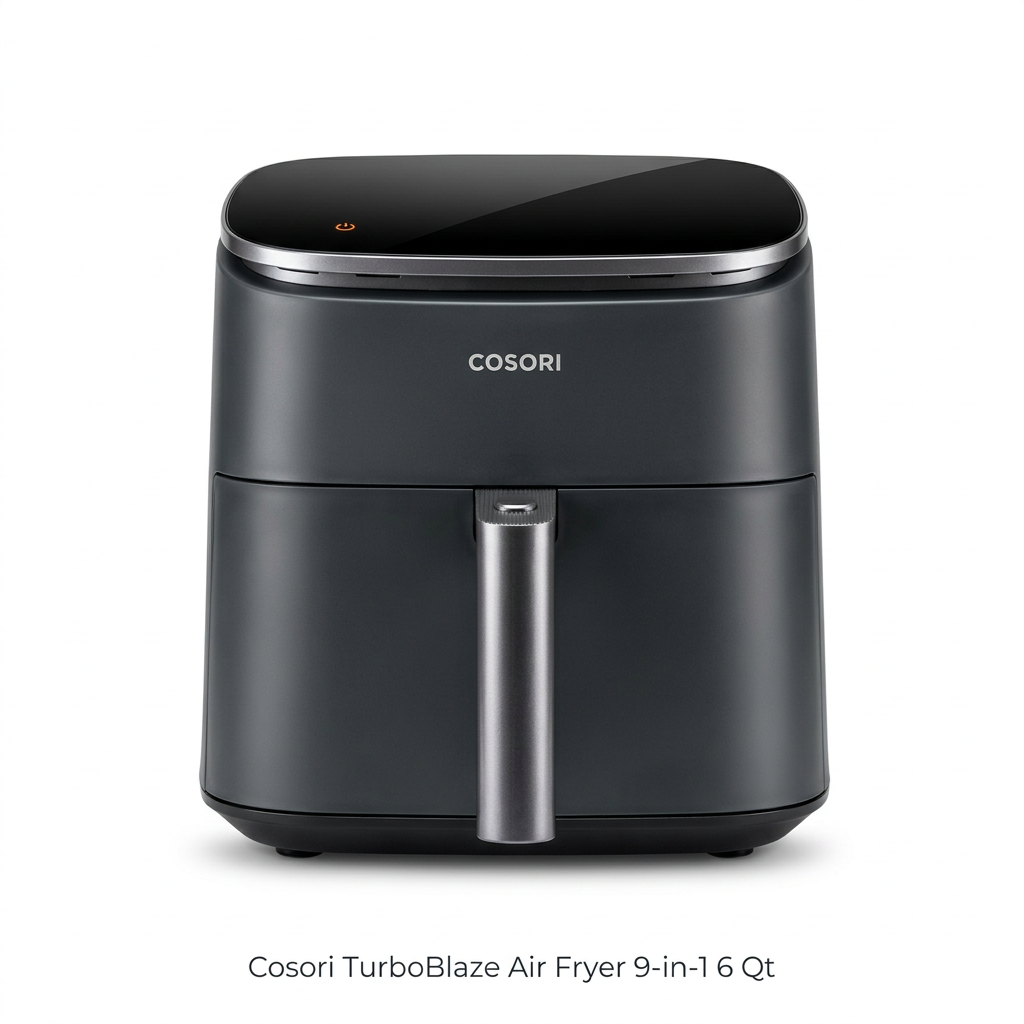
The TurboBlaze 6 Qt with its basket in place.
How I tested and scored the Cosori TurboBlaze
For three weeks, the Cosori TurboBlaze was our main air fryer. I bought it myself and was not paid by Cosori.
I tested it side by side with the Cosori Pro II and the Cosori Dual Blaze, using the same food, the same settings and the same spot on my counter.
My set tests were frozen thin fries, bacon, cookie dough and grilled cheese, each with and without preheating where that made sense. I also measured noise with a sound meter and timed cleanup.
Scores combine cooking results (40%), ease of use (25%), quietness (15%) and cleaning (20%).
- Cooking: fries, bacon, cookies, grilled cheese, reheated pizza, held sides
- Ease of use: display, buttons, basket release, presets
- Quietness: running noise and beep volume
- Cleaning: time and effort for tray, basket and body
Cosori TurboBlaze FAQ
Is the Cosori TurboBlaze worth buying?
Yes, for most homes. It cooks fries and bacon very well, it is unusually quiet, and its top display is easy to read. Just expect to flip some foods, like grilled cheese, yourself.
Do you need to shake or flip food in the TurboBlaze?
Not for most foods. Fries and bacon came out well with no shaking. Foods that need two browned sides, like grilled cheese and burgers, still turn out better if you flip them halfway.
Does the Cosori TurboBlaze have a shake reminder?
No. There is no shake reminder button. The manual barely mentions flipping, so set a phone timer if you want to turn food halfway through.
Should I preheat the TurboBlaze?
Preheat for frozen foods like fries and nuggets, which brown faster. Skip it for bacon and other fatty foods, which crisp more from a cold start. After preheating, check food 2 to 3 minutes early.
How loud is the Cosori TurboBlaze?
I measured a peak of about 54 dB while air frying, compared with over 60 dB for the Cosori Pro II in the same spot. The beeps are soft too.
What do the fan speed bars mean?
They show the fan level from 1 to 5. Air Fry runs at 5, Reheat at 4, Bake at 3, Keep Warm at 2, and Dry and Proof at 1.
How many people does the 6-quart TurboBlaze feed?
It suits one to four people. A pound of fries or about eight wings fit in one layer. Bigger families will need two batches for main dishes.
Is the TurboBlaze better than the Cosori Dual Blaze?
For most people, yes. The TurboBlaze has a better tray, a clearer display, a Preheat button and a quieter Keep Warm. The Dual Blaze heats from below too, so pick it if you never want to flip food.
How do you clean the TurboBlaze?
Let it cool, wipe out any fat, then wash the basket and flat crisper tray with warm soapy water and a soft sponge. Wipe the top panel with a damp cloth. Avoid metal tools on the nonstick coating.
Can you bake in the Cosori TurboBlaze?
Yes. Bake lowers the fan to level 3, which keeps cookie tops softer. My cookies at 320°F for 8 minutes came out golden with a slightly gooey center.
Senior home appliance tester
Emily has tested home appliances for a living since 2016, first as a test coordinator at a national consumer advocacy group and, since 2021, at HouseholdMe. She has a degree in industrial design from Ohio State, so she looks at how a product is built, not just how it performs. She used the Ninja Crispi Pro as her family's main air fryer for three weeks for this review.
- Three weeks of hands-on testing by Emily Carter, side by side with the Cosori Pro II and Cosori Dual Blaze
- Cosori TurboBlaze user manual and included recipe book
- Cosori official website
- Safe minimum internal temperature chart, USDA FSIS