Bosch 300 vs 800 Series: is the flagship worth it?
Bosch’s entry machine and its flagship share a quiet ceramic grinder and a removable brew unit, then split in every other way. The Bosch 300 Series makes five drinks in a slim body, while the Bosch 800 Series adds a 19-bar pump, a 5-inch touchscreen, 24 drinks and 30 favorites. I used both every day for four weeks to find out whether the flagship is worth it.
We choose products independently. We may earn a commission through links on this page; your price stays the same. Affiliate policy
Jargon helpNew to espresso? Tap any dotted term to see what it means.
In this comparison
If several people share the machine or you want the best coffee Bosch makes, buy the Bosch 800 Series. Its 19-bar pump made the richest espresso in the range, and its 5-inch touchscreen, 30 favorites and 81-ounce tank make it easy to share. If one or two people drink espresso, coffee and cappuccino, the Bosch 300 Series does those five drinks well in a slim body, with a brew unit you can rinse and a frother that goes in the dishwasher.
The two machines
Specs checked November 14, 2026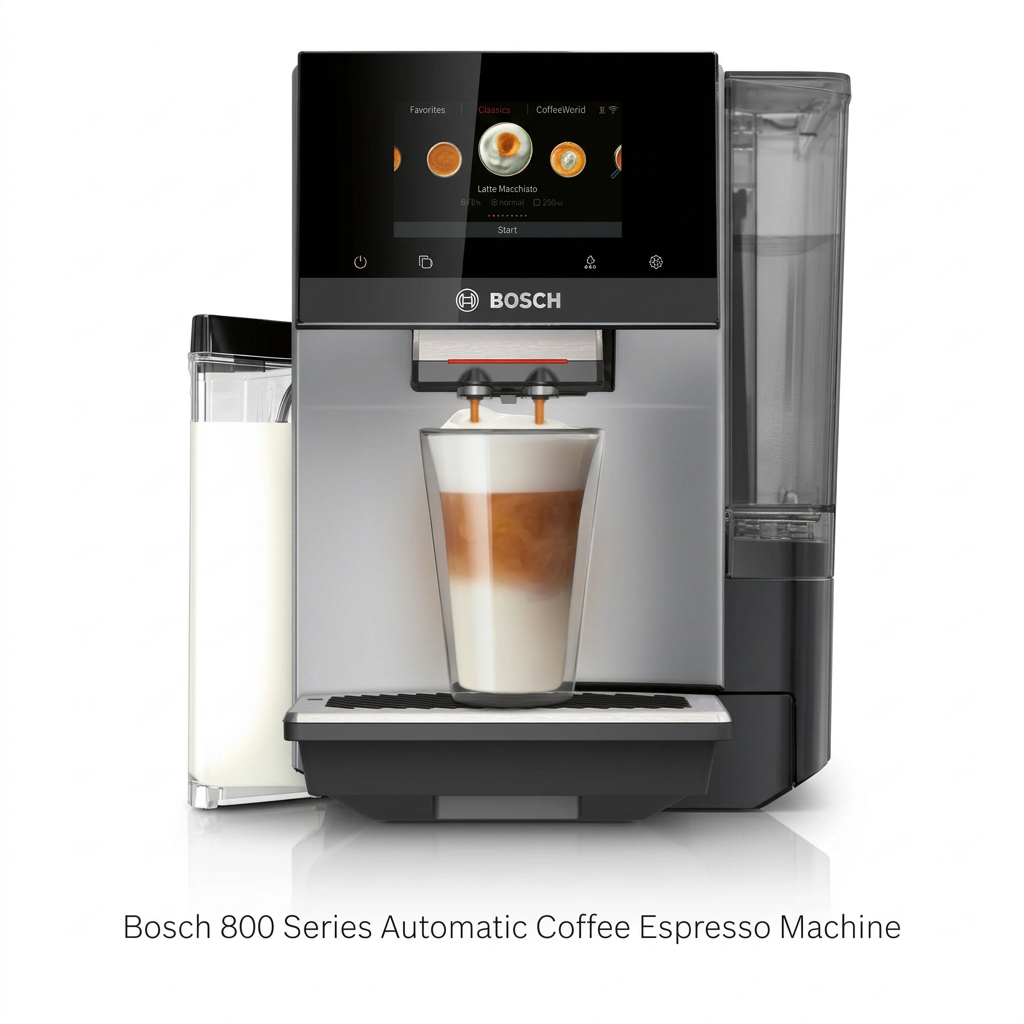
A 19-bar pump, a 5-inch touchscreen with 24 drinks and 30 favorites, an 81-ounce tank and a clip-on milk container.
Check price on Amazon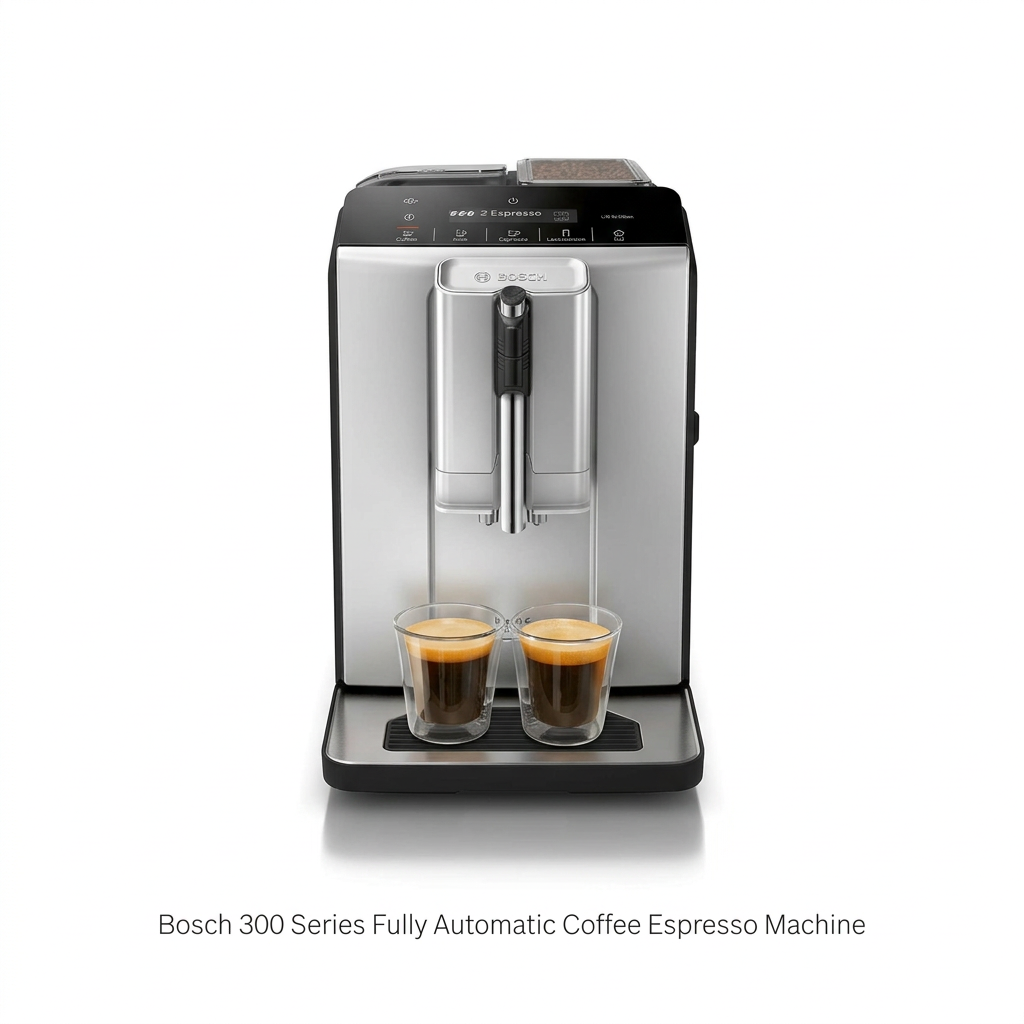
Five one-touch drinks, a quiet ceramic grinder, a front-access brew unit and a dishwasher-safe in-cup frother, under 10 inches wide.
Reveal Today’s DealBosch 300 vs 800 Series at a glance
- Buy the 800 Series if several people share it and you want the richest espresso in the range.
- Buy the 300 Series if one or two people drink espresso, coffee and cappuccino in a small kitchen.
- Both have a removable brew unit and a quiet ceramic grinder.
- Both serve drinks warm rather than scalding; warm your cups.
Head to head
The better result in each row is marked, based on my four weeks with each machine and Bosch’s specs. Rows where they are even have no winner.
These sit at opposite ends of Bosch’s range, so the 800 wins most rows. The 300’s wins are about size and simplicity.
| Spec | Bosch 300 | Bosch 800 |
|---|---|---|
| Espressomy scores | 7.8 | 8.6 ✓ Best |
| Milk drinksmy scores | 7.4 | 8.3 ✓ Best |
| Ease of usemy scores | 8.5 | 8.9 ✓ Best |
| Cleaningmy scores | 7.9 ✓ Best | 7.8 |
| One-touch drinks | 5 | 24, 36 with the app ✓ Best |
| Favorites | None | 30 ✓ Best |
| Pump | 15 bar | 19 bar ✓ Best |
| Display | Buttons and small display | 5-inch touchscreen ✓ Best |
| Milk system | In-cup frother, dishwasher safe | Clip-on 24 oz container |
| Water tank | 45 oz | 81 oz ✓ Best |
| Drip tray | Fills at a normal pace ✓ Best | Fills quickly |
| Width | Under 10 in ✓ Best | About 13.9 in |
| App | No | Home Connect ✓ Best |
| Rows won | 3 | 9 |
Bosch 300 vs 800 Series pros and cons
Bosch 300 Series
- Very easy to use, with one button per drink
- Removable brew unit and dishwasher-safe frother
- Slim, quiet and tidy on the counter
- Only five drinks and no app
- Grinder has just a few settings
- 45-ounce tank needs frequent refills
Bosch 800 Series
- Rich espresso from a 19-bar pump
- 5-inch touchscreen with 30 favorites
- 81-ounce tank and a quiet ceramic grinder
- Drip tray fills quickly
- Drinks are warm rather than piping hot
- Large, and parts of the body are plastic
Who should buy which machine?
- Families with many different drink preferences
- Capsule owners moving to fresh beans
- Early risers who need a quiet grinder
- Couples who drink espresso, coffee and cappuccino
- First-time owners moving up from pods
- Narrow counters and tidy kitchens
Design, size and build
These two sit at opposite ends of Bosch’s range, and it shows the moment you unbox them.
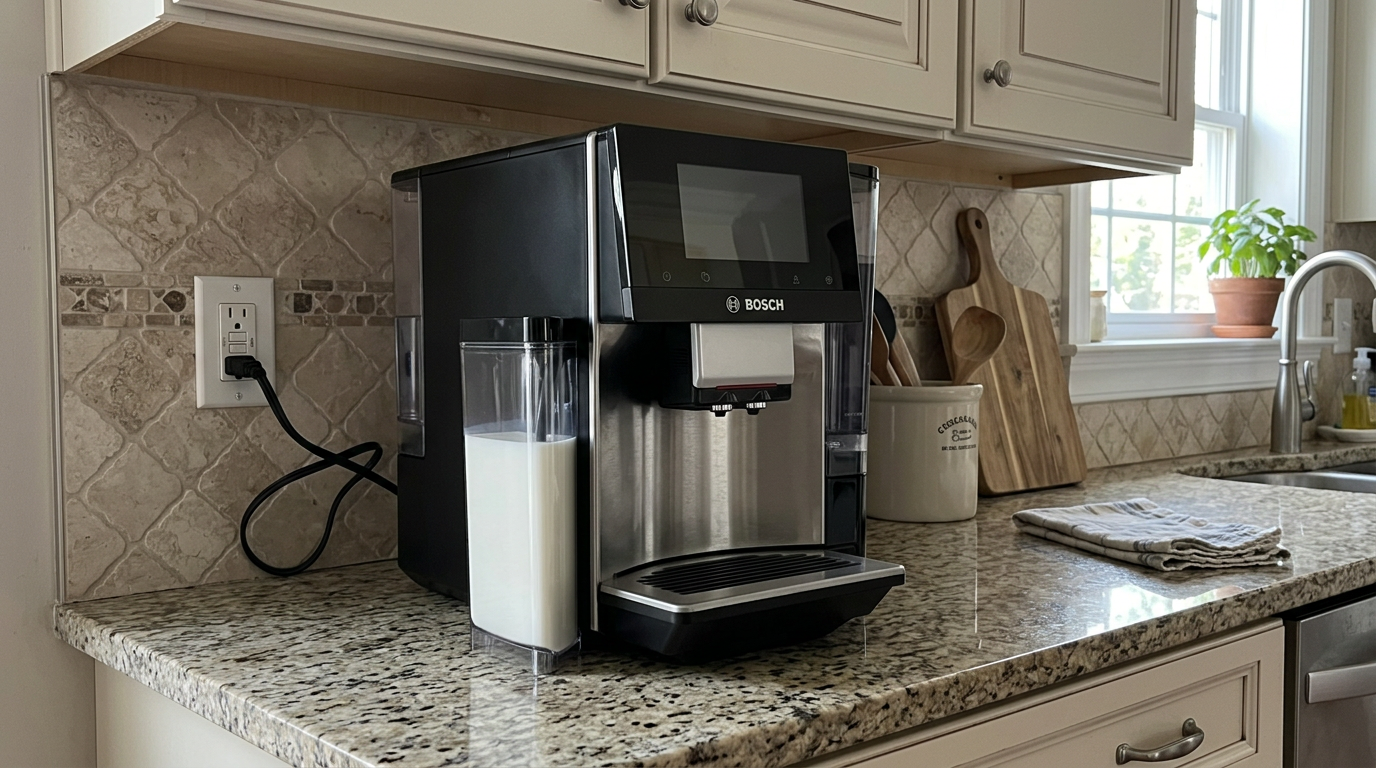
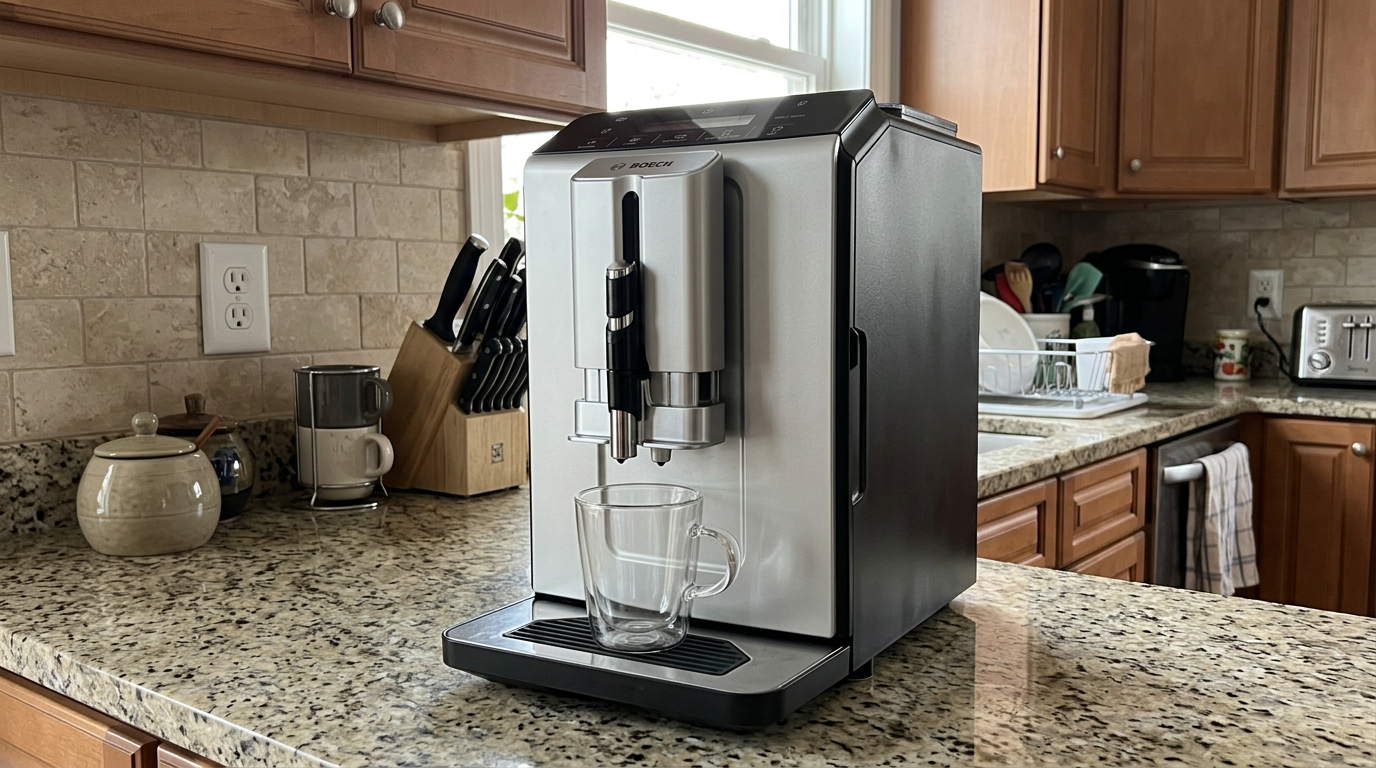
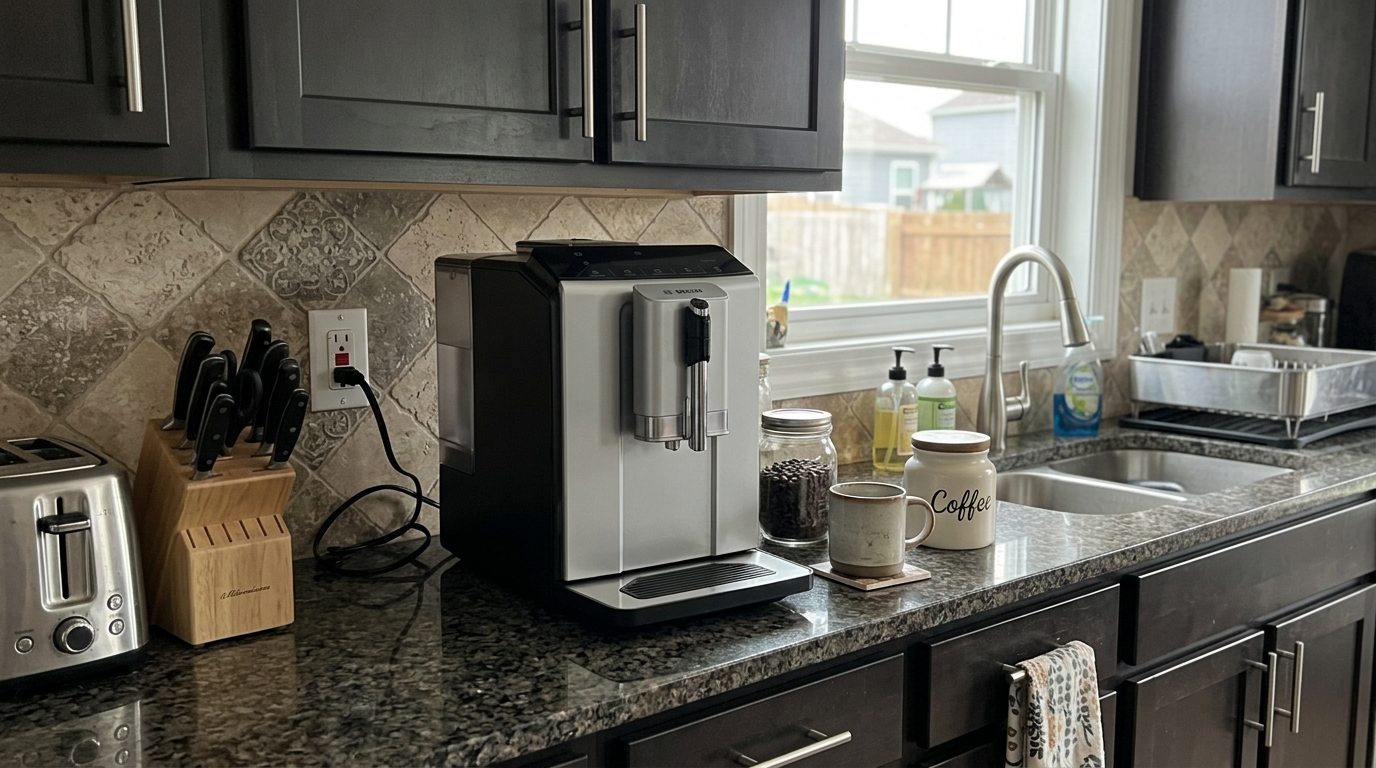
The Bosch 300 Series is slim and tidy: about 9.75 inches wide, 14.88 inches tall and 16.5 inches deep. My silver unit has a brushed front panel, a black body and a clip-on milk frother at the front.
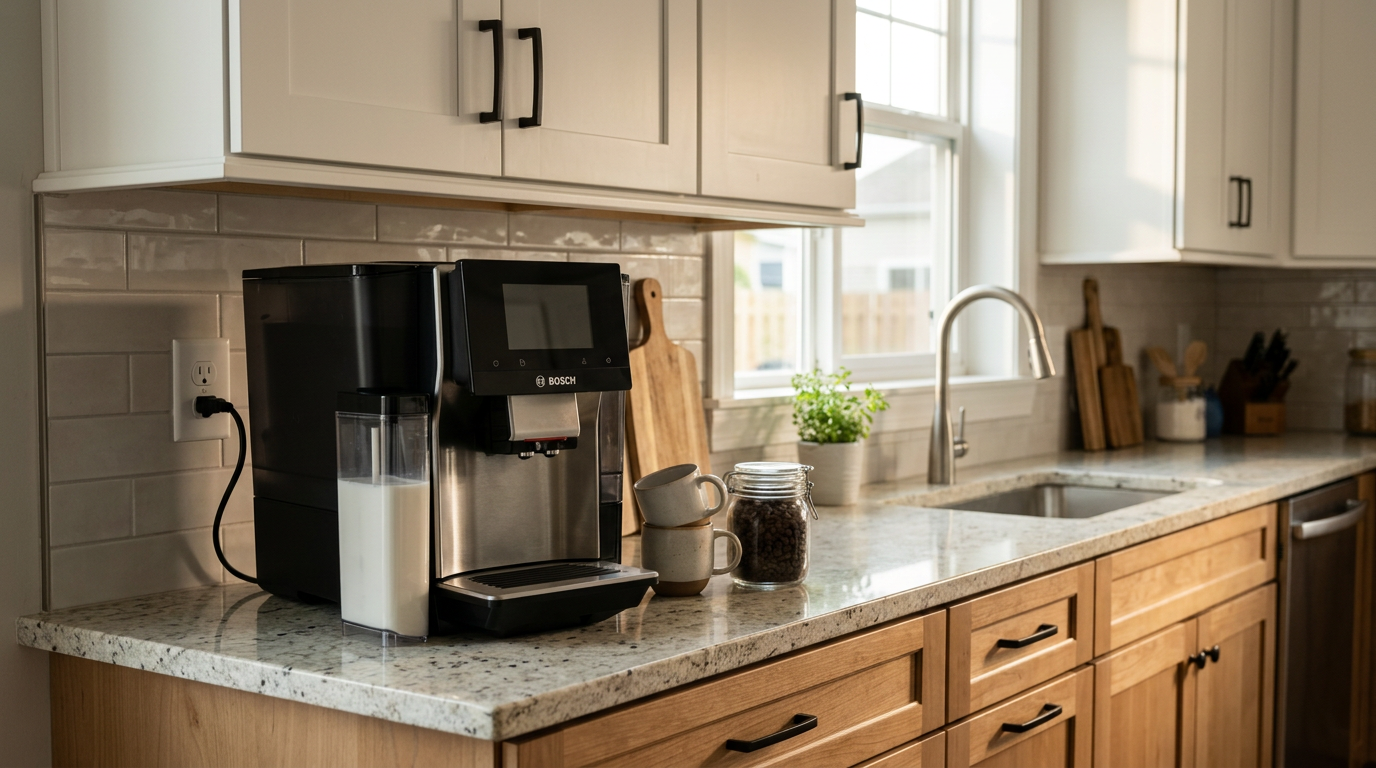
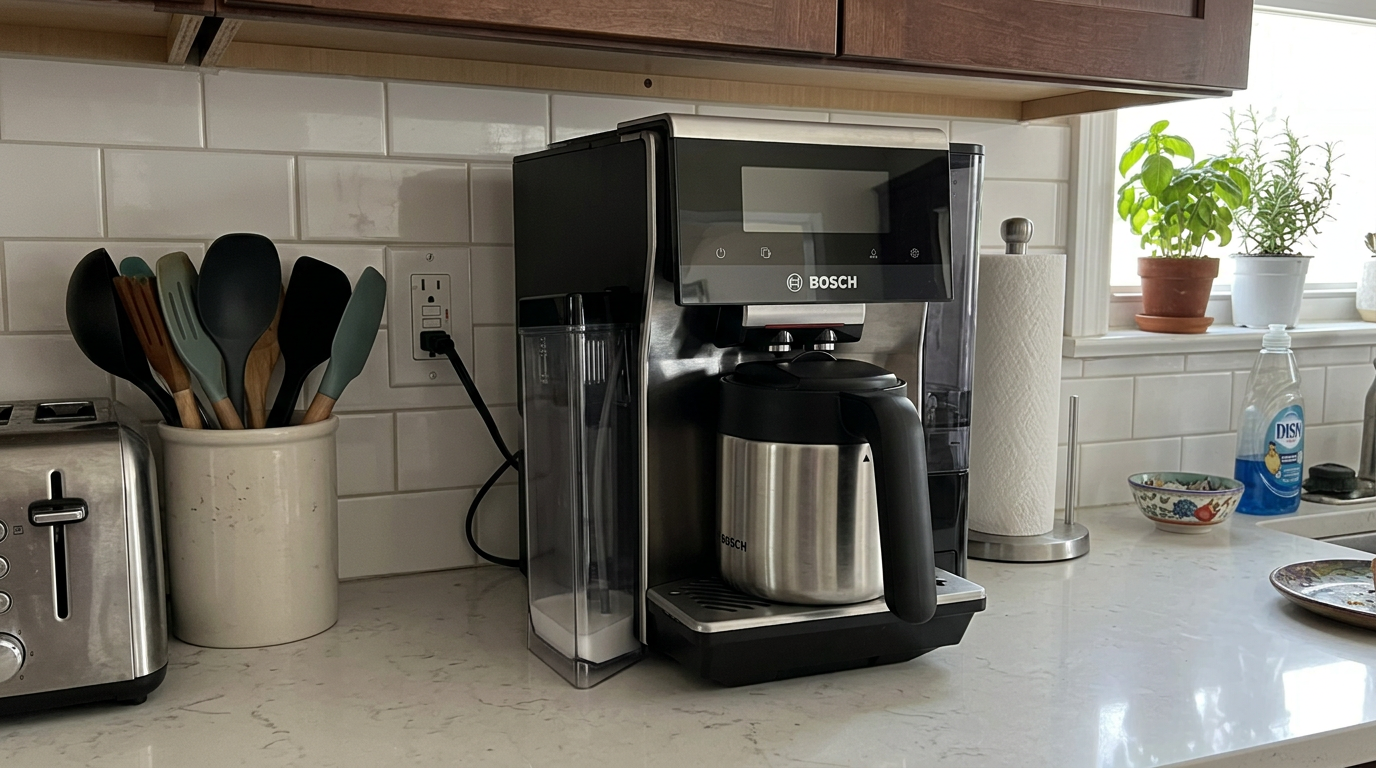
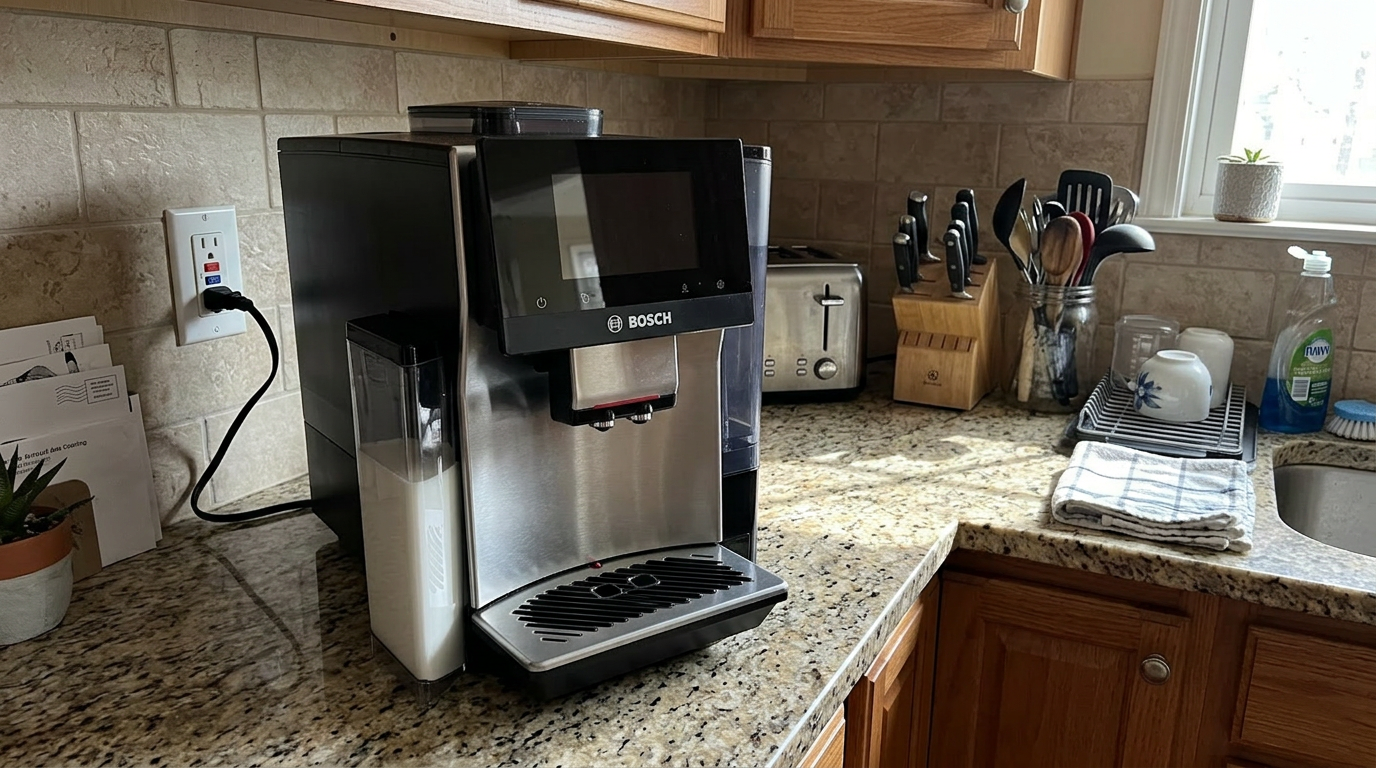
The Bosch 800 Series is big: about 13.9 inches wide, 15 inches tall and 18.4 inches deep. A 5-inch touchscreen dominates the front, and a clear milk container clips onto the side.
The 800 Series is the largest Bosch, built around a 5-inch touchscreen.
Width on the counter
Day to day, the 300’s slim body was the thing I appreciated most. It sat beside the kettle without crowding it, and the spout slides up and down to fit cups up to about 5 inches tall.
The 800’s presence is the opposite. It looks like the centerpiece of the kitchen, and guests asked about it, but it needs a dedicated spot.
From Bosch’s specs and my tape measure.
At about 18.4 inches deep, the 800 uses the full depth of a standard counter and needs a little space behind it for air. At 15 inches tall, it fits under most wall cabinets, which typically sit about 18 inches above the counter.
The 300 slides under standard cabinets with room to spare. Both are partly plastic, but the 800’s brushed front and big screen make it feel more premium.
Our tip: Measure your counter depth before buying the 800 Series, because at about 18.4 inches it needs nearly the full depth of a standard counter.
Setup and the first week
Setup was guided on both. On the 800, it took about 15 minutes on the touchscreen, plus a few minutes to pair the Home Connect✕Home ConnectBosch’s appliance app. On the 800 Series, it adds 12 extra drinks and lets you start or adjust drinks from your phone. app.
On the 300, setup was even simpler: fill, prime, set water hardness and rinse. There’s no app to pair.
On both, I spent the first week adjusting the grinder and drink volumes. The default espresso on the 300 was long, so I programmed it to about 1.3 fluid ounces for a denser, sweeter shot.
Both include a water hardness strip and a water filter. Entering the right hardness matters, because it sets how often each machine asks for descaling.
| Setup step | Bosch 300 | Bosch 800 |
|---|---|---|
| Water hardness | Set in the menu | Guided on touchscreen |
| App | None | Home Connect, a few minutes |
| Grinder | One step finer than default | Two steps finer than default |
| Favorites | None | Up to 30 |
| Time to first drink | A few minutes | About 15 minutes with setup |
Drinks, display and favorites
The 300 makes five drinks: espresso, coffee, cappuccino, latte macchiato and milk froth. There’s no Americano or flat white on the menu, and no app.
The 800 has 24 drinks on its touchscreen and up to 36 through the app, including a cold brew-style drink and international specialties. It stores up to 30 favorites, the most in Bosch’s range.
One-touch drinks
Counted from each machine’s menu.
At 5 inches, the 800’s screen shows large drink images that you swipe through like a phone. Its Coffee Playlist lets you queue several drinks for a group, which was brilliant for weekend guests.
The 300’s buttons were quicker for one drink. Nobody in my house needed help with it.
| Feature | Bosch 300 | Bosch 800 |
|---|---|---|
| Drinks | 5 | 24, 36 with app |
| Americano and flat white | No | Yes |
| Favorites | None | 30 |
| Coffee pot | No | About 25 oz in several cycles |
| Coffee Playlist | No | Yes |
| App | No | Home Connect |
If an app matters to you but the 800 is too big, the Bosch Series 4 adds Home Connect to a smaller body. In my testing, though, I rarely used the 800’s app once favorites were saved on the touchscreen.
The 800’s 5-inch screen shows large drink images you swipe through.
A typical morning on each
For two people, a typical weekday was an espresso and a cappuccino.
On the 300, I pressed espresso, then clipped the frother on, dropped its tube into a milk carton and pressed cappuccino. The espresso took about 35 seconds and the cappuccino about 90. Afterward, I rinsed the frother and put it in the dishwasher in the evening.
On the 800, I tapped my favorite, then my partner tapped hers. The milk container stayed clipped on the side, and the machine ran a short rinse after the milk drink. The whole thing took under three minutes, and neither of us touched a setting.
On weekends, the gap grew. With guests, the 800’s Coffee Playlist queued four drinks in a row while I set the table. On the 300, I stood at the machine and pressed each button in turn, refilling the tank halfway through.
| Morning step | Bosch 300 | Bosch 800 |
|---|---|---|
| Pick a drink | One button per drink | Tap a saved favorite |
| Milk | Clip frother, tube in carton | Container clipped on the side |
| Two drinks | About 2 minutes | Under 3 minutes, hands-free |
| After milk | Rinse frother | Automatic rinse, empty tray |
Hands-on steps for two drinks, my count
Counted from my weekday routine, including milk cleanup.
Grinder and pump
Both use a quiet ceramic grinder✕Ceramic grinderA grinder with ceramic burrs instead of steel. It stays cooler and quieter and keeps its edge for years.. The 300’s has only a few settings, while the 800’s sits in an insulated chamber and is the quietest grinder in Bosch’s range.
The bigger difference is the pump. Every other Bosch I’ve tested, from the 300 Series to the Series 6, runs at 15 bar. The 800 uses a 19-bar pump and Bosch’s AromaMax system.
In the cup, that gave the 800’s espresso a little more body than the 15-bar machines.
The 300’s grinder has only a few steps, so I treated grind as a once-per-bag decision. The 800’s finer steps let me match each bag a little more closely, which showed up most with lighter roasts.
| Grind setting | Bosch 300 | Bosch 800 |
|---|---|---|
| Finest | Slow, bold | Slow, intense |
| Two steps finer than default | — | Rich, my pick |
| One step finer than default | Fuller, my pick | Fuller |
| Factory default | Balanced | Light |
| Coarser | Lighter, thin | Thin |
Pump pressure
Rated pump pressure. About 9 bar is the target at the coffee itself.
Our tip: Only change the grind while the grinder is running on either Bosch, because turning the dial with the burrs stopped can jam beans.
Espresso and coffee
Once dialed in, the 800 made the best espresso of all the Bosch machines I tested. Two steps finer than the default, its shots were rich and syrupy with a thick crema✕CremaThe golden, foamy layer on a fresh espresso. It forms when pressure pushes oils and gases out of the coffee..
The 300’s espresso was smooth and pleasant, a step behind in body. Programmed to about 1.3 fluid ounces with the grinder one step finer, it was denser and sweeter than the default.
My espresso ratings
My scores out of 10 for body, crema, flavor and consistency.
For mug drinkers, the 800 is far better equipped. Its Americano✕AmericanoEspresso topped up with hot water. Done properly, the water is added after the shot instead of being pushed through the coffee. uses a separate hot water path and came out at about 164°F on medium. Its coffee pot function brews about 25 ounces in several cycles.
The 300 makes a clean coffee in a mug, but for a big mug, I ran two brews. There’s no Americano on its menu.
Consistency was good on both. Once I set the grind and volume, each machine made the same espresso every morning for four weeks, which is exactly what you want from a fully automatic machine.
The 800 also brews ristretto, the boldest short drink in the range. It became my after-dinner espresso by week two.
The 300 makes a smooth espresso; program it shorter for more body.
| Black coffee | Bosch 300 | Bosch 800 |
|---|---|---|
| Espresso | Smooth, good | Rich, syrupy |
| Ristretto | No | Yes |
| Americano | No | Yes, separate water path |
| Big mug | Run two brews | Coffee, or coffee pot |
| Iced or cold brew-style | No program | Via the app |
Drink temperature
This is the one weakness the two share. Both serve drinks warm rather than piping hot, and even the flagship 800 isn’t an exception.
On the 300, my espresso measured about 148°F in a cold cup on the first drink, rising to about 163°F with a warmed cup and a rinse first. On the 800, espresso came out around 150°F in a cold cup and about 161°F in a warm cup after a hot water flush.
Espresso temperature in the cup
Temperature matters because espresso cools fast. A 1-ounce shot in a cold ceramic cup can lose 10 degrees in the first minute, which is why warming the cup makes such a difference on any machine.
Measured with a probe thermometer.
Warming the cup made the biggest difference on both. If you like coffee above 175°F, you’ll notice the gap with either machine.
Milk drinks
The two take different approaches to milk.
The 300 uses an in-cup frother that clips onto the front. It draws milk through a short tube and pours foam straight into your cup, and the whole frother goes in the dishwasher. Whole milk scored 8.4 in my notes, barista oat 7.8.
The 800 uses a clear milk container of about 24 ounces that clips onto the side. Milk straight from the fridge, around 35 to 40°F, gave dense, glossy foam; whole milk scored 8.8.
Whole-milk foam scores
My scores out of 10 for texture and stability.
Bosch 800 foam by milk
My scores out of 10 on the 800 Series.
Milk that warmed above about 50°F on the counter made big, soapy bubbles that collapsed in the cup on both machines. Keep the milk cold until the last moment.
On the 800, a cappuccino landed around 150°F in a cold cup and about 157°F in a warm cup with fridge-cold milk. For a finished cappuccino, the whole sequence took under 90 seconds.
Plant milk behaved well on the 800. Barista oat scored 8.2 and foamed glossy and stable, while almond was thinner at 7.0. On the 300, barista oat scored 7.8 and was the best non-dairy option.
Neither machine lets you texture milk by hand, so latte art isn’t really possible. For café-style cappuccinos and latte macchiatos, both did the job well.
The 800’s clip-on milk container made the denser foam of the two.
Our tip: Keep the 800’s milk container in the fridge between drinks, because milk above about 50°F makes big, soapy bubbles.
Hot water and tea
Both dispense hot water, and both let you set the amount. Like their coffee, the water comes out warm rather than boiling.
For green and white tea, that was ideal. For black tea, I warmed the mug first and still found the water a little cool compared with a kettle.
| Tea type | Ideal water | Both Bosch machines |
|---|---|---|
| Green tea | 158–176°F | Excellent |
| White tea | 167–185°F | Excellent |
| Herbal tea | 194–212°F | A little cool |
| Black tea | 203–212°F | Use a kettle for strong tea |
Our tip: Keep a kettle for strong black tea with either Bosch, because their hot water is tuned for coffee, not boiling-point tea.
Cleaning and upkeep
Cleaning scores were almost identical, for different reasons.
The 300’s brew unit✕Brew unitThe removable part that presses the ground coffee, brews it and drops the used puck into the grounds container. slides out the front for a rinse, and its in-cup frother goes straight in the dishwasher. Its weak spot is the 45-ounce tank, which needs refilling often.
The 800 has an 81-ounce tank you rarely fill, but a drip tray you empty often, because its automatic rinses add up. It’s the odd contrast of this machine.
Cleaning scores
Both remind you when to clean and descale, and both walk you through it on screen. The 800’s larger display made the steps easier to follow.
My scores out of 10 from my single reviews.
| When | Bosch 300 | Bosch 800 |
|---|---|---|
| After milk | Rinse frother, dishwasher safe | Rinse container and tube |
| Daily | Empty tray and grounds, refill tank | Empty drip tray, often |
| Weekly | Rinse brew unit | Rinse brew unit |
| When prompted | Clean and descaling✕DescalingRunning a mild acid through the machine to dissolve the mineral scale that hard water leaves in the heater and pipes. | Clean and descale |
For cleaning programs, put a container of at least 30 ounces under the outlets of the 800. Its rinse and clean cycles use a lot of water.
The 300’s brew unit slides out from the front for a weekly rinse.
Our tip: Empty the 800’s drip tray every morning, even if it looks half full, because the automatic rinses can fill it by evening.
Noise and speed
Both are quiet. The 800’s insulated ceramic grinder measured about 60 dB, around the level of normal conversation, while a typical uninsulated burr grinder runs around 70 dB.
The 300 was similarly calm, slim and tidy, and never woke anyone in my house.
Grinding noise
In an open-plan apartment, both were easy to live with at 6 a.m. The 800’s insulated grinder chamber is a genuine upgrade if early mornings and light sleepers are part of your life.
Measured with a phone meter at about 3 feet.
Bosch 300 drink times
Timed from pressing the button to the last drip.
The 800 made a cappuccino in under 90 seconds, similar to the 300. Its Coffee Playlist lets you queue drinks for several people, which made it the faster machine for a group.
Water, beans and supplies
The tanks are the biggest practical difference after the menu. The 300’s 45-ounce tank is its practical limit; the 800’s 81-ounce tank is the biggest in Bosch’s range.
Drinks per full tank
Rough maths allowing for rinse water.
Both worked best with fresh medium and medium-dark beans. The 300’s hopper holds about 9 ounces, roughly 255 grams.
Avoid oily beans on both, because they build up in ceramic grinders and chutes over time.
Fill both tanks with fresh, cold water each day and use the water filter if your water is moderately hard. On the 300, a fresh tank every morning became a habit; on the 800, I topped it up every few days.
| Bean type | Bosch 300 | Bosch 800 |
|---|---|---|
| Medium-dark blend | Best, one step finer | Best, two steps finer |
| Medium roast | Good | Very good |
| Light roast | Thin | Good, finer grind |
| Very dark, oily | Avoid | Avoid |
The 800’s 81-ounce tank is the biggest in Bosch’s range.
Is the flagship worth it?
The 800 costs considerably more, so it’s worth being clear about what you get.
You gain 19 more drinks on the screen and 31 more with the app, 30 favorites, a 19-bar pump that made noticeably richer espresso, an 81-ounce tank, a 5-inch touchscreen, a coffee pot function and Coffee Playlist for groups.
You give up compactness, the dishwasher-safe in-cup frother and some tidiness on the counter. The 800 also fills its drip tray much faster.
In daily use, the favorites and the richer espresso were the upgrades I noticed most. The extra drinks were fun in week one, but my household settled on about six of them.
| What changes | 800 vs 300 |
|---|---|
| Espresso | Richer, 19 bar vs 15 bar |
| Drinks | 24 on screen vs 5 |
| Favorites | 30 vs none |
| Tank | 81 oz vs 45 oz |
| Milk | Clip-on container vs in-cup frother |
| Footprint | About 13.9 x 18.4 in vs 9.75 x 16.5 in |
| Drip tray | Fills faster on the 800 |
If neither feels right, the Bosch 500 Series sits between them, with nine drinks including Americano and flat white and a milk hose, in a body closer to the 300’s size.
Four weeks with each, week by week
These were my notes as each machine settled into the routine.
| Week | Bosch 300 | Bosch 800 |
|---|---|---|
| Week 1 | Shortened the espresso, one step finer | Favorites and app setup |
| Week 2 | Five drinks covered everything | Exploring 24 drinks |
| Week 3 | Refilling the tank often | Emptying the drip tray daily |
| Week 4 | Simple and reliable | Best Bosch espresso, easy for guests |
The 300 settled into a simple routine almost immediately. Five buttons covered everything two people asked for.
The 800 was the more impressive machine every day. By week four, my household had saved favorites for everyone, and its Coffee Playlist made weekend breakfasts easy.
Neither machine had a fault or error message during testing. Both brew units came out clean at every weekly rinse.
Three households, three picks
After a month with each, I could picture exactly who each machine suits.
The couple moving up from pods: 300 Series
Two people who drink espresso, coffee and cappuccino and want fresh beans with the same ease as capsules. The 300’s one-button-per-drink layout felt immediately familiar.
The busy family: 800 Series
Four people with four favorite drinks and guests at the weekend. Thirty favorites, Coffee Playlist and an 81-ounce tank made the 800 the machine that kept up.
The espresso lover
Someone who mostly drinks espresso and ristretto. The 800’s 19-bar pump made the best shot in Bosch’s range, and that alone justifies it for this drinker.
Common mistakes to avoid
These habits cost me the most flavor and the most cleaning time on both Bosch machines.
| Mistake | What happens | Fix |
|---|---|---|
| Brewing into a cold cup | Espresso around 148–150°F | Hot water flush first |
| Leaving the default grind | Light, thin espresso | One or two steps finer |
| Long default espresso on the 300 | Watery shot | Program about 1.3 fl oz |
| Warm milk | Big, soapy bubbles | Keep milk fridge-cold |
| Ignoring the 800’s drip tray | Overflow by evening | Empty it every morning |
The cold cup was the mistake I made most. It took 10 seconds to fix and made the biggest difference to how hot every drink felt.
What I’d change on each one
On the 300, I’d add an Americano button and a bigger tank. At 45 ounces, the tank needed refilling almost daily, and an Americano would round out its short menu.
On the 800, I’d raise the brewing temperature and enlarge the drip tray. Warm cups help, but a few more degrees would make it the complete flagship.
Our tip: Set a hot water flush as the first step of your morning routine on either Bosch, because it’s the simplest fix for drinks that feel warm rather than hot.
Real-life scenarios
These are the moments where one machine clearly pulled ahead in my kitchen.
Each scenario below is one I repeated several times during the month, so the winner is the machine that handled it best on most days.
Thirty favorites meant everyone had their drink saved.
Under 10 inches wide, it fit where the 800 couldn’t.
The 19-bar pump gave noticeably more body.
Coffee Playlist and a 25-ounce coffee pot.
The whole in-cup frother went in the dishwasher.
A separate hot water path; the 300 has no Americano.
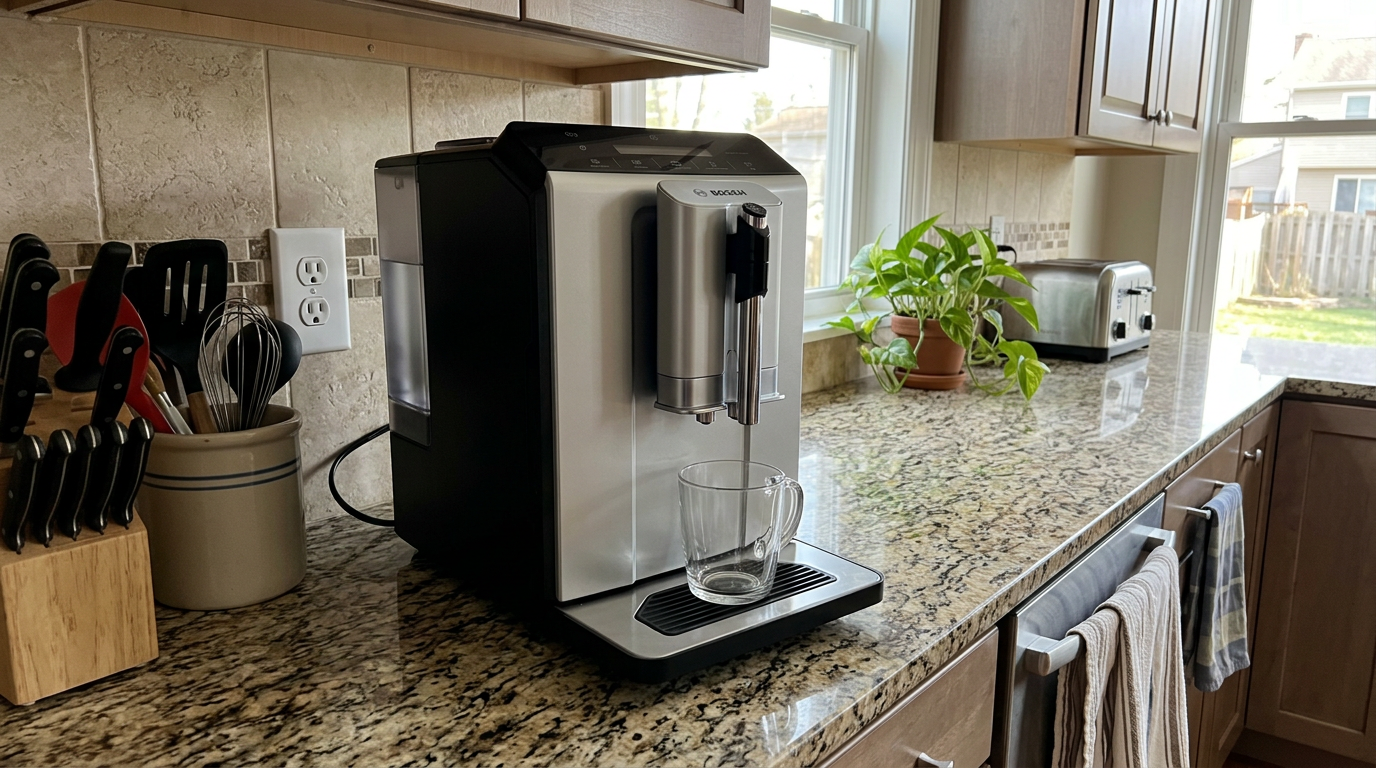
For narrow counters, the 300 is the tidier fit.
My scorecard
These are my scores out of 10 from my single reviews of each machine.
Bosch 300 Series
Overall: 7.7
Bosch 800 Series
Overall: 8.5
The 800 wins on almost everything. The 300’s case is size, simplicity and a frother you put in the dishwasher.
Cleaning is the only category where the 300 edges ahead, thanks to its dishwasher-safe frother and a drip tray that fills at a normal pace.
See How Much You’ll SaveWhich one is right for you?
4 quick questionsWhich one should you buy?
Count the people and the drinks. One or two people with five favorite drinks are well served by the 300. Three or more, or anyone who wants Americanos, flat whites and saved favorites, should buy the 800.
For the step between them, see my Bosch 500 Series review, which adds nine drinks and a milk hose.
If you’re torn, think about the next five years rather than the next five weeks. Households tend to grow into more drinks and more people, and the 800 has room for that. A couple with settled habits will be just as happy with the 300 for years. For the wider picture beyond this matchup, see my guide to the best Bosch espresso machines.
- Several people share the machine
- You want the best Bosch espresso
- You want Americanos and a coffee pot
- You have a full-depth counter
- You like scalding-hot coffee
- Your counter is shallow
- You want the smallest machine
- One or two people share it
- You drink espresso, coffee and cappuccino
- You have a narrow gap
- You want a dishwasher-safe frother
- You want Americano or flat white
- You want saved favorites or an app
- You hate refilling the tank
For most households, my pick is the Bosch 800 Series. It made the best espresso in Bosch’s range, its 5-inch touchscreen and 30 favorites make it easy to share, and its 81-ounce tank rarely needs filling.
The Bosch 300 Series is the smarter buy for one or two people in a small kitchen. It makes five drinks well, takes less than 10 inches of counter width and has a frother you can put in the dishwasher.
Whichever you choose, warm your cups, turn the grinder a step or two finer and keep milk cold until it goes in the machine.
Bosch 300 vs 800 Series specifications
From manufacturer specifications and my own testing.
| Bosch 300 Series | Bosch 800 Series | |
|---|---|---|
| Model tested | TIU20307 | TQU60307 |
| Type | Fully automatic | Fully automatic |
| Drinks | 5 | 24, 36 with app |
| Pump | 15 bar | 19 bar |
| Heating | Thermoblock | Thermoblock |
| Grinder | Ceramic, few settings | Ceramic disc, insulated |
| Display | Buttons and small display | 5-inch touchscreen |
| Favorites | None | 30 |
| Milk | In-cup frother, dishwasher safe | Clip-on container, about 24 oz |
| Water tank | 45 oz | 81 oz |
| Bean hopper | About 9 oz | Large |
| App | No | Home Connect |
| Size (W x H x D) | 9.75 x 14.88 x 16.5 in | 13.9 x 15 x 18.4 in |
How I tested and compared them
I used each machine as my everyday coffee maker for four weeks, making espresso, coffee, cappuccinos and latte macchiatos on both, plus Americanos, flat whites and the coffee pot on the 800.
I measured espresso, milk and Americano temperatures with a probe thermometer in cold and warm cups, timed every drink, measured noise with a phone meter and foamed whole, 2%, skim, barista oat and almond milk.
I ran every rinse, cleaning and descaling program, then compared my notes with Bosch’s specifications, owner documentation and published test data.
- Coffee: body, crema, temperature and consistency.
- Milk: foam texture, temperature and cleanup.
- Workflow: menus, favorites, app and speed.
- Ownership: cleaning, capacity, noise and footprint.
Bosch 300 vs 800 Series FAQ
What is the main difference between the Bosch 300 and 800 Series?
The 800 Series has a 19-bar pump, a 5-inch touchscreen with 24 drinks and 30 favorites, an 81-ounce tank and a clip-on milk container. The 300 Series makes five drinks with buttons, has a 45-ounce tank and an in-cup frother.
Which makes better espresso?
The 800 Series. Its 19-bar pump and AromaMax system gave noticeably more body than the 300’s 15-bar pump.
Do Bosch machines make hot coffee?
They serve drinks warm rather than scalding. Warming the cup with a 2-ounce hot water flush raised my espresso to about 161 to 163°F on both.
Can the Bosch 300 make an Americano?
Not at one touch. Its menu is espresso, coffee, cappuccino, latte macchiato and milk froth.
Is the 800 Series worth it over the 300?
Yes, for three or more people, for Americanos and flat whites, or for the best espresso in Bosch’s range.
Which is easier to clean?
They scored almost the same. The 300’s frother goes in the dishwasher; the 800’s drip tray fills quickly from its automatic rinses.
Do both have a removable brew unit?
Yes, both have a brew unit you can remove and rinse.
Which is quieter?
Both are quiet. The 800’s insulated ceramic grinder measured about 60 dB.
Which fits a small kitchen?
The 300 Series, at under 10 inches wide. The 800 is about 13.9 inches wide and 18.4 inches deep.
Does the 800 Series have an app?
Yes, Home Connect, which adds 12 drinks for 36 in total.

- Our hands-on Bosch 300 Series review
- Our hands-on Bosch 800 Series review
- Bosch product specifications and owner documentation
- General espresso brewing and maintenance guidance