Bosch 300 vs 500 Series espresso machine: what’s the difference?
They share a ceramic grinder, a 15-bar pump, a thermoblock and a removable brew unit. Then they split: the Bosch 300 Series keeps it to five drinks with a dishwasher-safe in-cup frother, while the Bosch 500 Series adds nine drinks, milk straight from the carton, Double Shot strength, a decaf chute and a 64-ounce tank. I used both every day for four weeks and lined up the data to find out which one belongs in your kitchen.
We choose products independently. We may earn a commission through links on this page; your price stays the same. Affiliate policy
Jargon helpNew to espresso? Tap any dotted term to see what it means.
In this comparison
For most people, the Bosch 500 Series is the Bosch to buy. It makes nine drinks instead of five, draws milk straight from the carton, brews two of any drink at once, holds 64 ounces of water and adds a chute for decaf, and its Double Shot setting makes the best espresso of Bosch’s lower and middle models. The Bosch 300 Series is still a lovely machine for one or two people who want five simple drinks, a frother that goes in the dishwasher and a brew unit that slides out the front.
The two machines
Specs checked November 14, 2026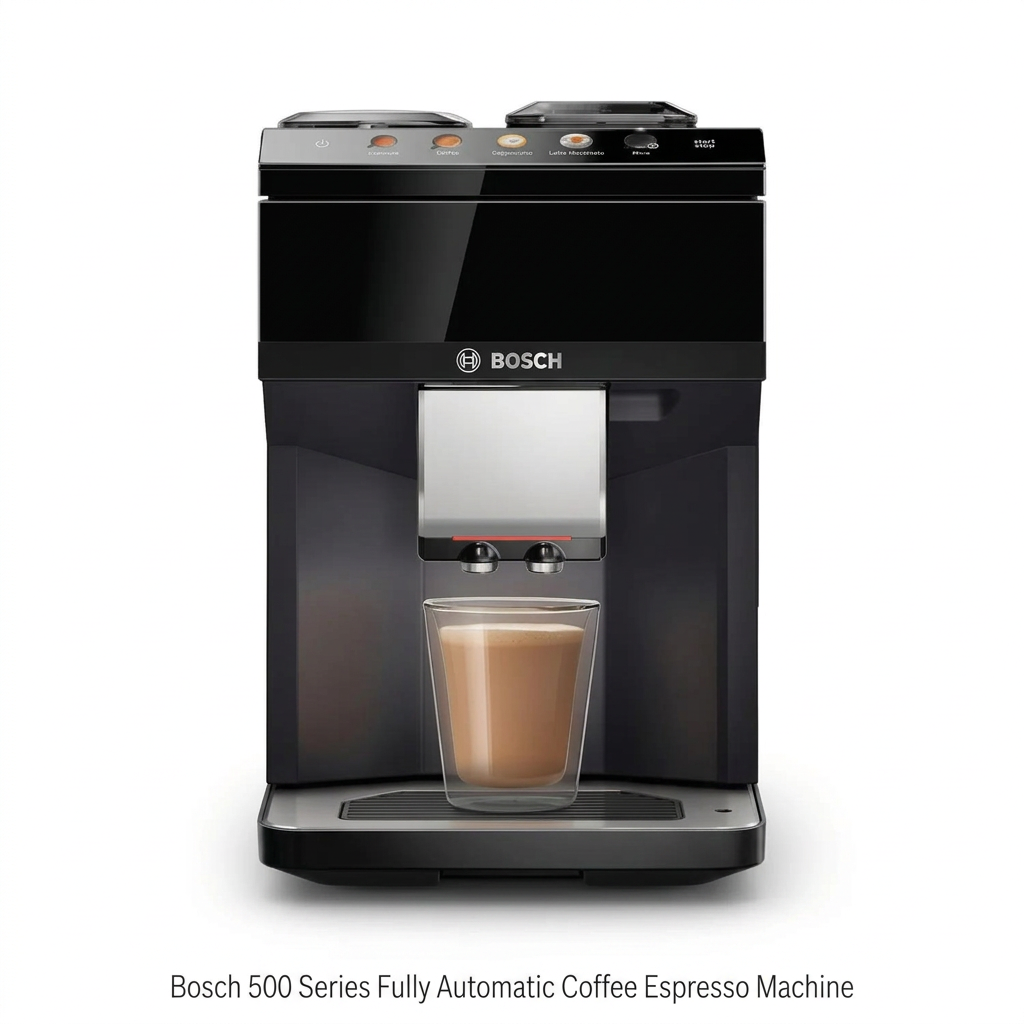
Nine drinks including Americano and flat white, milk straight from the carton, Double Shot strength and a 64-ounce tank.
Check price on Amazon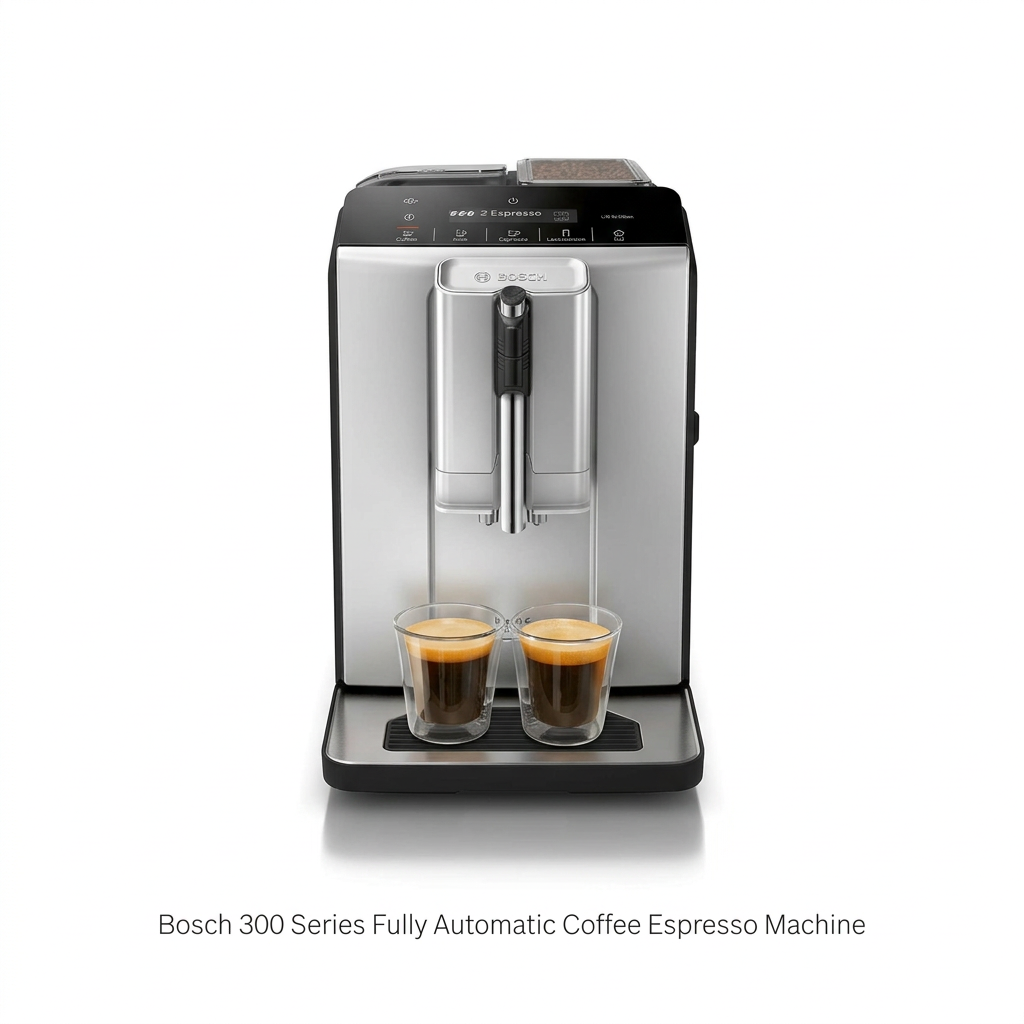
Five one-touch drinks, a dishwasher-safe in-cup frother, a front-loading brew unit and a body under 10 inches wide.
Reveal Today’s DealBosch 300 vs 500 Series at a glance
- Buy the 500 if you want more drinks, milk from the carton, decaf and a bigger tank.
- Buy the 300 if you want five simple drinks and the easiest possible cleanup.
- Both use a ceramic grinder, a 15-bar pump, a thermoblock and a removable brew unit.
- The 500 is barely bigger, about 0.65 inches wider, so space rarely decides it.
Head to head
The better result in each row is marked, based on my testing and the manufacturer specs. Rows where the machines are identical have no winner.
Keep in mind that the tally is not my verdict. Some rows matter far more than others, and which ones matter depends on what you drink.
| Spec | Bosch 300 Series | Bosch 500 Series |
|---|---|---|
| Espressomy score | 7.8, smooth and nutty | 8.1, richer with Double Shot ✓ Best |
| One-touch drinks | 5 | 9 ✓ Best |
| Americano and flat white | No | Yes ✓ Best |
| Strength settings | Set with the bean button | Mild, Regular, Strong, Double Shot ✓ Best |
| Grind settings | A few steps | 6 ✓ Best |
| Milk system | Clip-on in-cup frother | Hose from the carton, AutoMilk Clean ✓ Best |
| Dishwasher-safe milk parts | Whole frother ✓ Best | Hose parts |
| Two cups at once | Espresso and coffee | Every drink ✓ Best |
| Ground coffee chute | No | Yes, one scoop ✓ Best |
| Water tank | 45 oz | 64 oz ✓ Best |
| Brew unit access | Front ✓ Best | Side door |
| Width | 9.75 in ✓ Best | About 10.4 in |
| Ease of usemy score | 8.5 ✓ Best | 8.3 |
| Cleaningmy score | 7.9 ✓ Best | 7.7 |
| Rows won | 5 | 9 |
Bosch 300 vs 500 Series pros and cons
Bosch 300 Series
- Very easy to use, with one button per drink
- Removable brew unit and dishwasher-safe frother
- Slim, quiet and tidy on the counter
- Only five drinks and no app
- Grinder has just a few settings
- 45-ounce tank needs frequent refills
Bosch 500 Series
- Nine drinks, including Americano and flat white
- Milk hose draws straight from the carton
- Two cups at once for every drink
- No app, profiles or saved favorites
- Milk hose needs rinsing after each session
- Brew unit sits behind a side door
Who should buy which machine?
- One or two people who want simple drinks
- Narrow counters under low cabinets
- Owners who want parts that go in the dishwasher
- Couples and families who want more drinks
- Decaf drinkers in the evening
- Anyone who hates refilling a small tank
Design, size and build
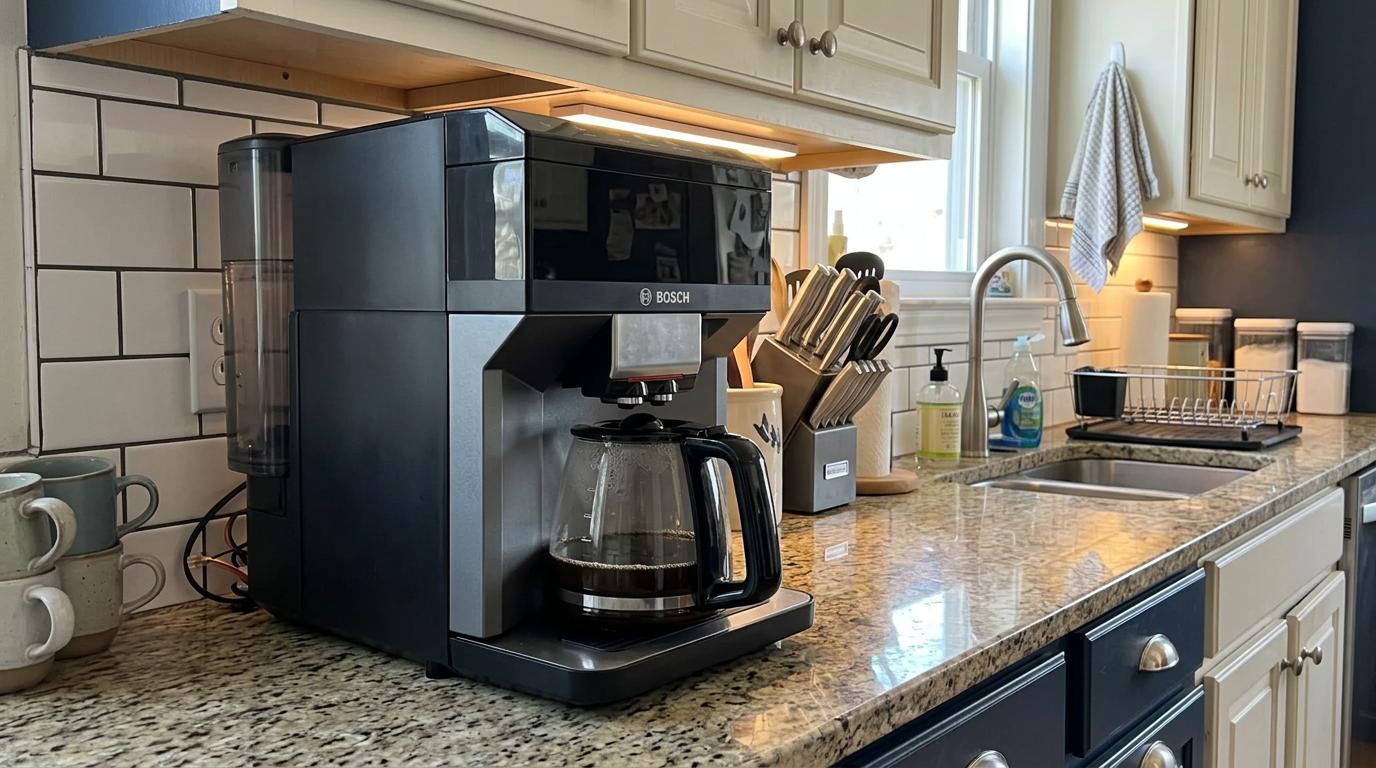
From across the room, these two look like close relatives. Both are slim, upright boxes with a bean hopper on top, a sliding spout in the middle and a drip tray with a red float that pops up when it is full.
The Bosch 300 Series is the slimmer of the two at 9.75 inches wide, 14.88 inches tall and 16.5 inches deep. The Bosch 500 is about 10.4 × 14.75 × 16.6 inches, so the difference is well under an inch.
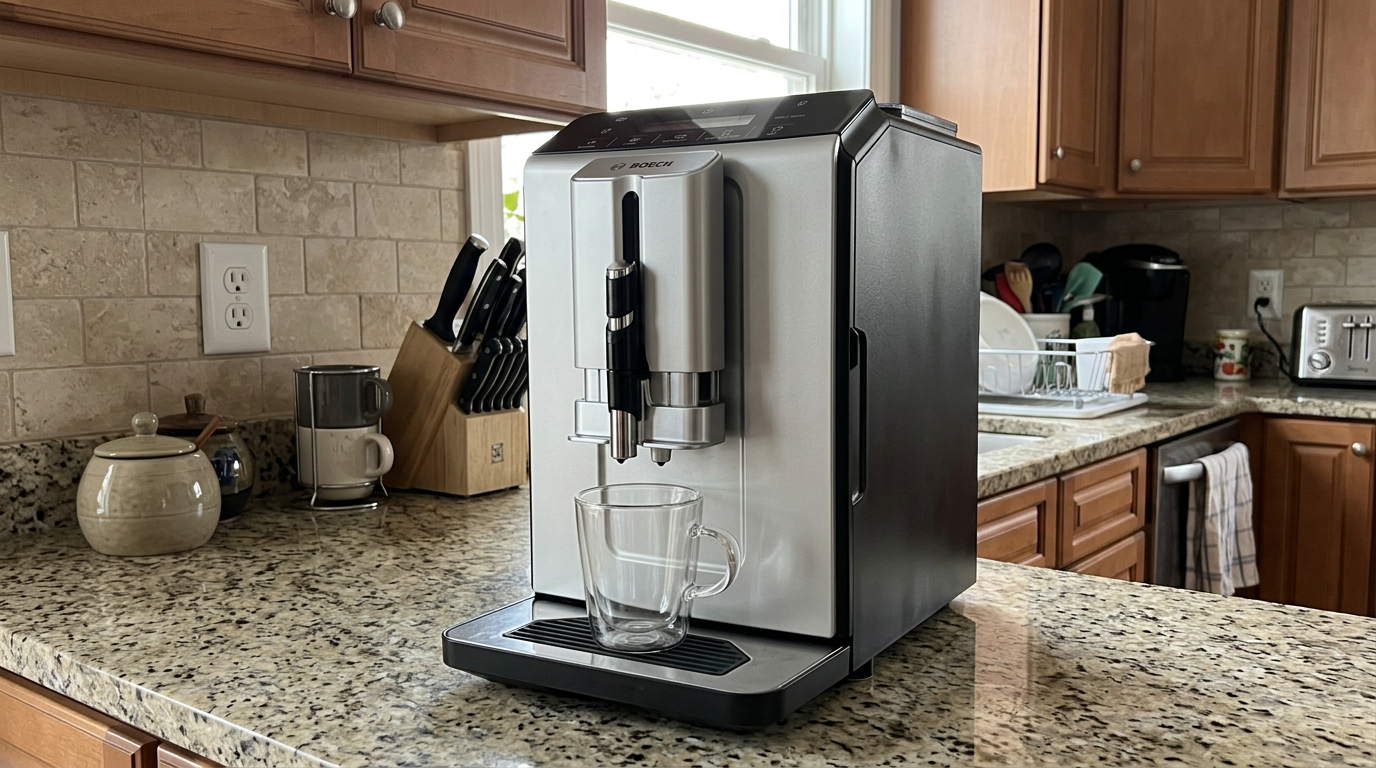
The Bosch 300 is under 10 inches wide, with a brushed front and a black body.
Width on the counter
Both fit a narrow stretch of counter. Depth is almost identical.
Both fit under standard wall cabinets with room to spare. Wall cabinets usually hang about 18 inches above the counter, and these stand under 15 inches tall.
The spouts slide from espresso-cup height up to a mug of about 5 inches on the 300 and about 5.5 inches on the 500.
Build quality is similar. My 300 was the silver version, with a brushed front panel and a black body, and my 500 was Piano Black. Both are mostly plastic, but neither flexed or creaked during my month with them.
Both hopper lids have a rubber seal. It keeps the beans fresher and muffles the grinder, which is a thoughtful touch at this level.
Our tip: Check which side you will reach the water tank from, because the 300’s 45-ounce tank fills from the back and needs a little space behind.
Setup and the first week
Setup took about ten minutes on the 300 and about 15 minutes on the 500. You rinse the tank, fill the hopper, set the water hardness and run a rinse.
On the 300, you enter the settings by pressing the bean button and the Calc’n Clean button together. It is not obvious, but the quick-start guide explains it.
The first two or three coffees on both were lighter while the grinder and brew chamber settled. By the third cup on the 500, the color, crema and body were where they should be.
The 500’s controls took me a few days to learn, because there are more options. The 300 was second nature from the first morning.
| Setup step | Bosch 300 | Bosch 500 |
|---|---|---|
| Setup time | About 10 minutes | About 15 minutes |
| Settings menu | Bean + Calc’n Clean buttons | On the display |
| First good coffee | Third or fourth cup | Third cup |
| Learning curve | A morning | A few days |
Our tip: Throw away the first two or three coffees from a new Bosch, because the grinder is still clearing factory test grounds.
Controls and drink menu
The Bosch 300 Series has one button per drink: espresso, coffee, cappuccino, latte macchiato and milk froth. You set strength with the bean button and save a drink size by holding its button for a few seconds.
That is the whole menu, and it is beautifully simple. Nobody in my house needed a single instruction.
The Bosch 500 Series adds Americano, flat white and more milk options for nine drinks in total. You choose the drink, then cycle through strength and size, from Small to Extra Large.
It is still easy, but it takes a few days to learn which button does what. Neither machine has an app, profiles or saved favorites.
One-touch drinks
Counted from each machine’s menu.
| Drink | Bosch 300 | Bosch 500 |
|---|---|---|
| Espresso | Yes | Yes |
| Coffee | Yes | Yes |
| Americano | No | Yes |
| Cappuccino | Yes | Yes |
| Latte macchiato | Yes | Yes |
| Flat white | No | Yes |
| Milk froth | Yes | Yes |
| Sizes | Saved by holding the button | Small to Extra Large |
If an app matters to you, neither of these is the one. Bosch’s Series 4 adds Home Connect, and the Bosch 800 Series adds a 5-inch touchscreen with 30 favorites.
Our tip: Hold a drink button for a few seconds on either machine to program your own cup size, because the default sizes rarely match your mug.
Grinder, dose and Double Shot
Both machines grind with ceramic discs, which stay sharp for a long time and run cool, so less heat reaches the coffee.
The Bosch 300 Series has only a handful of fineness steps. One step finer gave me a fuller shot with better crema, but with lighter roasts I ran out of room before the shot tasted as sweet as I wanted.
The Bosch 500 has six grind settings and a strength key that cycles through Mild, Regular, Strong and Double Shot. The first three simply grind more or less coffee into the brew unit.
Double Shot is the 500’s best trick. The machine brews half the drink, ejects the puck, grinds fresh coffee and brews the second half, so a big drink never gets thin.
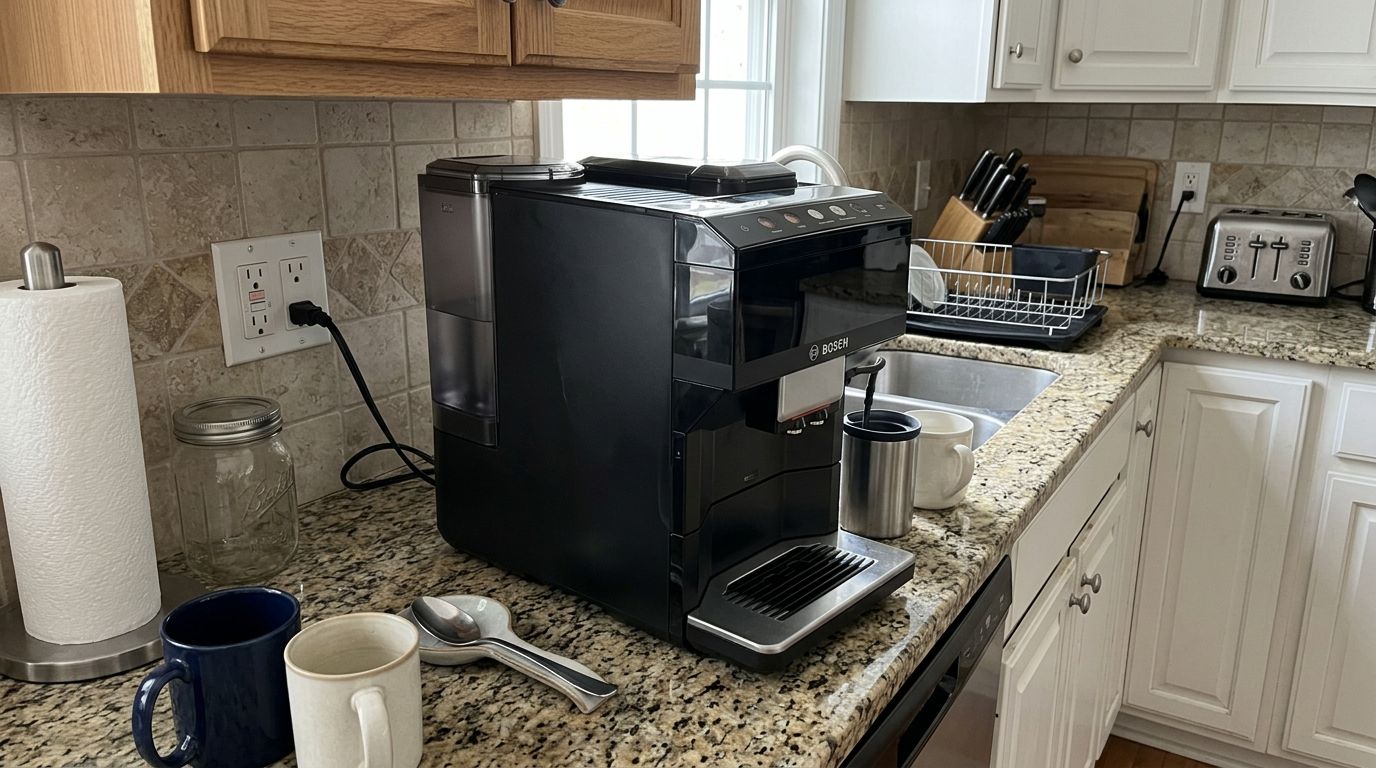
The Bosch 500’s Double Shot setting made bolder coffee without harsh bitterness.
| Grinder detail | Bosch 300 | Bosch 500 |
|---|---|---|
| Grinder | Ceramic discs | Ceramic discs |
| Settings | A few steps | 6 |
| Strength | Bean button | Mild, Regular, Strong, Double Shot |
| Bean hopper | About 9 oz / 255 g | About 9.5 oz / 270 g |
| Hopper seal | Rubber seal | Sealed lid |
Our tip: Change the grind only while the grinder is running, then wait two or three drinks before judging, because old grounds are still in the chute.
Espresso quality
My first espresso on the Bosch 300 Series came out smooth and nutty, with a fine layer of hazelnut-colored crema✕CremaThe golden, foamy layer on top of a fresh espresso. It forms when pressure pushes oils and gases out of the coffee.. It held for a couple of minutes, which is decent for a machine in this class.
It wasn’t as thick as the crema from bigger machines, but it was even and stable. The 300 scored 7.8 for espresso.
The Bosch 500 Series was a step better at 8.1. Once the grinder had settled, its espresso was the best I have had from Bosch’s lower and middle models, rich and dark with a fine, steady crema.
Straight from the spout, the 500’s espresso was hot enough that I waited a moment before sipping.
My espresso ratings
My scores out of 10 for body, crema, flavor and consistency.
Both use a 15-bar pump and a thermoblock✕ThermoblockA compact heater that warms water on its way through a metal block, instead of keeping a boiler hot. It heats up fast and switches between tasks quickly.. The coffee itself sees roughly 9 bar during a normal shot, which is the classic espresso target.
Every shot also starts with a short pre-infusion✕Pre-infusionA short soak of the ground coffee before full pressure starts, so the water flows through the puck evenly., which helps the water flow evenly through the puck.
| What you taste | Likely cause | First fix on either machine |
|---|---|---|
| Sour, thin, watery | Under-extracted✕Under-extractionWhen water does not pull enough flavor out of the coffee. The shot tastes sour, thin and watery. | One grind step finer or raise strength |
| Bitter, harsh | Grind far too fine | One step coarser while grinding |
| Pale crema that fades fast | Stale beans or grind too coarse | Fresher beans and a finer grind |
| Thin large coffee | One dose stretched too far | Use Double Shot on the 500 |
Long coffee and Americanos
This is a quiet but important difference. The Bosch 300 Series makes espresso and coffee, but no Americano. Its coffee pushes a larger amount of water through the grounds in one go.
The Bosch 500 Series adds a true Americano. It brews a shorter coffee and adds hot water separately, which keeps the cup from tasting over-extracted and bitter.
In my mug, the 500’s Americano was rounder and sweeter, with more body than the 300’s large coffee. Add Double Shot and it was the best black coffee I made on either machine.
If you drink a big mug of black coffee every morning, this one feature might be reason enough to choose the 500.
| Black coffee | Bosch 300 | Bosch 500 |
|---|---|---|
| Espresso | Yes | Yes |
| Coffee | Yes, one brew | Yes, with sizes up to Extra Large |
| Americano | No | Yes, water added separately |
| Double Shot | No | Yes, two brews |
| My favorite mug | Coffee, medium size | Americano with Double Shot |
Our tip: Choose Americano instead of a large coffee on the 500, because adding water after brewing keeps the cup from turning bitter.
Milk drinks
This is the biggest practical difference between the two.
The Bosch 300 Series uses a clip-on in-cup frother. A short tube goes into your milk, steam draws the milk up, and the frother sends hot foam straight into the cup.
The foam was fine and creamy, with small bubbles and a soft, spoonable texture on top of a cappuccino. It wasn’t as glossy as the foam from Bosch’s bigger machines, but it was well above what I expected at this level.
For a latte macchiato, the frother pours the milk and foam first, then the espresso runs through and settles in the middle.
The Bosch 500 Series uses a flexible hose that draws milk straight from the carton, so there is no jug to fill. Two cappuccinos took a little over two minutes, without anyone standing at the machine.
Its foam was fine and creamy, with small, even bubbles. It isn’t quite microfoam✕MicrofoamMilk foam with bubbles so small you can barely see them. It feels silky and glossy, which is what latte art needs. for latte art, but it is very good for one-touch milk.
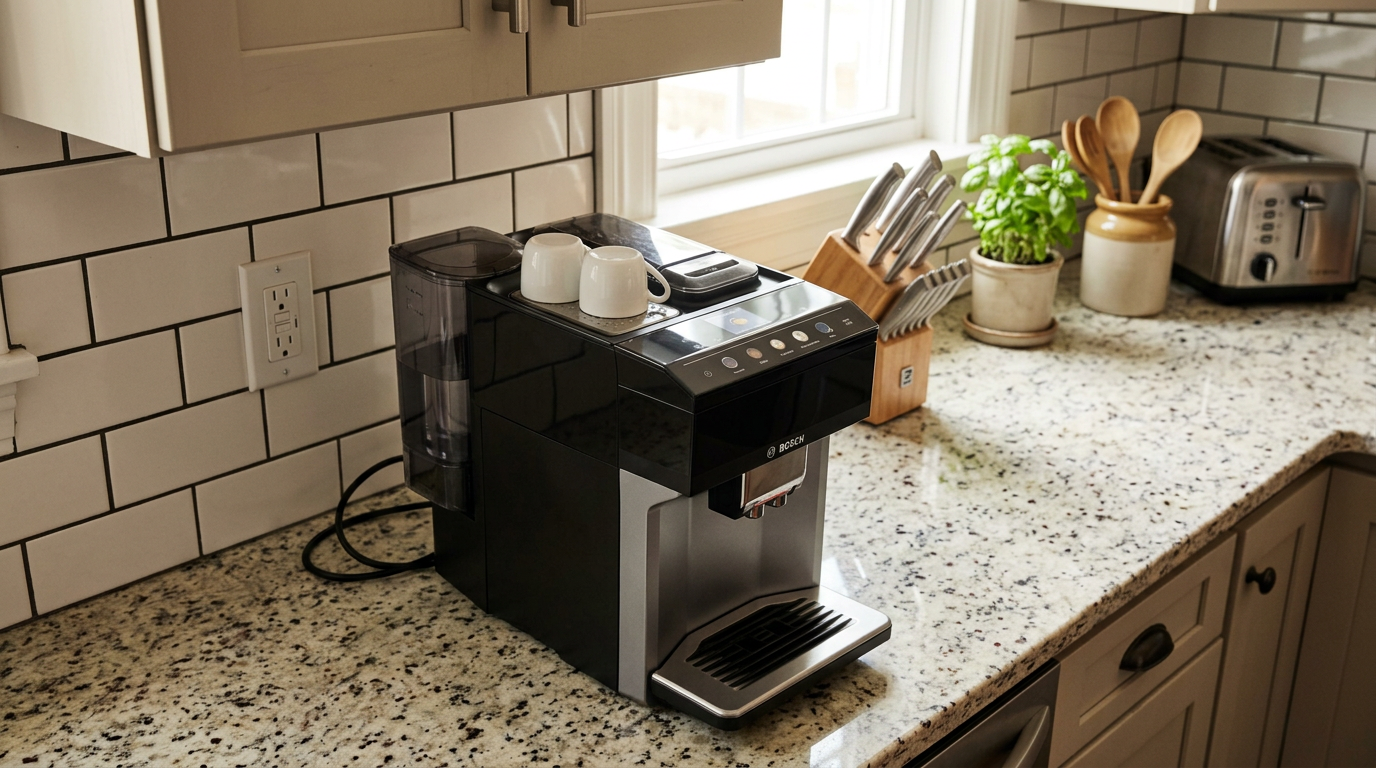
The 500’s hose draws milk straight from the carton, so there’s no jug to fill.
How each milk foamed on the 500
My relative ranking for texture and stability. Longer bars foamed better.
Milk straight from the fridge foamed far better than milk that had been sitting on the counter on both machines.
Overall, the 500 scored 8.0 for milk drinks and the 300 scored 7.4.
| Milk feature | Bosch 300 | Bosch 500 |
|---|---|---|
| System | Clip-on in-cup frother | Hose from the carton |
| Milk drinks | Cappuccino, latte macchiato, froth | Cappuccino, latte macchiato, flat white, froth |
| Two milk drinks at once | No | Yes |
| Cleaning | Frother in the dishwasher | AutoMilk Clean, rinse the hose |
| My milk score | 7.4 | 8.0 |
Our tip: Push the 300’s frother until it clicks fully into place, because a half-seated frother sprays and makes weak foam.
Two drinks at once and decaf
Both machines have two spouts, but they use them differently.
The Bosch 300 Series makes two espressos or two coffees at once. For coffee drinks, it grinds and brews in two passes, so both cups get a proper dose.
The Bosch 500 Series makes two of any drink at once, including cappuccinos and lattes. That made a real difference when my partner and I were getting ready at the same time.
The 500 also has a small chute with its own lid next to the hopper. It skips the grinder for one scoop of pre-ground coffee, which made evening decaf effortless without emptying the hopper.
Our tip: Use the 500’s ground coffee chute for decaf rather than swapping beans, because a full hopper of decaf mixes with regular for several cups.
Cleaning and upkeep
Both machines have a removable brew unit✕Brew unitThe part that compresses the ground coffee, holds it while water passes through and then ejects the used puck. A removable one can be rinsed under the tap., which you rinse under the tap once a week. On the 300 it slides out the front, and on the 500 it sits behind a side door.
The 300 is the easier of the two to clean. Its whole milk frother goes in the dishwasher, so daily cleaning took me about two minutes.
The 500 uses AutoMilk Clean. After every milk drink, it sends a short burst of steam through the milk path, and you rinse the hose and frother parts after each session.
Both run Bosch’s Calc’n Clean program, which handles descaling and cleaning in one guided cycle. A red float in the drip tray rises when it is getting full, so you see it before it overflows.
My daily hands-on cleaning time
My estimate with daily milk drinks, not counting automatic rinses.
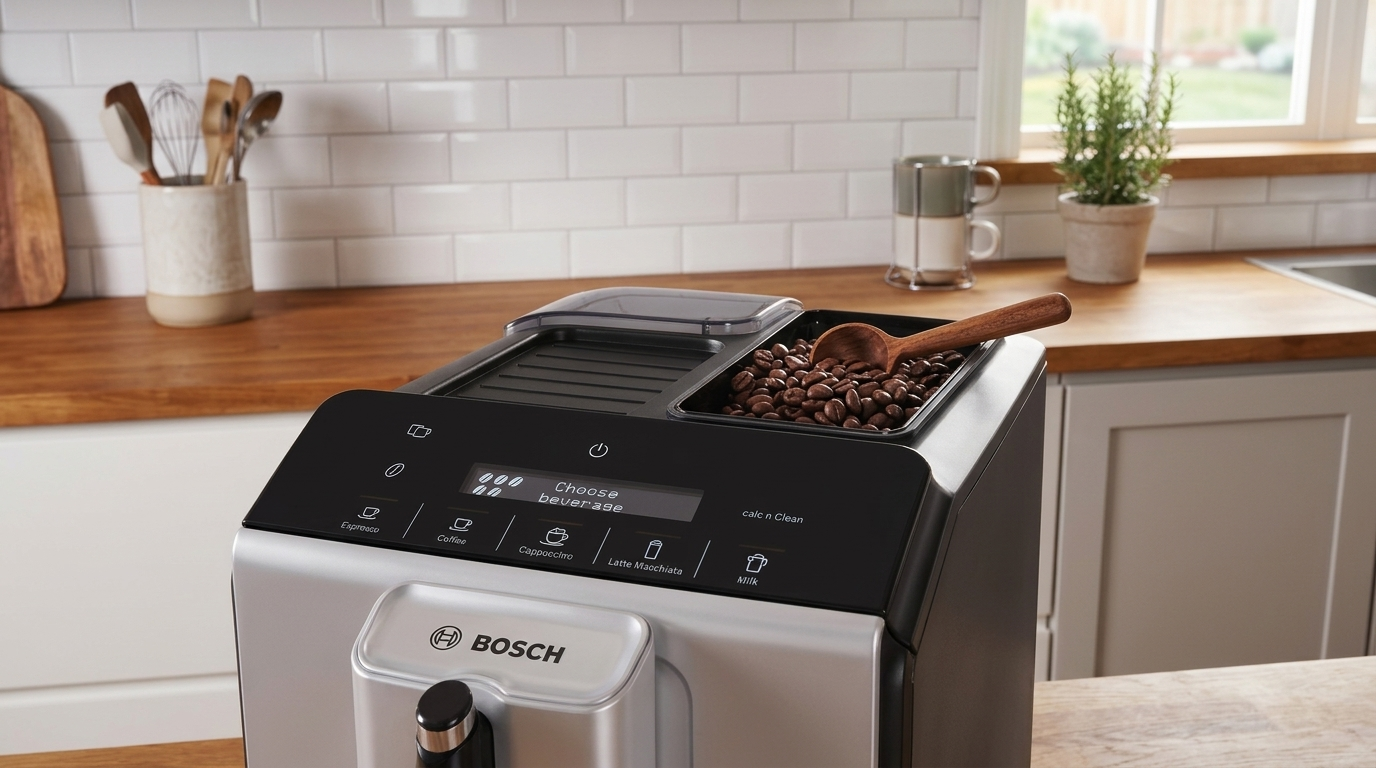
The 300’s brew unit slides out the front for a quick weekly rinse.
| When | Bosch 300 | Bosch 500 |
|---|---|---|
| After milk drinks | Frother in the dishwasher or rinse | AutoMilk Clean, then rinse the hose |
| Daily | Empty tray and grounds | Empty tray and grounds |
| Weekly | Rinse the brew unit | Rinse the brew unit |
| When prompted | Calc’n Clean | Calc’n Clean |
Our tip: Rinse the brew unit every week and let it air-dry overnight before sliding it back in, because damp grounds cause musty flavors.
Water, beans and capacity
Capacity is where the 500 pulls ahead most clearly. Its tank holds about 64 ounces, a big jump from the 300’s 45 ounces.
In my house, the 300 needed a refill most days, while the 500 went two or three days between refills.
Water tank size
From manufacturer specifications.
Cappuccinos per full tank, my estimate
Rough maths allowing for rinse water. Your numbers depend on cup size.
The hoppers are similar, about 9 ounces on the 300 and 9.5 ounces on the 500. Use fresh whole beans within a few weeks of the roast date, and avoid very oily beans that can clog the grinder.
Our tip: Fill the tank with fresh, cold water every morning on either machine, because water that has sat for days makes flatter coffee.
Noise
Both are quiet machines. The ceramic grinders hum at a low pitch rather than a high whine, and the sealed hopper lids take the edge off.
The 500 makes a little more noise overall because it does more, such as grinding twice for Double Shot. Neither woke anyone in my house at 6 a.m.
Our tip: Keep the hopper lid closed when grinding, because the rubber seal noticeably softens the sound on both machines.
A month with each machine
Living with each machine for four weeks showed me how differently they fit into a routine.
The Bosch 300 Series felt like a kitchen appliance in the best sense. I pressed a button, drank a pleasant coffee and put the frother in the dishwasher, and that was it. Its only real annoyance was filling the small tank almost every day.
The Bosch 500 Series took a few days to learn, but by week two it handled everything we asked of it. Two lattes at once, decaf after dinner and a Double Shot Americano in the morning made it the machine my household preferred.
The trade-off was a few more minutes of milk cleaning each day. AutoMilk Clean does the first rinse, but the hose still needs a quick wash after each session.
| After four weeks | Bosch 300 | Bosch 500 |
|---|---|---|
| What I loved | Simplicity and dishwasher-safe frother | Double Shot and carton milk |
| What annoyed me | Daily refills, few grind steps | Learning the buttons, hose cleaning |
| Who used it most | Me, for quick coffee | The whole household |
Our tip: Keep a small glass of water by the 500 to rinse the milk hose straight after use, because it takes seconds when the milk is still fresh.
Mistakes I made, and how to avoid them
I made a few mistakes in the first week. Here is what happened and how to avoid them.
| Mistake | What happened | How to avoid it |
|---|---|---|
| Frother not clicked in on the 300 | Weak foam and spray | Push until it clicks fully |
| Warm milk from the counter | Big, soapy bubbles | Use milk straight from the fridge |
| Extra Large coffee on Strong | Thin end of the pour | Use Double Shot on the 500 |
| Judging the grind change too early | Confusing results | Wait two or three drinks |
| Cold cup for espresso | Lukewarm shot | Rinse the cup with hot water first |
None of these were serious, and both machines rewarded small changes quickly.
Real-life scenarios
Specs only go so far. These are the situations where one machine clearly pulled ahead during my testing.
Two at once from the carton, done in a little over two minutes.
Under 10 inches wide, with a frother that goes straight in the dishwasher.
One scoop in the chute, no swapping beans.
Double Shot kept it rich all the way down.
Five buttons, two minutes of cleaning, nothing to learn.
A 64-ounce tank lasted two or three days.
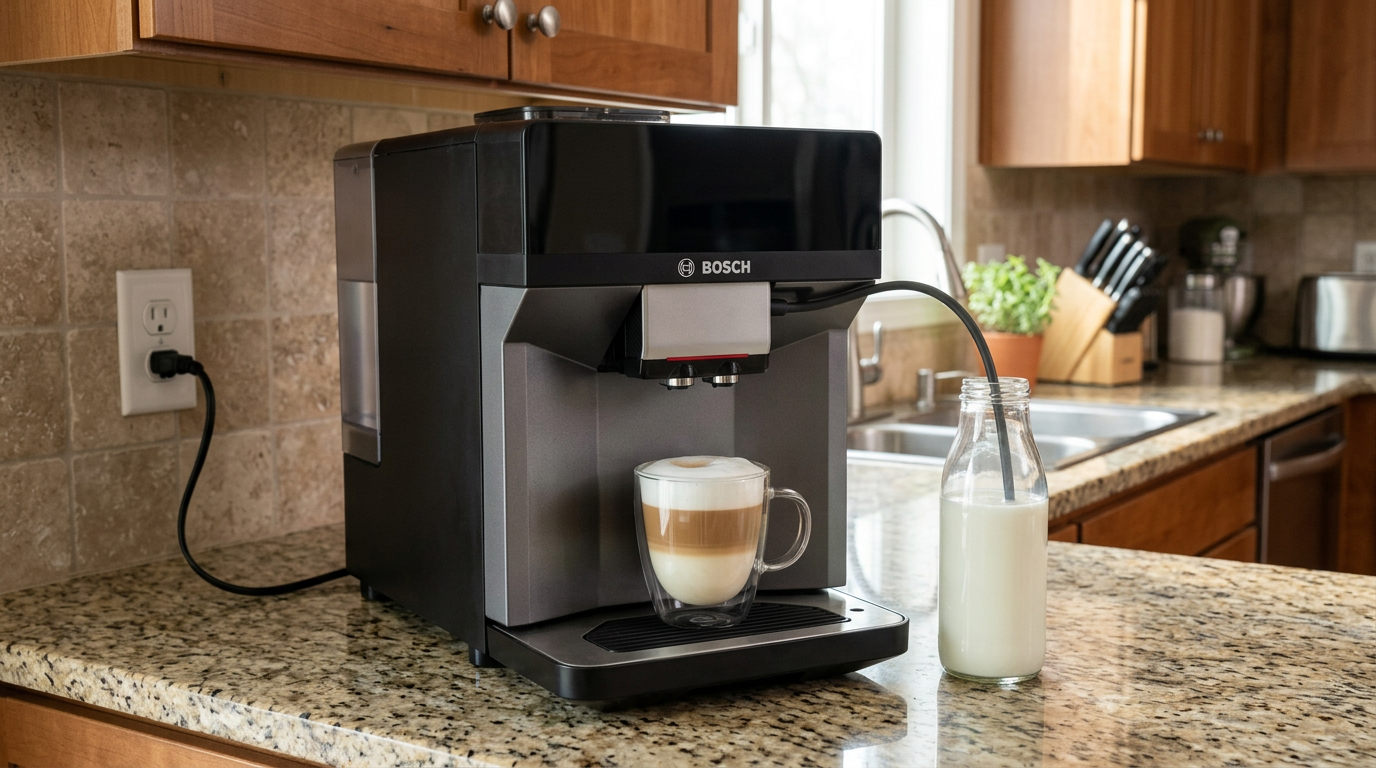
For most households, the 500 is the Bosch that makes daily life easier.
My scorecard
These are my own scores out of 10, taken from my single reviews, plus capacity because it often decides this matchup.
Bosch 500 Series
Bosch 300 Series
Overall, I rate the Bosch 500 8.0 and the Bosch 300 7.7. The 500 does more of everything; the 300 is simpler and a touch easier to clean.
See Today’s PriceWhich one is right for you?
4 quick questionsWhich one should you buy?
It comes down to one question: do you want five simple drinks, or a machine that handles everything a household asks of it? For the wider picture beyond this matchup, see my guide to the best super-automatic espresso machines.
If you are considering the top of the range too, read my best Bosch espresso machines guide, or see how Bosch compares with De’Longhi in my Bosch vs De’Longhi comparison.
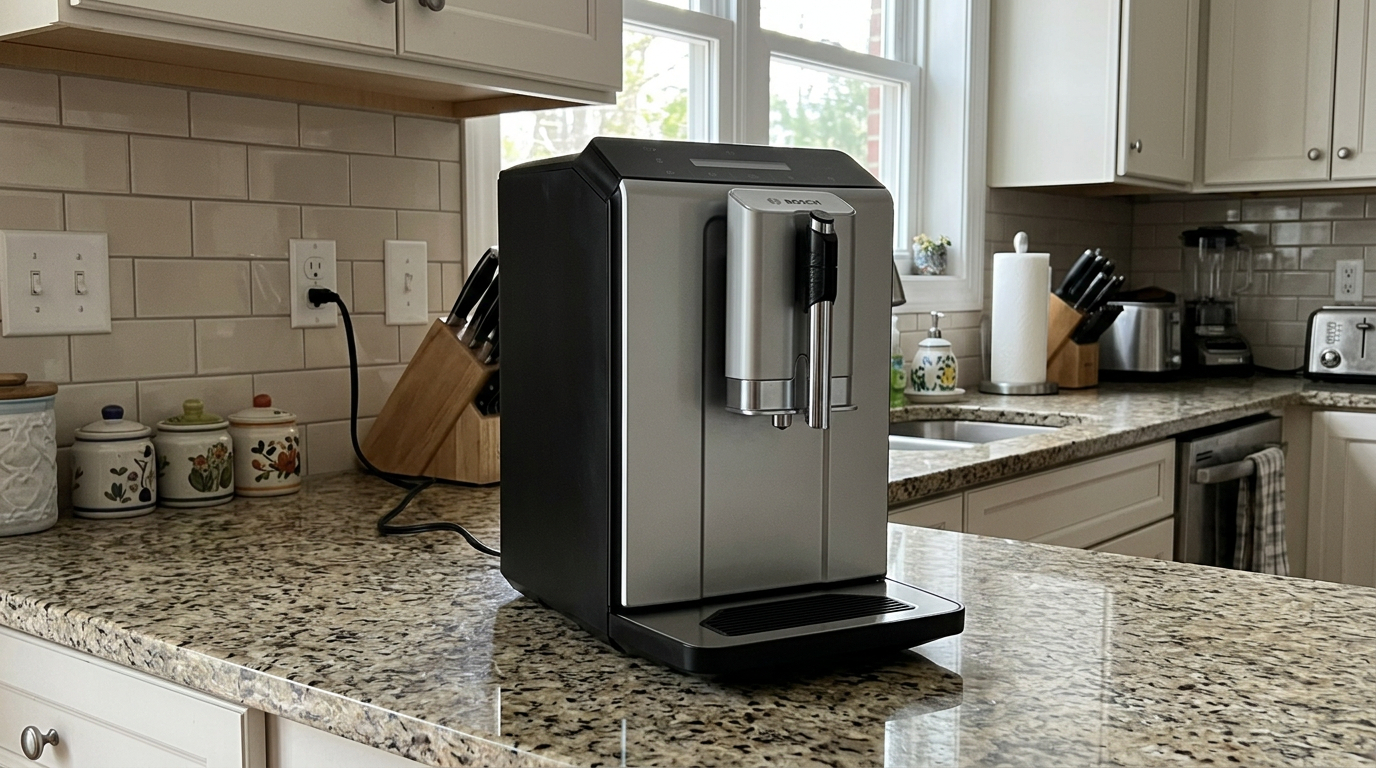
For one or two simple coffee drinkers, the 300 is an easy machine to love.
- You want nine drinks, including flat white
- You drink decaf in the evening
- Two people make coffee at the same time
- You hate refilling water
- You want an app or profiles
- You want dishwasher-safe milk parts
- You want the slimmest machine
- You only need five drinks
- You want the easiest cleaning
- Your counter is narrow
- You drink decaf from pre-ground
- You make several drinks a day
- You want to fine-tune the grind
For most homes, my pick is the Bosch 500 Series. It makes nine drinks, draws milk from the carton, brews two of anything at once, takes decaf through its chute and holds 64 ounces of water. Its Double Shot makes the best espresso of Bosch’s lower and middle models.
The Bosch 300 Series is the smarter buy if you want five simple drinks and the easiest cleaning. Its frother goes in the dishwasher, its brew unit slides out the front and it is beautifully simple to use.
Whichever you choose, use fresh beans and cold milk, and rinse the brew unit weekly. Both machines reward that care with years of good coffee.
Bosch 300 vs 500 Series specifications
From manufacturer specifications and my own testing.
| Bosch 300 Series | Bosch 500 Series | |
|---|---|---|
| Model | 300 Series VeroCafe, TIU20307 | 500 Series VeroCafe, TPU40109 |
| Drinks | 5 | 9 |
| Pump pressure | 15 bar | 15 bar |
| Heating | Thermoblock | Thermoblock |
| Grinder | Ceramic discs, a few steps | Ceramic discs, 6 settings |
| Strength | Bean button | Mild, Regular, Strong, Double Shot |
| Sizes | Programmable | Small to Extra Large |
| Two cups at once | Espresso and coffee | Every drink |
| Ground coffee chute | No | Yes, one scoop |
| Bean hopper | About 9 oz / 255 g | About 9.5 oz / 270 g |
| Water tank | 45 oz, rear access | 64 oz |
| Milk system | Clip-on in-cup frother | Hose with AutoMilk Clean |
| Cup clearance | About 5 in | About 5.5 in |
| App | None | None |
| Brew unit | Removable, front | Removable, side door |
| Power | 1,600 W | 1,600 W |
| Dimensions (W × H × D) | 9.75 × 14.88 × 16.5 in | About 10.4 × 14.75 × 16.6 in |
| Weight | About 14.7 lb | About 15.2 lb |
How I tested and compared them
I used each machine as my everyday coffee maker for four weeks, making espresso, coffee, Americanos, cappuccinos, latte macchiatos and flat whites, plus evening decaf through the 500’s chute.
I made milk drinks with whole, 2%, skim, barista oat and almond milk, worked through the grind and strength settings, and timed drinks and refills.
I followed the daily and weekly cleaning routine and Calc’n Clean, then wrote up my notes and measurements together and compared them with Bosch’s specifications and owner documentation.
- Coffee: dose, crema, body and consistency
- Milk: foam texture with five kinds of milk
- Workflow: controls, two-cup drinks and decaf
- Ownership: cleaning, capacity, noise and footprint
Bosch 300 vs 500 Series FAQ
What is the difference between the Bosch 300 and 500 Series?
The 500 makes nine drinks instead of five, including Americano and flat white. It draws milk from the carton through a hose, brews two of any drink at once, has six grind settings, a Double Shot strength, a ground coffee chute and a 64-ounce tank. The 300 has an in-cup frother, a 45-ounce tank and a front-loading brew unit.
Is the Bosch 500 worth it over the 300?
For most people, yes. The extra drinks, the carton milk hose, the decaf chute and the bigger tank make daily life easier. The 300 is the better choice only if you want five simple drinks and the easiest possible cleaning.
Which makes better espresso, the Bosch 300 or 500?
The 500, which scored 8.1 against 7.8 for the 300. Its six grind settings and Double Shot strength gave a richer shot with a steadier crema.
What is Double Shot on the Bosch 500?
A strength setting where the machine brews half the drink, ejects the puck, grinds fresh coffee and brews the second half. It makes large coffees bolder without harsh bitterness.
Can the Bosch 300 use pre-ground coffee?
No. The 300 works with whole beans only. The 500 has a ground coffee chute that takes one scoop, which is handy for decaf.
Is the Bosch 300 frother dishwasher-safe?
Yes. The clip-on in-cup frother goes in the dishwasher, which makes the 300 one of the easiest machines to keep clean.
Do both have a removable brew unit?
Yes. On the 300 it slides out the front, and on the 500 it sits behind a side door. Both rinse clean under the tap.
How big are the water tanks?
The 300 holds 45 ounces and the 500 holds 64 ounces. The 300 needed a refill most days in my house.
Do the Bosch 300 or 500 have an app?
No. Neither has an app, profiles or saved favorites. For those, look at the Bosch Series 4 or the 800 Series.
Can the Bosch 500 make two drinks at once?
Yes, for every drink, including milk drinks. Two cappuccinos took a little over two minutes in my testing. The 300 makes two espressos or coffees at once.

- Our hands-on Bosch 300 Series review
- Our hands-on Bosch 500 Series review
- Bosch product specifications and owner documentation
- How to Brew Coffee, National Coffee Association