BELLA 13683 review: a tiny one-knob espresso maker that turns a 2-minute brew into a cappuccino
The BELLA 13683 Personal Espresso Maker is a small steam espresso maker with one knob, a four-cup glass carafe and a steam wand. It brews strong, dark, moka-style coffee in about two minutes and makes cappuccino foam, but it is not a café-style pump machine.

Michael Reynolds
Hands-on review
Hands-on testing, research, specs
3 weeks
23 minutes
Jargon helpNew to espresso? Tap any dotted term to see what it means.
In this review
Yes, if you want cheap, simple cappuccinos from a machine that fits anywhere. The BELLA 13683 is a steam espresso maker, so it brews a strong, dark, moka-style coffee rather than true espresso with thick crema. One knob does everything, the glass carafe makes two or four servings in about two minutes, and the steam wand gives you real foam once you learn the ESPRESSO, OFF, STEAM order. The catches are a learning curve on the knob sequence, a cap you must never open while the machine is under pressure, and coffee that leans bitter if you brew the full four cups.
BELLA 13683 at a glance
BELLA 13683 pros and cons
- Very compact and light enough to store away
- One simple knob for brewing and steaming
- Steam wand makes real cappuccino foam
- Not true espresso, very little crema
- Steam only works after the right knob sequence
- Cap must not be opened while pressurized
Who should buy the BELLA 13683?
- First apartments and dorm-style kitchens
- Occasional cappuccino and latte drinkers
- Anyone who wants the simplest possible start
- Espresso fans who want real crema
- Latte art fans who need silky microfoam
- Households making many drinks back to back
First impressions of the BELLA 13683
Some coffee machines ask you to learn a craft.
The BELLA 13683 Personal Espresso Maker asks you to learn one knob.
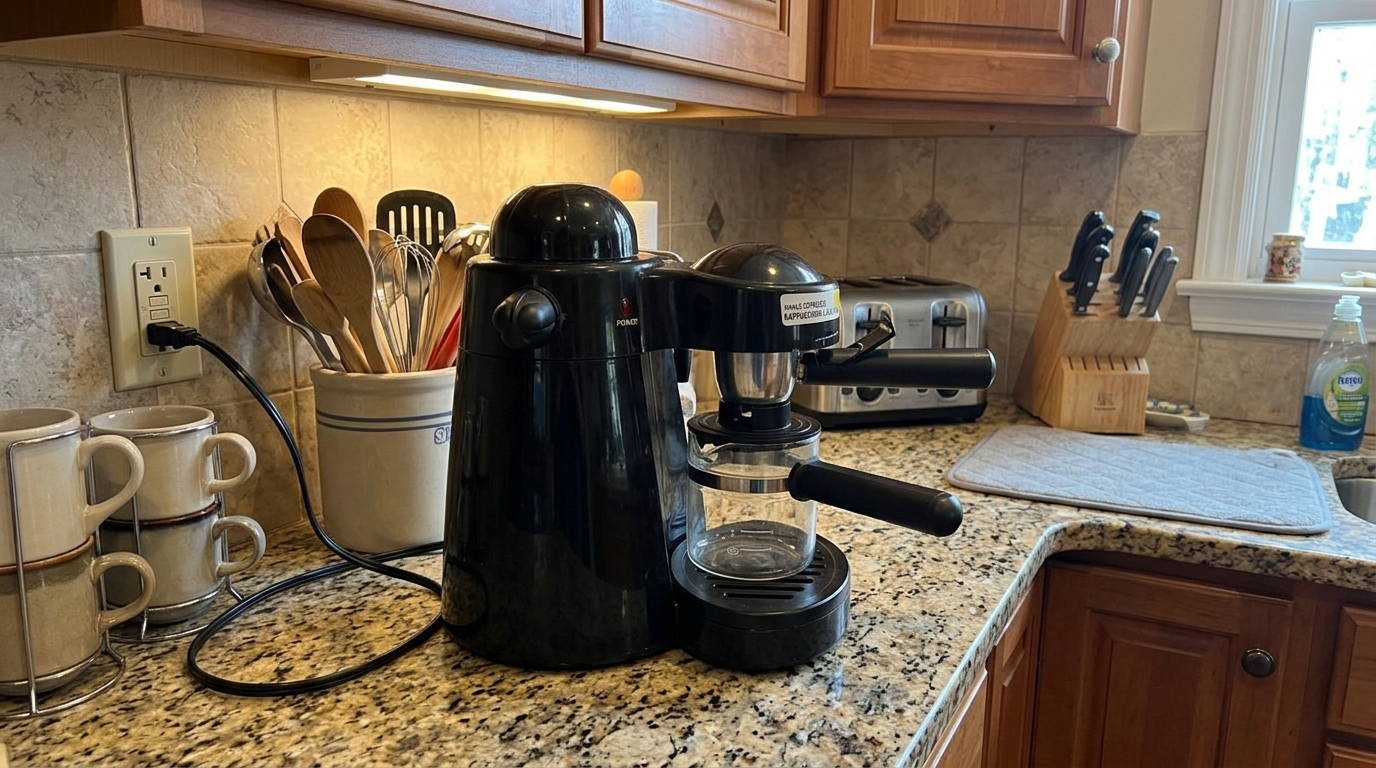
It's a small black machine with a round water cap on top, a portafilter handle at the front, a steam wand on the right and a glass carafe that sits under the spout.
Out of the box, it looked more like a compact drip brewer than an espresso machine.
That's not a criticism.
For three weeks, it was the first thing I touched every morning, and its size was a big part of why it never got in the way.
I set it up on a granite counter between a utensil crock and a row of mugs, and it took up about the same footprint as a two-slice toaster turned sideways.
The first thing that surprised me was how quickly it worked.
From a cold start, coffee started dripping into the carafe after roughly two minutes, and the full brew was done not long after.
The second thing that surprised me was how easy it is to get the steam wand wrong.
I turned the knob straight to STEAM on my first morning and got almost nothing.
The machine needs to heat in ESPRESSO mode first, then go through OFF, and only then to STEAM.
Once I learned that order, the rest of the test went smoothly.
The BELLA 13683 takes up less room than a toaster and slots in next to everyday kitchen clutter.
Our tip: Run one full cycle with plain water before your first coffee to rinse out any factory taste.
What the BELLA 13683 actually is
Before you buy this machine, it helps to know exactly what kind of coffee maker it is.
The BELLA 13683 is a steam espresso maker✕Steam espresso makerA small machine that heats water in a sealed chamber until steam builds up, then uses that steam pressure to push hot water through the coffee. It makes strong coffee, but at much lower pressure than a pump espresso machine..
It heats water in a sealed reservoir until steam builds up, and that steam pushes hot water through the coffee in the filter basket.
Pump machines use an electric pump to push water through the coffee at around 9 bar at the puck.
Steam machines like this one work at a fraction of that, usually a few bar.
That difference is the single biggest thing that shapes what ends up in your cup.
Approximate pressure at the coffee. Higher pressure gives a more concentrated, crema-rich shot.
In practice, the BELLA makes a coffee that sits between a stovetop moka pot and a real espresso.
It's dark, strong and concentrated enough to stand up to milk.
It isn't syrupy, and it doesn't carry the thick, hazelnut-colored crema✕CremaThe golden foam on top of a real espresso. It forms when high pump pressure forces gases and oils out of freshly ground coffee. Low-pressure steam machines make very little of it. that you get from a café shot.
I went in expecting that, and I think anyone buying this machine should too.
If you mostly drink cappuccinos, lattes and sweetened coffees, the difference matters much less than you'd think.
The milk softens the edges, and the coffee is strong enough to come through.
If you drink straight espresso, you'll notice it on the first sip.
BELLA 13683 design, parts and setup
The BELLA is mostly black plastic, with a glass carafe and a metal filter basket.
It feels light, and I could lift it with one hand to wipe underneath.
Everything you need is in the box, and setup took me about five minutes, including washing the parts.
The portafilter✕PortafilterThe handle that holds the ground coffee and locks under the machine. On the BELLA the filter basket is built into it, so you add coffee straight into the handle. is different from what you might know from bigger machines.
On the BELLA, the filter basket is built into the portafilter, so there's no separate basket to drop in or lose.
You add grounds straight into the handle, pack them, and lock it under the machine.
The locking design uses small ridges that have to line up with grooves on the machine.
When they're aligned, the handle twists in smoothly.
When they're not, it simply won't go, and forcing it is the worst thing you can do.
The included scoop doubles as a basic tamper, with a flat end for pressing the coffee down.
It's not a proper tamper, but for a steam machine it does the job.
| Item | What it is | My verdict |
|---|---|---|
| Portafilter | Handle with built-in filter basket | Simple, nothing to lose |
| Scoop/tamper | Measures and packs ground coffee | Fine for daily use |
| Glass carafe | Brews 2 or 4 servings, with lid | Doubles as the water measure |
| Steam wand | Wand with removable frothing tip | Works well once heated |
| Drip tray | Removable | Easy to empty and rinse |
Our tip: Keep the scoop in the drawer next to the machine, because it is the easiest way to dose the same amount every morning.
The one-knob control, and the order that matters
Everything on the BELLA runs through one rotary knob with three positions: OFF, ESPRESSO and STEAM.
That simplicity is the machine's biggest strength and the source of its one big learning curve.
ESPRESSO does two jobs.
It brews the coffee, and it heats the machine enough to produce steam afterwards.
STEAM sends steam out through the wand for frothing.
The problem is that STEAM only works properly once the machine has built up heat in ESPRESSO mode.
| Setting | What it does | When to use it |
|---|---|---|
| OFF | Stops heating and brewing | Between brewing and steaming, and when you finish |
| ESPRESSO | Heats the water and brews into the carafe | First step for every drink |
| STEAM | Sends steam through the wand | Only after ESPRESSO, then OFF |
The right sequence is ESPRESSO, then OFF, then STEAM.
I wrote it on a small sticky note and put it on the side of the machine for the first few days.
By the end of the first week, I did it without thinking.
If you skip ESPRESSO and go straight to STEAM, you get weak puffs or nothing at all.
That's not a fault, just the way the machine builds heat.
The indicator light shows when the machine is on and heating in ESPRESSO mode.
Water, the carafe and the measuring marks
The BELLA doesn't have a removable water tank.
Instead, you measure the water and pour it into the reservoir through the opening on top.
The glass carafe has two- and four-cup markings, and those are what I used for every brew.
Fill to the line you want, pour it in, screw the cap back on, and the carafe goes back under the spout.
It sounds fiddly, but it's actually a nice safeguard.
Because the reservoir only holds what you put in, the machine can't brew more than you asked for.
I used cold, filtered water throughout the test, and I think it made a visible difference.
Filtered water tasted cleaner, and it should also slow down mineral buildup inside the heating chamber.
| Brew size | Water to add | What I used it for |
|---|---|---|
| 2 servings | Fill the carafe to the 2-cup mark | One large cappuccino or two small ones |
| 4 servings | Fill the carafe to the 4-cup mark | Two lattes or coffee for guests |
| Cappuccino | Your brew water plus a little extra | The extra water is what becomes steam |
That last row matters.
If you're making a cappuccino, the steam for the milk comes from the same reservoir as the coffee.
I added a little extra water on milk-drink mornings, so there was enough left after brewing to steam a pitcher of milk.
The manual describes this as adding one steam level of water on top of the brew amount.
Our tip: Add a little extra water on cappuccino mornings, because the steam for your milk comes from the same reservoir.
Making a coffee, step by step
Here's the routine that worked best for me after a few days of trial and error.
1. Make sure the knob is on OFF, and remove the cap from the reservoir.
2. Fill the carafe with cold water to the 2- or 4-cup line and pour it in.
3. Screw the cap back on firmly.
4. Add ground coffee to the built-in filter basket and pack it gently with the scoop.
5. Wipe the rim so no grounds sit on the locking edge.
6. Line up the ridges and twist the portafilter fully into the locked position.
7. Put the carafe on the drip tray under the spout.
8. Turn the knob to ESPRESSO and wait.
After roughly two minutes, dark coffee starts to drip into the carafe.
It comes out in a steady trickle with bursts of steam, and it gets faster towards the end.
When the flow turns mostly to steam and sputtering, the brew is done.
These are my rough times from a cold start across three weeks of mornings.
They're not stopwatch-perfect, but they reflect what daily life with this machine felt like.
For a cheap machine, the speed is a real plus.
I never waited for a big boiler to warm up, and the whole drink was ready before the toast.
Dosing, grind and packing
On a steam machine, how much coffee you use and how firmly you pack it control the strength more than anything else.
My notes from the first week are mostly about this.
Too little coffee gave a thin, brown brew.
Too much, packed hard, slowed the flow and made the coffee harsh.
The sweet spot was a full, level basket, pressed down gently with the flat end of the scoop.
I used a fine-to-medium grind, a little coarser than true espresso.
Very fine espresso grounds packed hard made the flow stall and sputter, which isn't what you want with a steam machine.
| What I tried | Result | Verdict |
|---|---|---|
| Half basket, loose | Thin and watery | Too weak |
| Full basket, gentle press | Strong, dark, balanced | Best everyday result |
| Heaped basket, hard press | Slow flow, harsh and bitter | Too much |
| Very fine espresso grind | Stalls and sputters | Go a little coarser |
If your coffee tastes weak, change one thing at a time.
Keep the water the same, and add a little more coffee or press a little firmer.
Never overfill the basket, because coffee on the rim stops the handle from locking properly.
For beans, medium-dark and dark roasts worked best.
If you want to understand why, our guide to coffee roast levels explains how roast changes body and bitterness.
Our tip: Press the grounds gently and evenly, because hard tamping on a steam machine makes the coffee bitter rather than stronger.
BELLA 13683 coffee performance
So how does the coffee taste?
Strong and dark, with a bold, roasty flavor that reminded me of a good moka pot.
On two-cup brews with a medium-dark roast, it was genuinely pleasant, especially under milk.
On four-cup brews, the last part of the brew pulled a more bitter, slightly acidic edge into the carafe.
That's the pattern I saw across the whole test.
The first part of the brew is the best part, and the tail end adds volume but loses sweetness.
My scores out of 10 after three weeks of daily brewing. Crema is low because steam pressure is too low to create much of it.
Crema was the weakest point.
I got a thin, pale layer at best, which disappeared within a minute.
That's normal for a steam machine, and no amount of tamping changed it.
Temperature, on the other hand, was very hot.
The coffee came out close to boiling, which helps cappuccinos stay warm but can taste harsh if you drink it black.
A practical trick from my notes: stop the brew a little early when you're making milk drinks.
Turning to OFF just as the flow starts to sputter leaves the most bitter part behind.
Steam wand and milk frothing
The steam wand is the reason to buy the BELLA over a plain moka pot.
It's a short wand on the right side with a removable frothing attachment on the end.
That attachment pulls in air as the steam flows, which makes foam much easier for beginners than a bare steam tip.
Once the machine was properly heated and switched to STEAM, the wand produced a strong, steady flow.
I could take cold milk to hot and foamy in about 40 to 60 seconds for a small pitcher.
The key is position.
Keep the frothing attachment just below the surface of the milk.
Too deep, and you heat the milk without much foam.
Too high, and hot milk sprays out of the pitcher, which happened to me exactly once.
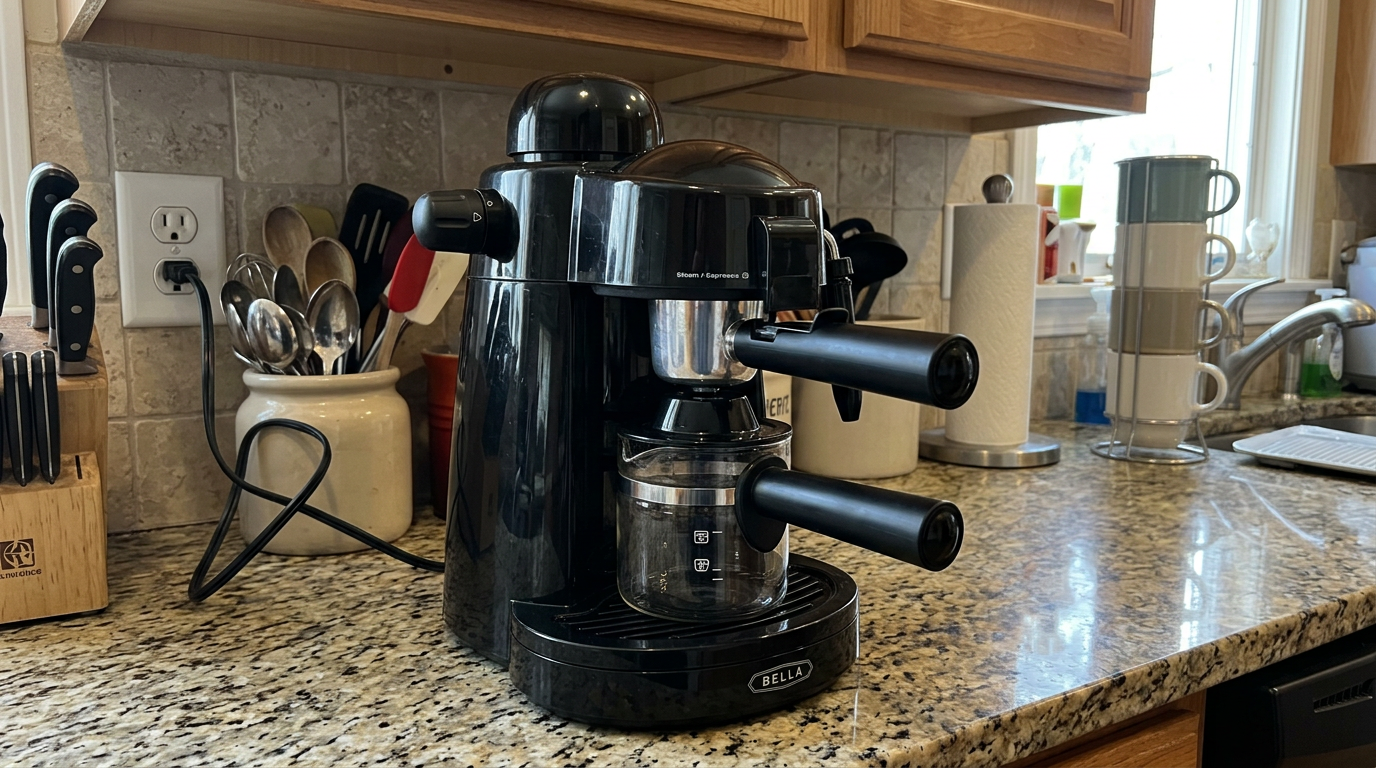
The steam wand sits on the right, with room for a small pitcher underneath.
The foam is thick and airy, more cappuccino than latte.
It's the stiff, spoonable foam you'd want on a classic cappuccino, not the glossy microfoam✕MicrofoamMilk steamed with very fine, invisible bubbles so it looks glossy and pours like wet paint. It's what baristas use for latte art and needs strong, dry steam. that baristas pour into hearts and rosettas.
I couldn't make latte art with it, and I don't think anyone realistically will.
Use a sturdy pitcher made of metal, thick glass or ceramic, and leave plenty of room.
Milk roughly doubles in volume while you froth it, so I never filled the pitcher more than a third of the way.
My scores out of 10. The frothing tip makes foam easy, but the texture is airy rather than silky.
Our tip: Fill your milk pitcher no more than a third full, because the milk roughly doubles while you froth it.
Dairy milk versus almond milk
I tested whole milk, 2% milk and almond milk over the three weeks.
They behaved very differently, which matches what the notes from my first few days predicted.
| Milk | Foam result | Best for |
|---|---|---|
| Whole milk | Creamy, rich, holds well | Cappuccinos and lattes |
| 2% milk | Most foam, slightly drier | Tall, foamy cappuccinos |
| Almond milk (barista style) | Decent foam, collapses faster | Dairy-free lattes |
| Almond milk (regular) | Thin, large bubbles | Better steamed than frothed |
Whole milk gave the nicest drink overall.
The foam was creamy and sweet, and it balanced the strong coffee best.
Almond milk worked, but it needed more care.
Regular almond milk made big bubbles that faded quickly, while a barista-style almond milk held its foam much better.
Always start with cold milk straight from the fridge.
Cold milk gives you more time to build foam before it gets too hot.
Drinks I made every day
Over three weeks I made around 70 drinks on the BELLA.
These were the ones that worked best.
| Drink | How I made it | How it turned out |
|---|---|---|
| Cappuccino | Two-serving brew, equal parts coffee and hot milk, thick foam on top | The machine at its best |
| Latte | Two-serving brew stopped early, more hot milk, thin foam | Smooth and mild |
| Vanilla latte | Latte plus a spoon of vanilla syrup | Syrup softened the bitter edge |
| Mocha | Coffee stirred into cocoa, hot milk on top | Rich, very popular at home |
| Long black | Coffee topped with hot water from the kettle | Strong and roasty |
| Iced latte | Coffee over ice, cold milk | Good on warm afternoons |
For a classic cappuccino, the rule of thumb from my notes worked well.
Use roughly equal parts coffee and hot liquid milk, then spoon the foam on top.
Adding vanilla syrup to the coffee helped balance the stronger taste, which is worth knowing if you find the coffee a bit harsh.
Straight from the carafe, black, the BELLA was my least favorite way to drink it.
Using it safely: the cap, the steam and the heat
Because the BELLA works with steam under pressure, it needs a little more respect than a drip coffee maker.
The most important rule is about the cap on the reservoir.
Never open it while the machine is on or still under pressure.
Turn the knob to OFF, then release the leftover steam through the wand into a pitcher of water, and only open the cap once the hissing has completely stopped.
I made this part of my routine at the end of every session, and it took less than a minute.
The portafilter also needs care.
Right after brewing, it's hot and there can still be pressure behind it.
I waited until the steam had been released before twisting it out.
None of this is complicated, but it's worth reading the manual once before your first brew.
Cleaning and maintenance
Cleaning the BELLA took me about two minutes a day.
After each session, I knocked the grounds out of the basket, rinsed the portafilter under warm water and wiped the rim.
The most important job is the steam wand.
Milk dries onto the frothing attachment fast, and dried milk blocks the tiny air hole that makes the foam.
I wiped the wand with a damp cloth right after frothing, then ran a short burst of steam into a cup of water to clear the inside.
Once a week, I unscrewed the frothing attachment when the machine was cool and rinsed it properly.
| Task | How often | Time |
|---|---|---|
| Rinse portafilter and basket | After every use | ~1 min |
| Wipe and purge steam wand | After every milk drink | ~30 sec |
| Wash carafe and lid | Daily | ~1 min |
| Empty and rinse drip tray | Daily or as needed | ~30 sec |
| Remove and clean frothing tip | Weekly | ~2 min |
| Descale the machine | Every 1–2 months, more with hard water | ~15 min |
Don't assume every part can go in the dishwasher.
I washed everything by hand, and I'd recommend checking the manual for your unit before putting any part in a dishwasher.
For descaling✕DescalingRunning a mild acid solution through the machine to dissolve the mineral scale that hard water leaves behind. It keeps water and steam flowing freely., I followed the manual's process with a descaling solution run through the machine, followed by plain water rinses.
If you live in a hard-water area, plan to do this more often.
Our tip: Purge the steam wand into a cup of water right after frothing, because dried milk blocks the frothing tip faster than you think.
What daily use is really like
By the end of the first week, my morning cappuccino routine on the BELLA took about five minutes, including cleanup.
Measure water, fill the basket, lock the handle, switch to ESPRESSO, then let it brew while I got the milk out.
When the brew finished, I clicked to OFF, then to STEAM, frothed the milk, and poured.
It isn't a hands-off machine.
You stay near it, you watch the flow, and you decide when to stop.
But it's very predictable once you know it.
The thing I missed most was the ability to make a second drink quickly.
Making another round means letting the machine cool, releasing the pressure, refilling the water and starting again.
For one or two people in the morning, that's fine.
For a brunch with six guests, it gets tedious.
Troubleshooting the problems I ran into
Most of the issues I hit were my own mistakes, and all of them were easy to fix.
| Problem | Likely cause | What fixed it |
|---|---|---|
| Coffee takes a while to come out | The machine is still heating | Wait, it needs about 2 minutes from cold |
| Handle won't lock | Ridges not aligned or grounds on the rim | Wipe the rim, realign, never force it |
| Handle feels loose | Not turned fully into place | Twist until it feels firm |
| Coffee too weak | Too little coffee or loose packing | Use a full basket and press gently |
| No steam from the wand | Went straight to STEAM | Heat in ESPRESSO, then OFF, then STEAM |
| Milk splatters | Frothing tip too high | Keep the tip just below the surface |
| Milk won't froth | Clogged tip or not hot enough | Clean the tip, heat the machine properly |
The one I'd flag for anyone buying this machine is the steam sequence.
It's the most common reason people think the steam wand doesn't work, and it's not a defect.
Our tip: If the steam is weak, check the order you turned the knob before you check anything else.
Common mistakes to avoid
Looking back at my notes, these were the mistakes that cost me the most coffee in week one.
Opening the cap too early is the dangerous one, so I'll repeat it: never open it while there's pressure inside.
Overfilling the basket is the most common one, because grounds on the rim stop the handle from sealing.
Brewing the full four cups for one strong drink is the one that most affects taste, because the end of the brew adds bitterness.
Using a plastic or thin glass cup for frothing is the one that surprised me.
The wand gets the milk very hot, and a sturdy metal pitcher is easier to hold and safer.
Finally, don't judge the machine on your first coffee.
It took me three or four brews to find my dose and stopping point.
Small kitchens, dorms and storage
This is where the BELLA really earns its place.
It's roughly 9.5 inches wide and deep and about 11 inches tall, so it fits under most wall cabinets with room to spare.
It's light enough to put away in a cupboard after breakfast, which I did several times to free up counter space.
There's no separate water tank sticking out the back, no grinder and no bulky drip tray.
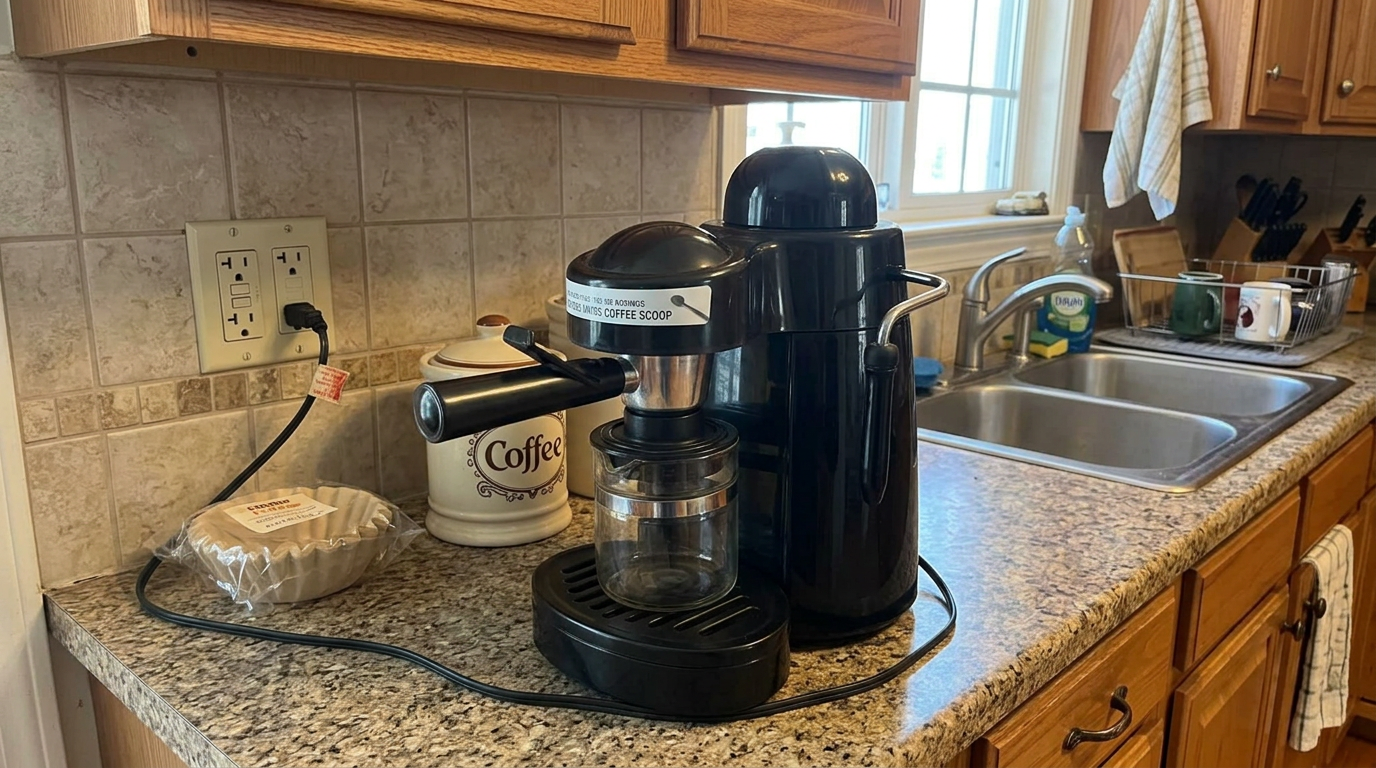
Next to the sink, the BELLA leaves plenty of room for a bag of coffee and a cutting board.
If you're furnishing a first apartment, or you want a cappuccino maker for a small office kitchenette, the size is a big advantage.
The one thing to plan for is a spot near an outlet with a little room on the right for the steam wand and a pitcher.
Is the BELLA 13683 good value?
I'm not going to talk numbers here, because they change all the time.
What I can tell you is what you get for your money.
You get a working steam wand, a glass carafe that makes two or four servings, a simple control and a machine small enough for any kitchen.
You don't get true espresso, temperature control, a pressure gauge or the ability to make drinks back to back quickly.
For someone who wants cappuccinos at home without learning a whole new hobby, that trade-off makes sense.
For someone who already loves espresso and wants to improve their shots over time, it doesn't.
My category scores out of 10, which make up the 6.4 overall rating.
Three weeks in: how it held up
After three weeks of daily use, the BELLA still worked exactly as it did on day one.
The steam wand was as strong as at the start, partly because I purged and wiped it after every use.
The portafilter locked smoothly, the knob still clicked firmly between positions and nothing leaked.
The glass carafe picked up a light coffee stain that came off with warm soapy water.
What changed most was me.
By week two, I had my dose, my stopping point and my steam sequence down, and the drinks got noticeably better.
That's worth keeping in mind if your first cup disappoints.
It's a simple machine, but it rewards a few days of practice.
How it compares with other coffee setups
The most useful comparison is with the kinds of machines you're likely choosing between.
The BELLA 13683 stands out for its small size, its one-knob control and its built-in steam wand.
| Feature | BELLA 13683 | Pump espresso machine | Stovetop moka pot |
|---|---|---|---|
| Pressure | Steam, a few bar | About 9 bar at the coffee | About 1.5 bar |
| Coffee style | Strong, moka-like | True espresso with crema | Strong, moka-like |
| Milk frothing | Built-in steam wand | Usually a steam wand | None |
| Servings | 2 or 4 per brew | 1–2 shots | Depends on size |
| Back-to-back drinks | Slow, needs a cool-down | Quick | Slow |
| Learning curve | Low | Moderate | Low |
A pump machine is the step up if you want real espresso and better milk texture.
It's bigger, it takes more practice and it costs more, but it makes a different drink.
A stovetop moka pot makes a similar style of coffee but can't froth milk on its own.
The BELLA sits neatly between the two, and for milk-drink lovers on a budget, that's a sensible place to be.
Which one is right for you: is the BELLA 13683 your match?
4 quick questionsBELLA 13683 specifications
From manufacturer data and my own testing.
How I tested and scored the BELLA 13683
For three weeks, I used the BELLA 13683 every day for strong black coffee, cappuccinos, lattes, mochas and iced drinks, around 70 drinks in total.
I tested dark and medium-dark roasts at different grinds, compared two-cup and four-cup brews and tried different amounts of coffee and packing pressure.
I frothed whole, 2% and almond milk, logged every steam and handle-locking problem and timed each drink from a cold start.
I followed the daily cleaning routine, cleaned the frothing tip weekly and checked my notes against the BELLA instruction manual and product information.
- Coffee (5.8): strength, flavor and consistency with dark and medium roasts, two-cup and four-cup brews, and different amounts of packing
- Milk drinks (6.6): foam volume, texture and temperature with whole, 2% and almond milk
- Ease of use (6.8): how quickly a beginner gets a drink, how clear the knob and markings are, and how forgiving the routine is
- Compact design (7.6): footprint, weight, storage and how easily it shares a small counter
BELLA 13683 FAQ
Is the BELLA 13683 worth it?
Yes, if you want simple, compact cappuccinos and lattes. It brews strong, moka-style coffee and makes thick foam, but not true café espresso.
Does the BELLA 13683 make real espresso?
Not in the café sense. It uses steam pressure of a few bar instead of a pump at around 9 bar, so the coffee is strong but has very little crema.
Why is my BELLA steam wand not working?
Usually because the knob went straight to STEAM. Heat the machine in ESPRESSO mode first, turn to OFF, then to STEAM.
How long does it take to brew?
In my testing, coffee started flowing after about two minutes from cold, and a two-serving brew was done in about two and a half minutes.
What grind should I use?
A fine-to-medium grind, slightly coarser than true espresso. Very fine grounds packed hard can stall the flow and taste bitter.
Can I use almond milk?
Yes. Barista-style almond milk froths much better than regular almond milk, and whole dairy milk gives the creamiest foam.
When can I open the water cap?
Only when the machine is OFF and all pressure has been released through the steam wand. Never open it while the machine is hot and pressurized.
Kitchen & coffee tester
Michael spent six years as a line cook in restaurants in Chicago and New York, and he has tested kitchen appliances for HouseholdMe since 2018, from air fryers to coffee makers. He holds an SCA certificate in barista skills and used the BELLA 13683 as his everyday coffee machine for three weeks for this review.
- Three weeks of hands-on testing of the BELLA 13683 by Michael Reynolds
- BELLA 13683 instruction manual and product information
- General coffee brewing, milk frothing and maintenance guidance