ROWAN RCE5011 review
The ROWAN RCE5011 Espresso Machine with Grinder puts a stepped burr grinder, a lever tamper, PID temperature control, pre-infusion, a pressure gauge and a separate hot water spout into one stainless steel machine. It heats in about 20 seconds and made smooth, sweet espresso and latte-art milk in my tests. It is big, the riser tray won't hold a scale, and the brand is new.

Michael Reynolds
Hands-on review
Hands-on testing, research, specs
3 weeks
21 minutes
Jargon helpNew to coffee gear? Tap any dotted term to see what it means.
In this review
Yes, if you want a complete grind, tamp and brew station without buying separate tools. The ROWAN RCE5011 was ready in about 20 seconds, its built-in lever tamper made a clean, level puck, and with a 9-bar extraction and pre-infusion my shots came out balanced and sweet. It needs a lot of counter space, the second drip tray is awkward with a scale, and long-term reliability is still unknown.
ROWAN RCE5011 at a glance
ROWAN RCE5011 pros and cons
- Ready to brew in about 20 seconds
- Built-in lever tamper and portafilter sensor
- Balanced 9-bar shots with pre-infusion and PID
- Needs a lot of counter space
- Riser drip tray won't hold a coffee scale
- New brand with unproven long-term reliability
Who should buy the ROWAN RCE5011?
- Beginners who want real espresso without extra tools
- Flat white and latte art fans
- Busy mornings that need a quick start
- Small kitchens and low cabinets
- Push-button drinkers who don't want to learn
- Buyers who only trust long-established brands
First impressions of the ROWAN RCE5011
The ROWAN RCE5011 arrived in a box big enough that I checked the label twice.
Once it was on the counter, I understood why.
This machine holds a bean hopper, a burr grinder, a built-in tamper, the brewing system, a steam wand and a separate hot water spout, all in one stainless steel body.
It looks smart, with brushed steel panels and a mirrored panel behind the group head that lets you watch the shot from the side.
On top, a passive cup warmer uses the machine's own heat to warm cups before brewing.
The first thing I noticed was the portafilter.
It is heavy, well balanced and finished with a smooth handle, more like the ones on machines several times the price than the light aluminum ones I usually find at this level.
The second thing was speed.
From pressing the screen, the machine was ready to brew in about 20 seconds.
My first shot, using the default 14-second grind and the built-in tamper, was a little fast but already tasty.
I didn't expect much from a brand I hadn't used before, so I went into the test looking for weak spots.
I found a few, mostly around size and the drip trays, but the coffee itself was never one of them.
By the end of the first week, I was pulling sweet, balanced doubles every morning with very little mess on the counter.
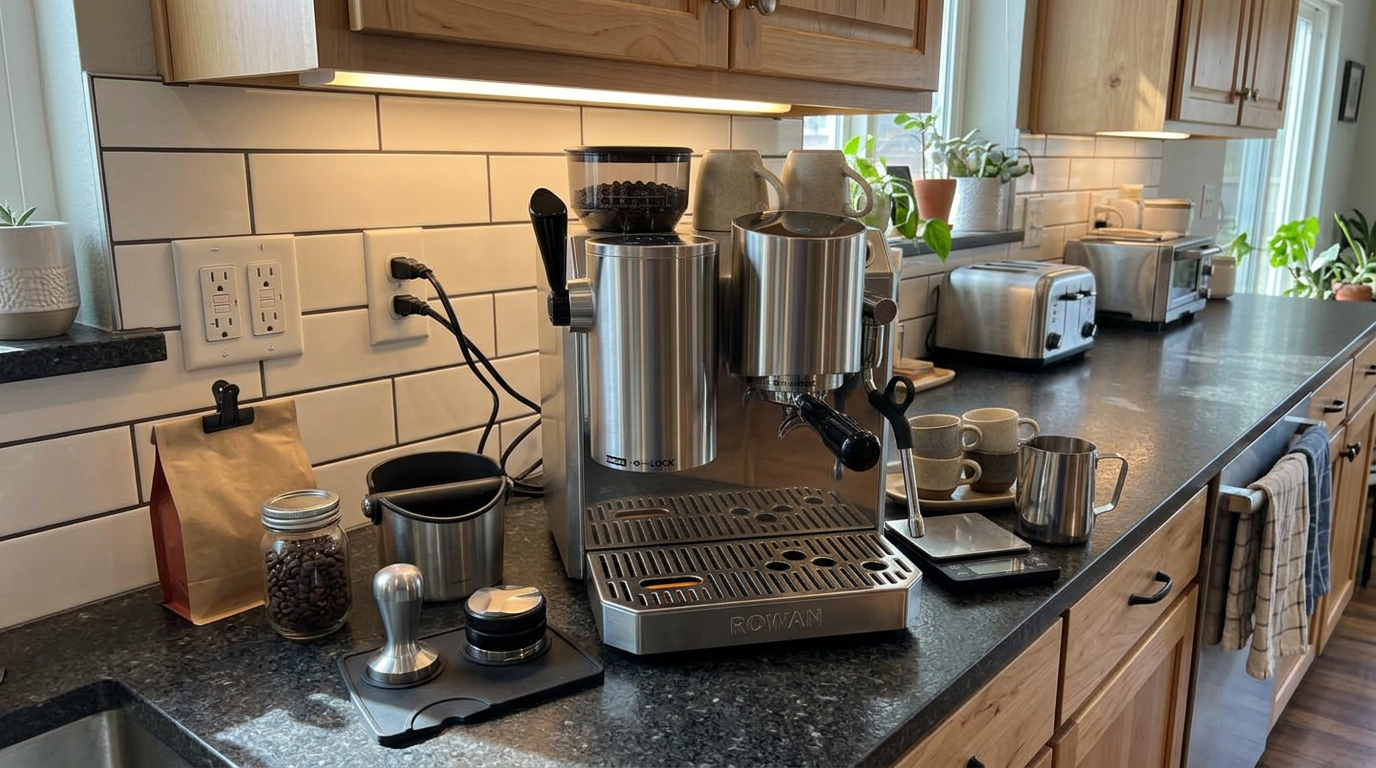
The RCE5011 packs a grinder, tamper, steam wand and hot water spout into one stainless steel body.
What the ROWAN RCE5011 actually is
The RCE5011 is a semi-automatic espresso machine with a built-in grinder.
Semi-automatic means you do the barista steps yourself: grind into the portafilter✕PortafilterThe handle with a metal basket that holds the ground coffee and locks into the machine's brew head., tamp, lock it in, start the shot and steam the milk.
The machine controls water temperature and pressure for you.
What makes the ROWAN different from most all-in-one machines is how much of the workflow happens in one place.
You grind into the portafilter while it sits in a cradle, pull a lever to tamp it right there, and then move it a few inches to the group head.
On paper, it ticks a remarkable number of boxes: PID temperature control, pre-infusion, a true 9-bar extraction, a pressure gauge, a shot timer and a dedicated hot water spout.
What's in the box
My box held the machine, the dual-spout portafilter with filter baskets, a stainless steel milk pitcher, the riser drip tray, a cleaning brush and the manual.
Our tip: Keep the cleaning brush in the drawer next to the machine, because a five-second sweep of the grinder chute after each dose keeps the counter clean.
ROWAN RCE5011 design and build
The footprint
This is a big machine.
It is wider and deeper than compact single-boiler machines, and it needs clearance above for the bean hopper.
I had to move a toaster and a fruit bowl to make room, and I would measure carefully before buying if your counter is small or your upper cabinets are low.
Build quality
The build quality is solid and respectable for the price.
It doesn't feel like a heavy commercial machine, but the touchpoints are good: the lever has a firm action, the buttons respond cleanly, and nothing felt hollow or rattly.
The portafilter
The portafilter is the standout part.
It is heavy, with a metal dual spout and a rubberized collar near the basket rim.
That collar sits snugly in the grinder cradle, so the portafilter doesn't rattle or slip while you grind.
It locks into both the cradle and the group head with a firm, reassuring stop.
Cup warmer and mirror
The cup warmer on top got my espresso cups warm in about 15 minutes after switching on.
The mirrored panel behind the spouts is more useful than it sounds, because I could watch the flow from the spouts without bending down.
Our tip: Stack your espresso cups on the cup warmer as soon as you switch on, because a warm cup keeps the crema and the temperature noticeably longer.
Screen, buttons and shot timer
The RCE5011 goes into a standby mode when idle and wakes with a single touch.
The display is clear and simple, and it gives you quick access to the things you actually change.
The built-in shot timer is the feature I used most after the grinder.
It starts counting the moment you press brew, so you don't need a stopwatch to know if a shot ran fast or slow.
The screen also shows a tamping indicator when you pull the tamping lever, which is a nice touch.
The built-in grinder and dosing
The grinder uses conical burrs✕BurrsThe two grinding plates inside a coffee grinder. The gap between them sets how fine or coarse the coffee is ground. with a stepped adjustment collar and a wide range of settings.
For espresso, I ended up around setting 4 to 5, near the fine end of the range.
Timed grinding
Out of the box, the grind time is set to about 14 seconds.
With my medium-dark beans, that gave very close to 18 grams, a standard double dose.
Sometimes a few beans stayed in the throat of the grinder, and a quick second tap finished them off.
The portafilter sensor
The grinder won't run unless the portafilter is properly locked into the cradle.
If you forget, the screen tells you, and you don't end up with coffee grounds all over the counter.
It saved me twice in the first week, both times before my first coffee.
Hopper or single dosing
You can fill the hopper and grind by time, or weigh a dose and drop it in.
I did both.
For the best freshness and consistency, I preferred single dosing✕Single dosingWeighing out exactly the beans for one shot and grinding them all, instead of storing beans in the hopper. It gives precise doses and fresher coffee. 18 grams, then grinding until the hopper was empty.
| Grind time | Dose in my tests | Use |
|---|---|---|
| 10 s | About 13 g | Single basket |
| 14 s (default) | About 18 g | Double basket |
| 16 s | About 20 g | Larger double, stronger milk drinks |
Our tip: Weigh one timed dose on a kitchen scale whenever you open a new bag, because different beans change how much the same grind time produces.
The built-in lever tamper
This is the part of the ROWAN RCE5011 I didn't expect to like as much as I did.
After grinding, you leave the portafilter in the cradle and pull down a lever on the side.
An internal tamper plate presses straight down onto the coffee.
With normal, firm pressure on the lever, the puck came out level and evenly compressed every time.
The small edge gap
When I looked closely, there was a tiny ring of loose grounds right at the edge of the basket.
I worried it would cause channeling, but in practice the shots ran evenly and tasted the same as with a hand tamper.
If you are a perfectionist, you can still remove the portafilter and tamp by hand.
Time from grinding to locking in the portafilter, from my timings.
PID, pre-infusion and the pressure gauge
PID temperature control
The RCE5011 uses a PID✕PID controllerA digital controller that keeps the water at a steady temperature by constantly adjusting the heater, instead of letting it swing up and down. to keep water temperature steady during the shot.
You can't set it to the exact degree, but there are three presets: low, medium and high.
I used high for most beans, and medium for one dark roast that tasted a little bitter on high.
Pre-infusion
Before full pressure, the machine runs about 7 to 8 seconds of low-pressure pre-infusion✕Pre-infusionA short, gentle wetting of the coffee puck before full pressure. It lets the grounds swell and settle so water flows through them more evenly..
I could see it on the gauge and hear the pump change pitch.
It made my shots more forgiving, especially when my dose or tamp was slightly off.
9-bar extraction and the gauge
Many home machines run at 15 or 20 bars to compensate for pressurized baskets.
The ROWAN extracts at about 9 bars, the pressure most cafés use.
The gauge showed me in real time whether my grind was too coarse, with low pressure, or too fine, with pressure climbing high.
Choosing a temperature preset
The three presets made a clear difference with different roasts.
Light and medium beans tasted sweeter and less sour on high, because hotter water extracts more from denser beans.
Very dark beans tasted smoother on medium, with less of the burnt edge they can have.
| Roast | Preset I used | What changed |
|---|---|---|
| Light roast | High | Less sour, more sweetness |
| Medium roast | High | Fuller body, fruit came through |
| Medium-dark blend | High or medium | Both good, high slightly richer |
| Dark roast | Medium | Less bitterness, smoother finish |
My readings during typical shots. The needle settled in the middle zone once dialed in.
Espresso and dialing in on the RCE5011
I aimed for a classic 1:2 brew ratio✕Brew ratioThe weight of liquid espresso compared with the weight of dry coffee. A 1:2 ratio means 18 grams of coffee makes about 36 grams of espresso.: 18 grams of coffee in, about 36 grams of espresso out, in 25 to 30 seconds.
My first shot at grind setting 5 gave 46 grams in 23 seconds.
That was a bit fast and a bit long, so I moved one step finer.
| Shot | Grind | Dose | Yield | Time | Taste |
|---|---|---|---|---|---|
| 1 | 5 | 18 g | 46 g | 23 s | Smooth, a little thin |
| 2 | 4 | 18 g | 38 g | 27 s | Sweet, balanced |
| 3 | 4 | 18 g | 36 g | 29 s | Best: rich, rounded |
| 4 | 3 | 18 g | 33 g | 34 s | Heavier, slightly bitter |
How it tasted
Even that first fast shot had rich aroma and a thick layer of golden crema✕CremaThe golden-brown foam on top of an espresso. It forms when pressure pushes gases and oils out of freshly ground coffee..
Once dialed in, the espresso was smooth, sweet and rounded, with no harsh bitterness and none of the sharp sourness of a rushed shot.
I also pulled the same beans on a much more expensive setup I use as a reference.
The ROWAN gave up a little clarity in the flavors, but the difference was small, and in a flat white I couldn't taste it at all.
Our tip: Change only the grind between shots and keep the dose at 18 grams, because changing two things at once makes it impossible to tell what fixed the shot.
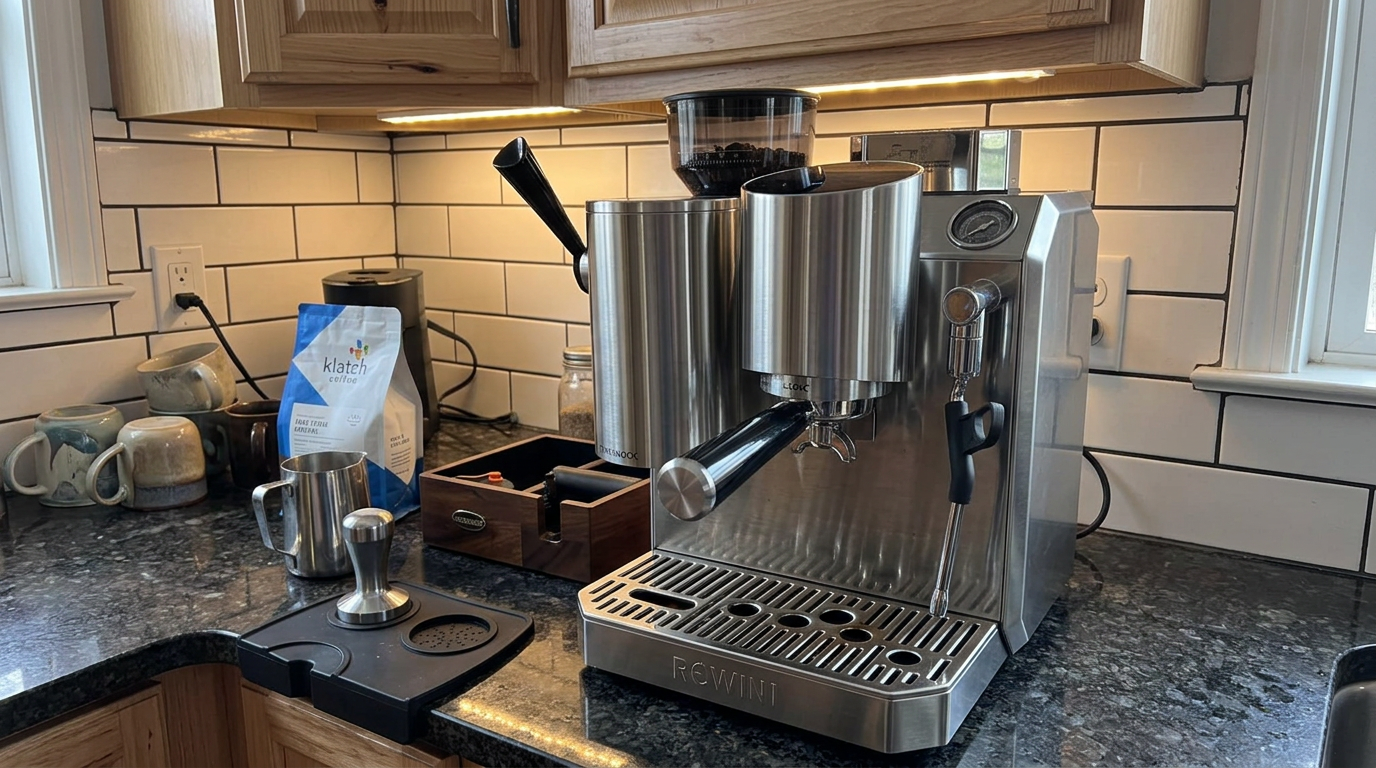
With the grind one step finer than my first try, shots settled at about 36 grams in 29 seconds.
Steaming milk and latte art
The steam wand has a single-hole tip, and it is one of the most beginner-friendly wands I have used.
After pressing the steam button, it takes a short while for steam to build up, with a rhythmic pulsing sound as water is flashed into steam.
I purged the first condensation into a cloth, then submerged the tip and turned the steam back on.
How the milk turned out
With the wand angled slightly off-center, the milk spun into a smooth whirlpool almost by itself.
It isn't as powerful as a commercial dual-boiler wand, so steaming 6 ounces of milk took around 40 seconds, but it is far from weak.
The result was glossy, wet-paint microfoam✕MicrofoamMilk foam with bubbles so small you can't see them. It feels silky and blends into the coffee instead of sitting on top like froth. with no big bubbles.
I poured hearts from day three and a wobbly tulip by the end of week two.
My ratings out of 10 for microfoam texture and latte art.
When to stop steaming
I stopped when the pitcher became too hot to hold comfortably, around 140 to 150°F.
Then I wiped the wand right away and gave it a short purge to clear milk from the tip.
Hot water spout and Americanos
The dedicated hot water spout is one of the small features I would now miss on other machines.
Pressing the hot water button gives a clean, steady stream from its own outlet, without touching the steam wand.
That means no milk taste in your Americano or tea, and no waiting for the wand to switch modes.
I made Americanos by pouring the shot over hot water, which kept more of the crema on top.
Our tip: Dispense the hot water first and pull the espresso on top of it, because the crema survives much better than when you add water to the shot.
My favorite drinks and settings
These are the recipes I settled on after three weeks with the ROWAN RCE5011.
All of them start from the same 18-gram dose at grind setting 4, so mornings never involved re-dialing.
| Drink | Espresso | Milk or water | Notes |
|---|---|---|---|
| Double espresso | 18 g in, 36 g out, 28 s | None | High temperature preset |
| Flat white | Same double | About 4 oz silky milk | Thin layer of foam, pour a heart |
| Latte | Same double | About 8 oz milk | Slightly less air than a flat white |
| Cappuccino | Same double | About 5 oz, more foam | Stretch the milk longer |
| Americano | Same double | 5–6 oz from the hot water spout | Water first, shot on top |
| Cortado | Same double | About 2 oz milk | Barely any foam |
A stronger milk drink
For big lattes, I increased the grind time to 16 seconds for about 20 grams and pulled a slightly longer shot.
The coffee held up better against 10 ounces of milk without tasting bitter.
A quick iced latte
Pull a double straight onto three or four ice cubes, stir, then add cold milk.
It isn't a dedicated iced program, but it tasted fresh and strong.
Our tip: Pull iced espresso straight onto a few ice cubes, not a full glass, so the shot chills quickly without turning watery.
Useful accessories
The ROWAN comes with almost everything you need, which is part of its appeal.
I still found a few cheap extras made a real difference.
| Accessory | Why it helps | Priority |
|---|---|---|
| Small coffee scale | Weigh dose and yield for consistent shots | High |
| Knock box | Quick, clean puck disposal | Medium |
| Microfiber cloths | Purging and wiping the steam wand | High |
| WDT tool | Breaks up clumps before tamping | Low, the grinder clumps little |
| Second milk pitcher | Hot milk for two drinks back to back | Low |
A scale is the one I would buy first.
The built-in timer tells you how long the shot ran, but only a scale tells you how much espresso you made, and together they tell you exactly what to change.
The two drip trays
The ROWAN comes with a two-tier drip tray system.
The main lower tray sits at the base and leaves plenty of room for tall mugs and iced latte glasses.
The second, raised tray sits on top of it and lifts small espresso cups closer to the spouts to reduce splashing.
In theory, that is thoughtful.
In practice, the riser tray had two problems for me.
It is bulky to store when you don't need it.
And it is too narrow and shallow to hold a coffee scale, which hung over the edge and wouldn't zero properly.
Because I weigh every shot, I took the riser off and put the scale on the lower tray.
With a dialed-in shot, the extra drop barely caused any splashing.
| Tray setup | Best for | Works with a scale? |
|---|---|---|
| Lower tray only | Mugs, glasses, weighing shots | Yes |
| Riser tray on top | Small espresso cups | No, the scale overhangs |
Heat-up speed and noise
A 20-second start
The ROWAN heats up fast, which changes how you use it.
Traditional machines with a heavy brass boiler can need 15 to 30 minutes before the first shot tastes right.
The RCE5011 was ready to brew in about 20 seconds from cold, and the first shot tasted the same as the fifth.
RCE5011 timed in my tests; boiler times vary widely.
Switching to steam
After a shot, switching to steam took a few more seconds to build pressure.
Steaming 6 ounces of milk then took around 40 seconds.
That means a flat white from a cold machine took me under three minutes from switch-on to first sip.
How loud it is
The grinder makes a short, sharp burst of about 14 seconds, louder than the brewing.
The pump hums steadily through pre-infusion and the shot, and the steam wand pulses rhythmically while it builds pressure.
None of it was loud enough to bother anyone in the next room, but early risers in an open-plan home will hear the grinder.
| Sound | When | Normal? |
|---|---|---|
| Grinder burst | About 14 s per double | Yes |
| Pump changing pitch | End of pre-infusion | Yes |
| Rhythmic pulsing | Steam building up | Yes |
| Hiss into the drip tray | Purging the steam wand | Yes |
| Grinder runs with no coffee coming out | Hopper empty or blocked | No, check beans and chute |
What daily use is really like
My weekday routine took about four minutes for a flat white.
I touched the screen to wake the machine, weighed 18 grams of beans, ground, tamped with the lever, locked in and pressed the double shot button.
While the shot ran, I filled the pitcher, and by the time the shot was done, the steam was ready a few seconds later.
At weekends, I made Americanos for guests using the hot water spout and pulled flat whites for my partner.
From my drink log, rounded.
Cleaning and maintaining the RCE5011
Daily cleaning was simple, but there are more parts to look after than on a machine without a grinder.
After each shot, I knocked out the puck, rinsed the basket and ran a short flush through the group head.
After steaming, I wiped and purged the wand.
The grinder
Once a week, I brushed out the grinder chute and the cradle area with the included brush.
Every couple of weeks, I removed the hopper and gave the upper burr a quick clean.
Water and descaling
The water tank lifts out for refilling at the sink.
I would descale according to your water hardness and the manual, roughly every two to three months with average water.
| Task | What it removes | How often |
|---|---|---|
| Rinse basket and flush group | Coffee oils and grounds | After every shot |
| Wipe and purge steam wand | Milk residue | After every steam |
| Empty both drip trays | Water | Daily |
| Brush grinder chute | Old grounds | Weekly |
| Clean burrs | Oils and fines | Every 2 weeks |
| Descale | Mineral scale | Every 2–3 months |
My estimate of hands-on cleaning time per day.
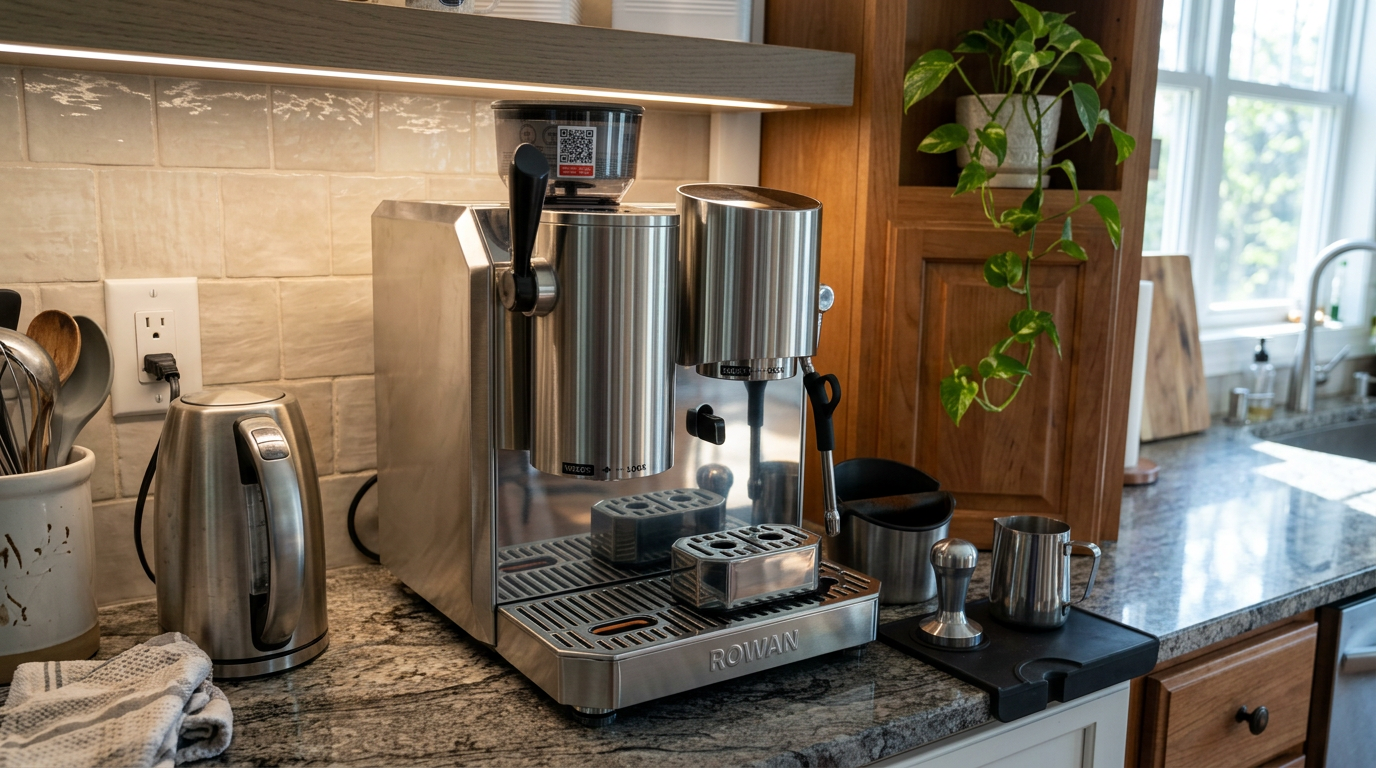
Wipe and purge the steam wand right after steaming, before the milk dries on.
Beans, water and milk
Fresh beans made a bigger difference on the ROWAN than on many machines, because nothing in the basket hides a stale bean.
Medium-dark blends gave the sweetest, most forgiving shots.
Medium roasts were brighter and lovely as Americanos.
| Bean type | Espresso | Milk drinks | Notes |
|---|---|---|---|
| Medium-dark blend | Best, sweet | Excellent | Easiest to dial in |
| Medium roast | Bright, fruity | Good | High temperature preset |
| Light roast | Tricky, can be sour | Fades in milk | Finest grind, high temp |
| Oily dark roast | Bitter | Strong | Medium temp, clean burrs often |
Water and milk
Use fresh, filtered water if your tap water is hard.
For milk, cold whole milk or barista oat milk gave the best foam.
Three weeks with the ROWAN RCE5011, week by week
Week 1: learning the workflow
I learned the grinder, the lever tamper and the timer, and pulled about 30 shots to find my settings.
The 20-second heat-up and the portafilter sensor stood out.
Week 2: dialing in and milk
Grind setting 4 with 18 grams became my daily shot.
I started pouring hearts in flat whites.
Week 3: the routine
Everything became quick and automatic, including the cleaning.
The only thing I never warmed to was the riser drip tray, which ended up in a cupboard.
Our combined feeling about the machine, from our shared notes.
Common mistakes to avoid
| Mistake | What happens | Better habit |
|---|---|---|
| Trusting the timer for every new bag | Dose drifts up or down | Weigh one dose per bag |
| Pressing the tamper lever too hard once | Uneven puck | Two firm presses |
| Weighing shots on the riser tray | Scale won't zero | Use the lower tray |
| Steaming without purging first | Water in the milk | Purge into a cloth first |
| Leaving milk on the wand | Blocked tip, bad taste | Wipe and purge right away |
| Changing grind and dose together | Can't tell what changed | One change per shot |
What I would change
A smaller footprint would make it easier to recommend for city kitchens.
A riser tray wide enough for a scale would fix my biggest daily annoyance.
And a few more years on the market would give buyers more confidence in long-term reliability.
Three households, three verdicts
The first-time home barista
Someone who wants real espresso and to learn latte art, without buying a separate grinder and tools.
The RCE5011 is an excellent choice, with lots of help built in.
The busy commuter
Someone who wants a good flat white before leaving the house.
The 20-second heat-up and built-in tamper make this realistic on weekdays.
The small-kitchen owner
Someone with a narrow counter and low cabinets.
The ROWAN is probably too big, even if everything else fits.
| Household | Fit | Main reason |
|---|---|---|
| First-time home barista | Excellent | Grinder, tamper, help built in |
| Flat white and latte fans | Excellent | Beginner-friendly steam wand |
| Busy weekday mornings | Very good | 20-second heat-up |
| Small kitchens | Poor | Large footprint |
| Push-button drinkers | Poor | Semi-automatic workflow |
Is the ROWAN RCE5011 worth the money?
The RCE5011 sits in the middle of the all-in-one espresso market.
For that, you get a grinder, a built-in tamper, PID, pre-infusion, 9-bar extraction with a gauge, a shot timer and a dedicated hot water spout.
That is an unusually complete feature list, and in my tests the cup quality lived up to it.
Buying a separate grinder, tamper, scale and machine with the same features would cost more and take up even more space.
The two questions are space and trust: you need room for it, and you have to be comfortable with a newer brand.
It is also worth thinking about what you would otherwise buy.
A separate machine with PID and pre-infusion, plus a capable espresso grinder, a good tamper and a distribution tool, adds up quickly, and it fills even more of the counter.
The ROWAN puts all of that into one body, with a workflow that is faster than most separate setups I have used.
What you give up is the ability to upgrade one part at a time, and the reassurance of a brand with a long service record.
For a first serious espresso machine, I think that trade is worth it.
Three questions to ask:
Do you have plenty of counter space?
Do you want to learn real espresso and latte art?
Are you happy to buy from a newer brand?
How it compares with other coffee setups
| Feature | ROWAN RCE5011 | Compact espresso machine | Super-automatic machine |
|---|---|---|---|
| Grinder | Built in, stepped conical burrs | Separate, extra cost | Built in, automatic |
| Tamping | Built-in lever tamper | Hand tamper | Automatic |
| Temperature | PID, 3 presets | Often fixed | Automatic, 3 to 5 levels |
| Pre-infusion | Yes, 7–8 s | Sometimes | Sometimes |
| Milk | Manual steam wand, latte art | Steam wand | Automatic carafe |
| Footprint | Large | Small | Medium to large |
Compared with a compact espresso machine and a separate grinder, the ROWAN saves you buying and storing extra tools, and the built-in tamper speeds things up.
Compared with a super-automatic, it asks you to learn the craft, but rewards you with sweeter shots and real latte art.
If you are still shopping, my guide to the best espresso machines with a grinder puts it alongside the alternatives.
| You mostly drink | Is the RCE5011 a fit? | Why |
|---|---|---|
| Flat whites and lattes | Excellent | Silky microfoam, latte art |
| Double espresso | Very good | Balanced 9-bar shots |
| Americanos and tea | Very good | Dedicated hot water spout |
| One-touch milk drinks | Poor | Manual steaming only |
| Coffee in a tiny kitchen | Poor | Big footprint |
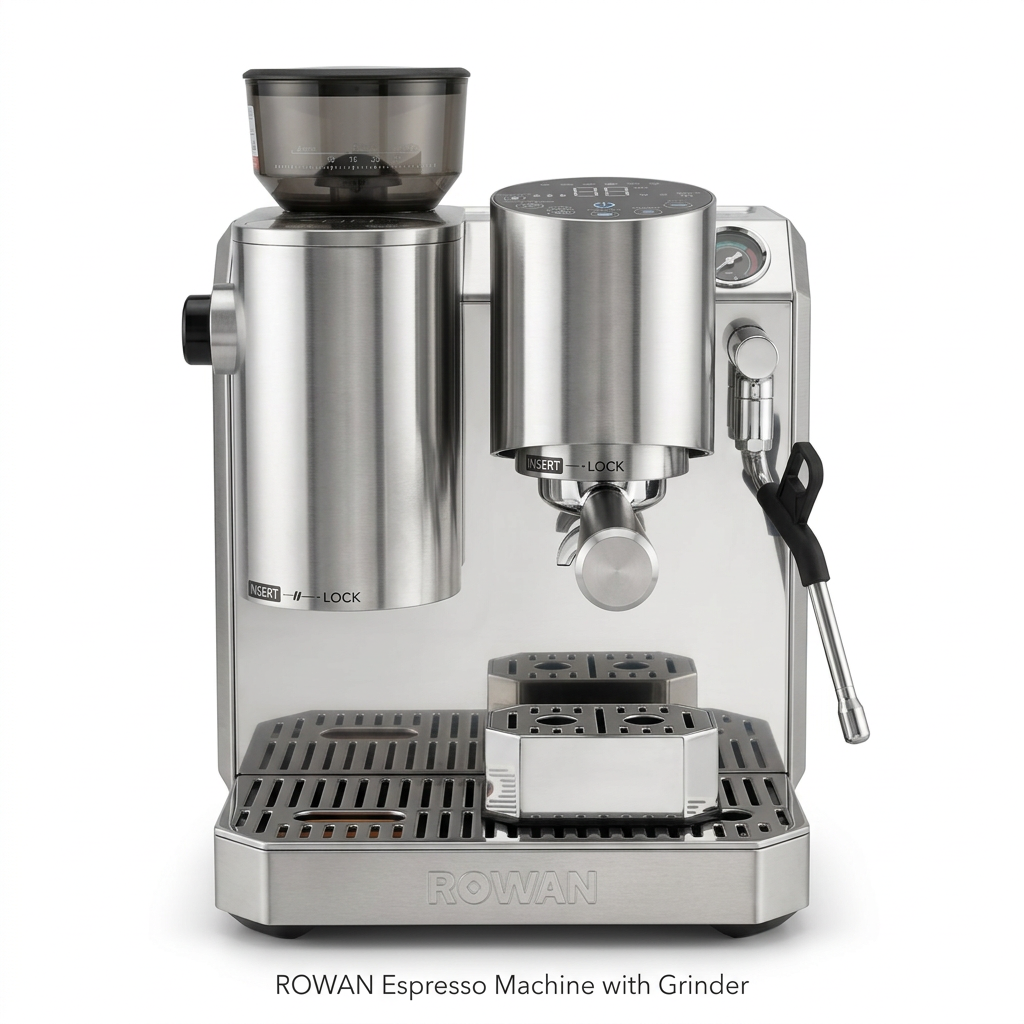
The full package: grinder on the left, gauge and group head in the middle, steam wand on the side.
Which one is right for you: is the ROWAN RCE5011 your match?
4 quick questionsROWAN RCE5011 specifications
From manufacturer data and my own testing.
How I tested and scored the ROWAN RCE5011
For three weeks, the ROWAN RCE5011 was our everyday espresso machine for espresso, Americanos, flat whites and lattes.
I single-dosed 18 grams of fresh beans for most shots, weighed every shot on a scale, and logged grind setting, time and yield.
I timed the heat-up, compared the built-in tamper with a hand tamper, and steamed whole and oat milk for flat whites and latte art.
I also used the hopper for timed grinding, cleaned the grinder and steam wand daily, and checked how the two drip trays worked with different cups.
- Espresso (8.7): balance, sweetness, crema and how easy it was to dial in.
- Milk drinks (8.4): steam power, microfoam quality, latte art and plant milks.
- Ease of use (8.6): heat-up, grinder, tamper, screen, timer and workflow.
- Cleaning (7.9): drip trays, grinder cleaning, steam wand and daily mess.
The overall score of 8.4 is an editorial rating that reflects those four areas.
ROWAN RCE5011 FAQ
Is the ROWAN RCE5011 worth it?
Yes, if you want a complete all-in-one espresso machine with a grinder, built-in tamper, PID and pre-infusion. It needs a big counter and is from a newer brand.
How fast does it heat up?
About 20 seconds from cold in my tests.
Does it have a built-in tamper?
Yes. You pull a side lever to press the coffee in the portafilter while it sits in the grinder cradle.
What pressure does it brew at?
It extracts at 9 bars and shows the pressure on a gauge during the shot.
Does it have pre-infusion?
Yes, about 7 to 8 seconds of low-pressure wetting before full pressure.
Can I adjust the temperature?
Yes, with three PID presets: low, medium and high.
How much coffee does the grinder dose?
The default 14-second grind gave about 18 grams in my tests. You can adjust the grind time.
Can I make latte art with it?
Yes. The single-hole steam wand made glossy microfoam good enough for hearts and tulips.
Can I use a coffee scale?
Yes, on the lower drip tray. The riser tray is too small to hold a scale reliably.
Does it have a hot water spout?
Yes, a dedicated spout for Americanos and tea, separate from the steam wand.
Is it big?
Yes. It needs much more counter space than a compact espresso machine, so measure first.
What beans work best?
Fresh medium or medium-dark beans. I single-dosed 18 grams for most shots.
Kitchen & coffee tester
Michael spent six years as a line cook in restaurants in Chicago and New York, and he has tested kitchen appliances for HouseholdMe since 2018, from air fryers to coffee makers. He holds an SCA certificate in barista skills and used the ROWAN RCE5011 as his everyday coffee maker for three weeks for this review.
- Three weeks of hands-on testing of the ROWAN RCE5011
- ROWAN product specifications and user manual
- General espresso brewing, dialing-in and milk steaming guidance