Ninja Luxe Café Pro review: hands-free tamping, a better steam wand and real hot water, but it’s thirsty
The Ninja Luxe Café Pro Series 4-in-1 Espresso Machine takes Ninja's guided espresso idea one step further: it grinds by weight, tamps for you, steams with a thicker non-burn wand and pours hot water from its own spout. It made the easiest good espresso of any guided machine Michael and I tested, but it uses a lot of water and the drip tray fills quickly.
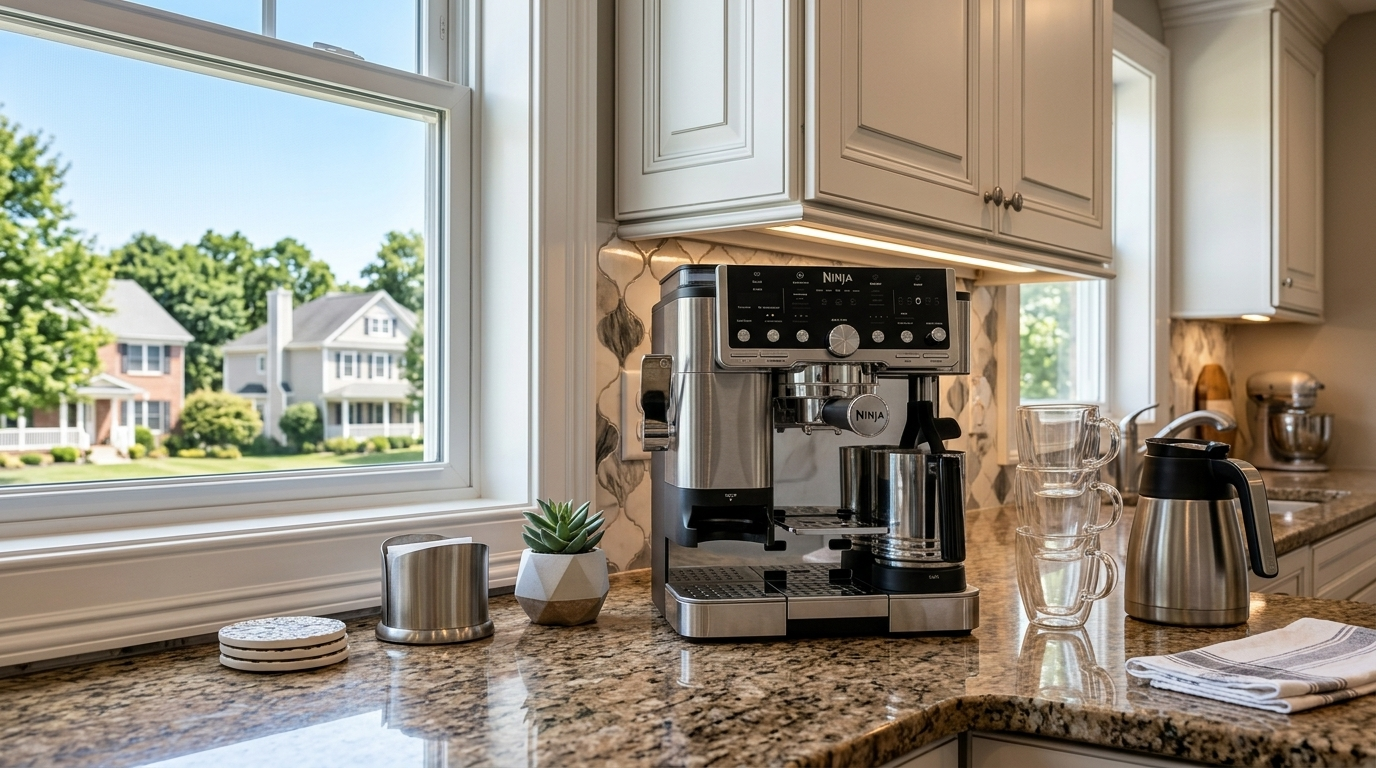

Michael Reynolds
Hands-on review
Hands-on testing, research, specs
4 weeks
20 minutes
Jargon helpNew to espresso? Tap any dotted term to see what it means.
In this review
Yes, if you want the most hands-off way to make real espresso and milk drinks. The Ninja Luxe Café Pro grinds, weighs and tamps in one cradle, so there's no funnel to juggle, and its non-burn steam wand is much easier to keep clean. Americano, lungo, ristretto, cold press and a separate hot water spout make it genuinely versatile. The trade-offs are heavy water use, a drip tray you'll empty every morning, no side handles and less freedom for manual puck preparation.
Ninja Luxe Café Pro at a glance
Ninja Luxe Café Pro pros and cons
- Integrated tamper: no funnel, no mess
- Non-burn steam wand that wipes clean
- Hot water spout and many drink styles
- Uses a lot of water; drip tray fills fast
- No side handles for moving it
- Little room for manual puck preparation
Who should buy the Ninja Luxe Café Pro?
- Espresso beginners who want the easiest workflow
- Households that drink lattes and cappuccinos daily
- People who like Americanos, lungos and iced drinks
- Hands-on home baristas
- Anyone who hates emptying drip trays
- Small kitchens
First impressions and setup
The Ninja Luxe Café Pro looks a lot like the rest of the Luxe Café family at first glance.
It has a bean hopper on top, a control dial and display in the middle, a steam wand on the right and a portafilter on the left.
Look closer and you'll spot the differences: a grinding and tamping cradle, a thick steam wand, a hot water spout and two small LED lights under the machine.
Setup took me about 15 minutes.
I rinsed the tank, hopper, baskets and XL milk jug, ran the priming cycle and used the included test strip to set our water hardness.
The machine then walked me through my first double espresso step by step.
The build is a mix of brushed stainless steel and sturdy plastic.
It feels solid and stable on the counter, and the controls click firmly.
The water tank sits at the back, so leave a little space behind the machine to lift it out.
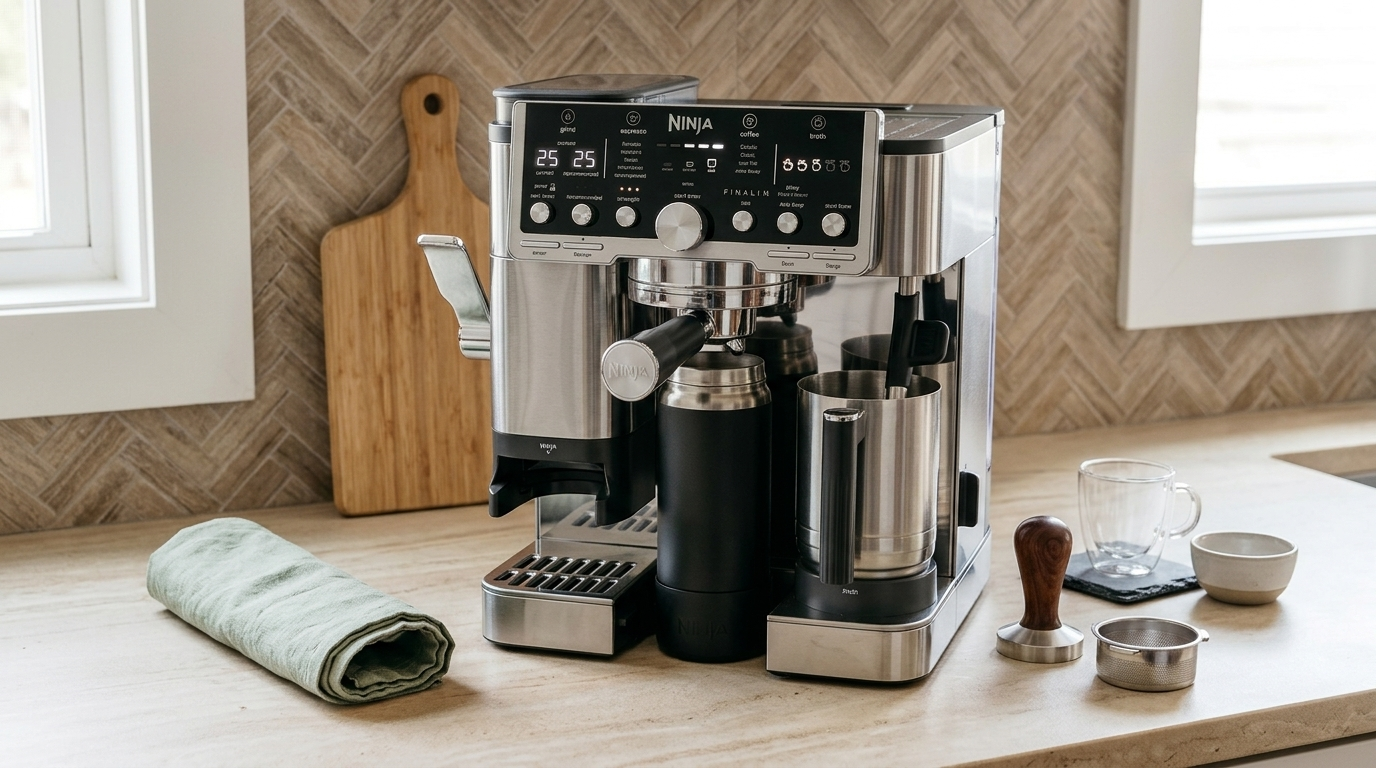
The Pro comes with single, double and Luxe baskets, an XL milk jug and cleaning accessories.
Our tip: Let the machine warm up for a few minutes before your first shot, because a warm portafilter makes a sweeter espresso.
The integrated tamper changes everything
The biggest upgrade on the Pro is its built-in tamper, and it's the reason I'd choose this model over its siblings.
On the simpler Luxe Café models, you attach a dosing funnel, grind, tamp and then remove the funnel again.
On the Pro, you just place the portafilter in the cradle and press grind.
The machine recognises which basket is installed, grinds the right weight of coffee and then tamps it.
You pull the tamping lever twice, and the display tells you when the portafilter is ready to lock in.
A removable cover lets you watch the coffee fall into the basket and see the tamper at work.
In four weeks of daily use, the puck✕PuckThe compressed disc of ground coffee in the portafilter basket. An even, level puck lets water flow through evenly for a balanced shot. came out level and firm every time.
There were no grounds on the counter, no funnel to rinse and no separate tamper to find.
Michael and I used the tamper dozens of times without any problems, and the built-in scale stayed accurate despite the tamping force.
There's one trade-off.
Because grinding and tamping happen inside the cradle, there's no room for manual puck preparation like stirring the grounds with a WDT✕WDTShort for Weiss Distribution Technique: stirring ground coffee in the basket with fine needles to break up clumps before tamping, so the puck extracts more evenly. tool.
Most people won't miss it, but hands-on home baristas might.
Espresso quality and consistency
I measured every shot during our first two weeks to see how close the Ninja Luxe Café Pro gets to its own targets.
With the double basket on the strongest setting, it aims for about 18 g of coffee and a 36 g shot, a classic 1:2 brew ratio✕Brew ratioThe weight of ground coffee compared with the weight of the finished drink. A 1:2 ratio means 18 g of coffee makes a 36 g espresso..
The dose landed between 17.8 and 18 g almost every time, and shots came out at around 38–39 g.
That's slightly over target but very consistent.
With a dark, robusta-rich espresso blend, the shots were sweet and chocolatey, with thick crema and plenty of body.
Shot temperature measured around 63–64°C in the cup, which is warm and pleasant to drink straight away.
Like the rest of the range, the Pro is happiest with medium and dark roasts.
The three temperature levels help here: lower for dark roasts, middle for medium roasts and highest for lighter beans.
You switch to temperature mode by pressing and holding the strength button, which isn't obvious until you read the manual.
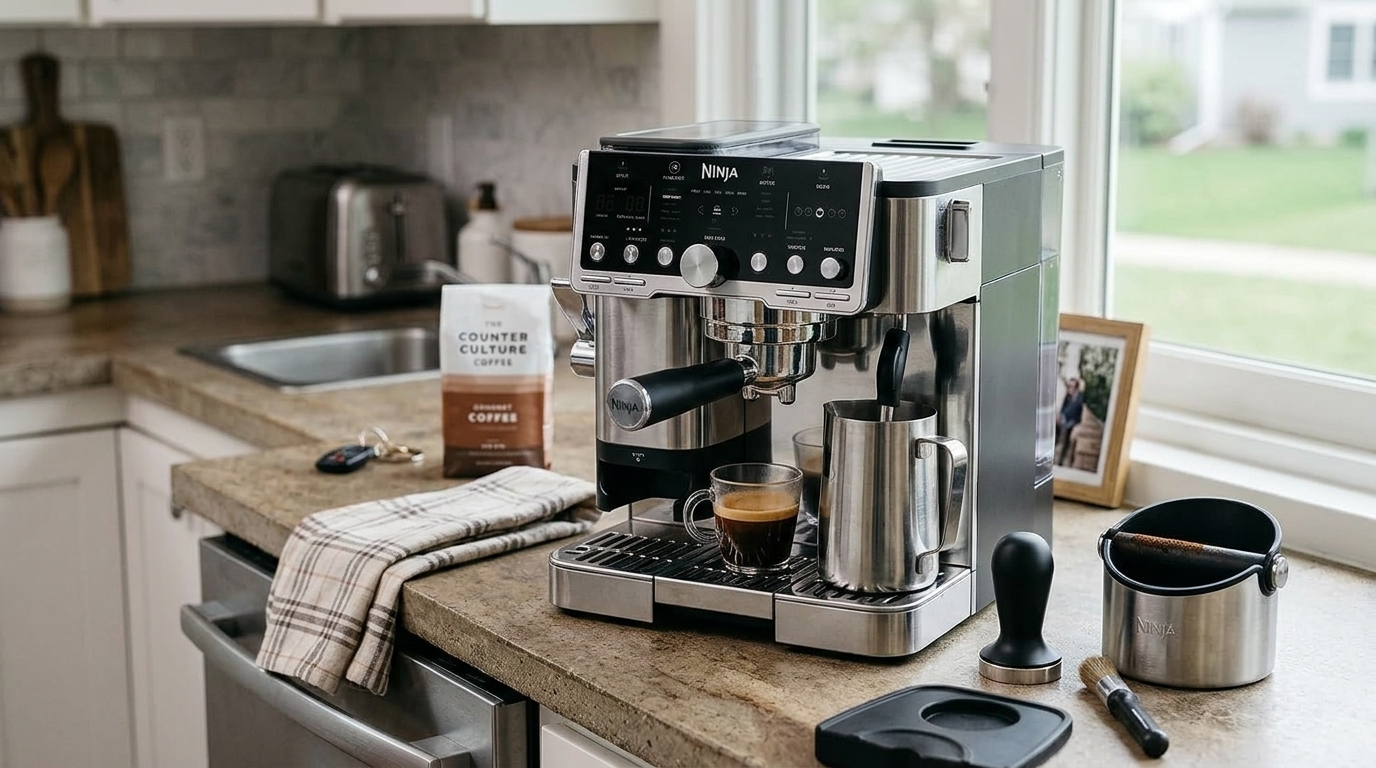
With a dark espresso blend, double shots were sweet, chocolatey and very consistent.
Targets versus what landed in the cup
| Drink | Target dose | Target output | Our result |
|---|---|---|---|
| Single espresso | 9 g | 18 g | 9.1 g in, 23 g out |
| Double espresso | 18 g | 36 g | 17.8–18 g in, 38–39 g out |
| Ristretto | 18 g | 18 g | 18 g in, 21 g out |
| Lungo | 18 g | 144 g | 142 g (sometimes 70–80 g) |
The targets are guides rather than exact measurements, but most drinks landed close enough that I couldn't taste the difference.
Our tip: Press and hold the strength button to switch to temperature mode, and use the lowest setting for very dark roasts.
Single, ristretto and lungo
The Pro adds several espresso styles that the simpler models don't have.
The single basket was my go-to for an afternoon espresso.
The machine recommended grind setting 15, dosed 9.1 g and poured a neat, balanced shot, though it ran a little long at 23 g.
Ristretto uses the double basket for a 1:1 ratio, so you get a very short, intense shot.
The machine recommended a finer setting of 11, and the shot came out at 21 g from 18 g of coffee.
It's syrupy and bold, which I liked in a small cup, but it's too strong for some people.
When you move the grinder to a finer setting, the burrs briefly turn to stop beans getting stuck.
After a big change, hold the grind button for a moment to purge old grounds before your shot.
Lungo is a long espresso at a 1:4 ratio, closer to a large café crema.
On a good day it hit 142 g against a 144 g target and came out at 73–75°C, which made a hot, full-bodied morning coffee.
On other days it stopped at 70–80 g, usually when my grind was too fine and the machine diverted water away from the puck.
Our flavor scores out of 10 by drink
Our tip: If your lungo stops early, go one or two grind steps coarser before changing anything else.
Americano and the hot water spout
The Pro has a dedicated hot water spout, which the US version of the Premier lacks.
It offers three temperatures, so you can make tea, top up a coffee or warm a cup without a kettle.
The Americano preset is clever.
It pours hot water into the cup first and then brews the espresso on top, which is technically a long black.
That order keeps the crema on top and makes a better-looking, smoother drink.
Strength 1 gave me a large, mild morning cup, and strength 3 made a smaller, bolder one.
After a week, the Americano had become my everyday big coffee.
Drip-style coffee and cup sizes
The Pro's coffee mode uses the Luxe basket and offers Classic and Rich styles, plus three strength levels.
Classic makes a longer, milder cup, while Rich uses less water for a stronger one.
Strength changes how much coffee the grinder doses.
Sizes run from about 175 mL to 530 mL, or about 6 to 18 fl oz.
With the drip tray removed, a 20 oz travel tumbler fits under the outlet.
Small stickers on the machine show the sizes, which I left on for the first week as a handy reference.
For coffee, I used a medium Arabica with strawberry and orange notes instead of my dark espresso blend.
The machine recommended grind setting 23, and the grounds go in the basket without tamping.
A Classic Small Plus cup targeted 235 mL and landed at 245 mL, with pleasant fruity notes.
It's good, but it's not as clean or complex as a careful pour-over.
| Size | Approximate volume |
|---|---|
| Small Plus | About 175–235 mL (6–8 oz) |
| Medium Plus | About 300 mL (10 oz) |
| Large Plus | About 400 mL (13–14 oz) |
| Extra Large | About 530 mL (18 oz) |
Milk drinks and the non-burn steam wand
The Pro's Dual Froth System Pro uses a thicker, 12 mm steam wand with an internal tube that keeps the outside cooler.
That non-burn design is the second big upgrade over the simpler models.
Milk wipes off easily instead of baking onto the wand, and the wand purges itself after every use.
Automatic frothing is very easy.
You choose dairy or plant milk and a froth level, and the machine heats and textures the milk on its own.
You can even queue the milk while the espresso is still brewing, which saves time.
Oat milk on medium froth reached about 61°C and came out creamy, though some oat milks separated after pouring.
For the best texture, I switched to manual steaming.
Pull the wand out, turn the selector fully to the left and hold the button to steam by hand.
With whole milk around 3.5% fat, I got glossy, silky microfoam✕MicrofoamFinely textured milk with tiny, even bubbles. It pours smoothly and is what baristas use for latte art. that poured well for basic latte art.
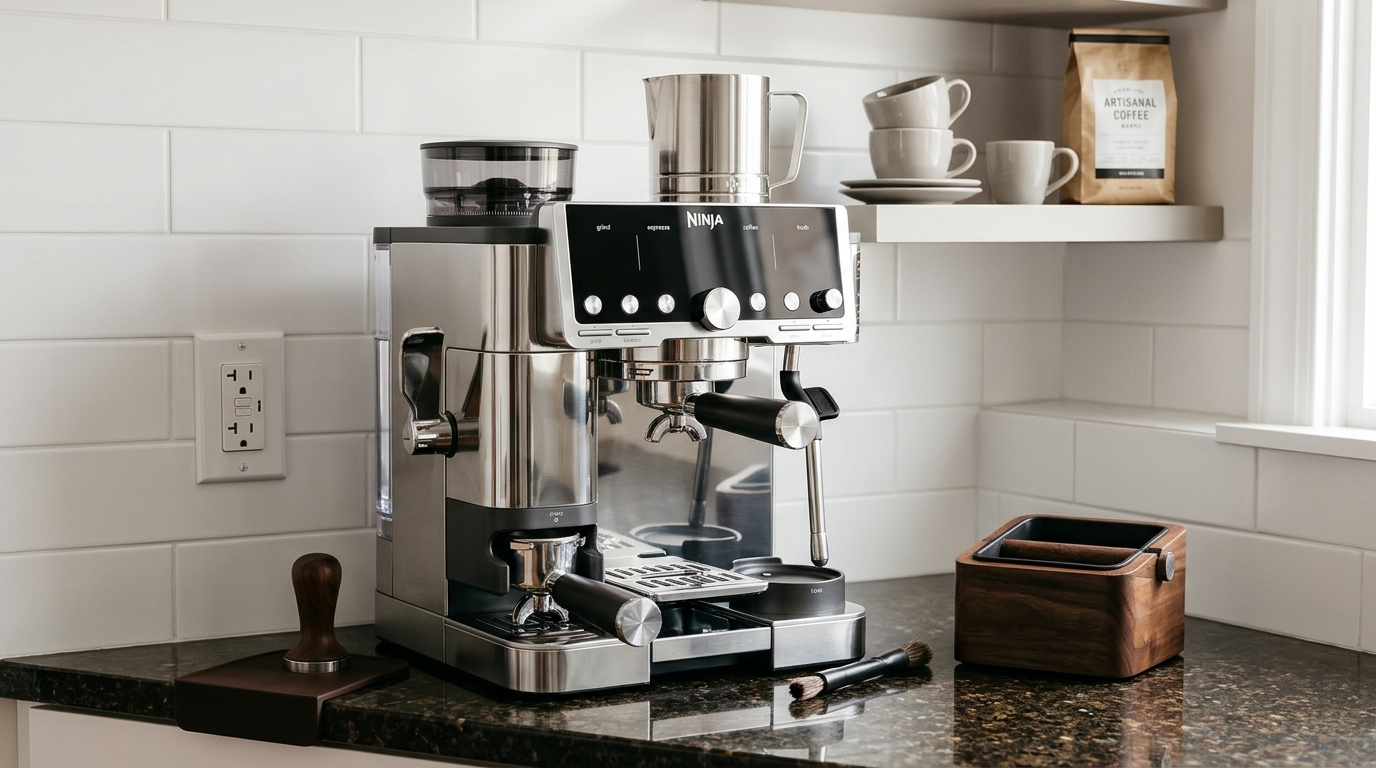
The thicker non-burn wand made milk drinks easier to make and much easier to clean.
Milk results
Our own texture and taste scores over four weeks.
Our tip: Wipe the steam wand with a damp cloth straight after frothing, even though it purges itself automatically.
Cold press and cold foam
The Pro's cold press setting makes espresso with cooler water, so it tastes smoother and less bitter over ice.
Because cooler water extracts more slowly, the machine recommends a finer grind and flushes the group to cool it before brewing.
The best part is that cold press and cold foam run at the same time.
While the espresso brewed, the whisk spun cold milk into a thick foam in the jug.
Over ice, it made a café-style cold foam latte in about two minutes.
Michael used this almost daily during a warm spell in week three.
If you love iced drinks, the Ninja Luxe Café Pro does them better than most guided machines we've tried.
The big drawback: water use
The Pro's biggest weakness is how much water it uses.
It uses water for brewing, rinsing, purging the wand and flushing the system.
But the main cause is the overpressure valve✕Overpressure valveA valve that releases water when brewing pressure gets too high, protecting the coffee and the machine. On this machine, released water goes into the drip tray..
When pressure rises above about 9 bar, the machine diverts water into the drip tray instead of back into the tank.
If your grind is too fine, more water gets diverted and the tray fills even faster.
In our test, the drip tray needed emptying every morning, and sometimes again in the afternoon on busy days.
We also refilled the 2 L tank roughly once a day for two people.
Rough share of daily water use during our test for two people.
Two habits fixed most of the hassle: empty the drip tray first thing every morning and check the water tank at the same time.
Our tip: Make emptying the drip tray and topping up the tank the first thing you do every morning.
Design, size and daily details
The Pro is a large machine at about 38 cm tall and 34 cm deep, so measure the space under your cabinets.
You'll also need room above it to refill the hopper and room behind it to lift out the tank.
There are no side handles, which made moving it to wipe the counter awkward.
Two LED lights under the machine light up the cup area.
They're useful in a dim kitchen, though not very bright.
There isn't enough space under the portafilter for two standard espresso glasses side by side, so splitting a double into two cups needs narrow glasses.
The 53.3 mm portafilter uses deep, tapered baskets, and pucks knocked out cleanly every time.
The baskets are keyed, though, so many third-party baskets won't fit.
There's no official bottomless portafilter either.
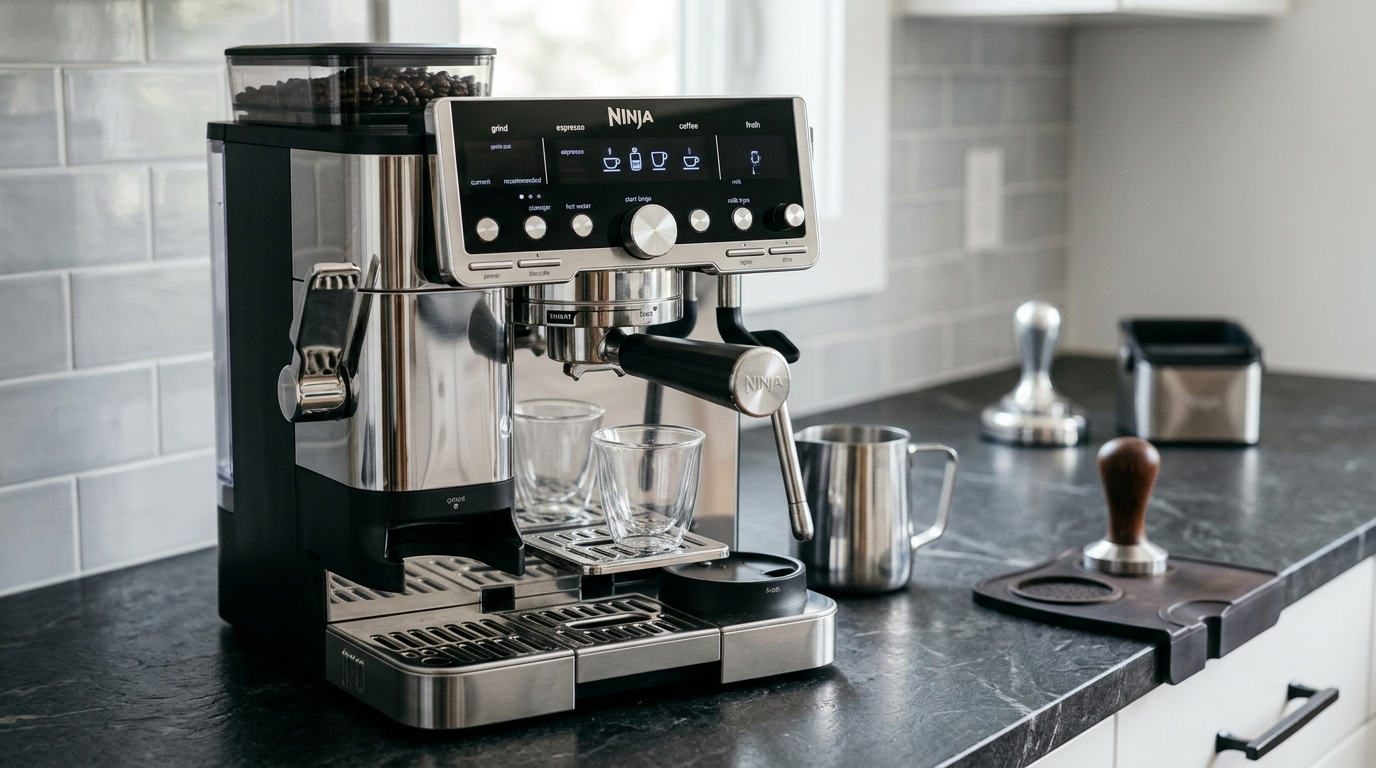
It's a big machine with no side handles, so pick its spot carefully.
Using your own ground coffee
You don't have to use the built-in grinder.
For evening decaf, I ground about 17.8 g separately, put it in the double basket and tamped it by hand with a 53 mm tamper.
The useful part is that Barista Assist ignores coffee you add yourself.
The grind recommendation for the beans in the hopper doesn't change, so you can switch back to your normal espresso without re-dialling.
If you have your own 53 mm funnel and distribution tool, this is also how you get your manual puck preparation back.
| Option | Best for | Notes |
|---|---|---|
| Built-in grinder and tamper | Everyday espresso | Fastest, cleanest workflow |
| Separate grinder, hand tamp | Decaf and special beans | Doesn't affect grind recommendations |
| Separately ground medium roast | Drip-style coffee | Keeps espresso beans in the hopper |
Cleaning and maintenance
Daily cleaning is easier than on most grinder machines, apart from the drip tray.
The non-burn wand wipes clean in seconds, and the auto-purge clears milk from inside the wand.
There's no dosing funnel to rinse, and the tapered baskets release pucks cleanly.
Rinse the baskets and wipe the brew area daily to stop old coffee building up.
After big grind changes, purge a little coffee to clear old grounds.
The machine alerts you when it's time to descale, and the included cleaning disc and tablets handle the brew group.
| Task | How often | Time |
|---|---|---|
| Empty drip tray | Daily, sometimes twice | 1 minute |
| Refill water tank | Daily | 1 minute |
| Wipe steam wand | After every milk drink | 20 seconds |
| Rinse baskets and wipe brew area | Daily | 2 minutes |
| Clean brew group with tablet | As prompted | About 10 minutes |
| Descale | When alerted | About 30 minutes |
A typical morning
By week two, my weekday routine took about three minutes from start to finish.
I emptied the drip tray, checked the tank and switched on the Ninja Luxe Café Pro.
I placed the portafilter in the cradle, pressed grind and tamped twice.
I locked it in, chose a double espresso and queued a medium froth for my latte.
While the shot brewed, I set the jug under the wand.
By the time the shot was done, the milk was nearly ready.
Michael's routine was a large Americano on strength 1 most mornings and a cold foam latte in the afternoon.
On weekends, we made drip-style coffee with a medium roast for guests.
How the four weeks went
| Week | Focus | What we found |
|---|---|---|
| Week 1 | Setup and espresso styles | Integrated tamping was effortless; doubles were consistent |
| Week 2 | Milk drinks | Non-burn wand was easy to clean; manual steaming gave the best texture |
| Week 3 | Cold press, Americano and drip-style coffee | Cold foam lattes were a hit; Americano became our daily big coffee |
| Week 4 | Pre-ground decaf and cleaning | Bypassing the grinder worked well; drip tray needed daily emptying |
How it fits in the Luxe Café range
The Pro shares its grinder, brew group and general construction with the Ninja Luxe Café Premier.
So don't expect a more powerful grinder or a completely different espresso.
What you pay extra for is convenience: the integrated tamper, the non-burn wand, the hot water spout, the single basket, the LED lights and extra drinks.
If you make lots of milk drinks or several different coffees every day, those upgrades make a real difference.
If you mainly drink straight espresso or enjoy manual puck preparation, the Premier makes more sense.
For a smaller machine, see our Ninja Luxe Café Mini Plus review.
| Feature | Luxe Café Premier | Luxe Café Pro |
|---|---|---|
| Grinder and brew group | Shared design | Shared design |
| Tamping | Funnel and manual steps | Integrated, in the cradle |
| Steam wand | Narrower | 12 mm non-burn wand |
| Hot water spout | Not on US model | Yes, 3 temperatures |
| Single basket | Not on US model | Included |
| Americano, lungo, ristretto | No | Yes |
| LED lights | No | Yes |
What I'd change
My wish list is short.
I'd like the overpressure water to return to the tank instead of the drip tray, and I'd like a larger drip tray in the meantime.
Recessed side handles would make the machine much easier to move.
A little more space under the portafilter for two cups and an official bottomless portafilter would please enthusiasts.
And the temperature mode should be easier to find than a press-and-hold on the strength button.
None of these spoil the coffee, but they explain why it isn't scoring higher.
How to get the best results
A few habits made a clear difference to our results with the Ninja Luxe Café Pro.
Buy fresh beans roasted within the last month and keep only a few days' worth in the hopper.
Follow the grind recommendation, but change one setting at a time and taste after each change.
If shots taste sour or run fast, go finer; if they taste bitter or the drip tray fills quickly, go coarser.
Match the brew temperature to your roast: low for dark, middle for medium and high for light.
Warm your cup with a splash from the hot water spout before brewing small drinks.
For milk drinks, start with cold milk and a cold jug, and choose barista-style oat milk if you use plant milk.
Our tip: Rinse your cup with water from the hot water spout before brewing, because espresso cools quickly in a cold cup.
For drip-style coffee, use a medium roast rather than a dark espresso blend.
And descale as soon as the alert appears, because scale affects temperature and flavor long before you notice it on the machine.
These small adjustments helped both of us make café-quality drinks within the first week.
Which households it suits
The Pro is ideal for couples and families who drink different coffees every day.
One person can make a latte, another an Americano and a third a cold foam latte without learning anything technical.
It's also the best Luxe Café model for anyone who makes a lot of milk drinks, thanks to the easy-clean wand.
It's less suited to people who want low maintenance, because the drip tray and tank need daily attention.
Hands-on home baristas will feel limited by the integrated tamper.
And small kitchens may struggle with its size and the space needed behind and above it.
Long-term ownership
After four weeks, the tamper, scale and grinder all worked as well as on day one.
The steam wand still looked new, thanks to its non-burn design.
The only signs of use were a few water spots around the drip tray and fingerprints on the steel.
With daily emptying, regular descaling and occasional brew group cleaning, I'd expect it to last for years.
Final thoughts
The Ninja Luxe Café Pro is the most convenient guided espresso machine Michael and I have tested.
Grinding, weighing and tamping in one cradle removes the messiest part of making espresso, and the non-burn wand makes daily milk drinks far less of a chore.
Americano, lungo, ristretto, cold press and a separate hot water spout make it genuinely versatile.
It's thirsty, though.
You'll empty the drip tray every morning, refill the tank often and wish it had side handles.
If you can live with that, it's an excellent choice for anyone who wants great espresso and milk drinks with the least effort.
Which one is right for you: is the Ninja Luxe Café Pro your match?
4 quick questionsNinja Luxe Café Pro specifications
From manufacturer data and my own testing.
How I tested and scored the Ninja Luxe Café Pro
For four weeks, I used the Ninja Luxe Café Pro as my main machine for single and double espresso, ristretto, lungo, Americano, drip-style coffee, cold press, lattes, cappuccinos and iced lattes with cold foam.
I weighed doses and shots on a separate scale, measured drink and milk temperatures with a probe, and compared the machine's targets with what actually landed in the cup.
I tested a dark, robusta-rich espresso blend, a medium Arabica for drip-style coffee and separately ground decaf, and compared automatic milk presets with manual steaming using whole and oat milk.
Michael and I shared the machine and wrote the notes together, then checked them against Ninja's specifications and owner documentation.
- Espresso (8.7): flavor, consistency of dose and output, and range of espresso styles.
- Milk drinks (8.6): automatic presets, cold foam, manual steaming and wand cleaning.
- Ease of use (9.0): integrated tamping, guidance, hot water and cup clearance.
- Cleaning (7.9): wand care, drip tray and water use, and moving the machine.
The overall score of 8.6 is an editorial rating that reflects those four areas.
More Ninja coffee machine reviews
We tested each Ninja coffee machine for four weeks. If this model isn't the perfect fit, one of these may be.
Ninja AutoBarista Pro review: A 53 mm brew group, 17-gram doubles, two swappable hoppers and real drip coffee.
Ninja AutoBarista review: Self-calibrating espresso, real drip coffee and cold brew from one fully automatic machine.
Ninja Luxe Café Mini Plus review: 60 grind settings, a built-in scale and filter coffee in a compact espresso machine.
Ninja Luxe Café Premier review: A guided espresso machine that makes great shots and cold foam, but weak big coffees.
Ninja Luxe Café Signature review: The Premier with a better wand, single shots and extra-thick foam.
Ninja Luxe Café Pro FAQ
Is the Ninja Luxe Café Pro worth it?
Yes, if you want the easiest guided espresso workflow and drink milk drinks often. If you like hands-on puck preparation, a simpler model makes more sense.
What is the difference between the Luxe Café Pro and the Premier?
The Pro adds an integrated tamper, a thicker non-burn steam wand, a hot water spout, a single basket, LED lights and extra drinks like Americano, lungo and ristretto. The grinder and brew group are very similar.
Does the Ninja Luxe Café Pro tamp automatically?
Yes. After grinding, you tamp twice in the cradle and the machine tells you when the portafilter is ready.
Can I use pre-ground coffee?
Yes. You can bypass the grinder, which is handy for decaf, and it won't change the grind recommendation for the beans in the hopper.
What size is the portafilter?
53.3 mm. The baskets are keyed, so many third-party baskets won't fit.
Why does the drip tray fill so fast?
Excess pressure is diverted into the drip tray during brewing, especially if the grind is too fine. Empty it every morning.
Does it have a hot water spout?
Yes, with three temperature settings.
Can it make cold foam?
Yes. The frother spins cold milk into foam, and it can run while cold press espresso brews.
Do two espresso cups fit side by side?
Only very narrow ones. Standard espresso glasses don't fit side by side.
How big a cup fits?
Coffee sizes run from about 6 to 18 oz, and a 20 oz tumbler fits with the drip tray removed.
Is the steam wand hard to clean?
No. The 12 mm non-burn wand stays cooler, so milk wipes off easily, and it purges automatically after frothing.
Can I adjust brew temperature?
Yes. Press and hold the strength button to switch to the three temperature levels.
Kitchen & coffee tester
Michael spent six years as a line cook in restaurants in Chicago and New York, and he has tested kitchen appliances for HouseholdMe since 2018, from air fryers to coffee makers. He holds an SCA certificate in barista skills and used the Ninja Luxe Café Pro as his everyday coffee machine for four weeks for this review, writing up the testing notes together with a second HouseholdMe tester.
- Four weeks of hands-on testing of the Ninja Luxe Café Pro ES701
- Ninja product specifications and owner documentation
- General espresso brewing and maintenance guidance