KEENSTAR 20 Bar review: a 5.5-inch-wide espresso machine with a 10-minute cold brew mode
The KEENSTAR 20 Bar Espresso Machine fits espresso, steamed milk and a quick cold brew mode into a stainless body only about 5.5 inches wide. It's easy to use and great for iced coffee, but its straight espresso is good rather than great.

Michael Reynolds
Hands-on review
Hands-on testing, research, specs
4 weeks
23 minutes
Jargon helpNew to espresso? Tap any dotted term to see what it means.
In this review
Yes, if you want hot and iced coffee from a machine that fits almost anywhere. The KEENSTAR 20 Bar is only about 5.5 inches wide, yet it pulls pleasant espresso with pre-infusion, steams milk well with a 360-degree wand and adds a 10-minute cold brew mode that makes smoother iced coffee than espresso over ice. The simple touch panel makes it easy for beginners. Straight espresso is good rather than great, the temperature knob has no numbers, the light body slides when you lock in the portafilter and the one-touch Americano is a little weak.
KEENSTAR 20 Bar at a glance
KEENSTAR 20 Bar pros and cons
- Extremely slim, about 5.5 inches wide
- Quick cold brew mode for smooth iced coffee
- Easy touch panel and a 360-degree steam wand
- Straight espresso is good, not great
- Light body slides when locking the portafilter
- Temperature knob has no numbers
Who should buy the KEENSTAR 20 Bar?
- Tiny kitchens and apartments
- Iced coffee fans in warm months
- Beginners who want one-touch simplicity
- Espresso purists chasing syrupy shots
- Anyone who wants a built-in grinder
- People who like precise, repeatable settings
First impressions of the KEENSTAR 20 Bar
Most budget espresso machines do one thing: hot espresso, and milk if you're willing to steam it.
The KEENSTAR 20 Bar Espresso Machine adds a twist I hadn't seen at this level.
A cold brew setting that promises a smooth, chilled-style coffee in about 10 minutes.
That alone made Michael and me curious enough to put it through four weeks of daily use.
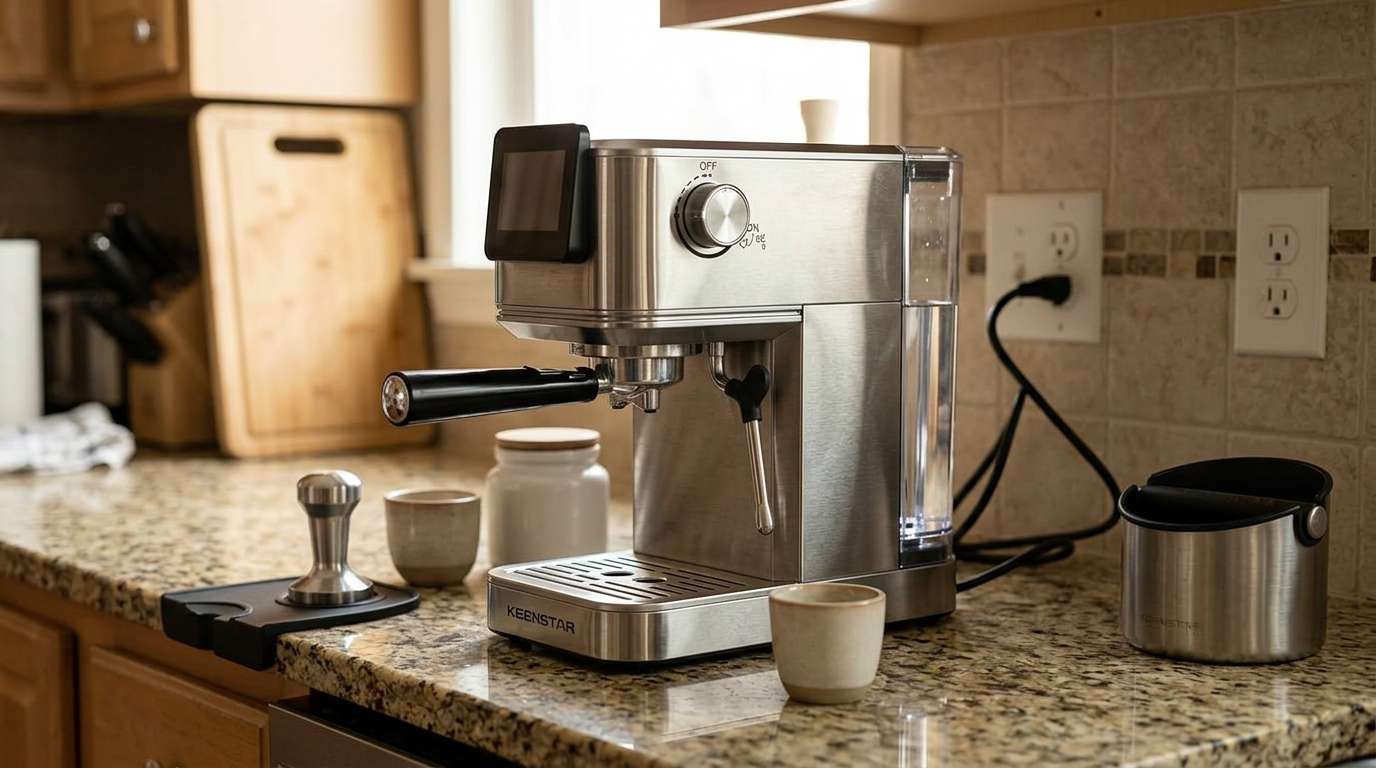
Out of the box, the first thing you notice is how slim it is.
At about 5.5 inches wide, it's one of the narrowest espresso machines we've ever had on the counter.
The front has a black glass touch panel with drink icons, and there's a temperature knob on the side with a color gradient from blue to red.
On the right hangs a swiveling steam wand with a black tip and handle.
At the back sits a clear 37-ounce water tank with a handle.
The body is stainless steel, and it feels light, which makes it easy to move around but also means you need to steady it when locking in the portafilter.
My first espresso, using fresh pre-ground coffee, had a pleasant, foamy crema and a mild, nutty flavor.
Not a showstopper, but a lot better than I expected from something this small.
At about 5.5 inches wide, the KEENSTAR is one of the slimmest machines we’ve tested.
What the KEENSTAR 20 Bar actually is
The KEENSTAR, model JH-C5210, is a compact semi-automatic espresso machine.
You fill and tamp the portafilter, lock it in and choose a drink on the touch panel.
The machine handles the water, and you steam milk by hand with the wand.
It has a 20-bar pump and a 1,350-watt heater, with a fast-heating system that gets it ready quickly.
Every shot starts with a short pre-infusion✕Pre-infusionA short, gentle soak of the coffee before full pressure. It lets the puck swell evenly so water doesn't rush through weak spots. to wet the coffee evenly before full pressure.
The touch panel offers espresso, Americano and cold brew, plus steam.
There's no grinder, so it works with ground coffee, either pre-ground or from your own grinder.
That keeps the machine small and simple, and it's the main reason it can be so narrow.
Think of it as a compact espresso maker with a bonus iced-coffee trick, rather than an all-in-one coffee station.
For a lot of small kitchens, that's exactly the right balance.
KEENSTAR 20 Bar design and setup
The KEENSTAR 20 Bar measures roughly 5.5 inches wide, 12.6 inches tall and 11.8 inches deep.
That narrow width is the headline.
It fit in gaps where we'd normally keep a toaster or a stand of utensils.
The water tank sits at the back, so pull the machine forward a little if it lives under a cabinet.
The drip tray has two height positions, which is a smart touch on such a small machine.
In the higher position, espresso cups sit closer to the spout with less splashing.
In the lower position, taller glasses fit underneath.
The touch panel and temperature knob
The black glass panel has six icons and lights up clearly.
One tap starts a drink, so there's not much to learn.
The knob on the side controls temperature, marked with a blue-to-red color gradient.
I'd have liked actual numbers, but the gradient is easy enough to read once you know your preferred spot.
First-time setup
Setup took about ten minutes.
Wash the portafilter, baskets and tank, fill the tank and seat it firmly at the back.
Then run a few cycles of plain water through the group and the steam wand before your first coffee.
Our tip: Hold the machine with one hand while you lock in the portafilter, because it’s light enough to slide on the counter.
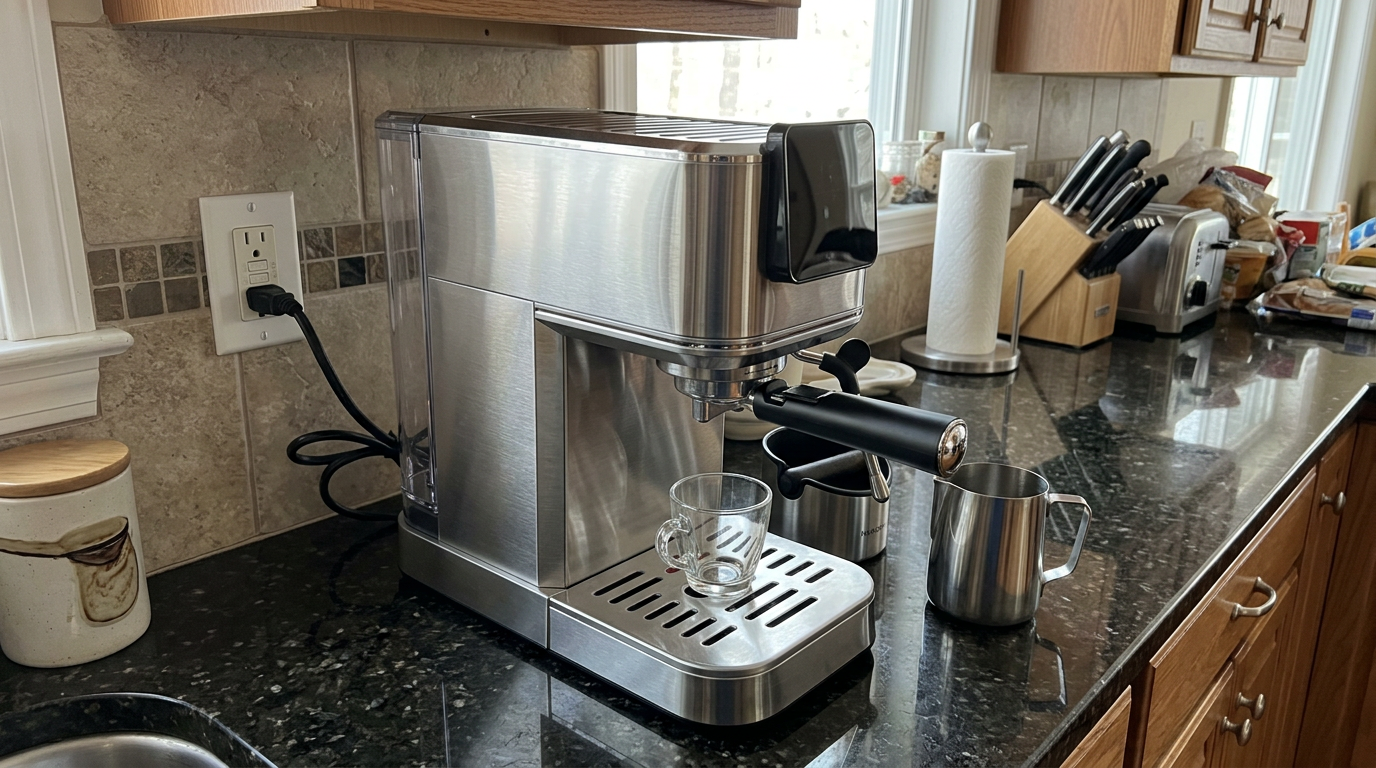
The rear tank keeps the body slim, but leave room to lift it out.
KEENSTAR 20 Bar espresso performance
Espresso from the KEENSTAR is solid for a compact budget machine, with a couple of caveats.
I tested it with supermarket espresso grounds, fresh pre-ground coffee from a local roaster and freshly ground beans.
For each, I filled the double basket to just below the rim, tamped firmly and aimed for about twice the coffee's weight in espresso in 25 to 30 seconds.
| Coffee | Time | Crema | How it tasted |
|---|---|---|---|
| Supermarket espresso grounds | ~24 s | Foamy, light brown | Roasty, slightly flat |
| Fresh roaster pre-ground | ~26 s | Thicker, finer | Nutty, mild chocolate |
| Freshly ground, fine | ~30 s | Dense, hazelnut | Fullest body, sweetest |
With fresh coffee, the shots were pleasant and balanced, with a mild nutty sweetness.
They didn't have the syrupy depth of a bigger machine, but in a latte or Americano, nobody at our table complained.
The crema✕CremaThe golden-brown foam on top of an espresso. It forms when pressure pushes gases and oils out of freshly ground coffee. was consistent, which helps milk drinks look the part.
Using the temperature knob
The temperature knob made a small but noticeable difference.
Toward the warmer end, darker roasts tasted fuller.
Toward the cooler end, they tasted smoother but a little thin.
I settled about three quarters of the way toward red for most coffees.
My preferred settings after four weeks. The knob has no numbers, only a color gradient.
| What you taste or see | Likely cause | First change |
|---|---|---|
| Sour, thin | Too little coffee or coarse grounds | Fill the basket fully, use espresso-fine coffee |
| Bitter, harsh | Very dark roast or too warm | Turn the knob slightly cooler |
| Lukewarm shot | Cold cup and portafilter | Run a blank shot, warm the cup |
| Watery Americano | Too much water | Use less water or a double shot |
Our tip: Run a blank shot through the empty portafilter first, so the metal is warm and your espresso stays hot.
The 10-minute cold brew mode
This is the feature that sets the KEENSTAR 20 Bar apart, so I tested it every few days.
Traditional cold brew✕Cold brewCoffee made by steeping grounds in cold or room-temperature water for many hours. It tastes smooth, low in bitterness and low in acidity. steeps coffee grounds in cold water for 12 to 24 hours.
That long, gentle steep gives it a smooth, low-bitterness taste.
The KEENSTAR's mode is different.
It uses a slower, gentler brewing cycle to make a milder, smoother coffee in about 10 minutes, designed to be poured over ice.
| Quality | Hot espresso mode | Cold brew mode |
|---|---|---|
| Time | Under a minute | About 10 minutes |
| Strength | Concentrated | Milder, longer |
| Bitterness | More | Less |
| Acidity | Brighter | Softer |
| Best served | Hot, or with steamed milk | Over ice, with or without milk |
How it tasted
Is it the same as true overnight cold brew? No.
It doesn't have the deep, chocolatey smoothness of a 16-hour steep.
But it was noticeably smoother and less bitter than espresso poured over ice, which usually tastes sharp and watery as the ice melts.
With a medium roast and a splash of milk, it made a genuinely refreshing iced coffee.
Michael preferred it black over ice, and I liked it with oat milk.
My taste ratings on a 10-point scale for smoothness and flavor.
Our tip: Lower the drip tray to its bottom position for tall iced coffee glasses.
Iced drinks I made with it
Because the cold brew mode is the standout feature, I built a small menu of iced drinks around it.
These are the ones we made most often over four weeks.
| Drink | Base | Add | My tip |
|---|---|---|---|
| Classic iced coffee | Cold brew mode | Ice only | Fill the glass with ice first |
| Iced oat latte | Cold brew mode | Ice and cold oat milk | Barista oat milk tastes creamiest |
| Iced vanilla latte | Cold brew mode | Ice, milk, a little vanilla syrup | Stir the syrup in before the milk |
| Espresso tonic | Double espresso | Ice and tonic water | Pour the espresso slowly on top |
| Iced Americano | Double espresso | Ice and cold water | Use less water than a hot one |
The cold brew mode worked best in drinks with milk, where its softer flavor came across as smooth rather than weak.
For a stronger iced drink, a double espresso over ice was punchier, though harsher.
Having both options on one small machine is genuinely useful in summer.
Our tip: Freeze leftover cold brew in an ice cube tray, so your iced coffee doesn’t get watered down as it melts.
Steam wand and milk drinks
The steam wand swivels a full 360 degrees, which is unusual on a machine this small.
That makes it easy to position the pitcher at the right angle without fighting the machine.
Because there's one heater, you brew your espresso first, then switch to steam on the touch panel and wait a moment.
How the steam performed
Steam power was better than I expected for a 5.5-inch-wide machine.
150 ml of cold whole milk took about 45 to 60 seconds to reach drinking temperature.
The texture was smooth and creamy once I got the technique right, and good enough for a basic heart in a latte.
My ratings on a 10-point scale for texture and stability.
Keep the tip just below the surface for the first few seconds to add air, then sink it a little and let the milk spin.
The steam is fairly strong for the size, so be careful not to add too much air too fast.
| Drink | How I made it | Milk texture |
|---|---|---|
| Cappuccino | Double espresso, thick foam | Airy, stretched by about half |
| Latte | Double espresso, more milk | Thin, glossy |
| Flat white | Double espresso, less milk | Very fine, silky |
| Iced latte | Cold brew mode over ice, cold milk | No steaming needed |
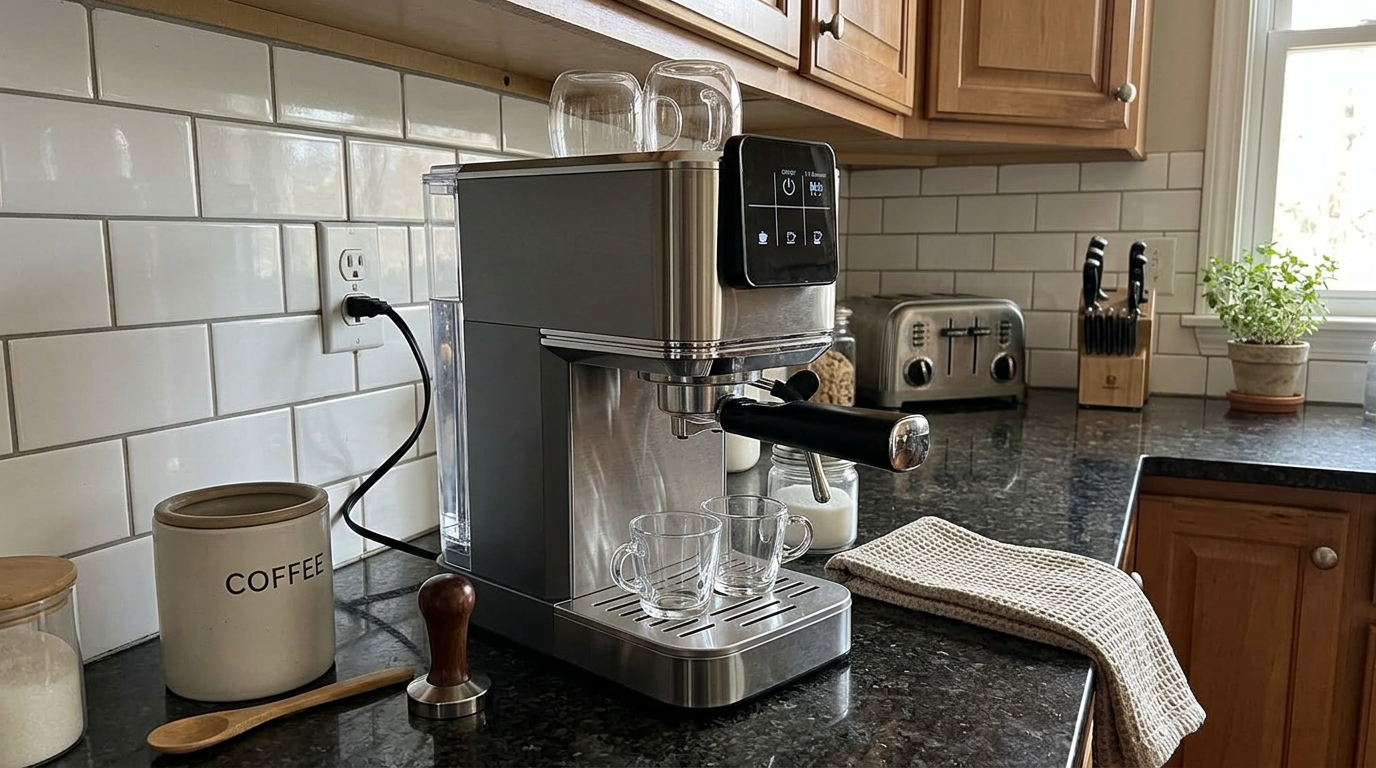
The 360-degree steam wand makes it easy to find the right pitcher angle.
Our tip: Purge the steam wand for a second before and after use, so no water dilutes the milk and nothing dries in the tip.
Americanos and hot water
The Americano button pulls a shot and adds hot water in one go.
It's convenient, though I found the default a little watery.
For a stronger mug, I pulled a double espresso and added hot water myself.
| Method | Strength | My verdict |
|---|---|---|
| One-touch Americano | Mild | Quick, slightly thin |
| Double espresso plus 120 ml water | Medium | My everyday mug |
| Double espresso plus 80 ml water | Strong | Close to a long black |
Choosing coffee for a compact machine
The KEENSTAR doesn't have a grinder, so you'll use pre-ground coffee or a separate grinder.
For most buyers, fresh pre-ground espresso coffee from a local roaster is the sweet spot.
It's fine enough for the basket and tastes much better than supermarket tins.
| Coffee | Best mode | What to expect |
|---|---|---|
| Supermarket espresso grounds | Espresso, milk drinks | Decent, a little flat |
| Fresh roaster espresso grind | All modes | Clearly better aroma |
| Freshly ground with a burr grinder | Espresso | Best body and sweetness |
| Medium roast, nutty or chocolatey | Cold brew mode | Smoothest iced coffee |
| Very dark, oily roast | Milk drinks only | Can taste bitter straight |
Pre-ground coffee goes stale quickly once opened.
I bought small bags and used each within about a week, stored in an airtight container.
Our tip: Store opened pre-ground coffee in an airtight container away from light, and finish it within a week or two.
A beginner’s first week, day by day
If this is your first espresso machine, here's roughly how your first week will go, based on ours.
| Day | What we did | What we learned |
|---|---|---|
| Day 1 | Setup, flushing, first espresso | Fill the basket fully or shots run weak |
| Day 2 | First cappuccino | Purge the wand, keep the tip near the surface |
| Day 3 | Tried the cold brew mode | Medium roast beats dark roast here |
| Day 4 | Played with the temperature knob | About ¾ warm suited most coffees |
| Day 5 | Switched to fresh roaster coffee | Biggest jump in flavor all week |
| Day 6 | Made iced oat lattes | Ice in the glass first |
| Day 7 | Full routine without thinking | Espresso in about two minutes |
By the end of the first week, the machine felt completely natural.
The biggest single improvement came from better coffee, not from any setting.
The second biggest came from learning to purge and position the steam wand.
Our own tasting scores across espresso, milk drinks and cold brew.
Our tip: Upgrade your coffee before anything else, because fresh roaster grounds improved our drinks more than any setting.
The touch panel in daily use
Touch panels on small appliances can be hit and miss, so I paid close attention to this one.
The KEENSTAR 20 Bar panel was responsive from day one and stayed that way.
Each icon lights up when it's selected, and the machine shows clearly when it's heating and when it's ready.
| Panel feature | How it worked for me |
|---|---|
| Drink icons | Clear and easy to learn in a day |
| Response | Quick, no double taps needed |
| Wet fingers | Still worked, but dry hands are more reliable |
| Fingerprints | Shows them, wipes clean easily |
| Night use | Bright enough to read in a dim kitchen |
The panel is the reason this machine feels easy for beginners.
There's no menu to dig through and no settings to program.
Tap espresso, Americano, cold brew or steam, and the machine does the rest.
What I missed
There's no shot timer and no way to save a custom volume that I could find.
If you like to fine-tune your shot length, you'll be stopping and starting by eye.
For most people buying a compact machine, though, simplicity is the point.
Making it work in a tiny kitchen
We tested the KEENSTAR in a small apartment kitchen with barely a foot of free counter.
It slotted in beside the kettle, with the steam wand swung out toward the sink side.
The light weight helped here, because I could slide it forward to refill the tank without effort.
The trade-off, again, is steadying it when you lock the portafilter in.
Cheap upgrades worth buying
You can start with what's in the box, but these small extras made a noticeable difference.
| Upgrade | What it fixes | Worth it? |
|---|---|---|
| Stainless milk pitcher, about 350 ml | Messy steaming | Essential for milk drinks |
| Solid metal tamper | Uneven tamping | Yes |
| Airtight coffee canister | Stale pre-ground coffee | Yes |
| Tall iced coffee glasses | Splashing cold brew | Nice to have |
| Burr grinder for espresso | Flat, stale-tasting shots | The biggest flavor upgrade |
Cleaning and maintaining the KEENSTAR 20 Bar
Daily cleaning is quick on a machine this simple.
Knock out the puck after each shot and rinse the basket.
Wipe and purge the steam wand after every milk drink.
| When | Task | Why it matters |
|---|---|---|
| After every shot | Knock out the puck, rinse the basket | Prevents oily buildup |
| After every milk drink | Wipe and purge the wand | Keeps the tip clear |
| Daily | Empty the drip tray, wipe the panel | Prevents stains and odors |
| Weekly | Wash the tank, baskets and portafilter | Removes coffee oils |
| Every 2–3 months | Descale | Protects the heater |
Descaling✕DescalingRunning a mild acid solution through the machine to dissolve mineral scale left by hard water. Scale slows heating and can block pipes. is important on small, fast-heating machines.
Their narrow water channels scale up faster than big boilers.
The glass touch panel wipes clean with a soft damp cloth, but avoid spraying it directly.
My estimate of hands-on cleaning time per day.
What daily use is really like
After a few days, the routine felt natural.
Switch on, let it heat briefly, fill and tamp the basket and tap the drink you want.
An espresso took about two minutes from switching on.
A cappuccino took about three and a half.
A cold brew took about 12 minutes, most of which I spent making breakfast.
Timed from switching on, using pre-ground coffee.
Noise
The pump hums during the shot, typical of small espresso machines.
Cold brew mode was quieter, with a slower, gentler pulsing sound.
The 37-ounce tank
The tank is a reasonable size for a compact machine.
For two people making a couple of drinks each, I refilled it about every other day.
Cold brew uses more water per cup, so on iced coffee days I topped it up daily.
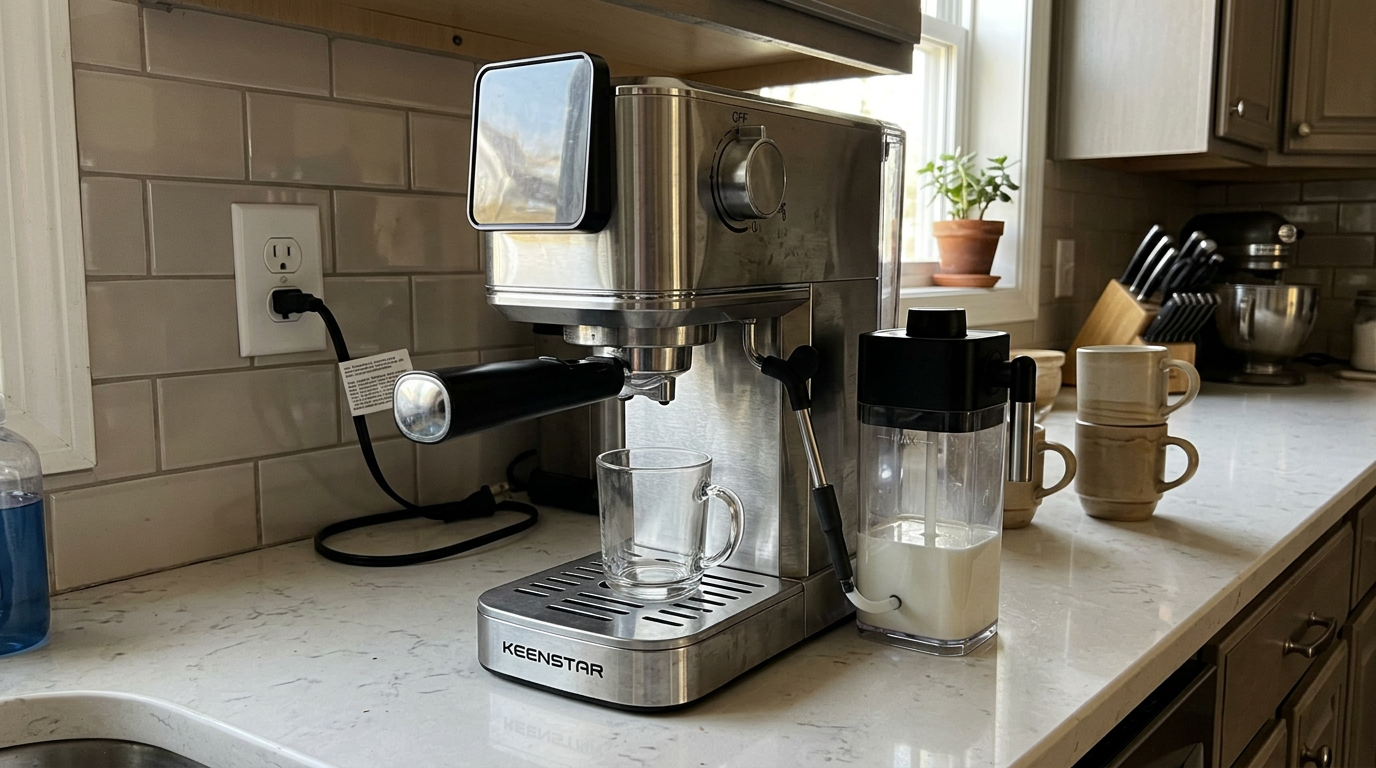
Cold brew mode over ice became our afternoon favorite.
Our tip: Fill the water tank the night before, especially on cold brew days, which use more water per cup.
Filling and tamping the basket
Good espresso on a compact machine comes down to filling the basket the same way every time.
I didn't use a scale for most of the test, because most buyers won't.
Tamping✕TampingPressing the ground coffee into a firm, flat puck so water passes through it evenly instead of finding loose, easy paths. doesn't need huge force, just a level, firm press.
An uneven, tilted tamp lets water rush down one side, and the shot tastes thin.
Troubleshooting the problems I hit
A few small problems came up in four weeks of use, all easy to fix.
| Problem | What I noticed | Fix that worked |
|---|---|---|
| Machine slides when locking in | Light body | Hold it steady with one hand |
| Water around the portafilter | Grounds on the rim | Wipe the rim before locking in |
| Watery Americano | Default water amount | Make it manually from a double |
| Thin cold brew | Dark roast | Switch to a medium roast |
| Wet, bubbly milk | Wand not purged | Purge first, wait for steam |
| Splashing into small cups | Drip tray too low | Raise the tray to the upper position |
The light weight was the one quirk I never fully got used to.
It's great for moving the machine, but you do need a free hand to steady it.
Common mistakes to avoid
The KEENSTAR 20 Bar is easy to live with, but a few habits will hold it back.
| Mistake | What happens | Better habit |
|---|---|---|
| Underfilling the basket | Weak, watery shots | Fill to just below the rim |
| Skipping the warm-up shot | First drink tastes flat | Run a blank shot first |
| Using dark roast for cold brew | Thin, flat iced coffee | Use a medium roast |
| Leaving milk on the wand | Blocked tip | Wipe and purge right away |
| Ignoring descaling | Slower heating, weaker steam | Descale every 2–3 months |
| Pouring cold brew into an empty glass | Warmer, weaker drink | Fill the glass with ice first |
What I would change
Numbers on the temperature knob would make it easier to repeat a favorite setting.
A slightly heavier base would stop the machine sliding when you lock the portafilter in.
And a stronger default Americano would suit most mug drinkers better.
Which households it suits best
To make the decision easier, here's how I'd judge the KEENSTAR 20 Bar for different kinds of households.
| Household | Fit | Why |
|---|---|---|
| Single person in a small apartment | Excellent | Slim, simple, hot and iced drinks |
| Couple who share lattes | Very good | Easy to make two drinks back to back |
| Iced coffee lover | Excellent | Cold brew mode is the standout |
| Family making four or more milk drinks | Fair | One heater means waiting between steps |
| Espresso enthusiast | Fair | Shots are good, not exceptional |
| Office kitchenette | Good | Small, simple, easy for anyone to use |
The pattern is clear.
The smaller your kitchen and the more you like variety, the more sense this machine makes.
The more you care about squeezing every last drop of flavor from a straight espresso, the less it suits you.
Where it surprised me
I expected the cold brew mode to be a gimmick I'd try once and forget.
Instead, it became the drink we made most on warm afternoons.
The steam wand was the other surprise, with more power and flexibility than a machine this small usually has.
Is the KEENSTAR 20 Bar worth the money?
The KEENSTAR earns its place with versatility in a tiny footprint.
Hot espresso, Americanos, steamed-milk drinks and a quick iced coffee mode, all from a machine about 5.5 inches wide.
It won't match the espresso of bigger, heavier machines, and it doesn't pretend to.
Ask yourself three questions before you buy.
Is your counter space very limited? Do you drink iced coffee in warm months? And are you happy using pre-ground coffee and steaming milk by hand?
If the answers are yes, it's an easy recommendation for a first machine.
If straight espresso quality is your top priority, a heavier machine with a better portafilter will suit you more.
Four weeks in: how it held up
We used the KEENSTAR 20 Bar as our only coffee machine for a month, making roughly 110 to 130 drinks.
| Area | Week 1 | Week 4 |
|---|---|---|
| Espresso taste | Pleasant with fresh coffee | Same, more consistent routine |
| Cold brew | Interesting novelty | Daily afternoon habit |
| Steam wand | Learning the angle | Smooth, glossy milk |
| Touch panel | Responsive | Still responsive, a few fingerprints |
| Leaks or faults | None | None |
The touch panel stayed responsive throughout, and the steam wand never lost power.
The light body picked up a few scuffs from being moved around, but nothing that affected use.
We descaled once near the end of the test, using a standard espresso machine descaler, and the cycle was simple to run.
Steam felt a touch stronger afterward, which is a good reminder that scale builds up faster than you think on small machines.
The rear water tank showed no cloudiness or staining after a month of daily rinsing.
Overall, nothing about the build gave us reason to worry over the four weeks.
For a light, compact machine, that's reassuring, though as with any budget appliance, keep the warranty paperwork handy.
Our day-to-day satisfaction, which rose as the routine became second nature.
How it compares with other espresso setups
The most useful comparison is with the kinds of machines you're likely choosing between.
The KEENSTAR 20 Bar stands out for its slim size and its cold brew mode.
| Feature | KEENSTAR 20 Bar | Larger semi-automatic machine | Fully automatic machine |
|---|---|---|---|
| Width | About 5.5 in | Often 9–12 in | Often 9–12 in |
| Grinder | None | Sometimes built in | Built in |
| Espresso quality | Good with fresh coffee | Good to excellent | Good, consistent |
| Iced coffee option | Cold brew mode | Rare | Sometimes |
| Milk | Manual 360° steam wand | Manual steam wand | Often one-touch |
| Controls | Touch panel and knob | Buttons or dials | Display or touchscreen |
| Learning curve | Low | Moderate | Very low |
A larger semi-automatic machine usually makes richer straight espresso but needs much more space.
A fully automatic machine is easier still, but costs far more and takes up a big chunk of counter.
The KEENSTAR fits in between for small kitchens that want hot and iced drinks from one compact machine.
| You mostly drink | Is it a fit? | Why |
|---|---|---|
| Straight espresso | Fair to good | Pleasant, but not the deepest shots |
| Lattes and cappuccinos | Good | Capable 360° steam wand |
| Iced coffee | Very good | Dedicated cold brew mode |
| Big mugs of black coffee | Good | Americano button and hot water |
| Very light roasts | Fair | Limited temperature range and feedback |
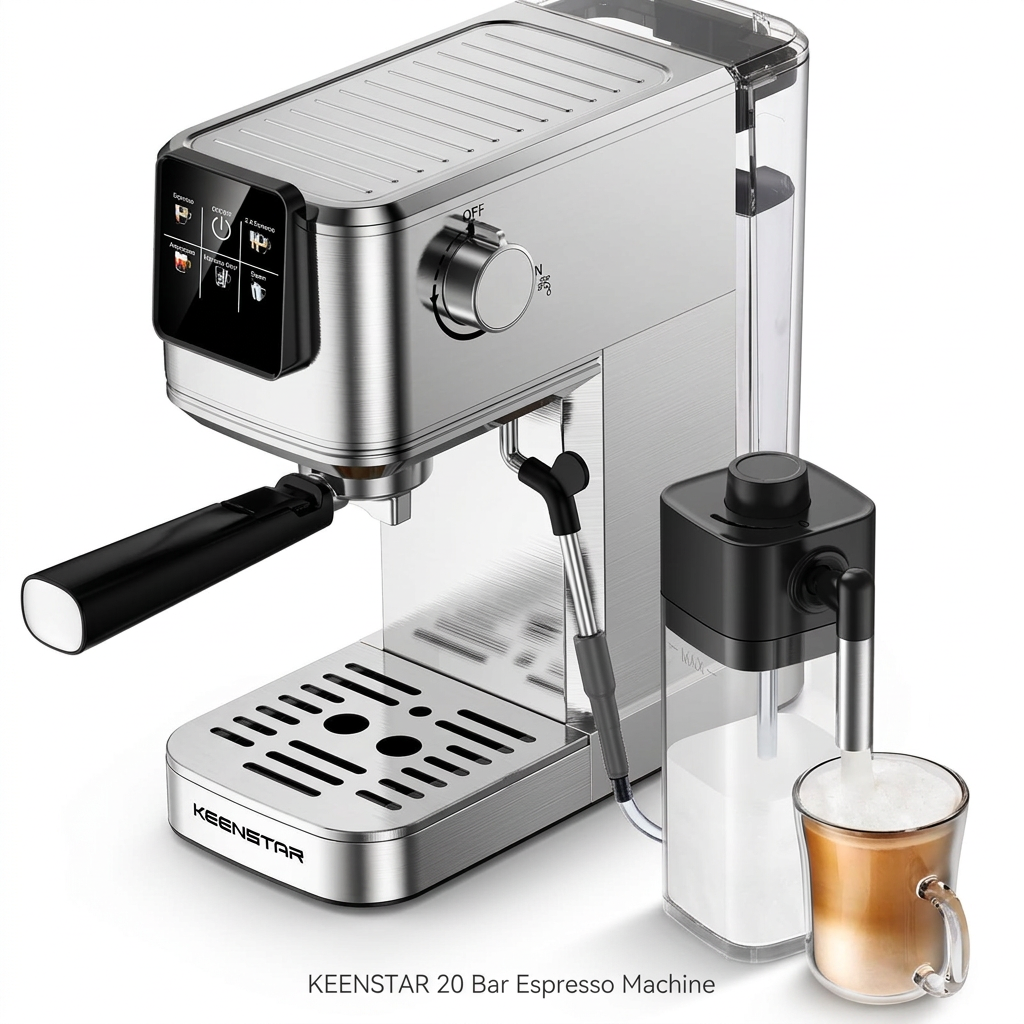
The full package: touch panel, side temperature knob, steam wand and a slim stainless body.
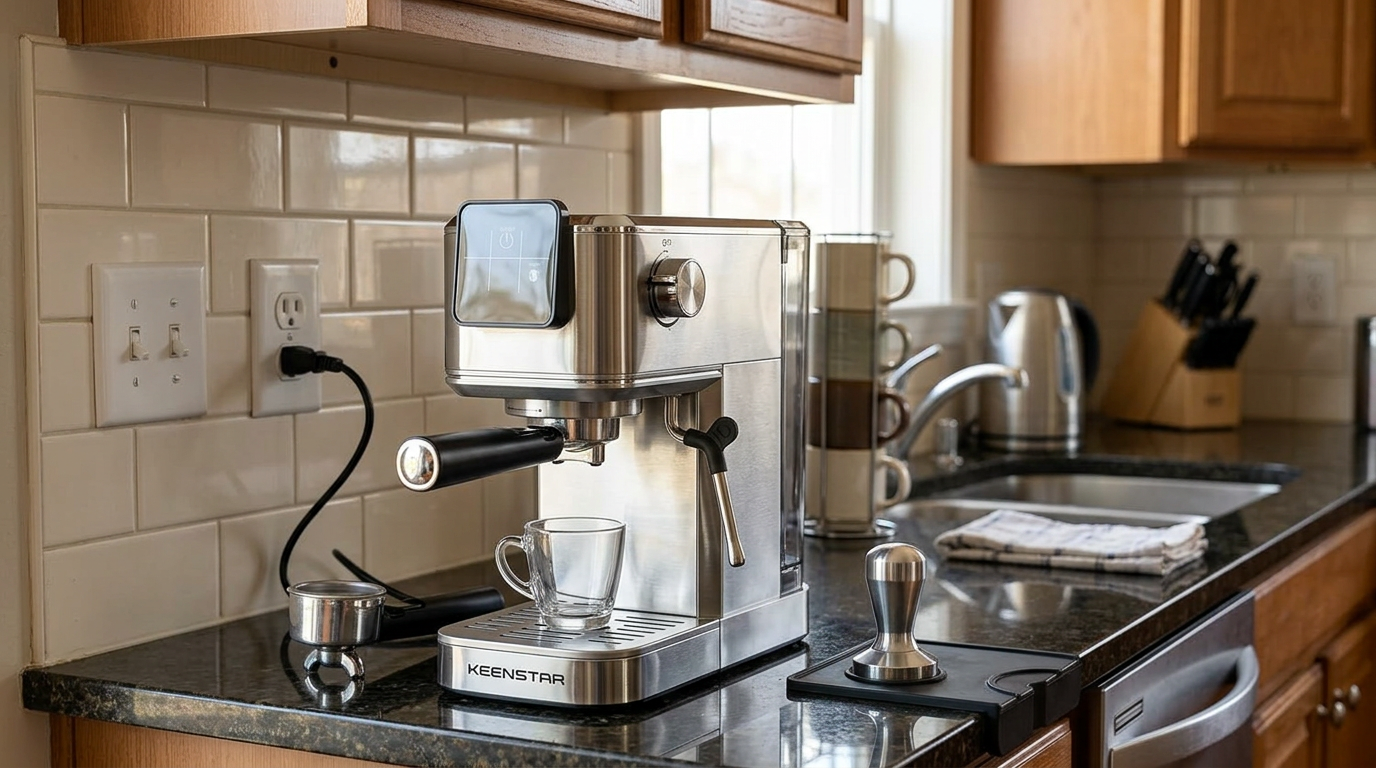
A glass mug fits underneath with the drip tray in its lower position.
Which one is right for you: is the KEENSTAR 20 Bar your match?
4 quick questionsKEENSTAR 20 Bar specifications
From manufacturer data and my own testing.
How I tested and scored the KEENSTAR 20 Bar
For four weeks, Michael Reynolds and I used the KEENSTAR 20 Bar as our only coffee machine in a small apartment kitchen.
We made espresso, Americanos, cappuccinos, lattes, flat whites and a lot of iced coffee, roughly 110 to 130 drinks in total.
We compared supermarket grounds, fresh pre-ground coffee from a roaster and freshly ground beans, worked through the temperature knob with different roasts and compared the cold brew mode with espresso and Americanos over ice.
We steamed whole, semi-skimmed, skim and oat milk, timed each drink and followed the daily and weekly cleaning routine.
We then checked our notes against KEENSTAR's product information and the owner's manual.
- Espresso (7.0): crema, body, flavor and consistency with different coffees and temperature settings.
- Milk drinks (7.4): steam power, wand movement, microfoam texture and the brew-then-steam workflow.
- Ease of use (8.0): setup, the touch panel, the temperature knob and the daily routine.
- Versatility (7.8): the cold brew mode, Americano button, hot water and iced drink options.
The overall score of 7.3 is an editorial rating that reflects those four areas.
KEENSTAR 20 Bar FAQ
Is the KEENSTAR 20 Bar worth it?
Yes, if you want hot and iced coffee from a very slim machine. It has a touch panel, a 360-degree steam wand and a 10-minute cold brew mode, though its straight espresso is good rather than great.
How does the cold brew mode work?
It runs a slower, gentler brewing cycle that makes a milder, smoother coffee in about 10 minutes, designed to be poured over ice. It isn't the same as overnight cold brew, but it's smoother than espresso over ice.
What coffee is best for cold brew mode?
A medium roast with chocolate or nutty notes. Dark roasts tasted flat in my testing.
Does it have a built-in grinder?
No. Use pre-ground espresso coffee or a separate burr grinder.
How big is the water tank?
About 37 ounces, or 1.1 liters. It's removable and sits at the back of the machine.
How wide is the KEENSTAR 20 Bar?
About 5.5 inches, which makes it one of the slimmest espresso machines we've tested.
Can it make lattes and cappuccinos?
Yes. The steam wand swivels 360 degrees and makes smooth, creamy milk for lattes, cappuccinos and flat whites.
Can I adjust the temperature?
Yes, with the side knob, which uses a blue-to-red color gradient rather than numbers.
Will a tall glass fit under the spout?
Yes, with the drip tray in its lower position. Raise it for small espresso cups to reduce splashing.
Can it brew and steam at the same time?
No. Brew the espresso first, then switch to steam.
How often should I descale it?
Every two to three months with moderately hard water, and more often with very hard water.
Why does the machine move when I lock in the portafilter?
It's light, so hold it steady with one hand while you twist the portafilter in.
Kitchen & coffee tester
Michael spent six years as a line cook in restaurants in Chicago and New York, and he has tested kitchen appliances for HouseholdMe since 2018, from air fryers to coffee makers. He holds an SCA certificate in barista skills and used the KEENSTAR 20 Bar as his everyday coffee machine for four weeks for this review.
- Four weeks of hands-on testing of the KEENSTAR 20 Bar JH-C5210
- KEENSTAR product information and owner's manual
- General espresso, cold brew and maintenance guidance