ECOVACS WINBOT MINI review: a compact window robot with ultrasonic spray, three cleaning modes and a power cord instead of a battery
The ECOVACS WINBOT MINI Window Cleaning Robot is a small, light window robot that runs on mains power, so it never stops for a battery. It cleans regularly maintained glass well, fits windows bigger robots cannot, and holds on for 30 minutes if the power drops, but it leaves a small pad mark where it parks, misses tiny corner squares and is louder than its size suggests.

Emily Carter
Hands-on review
Hands-on testing, research, specs
4 weeks
20 minutes
Jargon helpNew to window robots? Tap any dotted term to see what it means.
In this review
Yes, if you keep your windows reasonably clean and want a compact, affordable robot to do the regular wiping. The WINBOT MINI fits narrow and small windows, runs as long as it is plugged in and has sensible safety features. It is not a miracle on very dirty glass, it leaves a pad mark where it stops and small square patches in the corners, and it is noisy, so expect a little finishing by hand.
WINBOT MINI at a glance
WINBOT MINI pros and cons
- Small, light body fits narrow and small windows
- Runs on mains power with no battery limit
- Holds on for 30 minutes if the power fails
- Leaves a pad mark where it finishes
- Misses small square patches in corners
- Loud fan for such a small robot
Who should buy the WINBOT MINI?
- Homes that clean windows regularly
- Narrow, small and tilt-and-turn windows
- First-time window robot buyers
- Very dirty, neglected windows
- Anyone who wants a finish with no touch-ups
- Sloped skylights and tiled walls
First impressions of the ECOVACS WINBOT MINI
The ECOVACS WINBOT MINI is small. At about 8.5 inches square and just over 2 inches thick, it fits in one hand.
It has a handle on top, a single button and nothing else. Everything beyond on, off and suction lives in the app.
In the box: the robot, two microfiber pads✕Microfiber padA cloth made of very thin synthetic fibers that trap dust and grease. It is the part of the robot that actually wipes the glass., a bottle of ECOVACS cleaning solution, a power cable and a safety rope with a carabiner.
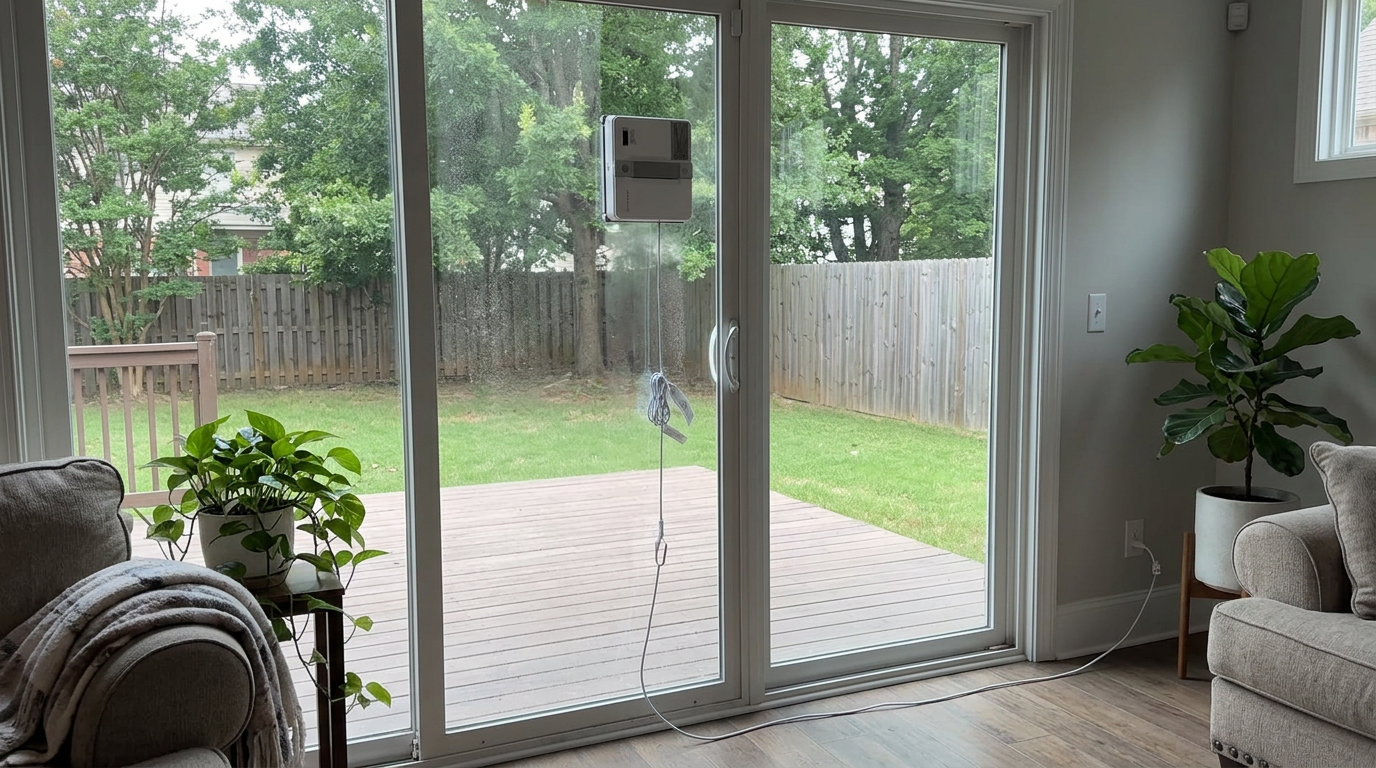
My first job was our living room sliding door. I wet and wrung out a pad, pressed it onto the Velcro underneath, filled the little tank, anchored the rope and plugged it in.
One press of the button, and the fan started with a loud whoosh and pulled the robot onto the glass.
It set off in an S-shaped pattern, misting the glass ahead of it, and worked its way across the door.
The result on that regularly cleaned door was good: clear glass, very few streaks.
Then I noticed the small mark where it had parked at the end, and a little square of dust in each corner.
That set the tone for the next four weeks: a capable, convenient robot that still expects you to have a cloth handy.
The WINBOT MINI on our living room slider, its first job.
What the WINBOT MINI actually is
The WINBOT MINI is a compact, suction✕Suction (Pa)How hard the fan pulls the robot against the glass, measured in pascals. More pascals means a firmer grip, which matters most on outside windows and big panes.-based window robot that runs on a power cable.
A central fan holds it to the glass with up to 7,500 pascals✕Pascal (Pa)The unit used for suction. Home window robots range from about 2,500 Pa to 10,000 Pa. of suction.
Two tracks drive it, four side rollers guide it and spherical sensors at the corners detect the edges of the glass.
An ultrasonic spray✕Ultrasonic sprayA tiny vibrating plate that turns water or cleaning solution into a very fine mist. Fine droplets wet the glass evenly without leaving drips. system with four nozzles, two at the front and two at the rear, mists cleaning solution onto the glass ahead of the pad.
No battery, by design
The MINI does not run on a battery. It needs to stay plugged in while it cleans.
That means no battery runtime to worry about, and no station to carry. The trade-off is that you need an outlet within reach of the window.
A small internal battery exists only for safety: it keeps the fan running if the power is cut.
WINBOT MINI design and setup
The design is about as simple as a window robot gets.
One button turns it on, starts suction and, at the end, stops suction so you can lift it off.
The pads attach to the underside with Velcro. Getting them on in the right direction matters, because the pad needs to cover the intended cleaning area.
Before each clean
| Step | What I do | Why |
|---|---|---|
| 1. Pad | Dampen, wring out thoroughly, attach with Velcro | Slightly damp, never wet |
| 2. Tank | Fill with undiluted ECOVACS solution | The spray needs it |
| 3. Rope | Clip the carabiner, anchor the rope | Essential on outside glass |
| 4. Power | Plug in near the window | It runs on mains power |
| 5. Attach | Press the button, hold it to the glass | Suction pulls it on |
| 6. Start | Default clean or choose a mode in the app | It handles the route |
No app or Wi-Fi is needed for a basic clean. Connect power, press the button and it goes.
Our tip: Fit the pad the right way round the first time. Check the arrow or shape against the manual, because a misaligned pad leaves uncleaned stripes.
Suction and safety
For a small robot, the WINBOT MINI grips firmly.
At up to 7,500 Pa, it stayed on every window I tried, including outside glass, while it turned and changed direction.
ECOVACS calls its approach a 9-stage safety system.
Bars show the order in which each layer acts.
If the power fails
If the power is interrupted, the robot stays attached for about 30 minutes while an alarm sounds.
I tested it by pulling the plug. It held on and beeped loudly, which would get my attention from anywhere in the house.
Ultrasonic spray and cleaning solution
The MINI’s ultrasonic spray turns solution into a very fine mist.
Four nozzles, two at the front and two at the back, spray in the direction of travel.
The amount it sprays depends on the mode, and you can switch automatic spraying on or off, or spray manually, in the app.
The cleaning solution did not add any streaks of its own, which is not true of every glass cleaner I have tried.
How far one tank goes
The tank holds about 2 fl oz.
In my test, about 0.7 fl oz cleaned two large glass doors of more than 21.5 sq ft each, with some left over.
By that measure, a full tank should cover roughly 160 to 215 sq ft of glass, depending on the mode.
My measured solution use and estimated coverage per tank.
Our tip: Top up the tank before every large window. It is small, and running dry halfway down a big door means a second run.
The three cleaning modes
The app offers three automatic modes, each with its own route.
| Mode | Route | When I used it |
|---|---|---|
| Quick | One S-shaped pass | Inside windows cleaned recently |
| Intensive | S-shaped pass plus an edge lap | Outside glass and doors |
| Deep | Two S-shaped passes | Windows left for a while |
Quick is the fastest, close to the rated 1.1 sq ft per minute.
Intensive adds a lap along the edges after the main passes, which noticeably helps borders.
Deep does two full S-shaped passes and takes roughly twice as long as Quick.
Relative cleaning time per window, with Quick as the baseline.
Spot cleaning
Spot cleaning sprays and then scrubs one area with three concentrated back-and-forth movements before stopping.
It was handy for the cat’s nose prints at the bottom of the patio door, without rerunning the whole window.
The app and remote control
The ECOVACS HOME app connects over Bluetooth and unlocks everything the single button cannot do.
Beyond the three modes and spot cleaning, it lets you control spraying, adjust the voice alert volume and run maintenance functions.
There is also a remote control for steering. Honestly, I found it fiddly.
Turning the robot accurately at an edge, especially at a right angle, took several attempts.
The automatic modes are far more practical, and that is what I used almost all the time.
The voice alerts are genuinely useful. The robot tells you when it has finished and when the tank is empty.
Our tip: Turn the voice volume up if you leave the room. The fan is loud enough to drown out a quiet alert from the next room.
How well the WINBOT MINI cleans
Results depended heavily on how dirty the glass was to begin with.
Regularly cleaned windows
On windows I keep up with, the MINI did a good job. Glass came out clear with very few visible streaks.
This is where it shines: routine upkeep, so you never face a big window-cleaning day.
Dirty windows
On dirtier glass, it struggled more. Several passes were needed, and even then faint streaks sometimes remained.
My ratings on a 10-point scale after one Deep run.
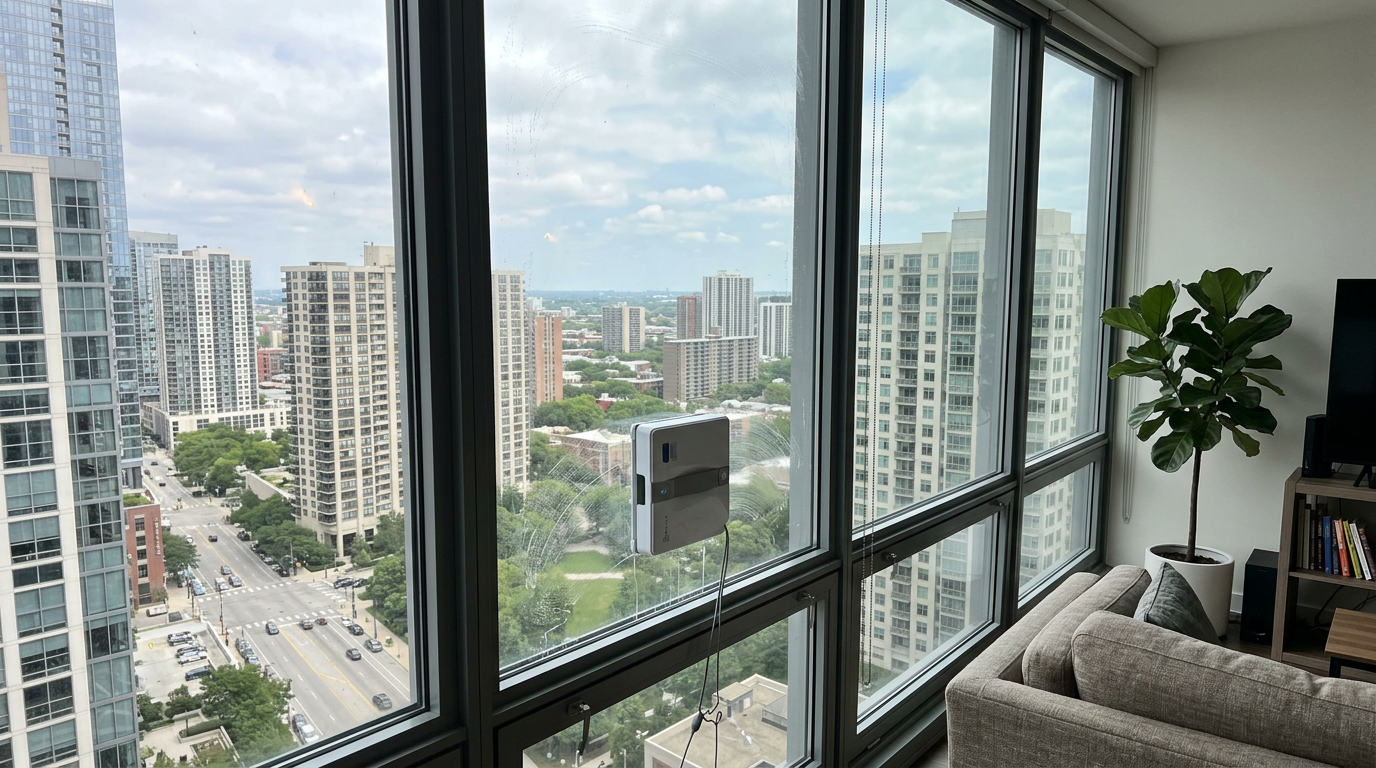
Floor-to-ceiling apartment glass, where regular Quick runs kept the view clear.
Edges, corners and the parking mark
The MINI cleans closer to the edges than I expected for its price.
Its bumper-free design lets the pad reach near the outer edges of the body, so the uncleaned border along the frame is narrow.
There are two catches.
Small corner squares
In each corner, a small square of glass can stay uncleaned. It is small, but on a sunny day you see it.
The parking mark
At the end of every cycle, in every mode and on every window, the pad left a visible mark where the robot stopped.
A quick wipe with a microfiber cloth removes it, but it means the job is never quite hands-free.
My cleaning ratings by part of the window, out of 10.
Our tip: Keep a microfiber cloth with the robot. Two quick wipes, one at the parking mark and one in the corners, finish every window.
Large windows and the cable problem
The MINI can clean large windows, but it does not always reach the very top.
On our tallest sliding door, it sometimes left a narrow dirty strip along the upper edge.
The cause seems to be the safety rope✕Safety tetherA strong cord that clips the robot to something solid indoors. If the robot ever lets go of the glass, the tether catches it before it can fall. and power cable rubbing against each other or tangling.
When they catch, the robot feels the drag and seems to think it has reached the end of its cable, so it stops climbing early.
The fix
Careful cable management solved it most of the time.
I let the power cable hang straight down from one side and ran the rope to the other, so they never crossed.
My results on the same tall sliding door.
Our tip: Run the power cable and safety rope down opposite sides of the robot. Keeping them apart is the simplest way to stop it giving up short of the top.
Narrow and small windows
This is the MINI’s reason to exist. Its small footprint fits glass that larger robots cannot use.
Our narrow hallway window, which no full-size robot fits, was easy to place it on.
Coverage along the sides of narrow panes was less consistent, though, and I sometimes ran a second pass.
The navigation could also be a little inefficient, going back and forth over the same area several times before moving on.
That adds time without adding cleanliness, but it did not stop it finishing the job.
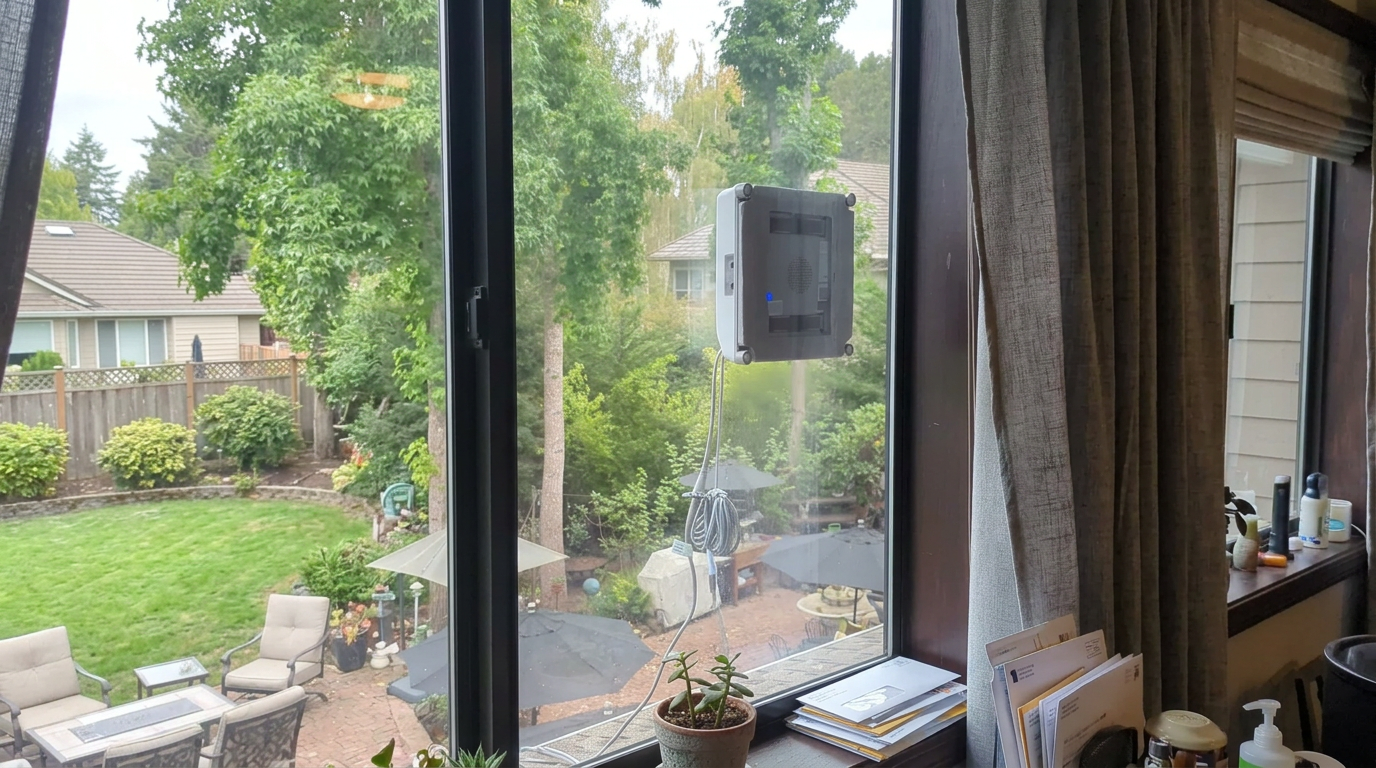
A garden-facing window: standard size, easy for the MINI.
Outside windows
The MINI can clean the outside of windows, and its light weight makes it easy to reach out and place on the glass.
With the rope anchored indoors and the power cable run through the open window, it worked on our ground-floor and upstairs panes.
Outside glass is where its limits show, though. Pollen and dust came off well, but dried rain spots and road film needed Deep mode and sometimes a second run.
My ratings on a 10-point scale, Deep mode with a fresh pad.
Avoid hot, direct sun when you clean outside. The fine mist dries before the pad reaches it, which is a recipe for streaks.
Our tip: Clean outside glass on an overcast morning. With a fresh pad and Deep mode, that gave me the best outside results the MINI could manage.
Which windows and surfaces it suits
The MINI is designed for flat, smooth glass, framed or frameless.
It works with standard vertical windows and with tilt-and-turn windows opened no more than about 45 degrees to the wall.
The glass needs a minimum edge lip of about 0.16 inches so its sensors can find the boundary.
| Surface | How it went | My verdict |
|---|---|---|
| Regularly cleaned windows | Clear, few streaks | Very good |
| Narrow and small windows | Fits where others cannot | Very good |
| Sliding glass doors | Good, watch the cables | Good |
| Tilt-and-turn windows, up to 45° | Works as specified | Good |
| Very dirty glass | Several passes, faint streaks | Fair |
| Tiled walls | Deep grout lines block it | Not suitable |
| Sloped skylights | Not supported | Not suitable |
Noise: louder than it looks
The MINI is not quiet.
I measured about 67 to 69 dB at roughly 3.3 feet, almost all of it from the suction fan’s airflow.
It is a loud, constant blowing noise. In a small apartment or a quiet room, you will notice it.
My measurement of the MINI compared with typical everyday sounds.
It is not unusual for a suction-based window robot, but it is worth knowing if you hoped a small robot would be a quiet one.
Pets and family
Our cat disliked the noise for the first couple of runs and left the room. After a week she ignored it.
With children around, the louder fan is actually useful: everyone can hear where the robot is, and the alarm on power loss is impossible to miss.
Keep the cable and rope out of walkways while it runs, as with any corded appliance.
Power, cable reach and runtime
Because it runs on mains power, there is no battery to run down.
The only real limit on a session is the solution tank. Refill it, and the robot carries on.
That makes it good for long sessions on many windows, as long as each window is near an outlet.
For windows far from a socket, you will need an extension cord, and you will need to manage it carefully alongside the rope.
What using it is really like
A typical session took me about two minutes to set up.
The robot then cleaned while I did something nearby, which I preferred given the noise and the occasional cable snag.
At the end, I pressed the button to release the suction, lifted it off, wiped the parking mark and the corners, and rinsed the pad.
My hands-on time for a typical session.
Robot versus cleaning by hand
On a single small window, I am faster by hand.
Over a whole floor, the MINI saves real effort, especially on tall glass where I would otherwise stretch or climb.
| Task | By hand | WINBOT MINI |
|---|---|---|
| One small window | Faster | Slower, because of setup |
| Several regularly cleaned windows | Tiring | Easy, with a quick finishing wipe |
| Very dirty windows | Better results | Several passes, faint streaks |
| Corners | Perfect if careful | Small squares left |
| Your effort | All of it | Setup, cables and finishing wipes |
How to get the best results
The MINI rewards a bit of care. These habits made the biggest difference in my test.
- Start with glass that is already fairly clean. Do one hand clean on very dirty windows first.
- Wring the pad until it is only slightly damp.
- Fill the tank before each big window.
- Run the power cable and safety rope down opposite sides.
- Use Intensive for doors so the edges get an extra lap.
- Keep a cloth handy for the parking mark and corner squares.
- Clean the tracks and sensors after every session.
My judgment of how much each habit improved the final look of the glass.
Cleaning and maintaining the MINI
Maintenance is more than rinsing pads.
Rinse the pads after every session, and wipe the tracks and sensors too, because dirt there can affect movement and navigation.
ECOVACS includes a track-cleaning program in the app. You lay the robot on its back and the tracks run so you can wipe them.
| When | Task | Why it matters |
|---|---|---|
| After each session | Rinse the pads | Stops dirt going back on the glass |
| After each session | Wipe tracks, rollers and sensors | Keeps movement and edge detection reliable |
| Weekly in heavy use | Run the track-cleaning program | Clears grit from the tracks |
| Before outside glass | Check the rope and carabiner | Your safety backup |
| When it runs low | Refill with ECOVACS solution | Avoids residue and streaks |
Supplies and long-term ownership
Two pads come in the box, and they are easy to remove and replace thanks to the Velcro.
The ongoing cost to think about is cleaning solution. The tank is small and the manufacturer’s solution is the one to use, so budget for refills if you clean often.
There is no storage case. I kept the robot, cable, rope and bottle in a small box so nothing went missing.
After four weeks, it cleaned as well as at the start, as long as I kept the tracks clean.
Which homes it suits best
The MINI fits best in homes where windows are cleaned often and are small to medium in size.
| Home | How well it fits | Why |
|---|---|---|
| Apartment with standard windows near outlets | Very good | Compact, simple, regular upkeep |
| House with narrow or small windows | Very good | Fits where big robots cannot |
| Home with huge glass walls | Fair | Cable and top-edge issues |
| Home with neglected outside glass | Fair | Needs a hand clean first |
| Conservatory with sloped glass | Not suitable | Skylights not supported |
If you are buying your first window robot and keep your glass in decent shape, it is an easy, low-commitment place to start.
Living with it: week one to week four
In week one, I cleaned regularly maintained inside glass and was pleased, apart from the parking mark.
In week two, I tried dirty outside windows and learned that it is a maintenance robot, not a restoration one.
In week three, I worked out the cable problem on the tall door by keeping the rope and power cable apart.
In week four, it was a quick weekly routine on the windows that matter, plus a cloth for the finishing touches.
My overall satisfaction each week, out of 10. Week two dipped on very dirty glass.
What surprised me, good and bad
The good surprise was how close it cleans to the frame for such a small, simple robot. The border it leaves along the edge is narrow.
The other good surprise was solution economy. Under an ounce did two big glass doors.
The less welcome surprises were the noise, which is far bigger than the robot, and the parking mark, which appeared every single time.
The cable issue on tall glass also caught me out until I worked out how to separate the cable and rope.
How each detail compared with my expectations before testing.
Common mistakes to avoid
The WINBOT MINI is simple, but these habits make a big difference.
| Mistake | What happens | Better habit |
|---|---|---|
| Using it on neglected glass | Several passes, faint streaks | Clean by hand once, then maintain |
| Cable and rope crossing | Stops short of the top | Run them down opposite sides |
| Soaking-wet pad | Smears and drips | Wring it out thoroughly |
| Skipping track cleaning | Wobbly navigation | Wipe tracks after each session |
| Using the remote for everything | Fiddly turns at edges | Let the automatic modes work |
| Tiled walls or skylights | Not supported | Stick to flat, vertical glass |
What I would change
A finishing routine that avoids the parking mark, and a quieter fan, would make the biggest difference.
Is it a good first window robot?
Many people buying the MINI have never owned a window robot. That is a good fit, with a few things to know up front.
What it gets right for beginners
It is simple. One button starts it, and you do not need the app or Wi-Fi to get going.
It is light and easy to place, which makes the slightly scary first moment of sticking a robot to a window much less nerve-racking.
And it is compact enough to store in a kitchen drawer or a shelf, so it is easy to grab for one window.
What beginners should expect
A window robot is a helper, not a replacement for every cloth in the house.
You will still prepare the pad, manage the cable, wipe the parking mark and the corners, and occasionally clean a stubborn window by hand.
If you go in expecting that, the MINI is satisfying. If you expect perfect, hands-free glass, you will be disappointed by any robot at this level.
| Beginner question | Short answer |
|---|---|
| Is it hard to set up? | No, about two minutes once you know the steps |
| Is it scary on high windows? | Less than you think, with the rope anchored |
| Will I still clean by hand? | A little, for marks and corners |
| Will I use it often? | Yes, if your windows are small and near outlets |
Is the WINBOT MINI worth the money?
For regular upkeep of small and standard windows, yes.
It is one of the more affordable ways into robotic window cleaning, and it does the routine work well.
Go in with the right expectations: it will keep clean windows clean, but it will not rescue very dirty ones, and you will still wipe a mark and some corners.
Ask yourself three questions. Do you clean your windows fairly often? Do you have narrow or small windows bigger robots cannot fit? And are you fine with a quick finishing wipe?
If so, the MINI is a sensible, compact helper.
How it compares with other ECOVACS window robots
| Feature | WINBOT MINI | WINBOT MINI 2 | WINBOT W2S PRO |
|---|---|---|---|
| Size | 8.46 in square | 8.46 in square | Larger square |
| Max suction | 7,500 Pa | 8,000 Pa | 10,000 Pa |
| Spray | Ultrasonic, 4 nozzles | Ultrasonic mist | Triple nozzles each side |
| Edge help | Bumper-free pad | Four corner brushes | TruEdge 2.0 brushes |
| Modes | Quick, Intensive, Deep, Spot | Five | Seven |
| Best for | Upkeep on small windows | Better corners | Big windows, best edges |
| Your home | Is the MINI a fit? | Why |
|---|---|---|
| Windows you clean regularly | Very good | Keeps them clear |
| Narrow or small windows | Very good | Compact body |
| Neglected outside glass | Fair | Needs several passes |
| You want perfect corners | Fair | Small squares left |
| Skylights or tiled walls | Not suitable | Not supported |
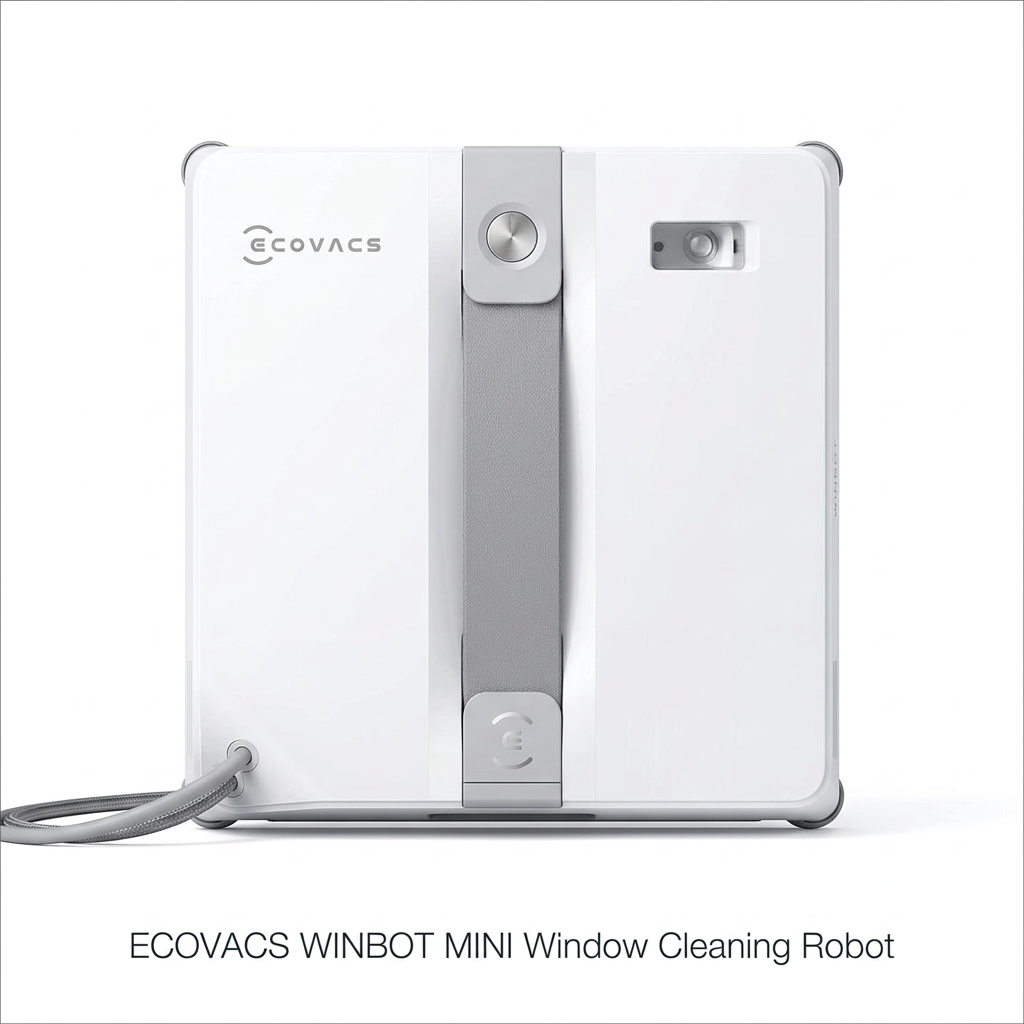
The MINI’s compact square body: small enough to fit windows bigger robots cannot.
Other ECOVACS window robots I tested
For better corners in the same compact size, read my WINBOT MINI 2 review.
For big windows and sharp edges, see my WINBOT W2S PRO review.
Which one is right for you: is the WINBOT MINI your match?
4 quick questionsWINBOT MINI specifications
From manufacturer data and my own testing.
How I tested and scored the WINBOT MINI
For four weeks, I used the WINBOT MINI on our sliding doors, a tall glass door, narrow hallway glass and regular windows, inside and out.
I ran all three modes and spot cleaning, compared regularly cleaned and neglected glass, measured noise at about 3.3 feet and tracked solution use on two large doors.
I experimented with cable layouts on tall glass and timed my hands-on and finishing work.
I then checked my notes against ECOVACS specifications and owner documentation.
- Cleaning (7.6): dust, fingerprints and light grime on regularly cleaned glass, plus how it coped with very dirty windows.
- Edge coverage (7.4): how close it got to the frames, the small corner squares and the strip at the top of large windows.
- Ease of use (8.1): the single button, app setup, the three modes, spot cleaning, pad care and cable handling.
- Safety (8.4): suction, the safety rope, the 30-minute power-loss hold and the alarm.
The overall score of 7.8 is an editorial rating that reflects those four areas.
WINBOT MINI FAQ
Is the ECOVACS WINBOT MINI worth it?
Yes, for regular upkeep of small and standard windows. It is less effective on very dirty glass and leaves a small mark and corner squares to wipe.
Does the WINBOT MINI have a battery?
It runs on mains power. A small backup battery keeps it attached for about 30 minutes if the power fails.
How strong is the suction?
About 7,500 Pa.
What cleaning modes does it have?
Quick, Intensive and Deep, plus spot cleaning in the app.
Do I need the app?
No. A basic clean needs only power and the button. The app adds modes, spot cleaning and settings.
How big is the tank?
About 2 fl oz. In my test, about 0.7 fl oz cleaned two large glass doors.
Why does it leave a mark?
The pad leaves a mark where the robot stops at the end of a cycle. A microfiber cloth wipes it off.
Why does it not reach the top of tall windows?
Usually the safety rope and power cable are catching on each other. Run them down opposite sides.
How loud is it?
I measured about 67 to 69 dB at around 3.3 feet.
Can it clean skylights or tiled walls?
No. It is not suited to sloped skylights, and deep grout lines interfere with its movement.
Does it work on tilt-and-turn windows?
Yes, when opened no more than about 45 degrees to the wall.
How do I clean the tracks?
Use the track-cleaning program in the app with the robot on its back, and wipe the tracks as they run.
Is the WINBOT MINI good for beginners?
Yes. It is simple to start with one button, light to place and easy to store. Expect to wipe a parking mark and corners after each window.
Can it clean very dirty windows?
It improves them, but often needs several passes and can leave faint streaks. Clean very dirty glass by hand once, then use the MINI to keep it clean.
Does it come with a storage case?
No. I kept the robot, cable, rope and bottle together in a small box.
Senior home appliance tester
Emily has tested home appliances for a living since 2016, including five years as a test coordinator at a national consumer advocacy group, and has run HouseholdMe's cleaning tests since 2021. She has a degree in industrial design, so she looks at how a product is built, not just how it performs. She used the WINBOT MINI for four weeks for this review, on sliding doors, narrow hallway glass and regular windows, and measured its noise and solution use.
- Four weeks of hands-on testing of the ECOVACS WINBOT MINI
- ECOVACS product specifications and owner documentation
- General window-cleaning and robot-safety guidance