De'Longhi La Specialista Opera review: a handsome all-in-one with a great steam wand and a grinder that limits it
The De'Longhi La Specialista Opera Espresso Machine is an all-in-one espresso station with a built-in conical burr grinder, a mess-free tamping lever, a cool-touch steam wand and a dial of drinks that includes Americano, Espresso Cool and cold brew. I made it my main machine for three weeks to see how it handles everything from dark espresso blends to lighter roasts.

Michael Reynolds
Hands-on review
Hands-on testing, research, specs
3 weeks
19 minutes
Jargon helpNew to espresso? Tap any dotted term to see what it means.
In this review
Yes, if you mostly drink milk drinks and classic medium-dark espresso and want a handsome, mess-free all-in-one. The La Specialista Opera heats in about 15 seconds, switches to steam in 10 to 12, and its cool-touch wand made the best microfoam of any machine I've tested at this level. Its Americano, Espresso Cool and cold brew options are genuinely useful. The catch is the grinder: it doesn't go fine enough for light roasts, and its "smart" dosing is really a timer.
La Specialista Opera at a glance
La Specialista Opera pros and cons
- Superb, fast cool-touch steam wand
- Mess-free grinding and tamping lever
- Americano, Espresso Cool and cold brew built in
- Grinder can't go fine enough for light roasts
- Timed dosing, not real smart dosing
- Very large countertop footprint
Who should buy the La Specialista Opera?
- Latte and flat white drinkers
- Medium-dark and dark roast fans
- Households with varied coffee tastes
- Light-roast specialty enthusiasts
- Small kitchens
- Buyers expecting dose sensors or guidance
First impressions of the La Specialista Opera
The La Specialista Opera is big, heavy and handsome.
At about 15 inches wide and 28.5 pounds, it took over the corner of my counter, with brushed metal panels, a bean hopper on top, a tamping lever on the side and a drink dial on the front.
It looks like a serious Italian machine, and it feels like one when you lock in the portafilter✕PortafilterThe handle with a metal basket that holds the ground coffee. You lock it into the machine to brew., which has a satisfying weight.
Depending on where you buy it, the box can include extras such as a metal knock box, a bean canister and espresso glasses.
It heated up in about 15 seconds.
My first shot used a medium-dark espresso blend: grind straight into the portafilter, pull the lever to tamp, lock in, brew.
There was no mess on the counter, which was the first thing I loved.
The shot was rich and balanced, with good body and a hazelnut crema.
Then I steamed milk, and the cool-touch wand made the silkiest milk I've had from a machine at this level.
That combination, tidy workflow plus excellent milk, defines the La Specialista Opera.
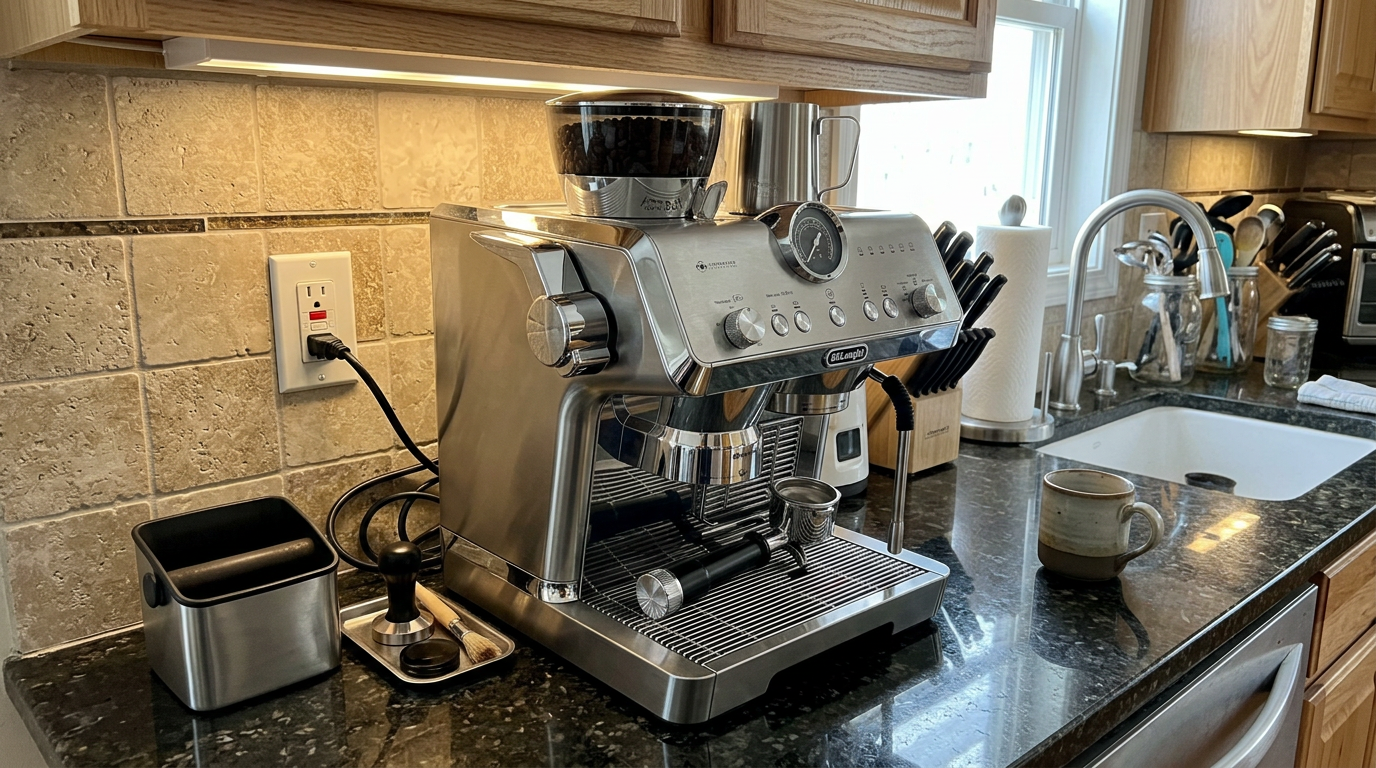
The Opera by my sink. It's a big machine, but the knock box and pitcher fit neatly alongside.
What the La Specialista Opera actually is
The Opera is a semi-automatic espresso machine with a built-in conical burr grinder, a manual steam wand and a fast thermoblock✕ThermoblockA compact heater that warms water as it flows through, instead of keeping a boiler of hot water ready..
You grind into the portafilter, tamp with the side lever, lock it in and choose your drink on the dial.
| Feature | What it does | My verdict |
|---|---|---|
| Conical burr grinder | 15 settings, grinds into the portafilter | Fine for darker roasts, limited for light |
| Dose dial | Timed grinding for single or double | Convenient, not a scale |
| Tamping lever | Levels the coffee in place | Tidy and consistent |
| Cool-touch steam wand | Manual, single-hole tip | Excellent |
| Drink dial | Espresso, coffee, Americano, Espresso Cool, cold brew, hot water | Genuinely useful |
| Baskets | Single-wall and pressurized | Good flexibility |
Opera design and footprint
Before buying, measure your counter, because the Opera is large.
The upside of the weight
All that mass keeps the machine planted when you lock in the portafilter or pull down the tamping lever.
It never moved on my counter, unlike the light budget machines.
Cup clearance
About 4.7 inches of space fitted cappuccino cups, double-walled glasses and smaller travel mugs without removing the drip tray.
The look
Brushed metal, clean lines and classic De'Longhi styling; several visitors assumed it cost far more than it does.
Our tip: Measure the height under your cabinets with the hopper lid open before you buy; the Opera is tall.
The built-in grinder: good, with a ceiling
The grinder is the part of the Opera that decides whether it's right for you.
It has 15 settings, up from 8 on older La Specialista models, and the extra steps help with fine-tuning.
Medium-dark and dark roasts
With a fresh medium-dark espresso blend in the single-wall basket, I needed setting 3 from the start to get a proper shot time.
That worked well, and I got rich, balanced espresso.
Light roasts
With a light single origin, I hit the finest setting, 1, and the shot still ran too fast and tasted sour.
Lighter, denser beans simply need a finer grind than this grinder can produce.
Shot time at the finest workable setting, double basket, 18 g.
With the pressurized baskets, the range doesn't matter, because the basket builds the pressure.
So the grinder is a good match for classic espresso blends and supermarket beans, and a frustrating one for light-roast specialty coffee.
Dosing: what "Grinding Intelligence" really is
De'Longhi's marketing talks about "Grinding Intelligence" delivering a consistent dose.
In practice, there's no scale or sensor; the dose dial sets how long the grinder runs.
That's normal for a machine like this, but the name can set the wrong expectations.
Why it matters
Beans vary in density, so the same grinding time gives different weights.
When I switched from a dark blend to a dense medium roast, my double dose dropped by more than a gram.
The machine also can't tell if the portafilter already has coffee in it, so it will happily overfill.
| Beans | Grinder dial setting | Weight I measured |
|---|---|---|
| Dark blend | Double, middle | About 18 g |
| Medium-dark blend | Double, middle | About 17.5 g |
| Medium roast, dense | Double, middle | About 16.6 g |
How I dealt with it
I weighed the dose for the first few shots of every new bag and nudged the dose dial until I hit 18 grams.
After that, it was consistent for that coffee.
The tamping lever
After grinding, you pull a lever on the left side, and it presses the coffee level inside the portafilter while it's still in the grinding cradle.
No coffee on the counter, no wobbly hand tamp, no tilted pucks.
The Opera's lever is much smoother than the clunky one on older La Specialista machines.
What it doesn't do is tell you anything: it presses to a fixed stop, without feedback on whether your dose is right.
So it's a tidy, consistent tool rather than a smart one.
My tamping routine
Grind, pull the lever down firmly once, release, and check the puck surface looks flat and evenly packed.
If the puck looked low or the shot ran fast, I increased the dose rather than tamping harder.
Our tip: If a shot runs fast, add coffee with the dose dial rather than pulling the tamping lever harder.
Opera espresso performance
With the right beans, the La Specialista Opera makes very good espresso.
Pre-infusion
When you press brew, the machine pauses silently for about four seconds, then pulses gently for about seven seconds, adding roughly 0.7 ounces of water to the puck.
Only then does the pump run at full power.
This pre-infusion✕Pre-infusionA short, gentle wetting of the coffee before full pressure. It helps water soak the puck evenly. helps the coffee soak evenly, and my shots ran with very little spurting.
How it tasted
With fresh medium-dark espresso blends, shots were rich and rounded, with chocolate, caramel and a little toasted nut, and a thick hazelnut crema.
Dark blends were bold and smooth, especially at the lowest temperature setting.
Light roasts were the exception: sour and thin, because the grinder couldn't go fine enough.
Temperature
Espresso landed in the cup in the high 170s to low 180s °F, which is a good drinking temperature.
My flavor ratings on a 10-point scale.
| What you taste or see | Likely cause | First change |
|---|---|---|
| Sour, fast | Grind not fine enough or dose too low | Finer setting, more dose |
| Bitter, slow | Grind too fine for a dark roast | One step coarser |
| Spurting | Uneven puck | Re-tamp, check for clumps |
| Thin, bubbly crema | Very fresh beans | Rest beans a week |
What the 19-bar pump really means
The box makes a lot of the Opera's 19-bar pump.
That figure is the most pressure the pump can produce with nothing flowing, not the pressure at the coffee.
Inside the machine, an OPV✕OPVShort for over-pressure valve. It caps the brewing pressure, usually at about 9 bar, by sending extra water back to the tank. limits brewing pressure to about 9 bar, which is the standard for good espresso.
If you grind too fine, the valve simply opens and sends the extra water away.
So in practice, it brews at the same pressure as a machine with a 15-bar pump, and that's a good thing.
Don't choose or reject the Opera based on the pump number; the grinder range and steam wand matter far more.
Which basket for which beans
The Opera comes with both single-wall basket✕Single-wall basketA basket full of small holes. All the resistance comes from the coffee itself, so grind and tamp matter much more. options and pressurized baskets✕Pressurized basketA double-wall basket with one tiny exit hole. It builds pressure for you, so even pre-ground coffee makes a foamy crema., and choosing the right one made a big difference.
Single-wall baskets
Use these with fresh, recently roasted beans, ideally medium-dark.
They gave the best flavor, body and natural crema.
Pressurized baskets
Use these with supermarket beans that show a best-by date rather than a roast date.
Older beans have lost the gas that helps build crema and pressure, and the pressurized basket makes up for it.
I got consistent, pleasant shots from a big-brand supermarket bag with no dialing in at all.
| Beans | Best basket | Result |
|---|---|---|
| Freshly roasted, medium-dark | Single-wall | Rich, sweet, real crema |
| Freshly roasted, dark | Single-wall | Bold, smooth |
| Supermarket beans | Pressurized | Consistent, easy |
| Light single origin | Single-wall | Sour, grinder limit |
My guide to choosing coffee beans explains roast dates and best-by dates.
Our tip: Check the bag: a roast date means single-wall basket, a best-by date means pressurized basket.
Steaming milk: the Opera's best feature
The cool-touch steam wand is the highlight of the La Specialista Opera.
Speed
Switching from brewing to steam took only 10 to 12 seconds, remarkably fast for a single thermoblock.
Steaming about 5.75 ounces of cold milk to 140 °F took roughly 40 seconds.
That's slower than big commercial machines, but it gave me plenty of time to control the texture.
Texture
The single-hole tip delivers dry, steady steam that's easy to control.
I could stretch the milk gently, then build a smooth whirlpool, and the result was glossy, paint-like microfoam✕MicrofoamMilk foam with bubbles so small you can't see them. It feels silky and pours well for latte art. almost every time.
Cool-touch
The insulated wand stays comfortable to touch after steaming, and milk doesn't bake onto it, so a quick wipe is enough.
My ratings on a 10-point scale for texture and stability.
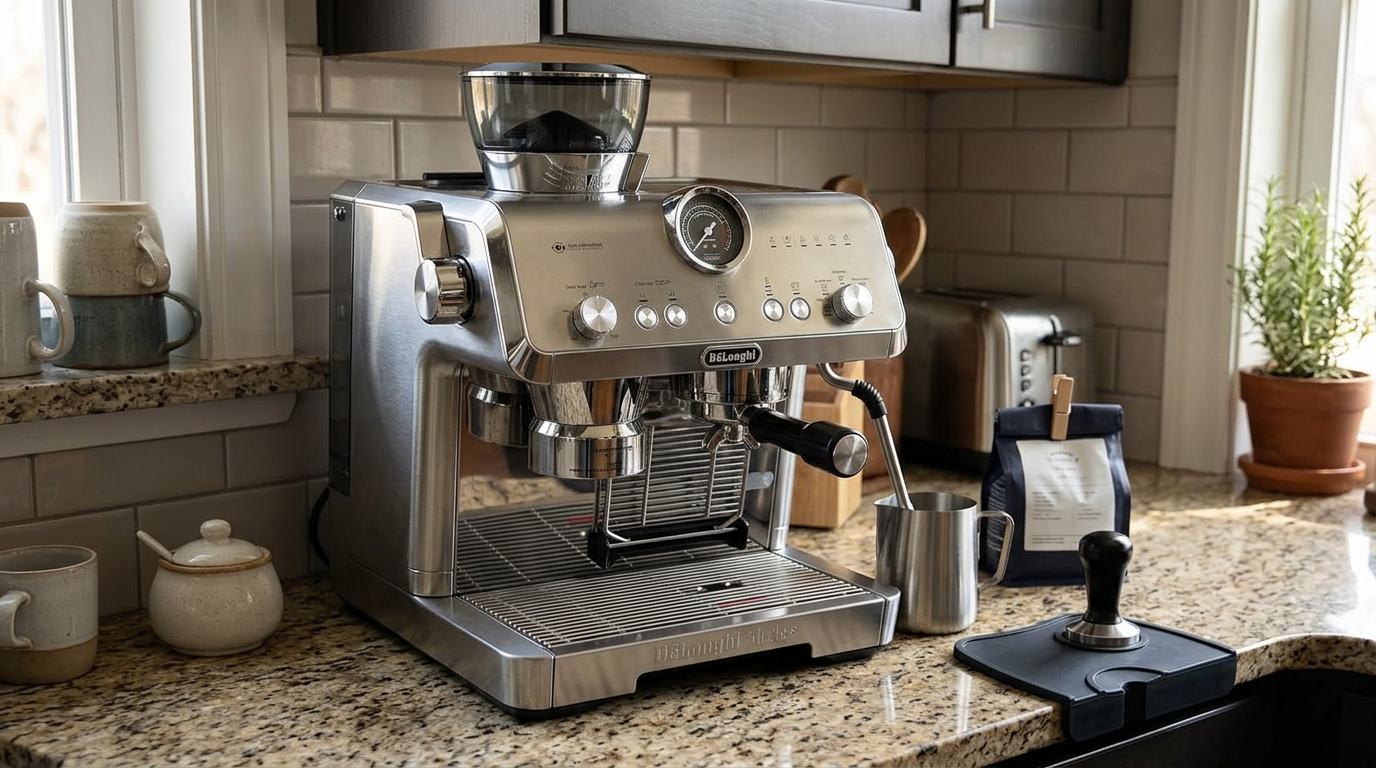
The Opera with a milk pitcher and beans. The cool-touch wand on the right made the best milk of any machine I've tested at this level.
How I steam milk on the Opera, step by step
| Step | What I do | Why |
|---|---|---|
| 1. Brew | Pull the shot first | Then switch to steam |
| 2. Switch | Turn to steam and wait 10 to 12 s | Thermoblock heats up |
| 3. Purge | Open briefly over the tray | Clears water |
| 4. Stretch | Tip just under the surface, 3 to 5 s | Adds air |
| 5. Spin | Sink slightly, off-center | Builds a whirlpool |
| 6. Stop | Around 140 °F, when the jug is hot to hold | Sweetest milk |
| 7. Clean | Wipe and purge | Cool-touch makes it easy |
The milk temperature is entirely up to you, because the wand is fully manual.
I stopped when the jug became too hot to hold comfortably for more than a second.
My latte art over the test, rated out of 10.
Our tip: Use a 12 ounce pitcher a third full; the Opera's steam is strong enough to spin it quickly.
The drink dial: Americano, coffee, cold drinks
The front dial is one of the Opera's most practical features.
Americano
Instead of pushing extra water through the coffee, which makes it bitter, the Opera pulls an espresso, then adds hot water from a separate spout.
My Americanos landed in the low 180s °F and tasted clean and smooth.
Coffee
The coffee setting brews a longer, milder black coffee with a light crema, similar to a European caffè crema.
It isn't drip coffee, but it was a pleasant mug-sized option.
Espresso Cool
This mode skips most of the heating and pulses water slowly at lower pressure.
The shot comes out cooler and tastes sweeter and less acidic, and it doesn't melt your ice instantly.
Cold brew
The cold brew setting uses the same slow, cool extraction for longer, in under five minutes.
Brewed over a glass of ice, it made a smooth, mild iced coffee.
| Dial setting | What you get | My verdict |
|---|---|---|
| Espresso | Single or double shot | Excellent with the right beans |
| Coffee | Longer, milder black coffee | Good mug option |
| Americano | Espresso plus hot water from a bypass spout | Clean and smooth |
| Espresso Cool | Cooler, sweeter shot for ice | Great iced lattes |
| Cold brew | Larger, smooth, cool coffee | Quick summer drink |
| Hot water | Water for tea or warming cups | Handy |
Temperature settings and drink temperatures
The Opera offers three brewing temperatures, starting around 197.6 °F and rising for lighter roasts.
I used the lowest for dark blends and the highest for medium roasts.
| Drink | Temperature I measured | Notes |
|---|---|---|
| Espresso | High 170s to low 180s °F in the cup | Ideal for sipping |
| Americano | Low 180s °F | Comfortably hot |
| Hot water | Mid to high 180s °F | Fine for tea |
| Steamed milk | Your choice, manual | I stopped around 140 °F |
The lowest setting took the bitter edge off a dark Italian blend.
The highest helped a medium roast taste sweeter, though it couldn't fix the grinder's limits with light roasts.
Cups warmed on the top tray kept espresso hotter for longer.
Our tip: Use the lowest temperature for dark roasts and the highest for medium roasts.
My first-week checklist for new owners
| Day | What to do | Why |
|---|---|---|
| Day 1 | Rinse parts, fill the tank, run the first rinse | Clean start |
| Day 1 | Start with a medium-dark blend, setting 3 to 4 | Within the grinder's range |
| Day 2 | Weigh your first doses, adjust the dose dial | Timer, not a scale |
| Day 2 | Practice the steam wand with a small jug | The Opera's strength |
| Day 3 | Try the Americano setting | Better than a long espresso |
| Day 4 | Try Espresso Cool over ice | Great iced lattes |
| Day 5 | Set the temperature for your roast | Fine-tune flavor |
| Day 7 | Clean the grinder chute | Keeps dosing consistent |
What other owners say
I also looked at what other owners and testers report.
The steam wand gets almost universal praise for its speed, control and cool-touch design.
Owners also like the tidy grinding and tamping, the Americano and cold brew options, and the solid, handsome build.
The most common criticism is the grinder's range: several testers found it can't grind fine enough for lighter roasts.
Others feel the marketing promises more automation than the machine delivers, especially around "Grinding Intelligence" and dosing.
What that means for you
Buy the Opera for its workflow and milk, not for automated dialing in.
Cleaning and maintaining the Opera
| When | Task | Why it matters |
|---|---|---|
| After steaming | Wipe and purge the wand | Cool-touch makes it quick |
| Daily | Rinse the portafilter and basket | Removes coffee oils |
| Daily | Empty the drip tray and knock box | Prevents odors |
| Weekly | Brush the grinder chute and tamping area | Keeps dosing consistent |
| Weekly | Brush the group head | Keeps the seal clean |
| Every few months | Descale | Protects the thermoblock |
Grinder care
Brush out the chute and around the tamping area every week; old grounds build up and can affect dosing.
Before switching to a very different coffee, I ran a few seconds of grinding into the bin to clear the old grounds.
Descaling
Follow the machine's descaling✕DescalingRunning a mild acid solution through the machine to dissolve the mineral scale that builds up from tap water. prompts with a proper descaler.
My estimate of hands-on cleaning time per day.
What daily use is really like
My weekday routine: switch on, grind into the portafilter, pull the lever, lock in, brew, switch to steam, steam, done.
A latte took about three minutes from a cold start, and there was no coffee on the counter afterwards.
The heat-up and steam switch are so quick that I never waited on the machine.
Noise
The grinder is the loudest part, a short, sharp burst, and the pump hums quietly.
Tank life
Rough maths from a 67.6 oz tank.
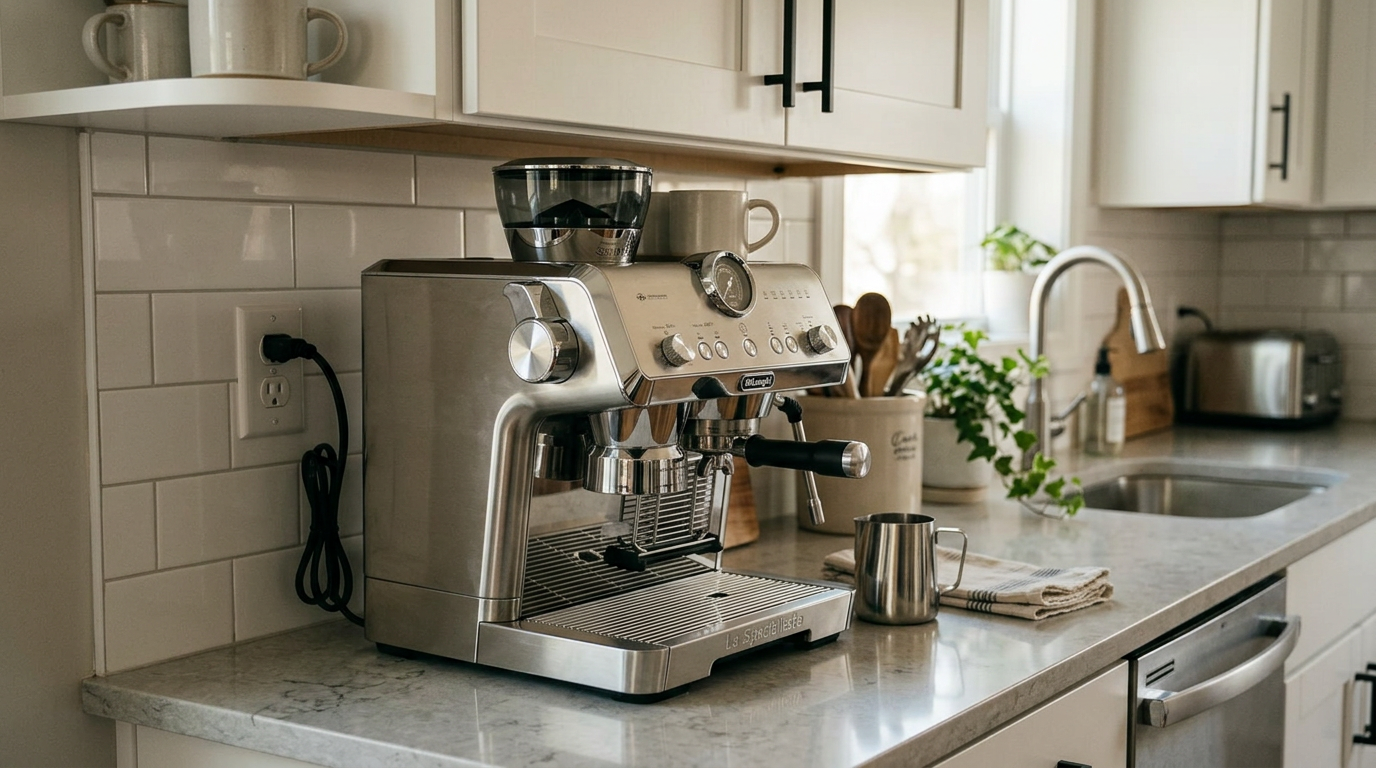
The Opera under my white cabinets, with a pitcher ready. The hopper sits on top, so measure the height first.
The drinks I made most often
| Drink | Coffee | How I made it | Notes |
|---|---|---|---|
| Flat white | 18 g double, medium-dark | Thin layer of silky milk | My favorite on this machine |
| Latte | 18 g double | About 8 oz steamed milk | Excellent texture |
| Cappuccino | 18 g double | More air in the stretch | Glossy, stable foam |
| Americano | Dial setting | Shot plus hot water from the bypass spout | Clean and smooth |
| Iced latte | Espresso Cool | Over ice with cold milk | Sweet, doesn't melt the ice |
| Cold brew | Dial setting | Over a full glass of ice | Quick and mild |
The flat white was the drink that showed off the Opera best: rich espresso and perfect milk.
In warm weather, Espresso Cool over ice became my afternoon favorite.
Our tip: For iced lattes, use Espresso Cool instead of a hot shot; it stays sweeter and melts less ice.
Living with it: week one to week three
Week one
I fought the grinder with a light roast, then switched to medium-dark beans and everything improved.
I also learned the steam wand, which was easy from the start.
Week two
I weighed doses for each new bag, tried every setting on the dial and settled on my temperatures.
Week three
I used the La Specialista Opera for a busy household, with guests and five drinks a day.
It handled back-to-back milk drinks easily, thanks to the fast switch to steam.
How I rated each drink by the end of the test, out of 10.
Serving guests
The Opera is excellent for guests who want milk drinks.
Four lattes took me about 10 minutes, because the steam switch is so fast and the tamping lever keeps the workflow tidy.
The drink dial let me offer a cold brew and an Americano alongside the lattes without any fuss.
Our tip: For a round of lattes, grind and tamp the next dose while the milk for the previous drink is steaming.
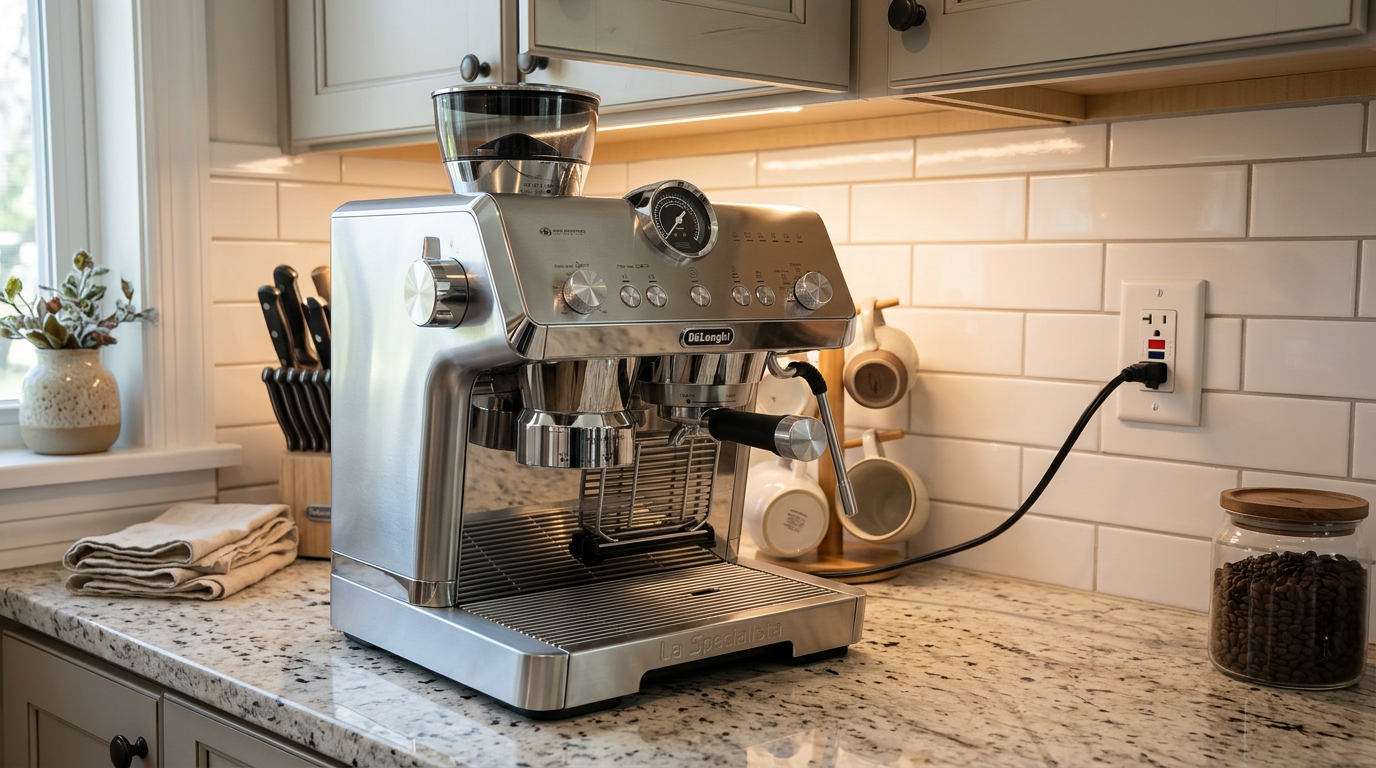
The Opera against white tile with a rack of mugs. It handled a full round of lattes for guests without slowing down.
Build quality
The Opera feels well made: heavy, stable, with solid controls and a weighty portafilter.
The brushed metal finish looks premium, and the tamping lever moves smoothly.
Over three weeks of heavy use, I had no faults.
What I liked most, and what bugged me
What I liked most
The steam wand: fast, cool-touch and capable of genuine latte-art milk.
The workflow: grind, tamp and brew with no mess.
The drink dial: proper Americanos, Espresso Cool and cold brew.
And the build: heavy, stable and handsome.
What bugged me
The grinder's limited fine range with light roasts.
Dosing by time, despite the "intelligent" name.
The size: it needs a lot of counter space.
Who will enjoy it
If you love milk drinks and classic espresso blends, you'll love the La Specialista Opera.
If you chase light-roast specialty coffee, you'll be frustrated by the grinder.
Common mistakes to avoid
| Mistake | What happens | Better habit |
|---|---|---|
| Starting with light roasts | Sour, fast shots at setting 1 | Start with medium-dark blends |
| Trusting the dose dial blindly | Doses drift with new beans | Weigh the first shots of each bag |
| Using pressurized baskets with fresh beans | Flat, foamy shots | Use single-wall for fresh beans |
| Pulling a long espresso for a mug | Bitter | Use the Americano setting |
| Letting grounds build up | Inconsistent doses | Brush the chute weekly |
A finer-grinding burr set and real dose weighing would make the Opera a top choice for every kind of coffee lover.
Is the La Specialista Opera worth the money?
For milk-drink lovers and classic espresso drinkers, yes.
You get a tidy grinder-and-tamp workflow, a superb steam wand, fast heating, useful drink options and a solid, attractive build.
What you give up is grind range for light roasts and any real automation in dosing.
Ask yourself three questions before you buy.
Do you mostly drink lattes and flat whites? Do you prefer medium-dark or dark beans? Do you have room for a big machine?
If the answers are yes, the La Specialista Opera is a very satisfying all-in-one.
If you'd rather have a touchscreen that guides you through dialing in, see my La Specialista Touch review.
How it compares with other setups
| Feature | La Specialista Opera | Budget machine plus separate grinder | Guided machine with dose sensing |
|---|---|---|---|
| Grinder range | Good for darker roasts | Depends on grinder | Usually wider |
| Dosing | Timed | Manual or timed | Measured |
| Tamping | Lever, mess-free | Hand tamp | Assisted |
| Milk | Excellent manual wand | Varies | Manual or automatic |
| Cold drinks | Espresso Cool and cold brew | No | Sometimes |
| Best for | Milk drinks, classic blends | Flexibility | Hands-off learning |
| You mostly drink | Is the Opera a fit? | Why |
|---|---|---|
| Lattes and flat whites | Excellent | Superb steam wand |
| Medium-dark espresso | Very good | Within the grinder's range |
| Light-roast espresso | Poor | Grinder can't go fine enough |
| Iced coffee | Very good | Espresso Cool and cold brew |
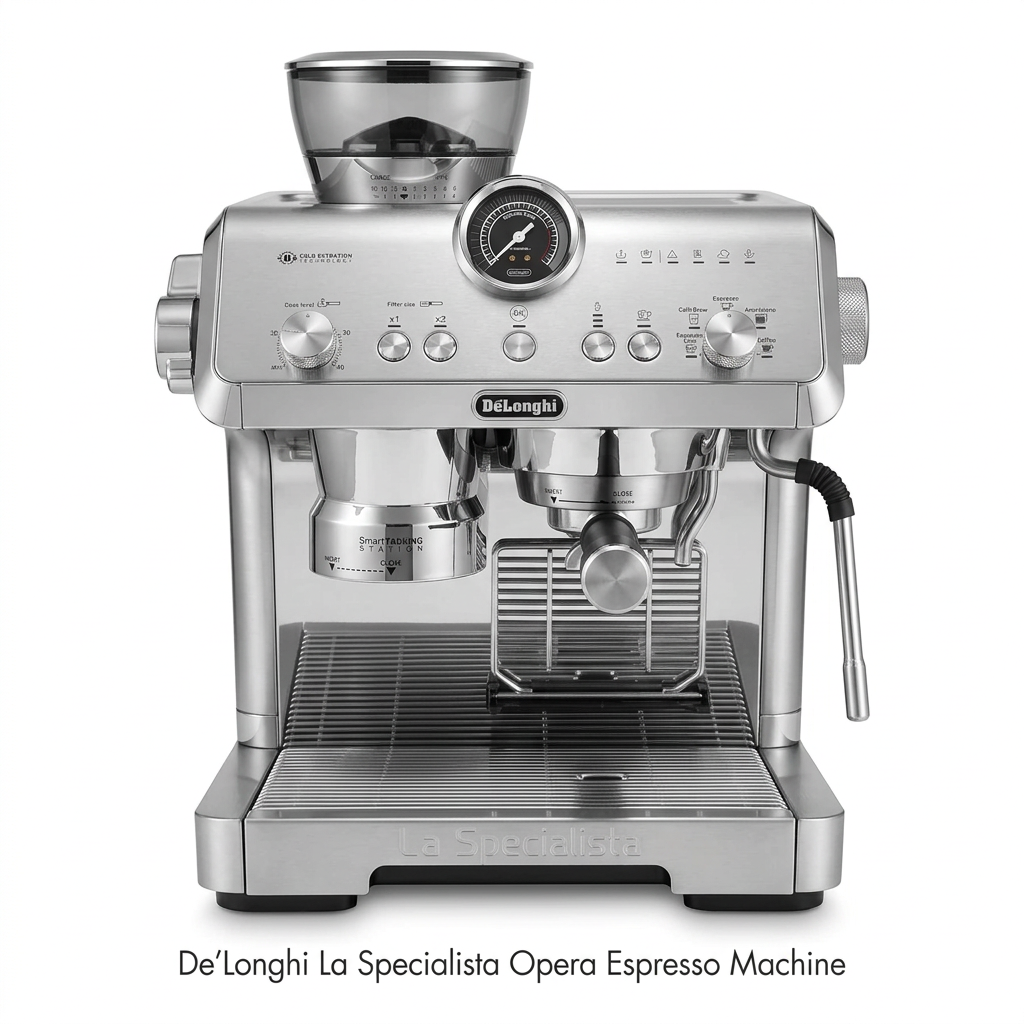
The Opera from the front: drink dial, grinder on the left and the cool-touch wand on the right.
From beans to cup, step by step
Here's the full routine I used for a double espresso on the Opera.
| Step | What I do | Why |
|---|---|---|
| 1. Switch on | Ready in about 15 s | Fast thermoblock |
| 2. Set the dose | Turn the dial to double | Times the grinder |
| 3. Grind | Lock the portafilter in the cradle, start the grinder | Grinds straight into the basket |
| 4. Tamp | Pull the side lever down firmly | Level puck, no mess |
| 5. Check | Glance at the puck surface | Flat and even |
| 6. Lock in | Move the portafilter to the group | Heavy machine stays put |
| 7. Brew | Choose espresso on the dial | Pre-infusion, then full pressure |
| 8. Knock out | Tap the puck into the knock box | Quick cleanup |
From switch-on to a finished double took about a minute and a half.
The workflow is the Opera's quiet strength: every step happens in one place, and the counter stays clean.
For a latte, I added about a minute for the switch to steam and the milk.
If you love light roasts
I wanted to give light roasts a fair chance, so I spent several mornings trying to make them work on the Opera.
At the finest grind setting, with the highest temperature and a slightly larger dose, my best light-roast shot still ran in about 17 seconds and tasted sharp.
A longer ratio helped a little, but it never tasted sweet and balanced.
What helped a bit
Increasing the dose by a gram slowed the shot a few seconds.
The highest temperature setting softened some of the sourness.
Using a medium roast from the same roaster gave me most of the fruitiness with much better balance.
| Light-roast tweak | Effect | Worth it? |
|---|---|---|
| Finest grind setting | Still too fast | Necessary, not enough |
| Bigger dose | A few seconds slower | Helps a little |
| Highest temperature | Slightly less sour | Helps a little |
| Switch to a medium roast | Sweet and balanced | Best fix |
If light roasts are your main coffee, the Opera's grinder will hold you back.
If you only drink them occasionally, a medium roast is a happy compromise.
What to expect long term
Three weeks can't tell you how the Opera will age, but its design gives some clues.
The heavy chassis, solid portafilter and smooth lever feel built for years of daily use.
The parts that need regular care are the grinder, the steam wand and the thermoblock.
Keeping the grinder chute brushed and the hopper free of oily residue helps the timed doses stay consistent.
Wiping and purging the wand after every milk drink keeps the steam strong.
And descaling when the machine asks protects the thermoblock and pump.
| Part | What to do | How often |
|---|---|---|
| Grinder chute | Brush out old grounds | Weekly |
| Bean hopper | Wipe away oils | When changing beans |
| Steam wand | Wipe and purge | Every use |
| Thermoblock | Descale | When prompted |
As always, keep your receipt and register the warranty.
Which one is right for you: is the La Specialista Opera your match?
4 quick questionsLa Specialista Opera specifications
From manufacturer data and my own testing.
How I tested and scored the La Specialista Opera
For three weeks, I used the La Specialista Opera as my everyday machine for espresso, lattes, flat whites, cappuccinos, Americanos, Espresso Cool and cold brew, usually four or five drinks a day.
I tested its grinder with a dark blend, a medium-dark espresso blend, a medium roast, a light single origin and supermarket beans, using both basket types.
I timed heat-up, the switch to steam and steaming, weighed my doses against the grind timer and measured drink temperatures.
I then checked my notes against De'Longhi's specifications, other hands-on reviews and owner feedback.
- Espresso (7.4): grinder range, dosing, extraction and flavor across roasts.
- Milk drinks (8.6): steam power, control, microfoam and speed.
- Ease of use (8.2): heat-up, tamping lever, beverage dial and setup.
- Cleaning (7.8): grinder cleaning, wand care, drip tray and descaling.
The overall score of 8 is an editorial rating that reflects those four areas.
La Specialista Opera FAQ
Is the La Specialista Opera worth it?
Yes, for milk-drink fans and medium-dark espresso drinkers. Light-roast enthusiasts will find the grinder limiting.
How many grind settings does it have?
15, up from 8 on older La Specialista models.
Can it grind fine enough for light roasts?
Not reliably. Medium-dark blends worked around setting 3, leaving little room for denser light roasts.
Does Grinding Intelligence weigh the coffee?
No. It runs the grinder for a set time based on the dial, so the weight changes with different beans.
What does the tamping lever do?
It presses the coffee level inside the portafilter without removing it, so there's no mess. It doesn't give feedback on dose.
Is the 19-bar pump better?
Not really. An over-pressure valve limits brewing pressure to about 9 bar, which is what you want.
How fast is the steam?
It switched to steam in about 10 to 12 seconds and steamed about 5.75 oz of milk in roughly 40 seconds.
Does the steam wand get hot?
The outside stays cool to the touch, which makes it safer and easier to clean.
How does the Americano work?
It pulls an espresso, then adds hot water from a separate spout, rather than running extra water through the coffee.
What is Espresso Cool?
A lower-temperature, slower extraction designed for pouring over ice.
How big is it?
About 15 inches wide, 14.6 deep and 17.5 tall, and it weighs about 28.5 pounds.
Which baskets are included?
Both single-wall and pressurized baskets.
Kitchen & coffee tester
Michael spent six years as a line cook in restaurants in Chicago and New York, and he has tested kitchen appliances for HouseholdMe since 2018, from air fryers to coffee makers. He holds an SCA certificate in barista skills and used the La Specialista Opera as his everyday coffee machine for three weeks for this review.
- Three weeks of hands-on testing of the De'Longhi La Specialista Opera
- De'Longhi product specifications and manual
- Independent hands-on reviews of the La Specialista Opera
- Owner feedback on the grinder, steam wand and dosing