Winix 5520 review
The Winix 5520 Air Purifier is a sleek, mid-to-large purifier with a true HEPA filter, a charcoal odor filter, Wi-Fi and voice control. In three weeks in my open-plan living room next to the kitchen, it handled dog hair, dust and cooking smells well. It's quiet on low, easy to maintain and very good value to run, though Turbo is noticeably louder and the ion feature is something you'll want to decide on.

Emily Carter
Hands-on review
Hands-on testing, research, specs
3 weeks
25 minutes
Jargon helpNew to air purifiers? Tap any dotted term to see what it means.
In this review
Yes, especially for open-plan living spaces, pets and cooking smells. The Winix 5520 combines a washable pre-filter, a charcoal odor filter and a thick true HEPA filter, and it noticeably cut dog hair, dust and lingering food smells in my living room. It's quiet on low, easy to control by app or voice, and filters are simple to swap. Turbo is loud enough to notice, and you'll want to decide whether to use the ion feature. For the price, it's one of the easiest purifiers to recommend.
Winix 5520 at a glance
Winix 5520 pros and cons
- True HEPA plus charcoal odor filter
- App, Alexa and Google Assistant control
- Easy, affordable filter upkeep
- Turbo is noticeably loud
- No timer or child lock buttons on the unit
- Ion feature needs switching off if unwanted
Who should buy the Winix 5520?
- Open-plan living rooms next to a kitchen
- Homes with shedding pets
- Smart-home users with Alexa or Google
- Light sleepers who need near-silent high speeds
- Very large, multi-room spaces
- Anyone set on avoiding ion technology entirely
First impressions of the Winix 5520
My living room is open-plan, with the kitchen right next to it, and my dog sheds year-round.
So I wanted something with more capacity than a small bedroom purifier.
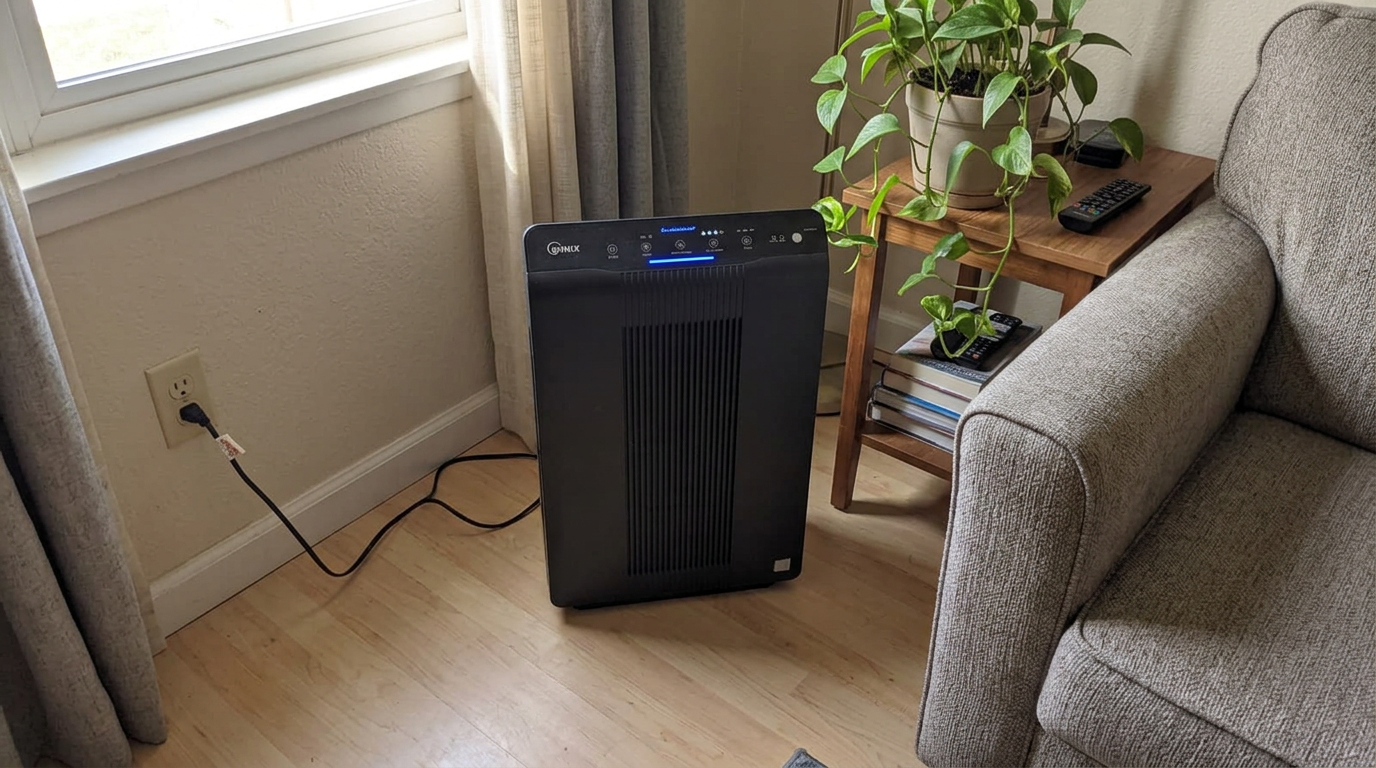
The Winix 5520 is larger than many budget purifiers, standing a little over 22 inches tall.
It has a sleek, black design with a patterned front panel, and it looked good enough to keep in the main living space.
It's also fairly light for its size, at around 13 pounds, so moving it between rooms was easy.
A stand along the bottom keeps it slightly off the floor.
Setup took a few minutes: pop off the front panel, take the plastic off the filters, put everything back and plug it in.
The first time I switched it on, it beeped, glowed and took a moment to check the air before settling on a color.
In my living room after breakfast, it started orange, ramped the fan up for a few minutes, then dropped back to blue.
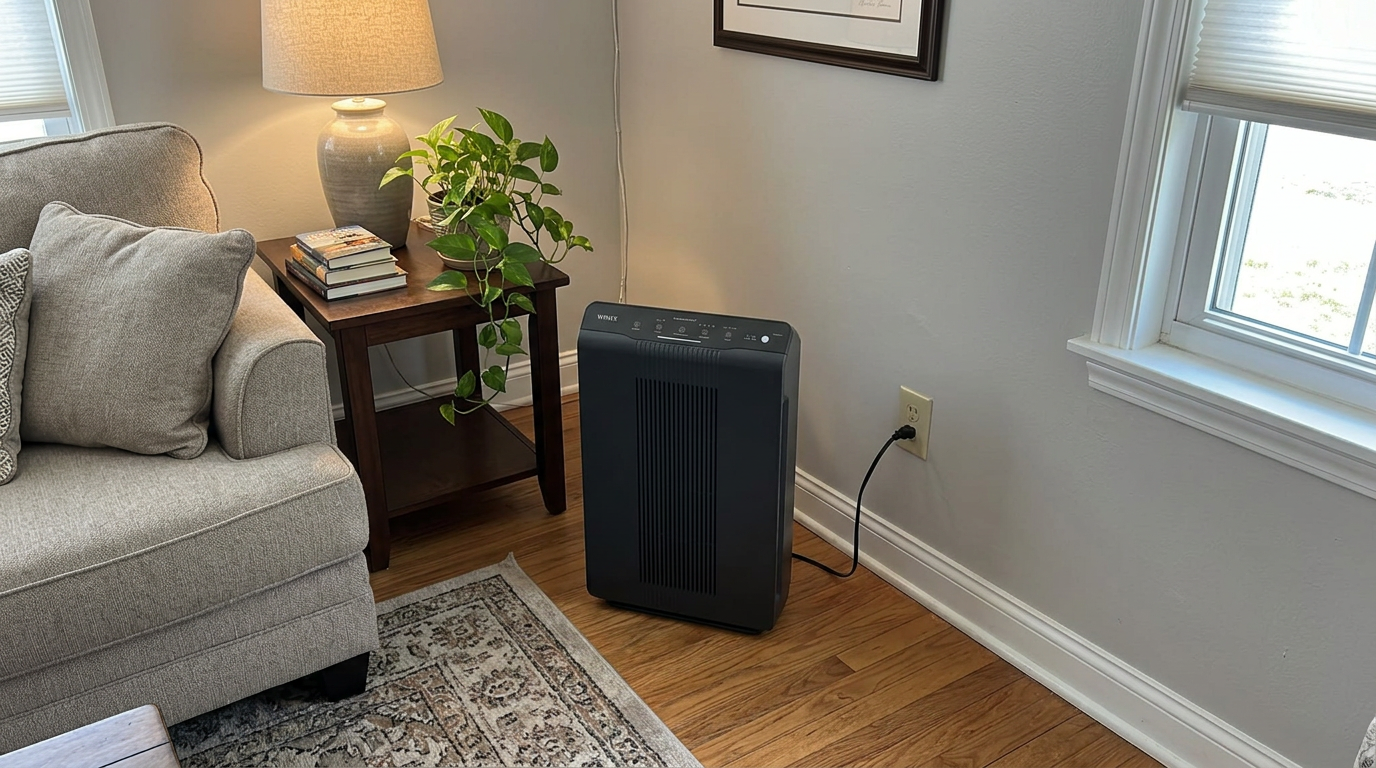
Slim enough for a corner, sleek enough for the living room.
What the Winix 5520 actually is
The 5520 is Winix's Wi-Fi-connected large-room purifier, released alongside the 5510.
Its rated CADR✕CADRClean Air Delivery Rate: how many cubic feet of cleaned air a purifier delivers per minute. Higher means it cleans a room faster. is 253 cubic feet per minute for smoke, with a verified room size of 392 square feet.
The headline figure of around 1,880 square feet is based on just one air change per hour, so the 392 square foot figure is the more useful one for allergies, pets and smoke.
Key features
| Feature | What it does | Why it matters |
|---|---|---|
| Washable pre-filter | Catches hair and large dust | Protects the other filters |
| Charcoal filter | Absorbs odors | Cooking and pet smells |
| True HEPA filter | Captures fine particles | Dust, dander, pollen, smoke |
| PlasmaWave | Releases ions, can be switched off | Optional extra |
| Auto and Sleep modes | Sensor and light-driven | Hands-off running |
| Wi-Fi app | Remote control and timers | Control from any room |
Our tip: Remove the plastic wrapping from every filter before first use, because a wrapped filter blocks the airflow and the purifier will barely clean.
The three-stage filtration system
The front panel pops straight off, and the three filters sit back to back inside.
Air is pulled in through the back of the unit, passes through each filter in turn, and comes out through the top.
Stage 1: washable mesh pre-filter
The first layer is a fine mesh that catches pet hair and larger dust.
That keeps big particles from clogging the more expensive filters behind it, and it's washable, so you clean it rather than replace it.
Stage 2: charcoal odor filter
Look closely and you'll see small beads of activated carbon✕Activated carbonCarbon treated to have a huge surface area full of tiny pores. It traps odors and gases such as cooking smells and VOCs that particle filters can't catch. in this layer.
It's there for odors, and in my open-plan kitchen and living room, it made a real difference.
Stage 3: true HEPA filter
The main filter is big and thick, almost like a furnace filter, with plenty of surface area.
Winix says it captures 99.99% of airborne particles as small as 0.01 microns.
It's a genuine true HEPA✕True HEPAA filter that meets the HEPA standard of capturing at least 99.97% of particles 0.3 microns in size. Some cheaper filters use HEPA-like wording without meeting it. filter, which isn't always the case with cheaper purifiers.
There's an arrow on its edge, and it must face the right way for the purifier to work at full performance.
| Stage | Catches | Care |
|---|---|---|
| 1. Mesh pre-filter | Pet hair, large dust | Vacuum or wash every few weeks |
| 2. Charcoal filter | Cooking and pet odors | Replace every 3–12 months |
| 3. True HEPA filter | Fine dust, dander, pollen, smoke | Replace about once a year |
Pet hair and dust in an open-plan room
My dog sheds steadily, and in an open-plan space, hair and dust travel everywhere.
Within a week, the pre-filter had a visible layer of fur on it, which is exactly where you want it, rather than on the floor or in the HEPA filter.
Dust on my TV stand and shelves built up more slowly than usual during the test.
When I brushed the dog indoors, the air quality light jumped to red, the fan ramped up in Auto, and the light went back to blue after a few minutes.
My ratings out of 10 after three weeks.
Our tip: Put the purifier where your pet spends the most time, because catching hair and dander close to the source works better than cleaning it from across the room.
Cooking smells and odors
With the kitchen right next to the living room, smells from frying, searing and spicy dishes used to drift through the whole space.
With the Winix 5520 running, they faded noticeably faster.
Smoky cooking sessions, like searing steak, cleared within an hour or so on a higher speed instead of lingering into the evening.
The purifier also has an odor sensor, so the air quality light reacts to cooking smells and VOCs✕VOCsVolatile organic compounds: gases released by things like cooking, paint, cleaning sprays and new furniture. Activated carbon can absorb many of them., not just to dust.
My own impressions in an open-plan kitchen and living room.
Our tip: Switch the purifier to a higher speed as you start cooking, not after, so it catches smoke and smells before they spread through an open-plan space.
Controls and the air quality light
The controls on top are simple and give a subtle beep when you press them.
There's a power button, fan speed, Auto mode, Sleep mode, a PlasmaWave toggle and a filter reset.
The air quality light on the front changes between blue, orange and red, so you can see the air quality at a glance from across the room.
When you first turn it on, it takes a moment to assess the air and then shows the result.
| Light | Air quality | What Auto mode does |
|---|---|---|
| Blue | Good | Low, quiet fan |
| Orange | Fair | Medium fan |
| Red | Poor | High fan until it clears |
What's missing
There's no timer button or child lock on the unit itself.
You can set timers in the app, but if you have curious kids, they can still press the buttons.
Our tip: Use the app's timer instead of switching the purifier off by hand at night, so it runs for a set time and turns off on its own.
Fan speeds and noise
The 5520 has several fan speeds, from a quiet low setting up to Turbo.
On low, it's barely audible, just a soft sound that faded into the background while I worked or watched TV.
Winix lists the lowest setting at 27 decibels✕Decibels (dB)A measure of loudness. A quiet library is around 40 dB and normal conversation around 60 dB. Every 10 dB sounds roughly twice as loud., which is about as quiet as a whisper.
Turbo is a different story.
It's noticeably louder, with a steady fan sound that you'll hear over a quiet conversation.
It's not unpleasant, and some people like it as white noise, but I only used it for short bursts.
My impressions in a living room, not lab measurements.
Our tip: Run Turbo while you're out of the room or cooking, then switch back to Auto, so you get fast cleaning without the noise when you want to relax.
PlasmaWave: the ion feature
PlasmaWave is Winix's name for its ion technology.
It releases positive and negative ions into the airflow, which Winix says help neutralize organic matter such as bacteria and viruses.
This is a form of bipolar ionization✕Bipolar ionizationTechnology that releases positive and negative ions into the air. Manufacturers say it helps break down airborne contaminants, but some people prefer to avoid it., and opinions on ion features vary.
The good news is that it has its own button, and you can switch it off with one press.
The HEPA and charcoal filters do the main cleaning either way, so turning PlasmaWave off doesn't stop the purifier doing its job.
I ran most of my test with it switched off, and the room still felt noticeably fresher.
If you're unsure, my advice is simple: try it with PlasmaWave off first.
For most homes, the three physical filters are what do the heavy lifting.
Our tip: Check whether PlasmaWave is on after a power cut or unplugging, and switch it off again if you prefer to run the purifier without ions.
Wi-Fi, the app and voice control
The 5520 connects to Wi-Fi and works with the Winix Smart app.
From the app I could switch it on and off, change modes and fan speeds, and set timers from anywhere in the house.
It also works with Amazon Alexa and Google Assistant.
Saying "turn on the air purifier" while my hands were full in the kitchen was surprisingly handy.
Pairing took a couple of minutes, and the connection stayed stable throughout the test.
The app also shows the current air quality, so I could check how the living room was doing from upstairs.
It's not the most feature-packed purifier app, but it's clean, simple and covers the things I actually used.
Our tip: Set up a voice routine that switches the purifier to a higher speed when you say you're cooking, so you don't have to touch it with messy hands.
Working from home with it running
I work from a desk in the corner of the living room, so I spent long days sitting a few feet from the purifier.
In Auto, it stayed on its lowest settings for hours at a time, and I genuinely forgot it was there.
The only times I noticed it were when it ramped up after I'd made lunch, or when the dog came in from the garden.
On video calls, nobody heard it on the lower speeds, though I switched it to low manually before longer meetings, just in case.
The beep when you press a button is subtle, and the air quality light is soft enough not to be distracting during the day.
If you spend a lot of time near your purifier, this balance of quiet running and quick reactions is exactly what you want.
Our tip: Set the purifier to low before a video call, because Auto might ramp it up mid-meeting if someone starts cooking nearby.
Sleep mode and the light sensor
The 5520 has a light sensor on top.
In Auto mode, when the room gets dark, it switches into a quieter low-light setting and dims its lights.
I moved it into the bedroom for a few nights to try this, and it was quiet enough to sleep with.
You can also choose Sleep mode manually, which keeps the fan at its quietest setting.
Our tip: Keep the light sensor clear of lamps and window light at night, so it can tell when the room is dark and switch to its quiet mode.
Maintenance and filter life
Upkeep is simple.
The front panel pops off, the pre-filter can be vacuumed or rinsed, and the main filters lift straight out.
Winix recommends replacing the HEPA filter about once a year.
The charcoal filter lasts anywhere from three months to a year, depending on how hard the purifier works and how much cooking and pet smell it deals with.
Replacement filters are widely available and reasonably priced, and Winix supports its filters well.
A filter indicator lights up when it's time to change, and holding the reset button for a few seconds clears it.
| Task | How often | Time it took me |
|---|---|---|
| Vacuum the pre-filter | Every 2–4 weeks | About 2 min |
| Wipe the exterior and vents | Weekly | About 1 min |
| Replace the charcoal filter | Every 3–12 months | About 2 min |
| Replace the HEPA filter | About once a year | About 2 min |
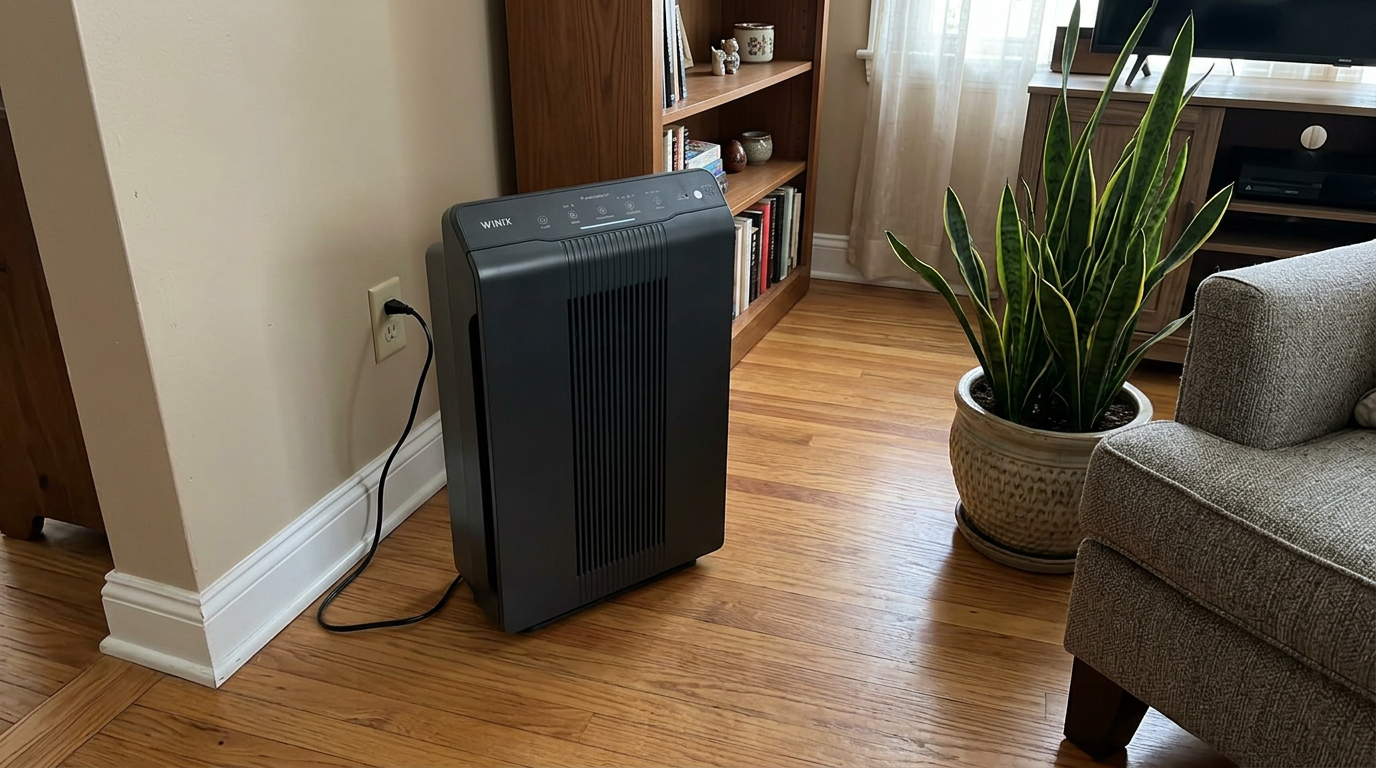
The front panel pops off for quick access to all three filters.
Replacing the filters, step by step
I did a trial filter swap to see how easy it is, and it took about two minutes.
Switch the purifier off and unplug it, then pull the front panel off by the grips at the bottom.
Lift out the pre-filter first, then the charcoal filter, then the HEPA filter.
Unwrap the new filters, slide them back in the same order, with the HEPA arrow pointing the right way, and clip the panel back on.
Finally, hold the filter reset button until the indicator light goes off.
| Step | What to do |
|---|---|
| 1 | Switch off and unplug |
| 2 | Pull off the front panel |
| 3 | Remove pre-filter, charcoal filter and HEPA filter |
| 4 | Unwrap the new filters |
| 5 | Refit in order, HEPA arrow facing the right way |
| 6 | Clip on the panel and reset the filter light |
The charcoal filter is the one that may need changing sooner in a busy kitchen.
If cooking smells start lingering longer than they did, that's a good sign the carbon is full.
Our tip: Swap filters outside or over a bin bag and seal the old ones in the bag straight away, so trapped dust and hair don't escape back into the room.
Energy use
The 5520 is Energy Star certified, which means it delivers a good amount of clean air for the electricity it uses.
Retail listings put its maximum power at around 56 watts, and it uses only a few watts on its lowest settings.
Because mine spent most of its time in Auto at low speeds, its real-world energy use was modest.
Running Turbo around the clock would use noticeably more, but there's little reason to do that with Auto mode doing the work.
Power use based on retail listings and my own use.
Our tip: Leave the purifier running in Auto all day rather than switching it on and off, because it uses very little power at low speed and keeps the air consistently clean.
Allergy season and bedrooms
I don't have strong allergies myself, but I paid attention to pollen days during the test.
With the windows closed and the purifier in Auto, the living room felt fresher on high-pollen days, and the air quality light stayed blue more often.
The thick HEPA filter is the key here, because pollen and dander are exactly the kind of particles it's designed to trap.
For bedrooms, the 5520 works, but it's quite large for a small room.
If you only need it for a bedroom, its Sleep mode is quiet, but a smaller purifier may fit the space better.
In a larger primary bedroom, it's a very good choice, especially with the light sensor dimming it automatically.
| Situation | Setting I used | Result |
|---|---|---|
| High-pollen day | Auto, windows closed | Fresher room |
| After vacuuming | High for 30 minutes | Dust cleared quickly |
| Bedtime | Sleep mode | Quiet, lights dimmed |
| Pet brushing | Auto | Ramped up, then settled |
Our tip: Keep windows closed on high-pollen days while the purifier runs, because an open window brings in pollen faster than any purifier can remove it.
Safety and certification
The 5520 is UL certified, which means it has been tested by Underwriters Laboratories for electrical safety.
That matters, because many cheap purifiers and appliances sold online don't have it.
It's also AHAM verified, so its CADR has been independently tested, and Energy Star certified for efficiency.
Room size and air changes per hour
The two room sizes you'll see for the 5520 mean very different things.
The large figure of around 1,880 square feet is based on one air change per hour✕Air changes per hour (ACH)How many times a purifier can filter the full volume of air in a room each hour. Four to five is a common target for allergies and smoke., which is fine for light freshening.
For pets, allergies and smoke, you want four to five changes an hour, which is where the verified 392 square foot figure comes from.
My open-plan living and kitchen area is a bit larger than that, so I ran the purifier on a medium or higher speed while cooking and let Auto handle the rest of the day.
| Goal | Air changes per hour | Realistic room size |
|---|---|---|
| Light freshening | 1 | Up to about 1,880 sq ft |
| General use | 2–3 | About 600–900 sq ft |
| Pets, allergies, smoke | 4–5 | About 390 sq ft |
Our tip: For a big open-plan space, put the purifier between the kitchen and the seating area, so it catches cooking smells before they reach the sofa.
Where to put it
Because it pulls air in through the back, the 5520 needs space behind it.
I kept it about a foot from the wall, with nothing covering the top vent.
It worked best out in the open, between the kitchen and the sofa, rather than tucked into a corner.
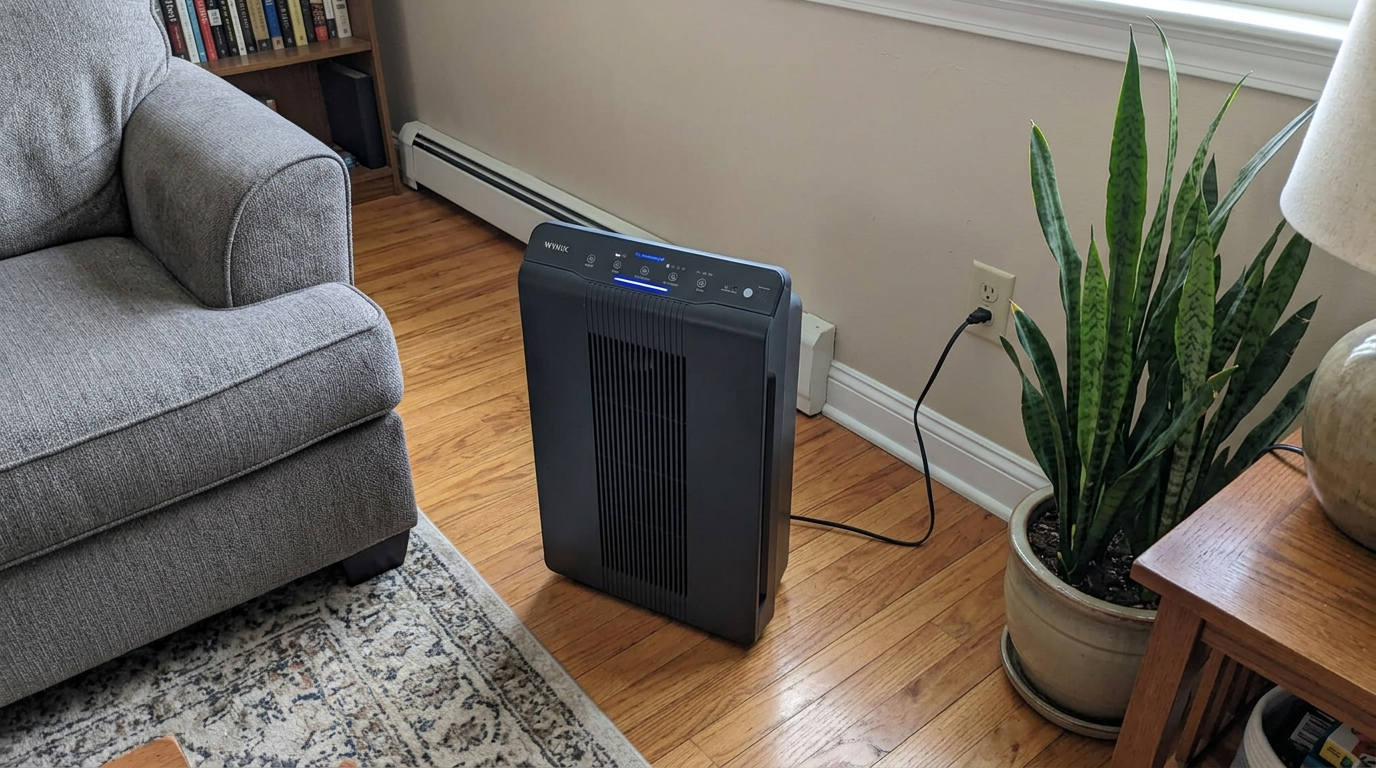
It works best with space behind it for the rear air intake.
Why it's better than a budget purifier
Before this test, I'd used a small, inexpensive purifier in the same room, and the difference was clear.
The cheap model had a thin, single filter that called itself HEPA-type, with no real odor layer and no certification.
It made the room a little fresher close up, but it couldn't keep up with the dog or the kitchen.
The Winix 5520 has a genuine true HEPA filter, a proper charcoal layer with visible beads, a washable pre-filter and independent CADR testing.
It also carries UL safety certification, which many cheap purifiers sold online don't have.
In practice, that meant noticeably less dust, faster-fading smells and a purifier I was happy to leave running unattended.
My overall air-cleaning ratings out of 10 in the same open-plan room.
All my results in one place
| Area | What I found | My rating |
|---|---|---|
| Pet hair and dust | Pre-filter caught plenty, less dust on surfaces | 8.8 |
| Cooking smells | Faded much faster | 8.5 |
| Noise on low | Barely audible | 9 |
| Noise on Turbo | Clearly audible | 7 |
| App and voice | Stable and easy | 8.8 |
| Maintenance | Quick and simple | 8.8 |
What daily use is really like
For most of the three weeks, the Winix 5520 sat between my kitchen and sofa in Auto mode.
It stayed on a quiet setting most of the day and ramped up when I cooked, vacuumed or brushed the dog.
In the evenings, the light sensor dimmed it and slowed the fan as the room got dark.
I used the app or Alexa a few times a day, mostly to boost it while cooking.
Share of running time from my testing notes.
Three weeks with the Winix 5520, week by week
Week 1: setup and first impressions
I set up the app and Alexa, learned the air quality colors and switched PlasmaWave off.
Week 2: pets and cooking
The pre-filter filled with fur, cooking smells faded faster, and I got into the habit of boosting it while cooking.
Week 3: living with it
It simply ran in the background, and I only noticed it when I wanted Turbo.
By the end of the test, I'd stopped thinking about it at all, which is the best compliment I can give an air purifier.
From my testing notes.
Common mistakes to avoid
| Mistake | What happens | Better habit |
|---|---|---|
| Leaving filters wrapped | Almost no cleaning | Remove all plastic first |
| HEPA filter backwards | Weaker cleaning | Follow the arrow |
| Pushed against the wall | Blocked rear intake | About a foot of space |
| Ignoring the pre-filter | Louder, weaker airflow | Clean every 2–4 weeks |
| Turbo all day | Noise and wasted energy | Auto with short bursts |
| Lamp next to the light sensor | Sleep mode doesn't trigger | Keep it in shadow at night |
What I would change
A quieter Turbo setting would make high-speed cleaning easier to live with.
A timer and child lock on the unit would help families.
And I'd like PlasmaWave to stay off by default once you've switched it off.
Three households, three verdicts
The open-plan family with a dog
Cooking smells, pet hair and a big shared space.
This is exactly what the 5520 is built for.
The pre-filter catches the fur, the charcoal handles the cooking, and the HEPA filter takes care of fine dust and dander.
Placed between the kitchen and the sofa, it covers the busiest part of the home.
The smart-home fan
Wants app control, timers and voice commands.
A very good fit, with Alexa and Google Assistant support.
Schedules and remote control from the app mean the living room can be fresh before you get home from work.
The light sleeper
Wants near-silence at night in a small bedroom.
Sleep mode is quiet, but a smaller bedroom purifier may suit you better.
| Household | Fit | Main reason |
|---|---|---|
| Open-plan with pets | Excellent | Pre-filter, charcoal, HEPA |
| Keen cooks | Very good | Odor filter and sensor |
| Smart-home users | Very good | App, Alexa, Google |
| Light sleepers in small rooms | Fair | Larger than needed |
Is the Winix 5520 worth the money?
Yes, for most homes.
You get a true HEPA filter, a proper charcoal odor filter, Wi-Fi with voice control and genuine safety certification, in a purifier that looks good in a living room.
Replacement filters are reasonably priced and easy to find, and the Energy Star rating keeps running costs sensible.
It's also built to last, with a two-year warranty and a brand that has kept making filters for its older models for years.
That long-term filter support matters more than people think, because a purifier is only as good as the filters you can still buy for it.
In three weeks, it never glitched, dropped its Wi-Fi connection or made an odd noise.
If you need the quietest possible high speed, or want to avoid ion technology completely, look elsewhere.
Three questions to ask:
Is your room up to around 400 square feet, or a slightly larger open-plan space?
Do you deal with pets or cooking smells?
And would you use app or voice control?
How it compares with other types of purifier
| Feature | Winix 5520 | Budget purifier | Bedroom purifier |
|---|---|---|---|
| True HEPA | Yes | Often not | Usually |
| Charcoal odor filter | Yes, with beads | Thin or none | Thin |
| Verified room size | 392 sq ft | Often unclear | Smaller |
| App and voice | Yes | Rarely | Sometimes |
| UL certified | Yes | Often not | Usually |
| Top-speed noise | Noticeable | Often loud | Quieter |
The biggest differences show up in everyday life rather than on the spec sheet.
A budget purifier often has a thin filter that clogs quickly with pet hair and can't do much about smells.
A small bedroom purifier is quieter, but it simply doesn't move enough air for an open-plan living space.
The 5520 sits in a sweet spot: enough power for a busy living room, real odor filtration, and smart features, without the size or noise of a large whole-room machine.
For a home like mine, with a dog and a kitchen next to the sofa, that balance is exactly right.
| Your priority | Is the 5520 a fit? | Why |
|---|---|---|
| Pet hair and dander | Excellent | Washable pre-filter, HEPA |
| Cooking smells | Very good | Charcoal beads, odor sensor |
| Smart control | Very good | App, Alexa, Google |
| Silent top speed | Fair | Turbo is audible |
| No ions at all | Good | PlasmaWave switches off |
Which one is right for you: is the Winix 5520 your match?
4 quick questionsWinix 5520 specifications
From manufacturer data, retailer listings and my own testing.
How I tested and scored the Winix 5520
For three weeks, the Winix 5520 ran in my open-plan living room and kitchen, with a shedding dog in the house, plus a few nights in the bedroom.
I tracked how the air quality light reacted to cooking, vacuuming and pet brushing, and how quickly smells faded.
I listened to every fan setting, used the app and voice control daily, and cleaned and removed every filter.
Finally, I checked my notes against Winix's specifications and user manual.
- Air cleaning (8.6): dust, pet hair and real-world room coverage.
- Odor control (8.5): cooking and pet smells.
- Ease of use (8.6): controls, app, voice and maintenance.
- Noise (7.8): quiet on low, noticeable on Turbo.
The overall score of 8.4 is an editorial rating that reflects those four areas.
Winix 5520 FAQ
Is the Winix 5520 worth it?
Yes, especially for living rooms with pets or cooking smells. Skip it if you need a near-silent top speed.
How big a room does it cover?
It has a verified room size of 392 square feet, or about 1,880 square feet at one air change per hour.
What filters does it use?
A washable mesh pre-filter, a charcoal odor filter and a true HEPA filter.
Is it true HEPA?
Yes. Winix says it captures 99.99% of airborne particles down to 0.01 microns.
Can I turn off PlasmaWave?
Yes. It has its own button and switches off with one press.
Does it work with Alexa?
Yes, it works with Amazon Alexa and Google Assistant through the Winix Smart app.
How often do I replace the filters?
The HEPA filter about once a year, and the charcoal filter every 3 to 12 months depending on use.
Is it loud?
It's barely audible on low, but Turbo is noticeably louder.
Does it have a timer?
Not on the unit, but you can set timers in the app.
Is it good for pets?
Yes. The washable pre-filter catches hair, and the HEPA filter captures dander.
Is it safety certified?
Yes. It's UL certified, AHAM verified and Energy Star certified.
Which way does the HEPA filter go in?
Follow the arrow on the filter frame, which shows the direction of airflow.
Senior home appliance tester
Emily has tested home appliances for a living since 2016, first as a test coordinator at a national consumer advocacy group and, since 2021, at HouseholdMe. She has a degree in industrial design from Ohio State, so she looks at how a product is built, not just how it performs. She tested the Winix 5520 in her open-plan living room and kitchen for three weeks for this review.
- Three weeks of hands-on testing of the Winix 5520
- Winix 5510 and 5520 user manual
- Winix 5520 product listings and specifications