Tosima WA9C Pro review: a square window robot with a four-nozzle spray, N and Z routes and a remote that does it all
The Tosima WA9C Pro Window Cleaning Robot is a square robot, so it reaches into window corners far better than round-pad designs. Its four-nozzle spray wets the glass evenly, N- and Z-shaped routes suit tall or wide panes and a 25-minute backup battery covers power cuts, but its suction is modest for its class, it needs an outlet nearby and hard water can clog its nozzles.

Emily Carter
Hands-on review
Hands-on testing, research, specs
4 weeks
20 minutes
Jargon helpNew to window robots? Tap any dotted term to see what it means.
In this review
Yes, if you want a square robot that cleans into the corners without paying premium prices. The Tosima WA9C Pro wets the glass evenly with four nozzles, lets you pick a vertical or horizontal route to suit the window and keeps its grip for 25 minutes if the power drops. Its 2,600 to 3,200 Pa suction is lower than many robots, so it is happiest on clean, smooth glass, and in hard-water homes you should use filtered water to keep the nozzles clear.
Tosima WA9C Pro at a glance
Tosima WA9C Pro pros and cons
- Square body reaches into corners
- Four nozzles wet the glass evenly
- N and Z routes plus a full remote
- Suction lower than many window robots
- Nozzles can clog with hard tap water
- Needs an outlet within cord reach
Who should buy the Tosima WA9C Pro?
- Rectangular windows and sliding doors
- Anyone who hates dirty corners
- People who prefer a remote to an app
- Very dirty, gritty outside glass
- Hard-water homes unwilling to use filtered water
- Windows far from power outlets
First impressions of the Tosima WA9C Pro
The Tosima WA9C Pro is a compact white square with a bright orange handle on top, about 8 inches across and 3.5 inches deep.
That square shape is the first thing worth noticing. Round robots leave curved patches in every corner; a square robot can reach in.
In the box: the robot, a remote, four cleaning mops, an AC cable with adapter, a safety rope, a water bottle, replacement nozzles and an unclogging needle kit.
That last item told me something before I even turned it on: the nozzles are fine enough to clog, and Tosima expects you to look after them.
My first job was the glass door to our screened porch. I filled the tank, fitted a damp mop, anchored the rope and plugged it in.
It attached with a steady hum, then set off on a vertical N-shaped route, spraying from two nozzles on each side.
The result was clean glass right up into the corners, which is exactly what I had hoped the square shape would deliver.
Over four weeks I learned where it shines, on smooth rectangular glass, and where its modest suction asks for a little care.
The second thing I noticed was the remote. Everything lives on it, from the route to the spray volume to the voice language, and it took about five minutes to learn.
No app, no account and no Wi-Fi meant I was cleaning within minutes of opening the box.
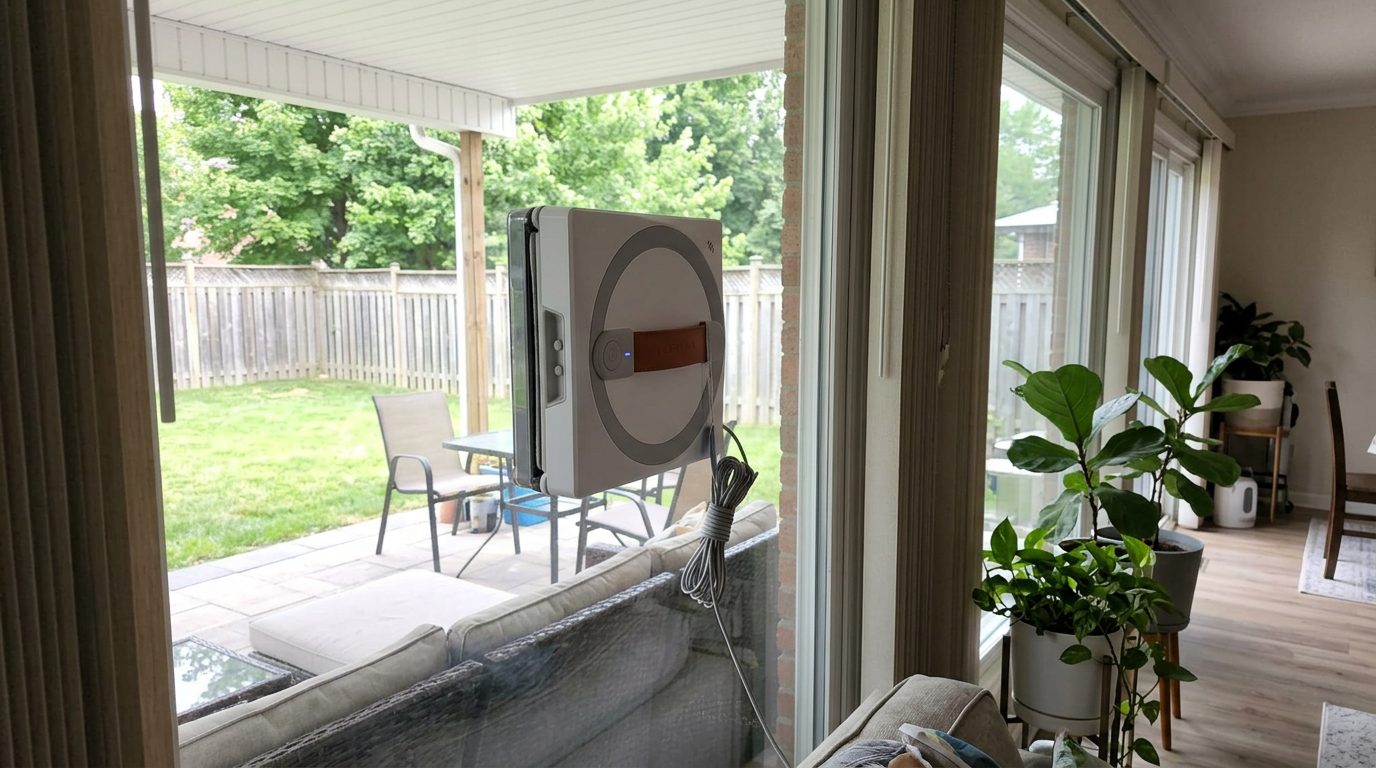
The WA9C Pro on our porch door, its first job.
What the Tosima WA9C Pro actually is
The WA9C Pro is a corded, square window robot that drags a microfiber mop✕Microfiber padA cloth made of very thin synthetic fibers that trap dust and grease. It is the part of the robot that actually wipes the glass. across the glass as it moves.
It holds on with 2,600 to 3,200 pascals✕Pascal (Pa)The unit used for suction. Home window robots range from about 2,500 Pa to 10,000 Pa. of suction, sprays from four nozzles and follows planned N- or Z-shaped routes.
| Feature | What it does | Why it matters |
|---|---|---|
| Square body | Fits the shape of rectangular glass | Better corner coverage |
| Four-nozzle dual spray | Two nozzles each side, purges air from the lines | Even, consistent mist |
| Air-pressure monitor | Tracks suction constantly | Early warning of slipping |
| Bottom drop sensor | Detects edges and drop-offs | Stops it driving off glass |
| Backup battery | Holds about 25 minutes, sound and light alerts | Time to rescue it |
| Remote | Modes, spray volume, language, steering | No app needed |
Tosima WA9C Pro design and setup
The design is practical: a flat square body, a big orange handle for placing and lifting it and a fill port for the tank.
The handle is genuinely useful on high glass, giving you a solid grip when you reach out of a window.
Before each clean
| Step | What I do | Why |
|---|---|---|
| 1. Tank | Fill with filtered water and the bottle | Protects the nozzles |
| 2. Mop | Dampen, wring out, attach flat | Even contact with the glass |
| 3. Rope | Anchor the safety rope indoors | Essential overhead |
| 4. Power | Plug in near the glass | Mains powered, with backup |
| 5. Attach | Place on glass, start | Suction holds it |
| 6. Route | N for tall glass, Z for wide glass | Efficient coverage |
Our tip: Use filtered or distilled water from day one. The fine nozzles are the WA9C Pro’s weak point, and clean water keeps them spraying evenly.
Handling, placing and removing it
The orange handle on top is one of those small details that makes a real difference.
On high glass, you are often reaching out of a window at an awkward angle. A solid handle gives you a secure grip while you place the robot and wait for suction✕Suction (Pa)How hard the fan pulls the robot against the glass, measured in pascals. More pascals means a firmer grip, which matters most on outside windows and big panes..
Removing it is the same in reverse: grip the handle, stop the robot with the remote and lift it off.
At around six pounds in its box and compact in size, it is easy to carry between rooms with one hand.
| Moment | What helped |
|---|---|
| Placing on high glass | Firm grip on the handle |
| Waiting for suction | Holding it steady by the handle |
| Lifting it off | Handle plus remote stop |
| Carrying between rooms | Compact, one-handed |
Why a square robot cleans corners better
Most window glass is rectangular, and that is the whole argument for a square robot.
A round or dual-round robot✕Dual spinning padsTwo round microfiber pads that rotate against the glass and pull the robot along. They scrub well but leave small curved corners uncleaned. can only get so close to a corner before its curved edge hits both frames. That leaves a curved patch every time.
A square body can push right into the corner, and the mop underneath covers almost the full footprint.
How fully each design cleaned my window corners, from my experience testing window robots.
In my test, the WA9C Pro left only thin slivers in the corners, which a cloth removed in seconds.
The four-nozzle spray
The WA9C Pro sprays from four nozzles, two on each side, so the glass ahead of the mop is always damp, whichever way it is moving.
Tosima says the system expels air from the internal water lines, which helps the spray come out evenly instead of sputtering.
In practice, the mist was consistent across the pane. I did not see dry patches or the spitting you get from cheaper pumps.
The remote lets you choose regular or large spray volume.
My ratings on a 10-point scale.
Our tip: Use regular spray indoors and large spray outside. Extra water on already clean glass is the fastest way to streaks.
Hard water and nozzle care
The included unclogging needle kit and spare nozzles are a clue: fine nozzles can block, especially with mineral-rich tap water.
Our tap water is hard. In week one I used it straight from the tap, and by the end of the week one nozzle was spraying weakly.
A quick clean with the needle fixed it, and after I switched to filtered water, the problem did not return.
| Water | Nozzles after a week | My verdict |
|---|---|---|
| Hard tap water | One nozzle weakened | Avoid |
| Filtered water | All clear | Recommended |
| Distilled water | All clear | Best for very hard water |
This is easy to manage once you know. Fill from a filter jug and empty the tank after use, and the nozzles stay clear.
Suction and safety
The WA9C Pro’s adsorption force is 2,600 to 3,200 Pa. That is enough to hold it on clean, smooth glass, but it is lower than many window robots.
On our inside windows and doors, it was steady. On gritty outside glass, I cleaned the start spot first so it got a good initial seal.
Rated suction compared with common window robot figures.
Tosima backs the suction with a smart air-pressure monitor, a bottom drop sensor, a 25-minute backup battery and a safety rope✕Safety tetherA strong cord that clips the robot to something solid indoors. If the robot ever lets go of the glass, the tether catches it before it can fall..
Bars show the order in which each layer acts.
The 25-minute power-loss backup
If the power is cut, the internal battery keeps the robot attached for up to 25 minutes while it beeps and flashes.
I tested it on an inside window by pulling the plug. It held on, and the combination of sound and light made it impossible to miss.
The light alert is a nice touch if you are outside and the window is closed.
Tosima is clear that the rope must be anchored to something reliable for overhead work, and I agree.
N and Z routes, modes and the remote
The WA9C Pro offers six cleaning modes on its remote, built around three ideas: a vertical route, a horizontal route and full manual control.
| Route or mode | How it moves | When I used it |
|---|---|---|
| N-shape | Vertical stripes, up and down | Tall windows and doors |
| Z-shape | Horizontal stripes, side to side | Wide windows |
| Manual | You steer with the remote | Single marks |
N-shape was my default on doors. Z-shape covered our wide picture window more efficiently.
Manual mode let me drive it to one stubborn mark and scrub it.
Relative time, matching the route to the window shape versus not.
The remote
The remote also toggles spray volume and switches the voice language. There is no app, and I never missed one.
Tall glass versus wide glass
Having both N and Z routes sounds like a minor feature until you clean a house with very different window shapes.
On our tall glass doors, the N route ran long vertical stripes and finished quickly.
On the wide picture window, the same route meant many short climbs and turns. Switching to Z made it noticeably faster and left fewer overlap marks.
My ratings for efficiency and finish, out of 10 scaled to bars.
Most robots pick one pattern for everything. Being able to choose is a small but real advantage.
How well the Tosima WA9C Pro cleans
On regularly cleaned glass, results were very good: clear panes and clean corners.
Dust, fingerprints and pollen came off in one pass with regular spray.
On dirtier outside glass, large spray and a second pass were needed, and the lower suction meant I prepared the start spot.
My ratings on a 10-point scale.
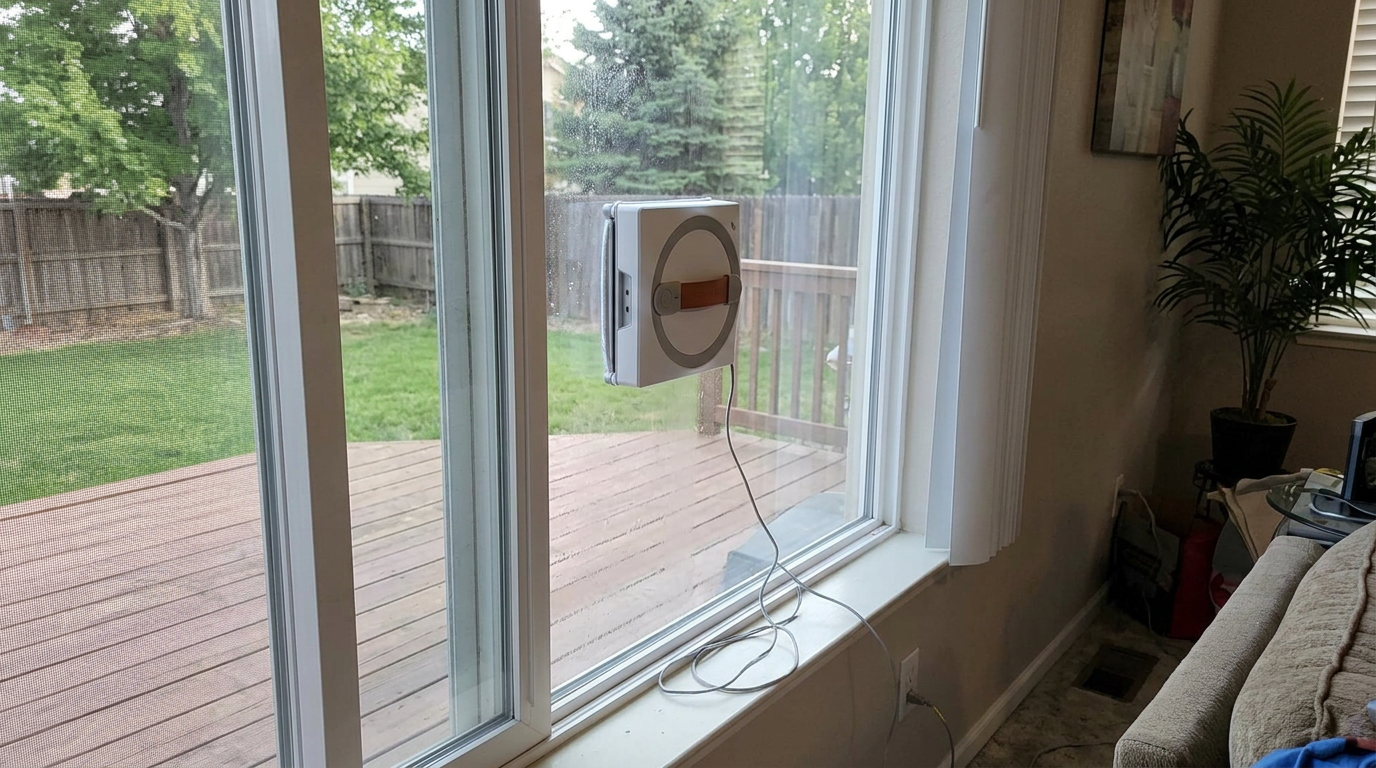
A window from inside, looking out to the deck, after an N-shape run.
Edges and corners
This is the WA9C Pro’s strongest suit.
Along the frames, the square body runs close and the mop covers nearly to the edge.
In the corners, it left only thin slivers, much less than any round-pad robot I have used.
My cleaning ratings by part of the window, out of 10.
Our tip: Run the route that ends along the frame you care about most. On doors, I finished with the N-route so the last pass ran along the handle side.
Outside windows
Outside glass is where the WA9C Pro needs the most care, because grit and dust can weaken the suction seal.
With a clean start spot, the rope anchored and large spray selected, it cleaned our outside doors and ground-floor windows well.
I was more cautious upstairs. I stayed in earshot every time and kept the rope taut enough to be useful.
My ratings on a 10-point scale, large spray, fresh mop.
Avoid hot, direct sun. The mist dries too fast and leaves faint marks.
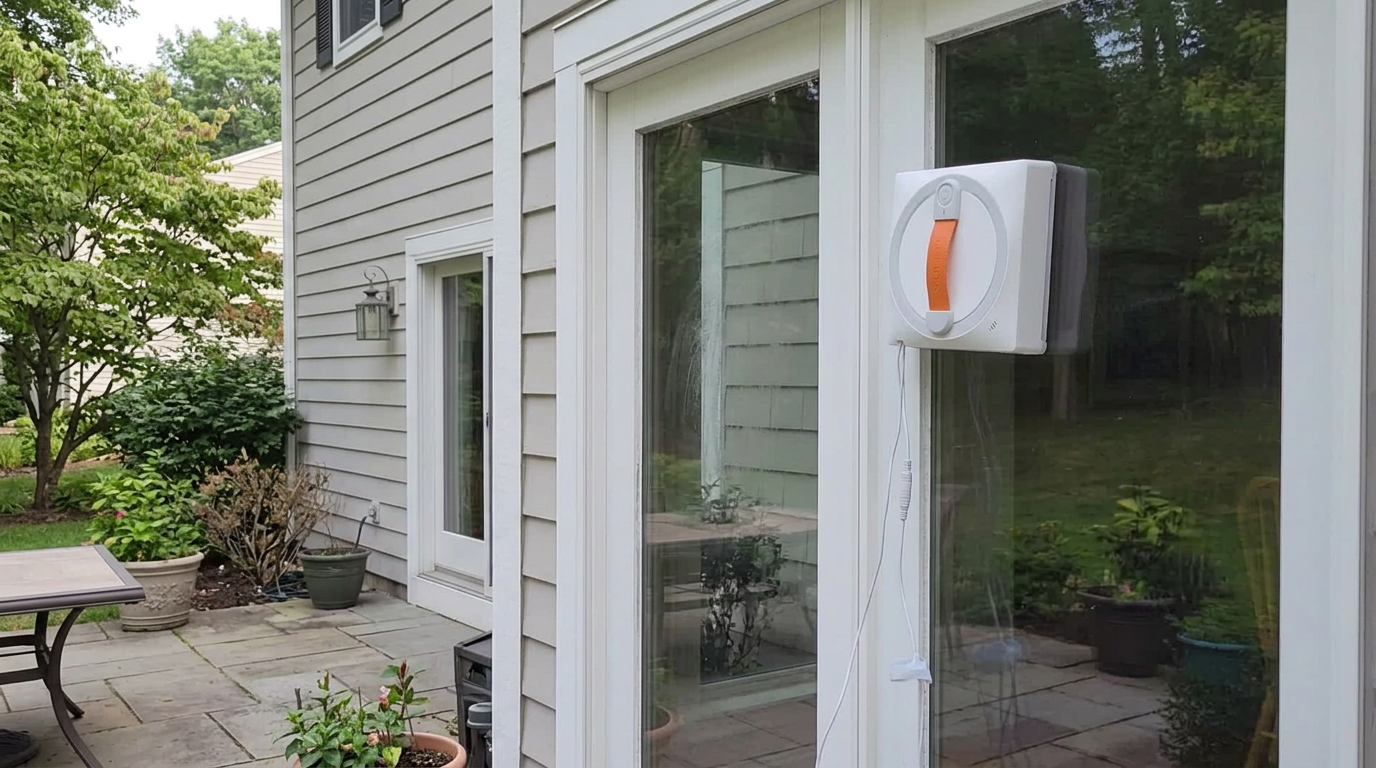
An outside glass door on the gray-sided wall, cleaned on large spray.
My routine for upstairs windows
Because the WA9C Pro’s suction is modest, I followed a careful routine on upstairs outside glass.
| Step | What I do | Why |
|---|---|---|
| 1. Anchor | Tie the rope to something heavy indoors | Reliable backup |
| 2. Clean start | Wipe a hand-sized patch of glass | Stronger first seal |
| 3. Check the cord | Make sure it cannot be pulled out | Avoid needless backup use |
| 4. Place | Use the handle, hold until suction is steady | Do not let go early |
| 5. Stay close | Remain within earshot | Use the 25-minute window |
| 6. Retrieve | Stop with the remote, lift by the handle | Controlled removal |
With this routine, it handled our upstairs windows without a slip. I would not leave it unattended on high glass and go out.
If most of your problem windows are high and dusty, a robot with more suction will give you more margin.
Power and cord reach
The WA9C Pro runs on mains power with an AC adapter. Its small battery is for emergencies only.
That means no runtime limit while plugged in, but you need an outlet within reach of each window.
For outside doors, I ran the cord through the doorway. For windows far from outlets, an extension cord did the job.
Our tip: Keep the power cord and safety rope on opposite sides. Twisted together, they can tug the robot off its route.
Mirrors, kitchen windows and bathroom glass
Indoor glass is where the WA9C Pro felt most comfortable, because clean, smooth surfaces suit its suction perfectly.
Bathroom mirror
This was one of its best results. Regular spray, an N-shape route and the mirror came out streak-free with near-clean corners.
On a mirror, corners matter more than on a window, because you look at them up close every day. The square body made the difference.
Kitchen window
The flat mop handled light grease reasonably well, though grease tends to smear under any flat pad. A second pass with a fresh mop finished it.
Shower glass
Soap film came off over two runs. Limescale needed a descaler first.
My ratings on a 10-point scale.
Our tip: Clean mirrors with regular spray and a just-damp mop. Mirrors show streaks more than windows, and less water gives a crisper finish.
Which windows and surfaces it suits
Tosima pitches it for high windows, mirrors and glass doors. In my test, it was best on smooth, rectangular glass.
| Surface | How it went | My verdict |
|---|---|---|
| Glass doors | Clean into the corners | Excellent |
| Rectangular windows | Even, efficient routes | Very good |
| Mirrors | Streak-free, tidy corners | Very good |
| Outside glass | Good with a clean start spot | Good |
| Very dirty, gritty glass | Modest suction, extra care | Fair |
| Windows far from outlets | Extension cord needed | Fair |
On frameless glass✕Frameless glassGlass with no raised frame around it, such as a shower screen, a mirror or a glass balcony rail. The robot must detect the drop-off with sensors instead of bumping into a frame. such as our hallway panel, the drop sensor found the edge and the robot turned before it could drive off.
What using it is really like
A session took about two minutes to set up, and the orange handle made placing it easy.
The noise is a steady hum, noticeable in the same room but not intrusive.
Afterward, I emptied the tank, rinsed the mop and wiped the thin corner slivers.
My hands-on time for a typical session.
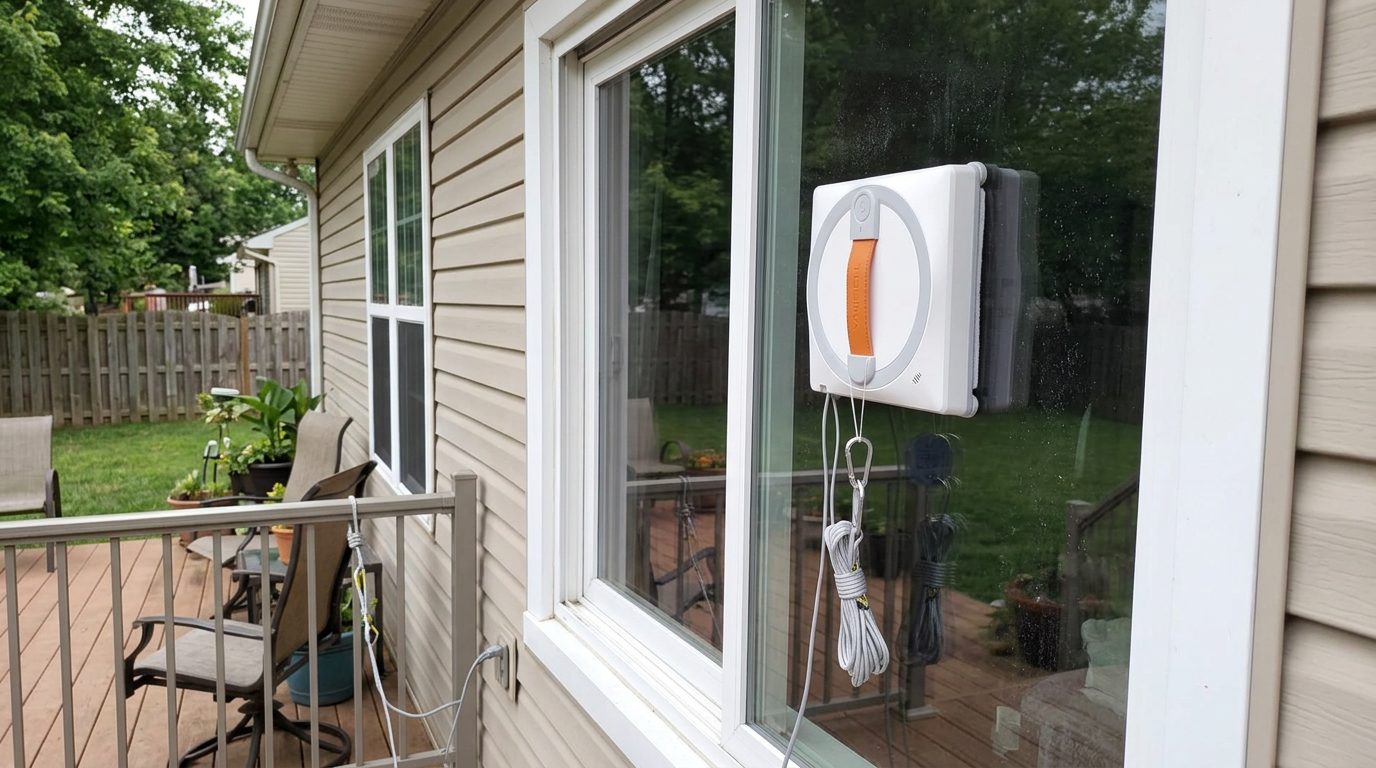
The outside of the deck door, a weekly job.
A whole-floor cleaning day
To see how the WA9C Pro handles a big session, I cleaned every window and door on our ground floor in one morning.
I filled the tank from a filter jug, lined up the four mops and planned the route for each pane: N for doors, Z for the wide picture window.
| Glass | Route | Spray | Notes |
|---|---|---|---|
| Porch door | N | Regular | Clean, corners tidy |
| Picture window | Z | Regular | Efficient on wide glass |
| Kitchen window | N | Regular, then second pass | Grease needed two runs |
| Deck door, inside | N | Regular | Nose prints cleared |
| Deck door, outside | N | Large | Clean start spot first |
| Side door, outside | N | Large | Pollen gone |
I swapped mops twice, refilled the tank once and spent about 25 minutes of my own time. Every corner needed at most a quick touch.
Our tip: Plan the route per window before you start. Matching N or Z to the shape of the glass saved me several minutes per pane.
Robot versus cleaning by hand
| Task | By hand | Tosima WA9C Pro |
|---|---|---|
| One small window | Faster | Slower, because of setup |
| Several doors and windows | Tiring | Consistent results |
| Corners | Perfect | Thin slivers at most |
| High outside glass | Ladder or stretching | From inside, roped |
| Your effort | All of it | Setup, mop and tank care |
How to get the best results
- Use filtered or distilled water.
- Empty the tank after every session.
- Match the route to the window: N for tall, Z for wide.
- Regular spray indoors, large spray outside.
- Wipe a clean start spot on outside glass.
- Clean outside glass in shade.
- Keep the cord and rope apart.
My judgment of how much each habit improved the final result.
Mop care and why it matters
The WA9C Pro wipes with a flat microfiber mop, and its condition decides how good the glass looks.
Four mops come in the box, enough to rotate through a whole floor.
My routine was simple: soak, wring until just damp and attach flat, with no folds or bunched edges.
A folded edge on a square robot leaves a stripe along the whole route, so take a second to smooth it.
I swapped mops every three windows indoors and every two outdoors, then rinsed them together and hung them to dry.
How mop condition showed on the glass, from my testing.
Every few weeks, a gentle machine wash without fabric softener kept the microfiber absorbent.
Cleaning and maintaining it
| When | Task | Why it matters |
|---|---|---|
| After each session | Empty the tank | Prevents mineral deposits |
| After each session | Rinse the mop | Dirty mops streak |
| Weekly | Check the spray pattern | Catch clogs early |
| If a nozzle weakens | Clear it with the needle kit | Restores the spray |
| Before high glass | Check the rope | Your safety backup |
Supplies and long-term ownership
Running costs are low. It uses water, and the mops are washable.
The spare nozzles and needle kit mean a clog is a five-minute fix rather than a repair.
There is no storage case. I kept the robot, remote, adapter, rope and mops together in a lidded box.
After four weeks, with filtered water, the spray and suction were as good as on day one.
Noise, pets and family life
The WA9C Pro hums rather than roars. It is clearly audible in the same room, but softer than some higher-suction robots.
Our cat inspected the orange handle once and lost interest.
Keep the cord and rope out of walkways while it runs, and supervise outside sessions that involve an open window.
One small thing I appreciated: the light alert on power loss. If you are in another room with the door closed, a flashing robot on the glass is easy to spot from the hallway.
Which homes it suits best
| Home | How well it fits | Why |
|---|---|---|
| Homes with many glass doors | Excellent | Clean corners on rectangular glass |
| Remote-not-app households | Very good | Everything on the remote |
| Hard-water areas | Good | With filtered water |
| Very dirty, gritty outside glass | Fair | Modest suction |
| Windows far from outlets | Fair | Corded |
If your windows are mostly rectangular and you care about corners, the WA9C Pro is a smart, affordable choice.
Who will enjoy it most
People with lots of glass doors and rectangular windows, especially indoors, will love the clean corners.
People whose main problem is gritty glass on the third floor should look for more suction.
Living with it: week one to week four
Week one: inside doors and windows, learning the N and Z routes.
Week one also brought a weak nozzle from hard tap water, fixed with the needle kit.
Week two: filtered water, outside doors and the clean-start-spot habit.
Weeks three and four: routine cleaning with clean corners and no further clogs.
My overall satisfaction each week, out of 10.
What surprised me, good and bad
The best surprise was the corners. After testing round-pad robots, seeing almost-clean corners straight off the robot was a relief.
The second was how even the four-nozzle spray was.
The less welcome surprise was the nozzle clog from hard water in week one, and the need to prepare a clean start spot outside.
How each detail compared with my expectations before testing.
Common mistakes to avoid
The Tosima WA9C Pro is easy to use, but these habits hold it back.
| Mistake | What happens | Better habit |
|---|---|---|
| Hard tap water | Weak or clogged nozzles | Use filtered water |
| Leaving water in the tank | Mineral deposits | Empty after each use |
| Dusty start spot outside | Weaker seal | Wipe a clean patch first |
| Large spray indoors | Streaks | Use regular spray |
| Wrong route for the window | Slower clean | N for tall, Z for wide |
| No rope overhead | No backup | Anchor it every time |
What I would change
More suction for gritty outside glass, and a storage case, would round it out.
Is it a good first window robot?
For many people, yes.
The remote is simple, there is no app to set up, and the square body gives better results on ordinary windows than many entry-level round robots.
The two habits to learn are using filtered water and giving it a clean start on outside glass.
If you live somewhere with soft water and mostly clean indoor glass, you may never think about either.
Is the Tosima WA9C Pro worth the money?
For rectangular windows and doors where corners matter, yes.
You get a square body, an even four-nozzle spray, flexible routes, a full remote and a 25-minute backup at a reasonable price.
You give up high suction and a battery for cordless use, and you need to look after the nozzles.
Ask yourself three questions. Are most of your windows rectangular? Do clean corners matter to you? And can you use filtered water?
If so, the WA9C Pro is good value.
Where your money goes
You are paying for the things that make ordinary windows look finished: a square body, an even spray and sensible routes.
You are not paying for high suction, an app or a battery station, which keeps it affordable and simple.
How it compares with other window robot designs
Rather than brand against brand, the most useful comparison is design against design.
| Feature | Tosima WA9C Pro | Dual round-pad robots | High-suction square robots | Station robots |
|---|---|---|---|---|
| Body | Square | Two round pads | Square | Square, with a carry station |
| Corners | Thin slivers | Curved patches | Thin slivers or none | Thin slivers or none |
| Suction | 2,600–3,200 Pa | About 6,000 Pa and up | 8,000–10,000 Pa | 8,000–10,000 Pa |
| Power | Corded, 25-min backup | Usually corded | Usually corded | Battery station |
| Control | Remote | Remote or buttons | Usually an app | Station and app |
| Best for | Corners on a budget | Scrubbing on a budget | Grip and edges | Cleaning anywhere |
| Your home | Is the WA9C Pro a fit? | Why |
|---|---|---|
| Rectangular doors and windows | Excellent | Square corners |
| Indoor glass and mirrors | Very good | Even spray, tidy edges |
| Gritty outside glass | Fair | Modest suction |
| Hard-water homes | Good | With filtered water |
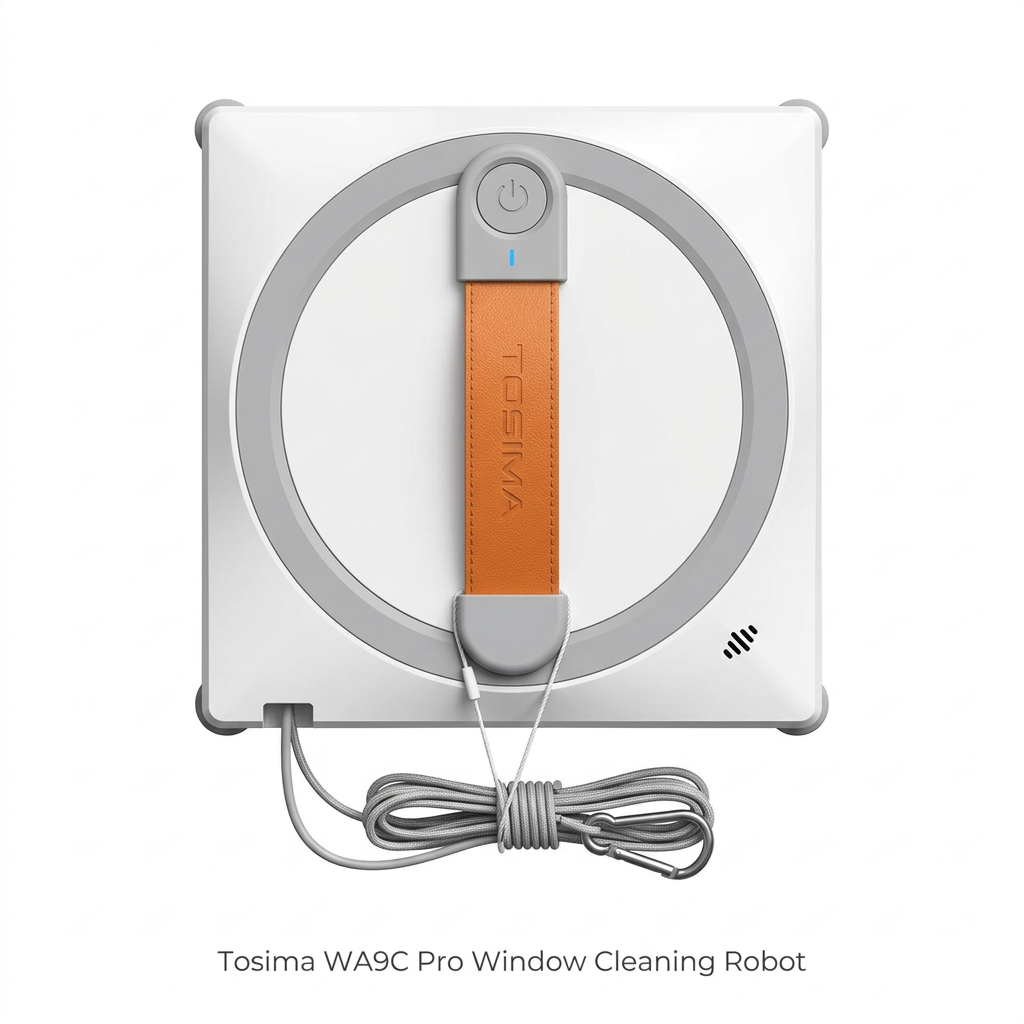
The square body and orange handle: built to reach into rectangular corners.
Which one is right for you: is the Tosima WA9C Pro your match?
4 quick questionsTosima WA9C Pro specifications
From manufacturer data and my own testing.
How I tested and scored the Tosima WA9C Pro
For four weeks, I used the Tosima WA9C Pro on glass doors, rectangular windows, a mirror and outside panes at ground level and upstairs.
I compared the N and Z routes, both spray volumes and manual control, and tested hard tap water against filtered and distilled water.
I checked the backup battery by cutting power, tracked corner coverage and timed my hands-on work.
I then checked my notes against Tosima’s published specifications.
- Cleaning (7.8): dust, fingerprints, pollen, water marks and outside grime on windows and glass doors.
- Edge coverage (7.9): how close the square body reaches into frames and corners.
- Ease of use (8.0): the remote, the N and Z routes, spray volume, refilling and nozzle care.
- Safety (7.6): suction, the air-pressure monitor, drop sensor, 25-minute backup and safety rope.
The overall score of 7.8 is an editorial rating that reflects those four areas.
Tosima WA9C Pro FAQ
Is the Tosima WA9C Pro worth it?
Yes, for rectangular windows and doors where corners matter. Its suction is modest, so it is best on clean, smooth glass.
How strong is the suction?
2,600 to 3,200 Pa, lower than many window robots.
Does it clean corners?
Yes, much better than round-pad robots. Its square body leaves only thin slivers.
What are the N and Z routes?
N-shape cleans in vertical stripes for tall glass; Z-shape cleans in horizontal stripes for wide glass.
What happens if the power goes out?
The backup battery holds it on the glass for about 25 minutes with sound and light alerts.
Does it have an app?
No. A remote controls modes, spray volume, language and steering.
Can I use tap water?
Filtered or distilled water is best. Hard tap water can clog the fine nozzles.
Why is there a needle kit in the box?
To clear the nozzles if minerals block them. Spare nozzles are included too.
Is it safe on high windows?
It has an air-pressure monitor, drop sensor, backup battery and safety rope. Anchor the rope and stay in earshot.
Does it need to be plugged in?
Yes, it runs on an AC adapter.
How many mops are included?
Four.
Is it loud?
It hums steadily, softer than some higher-suction robots.
Does it come with a storage case?
No. A lidded box keeps the robot, remote, adapter, rope and mops together.
Which route should I use?
Use the N route for tall glass such as doors and the Z route for wide windows.
How do I clear a clogged nozzle?
Use the included needle kit to gently clear the opening, then spray a little clean water. Spare nozzles are included if one is damaged.
Can it clean mirrors?
Yes. Mirrors were one of its best results, with streak-free glass and tidy corners.
Senior home appliance tester
Emily has tested home appliances for a living since 2016, including five years as a test coordinator at a national consumer advocacy group, and has run HouseholdMe's cleaning tests since 2021. She has a degree in industrial design, so she looks at how a product is built, not just how it performs. She used the Tosima WA9C Pro for four weeks for this review, on glass doors, rectangular windows, a mirror and outside panes, and tested it with hard and filtered water.
- Four weeks of hands-on testing of the Tosima WA9C Pro
- Tosima product specifications
- General window-cleaning and robot-safety guidance