Technivorm Moccamaster 53941 KBGV Select review
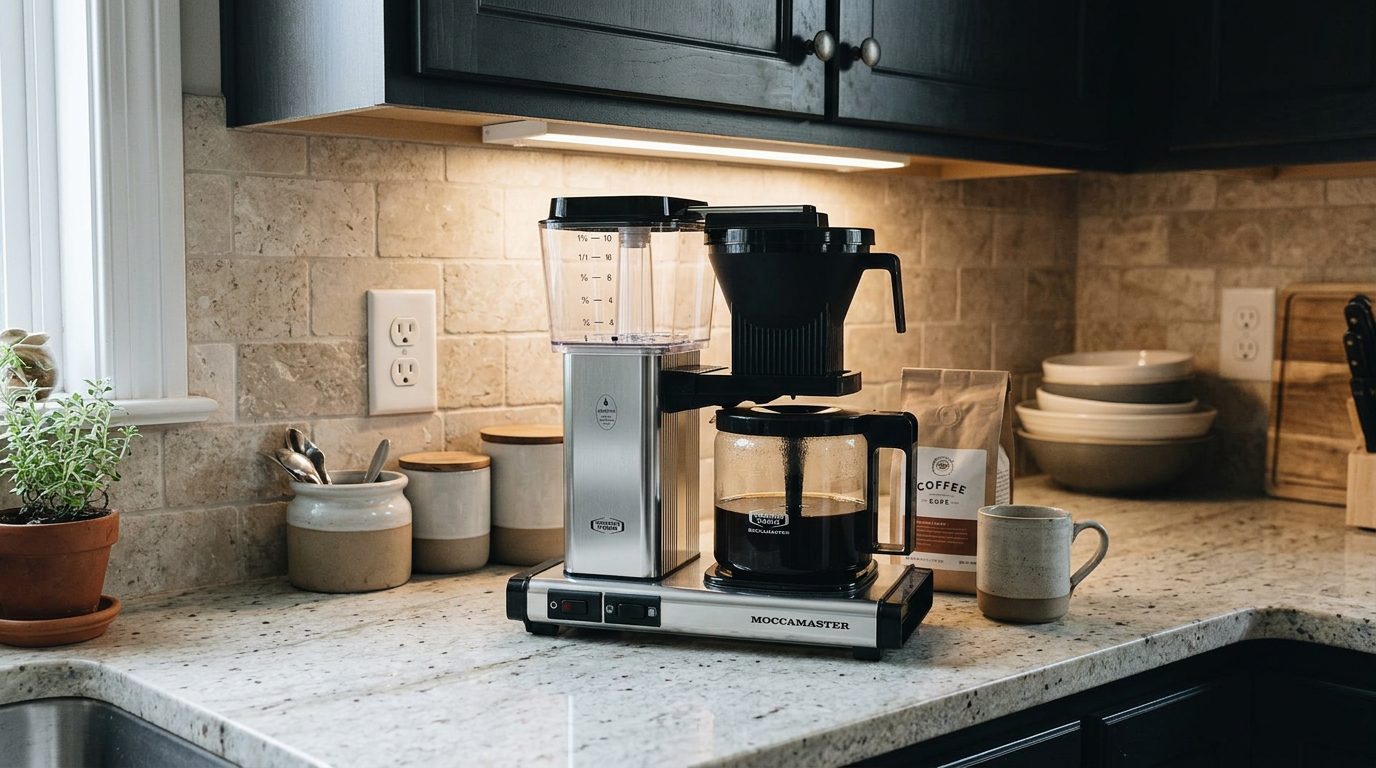
The Technivorm Moccamaster 53941 KBGV Select 10-Cup Coffee Maker is a hand-built, two-switch drip brewer made for pouring good coffee for a crowd without fuss. I spent three weeks with it, including a long family weekend, a tasting against my own pour-over and plenty of two-cup mornings. It brewed full pots that came impressively close to hand-poured coffee, and its small-batch setting kept two- and three-cup pots from tasting thin. The brew cone and arm feel flimsier than the price suggests, and the hot plate isn't kind to coffee left for hours, but as an everyday batch brewer it's excellent.

Emily Carter
Hands-on review
Hands-on testing, research, specs
3 weeks
27 minutes
Jargon helpNew to filter coffee? Tap any dotted term to see what it means.
In this review
Yes, if you regularly make coffee for more than one person. The Moccamaster 53941 KBGV Select turns a pot of freshly ground coffee into something close to a careful pour-over, with nothing more than a power switch and a small-batch switch to think about. It handled ten-cup pots for a crowd and two-cup pots for me alone. Water travels through glass and metal on its way to the grounds, and it's quiet enough for slow mornings. My criticisms: the brew cone and shower arm feel thin, and the hot plate slowly dulls coffee left on it for long.
Moccamaster 53941 at a glance
Moccamaster 53941 pros and cons
- Coffee close to a hand-made pour-over
- Small-batch switch handles two or three cups
- Glass and metal water path
- Brew cone and arm feel flimsy
- Hot plate dulls coffee over time
- Few settings to adjust
Who should buy the Moccamaster 53941?
- Households with several coffee drinkers
- People who often host guests
- Specialty-coffee fans who want less effort
- Slow sippers who keep coffee hot for hours
- Tinkerers who want temperature and pre-infusion control
- Buyers who expect every part to feel heavy-duty
First impressions
The Moccamaster 53941 looks like it belongs in a 1970s design catalog, which is exactly the point.
The tall water tank, exposed shower arm and brew cone above a glass carafe give it a look that's become a kitchen classic.
Technivorm has hand-built these machines in the Netherlands since 1968, and the design has barely changed.
It's also available in a wide range of colors, from classic metallics to pastels, so it can be a deliberate part of how your kitchen looks.
The main housing feels solid and well assembled, but when I lifted out the brew cone and shower arm, they felt lighter and thinner than I expected.
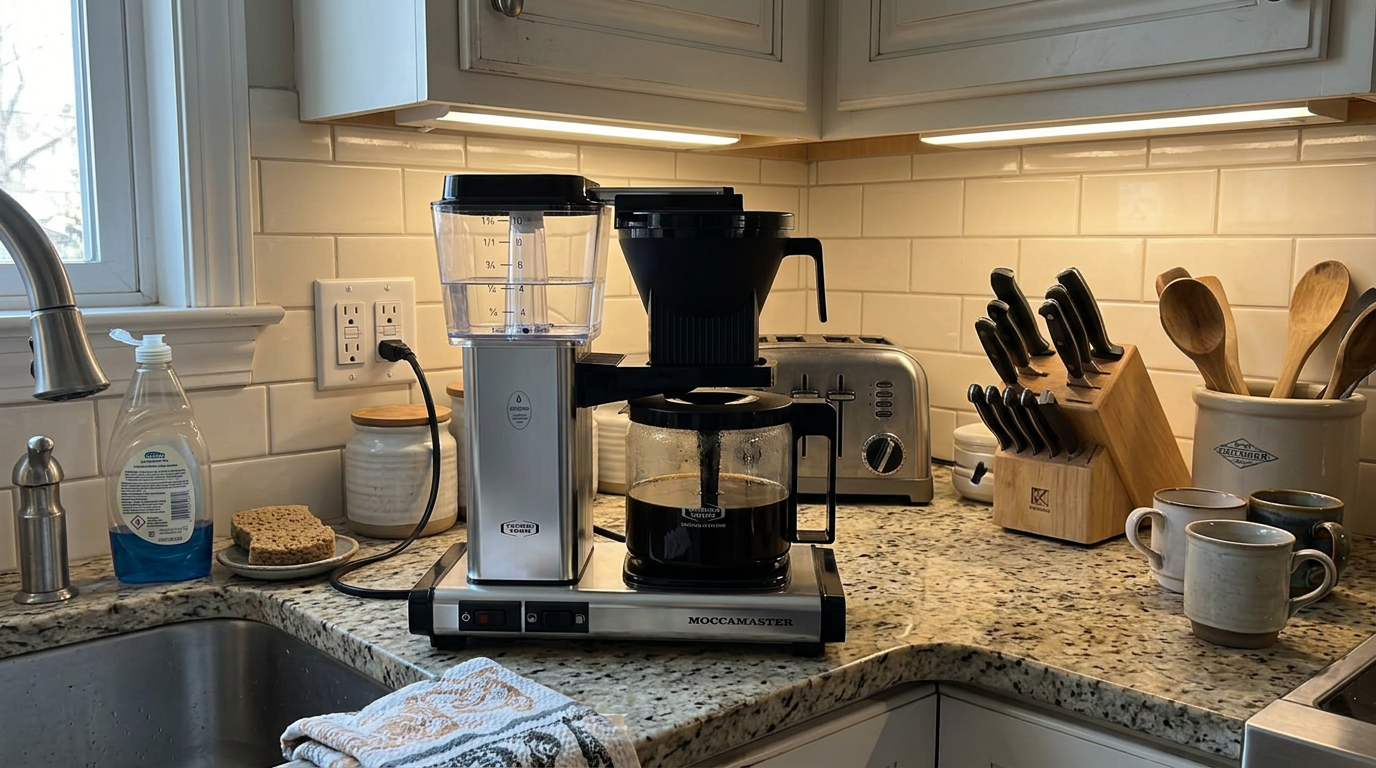
Every part of the brewing path is on show.
Our tip: Run one or two tanks of plain water through before your first brew, because it rinses the system and lets you practice seating the cone and arm without wasting coffee.
Setup takes minutes
There's no app, no screen and no menu to learn.
I fitted the shower arm, placed the brew cone, put the lids on and filled the tank.
That was it.
The cone takes standard #4 cone filters✕Cone filterA V-shaped paper filter. The shape funnels water through a deeper bed of grounds than a flat-bottomed basket filter., the kind sold in every supermarket, so there's no hunting for special supplies.
Visiting relatives who'd never seen one were making their own pots by the second day, which tells you how simple it is.
| Step | What to do | Time |
|---|---|---|
| 1 | Unbox and rinse the carafe, cone and lids | 3 minutes |
| 2 | Fit the shower arm | Seconds |
| 3 | Seat the brew cone | Seconds |
| 4 | Run a tank of plain water | About 6 minutes |
| 5 | Brew your first pot | About 6 minutes |
Materials: the good and the not-so-good
This is where my feelings were mixed.
On the plus side, hot water travels through glass and metal parts on its way to the coffee, rather than an all-plastic path, which matters to many people who think about what touches their drink.
The main body is well put together, and the whole machine is light enough to move easily without feeling unstable.
On the minus side, the brew cone and shower arm are thin, light and slightly flexible.
They're food-safe, high-temperature plastic and did their job perfectly for three weeks, but they don't feel as premium as the rest of the machine.
It's a question of feel rather than function, but at this level, I'd expect sturdier parts.
My impressions from three weeks of handling.
Our tip: Hold the brew cone by its rim rather than its handle when it's full of wet grounds, because the thin plastic flexes and a firm grip on the rim keeps it steady over the bin.
Two switches, and what they do
The Moccamaster has just two switches.
One turns it on.
The other, beside it, is the small-batch setting.
Flip it, and the machine slows the flow of coffee out of the brew cone and lowers the hot plate temperature.
Slower flow gives a smaller bed of grounds more contact time with the water, and a cooler plate is gentler on a small amount of coffee.
That's the whole interface, and I came to appreciate how little there was to get wrong.
| Switch | Setting | What changes | Use it for |
|---|---|---|---|
| Power | On | Starts the brew | Every pot |
| Batch | Full | Normal flow and plate heat | 5–10 cups |
| Batch | Small | Slower flow, cooler plate | 2–4 cups |
Small batches: two and three cups
Plenty of drip machines make good full pots and disappointing small ones.
With only a little coffee in the filter, water rushes through, and you end up with something weak and watery.
On weekday mornings when I was the only one drinking coffee, I brewed two or three cups with the small-batch switch on.
The coffee was round and full, not thin, and it tasted like a scaled-down version of a full pot.
I also tried the same three cups with the switch off: it was noticeably lighter and a little sharp.
My tasting notes, same beans and grind.
Brewing for a crowd
This is what the Moccamaster does best.
During the second week, my sister's family stayed for a long weekend, and there were eight of us wanting coffee at different times.
Making individual pour-overs for everyone would have kept me in the kitchen all morning.
Instead, I filled the tank, added grounds and switched it on, and about six minutes later there were ten cups ready for everyone to help themselves.
The first pot was gone within ten minutes, so I brewed another straight away.
I spent the morning at the table with everyone rather than standing at the counter with a kettle.
Hands-on time for ten cups, from my weekend test.
Our tip: Weigh out the beans for a second pot before guests arrive, because the changeover then takes a minute and you won't keep anyone waiting for their refill.
Coffee through the day
During the family weekend, coffee wasn't a single event; people drifted in from early morning to mid-afternoon.
Rather than keeping one pot on the hot plate all day, I brewed fresh, smaller pots as people arrived.
A full pot at 7:30 for the early risers, a small batch at 9:00 for the late sleepers, another full pot after lunch.
Because each brew took only a couple of minutes of my time, it was easy to keep coffee fresh all day.
That's the real advantage of a quick, simple batch brewer: fresh pots are so easy that you never need to keep old coffee warm.
| Time | Who | Batch | Switch |
|---|---|---|---|
| 7:30 | Early risers, 5 people | 10 cups | Full |
| 9:00 | Late sleepers, 2 people | 3 cups | Small batch |
| 13:30 | After lunch, 6 people | 8 cups | Full |
| 16:00 | Afternoon, 2 people | 2 cups | Small batch |
My brewing schedule on the Saturday of the family weekend.
Our tip: Brew fresh small batches through the day instead of holding one big pot on the plate, because each brew takes only a couple of minutes and fresh coffee always tastes better.
Iced coffee
On a warm afternoon, I tried brewing straight over ice in the carafe.
I filled the carafe about a third full of ice, used half the usual water with the usual amount of coffee and brewed on the full setting.
The hot coffee melted the ice as it dripped, chilling it instantly and diluting it to the right strength.
It was sweet and clean, much better than yesterday's coffee chilled in the fridge.
I let the carafe return to room temperature before putting it back on the hot plate, to avoid stressing the glass.
Moccamaster vs my own pour-over
To see how good the coffee really is, I brewed the same beans, at the same ratio and grind, two ways.
One was a careful hand-poured pour-over✕Pour-overMaking filter coffee by hand, pouring hot water over grounds in a cone in slow, controlled stages. with my gooseneck kettle; the other was a Moccamaster pot.
I tasted them side by side, and then asked my partner to taste them blind.
The pour-over was a touch brighter and more defined, but the gap was much smaller than I expected.
My partner picked the Moccamaster as the pour-over once out of three tries.
For a machine that does ten cups at a time, that's remarkable.
| What I tasted | Hand pour-over | Moccamaster 53941 |
|---|---|---|
| Clarity | Very clear | Clear |
| Sweetness | High | High |
| Body | Medium | Slightly fuller |
| Acidity | Bright | A little softer |
| My time | About 4 minutes per cup | About 2 minutes per pot |
Why the cone works
On paper, the Moccamaster's water distribution isn't perfect.
The shower arm drops water through a handful of holes, and a cone filter doesn't give the perfectly flat, even bed that some coffee enthusiasts prefer.
Yet the coffee tastes excellent.
My theory, after watching it brew, is that the cone restricts the flow slightly, so the grounds sit in water for a while as it drains.
That gives a brew that's part drip, part immersion✕ImmersionA brewing style where the grounds sit fully submerged in water for a time, as in a French press. It evens out extraction and adds body., which helps even out any patchy spots.
Whatever the exact reason, what matters is the result in the cup, and it was consistently very good.
Our tip: Give the cone a gentle shake after adding your grounds, because a level bed lets the water spread evenly before the cone's slower drain takes over.
The brew stopper
The brew cone has a stopper that closes the moment you lift the carafe away.
It worked every time, with no drips onto the hot plate.
It's handy when someone is desperate for a cup before the pot has finished.
But I learned to avoid using it unless I had to.
The first coffee out of the cone is the strongest, so pouring mid-brew gives that person a stronger cup and leaves a weaker pot for everyone else.
For the most even pot, let it finish, then stir and pour.
| Pouring | Result |
|---|---|
| Mid-brew cup | Strong for that cup, weaker pot after |
| After brewing, unstirred | Slight difference top to bottom |
| After brewing, stirred | Even from first cup to last |
Our tip: Swirl the carafe gently before the first pour, because it mixes the stronger early coffee with the lighter end of the brew so every cup tastes the same.
The hot plate: convenient, but not for slow sippers
The hot plate is the Moccamaster's biggest weakness for some households.
It keeps the carafe warm, which is convenient.
But any coffee kept on direct heat changes over time, losing its sweetness and picking up a flat, cooked taste.
When I brewed a pot for the family, it was gone in minutes, so the plate didn't matter at all.
On a quiet Sunday when I sipped one pot over a couple of hours, the last cup was noticeably duller than the first.
If that's how you drink coffee, plan to move it into a thermos.
How coffee on the hot plate tasted over time.
The thermos test
Because the hot plate is the Moccamaster's weak spot, I tested how much a thermos helps.
I split a full pot: half stayed on the plate, half went into a preheated vacuum flask.
After an hour, the thermos coffee was hot and tasted almost fresh; the plate coffee had lost its sweetness.
After three hours, the thermos coffee was still warm and pleasant.
If you're a slow sipper, a good thermos turns the Moccamaster's biggest weakness into a non-issue.
| Time | On the hot plate | In a thermos |
|---|---|---|
| 15 minutes | Hot, fresh | Hot, fresh |
| 1 hour | Hot, flatter | Hot, nearly fresh |
| 2 hours | Dull, cooked | Hot, pleasant |
| 3 hours | Not worth drinking | Warm, pleasant |
In a small office
For a few days, I took the Moccamaster into a friend's small design studio, where six people share one kitchen.
They had been using a pod machine, and the queue at it each morning was a running joke.
With the Moccamaster, whoever arrived first brewed a full pot, and everyone helped themselves as they came in.
Nobody needed instructions beyond a note about the small-batch switch for the afternoon top-up.
By the end of the week, the team asked where they could buy one, which says a lot about how easy and how good it is.
Our tip: In a shared kitchen, tape a small card with your coffee-to-water amounts next to the machine, because it keeps every pot consistent no matter who brews it.
Coffee flavor across roasts
The Moccamaster won't turn stale beans into great coffee, but it brings out the best in good ones.
With fresh specialty beans and a decent burr grinder, the coffee was outstanding.
A washed Colombian was sweet and caramel-like; a natural Ethiopian came through with blueberry and floral notes.
A dark-roast blend was rich, with no bitterness.
Pre-ground supermarket coffee made a perfectly decent pot, but with far less aroma and character.
From three weeks of daily brewing.
Choosing beans
With so few settings on the machine, the beans you choose make the biggest difference to the cup.
I got the best results from specialty coffee roasted within the previous month, ideally with a roast date printed on the bag.
Light and medium roasts showed off the Moccamaster's clarity best, with fruit, caramel and floral notes coming through clearly.
Dark roasts were smooth and rich, and I used slightly less coffee to keep them from tasting heavy.
Stored in an airtight jar away from light and heat, a 250-gram bag stayed fresh for the two weeks it took us to finish it.
| Roast | What I tasted | My tweak |
|---|---|---|
| Light | Fruity, floral, bright | One step finer |
| Medium | Sweet, caramel, balanced | None |
| Dark | Rich, chocolatey | About 10% less coffee |
| Decaf | Mellow but full | About 10% more coffee |
Our tip: Buy smaller bags more often rather than one big bag, because beans lose their aroma within weeks of opening and a simple brewer like this shows the difference.
Pair it with a good grinder
Because the Moccamaster gives you so few settings, the grinder is where you make the biggest difference.
I used a flat-burr grinder made for filter coffee throughout the test, and it made a clear difference compared with a cheap blade grinder.
A blade grinder produces a mix of dust and chunks, which over-extracts and under-extracts at the same time.
A burr grinder gives an even grind, so every particle brews at the same rate.
Together, a good burr grinder and the Moccamaster make a simple setup that produces excellent coffee all day with very little effort.
| Grinder | Grind | Coffee |
|---|---|---|
| Burr grinder for filter | Even | Sweet, clear, balanced |
| Blade grinder | Uneven, dusty | Muddy and a little bitter |
| Pre-ground | Even but stale | Decent, little aroma |
Our tip: If you only upgrade one thing, make it the grinder, because an even grind does more for drip coffee than any setting a machine could offer.
My recipe
With so few settings, the recipe is in your hands: beans, grind, coffee amount and water.
I started at 60 grams of coffee per liter of water and adjusted from there.
For full pots, a medium grind like coarse sand; for small batches with the switch on, a step finer.
| Batch | Water | Coffee (about) | Switch | Grind |
|---|---|---|---|---|
| 2 cups | 300 ml | 18 g | Small batch | Medium-fine |
| 3 cups | 450 ml | 27 g | Small batch | Medium-fine |
| 5 cups | 750 ml | 45 g | Full | Medium |
| 10 cups | 1.25 l | 75 g | Full | Medium |
My starting amounts; adjust to your taste.
Quiet mornings
The Moccamaster is pleasantly quiet.
You hear a soft bubbling as the water heats and a gentle drip into the carafe, and that's about it.
On early mornings with guests still asleep upstairs, nobody was woken by it.
The grinder was always the loudest part of my routine, so I ground beans the night before on a couple of very early starts and kept them in a sealed jar.
How loud each part of the routine felt.
Everyday practicality
After three weeks, what stood out most was how little thought it required.
Filter in, coffee in, water in, switch on.
Six minutes later there was a pot of genuinely good coffee, and nobody needed to ask me how it worked.
That makes it ideal for shared kitchens, holiday homes and busy mornings, where convenience matters as much as flavor.
The flip side is that there's nothing to adjust beyond the batch switch: no temperature control, no pre-infusion✕Pre-infusionWetting the grounds briefly and pausing before the main brew, so they can release gas and extract more evenly. setting and no timer.
Share of brews from my testing notes.
Cleaning and descaling
Daily cleaning took two or three minutes.
I binned the filter and grounds, rinsed the cone and lid, and washed the carafe in warm, soapy water.
Once a week, I pulled off the shower arm and rinsed it to keep the holes clear.
Regular descaling✕DescalingRunning a cleaning solution through the machine to dissolve the mineral deposits that build up from hard water. keeps the heater working at full strength.
With hard water, I'd do it roughly monthly; with soft or filtered water, every few months.
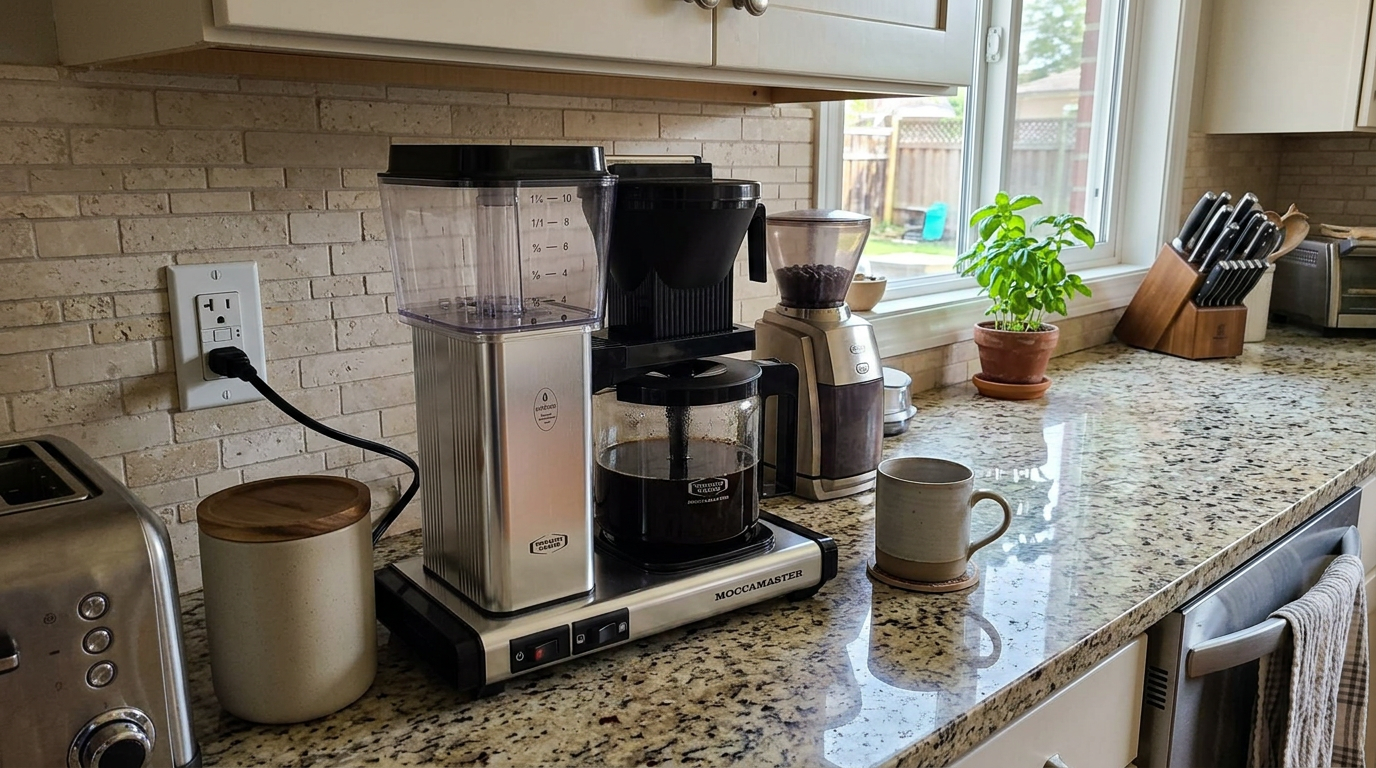
The cone, arm and carafe all come off for cleaning.
| Task | How often | Time |
|---|---|---|
| Empty filter, rinse cone | Every brew | 1 minute |
| Wash carafe and lid | Daily | 2 minutes |
| Rinse shower arm | Weekly | 1 minute |
| Wipe hot plate | Weekly, when cool | 1 minute |
| Descale | Monthly with hard water | About 30 minutes |
Our tip: Rinse the carafe with hot water straight after it's empty, because coffee oils dry into a brown film that's much harder to shift the next morning.
Water matters
Filter coffee is about 98% water, so what comes out of your tap shows up in the cup.
My hard tap water made coffee that tasted slightly duller than coffee brewed with filtered water.
Filtered water also slows scale build-up in the heater.
Avoid distilled water, which lacks the minerals that help pull out flavor and makes coffee taste flat.
| Water | Taste | Scale build-up |
|---|---|---|
| Hard tap water | Slightly dull | Faster |
| Filtered water | Clean, bright | Slower |
| Distilled water | Flat | Minimal |
Design and colors
The Moccamaster is one of the few coffee makers people buy partly for how it looks.
Its tall, upright shape and visible brewing parts have barely changed in decades, which gives it a timeless quality.
The wide range of colors means it can match a kitchen or be a bold accent, and it became a talking point when guests visited.
It's narrow but tall, so check the clearance under your wall cabinets, because you'll need space above it to fill the tank.
Troubleshooting
| Problem | Likely cause | Fix |
|---|---|---|
| Weak small pot | Batch switch on full | Use the small-batch setting |
| Bitter coffee | Grind too fine or too much coffee | Grind coarser or use less |
| Cone overflowing | Grind too fine or carafe removed too long | Grind coarser, return the carafe |
| Uneven pot | Poured mid-brew | Let it finish, then swirl |
| Dull coffee | Left on the hot plate | Use a thermos |
| Slow or cooler brew | Scale build-up | Descale |
Safety and warranty
Use the machine as designed.
Some owners talk about disabling or altering the hot plate to stop it cooking the coffee, but changing electrical or heating parts can make the machine unsafe and may void the manufacturer's warranty.
If the hot plate bothers you, use a thermos instead.
Let the plate cool before wiping it, handle the glass carafe with care and never run the machine without water or without the carafe in place.
What surprised me
How close it gets to pour-over
The blind tasting was much closer than I expected.
How well it handles two cups
The small-batch switch genuinely works.
How light some parts feel
The cone and arm don't match the reputation.
From my testing notes.
How to get the best results
Buy fresh, good-quality beans.
Grind them just before brewing with a burr grinder.
Use the small-batch switch for four cups or fewer.
Let the brew finish, swirl and pour.
And drink it fresh, or move it to a thermos.
Three weeks with the Moccamaster, week by week
Week 1: settling in
Setup, my first pots and finding my recipe with fresh beans.
Week 2: the family weekend
Back-to-back ten-cup pots for eight people.
Week 3: small batches and the taste-off
Solo two-cup mornings and the blind tasting against my own pour-over.
From my testing notes.
Common mistakes to avoid
| Mistake | What happens | Better habit |
|---|---|---|
| Small pot on the full setting | Thin, watery coffee | Use the small-batch switch |
| Blade-ground beans | Muddy, bitter cup | Use a burr grinder |
| Pouring mid-brew | Uneven pot | Let it finish |
| Leaving coffee on the plate | Cooked taste | Use a thermos |
| Modifying the hot plate | Safety risk, warranty issues | Use it as designed |
| Skipping descaling | Slower, cooler brews | Descale regularly |
What I would change
A sturdier brew cone and shower arm.
An insulated carafe option in place of the hot plate.
And a little more control for coffee tinkerers.
Three households, three verdicts
The family of five
Several coffee drinkers every morning.
An excellent fit: one pot, everyone served.
The weekend host
Regular guests and holiday gatherings.
An excellent fit: great coffee without being stuck in the kitchen.
The slow solo sipper
One pot, drunk over three hours.
Only a good fit with a thermos alongside.
| Household | Fit | Main reason |
|---|---|---|
| Families | Excellent | Ten cups in one go |
| Hosts | Excellent | Little effort per pot |
| Specialty-coffee fans | Very good | Close to pour-over |
| Solo drinkers | Very good | Small-batch switch |
| Slow sippers | Fair | Hot plate dulls coffee |
| Brewing tinkerers | Fair | Few settings |
Is the Moccamaster 53941 worth the money?
For anyone who brews for more than one person, yes.
It turns good beans into excellent coffee with almost no effort, serves a crowd in minutes and handles small batches properly.
The Dutch hand-built heritage and timeless design add to the appeal.
It loses points for the thin cone and arm and the hot plate, but neither affects how the coffee tastes when it's fresh.
Three questions to ask:
Do you usually make coffee for several people?
Do you finish a pot within an hour or so?
And would you rather enjoy great coffee than adjust settings?
How it compares with other ways to make coffee
| Feature | Moccamaster 53941 | Manual pour-over | Basic drip machine | Pod machine |
|---|---|---|---|---|
| Flavor | Excellent | Excellent | Fair | Good |
| Cups at once | Up to 10 | 1–2 | Up to 12 | 1 |
| Hands-on time per pot | About 2 minutes | About 4 minutes per cup | About 2 minutes | Seconds per cup |
| Control | Low | Total | Low | None |
| Small batches | Very good | Excellent | Often weak | Excellent |
| Ongoing cost | Beans and filters | Beans and filters | Beans and filters | Pods |
| Your priority | Is it a fit? | Why |
|---|---|---|
| Coffee for a group | Excellent | Ten cups in about six minutes |
| Specialty flavor with no fuss | Excellent | Close to pour-over |
| Two-cup mornings | Very good | Small-batch switch |
| All-morning warmth | Fair | Hot plate, no thermal carafe |
| Fine control | Poor | Two switches only |
Which one is right for you: is the Moccamaster 53941 your match?
4 quick questionsMoccamaster 53941 specifications
From manufacturer data, retailer listings and my own testing.
How I tested and scored the Moccamaster 53941
For three weeks, the Moccamaster 53941 was the only coffee maker in my kitchen.
I brewed full pots and two- to three-cup batches with and without the small-batch switch, using light, medium and dark roasts and a burr grinder.
I hosted a long family weekend with back-to-back pots, ran a side-by-side and blind tasting against my own pour-over and tasted coffee from the hot plate over two hours.
I also cleaned it daily and noted how each part felt in the hand.
- Coffee flavor (9.4): close to a careful pour-over.
- Batch brewing (9.5): ten cups in minutes, small batches done well.
- Simplicity (9.3): two switches, nothing to learn.
- Materials and hot plate (7.0): thin cone and arm, plate dulls coffee.
The overall score of 8.8 is an editorial rating that reflects those four areas.
Moccamaster 53941 FAQ
Is the Moccamaster 53941 worth it?
Yes, if you brew for more than one person. It makes coffee close to a careful pour-over with almost no effort.
How many cups does it make?
Up to 10 cups, or about 1.25 liters.
What does the second switch do?
It's the small-batch setting. It slows the flow from the brew cone and lowers the hot plate temperature for two to four cups.
Can it make just two cups?
Yes. With the small-batch switch on, two- and three-cup pots tasted full rather than thin.
Does it taste as good as pour-over?
Very close. In my blind tasting, the hand pour-over was slightly brighter, but the gap was small.
What filters does it use?
Standard #4 cone paper filters.
Can I pour a cup before it finishes?
Yes, the brew stopper closes when you lift the carafe, but letting it finish gives a more even pot.
Does the hot plate affect flavor?
Over time, yes. Coffee left on it for more than an hour tastes duller. Move leftovers to a thermos.
Should I modify the hot plate?
No. Changing electrical or heating parts can be unsafe and may void the warranty.
Is it loud?
No. It makes a soft bubbling and gentle drip.
Where is it made?
Moccamaster coffee makers are hand-built in the Netherlands, as they have been since 1968.
How often should I descale it?
About monthly with hard water, or every few months with soft or filtered water.
Senior home appliance tester
Emily has tested home appliances for a living since 2016, first as a test coordinator at a national consumer advocacy group and, since 2021, at HouseholdMe. She has a degree in industrial design from Ohio State, so she looks at how a product is built, not just how it performs. She brewed with the Moccamaster 53941 for three weeks for this review, including a long family weekend.
- Three weeks of hands-on testing of the Technivorm Moccamaster 53941 KBGV Select
- Technivorm product information and user manual