Technivorm Moccamaster 53923 KBGV Select review
The Technivorm Moccamaster 53923 KBGV Select 10-Cup Coffee Maker is a no-nonsense drip brewer with a copper boiler, a pulse-style spray arm and a half-pot/full-pot switch that slows the water flow for smaller batches. I brewed with it every day for three weeks. It held brewing water at 195–205°F, made a balanced, full-flavored cup whether I brewed five cups or ten, and finished a full pot in minutes. The basket takes a little practice and the warming plate shuts off after 100 minutes, but this is one of the best drip coffee makers I've used.

Emily Carter
Hands-on review
Hands-on testing, research, specs
3 weeks
26 minutes
Jargon helpNew to coffee brewing? Tap any dotted term to see what it means.
In this review
Yes, if you drink drip coffee every day and care how it tastes. The Moccamaster 53923 KBGV Select keeps brewing water at 195–205°F with its copper boiler, spreads it evenly over the grounds with a pulse-style spray arm and lets you switch to a slower half-pot flow for smaller batches. Every pot I brewed in three weeks was hot, balanced and full-flavored. It's simple to run, with a drip-stop and a separate warming plate. The downsides are small: the basket grooves take practice, the glass carafe needs care and the plate turns off after about 100 minutes.
Moccamaster KBGV Select at a glance
Moccamaster KBGV Select pros and cons
- Steady 195–205°F brewing temperature
- Half-pot setting keeps small batches full-flavored
- Even saturation from the pulse-style spray arm
- Basket grooves take some practice
- Warming plate shuts off after about 100 minutes
- No timer or programmable start
Who should buy the Moccamaster KBGV Select?
- Households that brew different amounts each day
- Coffee lovers who grind their own beans
- People who want simple, durable controls
- Anyone who wants coffee ready on a timer
- Single-cup drinkers who prefer pods
- People who keep a pot warm all day
First impressions of the Moccamaster KBGV Select
The Moccamaster KBGV Select looks different from most coffee makers, in a good way.
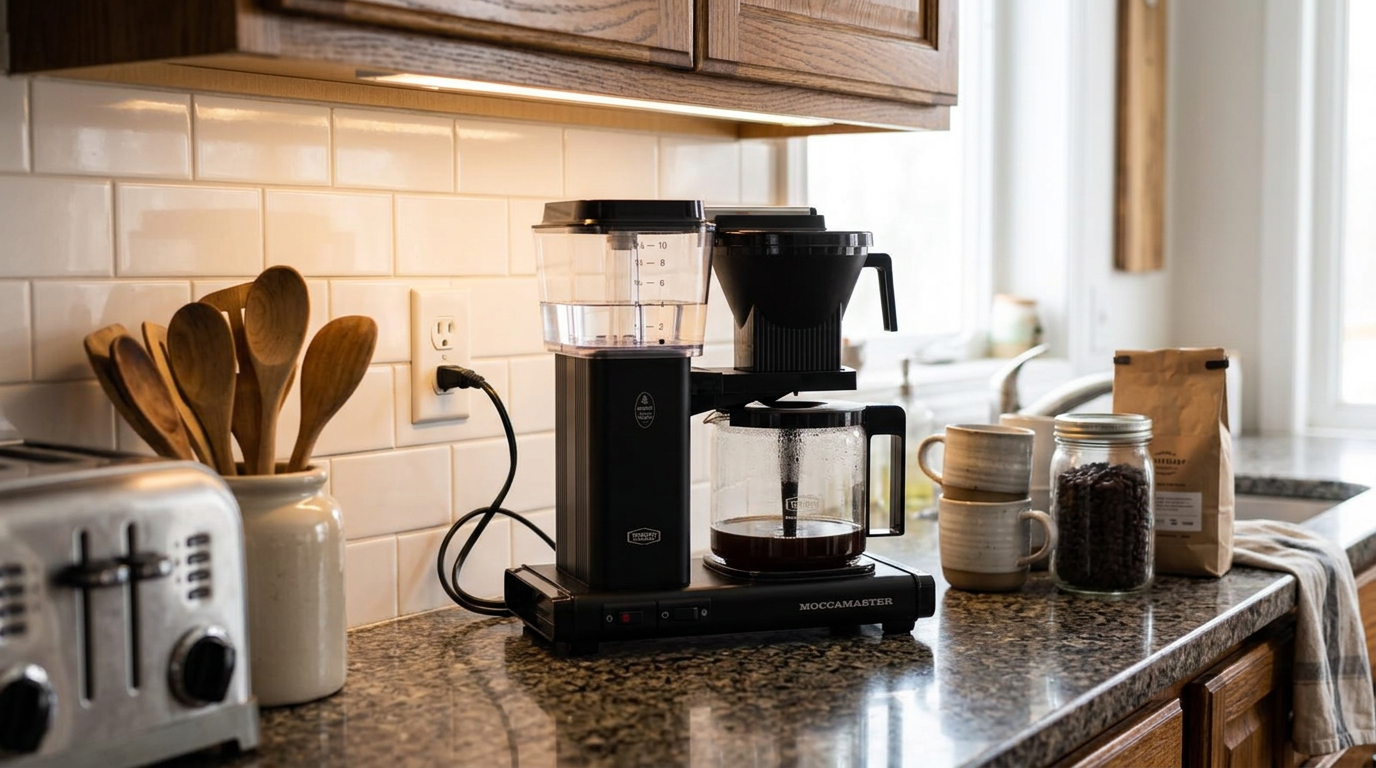
Instead of a closed plastic box, you can see every part: the water reservoir at the back, the spray arm on top, the filter basket, the glass carafe and the warming plate.
The housing feels solid and substantial, and nothing creaks or flexes when you handle it.
There are only two controls: the power switch and a small selector near the base for half pot or full pot.
Out of the box, I rinsed the carafe, basket and lid, ran two cycles of plain water to flush the system and was brewing within fifteen minutes.
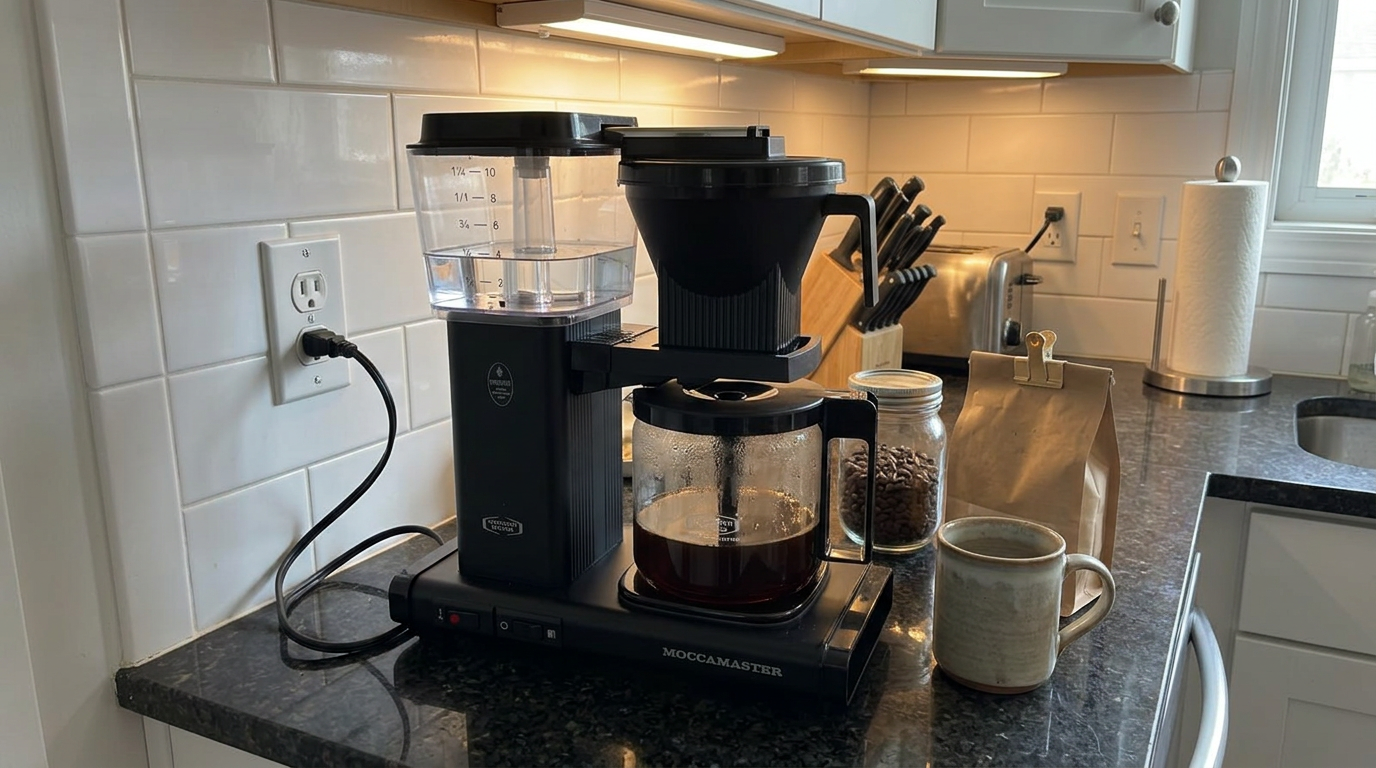
The open design shows every part of the brewing process.
Our tip: Run two full reservoirs of plain water through before your first pot, because it flushes out any taste from manufacturing and lets you see how the parts fit before coffee is involved.
Design and build quality
The design follows the classic Moccamaster layout, and it's built around function rather than gadgets.
The reservoir sits at the back with a lid on top; water passes through the copper boiler and up to the spray arm, which sits above the filter basket.
Coffee drips from the basket into the glass carafe, which rests on its own warming plate.
There's no screen, no clock and no menu.
That simplicity is part of the appeal: fewer electronics means fewer things to go wrong, and I never once had to look up how to do something.
It looks smart on the counter, too, and several visitors asked about it.
| Part | What it does | My notes |
|---|---|---|
| Reservoir | Holds up to 10 cups of water | Clear markings, easy to fill |
| Copper boiler | Heats water to brewing temperature | Fast and steady |
| Spray arm | Spreads water over the grounds | Removable, adjustable |
| Filter basket | Holds the cone filter and coffee | Slides into grooves |
| Drip-stop | Stops flow when the carafe is removed | Works reliably |
| Warming plate | Keeps coffee at 175–185°F | Shuts off after ~100 minutes |
The half-pot and full-pot selector
The selector is what makes the KBGV Select different from a basic drip brewer.
Most drip machines push water through at the same rate however much coffee you're making.
That works for a full pot, but with a small batch the water runs through the thinner bed of grounds too quickly, and the coffee comes out weak and thin.
On the KBGV Select, switching to half pot slows the flow from the basket so the grounds stay in contact with water for longer.
I tested this directly: five cups on the full-pot setting tasted noticeably weaker and a little sour, while the same five cups on the half-pot setting tasted as rich as a full pot.
In my house, it meant a full pot on weekend mornings and a half pot on weekdays, with no drop in quality.
My tasting notes, same beans and grind.
Copper boiler and brewing temperature
Temperature is the biggest factor in drip coffee after the beans themselves.
Water that's too cool under-extracts, leaving coffee sour and flat; water that's too hot over-extracts, making it bitter and harsh.
The ideal range for drip coffee is roughly 195–205°F, and the Moccamaster's copper boiler kept the water in that range in every brew I measured.
I checked with a probe thermometer in the basket and saw it reach brewing temperature within the first minute, then hold steady.
That consistency is why the coffee tasted the same from the first cup of the pot to the last, and from one day to the next.
Where the Moccamaster sits on the temperature scale.
Good extraction✕ExtractionHow much flavor hot water dissolves out of the coffee grounds. Too little tastes sour and weak; too much tastes bitter. depends on this, and the KBGV Select gets it right without any settings to fiddle with.
Our tip: Fill the reservoir with fresh, cold water every time, because water that has sat overnight tastes flat and reheated water can carry stale flavors into the cup.
Pulse brewing and even saturation
The spray arm doesn't pour a single stream into the middle of the basket.
It releases water in pulses through several holes, spreading it across the whole bed of grounds.
That matters because if water only hits the center, the grounds there over-extract while the grounds at the edges barely get wet.
After each brew, I checked the spent grounds: they were evenly wet and flat, without the deep crater in the middle that cheaper brewers leave behind.
The first pulses also let the grounds bloom✕BloomThe bubbling and swelling when hot water first hits fresh coffee, as trapped carbon dioxide escapes. Letting coffee bloom helps it extract evenly., which you can watch through the open basket lid as the coffee swells and bubbles.
| What I checked | Result |
|---|---|
| Spent grounds after brewing | Flat, evenly saturated bed |
| Dry patches at the edges | None |
| Bloom with fresh beans | Clear, visible bubbling |
| Flavor first cup vs last cup | Consistent |
Our tip: Give the basket a gentle shake after adding the grounds, because a level bed lets the spray arm wet every part evenly and stops water channeling through low spots.
Filter basket and cone filter
The removable basket takes a standard cone filter✕Cone filterA V-shaped paper filter. The shape funnels water through a deeper bed of grounds than a flat-bottomed basket filter., which I used in the #4 size.
The cone shape gives a deeper coffee bed, which helps water move through the grounds evenly.
I pre-wet each filter with a little hot water before adding coffee, which settled it into the basket and rinsed out any papery taste.
The basket slides into grooves on the machine and clicks into place.
For the first few days, I sometimes had to wiggle it to find the grooves, but by the end of the first week I was doing it without looking.
The basket has a lid, which keeps heat in during brewing.
Our tip: Fold the seams of the paper filter in opposite directions before you open it, because it sits flush against the basket and won't collapse when the water hits.
The removable spray arm
The spray arm is held on by a friction fit, so you just pull it gently to remove it.
That makes it easy to clean and to check that the holes aren't blocked by mineral build-up.
It can also be adjusted.
On my unit, it arrived pointing slightly off-center, and the grounds at one edge were drier than the rest.
A small nudge to center it over the basket fixed that, and every brew afterwards was even.
It's a simple part, but it does a lot of the work behind the Moccamaster's consistent flavor.
Our tip: Look at your spent grounds after the first few brews, because a dry patch on one side tells you the spray arm needs a small nudge toward the center.
Automatic drip-stop
Under the basket is an automatic drip-stop.
When you lift the carafe off the warming plate, a small trigger closes the outlet so coffee stops dripping.
Put the carafe back and the flow starts again.
I used this every morning to pour a first cup mid-brew, and it never dripped onto the plate.
One thing to know: if you leave the carafe out for too long during brewing, the basket fills up while the outlet is closed, so pour quickly and put it back.
| Situation | What happens |
|---|---|
| Carafe removed mid-brew | Drip-stop closes, no spills |
| Carafe returned | Flow resumes |
| Carafe out for a long time | Basket fills, risk of overflow |
Our tip: Pour a mid-brew cup within about 30 seconds, because the basket keeps filling while the drip-stop is closed and can overflow if the carafe stays out too long.
Glass carafe and warming plate
The glass carafe holds 10 cups and pours cleanly without dribbling.
It sits on a warming plate with its own heating element, separate from the brewing boiler.
That means the boiler can focus on brewing temperature while the plate holds the finished coffee at around 175–185°F.
The plate switches off automatically after about 100 minutes.
For most mornings, that was plenty; by the time it turned off, the pot was long gone.
On slow weekends, I poured the last of the pot into a thermos before the plate turned off, which also kept it tasting fresher than leaving it on heat.
How coffee on the warming plate tasted over time.
Our tip: If you sip slowly, move the coffee to a preheated thermos after 30 minutes, because it stays hot for hours and avoids the stewed taste that builds up on any warming plate.
How I brewed a pot, step by step
My daily routine took about two minutes of hands-on time.
I filled the reservoir with cold water, weighed and ground my beans, then pre-wet a cone filter in the basket.
I tipped in the grounds, shook the basket level and slid it into its grooves.
Then I set the selector to half or full pot and switched it on.
The rest took care of itself.
| Step | What to do |
|---|---|
| 1 | Fill the reservoir with fresh, cold water |
| 2 | Grind beans to a medium grind |
| 3 | Place and pre-wet a cone filter |
| 4 | Add grounds and shake level |
| 5 | Slide the basket in until it clicks |
| 6 | Set half or full pot, switch on |
| 7 | Stir the carafe before pouring |
Our tip: Give the carafe a quick stir before you pour the first cup, because the coffee that drips through first is stronger and stirring blends the pot evenly.
Brew time
A full pot took around six minutes from switching on to the last drip.
A half pot on the half-pot setting was a little quicker overall, even though the slower flow from the basket gives the grounds more contact time.
That's fast for a drip brewer, and quick enough that I never felt I was waiting around in the morning.
Brew times from my testing.
Coffee flavor and temperature in the cup
This is where the Moccamaster earns its reputation.
With a medium roast from a local roaster, the coffee was sweet and rounded, with chocolate and nutty notes and no harsh bitterness.
A light Ethiopian roast came through bright and fruity, with clear acidity rather than sourness.
A dark roast was rich and smooth, without the burnt edge it gets in a poorly controlled brewer.
The coffee was hot enough to enjoy straight away, and with milk it stayed comfortably warm.
From three weeks of daily brewing.
How much coffee to use
I started with a ratio of about 1 gram of coffee to 16 grams of water and adjusted to taste.
That's a little stronger than many people brew, but the Moccamaster's even extraction handles it without bitterness.
If you don't have a scale, a level scoop of about 2 tablespoons per 5-ounce cup is a good starting point.
Here's what I used across the week.
| Cups | Water | Coffee (about) | Selector |
|---|---|---|---|
| 4 | 20 oz (590 ml) | 36 g | Half pot |
| 5 | 25 oz (740 ml) | 45 g | Half pot |
| 6 | 30 oz (890 ml) | 54 g | Half pot |
| 8 | 40 oz (1.2 l) | 72 g | Full pot |
| 10 | 50 oz (1.25 l) | 78–80 g | Full pot |
My starting amounts; adjust to your taste.
Grind size
Grind size makes a big difference in a drip brewer.
Too fine and water backs up in the basket and the coffee turns bitter; too coarse and it rushes through and tastes weak.
A medium grind, like coarse sand, worked best for full pots.
For half pots, I sometimes went one step finer for a little more body.
| Grind | What I tasted | Use it for |
|---|---|---|
| Fine | Bitter, slow drain | Avoid |
| Medium-fine | Rich, full body | Half pots |
| Medium | Balanced, sweet | Full pots |
| Coarse | Weak, thin | Avoid |
Our tip: Grind your beans just before brewing, because ground coffee loses aroma within minutes and the Moccamaster's even extraction shows off fresh coffee best.
Choosing beans for the Moccamaster
A brewer this consistent shows off the differences between beans, so it's worth experimenting.
Over three weeks, I brewed six different coffees, from a bright, washed Ethiopian to a dark, chocolatey Brazilian blend.
Freshly roasted beans, used within about a month of the roast date, gave the best bloom and the most aroma in the cup.
Supermarket beans with no roast date still made a good pot, but the flavor was flatter and the bloom was barely visible.
Medium roasts were the easiest to get right, and they're where I'd start if you're new to brewing at home.
| Roast | How it tasted | My tweak |
|---|---|---|
| Light | Bright, fruity, floral | Slightly finer grind |
| Medium | Sweet, nutty, balanced | None needed |
| Dark | Rich, chocolatey, smooth | A little less coffee |
| Decaf | Mellow, still full | Slightly more coffee |
Our tip: Store beans in an airtight container away from light and heat, because exposure to air is what turns fresh coffee stale and flat within days.
Brewing for a crowd
During the second weekend, I hosted a family brunch for eight people.
I brewed a full pot before anyone arrived and a second as soon as the first was poured.
Between pots, I emptied the basket, rinsed it, added a new filter and fresh grounds, and refilled the reservoir; the whole changeover took under two minutes.
The second pot started dripping almost immediately, because the boiler was already warm.
Twenty cups of coffee in under 15 minutes is more than enough for most gatherings.
To keep the first pot fresh, I moved it into an insulated jug while the second brewed.
Back-to-back brewing from my brunch test.
Iced coffee and stronger brews
On a couple of warm afternoons, I brewed iced coffee straight into the carafe.
I filled the carafe about a third full with ice, used half the usual water with the same amount of coffee, and brewed on the half-pot setting.
The hot coffee melted the ice as it dripped, chilling and diluting it to the right strength.
It came out clean and sweet, without the flat taste of coffee left to cool in the fridge.
The glass carafe handled the temperature change fine, but I let it come back to room temperature before putting it on the warming plate again.
Living with it: mornings, weekends and guests
On weekdays, I brewed a half pot for my partner and me.
It was ready by the time I'd made toast, and the selector meant those smaller pots tasted as good as a full one.
On weekends, with family visiting, I brewed full pots back to back.
After the first pot, I rinsed the basket, added a fresh filter and grounds and started the second straight away; the boiler was ready immediately.
The one thing I missed was a timer.
There's no way to set it the night before and wake up to coffee, so you need to be up to switch it on.
Share of brews from my testing notes.
Design details I appreciated
A few small touches made the KBGV Select pleasant to use every day.
The reservoir has clear cup markings, so I could fill it accurately without a measuring jug.
The open design meant I could watch the bloom and the brew, which made it easy to spot a problem like an off-center spray arm.
The two switches are big and positive, with no beeps, flashing lights or menus.
And because every part is visible, cleaning never felt like a mystery; I always knew what needed rinsing.
From my three weeks of testing.
Warming plate or thermos?
The warming plate is convenient, but any coffee left on heat slowly loses its brightness.
I ran a simple test: half a pot stayed on the plate, and the other half went into a preheated thermos straight after brewing.
After 45 minutes, the thermos coffee tasted noticeably fresher and sweeter, while the plate coffee had started to taste slightly cooked.
After 100 minutes, the plate switched off, but the thermos coffee was still hot.
My advice: use the plate for the first half hour, and move anything you won't drink soon into a thermos.
| Time | On the warming plate | In a thermos |
|---|---|---|
| 15 minutes | Hot, fresh | Hot, fresh |
| 45 minutes | Hot, slightly cooked | Hot, fresh |
| 100 minutes | Plate switches off | Still hot |
| 3 hours | Lukewarm | Warm, drinkable |
Cleaning and descaling
Daily cleaning was quick.
I tipped the filter and grounds into the compost, rinsed the basket and lid, and washed the carafe with warm, soapy water.
Once a week, I pulled off the spray arm and rinsed it to keep the holes clear.
Like any coffee maker, it needs regular descaling✕DescalingRunning a cleaning solution through the machine to dissolve the mineral deposits that build up from hard water. to remove mineral build-up from the boiler.
How often depends on your water: with hard water, aim for roughly once a month; with soft or filtered water, every few months.
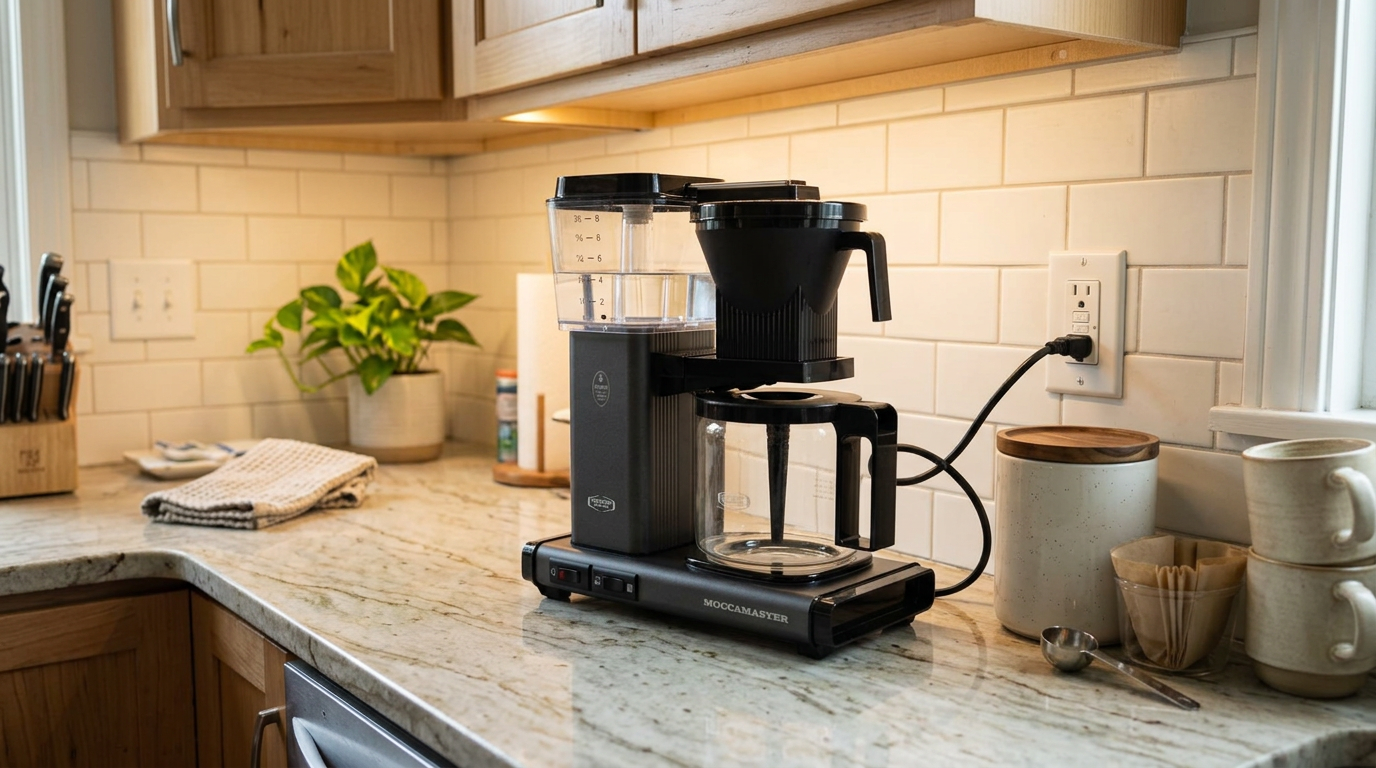
The basket and spray arm come off for easy cleaning.
| Task | How often | Time |
|---|---|---|
| Empty filter, rinse basket | After every brew | 1 minute |
| Wash carafe and lid | Daily | 2 minutes |
| Rinse spray arm | Weekly | 1 minute |
| Wipe warming plate | Weekly, when cool | 1 minute |
| Descale | Monthly with hard water | About 30 minutes |
Our tip: Descale more often if brewing slows down or the coffee tastes less hot, because mineral build-up in the boiler is the most common cause of both.
Water quality
Coffee is mostly water, so the water you use shows up in the cup.
My tap water is fairly hard, and coffee brewed with it tasted slightly duller than coffee brewed with filtered water from a pitcher.
Filtered water also means less scale in the boiler, so you'll descale less often.
Avoid distilled water: it lacks the minerals that help extract flavor, and the coffee tastes flat.
| Water | Taste | Scale build-up |
|---|---|---|
| Hard tap water | Slightly dull | Faster |
| Filtered water | Clean, bright | Slower |
| Distilled water | Flat | Minimal |
Noise and countertop space
The Moccamaster makes a gentle gurgling as the water heats and pulses, which I found quite pleasant in the morning.
It never got loud enough to interrupt a conversation.
It's tall and fairly narrow, so it fits under most wall cabinets, but you need clearance above to fill the reservoir and lift the spray arm.
I slid it forward slightly each time I filled it, which was easy as it isn't heavy.
Troubleshooting
I had very few problems, but here's what to check if your coffee isn't right.
| Problem | Likely cause | Fix |
|---|---|---|
| Weak small pot | Selector on full pot | Switch to half pot |
| Bitter coffee | Grind too fine or too much coffee | Grind coarser or use less |
| Basket overflowing | Carafe out too long or grind too fine | Return carafe sooner, grind coarser |
| Dry patch in grounds | Spray arm off-center | Nudge it to the center |
| Slow brewing | Scale build-up | Descale |
| Coffee dripping onto plate | Basket not seated | Slide it fully into the grooves |
Safety and care
The warming plate gets hot, so I kept the area around it clear and wiped it only once it had cooled.
Never put an empty carafe on a hot plate or run the brewer without the carafe in place.
The glass carafe should be handled with care: don't put it on a cold or wet surface straight from the plate, and avoid knocking it against the sink.
The automatic plate shutoff after about 100 minutes adds peace of mind if you forget to switch it off.
What surprised me
How much the selector matters
The difference between half-pot and full-pot settings for small batches was bigger than I expected.
How fast it brews
A full pot in about six minutes is quick for a drip brewer.
How consistent it is
Twenty-one days of coffee, and every pot tasted the way I expected.
From my testing notes.
How to get the best results
Use fresh beans, ground just before brewing, at a medium grind.
Weigh your coffee and water for consistency.
Pre-wet the filter, level the grounds and set the selector for the amount you're brewing.
Use filtered water and descale regularly.
And drink it within the first half hour, or move it to a thermos.
Three weeks with the Moccamaster, week by week
Week 1: learning the basket
Finding the basket grooves took a few tries, and I centered the spray arm after spotting a dry patch.
Week 2: dialing in
I settled on my ratio and grind, and tested half-pot versus full-pot settings side by side.
Week 3: routine
Back-to-back pots for guests, iced coffee and the first descale.
From my testing notes.
Common mistakes to avoid
| Mistake | What happens | Better habit |
|---|---|---|
| Small pot on full setting | Weak, sour coffee | Use the half-pot setting |
| Grind too fine | Bitter, slow, possible overflow | Medium grind |
| Unlevel grounds | Uneven extraction | Shake the basket |
| Basket not clicked in | Drips onto the plate | Slide fully into the grooves |
| Coffee left on heat | Stewed flavor | Use a thermos |
| Skipping descaling | Slower, cooler brewing | Descale regularly |
What I would change
Easier-to-find basket grooves.
An option for a longer warming time.
And a simple timer for early mornings.
Three households, three verdicts
The couple who brew every morning
Half pots on weekdays, full pots at weekends.
An excellent fit thanks to the selector.
The coffee enthusiast
Grinds fresh beans and weighs everything.
An excellent fit: the steady temperature and even saturation reward good beans.
The early-riser who wants coffee waiting
Wants a pot ready on a timer.
A programmable brewer would suit better.
| Household | Fit | Main reason |
|---|---|---|
| Varying amounts each day | Excellent | Half-pot selector |
| Coffee enthusiasts | Excellent | Temperature and saturation |
| Busy families | Very good | Fast full pots |
| Timer users | Fair | No programmable start |
| All-day sippers | Fair | Plate off after 100 minutes |
Long-term ownership
The Moccamaster's simple design is a strength for long-term ownership.
There's no circuit board running a screen, and the main parts are straightforward.
The carafe, basket and spray arm are separate parts, which makes them easy to clean and replace if they get damaged.
After three weeks of daily use, it worked exactly as on day one.
The ongoing costs are small: paper filters, descaling solution and good coffee.
Is the Moccamaster KBGV Select worth the money?
If drip coffee is a daily ritual, yes.
You're paying for the fundamentals done properly: the right brewing temperature, even saturation and solid construction, plus the half-pot setting that keeps small batches tasting right.
If you only drink the occasional cup, or you want a timer and touchscreen, it's more than you need.
Three questions to ask:
Do you brew drip coffee most days?
Do you sometimes make small batches?
And do you care more about flavor than features?
How it compares with other ways to brew
| Feature | Moccamaster KBGV Select | Basic drip brewer | Manual pour-over | Pod machine |
|---|---|---|---|---|
| Brewing temperature | Steady 195–205°F | Often too cool | Depends on you | Fixed |
| Small batches | Half-pot setting | Often weak | Excellent | One cup at a time |
| Effort | Low | Low | High | Very low |
| Batch size | Up to 10 cups | Up to 12 cups | 1–3 cups | 1 cup |
| Flavor | Excellent | Fair | Excellent | Good |
| Ongoing cost | Filters and beans | Filters and beans | Filters and beans | Pods |
| Your priority | Is it a fit? | Why |
|---|---|---|
| Best-tasting drip coffee | Excellent | Steady temperature, even saturation |
| Flexible batch sizes | Excellent | Half-pot selector |
| Simplicity | Excellent | Two controls |
| Coffee on a timer | Poor | No programmable start |
| All-day warming | Fair | 100-minute shutoff |
Which one is right for you: is the Moccamaster KBGV Select your match?
4 quick questionsMoccamaster KBGV Select specifications
From manufacturer data, retailer listings and my own testing.
How I tested and scored the Moccamaster KBGV Select
For three weeks, the Moccamaster KBGV Select was my only coffee maker.
I brewed half pots and full pots daily with light, medium and dark roasts, and tested the same five-cup batch on both selector settings.
I measured brewing temperature with a probe thermometer, timed brews, checked the spent grounds for even saturation and tasted coffee from the warming plate over time.
I also made iced coffee, brewed back-to-back pots for guests and descaled it once.
- Coffee flavor (9.5): balanced and full-flavored across roasts.
- Temperature control (9.6): steady 195–205°F every time.
- Ease of use (8.5): simple controls, basket grooves take practice.
- Keeping coffee hot (7.8): good plate, but only for about 100 minutes.
The overall score of 9.0 is an editorial rating that reflects those four areas.
Moccamaster KBGV Select FAQ
Is the Moccamaster KBGV Select worth it?
Yes, if you drink drip coffee daily. It brews at a steady 195–205°F, saturates grounds evenly and has a half-pot setting for smaller batches.
What does the half-pot selector do?
It slows the flow of water through the basket for smaller batches, so a half pot extracts as fully as a full pot.
What temperature does it brew at?
About 195–205°F, the ideal range for drip coffee.
How long does it take to brew?
About 5–10 minutes. A full pot took about six minutes in my tests.
How many cups does it make?
Up to 10 cups.
Does it have a timer?
No. There's no programmable start; you switch it on when you want coffee.
How long does the warming plate stay on?
About 100 minutes, then it switches off automatically.
How hot does the warming plate keep coffee?
About 175–185°F.
Can I pour a cup mid-brew?
Yes. The automatic drip-stop closes when you lift the carafe. Put it back within about 30 seconds.
What filters does it use?
Cone-style paper filters. I used the #4 size.
How often should I descale it?
About monthly with hard water, or every few months with soft or filtered water.
Can I make iced coffee with it?
Yes. Brew half the water over a carafe one-third full of ice, using the half-pot setting.
Senior home appliance tester
Emily has tested home appliances for a living since 2016, first as a test coordinator at a national consumer advocacy group and, since 2021, at HouseholdMe. She has a degree in industrial design from Ohio State, so she looks at how a product is built, not just how it performs. She brewed with the Moccamaster KBGV Select every day for three weeks for this review.
- Three weeks of hands-on testing of the Technivorm Moccamaster 53923 KBGV Select
- Technivorm product information and user manual