Shark Steam & Scrub review
The Shark Steam & Scrub Steam Mop S8001 is a hard-floor steam mop with two rotating microfiber pads that scrub as you push. It cleans with water only, offers Light, Normal and Deep modes, has a cleaning path just over 14 inches wide and a low-profile head with pads that reach close to baseboards. I tested it for three weeks on sealed tile, laminate and vinyl plank with children and a dog. It lifted dried spills and everyday grime with little effort, but the built-in tank is small and not removable, and it has no dry polishing mode.
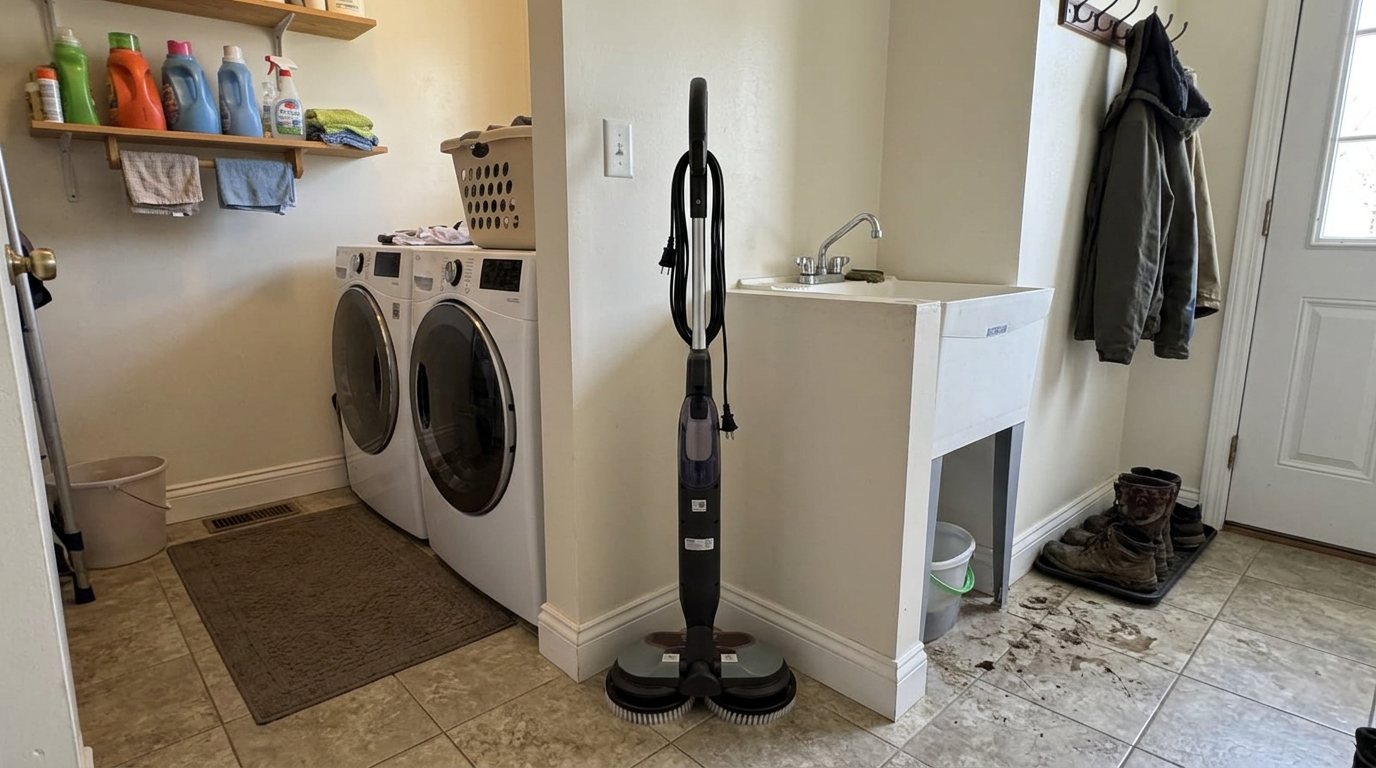

Emily Carter
Hands-on review
Hands-on testing, research, specs
3 weeks
26 minutes
Jargon helpNew to this kind of product? Tap any dotted term to see what it means.
In this review
Yes, if you want a steam mop that does the scrubbing for you. The Shark Steam & Scrub broke through dried soy sauce, muddy paw prints and sticky kitchen film using only water, and its spinning pads made mopping feel almost effortless. It cleaned right up to baseboards and under cabinet toe-kicks, and the pads washed clean in the machine. The small, non-removable tank needs frequent refills, there is no dry buffing mode, steam can strip floor polish and it has no wall hook. For homes with sealed hard floors, it is one of the easiest ways to get them truly clean.
Shark Steam & Scrub at a glance
Shark Steam & Scrub pros and cons
- Rotating pads lift dried spills
- Water only, no cleaner needed
- Excellent edge cleaning
- Small, non-removable tank
- No dry buffing or polishing mode
- No wall hook for storage
Who should buy the Shark Steam & Scrub?
- Busy family kitchens
- Pet owners with hard floors
- People who dislike scrubbing
- Large homes with lots of floor
- Unsealed wood floors
- People who want one tool to clean and polish
First impressions of the Shark Steam & Scrub
The Shark Steam & Scrub is a hard-floor steam mop with a twist: its two round pads spin as you push.
Steam loosens dirt while the rotating pads scrub it away, so you do less of the work yourself than with a standard steam mop.
It cleans with water only, with no floor cleaner needed.
Out of the box, it felt light and simple.
The handle clicks into the body, the pads attach underneath with hook-and-loop fasteners, and a single button chooses the cleaning mode.
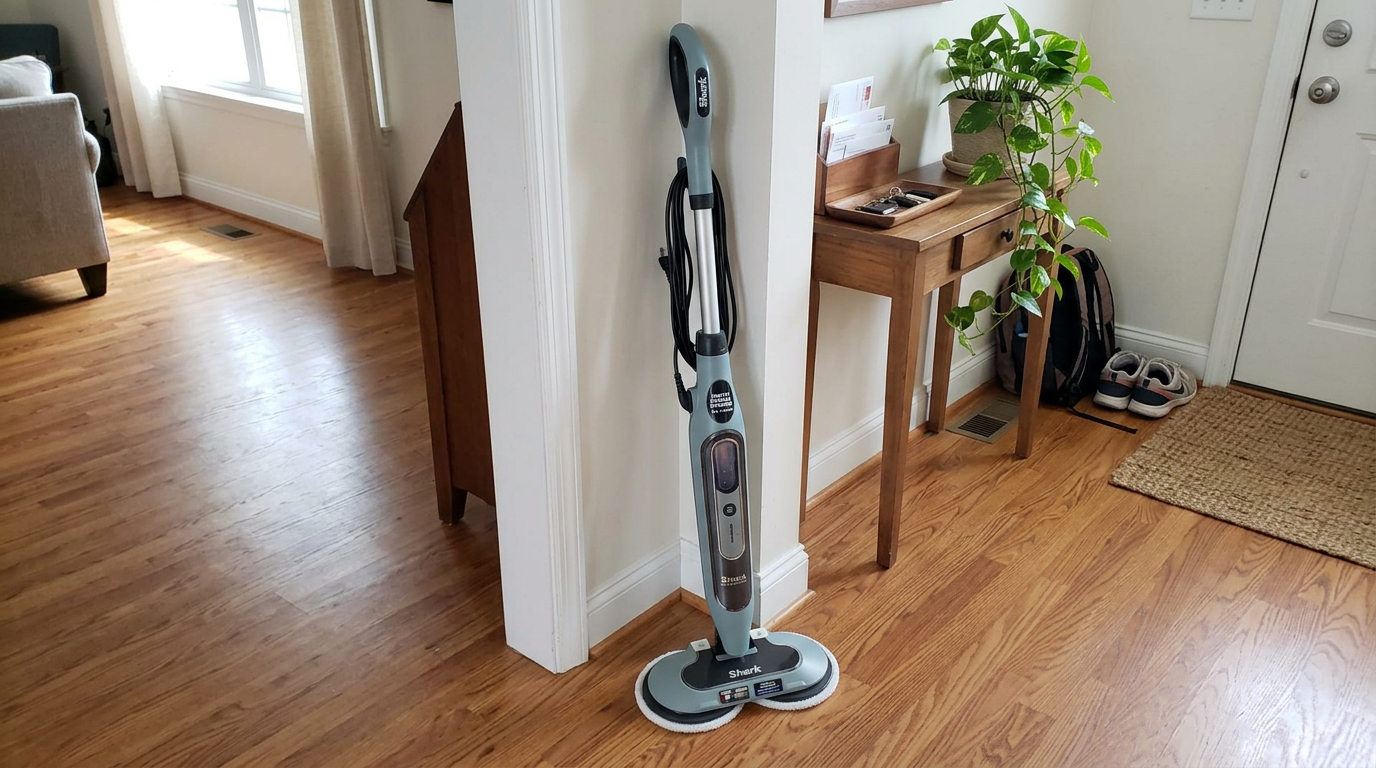
The Shark Steam & Scrub on my kitchen floor.
I tested it for three weeks on sealed laminate, porcelain tile and sealed vinyl plank in a busy family home with two children and a dog.
Our tip: Read the flooring manufacturer’s care guide before your first steam clean, because some sealed floors still have limits on heat and moisture that are worth knowing.
Setup and filling the tank
Setup took about five minutes.
I clicked the handle into place, pressed two pads onto the bottom and filled the tank.
The tank is built in, not removable.
You open a cap on the body and pour water in with the supplied fill cup.
One full cup brought the water close to the maximum line.
I used filtered water to reduce mineral buildup inside the mop.
| Setup step | Time | Notes |
|---|---|---|
| Attach handle | About 1 minute | Clicks into place |
| Attach pads | A few seconds | Self-centering |
| Fill tank | About 1 minute | Use the fill cup |
| Plug in and choose mode | A few seconds | One button |
| Heat up | About 1 minute | Usable while heating |
The mop took about a minute to reach full steam, but I could start pushing it while it heated.
Our tip: Fill the tank over the sink using the supplied cup, because pouring slowly into the small opening is much easier when spills can drain away.
How the rotating pads work
The two round pads spin in opposite directions underneath the mop head.
Steam flows down into the pads, and the spinning motion scrubs the floor as you push.
The motion gives the feeling that the mop is gliding.
It pulled itself forward slightly, so I barely had to push.
The pads are soft microfiber, not hard brushes.
They scrubbed firmly without scratching my laminate or tile.
They attach with hook-and-loop fasteners and are self-centering✕Self-centering padsPads shaped to settle into the correct position automatically when pressed onto the mop head, so they cannot be fitted off-center., so they always lined up correctly.
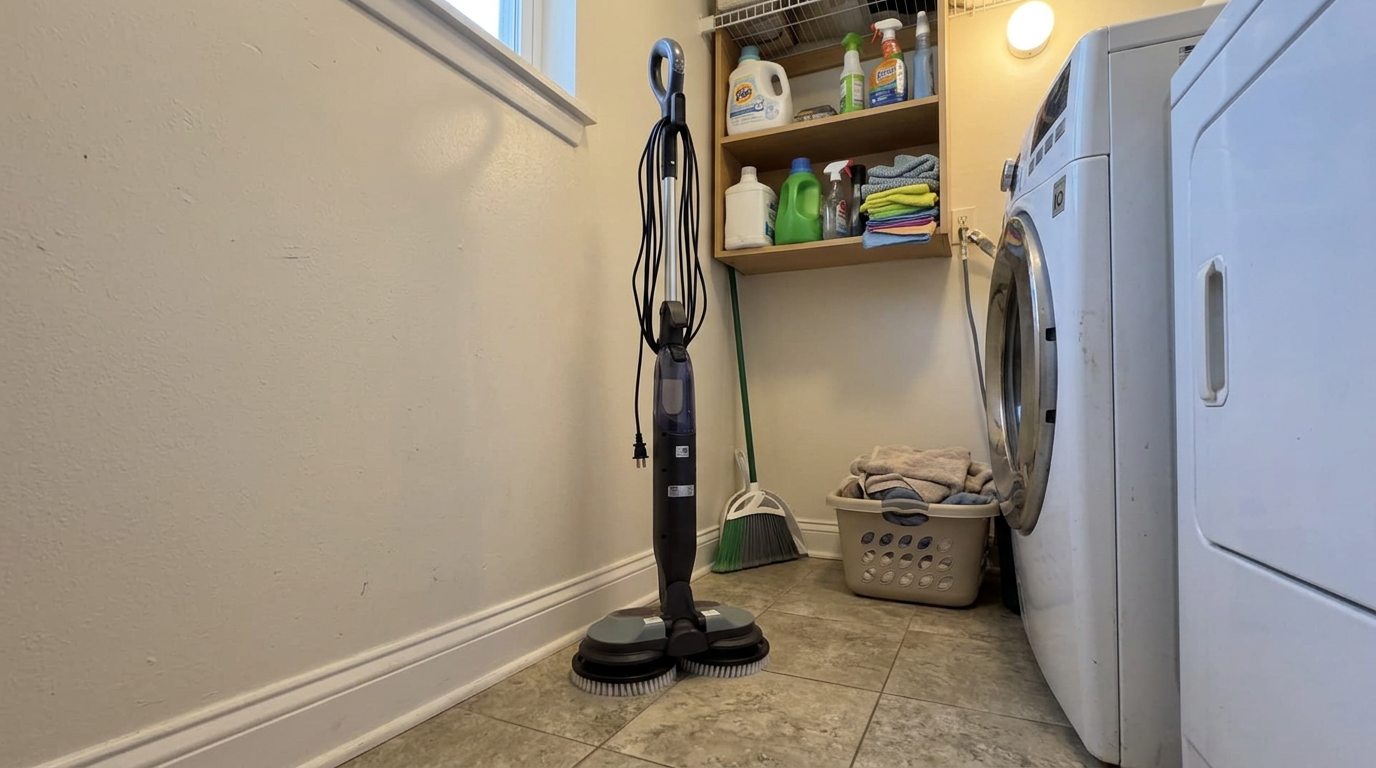
The two rotating pads scrub as you push.
Our tip: Press the pads firmly onto the mop head before switching it on, because a pad that is only partly attached can wobble or fly off when it starts spinning.
Light, Normal and Deep modes
A single button turns the mop on and cycles through three modes.
| Mode | Best for | What I noticed |
|---|---|---|
| Light | Quick touch-ups, lightly soiled floors | Gentle steam |
| Normal | Weekly cleaning | Good balance |
| Deep | Dried spills, sticky kitchens | Most steam and scrubbing |
I used Normal for weekly cleaning in most rooms.
Deep mode was best for the kitchen and entryway, where spills and mud dried on.
Light mode suited the bedroom and hallway, where the floor needed only a freshen-up.
Our tip: Use Light mode on floors that are only lightly soiled, because less steam means less moisture on the floor and a faster drying time.
Vacuum before you steam
Steam mops clean stuck-on dirt, not loose debris.
On my first try, I skipped vacuuming.
The pads pushed crumbs and dog hair around and turned dust into streaky grime.
After that, I always vacuumed first, paying attention to the edges, under cabinets and around the dog's food bowl.
The difference was clear.
With loose debris gone, the pads focused on dried-on dirt and stayed cleaner for longer.
Our tip: Vacuum or sweep thoroughly before steam mopping, because loose crumbs and hair turn into a smeary mess under wet pads and dirty them much faster.
Test one: dried soy sauce
For a tough test, I spread soy sauce across a section of the kitchen floor and let it dry overnight.
It dried into a dark, sticky film that a damp cloth only smeared.
On Deep mode, the rotating pads broke through the film quickly.
Within a few passes, most of it was gone.
Because the spill was large, one tank and one set of pads were not enough to remove every trace.
I switched to clean pads, refilled the tank and went over it again.
The second pass removed the remaining residue.
How much dried soy sauce was removed in my test.
Our tip: Keep a spare set of pads within reach when cleaning a very dirty floor, because saturated pads start spreading dirt instead of lifting it.
Test two: everyday grime
Even on floors that looked clean, the pads came up surprisingly dirty after a normal weekly clean.
In the hallway, which I had mopped by hand a week earlier, the pads turned gray within a few minutes.
Footprints, paw prints and the sticky film around the kitchen table all came up on Normal mode.
The floor felt noticeably cleaner underfoot afterward, with no tacky patches.
Everyday cleaning results on tile and laminate.
Our tip: Steam-mop high-traffic areas like hallways and kitchens every week, because invisible grime builds up quickly even when the floor looks clean.
Cleaning with water only
The mop uses only water, with no cleaning solution.
That suited my home with young children and a dog, because there was no chemical residue left on the floor.
The heat of the steam loosened grease and sticky spills, and the scrubbing removed them.
I did not miss floor cleaner at all.
The floors felt clean and residue-free.
It also meant one less product to buy and store.
Our tip: Use filtered or distilled water if you have hard tap water, because minerals can build up inside the mop over time and reduce steam output.
Edges, corners and under cabinets
Edge cleaning was one of the mop's strongest points.
The pads stick out slightly beyond the sides of the head, so they reached right up to baseboards and cabinet kick plates.
The head is low-profile.
It slid under my kitchen cabinets' toe-kick area and partway under the fridge.
Corners were the exception.
The round pads could not reach into the very tip of a 90-degree corner.
How well the mop cleaned edges and corners.
I wiped corners with a damp cloth once a week, which took a minute.
Our tip: Wipe room corners by hand every week or two, because round rotating pads cannot reach the very tip of a square corner.
A wide cleaning path
With the pads on, the cleaning path is just over 14 inches wide.
That covered a lot of floor with each pass.
My 200-square-foot kitchen took about eight minutes on Normal mode.
The open-plan living area took about 12 minutes.
| Area | Size | Time on Normal |
|---|---|---|
| Kitchen | About 200 sq ft | About 8 minutes |
| Hallway | About 80 sq ft | About 3 minutes |
| Living area | About 300 sq ft | About 12 minutes |
| Bathroom | About 50 sq ft | About 3 minutes |
A small tank meant I had to refill partway through larger rooms.
Our tip: Mop in overlapping rows from the far side of the room toward the door, because you avoid walking on damp floors and do not miss strips between passes.
Weight and maneuverability
The Steam & Scrub is light and easy to move.
It swiveled around table legs and chair bases easily and lay almost flat to reach under the couch.
Handling felt more like a light floor sweeper than a heavy steam cleaner.
The rotating pads helped, too.
Their motion pulled the mop along, which reduced arm effort on long cleaning sessions.
My partner, who usually avoids mopping, found it easy enough to use without complaint.
Our tip: Let the rotating pads do the work and guide the mop gently rather than pushing hard, because extra pressure does not clean better and makes the mop harder to steer.
The small built-in tank
The water tank was my biggest frustration.
It is small, so I refilled it about once every 10 to 12 minutes of cleaning on Normal, and more often on Deep.
Because it is not removable, I had to carry the mop to the sink or carry water to the mop.
Emptying leftover water also meant tipping the whole mop over the sink.
Approximate cleaning time per tank by mode.
A larger, removable tank would make the mop much more convenient for bigger homes.
Our tip: Keep a jug of filtered water near where you are cleaning, because refilling the small built-in tank on the spot is much quicker than walking back to the sink.
Washing and reusing the pads
The pads are machine-washable and reusable, which saves buying disposable pads.
For heavily soiled pads, I soaked them in warm water with an oxygen-based stain remover✕Oxygen-based stain removerA laundry soak that releases oxygen bubbles in water to loosen organic stains like food and dirt, without chlorine bleach. for an hour, then washed them on a normal cycle with regular detergent.
They came out clean and ready to use again.
I washed them with towels, skipped fabric softener and let them air-dry to keep the microfiber absorbent.
Having two sets of pads made it easy to swap out a dirty set mid-clean and wash them later.
Our tip: Skip fabric softener when washing the pads, because softener coats microfiber fibers and makes them less absorbent and less effective at lifting dirt.
Floor shine and finish
After the deep soy sauce clean, my laminate looked clean but noticeably duller.
The steam and scrubbing had removed some of the old floor polish along with the dirt.
The next day, a chalky haze appeared over part of the floor.
I worried the mop had damaged it, but another steam clean removed the haze.
I then applied a floor finish suitable for laminate.
The first product I tried left an uneven look, but a second one restored a rich shine that looked better than it had in years.
The lesson: steam cleaning can strip polish, so plan to reapply a finish that suits your floor.
Our tip: Test any floor finish on a small hidden area first, because different finishes react differently with each type of flooring and some can leave haze or streaks.
No dry scrubbing or polishing mode
The spinning pads look like they could buff a floor, but Shark warns against running the mop without water.
There is no mode to spin the pads without steam, so it cannot polish or dry-buff.
That felt like a missed opportunity.
A dry buffing mode would let one machine clean and then polish.
As it is, you need a separate method or tool to apply and buff floor finish.
Our tip: Never run the mop with an empty tank, because the manufacturer warns against operating it without water and it can damage the pads or motor.
Which floors it suits
The mop is designed for sealed hard floors only.
| Floor | Suitable | Notes |
|---|---|---|
| Sealed porcelain or ceramic tile | Yes | Excellent results |
| Sealed vinyl plank | Yes | Check maker’s guidance |
| Sealed laminate | With care | Keep moving, avoid seams soaking |
| Unsealed wood | No | Moisture can damage it |
| Carpet and rugs | No | Hard floors only |
Laminate needs extra care.
Moisture can seep into seams and edges and cause swelling, so I kept the mop moving at all times.
Leaving the mop in one spot concentrates heat and moisture.
I never let it sit running on the floor.
If your floor is damaged, worn or poorly sealed, steam may make problems worse.
Our tip: Keep the steam mop moving at all times on laminate, because leaving it in one spot concentrates heat and moisture that can seep into seams and cause swelling.
Storage and the power cord
Storage was less convenient than it could be.
There is no hook to hang it flat on a wall, so it took up floor space in my utility closet.
It does stand upright, but the wide head makes it awkward in a narrow space.
The power cord was a little short for my open-plan living area.
I had to switch outlets once to finish the room.
A longer cord and a wall hook would make a real difference.
Our tip: Remove the damp pads before storing the mop, because leaving them attached traps moisture and can cause smells or mildew between uses.
Living with pets and children
With a dog and two children, my floors see plenty of mess.
Muddy paw prints by the back door came up in one pass on Deep mode.
Sticky spots from juice and yogurt around the kitchen table were easy on Normal mode.
Water-only cleaning meant I did not worry about the dog or children walking on a floor treated with cleaning chemicals.
Floors dried within a few minutes, so the children could get back to playing quickly.
Our tip: Keep pets and children out of a freshly steamed room for a few minutes, because the floor is warm and slightly damp right after cleaning and can be slippery.
What I would change
The Steam & Scrub cleans very well, but a few design choices hold it back.
- Small, non-removable water tank
- No dry mode for buffing or polishing
- No wall hook for storage
- Power cord could be longer
- Round pads miss the tips of corners
None of these affected how clean my floors got.
They affected how convenient the mop was to live with.
A future version with a larger removable tank, a longer cord and a dry buffing mode would be excellent.
Our tip: Plan your cleaning route around outlets and the sink before you start, because a short cord and small tank are easier to manage with a little planning.
Why steam and scrubbing work together
Steam loosens dirt in two ways.
Heat softens sticky and greasy residue, and moisture breaks the bond between dried spills and the floor.
A standard steam mop relies on you to push back and forth over a stain until it lifts.
The rotating pads add constant mechanical agitation✕Mechanical agitationPhysical scrubbing motion, such as spinning pads or brushes, that helps break dirt away from a surface instead of relying on heat or chemicals alone., so the stain gets scrubbed many times in a single pass.
That is why the dried soy sauce came up so quickly.
The steam softened it, and the pads scrubbed it away before it could dry again.
It also explains why I needed so little floor cleaner: heat and motion did the work chemicals usually do.
Our tip: Pass slowly over tough spots on Deep mode instead of scrubbing back and forth, because the spinning pads scrub continuously and a slow pass gives the steam time to loosen dirt.
Cleaning bathroom tile
The bathroom was a good test for grout lines and tight spaces.
On porcelain tile, the pads lifted soap film and the dull gray haze near the shower.
Grout lines looked brighter after two passes on Deep mode, though deeply stained grout needed a separate scrub brush.
The low head reached around the base of the toilet better than I expected.
The rounded pads could not get into the tight gap behind it.
Floors dried in about five minutes with the window open.
Our tip: Run an extra slow pass along grout lines on Deep mode, because the rotating pads lift surface grime from grout better when they have more time over each line.
How quickly floors dry
Floors dried quickly after steam cleaning.
On Light mode, tile was dry in about two minutes.
On Normal, it took about three to four minutes, and on Deep, about five.
Laminate dried slightly faster than tile, because it holds less surface water.
Drying time on porcelain tile in a room at about 68°F.
Quick drying is important on laminate, where standing water can damage seams.
Our tip: Open a window or run a ceiling fan after deep steam cleaning, because better airflow dries floors faster and reduces the time moisture sits on seams.
Steam safety at home
Steam is hot, and a few simple habits kept my home safe.
- Keep children and pets away from the mop head while it is running
- Never point steam at people, pets or plants
- Unplug the mop before changing pads
- Let the pads cool for a minute before removing them
- Store the mop out of reach of small children
The pads and head get hot during use.
I always unplugged the mop and waited a minute before swapping pads.
The handle stayed cool throughout, which made it comfortable to use for long sessions.
Our tip: Unplug the mop and wait a minute before touching the pads, because the microfiber and head stay hot for a short time after the steam stops.
My weekly cleaning routine
By week three, I had a simple routine that kept my floors clean with little effort.
- Vacuum all hard floors, including edges and under furniture
- Fill the tank with filtered water
- Steam the kitchen and entryway on Deep mode
- Switch to fresh pads and steam hallways and living areas on Normal
- Do bathrooms last on Deep mode, then wash all pads together
The whole routine took about 40 minutes for my home, including refills.
Steaming once a week kept floors noticeably cleaner than my old weekly hand mopping.
Our tip: Steam the dirtiest rooms first and the cleanest last, because it keeps grime from the kitchen and entryway off the floors you have already cleaned.
Hard water and mineral buildup
Steam appliances can build up minerals inside when used with hard tap water.
Those minerals, often called scale✕ScaleHard white mineral deposits, mostly calcium, left behind when hard water is heated and evaporates inside appliances., can slowly clog steam paths and reduce output.
My area has moderately hard water, so I used filtered water for the whole test.
Steam output stayed strong and consistent from the first week to the last.
If you only have tap water, emptying the tank after each clean helps, because water left sitting inside leaves more deposits as it dries.
Our tip: Empty leftover water from the tank after each clean, because water left inside between uses leaves mineral deposits as it slowly evaporates.
Muddy entryway test
After a rainy weekend, my entryway tile was covered in dried muddy footprints and paw prints.
I vacuumed the loose grit first, then steamed on Deep mode.
Most prints came up in a single slow pass.
The heaviest patches by the door needed a second pass.
The pads turned brown quickly, so I swapped to a fresh set halfway through.
The tile looked as clean as the day it was laid, with no gritty film left behind.
Our tip: Vacuum grit and sand from entryways before steaming, because hard grit trapped under spinning pads can dull the surface of some floors over time.
A full kitchen deep clean
In week two, I gave the kitchen a full deep clean after a weekend of family cooking.
There were grease splatters near the stove, dried sauce under the table and sticky patches by the fridge.
On Deep mode, the grease near the stove lifted in two slow passes, and the steam left no oily film behind.
The dried sauce came up on the first pass, and the low head reached under the edge of the fridge and dishwasher.
I used one tank and two sets of pads for the whole kitchen, and the floor felt smooth and clean in bare feet afterward.
Our tip: Tackle grease near the stove with slow passes on Deep mode, because the extra steam softens cooking oil so the spinning pads can wipe it away without smearing.
My three weeks with the Shark Steam & Scrub
In week one, I set up the mop, learned the modes and tested it on everyday grime.
In week two, I tackled dried soy sauce, muddy paw prints and sticky kitchen spots.
In week three, I focused on floor shine, washing pads, storage and long cleaning sessions.
| Week | Focus | Main finding |
|---|---|---|
| 1 | Setup and everyday cleaning | Pads lift hidden grime |
| 2 | Tough stains | Dried spills gone with fresh pads |
| 3 | Shine, pads and storage | Strips polish, small tank, no hook |
Our tip: Wash both sets of pads at the end of each week, because starting every clean with fresh pads gives the best results and keeps them from smelling.
Is the Shark Steam & Scrub worth the money?
Yes, for homes with sealed hard floors that see sticky spills and muddy feet.
The rotating pads clean far better than a standard steam mop with much less effort.
The trade-offs are the small tank, the lack of a dry mode and awkward storage.
They make it less convenient, not less effective.
My category scores after three weeks.
How it compares with other ways to mop
| Feature | Shark Steam & Scrub | Standard steam mop | Spray mop | Bucket and mop |
|---|---|---|---|---|
| Scrubbing action | Rotating pads | You push | You push | You push |
| Cleans with | Water only | Water only | Cleaning solution | Water and cleaner |
| Dried spills | Excellent | Fair | Fair | Good with effort |
| Edge cleaning | Excellent | Fair | Fair | Good |
| Tank | Small, built-in | Varies | Small bottle | Bucket |
| Washable pads | Yes | Usually | Often | Mop head |
| Your priority | Fit | Why |
|---|---|---|
| Dried kitchen spills | Excellent | Deep mode and fresh pads |
| Everyday grime | Excellent | Normal mode |
| Edges and toe-kicks | Excellent | Pads extend past head |
| Large homes | Fair | Frequent refills |
| Polishing floors | Poor | No dry mode |
Which one is right for you: is the Shark Steam & Scrub your match?
4 quick questionsShark Steam & Scrub specifications
From manufacturer data, retailer listings and my own testing.
How I tested and scored the Shark Steam & Scrub
For three weeks, the Shark Steam & Scrub cleaned my kitchen, hallways, bathrooms and living area.
I tested it on sealed tile, laminate and vinyl plank with dried soy sauce, paw prints, sticky spills and everyday grime.
I timed cleaning and refills, checked edges and corners, washed pads and tested floor shine afterward.
- Cleaning power (9.2): lifts dried spills with water only.
- Ease of use (8.6): light and gliding.
- Convenience (6.6): small tank, no hook, short cord.
- Edge cleaning (8.8): close to baseboards, misses corner tips.
My test scores were: dried spills 9.4, everyday grime 9.2, edges 8.8, handling 8.8, pad washing 9.0, tank and refills 6.0, storage 6.4 and floor shine 6.8. The overall score of 8.1 is an editorial rating that reflects those results and three weeks of regular use.
Shark Steam & Scrub FAQ
Is the Shark Steam & Scrub worth it?
Yes, if you have sealed hard floors and want a steam mop that scrubs for you.
How does it work?
Steam loosens dirt while two rotating pads scrub it away as you push.
Does it need cleaning solution?
No. It cleans with water only.
What modes does it have?
Light, Normal and Deep.
How big is the water tank?
It is small and built in. I refilled it about every 10 to 12 minutes on Normal.
Is the tank removable?
No. You fill it with a cup and tip the mop to empty it.
Are the pads washable?
Yes. They are machine-washable and reusable.
Can it polish floors?
No. It cannot run without water, so there is no dry buffing mode.
Is it safe for laminate?
Only sealed laminate, used with care and kept moving.
Does it clean edges well?
Yes. The pads reach close to baseboards, but not into the tips of corners.
Can I use it on carpet?
No. It is for sealed hard floors only.
Does it hang on the wall?
No. It has no wall hook, so it needs floor space for storage.
Senior home appliance tester
Emily has tested home appliances for a living since 2016, first as a test coordinator at a national consumer advocacy group and, since 2021, at HouseholdMe. She has a degree in industrial design from Ohio State, so she looks at how a product is built, not just how it performs. She used the Shark Steam & Scrub at home for three weeks for this review.
- Three weeks of hands-on testing of the Shark Steam & Scrub
- Manufacturer product information and instruction manual