Shark NeverChange HP153 review
The Shark NeverChange Air Purifier HP153 promises years without a filter change, and its running costs really are among the lowest I've measured. In three weeks of testing, its laser sensor reacted fast, its side pre-filters were easy to clean and it stayed quiet on low. But its cleaning power is modest, it has little carbon for smells and no app, so it's best for a small room where low upkeep matters more than speed.

Emily Carter
Hands-on review
Hands-on testing, research, specs
3 weeks
25 minutes
Jargon helpNew to air purifiers? Tap any dotted term to see what it means.
In this review
Only if low upkeep is your top priority. The Shark HP153 has a fast laser sensor, clever side pre-filters, a filter rated for five years and some of the lowest running costs I've measured. But it cleans slowly for its size class, its small amount of carbon does little for smells, there's no app, and the scented odor cartridge is best removed. In a small bedroom or office it's a fuss-free choice; for a typical bedroom or larger, it's underpowered.
Shark HP153 at a glance
Shark HP153 pros and cons
- Very low running costs
- Easy-to-clean side pre-filters
- Fast, accurate laser sensor
- Modest cleaning power for its class
- Little carbon for odors and VOCs
- No app, and a strongly scented odor cartridge
Who should buy the Shark HP153?
- Small bedrooms, nurseries and offices
- People who never want to think about filters
- Anyone who wants low power use
- Standard bedrooms or larger rooms
- Kitchens, smokers and strong odors
- Fragrance-sensitive people who leave the cartridge in
First impressions of the Shark HP153
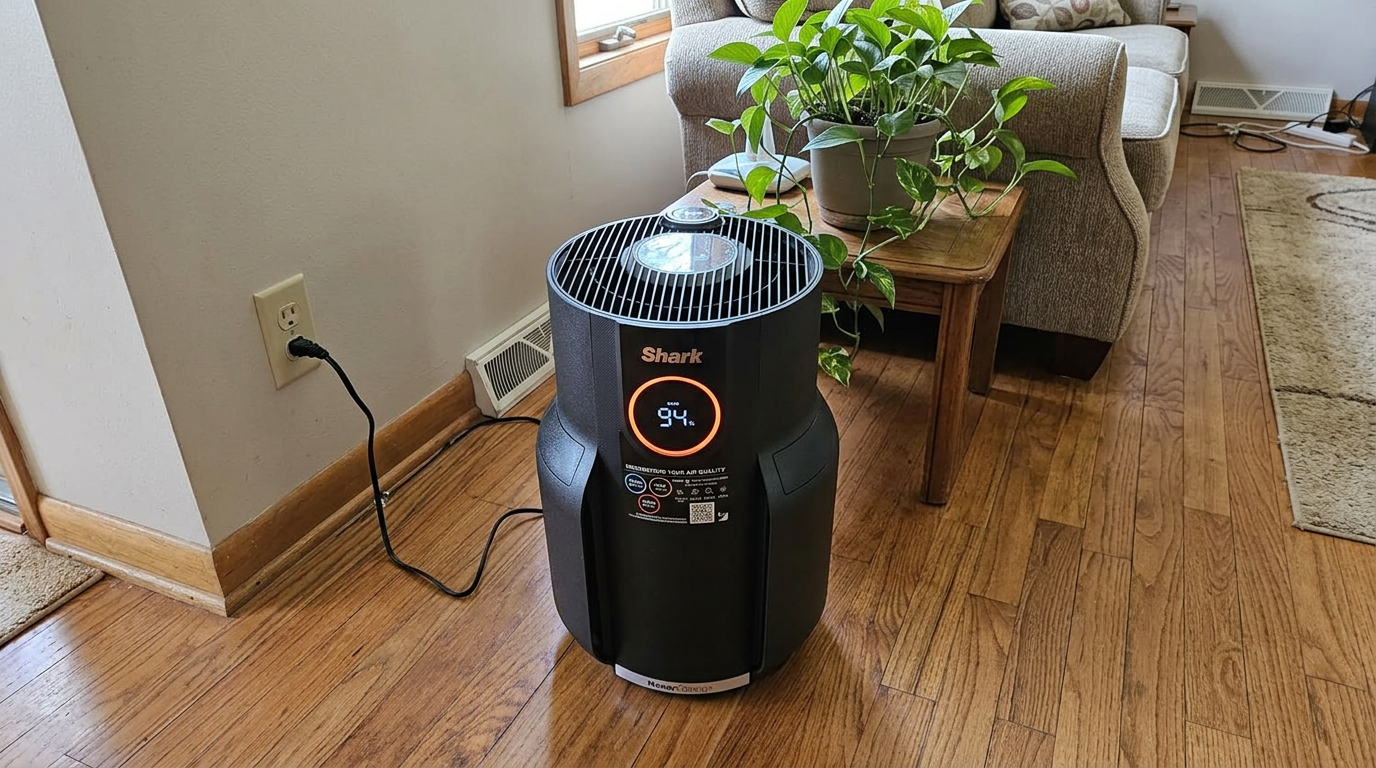
The Shark HP153 is the midsize model in Shark's NeverChange range, and it's a neat, compact cylinder about 15 inches tall.
The HP153 is the white version of this purifier, and apart from the color it's the same machine as its darker sibling.
It's light enough to carry with one hand and small enough to sit on a dresser or nightstand.
The front has a display showing air quality as a percentage of clean air, surrounded by a colored ring.
Two panels on the sides hide the pre-filters, which turned out to be one of my favorite design touches.
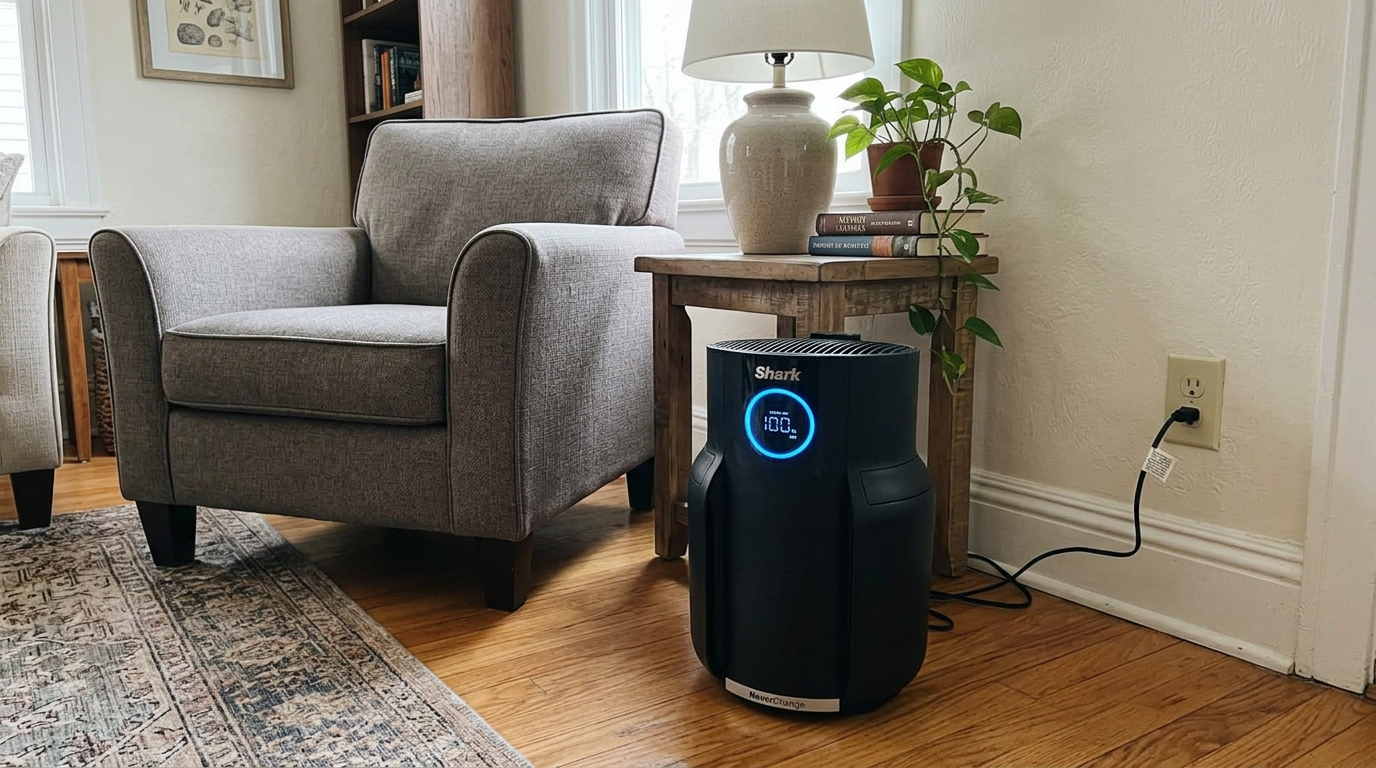
A compact cylinder that fits on a dresser or the floor.
Setting it up
Setup takes a few minutes.
To reach the main filter, you turn the purifier upside down and twist the bottom door counterclockwise to unlock it.
I removed the protective wrapping from the filter, put it back and locked the door.
Near the top is the odor neutralizer cartridge, which releases a fragrance.
I'll explain later why I turned it off within minutes.
| Step | What to do |
|---|---|
| 1 | Remove packaging and protective film |
| 2 | Turn the unit upside down |
| 3 | Twist the bottom door counterclockwise |
| 4 | Unwrap the filter and refit it |
| 5 | Lock the door and stand it upright |
| 6 | Decide whether to use the odor cartridge |
Our tip: Check that the bottom door clicks fully into place before you stand the purifier up, because a loose door lets air bypass the filter.
What the Shark HP153 actually is
Shark rates this purifier for up to 650 square feet, but that's based on one air change per hour✕Air changes per hour (ACH)How many times a purifier can filter the full volume of air in a room each hour. Four to five is a common target for allergies and smoke..
For allergies or pets, you want around five air changes per hour.
Its CADR✕CADRClean Air Delivery Rate: how many cubic feet of cleaned air a purifier delivers per minute. Higher means it cleans a room faster. is around 89 cubic feet per minute for smoke-sized particles on top speed, with third-party dust figures slightly higher.
At five air changes per hour, that covers a room of about 133 square feet on max.
On a quieter speed, the realistic room size drops to around 78 square feet, which is smaller than most bedrooms.
Real-world room sizes
| Fan speed | Approximate CADR | Room at 5 air changes/hr |
|---|---|---|
| Top speed | About 89 CFM | About 133 sq ft |
| Speed 2 (under 45 dB) | About 52 CFM | About 78 sq ft |
| Shark's rating | — | 650 sq ft at 1 air change/hr |
Our tip: Measure your room before buying, because at quiet speeds this purifier is really sized for a small bedroom, nursery or office of under 150 square feet.
How well it cleans
I tested how quickly the Shark HP153 cleared fine particles from a closed room of about 728 cubic feet.
On top speed, it took 68 minutes to bring fine particles back down to a clean level.
On speed 2, the fastest setting that stayed under 45 dB, it took 110 minutes.
Those are slow results for a purifier in this size class.
Many similar midsize purifiers deliver roughly twice the cleaning power, and even some older, smaller models beat it on a quiet speed.
Time to clear fine particles in my 728 cubic foot test room. Shorter is better.
In practice, that means it works best when it can run for a long time in a small, closed room.
It kept my small home office fresh, but it couldn't recover quickly after vacuuming or cooking smells drifted in.
The laser sensor and display
One area where the HP153 does well is its sensor.
It uses a laser particle sensor✕Laser particle sensorA sensor that shines a laser through sampled air and counts the particles by the light they scatter. It reacts faster and more accurately than older infrared sensors., which is more accurate and faster than the basic optical sensors in many purifiers.
It also doesn't need routine cleaning the way cheaper sensors often do.
In auto mode, it reacted within seconds when I lit a candle or shook out a rug.
Clean-air percentage
By default, the display shows air quality as a percentage of clean air.
I found that a little vague at first, because I'm used to seeing particle numbers.
Pressing the air info button switches to live readings for PM1, PM2.5 and PM10✕PM1, PM2.5, PM10Particle sizes in micrometers. PM1 and PM2.5 include smoke and fine pollution that reach deep into the lungs; PM10 includes larger dust and pollen., which is much more useful.
The color ring
A ring around the display glows blue for good air, yellow for fair and red for poor.
A pulsing red ring with a "check dust filters" message tells you when the pre-filters need cleaning.
| Ring color | Meaning |
|---|---|
| Blue | Good air quality |
| Yellow | Fair air quality |
| Red | Poor air quality |
| Pulsing red | Clean the pre-filters |
Our tip: Press the air info button to see the PM2.5 number, because it tells you far more about smoke and fine dust than the clean-air percentage does.
Controls
All controls are on the purifier itself, as there's no app.
At the top are buttons for air info, timer, display brightness, filter replacement and child lock.
Below those are the auto mode button and up and down arrows for the five fan speeds.
The power button sits at the bottom.
The controls are easy to learn, but the lack of an app stands out at this price level.
You can't check the air or switch it on from your phone, and there are no schedules beyond the timer.
Our tip: Dim the display with the brightness button before bed, because the colored ring is bright enough to light up a dark bedroom.
The filters and pre-filters
Side pre-filters
The HP153 has two removable mesh pre-filters, one on each side.
This is a smart design.
On many cylindrical purifiers, the pre-filter is attached to the main filter, so you have to pull the whole thing out to clean it, which can knock dust back into the room.
Here, I simply popped off the side panels, vacuumed the mesh and clicked them back in, without touching the main filter.
Main filter
The main filter combines HEPA✕HEPAA fine filter standard that captures at least 99.97% of particles 0.3 microns in size, including fine dust, pollen, pet dander and smoke. media with a layer of activated carbon✕Activated carbonCarbon treated to have a huge surface area full of tiny pores. It traps odors and gases such as cooking smells and VOCs that particle filters can't catch..
The particle filtration is fine, but the carbon content is small: about 90 grams, compared with around 250 grams in many similar purifiers.
That limits how well it handles smells and VOCs✕VOCsVolatile organic compounds: gases released by things like cleaning sprays, paint, new furniture and cooking. Some can irritate the eyes and lungs..
Approximate amount of activated carbon in the main filter.
| Part | What it does | Maintenance |
|---|---|---|
| Two side pre-filters | Catch hair, lint, large dust | Vacuum when the ring pulses red |
| HEPA media | Fine dust, pollen, dander, smoke | Rated up to 5 years |
| Carbon layer (about 90 g) | Light odors | Bonded to the main filter |
| Odor neutralizer | Adds fragrance | Optional cartridge |
Our tip: Vacuum the side pre-filters with a brush attachment as soon as the ring pulses red, because clogged pre-filters cut the already modest airflow even further.
Is the five-year filter claim realistic?
Shark rates the main filter for up to five years, compared with six to twelve months for many purifiers.
Its claim is based on a lab test assuming 12 hours of use a day.
For the particle filter, the side pre-filters genuinely help, because they stop the larger debris that clogs a HEPA filter early.
The carbon is a different story.
Activated carbon often becomes saturated or starts to smell after around six months in many purifiers.
Because the carbon here is bonded to the main filter, if it stops working or starts to smell, you'd have to replace the whole filter sooner than five years.
So I'd expect the full five years only in a home with light odors and no smoking.
My estimate based on the filter design and how carbon typically ages.
Our tip: Sniff the air coming out of the top every few months, because a musty smell is the first sign the carbon is tired and the filter needs replacing early.
The odor neutralizer
Near the top is an odor neutralizer cartridge, similar to the scent cartridges Shark uses in its vacuums.
It doesn't remove smells; it masks them with fragrance.
Within a few minutes of switching it on, I had a headache, so I turned the odor dial off and left it off for the rest of the test.
Even if you like the scent, adding fragrance to the air goes against the point of an air purifier.
If you're sensitive to scents or airborne chemicals, take the cartridge out on day one.
Our tip: Turn the odor neutralizer off before the first run, so you can judge the purifier's real effect on your air without fragrance getting in the way.
Noise levels
My test room had a background noise level of about 35 dB, so the lowest speed would likely be even quieter in a silent bedroom.
On top speed, I measured 59.1 dB, which is moderate and noticeably quieter than some larger purifiers.
Speed 2 was the fastest setting that stayed under 45 dB, which is a comfortable level for sleeping.
My sound meter readings.
The catch is that the quiet speeds are also the slow ones.
At speed 2, cleaning the test room took almost two hours, so quiet nights come at the cost of slow cleaning.
Our tip: Run top speed while you're out of the room and speed 2 while you sleep, so you get both clean air and a quiet night.
Power use and running costs
This is where the HP153 really shines.
Even running on top speed around the clock for a year, it would use about 228 kilowatt-hours.
That was the lowest yearly energy use of any purifier in my comparison group.
Combine that with a filter rated for five years and washable pre-filters, and the yearly running costs are some of the lowest you'll find.
Energy use at maximum continuous operation.
It's also very energy efficient overall, delivering good airflow for the power it draws.
The problem isn't efficiency; it's that the total airflow is modest.
Our tip: Don't be afraid to run it on top speed for long periods, because it uses so little power that the cost difference between high and low is tiny.
Maintenance
Day-to-day maintenance is simple.
When the ring pulses red and the display says "check dust filters", pop off the side panels and vacuum the mesh.
That's it for most of the year.
The main filter only needs replacing every few years, by turning the purifier upside down and twisting off the bottom door.
| Task | How often | Time needed |
|---|---|---|
| Vacuum side pre-filters | When the ring pulses red | 3 minutes |
| Wipe the outside | Monthly | 1 minute |
| Check the main filter for smells | Every few months | 1 minute |
| Replace the main filter | Rated up to 5 years | 5 minutes |
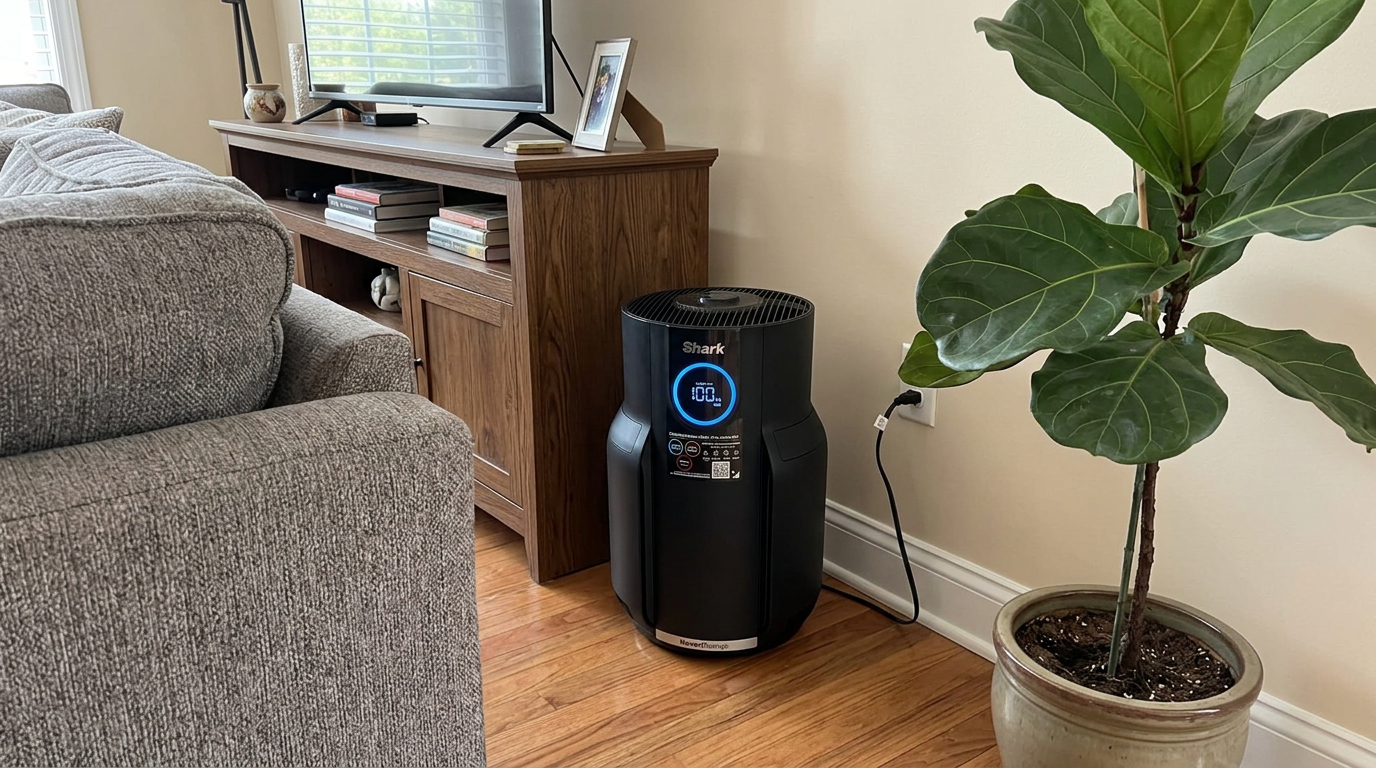
The side pre-filters come off without touching the main filter.
Where to put it
The HP153 draws air in through the sides and pushes it out the top.
Keep the side panels clear of curtains, walls and furniture so both pre-filters can breathe.
Because it's compact, a dresser or nightstand works well, as long as nothing is stacked on top.
Our tip: Close the door of the room it's cleaning, because with modest airflow it can't keep up with air coming in from the rest of the house.
Dust, allergies, pets and smells
Dust
In my small office, dust on the desk built up more slowly than usual, given enough running time.
Allergies
The HEPA media is designed to trap pollen and dander, and in a small, closed bedroom the air was consistently clean by morning.
Pets
The side pre-filters caught a good amount of dog hair, and they were easy to clean.
Smells
This is its weak spot.
With only about 90 grams of carbon, cooking smells and pet odor lingered longer than with purifiers that have more carbon.
| Problem | How the HP153 handles it | My rating |
|---|---|---|
| Dust in a small room | HEPA, given time | 7.5 |
| Pollen and dander | HEPA, closed room | 7.4 |
| Pet hair | Side pre-filters | 8.5 |
| Cooking and pet odors | Small carbon layer | 5.5 |
Our tip: Don't rely on this purifier for cooking smells, and use a range hood or open a window instead, because its small carbon layer is designed for light odors only.
Living with it in the bedroom
For one week, the Shark HP153 lived on a dresser in my 120 square foot spare bedroom.
That room size suits it well.
With the door closed and the purifier on top speed for an hour before bed, the air was clean when I lay down.
Overnight on speed 2, it was quiet enough that I stopped noticing it.
I dimmed the display, because the ring is bright in a dark room.
In my larger main bedroom, though, it took much longer to clean the air, and I wouldn't choose it for that room.
| Bedroom | Size | How it did |
|---|---|---|
| Spare bedroom | About 120 sq ft | Good fit |
| Main bedroom | About 200 sq ft | Too slow |
Living with it in the home office
My small office was another good match.
I left it in auto during the workday, and the laser sensor bumped up the speed whenever the dog shook herself or I used a cleaning wipe.
On top speed, it was audible but fine during calls.
The main frustration was waiting for it to clear the air after I'd vacuumed.
Share of a typical workday, from my testing notes.
Allergy season in a small room
If you're buying the Shark HP153 for allergies, the room size matters more than anything else.
In my small spare bedroom, with the door shut and the windows closed, the HEPA media kept the air consistently clean overnight.
The laser sensor helped too: it noticed when I came in from the garden with pollen on my clothes and nudged the fan up.
In the larger main bedroom, the same routine left the air noticeably less clean by morning.
So for allergy sufferers, I'd only recommend it for rooms well under 150 square feet.
| Allergy habit | Why it helps with this purifier |
|---|---|
| Close the bedroom door | Keeps the room within its modest airflow |
| Top speed before bed | Gives it time to clean the room |
| Change clothes outside the bedroom | Less pollen brought in |
| Wash bedding weekly | Removes allergens it can't reach |
Our tip: On high-pollen days, keep the windows shut and run top speed while you're out, because this purifier needs a head start to stay ahead of pollen.
What a year of ownership looks like
This is where the HP153 makes its case.
Over a year, you'll vacuum the side pre-filters maybe eight to twelve times, depending on dust and pets.
You won't need to buy any filters in a typical home.
And even at top speed, all day, every day, its electricity use stays at about 228 kilowatt-hours.
In my mostly-auto use, it would use far less than that.
My estimate for a typical small-room setup.
If you want an air purifier you can almost forget about, this is its biggest strength.
The trade-off is simply that it does less work per hour than many rivals.
Design details I liked and didn't
What I liked
The side pre-filters are the best part of the design, and they make maintenance clean and quick.
The compact size makes it easy to place and carry.
The laser sensor and detailed particle readouts are better than I expected.
What I didn't
Turning the unit upside down to change the main filter is awkward.
The scented odor cartridge feels unnecessary.
And the clean-air percentage isn't as informative as a plain particle number.
- Removable side pre-filters
- Compact size
- Laser sensor and PM readouts
- Upside-down filter access
- Scented cartridge
- Vague default readout
What surprised me
How cheap it is to run
I knew it was efficient, but seeing it rank lowest for energy use among the purifiers I compared was still a surprise.
How slow it is
I expected a midsize purifier to clear a small room faster than 68 minutes on top speed.
The headache
I didn't expect a fragrance cartridge in an air purifier, let alone one strong enough to give me a headache within minutes.
From my testing notes.
How to get the best results
Use it in a closed room of under 150 square feet.
Run top speed for an hour before you need the room, then switch to a quiet speed.
Turn off the odor neutralizer.
Vacuum the side pre-filters whenever the ring pulses red.
And check the main filter for smells every few months.
All my test results in one place
| Test | Result | My rating |
|---|---|---|
| Particle clearing, top speed | 68 minutes in 728 cu ft | 6.2 |
| Particle clearing, speed 2 | 110 minutes | 5.5 |
| Top speed noise | 59.1 dB | 7.8 |
| Sensor response | Seconds | 9.0 |
| Energy use | About 228 kWh a year at max 24/7 | 9.6 |
| Carbon content | About 90 g | 5.0 |
What daily use is really like
Over three weeks, the Shark HP153 moved between my spare bedroom, my office and, for a couple of days, my main bedroom.
It ran in auto most of the time, with top speed before bed and speed 2 overnight.
The odor cartridge stayed off after the first few minutes.
I vacuumed the side pre-filters once, when the ring pulsed red after about two weeks with the dog around.
Otherwise, I barely touched it, which is the whole point of this purifier.
A typical day began with the purifier on speed 2 in the spare bedroom, where the ring was usually blue by morning.
After breakfast, I carried it to the office and left it in auto.
The laser sensor reacted whenever I opened the window onto the street or the dog came in from the garden, and the ring briefly turned yellow.
On top speed, it took a while to bring the ring back to blue, especially after I'd vacuumed.
In the evening, it went back to the bedroom, with the timer set for an hour on top speed before switching down for the night.
I dimmed the display before turning out the lights, because the colored ring otherwise glows across the room.
It's not exciting to live with, but it's easy, and in a small room that's a real strength.
The only time I wished for more was on the day I cooked fish and the smell drifted upstairs: it was still faintly there the next morning.
Share of running time from my testing notes.
Three weeks with the HP153, week by week
Week 1: testing and the cartridge
The slow cleaning results and the headache from the scent cartridge were a disappointing start.
Week 2: finding the right room
In the small spare bedroom and office, with the door closed, it settled into a useful routine.
Week 3: low-effort living
One pre-filter clean and nothing else, with tiny power use.
From my testing notes.
Common mistakes to avoid
| Mistake | What happens | Better habit |
|---|---|---|
| Trusting the 650 sq ft rating | Slow cleaning in big rooms | Use it in rooms under 150 sq ft |
| Leaving the odor cartridge on | Added fragrance, possible headaches | Switch it off |
| Ignoring the pulsing ring | Lower airflow | Vacuum the side pre-filters |
| Using it for cooking smells | Odors linger | Range hood or window |
| Leaving the door open | Can't keep up | Close the room |
| Expecting five years regardless | Tired carbon, musty smell | Check for smells every few months |
What I would change
More airflow would make it suitable for a standard bedroom.
More carbon would make it useful for smells.
And an app, or at least schedules, would fit its price class better.
I'd also like the main filter door moved somewhere you can reach without turning the purifier upside down.
It's not a big job, but on a dresser it means lifting the unit down to the floor first, and any dust inside the base can fall out as you flip it.
Finally, I'd drop the fragrance cartridge altogether and use that space for more carbon, which would fix its biggest weakness in one move.
None of these are deal-breakers for a small room, but together they explain why it doesn't score higher.
Three households, three verdicts
The small nursery or spare room
A small, closed room and a desire for almost no upkeep.
A good fit.
The standard main bedroom
Around 200 square feet, often with the door open.
Too slow to clean properly at quiet speeds.
The cooking-and-pets household
Strong smells and lots of dander.
Not the right choice, mainly because of the small carbon layer.
| Household | Fit | Main reason |
|---|---|---|
| Small bedroom or nursery | Good | Low upkeep, quiet on low |
| Low running cost seekers | Excellent | Very low energy use |
| Standard bedroom or larger | Poor | Modest cleaning power |
| Odors and smoke | Poor | Little carbon |
Is the Shark HP153 worth the money?
It depends on what you value.
If you care most about long-term running costs and minimal maintenance, it delivers: very low energy use, a long-life filter and easy pre-filter cleaning.
If you care about cleaning power, it's underpowered for its class.
Many similar midsize purifiers offer around twice the cleaning power, more carbon or an app.
Three questions to ask:
Is your room under about 150 square feet?
Do you value low upkeep over fast cleaning?
And are smells a minor concern for you?
How it compares with other types of purifier
| Feature | Shark HP153 | Typical midsize purifier | Typical compact purifier |
|---|---|---|---|
| CADR on max | About 89 CFM | Often 150–200 CFM | Often 80–130 CFM |
| Carbon | About 90 g | Often around 250 g | Varies |
| Filter life | Rated up to 5 years | Often 6–12 months | Often 6–12 months |
| Sensor | Laser | Varies | Often basic |
| App | No | Often | Sometimes |
| Energy use | Very low | Moderate | Low |
| Your priority | Is the HP153 a fit? | Why |
|---|---|---|
| Low running costs | Excellent | Very low energy, long-life filter |
| Easy maintenance | Excellent | Side pre-filters |
| Fast cleaning | Poor | Modest CADR |
| Odor removal | Poor | Little carbon |
| App control | Not available | On-unit controls only |
Which one is right for you: is the Shark HP153 your match?
4 quick questionsShark HP153 specifications
From manufacturer data, retailer listings and my own testing.
How I tested and scored the Shark HP153
For three weeks, the Shark HP153 ran in my spare bedroom, home office and main bedroom.
I timed how long it took to clear fine particles from a closed 728 cubic foot room on top speed and on speed 2, using a separate air quality monitor.
I measured noise with a sound meter, calculated yearly energy use at maximum, weighed up the carbon content and tested the odor cartridge.
I also cleaned the side pre-filters and removed the main filter.
Finally, I checked my notes against Shark's specifications.
- Running costs (9.5): very low energy use and a long-life filter.
- Ease of upkeep (9.0): side pre-filters and rare filter changes.
- Air cleaning (6.2): slow for its size class.
- Odor removal (5.5): little carbon and a scented cartridge.
The overall score of 7.6 is an editorial rating that reflects those four areas.
Shark HP153 FAQ
Is the Shark HP153 worth it?
Only if low upkeep and running costs matter most and you have a small room. It's underpowered for a standard bedroom or larger.
What's the difference between the HP153 and HP152?
The HP153 is the white version; the HP152 is the darker version. They're otherwise the same purifier.
How big a room does it cover?
Shark rates it for 650 square feet at one air change per hour. For allergies, it's best in rooms of about 78 to 133 square feet.
Does the filter really last five years?
Shark rates it for up to five years. The carbon may tire sooner in homes with cooking, pet or smoke smells.
Can I clean the pre-filters?
Yes. The two side pre-filters come off without removing the main filter and can be vacuumed.
How loud is it?
I measured 59.1 dB on top speed, and speed 2 stays under 45 dB.
Does it have an app?
No. All controls are on the purifier.
Should I use the odor neutralizer?
I'd turn it off. It adds fragrance rather than removing smells, and it gave me a headache.
How good is it with smells?
Not great. It has only about 90 grams of carbon.
How much power does it use?
Very little: about 228 kWh a year even at top speed around the clock.
What sensor does it use?
A laser particle sensor, with PM1, PM2.5 and PM10 readouts.
How do I change the main filter?
Turn the unit upside down, twist the bottom door counterclockwise and lift out the filter.
Senior home appliance tester
Emily has tested home appliances for a living since 2016, first as a test coordinator at a national consumer advocacy group and, since 2021, at HouseholdMe. She has a degree in industrial design from Ohio State, so she looks at how a product is built, not just how it performs. She tested the Shark HP153 in her bedrooms and home office for three weeks for this review.
- Three weeks of hands-on testing of the Shark HP153
- Shark NeverChange product information and specifications