Ninja PossibleCooker PRO 8.5 qt review
The Ninja Foodi PossibleCooker PRO 8-in-1 Multi-Cooker (8.5 qt) is a big slow cooker at heart, with searing, steaming, sous vide, braising, baking and proofing added on top. I used it for three weeks for a nine-hour pot roast, a whole chicken, a frittata, cookies, croissants and frozen pizza. Slow-cooked meals were tender and easy, searing in the same pot saved a pan and pizza on the rack came out crisp. Baking straight on the pot bottom burned cookies and pastry, the bake temperatures are limited and several metal parts get very hot. As a large family slow cooker with useful extras, it is a strong choice.

Emily Carter
Hands-on review
Hands-on testing, research, specs
3 weeks
26 minutes
Jargon helpNew to multi-cookers? Tap any dotted term to see what it means.
In this review
Yes, if you mainly want a large slow cooker and like the idea of searing, steaming, sous vide and proofing in the same pot. The Ninja PossibleCooker PRO made a tender nine-hour pot roast, cooked a whole chicken with almost no effort and baked crisp frozen pizza on the rack. The 8.5-quart pot is big enough for family meals and goes into the oven. Baking directly on the pot bottom is unreliable, the bake temperature steps skip common settings, the cord is short and the lid rim and pot handles get very hot. Treat it as a slow cooker with bonus functions, and it delivers.
Ninja PossibleCooker PRO at a glance
Ninja PossibleCooker PRO pros and cons
- Excellent, easy slow cooking in a big 8.5-quart pot
- Sear and sauté in the same pot before slow cooking
- Pot is oven-safe to 500°F and goes straight to the table
- Baking on the pot bottom burns cookies and pastry
- Bake temperatures skip 275, 325 and 375°F
- Lid rim, pot handles and inner metal get very hot
Who should buy the Ninja PossibleCooker PRO?
- Families who slow cook roasts, stews and soups
- Cooks who want to sear without an extra pan
- Home bakers who need a warm spot to proof dough
- Anyone wanting oven-style baking
- Small kitchens with little counter space
- Kitchens with outlets far from the counter
First impressions of the PossibleCooker PRO
The PossibleCooker PRO is a big appliance.
With the side handles, it is about 18 inches wide and around 12.5 inches deep, so it needs a real spot on the counter.
The matte housing looks smart and the glass lid with a stainless steel rim feels sturdy.
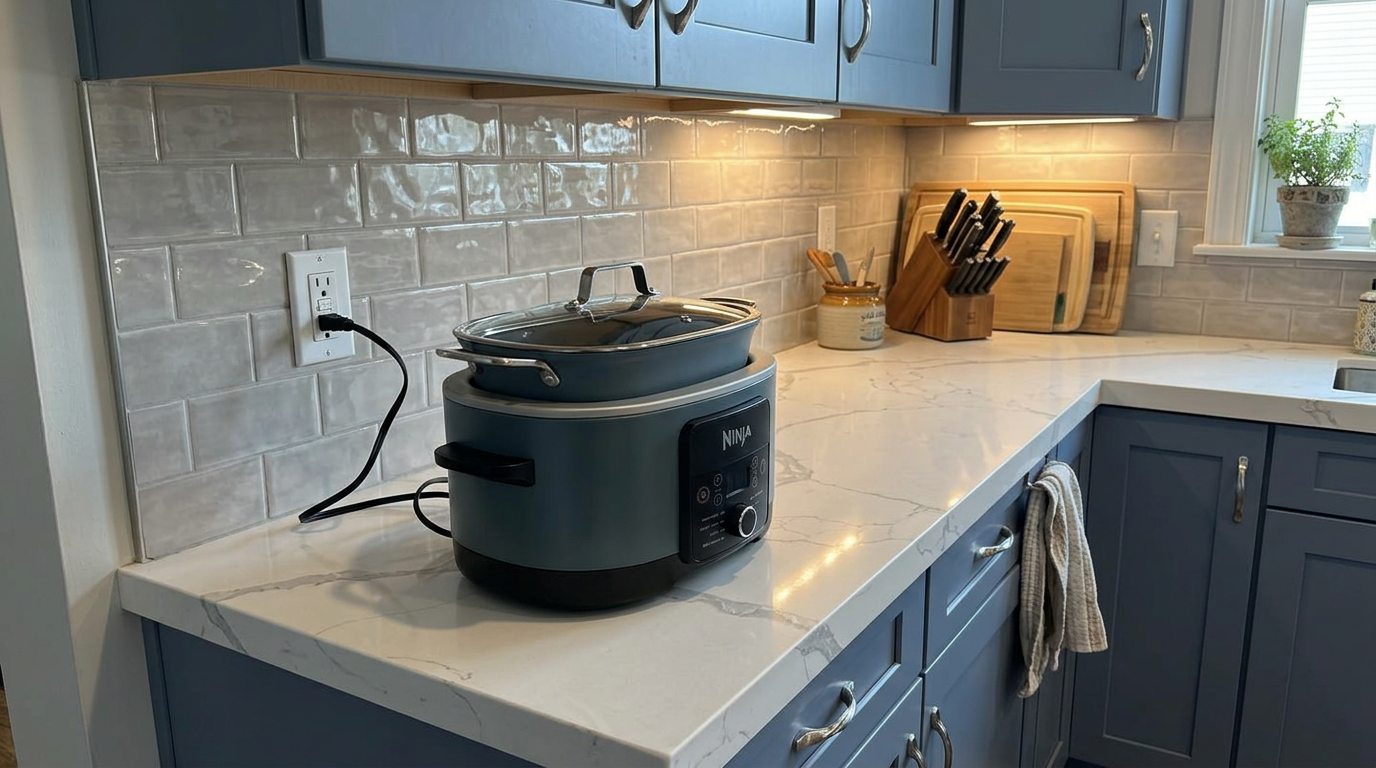
The base, the 8.5-quart pot, the glass lid and the built-in serving utensil.
Inside sits the removable 8.5-quart pot with a nonstick interior and stainless steel handles.
The control panel is simple: a central dial for the function, buttons for temperature and time, and a start/stop button.
I had the first meal going within ten minutes of unboxing.
My package included a stainless steel rack.
Not every retailer includes one, but after my baking tests, I would call it essential.
Our tip: Measure the spot where the cooker will live before you unpack it, because it is about 18 inches wide with the handles and the 30-inch cord limits how far it can sit from an outlet.
Design, size and build quality
The housing has thick walls that hold the heating elements.
Heat comes from both the bottom and the sides of the cooking chamber, which Ninja calls Triple Fusion Heat✕Triple Fusion HeatNinja’s name for combining bottom heat, side heat and steam to cook food more evenly and quickly than bottom-only slow cookers..
In slow cooking, that gave me very even results from edge to center.
A small safety switch checks that the pot is seated correctly.
If the pot is not in place, the cooker simply will not heat.
I found that reassuring, especially with a pot this heavy.
The plastic side handles stay cool, which makes it easy to slide the base across the counter.
The removable pot sits with a little room inside the housing, and after three weeks, I noticed light cosmetic marks on its outer finish.
Nothing serious, but worth knowing if you care about looks.
| Detail | What I found |
|---|---|
| Width | About 18 in with handles |
| Depth | About 12.5 in with the control knob |
| Height | About 14.25 in with the utensil on the lid |
| Power | 1,200 watts, 120 volts |
| Cord | About 30 in, on the short side |
| Side handles | Plastic, stay cool |
Our tip: Lift the pot straight up and out instead of dragging it against the housing, because the small gap between the two lets the pot rub on the way out and that is how the cosmetic scratches start.
Controls and the eight cooking functions
There are eight functions: Slow Cook, Sear/Sauté, Steam, Sous Vide, Braise, Bake, Proof and Keep Warm.
You turn the dial to pick one, adjust temperature and time, then press start.
Tapping changes time in steps, and holding the button speeds it up.
| Function | Temperature | Time |
|---|---|---|
| Slow Cook | Low or High | 3 to 12 hours, 15-minute steps |
| Sear/Sauté | Low or High | No timer |
| Steam | Fixed | Up to about 60 minutes |
| Sous Vide | 120 to 190°F | Hours and minutes, 15-minute steps |
| Braise | Fixed | 15-minute steps |
| Bake | 250, 300, 350, 400 or 425°F | Minutes |
| Proof | 90 to 105°F | 5-minute steps |
| Keep Warm | Fixed | About 3 hours after slow cooking |
It is easy to learn, and I never needed the manual after the first day.
The only real frustration was the Bake steps, which jump from 300 to 350 to 400°F and skip the common settings in between.
Our tip: Round down to the nearest available bake temperature and add a few minutes, because the cooker heats the pot directly and running a little cooler is safer than burning the bottom of your food.
Slow cooking: the main event
Slow cooking is what this machine is built for, and it shows.
There are two settings, Low and High, with times from three to twelve hours.
When the cycle ends, it switches to Keep Warm automatically for about three hours.
Because heat comes from the bottom and sides, food cooked evenly, with no cold center or scorched edges.
The glass lid let me check progress without lifting it and losing heat.
I ran it for long stretches while I was out, and it never needed attention.
Slow-cook times from my testing.
Our tip: Fill the pot between half and two-thirds full for slow cooking, because too little food overcooks and dries out while an overfull pot takes much longer to come up to a safe temperature.
Nine-hour pot roast test
For my first big test, I seasoned a chuck roast and browned it on Sear/Sauté High.
The pot got properly hot, and I had a deep brown crust in a few minutes per side.
Then I added stock, potatoes and vegetables and switched to Slow Cook.
After about nine hours, the roast fell apart under a fork.
The vegetables were soft but not mushy, and the broth was rich from the browned bits on the bottom of the pot.
It was a very good pot roast.
To be fair, it was not dramatically better than a classic slow cooker would make.
The real gain was convenience: one pot for browning and slow cooking, and one pot to wash.
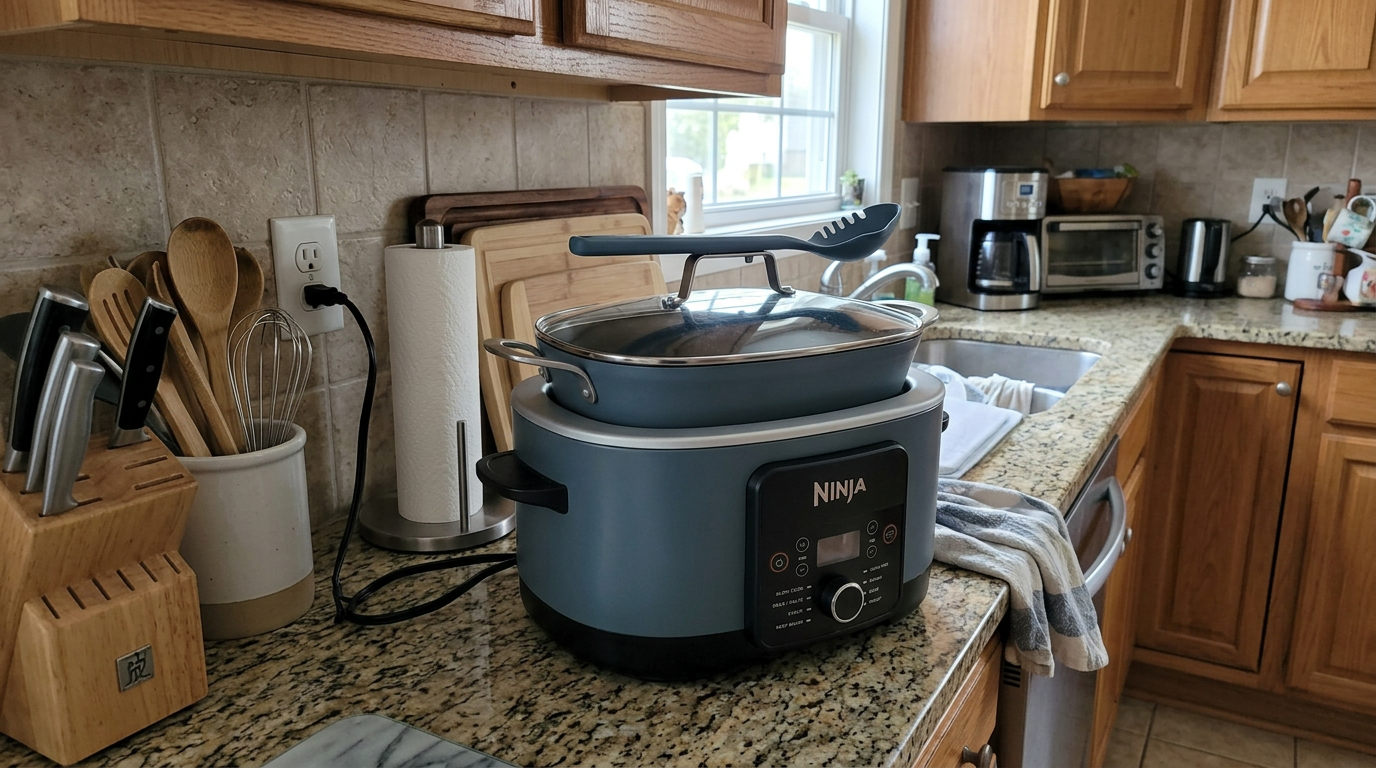
Searing and slow cooking happen in the same 8.5-quart pot.
Our tip: Deglaze the pot with a splash of stock right after searing and scrape up the brown bits, because those bits carry most of the flavor into the slow-cooking liquid.
Slow-cooked whole chicken
Next, I put the rack in the pot, poured in some chicken stock and set a seasoned whole chicken on top.
I set Slow Cook to High for about four and a half hours and walked away.
The chicken was fully cooked and easy to carve.
The meat was good, though slightly dry, probably because I used High instead of a longer cook on Low.
The skin stayed soft, which is normal for slow cooking.
If you want crispy skin, slow cooking is the wrong method.
Because the pot is oven-safe to 500°F, I tried finishing the chicken in my oven for ten minutes, and the skin crisped up nicely.
Our tip: Cook whole chicken on Low for longer instead of on High, because the gentler heat keeps the breast meat juicier and you can still crisp the skin afterward in a hot oven.
Searing and sautéing in the pot
Sear/Sauté has two settings, Low and High, and no timer.
That makes sense, because you should stand at the pot while browning.
High was hot enough for a good crust on beef, and Low worked well for softening onions and garlic.
Being able to brown and then slow cook in the same pot is the feature I used most.
It saved me a skillet nearly every day and gave my stews and chili a deeper flavor.
Our tip: Use a wooden or silicone spatula when searing, because metal tools can scratch the nonstick coating and a damaged coating should not be cooked on.
Sous vide, steam and braise
The sous vide✕Sous videA cooking method where food is sealed in a bag and cooked in a water bath held at a precise, low temperature for even doneness. setting holds water between 120 and 190°F.
I cooked sealed salmon portions with herbs at a gentle temperature, and they came out evenly cooked from edge to center.
For a built-in function, it was impressively steady.
Steam runs up to about 60 minutes with no temperature control.
I steamed broccoli and dumplings on the rack, and both were fine.
Braise has a fixed heat with 15-minute time steps.
It is a good middle ground between searing and slow cooking for tougher cuts and stews.
| Function | What I made | Result |
|---|---|---|
| Sous vide | Salmon with herbs | Even, tender, flaky |
| Steam | Broccoli and dumplings | Cooked well on the rack |
| Braise | Short ribs | Tender in a few hours |
Our tip: Clip sous vide bags to the pot rim so they stay fully under the water, because a floating bag cooks unevenly and the top part can end up below a safe temperature.
Baking a vegetable and bacon frittata
For my first bake, I made a vegetable and bacon frittata from the included recipe guide.
It took just under an hour.
It tasted good, but it showed me how this cooker bakes.
The outside developed a dark crust, close to burned but not quite.
The pot is heated directly from the bottom and sides, so the pot itself gets hotter than the air around the food.
That is the opposite of an oven, where hot air surrounds the food.
The top browned slowly because heat escapes through the glass lid.
The final frittata was enjoyable, but the result was less predictable than oven baking.
Our tip: Line the pot with parchment and use the lower bake setting for egg dishes, because the hot pot walls brown the sides fast and a little insulation evens out the cooking.
Baking refrigerated croissants
I tried store-bought refrigerated croissant dough next.
Directly on the pot bottom, the croissants burned underneath before the tops were done, so that batch went in the bin.
On the rack, with a light spray of oil on the rack only, they were much better.
The bottoms turned crisp and the croissants cooked evenly, though the tops stayed paler than I wanted.
They were still flaky and enjoyable.
Our tip: Spray cooking oil onto the rack outside the pot, never inside it, because spray that lands on the nonstick coating leaves a sticky residue that is hard to remove and hurts its performance.
Frozen pizza on the rack
Frozen pizza was the surprise success of my baking tests.
A personal-size frozen pizza on the rack cooked evenly in about the time on the box.
The crust was crisp, the cheese melted and the pepperoni was cooked through.
Next, I fit two mini frozen pizzas side by side on the rack.
The box said 375°F, which the cooker does not offer, so I used 350°F and added a few minutes.
Both came out crunchy and evenly cooked.
Baking results from my tests.
Our tip: Preheat the cooker on Bake for five minutes with the rack inside before adding pizza, because a hot rack crisps the crust from the first minute instead of letting it go soft.
Proofing bread dough
The Proof setting runs from 90 to 105°F in five-minute steps.
Many ovens cannot hold a temperature that low, so this was genuinely useful.
I proofed a bowl of bread dough inside the pot with the lid on.
It doubled in a little over an hour, faster and more evenly than on my cool winter counter.
Our tip: Proof dough in a separate bowl placed inside the pot rather than directly on the nonstick surface, because the bowl makes it easy to lift the dough out without stretching or deflating it.
The nonstick pot and how to care for it
The pot has a PTFE nonstick coating✕PTFE nonstick coatingA slick, synthetic nonstick surface. It releases food easily but scratches if you use metal tools or abrasive scrubbers, and should be replaced if it chips or peels. rather than a ceramic or porcelain interior.
It releases food well and wipes clean easily.
It also needs care.
Avoid metal utensils and abrasive pads, and do not cook on a coating that is chipped or flaking.
The rack’s bare metal feet also sit directly on the coating, so I put a folded silicone mat under it during baking.
The pot is rated oven-safe to 500°F.
I stayed well below that and followed the manual’s guidance for the coating.
Our tip: Put a thin silicone trivet under the rack’s feet, because the bare stainless steel feet rest directly on the nonstick coating and can scratch it over time.
Hot surfaces and safety
This cooker gets hot in places you might not expect.
The stainless steel rim on the glass lid becomes extremely hot, and so do the pot handles and the metal around the cooking chamber.
The warning symbols are small and easy to miss.
- Always use oven mitts on the lid and the pot handles.
- Only the plastic side handles on the base stay cool.
- Rest the hot lid on a trivet, not on the counter.
- Keep children away from the cooker while it runs.
Our tip: Keep a pair of silicone oven mitts right next to the cooker, because the lid rim and pot handles get hot enough to burn and it is easy to grab the lid out of habit.
The utensil, lid and cord
The included utensil is a hard black plastic spoon, ladle and fork-like edge in one.
It clips into a notch on the lid, which is handy.
But its pouring lip is shaped for left-handed use, which felt awkward to me.
The glass lid has a small steam vent and a riveted handle.
It lets you watch the food, but it also lets heat escape during baking.
The 30-inch cord is short.
I had to move the cooker closer to an outlet than I would have liked.
Our tip: Plan the cooker’s spot around your outlets rather than reaching for an extension cord, because the manufacturer’s safety guidance matters with a 1,200-watt appliance running for many hours.
Cleaning and care
Cleaning was easy for such a big cooker.
The nonstick pot wiped clean after most meals with warm soapy water and a soft sponge.
The glass lid and utensil can go in the dishwasher.
For baked-on bits after searing, I soaked the pot with warm water for 15 minutes first.
The housing only needs a wipe with a damp cloth once it is cool.
Our tip: Let the pot cool before washing it, because plunging a hot nonstick pot into cold water can warp it and shorten the life of the coating.
Cooker to oven to table
Because the pot is oven-safe to 500°F, you can finish dishes in a regular oven.
I used this for the whole chicken, a cheesy pasta bake and a braise that I wanted to brown on top.
Ten minutes under high heat gave each one the crisp finish the cooker cannot.
The matte pot also looks good enough to put on the table.
Serving straight from it meant one less dish to wash, which I came to appreciate on busy nights.
Our tip: Move the pot to the oven with both hands in oven mitts and set it on a sheet pan, because the full 8.5-quart pot is heavy and the sheet pan makes it easier and safer to slide out again.
Capacity and big-batch cooking
The 8.5-quart pot is the cooker’s best feature for families.
I fit a four-pound roast with vegetables, a whole chicken on the rack and a full batch of chili for eight with room to spare.
| Dish | How much fit | Servings |
|---|---|---|
| Pot roast with vegetables | About 4 lb meat plus vegetables | 6 to 8 |
| Whole chicken on the rack | One medium chicken | 4 to 6 |
| Chili | Full family batch | 8 |
| Soup | Large pot | 8 to 10 |
For a couple, it can be more pot than you need.
Small amounts cook fine, but the cooker takes the same counter space either way.
Our tip: Freeze leftovers from big batches in flat, portion-size bags, because the 8.5-quart pot makes more than most families eat in one meal and flat bags thaw quickly for a second dinner.
Power use and running it all day
The cooker draws up to 1,200 watts at its peak, mostly when searing or baking.
Slow cooking uses far less on average once the pot is up to temperature.
If you plan to run more than one high-power appliance at the same time, check your circuit.
Two units on one circuit is usually manageable, but stacking several high-draw appliances can trip a breaker.
Our tip: Do not run the cooker on the same outlet strip as a kettle or toaster, because combined peaks of over 1,200 watts each can overload a single circuit and trip the breaker mid-cook.
Keep Warm and planning your day
When a slow-cook cycle ends, the cooker drops to Keep Warm on its own for about three hours.
That buffer made weekday dinners much easier.
I could start a stew at 8 in the morning and still serve it hot well after my planned dinner time.
The Keep Warm time cannot be adjusted on most functions, so it is not a reason to leave food for longer.
For the best texture, I aimed to serve within an hour or so of the cycle ending.
| Start time | Setting | Ready | Warm until |
|---|---|---|---|
| 8:00 a.m. | Low, 9 hours | 5:00 p.m. | About 8:00 p.m. |
| 11:00 a.m. | High, 5 hours | 4:00 p.m. | About 7:00 p.m. |
| 2:00 p.m. | High, 3 hours | 5:00 p.m. | About 8:00 p.m. |
Our tip: Work backward from dinner time when you set the timer, because the automatic Keep Warm gives you a safety margin but food that sits warm for hours slowly loses texture.
The dishes it does best
After three weeks, a clear pattern emerged.
The cooker excels at anything that likes long, gentle, moist heat and benefits from browning first.
| Dish | How well it worked | Best function |
|---|---|---|
| Pot roast | Excellent | Sear, then Slow Cook Low |
| Beef stew and chili | Excellent | Sear, then Slow Cook |
| Short ribs | Excellent | Sear, then Braise✕BraiseA cooking method where food is browned first, then cooked slowly in a small amount of liquid with the lid on, which softens tougher cuts of meat. |
| Pulled pork | Very good | Slow Cook Low |
| Soups | Very good | Sauté, then Slow Cook |
| Sous vide fish | Very good | Sous Vide |
| Frozen pizza | Very good | Bake on the rack |
| Cookies and pastry | Fair | Bake on the rack, small batches |
If most of your weekly meals sit near the top of that table, this cooker will feel like a real upgrade.
If most sit near the bottom, an oven is still the better tool.
Our tip: Use the Braise function for tougher, cheaper cuts like chuck and short ribs, because the steady moist heat breaks down the connective tissue and turns them meltingly tender.
A typical Sunday with the PossibleCooker PRO
By week two, Sundays had a routine.
In the morning, I seared a roast or short ribs, added vegetables and stock and switched to Slow Cook Low.
Then I left the house for the day.
When I came back, dinner was ready and still warm.
I lifted the meat out, reduced the juices on Sear/Sauté High for a few minutes to thicken the sauce and served from the pot.
Leftovers went straight into containers for two weekday lunches.
That is the real strength of this cooker.
It turns a big, slow family meal into something that takes 20 minutes of hands-on work.
Our tip: Reduce the cooking liquid on Sear/Sauté High after slow cooking, because a few minutes of hard simmering turns thin broth into a glossy sauce without needing a separate saucepan.
My three weeks with the PossibleCooker PRO
In week one, I focused on slow cooking: the pot roast, the whole chicken, a beef stew and a chili.
Every one came out well, and I quickly trusted the cooker to run while I was out.
In week two, I tested the extras: sous vide salmon, steamed vegetables, braised short ribs and bread proofing.
They all worked, with sous vide and proofing the most useful additions.
In week three, I baked: the frittata, cookies, croissants and frozen pizza.
This was where the cooker needed the most workarounds, and where the rack proved essential.
| Week | Focus | Main finding |
|---|---|---|
| 1 | Slow cooking | Reliable, tender, low effort |
| 2 | Sous vide, steam, braise, proof | Useful extras that work well |
| 3 | Baking | Use the rack, or results burn |
Our tip: Start with the functions you already use most, because getting comfortable with slow cooking and searing first makes the trickier baking workarounds much easier to judge.
Troubleshooting what I ran into
A few problems came up, and each one had a simple fix.
| Problem | Cause | Fix |
|---|---|---|
| Cooker will not heat | Pot not seated on the safety switch | Lift and reseat the pot |
| Burned cookie bottoms | Baking on the hot pot bottom | Bake on the foil-covered rack |
| Meat steamed instead of browned | Pot too crowded | Sear in batches on High |
| Slightly dry chicken | Cooked on High | Use Low for longer |
| Pale tops on pastry | Heat escapes through the glass lid | Finish under the oven broiler |
Our tip: Reseat the pot firmly if the display lights but nothing heats, because the safety switch needs the pot to sit fully down before the heating elements turn on.
Storage and counter space
This is not a cooker you tuck away easily.
It is wide, deep and heavy, and the lid with the utensil adds height.
I kept it on the counter for the full three weeks.
If you must store it, the lid sits upside down inside the pot and the utensil fits inside too.
Choose a low cupboard, because lifting it to a high shelf is awkward.
Our tip: Store the rack inside the pot on a folded towel, because the towel keeps the bare metal feet from scratching the nonstick coating while it sits in the cupboard.
Who it suits in real life
The PossibleCooker PRO suits families who already love slow cooking and want more from one appliance.
If you make roasts, stews, chili and soups every week, it will earn its counter space.
It is less ideal if you want an oven replacement.
You can bake on the rack, but in small amounts and with care.
If you already own a good oven, a steamer and a sous vide stick, some of the extras add less value.
Couples can still enjoy it, especially if they like cooking once and eating twice.
A full pot of stew or chili gives you dinner tonight and several easy lunches or freezer meals for later in the week.
Just make sure you have the counter space to keep it out, because a cooker you have to dig out of a cupboard rarely gets used.
Our tip: Buy this cooker for its slow-cooking and searing first and treat every other function as a bonus, because that is where it shines and where your expectations will be met every time.
Is the Ninja PossibleCooker PRO worth the money?
Yes, if slow cooking is your priority.
It is a big, even, reliable slow cooker, and being able to sear, steam, braise, sous vide and proof in the same pot adds real everyday value.
The trade-offs are baking, heat management and accessories.
Baking needs the rack, the temperature steps are limited, metal parts get very hot and the cord is short.
If baking is your main reason to buy, look elsewhere.
My category scores after three weeks.
How it compares with other kitchen tools
| Feature | PossibleCooker PRO | Basic slow cooker | Dutch oven | Countertop oven |
|---|---|---|---|---|
| Slow cooking | Excellent | Excellent | Good, on the stove or in the oven | No |
| Sear in the same pot | Yes | Usually no | Yes | No |
| Sous vide | Built in | No | No | No |
| Baking | Fair, on the rack | No | Good, in an oven | Excellent |
| Proofing | Built in | No | No | Some models |
| Capacity | 8.5 qt | Varies | Varies | Small |
| Your priority | Fit | Why |
|---|---|---|
| Family slow cooking | Excellent | Big, even pot |
| One-pot meals | Excellent | Sear and slow cook together |
| Sous vide | Very good | Steady water bath |
| Baking cookies and pastry | Fair | Rack required, small space |
| Small kitchens | Fair | Large footprint |
Which one is right for you: is the Ninja PossibleCooker PRO your match?
4 quick questionsNinja PossibleCooker PRO specifications
From manufacturer data, retailer listings and my own testing.
How I tested and scored the Ninja PossibleCooker PRO
For three weeks, the Ninja PossibleCooker PRO was my main cooker.
I ran structured tests for slow cooking (pot roast, whole chicken, stew, chili), the extra functions (sous vide, steam, braise, proof) and baking (frittata, cookies, croissants, frozen pizza).
I noted times, checked doneness and texture, and cleaned the pot after every use.
- Slow cooking (9.0): even heat, tender results, automatic Keep Warm.
- Ease of use (8.4): simple dial and buttons, easy cleaning, but hot metal parts.
- Versatility (8.0): eight functions, oven-safe pot.
- Baking (6.4): good on the rack, poor on the pot bottom, limited temperatures.
My test scores were: pot roast 9.0, frozen pizza 9.0, sous vide salmon 8.6, whole chicken 8.0, cookies on the rack 7.5 and frittata 6.5. The overall score of 7.9 is an editorial rating that reflects those results and three weeks of daily use.
Ninja PossibleCooker PRO FAQ
Is the Ninja PossibleCooker PRO worth it?
Yes, if you mainly want a large slow cooker. It slow cooks evenly, lets you sear in the same pot and adds steam, sous vide, braise, bake and proof functions.
How big is the PossibleCooker PRO?
The pot holds 8.5 quarts, and the base is about 18 inches wide including the side handles, so it needs a good amount of counter space.
Can you sear in the PossibleCooker PRO?
Yes. Sear/Sauté has Low and High settings, and High browned beef well. Sear in batches so the meat does not steam.
How long can it slow cook?
Slow Cook runs from 3 to 12 hours on Low or High, then switches to Keep Warm for about 3 hours.
Is the pot oven-safe?
Yes, the removable pot is rated oven-safe up to 500°F, so you can finish dishes in the oven and serve from it.
Can you bake in it?
Yes, but bake on the rack. Directly on the pot bottom, cookies and croissants burned, while frozen pizza and cookies on the rack came out well.
What bake temperatures does it offer?
250, 300, 350, 400 and 425°F. Settings like 275, 325 and 375°F are missing, so round down and add a few minutes.
Does it do sous vide?
Yes. The water bath holds 120 to 190°F, and sous vide salmon came out evenly cooked in my test.
What kind of coating does the pot have?
A synthetic nonstick coating. Use wooden or silicone tools, avoid abrasive pads and stop using the pot if the coating chips.
Which parts get hot?
The stainless steel lid rim, the pot handles and the metal around the cooking chamber. Use oven mitts. The plastic side handles on the base stay cool.
How long is the cord?
About 30 inches, which is fairly short, so plan its spot near an outlet.
Is it easy to clean?
Yes. The nonstick pot wipes clean, and the glass lid and utensil are dishwasher-safe. Wipe the base with a damp cloth.
Senior home appliance tester
Emily has tested home appliances for a living since 2016, first as a test coordinator at a national consumer advocacy group and, since 2021, at HouseholdMe. She has a degree in industrial design from Ohio State, so she looks at how a product is built, not just how it performs. She used the Ninja PossibleCooker PRO as her main cooker for three weeks for this review.
- Three weeks of hands-on testing of the Ninja PossibleCooker PRO
- Ninja product information and owner’s guide