Ninja Crispi Pro review
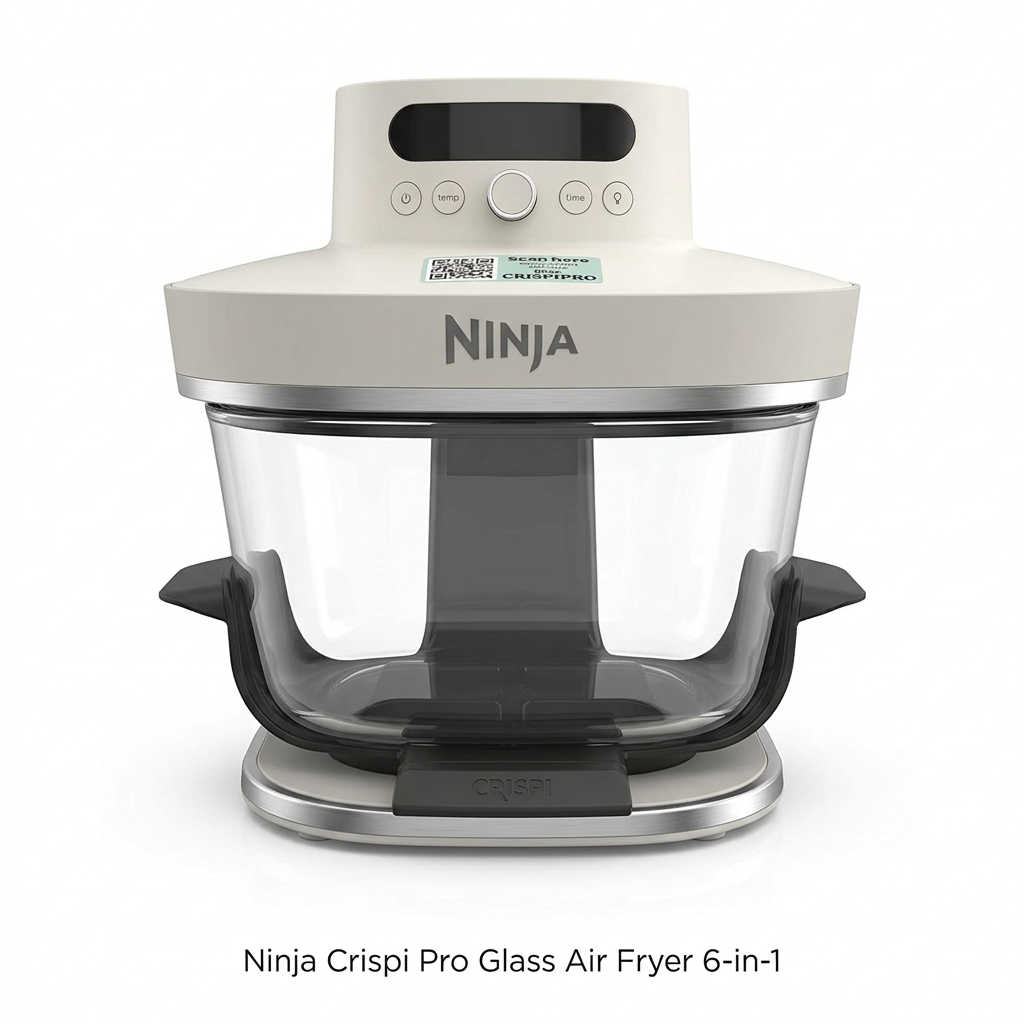
The Ninja Crispi Pro Glass Air Fryer 6-in-1 swaps the usual nonstick basket for two glass containers, a 6-quart and a 2.5-quart, that click under one modular heating base. In three weeks it handled wings, fries, a 6-pound whole chicken, cookies and dried strawberries without a single failed cook. It is big on the counter and in the cupboard, and a couple of control quirks need learning.

Emily Carter
Hands-on review
Hands-on testing, research, specs
3 weeks
25 minutes
Jargon helpNew to air fryers? Tap any dotted term to see what it means.
In this review
Yes, if you have the counter and cupboard space for it. The Ninja Crispi Pro cooked everything I threw at it well, from 13-minute fries to a 6-pound roast chicken, and its glass containers go from fridge to air fryer to table to dishwasher without a single nonstick surface to baby. You get six modes and adjustable temperature on most of them. You also get a bulky machine, a roast timer that stops at 59 minutes and no 4-quart container in the box.
Ninja Crispi Pro at a glance
Ninja Crispi Pro pros and cons
- Even, crisp results in all six modes
- Glass containers go from fridge to air fryer to dishwasher
- Fits a 6-pound whole chicken
- Bulky on the counter and in the cupboard
- Roast timer stops at 59 minutes
- 4-quart container not included
Who should buy the Ninja Crispi Pro?
- Families who roast whole chickens and big batches
- Meal preppers who store food in the same dish
- Anyone who wants to avoid nonstick coatings
- Small kitchens with little counter space
- Cooks who drop and bang their cookware
- People who want one-touch smart programs
First impressions of the Ninja Crispi Pro
Most air fryers hide your food in a dark metal drawer.
You pull it out, shake it, push it back and guess.
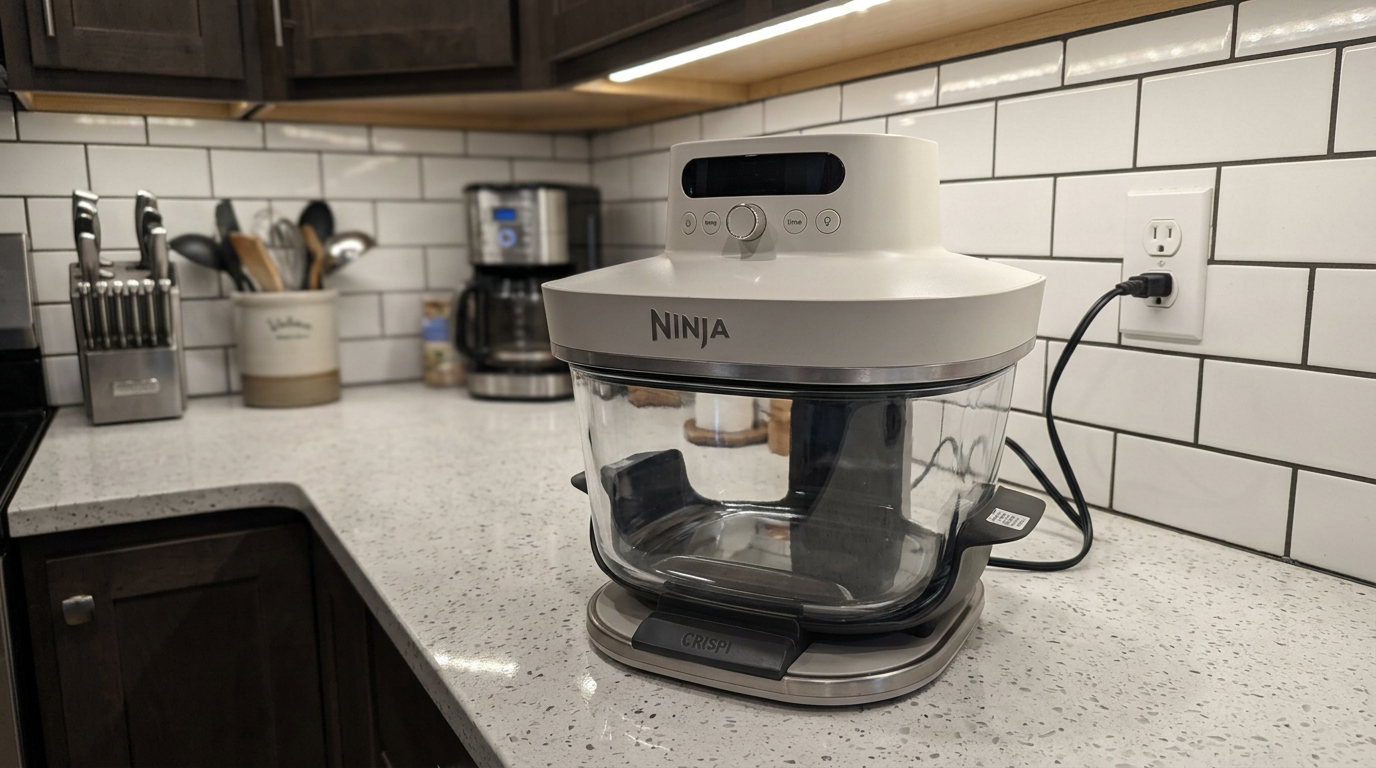
The Ninja Crispi Pro does the opposite: the food sits in a clear glass container under a heating base, and you watch it brown.
That one change shaped my whole three weeks with it.
I stopped opening the air fryer to check on things, because I could see them.
Out of the box, it felt solid.
The handles are comfortable and easy to grip, nothing creaked or flexed, and the glass is thick and reassuringly heavy.
The box holds a removable heating base, a 6-quart glass container, a 2.5-quart glass container, two identical crisper plates and two storage lids.
The second thing I noticed was the size.
With the big container fitted, it took over a good chunk of my counter, and storing the base plus both containers needed a proper cupboard shelf.
By the end of the first week, though, my family had stopped calling it "the air fryer" and started calling it "the glass one", which in our house is a compliment.
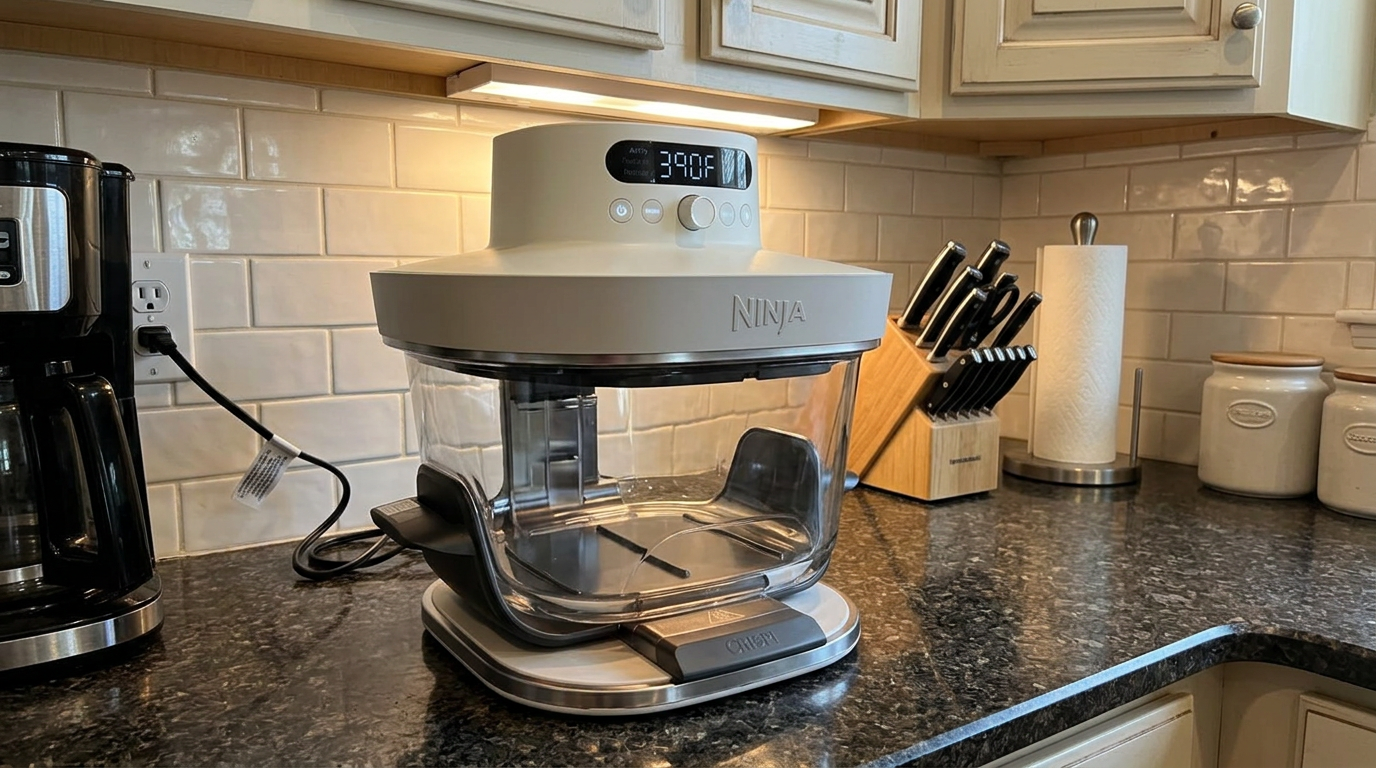
Through the glass, you can see exactly how brown the food is without opening anything.
What the Ninja Crispi Pro actually is
The Crispi Pro is an air fryer split into two parts.
The top part is a modular base with the fan, the heating element and the controls.
The bottom part is a glass container that holds the food.
You set the base on top of whichever container you want, and it clicks into place.
Like every air fryer, it is really a small, powerful convection oven✕Convection ovenAn oven with a fan that blows hot air around the food. Moving air carries heat faster than still air, so food browns and crisps more quickly..
An 1,800-watt heater and a fan push hot air down and around the food, which sits on a crisper plate so the air can reach the underside.
The six modes
| Mode | What it is for | Temperature adjustable? |
|---|---|---|
| Max Crisp | Frozen foods, nachos, finishing cheese | No, fixed at its top heat |
| Air Fry | Everyday cooking, wings, vegetables | Yes, even mid-cook |
| Roast | Whole chicken, large cuts, trays of vegetables | Yes |
| Bake | Cookies, small cakes, bread | Yes |
| Recrisp | Leftovers and takeout | Yes |
| Dehydrate | Fruit, herbs, jerky | Yes, 80–195°F / 27–91°C |
What's in the box
You get the modular heating base, the 6-quart and 2.5-quart CleanCrisp glass containers, two crisper plates, two storage lids and a recipe book.
The modular base also has a slot for a 4-quart container, but that container is not included.
Our tip: Wash both containers and crisper plates before the first cook, and run the base empty for a few minutes to burn off any factory smell.
Ninja Crispi Pro design and build
Ninja lists the Ninja Crispi Pro at about 11 × 11.8 × 12.2 inches, or roughly 28 × 30 × 31 cm, and 11.4 pounds, about 5.2 kg.
Those numbers undersell how much room it takes in real life.
The glass containers are wide, the handles stick out, and you need space around the base for the hot air to escape.
The glass
Both containers are made of glass that resists thermal shock✕Thermal shockStress that happens when glass heats or cools very quickly. Ordinary glass can crack from it; thermal-shock-resistant glass is made to handle sudden temperature changes., so you can take a container out of the fridge and cook in it straight away.
I cooked frozen fries in it straight from the freezer bag and had no problems.
Retailer listings say the glassware is heat-safe up to 550°F, or about 288°C, and both dishwasher-safe and microwave-safe.
The glass gets extremely hot after cooking, so treat it like a casserole dish fresh out of the oven.
Surface-safe feet
Each container sits on heat-safe feet, so you can put a hot container straight down on the table or counter.
I set it down on my granite and on a wooden table with a mat, and it never left a mark.
Build quality
Nothing on the base feels brittle or likely to snap.
The handles are solid, and the containers slide in and out of the base easily while still holding firmly.
The weak point is the obvious one: it is glass, and a hard knock on a tiled floor would be the end of it.
Our tip: Measure the shelf where you will store it before you buy, because the base and the two containers together need more room than most air fryers.
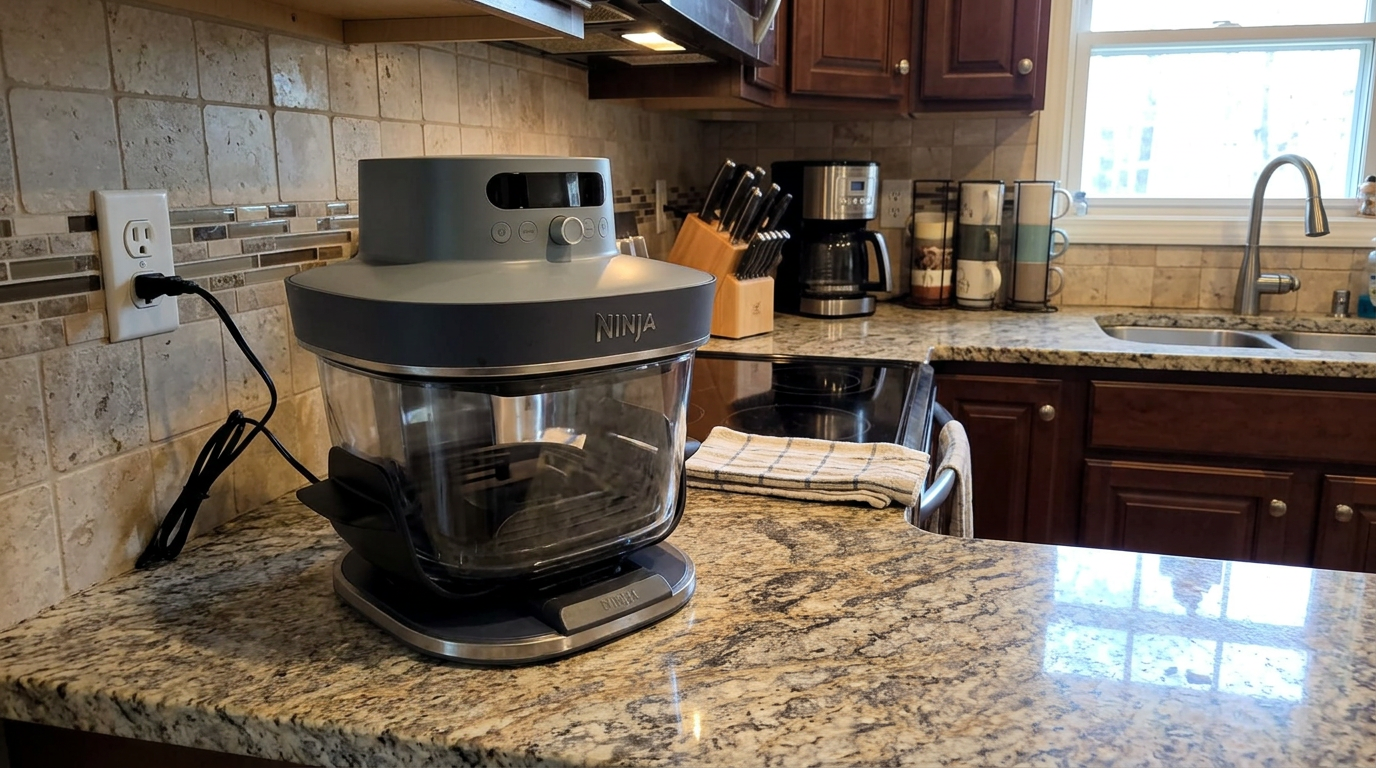
It needs a generous patch of counter, plus room behind for the hot air.
The modular base and container sizes
This is the clever part of the Ninja Crispi Pro.
The base has an adjustable mounting piece with slots at different heights, so it can sit on containers of different sizes.
| Slot | Container | Included? | What I used it for |
|---|---|---|---|
| Bottom | 6 qt / about 5.7 L | Yes | Whole chicken, family batches |
| Middle | 4 qt / about 3.8 L | No | Not tested |
| Top | 2.5 qt / about 2.4 L | Yes | Wings, fries, cookies, pizza, fruit |
Two sizes in daily life
I expected to use the big 6-quart container most.
In practice, the small 2.5-quart one did most of the work.
It held three full chicken wings, a single layer of fries or four cookies, which is plenty for one or two people.
The 6-quart container came out for the whole chicken and for nights when the whole family wanted fries at once.
Ninja says the big container serves up to 10, which matches what I saw with a 6-pound chicken.
From my notes over three weeks of daily cooking for a family.
The missing 4-quart container
Having three slots and only two containers feels odd at first.
After three weeks, I was quietly glad.
A third glass container would be one more bulky thing to find room for, and the two sizes covered everything I cooked.
If you want the middle size, check that any extra container you buy is listed as compatible with the Crispi Pro, because not every Crispi container fits this base.
Two crisper plates and lids
The two crisper plates are identical, so one can be in the dishwasher while the other is in use.
Each container also has a matching lid, which turns the air fryer basket into a storage dish.
Controls, temperature and timer quirks
The controls sit on top of the base.
There is a power button, a dial and buttons for the mode, temperature, time and an interior light.
The display is clear and bright, and setting a cook took me a few seconds after the first day.
The interior light
Press the light button and the inside of the container lights up.
With glass all around, you can mostly see the food anyway, but in the evening or a dim corner of the kitchen, the light helped me judge browning.
Temperature control
The Pro lets you change the temperature on most modes, including Air Fry, Roast, Bake, Recrisp and Dehydrate.
On Air Fry, I could change it while the food was cooking, which is handy when something browns faster than expected.
Max Crisp is the exception.
When I pressed the temperature button on Max Crisp, the display flashed as if I could change it, but the temperature stayed put.
That is by design, since Max Crisp always runs at full heat, but the flashing confused me the first time.
The 59-minute roast limit
On Roast, the timer stops at 59 minutes.
When I tried to set a full hour for my whole chicken, it would not go higher.
It is not a dealbreaker, since you just start a second cycle, but it is something to know before a big roast.
Our tip: For roasts longer than an hour, set a phone timer for the full cook and restart Roast when the first 59 minutes end.
Max Crisp: frozen fries
Max Crisp is made for frozen foods and for finishing cheesy dishes like nachos.
I tested it with frozen French fries in the 2.5-quart container.
How I tested it
I put a crisper plate in the bottom of the small container and spread the fries in a layer, leaving a couple overlapping on purpose to see what would happen.
Then I fitted the base on top, clicked it in and set Max Crisp for about 13 minutes.
The results
The fries came out a strong golden brown with fluffy insides.
The ones in a single layer were the best: crunchy, with a proper bite.
The overlapping ones were paler and softer.
My crispness ratings out of 10, from the same batch.
That is the most important lesson about any air fryer, and the Crispi Pro is no exception: crowding costs you crunch.
The upside of the glass is that you can see it happening, so you know when to give it a shake.
Our tip: Keep fries in a single layer in the small container, or use the big one and shake halfway, for even crunch from end to end.
Air Fry: chicken wings
Air Fry is the mode you will use most days.
For my test, I seasoned three full chicken wings with Creole seasoning and put them in the small container.
I set Air Fry to 400°F, about 204°C, for 20 minutes, and checked that I could change the temperature mid-cook, which worked.
Done early
Around the 13-minute mark, I looked through the glass, and the wings already looked done.
I let them run a little longer to be safe and checked the inside with a thermometer.
They came out golden brown, with a crisp outer skin and a juicy inside.
My family rated them 10 out of 10, and I did not argue.
Where the fat goes
The fat and juices dripped through the crisper plate and pooled underneath.
That kept the wings raised above their own drippings, which is exactly why the skin crisped so well.
Through the glass, you can watch the fat collect, which is oddly satisfying and a useful reminder to handle the container carefully when it comes out.
Three whole wings at 400°F / 204°C in the 2.5 qt container.
The browning comes from the Maillard reaction✕Maillard reactionThe chemical reaction between proteins and sugars at high heat that turns food golden brown and creates savory, roasted flavors., and the Crispi Pro's airflow got it going fast on the skin.
Our tip: Set a longer time than you need and watch through the glass, then stop the cook early once the food looks right and reaches a safe internal temperature.
Roast: a 6-pound whole chicken
This was the test I was most curious about.
Most air fryers struggle with a whole bird, either because it does not fit or because the top burns before the inside cooks.
Setup
I switched to the 6-quart container and moved the modular base to the bottom slot.
The 6-pound, about 2.7 kg, chicken went straight from the package into the container, and I seasoned it right there, so there was no extra dish to wash.
I set Roast to 400°F, about 204°C, and aimed for an hour, which in practice meant the 59-minute maximum.
The midway flip
About halfway through, I saw dark brown, almost black spots forming on the parts of the chicken closest to the heater.
I flipped and turned the bird, and the rest of the cook went smoothly.
In total, it took about 70 minutes to reach a safe internal temperature, which I checked with a probe thermometer.
6 lb / 2.7 kg chicken at 400°F / 204°C in the 6 qt container.
Resting and results
A lot of juice collected below the crisper plate, which kept the bird out of the liquid and helped the skin crisp.
I rested the chicken for 15 minutes before carving.
During that time, carryover cooking✕Carryover cookingThe way food keeps cooking from its own stored heat after you take it out. Large roasts can rise several degrees while resting. finished the job, and the juices settled back into the meat.
The result was very juicy and very crispy, and the best whole chicken I have made in an air fryer.
USDA guidance is that chicken is safe at 165°F, or 74°C, in the thickest part, so a probe thermometer is worth having for roasts like this.
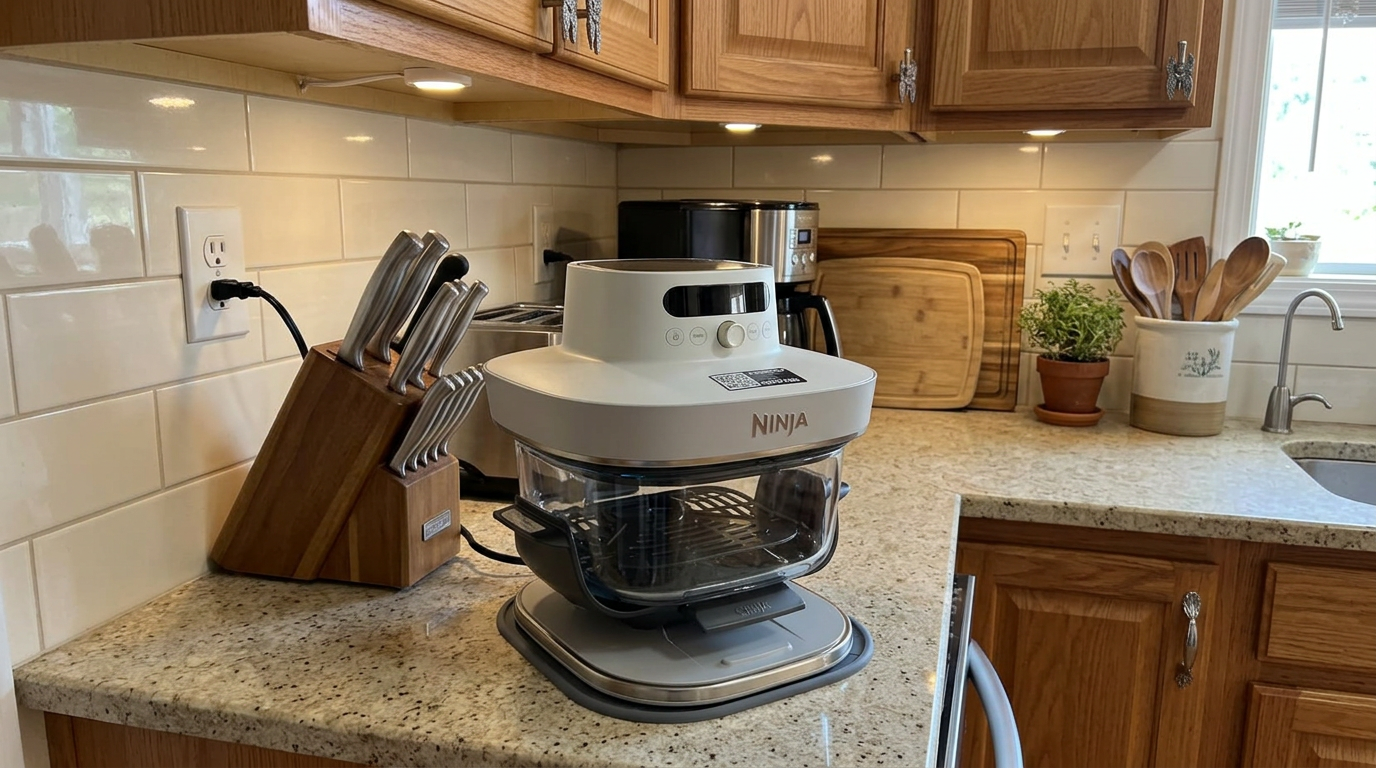
With the large container fitted, there is room for a 6-pound chicken.
Recrisp: day-old pizza
Recrisp is for leftovers, and it is the mode my family used most after Air Fry.
My test was a slice of pizza from the night before.
One slice at a time
The small container could not fit two slices, however I turned them.
So one 24-hour-old slice went onto the crisper plate.
To my surprise, Recrisp lets you set the temperature, so I chose about 360°F, roughly 182°C.
Better than fresh
After about 4 minutes, the cheese was bubbling, the slice was hot all the way through, and the crust was crisp.
It was crispier than when I picked the pizza up from the restaurant the day before.
My ratings for crust and texture, same pizza, same day.
Our tip: Use the big container for two or more slices of pizza, because the small one only fits a single slice.
Bake: brown butter chocolate chip cookies
Baking in an air fryer can be hit and miss, because the strong fan can brown the tops before the middle is done.
I tested Bake with pre-portioned brown butter chocolate chip cookie dough.
Four at a time
I spaced four dough balls out in the container, which was the most I could fit without them merging.
Bake ran at 325°F, about 163°C, for 15 minutes.
Results
After 15 minutes, the cookies looked well baked and felt soft.
The instructions suggest five minutes of cooling, but I lasted about one, added a pinch of flaky sea salt and cut one open.
The middle was soft, gooey and chocolatey, with a crunchy top and just the right amount of salt.
It was a 10 out of 10 cookie, and the kind of thing I would not normally heat a whole oven for.
Store the dough in the container
The storage lids are a real perk here.
I portioned dough into the container, snapped on the lid and kept it in the fridge, so fresh cookies were 15 minutes away whenever someone wanted one.
| Bake | Container | Setting I used | Result |
|---|---|---|---|
| Chocolate chip cookies | 2.5 qt, 4 at a time | 325°F / 163°C, 15 min | Gooey middle, crunchy top |
| Cookies, softer | 2.5 qt | 325°F / 163°C, 13 min | Paler, softer all through |
| Frozen dough | 2.5 qt | 325°F / 163°C, add 2 min | Same texture, slightly longer |
Our tip: Let cookies cool in the glass for a few minutes, because the hot glass keeps cooking the bottoms and firms them up.
Dehydrate: strawberry chips
Dehydrate is the mode most people never try, and the one that surprised me most.
It runs from 80°F to 195°F, about 27°C to 91°C, which covers herbs, fruit and jerky.
How I tested it
I sliced strawberries thinly and spread them out in the container.
Then I set Dehydrate to about 160°F, roughly 71°C, for 4 hours.
Progress through the glass
Being able to watch the fruit shrink was half the fun.
At the two-hour mark, the slices had clearly started drying.
At four hours, the moisture was gone.
My estimate of how much moisture was left in the strawberry slices.
The slices were completely dry and still bent a little in my fingers.
When I bit into one, it was crunchier than it looked, almost like a chip.
My kids ate the whole batch before dinner.
| Food | Typical temperature | Typical time |
|---|---|---|
| Herbs | 95–115°F / 35–46°C | 2–4 hours |
| Strawberries, thin slices | About 160°F / 71°C | About 4 hours, tested |
| Apple or banana chips | 135–160°F / 57–71°C | 4–7 hours |
| Beef jerky | 160–165°F / 71–74°C or higher | 5–7 hours |
General dehydrating ranges; only the strawberries were tested by me. Always check that meat reaches a safe temperature.
Our tip: Slice fruit as thinly and evenly as you can, because even slices dry at the same speed and none end up chewy.
All my cooking results in one place
Here is how every mode did across three weeks on the Ninja Crispi Pro.
| Mode | Food | Setting | Time | My rating |
|---|---|---|---|---|
| Max Crisp | Frozen fries | Fixed | About 13 min | 7–9.5, depends on crowding |
| Air Fry | 3 whole wings | 400°F / 204°C | Done by 13–15 min | 10 |
| Roast | 6 lb whole chicken | 400°F / 204°C | About 70 min | 9.5 |
| Recrisp | Day-old pizza | 360°F / 182°C | About 4 min | 9.5 |
| Bake | 4 cookies | 325°F / 163°C | 15 min | 10 |
| Dehydrate | Sliced strawberries | 160°F / 71°C | 4 hours | 9 |
Cook times from my tests, not counting dehydrating.
Speed, heat and noise
Speed
The 1,800-watt base heats the small container quickly.
I never felt I needed to preheat for frozen foods, wings or leftovers.
The big container takes a little longer to come up to heat simply because there is more air and more glass to warm.
Heat on the outside
The glass gets very hot during cooking, much hotter than the plastic outside of a typical basket air fryer.
Use the handles, keep little hands away and set it down only on its feet or a trivet.
Noise
The fan makes a steady whoosh, similar to other air fryers, and you will hear it across an open kitchen.
It was never loud enough to stop a conversation at the table.
| Sound or sight | When | Normal? |
|---|---|---|
| Steady fan whoosh | During every cook | Yes |
| Sizzling fat | Wings, chicken, bacon | Yes, drips under the plate |
| Light steam on the glass | Wet or frozen food, first minutes | Yes, clears as it heats |
| Fan keeps running briefly | After the cook ends | Yes, cooling the base |
| Smoke | Very fatty food at high heat | Lower temperature or drain fat |
Cleaning and caring for the Ninja Crispi Pro
Cleaning is where the Ninja Crispi Pro earns its keep.
There is no nonstick basket to protect, no coating to scratch and no corners where grease hides out of sight.
The glass containers
The containers and crisper plates are dishwasher-safe.
I put the container in the dishwasher after greasy cooks and rinsed it by hand after quick ones like pizza.
Because it is clear, you can see straight away whether it is truly clean, which you cannot always say about a dark metal basket.
The base
The base does not go in water.
Once cool, I wiped the underside and the area around the heating element with a damp cloth every few cooks.
No coating worries
Many air fryer baskets use nonstick coatings, and some people prefer to avoid PFAS✕PFASA large family of man-made chemicals, sometimes called forever chemicals, that includes some used in or to make nonstick coatings. chemicals in their cookware.
With glass, the food only touches glass and the crisper plate, which Ninja designs for non-toxic cooking.
| Task | What it removes | How often |
|---|---|---|
| Pour off fat, rinse container | Fat and crumbs | After every cook |
| Dishwasher for container and plate | Baked-on grease | After fatty cooks |
| Wipe the base underside | Splatter near the heater | Every few cooks |
| Wipe the control top | Fingerprints and spills | Weekly |
| Soak with warm soapy water | Stubborn sugar or cheese | As needed |
My estimate of hands-on cleaning time per cook, before the dishwasher.
Our tip: Let the glass cool before it touches cold water, and skip steel wool, because a scratch in glass is permanent.
The clear glass shows at a glance whether the container is really clean.
What daily use is really like
A normal weekday with the Crispi Pro looked like this in our house.
After school, the kids had something frozen from the small container on Max Crisp.
At dinner, it was wings, salmon or vegetables on Air Fry, or a whole chicken on Roast at the weekend.
Leftovers went into the fridge in the same container with the lid on.
The next day, the lid came off, the base went on, and lunch was on Recrisp.
That cook, store and reheat loop in one dish is the best thing about this air fryer.
It meant fewer storage tubs, fewer plates and much less washing up.
From my own routine, not counting plates.
Three weeks with the Crispi Pro, week by week
Week 1: learning the base
I tried all six modes and worked out which slot goes with which container.
The Max Crisp flashing temperature and the 59-minute roast limit both caught me out once.
Week 2: the big cooks
I roasted the 6-pound chicken and learned to flip it halfway.
The small container became our everyday default.
Week 3: the routine
Cookie dough lived in a lidded container in the fridge, and strawberry chips became a weekend thing.
The only complaint left was the cupboard space it needed.
From my testing notes.
Common mistakes to avoid
| Mistake | What happens | Better habit |
|---|---|---|
| Crowding fries | Pale, soft patches | Single layer or shake halfway |
| Leaving a big roast unturned | Dark, scorched spots | Flip around halfway |
| Expecting a 60-minute roast timer | Cook stops at 59 minutes | Restart Roast for the last part |
| Grabbing the glass without mitts | Burned fingers | Use the handles and oven mitts |
| Pouring hot fat in a hurry | Splashes, spills | Let it cool, then pour |
| Using steel wool | Scratched glass | Soak, then a soft sponge |
What I would change
A longer roast timer would make whole birds simpler.
A temperature display that does not flash on Max Crisp would avoid confusion.
And a slimmer storage design, or a stand for the containers, would help small kitchens.
Three households, three verdicts
The family of four
Weekend roast chicken, weeknight wings and leftovers the next day.
This is exactly what the Crispi Pro was built for, and it is where it shines.
The meal prepper
Someone who cooks on Sunday and eats from the fridge all week.
The lidded glass containers make the Crispi Pro a great fit, though you may want an extra container.
The small apartment
One person with a short counter and few cupboards.
It cooks beautifully, but the space it needs is hard to justify.
| Household | Fit | Main reason |
|---|---|---|
| Family of four | Excellent | 6 qt container fits a whole chicken |
| Meal prepper | Excellent | Cook and store in the same glass |
| Couple | Very good | Small container handles daily cooking |
| Small apartment | Fair | Takes a lot of counter and cupboard space |
Is the Ninja Crispi Pro worth the money?
The Crispi Pro costs more than a basic basket air fryer.
For that, you get two glass containers, lids for storage, six adjustable modes and a base that fits a 6-pound chicken.
If you cook for a family and like to store leftovers in the same dish, those extras are worth it.
If you only ever air fry a portion of fries, a simpler machine will do the same job in less space.
Three questions to ask:
Do you have room on the counter and a deep shelf to store it?
Would you use the glass containers for storing food?
And do you roast whole chickens or cook for four or more?
How it compares with other ways to cook
| Feature | Ninja Crispi Pro | Typical basket air fryer | Full-size oven |
|---|---|---|---|
| Cooking surface | Glass | Usually nonstick metal | Your own pans |
| See the food | Yes, all round | Rarely | Through the door |
| Store leftovers in it | Yes, with lids | No | Depends on the dish |
| Whole chicken | Up to about 6 lb | Often too small | Yes |
| Heat-up time | Fast | Fast | Often 10–15 min |
| Counter space | Large | Medium | None |
Compared with a basket air fryer, the Crispi Pro adds glass, visibility and storage, and takes more room.
Compared with an oven, it heats up faster and crisps better, but it cannot handle a big holiday roast.
| You mostly cook | Is the Crispi Pro a fit? | Why |
|---|---|---|
| Whole chicken and family dinners | Excellent | 6 qt glass, even results |
| Leftovers and takeout | Excellent | Recrisp plus storage lids |
| Frozen snacks | Very good | Max Crisp, avoid crowding |
| Baking | Good | Great cookies, small batches |
| Single portions in a tiny kitchen | Fair | More machine than you need |
Which one is right for you: is the Ninja Crispi Pro your match?
4 quick questionsNinja Crispi Pro specifications
From manufacturer data, retailer listings and my own testing.
How I tested and scored the Ninja Crispi Pro
For three weeks, the Ninja Crispi Pro was our main air fryer at home, cooking for my family most days.
I used all six modes and both containers, and kept notes on times, temperatures and results.
My set tests were frozen fries on Max Crisp, wings on Air Fry, a 6-pound chicken on Roast, pizza on Recrisp, cookies on Bake and strawberries on Dehydrate.
I checked meat with a probe thermometer, washed the containers by hand and in the dishwasher, and stored food in them with the lids.
Finally, I checked my notes against Ninja's specifications and the user manual.
- Cooking (9.2): crispness, evenness and results across all six modes.
- Ease of use (8.4): controls, temperature options, timer limits and handling the glass.
- Cleaning (9.1): containers, crisper plates, base and dishwasher results.
- Design and storage (7.9): build quality, footprint and cupboard space.
The overall score of 8.7 is an editorial rating that reflects those four areas.
Ninja Crispi Pro FAQ
Is the Ninja Crispi Pro worth it?
Yes, if you cook for two or more and have room for it. It cooked everything well in my tests, and the glass containers double as storage dishes. In a small kitchen, a compact basket air fryer makes more sense.
What sizes of containers come with the Crispi Pro?
A 6-quart and a 2.5-quart glass container, each with a lid, plus two crisper plates. The base also has a slot for a 4-quart container, which is sold separately.
Can it cook a whole chicken?
Yes. I roasted a 6-pound chicken in the 6-quart container at 400°F. It took about 70 minutes, with a flip halfway to stop dark spots forming.
Can you adjust the temperature?
On Air Fry, Roast, Bake, Recrisp and Dehydrate, yes. Max Crisp always runs at its fixed top heat, even though the temperature button flashes.
Why does the roast timer stop at 59 minutes?
That is the maximum for one Roast cycle. For longer roasts, start a second cycle when the first one ends.
Can the glass go from the freezer into the air fryer?
Yes. The glass is made to resist thermal shock, and I cooked frozen fries in it straight away. Let it cool before rinsing it with cold water.
Is the Crispi Pro dishwasher-safe?
The glass containers, lids and crisper plates are dishwasher-safe. Wipe the heating base with a damp cloth; never put it in water.
Does the Crispi Pro use a nonstick coating?
The food sits in glass rather than a nonstick-coated basket, which is why many buyers choose it.
How hot does the glass get?
Very hot. Use the handles and oven mitts, and set it down on its heat-safe feet or a trivet.
Can I dehydrate fruit in it?
Yes. Dehydrate runs from 80°F to 195°F. Thin strawberry slices at about 160°F were dry and crunchy after 4 hours.
How much space does it need?
Ninja lists it at about 11 × 11.8 × 12.2 inches. In practice, plan for extra room around it on the counter and a deep shelf for the base plus both containers.
Is it loud?
It has a steady fan sound like most air fryers. You will hear it in the kitchen, but not over a conversation.
Senior home appliance tester
Emily has tested home appliances for a living since 2016, first as a test coordinator at a national consumer advocacy group and, since 2021, at HouseholdMe. She has a degree in industrial design from Ohio State, so she looks at how a product is built, not just how it performs. She used the Ninja Crispi Pro as her family's main air fryer for three weeks for this review.
- Three weeks of hands-on testing of the Ninja Crispi Pro Glass Air Fryer 6-in-1
- Ninja Crispi Pro product specifications, SharkNinja
- Safe minimum internal temperature chart, USDA FSIS
- General air frying and dehydrating guidance