Levoit Superior 6000S Whole House Evaporative Humidifier review
The Levoit Superior 6000S Whole House Evaporative Humidifier is a 6-gallon, rolling, smart evaporative humidifier built to cover up to 3,000 square feet. I ran it for three weeks in the open ground floor of a two-story house, about 1,400 square feet, during the first hard frosts of the winter. Indoor humidity climbed from the low 30s to a steady 47% to 50%, I refilled it roughly every four to six days with the included hose and it never left a speck of white dust. It is big, and the wick filters need replacing every few months, but if dry air affects your whole home rather than one room, this is the humidifier I would buy.

Emily Carter
Hands-on review
Hands-on testing, research, specs
3 weeks
26 minutes
Jargon helpNew to humidifiers? Tap any dotted term to see what it means.
In this review
Yes, for anyone fighting dry air across a large home. The Levoit Superior 6000S holds 6 gallons, runs up to 72 hours per fill and raised my open-plan ground floor from about 32% to a steady 47% to 50% within two days. It uses ordinary tap water, leaves no white dust, rolls on wheels and fills from the faucet with an included hose. The app, auto mode, sleep mode and a filter-drying mode make it almost hands-off, and it uses very little power. It is tall and bulky, and the wick filters need replacing every three to six months. For a single small bedroom, it is overkill; for a whole floor, it is excellent.
Levoit Superior 6000S at a glance
Levoit Superior 6000S pros and cons
- Raises humidity across a whole floor
- 6-gallon tank lasts days, with a fill hose
- Tap water friendly with no white dust
- Tall and bulky for small homes
- Wick filters need replacing every few months
- No essential oils or aroma option
Who should buy the Levoit Superior 6000S?
- Large homes and open-plan living spaces
- Homes with hard tap water
- Anyone tired of refilling small humidifiers
- Small apartments and single bedrooms
- People who want an aroma diffuser
- Homes with very limited floor space
First impressions of the Superior 6000S
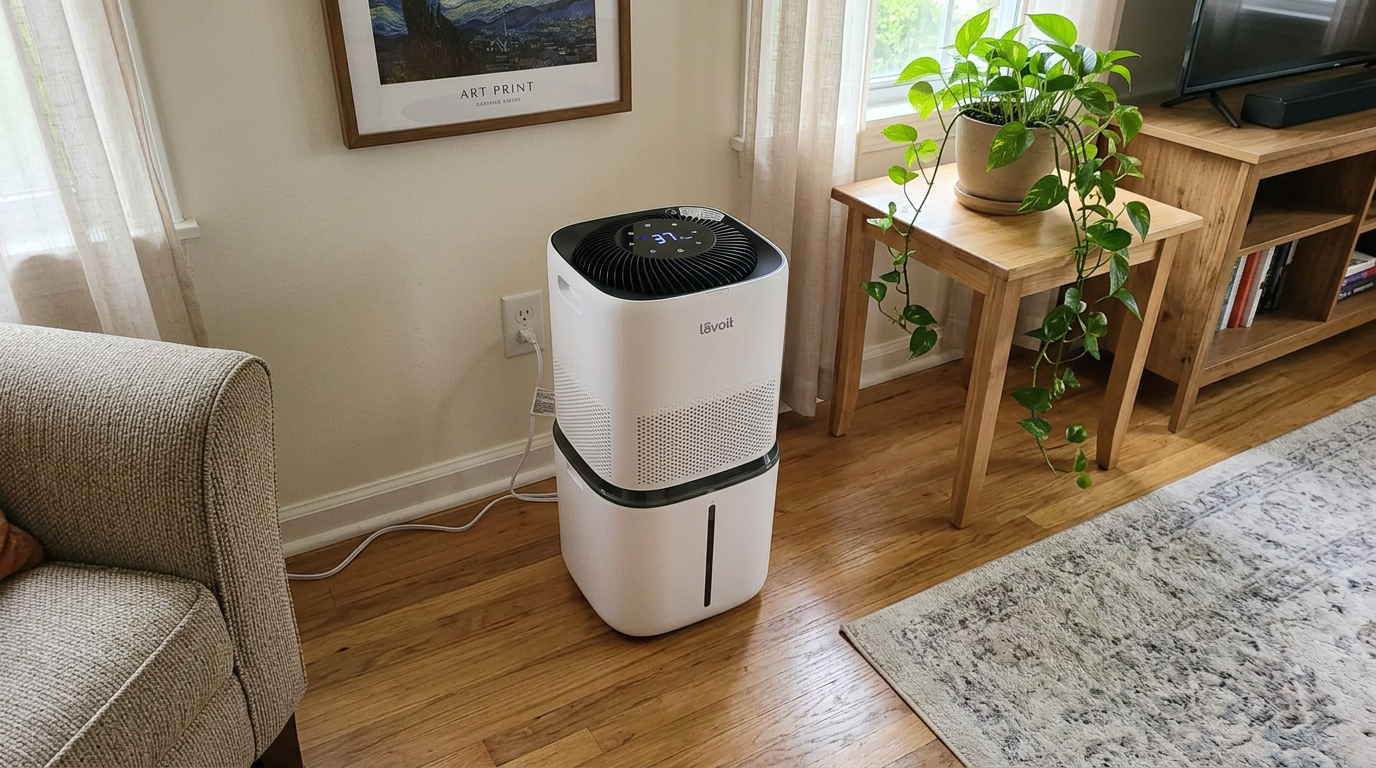
The 6000S is big.
It stands about 26.7 inches tall and 12.7 inches across, roughly the size of a large kitchen trash can.
Empty, it weighs around 13 pounds.
Its clean white cylinder and slatted top look modern, and the integrated wheels mean you never have to lift it.
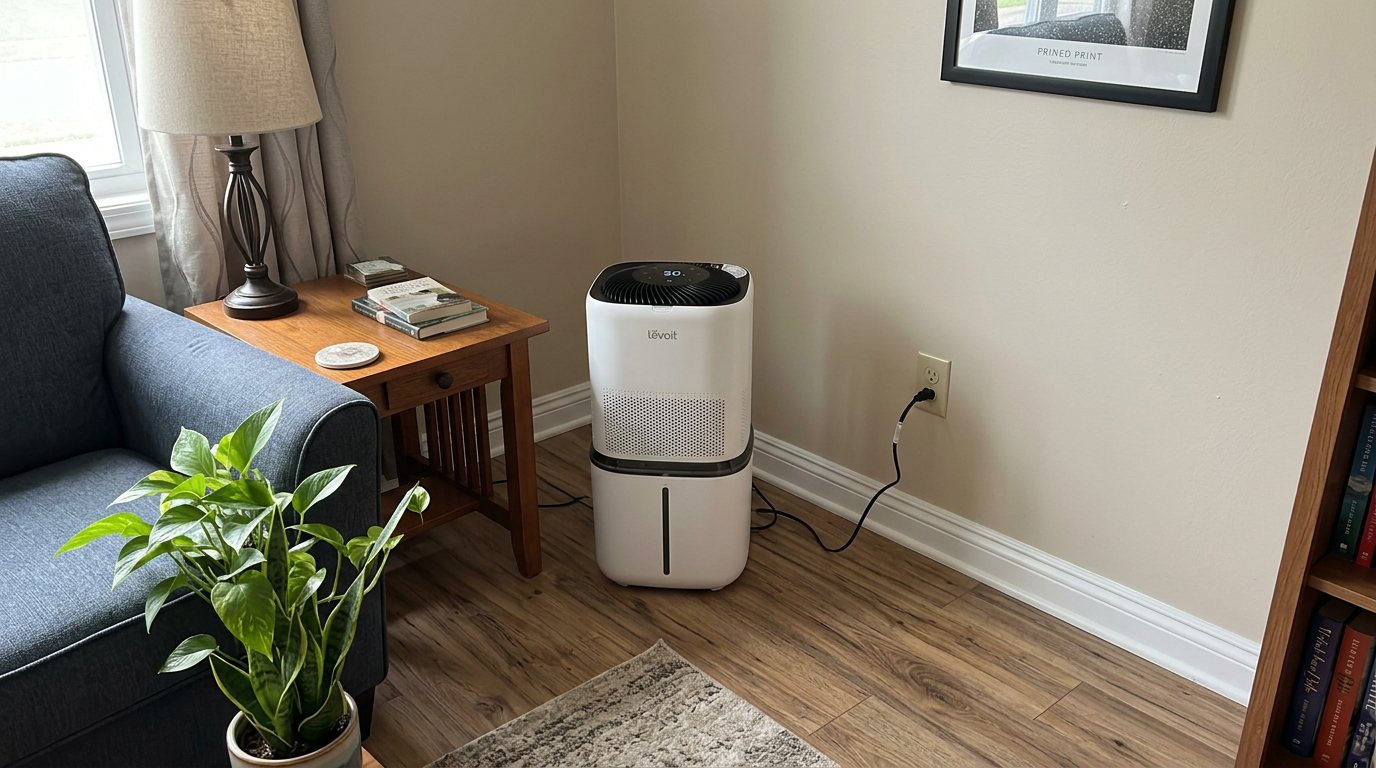
A tall, rolling design with 360-degree airflow from the top.
The control panel sits on top, with a touch display and a handful of buttons.
Airflow comes out through the top in every direction, which Levoit calls 360-degree humidification.
Inside, it is modular: a tank at the bottom, a support frame, a wick filter basket and the top section with the fan.
Our tip: Unbox the 6000S in the room where it will live and roll it into place before filling, because six gallons of water adds nearly 50 pounds and it is far easier to move empty.
How evaporative humidification works
The 6000S is an evaporative humidifier✕Evaporative humidifierA humidifier that blows air through wet wick filters. Water evaporates as invisible vapor, so there is no mist and no white dust..
Water from the tank soaks a set of wick filters.
A fan pulls room air through the wet wicks, and moisture evaporates naturally into the air before it leaves the top of the unit.
Because only water vapor leaves the machine, minerals in tap water stay behind in the wicks.
That means no white dust, no damp floors and no wet patches on furniture.
Evaporation also slows naturally as the air gets more humid, which makes it harder to overdo it.
| Feature | Superior 6000S | Ultrasonic mist | Warm mist |
|---|---|---|---|
| Visible mist | None | Yes | Yes |
| White dust with tap water | None | Common | None |
| Distilled water needed | No | Often recommended | No |
| Power use | Low | Low | High |
| Self-limiting | Partly, naturally | No | No |
Our tip: Use ordinary tap water in the 6000S, because evaporative humidifiers are designed for it and the wicks catch the minerals that would otherwise become dust.
Setting it up
Setup took me about 15 minutes.
The sections stack in order: tank, support frame, wick basket and top.
I lifted off the top, connected the filling hose to my kitchen faucet with the included adapter and filled the tank in place.
| Setup step | Time |
|---|---|
| Unbox and roll into place | 5 minutes |
| Check wick basket and frame | 2 minutes |
| Fill with hose | About 4 minutes |
| App pairing | About 4 minutes |
Water level markings on the front of the tank show when it is full, so I never had to guess.
Once the top was back on, I pressed power and the fan started almost silently.
Our tip: Watch the level markings on the front of the tank as you fill, because six gallons goes in faster than you expect and it is easy to overfill if you look away.
The filling hose
This is one of my favorite details.
Instead of carrying buckets, I ran the included hose from the kitchen faucet straight into the tank.
My test spot was about ten feet from the sink, and the hose reached comfortably.
Not every home has a faucet near the humidifier.
For the upstairs landing test, I filled two large jugs instead.
That took three trips, which made me appreciate the hose even more.
| Fill method | Time to fill 6 gallons | Effort |
|---|---|---|
| Hose from faucet | About 4 minutes | Very easy |
| Two large jugs | About 8 minutes | Three trips |
| Small pitcher | 15+ minutes | Tedious |
Our tip: Place the 6000S within hose reach of a sink if you can, because filling straight from the faucet turns a six-gallon refill into a four-minute job with no lifting at all.
Where to put it
Placement matters with a whole-house humidifier.
Levoit recommends open floor space with room for air to circulate.
I put it in the center of my open-plan kitchen, dining and living area, a couple of feet from walls and furniture.
The 360-degree airflow spread moisture well from that central spot.
When I moved it into a corner for a day, the far side of the room took noticeably longer to reach the target.
The wheels made experimenting easy.
| Spot | Result |
|---|---|
| Center of open-plan floor | Best: even humidity everywhere |
| Corner of living room | Slower on the far side |
| Upstairs landing | Good for bedrooms off the landing |
| Small closed bedroom | Overkill, reached target very fast |
Our tip: Start in the most open, central spot you have, because whole-house humidifiers work by moving air, and a central position lets moisture spread through connected rooms and stairwells.
How well it raised humidity
Before testing, my ground floor read 30% to 38% depending on the time of day, with the heating running.
I measured with three separate hygrometers✕HygrometerA small device that measures relative humidity. Placing several around the home shows how evenly moisture spreads. in the kitchen, living room and hallway.
After a few hours on auto mode with a 50% target, humidity rose by almost ten points.
After two days, it had climbed 15 to 18 points compared with the start, and it held steady from then on.
Even the hallway near the front door, the driest spot, reached 44% to 46%.
Average of three hygrometers across a 1,400 sq ft open-plan floor.
Our tip: Expect a whole-house humidifier to take a day or two to fully stabilize, because walls, wood floors and furniture absorb moisture at first before the air humidity can settle at your target.
Auto mode and humidity targets
Auto mode adjusts the fan speed to reach and hold a target humidity.
I set it to 50% on the ground floor.
When humidity was low, it ran faster; once the room hit the target, it slowed right down.
Most guidance suggests keeping indoor relative humidity✕Relative humidity (RH)The amount of moisture in the air compared with the most it could hold at that temperature, as a percentage. somewhere between 30% and 50%, and many people find 40% to 50% the most comfortable in winter.
I dropped my target to 45% on the coldest nights to keep condensation off the windows.
| Target | Measured range | Typical fan speed after stabilizing |
|---|---|---|
| 40% | 38–41% | Low |
| 45% | 43–46% | Low to medium |
| 50% | 47–50% | Medium |
Our tip: Lower the target by five points on very cold nights, because single-pane or older windows can collect condensation at 50%, and a slightly lower target protects frames and sills.
The 6-gallon tank and runtime
The tank holds 6 gallons.
Levoit rates it for up to 72 hours of continuous running, but in auto mode, once my home was at the target, it lasted much longer.
I refilled it every four to six days during three weeks of cold weather.
How long one full tank lasted me.
That is the biggest quality-of-life upgrade over small humidifiers.
Instead of a daily chore, refilling became a twice-a-week task that took a few minutes with the hose.
Our tip: Refill before the tank runs completely dry, because if it empties overnight in a cold snap, the house can lose several points of humidity before morning and take hours to recover.
Coverage: how big a space?
Levoit rates the 6000S for up to 3,000 square feet.
That number depends heavily on your home's layout, insulation and how open it is.
On my 1,400-square-foot open ground floor, it held 47% to 50% comfortably.
Upstairs bedrooms with doors open gained about five to eight points as moist air rose through the stairwell.
With bedroom doors closed, they barely changed.
For a whole two-story house, I would consider one unit per floor.
| Area | Gain over start | Notes |
|---|---|---|
| Open kitchen and living | +15 to 18 points | Excellent |
| Hallway by front door | +12 to 14 points | Driest spot, still good |
| Upstairs, doors open | +5 to 8 points | Moisture rose up the stairs |
| Upstairs, doors closed | +1 to 2 points | Needs its own humidifier |
Our tip: Leave interior doors open if you want one 6000S to humidify several rooms, because moist air needs a clear path to spread, and closed doors block most of it.
How loud is it?
For its size, the 6000S is quiet.
Its rated sound output runs from about 28 dB on the lowest speed to about 48 dB on the highest.
On low, it is a soft hush; on high, it sounds like a quiet fan.
Rated range, matched by my sound meter app at about 3 feet.
In the living room, I could hold a normal conversation and watch TV with no problem, even on medium.
At night, in sleep mode, I could not hear it from the sofa.
Our tip: Run it on a higher speed during the day and let sleep mode take over at night, because you get the humidity boost while you are up and moving, and near-silence when the house is quiet.
Sleep mode
Sleep mode drops the fan to its lowest speed and turns off the LED display.
That keeps the room dark and quiet.
I scheduled it from 10:30 p.m. to 6:30 a.m.
Overnight, humidity fell by only one or two points on most nights.
On the coldest night of testing, with the heating working hard, it dropped about four points and recovered within an hour of auto mode in the morning.
Our tip: Pair sleep mode with a schedule instead of switching it by hand, because the humidifier then goes quiet and dark at the same time every night and you never have to remember.
Dry mode and mold prevention
Dry mode is a maintenance feature for the wicks.
It runs the fan at a mix of lower and higher speeds to dry the wick filters✕Wick filterAbsorbent pads that soak up water. Air blown through them picks up moisture, while minerals stay trapped in the pads. after use.
Damp wicks left sitting are the main cause of musty smells and mold in evaporative humidifiers.
I ran dry mode whenever I knew the humidifier would be off for more than a day.
In three weeks, I never noticed any smell at all.
| Situation | Use dry mode? |
|---|---|
| Running continuously | Not needed daily |
| Off for a day or more | Yes |
| Before refilling with fresh water | Optional |
| Before storing for summer | Always |
Our tip: Always run dry mode before turning the 6000S off for a weekend away, because wet wicks sitting in a closed, dark unit are exactly the conditions that encourage mold.
The VeSync app
The 6000S connects to Wi-Fi and the VeSync app.
Pairing took about four minutes.
The app shows current humidity, lets you change modes and fan speed, set timers and create weekly schedules.
| App feature | What it does | How often I used it |
|---|---|---|
| Humidity target | Sets the auto mode goal | Weekly |
| Fan speed | Manual control | Occasionally |
| Weekly schedules | Runs at set times and days | Daily |
| Timers | Switches off after a set time | Rarely |
| Remote control | On and off from anywhere | Often |
Our tip: Set a weekly schedule that runs the humidifier only when you are home, because it saves water and filter life and the large tank still covers several days of normal use.
Alexa and Google Home
Through the app, the 6000S works with Alexa and Google Home.
I linked it to the kitchen smart speaker.
Simple commands like turning it on or off, or changing the mode, worked reliably.
Our tip: Name the humidifier after the floor or area, like downstairs humidifier, because short, clear names make voice commands more reliable in a home with several smart devices.
Wick filters and replacements
The 6000S uses replaceable wick filters.
Levoit suggests replacing them roughly every three to six months, depending on how much you run it and how hard your water is.
Because the wicks trap the minerals, harder water means they fill up faster.
After three weeks of hard-ish tap water, the wicks had a light chalky tint at the bottom edge but still worked normally.
Replacing them is simple: lift the top, pull out the old basket filters and slot in new ones.
Budget for replacement wicks as an ongoing cost of ownership.
Moderately hard tap water, near-continuous use.
Our tip: Write the install date on the wick basket with a marker, because the three-to-six-month replacement window is easy to lose track of over a long winter.
Cleaning and maintenance
Because it is modular, the 6000S is straightforward to clean.
Each section separates by hand.
I rinsed the tank at each refill and gave it a proper clean once a week.
| Task | How often | Time |
|---|---|---|
| Rinse tank at refill | Every refill | 3 minutes |
| Wipe frame and basket | Weekly | 5 minutes |
| Descale tank with citric acid or vinegar | Every 2–4 weeks | About 20 minutes, mostly soaking |
| Run dry mode | When off for a day or more | Automatic |
| Replace wicks | Every 3–6 months | 5 minutes |
With a 6-gallon tank, I emptied the old water into the bathtub rather than the sink.
Rolling it to the bathroom on its wheels made that easy.
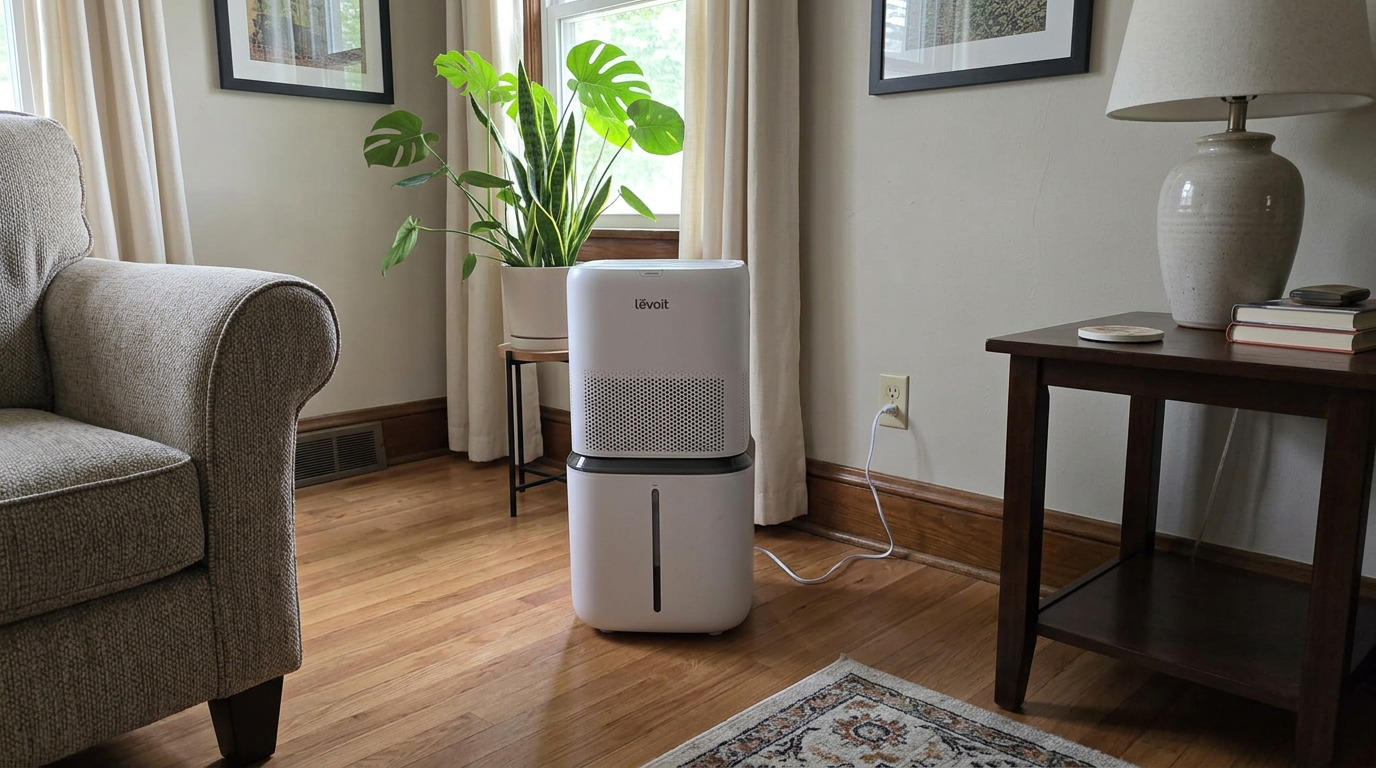
The modular sections separate by hand for cleaning.
Our tip: Empty and rinse the tank every time you refill instead of topping up, because water that sits for days in a large tank is where slime and odors start.
No essential oils
The 6000S is designed for water only.
There is no aroma pad or tray, and adding essential oils to the tank can leave residue that damages internal parts.
If you want fragrance, use a separate diffuser.
Our tip: Keep the tank strictly for water and use a separate diffuser for fragrance, because oils can coat the wicks and pump and shorten the life of the humidifier.
Power use
For a humidifier this size, power use is impressively low.
Levoit lists it at around 30 to 36 watts, depending on the listing.
It uses an efficient DC motor and has no heater.
Rated power comparison.
Running it almost continuously for three weeks made no visible difference to my energy use.
Our tip: Let auto mode manage the fan rather than leaving it on high, because once your home reaches the target, the fan slows down and both power use and noise drop noticeably.
Wheels and storage
The built-in wheels are essential at this size.
Even full, I could roll it a few feet to vacuum underneath or move it to another room.
On carpet, it rolled a little less freely but was still manageable.
For storage, the sections nest inside each other.
That reduces the space it needs over summer, which matters for a humidifier this big.
Our tip: Empty the tank before rolling the 6000S over thresholds or rugs, because a full tank is heavy and a sudden bump can slosh water out of the top.
Why whole-house humidity matters
Heating cold winter air drops its relative humidity sharply.
My home sat at 30% to 38% before testing, and some homes drop much lower.
Signs of dry air include static shocks from door handles, flyaway hair, dry skin, chapped lips, dry eyes and a scratchy throat in the morning.
A single bedroom humidifier helps one room.
But if you spend your evenings in an open living area, or your whole home feels dry, a large-capacity unit can keep every connected room comfortable.
It can also help protect wood floors, furniture and musical instruments from drying out.
| Sign of dry air | Before testing | After two weeks with the 6000S |
|---|---|---|
| Static shocks | Several a day | Almost none |
| Chapped lips | Daily | Rarely |
| Dry throat on waking | Most mornings | Occasionally |
| Wood floor gaps | Slightly visible | Closing up |
Our tip: Check the gaps between wood floorboards in winter, because widening gaps are a sign the whole house is dry and a whole-house humidifier can help them close back up over a few weeks.
How to measure your home
The 6000S has a built-in humidity sensor, but I always check with separate hygrometers.
Sensors near a humidifier usually read a little high.
In my testing, the built-in reading was about two to three points above my hygrometers across the room.
Placing a hygrometer in each main area showed me how evenly moisture spread.
The hallway by the front door was always the driest, so I used it as my worst-case reading.
Typical readings in auto mode with a 50% target.
Our tip: Put a cheap hygrometer in the driest part of your home, like an entry hallway, because if that spot is comfortable, the rest of the house almost certainly is too.
Two days on the upstairs landing
For two days, I rolled the 6000S to the upstairs landing, which connects three bedrooms and a bathroom.
I filled it with jugs, since there was no faucet nearby for the hose.
With bedroom doors open, all three bedrooms climbed from the mid-30s to 44% to 47% within a day.
It was quiet enough in sleep mode that nobody upstairs noticed it at night.
But downstairs dropped back toward 36% while it was away, which confirmed that a two-story house really benefits from one unit per floor.
| Room | Before | After one day |
|---|---|---|
| Bedroom 1 | 35% | 46% |
| Bedroom 2 | 34% | 45% |
| Bedroom 3 (smallest) | 36% | 47% |
| Downstairs (unit moved) | 48% | 37% |
Our tip: Consider one large humidifier per floor in a two-story home, because moist air rises only partly through a stairwell and closed bedroom doors block most of it.
Living with it day to day
In daily life, the 6000S faded into the background.
The only routine tasks were a refill twice a week and a quick weekly clean.
The app told me when the tank was getting low.
It is tall enough that our cat ignored it completely, and it was stable on its base.
Because it is evaporative, there was no mist for anyone to play with and no damp floor around it.
| Daily task | How often | Time |
|---|---|---|
| Glance at humidity in the app | Daily | Seconds |
| Refill with hose | Twice a week | About 5 minutes |
| Rinse tank and wipe | Weekly | About 10 minutes |
| Wick check | Monthly | 2 minutes |
Our tip: Set the app to send an alert when the tank is low, because a humidifier that only needs attention twice a week is easy to forget about until the house is dry again.
What long-term ownership looks like
The main ongoing cost is replacement wick filters every three to six months.
How quickly they wear depends mainly on your water hardness and how many hours a day the humidifier runs.
Electricity use is low.
| Habit | Benefit |
|---|---|
| Empty and rinse at each refill | No stale water or slime |
| Run dry mode before switching off | Fewer odors and less mold |
| Descale every few weeks | Tank and frame stay clean |
| Replace wicks on schedule | Full output and clean air |
| Dry and nest for summer storage | Ready for next winter |
Our tip: At the end of winter, run dry mode, clean every section, let them air-dry completely and nest them for storage, because a single damp part packed away for months will grow mold.
Hard water and the 6000S
My tap water is moderately hard, which is exactly where evaporative humidifiers shine.
With an ultrasonic humidifier, hard water usually means white dust on every nearby surface.
With the 6000S, the minerals stayed in the wicks and the bottom of the tank.
I placed a black tray beside the unit for the full three weeks.
It stayed perfectly clean.
The trade-off is a light chalky ring in the tank and gradual scale on the wick edges, both of which a regular descale and filter change take care of.
| Where minerals ended up | What I saw | What to do |
|---|---|---|
| Furniture and floors | Nothing at all | No action needed |
| Tank bottom | Light chalky ring | Descale every few weeks |
| Wick edges | Slight scale by week three | Replace wicks on schedule |
Our tip: Descale the tank with diluted citric acid or white vinegar every few weeks if you have hard water, because it keeps the chalky ring from building up and makes the next clean much quicker.
Avoiding condensation on windows
A powerful whole-house humidifier can raise humidity high enough to fog cold windows.
On the coldest night of testing, with the outside temperature well below freezing, I noticed light condensation on two older windows at 50%.
Dropping the target to 45% cleared it by morning.
| Outdoor temperature | Comfortable target I used |
|---|---|
| Above freezing | About 50% |
| Around freezing | About 45–50% |
| Hard freeze | About 40–45% |
Our tip: Check your windows on the first very cold morning after setting up the humidifier, because condensation is the clearest sign your target is a little too high for the weather.
My three weeks with the Superior 6000S
Week one was about catching up.
The house started very dry, and the 6000S ran hard for two days before settling.
I refilled it twice that week.
Week two was steady.
Auto mode held 47% to 50%, and I refilled it once.
Week three brought the coldest weather.
I lowered the target to 45% on the coldest nights and tried it upstairs for two days.
Overall, I refilled it six times in three weeks.
| Week | Refills | Average humidity | Highlight |
|---|---|---|---|
| Week 1 | 3 | 41% rising to 48% | Fast catch-up |
| Week 2 | 1 | 47–50% | Completely hands-off |
| Week 3 | 2 | 45–49% | Handled a hard freeze |
Our tip: Give the humidifier its first two days on auto mode before changing anything, because it needs that time to bring a dry house up to target and the readings in the first hours can be misleading.
Troubleshooting what I ran into
A few small things came up during testing.
| Problem | Cause | Fix |
|---|---|---|
| Far side of room drier | Unit in a corner | Move it to a central spot |
| Upstairs not humidified | Bedroom doors closed | Open doors or add a second unit |
| Condensation on windows | Target too high in a freeze | Lower target to 45% |
| Water splash when moving | Rolled while full | Move it empty or slowly |
| Slight chalky wick edges | Hard tap water | Normal, replace on schedule |
Our tip: If you see condensation on windows, lower the target first rather than turning the humidifier off, because a few points lower usually fixes it while still keeping the air comfortable.
Who it suits in real life
It suits large homes, open-plan floors and anyone who wants to humidify multiple rooms without several small units.
It is less suited to small apartments, single bedrooms or homes without much floor space.
| Household | Fit | Why |
|---|---|---|
| Large open-plan home | Excellent | Whole-floor coverage |
| Hard water area | Excellent | No white dust |
| Busy household | Excellent | Days between refills |
| Small apartment | Fair | Large and more than needed |
| Single bedroom | Poor | Overkill |
Our tip: Measure your open living area before buying, because the 6000S shines in large connected spaces and a compact bedroom humidifier makes more sense for a single closed room.
Is the Levoit Superior 6000S worth the money?
For large homes, yes.
It replaced the need for several small humidifiers, raised humidity across my whole ground floor and cut refilling to about twice a week.
It is quiet, uses little power and works with tap water without white dust.
Factor in replacement wicks every few months and the space it takes up.
For a single room, a smaller humidifier is the better value.
My category scores after three weeks.
How it compares with other types of humidifier
| Feature | Superior 6000S | Bedroom evaporative | Ultrasonic cool mist | Central (furnace) humidifier |
|---|---|---|---|---|
| Coverage | Up to about 3,000 sq ft | Up to about 500 sq ft | Up to about 500 sq ft | Whole house |
| Tank | 6 gallons | About 1 gallon | About 1–2.5 gallons | Plumbed in |
| White dust | None | None | Common with tap water | None |
| Installation | None, plug in | None | None | Professional install |
| Smart control | App, voice, auto | Sometimes | Sometimes | Via thermostat |
| Portable | Yes, wheels | Yes | Yes | No |
| Your priority | Fit | Why |
|---|---|---|
| Whole-floor humidity | Excellent | 3,000 sq ft rating |
| Few refills | Excellent | 6-gallon tank |
| No white dust | Excellent | Evaporative |
| Small footprint | Fair | Tall and wide |
| No filter costs | Fair | Wicks need replacing |
Which one is right for you: is the Levoit Superior 6000S your match?
4 quick questionsLevoit Superior 6000S specifications
From manufacturer data, retailer listings and my own testing.
How I tested and scored the Levoit Superior 6000S
For three weeks, the Levoit Superior 6000S ran on the 1,400-square-foot open ground floor of a two-story house, with two days on the upstairs landing.
I tracked humidity with three hygrometers in different rooms, logged refills, measured noise with a sound meter app, tested tap water, used auto, sleep and dry modes, schedules and voice control, and cleaned it on a weekly routine.
- Humidifying power (9.6): 15 to 18 points across a whole floor.
- Capacity and refills (9.5): four to six days per fill at target.
- Smart features (9.0): auto, sleep and dry modes, schedules and voice.
- Size and upkeep (7.4): bulky, with replaceable wicks.
The overall score of 9.0 is an editorial rating that reflects those four areas.
Levoit Superior 6000S FAQ
Is the Levoit Superior 6000S worth it?
Yes, for large homes and open-plan floors. It holds 6 gallons, covers up to about 3,000 square feet, uses tap water without white dust and needs refilling only every few days.
How big an area can it cover?
Levoit rates it for up to about 3,000 square feet. It held 47% to 50% across my 1,400-square-foot open ground floor.
How often do I need to refill it?
Levoit rates it for up to 72 hours per fill. In auto mode, once my home reached the target, I refilled it every four to six days.
Can I use tap water?
Yes. It is designed for tap water, and the wicks trap minerals, so there is no white dust.
How do I fill a 6-gallon tank?
Use the included hose to fill it straight from a faucet, or top it up with jugs. Markings on the front show when it is full.
How loud is it?
About 28 dB on the lowest speed and about 48 dB on the highest. Sleep mode is very quiet and turns the display off.
How often do the wick filters need replacing?
About every three to six months, depending on use and water hardness.
What is dry mode?
A maintenance mode that runs the fan to dry the wick filters, which helps prevent musty smells and mold.
Can I add essential oils?
No. It is designed for water only, and oils can damage internal parts.
Does it work with Alexa and Google?
Yes, through the VeSync app.
How much power does it use?
About 30 to 36 watts, depending on the listing, because there is no heater.
Is it easy to move?
Yes. It has built-in wheels, though it is best moved empty or slowly when full.
Senior home appliance tester
Emily has tested home appliances for a living since 2016, first as a test coordinator at a national consumer advocacy group and, since 2021, at HouseholdMe. She has a degree in industrial design from Ohio State, so she looks at how a product is built, not just how it performs. She ran the Levoit Superior 6000S across the ground floor of a two-story house for three weeks for this review.
- Three weeks of hands-on testing of the Levoit Superior 6000S
- Levoit product information and user manual