Levoit Core 600S-P review
The Levoit Core 600S-P Smart Air Purifier is the biggest purifier in Levoit's Core range, built for rooms up to 635 square feet. In three weeks in my large living room, it cleared dust, smoke and cooking smells fast, its laser sensor reacted in real time and it used surprisingly little power. It's large, the display is bright, and it's louder than I'd like in Sleep and Turbo, so it belongs in a living space rather than a bedroom.

Emily Carter
Hands-on review
Hands-on testing, research, specs
3 weeks
25 minutes
Jargon helpNew to air purifiers? Tap any dotted term to see what it means.
In this review
Yes, if you need to clean a large living room or open-plan space. The Levoit Core 600S-P improved air quality in my 560 square foot test room by 96% in an hour on Turbo, reacted instantly to cooking and dust with its laser sensor, and drew under 50 watts at full power. The VeSync app is one of the best I've used. It's big, the display is too bright at night, and Sleep and Turbo are louder than I'd like, so I wouldn't put it in a bedroom.
Levoit Core 600S-P at a glance
Levoit Core 600S-P pros and cons
- Cleans large rooms quickly
- Real-time laser sensor and excellent app
- Very low power use for its size
- Loud in Sleep and Turbo modes
- Bright display that's hard to read
- Large footprint
Who should buy the Levoit Core 600S-P?
- Large living rooms and open-plan spaces
- Homes dealing with smoke, dust and allergies
- Smart-home users who like data
- Bedrooms and light sleepers
- Small rooms
- Tight corners and small apartments
First impressions of the Levoit Core 600S-P
The first thing I noticed was the size.
The Levoit Core 600S-P is noticeably taller and wider than I expected, even knowing it's built for big rooms.
Despite that, it isn't heavy, and handles built into the sides make it easy to carry from room to room.
It has a clean, rectangular shape with softly rounded corners, and it's available in more than one color, so it can blend in with different decor.
The body is split into two parts: the lower half holds the filter and air intake, and the upper half holds the motor and pushes clean air out of the top.
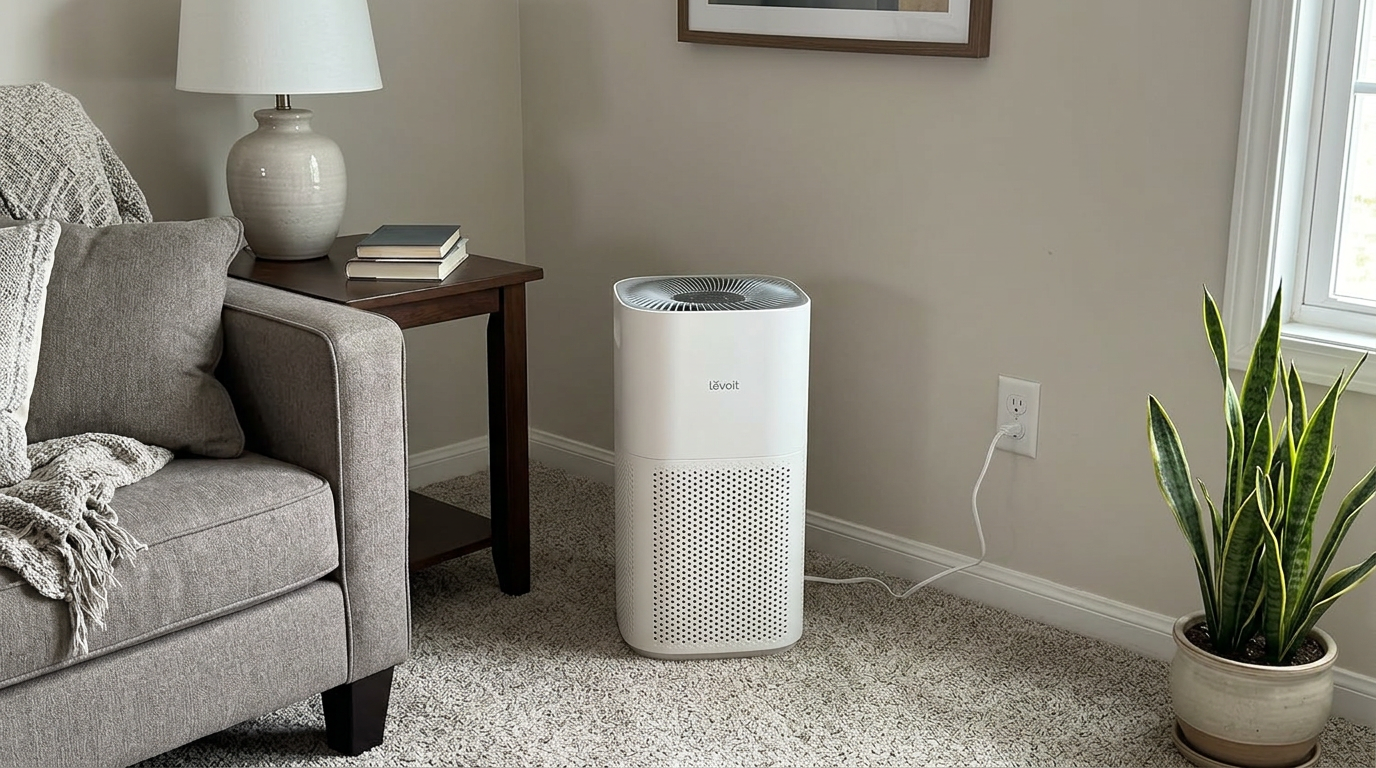
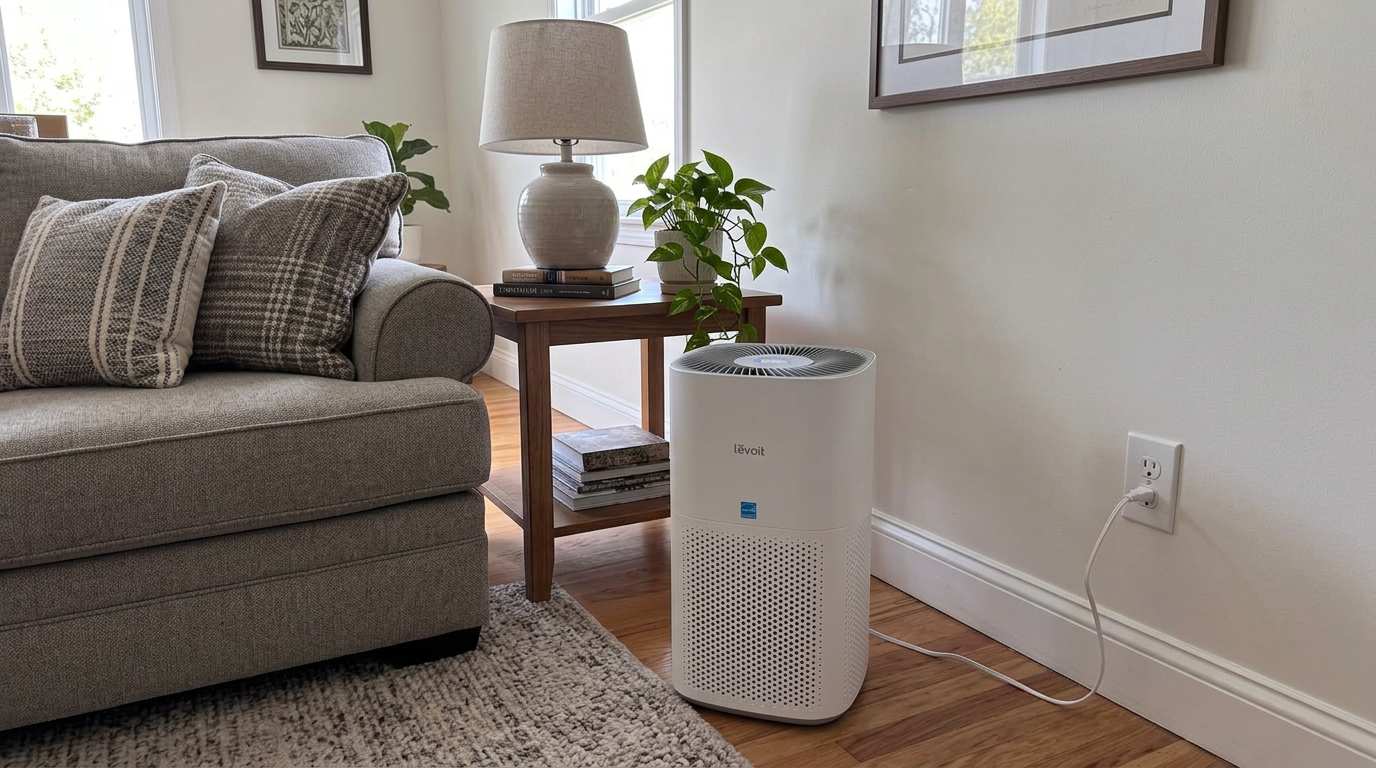
Bigger than most purifiers, with handles on the sides for moving it around.
Setting it up
Setup takes a few minutes, but there's one step you can't skip.
After unboxing, I peeled off all the protective film and tape from the outside.
Then I twisted the top section counterclockwise to separate it from the base, slid out the filter and removed its plastic wrapping.
With the filter back in and the top twisted back on, I plugged it in and switched it on.
| Step | What to do |
|---|---|
| 1 | Remove all tape and protective film |
| 2 | Twist the top section counterclockwise |
| 3 | Slide out the filter and remove its plastic |
| 4 | Put the filter back in |
| 5 | Twist the top back on |
| 6 | Plug in, switch on and connect the app |
Our tip: Unwrap the filter before the first run, because a filter left in its plastic bag blocks the airflow and the purifier will barely clean.
What the Levoit Core 600S-P actually is
The 600S-P sits at the top of Levoit's Core series, and it's the largest model in the range.
Levoit rates it for rooms up to 635 square feet at 4.8 air changes per hour✕Air changes per hour (ACH)How many times a purifier can filter the full volume of air in a room each hour. Four to five is a common target for allergies and smoke., which is the industry standard for allergies and smoke.
That works out to a CADR✕CADRClean Air Delivery Rate: how many cubic feet of cleaned air a purifier delivers per minute. Higher means it cleans a room faster. of roughly 410 cubic feet per minute, which is a lot of clean air.
In lightly polluted air, it can also cover up to 1,588 square feet at two air changes per hour.
Room coverage
| Room size | Air changes per hour | Good for |
|---|---|---|
| Up to 635 sq ft | 4.8 | Allergies, pets, smoke |
| Up to 1,588 sq ft | 2 | Light freshening only |
Our tip: Size the purifier by the 635 square foot figure if you're buying it for allergies, pets or smoke, and treat the larger number as a light-duty bonus.
The three-stage filter
Inside the lower half is a single cylindrical filter with three layers.
Stage 1: pre-filter
The outer layer catches larger particles like dust, lint, fibers, hair and pet fur.
Trapping those first helps the finer layers behind it last longer.
Stage 2: true HEPA filter
The main layer is a true HEPA✕True HEPAA filter that meets the HEPA standard of capturing at least 99.97% of particles 0.3 microns in size. Some cheaper filters use HEPA-like wording without meeting it. filter that captures 99.97% of airborne particles down to 0.3 microns.
That covers fine dust, smoke particles and common allergens like pollen and pet dander.
Stage 3: activated carbon
The final layer is made of pellets of activated carbon✕Activated carbonCarbon treated to have a huge surface area full of tiny pores. It traps odors and gases such as cooking smells and VOCs that particle filters can't catch., which absorb smoke, odors and fumes.
| Stage | Catches | Why it matters |
|---|---|---|
| Pre-filter | Hair, lint, large dust | Protects the HEPA layer |
| True HEPA | Fine dust, smoke, pollen, dander | Main cleaning |
| Activated carbon pellets | Odors, smoke, fumes | Fresher-smelling air |
It's also CARB certified and produces zero ozone✕OzoneA reactive gas that can irritate the lungs. Some ionizers and electronic purifiers produce it, which is why zero-ozone certification matters., so it's safe to run indoors all day.
Our tip: Wipe or vacuum the outside of the filter once a month, because that's the pre-filter layer and keeping it clear keeps airflow strong.
How well it cleans large rooms
This is where the Levoit Core 600S-P really impressed me.
In a 560 square foot room, I ran it on Turbo for an hour and tracked air quality with a monitor.
Air quality improved by 96%.
In a larger 730 square foot space, slightly above its rating, it still improved air quality by about 93% in the same time.
It also cleared smoke quickly in a smoke test and handled cooking fumes well in my kitchen.
From my air quality monitor readings.
The laser sensor and Auto mode
The 600S-P uses Levoit's AirSight Plus laser particle sensor✕Laser particle sensorA sensor that shines a laser through sampled air and counts the particles by the light they scatter. It reacts faster and more accurately than older infrared sensors., which tracks fine particles in real time.
It feeds a PM2.5✕PM2.5Fine particles 2.5 micrometers or smaller, such as smoke and some pollution. They can travel deep into the lungs. number on the display and a color-changing ring on top, so you can see the air quality at a glance.
It reacted within seconds when I fried onions, vacuumed or lit a candle.
In Auto mode, the fan ramped up straight away and dropped back down once the number fell.
Watching the PM2.5 number taught me a lot about what affects the air in my home, from cooking to opening windows on a busy road.
| Activity | What the sensor did | Auto mode response |
|---|---|---|
| Frying onions | PM2.5 jumped within seconds | High fan until it cleared |
| Vacuuming | Steady rise | Medium to high |
| Lighting a candle | Small spike | Brief boost |
| Open window, busy road | Gradual increase | Stayed higher |
Our tip: Watch the PM2.5 reading for a few days, because it shows exactly which habits, like frying or opening a window, affect your air the most.
Controls and display
The touch controls on top cover everything: power, display lock, display off, Auto, fan speed, Sleep, filter reset and timer.
There are indicators for air quality, filter status, Wi-Fi and display lock, plus a digital readout for PM2.5 and the timer.
Too bright, hard to read
My main complaint is the display.
It's very bright, which is distracting in a dark room, and some of the icons are hard to read at a glance.
The display-off button and light sensor help, but I'd prefer a dimmer default.
Our tip: Use the display lock if you have children or pets, so a curious paw or hand can't switch it to Turbo or turn it off.
The VeSync app
The 600S-P connects to Levoit's VeSync app, and it's one of the best purifier apps I've used.
From my phone I could see real-time air quality, switch modes, change fan speeds and set schedules.
The app also shows historical air quality, so I could see when the air got worse during the day and why.
It tracks filter wear too, which made it easy to plan a replacement ahead of time.
Some of the most useful features, like the history and automation scenes, are only available in the app.
Our tip: Check the app's air quality history after a week, because it shows your home's worst hours and lets you schedule higher speeds just before them.
Noise levels
Before testing, I'd read plenty of complaints about noise.
They're partly fair.
I measured every setting with a sound meter, and here's what I found.
| Mode | Measured | How it felt |
|---|---|---|
| Sleep | 43.9 dBA | Louder than a typical sleep mode |
| Low | 46.8 dBA | Soft background hum |
| Medium | 51.2 dBA | Noticeable |
| High | 58.7 dBA | Clearly audible |
| Turbo | 68.5 dBA | Loud |
My sound meter readings at each fan setting.
Sleep mode at 43.9 dBA is surprisingly high for a setting meant for bedrooms.
Turbo at 68.5 dBA is louder than I expected, closer to a running dishwasher than a quiet fan.
In a living room during the day, the lower speeds were fine, but I wouldn't recommend it for a bedroom.
Our tip: Use Low or Medium while you're in the room and save High and Turbo for when you step out, so you get strong cleaning without the noise.
Power use and running costs
For such a powerful purifier, the energy use is remarkably low.
The motor is rated at 49 watts, and I measured just 48.2 watts on Turbo.
Even running Turbo around the clock for a month, that's only about 35 kilowatt-hours.
In normal use, mostly in Auto at lower speeds, it used far less.
Combine that with filters that last six to twelve months and it's one of the most cost-effective large purifiers I've tested.
Estimated monthly energy use from my power meter readings.
Our tip: Leave it in Auto rather than a fixed high speed, because it uses very little power when the air is clean and only works hard when it needs to.
Maintenance and filter replacement
The filter isn't washable, so it needs replacing every six to twelve months, depending on how hard the purifier works.
You don't have to track that yourself, because the filter indicator lights up when it's time.
Between replacements, I cleaned the outer pre-filter layer once a month with a vacuum brush.
| Step | Replacing the filter |
|---|---|
| 1 | Unplug the purifier |
| 2 | Twist off the top and lift out the old filter |
| 3 | Vacuum any dust inside the base |
| 4 | Unwrap and insert the new filter |
| 5 | Twist the top back on |
| 6 | Hold filter reset for 3 seconds |
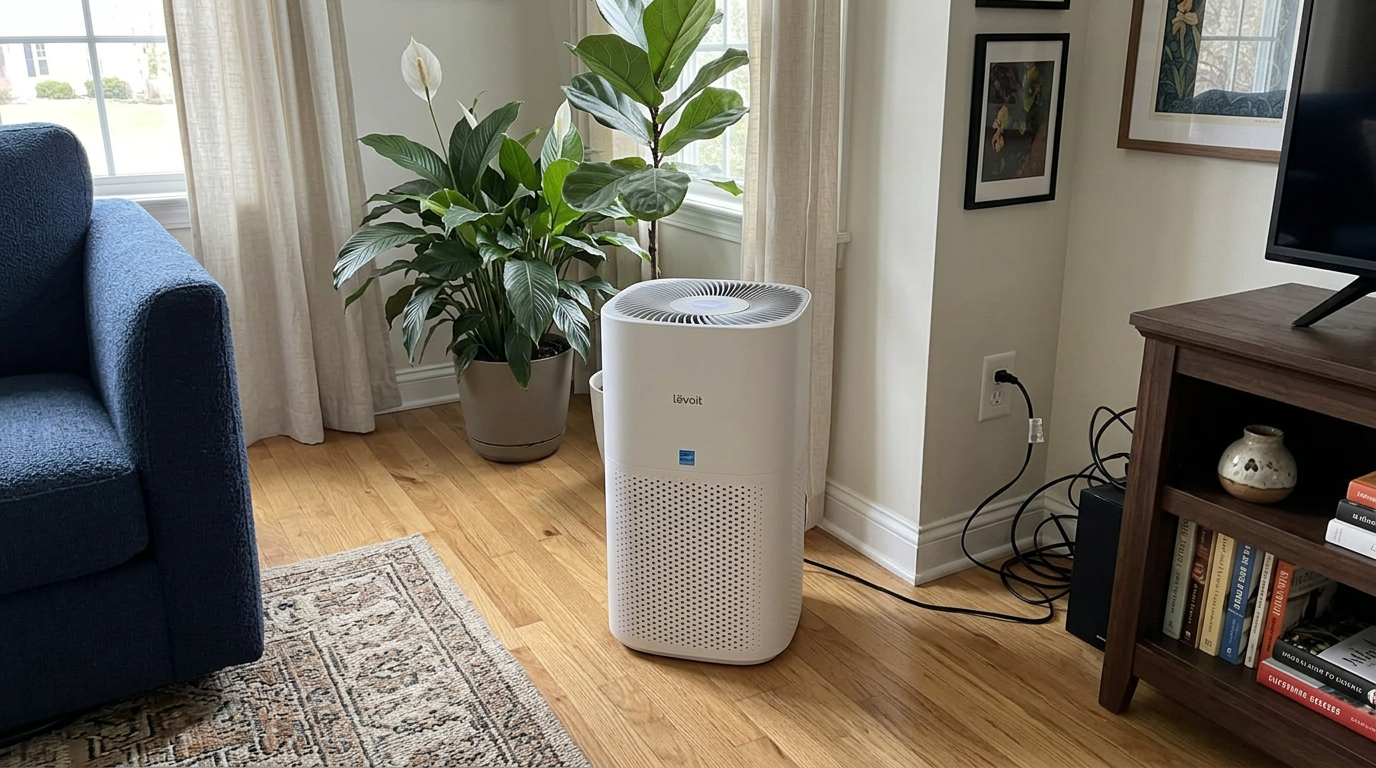
The top twists off for quick access to the cylindrical filter.
Where to put it
The 600S-P pulls air in all around the lower half and pushes it out the top.
That means it works best out in the room, not crammed against a wall, curtains or furniture.
The side handles made it easy to move: I ran it in the living room by day and occasionally carried it to the kitchen when cooking.
Our tip: Place it in the middle of a large open-plan space rather than at one end, so it can draw air evenly from the whole area.
Dust, smoke, allergies and kitchen smells
Household dust
Dust on shelves and the TV stand built up noticeably more slowly during the test.
Smoke
Smoke from a burnt pan and a lit candle cleared quickly on a high setting, helped by the carbon pellets.
For homes affected by wildfire smoke, the combination of a large HEPA area and carbon is exactly what you want.
Allergies and pets
The pre-filter caught dog hair, and the HEPA layer is designed to trap pollen, mold spores and pet dander.
Kitchen smells
Frying and searing smells faded much faster in my open-plan kitchen and living room.
| Problem | How the 600S-P handles it | My rating |
|---|---|---|
| Dust | Large HEPA area | 9 |
| Smoke | HEPA plus carbon pellets | 9 |
| Pollen and dander | True HEPA | 8.8 |
| Cooking smells | Carbon pellets | 8.5 |
Our tip: Close windows and run the purifier on High on wildfire smoke days, because outdoor smoke comes in faster than any purifier can remove it through an open window.
My night in the bedroom
I wanted to give the Levoit Core 600S-P a fair chance as a bedroom purifier, so on the third night I carried it upstairs.
My bedroom is about 180 square feet, far smaller than the room this purifier is designed for.
I set it to Sleep mode, switched the display off and went to bed.
The hum was steady rather than annoying, but it was definitely there.
At 43.9 dBA, Sleep mode is about as loud as Low on many smaller purifiers, and in a quiet room I noticed it every time I woke up.
The air felt fresh in the morning, but for a room that size, this purifier is overkill and the noise is the price you pay.
If you sleep with a fan or white noise machine on anyway, you may not mind.
If you're a light sleeper like me, keep it in the living room and close the bedroom door.
| Bedroom factor | How it did |
|---|---|
| Sleep mode noise | Noticeable in a quiet room |
| Display light | Fine once switched off |
| Air in the morning | Fresh |
| Size for the room | Far more than needed |
Our tip: If you want cleaner bedroom air from a living room purifier, run it on High in the evening with the bedroom door open, then close the door and switch it to Low before bed.
Living with pets
My dog sheds year-round, so pet hair was a big part of this test.
The outer pre-filter layer caught a visible coating of fur and lint within the first two weeks.
That's a good sign, because it means the hair is being stopped before it reaches the finer HEPA layer.
The fur tumbleweeds that usually gather under the sofa built up more slowly, though I still had to vacuum.
The carbon pellets helped with that general dog smell in the living room, especially after a wet walk.
No purifier replaces vacuuming, but the 600S-P made a real difference to how often the room felt dusty and stale.
My impressions over three weeks with a shedding dog.
Our tip: With a shedding pet, vacuum the outside of the filter every two weeks instead of monthly, because a matted layer of fur quickly cuts the airflow.
Design details I liked and didn't
Beyond the size, there are a few small design choices worth knowing about.
What I liked
The side handles are genuinely useful, and I moved it between rooms more often than I expected.
The twist-off top makes filter access simple, with no clips or screws.
The air quality ring on top is easy to read from across the room, even when the rest of the display is hard to see.
And the 360-degree intake means it doesn't matter which way it faces.
What I didn't
The display is too bright by default and some icons are small.
The touch buttons sometimes needed a second press, especially with slightly damp hands from the kitchen.
And its height makes it a visible piece of furniture rather than something that disappears into a corner.
- Side handles
- Twist-off top
- Visible air quality ring
- Bright display
- Occasional missed taps
- Tall and wide
Using it on smoky days
During the second week, there were a couple of hazy days when smoke from distant fires drifted over the area.
Outside, my monitor showed clearly elevated PM2.5 levels.
Inside, with the windows closed and the Levoit Core 600S-P in Auto mode, the readout stayed in the good range for most of the day.
Each time someone opened the back door, the sensor picked up the rise and the fan ramped up straight away.
Within about 15 minutes, the number settled back down.
This is where a large-room purifier really earns its place, because one unit could keep the whole downstairs living area comfortable.
| Smoky-day moment | Indoor reading | Purifier response |
|---|---|---|
| Windows closed, morning | Good | Low in Auto |
| Back door opened | Moderate spike | Ramped to High |
| 15 minutes later | Good again | Back to Low |
| Evening cooking | Brief spike | High, then Medium |
Our tip: On smoky days, keep a spare filter on hand, because heavy smoke can shorten the filter's life and you don't want to run out mid-season.
What a year of ownership looks like
Based on my three weeks and Levoit's guidance, here's what to expect over a year.
You'll vacuum the outer filter layer about twelve times, or more often with pets.
You'll replace the filter once or twice, depending on how dusty or smoky your home is.
And electricity use stays low, because the motor draws under 50 watts even at full power.
| Task | How often | Time needed |
|---|---|---|
| Vacuum pre-filter layer | Monthly | 2 minutes |
| Wipe outside of unit | Monthly | 1 minute |
| Replace filter | Every 6 to 12 months | 5 minutes |
| Reset filter indicator | After each change | 3 seconds |
For a purifier this powerful, that's very little effort.
The app makes it even easier, because it shows filter wear so you can order a replacement before the indicator lights up.
What surprised me, good and bad
The power use
I expected a purifier this big to draw a lot of electricity.
Seeing 48.2 watts on my plug-in meter at full Turbo was a genuine surprise, and it made me much happier to leave it running all day.
How much I used the data
I didn't think I'd care about PM2.5 numbers, but I ended up checking them constantly.
Seeing the spike from searing a steak, and then watching it fall, changed how I cook: I now turn on the purifier and the range hood before I start.
The noise complaints
Online reviews made it sound unbearable.
In reality, Low and Medium were fine in a living room, and only Sleep and Turbo felt louder than they should.
So the complaints are partly true, but they depend a lot on where you put it.
The size, again
Even after three weeks, I still noticed how much floor space it takes.
In my living room it was fine, but it would dominate a small apartment.
From my testing notes.
How to get the best results
After three weeks, these are the habits that made the biggest difference.
Keep it out in the room with space on every side, because it draws air in all the way around.
Leave it in Auto most of the time, so the laser sensor can do the work.
Schedule Turbo in the app for times when you're out, so you get the fast cleaning without the noise.
Switch it on before cooking, not after, because it's easier to stop smells spreading than to clear them later.
Close windows on high-pollen or smoky days, and let the purifier handle the air inside.
And clean the outer filter layer regularly, more often if you have pets.
All my test results in one place
| Test | Result | My rating |
|---|---|---|
| 560 sq ft room, 1 hour Turbo | 96% improvement | 9.4 |
| 730 sq ft room, 1 hour Turbo | About 93% improvement | 9.1 |
| Sensor response | Within seconds | 9.2 |
| Power on Turbo | 48.2 W | 9.2 |
| Sleep mode noise | 43.9 dBA | 6.5 |
| Turbo noise | 68.5 dBA | 5.8 |
What daily use is really like
For three weeks, the Levoit Core 600S-P lived in my large living room.
It ran in Auto most of the day, on Low or Medium, and I used the app to schedule Turbo bursts when I was out.
The PM2.5 readout became something I glanced at all the time, especially when cooking.
At night, I switched the display off, and I didn't run it in the bedroom after that one night.
Mornings usually started with the readout in the good range, even with the dog sleeping downstairs.
Breakfast cooking caused a small bump, which cleared within ten minutes in Auto.
Midday was quiet, with the purifier ticking over on Low and barely audible over the fridge.
Dinner was the busiest time, with frying and searing pushing the fan to High for a while.
By the time we sat down on the sofa in the evening, the smells had mostly gone and the fan had dropped back to a soft hum.
Before bed, I'd glance at the app's history to see how the day had gone, which became a surprisingly satisfying habit.
Over three weeks, I never had to think much about it, which is exactly what I want from a purifier.
Share of running time from my testing notes.
Three weeks with the Core 600S-P, week by week
Week 1: setup and testing
The big-room tests showed straight away how powerful it is.
A night in the bedroom showed it's too loud for sleeping.
Week 2: living with the app
Schedules, air quality history and Turbo-while-out became my routine.
Week 3: everyday cleaning
It kept a big room fresh with very little effort from me.
From my testing notes.
Common mistakes to avoid
| Mistake | What happens | Better habit |
|---|---|---|
| Leaving the filter wrapped | Almost no cleaning | Remove the plastic first |
| Putting it in a bedroom | Too loud to sleep | Use it in living spaces |
| Pushing it against a wall | Weaker intake | Space on all sides |
| Skipping pre-filter cleaning | Lower airflow | Vacuum monthly |
| Turbo while you're in the room | Loud | Turbo while you're out |
| Bright display at night | Distracting light | Display off or light sensor |
What I would change
A much quieter Sleep mode would make it suitable for bedrooms.
A dimmer, clearer display would be easier to live with.
And a slightly smaller footprint would help in tighter spaces.
Three households, three verdicts
The open-plan family home
A large living, dining and kitchen area with cooking smells and pets.
This is exactly what the 600S-P is built for.
The wildfire-season household
Smoke days, closed windows and a need to clean a big space quickly.
A very good fit, with strong HEPA and carbon filtration.
The light sleeper
Wants a purifier next to the bed.
Sleep mode is too loud, so a quieter bedroom purifier will suit you better.
| Household | Fit | Main reason |
|---|---|---|
| Large open-plan home | Excellent | 635 sq ft coverage |
| Smoke and allergies | Very good | HEPA and carbon |
| Smart-home users | Excellent | VeSync app and history |
| Bedroom use | Poor | Loud Sleep mode |
Is the Levoit Core 600S-P worth the money?
For large rooms, yes.
It cleans big spaces fast, uses very little electricity, and its filters last six to twelve months.
Together, that makes it one of the most cost-effective large purifiers I've tested.
The excellent app and real-time sensor add a lot of everyday value.
If you need a bedroom purifier or have a small room, you'll be paying for power you can't comfortably use.
Three questions to ask:
Is your room larger than about 400 square feet?
Will it live in a living space rather than a bedroom?
And do you have space for a large purifier?
How it compares with other types of purifier
| Feature | Levoit Core 600S-P | Mid-size purifier | Bedroom purifier |
|---|---|---|---|
| Room size at 4.8 ACH | Up to 635 sq ft | About 300–400 sq ft | About 150–250 sq ft |
| Sensor | Laser, live PM2.5 | Often infrared | Varies |
| App | Excellent | Sometimes | Sometimes |
| Power on max | About 48 W | Often 40–60 W | Lower |
| Sleep noise | 43.9 dBA | Often quieter | Quietest |
| Size | Large | Medium | Small |
| Your priority | Is the 600S-P a fit? | Why |
|---|---|---|
| Cleaning a big room fast | Excellent | 96% in an hour |
| Low running costs | Excellent | Under 50 W on Turbo |
| Smart data and app | Excellent | History, schedules, scenes |
| Quiet bedroom use | Poor | Sleep mode is loud |
| Small spaces | Fair | Large footprint |
Which one is right for you: is the Levoit Core 600S-P your match?
4 quick questionsLevoit Core 600S-P specifications
From manufacturer data, retailer listings and my own testing.
How I tested and scored the Levoit Core 600S-P
For three weeks, the Levoit Core 600S-P ran in my large, open-plan living room and kitchen, plus one night in the bedroom.
I measured air quality improvement over an hour on Turbo in a 560 and a 730 square foot space, and ran a smoke test.
I measured noise at every setting with a sound meter and power use with a plug-in meter.
I used the VeSync app daily, cleaned the pre-filter and did a trial filter swap.
Finally, I checked my notes against Levoit's specifications and user manual.
- Air cleaning (9.2): large-room performance, smoke and dust.
- Smart features (9.0): sensor, Auto mode and app.
- Running costs (8.8): power use and filter life.
- Noise (6.6): loud Sleep and Turbo modes.
The overall score of 8.3 is an editorial rating that reflects those four areas.
Levoit Core 600S-P FAQ
Is the Levoit Core 600S-P worth it?
Yes, for large living rooms and open-plan spaces. It's too loud for most bedrooms.
How big a room does it cover?
Up to 635 square feet at 4.8 air changes per hour, or 1,588 square feet at two changes per hour in lightly polluted air.
How well does it clean?
In my tests it improved air quality by 96% in a 560 square foot room after an hour on Turbo.
How loud is it?
I measured 43.9 dBA on Sleep and 68.5 dBA on Turbo.
Is it good for bedrooms?
Not really. Sleep mode is louder than most bedroom purifiers.
How much power does it use?
I measured 48.2 W on Turbo, which is very low for its size.
Does it have an app?
Yes. The VeSync app shows live and historical air quality, schedules, scenes and filter life.
How often do I replace the filter?
Every 6 to 12 months. An indicator tells you when.
Is the filter washable?
No, but you should vacuum the outer pre-filter layer monthly.
Does it produce ozone?
No. It's CARB certified and produces zero ozone.
What sensor does it use?
Levoit's AirSight Plus laser sensor, which shows a live PM2.5 reading.
Can I turn the display off?
Yes. There's a display-off button and a light sensor.
Senior home appliance tester
Emily has tested home appliances for a living since 2016, first as a test coordinator at a national consumer advocacy group and, since 2021, at HouseholdMe. She has a degree in industrial design from Ohio State, so she looks at how a product is built, not just how it performs. She tested the Levoit Core 600S-P in her open-plan living room for three weeks for this review.
- Three weeks of hands-on testing of the Levoit Core 600S-P
- Levoit Core 600S-P product information and user manual