KNKA APH4000 review
The KNKA APH4000 air purifier packs two filters, an AHAM-verified clean air rating and real charcoal into a slim, space-saving body. In three weeks in my living room and bedroom, it cleaned quickly, ran smoothly with no motor ticking and was very quiet in sleep mode. Its clip-on feet feel flimsy, it can't sit against a wall, and there's no app, but for the money it's one of the best no-nonsense purifiers I've tested.

Emily Carter
Hands-on review
Hands-on testing, research, specs
3 weeks
25 minutes
Jargon helpNew to air purifiers? Tap any dotted term to see what it means.
In this review
Yes, if you want strong, simple air cleaning without paying for extras. The KNKA APH4000 has two three-stage filters, an independently verified clean air rating of 226 CFM, proper charcoal for smells and a quiet, smooth motor. Sleep mode is genuinely quiet, and the controls cover everything you need. The clip-on feet are fiddly, it needs space in front and behind, and there's no app, but at its usual price it's excellent value.
KNKA APH4000 at a glance
KNKA APH4000 pros and cons
- Fast, verified cleaning performance
- Quiet, smooth motor and sleep mode
- Real charcoal and two filters
- Small, fragile tabs on the feet
- Can't sit flush against a wall
- No app or smart features
Who should buy the KNKA APH4000?
- Living rooms and large bedrooms
- Allergy sufferers on a budget
- People who want simple controls
- Smart-home and app users
- Narrow spaces against a wall
- Heavy pet-hair households
First impressions of the KNKA APH4000
The KNKA APH4000 is slimmer than most purifiers with this much cleaning power.
It's about 17 inches tall, 12.4 inches wide and only 8.2 inches deep, and weighs just under 10 pounds.
Instead of a round tower, it's a flat, rectangular unit with filters on the front and back and air outlets on the sides.
The black finish and green air quality light give it a clean, modern look.
In the box are the purifier, two pre-installed three-stage filters, a power adapter, two clip-on support feet and an aroma pad.
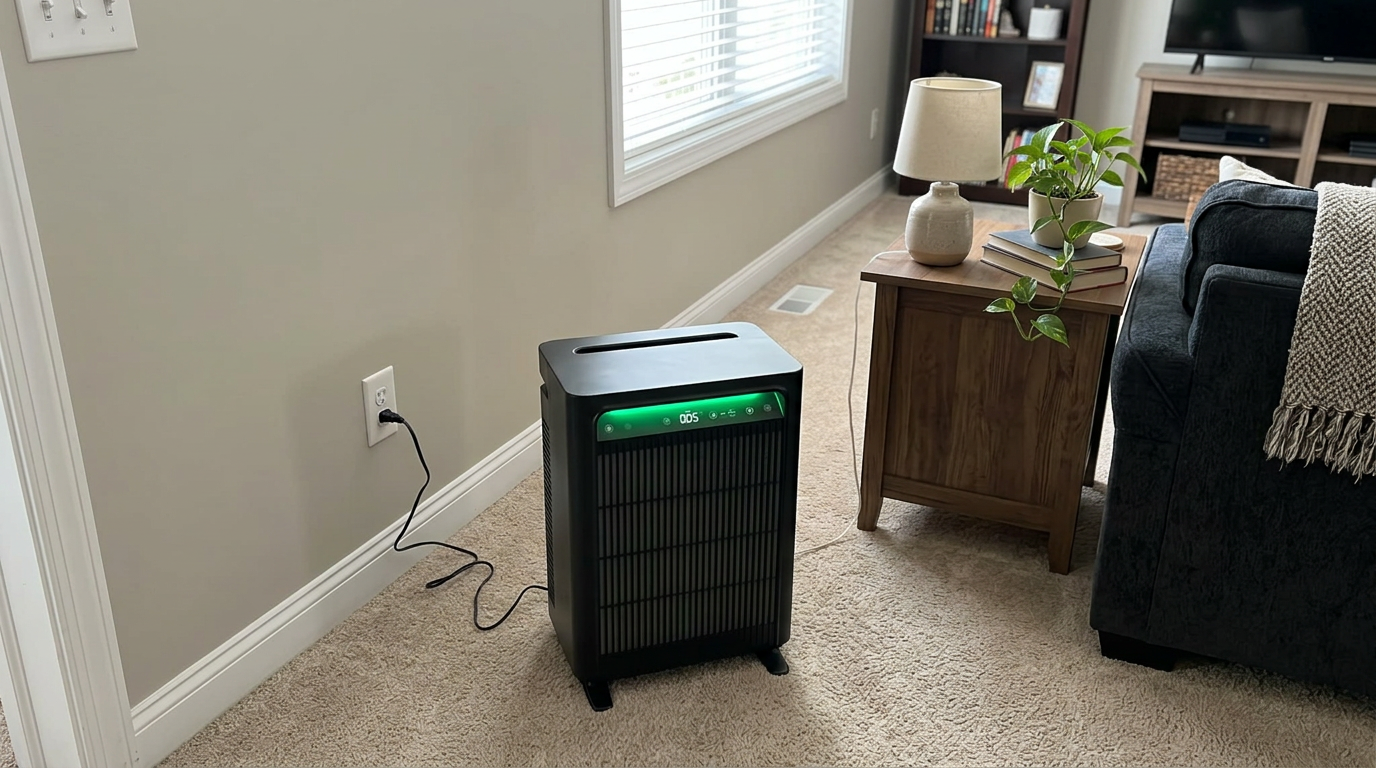
A slim, rectangular design with filters on the front and back.
Setting it up
Setup took about ten minutes.
First, I attached the two support feet to the bottom.
They rely on small tabs that need a firm push until they click; if you don't push hard enough, a foot just hangs loose.
Once they clicked in, they held well, but the tabs are small enough that I wouldn't want to remove and reattach them often.
Next, I removed the front and back covers, took the plastic off both filters and refitted them with the pull tabs facing outward.
The 6-foot power cord was long enough to reach my outlet without an extension.
| Step | What to do |
|---|---|
| 1 | Push both feet firmly until they click |
| 2 | Remove the front and back covers |
| 3 | Unwrap both filters |
| 4 | Refit them with pull tabs facing out |
| 5 | Snap the covers back on |
| 6 | Place with space front and back, then plug in |
Our tip: Fit the feet once and leave them on, because the small plastic tabs are the weakest part of the design and could snap with repeated removal.
What the KNKA APH4000 actually is
The APH4000's clean air rating is verified by AHAM, an independent appliance association, which gives it more credibility than many budget purifiers.
Its CADR✕CADRClean Air Delivery Rate: how many cubic feet of cleaned air a purifier delivers per minute. Higher means it cleans a room faster. is 226 cubic feet per minute for smoke, dust and fine particles, and 244 for pollen.
That's enough to clean a room of about 350 square feet at around 4.8 air changes per hour✕Air changes per hour (ACH)How many times a purifier can filter the full volume of air in a room each hour. Four to five is a common target for allergies and smoke., the usual target for allergies.
KNKA also says it can cover up to 1,695 square feet in an hour, which is better suited to light background cleaning.
CADR by pollutant
AHAM-verified clean air delivery rates.
| Room size | Air changes per hour | Good for |
|---|---|---|
| Up to about 350 sq ft | About 4.8 | Allergies, pets, smoke |
| About 500–700 sq ft | About 2.5–3.5 | General freshening |
| Up to 1,695 sq ft | 1 | Light background cleaning |
Our tip: Ignore the larger headline coverage figures if you have allergies, and use it in a room of up to about 350 square feet for thorough, fast cleaning.
The two three-stage filters
Instead of one filter, the APH4000 uses two: one on the front and one on the back.
That doubles the filter surface area, which helps airflow and should help the filters last longer.
Each filter has three layers, and there's no ionizer, so it doesn't produce ozone✕OzoneA reactive gas that can irritate the lungs. Some ionizers and electronic purifiers produce it, which is why many people prefer purifiers without one..
Stage 1: washable pre-filter
The outer mesh catches larger dust, lint and hair, and it can be washed.
The mesh is fairly coarse, so I didn't see much buildup on it during my test.
Stage 2: H13 true HEPA
The main layer is an H13 true HEPA✕True HEPAA filter that meets the HEPA standard of capturing at least 99.97% of particles 0.3 microns in size. Some cheaper filters use HEPA-like wording without meeting it. filter for fine dust, pollen, pet dander and smoke.
After three weeks, the white HEPA media had turned visibly grayer, which showed how much fine dust it was trapping.
Stage 3: activated charcoal
The last layer uses granules of activated carbon✕Activated carbonCarbon treated to have a huge surface area full of tiny pores. It traps odors and gases such as cooking smells and VOCs that particle filters can't catch. rather than a thin carbon-coated mesh.
Real charcoal granules absorb far more smells and gases than a mesh, so this is a real advantage at this price.
| Stage | Catches | Maintenance |
|---|---|---|
| Washable pre-filter | Hair, lint, large dust | Rinse or vacuum |
| H13 true HEPA | Fine dust, pollen, dander, smoke | Replace about every 6 months |
| Activated charcoal granules | Odors and gases | Part of the same filter |
Our tip: Install each filter with the pull tab facing outward, because if the tab faces inward, getting the filter out again is a real struggle.
Build quality and sealing
One detail I was pleased to see is how well the filters seal.
Foam trim around the edge of each filter sits in a channel in the housing, which stops air sneaking around the filter instead of through it.
After three weeks, there was no dust inside the housing behind the seal, which is a good sign.
The front and back covers line up with tabs at the bottom and snap shut with a firm push on each side.
They stayed firmly in place during normal use and only came off when I pulled the release tabs.
The motor also ran smoothly, without the clicking or ticking sounds I've heard from some purifiers at this price.
Our tip: Press each cover around its edges after refitting a filter, because a fully seated cover keeps the seal tight and stops dusty air bypassing the filter.
How well it cleans
I tested the KNKA APH4000 in my 330 square foot living room and my 200 square foot bedroom.
In the living room, it noticeably reduced floating dust, especially the fine particles I could see in afternoon sunlight.
After vacuuming, the air quality light switched from red to green within a few minutes on auto.
In the bedroom, it was more than powerful enough, which meant I could run it on a quieter speed.
The charcoal handled cooking smells well, and they faded faster than with purifiers that use a thin carbon mesh.
My impressions from three weeks of use.
The air sensor and auto mode
An air quality sensor on the back drives auto mode and the colored light on the front.
It reacted to dust from vacuuming and shaking out a blanket, as well as to strong smells and gases.
There's a slight delay before the fan responds, but once it does, it ramps up quickly and settles back down when the air clears.
The display also shows an air quality reading, so you can see what the sensor is detecting.
| What I did | What the sensor did | Auto mode response |
|---|---|---|
| Vacuumed the rug | Light turned red | Ramped up, green in minutes |
| Shook out a blanket | Quick spike | Short boost |
| Fried onions nearby | Detected the smell | Higher speed for a while |
| Quiet evening | Green | Low or eco standby |
Our tip: Don't place the back of the purifier near a kitchen or bathroom door, because the rear sensor will react to every passing smell and keep the fan running high.
Controls and modes
The touch controls are simple but cover everything most people need.
There are four fan speeds, plus auto, sleep, eco and pet modes.
Eco mode goes into standby when the air is excellent and restarts automatically when needed, which saves energy and filter life.
Pet mode runs a stronger cleaning pattern for dander and hair.
There's also a timer, a filter life percentage and a child lock, which you activate by holding the lock button for about three seconds until it beeps.
The display lights fade after around ten seconds, and you can turn them off completely, though a very faint power light can remain visible in a dark room.
Our tip: Use the child lock if you have pets or small children, because the touch buttons are easy to press by accident.
Noise levels
KNKA rates sleep mode at about 22 dB, and in my bedroom it was genuinely quiet enough to sleep next to.
Speeds 1 and 2 produced a gentle, steady airflow sound.
Speed 3 was noticeably louder, but still fine in a living room during the day.
Speed 4 was the loudest, a strong rush of air that I used mainly after vacuuming.
Eco mode was very quiet, and the motor never clicked or ticked at any speed.
How each setting sounded from about 3 feet away.
Our tip: Run speed 3 instead of speed 4 when you want a strong clean, because it moves plenty of air with noticeably less noise.
Power use
The APH4000 is rated at 45 watts at full power.
Running at maximum around the clock would use about 32 kilowatt-hours a month.
In real use, with auto, sleep and eco doing most of the work, it used far less.
Sleep mode with the lights off drew the least, and turning the lights on at full speed added only a tiny amount.
Estimated monthly energy use based on the rated wattage and my usage.
Our tip: Turn on eco mode when you're out, because it puts the purifier into standby once the air is clean and wakes it automatically when needed.
Maintenance and filter life
KNKA suggests replacing the filters roughly every six months.
The filter life percentage makes it easy to keep track.
After three weeks of running about 12 hours a day, and occasionally all day, mine still showed well over 90%.
Between replacements, rinse or vacuum the pre-filter mesh and wipe the outside.
| Task | How often | Time needed |
|---|---|---|
| Clean the pre-filter mesh | Every 2–4 weeks | 5 minutes |
| Wipe the outside and sensor area | Monthly | 2 minutes |
| Check filter life | Monthly | Seconds |
| Replace both filters | About every 6 months | 5 minutes |
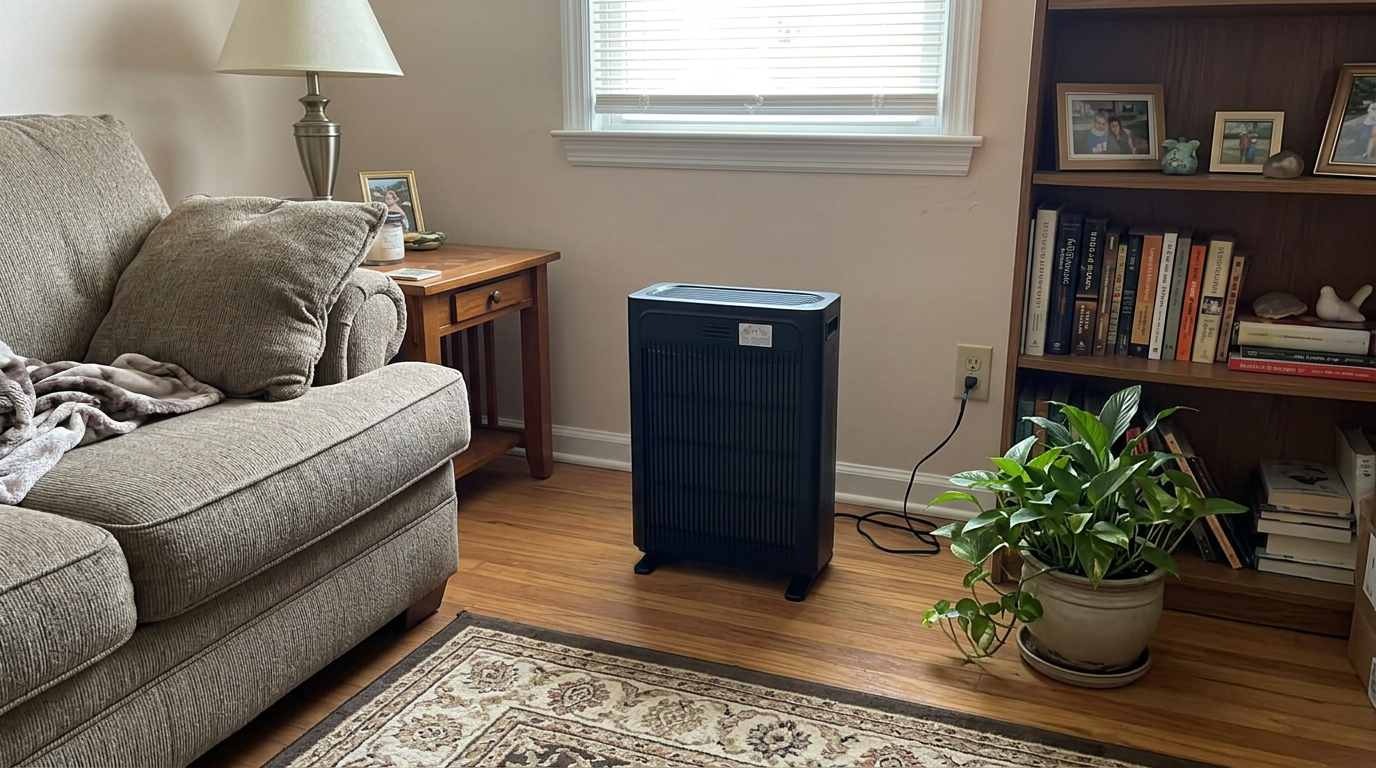
Filters on both sides double the surface area.
Where to put it
The APH4000 draws air in through the front and back and pushes it out through the sides.
That design saves floor space, but it means you can't push it flat against a wall without blocking one filter.
KNKA's guidance, and my experience, is to leave about a foot of space in front and behind, or at least 6 inches.
Our tip: Avoid placing it behind a sofa or between a bed and a wall, because blocking either filter roughly halves its effective intake.
Pet hair and dander
My dog sheds year-round, so I paid close attention to pet hair.
The HEPA layer clearly caught dander and fine dust, and pet mode boosted cleaning when she was in the room.
Floating hair is a different matter: with two filters sharing the airflow, suction at each filter is less concentrated than on a single-filter purifier.
The fairly smooth pre-filter mesh also let some hair slide off rather than stick.
Some owners remove the pre-filter so hair catches on the textured HEPA surface, but that shortens the HEPA filter's life, so I don't recommend it.
And remember, purifiers only catch hair that's floating in the air, not hair already on the floor or sofa.
| Pet problem | How the APH4000 handles it | My rating |
|---|---|---|
| Pet dander | H13 HEPA, pet mode | 8.8 |
| Pet odor | Charcoal granules | 8.6 |
| Floating hair | Split suction, smooth mesh | 7.0 |
Our tip: Brush your pet outside and vacuum regularly, because a purifier only catches the hair that's floating in the air and can't replace good grooming.
Smells, cooking and the aroma pad
The charcoal granules were one of the biggest surprises in this test.
Cooking smells from my open kitchen faded noticeably faster than with purifiers that use a thin carbon mesh.
The sensor also reacted to stronger smells and gases, raising the fan speed on its own.
There's an aroma compartment near the top with a felt pad, and KNKA includes spare pads.
You can add a few drops of essential oil if you like, but I left it empty, because I prefer clean, unscented air.
My impressions from three weeks of use.
Our tip: Leave the aroma pad empty if anyone in your home has allergies or asthma, because added fragrance can irritate sensitive airways.
Allergies and bedtime
For allergy sufferers, the APH4000 has the key ingredients: strong airflow, an H13 HEPA filter and a quiet sleep mode.
In my bedroom, I ran speed 2 for an hour before bed and switched to sleep mode at lights-out.
The air stayed clean overnight, and the faded display didn't bother me.
Its fine-particle performance also covers PM2.5✕PM2.5Fine particles 2.5 micrometers or smaller, such as smoke and some pollution. They can travel deep into the lungs., such as smoke and pollution.
| Allergy habit | Why it helps |
|---|---|
| Speed 2 for an hour before bed | Clean air when you lie down |
| Sleep mode overnight | Quiet, continuous cleaning |
| Close windows on high-pollen days | Stops pollen coming in |
| Wash bedding weekly | Removes allergens it can't reach |
Smoke and fine particles
Smoke is one of the toughest tests for a purifier, because the particles are so fine.
With a verified smoke CADR of 226 CFM, the APH4000 is well equipped for it in a medium-sized room.
When I burned a slice of toast, the light turned red within seconds and the fan ramped up on auto.
In my living room, the light was back to green in about 10 minutes, and the charcoal took care of most of the smell soon after.
Candle smoke cleared even faster.
What impressed me most was how the two filters shared the load: air was pulled in from both the front and the back, so smoke didn't linger on one side of the room.
That balanced intake is one of the real advantages of the dual-filter design, as long as both sides have space to breathe.
For homes affected by wildfire smoke, I'd keep the windows closed and run it on speed 3 in the main living area.
| Smoke source | Room | Back to green |
|---|---|---|
| Burnt toast | Living room | About 10 minutes |
| Blown-out candle | Bedroom | A few minutes |
| Searing steak | Open kitchen | About 15 minutes |
Our tip: Switch on the purifier and your range hood before you start searing or frying, because it's much easier to keep smoke under control than to clear it afterward.
What a year of ownership looks like
Based on my three weeks and KNKA's guidance, here's what a year with the APH4000 looks like.
You'll clean the pre-filter mesh roughly once or twice a month.
You'll replace both filters about twice, depending on dust, pets and cooking.
And thanks to auto, sleep and eco modes, electricity use stays modest.
My estimate for a typical living room.
Buying replacement filters in multi-packs keeps things simple, because you'll always have the next pair on hand.
Overall, it's a low-effort purifier to own.
Can it handle an open-plan space?
I spent a few days with the APH4000 in a 600 square foot open-plan living, dining and kitchen area.
It made a clear difference, especially near where it stood, and cooking smells faded faster than without it.
But it took longer to bring the whole space back to green after vacuuming or cooking.
In a space that size, it works out to around three air changes per hour, which is fine for general freshening but below the allergy target.
If you need thorough cleaning across a big open-plan area, consider two units or a larger purifier.
| Space | Approximate air changes per hour | Verdict |
|---|---|---|
| 200 sq ft bedroom | About 8 | Plenty, run it quietly |
| 330 sq ft living room | About 5 | Ideal |
| 600 sq ft open-plan | About 3 | Good for freshening |
Design details I liked and didn't
What I liked
The slim, flat shape takes up little floor space.
The filter seals are better than I expected at this price.
Real charcoal granules make a noticeable difference to smells.
And the motor is smooth and quiet, with no ticking.
What I didn't
The clip-on feet have small, fragile tabs.
It needs space in front and behind.
And there's no app, schedules or remote control.
- Slim footprint
- Tight filter seals
- Real charcoal, smooth motor
- Fragile feet tabs
- Needs front and back clearance
- No app
What surprised me
How much charcoal it has
I expected a thin carbon mesh at this price, not proper granules.
How smooth the motor is
Budget purifiers often tick or hum unevenly, but this one ran smoothly at every speed.
How fiddly the feet are
For such a well-built purifier, the small tabs on the feet felt like an afterthought.
From my testing notes.
How to get the best results
Use it in a room of up to about 350 square feet for thorough cleaning.
Leave space in front and behind, or turn it side-on to a wall.
Leave it in auto during the day, use sleep mode at night and eco when you're out.
Clean the pre-filter every few weeks and replace both filters together.
And leave the aroma pad empty unless you really want a scent.
All my test results in one place
| Test | Result | My rating |
|---|---|---|
| Living room cleaning | Red to green in minutes after vacuuming | 9.0 |
| Bedroom cleaning | Easily handled on low | 9.2 |
| Odor removal | Fast, thanks to charcoal | 8.8 |
| Sleep mode noise | About 22 dB, very quiet | 9.0 |
| Pet hair pickup | Moderate | 7.0 |
| Build quality | Good seals, fragile feet | 7.4 |
| Filter life after 3 weeks | Over 90% remaining | 8.8 |
What daily use is really like
For most of the three weeks, the KNKA APH4000 lived in my living room, side-on to the wall next to the bookshelf.
It ran in auto during the day, often at low speed, and jumped up whenever I vacuumed or cooked.
In the evenings, I sometimes carried it to the bedroom, which was easy despite its size thanks to its light weight.
There, I ran speed 2 for an hour and then sleep mode overnight.
When I left the house, I switched on eco mode, and it went into standby once the air was clean.
The only maintenance was rinsing the pre-filter mesh once and wiping the outside.
A typical weekday started with the green light glowing softly in the living room after a quiet night in auto.
Breakfast cooking pushed it up for ten minutes or so, then it settled back down.
During the day, while I worked from home, it hummed along at low speed, barely noticeable over the fridge.
Vacuuming in the afternoon was the biggest event, sending the light to red and the fan to a higher speed for a few minutes.
Dinner was the second peak, with the charcoal doing most of the work on the smells.
By the time I sat down in the evening, the display had faded and the purifier was back to a gentle hum.
It's the kind of appliance that quietly does its job without asking for attention, which is exactly what I want.
The only time I touched the controls was to switch between sleep and eco, and occasionally to boost it after cleaning.
Share of running time from my testing notes.
Three weeks with the APH4000, week by week
Week 1: setup and first tests
The fiddly feet were a poor start, but the cleaning performance and smooth motor quickly won me over.
Week 2: living room routine
Side-on placement, auto mode and fast odor removal made it an easy daily companion.
Week 3: bedroom and eco
Quiet nights and eco standby while I was out rounded out a very solid test.
From my testing notes.
Common mistakes to avoid
| Mistake | What happens | Better habit |
|---|---|---|
| Pushing it against a wall | One filter blocked | Leave space or turn it side-on |
| Not clicking the feet in fully | A loose, wobbly foot | Push firmly until it clicks |
| Filter tab facing inward | Hard to remove later | Tab facing out |
| Replacing one filter only | Unbalanced airflow | Replace both together |
| Removing the pre-filter for pet hair | Shorter HEPA life | Keep it in, groom and vacuum |
| Adding strong scents | Fragrance in the air | Leave the aroma pad empty |
What I would change
Sturdier feet with larger tabs would fix the biggest build weakness.
An optional app with schedules would make it easier to run automatically.
And a slightly textured pre-filter would help it grab more floating pet hair.
I'd also like the faint power light to switch off completely in sleep mode, because in a very dark bedroom I could still just see it.
It's a minor point, and a small piece of tape fixes it, but it's the kind of detail that light sleepers notice.
Finally, a carrying handle would make it easier to move between rooms, since the flat sides don't offer much grip.
None of these change my overall view: it's a very capable purifier with a few rough edges.
Three households, three verdicts
The budget-conscious allergy sufferer
Wants strong HEPA cleaning in a living room or bedroom without paying for smart features.
An excellent fit.
The cooking-heavy household
Wants smells gone quickly from an open kitchen and living area.
A very good fit, thanks to the charcoal granules.
The heavy-shedding pet home
Wants a purifier to catch floating hair.
Good for dander and odor, but less effective on floating hair than some single-filter designs.
| Household | Fit | Main reason |
|---|---|---|
| Allergy sufferers | Excellent | H13 HEPA, 226 CFM CADR |
| Cooking smells | Very good | Charcoal granules |
| Light sleepers | Very good | About 22 dB sleep mode |
| Smart-home users | Poor | No app |
Is the KNKA APH4000 worth the money?
Yes, it's one of the best-value purifiers I've tested.
You get two filters, an independently verified clean air rating, real charcoal and a smooth, quiet motor.
It's especially good value when it's on sale, but even at its regular price it holds up well.
The trade-offs are the lack of smart features and a few build quirks.
Three questions to ask:
Is your room around 350 square feet or smaller?
Can you give it space in front and behind?
And are you happy without an app?
How it compares with other types of purifier
| Feature | KNKA APH4000 | Typical budget purifier | Premium smart purifier |
|---|---|---|---|
| CADR | 226 CFM, AHAM verified | Often unverified | Usually verified |
| Filters | 2 three-stage | Usually 1 | Usually 1 |
| Carbon | Charcoal granules | Often thin mesh | Varies |
| Sleep noise | About 22 dB | Often 25–35 dB | Often under 25 dB |
| App | No | Rarely | Yes |
| Ionizer | None | Sometimes | Varies |
| Your priority | Is the APH4000 a fit? | Why |
|---|---|---|
| Value for money | Excellent | Two filters, verified CADR |
| Odor removal | Very good | Charcoal granules |
| Quiet nights | Very good | Sleep mode |
| Smart control | Poor | No app |
| Tight spaces against a wall | Fair | Needs front and back clearance |
Which one is right for you: is the KNKA APH4000 your match?
4 quick questionsKNKA APH4000 specifications
From manufacturer data, retailer listings and my own testing.
How I tested and scored the KNKA APH4000
For three weeks, the KNKA APH4000 ran in my 330 square foot living room and 200 square foot bedroom, plus a few days in a 600 square foot open-plan space.
I watched its air quality reading and a separate monitor after vacuuming, cooking and shaking out bedding.
I listened to every speed and mode from about 3 feet away, estimated energy use from the rated wattage and my usage, and checked the filter life indicator.
I also removed and refitted the filters and covers, and inspected the seals.
Finally, I checked my notes against KNKA's specifications.
- Air cleaning (8.8): fast in rooms up to about 350 square feet, with strong odor removal.
- Value (9.2): two filters and verified performance at a budget price.
- Noise (8.6): very quiet sleep mode and smooth motor.
- Build and features (7.4): good seals, but fragile feet and no app.
The overall score of 8.4 is an editorial rating that reflects those four areas.
KNKA APH4000 FAQ
Is the KNKA APH4000 worth it?
Yes. It offers two filters, an AHAM-verified CADR, real charcoal and a quiet motor at a budget-friendly price.
How big a room does it cover?
It's best for rooms up to about 350 square feet for allergies. KNKA says it can cover up to 1,695 square feet in an hour for light cleaning.
What is its CADR?
226 CFM for smoke, dust and PM2.5, and 244 CFM for pollen, verified by AHAM.
How many filters does it use?
Two three-stage filters, one on the front and one on the back.
Does it have an ionizer?
No. It uses a pre-filter, H13 true HEPA and activated charcoal only.
How loud is it?
About 22 dB in sleep mode. The highest speed is noticeably louder.
Can it go against a wall?
Not flat against one. Leave about a foot in front and behind, or place it side-on to the wall.
How often do I replace the filters?
About every six months. A percentage indicator shows remaining life.
Does it have an app?
No. All controls are on the unit.
Is it good for pet hair?
It's good for dander and odor, but less effective at catching floating hair than some single-filter designs.
What is eco mode?
It puts the purifier into standby when the air is excellent and restarts it automatically when needed.
How much power does it use?
It's rated at 45 watts at full power.
Senior home appliance tester
Emily has tested home appliances for a living since 2016, first as a test coordinator at a national consumer advocacy group and, since 2021, at HouseholdMe. She has a degree in industrial design from Ohio State, so she looks at how a product is built, not just how it performs. She tested the KNKA APH4000 in her living room and bedroom for three weeks for this review.
- Three weeks of hands-on testing of the KNKA APH4000
- KNKA APH4000 product information and user manual