Meraki Dual Boiler review: two boilers, two scales and one easy routine
The Meraki Dual Boiler Espresso Machine grinds by weight, stops by weight and steams while the shot runs. It made my espresso routine far more repeatable, though the detailed bodywork takes real effort to keep clean.
In this review
Yes, if you make espresso or milk drinks most days and want your dose and yield handled for you. The Meraki Dual Boiler Espresso Machine brews and steams at the same time, weighs both ends of the shot and keeps its grinder away from the heat. The bodywork takes patience to clean, and one aftermarket portafilter I tried leaked. For a daily routine that repeats itself, it's the most complete all-in-one setup I've used.
Meraki Dual Boiler at a glance
Meraki Dual Boiler pros and cons
- Brews and steams at the same time
- Two built-in scales make dose and yield repeatable
- Separate grinder tower with a wide grind range
- Intricate bodywork is hard to clean thoroughly
- Some aftermarket portafilters may not seal properly
- Firmware updates depend on a Wi-Fi connection
Who should buy the Meraki Dual Boiler?
- Households that make several milk drinks in a row
- Home baristas who want to brew by weight without extra gear
- People who switch between espresso and pour-over
- Anyone who wants fully automatic, one-touch coffee
- People who want a simple exterior to wipe down
- Kitchens without room for a wide, deep machine
First impressions of the Meraki Dual Boiler
Most all-in-one espresso machines ask you to accept a compromise somewhere.
The grinder is an afterthought, the steam is slow, or the machine does so much for you that it stops feeling like making coffee.
I went into my time with the Meraki Dual Boiler expecting to find that compromise quickly.
What struck me first was the layout.
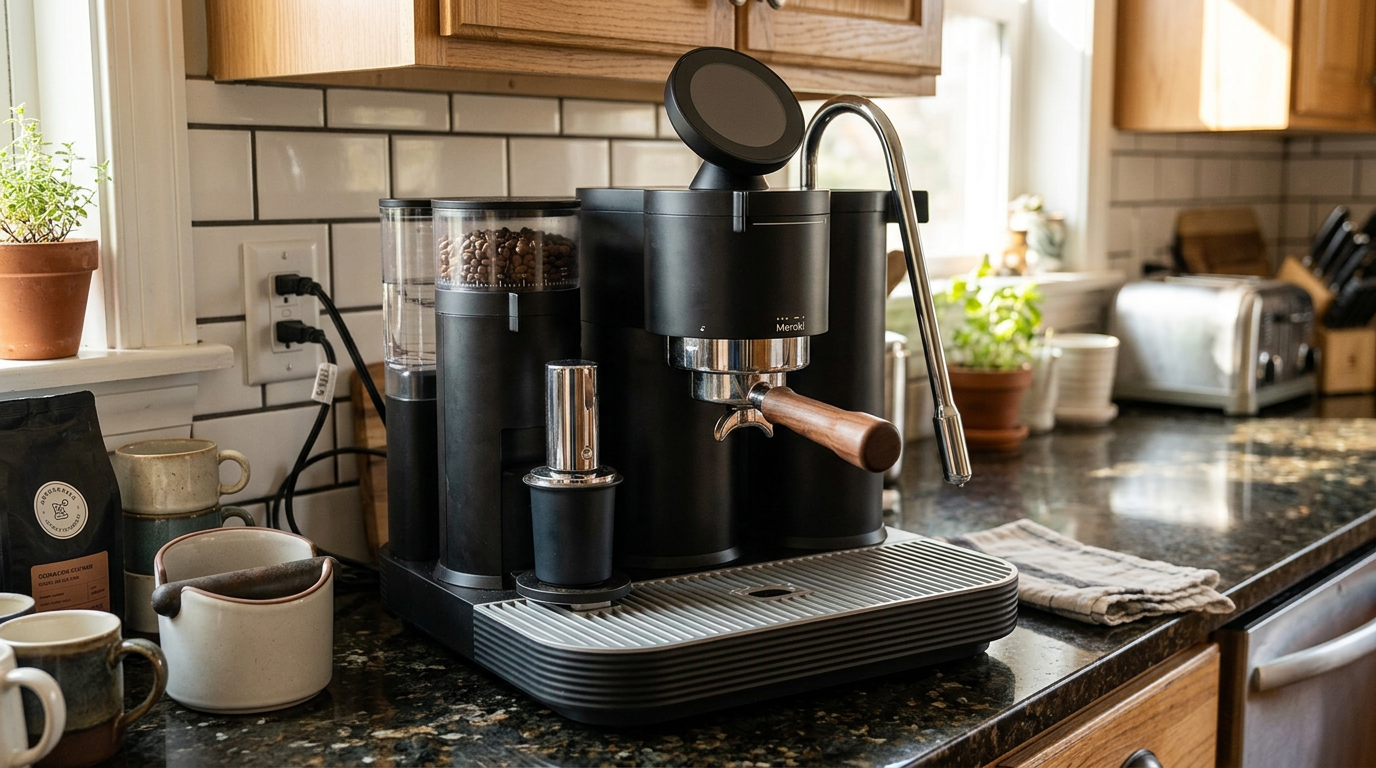
There are three distinct towers on one shared base: grinder on the left, brew group in the middle and steam on the right.
That isn't just styling. Each part has its own space, and the grinder stands apart from the hottest parts of the machine.
The second thing I noticed was how little loose equipment I needed around it.
My usual espresso corner includes a grinder, a scale, a dosing cup and a small collection of tools that slowly take over the counter.
Here, the two jobs I would normally use a scale for are built in.
I ground 19 grams directly into the basket, set a 38-gram target and let the machine stop the shot.
That simple sequence is the reason this machine is interesting.
It doesn't remove the craft. You still prepare the puck, tamp it, judge the taste and steam the milk.
It removes the small repeated measurements that make a good morning shot hard to reproduce the next morning.
The three-tower layout looks tidy on the counter, but give it some room to breathe.
What the Meraki Dual Boiler actually is
The Meraki Dual Boiler is a semi-automatic espresso machine with an integrated grinder, two boilers, a rotary pump and two built-in scales.
Semi-automatic is the important word.
It helps you measure and repeat, but it doesn't take over the whole drink the way a fully automatic bean-to-cup machine does.
You still move the portafilter, distribute the grounds and tamp.
You can also steam milk by hand or use the temperature-sensing wand to stop at a set point.
The machine I tested is the second version.
Meraki made three physical changes that matter to everyday owners, and I'll go through those below.
Inside, Meraki lists a 350 ml brew boiler and a 550 ml steam boiler, both stainless steel.
A commercial-style rotary pump delivers the standard 9 bars of pressure.
Temperature is managed with PID control, and the brew group is actively heated.
The grinder side has its own scale, and so does the drip tray area beneath the cup.
That pairing is the machine's defining trick: it knows how much coffee went in and how much espresso came out.
Manufacturer capacities. The 2-liter tank is large enough that it doesn’t need constant topping up.
What changed in version 2
The second-generation model doesn't reinvent the original.
It targets the parts that most limited the first machine, and those are sensible places to spend engineering effort.
A more open portafilter fit
The updated brew group accepts third-party 58 mm portafilters as well as the one in the box.
Meraki describes the fit as E61-compatible, which opens up far more accessory choices.
There's a catch, and I ran into it myself.
One unibody aftermarket portafilter I tried let water bypass the seal and dripped during extraction.
So compatible doesn't mean every model will fit perfectly, because manufacturing tolerances vary.
A revised shower screen
Water distribution has also been reworked.
In my testing, flow looked more even across the entire coffee bed, which is exactly what you want from this part.
Uneven water is one cause of channeling, where water finds an easy path through the puck and leaves other areas under-extracted.
A better screen can't rescue poor puck prep, but it gives good prep a better chance.
A wider grind range
The grinder dial now extends through Roman numeral markings up to setting 10.
Meraki lists 45 grind settings, up from 30 reference points on the first version.
That matters at both ends.
It leaves more room for espresso adjustments, and the coarser settings make non-espresso brewing realistic.
A 50% increase in marked reference points, based on published model details.
Software has moved along too.
My notes from early pre-infusion use included motor cut-outs, a stability problem that later firmware resolved.
After the update, pre-infusion ran smoothly over repeated extractions.
Our tip: Update the firmware before you start dialing in, so you aren’t troubleshooting a problem that has already been fixed.
How the Meraki Dual Boiler works
A dual boiler machine keeps its brewing and steaming water in separate systems.
That sounds like a spec-sheet detail until you make two lattes back to back.
On a machine with one heating system, brew and steam have to take turns, because the ideal temperatures are far apart.
Here, the brew side can hold its target while the steam side stays ready.
I could start an automated shot and open the steam at the same time, and neither job had to wait for the other.
- Grind: set the dose and grind directly into the portafilter basket.
- Prepare: distribute, level and tamp the coffee.
- Brew: lock in the portafilter and start the shot with a target yield.
- Steam: texture the milk while the espresso runs.
- Finish: stir the shot and pour.
The heated group is the less glamorous part of the system, but it matters just as much.
Water can leave a boiler at the right temperature and still lose heat when it reaches a cold metal group.
Keeping the head actively heated helps maintain thermal stability through the shot.
The brew cycle has a maximum of 65 seconds, which is more than enough for normal espresso.
It's also a useful safeguard if you choke the machine with a grind that is much too fine.
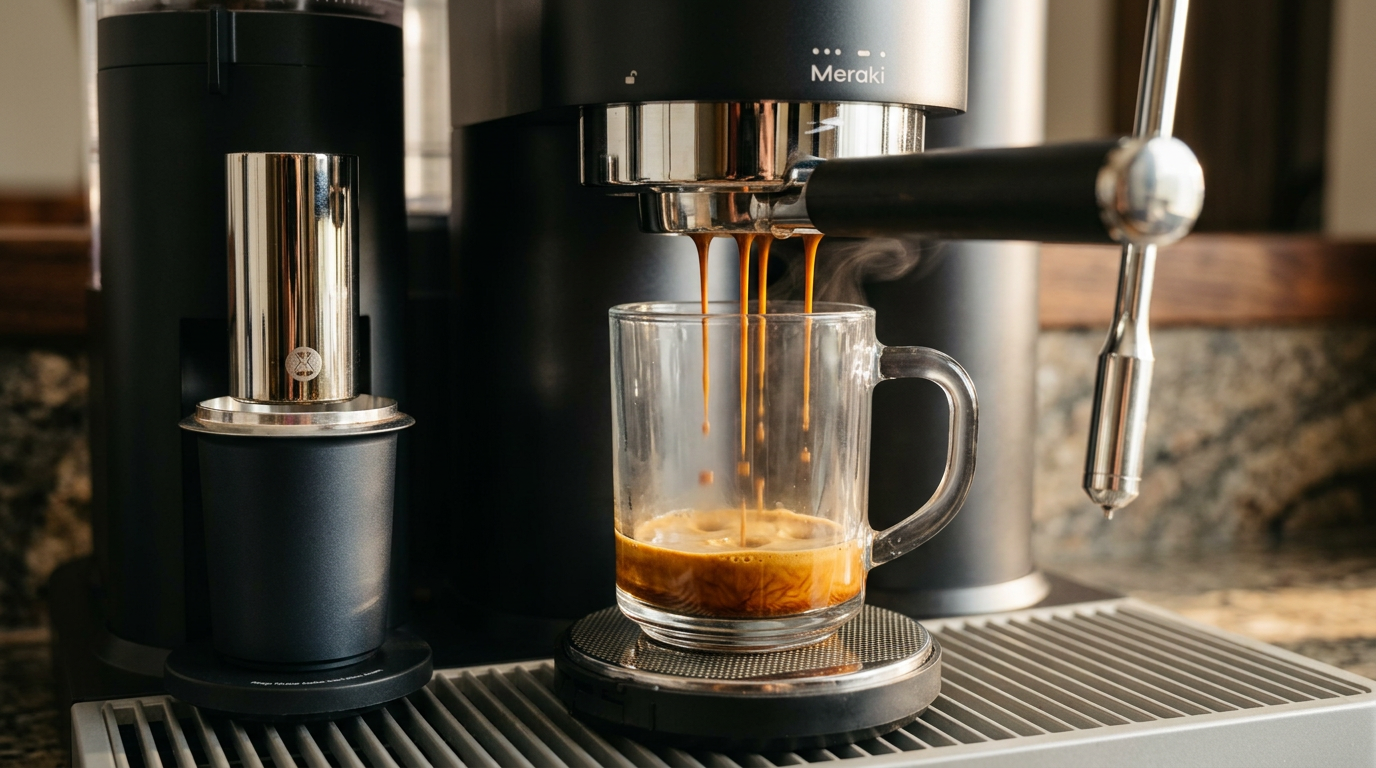
The cup sits on the integrated scale, so the machine can stop the shot by weight.
Meraki Dual Boiler design and setup
The Meraki is an attractive machine, but it isn't a small one.
Meraki lists it at 370 × 370 × 415 mm, or roughly 14.6 × 14.6 × 16.3 inches.
It weighs about 14.5 kg, close to 32 pounds, so decide where it will live before you lift it out of the box.
Depth is the measurement I'd check first.
You'll want to reach the water tank and bean area without dragging a heavy machine across the counter every time.
Height matters too if your wall cabinets sit low over the counter.
| Measurement | Metric | Imperial |
|---|---|---|
| Width | 370 mm | 14.6 in |
| Depth | 370 mm | 14.6 in |
| Height | 415 mm | 16.3 in |
| Weight | 14.5 kg | 32 lb |
| Water tank | 2 L | 68 fl oz |
Setup is mostly guided through the touchscreen.
The circular display sits above the brew group, which keeps the controls near the place where your attention already is.
Most of what I changed day to day came down to dose, target yield and milk temperature.
The programmable timer is one of those small features I expected to ignore and ended up relying on.
Warming up the machine before you enter the kitchen makes it feel ready instead of demanding.
Meraki quotes a heat-up time of about 3 to 4 minutes.
In my use, I found 5 to 7 minutes to be the more useful expectation before making a first drink.
I would rather wait a little longer than judge the first shot before the group has settled.
Our tip: Schedule the timer about 10 minutes before you usually want coffee, so the whole machine has time to stabilize.
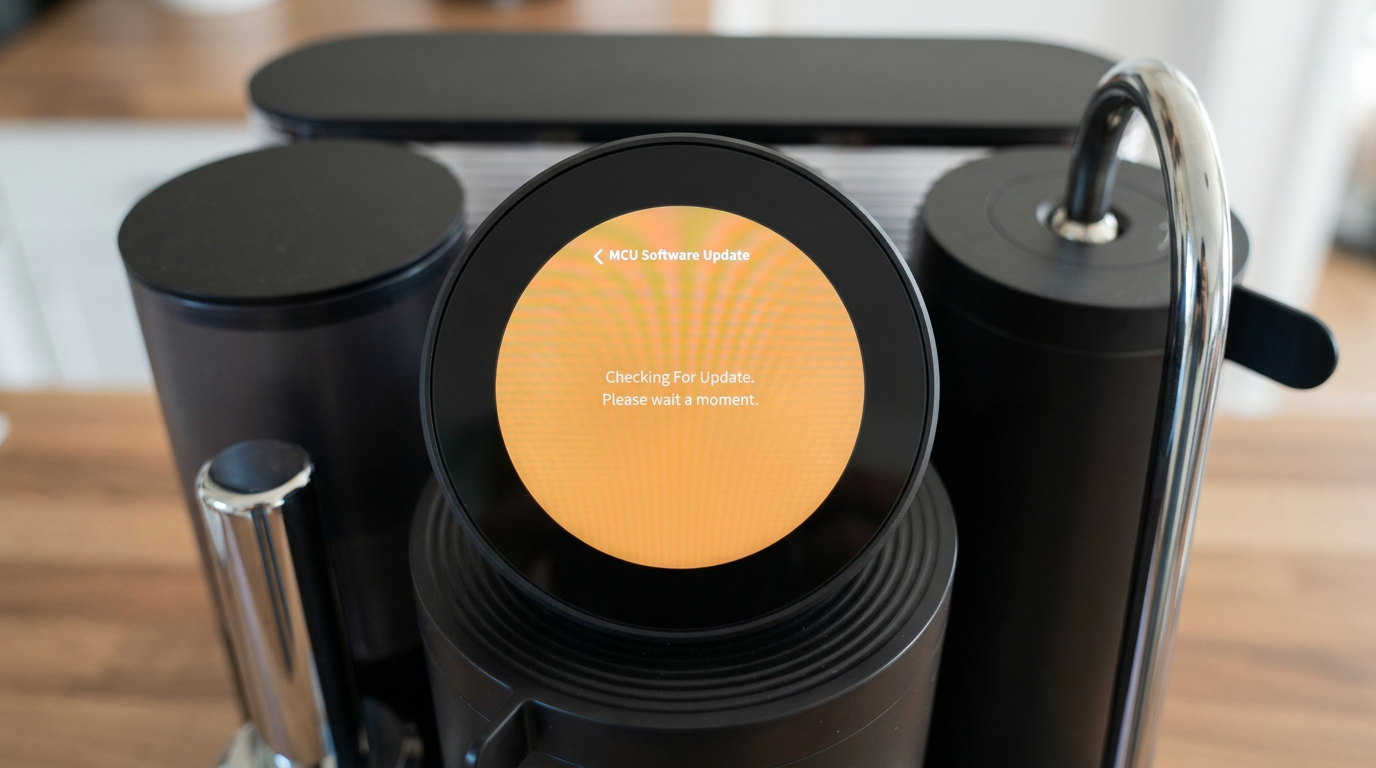
The round display keeps the core settings in one place.
The built-in grinder
An integrated grinder often decides whether an all-in-one machine is a long-term purchase or an expensive shortcut.
Meraki's solution is to give the grinder its own tower.
That separation physically decouples the grinding mechanism from the boilers and brew group.
Heat is not what you want around beans that are waiting to be ground, so this layout makes good engineering sense.
Meraki specifies 38 mm conical burrs.
The grinder weighs as it works, using its own scale to reach the dose you selected.
In practice, I set 19 grams and could concentrate on the grind setting instead of correcting the dose each time.
Static was another pleasant surprise.
The discharge path retained very little charge in my use, so grounds went into the basket rather than clinging around the outlet.
That keeps the counter cleaner and makes the dose more trustworthy.
Finding a starting point
The extended dial gives you plenty of range, which is helpful but also means you shouldn't guess wildly.
Start in the espresso zone, make one adjustment at a time and judge the result.
Use the time as a clue and your palate as the final decision.
A common reference point for a double shot is a 1:2 ratio in about 25 to 30 seconds.
If the espresso tastes sour, grind finer; if it tastes bitter, grind coarser.
| What you taste or see | Likely cause | First change |
|---|---|---|
| Sour, sharp, thin | Under-extraction | Grind finer |
| Bitter, harsh, drying | Over-extraction | Grind coarser |
| Shot rushes out | Grind too coarse or channeling | Grind finer and check puck prep |
| Shot barely drips | Grind too fine | Grind coarser |
| Spurts or blonde patches | Uneven puck | Improve distribution and tamp level |
Our tip: Change only one variable per shot, or you won’t know which adjustment improved the cup.
Beans vary, so treat every number here as a place to start.
Roast level, freshness and even the size of the batch can move the setting you land on.
The benefit of fixed dose and yield is that the grind becomes the obvious thing to adjust.
Brew by weight and the dual scales
If I had to name the Meraki's best feature, it would be the scales.
Plenty of machines can make excellent espresso, but very few make the measuring disappear this neatly.
Each built-in scale has a listed capacity of 1 kg and accuracy of ±0.2 grams.
One handles the grinder side and the other handles the shot.
Weight is a better target than volume for espresso because crema makes liquid volume misleading.
A shot can look larger or smaller depending on the coffee, while grams stay grams.
My default recipe was simple: 19 grams in and 38 grams out.
That's a 1:2 ratio, and the machine could stop automatically at the target I programmed.
| Style | Ratio | Target yield | Good starting use |
|---|---|---|---|
| Ristretto-leaning | 1:1.5 | 28.5 g | Short, dense shot |
| Classic espresso | 1:2 | 38 g | Most medium roasts and milk drinks |
| Longer espresso | 1:2.5 | 47.5 g | Lighter roasts |
| Lungo-leaning | 1:3 | 57 g | Very light, tea-like coffees |
Consistency here doesn't mean every shot is automatically delicious.
A stale bean or uneven puck will still taste like a stale bean or uneven puck.
But with the two most error-prone weights under control, the differences between shots become easier to understand.
For newer home baristas, that's a faster way to learn.
For experienced ones, it simply removes a chore.
Meraki Dual Boiler espresso performance
The best way to describe the espresso workflow is that it lets you pay attention to the right things.
I used the standard 19-gram dose and improved the bed with a needle tool for WDT, which breaks up clumps below the surface.
Then I used the included rotating leveler for the top and finished with a firm manual tamp.
It's a short routine, and it gave the revised shower screen a level bed to work with.
Water spread evenly across the coffee, without the lopsided start that makes me suspect channeling.
Thermal stability also felt like a real part of the design rather than a claim on the box.
The dual boilers and heated group let repeated shots feel like the same process, not a race against a machine that needs to recover.
Published standard recipes commonly call for a brew temperature of about 91 to 94°C.
Because this machine has digital temperature control, it's easy to treat that as a starting window and adjust for your coffee.
| Roast | Dose in | Yield out | Time | Temperature start |
|---|---|---|---|---|
| Dark | 19 g | 38 g | 25–30 sec | 91°C / 196°F |
| Medium | 19 g | 38 g | 25–30 sec | 93°C / 199°F |
| Light | 19 g | 47.5 g | 28–32 sec | 94°C / 201°F |
Starting points only, built from common espresso guidance and the 19-gram dose I used. Adjust by taste.
Pre-infusion is available if you want to wet the puck more gently before full pressure.
With the updated firmware it ran smoothly, and I would use it as a tool rather than a default for every bean.
Coffee that gushes or shows uneven flow is the best candidate for experimentation.
A level bed and a consistent tamp still matter, even with all the automation around them.
Our tip: Use a thin needle to stir the grounds all the way to the bottom of the basket before you level them.
Steaming milk on the Meraki
Milk drinks are where the dual boiler pays off every single morning.
I could pull an automated shot and steam at the same time, which turned a two-stage job into one continuous workflow.
For one drink, that saves a little time.
For two or three in a row, it changes how the kitchen feels.
There's no standing around between tasks, and the milk isn't waiting for the espresso or the espresso waiting for the milk.
The included pitcher is fine for a single drink.
If you regularly make larger drinks or more than one at a time, swapping it for a larger pitcher is an easy improvement.
The wand has a temperature sensor and can stop at your selected temperature.
A common target for drinking right away is around 55 to 60°C, or roughly 130 to 140°F.
Go hotter and the milk starts to lose some of its sweetness.
A small step that improves the pour
This is a tiny habit I'd keep on any machine.
Lightly stir the finished espresso before pouring the milk.
It blends the crema into the rest of the shot and gives the milk a more even surface to work against.
The cup looks better and the drink is more uniform from the first sip to the last.
Our tip: Purge the wand before and after every drink, then wipe it right away before the milk can dry on.
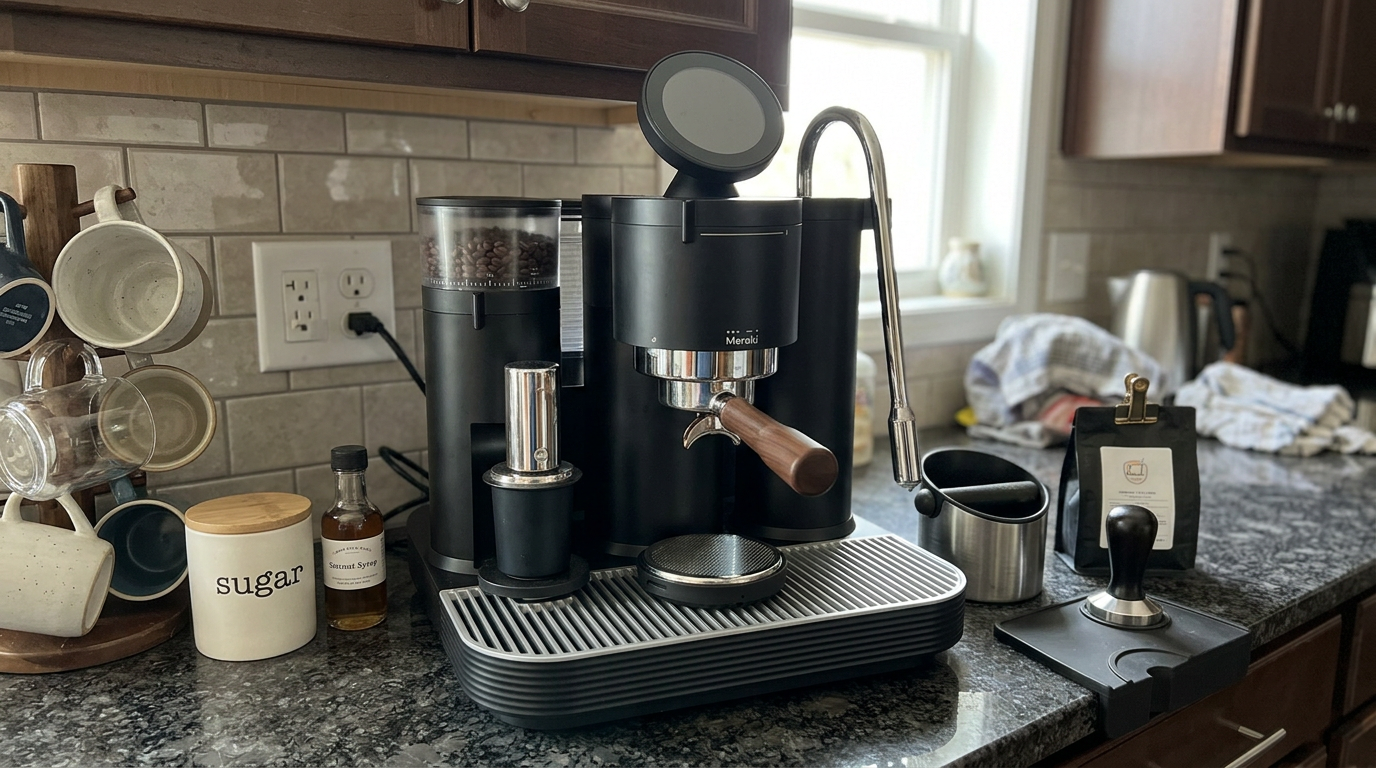
The steam tower stays ready while the brew side does its own work.
Going beyond espresso with coarser grinds
A surprising benefit of the new grind range is that the Meraki can do more than espresso.
Because the dial now extends up through setting 10, it reaches coarser territory than the earlier machine.
I'd use those settings with a fast-flowing paper filter for pour-over.
That doesn't make this the ultimate grinder for a filter-coffee obsessive.
It does mean someone who mostly drinks espresso can make a pour-over on the weekend without buying a second grinder.
Keep in mind that the grinder's dose scale also helps here, since a filter recipe usually starts with a larger, precise amount of coffee.
Rinse the paper first, use a consistent pour and adjust coarser if the brew stalls.
When you return to espresso, purge a small amount before pulling a shot so the leftover coarse grounds don't end up in the basket.
Wi-Fi, firmware and the smart features
The Wi-Fi connection on an espresso machine can sound unnecessary.
On the Meraki, its most practical job is delivering over-the-air software and firmware updates.
I saw the benefit directly, because the pre-infusion motor cut-outs were fixed by an update rather than a service visit.
That's a strong argument for connectivity in a machine this software-driven.
It also comes with a trade-off.
You'll need a connection to receive those updates, so a machine kept permanently offline won't get them.
The machine still makes coffee as a normal appliance, but it won't improve over time without that link.
Meraki also includes its CoffeeSense NFC system, which can read compatible tagged bean packs and apply preset settings.
I treat that as a bonus rather than a reason to buy, because most people will be using a wider variety of beans.
Cleaning and maintaining the Meraki
This is my main complaint, and it's not a small one if tidy appliances matter to you.
The modern exterior includes tight recesses, corners and channels.
They look great when the machine is clean, but they take detailed effort to keep that way.
Coffee grounds, milk splashes and water marks find those gaps.
A quick wipe handles the flat surfaces, but a proper clean means getting into the shapes around the towers and base.
I'd plan a small daily routine and a slightly more careful weekly one.
| When | Task | Why it matters |
|---|---|---|
| After each milk drink | Purge and wipe the steam wand | Stops milk drying inside and on the tip |
| Daily | Empty the drip tray, wipe recesses and flush the group | Prevents residue and odors |
| Weekly | Clean the shower area and backflush as directed | Removes coffee oils |
| Every 1–3 months | Descale as the machine and water hardness require | Controls scale inside the system |
Water quality deserves real attention on any boiler machine.
Hard water raises the risk of scale, while extremely pure water can affect taste and may not be ideal for the machine.
General home-espresso guidance ranges from about every three months with soft water to monthly with hard water.
Follow Meraki's maintenance prompts first, and use filtered water if your tap water is hard.
Our tip: Keep a small soft brush beside the machine and sweep the recesses while the grounds are still dry.
Aftermarket portafilters need their own check.
Inspect the gasket contact before using a new one, then run a test without a full dose so you can see any leak before it matters.
Stop if you see water escaping around the rim, since a poor seal can make a mess and undermine the extraction.
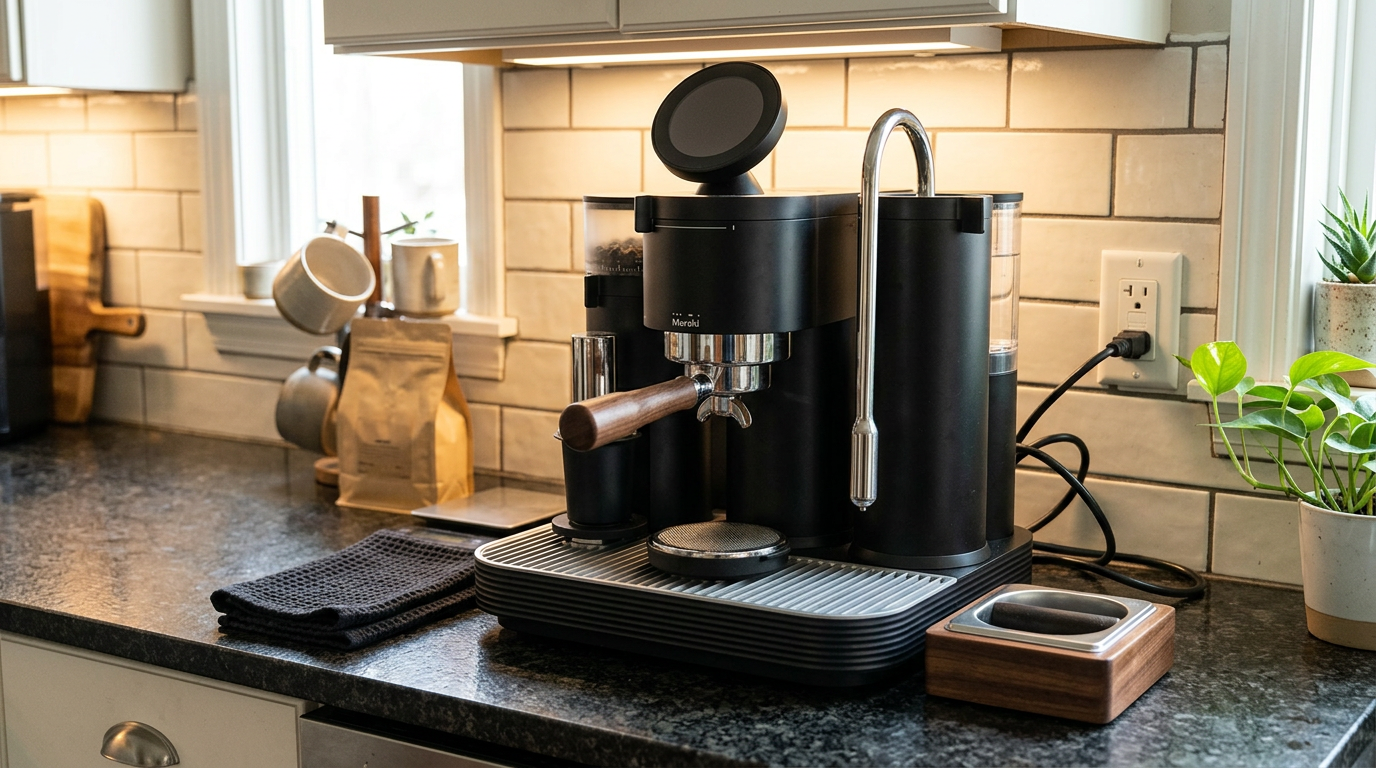
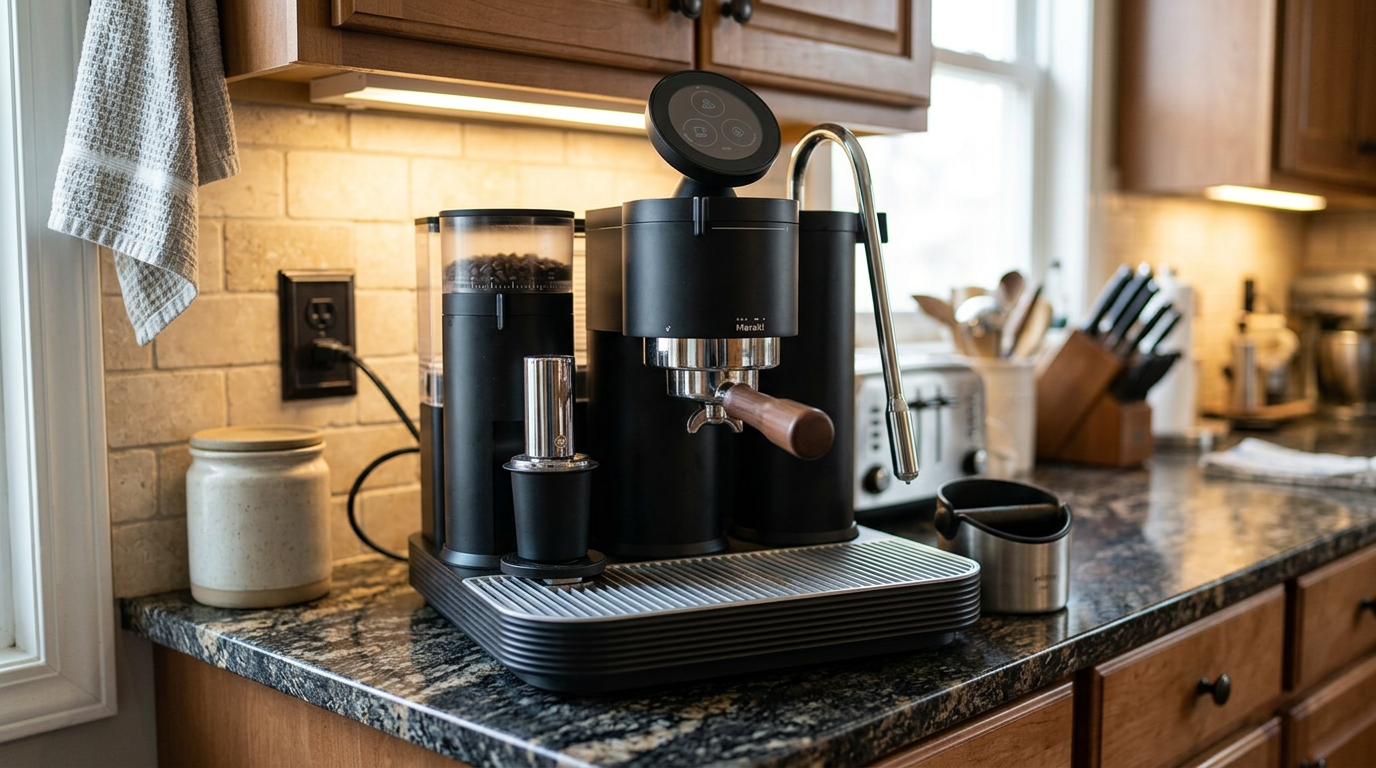
The ribbed base and tower recesses look great, but they take extra attention when cleaning.
What daily use is really like
Specifications tell you what a machine contains, but they don't tell you what it's like at 7 a.m.
The appeal of the Meraki Dual Boiler is that a normal morning has very few decisions left in it.
The timer has already warmed the machine, so I start by checking the water and putting a cup under the group.
Next I grind, prepare the puck and tamp.
The shot and the milk then happen together, and that overlap is what shortens the routine.
On a typical espresso machine, each drink is a chain of steps that have to wait for each other.
Here, the two longest steps sit side by side.
| Step | Who does the work | What you control |
|---|---|---|
| Warm-up | Machine, on a timer | Start time |
| Dose | Machine, by weight | Target grams |
| Puck prep | You | Distribution and tamp |
| Extraction | Machine stops by weight | Target yield and temperature |
| Milk | You, with optional temperature stop | Texture and final temperature |
| Assembly | You | Stir and pour |
That split of responsibilities is the reason I like this machine.
It automates the things a person is bad at repeating and leaves the things a person enjoys doing.
There is still enough involvement that a good drink feels earned.
It also means another person in the house can get a better result without memorizing your recipe.
Once the dose and target are stored, the routine is easy to pass along.
Making several drinks in a row
Back-to-back drinks are the real test of a home machine.
The separate brewing and steaming systems are what make the sequence feel continuous.
I found the rhythm easy to settle into: grind the next dose while the previous cup is finished, then rinse the pitcher and go again.
The 2-liter tank also helps, because a short run of drinks doesn't immediately send you back to the sink.
What will eventually slow you down is the drip tray, so keep an eye on it during a busy morning.
At a listed 650 ml, it's a reasonable size, but rinsing shots and purging the wand all add up.
Living with the noise
A rotary pump is generally valued for steady pressure and a calmer sound than the small vibration pumps found in many home machines.
Grinding is still grinding, and steam is still steam, so this won't be a silent appliance in an open-plan home.
If somebody sleeps next to the kitchen, the grinder will be the part they notice first.
Beans, water and small upgrades
A machine this capable makes your ingredients easier to taste, for better and for worse.
Freshly roasted whole beans are the obvious starting point, because pre-ground coffee throws away the main advantage of a built-in grinder.
Coffee that has rested for a short time after roasting generally behaves better than coffee straight from the roaster.
Very old beans tend to run fast and taste flat, and no amount of precise weighing can restore them.
Medium roasts are the easiest place to begin while you learn the machine.
Lighter roasts are denser and harder to extract, so expect to grind finer, use a longer ratio and raise the temperature slightly.
That's where the wider second-version grind range is most helpful.
Water matters more than most people expect
Espresso is mostly water, so anything in the tank affects both flavor and the machine itself.
More minerals can help extraction, but they also speed up scale formation inside the system.
Filtered water is a sensible default for most homes.
I would avoid using purely distilled water, because coffee needs some minerals to taste complete.
If you aren't sure how hard your water is, inexpensive test strips will answer the question in under a minute.
Accessories I would actually add
The box covers the basics, so there's no need to buy a pile of extras on day one.
A simple WDT needle tool is the first thing I'd add, because it directly improves distribution.
A larger pitcher makes sense if you regularly steam for two.
A soft brush and a dedicated microfiber cloth will do more for this particular machine than most flashy accessories.
If you want a third-party portafilter, buy from a seller with an easy return policy and test the seal early.
Common mistakes to avoid
The Meraki makes the basics much easier, but a few habits can still get in the way.
These are the ones I'd watch for during the first couple of weeks.
| Mistake | What happens | Better habit |
|---|---|---|
| Judging the first shot right after power-on | Temperature hasn’t settled | Allow a proper warm-up |
| Changing grind, dose and yield together | You can’t identify the cause | Change one thing at a time |
| Dosing too much for the basket | Puck can crowd the screen | Stay near the basket’s intended dose |
| Skipping distribution | Uneven flow | Stir, level, then tamp |
| Leaving milk on the wand | Residue hardens quickly | Purge and wipe immediately |
| Ignoring hard water | Scale builds up faster | Filter and descale on schedule |
Dial-in is the part that tends to worry people most.
In reality, you'll usually need only a few shots to get close with a new bag of coffee.
Fixed weights help because they narrow the problem down to grind and taste.
It's worth saving a little coffee for that process each time you open a new bag.
What I would change
My wish list is short, and cleaning is at the top of it.
A simpler shape around the base and towers would make daily upkeep much less fiddly.
I'd also like clearer guidance on which aftermarket portafilters seal correctly, since compatibility is now a selling point.
None of that changes my overall view, but both are things you should know before buying.
Is the Meraki Dual Boiler worth the money?
The Meraki sits in serious home-espresso territory, so this isn't an impulse purchase.
The right way to evaluate it is against what you would otherwise have to assemble.
A good dual boiler is one part of the equation, but you'd also need a capable espresso grinder and a reliable shot scale.
Then you'd have to find room for all of it and make those parts work together.
This machine packs that into one coordinated workflow.
It makes the most sense if you drink milk-based coffee every day and value consistency.
It makes less sense if you only make an occasional espresso, or if you enjoy building a setup piece by piece.
It's also worth remembering what you can't easily replace later.
A separate grinder can be upgraded on its own, while an integrated tower is part of the package.
For most people I'd count that as a fair trade, because the integration is the point.
Meraki lists a 2-year warranty and a 30-day home trial on its own sales channel, so check the terms for wherever you buy.
The biggest question to ask yourself is how much of the process you want to own.
If your idea of a perfect morning involves tuning every variable by hand, the built-in automation may feel like it's standing between you and the coffee.
In that case, you may be happier with separate pieces that you can choose and replace individually.
If you want the coffee to be excellent but would rather not weigh everything twice before work, this design makes a great deal of sense.
Think about how many drinks you make, who else will use the machine and how much cleaning you're honestly willing to do.
Those three answers will tell you more than a long list of features.
For me, the daily time saved and the repeatable results outweigh the extra attention the exterior demands.
That balance is what earns the machine its score.
How it compares with other espresso setups
The most useful comparison isn't with one particular model.
It's with the kinds of setup you are most likely to be choosing between.
On paper and in use, the Meraki is strongest when you value measured repeatability and simultaneous milk work.
| Feature | Meraki Dual Boiler | Separate machine and grinder | Fully automatic machine |
|---|---|---|---|
| Grinding | Built-in tower | Separate unit | Built in |
| Weighs dose and yield | Yes, both | Usually with an added scale | Usually no |
| Brew and steam together | Yes | Only with two boilers | Usually no |
| Milk quality control | High | High, skill-dependent | Limited |
| Counter footprint | One wide unit | Two or more devices | One unit |
| Learning curve | Moderate | Steep | Low |
| Upgrade one part later | Limited | Easy | No |
A separate machine and grinder gives you the most freedom to upgrade over time.
It also asks you to do more of the measuring and takes up more of the counter.
A fully automatic machine is easier still, but you give up much of your control over the puck and milk texture.
The Meraki lands in a very appealing middle ground.
It keeps the hands-on parts that make espresso rewarding and automates the measurements that make it tedious.
| Second-version upgrade | Version 1 | Version 2 |
|---|---|---|
| Marked grind settings | 30 | 45 |
| Group fit | Meraki-oriented | 58 mm E61-compatible |
| Water distribution | Original screen | Revised two-stage system |
| Coarser brewing | More limited | Pour-over capable |
| Software | Wi-Fi updates | Wi-Fi updates |
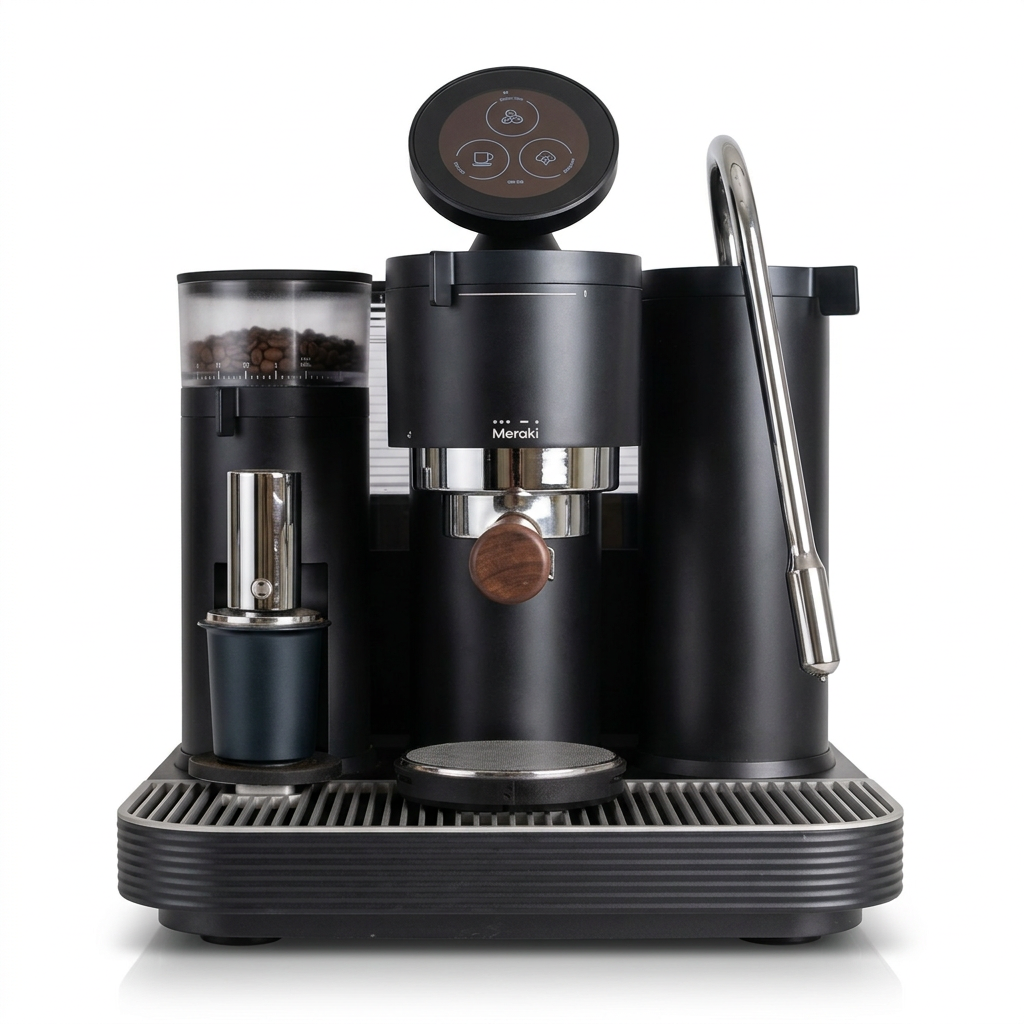
The three-tower design: grinder on the left, brew group in the center and steam on the right.
Meraki Dual Boiler specifications
From manufacturer data and my own notes on the machine.
How I tested and scored the Meraki Dual Boiler
I used the second-version Meraki Dual Boiler for its core jobs: grinding into the basket, brewing by weight, steaming at the same time and making coarser grinds for filter coffee.
I also tried third-party portafilter fit, watched how water spread across the puck and checked how the machine behaved with pre-infusion after a firmware update.
I then compared those notes with the manufacturer's specifications and general espresso brewing guidance.
- Espresso (8.8): extraction consistency, water distribution and temperature behavior.
- Milk (9.0): simultaneous operation, steam workflow and control.
- Workflow (9.2): grinding, weighing, shot control and daily ease.
- Cleaning (7.0): how much effort the exterior and routine care demand.
The overall score of 8.7 is an editorial rating that reflects those four areas.
Meraki Dual Boiler FAQ
Is the Meraki Dual Boiler worth it?
Yes, if you regularly make espresso or milk drinks and want built-in dose and yield control. It’s less compelling if you only want occasional coffee or prefer a fully automatic machine.
Can you steam milk and pull a shot at the same time?
Yes. Separate boilers for brewing and steaming allow both to run at once.
How long does it take to warm up?
Meraki says about 3 to 4 minutes. I found 5 to 7 minutes to be a more useful expectation, and the timer can handle that wait for you.
Does it work with third-party portafilters?
The updated group accepts 58 mm third-party portafilters, but fit varies. One unibody model I tried dripped because it didn’t seal correctly.
Can it grind for pour-over?
Yes. The expanded dial reaches coarser settings that work with fast-flowing paper filters.
What dose should I start with?
I used 19 grams in and 38 grams out, a 1:2 ratio. It’s a practical starting point that you can adjust by taste.
Does it need Wi-Fi?
You need Wi-Fi to receive over-the-air firmware and software updates.
Is it hard to clean?
The everyday tasks are normal for an espresso machine, but the exterior has tight corners and channels that take extra effort.
What is the maximum brew time?
The maximum brew cycle is 65 seconds.
- Hands-on testing of the second-version Meraki Dual Boiler
- Meraki product specifications and owner documentation
- General espresso brewing and maintenance guidance