Jura ENA 4 review: a small, quiet black coffee machine with big espresso manners
The Jura ENA 4 15518 Automatic Espresso Machine is one of the smallest bean-to-cup machines I've tested, built only for espresso and black coffee. It pulls sweet, crema-rich shots with almost no effort, but its tank, hopper and grounds bin are small, and there's no milk or hot water.

Michael Reynolds
Hands-on review
Hands-on testing, research, specs
4 weeks
26 minutes
Jargon helpNew to espresso? Tap any dotted term to see what it means.
In this review
Yes, if you live alone or as a couple, drink espresso or black coffee, and have very little counter space. The Jura ENA 4 is narrow, low and quiet, and its pulsed extraction produces sweet, balanced espresso with a dense golden crema. It's very easy to use and keep clean. The trade-offs are real, though: a 1.1-liter tank, a 125-gram hopper, a grounds bin for about 10 pucks, and no milk system or hot water.
Jura ENA 4 at a glance
Jura ENA 4 pros and cons
- Sweet, balanced espresso with dense crema
- Very compact, quiet and simple to use
- Easy cleaning with no milk system
- Small tank, hopper and grounds bin
- No milk system and no hot water
- Long coffee is softer than a filter-style mug
Who should buy the Jura ENA 4?
- Singles and couples who drink black coffee
- Small kitchens, apartments and offices
- Anyone stepping up from a capsule machine
- Families who drink many cups a day
- Latte and cappuccino drinkers
- Tea drinkers who want hot water from the machine
First impressions of the Jura ENA 4
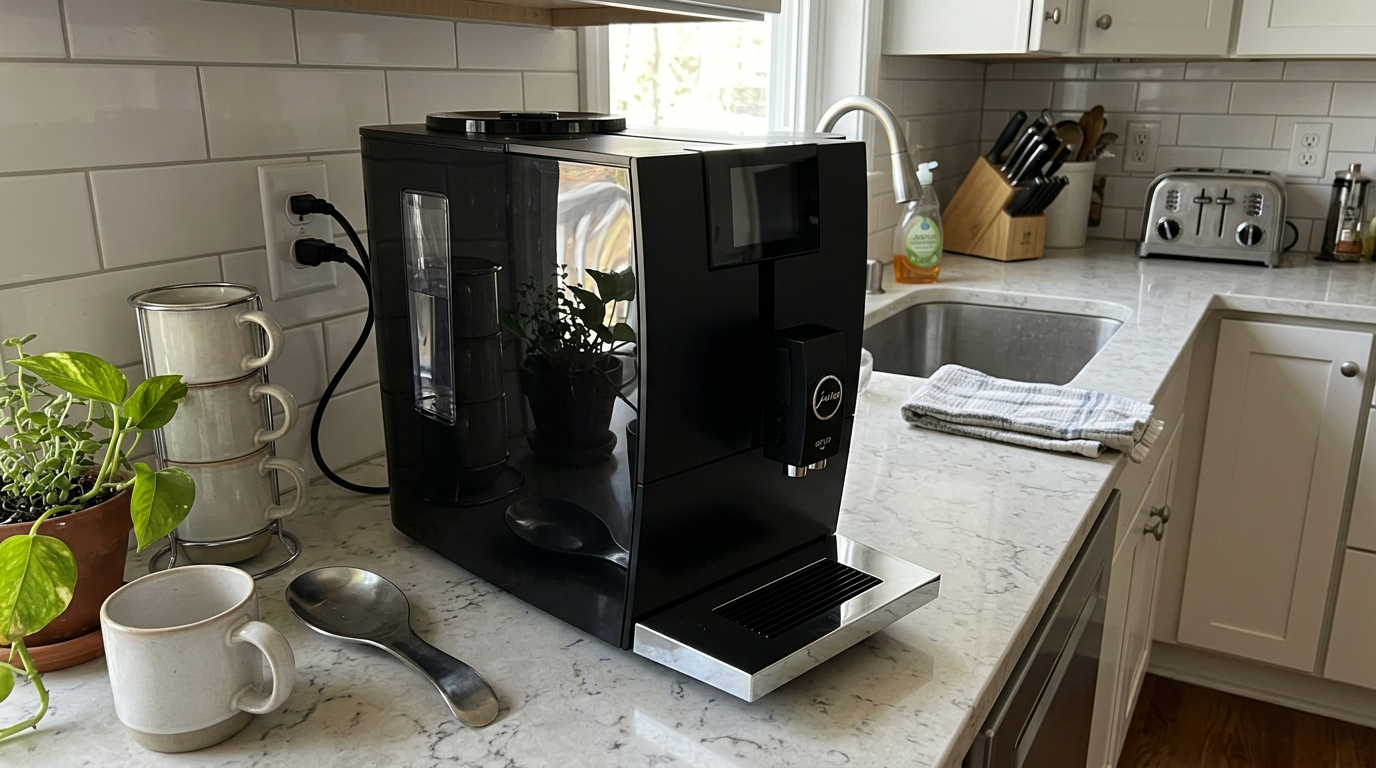
Most bean-to-cup machines take over a corner of the counter.
The Jura ENA 4 barely takes up a corner of a corner.
It's about 27 centimeters wide and 32 centimeters tall, with a tall, clear water cylinder on the side that looks almost like a carafe.
On my counter, it looked more like a design object than an appliance.
The second thing I noticed was the simplicity.
There's a small monochrome icon display, a handful of tactile buttons and a pair of coffee spouts.
No touchscreen, no milk pipe and no hot water outlet.
My first espresso was a pleasant surprise.
It came out sweet and balanced, under a dense, golden crema that stayed put.
For a machine this small, that's a real achievement.
The ENA 4 fits beside the sink with room to spare for mugs.
What the Jura ENA 4 actually is
The ENA 4 is a compact, fully automatic, bean-to-cup machine for espresso and black coffee.
It grinds, doses, compresses and brews the coffee, then drops the used puck into a bin inside the drip tray.
It's the successor to Jura's earlier entry machine, refined for better espresso in the same tiny footprint.
Inside is a thermoblock✕ThermoblockA compact heater that warms water as it flows through, instead of keeping a whole boiler hot. It heats up fast and uses less standby energy. that reaches brewing temperature within seconds of a cold start.
The pump is rated at 15 bar.
The brew unit✕Brew unitThe chamber inside an automatic machine that receives the ground coffee, presses it into a puck, pushes hot water through it and then ejects the used grounds. is smaller than on Jura's full-size machines, taking about 6 to 10 grams per cycle.
For stronger drinks, the ENA 4 simply runs two cycles.
Jura ENA 4 design and setup
The Jura ENA 4 measures 27.1 × 32.3 × 44.5 cm, or 10.7 × 12.7 × 17.5 inches.
It's low enough to sit under any standard wall cabinet with plenty of room to open the hopper lid.
It's still fairly deep, so check your counter.
The cylindrical water tank
The water tank is a tall, clear cylinder on the side.
It looks great and shows the water level at a glance.
At about 1.1 liters, though, it's small.
The bean hopper
The hopper on top holds about 125 grams of beans under an aroma-preserving lid.
That's roughly a week's worth for one espresso drinker, and a few days for two.
The small size does mean beans never sit long enough to go stale.
The drip tray
The drip tray is a multi-piece design with an internal flap that stops water sloshing when you pull it out.
The grounds bin sits inside it and holds about 10 pucks.
The machine counts brewing cycles to know when the bin is full, rather than using a float sensor.
That means you need to leave the tray out for a few seconds when you empty it, so the counter resets.
Our tip: Leave the drip tray out for at least five seconds when you empty it, so the grounds counter resets properly.
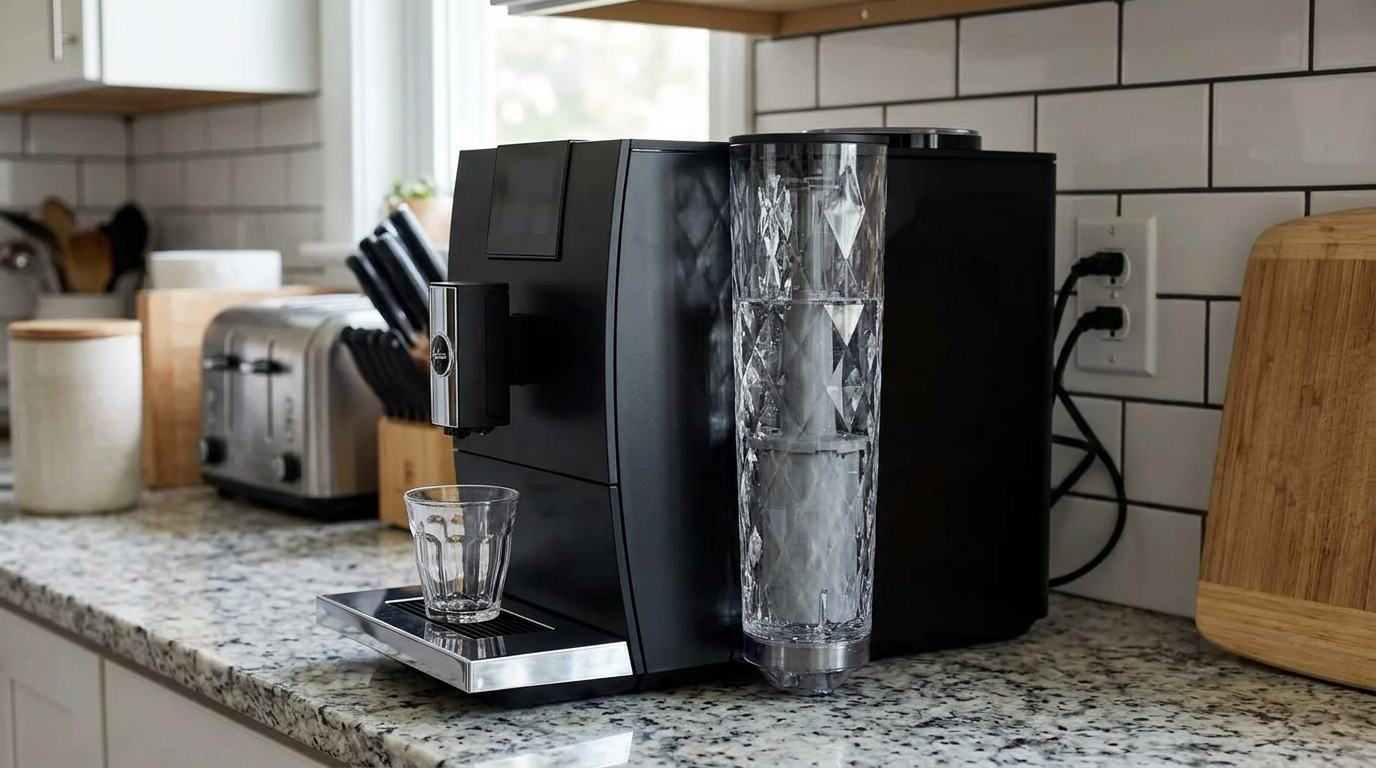
The clear water cylinder is the ENA 4's signature design touch.
Display and buttons
The ENA 4 uses a small monochrome icon display with tactile buttons.
There's a button for espresso, one for coffee, a strength button and a settings button.
| Control | What it does |
|---|---|
| Espresso button | One press for a single, two quick presses for a double |
| Coffee button | One press for a long coffee, two quick presses for a double |
| Strength button | Cycles mild, medium and strong |
| Settings button | Water hardness, filter, switch-off timer and maintenance |
It's about as simple as a bean-to-cup machine gets.
Anyone in the house can use it within a minute.
The settings menu covers the essentials: water hardness, filter activation and the auto switch-off timer.
Strength levels
The strength button changes how much coffee goes into each brew.
Approximate dose per cycle within the 6–10 g range.
Our tip: Use the strong setting and a double press when you want a full-bodied espresso, because one small cycle tops out around 10 grams.
The grinder
The ENA 4 grinds with Jura's Professional Aroma Grinder and its conical burrs✕Conical burrsA cone-shaped cutting part that turns inside a ring. They grind evenly at fairly low speed, which keeps heat and noise down..
It's one of the quieter grinders I've used, with a low, soft hum rather than a sharp whine.
A dial adjusts the fineness.
As with every Jura grinder, only change it while the grinder is running, so beans don't jam between the burrs.
Bars show how much resistance the coffee puts up and how long the water stays in contact with it.
With medium-dark beans, I settled just finer than the middle.
Only use non-oily beans in the hopper, because oily beans can clog a small grinder quickly.
Our tip: After any grind change, wait two or three drinks before judging, because some old coffee is still in the chute.
Jura ENA 4 espresso performance
The espresso is the ENA 4's strongest point.
Each shot starts with pre-infusion✕Pre-infusionA short, gentle soak of the coffee before full pressure. It lets the puck swell evenly so water doesn't rush through weak spots., which soaks the compacted coffee evenly.
Then Jura's Pulse Extraction Process✕Pulse Extraction Process (P.E.P.)Jura's method of pushing hot water through the coffee in short, rapid bursts instead of one steady stream. It lengthens contact time for short drinks, giving a fuller flavor. pushes water through in short bursts.
That gives short drinks more contact time and more flavor without more water.
How it tasted
On the strong setting, the espresso had a dense, finely textured, golden crema✕CremaThe golden-brown foam on top of an espresso. It forms when pressure pushes gases and oils out of freshly ground coffee. that held for minutes.
The flavor was balanced, with well-developed sweetness and controlled acidity.
I didn't taste any harsh astringency or burnt bitterness.
There was very little sediment in the bottom of the cup.
The results stayed consistent when I switched between bean types, with just a strength change needed.
The double espresso
A double press makes the ENA 4 grind, brew, eject the puck, then grind and brew again into the same cup.
That gives a full-bodied double without overloading the small brew unit.
Bean by bean
Over the month, I ran four different coffees through the ENA 4.
A chocolatey medium-dark espresso blend was the easy favorite, with thick crema and a sweet, rounded finish.
A Brazilian medium roast tasted nutty and soft, with low acidity, and worked well as a long coffee.
An Ethiopian light roast was bright and floral, but it needed a finer grind and a double press to avoid tasting sharp.
A dark Italian-style blend gave the most crema, but its oily surface made me nervous about the small grinder, so I only used one bag.
The machine handled all four without fuss, and only the strength and grind needed changing between them.
Temperature in the cup
The thermoblock heats water quickly and holds it steady for short drinks.
The espresso tasted properly hot when I used a warm cup.
In a cold, thick ceramic cup, it cooled noticeably within a minute, which is common with small shots.
Consistency
What impressed me most was how repeatable the ENA 4 was.
Once I'd found my settings, the tenth espresso of the week tasted like the first.
That's the real advantage of a bean-to-cup machine over a manual setup.
You don't need any skill on a sleepy morning, and the machine doesn't have bad days.
| What you taste or see | Likely cause | First change |
|---|---|---|
| Sour, thin, watery | Under-extraction | Grind finer or use the strong setting |
| Bitter, harsh, drying | Over-extraction | Grind a little coarser or shorten the volume |
| Thin body | Small single dose | Use a double press |
| Pale crema that fades fast | Stale beans | Use fresher beans |
| Lukewarm shot | Cold cup | Warm the cup first |
Long coffee
The coffee button makes a lungo-style long coffee.
The whole cup of water passes through the coffee, which gives a smooth, soft cup.
At small mug sizes, it was pleasant and balanced.
At large mug sizes, a single small dose stretched too far and tasted thin.
A double press fixed that, with two cycles into one mug.
Approximate dose per mug at the strong setting.
No hot water
There's no hot water spout, so you can't make a two-step americano or tea from the machine.
For an americano, I pulled a double espresso and topped it up from the kettle.
It tasted cleaner and brighter than a single long pour.
Our tip: For a big mug, make a double espresso and add kettle water instead of running one long coffee.
Pre-ground coffee and decaf
The pre-ground coffee✕Pre-ground bypassA separate chute that sends already-ground coffee straight to the brew unit, skipping the grinder. Handy for decaf without emptying the bean hopper. chute on top opens with a small lever.
Add one level scoop of espresso-fine coffee, close it and press your drink button.
The machine detects the manual dose, skips the grinder and brews as usual.
Use espresso-fine coffee, not coarse filter grind.
Coarse grounds let water rush through and taste weak, while very fine powder can block the flow.
Our tip: Buy decaf ground for espresso, not for filter coffee, so it brews properly through the chute.
What about milk drinks?
The Jura ENA 4 has no milk system.
That keeps it small, simple and easy to clean.
If you want an occasional cappuccino, pair it with a separate electric milk frother.
Pull a double espresso, froth the milk while it brews and pour it over.
| Drink you want | ENA 4 part | Extra you need |
|---|---|---|
| Cappuccino | Double espresso | Electric milk frother, thick foam |
| Flat white | Double espresso | Frother, thin silky foam |
| Latte | Espresso | Frother, more milk |
| Americano | Double espresso | Kettle for hot water |
If you'd use a frother every day, a machine with a built-in milk system will save you time.
Cleaning and maintaining the Jura ENA 4
With no milk system, daily care is quick.
The thermoblock rinses the brew channels when the machine warms up.
I emptied the grounds bin, rinsed and dried it, and cleared water from the tray channels.
Mild soap and warm water are fine, but avoid abrasive scrubbers.
The water tank
Rinse the cylindrical tank regularly to stop a film forming.
Filter changes
To change the filter, lift the tank from its side dock, open the holder and pull the old cartridge out.
Push a new one into the socket at the bottom, latch it, refill with cold water and put the tank back.
Then run the filter rinse from the settings menu to purge air.
Tablet cleaning
When prompted, drop a Jura cleaning tablet into the pre-ground chute, put a large container under the spouts and start the program.
The machine alternates hot water flushes with the cleaning solution.
The brew unit is fixed inside, so this program is how it gets cleaned.
Descaling✕DescalingRunning a mild acid solution through the machine to dissolve mineral scale left by hard water. Scale slows heating and can block pipes.
If you don't use a filter, or your water is very hard, the machine asks for descaling.
| When | Task | Why it matters |
|---|---|---|
| Every few days | Empty and rinse the grounds bin | It only holds about 10 pucks |
| Daily | Empty the drip tray | Prevents odors |
| Weekly | Rinse the water tank | Prevents biofilm |
| When prompted | Tablet cleaning via the chute | Strips coffee oils |
| When prompted | Filter change or descaling | Controls mineral scale |
My estimate of hands-on daily cleaning time.
What daily use is really like
My mornings with the ENA 4 were quick and quiet.
Check the tank, put a warm cup under the spouts, choose a strength and press a button.
The thermoblock was ready within seconds of a cold start.
After a full power-down, it runs a short heat-and-rinse first.
The capacity trade-off
The small tank, hopper and grounds bin are the price of the small footprint.
Rough maths from a 1.1 L tank, 125 g hopper and 10-puck bin, allowing for rinse water.
For two espresso drinkers, I refilled the tank about once a day, topped up the hopper every few days and emptied the bin every three or four days.
For one person, it's barely noticeable.
For a family, it would get tiresome.
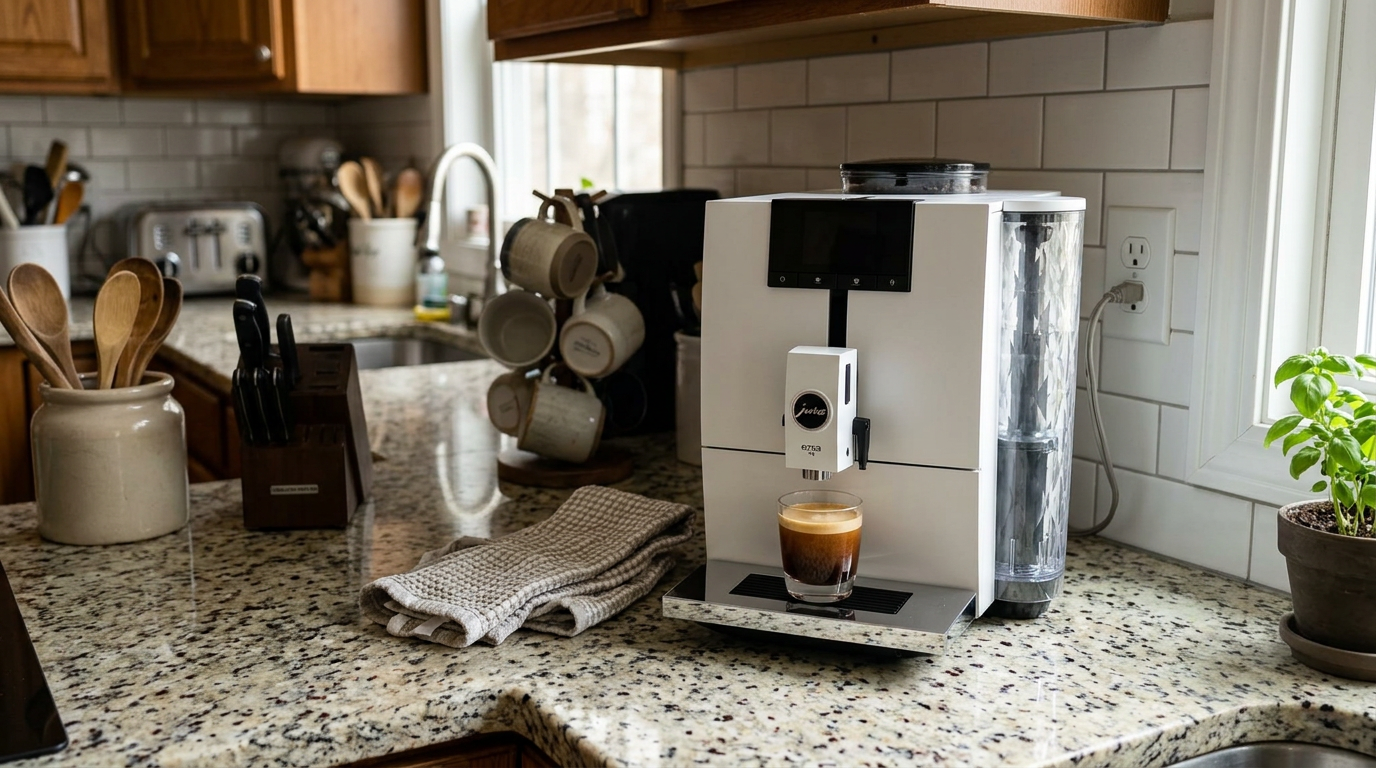
The ENA 4 also comes in white, which suits a bright kitchen.
The app
There's a port on the back for Jura's optional connectivity adapter.
With it, the J.O.E. app lets you adjust drink volume and strength, check maintenance and start a cleaning cycle from your phone.
It also shows lifetime drink counts and filter status.
It's nice to have, but the ENA 4's buttons are so simple that I rarely missed it.
Moving up from a capsule machine
Many people who look at the ENA 4 are coming from a capsule machine.
It's a natural step, because the footprint is similar and the operation is just as simple.
The difference is in the cup.
Capsule coffee is ground weeks or months before you drink it.
The ENA 4 grinds whole beans seconds before brewing, so the aromas haven't had time to fade.
In side-by-side tasting, the ENA 4's espresso had more sweetness, a thicker crema and a longer, cleaner finish.
What changes in your routine
With capsules, you drop in a pod and press a button.
With the ENA 4, you fill a hopper every few days and empty a grounds bin instead of a pod bin.
The daily effort is about the same.
You also choose your own beans, which opens up a whole world of roasters and flavors.
Cost per cup
Whole beans usually cost far less per cup than capsules.
Over a year of daily espresso, that difference adds up.
The ENA 4 costs more up front, so the savings take time to build.
| Step | Capsule machine | Jura ENA 4 |
|---|---|---|
| Load coffee | One pod per drink | Fill the hopper every few days |
| Brew | Press a button | Press a button |
| Waste | Used pods | Compostable coffee pucks |
| Coffee freshness | Ground long before | Ground seconds before |
| Coffee choice | Brand's pod range | Any whole bean you like |
Our tip: Start with a medium-dark espresso blend from a local roaster, because it shows off the jump from capsules most clearly.
The ENA 4 in a small office
I also spent a few days with the ENA 4 in a small home office shared by two people.
Its quiet grinder was a big plus, because calls and coffee could happen in the same room.
The simple buttons meant no one needed instructions.
The small containers were the limit again.
With two people drinking three or four coffees each, the tank needed refilling twice a day.
For an office of three or more, a machine with a larger tank and grounds bin would make more sense.
For a solo home office, the ENA 4 is close to perfect.
| Setting | Is the ENA 4 a fit? | Why |
|---|---|---|
| Solo home office | Excellent | Quiet, small, quick espresso |
| Two-person office | Good | Refill the tank twice a day |
| Office of three or more | Poor | Tank, hopper and bin too small |
My four weeks with the ENA 4
Week one: settling in
The first few espressos were a little weak while the grinder settled.
By day three, I had a grind just finer than the middle and the strong setting for espresso.
Week two: the double-press habit
In week two, I started double-pressing almost everything.
Two small cycles into one cup gave more body than any single setting.
Week three: living with the small containers
Week three was when the small containers became part of my routine.
I refilled the tank each morning and emptied the grounds bin every few days.
It became automatic, but it's worth knowing before you buy.
Week four: maintenance
In week four, I changed the filter and ran a tablet cleaning cycle.
Both took a few minutes, and the espresso tasted fresh and clean afterward.
Beans and water
Use fresh, non-oily whole beans within a few weeks of the roast date.
Medium and medium-dark roasts worked best.
Oily beans are a particular risk in a small grinder.
| Bean type | How it worked | Settings I used |
|---|---|---|
| Medium-dark blend | Best all-rounder, dense crema | Strong, a little fine |
| Medium roast | Sweet and balanced | Strong |
| Light roast | Can taste sharp | Strong, finer, double press |
| Very dark, oily | Not recommended | Avoid |
Fill the tank with fresh, cold water.
Use the filter if your water is moderately hard or harder.
Common mistakes to avoid
The Jura ENA 4 is simple, but a few habits make a difference.
| Mistake | What happens | Better habit |
|---|---|---|
| Putting the drip tray back too quickly | The grounds counter doesn't reset | Leave it out for five seconds |
| Turning the grind dial with the grinder stopped | Beans jam the burrs | Adjust only while it grinds |
| Using filter-grind decaf in the chute | Weak, watery coffee | Use espresso-fine decaf |
| Running one long coffee for a big mug | Thin cup | Use a double press |
| Using oily beans | Small grinder clogs | Choose non-oily roasts |
What I would change
A slightly bigger grounds bin and water tank would make a big difference.
A small hot water outlet would also make the ENA 4 far more versatile.
Is the Jura ENA 4 worth the money?
The ENA 4 is a premium compact machine.
Its value depends on your household and your kitchen.
For one or two black coffee drinkers with little space, it's one of the best small bean-to-cup machines I've used.
For a family, the constant refilling and emptying would wear thin.
Ask yourself three questions before you buy.
Do you drink fewer than four coffees a day at home? Is your counter space limited? And do you drink your coffee black?
If the answers are yes, the ENA 4 is easy to recommend.
If you answered no to the first question, look at a full-size machine with a bigger tank and grounds container.
If you answered no to the third, choose a model with a built-in milk system.
Check what's included where you buy, because filters, cleaning tablets and the app adapter vary between bundles.
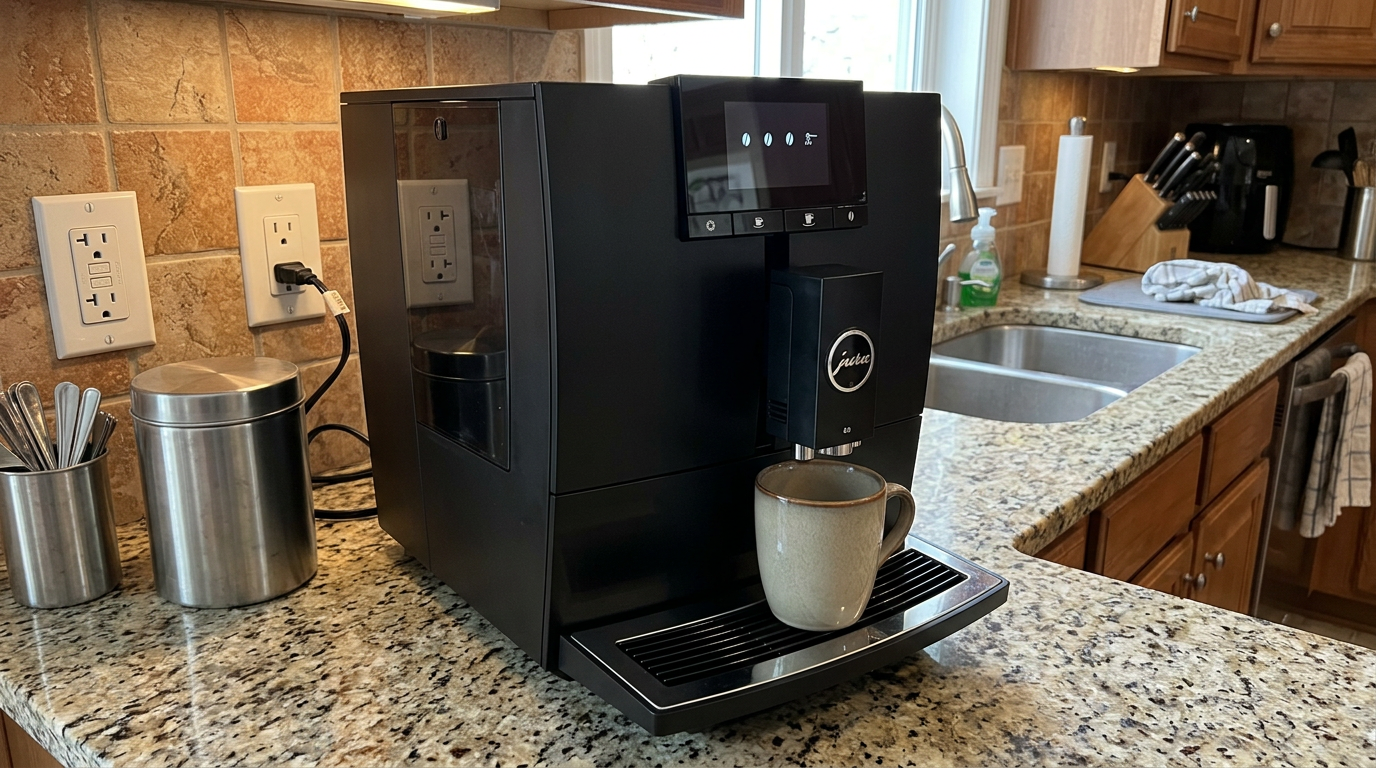
The ENA 4's small display sits above a single pair of spouts.
How it compares with other espresso setups
The most useful comparison is with the types of machines you're likely choosing between.
The Jura ENA 4 wins on size, quiet operation and espresso quality for its footprint.
| Feature | Jura ENA 4 | Full-size black coffee machine | Capsule machine |
|---|---|---|---|
| Fresh-ground beans | Yes | Yes | No |
| Footprint | Very small | Medium | Very small |
| Water tank | About 1.1 L | Often 1.6–1.9 L | Small |
| Dose per brew | 6–10 g, or two cycles | Up to 16 g | Fixed capsule |
| Hot water | No | Sometimes | Rarely |
| Running cost per cup | Low, beans | Low, beans | Higher, capsules |
A full-size machine holds more and doses more per brew, but takes more space.
A capsule machine is similar in size, but costs more per cup and can't match fresh-ground beans.
The ENA 4 is the small-space choice for real espresso.
| You mostly drink | Is the ENA 4 a fit? | Why |
|---|---|---|
| Espresso | Excellent | Sweet, balanced, dense crema |
| Double espresso | Excellent | Two full cycles into one cup |
| Long coffee | Fair | Better with a double press |
| Americano | Fair | Needs a kettle |
| Lattes | Poor | No milk system |
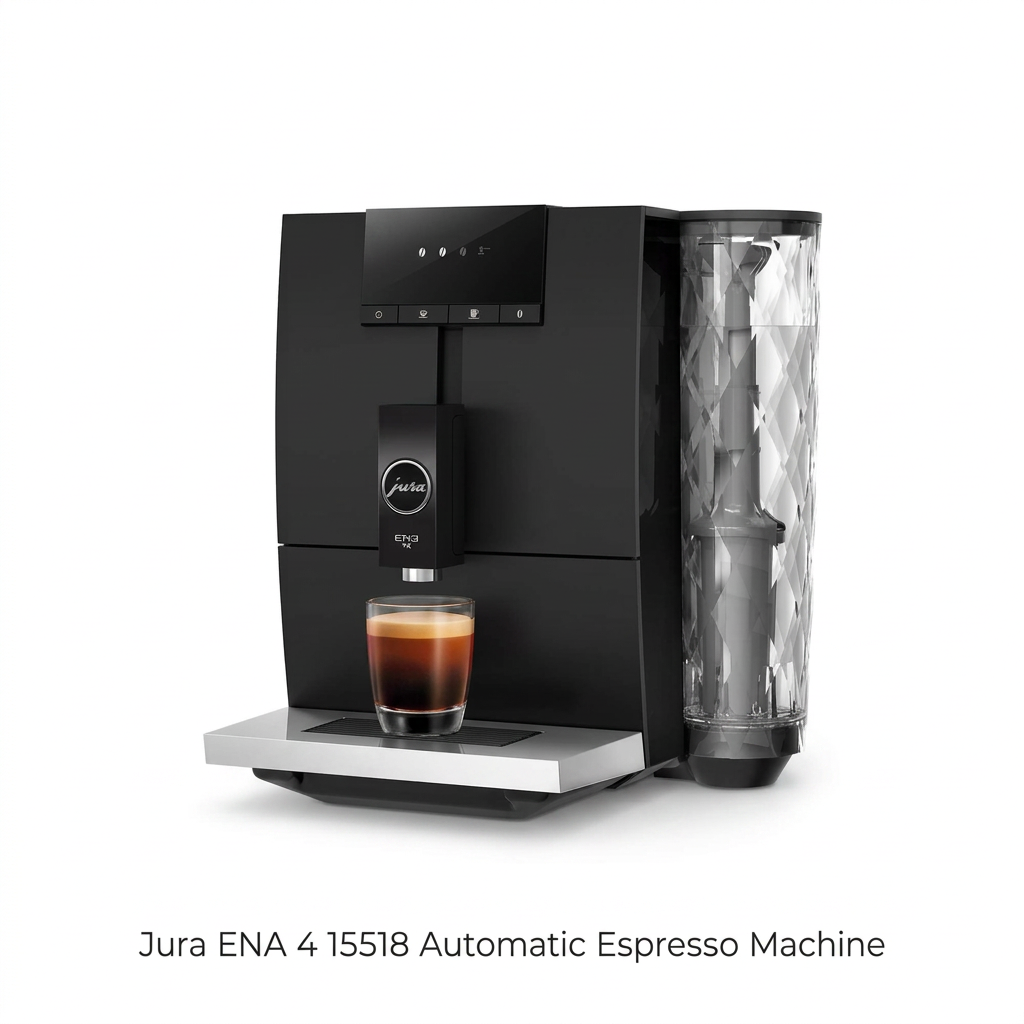
The ENA 4 in full: small display, simple buttons and dual coffee spouts.
Other Jura machines I tested
If you need a hot water spout for americanos and tea, the Jura E4 is the better black-coffee pick.
The Jura C3 is another compact, simple option that sticks to black coffee.
And if you want the same small footprint with milk drinks, read my Jura ENA 8 review.
Which one is right for you: is the Jura ENA 4 your match?
4 quick questionsJura ENA 4 specifications
From manufacturer data and my own testing.
How I tested and scored the Jura ENA 4
For four weeks, I used the Jura ENA 4 as my everyday machine for single and double espressos, long coffee and pre-ground decaf.
I tested all three strength levels with several bean types, worked through the grind range and tracked how often the tank, hopper and grounds bin needed attention.
I followed the full care routine, including a filter change and a tablet cleaning cycle.
I then checked my notes against Jura's specifications and owner documentation.
- Espresso (8.6): sweetness, crema, body and consistency across bean types.
- Long coffee (7.8): flavor at mug sizes and the double-brew option.
- Ease of use (8.8): buttons, display, strength settings and setup.
- Cleaning (8.6): drip tray, grounds bin, tablet cleaning and filter changes.
The overall score of 8.3 is an editorial rating that reflects those four areas.
Jura ENA 4 FAQ
Is the Jura ENA 4 worth it?
Yes, if you drink espresso or black coffee, have little counter space and make a few cups a day. Its espresso is sweet and crema-rich. If you make many cups or want milk drinks, choose a larger machine.
Can the Jura ENA 4 make cappuccinos or lattes?
No. It has no milk system. You can pair it with a separate electric milk frother for occasional milk drinks.
Does the Jura ENA 4 have hot water?
No. There's no hot water spout, so you'll need a kettle for tea or americanos.
How big is the water tank?
About 1.1 liters, or 37 fluid ounces. It's a tall, clear cylinder on the side of the machine.
How big is the bean hopper?
About 125 grams, or 4.4 ounces. In my home, that meant topping it up every few days.
How do I make a double espresso?
Press the espresso button twice quickly. The machine grinds, brews, ejects the puck, then grinds and brews again into the same cup.
How do I change the strength?
Press the strength button to cycle through mild, medium and strong. It changes how much coffee goes into each brew.
Can I use pre-ground coffee?
Yes. Open the chute on top with its lever, add one level scoop of espresso-fine coffee and press your drink button. The grinder is skipped.
How do I clean the Jura ENA 4?
Empty the drip tray and grounds bin regularly, run the tablet cleaning cycle when prompted with the tablet in the pre-ground chute, and change the filter when the machine asks.
Can I remove the brew unit?
No. The brew unit is fixed inside and is cleaned with the automatic tablet program.
Does it work with an app?
Yes, with Jura's J.O.E. app after adding the optional connectivity adapter to the port at the back.
Kitchen & coffee tester
Michael spent six years as a line cook in restaurants in Chicago and New York, and he has tested kitchen appliances for HouseholdMe since 2018, from air fryers to coffee makers. He holds an SCA certificate in barista skills and used the Jura ENA 4 as his everyday coffee machine for four weeks for this review.
- Four weeks of hands-on testing of the Jura ENA 4 15518
- Jura product specifications and owner documentation
- General espresso brewing and maintenance guidance