Jura C9 review: 17 drinks, silky milk foam and a gentle Light Brew mode in a compact body
The Jura C9 15739 Automatic Espresso Machine squeezes a full-size brew unit, a fine-foam milk system and 17 one-touch drinks into a body just over 10 inches wide. Its espresso is rich and its milk foam is excellent, but the single-direction menu and the small water tank take some getting used to.

Michael Reynolds
Hands-on review
Hands-on testing, research, specs
4 weeks
27 minutes
Jargon helpNew to espresso? Tap any dotted term to see what it means.
In this review
Yes, if you want café-style espresso and milk drinks from a compact machine. The Jura C9 keeps a full-size brew unit, makes thick, sweet espresso and pours some of the finest milk foam I've had from a one-touch machine. Its Light Brew mode adds a milder, ready-to-drink option that some people will love and others will never use. The menu only scrolls one way, the 1.6-liter tank needs frequent refills, and the clear milk hose needs rinsing after every use.
Jura C9 at a glance
Jura C9 pros and cons
- Rich espresso with dense, long-lasting crema
- Fine, silky milk foam from a simple hose system
- Compact and quiet, with a full-size brew unit
- Menu scrolls in one direction only
- Small water tank needs frequent refills
- Clear milk hose needs rinsing after every use
Who should buy the Jura C9?
- Small kitchens that still want lattes and cappuccinos
- Households that like both strong and mild coffee
- Early risers who need a quiet machine
- Big families who need separate user profiles
- Anyone who wants iced coffee from the machine
- People who hate refilling a water tank
First impressions of the Jura C9
Compact espresso machines usually ask you to give something up.
A smaller brew unit, a weaker grinder or a milk system that's more toy than tool.
The Jura C9 is an attempt to shrink the machine without shrinking the coffee.
It's about 10.2 inches wide, but it keeps the same full-size brew chamber and thermoblock as much bigger machines.
Jura saved the space elsewhere, mostly by trimming the water tank and bean hopper.
The first thing I noticed out of the box was the finish.
My unit came in black, with a curved front, a brushed metal drip tray with a wave pattern and a sculpted water tank on the side.
It looks more like a design object than a kitchen appliance.
The second thing I noticed was the menu.
There are 17 drinks, shown as icons with labels on a bright color screen.
And there's a Light Brew version of most of them, which is unusual on any machine.
My first cappuccino set the tone for the next four weeks.
The foam was glossy and fine, with no big bubbles, and it sat on a dense, sweet espresso.
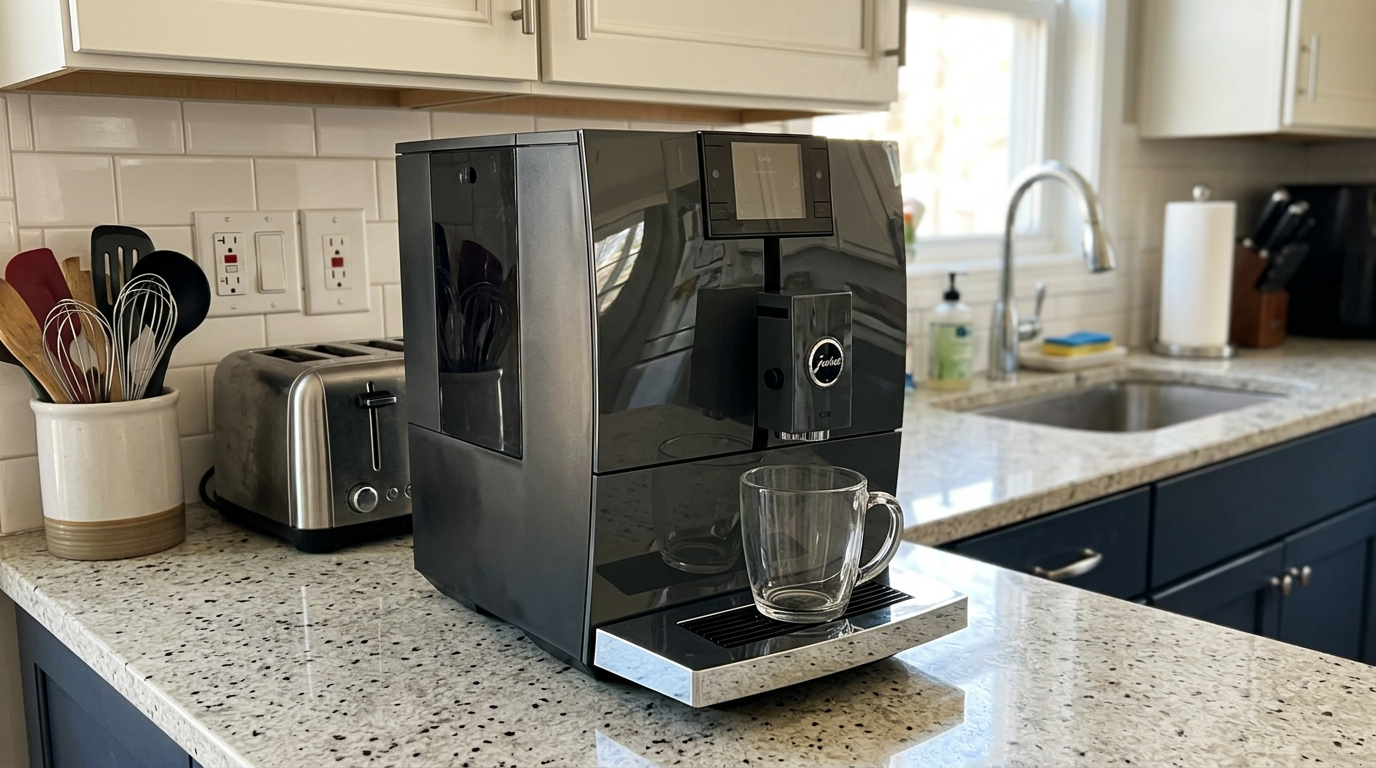
The C9 is narrow enough to tuck between a toaster and the sink.
What the Jura C9 actually is
The C9 is a fully automatic, bean-to-cup espresso machine with a built-in milk system.
It grinds the beans, doses and compresses the coffee, brews it and drops a dry puck into the waste drawer.
For milk drinks, it draws milk through a hose and froths it with steam.
Inside is a thermoblock✕ThermoblockA compact heater that warms water as it flows through, instead of keeping a whole boiler hot. It heats up fast and uses less standby energy. made of aluminum with stainless steel water channels.
It heats up quickly from power-on and holds its temperature well across back-to-back drinks.
The pump is rated at 15 bar, but a bypass valve keeps the working pressure at the coffee around 9 to 10 bar.
That's the classic espresso target.
The heart of the machine is the full-size brew unit✕Brew unitThe chamber inside an automatic machine that receives the ground coffee, presses it into a puck, pushes hot water through it and then ejects the used grounds., which takes roughly 5 to 16 grams of coffee per brew.
Many compact machines shrink this part, which limits how strong a single shot can be.
Here, you get a big-machine dose in a small body.
Jura C9 design and setup
The Jura C9 measures 26 × 32.5 × 43.7 cm, or about 10.2 × 12.8 × 17.2 inches.
The narrow width is the headline.
At 12.8 inches tall, it also fits under standard wall cabinets.
Like most bean-to-cup machines, it's deeper than it looks, so check your counter depth.
The water tank sits upright along the side, flush with the housing.
You lift it by its handle and slide it out sideways, so leave a few inches clear on that side.
The bean hopper on top holds about 200 grams, or 7 ounces.
That's on the small side, but it means beans don't sit around going stale.
Its floor is angled so the beans keep feeding into the grinder instead of bridging over it.
The dual coffee and milk spout slides up and down smoothly for anything from espresso cups to tall latte glasses.
The drip tray has a brushed metal plate and a two-part basin, with the waste drawer for used pucks inside.
One design quirk to know about
The front cover plate below the spout is held on by magnets.
It looks clean, but it has a weakness.
When I pushed the spout all the way up with the milk hose attached, the hose tugged the cover plate off its magnets twice.
It's easy to put back, but firm clips would have been better.
First-time setup
Setup is guided on the screen.
You choose your language, test your water hardness and decide whether to use the CLEARYL Smart+ filter, which fits inside the tank.
The filter removes scale minerals and chlorine, and the machine tracks how much water passes through it.
The first few drinks are weaker while the grinder settles, so don't judge anything until about the fourth cup.
Our tip: Leave a hand's width of space on the tank side, so you can slide the tank out without moving the machine.
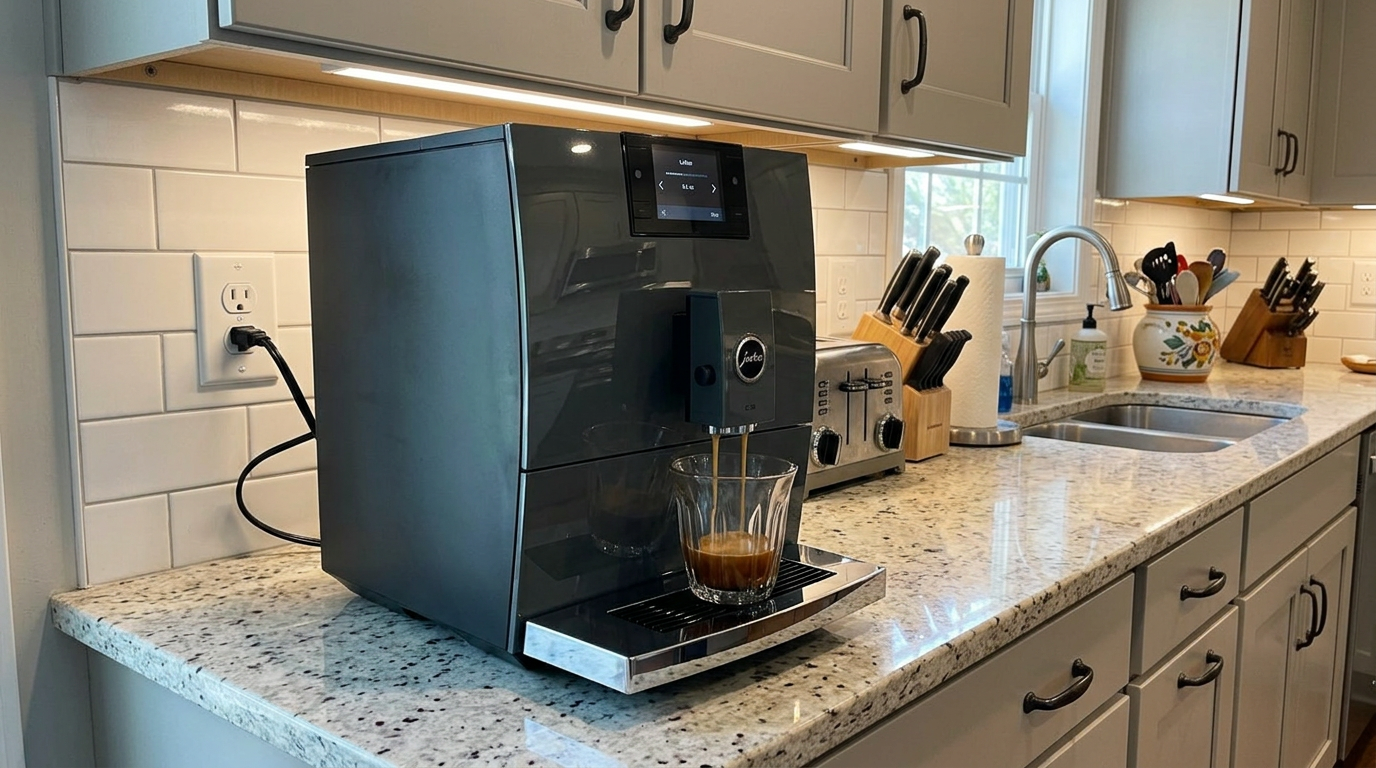
Under-cabinet lighting shows off the C9's curved front and wave-patterned drip tray.
The built-in grinder
The C9 grinds with steel conical burrs✕Conical burrsA cone-shaped cutting part that turns inside a ring. They grind evenly at fairly low speed, which keeps heat and noise down..
They turn at a relatively low speed, which limits friction heat.
Less heat means the coffee's aromatic oils survive the grind instead of oxidizing early.
The hidden dial
The grind dial sits behind the water tank.
To change it, you lift the tank out first.
That keeps the front of the machine clean, but it makes quick adjustments a two-handed job.
The dial is stepless, with no numbers, and runs between Mild and Intense.
Intense narrows the gap between the burrs for a finer grind and a stronger cup.
Mild widens it for a coarser grind and a lighter body.
Bars show how much resistance the coffee puts up and how long the water stays in contact with it.
With medium-dark beans, my sweet spot was a little past the middle toward Intense.
For light roasts, I went a touch finer again.
Adjust only while it grinds
The most important rule on any Jura grinder applies here too.
Only turn the dial while the grinder is running.
Turning it toward fine with the burrs stopped can wedge bean fragments between them and strain the mechanism.
My routine was to start an espresso, lift the tank, nudge the dial while it ground and judge the result two or three cups later.
Our tip: After any grind change, wait two or three drinks before judging, because some old coffee is still in the chute.
Jura C9 espresso performance
Espresso is where the C9's full-size brew unit pays off.
Each shot starts with a short pre-infusion✕Pre-infusionA short, gentle soak of the coffee before full pressure. It lets the puck swell evenly so water doesn't rush through weak spots., which wets and swells the coffee before full pressure arrives.
That helps the water flow evenly instead of finding weak spots.
Then Jura's Pulse Extraction Process✕Pulse Extraction Process (P.E.P.)Jura's method of pushing hot water through the coffee in short, rapid bursts instead of one steady stream. It lengthens contact time for short drinks, giving a fuller flavor. takes over.
Instead of a steady stream, water passes through the coffee in short, rapid pulses.
For short drinks, that means more contact time and more flavor without more water.
How it tasted
With a medium-dark blend, my espresso came out with a thick, deep-brown crema✕CremaThe golden-brown foam on top of an espresso. It forms when pressure pushes gases and oils out of freshly ground coffee. that held for minutes.
The body was round and dense.
I tasted dark chocolate, roasted nuts and a gentle sweetness, with balanced acidity and very little bitterness.
Back-to-back shots tasted the same, which says a lot about the thermoblock's stability.
I made three espressos in a row for guests, and the third was as hot and full as the first.
Where it falls short
It's still an automatic machine.
You can't change the pressure, adjust the pre-infusion or tweak the puck prep.
A skilled home barista with a manual setup can get more clarity from exceptional beans.
For one-touch espresso, though, the C9 is near the top of what I've tasted from a compact machine.
| What you taste or see | Likely cause | First change |
|---|---|---|
| Sour, thin, watery | Under-extraction | Turn the dial toward Intense or raise strength |
| Bitter, harsh, drying | Over-extraction | Turn the dial toward Mild or cut the volume |
| Pale crema that fades fast | Stale beans, grind too coarse or Light Brew on | Use fresher beans and check the mode |
| Drips slowly or stops | Grind far too fine | Turn toward Mild while grinding |
| Lukewarm shot | Cold cup or low temperature | Warm the cup and set temperature to High |
Our tip: Warm your espresso cup with hot water first, because a cold cup steals a lot of heat from a small shot.
Light Brew: the C9's gentle mode
Light Brew is the feature that sets the C9 apart, so I spent a full week drinking it.
Jura calls the technology the Light Extraction Process✕Light Extraction Process (L.E.P.)Jura's mild brewing mode. It uses less coffee and cooler water, around 60°C, and changes the pump pulses, for a lighter cup you can drink right away..
In Light Brew mode, the thermoblock runs cooler than the Low temperature setting, and the pump changes its pulse rhythm.
The water reaches the coffee at around 60°C, or 140°F, and the machine uses less coffee.
The screen turns brown with a single bean icon at the top, so you always know which mode you're in.
How Light Brew tastes
The difference is obvious from the first sip.
The crema is pale and cream-colored instead of dark reddish-brown.
The body is light, the intensity is low and the coffee is ready to drink straight away, with no waiting for it to cool.
| Quality | Standard drink | Light Brew drink |
|---|---|---|
| Crema | Thick, deep reddish-brown | Pale, cream-colored |
| Body | Dense and round | Light and thin |
| Flavor | Chocolate, roasted, sweet | Mild, soft, less nuance |
| Temperature | Hot | Warm, ready to drink |
| Best with | Most roasts | Medium roasts that taste good cool |
With a medium roast, Light Brew was smooth and pleasant, especially in a cappuccino.
With darker roasts that need heat to open up, it sometimes tasted thin or slightly papery.
I also tried pouring Light Brew coffee over ice.
It melted the ice fast and ended up weak and watery, so it's not a substitute for an iced coffee program.
Who Light Brew is for
If you like strong, very hot coffee, you may never press the Light Brew icons.
If you, or someone you live with, finds standard espresso too intense, it's a genuinely useful second option.
Approximate water temperatures. Light Brew runs cooler than even the Low setting.
Long coffee and doubles
The Coffee button makes a long black coffee in one continuous pour.
The full cup of water passes through the coffee, so there's no separate hot water step.
At normal mug sizes, it came out smooth and rounded, with a thin layer of crema.
Pushing the volume very high made the end of the pour taste flatter.
For a big mug, I preferred the 2 × Coffee option, which runs two full grind-and-brew cycles into the same cup.
Two cups at once
Both espresso and coffee have a two-cup version.
The C9 doesn't split one dose between two cups.
It grinds, brews and ejects one puck, then grinds fresh for the second.
Both drinks get a full dose, so neither cup ends up weak.
| Drink | How it's made | Milk used |
|---|---|---|
| Espresso, 2 × Espresso | Short pulsed brew, one or two full cycles | None |
| Coffee, 2 × Coffee | Long continuous pour, one or two full cycles | None |
| Cappuccino | Espresso with a tall layer of foam | Foam |
| Flat white | Espresso with thinner, silky milk | Foam and milk |
| Latte macchiato | Milk and foam first, espresso through the middle | Foam and milk |
| Cortado, espresso macchiato | Short espresso with a little milk or foam | Small amount |
| Portion of milk foam | Foam only | Foam |
Our tip: For a stronger long coffee, use 2 × Coffee into one mug instead of raising the volume on a single brew.
Milk foam and milk drinks
The C9's milk system is simple, and it works very well.
A clear silicone hose draws milk from a glass or carafe next to the machine.
Inside the frothing head, steam rushes through a narrow nozzle, and the Venturi effect✕Venturi effectWhen a fluid speeds up through a narrow opening, its pressure drops. In a milk frother, fast steam creates suction that pulls milk up the hose. pulls the milk up the hose.
A calibrated valve then adds air.
The result is microfoam✕MicrofoamMilk foam with bubbles so small you can't see them. It feels silky and blends into the coffee instead of sitting on top like froth. with tiny bubbles and a silky, glossy texture.
It was some of the best one-touch foam I've had.
The foam held its shape in a latte macchiato and poured smoothly into a flat white.
Milk types I tried
Whole milk gave the richest, sweetest foam.
Skim milk made taller, stiffer foam that faded faster.
Oat milk foamed well, especially barista-style oat drinks.
My ratings on a 10-point scale for texture and stability.
Setting foam by time, not volume
In each drink's settings, you set the milk foam amount in seconds rather than milliliters.
My cappuccino default was around 18 seconds of foam.
It takes a few tries to find the right number for your favorite glass.
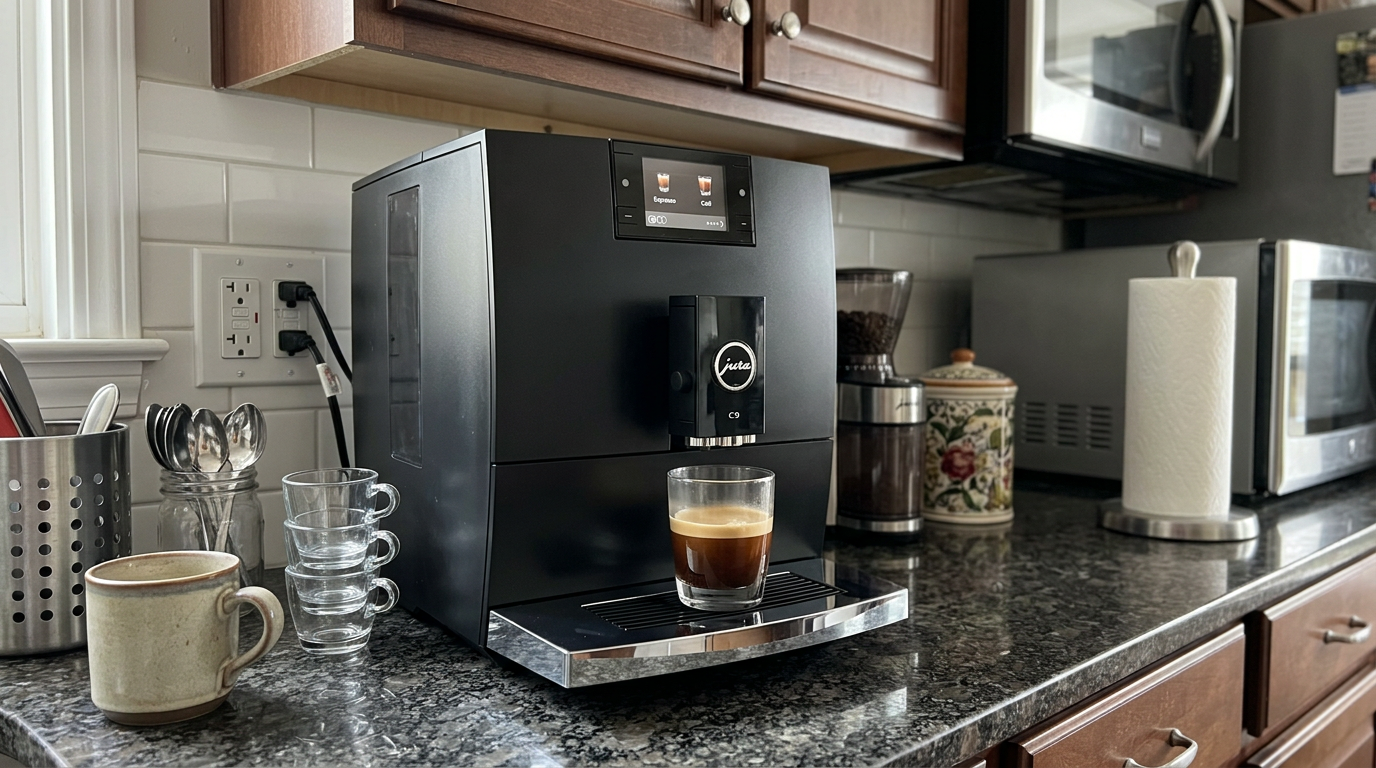
The clear milk hose plugs into the side of the spout when you need it.
The clear hose is functional but not beautiful.
It also shows milk residue quickly, which is a good reminder to rinse it.
A stainless thermal milk container would look better and keep milk colder on the counter.
Our tip: Keep the milk in the fridge and only pour out what you need, because the open glass and hose don't keep milk cold.
Display, buttons and programming
The color display is bright and easy to read, with an icon and a text label for every drink.
Navigation is the weak spot.
You scroll with a single physical button on the right side of the screen, and the menu only moves in one direction.
There's no back button.
If you scroll past the drink you want, you have to cycle through all 17 to get back to it.
After a week, I knew roughly how many presses each favorite needed, but it never felt quick.
Changing a drink on the fly
While a drink is grinding or pre-infusing, you can tweak its strength and volume for that one cup.
The prompts only stay on screen for a moment, so you need to be quick.
These changes don't alter your saved settings.
Saving your own defaults
Press and hold the button beside a drink to open its settings, then choose Product Settings.
These settings apply to everyone who uses the machine, because the C9 has no user profiles.
In a household with very different tastes, that means someone always adjusts on the fly.
Our tip: Lower the espresso volume from about 3 to 2 fl oz for a denser, sweeter shot.
Pre-ground coffee and decaf
There's a bypass chute for pre-ground coffee✕Pre-ground bypassA separate chute that sends already-ground coffee straight to the brew unit, skipping the grinder. Handy for decaf without emptying the bean hopper. under a small lid on the top left.
It's handy for an evening decaf without emptying the hopper.
Getting to it takes a few steps, though.
You open settings from the icon at the lower left, go to page two, choose the gear icon, then Powder Mode, and switch it on.
Then you add one level scoop to the chute, place your cup and start the drink.
I wish this were a single button on the home screen.
The chute's funnel unclips, so you can brush out old powder and keep it from clogging.
Our tip: Add only one level scoop to the chute, because overfilling it can clog the brew chamber.
Cleaning and maintaining the Jura C9
Daily care is quick, apart from the milk system.
The machine rinses its coffee path when it switches on and off.
After milk drinks, it rinses the frothing head, and you should also run the milk rinse when prompted.
Each week, I took the frothing head apart by hand and washed the parts in warm water.
The clear hose shows residue quickly, so I rinsed it more often than that.
Filter or descaling✕DescalingRunning a mild acid solution through the machine to dissolve mineral scale left by hard water. Scale slows heating and can block pipes.
With the CLEARYL Smart+ filter installed, you swap the cartridge when the display asks.
Without it, the machine prompts you to descale based on your water hardness.
It also asks for a brew group cleaning with a tablet every so often.
| When | Task | Why it matters |
|---|---|---|
| After milk drinks | Run the milk rinse | Flushes milk from the frothing head |
| Daily | Empty drip tray and waste drawer | Prevents mold and odors |
| Daily | Rinse the milk hose | Stops residue building up in the clear tube |
| Weekly | Take apart and wash the frothing head | Removes dried milk from small parts |
| Weekly | Clean the pre-ground chute | Removes coffee dust |
| When prompted | Tablet cleaning, filter change or descaling | Keeps oils and scale under control |
My estimate of hands-on cleaning time per day, including the milk hose rinse.
Jura's warranty covers the C9 for two years, capped at 6,000 brews in the US.
What daily use is really like
My mornings started by switching the C9 on and letting it rinse into the drip tray.
Then I scrolled to my drink and pressed start.
An espresso took well under a minute, and a cappuccino about a minute.
The tank fills up your routine
The 1.6-liter tank is the C9's practical limit.
Many automatic machines hold closer to 2 liters, and you feel the difference.
With two of us making milk drinks and a few espressos, I refilled the tank almost every day.
Rough maths from a 1.6 L tank, allowing for rinse water. Actual numbers depend on cup size.
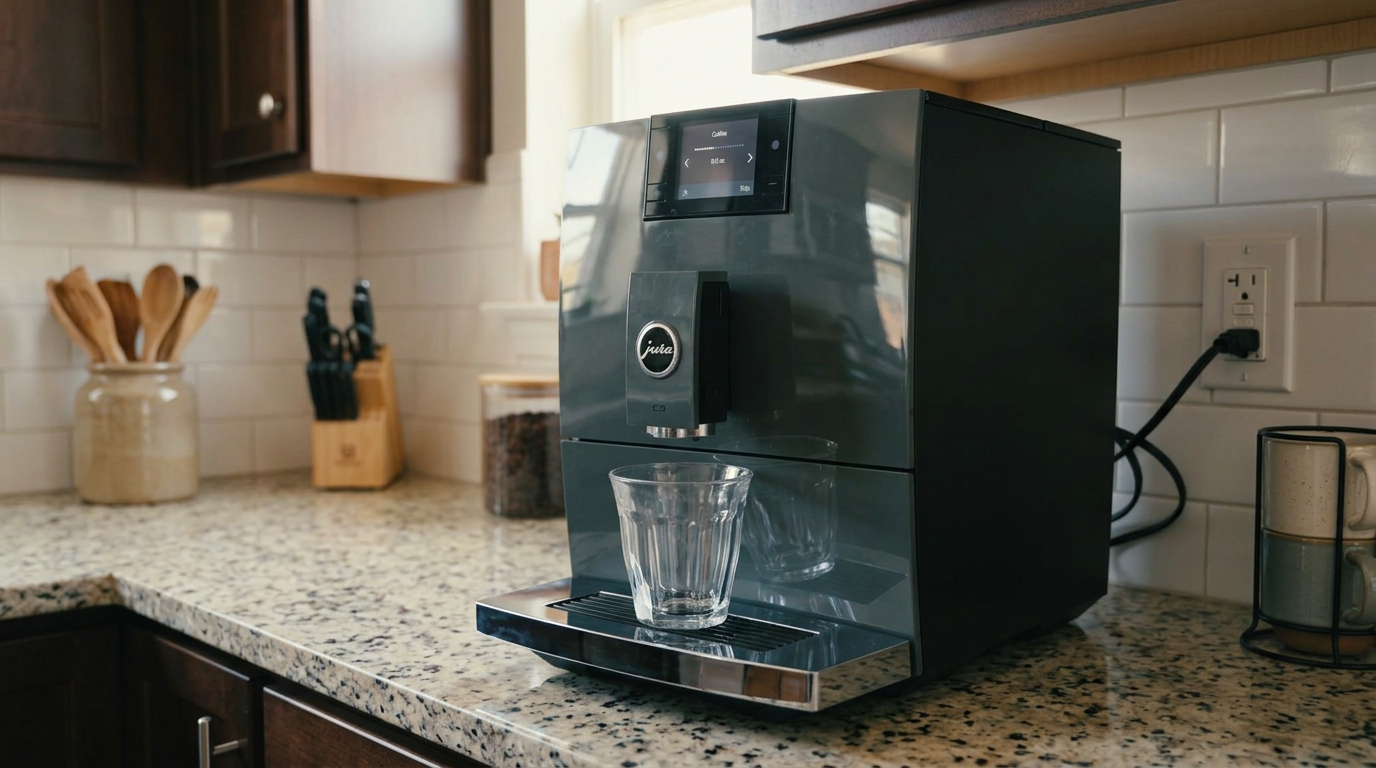
In gray, the C9 blends quietly into a light kitchen.
Noise
The C9 is quiet for a bean-to-cup machine.
The grinder gives a short, low burst, and the pump runs smoothly rather than rattling.
It didn't wake anyone in my house.
Our tip: Fill the tank the night before so the first coffee of the day never runs dry halfway through.
Beans, water and milk
The C9 is good enough that your beans make a clear difference.
Use fresh whole beans within a few weeks of the roast date.
Medium and medium-dark roasts worked best for standard drinks.
For Light Brew, medium roasts with chocolate or fruit notes held up better than very dark ones.
Avoid very oily, shiny beans and flavored beans, which can clog the grinder.
| Bean type | Standard drinks | Light Brew drinks |
|---|---|---|
| Medium-dark blend | Excellent, thick crema | Good in milk drinks |
| Medium roast | Very good, brighter | Best match |
| Light roast | Grind finer, raise strength | Can taste thin |
| Very dark, oily | Not recommended | Not recommended |
Water
Fill the tank with fresh, cold water.
Use the filter if your tap water is moderately hard or harder.
Avoid distilled water, because coffee needs some minerals to taste full.
Common mistakes to avoid
The Jura C9 is easy to live with, but a few habits will hold it back.
| Mistake | What happens | Better habit |
|---|---|---|
| Turning the grind dial with the grinder stopped | Beans jam and strain the burrs | Adjust only while it grinds |
| Raising the spout fully with the hose attached | The magnetic cover plate pops off | Raise it gently or detach the hose |
| Skipping the milk rinse | Milk residue builds up in the hose | Rinse after milk drinks |
| Judging Light Brew with a dark roast | Thin, papery taste | Try a medium roast |
| One huge Coffee pour | Flat, over-brewed finish | Use 2 × Coffee |
| Forgetting the small tank | Drink stops halfway | Refill before bed |
Change one setting at a time and taste after each change.
Change the grind and strength together, and you won't know which helped.
What I would change
A two-way menu with a back button would fix the C9's biggest annoyance.
A bigger water tank and a home-screen button for powder mode would also help.
And a stainless or insulated milk container would look and work better than the clear hose and glass.
Is the Jura C9 worth the money?
The C9 is a premium machine, so it has to earn its place.
It does that best in a small kitchen.
You get a full-size brew unit, excellent milk foam and 17 drinks in a body narrower than many basic machines.
If counter space isn't a concern, a larger model gives you a bigger tank and user profiles.
Ask yourself three questions before you buy.
Do you drink milk drinks most days? Is your counter space limited? And can you live with refilling a small tank and scrolling one way through a menu?
If the answers are yes, the C9 is easy to recommend.
Check what's included where you buy, because milk containers, filters and cleaning tablets vary between bundles.
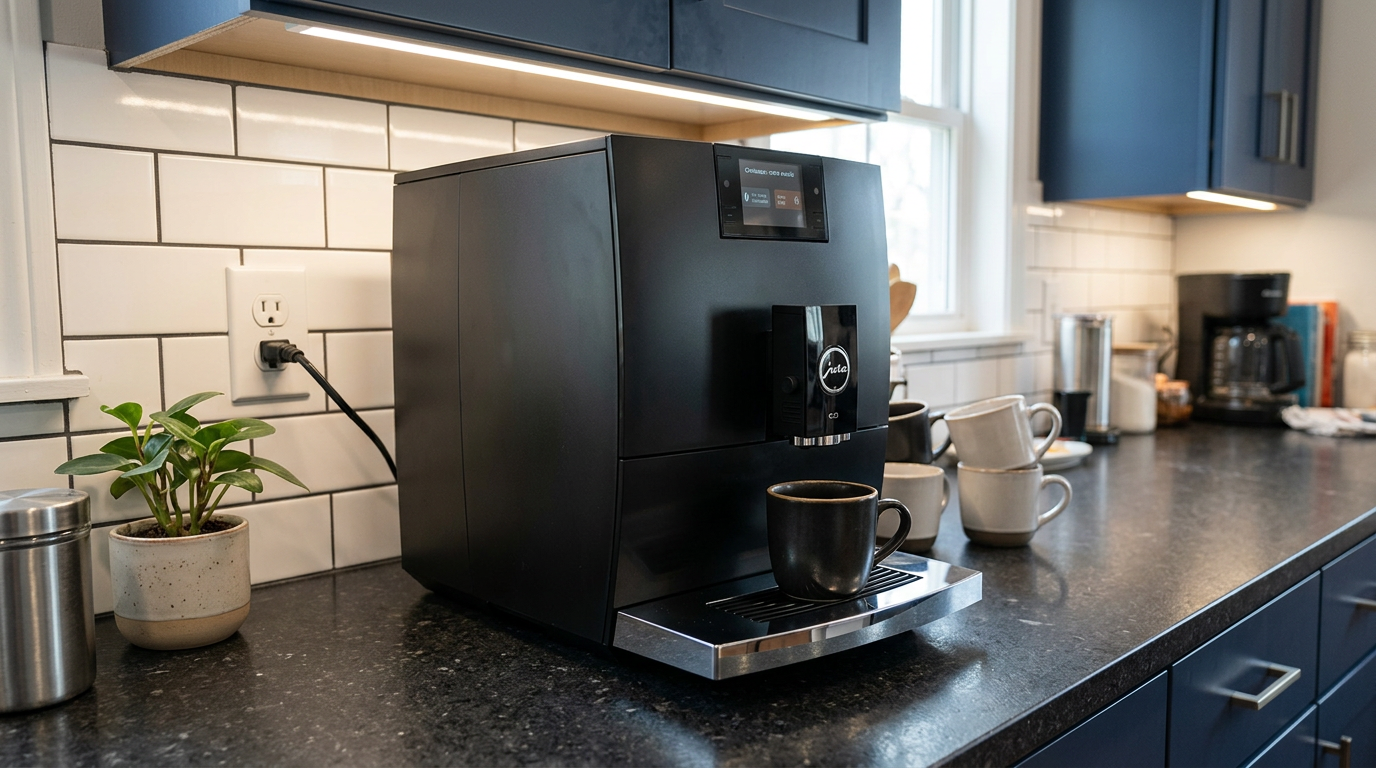
The C9 looks at home in a modern kitchen, especially in black.
How it compares with other espresso setups
The most useful comparison is with the kinds of machines you're likely choosing between.
The Jura C9 stands out for its size, its foam and its Light Brew option.
| Feature | Jura C9 | Larger automatic machine | Manual machine and grinder |
|---|---|---|---|
| Grinding and brewing | Fully automatic | Fully automatic | You do it |
| Espresso quality | Very good, consistent | Varies widely | Excellent, skill-dependent |
| Milk foam | Fine, one touch | Varies, one touch | Steam wand, skill-dependent |
| Mild coffee option | Light Brew | Rare | No |
| Water tank | About 1.6 L | Often 1.8–2.3 L | Varies |
| User profiles | None | Often several | No |
| Footprint | Compact | Larger | Two appliances |
A larger automatic machine gives you more capacity and often user profiles, at the cost of counter space.
A manual setup gives the most control, but it takes time and skill every morning.
The C9 sits in between, with café-style drinks in a very small footprint.
| You mostly drink | Is the C9 a fit? | Why |
|---|---|---|
| Espresso | Excellent | Full dose, pulsed extraction, thick crema |
| Cappuccinos and flat whites | Excellent | Fine, silky microfoam |
| Mild, easy coffee | Good | Light Brew drinks |
| Iced coffee | Poor | No iced program, Light Brew dilutes |
| Large household, many tastes | Fair | No user profiles, small tank |
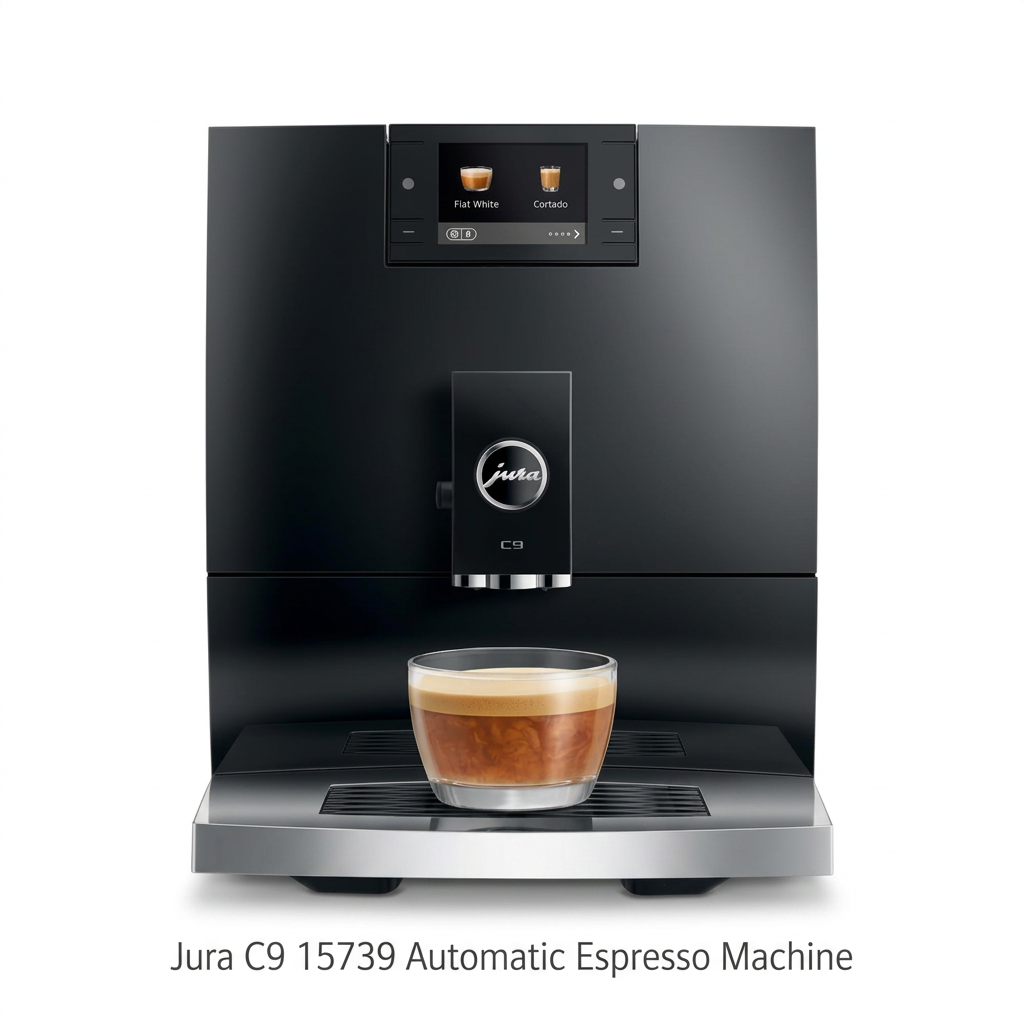
The full package: color display, adjustable spout and the wave-patterned drip tray.
Other Jura machines I tested
If you never drink milk, the Jura C3 gives you a similarly compact machine for black coffee only.
The Jura E8 also makes 17 drinks and adds smart filter tracking.
For a big touchscreen and a lever that switches between latte and cappuccino foam, see my Jura S8 review.
Which one is right for you: is the Jura C9 your match?
4 quick questionsJura C9 specifications
From manufacturer data and my own testing.
How I tested and scored the Jura C9
For four weeks, I used the Jura C9 as my everyday machine for espresso, long coffee, cappuccinos, flat whites, latte macchiatos and the Light Brew drinks.
I worked through the grind range, changed strength, volume, temperature and foam time for each drink, and compared every Light Brew drink with its standard version.
I made milk drinks with whole, skim and oat milk, followed the daily and weekly cleaning routine, and timed how long the tank lasted.
I then checked my notes against Jura's specifications and owner documentation.
- Espresso (8.9): body, crema, flavor and consistency across back-to-back drinks.
- Milk drinks (8.4): foam texture, milk temperature and the Light Brew milk drinks.
- Ease of use (7.6): menu, display, on-the-fly changes and setup.
- Cleaning (8.2): daily rinse, weekly frother wash and maintenance prompts.
The overall score of 8.3 is an editorial rating that reflects those four areas.
Jura C9 FAQ
Is the Jura C9 worth it?
Yes, if you want rich espresso and silky milk drinks from a compact machine. It keeps a full-size brew unit and makes excellent milk foam. If you need user profiles or a large water tank, look at a bigger model.
What is Light Brew on the Jura C9?
Light Brew uses less coffee and cooler water, about 60°C, for a milder, lighter cup you can drink right away. It has pale crema and a thinner body than the standard drinks.
How many drinks does the Jura C9 make?
It has 17 drinks, including espresso, coffee, cappuccino, flat white, latte macchiato, cortado, espresso macchiato, milk foam and Light Brew versions of most of them.
How does the milk system work?
A clear hose draws milk from a glass or carafe. Steam pulls the milk up and a valve adds air, which creates fine microfoam. The system rinses itself after each milk drink.
Where is the grind dial on the Jura C9?
It sits behind the water tank, so you need to lift the tank out to reach it. Only turn it while the grinder is running.
How big is the water tank?
About 1.6 liters, or 54 fluid ounces. That is smaller than many automatic machines, so expect to refill it often.
Does the Jura C9 have user profiles?
No. You can save your preferred strength, volume, temperature and foam time for each drink, but not separate settings for different people.
Can I use pre-ground coffee?
Yes. Turn on powder mode in the settings, add one level scoop to the chute on top and start the drink.
How do I clean the milk system?
Rinse the milk path after milk drinks, take apart and wash the frothing head each week, and run the milk cleaning cycle when the machine asks.
Can the Jura C9 make iced coffee?
Not with a dedicated program. Light Brew over ice melts the ice quickly and tastes diluted, so it's better to chill a strong espresso first.
How loud is the Jura C9?
It's quiet for a bean-to-cup machine. The grinder gives a short, low burst, and the pump runs smoothly.
Kitchen & coffee tester
Michael spent six years as a line cook in restaurants in Chicago and New York, and he has tested kitchen appliances for HouseholdMe since 2018, from air fryers to coffee makers. He holds an SCA certificate in barista skills and used the Jura C9 as his everyday coffee machine for four weeks for this review.
- Four weeks of hands-on testing of the Jura C9 15739
- Jura product specifications and owner documentation
- General espresso brewing and maintenance guidance