Greater Goods Sous Vide review
The Greater Goods Sous Vide Cooker 1100W is an immersion circulator with simple knob-and-button controls on the device, no app required. It holds water within about 0.1°F of the target, starts its timer only once the water reaches temperature, keeps holding temperature after the timer ends and clips to pots of different depths with a removable clamp. I tested it for three weeks with steak, chicken, pork, salmon, eggs and leftovers. It was accurate, quiet and easy to use, though the clamp is fiddly to reassemble.

Emily Carter
Hands-on review
Hands-on testing, research, specs
3 weeks
26 minutes
Jargon helpNew to this kind of product? Tap any dotted term to see what it means.
In this review
Yes, if you want an accurate sous vide cooker without an app. The Greater Goods Sous Vide held my water bath within a fraction of a degree, cooked ribeyes evenly pink from edge to edge and made chicken thighs and salmon tender and juicy. Its timer waited until the water reached temperature, and it kept holding the bath after the timer ended, which made dinner timing easy. It is quiet and stores neatly in its box. The clamp is awkward to reassemble and the button sequence takes practice, but the cooking results are excellent.
Greater Goods Sous Vide at a glance
Greater Goods Sous Vide pros and cons
- Very accurate temperature control
- Simple controls on the device
- Timer starts once water is at temperature
- Clamp is awkward to reassemble
- Button sequence takes practice
- No app or remote monitoring
Who should buy the Greater Goods Sous Vide?
- Steak lovers
- Cooks who dislike kitchen apps
- Meal preppers
- People who want remote monitoring
- Cooks with very small pots
- Anyone who rarely cooks meat or fish
First impressions of the Greater Goods Sous Vide
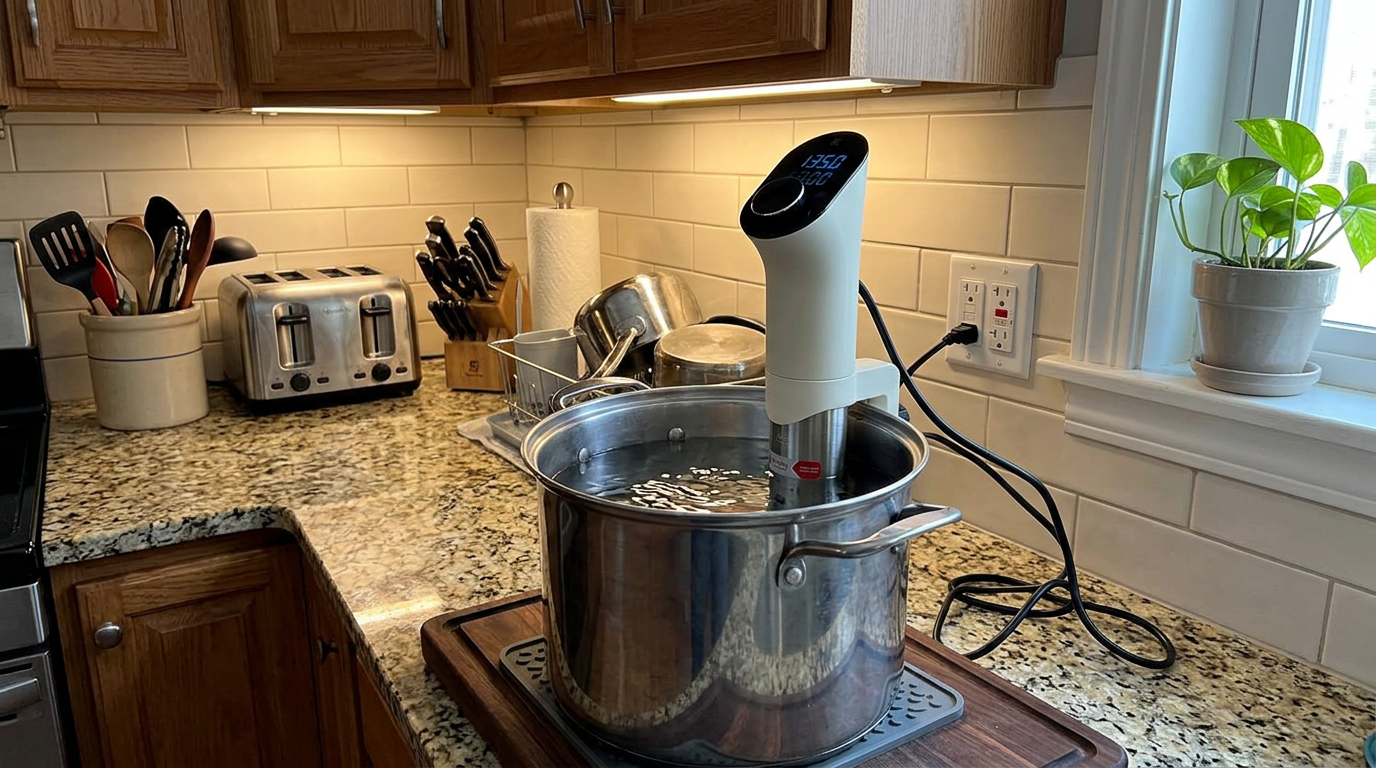
The Greater Goods Sous Vide Cooker is an 1100-watt immersion circulator that clips onto the side of a pot.
It heats and circulates water to cook sealed food at a precise temperature.
The first thing I noticed was how simple it is.
There is no app, no Bluetooth and no account to create, just a knob, a button and a clear display on the top.
It feels sturdy, with a stainless-steel lower section and a solid adjustable clamp.
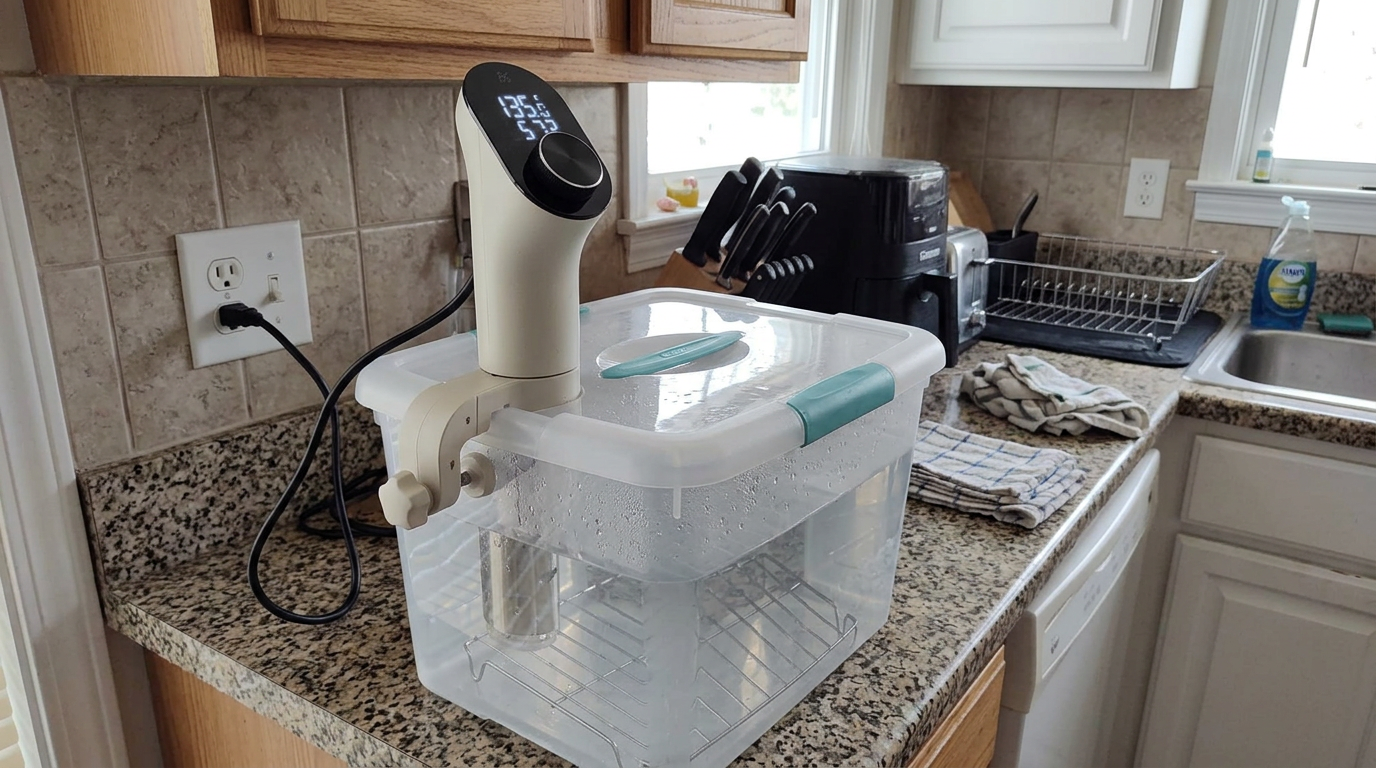
The Greater Goods sous vide clipped to the side of a stockpot.
I tested it for three weeks, cooking steaks, chicken breasts, chicken thighs, pork chops, salmon and eggs, and reheating leftovers.
I used a 12-quart stockpot for most cooks and a smaller 6-quart pot for single portions.
Our tip: Use a pot that holds at least 6 quarts of water for your first cooks, because a bigger water bath holds its temperature more steadily when you add cold food.
Setup and first cook
Setup took under five minutes.
I attached the clamp to the side of my stockpot, slid the circulator to the right depth and filled the pot with water between the minimum and maximum lines.
Then I turned the knob to set the temperature, pressed the button to set hours and minutes and pressed it again to start.
The display shows the current water temperature and the target temperature side by side.
I could watch the water heat up without a separate thermometer.
| Setup step | Time | Notes |
|---|---|---|
| Attach clamp to pot | About 1 minute | Fits a range of pot depths |
| Fill with water | About 2 minutes | Between min and max lines |
| Set temperature | A few seconds | Turn the knob |
| Set time | About 30 seconds | Hours, then minutes |
| Heat 12 qt water to 125°F | About 20 minutes | From warm tap water |
The button sequence took a little practice.
By my third cook, setting hours and minutes felt natural.
Our tip: Fill the pot with hot tap water rather than cold, because starting closer to your target temperature can cut the heat-up time roughly in half.
Simple controls without an app
The controls are the main reason to choose this cooker.
Everything happens on the device.
- Turn the knob to choose the temperature
- Press the button to move to the hours setting
- Turn the knob to set hours
- Press again to move to minutes
- Turn the knob to set minutes
- Press to confirm and start
I liked not needing my phone.
With wet or greasy hands in the kitchen, it was much easier to turn a knob than to unlock a phone and open an app.
The display is bright and easy to read from across the kitchen.
It shows the target temperature, the current water temperature and the remaining time.
The only downside is that there is no remote monitoring.
You have to walk over to check how much time is left.
Our tip: Set a matching timer on your phone or oven when you start a long cook, because the cooker has no app and a second reminder helps if you step away from the kitchen.
Temperature accuracy in my tests
Greater Goods says the cooker holds the water within about 0.1°F of the target.
I checked it with a calibrated probe thermometer in the water bath.
At 125°F for steak, my probe read between 124.9°F and 125.2°F over a two-hour cook.
At 160°F for chicken thighs, it stayed between 159.8°F and 160.2°F.
Water temperature measured with a probe thermometer in a 12-quart pot.
When I dropped in two cold ribeyes, the water dipped about 2°F and recovered within six minutes.
That level of accuracy is what makes sous vide work.
A few degrees can be the difference between medium-rare and medium.
Our tip: Check the cooker against a trusted thermometer on your first cook, because knowing it matches gives you confidence to trust the display on every cook after that.
Water circulation and noise
Sous vide depends on moving water.
The circulator pulls water through its lower housing and pushes it back out, keeping the whole bath at an even temperature.
I tested evenness by placing a probe at the far side of the pot, away from the circulator.
It read within 0.3°F of the display.
It was also quiet.
At arm's length, I heard a soft hum and a gentle swirl of water, much quieter than my dishwasher or range hood.
That mattered on long cooks.
A four-hour pork shoulder cook never became distracting.
How the cooker sounded at arm’s length compared with other appliances.
Our tip: Leave a little space between bags so water can flow around every side, because even circulation is what keeps food cooking evenly from edge to center.
A timer that starts at temperature
The timer does not begin counting down until the water reaches your target temperature.
That was one of my favorite details.
When I set 1 hour 15 minutes at 125°F, the cooker first heated the water, then started the countdown once it reached 125°F.
That means the heat-up time is never subtracted from your cooking time.
When the timer finished, the cooker beeped.
It did not shut off; it kept holding the water at 125°F and beeped again every few minutes as a reminder.
That gave me flexibility when side dishes took longer than planned.
Our tip: Add food once the water reaches temperature and then start your timer, because it keeps your cooking times consistent from one cook to the next.
Test one: medium-rare ribeye
Steak is where sous vide shines.
I cooked a 1-inch ribeye at 125°F for 1 hour 15 minutes.
I used a zip-top bag and the water displacement method✕Water displacement methodA way to remove air from a zip-top bag without a vacuum sealer: lower the open bag into water so the pressure pushes the air out, then seal it just above the surface. to remove the air.
It worked well and saved me from needing a vacuum sealer.
The steak came out evenly pink from edge to edge, with no gray band under the surface.
I patted it dry and seared it in a very hot cast-iron skillet for about 45 seconds per side.
The crust was deep brown, and the inside stayed medium-rare.
My results for ribeye at 125°F.
Our tip: Pat the steak completely dry with paper towels before searing, because a dry surface browns quickly and gives you a better crust without overcooking the inside.
Searing after sous vide
Sous vide cooks food gently, so it does not brown on its own.
Searing adds color and flavor through the Maillard reaction✕Maillard reactionThe browning reaction between proteins and sugars at high heat that creates the savory crust and roasted flavors on seared meat..
I tried three finishes: a cast-iron skillet, a gas grill and a kitchen torch.
| Finish | Time per side | Result |
|---|---|---|
| Cast-iron skillet | About 45 seconds | Best even crust |
| Gas grill | About 60 seconds | Smoky, grill marks |
| Kitchen torch | About 90 seconds | Patchy, slower |
Cast iron gave the best overall result.
The grill was a close second, with a pleasant smoky flavor.
A very quick, very hot sear is the goal.
A long sear starts to cook the inside and undoes the precise doneness.
Our tip: Get your skillet smoking hot before the steak touches it, because a short, very hot sear builds a crust without cooking the inside past your chosen doneness.
Test two: chicken breast and thighs
Chicken breast needed more experimenting.
At 150°F for 1 hour 30 minutes, it was juicy and tender, much more so than oven-roasted.
At 145°F, it was very soft, and some people in my family found the texture too delicate.
Chicken thighs were a highlight.
At 160°F for 2 hours, then finished on the grill, they were tender, juicy and nicely charred.
Poultry safety depends on both temperature and time, so I followed a trusted time-and-temperature chart for every cook.
| Cut | Setting | My result |
|---|---|---|
| Chicken breast | 145°F, 1.5 hours | Very soft, delicate texture |
| Chicken breast | 150°F, 1.5 hours | Juicy, firm, my favorite |
| Chicken thighs | 160°F, 2 hours | Tender, then grilled |
| Chicken thighs | 165°F, 2 hours | Firmer, still juicy |
Our tip: Start chicken breast at 150°F and adjust by a few degrees, because the texture changes noticeably with small temperature changes and personal preference varies.
Pork, salmon and eggs
Beyond steak and chicken, I cooked pork chops, salmon and eggs.
Thick pork chops at 140°F for 1 hour 30 minutes were juicy and slightly pink.
A quick sear finished them well.
Salmon at 122°F for 40 minutes was silky and flaked gently.
I skipped the sear and served it with a squeeze of lemon.
Eggs in their shells at 145°F for 45 minutes gave soft, custardy yolks, perfect on toast.
Results for other foods in my tests.
Our tip: Handle salmon gently after a sous vide cook, because the fish turns very tender at low temperatures and can fall apart if you lift it straight out of the bag.
Reheating leftovers without overcooking
One surprise was how good the cooker is for reheating.
A leftover medium-rare steak in the microwave turns gray and tough.
In a 110°F water bath for about 30 minutes, it warmed through and stayed pink.
I also reheated sous vide chicken thighs and pulled pork this way.
Both stayed moist and tender.
Food safety still matters.
I only reheated food that had been properly refrigerated, ate it right away and used higher temperatures for chicken and pork.
Our tip: Reheat leftover steak in a water bath a little below its original cooking temperature, because it warms through gently without cooking further or losing its pink center.
The clamp and mounting
The clamp slides up and down the body to fit pots of different depths.
It held firmly on my stockpot and on a deep plastic food container.
It is also removable, which makes cleaning and storage easier.
Reattaching the metal bar was the one awkward part.
The connection is not obvious, and the first time it took me a few minutes to work out how the pieces fit.
Clear alignment arrows would help.
After a couple of tries, I could do it in a few seconds.
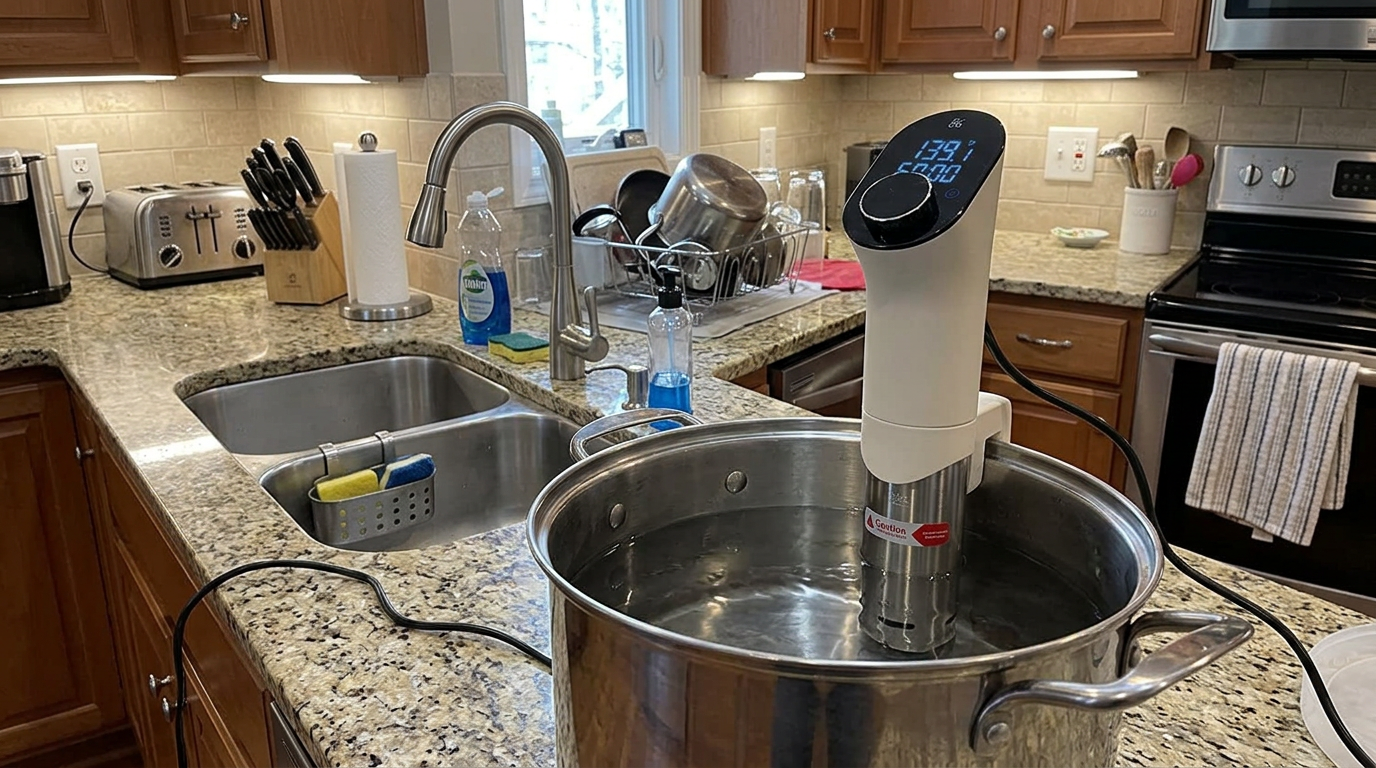
The adjustable clamp slides to fit different pot depths.
Our tip: Take a photo of the clamp before you remove it the first time, because it makes reassembly much quicker until you learn how the pieces line up.
Choosing a pot or container
The cooker works with any heat-safe pot or container deep enough to cover the minimum water line.
A 12-quart stockpot was my favorite for family meals.
It fit four steaks or a whole pack of chicken thighs.
For one or two portions, a 6-quart pot worked well and heated faster.
For long cooks, I covered the top of the water with plastic wrap, leaving a gap around the circulator.
It reduced evaporation✕EvaporationWater turning to vapor and leaving the bath. On long cooks, evaporation lowers the water level and can drop it below the circulator’s minimum line. and kept the water above the minimum line.
| Container | Best for | Notes |
|---|---|---|
| 6-quart pot | 1 to 2 portions | Heats fastest |
| 12-quart stockpot | Family meals | My everyday choice |
| Deep food container | Long cooks | Easy to cover |
| Small saucepan | Not recommended | Too little water |
Our tip: Cover the water bath on cooks longer than two hours, because it slows evaporation and stops the water level from dropping below the minimum line.
Cleaning and storage
Cleaning was simple.
After each cook, I wiped the body with a damp cloth and let it air dry.
The lower stainless-steel housing can be rinsed, but the top with the controls must stay dry.
Hard tap water can leave white mineral deposits.
After two weeks, I ran it in a bath of water and a splash of white vinegar to remove them.
Because the clamp comes off, the cooker fits neatly back in its box.
It took up very little space in my cupboard.
Our tip: Descale the cooker with a little white vinegar in the water every few weeks if you have hard water, because mineral buildup can slow circulation over time.
The bonus chef’s knife
My unit came with an offer card for a free 8-inch chef's knife, which I claimed by contacting the seller.
The knife was a pleasant surprise.
It uses German 4116 stainless steel with a reported hardness of around 57 on the Rockwell scale.
It has a thin blade with a straight taper and held a sharp edge through three weeks of trimming steaks, slicing vegetables and carving chicken.
It arrived in a nice box.
I kept it in a sheath in my knife drawer.
Offers like this can change, so check what is included when you buy.
Our tip: Look for any offer card in the box when you unpack, because bonus accessories are easy to miss and may need to be claimed within a limited time.
Sous vide on busy weeknights
Sous vide suited my weeknights better than I expected.
I bagged and seasoned chicken thighs in the morning and kept them in the fridge.
At 5 p.m., I started the cooker and added the bags once it reached temperature.
While they cooked, I made rice and a salad.
Because the cooker holds temperature after the timer ends, there was no rush when the timer beeped.
A quick grill or sear finished dinner in a few minutes, and the cleanup was minimal.
Our tip: Season and bag proteins ahead of time and keep them in the fridge, because it turns a sous vide dinner into a hands-off weeknight meal you can start in seconds.
What I would change
This is a strong cooker, but a few things could be better.
- The clamp’s metal bar is awkward to reassemble
- The button sequence for hours and minutes takes practice
- No app or remote monitoring if you want it
- You need a separate pot and a way to seal bags
None of these affected the cooking results.
The clamp and controls became easy after a few uses.
If you want to check your cook from another room, an app-connected cooker would suit you better.
If you prefer simplicity, these controls are an advantage.
Our tip: Keep a small notebook of the times and temperatures you like best, because sous vide results are very repeatable once you know your favorite settings.
How sous vide cooking works
Sous vide means "under vacuum" in French.
Food is sealed in a bag and cooked in water held at the exact temperature you want the center of the food to reach.
In a hot pan or oven, the outside of a steak gets much hotter than the middle.
By the time the center is medium-rare, the outer layer is often overcooked.
In a sous vide bath, the water is never hotter than your target.
The whole steak slowly rises to 125°F and stays there, so it cannot overcook past that point.
That is why timing is so forgiving.
A steak left in the bath an extra 30 minutes still comes out medium-rare.
The circulator's job is simple: heat the water, keep it moving and hold it at one temperature.
This one does all three very well.
Our tip: Think of the water temperature as your final doneness, because sous vide brings food up to the bath temperature and no higher.
What 1100 watts means for heat-up
The cooker is rated at 1100 watts✕WattA unit of power. For a sous vide cooker, more watts generally means the heater can raise the water temperature faster..
In practice, that decides how quickly it can bring a pot of water up to temperature.
From warm tap water at about 105°F, it brought 12 quarts to 125°F in about 20 minutes.
From cold water, the same pot took close to 45 minutes.
Heat-up times in my tests.
Those times are typical for a home sous vide cooker of this power.
Starting with hot tap water made the biggest difference.
Recovery after adding cold food was quick, which matters more for results than the first heat-up.
Our tip: Cover the pot loosely with a lid or foil while the water heats, because trapping heat at the surface shortens the wait before you can start cooking.
Bags, sealing and safety
You do not need a vacuum sealer to use this cooker.
Good-quality zip-top freezer bags worked well for every cook up to 160°F.
For long cooks or food I wanted to freeze, a vacuum sealer gave a tighter seal and less chance of leaks.
I clipped bags to the side of the pot with a binder clip so they stayed under the water and away from the circulator intake.
When a bag floated because of trapped air, I added a heavy spoon or a small plate on top to keep it submerged.
- Use bags labeled for freezing or cooking
- Remove as much air as possible
- Keep bags fully submerged
- Clip bags so they do not block the circulator
- Chill food quickly if you are not eating it straight away
Our tip: Clip bags to the side of the pot with a binder clip, because it keeps them submerged and stops them drifting into the circulator where they can block water flow.
Seasoning for sous vide
Seasoning works a little differently with sous vide.
Salt, pepper, herbs and garlic all go into the bag with the food.
Because the bag is sealed, flavors stay concentrated.
I found raw garlic could taste harsh after long cooks, so I switched to garlic powder or added fresh garlic during the sear.
Butter and herbs in the bag added richness to steaks and pork chops.
For chicken, a simple mix of salt, paprika and thyme worked well.
I avoided too much oil in the bag, because it can draw some flavor out of the food and into the liquid.
Our tip: Add fresh garlic and delicate herbs during the sear rather than in the bag, because long, gentle cooking can make raw garlic taste sharp and herbs taste dull.
Using it for meal prep
The cooker was very useful for weekly meal prep.
On Sundays, I cooked six chicken breasts at 150°F, chilled them quickly in ice water and kept them in the fridge for salads and wraps.
They stayed juicy all week, much more so than chicken I had roasted in the oven.
I also cooked a batch of pork tenderloin and sliced it cold for sandwiches.
Chilling cooked bags quickly in an ice bath is important for food safety.
I kept a large bowl of ice water ready before the timer finished.
Our tip: Plunge finished bags into an ice bath for at least 15 to 30 minutes before refrigerating, because chilling quickly keeps meal-prepped food safe and preserves its texture.
Steak doneness by temperature
Because sous vide is so precise, I cooked the same cut at four temperatures to see the differences side by side.
| Doneness | Water temperature | What I saw |
|---|---|---|
| Rare | 120°F | Deep red, very soft |
| Medium-rare | 125°F to 129°F | Pink, juicy, my favorite |
| Medium | 135°F | Light pink, firmer |
| Medium-well | 145°F | Mostly tan, still moist |
The differences were clearer than with any pan-cooked steak I have made.
Each steak looked uniform from edge to edge.
My family split between 125°F and 129°F.
With sous vide, I could cook two bags at different times and serve everyone their own doneness.
Thicker steaks need longer, but not hotter.
A 2-inch ribeye took about 2 hours 30 minutes at 125°F to reach the center.
Our tip: Choose the water temperature for doneness and the time for thickness, because sous vide uses temperature to set how cooked food is and time to make sure the center gets there.
Food safety basics
Sous vide is safe when time and temperature are right.
Low temperatures can be safe if food is held there long enough, a process called pasteurization✕PasteurizationKilling harmful bacteria by holding food at a set temperature for a set time. Lower temperatures need longer holding times to reach the same safety..
I followed a trusted time-and-temperature chart for chicken and pork, and served food straight from the bath or chilled it quickly.
I avoided cooking for many hours below about 130°F, and I never left cooked food sitting in warm water overnight.
Our tip: Keep a printed time-and-temperature chart in your kitchen, because it makes it easy to choose safe settings for chicken, pork and fish without guessing.
Cooking for guests
Sous vide took the stress out of a dinner party for six.
I cooked six steaks in the 12-quart pot at 127°F.
Because they could stay in the bath after the timer ended, I could focus on guests and side dishes.
When everyone sat down, I seared the steaks two at a time in a hot skillet.
Each one was cooked exactly the same, which is very hard to do on a grill for six people.
It felt like a restaurant trick, but it was simple.
The only hard part was resisting the urge to check the steaks every ten minutes.
Our tip: Sear steaks for a group in batches of two, because overcrowding the pan drops its temperature and gives you a weaker crust.
My three weeks with the Greater Goods Sous Vide
In week one, I tested accuracy, heat-up times and circulation, and cooked my first steaks.
In week two, I cooked chicken breasts, thighs, pork chops, salmon and eggs.
In week three, I focused on reheating, long cooks and everyday weeknight dinners.
| Week | Focus | Main finding |
|---|---|---|
| 1 | Accuracy and steak | Within about 0.3°F, perfect steaks |
| 2 | Chicken, pork, fish, eggs | Thighs and salmon were standouts |
| 3 | Reheating and routine | Gentle reheating, easy weeknights |
Our tip: Add about 30 to 60 minutes to the cooking time for food that goes in frozen, because the extra time lets the center thaw and reach your target temperature.
Is the Greater Goods Sous Vide worth the money?
Yes, for home cooks who want restaurant-quality steaks and juicy chicken without fuss.
It is accurate, quiet and simple, and it holds temperature after the timer ends for flexible timing.
The trade-offs are a fiddly clamp and no app.
If you prefer physical controls, the lack of an app is a benefit rather than a drawback.
My category scores after three weeks.
How it compares with other ways to cook precisely
| Feature | Greater Goods Sous Vide | App-connected sous vide | Oven and thermometer | Stovetop pan |
|---|---|---|---|---|
| Accuracy | About ±0.1°F | Similar | Several degrees | Varies widely |
| Controls | Knob and button | Phone app | Oven dial | Burner |
| Timer starts at temperature | Yes | Often | No | No |
| Remote monitoring | No | Yes | Some ovens | No |
| Edge-to-edge doneness | Yes | Yes | Partly | No |
| Reheats gently | Yes | Yes | Partly | No |
| Your priority | Fit | Why |
|---|---|---|
| Steak | Excellent | Edge-to-edge pink |
| Chicken thighs | Excellent | Tender, then grilled |
| Reheating leftovers | Excellent | No overcooking |
| Quick weeknight meals | Good | Prep ahead helps |
| Remote cooking | Poor | No app |
Which one is right for you: is the Greater Goods Sous Vide your match?
4 quick questionsGreater Goods Sous Vide specifications
From manufacturer data, retailer listings and my own testing.
How I tested and scored the Greater Goods Sous Vide
For three weeks, the Greater Goods Sous Vide cooked dinners for my family several times a week.
I cooked ribeye, chicken breasts and thighs, pork chops, salmon and eggs, and reheated leftovers.
I measured temperature accuracy with a probe thermometer, timed heat-up and recovery, and tested noise, the clamp and cleanup.
- Cooking results (9.4): perfect steaks and juicy chicken.
- Accuracy (9.6): within a fraction of a degree.
- Ease of use (8.4): simple once you learn the buttons.
- Design (7.0): fiddly clamp reassembly.
My test scores were: accuracy 9.6, steak 9.8, chicken thighs 9.4, salmon 9.4, reheating 9.2, noise 9.0, ease of use 8.4 and clamp design 7.0. The overall score of 8.5 is an editorial rating that reflects those results and three weeks of regular use.
Greater Goods Sous Vide FAQ
Is the Greater Goods Sous Vide worth it?
Yes, if you want accurate sous vide cooking with simple controls and no app.
Does it need an app?
No. Everything is set on the device with a knob and button.
How accurate is it?
Greater Goods says about ±0.1°F. My probe stayed within about 0.3°F.
Does the timer include heat-up time?
No. The countdown starts once the water reaches your target temperature.
What happens when the timer ends?
It beeps and keeps holding the water at temperature, with reminder beeps.
How loud is it?
Quiet. It makes a soft hum and a gentle swirl of water.
What temperature for medium-rare steak?
I used 125°F, then seared the steak briefly.
Can it cook chicken?
Yes. I liked breasts at 150°F and thighs at 160°F, following safe time charts.
Do I need a vacuum sealer?
No. The water displacement method with zip-top bags works well.
Can I reheat leftovers with it?
Yes. A water bath reheats steak gently without overcooking it.
What size pot do I need?
At least 6 quarts. I used a 12-quart stockpot for family meals.
Is the clamp removable?
Yes, which helps storage, but it is a little awkward to reattach.
Senior home appliance tester
Emily has tested home appliances for a living since 2016, first as a test coordinator at a national consumer advocacy group and, since 2021, at HouseholdMe. She has a degree in industrial design from Ohio State, so she looks at how a product is built, not just how it performs. She used the Greater Goods Sous Vide at home for three weeks for this review.
- Three weeks of hands-on testing of the Greater Goods Sous Vide
- Manufacturer product information and instruction manual