ECOVACS DEEBOT T90 PRO OMNI review
The ECOVACS DEEBOT T90 PRO OMNI Robot Vacuum and Mop pairs 30,000 Pa suction with a ZeroTangle 4.0 brush, an Osmo 3.0 roller mop that rinses itself as it cleans, AI obstacle avoidance and an OMNI station that empties dust, washes the roller in hot water and dries it with heated air. I used it for three weeks on oak, tile, rugs and carpet with a shedding dog and long hair in the house. It picked up pet hair superbly, never tangled, avoided almost every obstacle and lifted dried stains well. The small onboard dustbin means extra trips to the station, but this is one of the best all-round robots I have tested.

Emily Carter
Hands-on review
Hands-on testing, research, specs
3 weeks
26 minutes
Jargon helpNew to this kind of product? Tap any dotted term to see what it means.
In this review
Yes, if you want a robot that mops as well as it vacuums. The DEEBOT T90 PRO OMNI left rugs free of dog hair, kept its brush tangle-free for three weeks and avoided nearly every obstacle in my test course. Its roller mop lifted dried coffee and juice in one pass and collected wet spills without spreading them, while the station washed and dried the roller in hot air. The small onboard bin means more trips to the station, and navigation is good rather than lightning-fast. For pet homes with hard floors and rugs, it is an outstanding choice.
DEEBOT T90 PRO OMNI at a glance
DEEBOT T90 PRO OMNI pros and cons
- Excellent pet hair pickup and zero tangles
- Roller mop lifts dried stains and wet spills
- Avoids almost every everyday obstacle
- Small onboard dustbin
- Navigation is good, not the fastest
- Dust emptying is loud
Who should buy the DEEBOT T90 PRO OMNI?
- Pet owners and long-haired households
- Kitchens with frequent spills
- Homes with low furniture
- Very heavy shedders wanting long runs
- Homes with deep shag rugs
- Anyone wary of cameras
First impressions of the DEEBOT T90 PRO OMNI
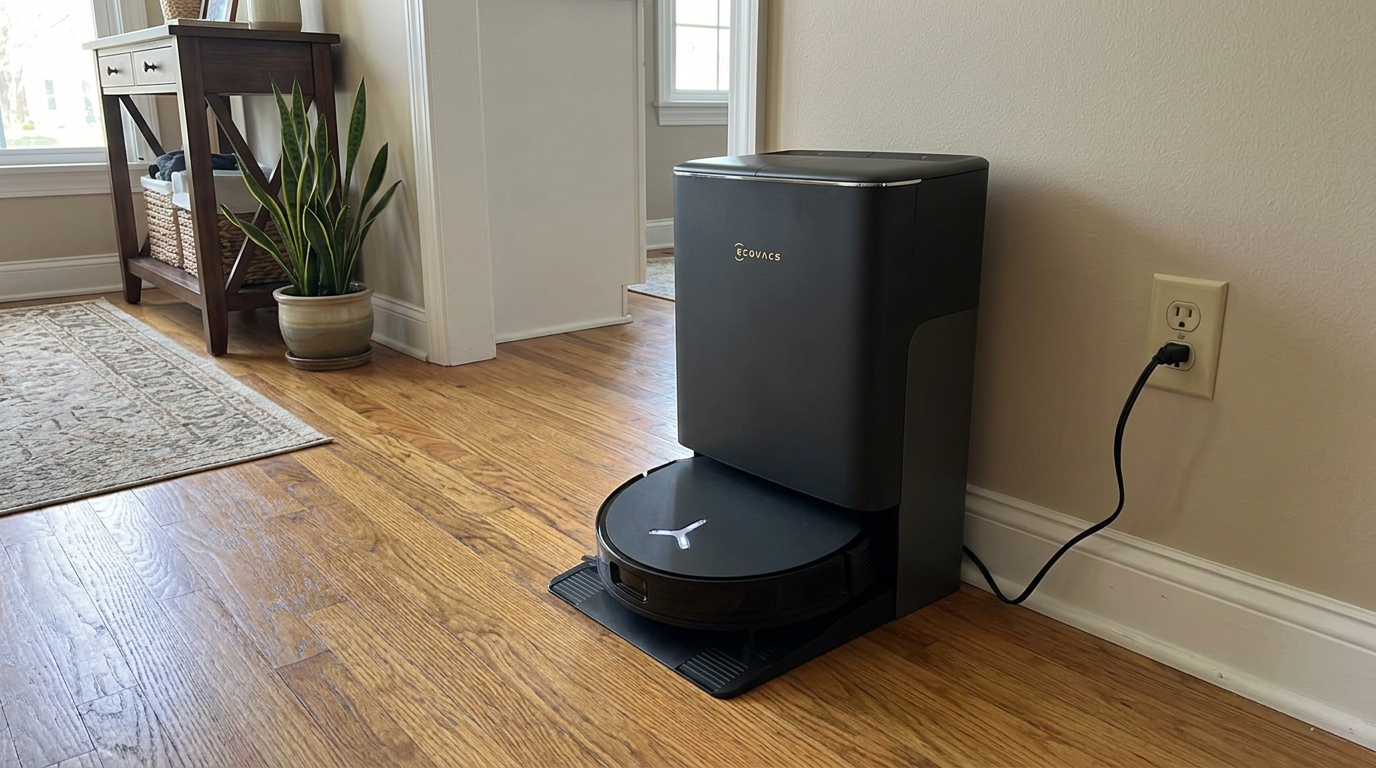
The T90 PRO OMNI has a softer look than earlier ECOVACS robots, with a textured shell on both the robot and the station.
It looks more like a piece of furniture than a gadget, which matters when it lives in your kitchen or hallway.
The robot is low, because its LiDAR sensor is built into the body instead of sitting in a turret on top.
That let it slide under my sofa and the low bed frame upstairs, where turret robots usually stop.
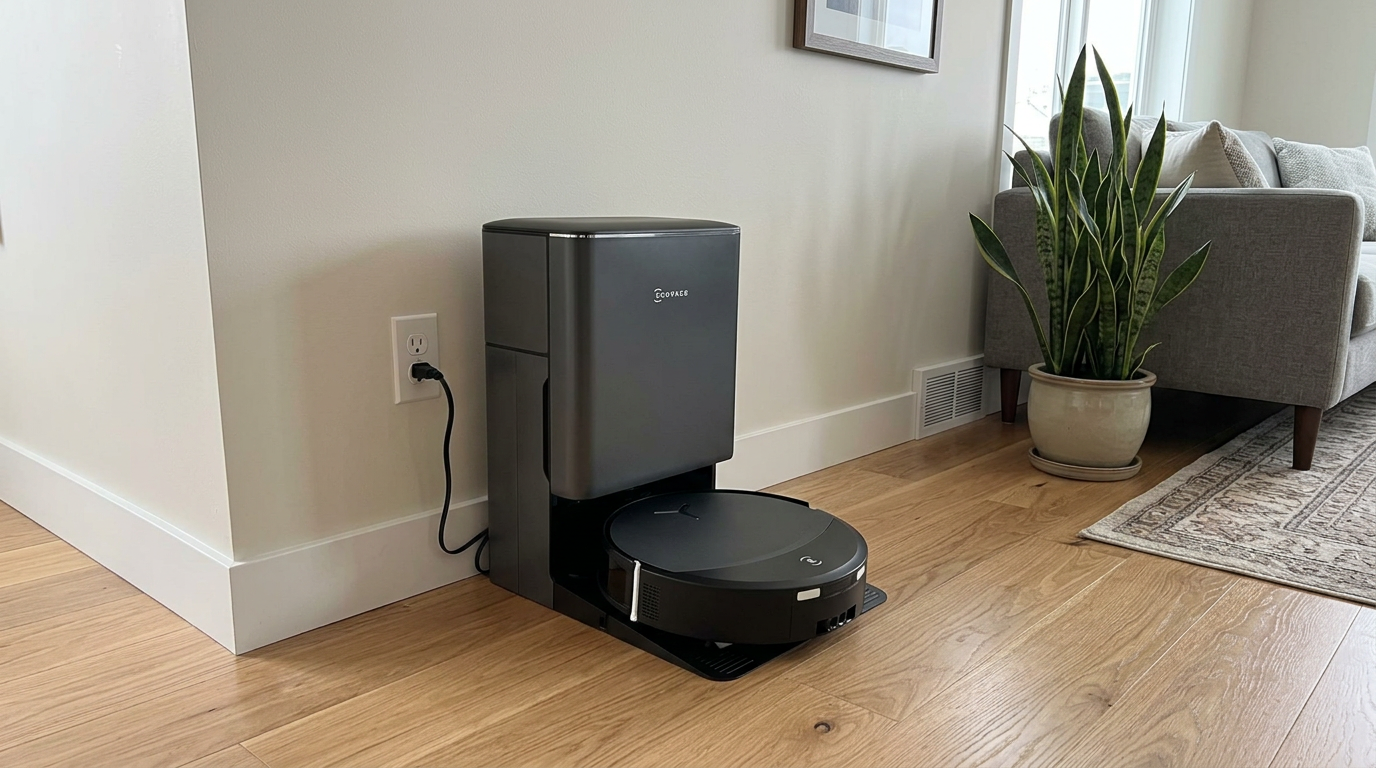
The T90 robot with its OMNI station.
I tested it for three weeks in a two-floor home with oak, tile, a medium-pile living room rug, low-pile bedroom carpet, a shedding dog and two people with long hair.
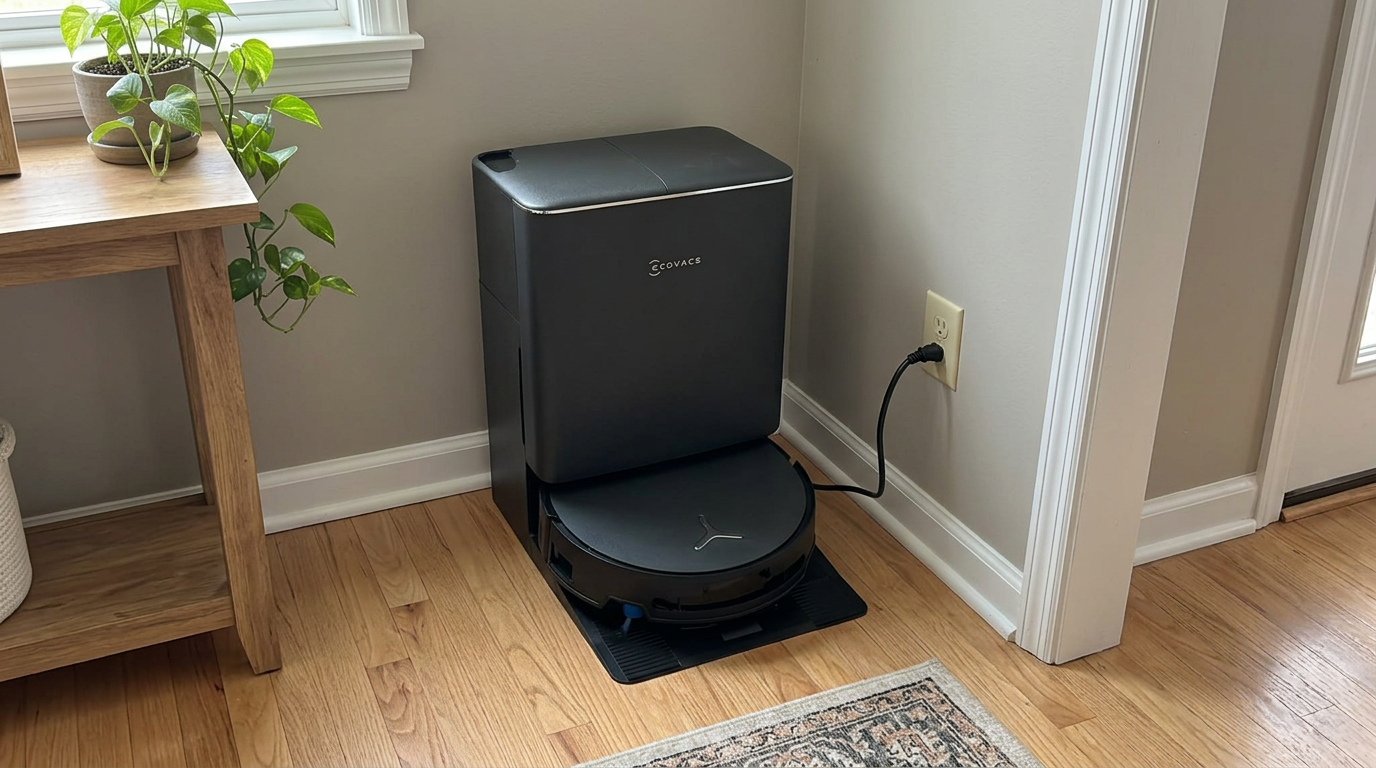
Our tip: Place the station on a hard floor with a little space on each side, because the robot docks more reliably on a firm surface and the station needs room to vent its hot-air dryer.
Setup and mapping
Setup took about 25 minutes: filling the clean water tank, adding the detergent, connecting the app and running the first map.
The embedded LiDAR✕Embedded LiDARA laser distance sensor built into the robot’s body rather than a raised turret. It maps rooms like a turret LiDAR but keeps the robot lower so it can fit under more furniture. mapped my ground floor in about 14 minutes and divided it into rooms accurately.
I merged two zones in the open living area and named the rest.
Upstairs, a second map saved without trouble, and the robot recognized each floor when I carried it up and down.
| Setup step | Time | Notes |
|---|---|---|
| Unbox and place station | About 5 minutes | Needs a nearby outlet |
| Fill tanks and detergent | About 5 minutes | Wide openings |
| App and Wi-Fi | About 5 minutes | Smooth pairing |
| First map | About 14 minutes | Accurate rooms |
| Room tweaks | About 5 minutes | One merge needed |
Our tip: Open every interior door before the first mapping run, because the robot can only map rooms it can reach and adding them later takes extra runs.
Vacuuming with 30,000 Pa suction
ECOVACS rates the T90 at up to 30,000 Pa, using its latest Blast suction system.
On paper that is a big jump over the previous T-series, and in my home, it showed.
On oak and tile, it cleared cereal, rice, coffee grounds, kibble and gravel in one pass.
I could not find leftovers in corners or along the edge of the rug.
On the medium-pile rug, I worked sand into the fibers and let it run its carpet routine.
It pulled out most of the grit on the first run and nearly all of it on the second.
Share of test debris removed in my trials.
Our tip: Run the carpet routine twice on rugs with grit or sand, because a second pass from a different angle lifts embedded particles that the first pass loosened.
Pet hair and long hair
Hair is where the T90 really impressed me.
On the living room rug, where dog hair gets pressed into the pile, the robot left the surface visibly hair-free after one run.
ECOVACS uses its ZeroTangle 4.0 system, with a redesigned main brush and side brush built to stop hair wrapping.
I checked the brush every few days.
After three weeks with a shedding dog and two long-haired people, there was no hair wrapped around it at all, just a little fluff in the end caps.
Our tip: Pull the main brush out and check the end caps every week, because even anti-tangle brushes collect a little fluff where the brush meets its bearings.
Obstacle avoidance
Obstacle avoidance was a weak spot for earlier ECOVACS T-series robots, and it is much better here.
The T90 combines an AI camera, 3D structured light✕3D structured lightA sensor that projects a pattern of light onto objects and reads how it bends to judge their shape and distance, helping the robot see small obstacles., LED lighting and 3D edge sensors.
I set up my own obstacle course: socks, a phone cable, a shoe, a pet toy, a towel and a fake pet mess made from modeling clay.
Over several runs, it avoided almost everything, including the cable and the clay.
The only object it touched was a thin flat charging cable lying flush against the floor, which it brushed against once without getting tangled.
| Obstacle | Result | Notes |
|---|---|---|
| Socks | Avoided | Every run |
| Phone cable | Avoided | Every run |
| Flat charging cable | Touched once | No tangle |
| Shoes | Avoided | Close but clean |
| Pet toy | Avoided | Every run |
| Clay pet mess | Avoided | Every run |
Our tip: Keep the camera lens on the front of the robot clean, because a smudged lens makes obstacle recognition less reliable, especially in dim rooms.
Thresholds and transitions
ECOVACS rates the T90 for tiered thresholds up to about 1.6 inches.
My home has a raised bathroom threshold of about 1 inch and a rug edge with a thick binding.
It climbed both without hesitation, and it handled the step down from the kitchen tile to the oak without getting caught.
A single-step test I built from a 1.25-inch board was also fine.
Very sharp or tall single steps can still stop it, so check your thresholds if they are unusual.
Our tip: Add a small threshold ramp if the robot struggles with a raised door strip, because a gentle slope is much easier to climb than a sharp single step.
The Osmo 3.0 roller mop
Instead of spinning pads, the T90 uses a roller mop✕Roller mopA cylindrical mop that spins continuously as the robot moves. Many roller mops, like this one, are rinsed with fresh water while the robot works, with dirty water collected in a separate tank. about 10.6 inches long that spins at around 200 rpm.
It is rinsed with fresh water as the robot works, and dirty water goes into a separate tank instead of back onto the floor.
That design made a visible difference.
The floor did not get the slightly gray tinge that pad mops sometimes leave toward the end of a big room.
The roller also extends sideways near walls and furniture, which helped it mop closer to baseboards and cabinet kick plates than most robots I have tested.
The long roller mop extends to clean closer to walls and furniture.
Our tip: Choose floor-direction mopping in the app for wood floors, because mopping along the boards gives a cleaner, more even look than a random pattern.
Dried stains and wet spills
Dried stains are the real test of a robot mop.
I let orange juice, coffee and ketchup dry on tile for a day, then ran a single mop pass.
The coffee and juice came up completely, and the ketchup came up with a second pass on the deep-clean setting.
The floor dried quickly with no visible streaks.
Wet spills were even more impressive.
A spilled cup of water and a splash of milk were picked up by the roller without being spread across the floor.
Mopping results on tile in my tests.
Our tip: Wipe up thick or greasy spills by hand first, because sauces and oils can coat the roller and spread a film that takes several washes to clear.
Carpet protection while mopping
When the T90 reaches carpet during a vacuum-and-mop run, it lifts the roller by about 0.6 inches.
My medium-pile rug and low-pile bedroom carpet both stayed dry.
The robot also boosts suction automatically on carpet.
I let it clean mixed rooms in one go without setting separate vacuum and mop routines.
Very thick rugs can still be a problem, so I set a no-go zone around a shaggy bath mat.
Our tip: Set a no-mop zone around thick rugs and bath mats instead of trusting the lift alone, because deep pile can still brush against a damp roller.
The OMNI station
The station does almost all the maintenance.
It empties the dustbin into a 0.66-gallon bag, refills the robot's clean water tank, empties its dirty water, adds cleaning solution and washes the roller.
The roller is washed with water at about 167°F and dried with air at about 145°F.
After three weeks of daily mopping, it never smelled musty.
| Station task | Detail | How it went |
|---|---|---|
| Dust emptying | 0.66-gallon bag | Not full after 3 weeks |
| Roller wash | About 167°F water | Spotless roller |
| Roller drying | About 145°F air | No odors |
| Water refill and drain | Automatic | Tanks every 3 to 4 days |
| Detergent | Auto-dispensed | Refilled once |
Our tip: Empty and rinse the station’s dirty water tank every time you refill the clean tank, because mop water left standing for days can smell and stain the tank.
Battery life and Power Boost charging
The T90 is efficient with its battery.
A full vacuum-and-mop run of my ground floor used about half the charge.
Its Power Boost feature tops up the battery while the robot sits in the station washing its roller.
ECOVACS says it gains about 10 percent in three minutes, and that matched what I saw.
On a long whole-home run, those mop-wash stops added enough charge that it finished without a long recharge break.
Battery use and charging in my home.
Our tip: Let the robot wash its mop mid-run on big homes instead of disabling it, because those stops double as quick charging and help it finish without long breaks.
The small onboard dustbin
The T90's biggest weakness is its small onboard dustbin, at about 8.5 ounces.
That is smaller than most robots in this class.
In practice, it meant more trips back to the station during big runs.
On days with heavy dog shedding, it returned to empty two or three times.
The app lets you set it to empty more often, and the station bag is large, so this was more of a slowdown than a problem.
Our tip: Set the robot to empty its bin more often on heavy-shedding days, because a full bin reduces suction and can leave hair behind before it returns to the station.
App, camera and smart home
The ECOVACS app is detailed.
I set suction and water by room, chose floor-direction mopping for the oak and scheduled weekday runs.
The robot's RGB camera supports live video monitoring and two-way video calls through the app.
I used it once to check on the dog while away, which felt surprisingly handy.
The T90 supports Matter for smart home integration and includes ECOVACS' own voice assistant.
Both worked reliably for starting and stopping runs.
Our tip: Turn off the camera features if you do not use them, because disabling live video adds privacy and you can still use obstacle avoidance normally.
Noise levels
ECOVACS says the new Blast suction runs quieter than the last generation.
On standard suction, it was easy to talk over in the same room.
Max suction on carpet is louder, and the station's dust emptying is the loudest moment, a burst of about ten seconds.
The hot-air drying makes only a soft fan noise.
Relative noise in my home.
Our tip: Schedule dust emptying for daytime, because the burst of noise is short but loud and can wake light sleepers at night.
Weekly maintenance
My weekly upkeep took about ten minutes.
- Refill the clean water tank and empty the dirty tank.
- Check the main brush end caps and the side brush.
- Wipe the camera, LiDAR window and cliff sensors.
- Rinse the roller’s cleaning tray in the station.
- Top up the cleaning solution when the app asks.
- Replace the dust bag when the station reports it full.
Filters, rollers, brushes and bags are consumables.
With daily use, plan to replace them every few months.
Our tip: Rinse the station’s wash tray every week or two, because dirt and hair collect there over time and can make roller washing less effective.
Is it safe for wood floors?
On sealed oak, the T90 left the floor barely damp, and it dried within a couple of minutes.
After three weeks of daily mopping, the finish looked unchanged.
Floor-direction mopping gave the oak a more even look.
For unsealed, waxed or oiled floors, check your flooring maker's guidance before using any robot mop.
Our tip: Use the lowest water setting on wood floors, because the roller mop cleans well with little water and less moisture is safer for wood over time.
How it fit our daily routine
The T90 ran a vacuum-and-mop session every weekday morning on the ground floor, and a carpet-focused run upstairs on Saturdays.
After dinner, I used voice control to send it to the kitchen.
Most days, my only job was glancing at the cleaning report in the app.
| Day | Run | Rooms |
|---|---|---|
| Weekdays, morning | Vacuum and mop | Ground floor |
| Weekdays, evening | Spot clean | Kitchen |
| Saturday | Carpet deep clean | Upstairs |
| Sunday | Rest day | None |
Our tip: Give the robot one rest day each week, because it lets you check brushes and tanks without interrupting a scheduled run.
Everyday kitchen messes
The kitchen is where the T90 earned its place.
After breakfast, I sent it to clean up crumbs, spilled cereal and drips by the coffee maker with one voice command.
Because the roller is rinsed as it works, sticky footprints and juice drips came up without a gray film.
Under the dining table, it cleaned between chair legs once the chairs were pushed in.
On pasta night, I let it handle the floor after dinner while I loaded the dishwasher.
By the time I finished, the floor was clean and nearly dry.
Our tip: Create a kitchen-only routine in the app for after meals, because a short targeted run cleans fresh crumbs before they get tracked through the rest of the house.
Water levels and detergent
The app lets you set water levels per room.
I used the lowest setting on oak, medium in the hallway and high in the kitchen.
The station adds cleaning solution automatically from its own reservoir.
It used the solution slowly, and I topped it up only once in three weeks.
With the solution, the kitchen tile felt cleaner underfoot and had a light fresh scent that faded quickly.
| Room | Water level | Why |
|---|---|---|
| Living room oak | Low | Wood needs little water |
| Hallway tile | Medium | Everyday dirt |
| Kitchen tile | High | Spills and footprints |
| Bathroom | Medium | Small space, quick dry |
Our tip: Use only the manufacturer’s recommended cleaning solution in the station, because other floor cleaners can foam and damage the pumps or leave residue on floors.
Edges, corners and baseboards
Edges are where many robots fall short.
The T90's roller extends sideways near walls and furniture, so it mopped much closer to baseboards than robots with round pads.
In the kitchen, the strip along the cabinet kick plates stayed noticeably cleaner during testing.
The side brush also pulled dust out of corners before the main brush picked it up.
It still could not reach deep into the right-angle corner itself, but the gap was small.
Our tip: Still wipe the deepest corners by hand every couple of weeks, because no round robot can reach right into a 90-degree corner where dust slowly builds up.
Living with a dog
Our dog sheds steadily, and hair gathers in the hallway and under the sofa.
With daily runs, I barely saw any hair on the floor during testing.
The obstacle avoidance mattered too.
It cleaned around the food and water bowls without bumping them, and it avoided chew toys left in the living room.
The dog ignored the robot after the first day, partly because it is quiet on standard suction.
Our tip: Set a no-go zone around pet bowls even with obstacle avoidance, because a full water bowl that gets nudged makes a mess the robot then has to deal with.
Dust, dander and allergies
Because the station empties into a sealed bag, I rarely handled dust or hair directly.
That is a real benefit for allergy sufferers.
Daily runs kept dust and dander from building up, and I noticed less dust settling on low shelves during testing.
When it was time to change the bag, the self-sealing dust bag✕Self-sealing dust bagA disposable bag in the station that closes its opening as you remove it, so dust and allergens stay inside instead of puffing out. closed as I lifted it out, so no dust escaped.
Our tip: Change the dust bag outdoors or over a bin if you have allergies, because even a self-sealing bag can release a little dust as you remove it.
Build quality and durability
The robot and station feel solidly made.
Tanks clicked into place firmly, the roller cover was easy to remove and the textured finish did not show fingerprints.
After three weeks, the wheels, bumper and roller showed only normal light wear.
As a newer model, long-term reliability is still unproven, so register it for warranty support.
Our tip: Keep the box and register the robot after setup, because newer models have less long-term track record and warranty registration makes repairs easier.
Using it on more than one floor
The T90 stores multiple maps, so I used it on both floors of my home.
I carried it upstairs for the Saturday carpet clean, and it recognized the upstairs map within a few seconds.
Because the station lives downstairs, the robot cannot self-empty or wash its mop upstairs.
For a carpet-only vacuum run, that was not a problem, and I emptied the onboard bin by hand afterward.
For upstairs mopping, the robot can still clean, but you lose the mid-run roller rinse and drying benefits.
| Floor | Station | What worked |
|---|---|---|
| Ground floor | Yes | Full vacuum, mop and self-maintenance |
| Upstairs | No | Vacuum runs, manual bin emptying |
| Stairs | No | Robot stops at drops |
Our tip: Empty the onboard bin by hand after an upstairs run away from the station, because the small 8.5-ounce bin fills quickly and the next downstairs run starts with full suction.
Camera and privacy
A camera on a robot that roams your home raises fair questions.
The T90 uses its RGB camera for obstacle recognition, live view and video calls.
In the app, I could turn off live video while keeping obstacle avoidance active.
I also set the robot not to run while we were having guests.
If privacy is a priority, check the app's camera and data settings during setup and switch off the features you do not need.
Our tip: Review the camera and data-sharing options in the app during setup, because it is easier to choose your privacy settings before the robot starts cleaning every day.
Schedules that actually work
Scheduling is where a robot becomes truly hands-free.
I set different routines for weekdays and weekends and chose room order so the kitchen was always cleaned last, after the rest of the floor.
The app also offers smart cleaning that adapts to how dirty rooms are, which tended to add extra passes in the kitchen and hallway.
I kept it on for most of the test.
Every run ended with a map and a short report, which made it easy to spot anything the robot had skipped.
Our tip: Schedule the dirtiest room last in a combined run, because the robot then washes its roller at the end and does not carry kitchen grime into cleaner rooms.
My three weeks with the DEEBOT T90 PRO OMNI
In week one, I mapped both floors, set rooms and zones and started daily runs.
The robot settled into a reliable routine within days.
In week two, I tested sand in carpet, pet hair, dried stains, wet spills and my obstacle course.
Hair pickup and mopping were the standouts.
In week three, I focused on maintenance, battery, noise and the camera features.
The brush stayed tangle-free and the station kept everything fresh.
| Week | Focus | Main finding |
|---|---|---|
| 1 | Mapping and daily runs | Accurate, reliable routine |
| 2 | Carpet, hair, stains, obstacles | Excellent hair and mopping |
| 3 | Maintenance, battery, app | Low upkeep, efficient battery |
Our tip: Review the cleaning map after the first week, because adjusting zones and room settings then makes every later run faster and more thorough.
Troubleshooting what I ran into
A few small issues came up, each with an easy fix.
| Problem | Cause | Fix |
|---|---|---|
| Frequent station returns | Small onboard bin | Raise emptying frequency |
| Paused near chairs | Busy dining area | Push chairs in |
| Touched a flat cable | Cable flush to floor | Clip cables up |
| Ketchup left after one pass | Thick dried stain | Deep-clean or second pass |
| Split living room | Open-plan layout | Merge rooms in the app |
Our tip: Check the app’s error log when something goes wrong, because it usually names the exact sensor or part involved and saves you guessing.
Who it suits in real life
The T90 suits homes with mixed floors, pets and long hair, and anyone who wants strong mopping as well as vacuuming.
It is less ideal if you have heavy shedding and want long runs without station returns, because of the small onboard bin.
Homes with deep shag rugs will also need no-go zones.
Our tip: Pick a roller-mop robot like this one if your kitchen sees frequent spills, because the roller rinses itself as it works and handles wet messes better than pad mops.
Is the DEEBOT T90 PRO OMNI worth the money?
Yes, for homes that want top-tier mopping and hair pickup.
It combines strong suction, a self-rinsing roller mop, smart obstacle avoidance and a station that handles nearly all upkeep.
The trade-offs are a small onboard bin and navigation that is solid rather than class-leading.
For most families, the cleaning results outweigh both.
My category scores after three weeks.
How it compares with other ways to clean floors
| Feature | DEEBOT T90 PRO OMNI | Pad-mop robot | Basic robot vacuum | Wet-dry floor cleaner |
|---|---|---|---|---|
| Mopping | Self-rinsing roller | Spinning pads | No | Roller |
| Wet spills | Very good | Fair | No | Excellent |
| Self-emptying | Yes | Often | Rarely | No |
| Hot wash and dry | Yes | Sometimes | No | Self-clean cycle |
| Obstacle avoidance | AI camera and 3D light | Varies | Basic | Manual |
| Hands-free | Yes | Yes | Yes | No |
| Your priority | Fit | Why |
|---|---|---|
| Pet hair | Excellent | Perfect pickup, no tangles |
| Dried stains | Excellent | Roller mop |
| Cluttered floors | Very good | AI obstacle avoidance |
| Long runs without returns | Fair | Small onboard bin |
| Low furniture | Very good | Embedded LiDAR, low body |
Which one is right for you: is the DEEBOT T90 PRO OMNI your match?
4 quick questionsDEEBOT T90 PRO OMNI specifications
From manufacturer data, retailer listings and my own testing.
How I tested and scored the DEEBOT T90 PRO OMNI
For three weeks, the DEEBOT T90 PRO OMNI cleaned my two-floor home daily.
I tested it on oak, tile, medium-pile and low-pile carpet with cereal, kibble, sand, dog hair, long hair, dried stains, wet spills and an obstacle course.
I checked the brush, roller, tanks and dust bag every few days and timed my weekly upkeep.
- Vacuuming (9.2): strong on debris and carpet grit, perfect on hair.
- Mopping (9.4): roller lifted dried stains and wet spills.
- Obstacle avoidance (9.2): avoided almost everything in my course.
- Navigation (8.2): thorough but occasionally slow around chairs.
My test scores were: pet hair 9.8, long hair tangles 9.8, dried stains 9.4, wet spills 9.4, obstacles 9.2, carpet grit 8.8 and navigation speed 8.0. The overall score of 8.9 is an editorial rating that reflects those results and three weeks of daily use.
DEEBOT T90 PRO OMNI FAQ
Is the DEEBOT T90 PRO OMNI worth it?
Yes, for homes with pets and hard floors. It vacuums strongly, mops exceptionally well and its station handles nearly all upkeep.
How strong is the suction?
It is rated at up to 30,000 Pa and handled debris, carpet grit and pet hair very well in my tests.
Does hair tangle on the brush?
No. After three weeks with a dog and long hair, nothing wrapped around the brush.
How does the roller mop work?
The 10.6-inch roller spins at about 200 rpm and is rinsed with fresh water as it cleans, with dirty water stored separately.
Can it handle wet spills?
Yes. It collected spilled water and milk without spreading them.
Does it keep carpets dry?
Yes. It lifts the roller by about 0.6 inches on carpet.
How does the station clean the mop?
It washes the roller in water at about 167°F and dries it with air at about 145°F.
How big is the dustbin?
The onboard bin is about 8.5 ounces and the station bag holds about 0.66 gallons.
What is Power Boost?
It charges the battery about 10 percent in three minutes while the robot washes its roller in the station.
Does it have a camera?
Yes. It has an RGB camera for obstacle avoidance, live monitoring and two-way video calls.
Does it work with smart home systems?
Yes. It supports Matter and has its own voice assistant.
How high can it climb?
It is rated for tiered thresholds up to about 1.6 inches.
Senior home appliance tester
Emily has tested home appliances for a living since 2016, first as a test coordinator at a national consumer advocacy group and, since 2021, at HouseholdMe. She has a degree in industrial design from Ohio State, so she looks at how a product is built, not just how it performs. She used the DEEBOT T90 PRO OMNI at home for three weeks for this review.
- Three weeks of hands-on testing of the DEEBOT T90 PRO OMNI
- Manufacturer product information and instruction manual