Dreo Whole Room Heater review
The DREO Whole Room Heater, 3D Oscillating is a 1,500-watt smart space heater with a nine-blade DC motor, a spiral grille and an oscillating turntable base for whole-room warmth. It blows warm air in about two seconds, has physical controls and a remote, and adds a thermostat, schedules, oscillation angles and Apple Home and Google Home support through the Dreo app. I tested it for three weeks in a living room, bedroom and home office. It heated rooms evenly, was quiet on low and shut off quickly when tilted, though the base feels loose at first and some settings need the app.

Emily Carter
Hands-on review
Hands-on testing, research, specs
3 weeks
26 minutes
Jargon helpNew to this kind of product? Tap any dotted term to see what it means.
In this review
Yes, if you want a smart space heater that warms a whole room evenly. The Dreo Whole Room Heater blew warm air in about two seconds, brought my home office from 59°F to 68°F in about 18 minutes and kept corners of my living room within about 2°F of each other thanks to oscillation. The thermostat held a steady temperature, schedules warmed my bedroom before I woke up, and it was barely audible on low. It shut off within a second when tilted. The base feels loose until you know it is the turntable, and some settings need the app, but it is an excellent everyday heater.
Dreo Whole Room Heater at a glance
Dreo Whole Room Heater pros and cons
- Warm air in about two seconds
- Even whole-room heat with oscillation
- Thermostat, schedules and smart home support
- Turntable base feels loose at first
- Some settings need the app
- Audible on high
Who should buy the Dreo Whole Room Heater?
- Home offices
- Bedrooms with early mornings
- Smart home households
- Large open-plan spaces
- People who dislike apps for advanced settings
- Very noise-sensitive sleepers on high
First impressions of the Dreo Whole Room Heater
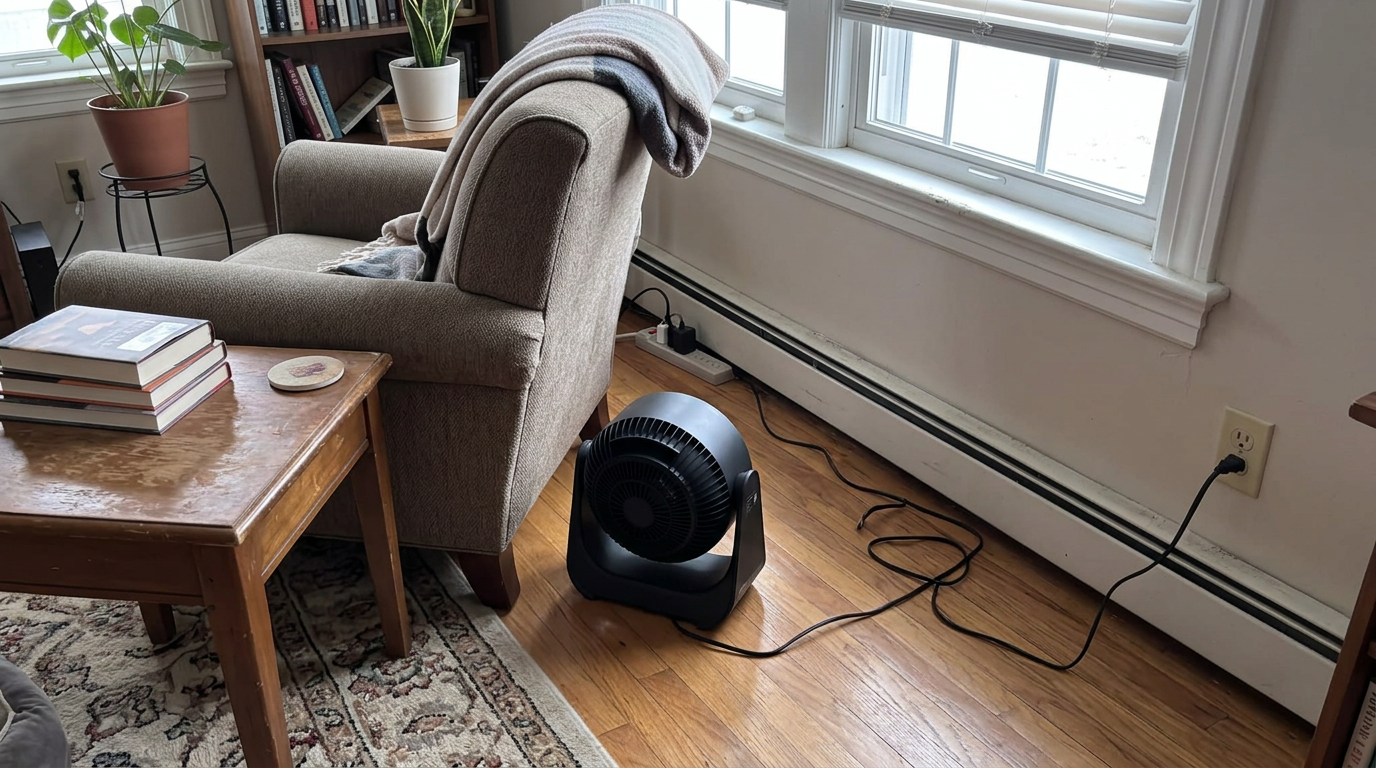
The Dreo Whole Room Heater is a 1,500-watt smart space heater built to spread warmth across a whole room rather than blasting one spot.
It looks more like a modern fan than a traditional heater.
The round body has a spiral front grille, a compact housing and a base that turns to oscillate.
Under the grille, a nine-blade DC motor pushes air through the heating element, and a shaped air inlet at the back feeds it.
Dreo calls the combination 3D whole-room heating.
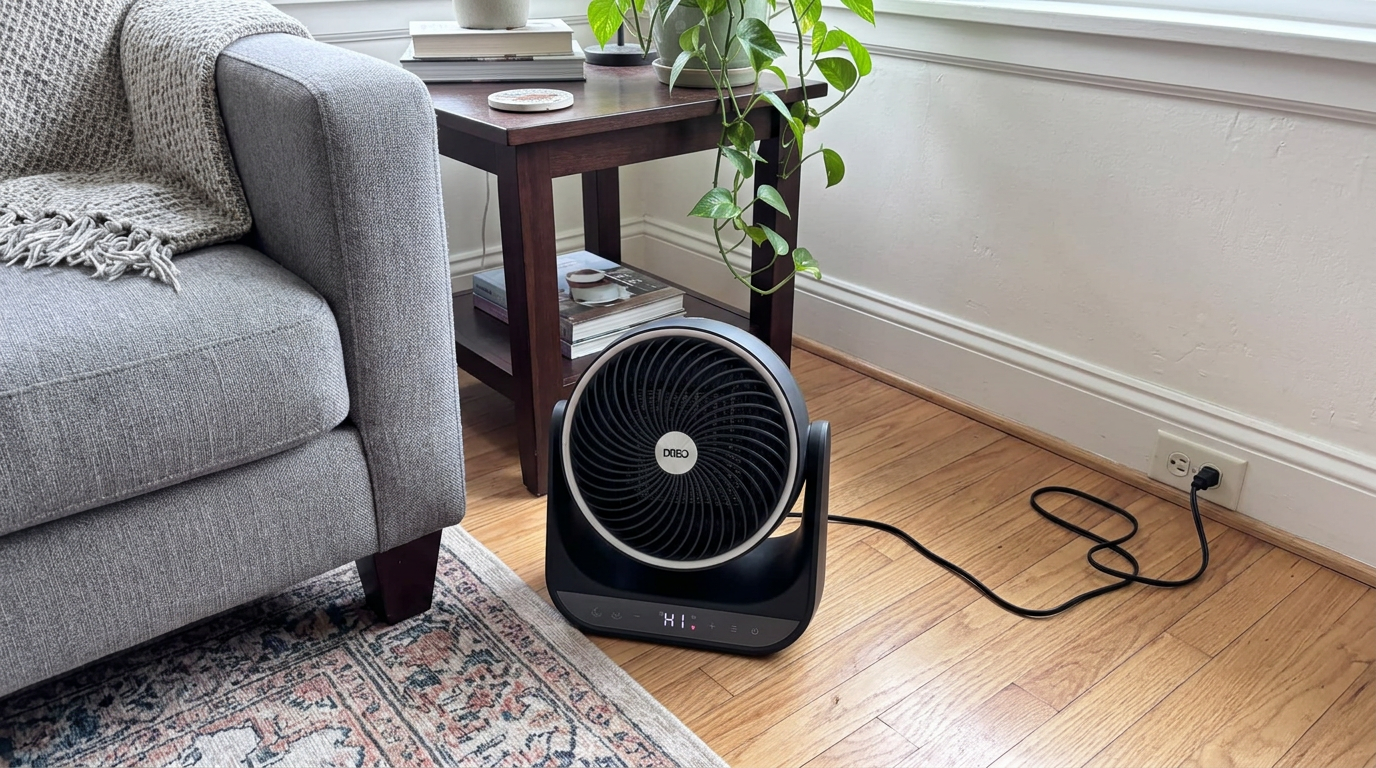
The Dreo heater in my living room.
I tested it for three weeks in a living room, a bedroom and a home office during a cold spell in late autumn.
I measured heat-up times, room temperatures, surface temperatures and noise, and used the app, schedules and remote every day.
Our tip: Unbox the heater and run it on low for 15 minutes in a ventilated room before your first long session, because new heating elements can give off a faint smell the first time.
Setup and the wobbly base
Setup took about five minutes.
I took it out of the box, set it on the floor, plugged it in and pressed the power button.
The base felt slightly loose when I first placed it.
That is normal, because the base plate is also the turntable that lets the heater oscillate.
Once I knew that, it made sense.
On a flat, hard floor, it sat securely and turned smoothly.
On a thick rug, the base did not sit as evenly, so I moved it to the wooden floor next to the rug.
| Setup step | Time | Notes |
|---|---|---|
| Unpack | About 2 minutes | Remove all packaging |
| Place on flat floor | A few seconds | Hard, level surface |
| Plug into wall outlet | A few seconds | No extension cords |
| First power-on | About 2 seconds to warm air | Very fast |
| App pairing | About 4 minutes | Optional |
Our tip: Place the heater on a hard, level floor rather than a thick rug, because the turntable base needs a flat surface to sit securely and oscillate smoothly.
Warm air in about two seconds
The heater produced warm air almost the moment I switched it on.
I timed about two seconds before I felt warmth on my hand at arm's length.
That made a real difference on cold mornings.
Walking into a chilly office, I felt warmth straight away instead of waiting minutes for the element to heat up.
I measured the air temperature at the center of the outlet with a probe.
It reached over 284°F within the first minute on high.
How quickly the heater warmed up on high in my tests.
The heat was strong but not harsh.
The fan spread it out, so it did not feel like a narrow, scorching blast.
Our tip: Start on high to warm a cold room quickly, then drop to a lower setting once you feel comfortable, because it saves energy and keeps the heater quieter.
How well it heats a whole room
The more important test was how well it warmed a whole room.
In my 180-square-foot home office, starting at 59°F, the room reached 68°F in about 18 minutes on high with 90-degree oscillation.
In my 250-square-foot living room, starting at 61°F, it reached 68°F in about 32 minutes.
Time to reach 68°F on high with oscillation.
I placed thermometers in three corners of the living room.
After 40 minutes, the warmest and coolest corners were within about 2°F of each other.
That even spread is the point of oscillation.
A non-oscillating heater I used before left the far corner noticeably cooler.
Our tip: Close the door and any vents to rooms you are not heating, because a space heater warms one room much faster when warm air is not escaping elsewhere.
Oscillation and airflow
The base rotates to sweep warm air across the room.
In the app, I could choose a wide 90-degree sweep, a moderate 60-degree sweep or a narrower, more focused setting.
The wide setting worked best in the living room, where my family sat in different spots.
At my desk, I used a narrow angle aimed at my chair.
It kept me warm without heating empty parts of the room.
| Oscillation | Best for | What I noticed |
|---|---|---|
| 90 degrees | Living rooms, family spaces | Even warmth across the room |
| 60 degrees | Bedrooms, smaller rooms | Good balance of spread and focus |
| Narrow or off | Desks and reading chairs | Warmth where you sit |
The spiral grille and nine-blade fan gave a steady, wide stream of air.
It felt more like a warm breeze than a hot jet.
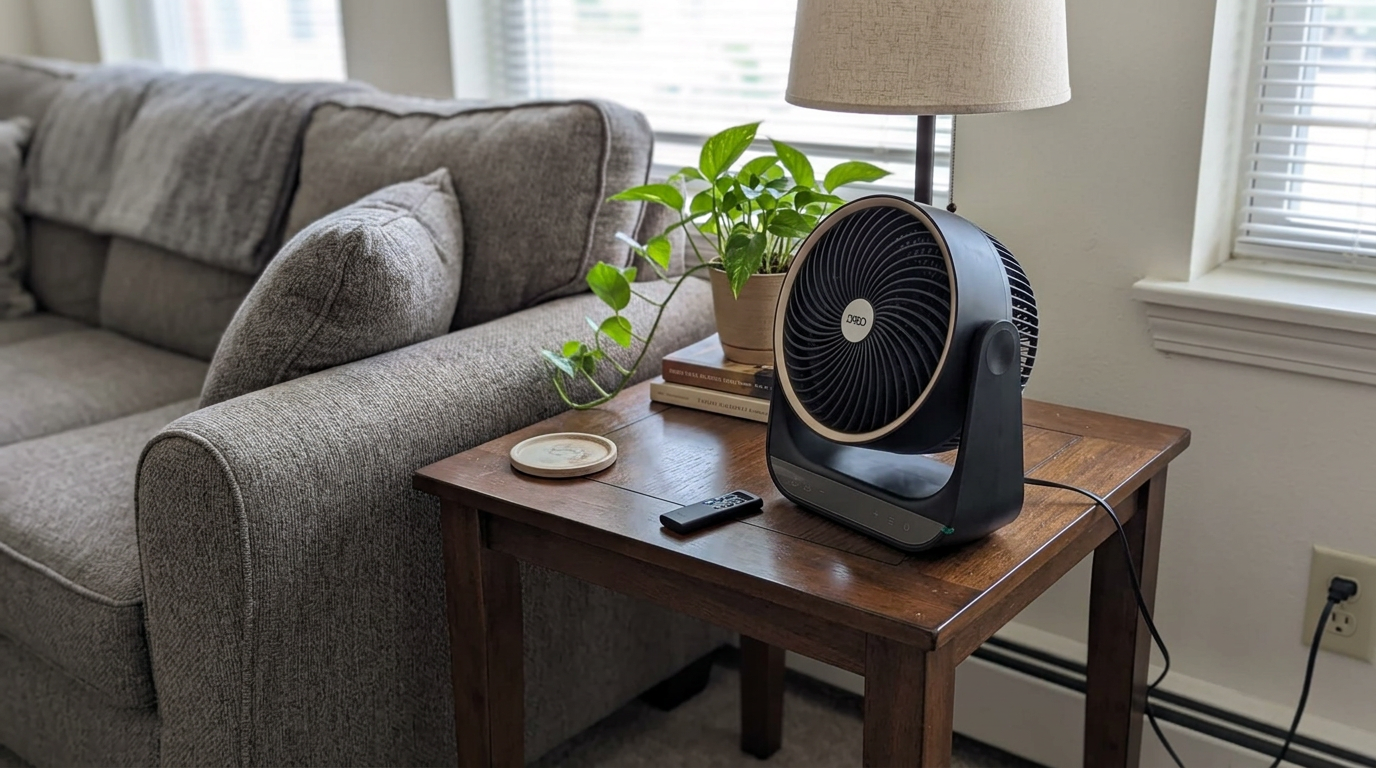
The spiral grille and oscillating base spread warm air across the room.
Our tip: Match the oscillation angle to where people sit, because a narrow angle aimed at one chair can feel warmer than a wide sweep while using less energy.
Controls, display and remote
You do not need the app to use this heater.
The buttons on top cover power, heat level, oscillation and the target temperature.
The display was readable from across the room and from the side, which helped when the heater sat in a corner.
The included remote was handy.
From the couch, I could change settings without getting up, and from bed, I could switch it off without stepping onto a cold floor.
Everything worked without Wi-Fi.
For people who dislike apps, the physical controls and remote cover all the essentials.
Our tip: Keep the remote in a set spot, like a bedside table or the coffee table, because small remotes are easy to misplace and it is much more convenient than walking over to the heater.
The Dreo app and thermostat
The Dreo app adds more control.
Pairing took about four minutes on my home Wi-Fi.
The app shows the current room temperature, which was one of its most useful features.
I could see at a glance whether I even needed heat.
I set a target temperature, and the heater regulated itself to hold the room there, working like a thermostat✕ThermostatA control that measures the room temperature and switches heating on or down to hold a set target temperature..
When the room dropped below my setting, it heated.
When it reached the target, it eased off, then picked up again as the room cooled.
Room temperature over two hours with the thermostat set to 68°F.
Our tip: Set the target temperature a couple of degrees lower than you think you need, because a steady 66 to 68°F often feels comfortable and uses noticeably less energy than 72°F.
Schedules for mornings and evenings
Scheduling turned out to be the feature I used most.
I set the bedroom heater to switch on 20 minutes before my alarm.
Getting out of bed into a warm room made winter mornings far easier.
I also set the office heater to start at 8:30 a.m. on weekdays, so the room was comfortable when I sat down.
- Warm the bedroom before waking up
- Warm the office before the workday
- Warm the living room before coming home
- Switch off automatically at a set time
Schedules ran reliably over three weeks.
I never came back to a heater that had failed to start.
Our tip: Pair every on-time in your schedule with an off-time, because it stops the heater from warming an empty room after you have left it.
Apple Home and Google Home
The heater works with Apple Home and Google Home.
I added it to Google Home and could switch it on and off by voice.
Saying "turn on the office heater" from the hallway was convenient when my hands were full.
In Apple Home, it showed up alongside my lights and thermostat, so it fit into a routine that turned on the lights and heater together in the morning.
Smart control is convenient, but a space heater still needs sensible supervision.
I did not use remote control to run it in an empty house.
Our tip: Give the heater a clear name like “office heater” in your smart home app, because short, distinct names make voice commands work reliably the first time.
Noise levels
Noise matters with a heater you run for hours, especially at night.
My bedroom measured 43 to 45 decibels with everything off.
On the lowest setting, the heater added almost nothing I could hear over that background.
On high, the fan was clearly audible, about as loud as a quiet conversation.
That was fine for warming a room quickly, but I switched to low before sleep.
Noise measured about 3 feet from the heater.
When the heater oscillated toward my sound meter, airflow nudged the reading up briefly.
That was air movement rather than the motor getting louder.
I could sleep comfortably with it on the lowest setting.
Our tip: Use the lowest setting at night once the room is warm, because the heater is barely audible there and holds the temperature well with the thermostat on.
Using it in the bedroom
The bedroom was where the heater impressed me most.
In the app, I turned off the button sounds so it would not beep when I adjusted it at night.
I set it to face away from the bed so the small display glow did not bother me, and the room stayed dark enough to sleep.
With the thermostat at 66°F and the lowest fan setting, the room stayed comfortable all night without the dry, stuffy feeling I get from some heaters.
I placed it about 4 feet from the bed, facing the room rather than the bed, for gentle, even warmth.
Our tip: Turn off the button beeps and dim the display in the app for bedroom use, because a quiet, dark heater is much easier to sleep next to.
Tip-over protection
The heater has tip-over protection✕Tip-over protectionA safety switch that turns a heater off automatically if it is knocked over or tilted beyond a safe angle., which switches it off if it tilts too far.
I tested it by gently tilting the heater forward, backward and to each side while it was running on high.
Each time, it shut off within about a second.
When I set it back upright, it was ready to resume.
Left lying on its side, it stayed off.
| Direction | Result | Time to shut off |
|---|---|---|
| Forward | Shut off | About 1 second |
| Backward | Shut off | About 1 second |
| Left side | Shut off | About 1 second |
| Right side | Shut off | About 1 second |
| Back upright | Ready to resume | Immediately |
This matters in a home with pets or children.
My dog bumped into it once, and it simply kept running because it did not tip far enough.
Our tip: Test the tip-over switch gently once when you set up the heater, because knowing it works gives you peace of mind and confirms nothing was damaged in shipping.
How hot the outside gets
I measured the outside of the housing with an infrared thermometer after an hour on high.
The air at the center of the outlet was over 284°F.
The side of the housing measured about 104°F.
Surface and airflow temperatures after one hour on high.
The housing stayed much cooler than the airflow, which made the heater easier to live with.
It is still warm, not cool.
I kept it away from small children, pets' beds, curtains and furniture, and did not touch the grille while running.
Our tip: Keep at least 3 feet of clear space in front of and around the heater, because the airflow is very hot even when the sides of the housing feel only warm.
Safe placement and everyday safety
Space heaters need sensible placement, and this one is no exception.
- Plug directly into a wall outlet, never an extension cord or power strip
- Keep 3 feet of clearance from curtains, bedding, paper and furniture
- Place on a hard, level floor
- Keep away from water, bathtubs and sinks
- Do not run it while no one is home
- Switch it off and unplug it when not in use for long periods
At 1,500 watts, the heater draws a lot of power.
I made sure it was the only high-power device on its circuit.
I never covered it, dried clothes on it or placed it where people would walk into it.
Our tip: Plug the heater directly into a wall outlet and keep other high-power appliances off the same circuit, because a 1,500-watt heater can overload extension cords and shared circuits.
Fan-only mode for warmer months
The heater also has a fan-only mode.
That makes it useful outside winter, instead of sitting in a closet.
I tried it on a mild afternoon.
It moved air gently around the room and was quiet on lower settings.
It is not as powerful as a dedicated tower or pedestal fan.
For a small room or desk, though, it was a pleasant breeze.
Fan mode with oscillation also helped circulate air in the evening after cooking.
Our tip: Use fan-only mode with oscillation on mild days, because gentle air circulation can make a room feel fresher without needing to run the heat at all.
Energy use and running costs
Any 1,500-watt heater uses a lot of electricity on high.
How much you use depends on how long it runs at full power.
The thermostat and schedules helped me keep usage down.
Once the room reached my target, the heater spent much of its time on lower output.
Over a typical workday in my office, it ran on high for about 20 minutes to warm the room, then held temperature on lower output.
Heating one occupied room with a space heater, rather than the whole house, can make sense on cold days when you only use one room.
It is not a replacement for central heating in a large home.
It works best as a way to warm the rooms you actually use.
Our tip: Lower your central heating by a few degrees and use the space heater only in the room you are in, because heating one occupied room can be more efficient than heating the whole house.
A workday in my home office
My home office is the coldest room in the house, and it was where I used the heater most.
The schedule started it at 8:30 a.m.
By 9 a.m., the room was at 68°F, and the thermostat held it there.
I set the oscillation to a narrow angle aimed at my chair.
My feet and legs stayed warm without the room getting stuffy.
On video calls, the lowest setting was quiet enough that no one noticed it.
At 5:30 p.m., it switched off on schedule, so I never left it running overnight by accident.
Our tip: Aim the heater at your legs and feet rather than your face at a desk, because warm feet make you feel comfortable at a lower room temperature.
Does it dry out the air?
Electric heaters do not remove moisture from the air, but warming air lowers its relative humidity✕Relative humidityThe amount of moisture in the air compared with the most it can hold at that temperature. Warmer air can hold more moisture, so heating air lowers its relative humidity., which can make it feel drier.
In my bedroom, humidity dropped from about 42 percent to 36 percent over a night of heating.
That was noticeable but mild.
Running the heater on a lower setting with the thermostat helped, because it avoided overheating the room.
On the driest nights, a small humidifier made the room feel more comfortable.
Our tip: Run a small humidifier in the bedroom on very cold nights, because heated winter air feels drier and a little added moisture makes it more comfortable to sleep.
Moving it between rooms
The heater is compact and light enough to carry from room to room with one hand.
I moved it from my office to the living room most evenings.
It took a few seconds to switch off, unplug, carry and set down again.
The app remembered its settings, so I did not need to reset anything after moving it.
I always let it cool for a few minutes before carrying it and kept my hands on the housing rather than the grille.
Our tip: Switch the heater off and let it cool for a few minutes before you move it, because the grille and airflow area stay hot for a short time after it stops.
Cleaning and maintenance
Dust is the main maintenance task with any fan heater.
Every week, I unplugged it, let it cool and wiped the outside with a dry cloth.
Every couple of weeks, I used a vacuum brush attachment on the rear air inlet and the front grille to remove dust.
Clean inlets keep airflow strong and stop dust from collecting near the heating element, which can cause a burning smell.
I never used water or sprays on or inside the heater.
Our tip: Vacuum the rear air inlet every couple of weeks during heavy use, because dust buildup restricts airflow and can cause a burning smell when the heater starts.
What I would change
The Dreo is a strong heater, but there are a few things to know.
- The turntable base feels loose until you know it is intentional
- Some features, like oscillation angles and schedules, need the app
- The fan is clearly audible on high
- Like any 1,500-watt heater, it uses a lot of power on high
- Fan-only mode is gentle rather than powerful
None of these were serious problems.
The loose-feeling base was the only thing that surprised me, and it worked perfectly on a flat floor.
If you want every setting on the device itself, you might miss some app-only options.
Our tip: Set up schedules and oscillation in the app once, then use the remote day to day, because most of the app settings only need adjusting occasionally.
Why the DC motor matters
The fan is driven by a DC motor✕DC motorA motor that runs on direct current. In fans and heaters, DC motors usually run more quietly and can change speed more smoothly than older AC motors. with nine blades.
In practice, that meant smooth speed changes and a soft, even sound rather than a rattly hum.
Moving between low, medium and high felt gradual, with no sudden jump in noise.
The nine blades also produced a steady stream of air instead of a choppy pulse.
That made the warmth feel more like a gentle breeze across the room.
After three weeks of daily use, the motor sounded exactly the same as it did on the first day.
Our tip: Choose the lowest fan level that keeps you comfortable once the room is warm, because a slower DC fan is quieter and still circulates enough warm air.
Living with pets and children
With a dog and two small children at home, safety and placement mattered.
I kept the heater in a corner of the living room facing out, with a clear 3-foot zone in front of it.
The dog quickly learned to avoid the warm airflow, and the children knew not to touch the grille.
The tip-over switch and cooler housing gave me extra peace of mind, but I still never left it running in a room with the children alone.
I kept the remote on a high shelf so the children could not change settings, and I used the app to switch the heater off from the kitchen when the room was warm enough.
When the heater was not needed, I unplugged it and stored it out of reach.
Our tip: Keep the remote out of reach of small children, because it stops them from turning the heat up or switching the heater on when you are not in the room.
A cold morning routine
By the second week, the heater was part of my morning routine.
- At 6:40 a.m., the schedule switches on the bedroom heater
- By 7 a.m., the bedroom is warm when my alarm goes off
- At 7:30 a.m., the schedule switches it off
- I carry it to the office, where its office schedule takes over at 8:30 a.m.
The routine took no effort once set up.
It made getting up on dark, cold mornings noticeably easier.
Our tip: Start bedroom heating about 20 minutes before your alarm, because it gives the room enough time to warm through without running the heater all night.
My three weeks with the Dreo Whole Room Heater
In week one, I tested heat-up speed, room heating and oscillation in three rooms.
In week two, I set up the app, thermostat, schedules and smart home integration.
In week three, I focused on noise, bedroom use, surface temperatures and tip-over safety.
| Week | Focus | Main finding |
|---|---|---|
| 1 | Heat-up and room heating | Warm air in seconds, even room heat |
| 2 | App, thermostat, schedules | Reliable schedules, steady temperature |
| 3 | Noise, safety, bedroom | Quiet on low, quick tip-over shutoff |
Our tip: Place the heater a few feet from walls and furniture rather than tucked in a corner, because it reads the room temperature more accurately and spreads heat more evenly.
Is the Dreo Whole Room Heater worth the money?
Yes, for anyone who wants to warm the rooms they actually use.
It heats quickly, spreads warmth evenly and adds genuinely useful smart features like schedules and a thermostat.
The trade-offs are a base that feels loose until you know why and app-only extras.
On a flat floor and with the app set up once, it is easy to live with.
My category scores after three weeks.
How it compares with other ways to heat a room
| Feature | Dreo Whole Room Heater | Basic ceramic heater | Oil-filled radiator | Central heating |
|---|---|---|---|---|
| Warm air felt | About 2 seconds | Fast | Slow, 15+ minutes | Slow |
| Whole-room spread | Yes, oscillation | Often one direction | Gentle, slow | Whole home |
| Thermostat | Yes | Sometimes | Often | Yes |
| Schedules and app | Yes | Rarely | Rarely | Sometimes |
| Noise on low | Very quiet | Varies | Silent | Quiet |
| Tip-over shutoff | Yes | Usually | Usually | Not applicable |
| Your priority | Fit | Why |
|---|---|---|
| Home office | Excellent | Fast, focused warmth |
| Bedroom | Excellent | Quiet on low, schedules |
| Living room | Very good | Even heat with oscillation |
| Large open spaces | Fair | Struggles to keep up |
| Off-grid or no app | Good | Physical controls and remote |
Which one is right for you: is the Dreo Whole Room Heater your match?
4 quick questionsDreo Whole Room Heater specifications
From manufacturer data, retailer listings and my own testing.
How I tested and scored the Dreo Whole Room Heater
For three weeks, the Dreo Whole Room Heater warmed my home office, bedroom and living room every day.
I measured heat-up speed, time to reach 68°F, temperature spread across rooms, surface temperatures and noise, and tested tip-over shutoff in four directions.
I also used the app, thermostat, schedules, remote and Google Home daily.
- Heating (8.8): fast warmth and even room heat.
- Smart features (9.0): reliable thermostat and schedules.
- Noise (8.0): barely audible on low, clear on high.
- Design (7.2): loose-feeling base, needs a flat floor.
My test scores were: heat-up speed 9.6, schedules 9.2, thermostat 9.0, even room heat 8.8, tip-over safety 9.4, noise on low 9.0, noise on high 7.0 and base design 7.2. The overall score of 8.4 is an editorial rating that reflects those results and three weeks of daily use.
Dreo Whole Room Heater FAQ
Is the Dreo Whole Room Heater worth it?
Yes, if you want fast, even heat in the rooms you use, with useful smart features.
How fast does it heat up?
I felt warm air in about two seconds after switching it on.
How powerful is it?
It has a 1,500-watt peak output.
Does it oscillate?
Yes. The base rotates, and the app offers 90-degree, 60-degree and focused angles.
Why does the base feel loose?
The base doubles as the turntable for oscillation. It is normal and sits securely on a flat floor.
Does it have a thermostat?
Yes. Set a target in the app and it regulates itself to hold the room temperature.
Can I schedule it?
Yes. The app supports schedules, such as warming a bedroom before you wake up.
Does it work with smart home systems?
Yes, with Apple Home and Google Home.
Can I use it without the app?
Yes. The buttons, display and remote cover the basics.
Is it quiet?
Very quiet on low. On high, the fan is clearly audible.
Does it shut off if knocked over?
Yes. It switched off within about a second when tilted in my tests.
Does it have a fan mode?
Yes, a fan-only mode for warmer months.
Senior home appliance tester
Emily has tested home appliances for a living since 2016, first as a test coordinator at a national consumer advocacy group and, since 2021, at HouseholdMe. She has a degree in industrial design from Ohio State, so she looks at how a product is built, not just how it performs. She used the Dreo Whole Room Heater at home for three weeks for this review.
- Three weeks of hands-on testing of the Dreo Whole Room Heater
- Manufacturer product information and instruction manual