De’Longhi Rivelia vs Breville Barista Express: convenience vs control
Both live on the same shopping lists, and both grind fresh beans for every drink. Then they take opposite paths: the De’Longhi Rivelia grinds, tamps, brews and froths at one touch, with two swappable bean hoppers for regular and decaf, while the Breville Barista Express gives you a portafilter, a pressure gauge and a steam wand and asks you to learn the craft. I used each as my everyday machine for four weeks, weighed shots, measured milk and noise and logged every cleaning job to find out which one belongs in your kitchen.
We choose products independently. We may earn a commission through links on this page; your price stays the same. Affiliate policy
Jargon helpNew to espresso? Tap any dotted term to see what it means.
In this comparison
For most homes, buy the De’Longhi Rivelia. It grinds a generous 15-gram dose for a fully automatic machine, makes milk drinks at one touch, remembers four people and swaps to decaf in about three seconds. Buy the Breville Barista Express if you want to learn real espresso, pour latte art and control every variable yourself. Once dialed in, it made the sweeter, more syrupy shot and the silkier milk, but it asks for practice, fresh beans and about five minutes per latte.
The two machines
Specs checked November 14, 2026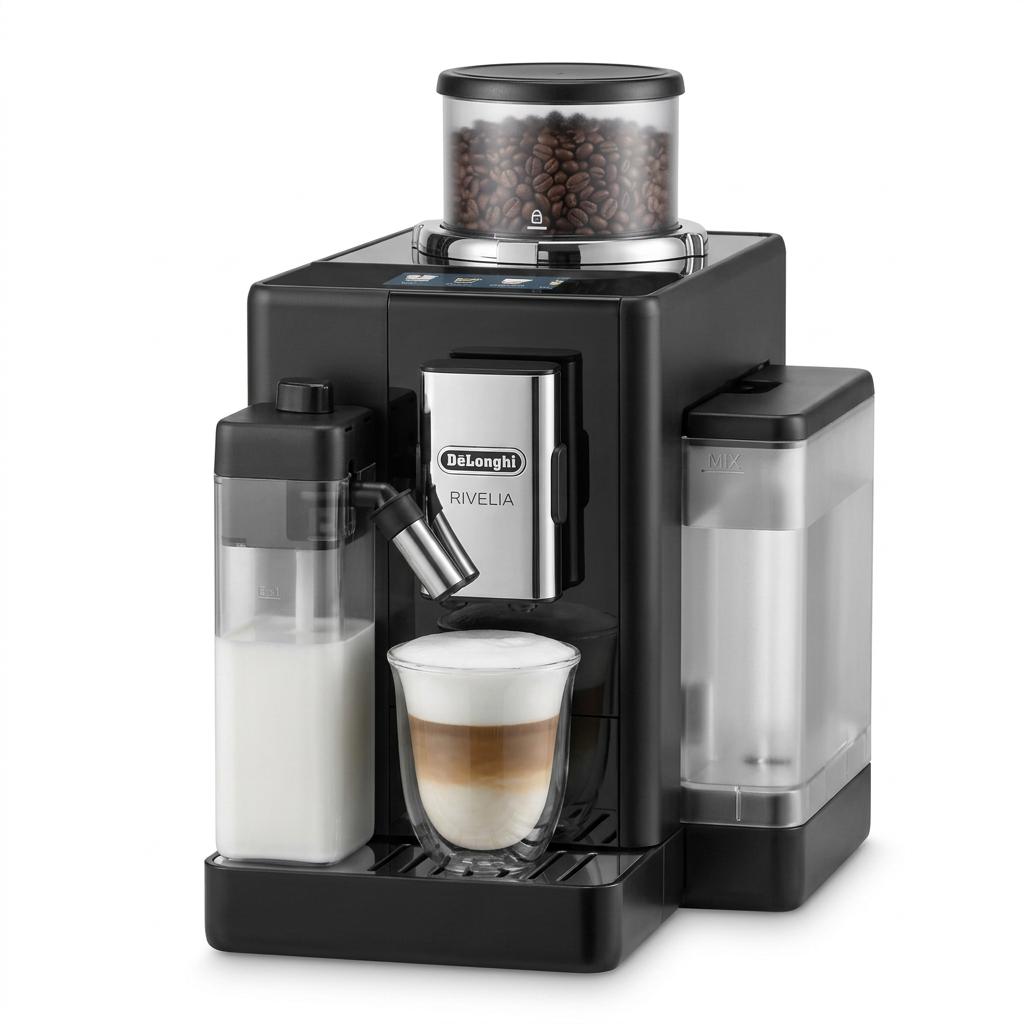
Two swappable bean hoppers, Bean Adapt grind suggestions, up to about 15 g per shot, 18 recipes, four profiles and an automatic milk carafe.
Check price on Amazon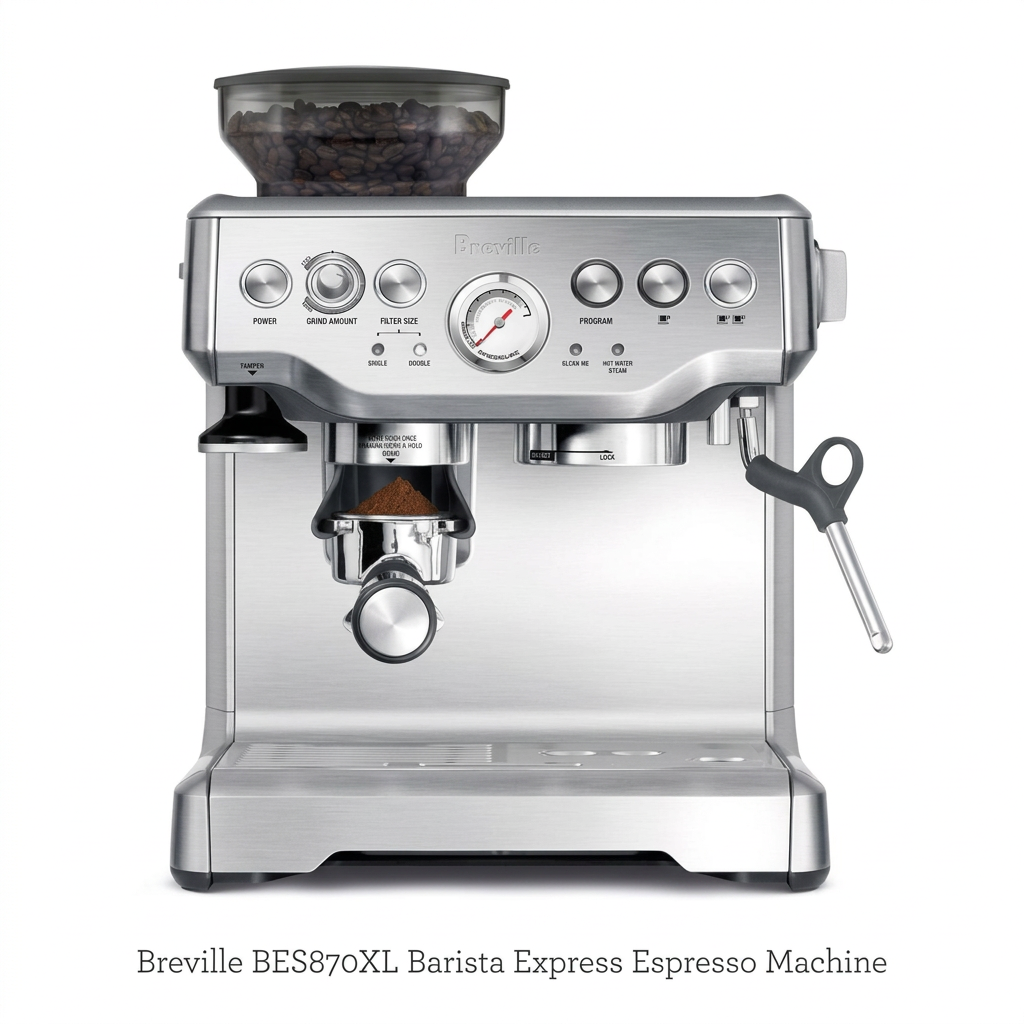
A built-in conical burr grinder, 54 mm portafilter, analog pressure gauge, PID temperature control and a manual steam wand for latte art.
Reveal Today’s DealDe’Longhi Rivelia vs Breville Barista Express at a glance
- Buy the Rivelia if you want café drinks at one touch, especially in a regular-and-decaf home.
- Buy the Barista Express if you enjoy the ritual and want to learn espresso and latte art.
- Both use a similar amount of coffee per shot, so the Rivelia’s espresso is closer to the Breville’s than most automatics.
- The Rivelia is about convenience and sharing; the Breville is about skill and control.
Head to head
The better result in each row is marked, based on my testing and the manufacturer specs. Rows where the two machines are effectively equal have no winner.
Keep in mind that the tally is not my verdict. An automatic and a semi-automatic win different rows by design.
| Spec | De’Longhi Rivelia | Breville Barista Express |
|---|---|---|
| Espressomy tasting, dialed in | Intense, chocolate-forward | Sweet, syrupy, café-style ✓ Best |
| Consistencyday to day | Same every press ✓ Best | Depends on you |
| Dose | Up to about 15 g | About 15.4 g, weighed |
| Bean switching | Two hoppers, about 3 s ✓ Best | Empty the hopper by hand |
| Skill needed | None ✓ Best | A few days of practice |
| Milk texture | Smooth, slightly airy | Glossy microfoam, latte art ✓ Best |
| Milk drinks at one touch | Yes, 18 recipes ✓ Best | No, steam by hand |
| User profiles | 4 ✓ Best | None |
| Pressure feedback | None | Analog gauge ✓ Best |
| Noisegrinding | 66–68 dB ✓ Best | Louder grinder, pump hum |
| Water tank | 47 oz, side, top-fill | 67 oz, back ✓ Best |
| Footprint (W × D × H) | 9.6 × 16.9 × 15.2 in | 12.5 × 13.8 × 15.9 in |
| Rows won | 6 | 4 |
De’Longhi Rivelia vs Breville Barista Express pros and cons
De’Longhi Rivelia
- Swap between two bean hoppers in about three seconds
- Grinds up to about 15 g for a fuller espresso
- Quiet in use at 66 to 68 dB
- Each swap wastes or mixes around 10 g of beans
- Flat top screen is awkward to read from below
- No cold extraction or cold milk foam
Breville Barista Express
- Sweet, syrupy espresso once dialed in
- Steam wand makes real latte-art microfoam
- Pressure gauge makes learning easier
- Grinder needs an inner-burr tweak out of the box
- Slower steam and a wait between brewing and frothing
- No low-water sensor on the tank
Who should buy which machine?
- Homes with a regular and a decaf drinker
- Families who want one-touch milk drinks
- Smaller kitchens that need a narrow machine
- Beginners who want to learn real espresso
- Latte art and flat white fans
- Anyone who enjoys a morning ritual
Design, size and build
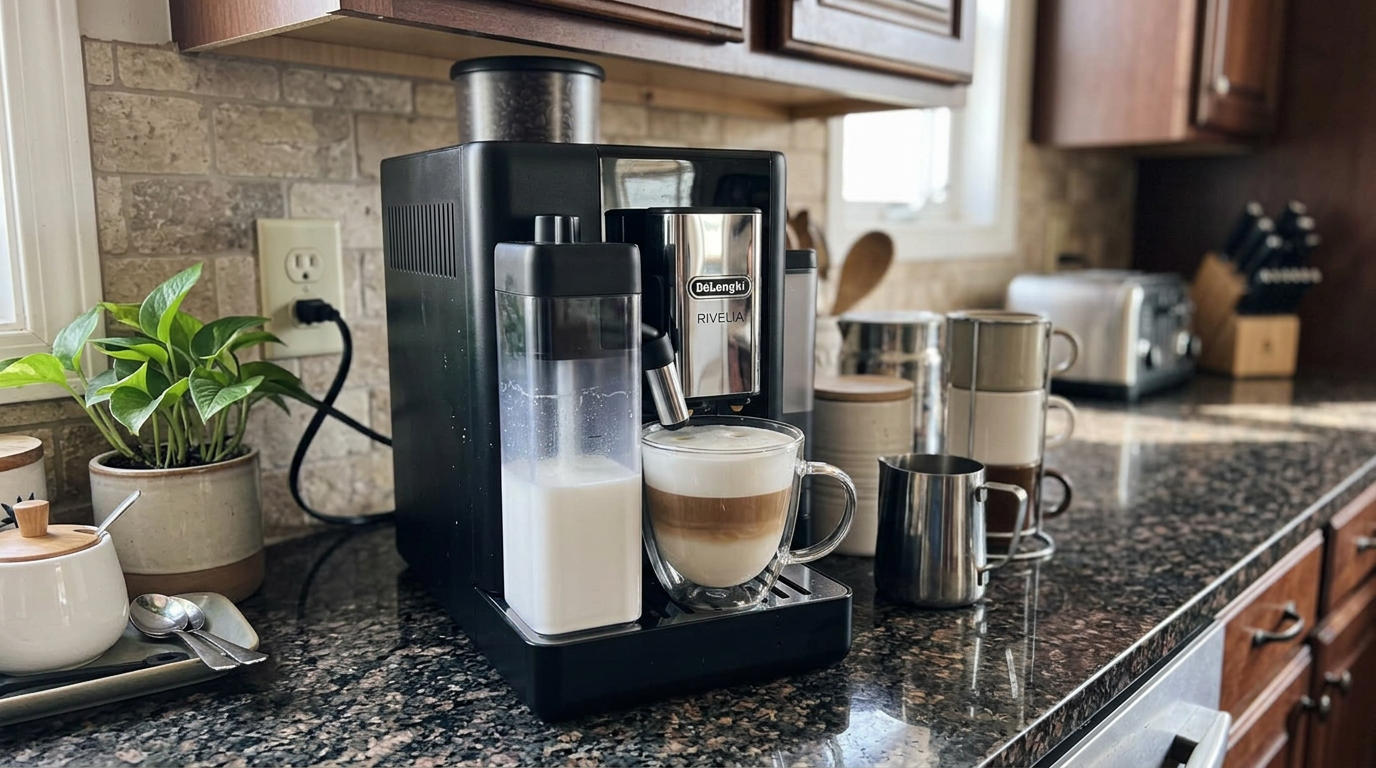
The De’Longhi Rivelia has rounded corners, a slim body and a water tank that clips onto the side instead of sliding out of the back. On my counter, it looked noticeably less boxy than a typical bean-to-cup machine.
The Breville Barista Express is brushed stainless steel with a round pressure gauge in the middle, chunky dials and a bean hopper on top. It looks like a compact café machine, and at 22 to 23 pounds it stays put when you lock in the portafilter.
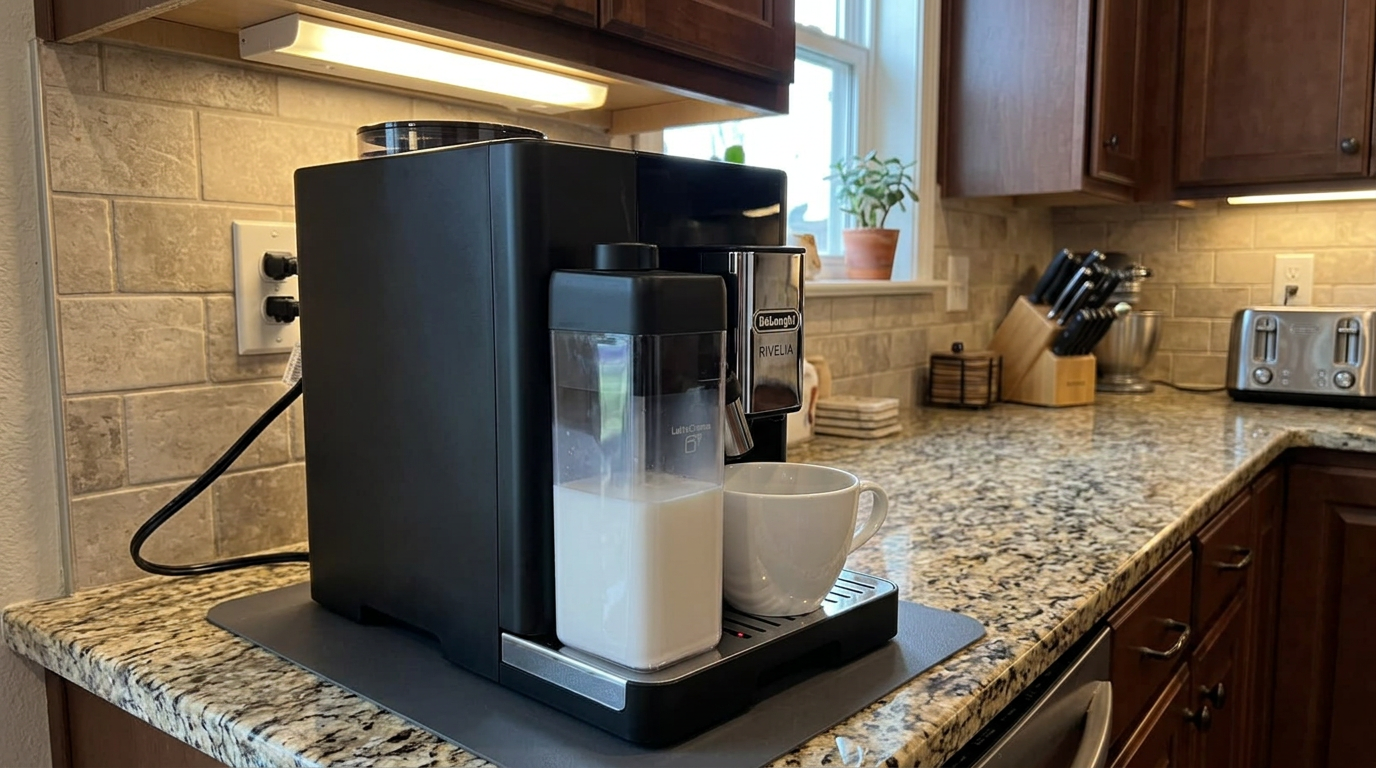
The Rivelia’s milk carafe clips to the side, which keeps the machine narrow.
The Rivelia is narrower at about 9.6 inches but deeper at about 16.9 inches. The Barista Express is about 12.5 inches wide and only 13.8 inches deep.
Both need clearance above. The Rivelia’s bean hoppers and touchscreen are on top, and the Breville’s hopper needs room for its lid.
My one physical complaint about the Rivelia is that there are no handles or finger grips. Every time I shifted it to wipe underneath, I had to hug it with both hands.
Width on the counter
Add a few inches beside the Rivelia for the milk carafe, and in front of the Breville for working space.
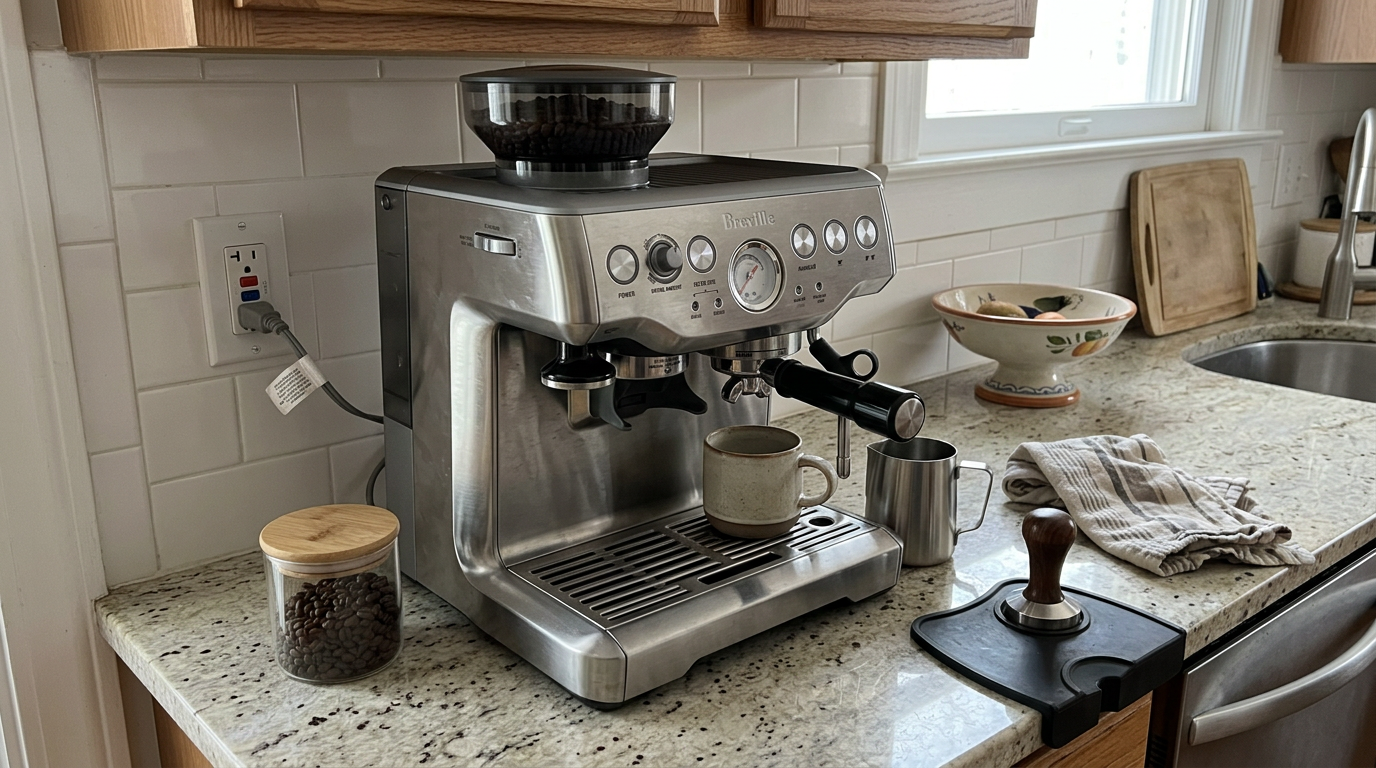
The Barista Express is wider but shallower, with everything you touch on the front.
Our tip: Leave space above both machines, because the Rivelia’s hoppers twist off from the top and the Breville’s hopper lid needs room to open.
Setup and the learning curve
The Rivelia’s setup is guided on screen and took about 15 minutes. You choose a language, test water hardness with the strip, fit the filter and run a rinse.
Then its Bean Adapt✕Bean AdaptDe’Longhi’s setup wizard for new beans. You answer a few questions about roast and type, and the machine suggests a grind setting and adjusts dose and temperature. wizard asks about your beans and suggests a grind setting. For my medium roast, it landed close to where I eventually settled.
The Breville Barista Express took longer to tame. Out of the box, its inner burr sat at 6, which left most of the side dial too coarse for fresh beans.
I moved the inner burr✕Inner burr adjustmentA hidden setting under the Barista Express hopper that moves the upper burr itself. It shifts the whole range of the side grind dial finer or coarser. to 2, put a 0.1-gram scale on the counter and dialed in my dose. By day two I was pulling good shots; by week four, nine in ten hit my target.
Time to my first really good espresso
Including setup, Bean Adapt or inner-burr adjustment, and test shots.
My Barista Express shots on target, by week
Share of shots that hit my 25 to 30 second window for about 30 g out.
Our tip: Run two or three throwaway coffees after setup on the Rivelia, because the first cups flush the system and don’t show what it can do.
Beans, decaf and the grinder
This is the Rivelia’s headline trick. Its Bean Switch System✕Bean Switch SystemDe’Longhi’s two interchangeable bean hoppers. Each one twists on and off the grinder, and a shutter closes so beans stay inside the removed hopper. uses two interchangeable 8.8-ounce hoppers that twist on and off with a 90-degree turn.
Mechanically, the swap took me about three seconds every time. After it, about 10 grams of the old beans stay between the hopper and the burrs, and you choose to grind and empty them or mix them into a transition drink.
For a real decaf, I chose grind and empty almost every time. That’s about two-thirds of a single shot lost per switch.
Beans lost per day on the Rivelia, based on the roughly 10 g I measured after each swap.
On the Breville Barista Express, switching beans means emptying the hopper by hand, then moving the grind dial for the new coffee. For decaf, I usually used pre-ground coffee in a pressurized basket instead.
| Grinder detail | De’Longhi Rivelia | Breville Barista Express |
|---|---|---|
| Burrs | Steel conical, 13 settings | Steel conical, 16 settings plus inner burr |
| Dose | Up to about 15 g, set by intensity | Timed, about 15.4 g weighed |
| Hoppers | 2, 8.8 oz each | 1, about 8.8 oz |
| Bean switching | About 3 s, ~10 g purge | Empty by hand |
| Grind help | Bean Adapt suggestions | Pressure gauge feedback |
| Pre-ground | Removable chute | Pressurized baskets |
One limit applies to both. Each has a single grinder, so a very light roast and a smoky dark roast need different grind settings. On the Rivelia, I treated the two hoppers as a same-family pair, like a medium blend and a medium decaf.
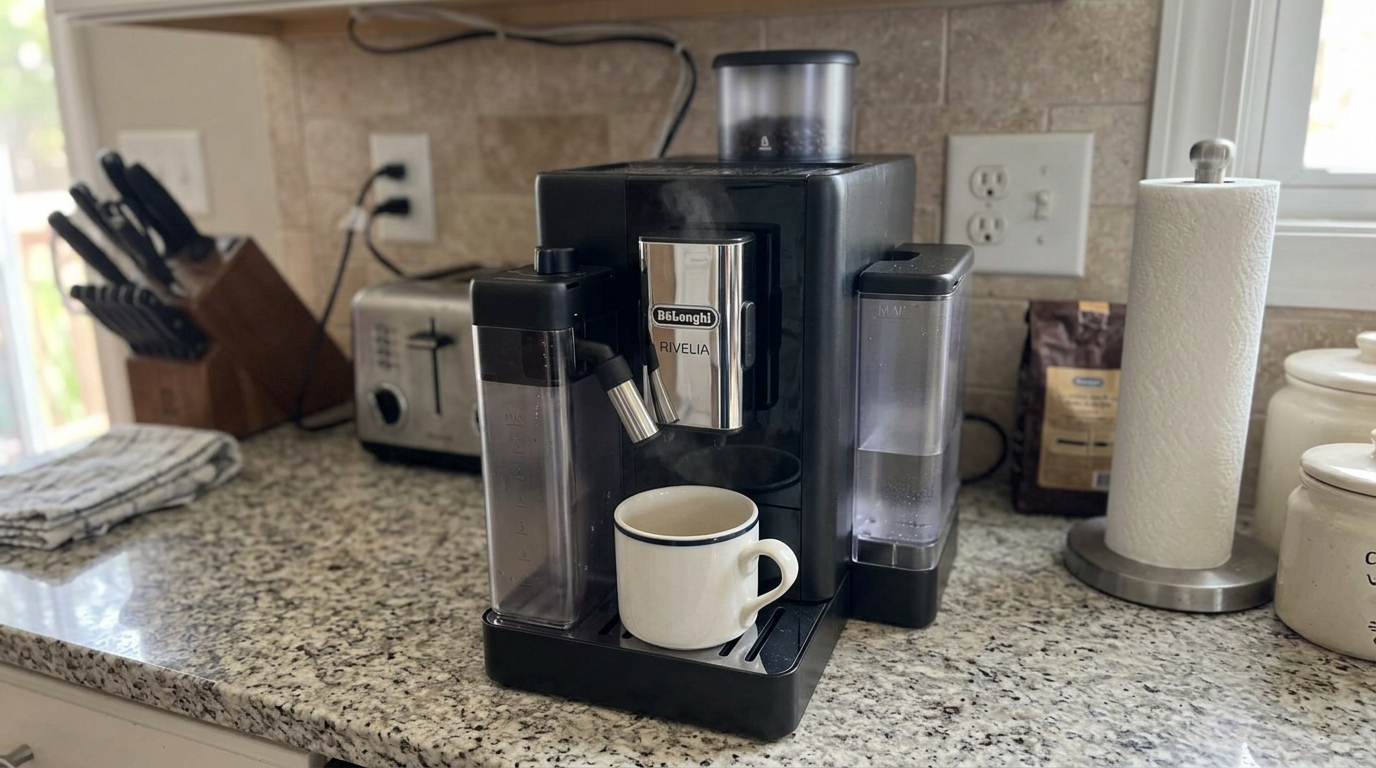
The Rivelia’s hoppers twist on and off in seconds, with a shutter to keep beans in.
Our tip: Swap the Rivelia’s hoppers right before a drink you’d make anyway, so the purge happens once instead of twice.
Espresso quality
This matchup is closer in the cup than most automatic-versus-manual comparisons, and the dose is why.
At intensity 5, the De’Longhi Rivelia’s grinder ran for about 10 seconds and produced roughly 15 grams. With a small cup, I got about 30 grams out, a classic 1:2 ratio, with a thick layer of hazelnut crema✕CremaThe golden, foamy layer on top of a fresh espresso. It forms when pressure pushes oils and gases out of the coffee..
It tasted intense and chocolate-forward, with cocoa and toasted nuts. The more delicate fruit notes of lighter coffees came through less clearly, which is typical of automatic machines.
On the Breville Barista Express, I aimed for 15.4 grams in and 30 grams out in 25 to 30 seconds. Once dialed in, the shot flowed like warm honey with a deep, velvety crema, sweet and creamy with balanced acidity.
The pressure gauge was my best teacher. When the needle stayed low, the shot was sour from channeling✕ChannelingWhen water finds a weak path through the coffee puck and rushes through it, leaving the rest under-extracted. It makes shots sour and thin.; when it settled in the espresso zone, the shot was right.
My espresso ratings
My scores out of 10 for body, crema and flavor.
| Recipe | Rivelia setting | Breville setting |
|---|---|---|
| Espresso | Intensity 5, about 30 g out | 15.4 g in, 30 g out, 25–30 s |
| Ristretto-style | Intensity 5, about 22 g out | 15.4 g in, 22 g out |
| Longer espresso | Intensity 5, about 38 g out | 15.4 g in, 36 g out |
| Light roast | Finer, intensity 5 | Finer, temperature up a little |
| What you taste | Likely cause | Fix on Rivelia | Fix on Barista Express |
|---|---|---|---|
| Sour, thin | Under-extraction✕Under-extractionWhen water does not pull enough flavor out of the coffee. The shot tastes sour, thin and watery. | One step finer while grinding | Check tamp, one step finer |
| Bitter, harsh | Over-extraction | One step coarser | One step coarser |
| Watery | Dose too low | Raise intensity | Weigh the dose |
| Pale crema | Stale beans | Fresher beans | Fresher beans |
Milk drinks
The De’Longhi Rivelia’s carafe clips to the left side and draws milk through a small tube. You choose a drink, and it froths the milk and adds the espresso in the right order.
I measured the milk between 140°F and 149°F across several drinks, right where milk tastes sweetest. The texture was smooth and stable with fine bubbles, slightly airier than hand-steamed microfoam.
For a cappuccino, that is perfect. For a flat white, it is very good rather than perfect.
The Breville Barista Express’s steam wand is fully manual. I started with the tip just under the surface to stretch the milk, then sank it slightly to spin a whirlpool, and after about 40 seconds the milk looked like glossy paint.
That is true microfoam✕MicrofoamMilk foam with bubbles so small you can barely see them. It feels silky and glossy, which is what a good flat white or latte art needs.. By week three, I could pour a heart most mornings and a simple rosetta on a good day.
How the milk compared
My ratings out of 10 for texture and stability. Only the Breville makes latte-art milk.
| Milk detail | De’Longhi Rivelia | Breville Barista Express |
|---|---|---|
| Method | Automatic carafe | Manual steam wand |
| Temperature | 140–149°F measured | You stop at 140–150°F |
| Foam control | Milk amount and foam level | Your wrist and timing |
| Latte art | No | Yes, with practice |
| Back-to-back drinks | Easy, short pause | Slow steam, a cool-down |
| After each drink | Turn dial to clean | Wipe and purge the wand |
| Storage | Carafe goes in the fridge | Jug washes in seconds |
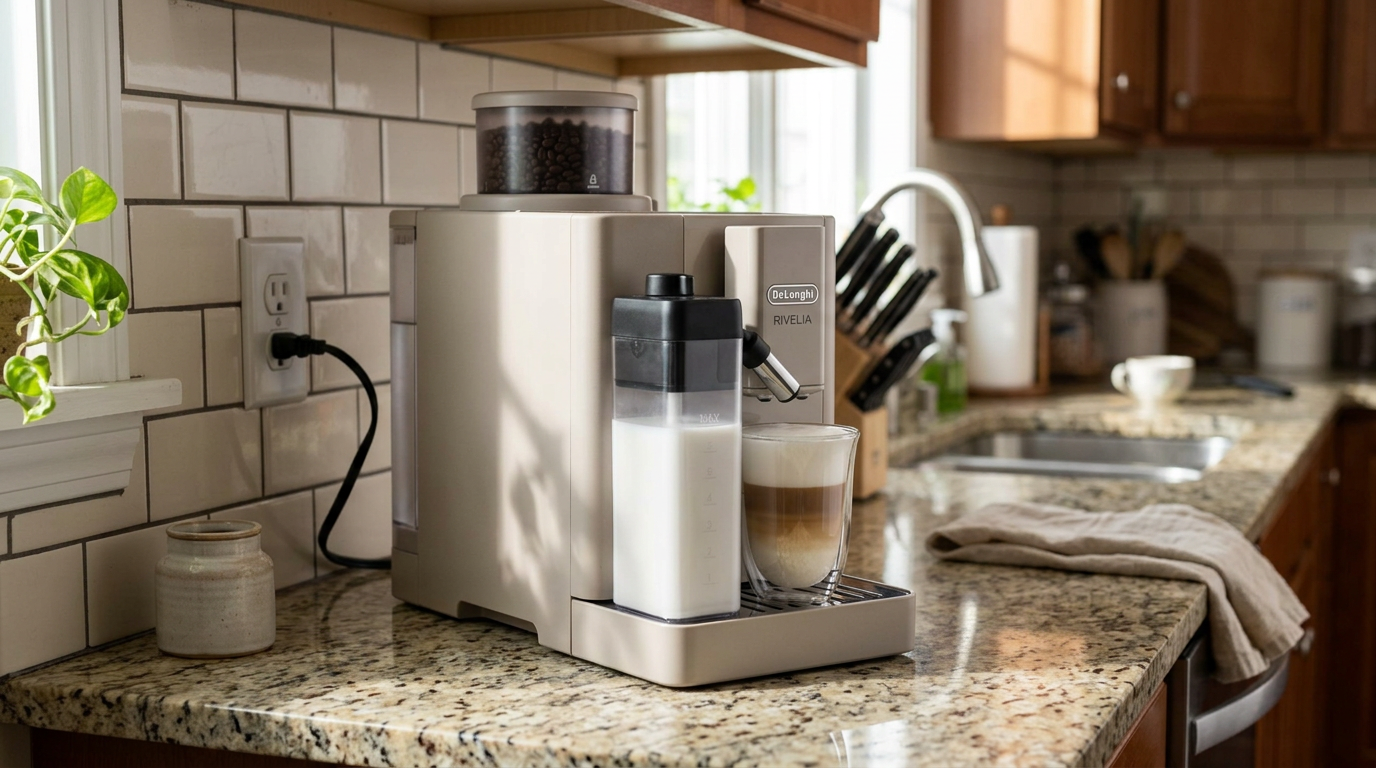
The Rivelia pours milk first and espresso second for layered drinks.
Our tip: Run the Rivelia’s carafe clean cycle after every milk drink, because dried milk in the frother is much harder to remove later.
Long coffee, tea and iced drinks
The De’Longhi Rivelia’s coffee recipe, sometimes called coffee crema, became my default first cup. It is a longer drink than espresso, with a layer of crema that gives it body in the first few sips.
On the Breville Barista Express, I made americanos from the dedicated hot water outlet, or a long black with water first and the shot on top to keep the crema.
My ratings out of 10 for flavor and balance in a mug.
Hot water and tea
The Rivelia’s plug-in hot water spout measured 194 to 203°F, hot enough for black tea. The spout itself is lightweight plastic and felt cheaper than the rest of the machine.
The Barista Express’s hot water is hot enough for tea but not quite boiling, so it suits green tea better than a strong black tea.
| Tea type | Ideal water | Rivelia | Barista Express |
|---|---|---|---|
| Black tea | 203–212°F | Good, 194–203°F | A bit cool |
| Herbal tea | 194–212°F | Good | Fair |
| Green tea | 158–176°F | Let it sit a minute | Good |
| White tea | 167–185°F | Let it sit a minute | Good |
Iced drinks
Neither machine does cold extraction. The Rivelia’s iced coffee and espresso-over-ice buttons simply brew hot coffee onto ice you’ve already put in the glass, and its carafe froths hot milk only.
On the Breville, I pulled a double straight over ice and added cold milk. Because both make espresso with real body, the drinks held up well as the ice melted.
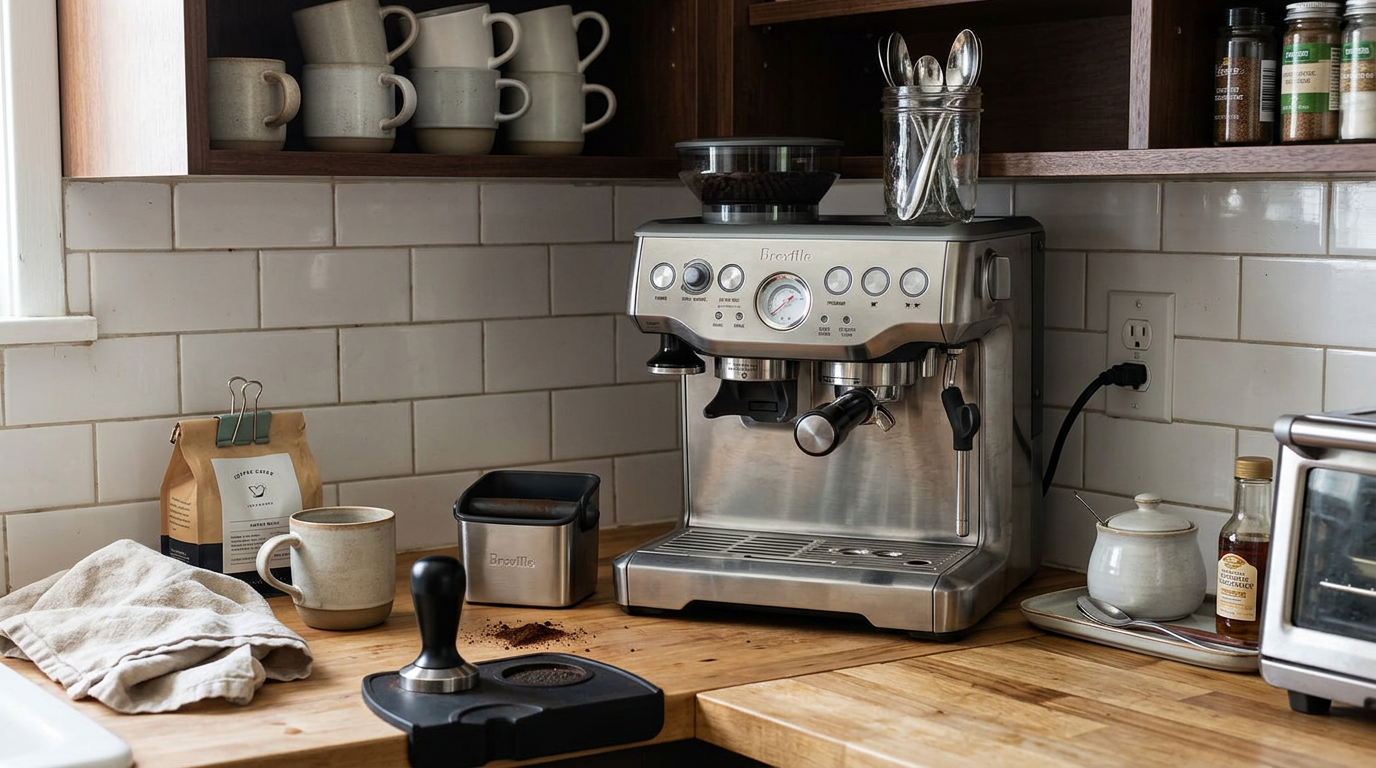
A long black with water first and the shot on top keeps the crema.
Our tip: Fill the glass completely with ice before brewing an iced drink on either machine, because hot espresso melts a few cubes faster than you’d expect.
Find Out the Price TodayControls, profiles and daily use
The De’Longhi Rivelia runs everything from a sharp 3.5-inch color touchscreen. Drinks are split into coffee and milk menus, and you can store four profiles, each with its own strength, size and milk settings.
Its Coffee Routines feature learned my habits, and within a week my usual morning drink was waiting on the first screen.
My main complaint is placement. The screen lies flat on top, so standing over it the viewing angle is excellent, but my kids couldn’t easily see it and anyone seated would struggle.
The Breville Barista Express uses dials and buttons. You set the grind amount, choose a one-cup or two-cup shot and turn a dial for steam or hot water, with the pressure gauge in the middle.
I reprogrammed the two-cup button to stop at about 30 grams, so I only had to glance at the scale. There are no profiles, so everyone in the house shares the same settings.
| Feature | De’Longhi Rivelia | Breville Barista Express |
|---|---|---|
| Controls | 3.5-inch color touchscreen | Dials, buttons, analog gauge |
| Recipes | 18 one-touch | Programmable shot buttons |
| Profiles | 4 | None |
| Learns your habits | Yes, Coffee Routines | No |
| Temperature | Adjustable per drink | PID, adjustable in steps |
| Low-water warning | Yes | No |
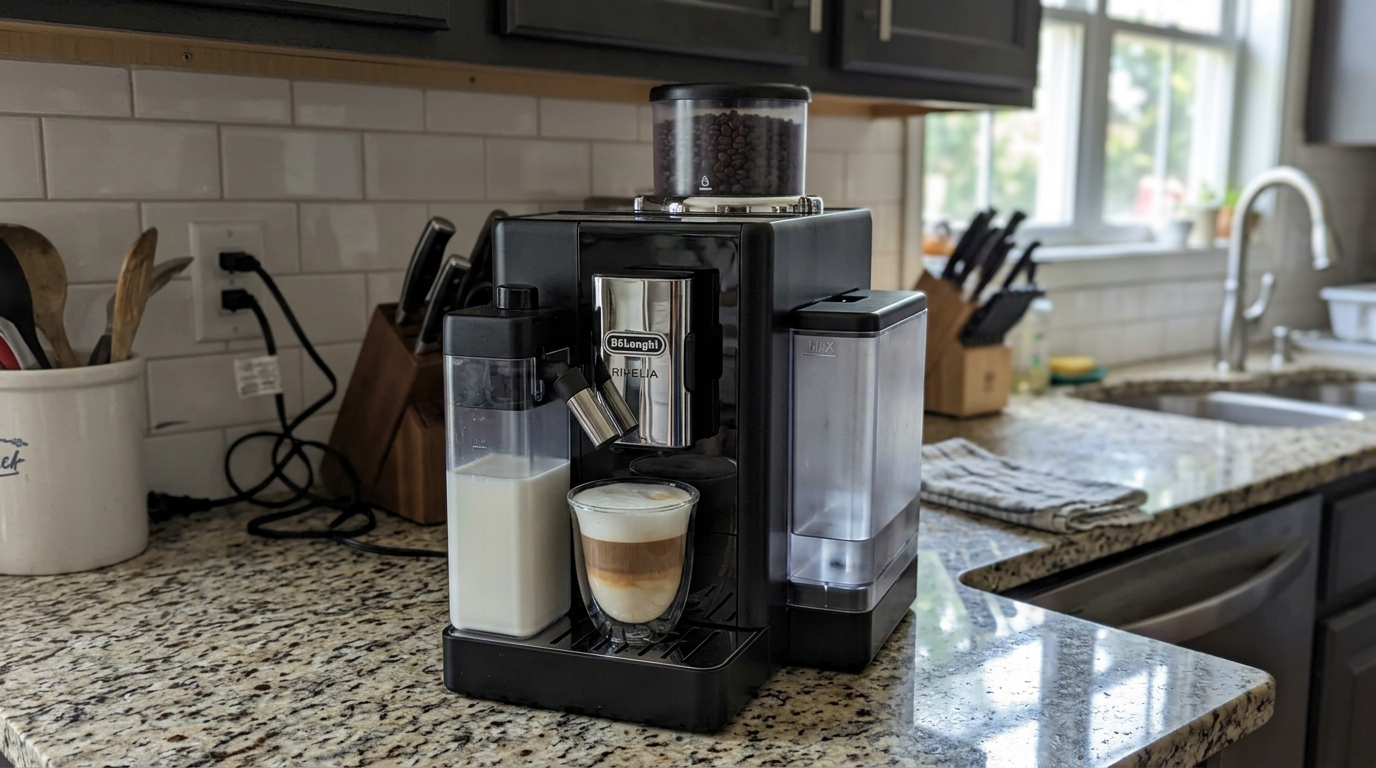
The Rivelia’s touchscreen is sharp, but it sits flat on top of the machine.
Our tip: Set up each person’s Rivelia profile on day one, so everyone gets their own drink without changing the shared defaults.
Noise and speed
The Rivelia surprised me. I measured 66 to 68 dB during grinding and brewing, roughly a normal conversation, and its grinder runs for about 10 seconds per drink.
The Barista Express is louder for a few seconds while it grinds, then its vibration pump hums and clicks and the steam wand hisses. None of it is unusual, but it will wake a light sleeper in an open-plan home.
Sound levels
Rivelia measured with a decibel meter. Barista Express ranked by ear in the same kitchen.
Time per drink
From switch-on, including warm-up, blank shot and wiping the wand on the Breville.
Cleaning and upkeep
The De’Longhi Rivelia has a removable brew unit✕Brew unitThe part that compresses the ground coffee, holds it while water passes through and then ejects the used puck., auto-rinse cycles and a step-by-step descaling guide. After every milk drink, it prompts you to turn the carafe dial to clean, and steam flushes the milk path in seconds.
Two habits matter. Empty the grounds container every day or two, because warm, damp pucks can grow mold within days, and take the carafe apart weekly.
One quirk: when I pulled out the drip tray and grounds container, the assembly tended to drop at the front. Hold it with your other hand as it comes free.
On the Breville Barista Express, cleaning is all habits. Wipe and purge the steam wand after every milk drink, knock out the puck and rinse the basket after every shot, and backflush✕BackflushingRunning water backward through the group head with a blind disc and cleaning tablet, to dissolve coffee oils from the valve. with a tablet when the Clean Me light comes on.
My daily hands-on cleaning time
My estimate of hands-on time per day.
| When | De’Longhi Rivelia | Breville Barista Express |
|---|---|---|
| After milk drinks | Carafe clean cycle | Wipe and purge the wand |
| After each shot | Nothing | Knock out puck, rinse basket |
| Every day or two | Empty grounds and drip tray | Empty tray, wipe shower screen |
| Weekly | Wash carafe, rinse brew unit | Brush gasket and grinder chute |
| When prompted | Filter and descale | Backflush, descale, filter every 2–3 months |
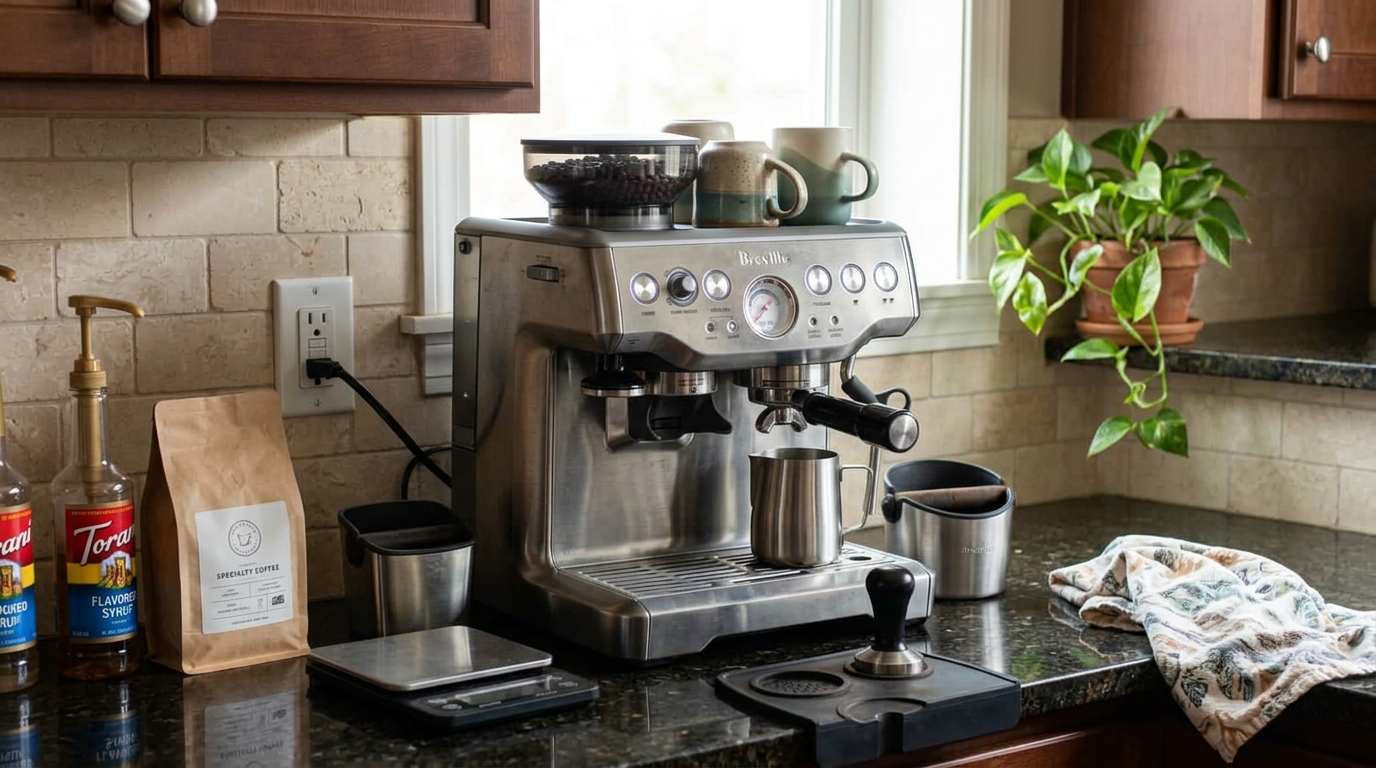
The Breville’s cleaning is quick but constant: wipe, knock, rinse.
Our tip: Leave the Rivelia’s brew unit to air-dry fully before you put it back, so moisture isn’t trapped inside the machine.
Water, beans and supplies
Both machines reward fresh beans. On the Rivelia, beans roasted about four to five weeks earlier gave the richest crema; on the Breville, two to four weeks was the sweet spot.
Supermarket beans with no roast date ran fast and flat on both, but the Breville punished them harder.
| Bean type | De’Longhi Rivelia | Breville Barista Express |
|---|---|---|
| Medium roast | Middle of the range, intensity 4–5 | Step 6–8, default temperature |
| Medium-dark | Slightly coarser | A step coarser |
| Decaf | Second hopper, same grind | Pre-ground, pressurized basket |
| Light roast | Finer, intensity 5 | Finer, a little hotter |
| Very oily, dark | Not recommended | Bitter risk, more cleaning |
How far one tank goes
Rough maths allowing for rinses, blank shots and purging.
Fit the water filter on both from day one. Minerals like calcium and magnesium build scale in the heating system, and on the Rivelia the descaling reminder is based on the hardness you enter at setup.
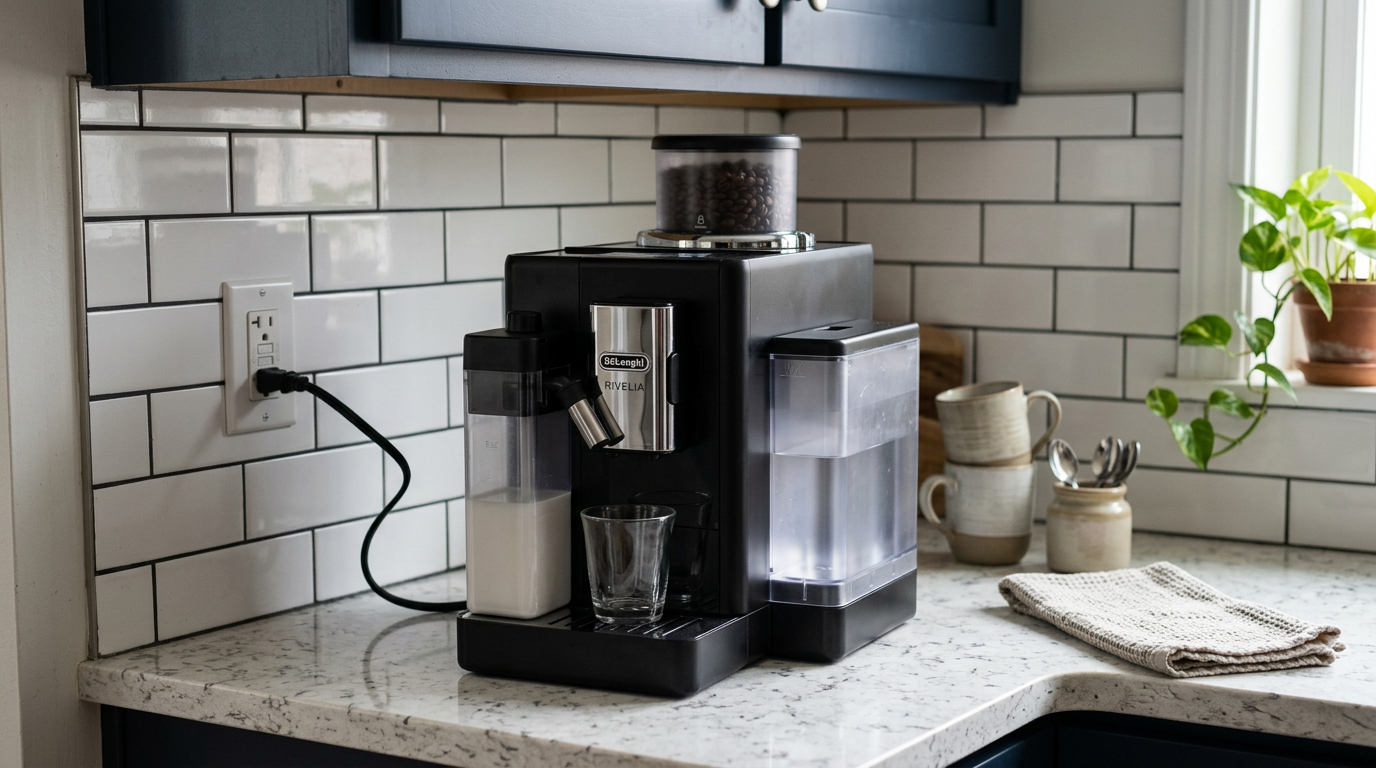
The Rivelia’s side tank refills from the top without lifting it out.
Our tip: Keep the bulk of your beans in a sealed canister and fill the Rivelia’s hoppers with a few days’ worth, because the hoppers aren’t airtight storage.
Real-life scenarios
Specs only go so far. These are the situations where one machine clearly pulled ahead during my testing.
Twist off one hopper, twist on the other, grind and empty, done. On the Breville, decaf meant a scoop of pre-ground every time.
The steam wand made glossy microfoam, and with practice I could pour a heart most mornings.
Four profiles and one-touch milk drinks meant nobody waited for anyone to steam milk.
Dialed in at 15.4 g in and 30 g out, the Breville’s shot was the sweetest and most syrupy in this comparison.
At 66 to 68 dB, the Rivelia was the quieter machine, with no pump hum or steam wand hiss.
The pressure gauge and my shot log taught me more in four weeks than any automatic ever has.
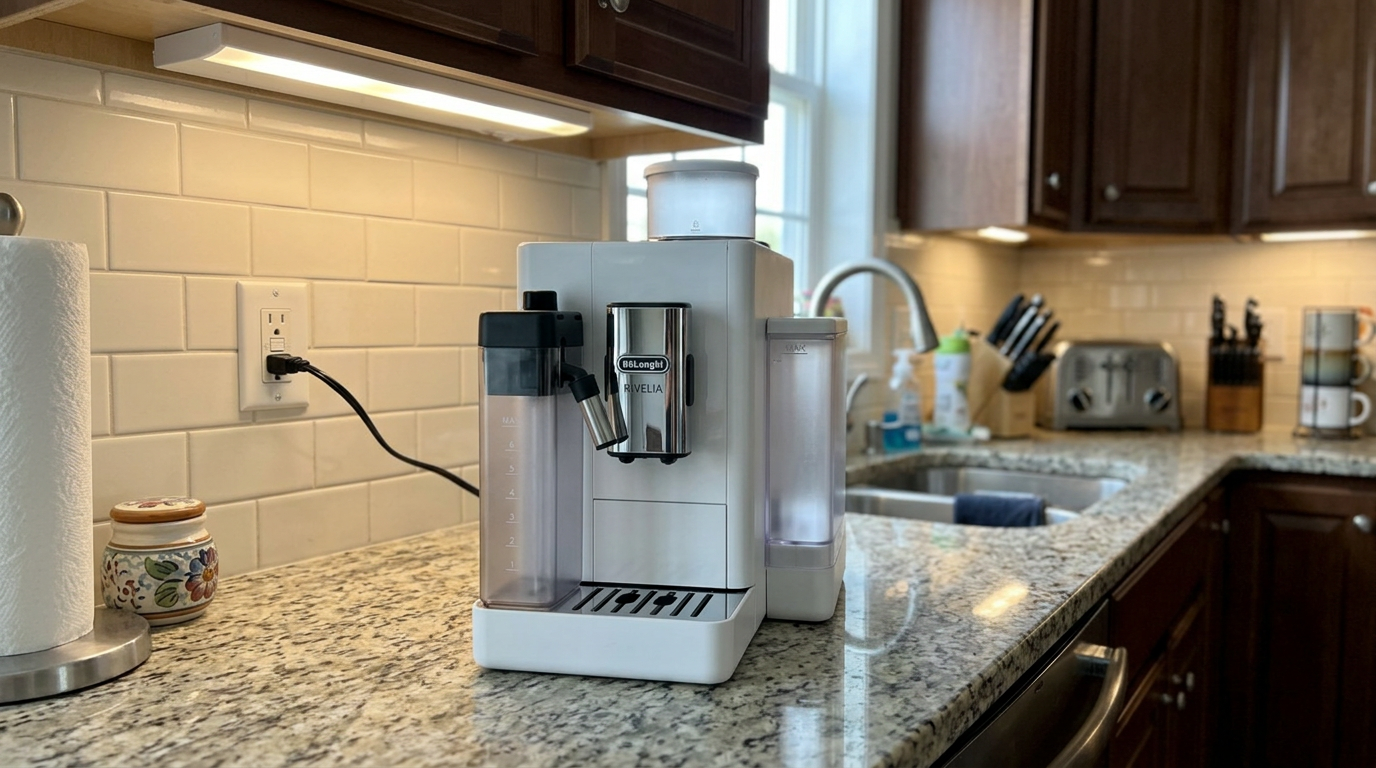
For a regular-and-decaf household, the Rivelia made mornings simpler.
My scorecard
These are my own scores out of 10. The first four come from my single reviews of each machine, and I added speed and learning curve because they decide this matchup.
De’Longhi Rivelia
Breville Barista Express
Overall, I rate the Rivelia 8.5 and the Barista Express 8.0. The Rivelia is the better everyday machine for most people; the Breville is the better teacher and makes the best espresso in skilled hands.
See How Much You’ll SaveWhich one is right for you?
4 quick questionsWhich one should you buy?
It comes down to one question: do you want great coffee made for you, or do you want to make it yourself?
If you want it made for you, the Rivelia is one of the friendliest machines I’ve used, and its bean switch is brilliant in a decaf household. If making it is half the pleasure, the Barista Express is one of the best ways to learn. Still weighing other options? I rank every model I’ve tested in my guide to the best De’Longhi super-automatic machines.
For more options, my Rivelia vs Dinamica Plus comparison covers another one-touch De’Longhi, and Barista Express vs Barista Pro shows the faster-heating Breville.
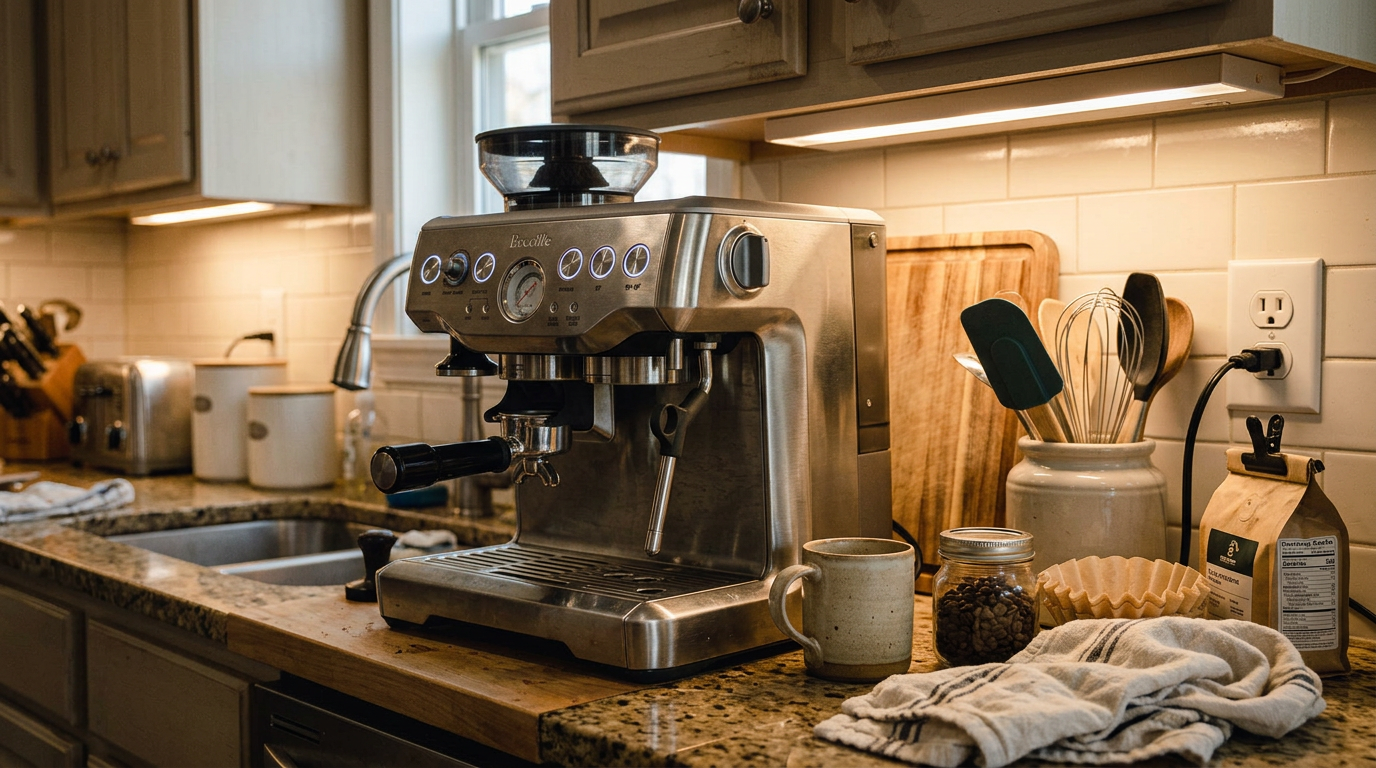
For hands-on beginners, the Barista Express is the machine that teaches.
- You want one-touch milk drinks
- Someone at home drinks decaf
- Several people share the machine
- You want a quieter machine
- You want cold brew or cold foam
- You switch light and dark roasts daily
- Your cabinets are very low
- You want to learn real espresso
- You want to pour latte art
- You enjoy a morning ritual
- You will buy fresh beans
- You want push-button drinks
- You make several milk drinks back to back
- Someone at home needs decaf daily
For most homes, my pick is the De’Longhi Rivelia. It grinds a generous 15-gram dose, makes café-style milk drinks at one touch, remembers four people and swaps to decaf in about three seconds. It’s the machine my household reached for most.
The Breville Barista Express is the better buy if you want to learn. Once dialed in, it pulled the sweeter shot and steamed the silkier milk, and its gauge and steam wand teach you something every morning.
Whichever you choose, buy fresh beans, use the water filter and build the small cleaning habits each machine needs. Both reward that care with years of good coffee.
De’Longhi Rivelia vs Breville Barista Express specifications
From manufacturer specifications and my own testing.
| De’Longhi Rivelia | Breville Barista Express | |
|---|---|---|
| Model | Rivelia | BES870XL |
| Type | Fully automatic with milk carafe | Semi-automatic with grinder |
| Pump | 19 bar | 15-bar vibration pump, gauge |
| Grinder | Steel conical, 13 settings | Steel conical, 16 settings plus inner burr |
| Bean hoppers | 2 interchangeable, 8.8 oz each | 1, about 8.8 oz |
| Dose | Up to about 15 g measured | Timed, about 15.4 g weighed |
| Brew unit | Removable, 44 mm chamber | 54 mm portafilter |
| One-touch recipes | 18 | None |
| Profiles | 4 | None |
| Display | 3.5-inch color touchscreen | Analog pressure gauge |
| Milk system | Automatic hot milk carafe | Manual steam wand |
| Milk temperature measured | 140–149°F | About 140–150°F, your choice |
| Hot water measured | 194–203°F | Dedicated outlet |
| Noise measured | 66–68 dB | Louder grinder, pump hum |
| Water tank | 47 fl oz, side | 67 fl oz, back |
| Power | 1,450 W | 1,600 W |
| Dimensions (W × D × H) | 9.6 × 16.9 × 15.2 in | 12.5 × 13.8 × 15.9 in |
| Weight | About 21.4 lb | About 22–23 lb |
How I tested and compared them
I used each machine as my everyday coffee maker for four weeks, making espresso, coffee crema, americanos, cappuccinos, flat whites, latte macchiatos and iced drinks.
On the Rivelia, I switched between regular and decaf hoppers most days and tried similar and very different roast pairings. On the Barista Express, I adjusted the inner burr, weighed every dose and logged dose, yield and time for every shot.
Michael Reynolds and a second HouseholdMe tester shared both machines and wrote the notes together, measuring milk and water with a probe thermometer and noise with a decibel meter, then compared them with the manufacturers’ specifications and owner documentation.
- Coffee: dose, crema, body and consistency.
- Milk: foam texture, temperature and latte art.
- Workflow: learning curve, bean switching, profiles and speed.
- Ownership: noise, cleaning, water care and footprint.
De’Longhi Rivelia vs Breville Barista Express FAQ
Is the De’Longhi Rivelia better than the Breville Barista Express?
For convenience, yes. The Rivelia makes milk drinks at one touch, saves four profiles and swaps to decaf in about three seconds. The Barista Express made the better espresso and milk in my tests once dialed in, but you grind, tamp and steam yourself.
Which makes better espresso?
The Breville Barista Express, once dialed in, by a small margin. The Rivelia is close because it grinds up to about 15 grams at intensity 5, which is generous for an automatic.
Is the Rivelia good for decaf drinkers?
Yes. Its two hoppers swap in about three seconds. Choose grind and empty after a swap, which purges about 10 grams of the previous beans, so your decaf is really decaf.
Can you make latte art with the Rivelia?
No. Its carafe froths milk automatically at about 140 to 149°F. The Barista Express’s manual steam wand makes true microfoam for latte art.
How long does the Barista Express take to learn?
A few days for good shots, and about four weeks to be consistent. About 45% of my shots hit target in week one and about 90% by week four.
Can the Rivelia make cold brew?
No. Its iced recipes brew hot coffee onto ice, and the carafe froths hot milk only.
Which one is quieter?
The Rivelia. I measured 66 to 68 dB while grinding and brewing. The Barista Express has a louder grinder, a pump hum and a hissing steam wand.
Which is easier to clean?
The Rivelia takes less hands-on time, about 3 minutes a day with milk drinks. The Barista Express took about 6 minutes with two milk drinks, mostly wiping the wand and knocking out pucks.
Do both have built-in grinders?
Yes. Both use steel conical burrs. The Rivelia has 13 settings and two hoppers, and the Barista Express has 16 settings plus an inner burr adjustment.
Which takes less counter space?
The Rivelia is narrower at about 9.6 inches but deeper at about 16.9 inches. The Barista Express is about 12.5 inches wide and 13.8 inches deep.

- Our hands-on De’Longhi Rivelia review
- Our hands-on Breville Barista Express review
- De’Longhi and Breville product specifications and owner documentation
- Coffee standards, Specialty Coffee Association
- General espresso brewing, milk steaming and maintenance guidance